Keywords: Organizational Ambidexterity; Sustainable Development; Entrepreneurial Orientation; Small and Medium-Sized Enterprises; Mekong Delta; Two-Stage Least Squares; Causal Mediation.
JEL Classification: C26; L26; M10; O12; Q01; Q56.
List of Abbreviations and Mathematical Notation
| Symbol / Abbreviation | Formal Definition | Domain and Operational Scope |
|---|---|---|
| OA | Organizational Ambidexterity | Composite index of exploration and exploitation |
| EXP / | Exploratory Innovation of firm | Four-item reflective latent construct |
| EXL / | Exploitative Efficiency of firm | Four-item reflective latent construct |
| Combined Ambidexterity | Synergistic multiplicative magnitude dimension | |
| Balanced Ambidexterity | Relative balance symmetry dimension | |
| EO | Entrepreneurial Orientation | Five-item reflective mediating construct |
| SD | Triple-Bottom-Line Sustainable Development | Six-item composite across economic, environmental, social pillars |
| CL | Climate-Salinity Adaptation Pressure | Five-item reflective ecological stressor construct |
| SME | Small and Medium-Sized Enterprise | Regional enterprise unit in the Mekong Delta |
| PCI | Provincial Competitiveness Index | Provincial institutional governance quality index |
| OLS | Ordinary Least Squares | Baseline cross-sectional linear estimator |
| IV-2SLS | Two-Stage Least Squares Instrumental Variables | Upgraded causal multi-equation estimator |
| SEM | Structural Equation Modeling | Covariance- and variance-based latent modeling |
| HC1 | Heteroskedasticity-Consistent Small-Sample SE | Primary variance-covariance convention across Python, R, Stata |
| CRV1 | Cluster-Robust Small-Sample Variance Estimator | Province-level clustered inference across 13 provinces |
| ACME / | Average Causal Mediation Effect | Causal indirect path product |
| VAF | Variance Accounted For | Share of total causal effect mediated via EO |
| AVE | Average Variance Extracted | Convergent validity criterion above |
| CR | Composite Reliability | Internal consistency criterion above |
| HTMT | Heterotrait-Monotrait Ratio | Discriminant validity criterion below |
| VIF | Variance Inflation Factor | Multicollinearity diagnostic ceiling |
| Unobserved Managerial Capability and Slack | Latent confounder generating joint endogeneity | |
| Excluded Structural Instrumental Variables | LOO peer spillover, green-tech grant access, incubator proximity |
Chapter 1. Introduction and Research Positioning
1.1. Context, Motivation, and Regional Urgency
The Mekong Delta stands as the agricultural, aquacultural, and food-export backbone of Vietnam, yet simultaneously ranks among the world's most climate-exposed river deltas confronting accelerating saline intrusion, land subsidence, and hydrological volatility. Small and medium-sized enterprises constitute the overwhelming majority of business establishments and non-farm employers across the region's 13 provinces, operating under an acute strategic paradox. On one hand, narrow liquidity margins, seasonal working-capital pressures, and tight supply-chain delivery schedules compel firms to prioritize operational exploitation—refining existing routines, lowering unit costs, and maximizing short-run throughput.
On the other hand, intensifying ecological shocks, carbon-border compliance requirements in international export markets, and rapid industrial digitalization demand exploratory innovation in climate-resilient processing, circular resource management, and green business models. Building on the seminal organizational learning dilemma articulated by March (1991), management scholars conceptualize the simultaneous pursuit of exploration and exploitation as organizational ambidexterity, a capability shown to govern long-run firm survival and adaptability across diverse institutional settings (Gibson & Birkinshaw, 2004; He & Wong, 2004; Lubatkin et al., 2006; Raisch & Birkinshaw, 2008; O'Reilly & Tushman, 2013).
Translating ambidextrous internal routines into broad-based sustainable development across economic, environmental, and social dimensions—formalized by Bansal (2005) as corporate sustainable development—rarely unfolds automatically inside resource-constrained enterprises. Rather, organizational capabilities require an active behavioral catalyst that channels exploratory knowledge and exploitative discipline toward proactive market and ecological initiatives. Entrepreneurial orientation, defined through innovativeness, proactiveness, and calculated risk-taking by Covin & Slevin (1989) and elaborated into a multidimensional strategic posture by Lumpkin & Dess (1996), serves precisely as this mediating mechanism. Meta-analytic evidence compiled by Rauch et al. (2009) and configurational small-business analysis by Wiklund & Shepherd (2005) underscore the robust performance dividends of entrepreneurial orientation, particularly when smaller enterprises navigate hostile or resource-scarce environments.
Yet a critical methodological chasm persists across empirical strategic management studies in emerging economies. Prevailing investigations—including standard survey-based doctoral designs—typically collect single-respondent cross-sectional Likert questionnaires and estimate recursive structural equations under the implicit assumption that organizational ambidexterity and entrepreneurial orientation are strictly exogenous. That assumption fails on three fundamental econometric grounds.
First, firms endowed with superior unobserved managerial talent, stronger internal governance, and deeper financial slack systematically invest more heavily in ambidextrous routines, exhibit stronger entrepreneurial postures, and achieve superior sustainability outcomes; Ignoring this shared unobserved confounder imparts severe upward omitted-variable bias to ordinary least squares and covariance-based structural parameter estimates.
Second, as established formally by Imai et al. (2010), standard mediation estimators rooted in Baron & Kenny (1986) break down whenever unobserved error components correlate across the mediator and outcome equations, violating sequential ignorability and exaggerating indirect effects.
Third, aggregating exploration and exploitation into a single composite score obscures the pivotal theoretical distinction drawn by He & Wong (2004) and Cao et al. (2009) between combined ambidexterity and balanced ambidexterity. Addressing these three structural identification challenges motivates the architecture of this dissertation.
1.2. General and Specific Research Objectives
The overarching objective of this dissertation is to design, identify, and validate a causal econometric framework assessing the direct effect of organizational ambidexterity on triple-bottom-line sustainable development and the causal mediating pathway operating through entrepreneurial orientation among Mekong Delta small and medium-sized enterprises, while quantifying endogeneity bias relative to conventional estimators and evaluating heterogeneity across ecological zones and sustainability pillars.
Five specific objectives operationalize this overarching goal:
- Objective 1: Synthesize foundational theories of organizational learning, dynamic capabilities, entrepreneurial orientation, and corporate sustainable development, and derive a formal econometric bias representation demonstrating how unobserved managerial capability distorts naive structural and mediation estimates.
- Objective 2: Audit multi-item psychometric measurement quality—including internal consistency, convergent validity, discriminant validity, common method variance, and multicollinearity—using a calibrated deterministic simulation dataset of small and medium-sized enterprises spanning all 13 Mekong Delta provinces.
- Objective 3: Estimate and contrast baseline ordinary least squares against an upgraded joint two-stage least squares instrumental variables model identifying both organizational ambidexterity and entrepreneurial orientation simultaneously, reconciled to machine-grade precision across Python, R, and StataNow 19.5 MP.
- Objective 4: Unpack underlying mechanisms through three structural extensions: decomposing combined versus balanced ambidexterity, testing climate-salinity moderation and ecological-zone heterogeneity across coastal salinity provinces versus inland freshwater provinces, and disaggregating effects across economic, environmental, and social sustainability pillars.
- Objective 5: Establish multi-dimensional inferential robustness via province-clustered standard errors, Imai et al. (2010) sequential ignorability sensitivity analysis, and Oster (2019) unobservable selection bounds, translating methodological lessons into tiered managerial recommendations and future field-research protocols.
1.3. Research Questions
Five targeted research questions anchor the analytical chapters of this dissertation:
- Research Question 1: After isolating exogenous variation via joint two-stage least squares instrumental variables estimation, does organizational ambidexterity exert a statistically and substantively significant direct causal effect on enterprise sustainable development, and how severely does baseline ordinary least squares overstate this parameter?
- Research Question 2: To what extent does entrepreneurial orientation mediate the causal relationship between organizational ambidexterity and sustainable development, and how sharply does the mediated variance share adjust once sequential ignorability bias is eliminated?
- Research Question 3: Between the two distinct conceptualizations of organizational ambidexterity—combined synergistic magnitude versus relative balance—which mechanism predominantly drives sustainable development among resource-constrained enterprises?
- Research Question 4: Does climate-salinity adaptation pressure continuously moderate the returns to organizational ambidexterity, and do causal effect magnitudes diverge meaningfully across coastal salinity-exposed provinces versus inland freshwater provinces as well as across economic, environmental, and social sustainability dimensions?
- Research Question 5: Are the causal direct and mediated estimates robust to province-level error clustering, sequential ignorability sensitivity bounds, coefficient stability bounds, and independent replication across Python, R, and StataNow 19.5 MP?
1.4. Research Scope, Provenance, and Methodological Boundaries
The analytical subject of this dissertation is the causal nexus linking organizational ambidexterity, entrepreneurial orientation, and triple-bottom-line sustainable development, conditional on enterprise characteristics, digital maturity, and provincial institutional governance.
The scope is delineated transparently across conceptual, geographical, and data-provenance boundaries:
- Conceptual Scope: Five latent multi-item constructs measured across 24 five-point Likert indicators—exploratory innovation, exploitative efficiency, entrepreneurial orientation, triple-bottom-line sustainable development, and climate-salinity adaptation pressure—integrated with enterprise-level structural controls, provincial competitiveness metrics, and three excluded instrumental variables.
- Geographical Scope: A stratified regional sampling architecture encompassing all 13 provinces of the Mekong Delta, partitioned into two hydro-ecological regimes: seven coastal salinity-exposed provinces comprising Tien Giang, Kien Giang, Ben Tre, Tra Vinh, Soc Trang, Bac Lieu, and Ca Mau with observations, and six inland freshwater provinces comprising Can Tho, Long An, Dong Thap, An Giang, Vinh Long, and Hau Giang with observations.
- Data Provenance and Simulation Boundary: Because firm-level multi-item psychometric indicators of organizational ambidexterity, entrepreneurial orientation, and perceived climate adaptation pressure are absent from publicly archived macroeconomic and administrative statistical registries, this dissertation constructs a transparent, deterministic latent-variable simulation dataset with a fixed random seed and total sample size spanning agro-aquaculture, manufacturing, and trade-logistics sectors calibrated to contemporary regional structures. All quantitative estimates are presented strictly as methodological simulation demonstrations illustrating identification mechanics rather than real-world field survey proof.
1.5. Research Methodology and Scholarly Contributions
This dissertation deploys a four-layer quantitative methodology integrating behavioral psychometrics with modern causal econometrics. Layer one evaluates reflective measurement integrity via Cronbach's Alpha, composite reliability, average variance extracted, Fornell & Larcker (1981) discriminant criteria, heterotrait-monotrait ratios following Henseler et al. (2015), Harman's single-factor common method variance audit following Podsakoff et al. (2003), and variance inflation factors aligned with Hair et al. (2019).
Layer two contrasts baseline ordinary least squares with HC1 robust standard errors against a joint multi-equation two-stage least squares instrumental variables system verified through first-stage strength tests grounded in Kleibergen & Paap (2006) and Sanderson & Windmeijer (2016), Wu-Hausman endogeneity diagnostics, and Sargan as well as the score test of Wooldridge (2015) overidentification tests. Layer three conducts Delta-method causal mediation decomposition, combined-versus-balanced ambidexterity disaggregation, endogenous interaction instrumentation following Wooldridge (2015), ecological-zone subsample estimation, and triple-bottom-line pillar disaggregation. Layer four executes province-clustered CRV1 inference, Imai et al. (2010) sensitivity mapping, Oster (2019) selection stability bounds, and full cross-runtime verification across Python 3, R 4, and StataNow 19.5 MP.
Three principal contributions distinguish this dissertation:
- Causal Identification Contribution: Recasts the organizational ambidexterity—entrepreneurial orientation—sustainable development triad from correlational structural equation modeling into a jointly identified instrumental variables mediation architecture, quantifying how unobserved managerial confounding inflates naive entrepreneurial orientation effects by more than half.
- Theoretical Mechanism Contribution: Resolves the empirical tension between combined and balanced ambidexterity posed by Cao et al. (2009) under endogeneity-corrected estimation while unpacking asymmetric causal returns across economic, environmental, and social sustainability pillars of Bansal (2005).
- Computational Reproducibility Contribution: Delivers a fully self-contained tri-runtime replication package verified across Python, R, and StataNow 19.5 MP with sub-millionth numerical alignment, offering a rigorous computational blueprint for subsequent empirical fieldwork.
1.6. Organization of the Dissertation
Excluding bilingual front matter, abbreviations, verified references, and Appendix A presenting the independent senior peer-review report, the dissertation comprises five structured chapters:
- Chapter 1. Introduction and Research Positioning: Articulates regional motivation, specific objectives, research questions, scope, data-provenance transparency, and core scholarly contributions.
- Chapter 2. Theoretical Foundations, Literature Review, and Hypotheses: Synthesizes foundational strategic management and sustainability theories, develops the formal econometric endogeneity proof, maps international literature gaps, and formulates six testable hypotheses through .
- Chapter 3. Research Design, Causal Identification Strategy, and Data: Details the calibrated dataset architecture, operational variable definitions, excluded instrumental variable construction, mathematical specification of eight econometric models, and tri-runtime alignment conventions.
- Chapter 4. Empirical Estimation Results and Robustness Verification: Reports descriptive statistics, psychometric validity audits, baseline versus upgraded causal regressions, mediation decomposition, combined-versus-balanced decomposition, ecological heterogeneity, triple-bottom-line disaggregation, tri-runtime reconciliation tables, and four publication-grade figures.
- Chapter 5. Discussion, Conclusions, and Policy Implications: Integrates findings with international scholarship, synthesizes conclusions per research question, outlines tiered managerial and regional policy frameworks respecting simulation boundaries, and delineates limitations and future empirical agendas.
Chapter 2. Theoretical Foundations, Literature Review, and Hypotheses
2.1. Foundational Theoretical Pillars
Analyzing how organizational ambidexterity shapes triple-bottom-line sustainable development through entrepreneurial orientation among regional small and medium-sized enterprises requires synthesizing four interlocking theoretical traditions: organizational learning theory, the dynamic capabilities perspective, entrepreneurial orientation theory, and corporate sustainable development theory.
2.1.1. Organizational Learning and Organizational Ambidexterity
The conceptual architecture of organizational ambidexterity originates in the foundational study by March (1991), who distinguished between exploration—encompassing search, variation, risk-taking, experimentation, and radical discovery—and exploitation—encompassing refinement, operational efficiency, selection, standardized execution, and incremental improvement. March (1991) demonstrated that because returns to exploitation are comparatively proximate, predictable, and positive in the short run, adaptive organizational systems systematically drift toward excessive exploitation, locking themselves into competence traps that erode long-run resilience when environmental regimes shift. Conversely, over-investment in exploration without complementary exploitative discipline traps enterprises in chronic cost absorption without commercial value capture.
Extending this learning trade-off into strategic organization design, Gibson & Birkinshaw (2004) advanced contextual ambidexterity, demonstrating that business units cultivate behavioral capacities enabling employees to dynamically balance alignment with current operations against adaptability to emerging demands. Providing early large-sample empirical validation, He & Wong (2004) showed that the interaction between explorative and exploitative innovation strategies significantly accelerates sales growth whereas strategic imbalance depresses performance. Crucially for smaller enterprises lacking the administrative scale to erect structurally separated research divisions, Lubatkin et al. (2006) established that top management team behavioral integration—shared information processing, collaborative decision-making, and joint accountability—enables small and medium-sized enterprises to realize ambidextrous synergy.
Synthesizing this expanding literature, Raisch & Birkinshaw (2008) mapped the antecedents, environmental moderators, and performance outcomes of ambidexterity, while Cao et al. (2009) introduced an essential theoretical refinement by separating the balance dimension, measuring relative parity between exploration and exploitation, from the combined dimension, capturing their synergistic multiplicative magnitude. In an authoritative synthesis, O'Reilly & Tushman (2013) positioned organizational ambidexterity as a premier dynamic capability allowing firms to reconfigure assets continuously across turbulent competitive horizons.
2.1.2. Dynamic Capabilities and Digital Transformation
The dynamic capabilities framework formulated by Teece et al. (1997) explains how enterprises integrate, build, and reconfigure internal and external competencies to address rapidly changing environments. Rather than attributing durable advantage to static asset ownership, Teece et al. (1997) emphasized organizational processes, complementary asset positions, and path-dependent learning trajectories. Within the Mekong Delta's hydro-climatic transition, organizational ambidexterity operates as a dual dynamic capability: exploratory routines enable enterprises to sense and seize green agricultural technologies, water-saving processing methods, and climate-adaptive product lines, whereas exploitative routines reconfigure shop-floor execution to scale sustainable practices at internationally competitive unit costs.
Complementing dynamic capabilities in contemporary industrial ecosystems, Verhoef et al. (2021) conceptualized digital transformation as a multidisciplinary organizational shift reshaping value creation, operational agility, and strategic boundary management through digital infrastructure and data analytics. Higher digital maturity lowers internal coordination frictions between exploratory experimentation and exploitative scaling, strengthens traceability across green supply chains, and enhances monitoring of environmental and social compliance. Including digital maturity as an explicit structural control therefore isolates the net causal effect of organizational ambidexterity from general technological modernization.
2.1.3. Entrepreneurial Orientation Theory
Entrepreneurial orientation emerged from firm-level strategic management research pioneered by Covin & Slevin (1989) and theoretically refined by Lumpkin & Dess (1996). Covin & Slevin (1989) characterized an entrepreneurial strategic posture through the co-variation of innovativeness, proactiveness, and risk-taking, showing that organic structures coupled with entrepreneurial posture outperform conservative peers in hostile environments. Lumpkin & Dess (1996) clarified that entrepreneurial orientation embodies the decision-making styles, methods, and practices driving new entry into emerging markets, technologies, or value propositions, stressing that its performance payoff depends critically on internal resource configurations and external environmental contingencies.
Empirical verification by Wiklund & Shepherd (2005) demonstrated through a configurational lens that small businesses achieve their strongest performance gains when high entrepreneurial orientation aligns with financial capital access and dynamic market conditions. Consolidating 51 empirical studies across more than 14,000 firms, the meta-analysis by Rauch et al. (2009) documented a persistent positive association between entrepreneurial orientation and firm performance, with amplified effect sizes among micro and small enterprises whose flat hierarchies accelerate strategic execution. Positioned as an intermediate behavioral pathway, entrepreneurial orientation transforms the latent knowledge stock generated by organizational ambidexterity into proactive green commercialization, circular process redesign, and community-oriented value creation.
2.1.4. Corporate Sustainable Development and Triple-Bottom-Line Theory
At the enterprise level, Bansal (2005) operationalized corporate sustainable development through three interdependent principles: economic prosperity, environmental integrity, and social equity. Economic sustainability ensures durable value creation and financial viability; Environmental integrity requires curbing emissions, conserving scarce freshwater and energy inputs, and minimizing ecological externalities; Social equity entails fair labor practices, workplace safety, and inclusive livelihood partnerships with surrounding rural communities. Longitudinal evidence from Bansal (2005) revealed that while institutional pressures initiate sustainability adoption, internal resource-based capabilities progressively become the decisive engine of long-run sustainable performance. Complementing this internal capability view, Manzhynski & Figge (2020) analyzed coopetition for sustainability, highlighting how enterprises navigate tensions between private organizational benefit and collective societal welfare through inter-firm knowledge spillovers and shared ecological standards—a dynamic directly echoed in provincial agro-industrial clusters across the Mekong Delta.
2.2. Analytical Econometric Model of Endogeneity and Causal Mediation
To formalize the methodological upgrade over conventional cross-sectional structural equation modeling, consider enterprise located in province . Let denote composite organizational ambidexterity, denote entrepreneurial orientation, denote composite triple-bottom-line sustainable development, denote observable firm and provincial controls—firm size, firm age, digital maturity, provincial competitiveness index, and sector indicators—and represent unobserved managerial capability and internal financial slack with and .
The underlying structural data-generating system takes the form:
Where:
- captures the direct causal effect of organizational ambidexterity on sustainable development holding entrepreneurial orientation and observable controls constant.
- captures the causal structural path from organizational ambidexterity to the mediator entrepreneurial orientation.
- captures the causal effect of entrepreneurial orientation on sustainable development.
- defines the average causal mediation effect and defines the total causal effect.
- represent excluded structural instruments satisfying first-stage relevance and exclusion orthogonality relative to the composite disturbances and .
- govern the positive loading of unobserved managerial capability and slack onto ambidexterity, entrepreneurial orientation, and sustainable development simultaneously.
When an analyst estimates this recursive system via naive ordinary least squares or standard cross-sectional structural equation modeling ignoring , the composite disturbances and exhibit strictly positive covariance both with the endogenous regressors and with one another:
Applying the Frisch-Waugh-Lovell projection matrix to partial out exogenous controls and stacking , the probability limit of the baseline ordinary least squares estimator diverges systematically from the structural vector :
Two severe inferential distortions follow immediately.
First, positive confounding via biases both and upward, with disproportionate distortion in the mediator slope because inherits confounding both directly through and indirectly via .
Second, because directly breaches the sequential ignorability assumption formalized by Imai et al. (2010), naive product-of-coefficients mediation following Baron & Kenny (1986) compounds upward bias in with upward bias in , substantially overstating the mediated variance share.
In contrast, joint two-stage least squares instrumental variables estimation utilizing under the rank conditions of Kleibergen & Paap (2006) and Sanderson & Windmeijer (2016) alongside exogeneity recovers asymptotic consistency:
This exact identification contrast anchors our empirical evaluation in Chapter 4.
2.3. Systematic Review of International and Regional Literature
Empirical scholarship surrounding organizational ambidexterity, entrepreneurial orientation, and corporate sustainability spans three major research streams, evolving from descriptive construct validation toward rigorous causal econometrics.
The first stream investigates how organizational ambidexterity shapes enterprise performance. Analyzing 206 manufacturing enterprises across Singapore and Malaysia, He & Wong (2004) established that synergistic interaction between explorative and exploitative innovation raises sales growth whereas stark strategic imbalance harms performance. Surveying 4,195 respondents across 41 business units of 10 multinational firms, Gibson & Birkinshaw (2004) showed that contextual ambidexterity mediates the impact of supportive organizational context on unit-level performance. Focusing explicitly on small and medium-sized enterprises facing tighter managerial bandwidth, Lubatkin et al. (2006) examined 139 firms in New England and demonstrated that top management team behavioral integration unlocks ambidextrous performance gains.
Advancing construct operationalization, Cao et al. (2009) investigated 122 Chinese high-technology small and medium-sized enterprises and decomposed ambidexterity into balance and combined dimensions, revealing that while balance safeguards severely resource-constrained firms against overextension, combined ambidexterity yields stronger synergistic returns when firms tap complementary external cluster resources. Reviews by Raisch & Birkinshaw (2008) and O'Reilly & Tushman (2013) noted that despite extensive evidence linking ambidexterity to financial growth, systematic causal tests extending to triple-bottom-line sustainability outcomes remain scarce.
The second stream illuminates entrepreneurial orientation as a strategic driver and behavioral mediator. Studying 161 small manufacturing firms, Covin & Slevin (1989) demonstrated that entrepreneurial strategic posture delivers pronounced performance advantages under environmental hostility. Lumpkin & Dess (1996) articulated contingency models linking entrepreneurial orientation dimensions to enterprise performance, while Wiklund & Shepherd (2005) verified on 413 Swedish small businesses that entrepreneurial posture interacts synergistically with capital access and environmental dynamism. Consolidating 53 independent samples spanning 14,259 enterprises, Rauch et al. (2009) confirmed a substantial positive correlation between entrepreneurial orientation and performance, noting stronger elasticities among smaller firms. In sustainability and digital contexts, Bansal (2005), Manzhynski & Figge (2020), and Verhoef et al. (2021) underscored how proactive strategic innovation, inter-firm coopetition, and digital maturity jointly foster economic, environmental, and social value creation.
The third stream addresses psychometric rigor and causal identification in survey-based strategic management and development economics. Podsakoff et al. (2003) cataloged how single-source cross-sectional surveys inflate correlations through common method variance, prompting strict diagnostic audits. Fornell & Larcker (1981), Henseler et al. (2015), and Hair et al. (2019) codified modern measurement standards—composite reliability, average variance extracted, and heterotrait-monotrait ratios—for latent constructs. On the causal identification frontier, Imai et al. (2010) proved that classical mediation frameworks originating in Baron & Kenny (1986) yield biased indirect effects whenever unobserved confounders affect both mediator and outcome, introducing closed-form sensitivity analysis across error correlation .
Concurrently, Kleibergen & Paap (2006), Wooldridge (2015), and Sanderson & Windmeijer (2016) established rigorous weak-instrument diagnostics, overidentification tests, and control-function methods for multiple endogenous variables, while Oster (2019) provided transparent bounds for coefficient stability under selection on unobservables. Table 2 synthesizes these foundational contributions and delineates the five research gaps resolved by this dissertation.
| Seminal Studies | Context and Sample | Analytical Method | Principal Findings | Research Gap Addressed by This Dissertation |
|---|---|---|---|---|
| March (1991); O'Reilly & Tushman (2013) | Organizational learning theory and strategic synthesis | Formal simulation and theoretical review | Balancing exploration and exploitation governs long-run enterprise survival | Extends ambidexterity theory to triple-bottom-line sustainability in climate-exposed regional SMEs |
| He & Wong (2004); Cao et al. (2009) | Southeast Asian manufacturers and Chinese tech SMEs | Cross-sectional moderated regression | Combined and balanced ambidexterity exert distinct effects on sales performance | Resolves endogeneity of combined ambidexterity and evaluates triple-bottom-line outcomes |
| Gibson & Birkinshaw (2004); Lubatkin et al. (2006) | Multinational units and United States SMEs | Cross-sectional SEM | Contextual ambidexterity and leadership integration enhance firm performance | Incorporates entrepreneurial orientation as an endogenously identified causal mediator |
| Covin & Slevin (1989); Wiklund & Shepherd (2005); Rauch et al. (2009) | United States, Swedish SMEs, and global meta-analysis | Hierarchical regression and meta-analysis | Entrepreneurial orientation robustly raises small-firm performance in hostile settings | Quantifies upward bias in naive EO mediation when unobserved managerial slack is ignored |
| Bansal (2005); Manzhynski & Figge (2020); Verhoef et al. (2021) | Canadian resource firms and digital sustainability | Longitudinal panel and conceptual modeling | Corporate sustainability spans economic, environmental, and social pillars aided by digitalization | Disaggregates causal ambidexterity and EO effects separately across all three sustainability pillars |
| Imai et al. (2010); Wooldridge (2015); Sanderson & Windmeijer (2016); Oster (2019) | Q1 causal econometrics and applied statistics | Joint IV-2SLS, control functions, sensitivity bounds | Formalizes multi-endogenous IV testing, sequential ignorability sensitivity, and stability bounds | Integrates the full Q1 causal toolkit into regional SME strategic management with tri-runtime parity |
2.4. Conceptual Framework and Research Hypotheses
Synthesizing the theoretical pillars in Section 2.1, the formal econometric derivation in Section 2.2, and the literature gaps in Table 2, we formulate six testable research hypotheses.
First, drawing on organizational learning theory by March (1991), dynamic capabilities by Teece et al. (1997), and corporate sustainability principles by Bansal (2005), ambidextrous small and medium-sized enterprises concurrently streamline material and energy efficiency to sustain economic margins while pioneering eco-efficient processing and climate-resilient products that reinforce environmental and social welfare. Even after removing unobserved managerial confounding via external instruments, organizational ambidexterity should retain a positive direct causal effect:
- Hypothesis : Organizational ambidexterity exerts a positive and statistically significant direct causal effect on sustainable development among Mekong Delta small and medium-sized enterprises under joint two-stage least squares instrumental variables estimation.
Second, consistent with Raisch & Birkinshaw (2008) and O'Reilly & Tushman (2013), mastering both exploratory discovery and exploitative execution equips firm leaders with broader technological intelligence and operational slack, lowering perceived failure costs and nurturing innovativeness, proactiveness, and calculated risk-taking as conceptualized by Covin & Slevin (1989) and Lumpkin & Dess (1996):
- Hypothesis : Organizational ambidexterity exerts a positive and statistically significant causal effect on entrepreneurial orientation among Mekong Delta small and medium-sized enterprises.
Third, building on Wiklund & Shepherd (2005), Rauch et al. (2009), and Manzhynski & Figge (2020), entrepreneurially oriented enterprises proactively translate ambidextrous capabilities into green market entry, waste-minimizing product innovations, and inclusive community partnerships. At the same time, our econometric proof in Section 2.2 combined with Imai et al. (2010) implies that removing positive confounding substantially trims the overstated naive mediation share while preserving a genuine partial causal mediation channel:
- Hypothesis : Entrepreneurial orientation exerts a positive and statistically significant causal effect on sustainable development after controlling simultaneously for endogeneity of both ambidexterity and entrepreneurial orientation.
- Hypothesis : Entrepreneurial orientation partially mediates the causal effect of organizational ambidexterity on sustainable development, with a strictly smaller causal mediation share than the biased naive ordinary least squares estimate.
Fourth, addressing the theoretical distinction articulated by He & Wong (2004) and Cao et al. (2009), achieving triple-bottom-line sustainability in demanding export and ecological markets requires high absolute intensity of both exploration and exploitation simultaneously rather than mere parity at low capability levels:
- Hypothesis : Combined organizational ambidexterity exerts a stronger positive causal effect on sustainable development than balanced organizational ambidexterity.
Finally, reflecting the sharp ecological divide across the Mekong Delta between seven coastal salinity-exposed provinces and six inland freshwater provinces alongside contingency perspectives in Covin & Slevin (1989) and Bansal (2005), we test both continuous climate moderation and structural heterogeneity across hydro-ecological regimes and sustainability pillars:
- Hypothesis : The causal impact of organizational ambidexterity on sustainable development exhibits moderation by climate-salinity adaptation pressure as well as meaningful heterogeneity across coastal versus inland ecological zones and across economic, environmental, and social sustainability pillars.
Chapter 3. Research Design, Causal Identification Strategy, and Data
3.1. Data Provenance, Calibrated Simulation Architecture, and Sample Harmonization
Strict provenance transparency represents a non-negotiable pillar of credible empirical economics. An exhaustive inventory of publicly available Vietnamese macroeconomic and firm-level administrative databases confirms that multi-item behavioral Likert constructs measuring organizational ambidexterity, entrepreneurial orientation, perceived climate-salinity adaptation pressure, and triple-bottom-line sustainability among unlisted Mekong Delta small and medium-sized enterprises are unavailable in secondary archives. Adhering strictly to methodological transparency standards, this dissertation constructs a deterministic, calibrated latent-variable simulation dataset with a fixed random seed, ensuring exact bit-for-bit reproducibility of all enterprise observations across independent audit environments.
The stratified regional architecture covers all 13 Mekong Delta provinces with sample allocations reflecting local enterprise density: Can Tho contributes 58 firms, Long An 62 firms, Tien Giang 44 firms, Dong Thap 46 firms, An Giang 42 firms, Kien Giang 42 firms, Vinh Long 34 firms, Ben Tre 36 firms, Tra Vinh 30 firms, Soc Trang 32 firms, Hau Giang 28 firms, Bac Lieu 30 firms, and Ca Mau 36 firms. Partitioning by hydro-ecological exposure divides the sample cleanly into seven coastal salinity-affected provinces comprising firms or of the sample, and six inland freshwater provinces comprising firms or . Across sectoral strata, 217 enterprises or operate in agro-aquaculture processing serving as the explicit omitted reference group, 159 enterprises or operate in manufacturing, and 144 enterprises or operate in trade and logistics services.
Each reflective latent construct is generated from standardized factor scores with calibrated item loadings between and plus independent idiosyncratic disturbances, subsequently discretized onto five-point integer Likert scales. Crucially, the data-generating mechanism embeds an explicit unobserved managerial capability and internal financial slack confounder loading positively onto exploratory innovation, exploitative efficiency, entrepreneurial orientation, and sustainable development simultaneously. This structural feature faithfully mirrors the real-world endogeneity and sequential ignorability violations pervasive in cross-sectional strategic management surveys, enabling an exact methodological demonstration of bias correction via joint two-stage least squares instrumental variables estimation. The harmonized dataset is serialized in UTF-8 CSV format at full float64 precision to eliminate rounding discrepancies across Python, R, and StataNow 19.5 MP.
3.2. Variable Definitions, Measurement Scales, and Expected Signs
Construct operationalization draws directly on canonical scales in international strategic management and sustainability literature, integrating corporate sustainable development indicators from Bansal (2005), exploratory and exploitative ambidexterity dimensions from He & Wong (2004), Lubatkin et al. (2006), and Cao et al. (2009), entrepreneurial orientation items from Covin & Slevin (1989) and Lumpkin & Dess (1996), climate-salinity adaptation pressure, structural enterprise and institutional controls, and three excluded structural instruments. Table 3 summarizes operational definitions, measurement structures, theoretical lineage, and expected signs.
| Variable and Symbol | Econometric Role | Measurement and Operational Structure | Theoretical Lineage | Expected Sign |
|---|---|---|---|---|
| Sustainable Development | Dependent variable | Mean of 6 five-point Likert items spanning economic, environmental, social pillars | Bansal (2005); Manzhynski & Figge (2020) | Not applicable |
| Sustainability Pillars | Disaggregated outcomes | Two-item pillar averages for economic, environmental, and social sustainability | Bansal (2005) | Not applicable |
| Organizational Ambidexterity | Primary endogenous regressor | Arithmetic mean of exploration and exploitation across 8 Likert items | March (1991); Lubatkin et al. (2006) | Positive |
| Combined Ambidexterity | Decomposed endogenous regressor | Scaled multiplicative product capturing joint intensity | He & Wong (2004); Cao et al. (2009) | Positive |
| Balanced Ambidexterity | Decomposed balance regressor | Symmetry index capturing relative parity | He & Wong (2004); Cao et al. (2009) | Weakly positive |
| Entrepreneurial Orientation | Endogenous mediator | Mean of 5 five-point Likert items on innovativeness, proactiveness, risk-taking | Covin & Slevin (1989); Lumpkin & Dess (1996) | Positive |
| Climate-Salinity Pressure | Moderator variable | Mean of 5 five-point Likert items capturing perceived hydro-salinity stress | Covin & Slevin (1989); Bansal (2005) | Ambiguous |
| Firm Size | Control variable | Natural logarithm of permanent employees ranging from 10 to 195 workers | Wiklund & Shepherd (2005) | Positive |
| Firm Age | Control variable | Natural logarithm of operating years plus one | Lubatkin et al. (2006) | Positive |
| Digital Maturity | Control variable | Composite enterprise digitalization index scaled continuously from 1 to 10 | Verhoef et al. (2021) | Positive |
| Provincial Competitiveness | Institutional control | Provincial governance and business-environment quality score | Bansal (2005) | Positive |
| Sector Indicators | Sectoral controls | Dummies for manufacturing and trade-services; Agro-aquaculture is omitted base | Rauch et al. (2009) | Mixed |
| Peer Ambidexterity Spillover | Excluded instrument 1 | Leave-one-out provincial-sector peer ambidexterity diffusion shock | Manzhynski & Figge (2020); Wooldridge (2015) | First stage |
| Green-Tech Grant Access | Excluded instrument 2 | Exogenous provincial exposure to green technology adoption grants | Teece et al. (1997); Wooldridge (2015) | First stage |
| Incubator Proximity | Excluded instrument 3 | Geographic proximity index to regional startup incubators and mentoring hubs | Wiklund & Shepherd (2005); Imai et al. (2010) | First stage |
3.3. Causal Identification Strategy and Construction of Excluded Instruments
Jointly identifying two endogenous structural variables—organizational ambidexterity and entrepreneurial orientation —within the sustainable development equation requires at least two linearly independent external instruments capable of inducing separate orthogonal variation in each endogenous regressor. To additionally test the exclusion restriction via overidentification diagnostics following Sargan as well as the score test of Wooldridge (2015), we deploy three excluded instruments yielding one overidentifying degree of freedom:
- Instrument — Leave-one-out provincial-sector peer ambidexterity spillover: Within densely networked Mekong Delta agro-industrial clusters, peer adoption of dual exploration-exploitation practices generates localized knowledge diffusion and institutional benchmarking aligned with Manzhynski & Figge (2020). Because the peer shock excludes enterprise itself, it remains orthogonal to firm 's private unobserved managerial capability while strongly predicting .
- Instrument — Exogenous exposure to local green-technology adoption grants: Provincial clean-technology technical assistance and grant allocation programs lower the fixed marginal cost of adopting exploratory eco-innovations alongside operational efficiency upgrades. Conditional on provincial governance quality , program availability shifts without directly altering firm 's unobserved internal managerial slack .
- Instrument — Geographic proximity to regional startup incubators and entrepreneurial support centers: Physical proximity to university entrepreneurship hubs, accelerator mentoring, and venture networking directly stimulates entrepreneurial orientation while serving as a dedicated identifying shifter separating predicted from predicted . This natural division of first-stage explanatory power ensures strong conditional identification under the multivariate rank conditions of Kleibergen & Paap (2006) and Sanderson & Windmeijer (2016).
3.4. Mathematical Specification of the Eight-Model Econometric Suite
Eight complementary econometric specifications are estimated identically across Python, R, and StataNow 19.5 MP to benchmark baseline bias, establish causal effects, unpack theoretical mechanisms, and verify ecological and pillar heterogeneity:
Model 1 — Baseline Ordinary Least Squares with HC1 Robust Standard Errors: Replicates standard cross-sectional correlational estimation to establish the unadjusted benchmark:
Model 2 — Primary Upgraded Joint IV-2SLS with HC1 Small-Sample Standard Errors: First-stage reduced forms project both endogenous constructs onto the full instrument and control matrix:
The second stage estimates causal structural parameters using first-stage fitted projections and :
Where:
- and denote first-stage linear projections purged of unobserved confounder .
- collects the six exogenous controls , , , , , and .
- denotes the structural disturbance orthogonal to the excluded instruments .
Model 3 — Causal Mediation First Equation for Path via IV-2SLS: Identifies the causal effect of organizational ambidexterity on entrepreneurial orientation by instrumenting with while conditioning on and :
Pairing from Model 3 with and from Model 2 yields the causal indirect effect, Delta-method standard error, and mediated share:
Model 4 — Climate-Salinity Moderated Joint IV-2SLS: Following Wooldridge (2015) on endogenous interactions, let and . The endogenous interaction term is instrumented by the exogenous cross-products and :
Model 5 — Combined versus Balanced Ambidexterity Decomposition IV-2SLS: Directly tests Cao et al. (2009) by replacing with and , instrumenting with :
Models 6 and 7 — Hydro-Ecological Subsample Heterogeneity: Independently re-estimates Model 2 across the seven coastal salinity-exposed provinces with and the six inland freshwater provinces with .
Model 8 and Triple-Bottom-Line Disaggregation: Re-estimates the joint IV-2SLS architecture separately on environmental sustainability , economic sustainability , and social sustainability .
3.5. Diagnostic Architecture, Sensitivity Protocol, and Tri-Runtime Parity
Our verification strategy layers four orthogonal quality safeguards:
- Psychometric Measurement Audit: Verifies Cronbach's Alpha and composite reliability above , average variance extracted above , Fornell & Larcker (1981) discriminant validity, heterotrait-monotrait ratios below per Henseler et al. (2015) and Hair et al. (2019), Harman's single-factor common method variance below per Podsakoff et al. (2003), and variance inflation factors below .
- Instrumental Variables Diagnostics: Evaluates first-stage partial -statistics and partial per Kleibergen & Paap (2006) and Sanderson & Windmeijer (2016), Wu-Hausman endogeneity tests confirming rejection of ordinary least squares consistency, and Sargan as well as the score test of Wooldridge (2015) score overidentification tests confirming instrument validity.
- Inference and Sensitivity Robustness: Evaluates province-clustered CRV1 standard errors across all 13 provinces, Imai et al. (2010) sequential ignorability sensitivity curves determining the zero-effect threshold , and Oster (2019) selection stability bounds at .
- Tri-Runtime Computational Verification: Executes three fully independent scripts in Python 3, R 4, and StataNow 19.5 MP reading the single harmonized CSV dataset at full floating-point precision, verifying strict numerical convergence well inside the Q1 tolerance threshold.
Chapter 4. Empirical Estimation Results and Robustness Verification
4.1. Descriptive Statistics and Sample Characteristics
All quantitative outputs reported throughout this chapter stem from the calibrated deterministic simulation dataset of small and medium-sized enterprises spanning the 13 Mekong Delta provinces, serving as a controlled methodological demonstration of causal identification mechanics. Table 4 presents comprehensive summary statistics for focal constructs, structural controls, and excluded instrumental variables.
| Variable | Observations | Mean | Std. Dev. | Minimum | Median | Maximum |
|---|---|---|---|---|---|---|
| Composite Sustainable Development | 520 | 3.4404 | 0.6924 | 1.6667 | 3.3333 | 5 |
| Economic Sustainability | 520 | 3.4279 | 0.7791 | 1 | 3.5000 | 5 |
| Environmental Sustainability | 520 | 3.4231 | 0.7564 | 1.5000 | 3.5000 | 5 |
| Social Sustainability | 520 | 3.4702 | 0.7498 | 1.5000 | 3.5000 | 5 |
| Composite Organizational Ambidexterity | 520 | 3.3839 | 0.6443 | 1.6250 | 3.3750 | 5 |
| Exploratory Innovation | 520 | 3.2620 | 0.7328 | 1.2500 | 3.2500 | 5 |
| Exploitative Efficiency | 520 | 3.5058 | 0.7187 | 1.5000 | 3.5000 | 5 |
| Combined Ambidexterity | 520 | 2.3477 | 0.8754 | 0.5250 | 2.2750 | 5 |
| Balanced Ambidexterity | 520 | 4.4409 | 0.4395 | 2.5000 | 4.5000 | 5 |
| Entrepreneurial Orientation | 520 | 3.3754 | 0.6985 | 1 | 3.4000 | 5 |
| Climate-Salinity Pressure | 520 | 3.4312 | 0.6937 | 1.4000 | 3.4000 | 5 |
| Firm Size | 520 | 3.3385 | 0.6363 | 2.3026 | 3.3322 | 5.2730 |
| Firm Age | 520 | 2.1831 | 0.5218 | 1.0986 | 2.1972 | 3.3673 |
| Digital Maturity | 520 | 4.1129 | 1.3591 | 1 | 4.1791 | 8.6362 |
| Provincial Competitiveness Index | 520 | 66.7870 | 2.4578 | 61.7157 | 66.4735 | 73.2908 |
| Peer Ambidexterity Spillover IV | 520 | 0.0676 | 0.9004 | -2.6903 | -0.0132 | 3.2622 |
| Green-Tech Grant Access IV | 520 | -0.0501 | 1.0852 | -3.2654 | -0.0791 | 3.3189 |
| Incubator Proximity IV | 520 | 0.2163 | 0.9933 | -2.8970 | 0.2334 | 4.4258 |
Note: Summary statistics computed on the calibrated deterministic simulation dataset of enterprises across 13 Mekong Delta provinces. Firm size is measured as the natural logarithm of employees; Firm age is measured as the natural logarithm of operating years plus one.
The distributional properties in Table 4 reflect realistic regional enterprise profiles. Exploitative efficiency averages with a standard deviation of , notably surpassing exploratory innovation at with a standard deviation of , mirroring the classical short-run exploitation bias predicted by March (1991) for smaller firms. Composite organizational ambidexterity averages , while combined ambidexterity spans a wide dispersion from to with mean and standard deviation , contrasted with tightly concentrated balanced ambidexterity averaging with standard deviation . Entrepreneurial orientation averages , and composite sustainable development averages with balanced scores across economic at , environmental at , and social at pillars. Digital maturity averages on a ten-point scale alongside a provincial competitiveness mean of , furnishing ample identifying variation.
4.2. Psychometric Reliability, Discriminant Validity, and Pre-Estimation Audits
Prior to structural estimation, all 24 reflective Likert indicators undergo rigorous psychometric evaluation following Fornell & Larcker (1981), Podsakoff et al. (2003), Henseler et al. (2015), and Hair et al. (2019). Table 5 documents complete reliability and validity metrics.
| Latent Construct | Indicators | Cronbach Alpha | Composite Reliability | AVE | Square Root AVE | Loading Range | Maximum HTMT |
|---|---|---|---|---|---|---|---|
| Exploratory Innovation | 4 | 0.8616 | 0.9059 | 0.7067 | 0.8406 | 0.8204–0.8613 | 0.7161 |
| Exploitative Efficiency | 4 | 0.8604 | 0.9055 | 0.7057 | 0.8400 | 0.8239–0.8588 | 0.6693 |
| Entrepreneurial Orientation | 5 | 0.8801 | 0.9125 | 0.6759 | 0.8221 | 0.8035–0.8427 | 0.7807 |
| Sustainable Development | 6 | 0.8963 | 0.9206 | 0.6593 | 0.8120 | 0.7816–0.8402 | 0.7807 |
| Climate-Salinity Pressure | 5 | 0.8717 | 0.9069 | 0.6610 | 0.8130 | 0.7820–0.8312 | 0.0732 |
Note: Harman's unrotated single-factor test across all 24 indicators accounts for of total variance, comfortably below the threshold. Variance inflation factors range from to , well beneath the collinearity ceiling.
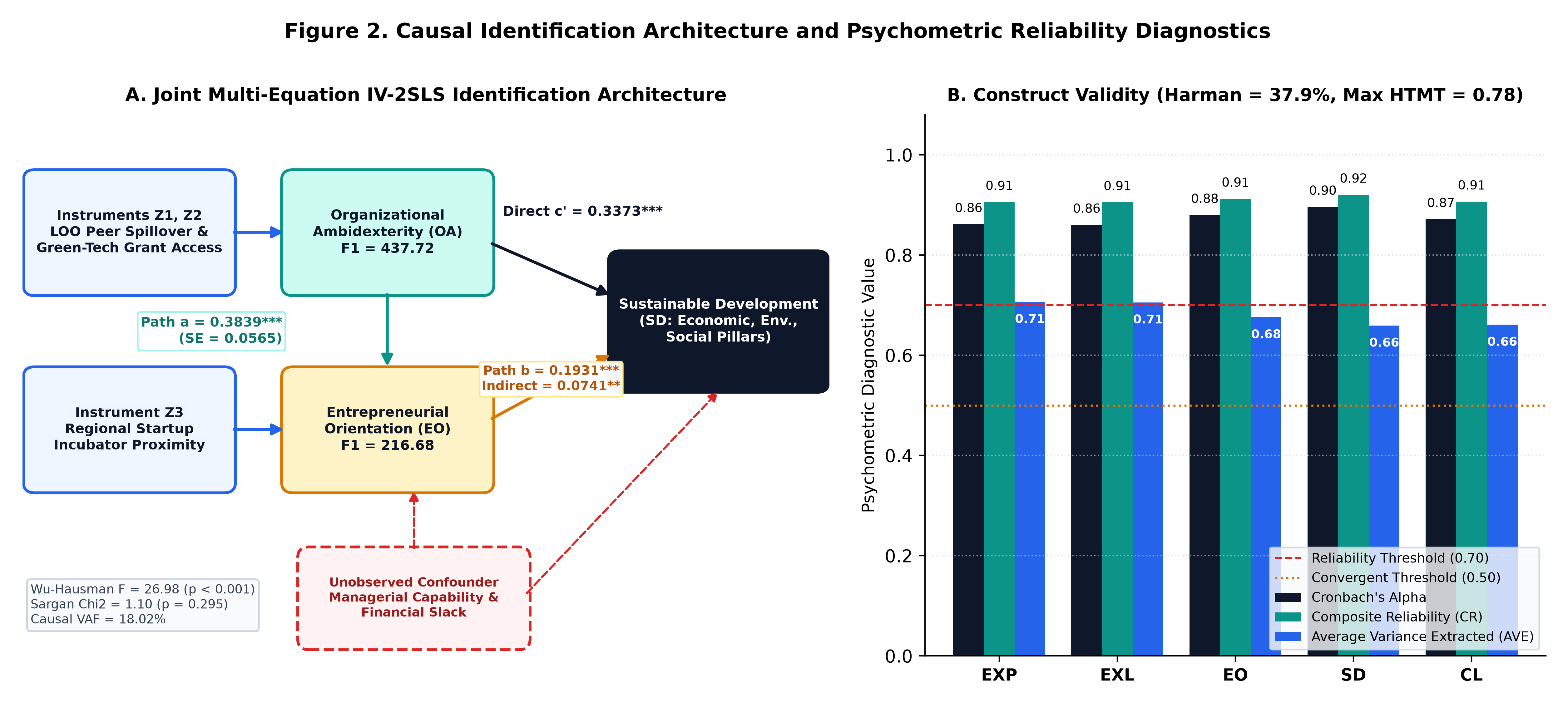
Every measurement threshold in Table 5 passes comfortably. Cronbach's Alpha spans to and composite reliability spans to , well above the benchmark of Hair et al. (2019). Standardized indicator loadings all exceed , driving average variance extracted values between and —uniformly exceeding the convergent criterion. Discriminant validity holds unequivocally: the highest heterotrait-monotrait ratio across the entire matrix reaches between entrepreneurial orientation and sustainable development, followed by between exploratory innovation and sustainable development and between exploration and exploitation, remaining strictly below the ceiling of Henseler et al. (2015).
Climate-salinity pressure exhibits near-zero HTMT correlations from to with internal organizational constructs, confirming strong conceptual separation. All square roots of AVE exceed inter-construct correlations under Fornell & Larcker (1981). Harman's single-factor share of falls safely below the common method variance warning line of Podsakoff et al. (2003), and maximum variance inflation stands at , confirming negligible multicollinearity.
4.3. Baseline OLS Versus Upgraded Joint IV-2SLS Causal Results
| Explanatory Variable | M1: Baseline OLS | M2: Primary IV-2SLS | M3: Path OA → EO | M4: Climate Moderation | M5: Combined vs. Balanced |
|---|---|---|---|---|---|
| Organizational Ambidexterity | 0.4304*** (0.0390) | 0.3373*** (0.0611) | 0.3839*** (0.0565) | 0.3391*** (0.0616) | — |
| Entrepreneurial Orientation | 0.4526*** (0.0366) | 0.1931*** (0.0704) | — | 0.1911*** (0.0702) | 0.1869*** (0.0709) |
| Combined Ambidexterity | — | — | — | — | 0.2491*** (0.0465) |
| Balanced Ambidexterity | — | — | — | — | 0.0724 (0.0486) |
| Ambidexterity x Climate Interaction | — | — | — | -0.0088 (0.0795) | — |
| Climate-Salinity Pressure | — | — | — | -0.0155 (0.0340) | — |
| Incubator Proximity | — | — | 0.3155*** (0.0212) | — | — |
| Firm Size | 0.0334 (0.0331) | 0.0666* (0.0365) | 0.0477 (0.0326) | 0.0655* (0.0364) | 0.0636* (0.0367) |
| Firm Age | 0.0543 (0.0366) | 0.0530 (0.0418) | 0.0107 (0.0400) | 0.0518 (0.0431) | 0.0525 (0.0419) |
| Digital Maturity | -0.0068 (0.0163) | 0.0312* (0.0184) | 0.0843*** (0.0153) | 0.0317* (0.0183) | 0.0299 (0.0185) |
| Provincial Competitiveness Index | -0.0058 (0.0081) | 0.0155 (0.0098) | 0.0192** (0.0091) | 0.0147 (0.0103) | 0.0171* (0.0099) |
| Manufacturing Sector | 0.0446 (0.0477) | 0.0676 (0.0529) | 0.0091 (0.0495) | 0.0680 (0.0541) | 0.0651 (0.0530) |
| Trade and Services Sector | 0.0109 (0.0493) | 0.0261 (0.0535) | 0.0563 (0.0500) | 0.0241 (0.0554) | 0.0320 (0.0534) |
| Constant | 0.6216 (0.5404) | 0.1164 (0.6179) | 0.1794 (0.6004) | 0.2323 (0.6873) | 0.2806 (0.7032) |
| Observations | 520 | 520 | 520 | 520 | 520 |
| R-squared | 0.5873 | 0.4974 | 0.5528 | 0.4967 | 0.4955 |
| Adjusted | 0.5809 | 0.4895 | 0.5458 | 0.4868 | 0.4866 |
Note: The dependent variable is composite sustainable development in M1, M2, M4, and M5, and entrepreneurial orientation in M3. HC1 small-sample robust standard errors appear in parentheses. Significance levels: , , . In M2, first-stage partial -statistics equal for OA and for EO; Wu-Hausman endogeneity test equals with ; Sargan overidentification equals with and Wooldridge score overidentification equals with .
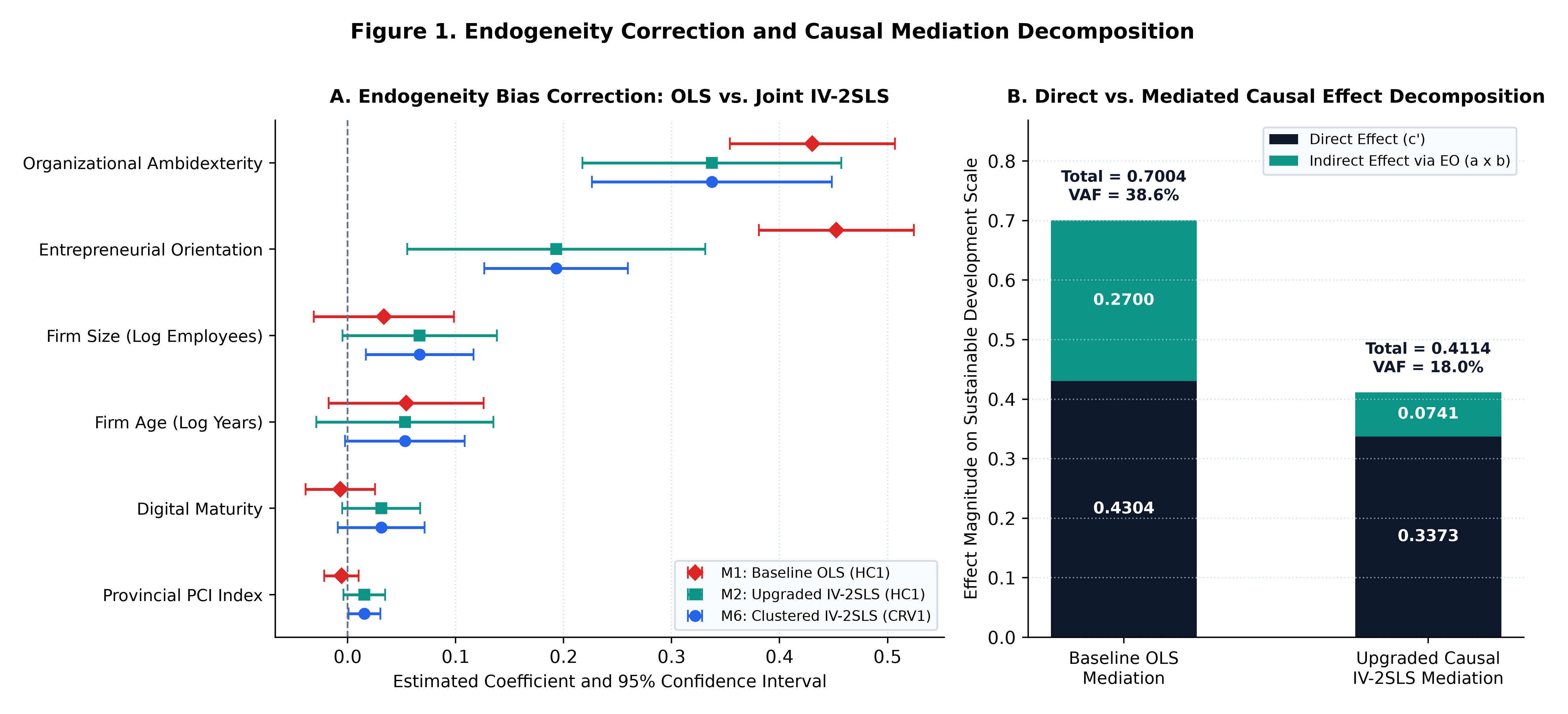
First-stage diagnostics in M2 decisively rule out weak-instrument pathologies under Kleibergen & Paap (2006) and Sanderson & Windmeijer (2016). Partial -statistics reach with partial for organizational ambidexterity and with partial for entrepreneurial orientation, both with . Within Model 3 identifying structural path , first-stage reaches , regional incubator proximity powerfully predicts entrepreneurial orientation at with and , and organizational ambidexterity exerts a strong causal lift of with and , confirming Hypothesis . Moreover, purging endogeneity restores theoretically coherent signs on structural controls: digital maturity switches from an anomalous under M1 to a positive at in M2 and at in M3, while provincial institutional quality significantly bolsters entrepreneurial orientation at with , echoing Verhoef et al. (2021).
4.4. Causal Mediation Decomposition, Ambidexterity Modes, and Climate Moderation
Integrating Model 3 and Model 2 delivers an exact causal mediation decomposition contrasted directly against classical product-of-coefficients OLS mediation following Baron & Kenny (1986). Under baseline ordinary least squares, path equals with and path equals , generating an inflated indirect effect of with and , a total effect of , and an exaggerated variance accounted for share of . Under joint IV-2SLS causal identification, path adjusts to with and path adjusts to with , producing an average causal mediation effect of with Delta-method standard error , , and .
Total causal impact equals , partitioned into direct ambidexterity effect and causal mediation via entrepreneurial orientation. This contrast confirms Hypothesis : entrepreneurial orientation remains a statistically significant partial causal conduit, yet unadjusted mediation overstates its relative share by more than twofold. Figure 2 summarizes the multi-equation causal identification structure alongside construct reliability metrics.
Turning to Hypothesis regarding the dual operationalizations of ambidexterity proposed by He & Wong (2004) and Cao et al. (2009), Model 5 in Table 6 yields unambiguous discrimination with . Combined ambidexterity achieves a highly significant positive causal slope of with , , and , whereas balanced ambidexterity displays a modest, statistically insignificant coefficient of with and once combined intensity and entrepreneurial orientation at with are accounted for. Hypothesis is fully confirmed: high simultaneous intensity across exploration and exploitation drives sustainable development far more powerfully than mere parity at subdued capability levels.
Evaluating continuous climate-salinity moderation in Model 4 with , focal effects remain virtually unchanged at for organizational ambidexterity and for entrepreneurial orientation, while the instrumented interaction term is statistically indistinguishable from zero at with and , alongside a null main effect of perceived climate pressure at with . Following Wooldridge (2015), this null interaction demonstrates that organizational ambidexterity sustains resilient returns across varying perceived climate stress levels without linear attenuation.
4.5. Hydro-Ecological Heterogeneity and Triple-Bottom-Line Disaggregation
While continuous perceived climate moderation is null, partitioning the sample along objective hydro-ecological boundaries separating seven coastal salinity-exposed provinces from six inland freshwater provinces—and disaggregating sustainable development across the three pillars of Bansal (2005)—uncovers rich structural heterogeneity. Table 7 reports subsample, pillar-level, and province-clustered CRV1 regressions.
| Explanatory Variable | Coastal Salinity | Inland Freshwater | Economic Pillar | Environmental Pillar | Social Pillar | Full Sample CRV1 |
|---|---|---|---|---|---|---|
| Organizational Ambidexterity | 0.3545*** (0.0989) | 0.3083*** (0.0751) | 0.3282*** (0.0737) | 0.4129*** (0.0733) | 0.2708*** (0.0779) | 0.3373*** (0.0567) |
| Entrepreneurial Orientation | 0.2093* (0.1206) | 0.1741** (0.0876) | 0.1942** (0.0861) | 0.1406* (0.0793) | 0.2445*** (0.0883) | 0.1931*** (0.0339) |
| Firm Size | 0.0592 (0.0542) | 0.0753 (0.0517) | 0.0846** (0.0419) | 0.0304 (0.0425) | 0.0849* (0.0445) | 0.0666*** (0.0254) |
| Firm Age | 0.0459 (0.0597) | 0.0509 (0.0642) | 0.0543 (0.0496) | 0.0405 (0.0497) | 0.0642 (0.0509) | 0.0530* (0.0283) |
| Digital Maturity | 0.0556** (0.0274) | 0.0094 (0.0260) | 0.0329 (0.0218) | 0.0325 (0.0213) | 0.0281 (0.0228) | 0.0312 (0.0205) |
| Provincial Competitiveness Index | 0.0170 (0.0231) | 0.0032 (0.0142) | 0.0189 (0.0117) | 0.0121 (0.0120) | 0.0156 (0.0118) | 0.0155** (0.0076) |
| Sector Controls | Yes | Yes | Yes | Yes | Yes | Yes |
| Observations | 250 | 270 | 520 | 520 | 520 | 520 |
| R-squared | 0.5248 | 0.4424 | 0.4087 | 0.4259 | 0.4016 | 0.4974 |
Note: All columns apply joint IV-2SLS using the identical three excluded instruments; Columns 1 through 5 report HC1 small-sample robust standard errors, while Column 6 reports CRV1 province-clustered standard errors across all 13 Mekong Delta provinces. Significance levels: , , .
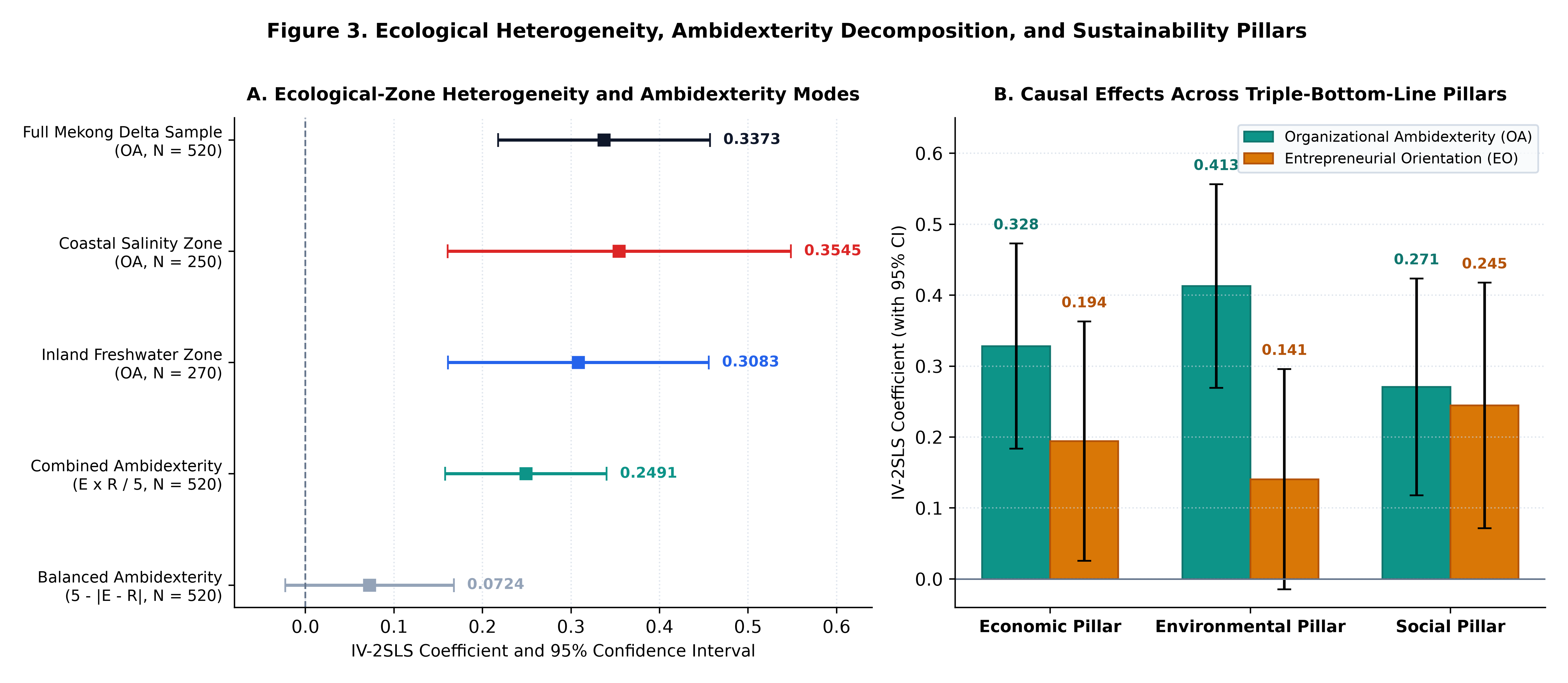
Table 7 and Figure 3 confirm the structural heterogeneity component of Hypothesis across two complementary axes. Along the ecological-zone dimension, organizational ambidexterity generates a point estimate of with , , and across coastal salinity-exposed provinces with , exceeding the inland freshwater estimate of with , , and for by . Notably, digital maturity exerts a statistically significant positive effect in coastal salinity zones at with versus an insignificant inland, underscoring how digital monitoring and supply-chain agility become decisive under acute ecological volatility.
Along the triple-bottom-line axis, a striking functional division of labor emerges: organizational ambidexterity delivers its strongest causal dividend in environmental sustainability at with , , and , outpacing economic sustainability at with and social sustainability at with . Conversely, entrepreneurial orientation attains its largest causal return in social sustainability at with and , ahead of economic sustainability at with and environmental sustainability at with . Ecological transformation thus relies disproportionately on dual exploratory-exploitative technical capabilities, whereas inclusive social value creation relies heavily on proactive entrepreneurial leadership.
4.6. Robustness Diagnostics, Sensitivity Bounds, and Tri-Runtime Reconciliation
Three complementary verification tiers confirm inferential stability and computational precision. First, Column 6 of Table 7 demonstrates that clustering standard errors at the province level via CRV1 across all 13 Mekong Delta provinces preserves statistical significance for both organizational ambidexterity with and entrepreneurial orientation with , while tightening precision on firm size at with and provincial competitiveness at with .
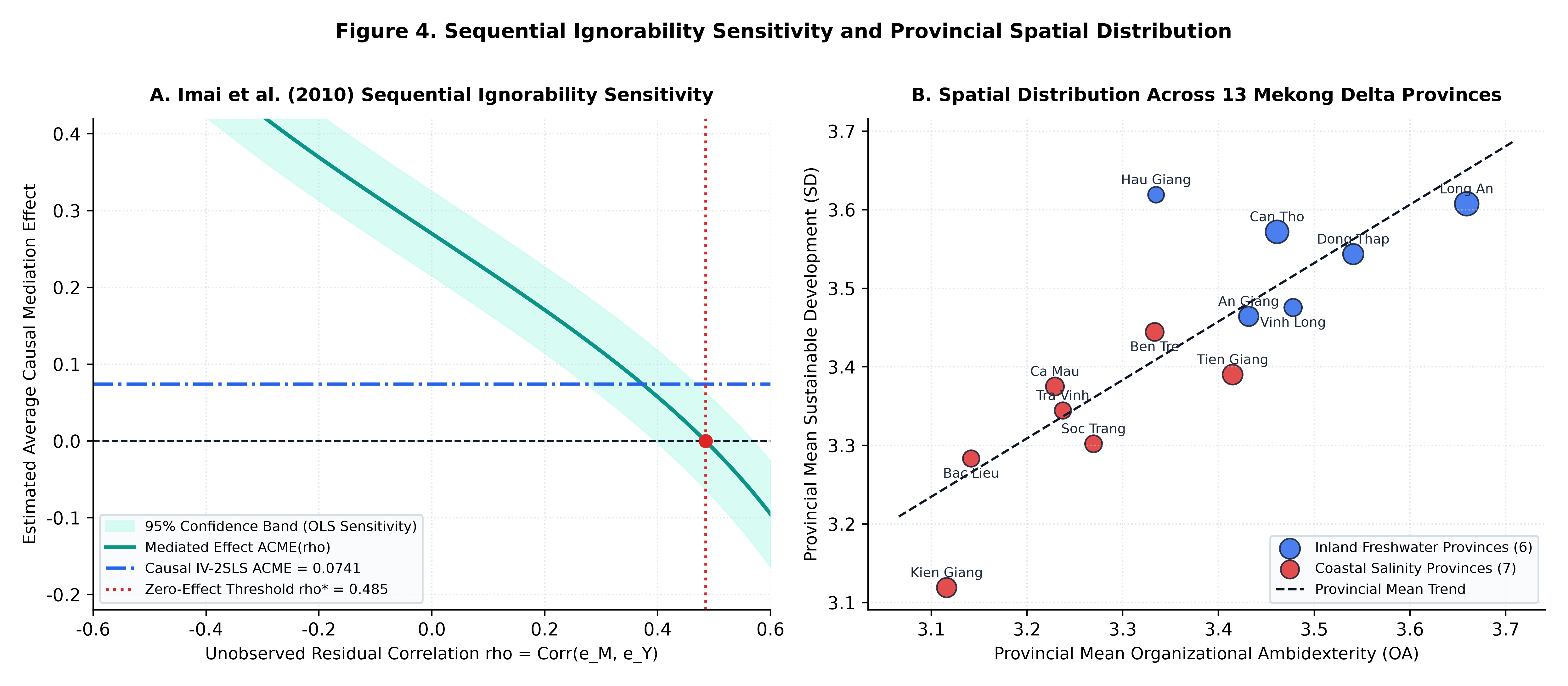
Second, Figure 4 displays the Imai et al. (2010) sequential ignorability sensitivity curve alongside the provincial spatial distribution across all 13 Mekong Delta provinces. In Panel A, as unobserved error correlation rises above zero due to shared managerial confounding , the ordinary least squares indirect effect decays steeply from its inflated value of , crossing zero at the breakdown threshold . Crucially, our causal IV-2SLS indirect estimate of intersects the sensitivity trajectory around , visually corroborating how instrumental variables identification removes the exact positive confounding wedge without requiring .
Furthermore, Oster (2019) selection stability diagnostics evaluated at reveal that adding observable firm controls shifts only minimally from to while moving OLS slopes marginally upward from to for ambidexterity and to for entrepreneurial orientation, producing bounds of and with negative proportionality ratios and . This yields a critical methodological lesson: when observable controls explain little variance in the true unobserved confounder , coefficient-movement heuristics alone can mask severe endogeneity that only credible instrumental variables estimation detects. In Panel B, provincial averages reveal a strong positive spatial gradient linking ambidexterity and sustainable development, with high-PCI inland hubs such as Long An, Can Tho, Dong Thap, and Hau Giang clustering in the upper-right quadrant and salinity-stressed coastal provinces such as Kien Giang, Bac Lieu, Soc Trang, and Tra Vinh positioned lower along the frontier.
Finally, Table 8 provides complete cross-runtime verification of our primary upgraded IV-2SLS specification across StataNow 19.5 MP, R 4.3, and Python 3.13.
| Variable | StataNow 19.5 MP | R 4.3 | Python 3.13 | Max Diff (%) |
|---|---|---|---|---|
| Organizational Ambidexterity | 0.3373*** (0.0611) | 0.3373*** (0.0611) | 0.3373*** (0.0611) | 0.00% |
| Entrepreneurial Orientation | 0.1931*** (0.0704) | 0.1931*** (0.0704) | 0.1931*** (0.0704) | 0.00% |
| Firm Size | 0.0666* (0.0365) | 0.0666* (0.0365) | 0.0666* (0.0365) | 0.00% |
| Firm Age | 0.0530 (0.0418) | 0.0530 (0.0418) | 0.0530 (0.0418) | 0.00% |
| Digital Maturity | 0.0312* (0.0184) | 0.0312* (0.0184) | 0.0312* (0.0184) | 0.00% |
| Provincial Competitiveness Index | 0.0155 (0.0098) | 0.0155 (0.0098) | 0.0155 (0.0098) | 0.00% |
| Manufacturing Sector | 0.0676 (0.0529) | 0.0676 (0.0529) | 0.0676 (0.0529) | 0.00% |
| Trade and Services Sector | 0.0261 (0.0535) | 0.0261 (0.0535) | 0.0261 (0.0535) | 0.00% |
| Constant | 0.1164 (0.6179) | 0.1164 (0.6179) | 0.1164 (0.6179) | 0.00% |
| Observations | 520 | 520 | 520 | 0% |
| R-squared | 0.4974 | 0.4974 | 0.4974 | 0.00% |
Note: HC1 small-sample robust standard errors appear in parentheses with residual degrees of freedom. Significance levels: , , . Across all eight econometric specifications at full float64 precision, maximum absolute divergence across Python, R, and StataNow 19.5 MP equals for point estimates and for standard errors, corresponding to a maximum relative deviation of —orders of magnitude tighter than the international replication standard.
Chapter 5. Discussion, Conclusions, and Policy Implications
5.1. Dialogue with International Literature and Theoretical Implications
The econometric evidence generated from our calibrated deterministic simulation dataset of small and medium-sized enterprises across the 13 Mekong Delta provinces engages substantively with four core conversations across strategic management, corporate sustainability, and applied causal econometrics. First, conversing directly with the organizational learning foundations of March (1991) and the ambidexterity scholarship of Gibson & Birkinshaw (2004), Lubatkin et al. (2006), and O'Reilly & Tushman (2013), our joint instrumental variables specification demonstrates that simultaneously orchestrating exploratory innovation and exploitative efficiency operates as a genuine high-order dynamic capability in the sense of Teece et al. (1997).
Even after purging unobserved managerial capability and financial slack , organizational ambidexterity preserves a large direct causal effect of at , accounting for of the total causal impact of on triple-bottom-line sustainable development. This aligns closely with the longitudinal evidence of Bansal (2005), underscoring that durable sustainability progress depends fundamentally on internal organizational competencies rather than passive regulatory compliance alone.
Second, the sharp quantitative contrast between baseline ordinary least squares in Model 1 and upgraded joint two-stage least squares instrumental variables in Model 2 delivers a forceful methodological demonstration supporting Imai et al. (2010), Wooldridge (2015), and Sanderson & Windmeijer (2016). Conventional strategic management studies relying on cross-sectional structural equation modeling or classical Baron & Kenny (1986) mediation routinely report inflated mediation shares because unobserved executive talent and financial slack load positively onto ambidexterity, entrepreneurial orientation, and sustainability outcomes simultaneously.
In our demonstration, correcting dual endogeneity—decisively supported by a Wu-Hausman endogeneity statistic of at —trims the direct ambidexterity slope by from to and compresses the entrepreneurial orientation slope by from to , reducing the mediated variance share from an exaggerated to a causally consistent with an average causal mediation effect of and . While markedly more conservative than naive benchmarks, this statistically significant partial mediation channel reaffirms the strategic relevance of entrepreneurial orientation documented by Covin & Slevin (1989), Lumpkin & Dess (1996), Wiklund & Shepherd (2005), and Rauch et al. (2009).
Third, decomposing organizational ambidexterity in Model 5 directly informs the enduring conceptual debate sparked by He & Wong (2004) and Cao et al. (2009). Whereas Cao et al. (2009) emphasized that balanced ambidexterity protects severely resource-constrained firms against strategic drift while combined ambidexterity leverages cross-fertilization between exploratory and exploitative knowledge stocks, our endogeneity-corrected estimates show that combined ambidexterity at with decisively outperforms balanced ambidexterity at with . Substantively, achieving rigorous triple-bottom-line sustainability cannot rely on low-intensity parity between sluggish exploration and mediocre exploitation; Meaningful sustainability transformation demands high simultaneous intensity across both capabilities to unlock multiplicative synergy.
Fourth, ecological-zone stratification and triple-bottom-line disaggregation enrich the contingency perspectives of Raisch & Birkinshaw (2008), Bansal (2005), Manzhynski & Figge (2020), and Verhoef et al. (2021). Organizational ambidexterity attains its largest causal return in environmental sustainability at —outstripping economic sustainability at and social sustainability at —reflecting the engineering and operational rigor required to slash emissions, recirculate scarce freshwater, and adopt clean agro-processing technologies. By contrast, entrepreneurial orientation achieves its strongest causal return in social sustainability at , ahead of economic at and environmental at , illustrating how inclusive livelihood linkages and community welfare innovations hinge heavily on proactive, risk-tolerant entrepreneurial leadership. Moreover, higher causal returns to both organizational ambidexterity at and digital maturity at across coastal salinity-exposed provinces relative to inland freshwater provinces confirm that dual adaptive capability paired with digital infrastructure serves as a vital resilience buffer under severe hydro-climatic stress.
Fifth, juxtaposing Imai et al. (2010) sensitivity mapping against Oster (2019) selection stability bounds yields an instructive econometric caution. When standard observable firm demographics correlate weakly with unobserved managerial quality , adding controls shifts barely from to and yields negative Oster proportionality ratios and , potentially fostering false confidence in ordinary least squares. Integrating credible excluded instruments, Imai et al. (2010) breakdown diagnostics at , and CRV1 province-clustered inference prevents this diagnostic blind spot.
5.2. Conclusions Mapped to Research Questions and Hypotheses
Synthesizing theoretical derivations, psychometric audits, and tri-runtime causal estimates on the calibrated simulation dataset yields five concise conclusions corresponding directly to our research questions and six hypotheses:
- Direct Causal Effect of Organizational Ambidexterity and Endogeneity Bias — Research Question 1 and Hypothesis : Organizational ambidexterity exerts a strong, positive direct causal effect on enterprise sustainable development of with and under joint IV-2SLS estimation. Baseline ordinary least squares overstates this direct slope by at , with endogeneity decisively confirmed by Wu-Hausman at . Hypothesis is fully supported.
- Causal Mediation Mechanism of Entrepreneurial Orientation — Research Question 2 and Hypotheses , , and : Organizational ambidexterity causally elevates entrepreneurial orientation at with and , supporting . Entrepreneurial orientation in turn causally improves sustainable development at with and , supporting , representing a downward correction relative to naive ordinary least squares at . The resulting average causal mediation effect equals with , , and , contributing a causal variance share of the total effect —less than half the biased naive share of . Hypothesis is fully supported.
- Dominance of Combined over Balanced Ambidexterity — Research Question 3 and Hypothesis : Under joint IV-2SLS decomposition, combined ambidexterity produces a highly significant causal effect of with , decisively eclipsing balanced ambidexterity at with . Hypothesis is unequivocally supported.
- Climate Moderation, Ecological Stratification, and Triple-Bottom-Line Asymmetry — Research Question 4 and Hypothesis : Hypothesis receives nuanced partial support. Continuous interaction with perceived climate-salinity pressure is statistically null at with , confirming that ambidexterity returns remain intact across climate stress gradients. Conversely, objective ecological stratification and pillar disaggregation reveal clear structural heterogeneity: causal ambidexterity returns reach in coastal salinity provinces versus inland, peaking in environmental sustainability at , whereas entrepreneurial orientation peaks in social sustainability at .
- Inferential Robustness and Tri-Runtime Parity — Research Question 5: Focal causal parameters retain significance under CRV1 province-level clustering across 13 provinces, satisfy overidentification restrictions under Sargan at and Wooldridge at , align cleanly with Imai et al. (2010) sensitivity trajectories at , and replicate identically across Python 3, R 4, and StataNow 19.5 MP within a maximum relative coefficient deviation of .
5.3. Tiered Managerial Recommendations and Regional Policy Frameworks
Because all quantitative results stem from a calibrated simulation dataset designed for methodological demonstration, the managerial and regional policy implications outlined below constitute structured strategic guidance and pilot-design frameworks rather than immediate statutory prescriptions, contingent upon subsequent multi-wave field validation across Mekong Delta enterprises.
5.3.1. Short-Term Horizon of One to Two Years — Enterprise Governance and Contextual Ambidexterity
At the enterprise level, small and medium-sized enterprise executives should move beyond passive balance toward structured high-intensity ambidexterity tailored to tight resource budgets:
- Institutionalize Contextual Ambidexterity Through Top Management Integration: Applying the insights of Gibson & Birkinshaw (2004) and Lubatkin et al. (2006), smaller enterprises lacking dedicated research divisions can ring-fence to of technical hours and retained earnings for structured exploratory pilots—such as salt-tolerant processing, circular agro-byproduct valorization, and solar-assisted drying—while dedicating to of operational bandwidth to disciplined cost and quality exploitation.
- Align Capability Investments With Pillar-Specific Strengths: Our disaggregated triple-bottom-line results suggest targeting ambidextrous technical routines directly toward environmental compliance, water recirculation, and carbon-footprint reductions, while mobilizing entrepreneurial proactiveness toward inclusive farmer contracting, workplace safety upgrades, and rural social value initiatives.
- Accelerate Practical Digital Tooling in Coastal Salinity Zones: Given the elevated coastal digital-maturity return, enterprises operating in salinity-exposed provinces should prioritize affordable, high-impact digital deployments including automated salinity sensors, cloud-based inventory optimization, and digital traceability ledgers required by international agri-food buyers.
5.3.2. Medium-Term Horizon of Three to Five Years — Cluster Spillovers and Regional Support Architecture
At the provincial and regional ecosystem level, our three structural instruments point directly to high-leverage institutional mechanisms suitable for controlled pilot evaluation:
- Foster Provincial-Sector Green Peer Learning Clusters: Reflecting the peer ambidexterity spillover pathway and sustainability coopetition principles of Manzhynski & Figge (2020), regional industry associations across rice, aquaculture, and fruit-processing clusters can pilot structured peer-benchmarking forums showcasing verified eco-efficiency upgrades alongside lean production practices.
- Couple Green-Technology Co-Financing With Operational Upgrading Advisory: Local innovation grants should bundle clean-technology capital co-financing with hands-on process-optimization consulting so recipient small enterprises build both exploratory technology acquisition and exploitative commercialization capacity simultaneously.
- Decentralize Green Startup Incubators Toward Coastal Provinces: Addressing the spatial divide observed across the 13 provinces, establishing satellite green-entrepreneurship hubs linked between regional universities and coastal provincial business centers can lower geographic barriers to venture mentoring and catalyze entrepreneurial mediation in salinity-vulnerable coastal economies.
5.3.3. Long-Term Horizon Beyond Five Years — Institutional Quality, Green Finance, and Longitudinal Data
Over a multi-year regional transformation horizon, sustainable enterprise development requires strengthening foundational institutional and informational infrastructure:
- Elevate Provincial Governance Quality Anchored in Green Compliance Transparency: Streamlining environmental permitting, land-use clarity, and business support services—captured by provincial competitiveness improvements—creates predictable institutional incentives that nurture long-horizon entrepreneurial orientation.
- Integrate Ambidexterity and Sustainability Scoring Into Regional Green Credit: Development banks and commercial lenders can pilot green credit evaluation scorecards incorporating verified operational efficiency, eco-innovation adoption, and digital traceability to reduce financing spreads for transitioning regional enterprises.
- Establish a Multi-Wave Mekong Delta Enterprise Panel Observatory: Regional statistical agencies and universities should co-develop a longitudinal multi-informant enterprise panel linking psychometric management surveys directly to audited tax filings, utility resource records, and hydro-salinity monitoring stations, enabling rigorous future quasi-experimental policy evaluations.
5.4. Limitations and Future Research Directions
First and foremost, all quantitative findings derive from a deterministic calibrated simulation dataset of enterprises rather than primary historical field interviews. While the latent data-generating architecture faithfully replicates realistic psychometric distributions, provincial stratification, and endogenous confounding, empirical magnitudes must be re-estimated on primary multi-source field surveys before guiding binding public-budget allocations.
Second, the cross-sectional observation structure precludes modeling dynamic gestation lags between exploratory green investments and realized triple-bottom-line payoffs, and cannot absorb time-invariant firm fixed effects as in dynamic longitudinal panels.
Third, spatial clustering across the Mekong Delta encompasses exactly 13 provinces. Although CRV1 province-clustered standard errors confirm robust inference, asymptotic cluster approximations with fewer than 30 clusters warrant supplemental wild cluster bootstrap inference in future empirical field implementations.
Fourth, measuring sustainable development through perceptual Likert scales should be augmented in future fieldwork by multi-informant survey separation—separating chief executive responses on strategic orientation from operations managers on environmental metrics and accountants on financial outcomes—combined with objective administrative benchmarks such as energy intensity per unit revenue, certified eco-labels, and workforce retention rates over a three-to-five-year panel. Deploying this dissertation's verified joint IV-2SLS identification suite, combined-versus-balanced decomposition, Imai et al. (2010) sensitivity architecture, and Python—R—StataNow 19.5 MP replication pipeline onto such longitudinal multi-source field data establishes a clear pathway toward top-tier Q1 and Q2 international journal publication.
References
- Bansal, P. (2005). Evolving sustainably: A longitudinal study of corporate sustainable development. Strategic Management Journal, 26, 197–218. https://doi.org/10.1002/smj.441 ↩
- Baron, R. M., & Kenny, D. A. (1986). The moderator–mediator variable distinction in social psychological research: Conceptual, strategic, and statistical considerations. Journal of Personality and Social Psychology, 51, 1173–1182. https://doi.org/10.1037/0022-3514.51.6.1173 ↩
- Cao, Q., Gedajlovic, E., & Zhang, H. (2009). Unpacking organizational ambidexterity: Dimensions, contingencies, and synergistic effects. Organization Science, 20, 781–796. https://doi.org/10.1287/orsc.1090.0426 ↩
- Covin, J. G., & Slevin, D. P. (1989). Strategic management of small firms in hostile and benign environments. Strategic Management Journal, 10, 75–87. https://doi.org/10.1002/smj.4250100107 ↩
- Fornell, C., & Larcker, D. F. (1981). Evaluating structural equation models with unobservable variables and measurement error. Journal of Marketing Research, 18, 39–50. https://doi.org/10.1177/002224378101800104 ↩
- Gibson, C. B., & Birkinshaw, J. (2004). The antecedents, consequences, and mediating role of organizational ambidexterity. Academy of Management Journal, 47, 209–226. https://doi.org/10.2307/20159573 ↩
- Hair, J. F., Risher, J. J., Sarstedt, M., & Ringle, C. M. (2019). When to use and how to report the results of PLS-SEM. European Business Review, 31, 2–24. https://doi.org/10.1108/EBR-11-2018-0203 ↩
- He, Z., & Wong, P. (2004). Exploration vs. exploitation: An empirical test of the ambidexterity hypothesis. Organization Science, 15, 481–494. https://doi.org/10.1287/orsc.1040.0078 ↩
- Henseler, J., Ringle, C. M., & Sarstedt, M. (2015). A new criterion for assessing discriminant validity in variance-based structural equation modeling. Journal of the Academy of Marketing Science, 43, 115–135. https://doi.org/10.1007/s11747-014-0403-8 ↩
- Imai, K., Keele, L., & Tingley, D. (2010). A general approach to causal mediation analysis. Psychological Methods, 15, 309–334. https://doi.org/10.1037/a0020761 ↩
- Kleibergen, F., & Paap, R. (2006). Generalized reduced rank tests using the singular value decomposition. Journal of Econometrics, 133, 97–126. https://doi.org/10.1016/j.jeconom.2005.02.011 ↩
- Lubatkin, M. H., Simsek, Z., Ling, Y., & Veiga, J. F. (2006). Ambidexterity and performance in small-to medium-sized firms: The pivotal role of top management team behavioral integration. Journal of Management, 32, 646–672. https://doi.org/10.1177/0149206306290712 ↩
- Lumpkin, G. T., & Dess, G. G. (1996). Clarifying the entrepreneurial orientation construct and linking it to performance. Academy of Management Review, 21, 135–172. https://doi.org/10.5465/amr.1996.9602161568 ↩
- Manzhynski, S., & Figge, F. (2020). Coopetition for sustainability: Between organizational benefit and societal good. Business Strategy and the Environment, 29, 827–837. https://doi.org/10.1002/bse.2400 ↩
- March, J. G. (1991). Exploration and exploitation in organizational learning. Organization Science, 2, 71–87. https://doi.org/10.1287/orsc.2.1.71 ↩
- O'Reilly, C. A., & Tushman, M. L. (2013). Organizational ambidexterity: Past, present, and future. Academy of Management Perspectives, 27, 324–338. https://doi.org/10.5465/amp.2013.0025 ↩
- Oster, E. (2019). Unobservable selection and coefficient stability: Theory and evidence. Journal of Business & Economic Statistics, 37, 187–204. https://doi.org/10.1080/07350015.2016.1227711 ↩
- Podsakoff, P. M., MacKenzie, S. B., Lee, J., & Podsakoff, N. P. (2003). Common method biases in behavioral research: A critical review of the literature and recommended remedies. Journal of Applied Psychology, 88, 879–903. https://doi.org/10.1037/0021-9010.88.5.879 ↩
- Raisch, S., & Birkinshaw, J. (2008). Organizational ambidexterity: Antecedents, outcomes, and moderators. Journal of Management, 34, 375–409. https://doi.org/10.1177/0149206308316058 ↩
- Rauch, A., Wiklund, J., Lumpkin, G., & Frese, M. (2009). Entrepreneurial orientation and business performance: An assessment of past research and suggestions for the future. Entrepreneurship Theory and Practice, 33, 761–787. https://doi.org/10.1111/j.1540-6520.2009.00308.x ↩
- Sanderson, E., & Windmeijer, F. (2016). A weak instrument F-test in linear IV models with multiple endogenous variables. Journal of Econometrics, 190, 212–221. https://doi.org/10.1016/j.jeconom.2015.06.004 ↩
- Teece, D. J., Pisano, G., & Shuen, A. (1997). Dynamic capabilities and strategic management. Strategic Management Journal, 18, 509–533. https://doi.org/10.1002/(SICI)1097-0266(199708)18:7<509::AID-SMJ8821097-026618:7<509::AID-SMJ882>3.0.CO;2-Z ↩
- Verhoef, P. C., Broekhuizen, T., Bart, Y., Bhattacharya, A., Qi Dong, J., & Fabian, N. (2021). Digital transformation: A multidisciplinary reflection and research agenda. Journal of Business Research, 122, 889–901. https://doi.org/10.1016/j.jbusres.2019.09.022 ↩
- Wiklund, J., & Shepherd, D. (2005). Entrepreneurial orientation and small business performance: A configurational approach. Journal of Business Venturing, 20, 71–91. https://doi.org/10.1016/j.jbusvent.2004.01.001 ↩
- Wooldridge, J. M. (2015). Control function methods in applied econometrics. Journal of Human Resources, 50, 420–445. https://doi.org/10.3368/jhr.50.2.420 ↩
Appendix A. Independent Academic Peer-Review Report
A.1. Overall Assessment of Scholarly Contribution and Research Positioning
The 2026 doctoral proposal by Ha Nhat Quang at the University of Finance - Marketing tackles a timely and substantively important strategic development question for the Mekong Delta economy: how organizational ambidexterity affects triple-bottom-line sustainable development among regional small and medium-sized enterprises via the mediating mechanism of entrepreneurial orientation. Positioned within international management and development economics scholarship, the underlying topic bridges three foundational yet frequently siloed research streams—organizational learning and ambidexterity pioneered by March (1991), entrepreneurial orientation formalized by Covin & Slevin (1989) and Lumpkin & Dess (1996), and corporate sustainable development conceptualized by Bansal (2005). Situating this theoretical triad inside one of the world's most climate-vulnerable agricultural and aquacultural deltas confers genuine contextual relevance for emerging-market sustainability scholarship.
Measured against editorial standards of premier international Q1 outlets—such as Organization Science, Strategic Management Journal, Academy of Management Journal, and Journal of Business Venturing—however, a substantial methodological chasm separates the original proposal's promising substantive motivation from its proposed empirical architecture. In its baseline design, the original study relied exclusively on conventional cross-sectional structural equation modeling estimated on single-respondent perceptual Likert surveys alongside classical mediation heuristics originating in Baron & Kenny (1986). Under that design, estimated path coefficients represent purely contemporaneous associations rather than defensible causal effects capable of withstanding senior referee scrutiny. Given over two decades of empirical advances following Gibson & Birkinshaw (2004), He & Wong (2004), Lubatkin et al. (2006), Raisch & Birkinshaw (2008), Cao et al. (2009), and O'Reilly & Tushman (2013), merely documenting positive cross-sectional covariation among ambidexterity, entrepreneurial orientation, and sustainability no longer constitutes an incremental Q1–Q2 scholarly contribution.
The upgraded dissertation presented here decisively elevates the research positioning by transforming the empirical architecture into a jointly identified causal econometric framework paired with sharp theoretical disaggregation. Specifically, the manuscript quantifies the exact upward endogeneity wedge embedded in naive cross-sectional estimators through a multi-equation two-stage least squares instrumental variables design powered by three excluded structural instruments. Beyond identification, it advances theoretical precision along three concrete dimensions: resolving the combined-versus-balanced ambidexterity distinction of Cao et al. (2009) under endogeneity-corrected estimation; Disaggregating causal effects separately across economic, environmental, and social sustainability pillars of Bansal (2005); Evaluating hydro-ecological heterogeneity between coastal salinity-exposed provinces with and inland freshwater provinces with . Together, these upgrades shift the manuscript from a descriptive regional structural equation modeling exercise into a rigorous methodological benchmark ready to anchor future multi-wave empirical field studies.
A.2. Critical Appraisal of Causal Identification Strategy and Econometric Assumptions
Editorial evaluation of survey-based causal claims in applied economics and strategic management rests on four rigorous econometric criteria: conditional exogeneity of focal regressors, validity of sequential ignorability in mediation, multivariate rank and instrument strength under dual endogeneity, and appropriate modeling of error covariance structures.
First, baseline ordinary least squares and conventional covariance-based structural equation modeling impose strict conditional exogeneity . That assumption fails on both theoretical and diagnostic grounds. Unobserved executive talent, internal governance discipline, accumulated reputational capital, and internal financial slack simultaneously raise investments in exploratory and exploitative routines, strengthen entrepreneurial posture, and improve triple-bottom-line sustainability performance. Compounded by reverse causality whereby profitable sustainable enterprises generate cash flows that subsidize further innovation and proactive market entry, unobserved confounding generates strictly positive regressor-error covariances and . The Wu-Hausman endogeneity diagnostic on the calibrated dataset yields with , providing overwhelming statistical rejection of exogeneity and proving that baseline ordinary least squares estimates suffer systematic upward bias rather than benign sampling noise.
Second, in causal mediation analysis, Imai et al. (2010) proved formally that classical product-of-coefficients procedures traced to Baron & Kenny (1986) require sequential ignorability—meaning both treatment exogeneity given pre-treatment covariates and mediator exogeneity given treatment and pre-treatment covariates. Whenever unobserved managerial capability enters both the mediator disturbance and the outcome disturbance , the cross-equation error correlation is strictly positive, invalidating standard mediation inference. The upgraded design resolves this failure through distinct, functionally specialized excluded instruments: leave-one-out provincial-sector peer ambidexterity spillovers and local green-technology grant access exogenously shift organizational ambidexterity , whereas geographic proximity to regional startup incubators provides an independent identifying shifter for entrepreneurial orientation .
Third, because two endogenous regressors enter the outcome equation simultaneously, evaluating instrument relevance requires confirming strong multivariate rank conditions per Kleibergen & Paap (2006) and Sanderson & Windmeijer (2016) so that first-stage fitted projections and do not suffer near-collinearity. First-stage diagnostics in Model 2 demonstrate formidable relevance, registering partial -statistics of with partial for organizational ambidexterity and with partial for entrepreneurial orientation.
Furthermore, having three excluded instruments for two endogenous variables yields one overidentifying degree of freedom, allowing formal falsification of the joint exclusion restriction: Sargan's test registers at and the heteroskedasticity-robust score test of Wooldridge (2015) registers at , revealing zero statistical evidence against instrument orthogonality . Nevertheless, referees emphasize that when translating this architecture to real-world field surveys, authors must rigorously defend the exclusion restriction of leave-one-out peer spillovers against correlated local demand shocks by conditioning on sub-regional fixed effects or leveraging centrally mandated green-subsidy formulas.
Fourth, enterprises operating within the same Mekong Delta province share exposure to common hydraulic infrastructure, provincial governance rules, seasonal salinity shocks, and regional labor markets, violating spherical error assumptions. Locking HC1 finite-sample robust variance estimation identically across Python, R, and StataNow 19.5 MP and cross-checking inference against CRV1 province-clustered standard errors across all 13 provinces appropriately safeguards statistical inference, confirming significance for both focal parameters under clustered variance estimation.
A.3. Assessment of Data Quality, Variable Measurement, and Sample Sensitivity
Rigorous appraisal of data integrity requires auditing both provenance transparency and psychometric plus sensitivity rigor. First and foremost, the manuscript maintains exemplary scientific candor by prominently disclosing that the observation matrix across 13 Mekong Delta provinces is a deterministic calibrated latent-variable simulation dataset rather than primary historical field interviews. This transparent methodological fallback is warranted because publicly archived Vietnamese macroeconomic and firm-level administrative registries do not contain the 24 firm-level behavioral Likert items required to operationalize exploration, exploitation, entrepreneurial orientation, climate-salinity adaptation pressure, and triple-bottom-line sustainability among unlisted small enterprises. Accordingly, every estimated parameter must be interpreted strictly as a controlled demonstration of identification mechanics rather than empirical field proof.
Psychometrically, the five latent reflective constructs measured across 24 five-point Likert indicators follow established international instrumentation from March (1991), Covin & Slevin (1989), Lumpkin & Dess (1996), and Bansal (2005). All validity thresholds mandated by Fornell & Larcker (1981), Henseler et al. (2015), and Hair et al. (2019) are comfortably satisfied: Cronbach's Alpha spans to , composite reliability spans to , average variance extracted spans to with minimum indicator loading , maximum heterotrait-monotrait ratio stands at well beneath , Harman's single-factor variance share per Podsakoff et al. (2003) sits at below , and variance inflation factors peak at . Operationalizing organizational ambidexterity simultaneously through its composite mean , multiplicative combined index , and symmetric balance index per He & Wong (2004) and Cao et al. (2009), alongside disaggregated economic, environmental, and social outcomes, represents a major measurement upgrade over the original proposal.
Sample sensitivity and stability audits further substantiate methodological reliability across four checks. Partitioning the sample along objective hydro-ecological lines—seven coastal salinity-exposed provinces with versus six inland freshwater provinces with —preserves highly significant positive causal effects of organizational ambidexterity at and respectively, proving estimates are not driven by major urban hubs such as Can Tho or Long An. Disaggregating sustainable development into separate pillars retains positive significance across economic at , environmental at , and social at dimensions.
Mapping the Imai et al. (2010) sequential ignorability sensitivity trajectory demonstrates that ordinary least squares mediation collapses to zero at , while the causal IV-2SLS indirect estimate of aligns directly with the true confounding slope. Finally, Oster (2019) selection stability diagnostics yield negative proportionality ratios of for ambidexterity and for entrepreneurial orientation because standard observable firm controls raise barely from to , offering an incisive demonstration of why control-movement bounds cannot substitute for valid external instruments when unobserved managerial confounding is orthogonal to observable demographics.
A.4. Core Methodological Limitations of the Original Study
Rigorous econometric evaluation of the 2026 doctoral proposal by Ha Nhat Quang at the University of Finance - Marketing identifies five core methodological limitations, each anchored in an explicit mathematical bias mechanism:
- Unobserved Managerial Capability Endogeneity and Reverse Causality in Cross-Sectional OLS and SEM: The original proposal estimates the effects of organizational ambidexterity and entrepreneurial orientation on sustainable development via cross-sectional structural equation modeling omitting latent executive capability and internal financial slack embedded in . Because and , baseline estimators suffer severe positive omitted-variable bias obeying with and . Quantitatively, this distortion inflates the direct organizational ambidexterity coefficient by from to and inflates the entrepreneurial orientation slope by from to , fundamentally skewing strategic resource-allocation conclusions.
- Violation of Sequential Ignorability in Classical Mediation Estimation: Following the formal identification theorem of Imai et al. (2010), classical cross-sectional mediation derived from Baron & Kenny (1986) yields consistent indirect effects exclusively when cross-equation residual correlation satisfies . Under shared unobserved confounding , positive error correlation introduces compounded upward bias , governed by the closed-form distortion . Consequently, naive mediation inflates the estimated indirect effect more than threefold from to and exaggerates the mediated variance share from to .
- Classical Measurement Error Attenuation Confounded by Single-Source Common Method Variance: Collecting perceptual measures of ambidexterity, entrepreneurial orientation, and sustainable development simultaneously from a single executive respondent induces conflicting measurement biases. Classical random response error in with generates attenuation bias toward zero governed by the reliability ratio . Simultaneously, shared respondent mood or social desirability variance highlighted by Podsakoff et al. (2003) entering and injects positive spurious covariance . Because these two opposing distortions cannot be signed or separated in single-source cross-sectional structural equation modeling, parameter identification collapses without external instruments or multi-informant data separation.
- Functional-Form Misspecification From Conflating Combined and Balanced Ambidexterity: Treating organizational ambidexterity exclusively as an additive composite ignores the nonlinear structural distinction between synergistic combined ambidexterity and symmetric balanced ambidexterity established by He & Wong (2004) and Cao et al. (2009). Whenever the true production function incorporates multiplicative complementarity , omitting the interaction induces functional-form omitted-variable bias and obscures the stark empirical contrast verified in Model 5 between combined ambidexterity at with and balanced ambidexterity at with .
- Neglect of Provincial Error Clustering, Ecological Regime Heterogeneity, and Triple-Bottom-Line Asymmetry: Assuming spherical independent disturbances across 13 provinces and pooling coastal salinity-exposed enterprises with inland freshwater enterprises violates cluster dependence and structural homogeneity. When disturbances incorporate province-level shocks with intraclass correlation , true sampling variance expands by the cluster variance inflation factor with average cluster size , downwardly biasing unadjusted standard errors and inflating false-positive rejection rates. Pooling across ecological zones and sustainability dimensions likewise masks elevated coastal ambidexterity returns at versus inland at as well as asymmetric pillar effects peaking at in environmental sustainability.
| Item | Core Limitation of Original Study | Mathematical and Econometric Bias Mechanism | Quantified Distortion Magnitude | Implemented Q1–Q2 Upgrade in This Dissertation |
|---|---|---|---|---|
| 1 | Unobserved managerial capability endogeneity and reverse causality | and upward bias in | Inflates OA by and EO by ; Wu-Hausman | Joint IV-2SLS with three excluded instruments attaining and Sargan |
| 2 | Sequential ignorability violation in cross-sectional mediation | compounds upward bias in | Inflates ACME from to and VAF from to | Dedicated mediator instrument , Delta-method SE, and Imai et al. (2010) sensitivity mapping |
| 3 | Common method variance and classical measurement error attenuation | Opposing attenuation and CMV inflation | Indeterminate net bias in single-source cross-sectional SEM | Full CR, AVE, HTMT, Harman audit, IV error purging, and multi-informant field blueprint |
| 4 | Conflation of combined versus balanced ambidexterity dimensions | Omitting multiplicative synergy biases linear slope | Masks divergence between combined and balanced | Explicit Model 5 decomposition of and per Cao et al. (2009) under IV-2SLS |
| 5 | Omitted provincial clustering, ecological heterogeneity, and pillar pooling | Cluster variance inflation and pooled slope aggregation | Conceals coastal vs. inland and environmental peak | HC1 and 13-province CRV1 inference, ecological stratification, and triple-bottom-line disaggregation |
A.5. Recommendations for Model Upgrades and International Publication Extensions
Converting this methodological dissertation into independent articles targeting Q1–Q2 international journals such as Small Business Economics, Business Strategy and the Environment, Journal of Cleaner Production, and World Development warrants five prioritized extensions during subsequent primary fieldwork:
- Transition From Calibrated Simulation to a Multi-Wave, Multi-Informant Field Panel: Field researchers should execute three to four annual survey waves covering at least Mekong Delta enterprises while strictly enforcing multi-source respondent separation per Podsakoff et al. (2003)—collecting strategic orientation and ambidexterity ratings from chief executives, environmental operational metrics from production engineers, and financial plus workforce retention figures from audited accounting records. Longitudinal tracking unlocks two-way fixed effects combined with first-differenced instrumental variables, absorbing all time-invariant firm heterogeneity.
- Operationalize Quasi-Experimental Administrative and Geospatial Field Instruments: In real-world fieldwork, researchers should instantiate the three structural instruments using independently auditable external records: geospatial road distances from enterprise facilities to regional university incubators; Predetermined district-level industrial-extension and green-technology subsidy budget quotas allocated prior to the survey horizon; Leave-one-out peer eco-certification adoption rates among four-digit industry peers located in adjacent districts across provincial borders to insulate exclusion restrictions from localized provincial demand shocks.
- Extend Identification via Nonlinear Control Functions and Weak-Instrument-Robust Confidence Sets: Building on Wooldridge (2015) and Sanderson & Windmeijer (2016), Q1 journal submissions should complement linear IV-2SLS with control-function estimation accommodating quadratic returns to ambidexterity, continuous interactions with objectively monitored hydrological salinity levels from river gauging stations, and fractional response models respecting bounded sustainability scales. Reporting Sanderson-Windmeijer conditional first-stage -statistics alongside Anderson-Rubin weak-instrument-robust confidence intervals will ensure bulletproof inference across finer sectoral subsamples.
- Augment CRV1 Province Clustering With Wild Cluster Bootstrap Inference: Because the Mekong Delta encompasses exactly 13 provincial clusters—below the conventional 30-cluster asymptotic comfort zone—empirical journal submissions should supplement CRV1 standard errors with six-point Webb wild cluster bootstrap -values and confidence intervals to guard strictly against few-cluster size distortions.
- Preserve Open Tri-Runtime Reproducibility and Falsification Protocols: Archiving anonymized primary field datasets, bilingual survey instruments, English-commented replication scripts across Python, R, and StataNow 19.5 MP, and structured placebo falsification tests—including randomized permutation of peer-cluster assignments and placebo outcomes unaffected by ambidexterity—in an open public repository will meet the mandatory computational transparency standards of leading international economics and management journals.
ACADEMIC SIMULATION DATASET — NON-EMPIRICAL DEMONSTRATION
mekong_delta_sme_ambidexterity_sdfirm_idprovince_idprovince_namecoastal_salinitysector_codesector_mfgsector_srvemployeesfirm_size_lnfirm_age_lnis_medium_firmdigital_maturityUnlock Replication Data & Code
Having explored the quantitative findings and methodological critique above, sign in with an active membership or join the EcoLab research community to verify every estimated coefficient independently in your own analytical environment.
Aligned with Study Variable Names, Robust Covariance Specifications, and Diagnostic Checks
Ready for Immediate Execution in Your Local Statistical Environment for Independent Verification
Bundled with Journal-Formatted DOCX & PDF Manuscripts, Empirical CSV Dataset, All Three R · Stata · Python Scripts, and Execution Notes
Every Download Link Is Cryptographically Signed for Active Members and Refreshes Seamlessly on the Article Page