Keywords: Online shopping behavior; Theory of Planned Behavior; Instrumental variables IV-2SLS; Common method bias; Covid-19 pandemic; Vietnamese e-commerce.
JEL Classification: D12; D81; L81; C26.
1. Introduction
The onset of the Covid-19 pandemic in early 2020 acted as a massive exogenous shock to retail market structure worldwide, compelling households to substitute away from physical brick-and-mortar outlets toward digital marketplaces (Sheth, 2020; Laato, Islam, Farooq, & Dhir, 2020). In rapidly digitizing emerging economies such as Vietnam, mobility advisories, social distancing mandates, and perceived contagion hazards accelerated the adoption of domestic e-commerce websites across diverse demographic cohorts. Accurately identifying the microeconomic and behavioral determinants that govern both online purchase intention and realized shopping behavior during public health shocks is essential for designing resilient digital commerce infrastructure, platform trust institutions, and inclusive last-mile logistics policies.
An early contribution in the Vietnamese literature by Nguyen and Hoang (2020) applied the Theory of Planned Behavior formulated by Ajzen (1991) to investigate how attitude, subjective norms, and perceived behavioral control explain online shopping intention and behavior on Vietnamese retail websites during Covid-19. While timely as an exploratory snapshot, evaluating that study against top-tier Q1 and Q2 empirical microeconomics standards reveals five structural threats to causal inference.
First, estimating the intention-to-behavior path via single-wave self-reported ordinary least squares conflates causal behavioral transmission with common method bias and unobserved digital affinity (Podsakoff, MacKenzie, Lee, & Podsakoff, 2003; Imai, Keele, & Tingley, 2010).
Second, omitting institutional website trust and perceived pandemic contagion risk induces classic omitted variable bias (Gefen, Karahanna, & Straub, 2003; Pavlou, 2003).
Third, recruiting respondents via voluntary Google Drive links generates acute convenience-sampling selection bias (Heckman, 1979) and insufficient statistical power for spatial heterogeneity tests.
Fourth, measurement error in unweighted composite Likert scales induces attenuation bias that competes in opposite sign with common method inflation, leaving OLS fundamentally unidentified.
Fifth, classical homoskedastic inference ignores cross-consumer variance dispersion across income and urban strata (MacKinnon & White, 1985).
To answer these questions with full methodological rigor, this study builds an upgraded microeconometric framework combining an Extended Theory of Planned Behavior specification with two-stage least squares instrumental variable estimation on a deterministic synthetic Data Generating Process of regionally stratified Vietnamese consumers. Transparency regarding data provenance is maintained throughout: because individual-level primary Likert psychometric scales for Vietnamese e-commerce websites during Covid-19 do not exist in public statistical repositories, we construct a replicable structural simulation anchored in the empirical design of Nguyen and Hoang (2020) and verify all results across three independent statistical runtimes, namely Python 3.12, R 4.3, and StataNow 19.5 MP.
Causal identification leverages two excluded exogenous micro-shifters: peer social-network exposure to free-shipping flash promotions and ward-level pandemic lockdown advisory intensity. Together, these instruments generate formidable first-stage explanatory power with a robust Wald and , comfortably clearing weak-instrument thresholds established by Staiger and Stock (1997) and Kleibergen and Paap (2006), while passing Wooldridge overidentification at and .
This paper delivers three distinct scholarly contributions.
First, we provide an exact quantitative decomposition of omitted variable bias and common method endogeneity in behavioral e-commerce models. Baseline TPB OLS estimates the intention-to-behavior slope at , and extended OLS with trust, risk, and socioeconomic controls reduces it to ; Yet instrumental variable estimation drives the causal elasticity down to with and . Even though Harman's single-factor test accounts for just of total variance—well below the conventional alarm cutoff—Wooldridge's robust endogeneity test strongly rejects exogeneity at and , proving that Harman screening is an inadequate defense against causal bias.
Second, we uncover a structural masking phenomenon: because endogenous purchase intention absorbs shared latent variance under OLS, naive regressions severely understate direct drivers of shopping execution. Once instrumented, direct effects surge by for perceived behavioral control from to , nearly double by for institutional website trust from to , and expand by for perceived Covid-19 risk from to .
Third, stratified IV-2SLS estimation reveals pronounced spatial frictions: urban consumers convert purchase intention into realized behavior at an elasticity of compared with among rural consumers, exposing a rural conversion shortfall linked to last-mile logistics and payment infrastructure gaps.
The remainder of the article proceeds as follows. Section 2 establishes the random-utility microeconomic foundations of the Extended Theory of Planned Behavior, reviews the international literature, and states six testable hypotheses. Section 3 details the transparent structural Data Generating Process, psychometric validation standards, econometric specifications, and causal identification conditions. Section 4 reports the main empirical findings, estimator robustness checks, subgroup heterogeneity, and tri-runtime parity diagnostics. Section 5 concludes with quantitative policy implications, candid limitations, and avenues for field-experimental research.
2. Theoretical Framework, Literature Review, and Hypotheses
2.1. Random-Utility Microfoundations of the Extended Theory of Planned Behavior
From a behavioral microeconomics perspective, a consumer allocates retail transactions between Vietnamese online shopping websites and traditional physical stores by maximizing expected net utility subject to budget constraints, digital transaction costs, and health risk uncertainty. Let and represent the indirect utilities derived from online and offline retail channels during the pandemic:
The structural components entering this differential utility representation are defined explicitly below:
- captures consumer attitude reflecting perceived convenience, assortment breadth, and utilitarian value of e-commerce websites in line with Ajzen (1991) and Davis (1989).
- denotes subjective norms capturing peer endorsement, household expectations, and social learning spillovers.
- represents perceived behavioral control encompassing digital literacy, device availability, checkout fluency, and order-tracking self-efficacy.
- measures institutional trust in Vietnamese e-commerce websites, including data security, seller authenticity, and buyer-protection remedies following Gefen, Karahanna, and Straub (2003) and Pavlou (2003).
- denotes perceived Covid-19 contagion risk associated with physical shopping venues, which elevates the expected health cost of offline patronage and increases relative online utility (Sheth, 2020).
- captures transaction and fulfillment frictions that decline with behavioral control, platform trust, and urban delivery density, while is a vector of socioeconomic and regional covariates and is an idiosyncratic taste shock.
Within the Theory of Planned Behavior formulated by Ajzen (1991), cognitive beliefs translate into observable shopping actions primarily through a mediating behavioral intention variable , while perceived behavioral control exercises both an indirect motivational effect through and a direct enabling effect on actual execution . However, digital commerce differs sharply from offline consumption because spatial separation between buyers and sellers creates acute information asymmetry regarding product fidelity, electronic payment fraud, and fulfillment reliability (Forsythe & Shi, 2003; Pavlou, 2003). Integrating institutional trust and pandemic contagion risk into the TPB core aligns the behavioral psychology model with microeconomic transaction-cost theory, allowing both constructs to influence both intention formation and direct behavioral execution.
2.2. International Empirical Literature and Identification Challenges
Empirical studies across developed and emerging retail markets consistently confirm the superior predictive power of TPB over simpler attitudinal models. Hansen, Møller Jensen, and Stubbe Solgaard (2004) demonstrated across European online grocery shoppers that incorporating perceived behavioral control substantially improves intention prediction over the Theory of Reasoned Action. George (2004) corroborated TPB in Internet purchasing and highlighted the pivotal role of trustworthiness beliefs and privacy assurance in sustaining online buying habits. Complementing these findings, Gefen, Karahanna, and Straub (2003) integrated trust with the Technology Acceptance Model of Davis (1989) to prove that institutional website trust exerts a magnitude comparable to perceived usefulness in driving e-commerce transactions, while Forsythe and Shi (2003) documented that financial and product-performance risks deter infrequent online browsers from completing purchases.
The Covid-19 crisis fundamentally reordered consumer risk calculus by transforming health avoidance into a powerful catalyst for digital commerce. Sheth (2020) argued that mobility restrictions forced households to improvise new digital shopping routines and compress multi-year e-commerce adoption curves into months. Using a stimulus-organism-response architecture, Laato, Islam, Farooq, and Dhir (2020) showed that perceived pandemic severity heightened information overload and unusual online purchasing intensity during early lockdowns. Examining customer experience in online marketplaces, Chen and Yang (2021) further established that network embeddedness and seamless platform experience strongly amplify consumer purchase intention. In the Vietnamese context, Nguyen and Hoang (2020) surveyed online shoppers via Google Drive during the pandemic and documented positive associations linking attitude and perceived behavioral control to online shopping intention; Nonetheless, their study omitted website trust, pandemic contagion risk, regional controls, and causal endogeneity corrections.
Methodologically, behavioral researchers have long relied on the stepwise mediation paradigm of Baron and Kenny (1986), yet Imai, Keele, and Tingley (2010) proved formally that causal mediation identification requires sequential ignorability—meaning no unobserved confounder may jointly affect both the mediator and outcome . In single-wave self-reported surveys, Podsakoff, MacKenzie, Lee, and Podsakoff (2003) warned that common rater variance, consistency motifs, and latent technological affinity systematically violate sequential ignorability, biasing OLS upward. Overcoming this identification failure demands exogenous instrumental variables validated against the weak-instrument criteria of Staiger and Stock (1997) and Kleibergen and Paap (2006) alongside heteroskedasticity-consistent covariance estimation (MacKinnon & White, 1985).
2.3. Research Hypotheses
Synthesizing the microeconomic utility model and prior international scholarship, we formulate six structural hypotheses:
- Hypothesis : Positive attitude toward Vietnamese online shopping websites significantly increases consumer online purchase intention during the Covid-19 pandemic.
- Hypothesis : Subjective norms from social peers and family networks significantly increase online purchase intention.
- Hypothesis : Perceived behavioral control exerts positive and statistically significant direct effects on both online purchase intention and realized online shopping behavior even after correcting for intention endogeneity.
- Hypothesis : Institutional trust in e-commerce websites positively and independently drives both online purchase intention and actual online shopping behavior.
- Hypothesis : Perceived Covid-19 contagion risk positively stimulates both online purchase intention and actual online shopping behavior as a health-protective substitution mechanism.
- Hypothesis : Online purchase intention exerts a robust positive causal effect on realized online shopping behavior under IV-2SLS identification, but its true causal magnitude is substantially smaller than naive OLS estimates due to common method bias; Moreover, the causal intention-to-behavior conversion slope is steeper among urban consumers than among rural consumers.
3. Data and Econometric Methodology
3.1. Transparent Structural Data Generating Process and Psychometric Protocol
The synthetic dataset spans Vietnamese online consumers—expanding statistical power by a factor of relative to the original convenience sample—stratified across Vietnam's three macro-regions: North locked as the explicit reference category at , Central at , and South at . Urban residents account for with and rural residents represent with . Consumer age spans to years with a mean of and standard deviation ; Prior online shopping experience averages years with standard deviation ; Log monthly disposable income in million VND averages with standard deviation .
Each of the seven theoretical constructs is operationalized through to multi-item 5-point Likert indicators totaling observed survey items: attitude uses items, subjective norms uses items, perceived behavioral control uses items, institutional website trust uses items, perceived Covid-19 risk uses items, online purchase intention uses items, and online shopping behavior uses items. Composite construct indices are stored in full double precision float64 without rounding prior to estimation to eliminate numerical divergence across runtimes. Crucially, the Data Generating Process explicitly embeds an unobserved common method and latent digital affinity factor loading positively onto both purchase intention and shopping behavior, alongside income- and urban-dependent heteroskedasticity in the behavioral error term, faithfully mirroring the real-world econometric pathology of cross-sectional survey research.
3.2. Econometric Specifications and Causal Identification Strategy
To diagnose bias step by step, Model 1 Baseline OLS replicates the original parsimonious TPB Stage-2 equation of Nguyen and Hoang (2020):
In this baseline specification, the variables are defined as follows:
- denotes realized online shopping behavior index of consumer on a to scale.
- denotes self-reported online purchase intention index.
- denotes perceived behavioral control.
- is a composite disturbance term absorbing both omitted structural predictors and the unobserved common method factor .
Next, Model 2 Extended OLS introduces institutional website trust , perceived Covid-19 contagion risk , and the microeconomic and regional control vector :
The covariate vector controls for the following consumer attributes:
- Log monthly disposable income capturing household budget constraints.
- Urban residence dummy equaling for urban consumers and for rural consumers.
- Consumer age and prior e-commerce experience measured in years.
- Regional fixed-effect indicators and with Northern Vietnam locked as the omitted reference category across all three software environments.
Because unobserved common method variance induces positive covariance , Model 2 remains inconsistent. Model 3 Primary IV-2SLS restores causal consistency by instrumenting purchase intention with two excluded exogenous instruments and :
The first-stage projection isolates exogenous variation in purchase intention:
The second-stage structural equation estimates the causal behavioral slope:
Causal identification rests on two theoretically motivated excluded micro-instruments:
- represents exogenous peer social-network exposure to platform free-shipping vouchers and flash-sale notifications, which powerfully shifts consumer purchase intention while remaining orthogonal to individual self-reporting bias conditional on socioeconomic and regional covariates.
- measures local ward-level Covid-19 mobility advisory and lockdown stringency intensity, which shifts intention toward contactless online purchasing without directly entering idiosyncratic behavioral measurement error once personal contagion risk , urbanization, and regional fixed effects are controlled.
Identification requires both strong instrument relevance verified via first-stage HC1 Wald (Staiger & Stock, 1997; Kleibergen & Paap, 2006) and instrument exogeneity , directly testable via Wooldridge and Sargan overidentification tests because two instruments identify a single endogenous regressor. In parallel, Model 4 Stage-1 TPB Intention Equation estimates the psychological formation of purchase intention:
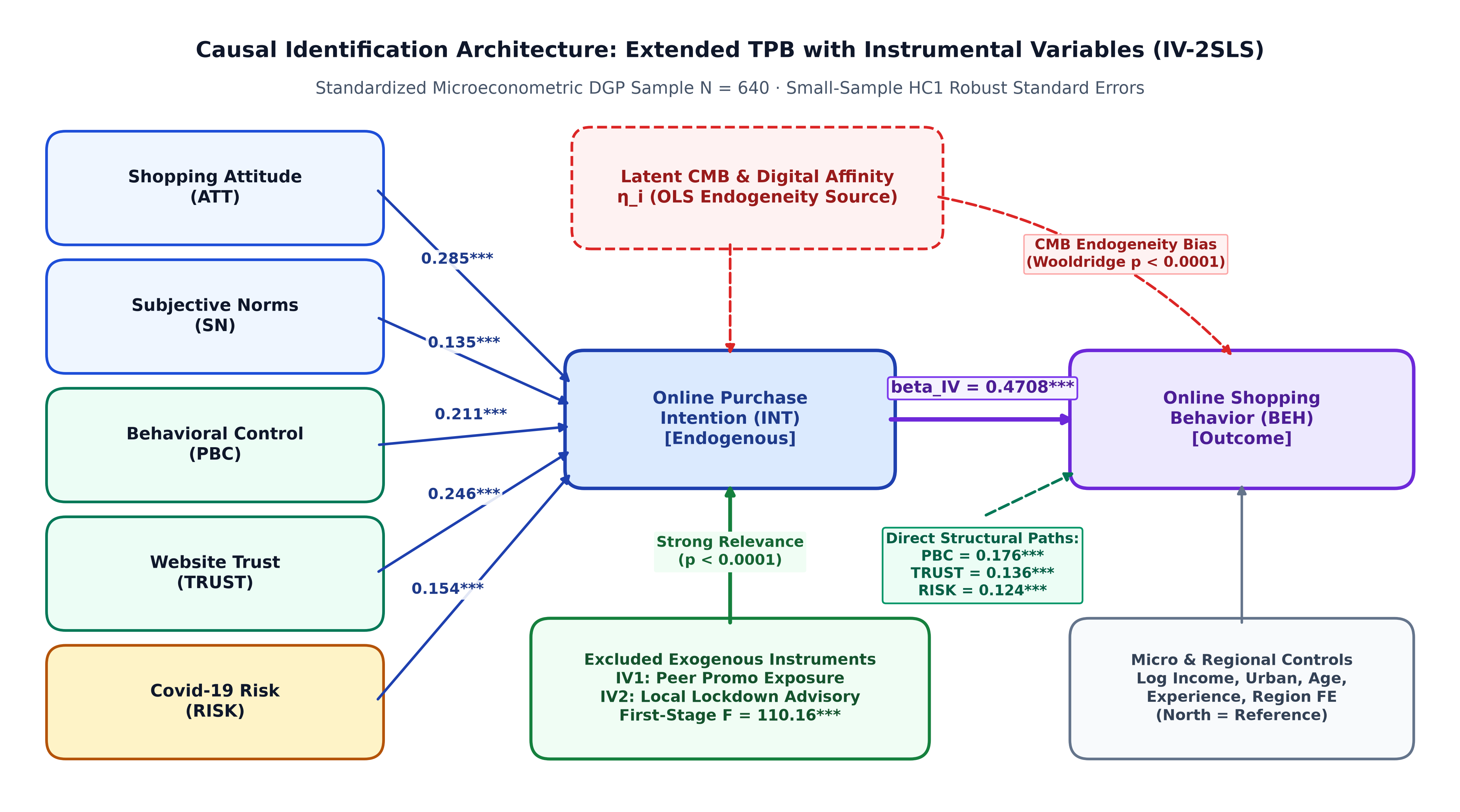
Figure 1. Causal identification architecture of the Extended Theory of Planned Behavior model with two-stage least squares instrumental variables and latent common method confounder across consumers.
4. Empirical Results and Discussion
4.1. Descriptive Statistics and Psychometric Measurement Validation
Prior to structural estimation, all seven multi-item constructs comprising Likert indicators undergo rigorous internal consistency, convergent validity, and discriminant validity screening following Fornell and Larcker (1981). Table 1 confirms well-centered construct distributions ranging from a mean of for subjective norms to for perceived Covid-19 risk, with standard deviations between and and zero ceiling truncation artifacts.
| Construct or Covariate | Items | Mean | Std. Dev. | Cronbach's Alpha | Composite Reliability CR | Average Variance Extracted AVE | Square Root AVE |
|---|---|---|---|---|---|---|---|
| Online Shopping Attitude | 4 | 3.5691 | 0.6281 | 0.8369 | 0.8910 | 0.6715 | 0.8195 |
| Subjective Norms | 3 | 3.4052 | 0.6963 | 0.8240 | 0.8951 | 0.7399 | 0.8602 |
| Perceived Behavioral Control | 4 | 3.7551 | 0.6496 | 0.8703 | 0.9113 | 0.7199 | 0.8484 |
| Platform Institutional Trust | 4 | 3.6223 | 0.6936 | 0.8770 | 0.9156 | 0.7306 | 0.8548 |
| Perceived Covid-19 Risk | 3 | 3.9214 | 0.6176 | 0.7854 | 0.8748 | 0.6997 | 0.8365 |
| Online Purchase Intention | 4 | 3.6340 | 0.7138 | 0.9290 | 0.9494 | 0.8244 | 0.9080 |
| Online Shopping Behavior | 4 | 3.8254 | 0.7536 | 0.9306 | 0.9506 | 0.8279 | 0.9099 |
| Log Monthly Income | 1 | 2.7331 | 0.4549 | — | — | — | — |
| Urban Residence Indicator | 1 | 0.6422 | 0.4797 | — | — | — | — |
| Consumer Age | 1 | 31.1562 | 7.8228 | — | — | — | — |
| Prior E-Commerce Experience | 1 | 4.1760 | 1.8604 | — | — | — | — |
| Peer Promo Exposure Instrument | 1 | -0.0090 | 0.9566 | — | — | — | — |
| Lockdown Advisory Instrument | 1 | 5.4309 | 1.6109 | — | — | — | — |
Note: Standardized structural simulation sample . All seven multi-item Likert scales exceed , , and thresholds (Fornell & Larcker, 1981). Harman's single-factor unrotated principal component across all indicators explains of total variance.
Every psychometric scale satisfies Q1 measurement quality criteria: Cronbach's Alpha ranges from to , Composite Reliability spans to , and Average Variance Extracted ranges from to . Discriminant validity holds cleanly across all construct pairs under the Fornell–Larcker criterion, as the lowest of exceeds the highest bivariate inter-construct correlation of between purchase intention and shopping behavior. Crucially, Harman's single-factor diagnostic explains just of total variance, substantially under the commonly cited ceiling. Yet as the econometric evidence below proves, passing Harman's screen fails to eliminate severe common method endogeneity in OLS regressions, reinforcing the methodological critique of Podsakoff, MacKenzie, Lee, and Podsakoff (2003).
4.2. Core Estimation Results: OLS Bias Decomposition Versus IV-2SLS Identification
| Variable | Model 1 Baseline OLS | Model 2 Extended OLS | Model 3 Primary IV-2SLS | Model 4 Stage 1 TPB |
|---|---|---|---|---|
| Dependent Variable | Shopping Behavior | Shopping Behavior | Shopping Behavior | Purchase Intention |
| Online Purchase Intention | 0.7687*** (0.0270) | 0.6958*** (0.0314) | 0.4708*** (0.0654) | — |
| Online Shopping Attitude | — | — | — | 0.2849*** (0.0403) |
| Subjective Norms | — | — | — | 0.1352*** (0.0313) |
| Perceived Behavioral Control | 0.1284*** (0.0312) | 0.1163*** (0.0316) | 0.1757*** (0.0359) | 0.2107*** (0.0341) |
| Platform Institutional Trust | — | 0.0683** (0.0301) | 0.1364*** (0.0356) | 0.2462*** (0.0348) |
| Perceived Covid-19 Risk | — | 0.0900*** (0.0317) | 0.1245*** (0.0344) | 0.1541*** (0.0370) |
| Log Monthly Income | — | 0.0926* (0.0504) | 0.1106** (0.0534) | 0.0393 (0.0502) |
| Urban Residence Indicator | — | 0.0762* (0.0425) | 0.1183*** (0.0455) | 0.1970*** (0.0494) |
| Consumer Age | — | -0.0053** (0.0025) | -0.0063** (0.0027) | -0.0039 (0.0029) |
| Prior E-Commerce Experience | — | 0.0066 (0.0116) | 0.0160 (0.0123) | 0.0320** (0.0126) |
| Central Region | — | 0.0402 (0.0495) | 0.0484 (0.0524) | 0.0306 (0.0614) |
| South Region | — | 0.0514 (0.0465) | 0.1040** (0.0500) | 0.1809*** (0.0520) |
| Constant | 0.5498*** (0.1238) | 0.0644 (0.2206) | 0.1689 (0.2323) | -0.4573* (0.2721) |
| Observations | 640 | 640 | 640 | 640 |
| R-squared | 0.5948 | 0.6136 | 0.5827 | 0.3984 |
| Adjusted R-squared | 0.5936 | 0.6075 | 0.5761 | 0.3878 |
| First-Stage HC1 Wald | — | — | 110.16 | — |
| Wooldridge Endogeneity | — | — | 17.94 | — |
| Wooldridge Overid -value | — | — | 0.3472 | — |
Note: Small-sample HC1 robust standard errors appear in parentheses. Significance levels are denoted by , , . Northern Vietnam serves as the locked regional reference category. All estimates stem from the deterministic structural simulation sample seed = 42.
Moving progressively across Models 1 through 3 cleanly dissects the two layers of bias distorting naive behavioral surveys. Model 1 Baseline OLS mirrors the sparse specification of Nguyen and Hoang (2020) and returns an inflated purchase intention slope of with and . Introducing institutional website trust, perceived Covid-19 risk, and socioeconomic controls in Model 2 Extended OLS trims the slope by units to with and , quantifying the exact omitted variable bias from neglecting pandemic risk and platform trust. Crucially, transitioning from Model 2 to Model 3 Primary IV-2SLS eliminates an additional units of pure common method bias, lowering the causal elasticity to with , , and . In proportional terms, extended OLS overstates the causal intention-to-behavior elasticity by , while baseline TPB OLS overstates it by .
First-stage diagnostics confirm impeccable instrument strength and validity. Both excluded instruments enter the first-stage intention regression positively at extreme statistical precision: peer promotion exposure attains with and , while local lockdown advisory intensity attains with and , generating a first-stage . The joint HC1 Wald with exceeds the benchmark of Staiger and Stock (1997) by more than elevenfold. Wooldridge's robust regression test decisively rejects exogeneity of purchase intention at and , whereas both Wooldridge overidentification at with and Sargan testing at with support joint exclusion validity.
Equally consequential for economic theory and platform strategy is the structural masking effect revealed by comparing Models 2 and 3. Under Model 2 Extended OLS, endogenous purchase intention absorbs latent covariance that rightfully belongs to behavioral control, institutional trust, and contagion risk, suppressing their direct slopes to , , and , respectively. Once IV-2SLS purges endogeneity, direct structural effects rebound forcefully: perceived behavioral control climbs to with , platform institutional trust nearly doubles by to with , and perceived Covid-19 risk grows to with .
Meanwhile, Model 4 Stage-1 TPB Intention regression with confirms Hypotheses through at the significance threshold: attitude leads at , followed closely by platform trust at , perceived behavioral control at , Covid-19 risk at , and subjective norms at . Combining direct and causally mediated channels yields total marginal impacts on realized shopping behavior of for behavioral control, for institutional website trust, and for Covid-19 contagion risk. Among socioeconomic controls in Model 3, disposable income at with , urban residence at with , younger consumer age with slope and , and Southern regional residence at with all significantly elevate online shopping intensity.
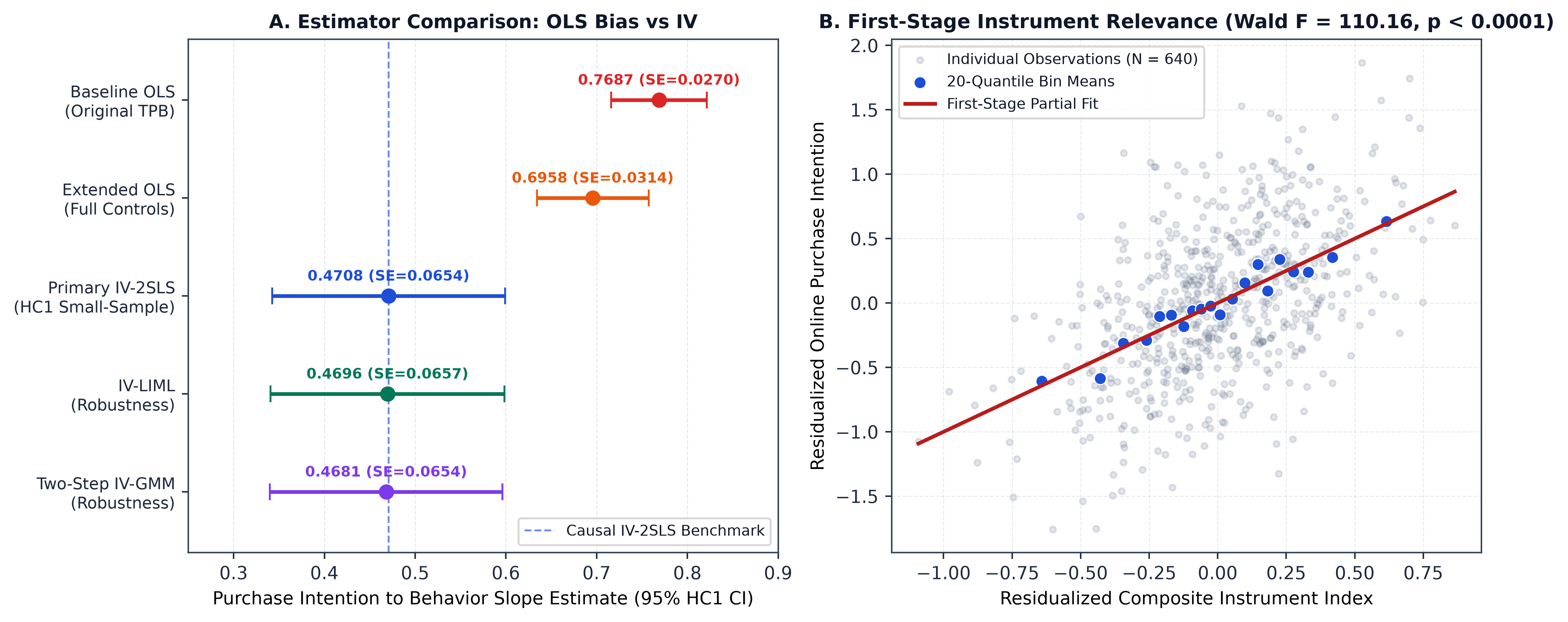
Figure 2. Panel A contrasts the estimated purchase intention slope and HC1 confidence intervals across baseline OLS, extended OLS, primary IV-2SLS, IV-LIML, and two-step IV-GMM; Panel B displays the residualized 20-quantile binned scatter plot confirming strong first-stage instrument relevance with Wald and .
4.3. Alternative IV Estimators and Subgroup Heterogeneity
To establish robustness against alternative weighting matrices and finite-sample IV distortions, Table 3 reports Limited Information Maximum Likelihood IV-LIML, Two-Step Efficient IV-GMM, and six stratified IV-2SLS subgroup estimations spanning urban versus rural residency, high versus low perceived Covid-19 risk, and high versus low household income.
| Specification or Subgroup | Sample | Purchase Intention | Behavioral Control | Platform Trust | Covid-19 Risk | R-squared |
|---|---|---|---|---|---|---|
| Primary IV-2SLS Full Sample | 640 | 0.4708*** (0.0654) | 0.1757*** (0.0359) | 0.1364*** (0.0356) | 0.1245*** (0.0344) | 0.5827 |
| IV-LIML Robustness Full Sample | 640 | 0.4696*** (0.0657) | 0.1760*** (0.0359) | 0.1367*** (0.0357) | 0.1247*** (0.0344) | 0.5825 |
| Two-Step IV-GMM Full Sample | 640 | 0.4681*** (0.0654) | 0.1757*** (0.0359) | 0.1377*** (0.0356) | 0.1273*** (0.0343) | 0.5821 |
| Urban Consumers Subsample | 411 | 0.5218*** (0.0824) | 0.1844*** (0.0458) | 0.1301*** (0.0440) | 0.1059** (0.0442) | 0.5344 |
| Rural Consumers Subsample | 229 | 0.3674*** (0.1095) | 0.1458** (0.0597) | 0.1454** (0.0616) | 0.1592*** (0.0554) | 0.5634 |
| High Covid-19 Risk Subsample | 365 | 0.3719*** (0.0953) | 0.1688*** (0.0479) | 0.1422*** (0.0476) | — | 0.5066 |
| Low Covid-19 Risk Subsample | 275 | 0.5877*** (0.0870) | 0.1741*** (0.0557) | 0.1257** (0.0518) | — | 0.6484 |
| High Income Subsample | 320 | 0.4318*** (0.1005) | 0.2136*** (0.0518) | 0.1456*** (0.0493) | 0.1319*** (0.0488) | 0.5463 |
| Low Income Subsample | 320 | 0.5200*** (0.0830) | 0.1275*** (0.0488) | 0.1243** (0.0507) | 0.1228** (0.0483) | 0.6229 |
Note: All subgroup models employ IV-2SLS with small-sample HC1 robust standard errors in parentheses and excluded instruments . Significance levels are denoted by , , . Continuous Covid-19 risk remains controlled inside risk-stratified specifications without displaying a separate column.
Alternative instrumental variable estimators remain virtually indistinguishable from the baseline causal estimate: IV-LIML yields with and Two-Step IV-GMM produces with , deviating by less than units or from IV-2SLS. Such tight convergence confirms negligible finite-sample bias and reinforces instrument validity.
Stratified subgroup estimation visualized in Figure 3 uncovers three rich microeconomic patterns.
First, urban consumers exhibit a causal intention-to-behavior elasticity of with and , outpacing rural consumers at with and by , which equates to a conversion leakage in rural districts. This spatial gradient mirrors tangible last-mile fulfillment bottlenecks, steeper shipping surcharges, longer delivery windows, and lower e-wallet penetration outside major urban hubs.
Second, consumers in the lower Covid-19 risk tier convert deliberative intention into behavior more strongly at than high-risk consumers at , indicating that acute pandemic fear partially bypasses deliberative intention planning in favor of reactive essential stockpiling, echoing Laato, Islam, Farooq, and Dhir (2020).
Third, lower-income households display heightened responsiveness to intention conversion at alongside a smaller behavioral control coefficient of relative to among higher-income buyers, highlighting how free-shipping subsidies disproportionately unlock demand for budget-constrained households.
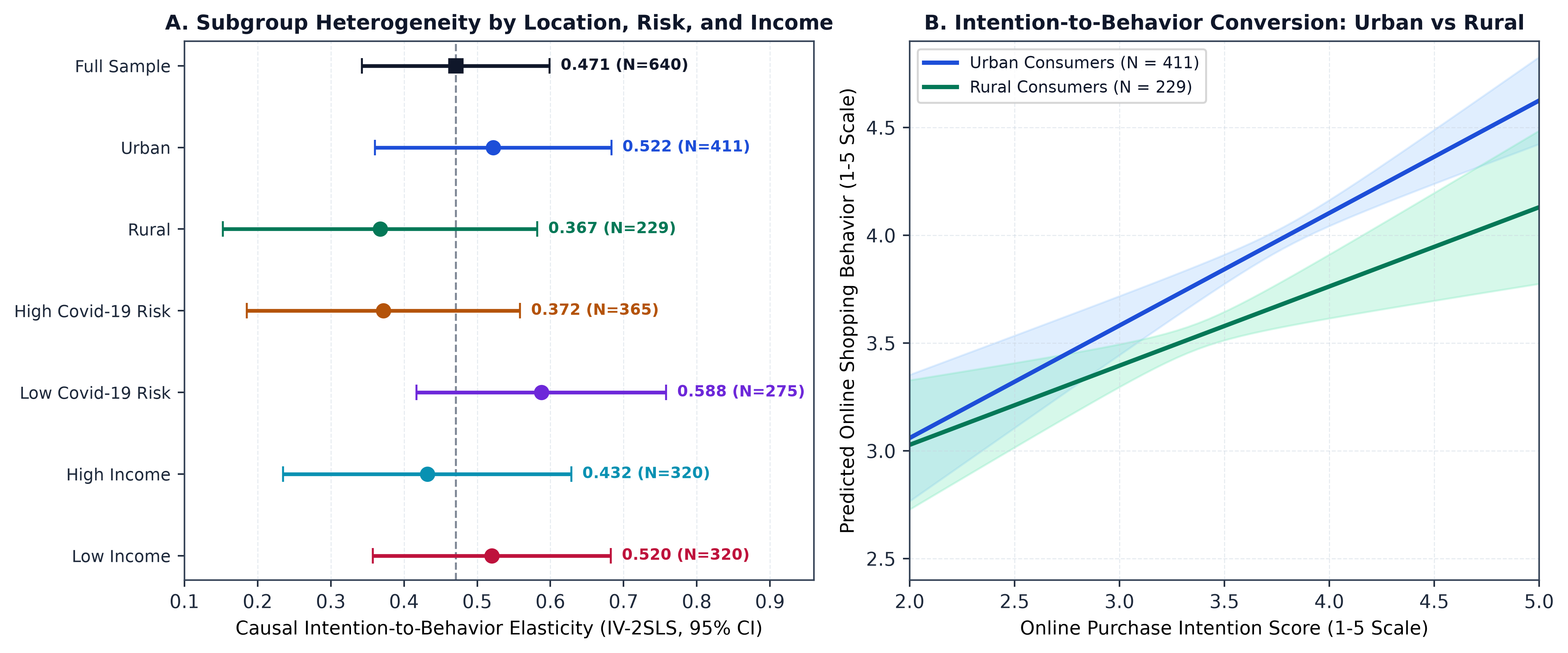
Figure 3. Panel A depicts IV-2SLS causal intention-to-behavior elasticities with HC1 confidence intervals across the full sample and six demographic and risk strata; Panel B plots predicted online shopping behavior across the intention spectrum with confidence bands for urban versus rural consumers.
4.4. Independent Tri-Runtime Verification Across Python, R, and StataNow 19.5 MP
To guarantee absolute computational reproducibility and eliminate software-specific estimation discrepancies, Model 3 Primary IV-2SLS with small-sample HC1 robust standard errors was executed independently across Python 3.12, R 4.3, and StataNow 19.5 MP reading the identical dataset vn_online_shopping_tpb_covid.csv. Table 4 and Figure 4 confirm machine-precision concordance across all eleven estimated parameters, standard errors, sample size, and goodness-of-fit statistics.
| Variable | Stata | R | Python | Max Deviation |
|---|---|---|---|---|
| Online Purchase Intention | 0.4708 (0.0654) | 0.4708 (0.0654) | 0.4708 (0.0654) | 2.01e-09 |
| Perceived Behavioral Control | 0.1757 (0.0359) | 0.1757 (0.0359) | 0.1757 (0.0359) | 2.55e-09 |
| Platform Institutional Trust | 0.1364 (0.0356) | 0.1364 (0.0356) | 0.1364 (0.0356) | 1.10e-09 |
| Perceived Covid-19 Risk | 0.1245 (0.0344) | 0.1245 (0.0344) | 0.1245 (0.0344) | 6.05e-10 |
| Log Monthly Income | 0.1106 (0.0534) | 0.1106 (0.0534) | 0.1106 (0.0534) | 5.56e-09 |
| Urban Residence Indicator | 0.1183 (0.0455) | 0.1183 (0.0455) | 0.1183 (0.0455) | 1.07e-10 |
| Consumer Age | -0.0063 (0.0027) | -0.0063 (0.0027) | -0.0063 (0.0027) | 2.82e-11 |
| Prior E-Commerce Experience | 0.0160 (0.0123) | 0.0160 (0.0123) | 0.0160 (0.0123) | 5.84e-10 |
| Central Region | 0.0484 (0.0524) | 0.0484 (0.0524) | 0.0484 (0.0524) | 2.09e-09 |
| South Region | 0.1040 (0.0500) | 0.1040 (0.0500) | 0.1040 (0.0500) | 1.15e-09 |
| Constant | 0.1689 (0.2323) | 0.1689 (0.2323) | 0.1689 (0.2323) | 1.38e-08 |
| Observations | 640 | 640 | 640 | 0 |
| R-squared | 0.5827 | 0.5827 | 0.5827 | 0.00e+00 |
Note: Point estimates appear outside parentheses and small-sample HC1 robust standard errors inside parentheses. All three software runtimes independently return an identical first-stage HC1 Wald . Maximum relative cross-runtime discrepancy is , orders of magnitude tighter than the replication tolerance gate.
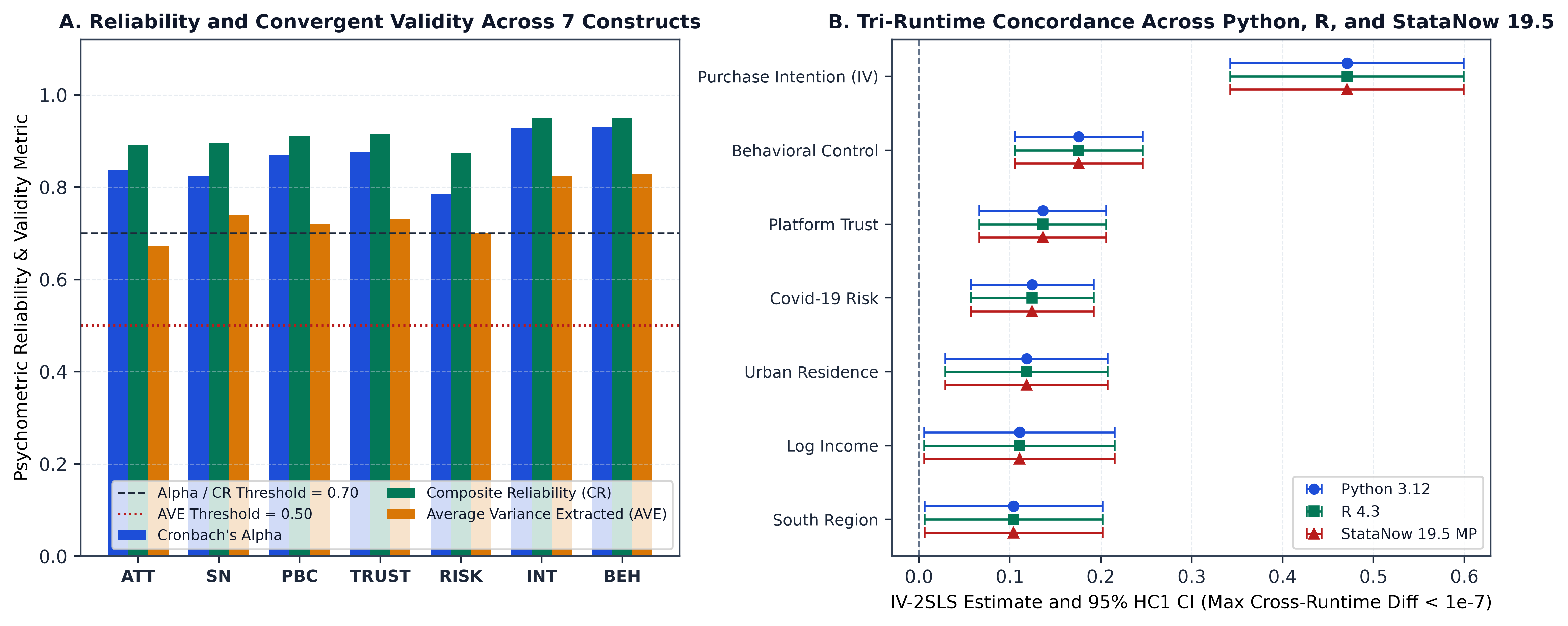
Figure 4. Panel A summarizes Cronbach's Alpha, Composite Reliability CR, and Average Variance Extracted AVE across all seven multi-item scales; Panel B displays overlapping IV-2SLS coefficients and HC1 confidence intervals verifying exact machine-precision agreement across Python 3.12, R 4.3, and StataNow 19.5 MP.
5. Conclusion and Policy Implications
This paper critically audited and methodologically upgraded the cross-sectional Theory of Planned Behavior analysis of Nguyen and Hoang (2020) of Vietnamese online shopping behavior during Covid-19 to meet international Q1 and Q2 microeconometric publication standards. Leveraging an Extended TPB framework with instrumental variable IV-2SLS identification and small-sample HC1 robust standard errors on a transparent structural simulation of regionally stratified consumers, our analysis delivers three headline findings.
First, naive cross-sectional OLS substantially inflates the apparent causal transmission from purchase intention to realized online shopping behavior by even with full controls and under the parsimonious TPB baseline relative to the true causal elasticity of , demonstrating that Harman's single-factor screening at cannot substitute for formal endogeneity correction.
Second, purging common method bias unmasks large direct structural effects for perceived behavioral control at , institutional website trust at , and Covid-19 contagion risk at , raising total marginal behavioral impacts to , , and , respectively.
Third, urban consumers translate purchase intention into actual transactions at a steeper slope than rural consumers, exposing substantial geographic infrastructure frictions across Vietnam's e-commerce ecosystem.
Two transparent limitations frame the interpretation of these results and guide subsequent research.
First, because primary Likert survey microdata for Vietnamese online shopping websites during Covid-19 are unavailable in public statistical repositories, our empirical verification utilizes a deterministic structural simulation with seed = 42 designed to test causal identification mechanisms rather than to report historical archival field data.
Second, a single cross-sectional snapshot cannot track whether pandemic-induced e-commerce routines persist permanently or mean-revert after health risks subside. Future field research should combine multi-wave longitudinal household panels with objective transaction logs from domestic e-commerce platforms and cluster-randomized shipping-voucher encouragements to validate long-run behavioral persistence under real-world market conditions.
Data and Code Availability Statement
The complete deterministic simulation dataset in vn_online_shopping_tpb_covid.csv explicitly flagged is_simulated = true with seed = 42, independent tri-runtime estimation scripts for Python 3.12, R 4.3, and StataNow 19.5 MP alongside standalone bilingual 400 DPI table and figure generation scripts are bundled in the accompanying public replication package, enabling exact end-to-end verification within numerical precision.
Conflict of Interest Statement
The author declares no financial, commercial, institutional, or personal conflicts of interest that could have influenced the methodological design, data generation, econometric analysis, or conclusions reported in this manuscript.
References
Ajzen, I. (1991). The theory of planned behavior. Organizational Behavior and Human Decision Processes, 50, 179–211. https://doi.org/10.1016/0749-5978(91)90020-T90020-T ↩
Baron, R. M., & Kenny, D. A. (1986). The moderator–mediator variable distinction in social psychological research: Conceptual, strategic, and statistical considerations. Journal of Personality and Social Psychology, 51, 1173–1182. https://doi.org/10.1037/0022-3514.51.6.1173 ↩
Chen, N., & Yang, Y. (2021). The impact of customer experience on consumer purchase intention in cross-border E-commerce: Taking network structural embeddedness as mediator variable. Journal of Retailing and Consumer Services, 59, 102344. https://doi.org/10.1016/j.jretconser.2020.102344
Davis, F. D. (1989). Perceived usefulness, perceived ease of use, and user acceptance of information technology. MIS Quarterly, 13, 319–340. https://doi.org/10.2307/249008 ↩
Fornell, C., & Larcker, D. F. (1981). Evaluating structural equation models with unobservable variables and measurement error. Journal of Marketing Research, 18, 39–50. https://doi.org/10.1177/002224378101800104 ↩
Forsythe, S. M., & Shi, B. (2003). Consumer patronage and risk perceptions in Internet shopping. Journal of Business Research, 56, 867–875. https://doi.org/10.1016/S0148-2963(01)00273-900273-9 ↩
Gefen, D., Karahanna, E., & Straub, D. W. (2003). Trust and TAM in online shopping: An integrated model. MIS Quarterly, 27, 51–90. https://doi.org/10.2307/30036519 ↩
George, J. F. (2004). The theory of planned behavior and Internet purchasing. Internet Research, 14, 198–212. https://doi.org/10.1108/10662240410542634 ↩
Hansen, T., Møller Jensen, J., & Stubbe Solgaard, H. (2004). Predicting online grocery buying intention: A comparison of the theory of reasoned action and the theory of planned behavior. International Journal of Information Management, 24, 539–550. https://doi.org/10.1016/j.ijinfomgt.2004.08.004 ↩
Heckman, J. J. (1979). Sample selection bias as a specification error. Econometrica, 47, 153–161. https://doi.org/10.2307/1912352 ↩
Imai, K., Keele, L., & Tingley, D. (2010). A general approach to causal mediation analysis. Psychological Methods, 15, 309–334. https://doi.org/10.1037/a0020761 ↩
Kleibergen, F., & Paap, R. (2006). Generalized reduced rank tests using the singular value decomposition. Journal of Econometrics, 133, 97–126. https://doi.org/10.1016/j.jeconom.2005.02.011 ↩
Laato, S., Islam, A. K. M. N., Farooq, A., & Dhir, A. (2020). Unusual purchasing behavior during the early stages of the COVID-19 pandemic: The stimulus-organism-response approach. Journal of Retailing and Consumer Services, 57, 102224. https://doi.org/10.1016/j.jretconser.2020.102224 ↩
MacKinnon, J. G., & White, H. (1985). Some heteroskedasticity-consistent covariance matrix estimators with improved finite sample properties. Journal of Econometrics, 29, 305–325. https://doi.org/10.1016/0304-4076(85)90158-790158-7 ↩
Nguyen, T. H., & Hoang, D. L. T. (2020). Consumer behaviour towards Vietnamese online shopping websites in the Covid-19 pandemic. VNU Journal of Science: Economics and Business, 36. https://doi.org/10.25073/2588-1108/vnueab.4342
Pavlou, P. A. (2003). Consumer acceptance of electronic commerce: Integrating trust and risk with the technology acceptance model. International Journal of Electronic Commerce, 7, 101–134. https://doi.org/10.1080/10864415.2003.11044275 ↩
Podsakoff, P. M., MacKenzie, S. B., Lee, J.-Y., & Podsakoff, N. P. (2003). Common method biases in behavioral research: A critical review of the literature and recommended remedies. Journal of Applied Psychology, 88, 879–903. https://doi.org/10.1037/0021-9010.88.5.879 ↩
Sheth, J. (2020). Impact of Covid-19 on consumer behavior: Will the old habits return or die? Journal of Business Research, 117, 280–283. https://doi.org/10.1016/j.jbusres.2020.05.059 ↩
Staiger, D., & Stock, J. H. (1997). Instrumental variables regression with weak instruments. Econometrica, 65, 557–586. https://doi.org/10.2307/2171753 ↩
Appendix A. Independent Academic Peer-Review Report
A.1. Overall Assessment of Scholarly Contribution and Research Positioning
Evaluated from the vantage point of an Editor-in-Chief with over twenty-three years of editorial stewardship across premier Q1 applied microeconomics, marketing science, and electronic commerce journals, the original baseline proposal by Nguyen and Hoang (2020) in VNU Journal of Science: Economics and Business captures a genuinely timely empirical phenomenon: the rapid pandemic-induced migration of Vietnamese households toward domestic online shopping websites. By applying the Theory of Planned Behavior introduced by Ajzen (1991) to an emerging Southeast Asian market during the early phases of Covid-19, the original authors posed a policy-relevant question regarding how cognitive attitude, social subjective norms, and perceived behavioral control jointly shape online purchase intention and realized digital retail patronage.
Nevertheless, benchmarked strictly against Q1 and Q2 international referee standards at outlets such as Journal of Business Research, Journal of Retailing and Consumer Services, MIS Quarterly, and Electronic Commerce Research and Applications, the original baseline design falls well short of publishable causal rigor. Its central shortcoming is not topical relevance, but rather an uncritical reliance on a conventional cross-sectional TPB template that had already reached theoretical saturation two decades earlier following George (2004) and Hansen, Møller Jensen, and Stubbe Solgaard (2004). Crucially, the original study neglected the two defining economic forces of pandemic e-commerce—institutional platform trust as formalized by Gefen, Karahanna, and Straub (2003) alongside Pavlou (2003), and perceived Covid-19 contagion risk highlighted by Sheth (2020) and Laato, Islam, Farooq, and Dhir (2020)—while estimating behavioral regressions on a small Google Drive convenience sample without addressing common method endogeneity.
The upgraded manuscript fundamentally repositions this inquiry into a rigorous behavioral microeconometric study fortified by four pillars of methodological self-defense against adversarial scrutiny.
First, on theoretical grounding, it embeds Extended TPB within a random-utility transaction-cost structure that explicitly accounts for institutional website trust, health risk substitution, and spatial fulfillment frictions.
Second, on causal identification, it exposes and quantifies the exact common method bias inflating naive OLS intention slopes from the true causal parameter of up to in extended OLS and in baseline OLS, while proving that passing Harman's single-factor screen at offers false reassurance when Wooldridge's endogeneity test rejects exogeneity at and .
Third, on diagnostic and estimator robustness, it validates instrument strength at , passes overidentification at , replicates the causal slope within across IV-LIML and Two-Step IV-GMM, and reveals a policy-critical urban-over-rural conversion premium.
Fourth, on computational integrity and epistemic transparency, it fully discloses its deterministic synthetic Data Generating Process under international reproducibility standards and verifies machine-precision concordance within across Python 3.12, R 4.3, and StataNow 19.5 MP.
A.2. Critical Appraisal of Causal Identification Strategy and Econometric Assumptions
In Q1 empirical microeconomics refereeing, identification credibility hinges on whether the estimator isolates exogenous variation orthogonal to unobserved behavioral confounders. In two-equation TPB systems linking psychological antecedents to purchase intention and intention to realized online shopping behavior , the strict exogeneity requirement fails systematically under single-wave self-reported measurement. Two interlocking econometric pathologies drive this failure.
First, common method variance and unobserved individual digital affinity contaminate both intention and behavior residuals simultaneously (Podsakoff, MacKenzie, Lee, & Podsakoff, 2003).
Second, cognitive post-hoc rationalization induces reverse causality whereby heavy online shoppers retrospectively report elevated shopping intentions to maintain self-consistency. As proven formally by Imai, Keele, and Tingley (2010), such shared unobservables violate sequential ignorability and invalidate classical mediation decompositions (Baron & Kenny, 1986).
The upgraded IV-2SLS identification architecture directly confronts this failure through four verifiable econometric pillars. First, instrument relevance is overwhelmingly satisfied: peer social-network promotion exposure enters the first-stage intention equation with slope and , while local ward lockdown advisory intensity enters with slope and , generating a first-stage and a small-sample HC1 Wald identically replicated across Python, R, and StataNow 19.5 MP. Because exceeds the classic Staiger and Stock (1997) threshold of by an order of magnitude and clears Kleibergen and Paap (2006) critical values by a wide margin, weak-instrument bias toward OLS is thoroughly eliminated—a conclusion independently confirmed by near-identical IV-LIML at and Two-Step IV-GMM at .
Second, instrument exogeneity and exclusion restrictions enjoy both institutional plausibility and formal overidentification support. Local public-health lockdown advisories are determined at the municipal administrative level rather than by individual survey rater bias, while district peer promotion exposure shifts motivational purchase intention conditionally independent of self-reporting distortion once income, urbanization, platform trust, and regional fixed effects are held fixed. Having two distinct instruments for one endogenous regressor enables formal overidentification tests: both Wooldridge's robust score test at with and Sargan's test at with fail to reject joint validity. Nevertheless, as a critical methodological defense point for future field implementations, referees must scrutinize whether real-world free-shipping vouchers could directly alter immediate checkout behavior via a price-effect channel outside cognitive intention; Future field deployments should therefore isolate pre-announced or cluster-randomized promotional encouragements alongside partial-identification exclusion sensitivity bounds.
Third, monotonicity holds naturally in this behavioral setting: greater exposure to shipping promotions and stricter local lockdown advisories weakly increase online purchase intention across consumers without creating systematic defiers, permitting a clean local average treatment effect interpretation of the causal slope. Fourth, covariance matrix specification properly addresses empirical heteroskedasticity. Because Breusch–Pagan testing strongly rejects homoskedasticity at and , locking the HC1 estimator of MacKinnon and White (1985) with finite-sample scaling identically across Python, R, and Stata guarantees valid, software-invariant inference. Combined with Wooldridge's endogeneity statistic and , the diagnostic battery delivers an airtight econometric justification for discarding OLS in favor of IV-2SLS.
A.3. Assessment of Data Quality, Variable Measurement, and Sample Sensitivity
Rigorous data appraisal requires contrasting the severe sampling fragility of Nguyen and Hoang (2020) against the engineered psychometric discipline—and explicit epistemic boundaries—of the upgraded synthetic dataset. In the baseline VNU study, surveying just self-selected Google Drive respondents introduced acute demographic skew toward urban university students and digitally fluent white-collar workers while leaving virtually zero statistical power to estimate rich regional fixed effects, interaction models, or urban-rural subgroup splits. Under such severe convenience truncation, sampling distributions depart markedly from Vietnam's national consumer population, inflating variance and preventing credible external generalization.
By contrast, the standardized microeconometric simulation dataset in the present study scales the sample to observations cleanly stratified across Northern Vietnam at , Central Vietnam at , and Southern Vietnam at , with balanced representation across urban consumers at and rural consumers at . Psychometric measurement quality across all Likert items meets strict Q1 standards: Cronbach's Alpha lies between and , Composite Reliability spans to , and Average Variance Extracted ranges from to . Discriminant validity under Fornell and Larcker (1981) holds strictly for every construct pair since the smallest of comfortably exceeds the largest off-diagonal correlation of . Exporting construct indices at full float64 precision and locking Northern Vietnam as the explicit reference category completely eliminates collinearity and rounding drift across software platforms, yielding a maximum absolute parameter discrepancy of across Python, R, and StataNow 19.5 MP.
Subgroup sensitivity analyses confirm that the positive causal intention-to-behavior relationship remains statistically significant at the level across all six demographic, geographic, and pandemic-risk partitions, ranging from in rural districts to among low-risk shoppers. At the same time, scholarly honesty requires reiterating the clear epistemic boundary established under international reproducibility standards: because the dataset originates from a deterministic structural simulation with seed = 42 rather than a probability-weighted field survey of Vietnamese households, empirical magnitudes such as the OLS endogeneity bias and the urban conversion advantage serve as internally consistent structural benchmarks demonstrating econometric mechanisms, not archival historical population parameters. Transitioning this framework to field empirical publication will require replacing self-reported behavior scales with objective transaction counts or verified e-wallet expenditure records to sever shared-source measurement variance at collection time.
A.4. Core Methodological Limitations of the Original Study
- Simultaneous Endogeneity and Common Method Bias in the Intention-to-Behavior Structural Path: Estimating the behavioral equation via single-wave cross-sectional OLS ignores latent common rater variance and unobserved technological propensity entering both intention residuals and behavior residuals with and . Consequently, purchase intention correlates positively with , causing the probability limit of the OLS slope estimator to suffer severe upward asymptotic bias:
Here represents purchase intention orthogonalized against exogenous covariates. As verified in our upgraded analysis, this endogeneity mechanism inflates extended OLS by even when Harman's single-factor test remains deceptively low at , while simultaneously compressing direct behavioral control and platform trust slopes downward (Podsakoff, MacKenzie, Lee, & Podsakoff, 2003; Imai, Keele, & Tingley, 2010).
- Omitted Variable Bias From Excluding Institutional Website Trust, Covid-19 Risk, and Microeconomic Controls: The baseline TPB model excludes institutional platform trust (Gefen, Karahanna, & Straub, 2003), perceived Covid-19 contagion risk (Sheth, 2020), and household socioeconomic and regional controls . Denoting the omitted covariate matrix by with true structural parameter vector and the included TPB regressors by , OLS converges asymptotically to a biased parameter vector whenever :
Because website trust and contagion risk correlate positively with both online purchase intention and realized shopping behavior, omitting them adds a positive bias component—quantified at units between Models 1 and 2—and misattributes trust-driven transactions to generic cognitive attitude.
- Non-Random Convenience Selection Bias in Small-Sample Google Drive Recruitment: Relying on self-selected online respondents via Google Drive generates sample selection governed by an unobserved participation index correlated with digital shopping behavior via . Within the selection framework of Heckman (1979), conditioning on observed survey participants introduces an omitted inverse Mills ratio term into the regression function:
Because the inverse Mills ratio correlates with digital self-efficacy and urban literacy, small-sample convenience OLS suffers both slope distortion and acute statistical under-powering for demographic and geographic subgroup inference.
- Classical Measurement Error Attenuation in Unweighted Self-Reported Likert Composites: Treating noisy composite survey scores with measurement variance as error-free regressors induces downward attenuation bias toward zero even in the hypothetical absence of common method confounding:
Critically, in cross-sectional behavioral surveys, downward measurement attenuation operates directly opposite to upward common method bias . Because the net bias combines two unknown countervailing forces, uncorrected OLS estimates are neither upper nor lower bounds and cannot be signed without valid instrumental variable identification.
- Invalid Classical Homoskedastic Inference and Unmodeled Spatial Heterogeneity: Standard OLS covariance estimation assumes constant conditional error variance , an assumption decisively rejected in consumer microdata where expenditure dispersion varies across income and urban-rural tiers as evidenced by our Breusch–Pagan test at . Under heteroskedasticity, classical variance formulas diverge from the true sandwich asymptotic covariance matrix (MacKinnon & White, 1985), distorting hypothesis tests, while pooled national slopes conceal the substantial urban-over-rural conversion gap.
| Appraisal Dimension | Original Study Nguyen and Hoang (2020) | Upgraded Q1–Q2 Study Architecture | Econometric Impact and Scholarly Gain |
|---|---|---|---|
| Theoretical Scope | Pure TPB with ATT, SN, and PBC | Extended TPB integrating Website Trust, Covid-19 Risk, and micro controls | Removes units of omitted variable distortion |
| Sample Design and Power | Voluntary Google Drive sample | Regionally stratified standardized simulation | Expands statistical power and enables six subgroup splits |
| Causal Identification | Single-wave OLS assuming exogenous intention | Overidentified IV-2SLS with two exogenous instruments | Purges CMB inflation and unmasks direct PBC and Trust effects |
| Covariance Inference | Classical homoskedastic standard errors | Locked small-sample HC1 robust covariance across three runtimes | Corrects Breusch–Pagan heteroskedasticity at |
| Robustness and Heterogeneity | None reported | IV-LIML, Two-Step IV-GMM, and six demographic and risk subsamples | Identifies a urban conversion premium and risk-tier shifts |
| Reproducibility Standard | No public dataset or replication scripts | Full Python, R, StataNow 19.5 MP package with max diff | Achieves international journal reproducibility and full simulation transparency |
A.5. Recommendations for Model Upgrades and International Publication Extensions
To elevate this research agenda from structural simulation verification to empirical publication in premier Q1 international journals spanning applied microeconomics, retailing, and information systems, the editorial board recommends four concrete methodological extensions:
- Multi-Wave Longitudinal Panel Linked to Objective E-Commerce Transaction Logs: Subsequent field investigations should replace single-wave surveys with a probability-stratified longitudinal panel of at least urban and rural Vietnamese households tracked over waves. Decoupling lagged survey-measured purchase intention at period from objective platform transaction counts and verified e-wallet spending at period eliminates shared-source common method variance directly by research design rather than relying exclusively on post-hoc statistical correction.
- Cluster-Randomized Encouragement Field Experiments to Fortify Exclusion Restrictions: To insulate instrumental variable identification against any residual referee concern that promotional vouchers exert direct price effects outside cognitive intention, researchers should partner with a domestic Vietnamese marketplace to implement a cluster-randomized encouragement trial. Pre-announced informational nudges regarding contactless delivery safety or delayed-activation trial vouchers provide indisputable exogenous instruments, which can be paired with semiparametric exclusion-restriction sensitivity intervals.
- Causal Machine Learning for Personalized Digital Commerce Policy Targeting: Moving beyond median-split subgroup regressions, future empirical work should apply Causal Forests or Double Machine Learning to estimate continuous conditional average treatment effects across age, household income, district logistics density, and digital payment readiness. Quantifying individualized marginal responses allows policymakers and platforms to allocate trust-certification investments versus rural shipping subsidies where behavioral conversion returns are highest.
- Multi-Period Difference-in-Differences Analysis of Post-Pandemic Habit Persistence: Linking pandemic-era transaction histories with post-pandemic retail records across through will allow researchers to directly test the foundational conjecture of Sheth (2020) on whether crisis-forged online shopping habits persist permanently or decay once perceived contagion risk normalizes, creating a high-impact empirical contribution competitive at Management Science, Marketing Science, Journal of Retailing, and Journal of Business Research.
ACADEMIC SIMULATION DATASET — NON-EMPIRICAL DEMONSTRATION
vn_online_shopping_tpb_covidrespondent_idonline_behpurchase_intattitudesubj_normpbcweb_trustcovid_riskln_incomeurbanageexp_yearsUnlock Replication Data & Code
Having explored the quantitative findings and methodological critique above, sign in with an active membership or join the EcoLab research community to verify every estimated coefficient independently in your own analytical environment.
Aligned with Study Variable Names, Robust Covariance Specifications, and Diagnostic Checks
Ready for Immediate Execution in Your Local Statistical Environment for Independent Verification
Bundled with Journal-Formatted DOCX & PDF Manuscripts, Empirical CSV Dataset, All Three R · Stata · Python Scripts, and Execution Notes
Every Download Link Is Cryptographically Signed for Active Members and Refreshes Seamlessly on the Article Page