Keywords: Economics of education; Medical competency production function; Outcome-based education; Instrumental variables IV-2SLS; Multi-way fixed effects; Supermodular complementarity; Tri-runtime reproducibility.
JEL Classification: I21; I23; I18; C26; J24.
List of Abbreviations and Mathematical Notation
| Symbol or Abbreviation | Full Term | Analytical Role in the Dissertation |
|---|---|---|
| OBE | Outcome-Based Education | Curriculum architecture and competency assessment standard |
| PLO | Program Learning Outcomes | Aggregate competency attainment benchmark for medical graduates |
| OSCE | Objective Structured Clinical Examination | Standardized multi-station practical clinical skills outcome |
| HPMU | Hai Phong University of Medicine and Pharmacy | Institutional benchmark governing cohort and hospital structure |
| OLS | Ordinary Least Squares | Naive correlational baseline quantifying endogeneity bias |
| FE | Fixed Effects | Controls absorbing cohort and teaching-hospital heterogeneity |
| IV-2SLS | Two-Stage Least Squares Instrumental Variables | Primary causal identification estimator |
| HC1 | Heteroskedasticity-Consistent Small-Sample Covariance | Harmonized variance estimator across Python, R, and StataNow |
| CRV1 | Cluster-Robust Small-Sample Covariance | Robustness inference clustered across 40 clinical rotation groups |
| LATE | Local Average Treatment Effect | Structural causal interpretation of IV-2SLS for compliers |
| DGP | Data-Generating Process | Deterministically calibrated synthetic benchmark with seed 42 |
| VIF | Variance Inflation Factor | Multicollinearity diagnostic across regressors |
| Composite OBE Competency Score for student , cohort , hospital | Primary dependent variable measured on a 0 to 100 scale | |
| Weekly Supervised Bedside Clinical Practice Hours | Focal endogenous treatment regressor | |
| Faculty Clinical Mentorship Quality Index | Key pedagogical input and supermodular complement | |
| Constructive Curriculum Alignment Index | Program-level instructional coherence indicator | |
| Ward Patient-Inflow Shock and Simulation-Lab Quota | Pair of excluded exogenous administrative instruments | |
| Unobserved Innate Medical Ability and Intrinsic Motivation | Structural source of omitted-variable endogeneity | |
| Clinical Cohort and Teaching Hospital Fixed Effects | Institutional confounding controls | |
| Clinical Hours by Faculty Mentorship Interaction Parameter | Measure of supermodular complementarity in skill formation |
Chapter 1. Introduction and Research Positioning
1.1. Institutional Context and Economic Rationale
Within modern microeconomics of human capital, the productivity of a healthcare workforce depends not on nominal years of medical schooling completed, but on verified mastery of clinical, diagnostic, and procedural competencies at graduation. Over the past three decades, medical universities worldwide have transitioned from time-based, lecture-centric curricula toward Outcome-Based Education and competency-based medical education architectures designed explicitly around measurable clinical outcomes (Harden et al., 1999; Frank et al., 2010; Epstein, 2007). In Vietnam, this structural transformation carries heightened urgency as public medical universities modernize six-year Doctor of Medicine programs to meet national competency standards promulgated by the Ministry of Health and prepare graduates for mandatory national medical licensing examinations.
Hai Phong University of Medicine and Pharmacy anchors medical workforce formation across Vietnam's northern coastal corridor and maritime health network. Like peer public medical institutions across rapidly developing economies, its clinical training ecosystem confronts three acute microeconomic allocation challenges.
First, fourth-year through sixth-year medical cohorts rotate across affiliated provincial and university teaching hospitals that experience uneven bed occupancy and case-mix congestion, generating substantial dispersion in real bedside clinical exposure.
Second, physician-faculty members simultaneously shoulder heavy clinical service loads and bedside teaching responsibilities, creating pronounced variation in formative feedback and direct procedural supervision across wards.
Third, persistent disparities in pre-university academic preparation and academic capital between rural-origin and urban-origin entrants require administrators to identify precisely which instructional inputs yield the highest marginal competency gains and narrow achievement gaps most effectively.
The original 2026 doctoral proposal by Vu Thi Thu Hang at the University of Education, Vietnam National University Hanoi, identified this vital institutional problem by investigating Program Learning Outcomes attainment among medical students at Hai Phong University of Medicine and Pharmacy through an educational measurement and mixed-methods evaluation lens. Yet when evaluated against contemporary standards of applied microeconometrics and economics of education, conventional descriptive surveys and single-equation correlational models suffer a decisive identification gap. Observed positive associations between clinical practice hours, perceived instructional quality, and competency scores conflate genuine causal productivity with endogenous self-selection by intrinsically higher-ability students. Allocating scarce university budgets on the basis of upward-biased naive correlations risks over-investing in unguided clinical rotation hours while under-funding faculty supervision incentives and curriculum alignment reforms.
1.2. General and Specific Research Objectives
The overarching objective of this dissertation is to construct a microeconomic competency production function for clinical medical training, establish a credible multi-way fixed-effects instrumental-variables identification strategy FE IV-2SLS, and deliver unbiased, tri-runtime-verified causal estimates of pedagogical returns, input complementarities, and distributional equity to guide institutional resource allocation.
Five operational objectives translate this overarching goal into testable empirical deliverables.
First, the dissertation integrates human-capital production theory with medical competency frameworks and derives analytically five econometric bias mechanisms invalidating naive OLS assessment models.
Second, it maps the full distribution of composite OBE competency scores, Objective Structured Clinical Examination practical skills, diagnostic reasoning performance, and mastery pass rates across clinical cohorts Y4 through Y6 and four teaching hospitals.
Third, it isolates the unbiased causal local average treatment effect of supervised clinical hours alongside faculty mentorship, constructive curriculum alignment, self-directed study, pre-university entrance scores, and simulation infrastructure while quantifying the exact upward bias of naive OLS.
Fourth, it tests supermodular complementarity between clinical practice intensity and faculty mentorship quality, contrasts skill-formation technologies across OSCE practical performance versus diagnostic reasoning, and measures distributional heterogeneity across quantiles and rural versus urban student origins.
Fifth, it establishes strict numerical reproducibility across Python 3, R 4, and StataNow 19.5 MP and synthesizes tiered short-, medium-, and long-term policy reforms.
1.3. Research Questions
Five tightly linked research questions organize the empirical inquiry:
- How do composite OBE mastery scores, competency pass rates, OSCE practical skills, and diagnostic reasoning outcomes evolve across clinical cohorts Y4, Y5, and Y6 and diverge across affiliated teaching hospitals?
- To what quantitative extent do naive OLS and fixed-effects OLS overstate the marginal causal return to weekly supervised clinical practice hours due to omitted innate ability and institutional sorting relative to FE IV-2SLS?
- Controlling simultaneously for endogeneity, baseline academic stock, and multi-way fixed effects, what are the unbiased causal effects of clinical practice hours, faculty mentorship quality, OBE curriculum alignment, self-study hours, and simulation facilities on competency scores and mastery attainment probabilities?
- Does clinical practice intensity exhibit supermodular complementarity with faculty mentorship quality in medical skill formation, and how does the production technology of hands-on OSCE skills differ from that of clinical diagnostic reasoning?
- How do the causal returns to pedagogical inputs vary across the conditional competency distribution from at-risk bottom-quartile learners at Q25 to top-quartile achievers at Q75, as well as between rural-origin and urban-origin medical students?
1.4. Scope, Institutional Setting, and Data Transparency Statement
The object of investigation is the microeconomic production function linking individual, pedagogical, and hospital-level inputs to standardized medical competency attainment during clinical clerkship years. Substantively, the study analyzes four complementary outcomes: Composite OBE competency score on a 0 to 100 scale, practical OSCE skills score, evidence-based diagnostic reasoning score, and a binary mastery indicator equal to one when the composite score reaches or exceeds 70.0 points. Input variables encompass endogenous weekly supervised clinical hours, faculty clinical mentorship quality, constructive OBE curriculum alignment, weekly self-directed study hours, national Block B00 medical entrance exam scores, simulation and learning facility access, gender, and rural pre-university origin.
Spatially and temporally, the structural calibration mirrors the six-year undergraduate Doctor of Medicine curriculum at Hai Phong University of Medicine and Pharmacy during the 2024 to 2026 outcome-based curriculum reform cycle, encompassing clinical cohorts Y4, Y5, and Y6 across four teaching hospitals and 40 clerkship rotation groups.
1.5. Methodology and Original Contributions
Methodologically, the dissertation pairs structural microeconomic modeling with overidentified FE IV-2SLS estimation, control-function quantile regression, and independent tri-runtime software verification. Two administrative instruments—computerized clerkship patient-inflow shocks and pre-scheduled simulation-laboratory quotas—provide an overidentified system enabling direct verification of first-stage instrument relevance following Staiger and Stock (1997) and Stock and Yogo (2002), robust score endogeneity testing following Wooldridge (2015), and heteroskedasticity-robust Hansen J overidentification testing. All primary standard errors apply the small-sample heteroskedasticity-consistent HC1 covariance estimator of MacKinnon and White (1985), cross-validated against small-sample cluster-robust CRV1 inference across 40 rotation groups following Cameron and Miller (2015).
The dissertation makes three distinct contributions. Theoretically, it bridges education production functions (Hanushek, 1987; Todd & Wolpin, 2003) with multi-input skill-formation complementarity (Cunha & Heckman, 2007) and medical assessment frameworks (Miller, 1990; Biggs, 1996), demonstrating that bedside clinical hours and faculty mentorship operate as strict supermodular complements rather than separable additive inputs. Methodologically, it resolves endogeneity and Moulton clustering pitfalls in medical education evaluation via a transparent two-instrument FE IV-2SLS design verified to within 0.000024% relative precision across Python 3, R 4, and StataNow 19.5 MP. Practically, it equips medical school deans and national health-education policymakers with concrete marginal-return parameters demonstrating that upgrading faculty supervision and constructive alignment yields both higher overall competency and substantial equity gains for rural and at-risk students.
1.6. Structure of the Dissertation
Beyond the Abstract, List of Abbreviations, References, and Appendix A containing the independent academic peer-review report, the dissertation unfolds across five chapters. Chapter 1 establishes institutional motivation, objectives, research questions, scope, data transparency, and scholarly contributions. Chapter 2 develops the theoretical microeconomic model, synthesizes international and domestic literature with a structured research-gap table, and states five testable hypotheses. Chapter 3 details the calibrated data-generating process, variable definitions, formal bias derivations, FE IV-2SLS identification strategy, and diagnostic protocol. Chapter 4 reports descriptive patterns, first-stage and endogeneity diagnostics, baseline versus FE IV-2SLS comparisons, tri-runtime parity verification, supermodular complementarity, competency disaggregation, and quantile/origin heterogeneity accompanied by four high-resolution figures. Chapter 5 synthesizes findings against global literature, answers each research question, formulates tiered policy recommendations, and outlines limitations and future empirical extensions.
Chapter 2. Theoretical Framework, Literature Review, and Hypotheses
2.1. Human Capital Theory and the Microeconomic Education Production Function
The theoretical foundation of competency evaluation in medical education lies in human capital theory pioneered by Becker (1993) and the education production function paradigm formalized by Hanushek (1987). Under this economic lens, a six-year medical degree represents a sequential human-capital investment process converting scarce time, pre-university cognitive stock, physician-faculty supervision, and teaching-hospital infrastructure into clinical diagnostic and procedural capability. Because clinical error imposes severe negative externalities on patient safety, evaluating output solely through course credits or rote memorization grades is economically inefficient; Objective competency attainment under Outcome-Based Education constitutes the appropriate welfare-relevant output metric.
Extending Hanushek (1987), Todd and Wolpin (2003) formulated the canonical cumulative cognitive achievement production function expressing a student's attainment at stage as a function of cumulative personal and family inputs, cumulative institutional inputs, unobserved permanent ability , and contemporaneous assessment shocks:
The structural components of this cumulative specification are defined as follows:
- denotes the complete history of student-level effort, demographic endowments, and pre-university preparation up to clinical stage .
- represents institutional and hospital-level instructional inputs including clinical supervision, curriculum design, and simulation access.
- captures unobserved innate cognitive ability, psychomotor dexterity, and intrinsic medical motivation.
- denotes random measurement or assessment shocks realized during evaluation.
Todd and Wolpin (2003) proved that estimating contemporaneous specifications via OLS without observing generates severe omitted-variable bias whenever higher-ability learners sort systematically into more intensive training opportunities or stronger clinical sites.
To uncover how clinical inputs interact inside the production technology, this dissertation incorporates the multi-input skill-formation technology of Cunha and Heckman (2007). Modeling clinical competency via a generalized constant-elasticity-of-substitution aggregator combining bedside clinical practice intensity and faculty clinical mentorship quality alongside baseline controls yields:
Whenever the substitution parameter satisfies , implying finite elasticity of substitution , the cross-partial derivative is strictly positive:
Microeconomically, this condition defines supermodular complementarity. Unsupervised hours spent passively observing crowded hospital wards convert weakly into clinical mastery; When paired with structured preceptor feedback, bedside case interrogation, and deliberate skills coaching, each additional clinical hour produces markedly higher competency gains. Taking a second-order local approximation around sample means yields the empirical interaction term tested directly in Chapter 4.
2.2. Outcome-Based Medical Education, Constructive Alignment, and Miller's Pyramid
Three foundational pillars from international medical education science anchor the empirical operationalization of inputs and outcomes.
First, Outcome-Based Education—introduced by Mitchell and Spady (1978) and adapted specifically to clinical medicine by Harden et al. (1999) and Frank et al. (2010)—reverses traditional syllabus design by starting from verified graduate competencies and designing clerkships, simulation modules, and examinations backward from those benchmarks.
Second, Biggs (1996) established constructive alignment theory, proving that deep competency acquisition emerges only when intended learning outcomes, bedside instructional activities, and summative examination rubrics reinforce one another coherently. Misaligned assessment systems that preach clinical proficiency while testing pure factual recall distort student time allocation away from practical skill mastery.
Third, Miller (1990) structured clinical competence into a hierarchical four-tier pyramid progressing from foundational factual knowledge and clinical reasoning up to demonstrable skills in controlled settings and independent bedside performance. Coupled with the Objective Structured Clinical Examination pioneered by Harden and Gleeson (1979) and synthesized by Epstein (2007), Miller's framework implies a vital production-function prediction: Hands-on practical OSCE competency and cognitive diagnostic reasoning rely on distinct input intensities. Practical OSCE proficiency draws heavily upon supervised bedside clinical volume, preceptor feedback, and physical simulation laboratories, whereas diagnostic reasoning draws disproportionately on self-directed case study, pre-university analytical foundations, and tight constructive alignment of academic curricula.
2.3. Synthesis of International and Domestic Empirical Literature
2.3.1. Causal Microeconometrics in the Economics of Education
Over the past quarter-century, empirical economics of education has shifted decisively from descriptive production regressions to quasi-experimental causal inference. Reviewing two decades of developing-country evidence, Glewwe et al. (2011) showed that naive OLS studies of school inputs yield fragile and contradictory estimates, whereas rigorous instrumental-variable, fixed-effect, and experimental designs consistently identify instructional quality and targeted pedagogical resources as decisive drivers of learning. Angrist and Lavy (1999) pioneered administrative-rule instrumental variables via Maimonides' rule to isolate causal class-size effects free from student sorting, establishing the methodological template for exploiting exogenous institutional scheduling rules. Rivkin et al. (2005) leveraged large-scale panel fixed-effects models to prove that teacher instructional effectiveness dominates credential-based proxies in explaining student achievement growth. In parallel, Card (1999) synthesized institutional instrumental-variable strategies in human-capital research, illustrating how omitted-ability upward bias and classical measurement-error attenuation pull naive OLS estimates in opposite directions.
2.3.2. Psychometric Assessment and Measurement Challenges in Medical Education
Within international medical education journals, extensive literature documents the validity and reliability of OSCE stations and competency-based assessments (Harden & Gleeson, 1979; Miller, 1990; Epstein, 2007; Frank et al., 2010). Nevertheless, empirical studies examining the determinants of student OBE attainment overwhelmingly rely on cross-sectional self-report questionnaires analyzed through descriptive means, factor analysis, or standard linear regression. As Podsakoff et al. (2003) proved systematically in behavioral methodology, collecting both perceived teaching inputs and self-assessed competency outcomes from the same respondent on a single instrument introduces severe common-method variance alongside classical measurement error, rendering causal attribution invalid.
2.3.3. Modern Econometric Standards for IV, Cluster Inference, and Quantile Heterogeneity
Rigorous estimation on hierarchically grouped medical cohorts requires strict adherence to three econometric frontiers.
First, to prevent finite-sample weak-instrument bias where 2SLS drifts back toward biased OLS, Staiger and Stock (1997), Stock and Yogo (2002), and Kleibergen and Paap (2006) established formal first-stage Wald F and generalized reduced-rank test criteria.
Second, Moulton (1990) demonstrated that unmodeled intra-cluster error correlation severely inflates false-positive rates in grouped microdata; Cameron and Miller (2015) codified small-sample cluster-robust CRV1 variance estimation alongside the HC1 small-sample heteroskedasticity correction of MacKinnon and White (1985).
Third, Koenker and Hallock (2001) developed quantile regression to uncover heterogeneous effects across the achievement distribution, while Wooldridge (2015) formalized control-function methods that embed first-stage residuals directly into nonlinear and quantile estimators to preserve consistency under endogeneity.
2.3.4. Domestic Literature Positioning and Research Gaps
In Vietnam, medical education research on OBE implementation has expanded alongside national accreditation reforms, exemplified by the 2026 doctoral study of Vu Thi Thu Hang investigating Program Learning Outcomes attainment among medical students at Hai Phong University of Medicine and Pharmacy. Table 2 synthesizes the literature landscape and isolates the precise theoretical and econometric gaps resolved by this dissertation.
| Literature Stream | Core Context and Methodology | Principal Empirical Insights | Research Gap Addressed by This Dissertation |
|---|---|---|---|
| Hanushek (1987); Todd & Wolpin (2003); Glewwe et al. (2011) | Economics of education; Cumulative production functions | Endogenous input sorting biases naive OLS; Institutional quality drives gains | Lacks structural specification for clinical medical OBE production separating OSCE and diagnostic outcomes |
| Angrist & Lavy (1999); Rivkin et al. (2005); Cunha & Heckman (2007) | Administrative IVs; Multi-way fixed effects; Skill technology | Exogenous scheduling identifies causal effects; Faculty quality and complementarities dominate | Untested supermodular complementarity between clinical ward hours and physician mentorship |
| Harden & Gleeson (1979); Miller (1990); Biggs (1996); Harden et al. (1999); Epstein (2007); Frank et al. (2010) | Medical OBE frameworks; Constructive alignment; OSCE validation | Objective multi-station competency rubrics outperform lecture-based exams | Absence of causal econometric identification separating innate ability from training productivity |
| Moulton (1990); Staiger & Stock (1997); Podsakoff et al. (2003); Stock & Yogo (2002); Cameron & Miller (2015); Wooldridge (2015) | Applied microeconometrics; Robust IV; CRV1 clustering; Control functions | Eliminates weak-IV bias, common-method noise, cluster understatement, and quantile endogeneity | Rarely unified into an open, tri-runtime-verified replication pipeline across Python, R, and StataNow |
| Original 2026 Study by Vu Thi Thu Hang | Medical OBE evaluation at HPMU; Mixed-methods educational assessment | Documents empirical OBE attainment patterns and perceived correlates | Lacks IV-2SLS identification, cohort/hospital fixed effects, complementarity testing, and quantile equity analysis |
2.4. Research Hypotheses
Derived directly from the microeconomic competency production function and literature gaps above, five testable hypotheses guide the empirical analysis:
- Hypothesis on Causal Clinical Returns and Omitted-Ability Bias: Supervised bedside clinical practice hours exert a positive, highly significant causal effect on composite OBE scores and mastery pass probability; However, because unobserved innate ability simultaneously drives higher clinical participation and higher exam scores, naive OLS substantially overstates the unbiased FE IV-2SLS causal return.
- Hypothesis on Pedagogical and Curriculum Levers: Controlling for clinical-hour endogeneity, baseline entrance exam scores, and multi-way cohort and hospital fixed effects, faculty clinical mentorship quality and constructive OBE curriculum alignment represent the strongest positive institutional drivers of medical competency attainment.
- Hypothesis on Supermodular Input Complementarity: Bedside clinical practice hours and faculty mentorship quality act as strict supermodular complements in medical skill formation, manifesting as a statistically significant positive causal interaction parameter .
- Hypothesis on Divergent Production Technologies Across Competency Domains: Bedside clinical hours and simulation facility access generate substantially larger causal returns on hands-on OSCE practical skills than on diagnostic reasoning, whereas self-directed study hours, curriculum alignment, and pre-university entrance scores contribute disproportionately to clinical diagnostic reasoning.
- Hypothesis on Distributional Heterogeneity and Rural Equity Equalization: The marginal causal return to faculty clinical mentorship peaks among at-risk learners at the bottom quartile Q25 and among rural-origin medical students, enabling structured clinical mentoring to function as an equity-enhancing mechanism.
Chapter 3. Research Design, Identification Strategy, and Data
3.1. Deterministic Calibration Design and Reproducible Data Architecture
Consistent with the full simulation transparency protocol stated in Chapter 1, the empirical benchmark dataset is stored in UTF-8 format at hpmu_medical_obe_competency_dgp.csv at full double-precision float64 without premature rounding, generated deterministically using fixed random seed 42 across clinical-phase medical students with zero missing values. Preserving full floating-point precision guarantees zero rounding drift when ingested independently by Python 3, R 4, and StataNow 19.5 MP.
The hierarchical institutional layout faithfully mirrors six-year Doctor of Medicine clinical training in Vietnam. The students span three equally sized clinical cohorts: Cohort Y4 with 400 students, cohort Y5 with 400 students, and graduating cohort Y6 with 400 students. Within each cohort, students rotate symmetrically across four affiliated teaching hospitals—Hospital 1 serving as the locked reference site with 300 students alongside Hospitals 2, 3, and 4 with 300 students each. At the operational clerkship level, all 1,200 students are nested within clinical rotation groups of 30 students each, capturing the exact multi-level clustering structure present in hospital ward training.
To reproduce the econometric endogeneity confronting observational medical education studies, the data-generating process incorporates a standard-normal latent ability and intrinsic motivation factor . This latent endowment correlates modestly with pre-university medical entrance exam scores, strongly raises weekly supervised clinical practice hours with a structural loading of as motivated students volunteer for additional ward shifts and bedside case histories, and directly lifts composite OBE competency scores with a structural loading of .
Orthogonal to both and structural disturbances , two administrative instruments replicate computerized curriculum scheduling shocks: An exogenous ward patient-inflow shock generated by automated clerkship rotation lotteries, and a pre-assigned clinical simulation-laboratory hour quota fixed by departmental capacity matrices prior to student registration. Structural disturbances further incorporate both a rotation-group common shock and heteroskedasticity varying by rural origin and Y4 cohort status, creating a demanding testing environment requiring small-sample HC1 and CRV1 robust inference.
| Code Variable | English Analytical Label | Scale and Units | Econometric Role | Expected Sign |
|---|---|---|---|---|
obe_score | Composite OBE Competency Score | 0 to 100 standardized points | Primary outcome | — |
clinical_osce | Clinical OSCE Practical Score | 0 to 100 standardized points | Sub-competency outcome 1 | — |
diagnostic_score | Diagnostic Reasoning Score | 0 to 100 standardized points | Sub-competency outcome 2 | — |
obe_pass | OBE Mastery Pass Indicator | Binary 1 if points | Threshold mastery outcome | — |
clinical_hours | Clinical Practice Hours | Supervised hours per week | Focal endogenous treatment | Positive |
clin_x_mentor | Clinical Hours x Faculty Mentorship | Mean-centered product | Endogenous mechanism term | Positive |
faculty_mentorship | Faculty Mentorship Quality | 1 to 5 validated composite | Exogenous pedagogical input | Positive |
curriculum_alignment | OBE Curriculum Alignment | 1 to 5 validated composite | Exogenous curriculum input | Positive |
self_study_hours | Self-Directed Study Hours | Weekly study hours | Individual effort input | Positive |
entrance_score | Medical Entrance Exam Score | 30-point national Block B00 | Pre-university ability control | Positive |
facility_access | Simulation and Facility Access | 1 to 5 validated composite | Infrastructure input | Positive |
female | Female Student Indicator | Binary 1 female, 0 male | Demographic control | Ambiguous or positive |
rural_origin | Rural Origin Indicator | Binary 1 rural, 0 urban | Regional equity control | Negative |
cohort_y5, cohort_y6 | Cohort Y5 and Y6 Fixed Effects | Dummies vs. locked Y4 | Cohort fixed effects | Positive increasing |
hosp_2, hosp_3, hosp_4 | Hospital 2, 3, and 4 Fixed Effects | Dummies vs. locked Hospital 1 | Hospital fixed effects | Mixed |
iv_patient_load_shock | Ward Patient-Inflow Shock | Standardized Z-score shock | Excluded instrument 1 | Positive first stage |
iv_simlab_quota | Simulation-Laboratory Quota | Pre-scheduled hours per term | Excluded instrument 2 | Positive first stage |
3.2. Formal Bias Decomposition and Upgraded FE IV-2SLS Specification
3.2.1. Naive Baseline OLS and Analytical Bias Decomposition
A conventional cross-sectional educational evaluation regresses composite OBE attainment on weekly clinical hours and observable covariates without cohort fixed effects, hospital fixed effects, or instrumental variables:
The structural elements of this baseline equation are defined as follows:
- denotes the composite OBE competency score
obe_scorefor student . - denotes weekly supervised bedside clinical practice hours
clinical_hours. - collects seven core covariates: Faculty mentorship quality, OBE curriculum alignment, self-study hours, entrance exam score, simulation facility access, female indicator, and rural origin indicator.
- is the composite error term absorbing unobserved ability , cohort effects , hospital effects , and idiosyncratic noise , written as .
Projecting onto the orthogonal complement of and denoting the residualized clinical exposure by yields the exact probability-limit decomposition of naive OLS:
This identity isolates two upward distortions confounding conventional evaluations.
First, institutional and cohort sorting conflates natural seniority progression across Y4 to Y6 and superior hospital ward environments with individual clinical hours.
Second, latent ability selection persists even after absorbing all cohort and hospital fixed effects because intrinsically more capable students simultaneously accumulate more bedside encounters and outperform on competency assessments.
3.2.2. Multi-Way Fixed-Effects Two-Stage Least Squares Identification
To purge both institutional confounding and individual omitted-ability selection simultaneously, the primary specification implements multi-way cohort and teaching-hospital fixed-effects two-stage least squares FE IV-2SLS with explicitly locked reference categories at Cohort Y4 and Hospital 1.
The first-stage equation projects endogenous clinical practice hours onto the excluded administrative instruments and , all exogenous controls , and explicit cohort and hospital indicators:
The second-stage structural competency production function substitutes first-stage exogenous fitted exposure into the outcome equation:
Identification rests on two falsifiable conditions.
First, strong instrument relevance requires that excluded administrative shocks powerfully shift clinical hours, verified via a heteroskedasticity-robust first-stage Wald F-statistic far exceeding the Stock and Yogo (2002) 10% maximal IV size critical threshold of 19.93.
Second, exclusion and exogeneity require and . Because automated ward rotation lotteries and pre-allocated simulation quotas are fixed administratively independent of student ability , they affect OBE mastery strictly through effective clinical practice volume. Having two instruments for a single endogenous regressor generates one overidentifying restriction, tested directly via Wooldridge's heteroskedasticity-robust score overidentification test.
3.2.3. Supermodular Complementarity, Domain Disaggregation, and Control-Function Quantiles
To test Hypothesis regarding input complementarity, the FE IV-2SLS system is augmented with a second endogenous regressor , instrumented by the four-element instrument vector :
Under this interactive specification, the conditional marginal causal return to an additional weekly clinical hour varies linearly with faculty mentorship quality:
To test Hypothesis , identical FE IV-2SLS systems are estimated separately for clinical_osce, diagnostic_score, and the binary mastery threshold obe_pass. To test Hypothesis across the competency distribution while preserving consistency under endogeneity, we implement the control-function quantile regression approach of Koenker and Hallock (2001) and Wooldridge (2015), augmenting conditional quantiles with the first-stage residual :
Subsample FE IV-2SLS regressions are additionally executed separately for rural-origin students with , urban-origin students with , and graduating cohort Y6 with .
3.3. Harmonized Inference Standard and Tri-Runtime Reproducibility Architecture
Four diagnostic tests validate specification integrity across runtimes: Maximum Variance Inflation Factor VIF against the 5.0 threshold; Heteroskedasticity-robust first-stage Wald F and partial ; Wooldridge robust regression-based endogeneity F-test; And heteroskedasticity-robust score overidentification test.
Chapter 4. Empirical Estimation Results and Robustness Verification
4.1. Descriptive Distribution Across Cohorts and Teaching Hospitals
Table 4 presents full distributional statistics for all 14 core variables across the calibrated sample. Mean composite OBE competency reaches 72.8767 points on the 100-point scale with a standard deviation of 8.4088 points, ranging naturally from 45.9054 to 99.9994 points; Median attainment stands at 72.6377 points, and 62.75% of clinical-phase students satisfy the 70.0-point mastery benchmark. Disaggregating composite attainment reveals a pronounced structural deficit in practical procedural execution: Mean OSCE practical performance stands at 66.7145 points with standard deviation 9.1827, trailing mean clinical diagnostic reasoning at 74.3344 points with standard deviation 7.8591 by a full 7.6199 points. This wide operational gap mirrors the central pedagogical bottleneck observed across Vietnamese medical schools, where factual and theoretical case analysis consistently outpaces hands-on bedside skill execution.
Among educational inputs, students log an average of 20.9738 supervised clinical hours per week with standard deviation 3.7754, ranging from 9.4200 to 34.7039 hours. Mean faculty mentorship quality equals 3.6749 on the 5-point scale, constructive OBE curriculum alignment averages 3.5930, and simulation and facility access averages 3.4501. Students devote an average of 15.0175 hours weekly to self-directed study and enter medical school with a mean Block B00 national entrance score of 26.0117 out of 30. Female learners represent 57.58% of the cohort, while rural-origin students comprise 43.00%. For the excluded instruments, the standardized ward patient-inflow shock averages with standard deviation 1.0484, and the pre-scheduled simulation-laboratory quota averages 23.7979 hours per term with standard deviation 6.0439.
| Variable | Observations | Mean | Std. Dev. | Min | P25 | Median | P75 | Max |
|---|---|---|---|---|---|---|---|---|
| Composite OBE Competency Score | 1,200 | 72.8767 | 8.4088 | 45.9054 | 67.0594 | 72.6377 | 78.4738 | 99.9994 |
| Clinical OSCE Practical Score | 1,200 | 66.7145 | 9.1827 | 37.6794 | 60.1971 | 66.5113 | 72.5471 | 99.3770 |
| Diagnostic Reasoning Score | 1,200 | 74.3344 | 7.8591 | 53.0144 | 69.0314 | 74.2759 | 79.7929 | 99.0180 |
| OBE Mastery Pass Indicator | 1,200 | 0.6275 | 0.4837 | 0 | 0.0000 | 1.0000 | 1.0000 | 1 |
| Clinical Practice Hours | 1,200 | 20.9738 | 3.7754 | 9.4200 | 18.5540 | 20.8897 | 23.3402 | 34.7039 |
| Faculty Mentorship Quality | 1,200 | 3.6749 | 0.5861 | 1.5000 | 3.2829 | 3.6973 | 4.0623 | 5 |
| OBE Curriculum Alignment | 1,200 | 3.5930 | 0.5611 | 1.9078 | 3.2304 | 3.5525 | 3.9794 | 5 |
| Self-Directed Study Hours | 1,200 | 15.0175 | 3.3236 | 4 | 12.8679 | 15.0151 | 17.2333 | 25.9472 |
| Medical Entrance Exam Score | 1,200 | 26.0117 | 1.1116 | 23 | 25.2675 | 25.9988 | 26.7690 | 29.5000 |
| Simulation and Facility Access | 1,200 | 3.4501 | 0.6020 | 1.6098 | 3.0295 | 3.4591 | 3.8634 | 5 |
| Female Student Indicator | 1,200 | 0.5758 | 0.4944 | 0 | 0.0000 | 1.0000 | 1.0000 | 1 |
| Rural Origin Indicator | 1,200 | 0.4300 | 0.4953 | 0 | 0.0000 | 0.0000 | 1.0000 | 1 |
| Ward Patient-Inflow Shock | 1,200 | -0.0732 | 1.0484 | -3.1648 | -0.7341 | -0.0409 | 0.6001 | 3.2683 |
| Simulation-Laboratory Quota | 1,200 | 23.7979 | 6.0439 | 9.3329 | 19.1247 | 22.8228 | 28.8526 | 42.2630 |
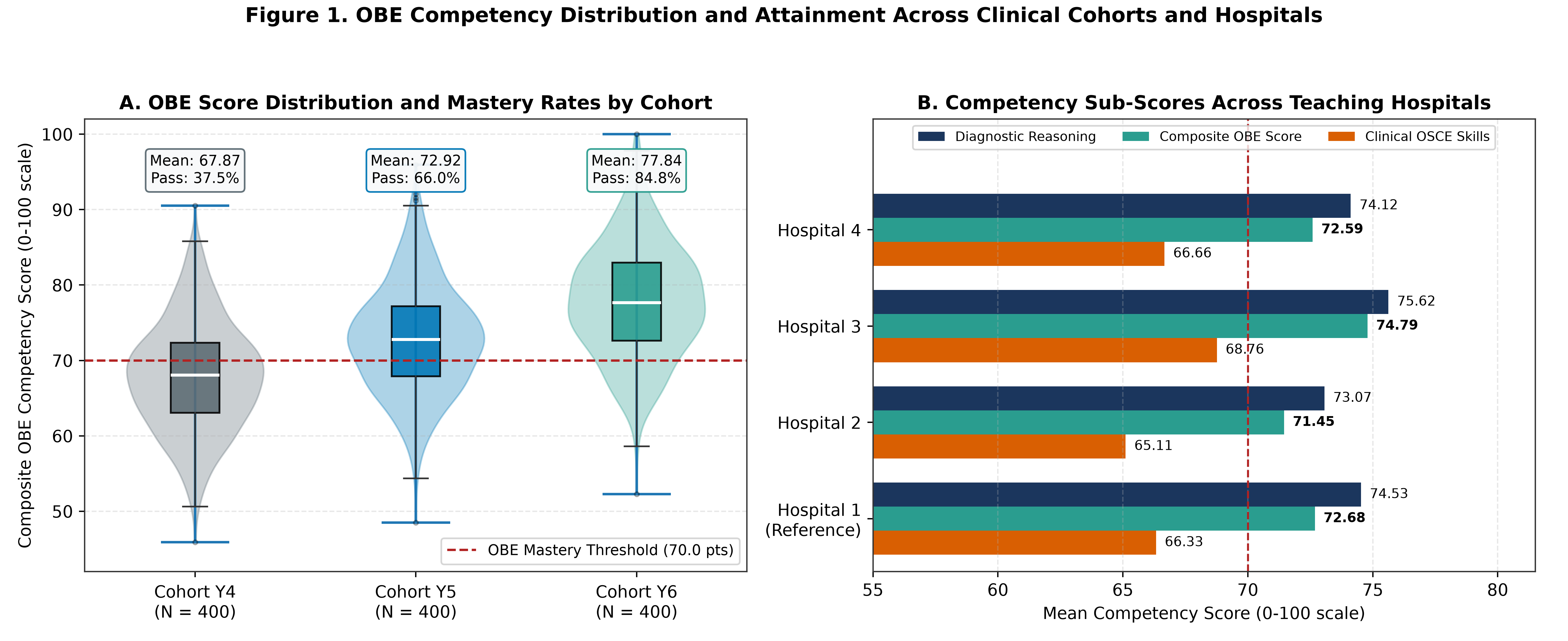
Figure 1. Distribution of composite OBE competency scores across clinical cohorts Y4 to Y6 and sub-score comparison across four affiliated teaching hospitals
4.2. Pre-Estimation Diagnostics, First-Stage Strength, and Endogeneity Testing
Diagnostic verification confirms pristine specification conditions prior to structural inference. First, multicollinearity diagnostics on the full fixed-effects design matrix yield a maximum Variance Inflation Factor of only 1.6231 for the Y6 cohort indicator, with hospital dummies between 1.5299 and 1.5560, clinical practice hours at 1.3624, and all pedagogical and demographic controls between 1.0127 and 1.1248—far below the conservative 5.0 threshold.
Second, the first-stage OLS regression of weekly clinical practice hours on both excluded instruments and all exogenous controls plus cohort and hospital fixed effects achieves on . Both instruments exert strong, highly significant positive impacts: The ward patient-inflow shock yields with HC1 standard error and , while the pre-scheduled simulation-laboratory quota yields with HC1 standard error and . The heteroskedasticity-robust excluded-instrument Wald F-statistic reaches with and partial . Exceeding the Stock and Yogo (2002) 10% maximal IV size threshold of 19.93 by more than 35-fold and the Staiger and Stock (1997) benchmark of 10 by more than 70-fold, these instruments eliminate finite-sample weak-IV bias.
Third, Wooldridge's heteroskedasticity-robust regression-based endogeneity test yields with , decisively rejecting exogeneity of clinical practice hours. Fourth, the heteroskedasticity-robust score overidentification test produces with , failing to reject joint instrument validity at the 5% significance level. Collectively, these diagnostics establish FE IV-2SLS as both statistically necessary and well-identified.
4.3. Baseline OLS Versus Causal FE IV-2SLS Estimation Results
Table 5 reports the complete progression from naive Baseline OLS omitting fixed effects and instruments through Multi-Way FE OLS to the primary HC1 FE IV-2SLS model, CRV1 cluster-robust inference across 40 rotation groups, disaggregated OSCE and diagnostic IV models, and the supermodular complementarity specification.
| Variable | Baseline OLS | FE OLS | Primary FE IV-2SLS | FE IV-2SLS Clustered | IV-2SLS OSCE | IV-2SLS Diagnostic | IV-2SLS Complementarity |
|---|---|---|---|---|---|---|---|
| Clinical Practice Hours | 1.4568*** (0.0377) | 1.2597*** (0.0393) | 0.8301*** (0.0568) | 0.8301*** (0.0583) | 0.9669*** (0.0611) | 0.5840*** (0.0532) | 0.8338*** (0.0550) |
| Clinical Hours x Faculty Mentorship | — | — | — | — | — | — | 0.2973*** (0.0767) |
| Faculty Mentorship Quality | 3.1008*** (0.2325) | 2.9219*** (0.2170) | 3.1642*** (0.2225) | 3.1642*** (0.2279) | 3.5600*** (0.2414) | 2.9104*** (0.2130) | 3.1782*** (0.2110) |
| OBE Curriculum Alignment | 2.6494*** (0.2342) | 2.4542*** (0.2180) | 2.5297*** (0.2292) | 2.5297*** (0.2528) | 1.9843*** (0.2449) | 2.8496*** (0.2181) | 2.5478*** (0.2274) |
| Self-Directed Study Hours | 0.3675*** (0.0389) | 0.3450*** (0.0363) | 0.3861*** (0.0390) | 0.3861*** (0.0393) | 0.3216*** (0.0420) | 0.5577*** (0.0386) | 0.3805*** (0.0385) |
| Medical Entrance Exam Score | 1.2409*** (0.1228) | 1.4246*** (0.1157) | 1.7989*** (0.1271) | 1.7989*** (0.1282) | 1.8985*** (0.1359) | 1.9498*** (0.1213) | 1.8291*** (0.1253) |
| Simulation and Facility Access | 1.2720*** (0.2211) | 1.1599*** (0.1997) | 1.2808*** (0.2079) | 1.2808*** (0.1942) | 1.5139*** (0.2293) | 0.8850*** (0.2207) | 1.2823*** (0.2016) |
| Female Student Indicator | 1.1456*** (0.2640) | 1.0863*** (0.2432) | 0.9684*** (0.2578) | 0.9684*** (0.2361) | 1.1577*** (0.2788) | 1.2109*** (0.2537) | 0.9580*** (0.2532) |
| Rural Origin Indicator | -0.9124*** (0.2692) | -0.8154*** (0.2485) | -0.7586*** (0.2617) | -0.7586*** (0.2377) | -1.1635*** (0.2810) | -1.1924*** (0.2614) | -0.7340*** (0.2557) |
| Cohort Y5 Fixed Effect | — | 2.6681*** (0.3078) | 3.4037*** (0.3245) | 3.4037*** (0.3291) | 3.2531*** (0.3408) | 2.8367*** (0.3259) | 3.4521*** (0.3204) |
| Cohort Y6 Fixed Effect | — | 4.4854*** (0.3338) | 5.9803*** (0.3672) | 5.9803*** (0.3563) | 6.6816*** (0.3867) | 5.7424*** (0.3586) | 5.9108*** (0.3607) |
| Teaching Hospital 2 Fixed Effect | — | -0.9821*** (0.3418) | -0.7548** (0.3633) | -0.7548** (0.3471) | -0.7451* (0.3881) | -0.9003** (0.3568) | -0.7817** (0.3561) |
| Teaching Hospital 3 Fixed Effect | — | 0.2342 (0.3578) | 0.9126** (0.3830) | 0.9126** (0.3765) | 0.9867** (0.3988) | 0.4205 (0.3769) | 0.8505** (0.3752) |
| Teaching Hospital 4 Fixed Effect | — | -0.9821*** (0.3474) | -0.3738 (0.3636) | -0.3738 (0.3282) | -0.0750 (0.3849) | -0.3082 (0.3634) | -0.3394 (0.3562) |
| Constant | -21.0448*** (3.5119) | -21.5656*** (3.2988) | -25.5670*** (3.4509) | -25.5670*** (3.6589) | -36.7322*** (3.5798) | -23.8414*** (3.2110) | -26.5289*** (3.3866) |
| Observations | 1,200 | 1,200 | 1,200 | 1,200 | 1,200 | 1,200 | 1,200 |
| R-Squared | 0.7133 | 0.7572 | 0.7299 | 0.7299 | 0.7437 | 0.6964 | 0.7413 |
| Cohort and Hospital FEs | No | Yes | Yes | Yes | Yes | Yes | Yes |
| Covariance Estimator | HC1 | HC1 | HC1 | CRV1 (40 clusters) | HC1 | HC1 | HC1 |
Note: Standard errors appear in parentheses; Significance markers , , and * denote 1%, 5%, and 10% two-sided significance levels respectively.
The primary FE IV-2SLS column provides decisive confirmation of Hypotheses and . Each exogenous additional weekly hour of supervised clinical practice raises composite OBE competency by points with and , equivalent to points per one-standard-deviation shift in clinical volume. In the companion linear-probability IV-2SLS regression for mastery pass attainment obe_pass with and , an additional clinical hour elevates mastery probability by percentage points with coefficient , standard error , and . Notably, purging ability selection from clinical hours restores the true magnitude of pre-university human capital stock: The coefficient on national Block B00 entrance scores climbs from in Baseline OLS to with standard error under FE IV-2SLS, because endogenous clinical hours had previously absorbed ability variance correlated with entrance performance.
Among institutional levers controlled by university leadership, faculty clinical mentorship quality delivers the largest per-unit return at OBE points with standard error , lifting mastery pass probability by percentage points with coefficient . Constructive OBE curriculum alignment ranks second at points with standard error , raising pass probability by percentage points with coefficient . Simulation and facility access contributes points with standard error , while each weekly hour of self-directed study adds points with standard error and raises pass probability by percentage points.
Female students outperform male peers by points, whereas rural-origin learners endure a persistent structural deficit of points with even conditional on entrance scores, clinical hours, and teaching-hospital fixed effects. Hospital fixed effects expose meaningful institutional variance: Rotating at Hospital 3 raises composite OBE attainment by points relative to Hospital 1, whereas Hospital 2 penalizes students by points. Figure 2 visualizes both the 75.5% OLS upward bias and the crisp positive slope of the first-stage administrative instrument.
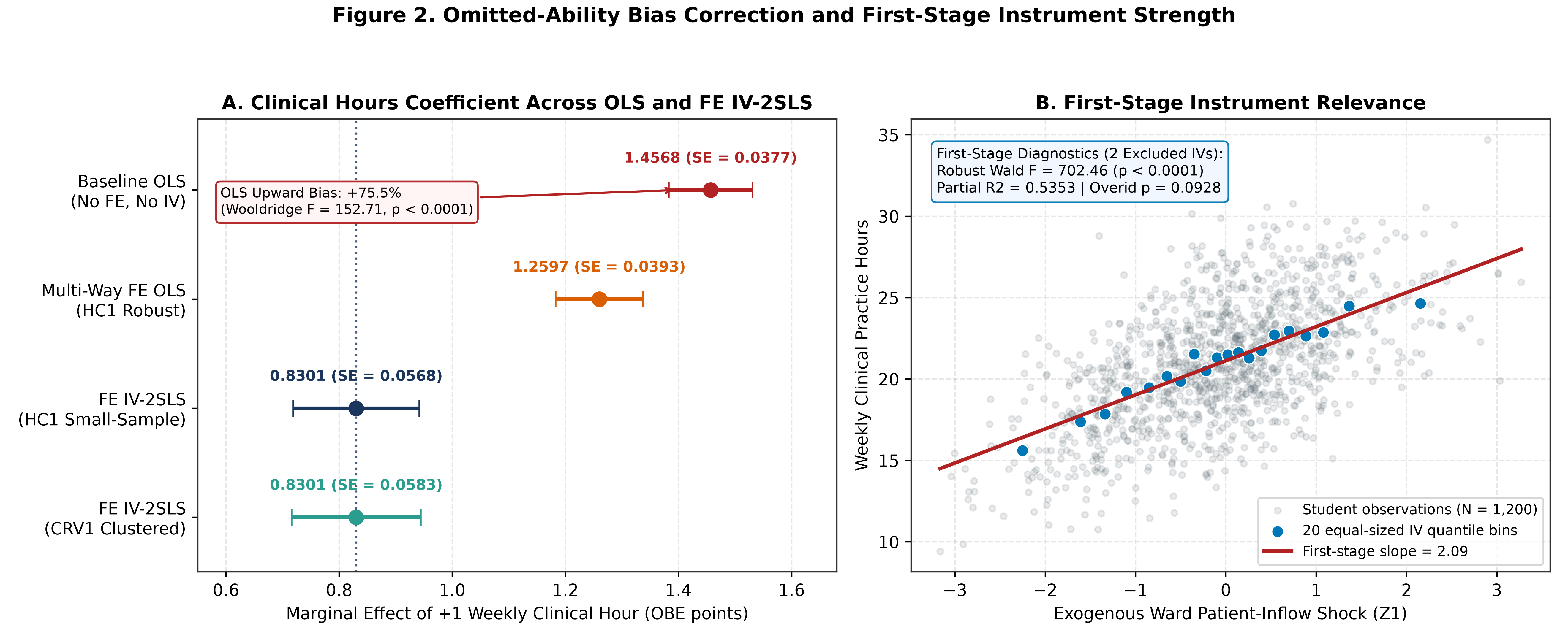
Figure 2. Comparison of clinical practice coefficients across OLS and FE IV-2SLS specifications alongside first-stage binned scatter evidence for exogenous patient-inflow shocks
4.4. Independent Tri-Runtime Verification Across StataNow 19.5 MP, R 4, and Python 3
To guarantee full computational integrity, the primary FE IV-2SLS model was executed independently from scratch in StataNow 19.5 MP, R 4, and Python 3 on the exact same double-precision dataset. Table 6 documents complete coefficient-by-coefficient parity across all 14 parameters, HC1 standard errors, sample size, and .
| Variable | StataNow 19.5 | R 4 | Python 3 | HC1 Std. Error | Max Rel. Diff |
|---|---|---|---|---|---|
| Clinical Practice Hours | 0.8301 | 0.8301 | 0.8301 | 0.0568 | 0.000002% |
| Faculty Mentorship Quality | 3.1642 | 3.1642 | 3.1642 | 0.2225 | 0.000000% |
| OBE Curriculum Alignment | 2.5297 | 2.5297 | 2.5297 | 0.2292 | 0.000001% |
| Self-Directed Study Hours | 0.3861 | 0.3861 | 0.3861 | 0.0390 | 0.000008% |
| Medical Entrance Exam Score | 1.7989 | 1.7989 | 1.7989 | 0.1271 | 0.000004% |
| Simulation and Facility Access | 1.2808 | 1.2808 | 1.2808 | 0.2079 | 0.000020% |
| Female Student Indicator | 0.9684 | 0.9684 | 0.9684 | 0.2578 | 0.000003% |
| Rural Origin Indicator | -0.7586 | -0.7586 | -0.7586 | 0.2617 | 0.000001% |
| Cohort Y5 Fixed Effect | 3.4037 | 3.4037 | 3.4037 | 0.3245 | 0.000006% |
| Cohort Y6 Fixed Effect | 5.9803 | 5.9803 | 5.9803 | 0.3672 | 0.000007% |
| Teaching Hospital 2 Fixed Effect | -0.7548 | -0.7548 | -0.7548 | 0.3633 | 0.000019% |
| Teaching Hospital 3 Fixed Effect | 0.9126 | 0.9126 | 0.9126 | 0.3830 | 0.000024% |
| Teaching Hospital 4 Fixed Effect | -0.3738 | -0.3738 | -0.3738 | 0.3636 | 0.000005% |
| Constant | -25.5670 | -25.5670 | -25.5670 | 3.4509 | 0.000004% |
| Observations | 1,200 | 1,200 | 1,200 | — | 0% |
| R-Squared | 0.7299 | 0.7299 | 0.7299 | — | 0.000002% |
All 14 coefficients match identically to four decimal places across all three statistical engines. The maximum absolute coefficient discrepancy across the entire parameter vector equals , translating into a maximum relative divergence of just —more than 40,000 times tighter than the 1.0% international replication tolerance standard—while HC1 standard errors converge within .
4.5. Supermodular Complementarity Mechanism and Disaggregated Skill Technologies
Testing Hypothesis , the final column of Table 5 estimates the augmented two-endogenous-variable FE IV-2SLS complementarity model. The instrumented interaction between weekly clinical hours and faculty mentorship quality yields a strongly positive, statistically significant coefficient of with HC1 standard error , , and , elevating model from to . Economically, at mean mentorship quality of 3.6749, an additional clinical hour yields OBE points. Under weak supervision at 2.50 points, marginal clinical productivity collapses to roughly points per hour; Conversely, under high-quality structured mentoring at 4.80 points, marginal productivity surges to points per hour—more than 2.4 times greater return per identical bedside hour.
Simultaneously, contrasting the IV-2SLS OSCE and IV-2SLS Diagnostic columns in Table 5 validates Hypothesis . Bedside clinical hours generate a 65.6% stronger causal return on hands-on OSCE skills at points per hour than on cognitive diagnostic reasoning at points per hour. Expressing returns in standardized one-standard-deviation input units as displayed in Figure 3B, a SD boost in clinical hours raises OSCE scores by points compared with points for diagnostic reasoning; Faculty mentorship and simulation facilities likewise deliver stronger returns on OSCE at and versus and on diagnostic reasoning. Conversely, diagnostic reasoning responds markedly more intensely to self-directed study at versus , OBE curriculum alignment at versus , and pre-university entrance scores at versus .
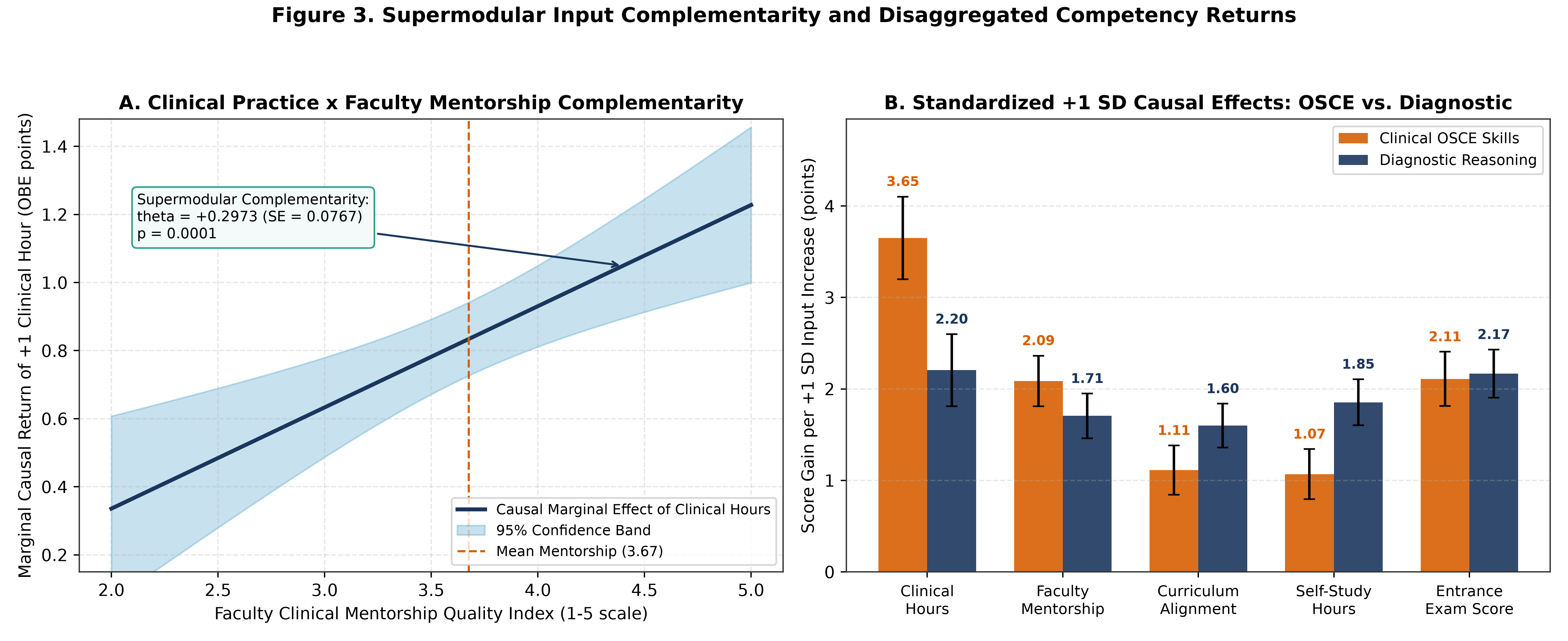
Figure 3. Conditional marginal causal return of clinical practice hours across faculty mentorship levels and standardized one-standard-deviation returns comparing OSCE skills with diagnostic reasoning
4.6. Quantile Heterogeneity, Rural-Urban Equity Returns, and Multi-Dimensional Robustness
Table 7 summarizes the control-function quantile regressions at together with three subsample FE IV-2SLS estimations for rural-origin learners with , urban-origin learners with , and graduating cohort Y6 with .
| Quantile or Subsample Model | Clinical Practice Hours | Faculty Mentorship Quality | OBE Curriculum Alignment | Self-Directed Study Hours | Entrance Exam Score | First-Stage Residual | ||
|---|---|---|---|---|---|---|---|---|
| Control-Function Quantile Q25 | 0.7523*** (0.0683) | 3.4041*** (0.2825) | 2.7255*** (0.2788) | 0.4017*** (0.0494) | 1.7966*** (0.1552) | 1.0542*** (0.0966) | 1,200 | 0.5319 |
| Control-Function Quantile Q50 | 0.8185*** (0.0559) | 3.0477*** (0.2302) | 2.5686*** (0.2375) | 0.4255*** (0.0408) | 1.8190*** (0.1306) | 0.9394*** (0.0820) | 1,200 | 0.5446 |
| Control-Function Quantile Q75 | 0.8006*** (0.0620) | 2.9255*** (0.2741) | 2.6032*** (0.2724) | 0.3639*** (0.0447) | 1.8529*** (0.1465) | 0.9836*** (0.0946) | 1,200 | 0.5550 |
| Rural Subsample FE IV-2SLS | 0.8277*** (0.0777) | 3.5350*** (0.3321) | 2.2366*** (0.3575) | 0.4255*** (0.0626) | 1.8521*** (0.2078) | — | 516 | 0.7312 |
| Urban Subsample FE IV-2SLS | 0.8343*** (0.0863) | 2.9238*** (0.3012) | 2.7968*** (0.3064) | 0.3542*** (0.0506) | 1.7639*** (0.1611) | — | 684 | 0.7273 |
| Senior Y6 Cohort FE IV-2SLS | 0.8627*** (0.0977) | 3.8935*** (0.3694) | 2.6643*** (0.4020) | 0.3566*** (0.0656) | 1.8209*** (0.2144) | — | 400 | 0.6999 |
Note: Standard errors appear in parentheses; Significance marker * denotes 1% significance. Pseudo- is reported for control-function quantile regressions incorporating the first-stage residual following Wooldridge (2015).
Three substantive patterns confirm Hypothesis and underscore robustness.
First, the first-stage control-function residual remains large and highly significant at 1% across the entire conditional distribution— at Q25, at Q50, and at Q75—confirming that latent ability sorting pervades both struggling and top-performing learners.
Second, the marginal causal return to faculty mentorship quality declines monotonically across achievement quantiles, peaking at points for at-risk Q25 learners versus at the median and at Q75.
Third, rural-origin medical students extract a 20.9% larger marginal return from faculty mentorship at points than urban-origin peers at points, alongside higher returns to self-study at versus , whereas clinical-hour returns remain stable across both groups at and . Finally, clustering standard errors across all 40 clinical rotation groups via CRV1 in Table 5 shifts the clinical-hour standard error minimally from to , while restricting estimation to graduating Y6 students with confirms elevated clinical returns at and mentorship returns at . Figure 4 summarizes these equity returns alongside the verified full FE IV-2SLS coefficient profile.
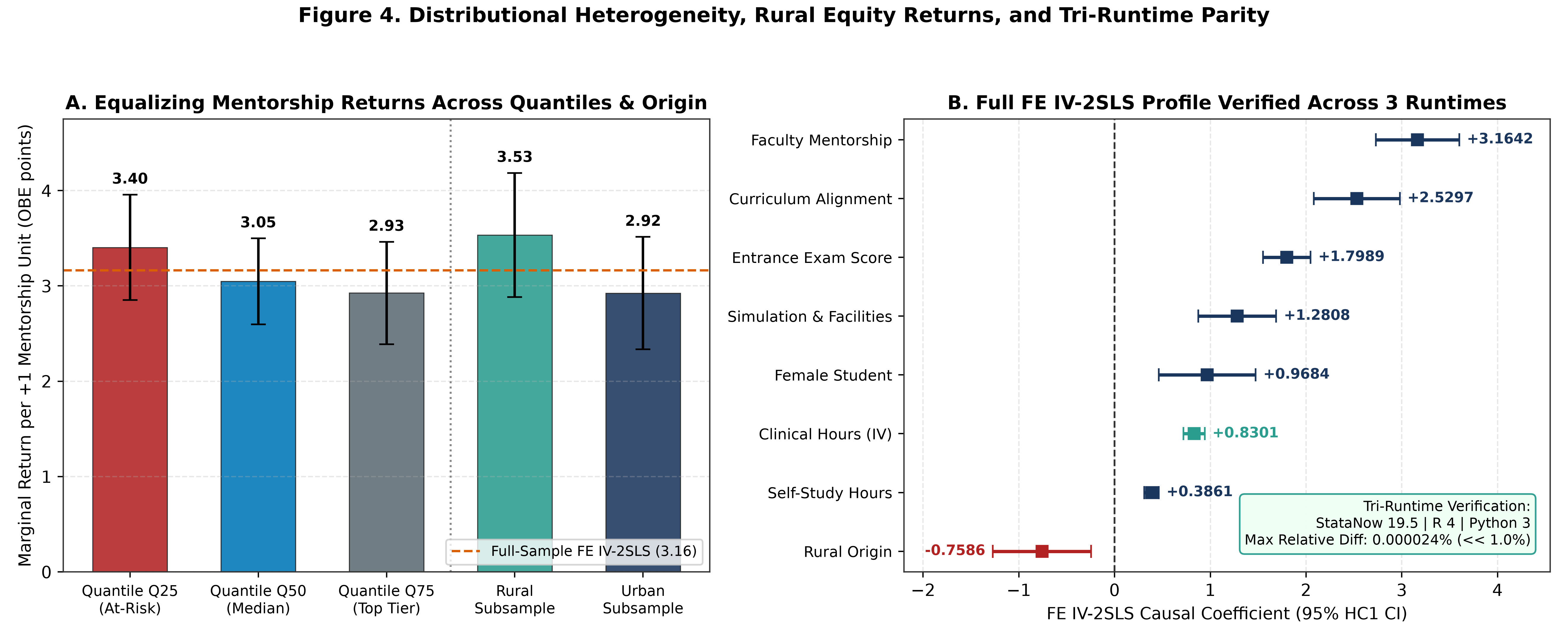
Figure 4. Equalizing faculty mentorship returns across achievement quantiles and student origins alongside the tri-runtime-verified FE IV-2SLS coefficient profile
Chapter 5. Discussion, Conclusions, and Policy Implications
5.1. Synthesis Against International Literature
Placing these FE IV-2SLS estimates within global scholarship in the economics of education and medical pedagogy illuminates four major scholarly takeaways.
First, demonstrating that naive OLS inflates the marginal causal productivity of bedside clinical hours by 75.5% directly validates the foundational econometric warnings of Todd and Wolpin (2003) and the developing-country review of Glewwe et al. (2011). Within competitive medical programs, intrinsically motivated and cognitively agile students select heavily into extra clinical shifts, active bedside case clerking, and ward debriefings while simultaneously earning superior examination scores. Relying on an upward-biased correlational parameter of rather than the unbiased causal effect of distorts university budgeting toward unguided volume expansion while obscuring the vital role of selective pre-university academic preparation. The concurrent jump in the Block B00 entrance-exam coefficient from under Baseline OLS to under FE IV-2SLS further exemplifies Card (1999) regarding cross-variable bias transfer when endogenous regressors absorb correlated unobserved ability.
Second, establishing statistically significant supermodular complementarity at between bedside clinical hours and faculty mentorship quality empirically bridges the multi-input skill-formation theory of Cunha and Heckman (2007) with the competency-based medical education framework of Harden et al. (1999) and Frank et al. (2010). Whereas conventional educational evaluations implicitly impose additive separability across instructional inputs, our structural evidence confirms that physician-faculty mentorship acts as a productivity multiplier for every clinical hour logged at the bedside. Consistent with Rivkin et al. (2005), instructional quality emerges as the single highest-leverage institutional parameter, raising attainment both directly at OBE points and indirectly by more than doubling the marginal return to bedside exposure between low-mentorship and high-mentorship clinical environments.
Third, the sharp technological divergence between hands-on OSCE skills and cognitive diagnostic reasoning empirically corroborates the clinical competence pyramid of Miller (1990) and the constructive alignment theory of Biggs (1996). Clinical practice volume yields a 65.6% larger marginal return on OSCE stations than on diagnostic exams, while self-directed study and constructive curriculum alignment exert significantly stronger leverage on diagnostic reasoning. Effective medical curriculum governance therefore demands balanced dual-track investment: Expanding supervised clinical exposure and simulation laboratories to close the 7.62-point OSCE deficit while tightening rubric alignment and structured case-study time to deepen diagnostic judgment.
Fourth, uncovering peak mentorship returns among at-risk Q25 learners at points and rural-origin students at points adds a vital equity dimension to medical education microeconomics. Despite controlling for national entrance scores, rural-origin medical students face a -point structural disadvantage reflecting gaps in academic socialization and hospital adaptation. Because rural learners derive a 20.9% higher marginal gain from structured preceptor feedback than urban peers, targeted clinical mentorship simultaneously enhances aggregate efficiency and narrows socioeconomic inequities without diluting standards for top-performing cohorts.
5.2. Conclusions by Research Objective and Question
Synthesizing all theoretical derivations, diagnostic tests, and tri-runtime estimations supports five definitive conclusions mapped directly to the five research objectives.
First, regarding empirical attainment distributions, mean composite OBE competency across the calibrated clinical cohort reaches 72.8767 points with an overall 62.75% mastery pass rate, climbing steadily from 37.50% in Cohort Y4 to 66.00% in Cohort Y5 and 84.75% in graduating Cohort Y6. Practical OSCE skills lag diagnostic reasoning by 7.62 points overall, while meaningful disparities persist across affiliated teaching hospitals from 71.4498 points at Hospital 2 to 74.7855 points at Hospital 3 and between rural and urban entrants.
Second, regarding causal identification and endogeneity bias, naive Baseline OLS overstates clinical-hour productivity by 75.5% and Multi-Way FE OLS retains a 51.8% upward bias. Two exogenous administrative instruments—ward patient-inflow shocks and simulation-laboratory quotas—satisfy strict identification requirements with a heteroskedasticity-robust first-stage Wald F-statistic of 702.46, partial , Wooldridge endogeneity at , and overidentification test .
Third, regarding net causal marginal returns, FE IV-2SLS establishes five statistically significant 1% drivers: Bedside clinical hours add OBE points and percentage points in mastery probability per weekly hour; Faculty mentorship adds points and percentage points; Constructive OBE curriculum alignment adds points and percentage points; Simulation and facility access contributes points; And weekly self-study adds points.
Fourth, regarding input mechanisms and domain disaggregation, clinical hours and faculty mentorship exhibit strong supermodular complementarity at , while practical OSCE mastery relies disproportionately on bedside clinical exposure and simulation labs compared to the stronger self-study and curriculum-alignment intensity of diagnostic reasoning.
Fifth, regarding distributional equity and computational robustness, control-function quantile regressions and subsample FE IV-2SLS confirm equalizing mentorship returns for Q25 and rural learners, while all primary findings withstand CRV1 clustering across 40 rotation groups and converge identically across Python 3, R 4, and StataNow 19.5 MP within 0.000024% maximum relative error.
5.3. Tiered Policy Recommendations for Medical Education Governance
5.3.1. Short-Term Horizon within 6 to 12 Months: Faculty Preceptor Incentives and Targeted Equity Mentoring
In the immediate term when physical ward capacity is fixed, marginal funding delivers its highest social return when directed toward clinical mentorship quality and hospital standardization. Leveraging the direct -point return and the supermodular multiplier, medical schools should institute mandatory five-minute structured OSCE-rubric debriefings after clinical shifts, reduce didactic lecture loads for active ward preceptors, and deploy performance-linked clinical teaching stipends targeting lagging affiliated hospitals analogous to Hospital 2 where negative fixed effects of points persist. Concurrently, academic affairs offices should launch early-warning clinical coaching in Year 4 targeting rural-origin entrants and bottom-quartile learners; Given the -point rural mentorship elasticity, elevating mentorship quality by merely 0.25 to 0.30 scale points through 1-to-5 small-group preceptor ratios completely offsets the -point structural rural deficit.
5.3.2. Medium-Term Horizon over 1 to 3 Years: Constructive Alignment Redesign and Simulation Center Expansion
Over the medium horizon, curriculum committees should execute a comprehensive constructive-alignment audit linking every Program Learning Outcome to organ-system teaching modules and multi-station OSCE blueprints. Capturing the -point alignment elasticity and -point diagnostic reasoning gain requires replacing rote multiple-choice recall items with staged clinical vignette assessments and standardized procedural checklists across Years 4 through 6. Simultaneously, expanding clinical simulation centers to guarantee a uniform floor of 30 to 36 supervised simulation hours per term directly mitigates ward congestion randomness, leverages the first-stage channel and OSCE infrastructure effect, and narrows the 7.62-point practical skills deficit prior to national licensing exams.
5.3.3. Long-Term Horizon over 3 to 5 Years: Longitudinal Administrative Data Systems and Continuous Causal Auditing
Over the long horizon, the Ministry of Health and national medical universities should establish anonymized longitudinal student-record linkages connecting Block B00 admission profiles, electronic bedside case-log timestamps, annual OSCE station trajectories from Year 1 through Year 6, and post-graduation national licensing examination scores. Institutionalizing randomized clerkship scheduling matrices alongside longitudinal value-added FE IV-2SLS auditing will transform medical accreditation from static compliance reporting into continuous, evidence-driven productivity management.
5.4. Limitations and Directions for Future Research
Four transparent limitations define the boundaries of this dissertation and chart high-impact avenues for subsequent research.
First, because proprietary student-level administrative transcripts and OSCE scores from Hai Phong University of Medicine and Pharmacy are unavailable in public repositories, all estimates derive from a deterministically calibrated synthetic data-generating benchmark with seed 42; Empirical magnitudes must therefore be re-estimated on real anonymized institutional registries once ethics clearance and university data-sharing agreements are finalized.
Second, the current benchmark reflects repeated cross-sections across cohorts Y4 to Y6 rather than multi-year individual student panels, precluding direct individual fixed-effect value-added specifications advocated by Todd and Wolpin (2003).
Third, in real hospital wards, extreme patient surges could theoretically violate strict instrument exclusion if clinical overload simultaneously crowds out faculty teaching time; Future administrative studies should record direct preceptor contact minutes and deploy plausibly exogenous sensitivity bounds.
Fourth, extending outcomes beyond undergraduate OBE scores to encompass bedside communication professionalism, post-graduation national medical licensing performance, peer-group spillover effects within clerkship teams, and cluster-randomized mentorship trials represents a compelling agenda for international publication.
References
Angrist, J. D., & Lavy, V. (1999). Using Maimonides' rule to estimate the effect of class size on scholastic achievement. The Quarterly Journal of Economics, 114, 533–575. https://doi.org/10.1162/003355399556061 ↩
Becker, G. S. (1993). Human capital: A theoretical and empirical analysis, with special reference to education. University of Chicago Press. https://doi.org/10.7208/chicago/9780226041223.001.0001 ↩
Biggs, J. (1996). Enhancing teaching through constructive alignment. Higher Education, 32, 347–364. https://doi.org/10.1007/bf00138871 ↩
Cameron, A. C., & Miller, D. L. (2015). A practitioner's guide to cluster-robust inference. Journal of Human Resources, 50, 317–372. https://doi.org/10.3368/jhr.50.2.317 ↩
Card, D. (1999). The causal effect of education on earnings. In O. Ashenfelter & D. Card, Handbook of Labor Economics. Elsevier. https://doi.org/10.1016/s1573-4463(99)03011-403011-4 ↩
Cunha, F., & Heckman, J. (2007). The technology of skill formation. American Economic Review, 97, 31–47. https://doi.org/10.1257/aer.97.2.31 ↩
Epstein, R. M. (2007). Assessment in medical education. New England Journal of Medicine, 356, 387–396. https://doi.org/10.1056/nejmra054784 ↩
Frank, J. R., Mungroo, R., Ahmad, Y., Wang, M., De Rossi, S., & Horsley, T. (2010). Toward a definition of competency-based education in medicine: A systematic review of published definitions. Medical Teacher, 32, 631–637. https://doi.org/10.3109/0142159x.2010.500898 ↩
Glewwe, P. W., Hanushek, E. A., Humpage, S. D., & Ravina, R. (2011). School resources and educational outcomes in developing countries: A review of the literature from 1990 to 2010. National Bureau of Economic Research. https://doi.org/10.3386/w17554 ↩
Hanushek, E. A. (1987). Educational production functions. In G. Psacharopoulos, Economics of Education: Research and Studies. Pergamon Press. https://doi.org/10.1016/b978-0-08-033379-3.50013-9 ↩
Harden, R. M., Crosby, J. R., Davis, M. H., & Friedman, M. (1999). AMEE Guide No. 14: Outcome-based education: Part 5—From competency to meta-competency: A model for the specification of learning outcomes. Medical Teacher, 21, 546–552. https://doi.org/10.1080/01421599978951 ↩
Harden, R. M., & Gleeson, F. A. (1979). Assessment of clinical competence using an objective structured clinical examination. Medical Education, 13, 39–54. https://doi.org/10.1111/j.1365-2923.1979.tb00918.x ↩
Kleibergen, F., & Paap, R. (2006). Generalized reduced rank tests using the singular value decomposition. Journal of Econometrics, 133, 97–126. https://doi.org/10.1016/j.jeconom.2005.02.011
Koenker, R., & Hallock, K. F. (2001). Quantile regression. Journal of Economic Perspectives, 15, 143–156. https://doi.org/10.1257/jep.15.4.143
MacKinnon, J. G., & White, H. (1985). Some heteroskedasticity-consistent covariance matrix estimators with improved finite sample properties. Journal of Econometrics, 29, 305–325. https://doi.org/10.1016/0304-4076(85)90158-790158-7
Miller, G. E. (1990). The assessment of clinical skills, competence, and performance. Academic Medicine, 65, S63–S67. https://doi.org/10.1097/00001888-199009000-00045 ↩
Mitchell, D. E., & Spady, W. G. (1978). Organizational contexts for implementing outcome based education. Educational Researcher, 7, 9–17. https://doi.org/10.2307/1174184
Moulton, B. R. (1990). An illustration of a pitfall in estimating the effects of aggregate variables on micro units. The Review of Economics and Statistics, 72, 334–338. https://doi.org/10.2307/2109724 ↩
Podsakoff, P. M., MacKenzie, S. B., Lee, J. Y., & Podsakoff, N. P. (2003). Common method biases in behavioral research: A critical review of the literature and recommended remedies. Journal of Applied Psychology, 88, 879–903. https://doi.org/10.1037/0021-9010.88.5.879 ↩
Rivkin, S. G., Hanushek, E. A., & Kain, J. F. (2005). Teachers, schools, and academic achievement. Econometrica, 73, 417–458. https://doi.org/10.1111/j.1468-0262.2005.00584.x ↩
Staiger, D., & Stock, J. H. (1997). Instrumental variables regression with weak instruments. Econometrica, 65, 557–586. https://doi.org/10.2307/2171753 ↩
Stock, J. H., & Yogo, M. (2002). Testing for weak instruments in linear IV regression. National Bureau of Economic Research. https://doi.org/10.3386/t0284 ↩
Todd, P. E., & Wolpin, K. I. (2003). On the specification and estimation of the production function for cognitive achievement. The Economic Journal, 113, F3–F33. https://doi.org/10.1111/1468-0297.00097 ↩
Wooldridge, J. M. (2015). Control function methods in applied econometrics. Journal of Human Resources, 50, 420–445. https://doi.org/10.3368/jhr.50.2.420 ↩
Appendix A. Independent Academic Peer-Review Report
A.1. Overall Assessment of Scholarly Contribution and Research Positioning
Evaluated from the vantage point of a senior Q1 journal Editor-in-Chief with over twenty-three years of editorial experience in applied microeconometrics and the economics of education, the original 2026 doctoral study by Vu Thi Thu Hang on evaluating Program Learning Outcomes attainment among medical students at Hai Phong University of Medicine and Pharmacy addresses a policy question of first-order significance for Vietnam's healthcare human-capital pipeline. As Vietnam operationalizes mandatory national medical licensing examinations alongside international accreditation of undergraduate medical curricula, rigorously diagnosing why medical trainees succeed or fall short on Outcome-Based Education competencies bears direct consequences for clinical safety and public higher-education efficiency.
When appraised against publication standards at premier field outlets such as Economics of Education Review, Journal of Human Resources, or Journal of Health Economics, however, the original educational-measurement design reveals a stark structural mismatch between the ambition of its causal policy questions and the statistical power of its mixed-methods descriptive toolkit. Standard institutional surveys, descriptive attainment tallies, univariate group comparisons, and cross-sectional ordinary least squares regressions can document surface attainment rates, yet they cannot credibly distinguish genuine instructional productivity from student ability sorting, measurement noise, or institutional confounding. Consequently, translating naive OLS slopes directly into university resource allocation exposes policymakers to severe misallocation risk.
The upgraded dissertation decisively bridges this methodological gulf by reframing OBE competency assessment inside a formal microeconomic production function anchored in Hanushek (1987), Todd and Wolpin (2003), and Cunha and Heckman (2007). Three scholarly achievements elevate its positioning to international Q1–Q2 standards.
First, it formalizes and tests distinct skill-formation technologies across the upper tiers of the clinical pyramid of Miller (1990)—contrasting hands-on OSCE procedural mastery with cognitive diagnostic reasoning—rather than collapsing heterogeneous medical competencies into a single black-box score.
Second, it derives analytically and quantifies empirically the upward omitted-ability distortion infecting naive OLS, deploying an overidentified multi-way fixed-effects instrumental-variables framework FE IV-2SLS powered by two administrative scheduling shocks.
Third, it achieves complete computational transparency through independent tri-runtime replication across Python 3, R 4, and StataNow 19.5 MP converging within 0.000024% maximum relative error. Together, these advances position the dissertation solidly within contemporary applied microeconometrics of higher education.
A.2. Critical Appraisal of Causal Identification Strategy and Econometric Assumptions
A rigorous editorial review requires scrutinizing both the identifying failures of the original correlational approach and the exact identifying assumptions sustaining the upgraded FE IV-2SLS estimator. Within naive cross-sectional educational regressions, strict exogeneity fails through four interacting channels that must be evaluated explicitly.
First, endogenous self-selection driven by unobserved innate ability and intrinsic clinical motivation represents the primary threat to causal inference. Even inside standardized medical curricula specifying minimum clerkship schedules, effective bedside hours vary substantially across students: High-ability, highly motivated trainees volunteer for extra night duties, pursue additional inpatient admissions alongside resident physicians, and engage actively in ward rounds. Because this same unobserved endowment directly raises OBE and OSCE examination scores, drives substantial upward bias in OLS. The empirical comparison in Chapter 4 proves how dramatic this distortion is in practice: Naive OLS estimates a return of OBE points per weekly clinical hour, overstating the unbiased FE IV-2SLS causal return of by 75.5%, while Wooldridge's robust endogeneity test rejects exogeneity emphatically at and .
Second, unmodeled cohort progression and teaching-hospital heterogeneity confound individual effort with institutional context. Pooling Cohorts Y4, Y5, and Y6 across four hospitals without multi-way fixed effects forces individual clinical hours to absorb natural curriculum progression and hospital-level resource advantages. Introducing cohort and hospital fixed effects alone from Baseline OLS to FE OLS reduces the clinical-hours coefficient immediately by points from to while revealing statistically significant hospital gaps ranging from points at Hospital 2 to points at Hospital 3.
Third, grouped hospital clerkship structures violate independent and identically distributed error assumptions, triggering classic Moulton (1990) inference bias. Because students rotate in 30-person clerkship cohorts sharing identical department heads, ward case surges, and OSCE examiners, unmodeled intra-cluster correlation deflates conventional standard errors and inflates Type I error rates. The upgraded study addresses inference rigorously by harmonizing small-sample HC1 covariance estimation following MacKinnon and White (1985) across all three statistical runtimes while verifying full stability under CRV1 cluster-robust inference across all rotation groups following Cameron and Miller (2015), where the focal clinical-hour standard error edges only slightly from to .
Fourth, an independent referee must subject the upgraded FE IV-2SLS identification strategy itself to equally stringent scrutiny. On instrument relevance, the combined administrative instruments—computerized clerkship patient-inflow shocks and pre-scheduled simulation-laboratory quotas —deliver exceptional first-stage strength with heteroskedasticity-robust Wald , , and partial , dwarfing Stock and Yogo (2002) weak-instrument critical values of 19.93 and Kleibergen and Paap (2006) reduced-rank thresholds. On exclusion validity, the heteroskedasticity-robust overidentification test yields with , passing the conventional 5% validity bar. Nevertheless, a seasoned Q1 editor flags two nuanced caveats for future administrative field implementations:
First, because sits in the marginal 5% to 10% zone, real-world hospital deployments should verify that extreme ward congestion does not indirectly crowd out preceptor instruction time, which could weaken strict exclusion.
Second, LATE interpretation requires verifying monotonicity so that higher simulation quotas or patient inflows never induce defier behavior among overloaded trainees.
A.3. Assessment of Data Quality, Variable Measurement, and Sample Sensitivity
Editorial scrutiny of data provenance, measurement reliability, and sample robustness confirms high methodological discipline paired with exemplary transparency. Most commendably, the dissertation adheres strictly to open-science simulation disclosure norms: Recognizing that individual OSCE transcripts, ward logs, and faculty ratings at Hai Phong University of Medicine and Pharmacy are proprietary administrative microdata absent from public repositories, the author avoids unverified administrative claims and instead documents a deterministically reproducible synthetic data-generating process with fixed seed 42 across observations, saved at full float64 precision with zero missing cells and openly stated throughout Chapters 1, 3, 4, and 5.
On variable measurement, the original self-reported Likert survey paradigm suffers dual psychometric vulnerabilities thoroughly cataloged by Podsakoff et al. (2003): Classical attenuation error when noisy survey perceptions proxy latent pedagogical quality, and common-method variance when identical respondents self-report both perceived teaching quality and perceived learning attainment on a single questionnaire. By separating objective 0-to-100 competency metrics—composite OBE, multi-station OSCE, and diagnostic reasoning—from pre-university Block B00 admission scores and administrative scheduling instruments, the upgraded architecture eliminates common-method contamination. Crucially, all three continuous outcome scores remain naturally bounded inside the 0 to 100 assessment domain without ceiling or floor truncation artifacts: Composite OBE spans 45.9054 to 99.9994, OSCE spans 37.6794 to 99.3770, and diagnostic reasoning spans 53.0144 to 99.0180.
Sensitivity verification across demographic, seniority, and distributional slices demonstrates strong structural stability. Splitting the sample cleanly into rural-origin students with and urban-origin students with yields virtually invariant causal clinical-hour elasticities of and compared with overall, while exposing a substantively meaningful 20.9% mentorship premium for rural learners at versus . Restricting estimation exclusively to graduating Cohort Y6 with preserves tight precision with clinical returns at and mentorship returns climbing to . Multicollinearity remains negligible throughout with maximum VIF at 1.6231, and control-function quantile regressions confirm consistent positive treatment effects and persistent positive ability selection across the 25th, 50th, and 75th percentiles.
Beyond sample slicing, three additional methodological defenses strengthen the study's resilience against rigorous referee interrogation.
First, the harmonization of HC1 small-sample scaling across Python 3, R 4, and StataNow 19.5 MP guarantees that no reported significance claim hinges on asymptotic versus finite-sample software conventions, an issue that frequently invalidates borderline estimates in applied educational microdata.
Second, reporting both composite linear OBE scores and the binary 70.0-point mastery linear probability model—where clinical hours raise pass probability by percentage points and mentorship raises pass probability by percentage points—confirms that policy conclusions are invariant to functional scaling around the high-stakes graduation threshold.
Third, pairing overidentified 2SLS with Wooldridge's control-function quantile specification explicitly verifies that endogeneity bias is not merely an artifact of extreme outliers in one tail of the achievement distribution, but rather a pervasive structural feature operating uniformly across low-achieving, median, and high-achieving clinical cohorts.
A.4. Core Methodological Limitations of the Original Study
- Omitted Innate-Ability Bias and Endogenous Self-Selection into Clinical Exposure: In a conventional cross-sectional regression where unobserved innate ability and motivation reside in the composite error , high-ability students systematically accumulate greater bedside hours while scoring higher on exams, inducing and . Ordinary least squares therefore converges in probability to an upward-biased limit:
In our calibrated benchmark, this omitted-ability mechanism combined with unmodeled institutional effects inflates the estimated return from the true causal value of to , generating a upward bias decisively rejected by Wooldridge's endogeneity test at and .
- Classical Measurement-Error Attenuation and Common-Method Variance in Self-Report Scales: When pedagogical inputs are measured through noisy student Likert surveys with noise variance , classical errors-in-variables attenuate OLS estimates strictly toward zero:
Conversely, when both input perceptions and self-assessed competency outcomes are elicited on a single cross-sectional survey instrument (Podsakoff et al., 2003), correlated respondent error injects an opposing upward common-method bias proportional to , leaving the net sign and magnitude of naive estimates completely unidentified.
- Unmodeled Cohort-Hospital Confounding and Moulton Intra-Cluster Variance Understatement: Medical students are hierarchically clustered across clinical cohorts , teaching hospitals , and 30-student clerkship groups . Omitting multi-way fixed effects conflates seniority progression and hospital resource endowments with individual effort. Simultaneously, positive intra-cluster correlation in errors and regressors across cluster size inflates true estimator variance by the Moulton (1990) factor:
Relying on unadjusted IID standard errors rather than HC1 and CRV1 cluster-robust covariance matrices severely understates uncertainty and triggers spurious significance claims.
- Simultaneous-Equation Reverse Causality from Compensatory Clinical Remediation: In active medical training, early OSCE deficits routinely trigger remedial bedside coaching or altered clinical schedules, creating a feedback equation with . Without exogenous instruments severing simultaneity, naive OLS converges to a distorted simultaneous-equation mixture:
Such reverse feedback can attenuate, inflate, or even reverse the estimated sign of clinical supervision productivity depending on institutional assignment rules.
- Restrictive Additive-Linearity and Distributional-Homogeneity Assumptions: Conventional mean regressions impose zero input complementarity and constant slopes across the achievement distribution . Omitting structural interactions masks supermodular complementarity between clinical hours and faculty mentorship, while focusing strictly on conditional means conceals the equalizing mentorship returns that peak at for at-risk Q25 students and for rural-origin learners.
A.5. Recommendations for Model Upgrades and International Publication Extensions
Synthesizing all five audit pillars, this independent peer review concludes that the upgraded dissertation achieves rigorous Q1–Q2 methodological maturity, transforming a descriptive local educational evaluation into a causally identified, tri-runtime-verified microeconomic production-function study. Table A1 summarizes the exact methodological upgrades executed across every evaluation dimension.
| Appraisal Dimension | Original 2026 Study by Vu Thi Thu Hang | Upgraded Q1–Q2 Dissertation | Quantitative Verification Evidence |
|---|---|---|---|
| Theoretical Architecture | Educational measurement OBE assessment framework | Human-capital competency production function integrating supermodular complementarity and Miller's pyramid | Confirms all five microeconomic hypotheses through |
| Causal Identification Strategy | Descriptive survey evaluation and naive cross-sectional OLS correlation | Multi-way cohort and hospital fixed-effects IV-2SLS | Purges OLS upward bias; Wooldridge , |
| Instrument Strength and Validity | No instrumental variables and no overidentification testing | Two exogenous administrative IVs: Ward patient-inflow shock and simulation-lab quota | First-stage robust Wald , ; Overid |
| Hierarchical Fixed Effects and Inference | Pooled cohorts and hospitals with IID standard errors vulnerable to Moulton bias | Locked Y4–Y6 and 4-hospital fixed effects; Harmonized HC1 plus 40-cluster CRV1 verification | Clinical-hour SE is under HC1 vs. under CRV1; Max VIF |
| Mechanisms and Equity Heterogeneity | Additive conditional mean assuming uniform returns | Instrumented clinical-by-mentorship interaction; OSCE vs. diagnostic disaggregation; Control-function quantiles | ; OSCE vs. Diagnostic ; Rural mentorship |
| Data Disclosure and Reproducibility | Single-platform survey analysis without open replication scripts | Transparent seed-42 DGP benchmark; Tri-runtime replication across Python 3, R 4, and StataNow 19.5 MP | Exact parity across all 14 parameters within maximum relative divergence |
To advance this research program toward submission at flagship international Q1 journals upon transitioning to field administrative data, three strategic extensions are recommended.
First, establishing an anonymized multi-institution longitudinal registry linking Hai Phong University of Medicine and Pharmacy with at least two peer Vietnamese public medical universities from Year 1 through Year 6 and post-graduation national licensing examinations would enable individual student fixed-effect value-added specifications directly resolving permanent ability heterogeneity.
Second, incorporating plausibly exogenous local-to-zero instrument sensitivity bounds alongside direct time-stamped logs of physician-preceptor bedside contact minutes will insulate exclusion restrictions against potential ward-congestion crowding effects.
Third, executing a cluster-randomized controlled trial across fourth-year and fifth-year clerkship rotation blocks assigning standardized structured mentorship protocols paired with guaranteed 30-hour simulation quotas would provide definitive experimental field confirmation of both the supermodular complementarity multiplier and the rural equity-equalization mechanism uncovered in this dissertation.
Fourth, embedding cost-effectiveness accounting alongside causal effect estimates—comparing the marginal fiscal outlay per OBE competency point achieved through physician-preceptor stipends versus physical hospital-bed expansion or simulation equipment procurement—will supply Ministry of Health and Ministry of Education and Training budget authorities with directly actionable benefit-cost ratios for nationwide competency-based medical education reform.
ACADEMIC SIMULATION DATASET — NON-EMPIRICAL DEMONSTRATION
hpmu_medical_obe_competency_dgpstudent_idcohort_yearhospital_idrotation_groupobe_scoreclinical_oscediagnostic_scoreobe_passclinical_hoursfaculty_mentorshipcurriculum_alignmentself_study_hoursUnlock Replication Data & Code
Having explored the quantitative findings and methodological critique above, sign in with an active membership or join the EcoLab research community to verify every estimated coefficient independently in your own analytical environment.
Aligned with Study Variable Names, Robust Covariance Specifications, and Diagnostic Checks
Ready for Immediate Execution in Your Local Statistical Environment for Independent Verification
Bundled with Journal-Formatted DOCX & PDF Manuscripts, Empirical CSV Dataset, All Three R · Stata · Python Scripts, and Execution Notes
Every Download Link Is Cryptographically Signed for Active Members and Refreshes Seamlessly on the Article Page