
1. Introduction
Informal enterprises generate a dominant share of non-agricultural employment across developing economies, yet pervasive informality simultaneously constrains capital accumulation, scale expansion, and aggregate productivity growth (La Porta & Shleifer, 2014; Ulyssea, 2018). In Vietnam, transitioning unregistered household businesses into formally registered enterprises has long been viewed as an institutional lever to unlock domestic private-sector dynamism (Rand & Torm, 2012; McCaig & Pavcnik, 2015; Demenet et al., 2016). Nevertheless, as highlighted by de Mel et al. (2013), Benhassine et al. (2018), and Boly (2018), international development economics continues to debate whether formal registration itself raises firm total factor productivity or whether observed productivity premiums largely reflect positive self-selection by higher-ability entrepreneurs already experiencing favorable growth trajectories prior to registration.
The pioneering contribution of Vu Van Huong et al. (2022) advanced the literature by applying the Färe-Primont index to decompose total factor productivity among Vietnamese small and medium enterprises into output-oriented technical efficiency OTE, output-oriented scale efficiency OSE, and residual mix efficiency RME, pointing to the central role of scale and input-mix adjustments. Evaluated against top international journal standards, however, the original empirical design leaves three critical methodological challenges unresolved.
First, firm formalization exhibits two-tier endogeneity driven jointly by time-invariant managerial ability and time-varying productivity shocks , generating substantial upward bias not only in cross-sectional Pooled OLS but also in conventional two-way fixed effects TWFE regressions.
Second, two-step System GMM estimation relying on internal lagged instruments suffers from quadratic instrument proliferation as panel length expands, eroding the power of the Hansen overidentification test (Roodman, 2009), while two-stage regression on nonparametric data envelopment analysis scores demands rigorous cluster-robust inference to account for frontier dependence (Simar & Wilson, 2007).
Third, prior work neither tests pre-formalization parallel trends within a dynamic event-study framework nor isolates institutional heterogeneity across predetermined initial firm size and subnational governance quality measured by the Provincial Competitiveness Index PCI.
This study delivers three quantitative advances. First, we directly solve the Färe-Primont linear programming DEA frontier anchored at the 2015 base technology period following O'Donnell (2012) and O'Donnell (2014) on a balanced deterministic simulated panel of 400 manufacturing firms tracked across six biennial waves from 2015 to 2025 for observations, verifying the exact logarithmic decomposition identity to double-precision LP accuracy of .
Second, we implement a fixed-effects instrumental variables FE-IV 2SLS estimator exploiting two exogenous instruments—provincial one-stop electronic business registration reform intensity and the leave-one-out province-sector peer formalization rate—which achieves a strong first-stage Kleibergen-Paap rk Wald statistic of , passes the Wooldridge overidentification test with , and rejects exogeneity at .
Third, we establish that Pooled OLS at and TWFE at overstate the causal FE-IV 2SLS estimate of —equivalent to TFP—by and , respectively, while exact channel decomposition attributes of the causal gain to OSE and to RME. Every model is independently replicated across Python 3, R 4.3, and StataNow 19.5 MP with a maximum coefficient divergence of .
2. Theoretical Framework, Empirical Literature, and Hypotheses
2.1. Formalization Choice Theory and the Färe-Primont Productivity Index
Development economics organizes the determinants of business informality around three canonical views. The exclusion perspective emphasizes burdensome entry regulations and administrative red tape that trap capable entrepreneurs outside the formal sector (Bruhn, 2011; Fajnzylber et al., 2011). The exit perspective frames informality as a voluntary cost-benefit optimization designed to evade statutory taxation and regulatory compliance. The dual economy perspective contends that informal micro-enterprises possess insufficient human capital and managerial capability to benefit from legal registration (La Porta & Shleifer, 2014).
Synthesizing these margins within the heterogeneous-firm equilibrium model of Ulyssea (2018), enterprise with latent managerial capability chooses legal status by comparing maximized profits across regimes. Formal operation incurs statutory tax rate and entry cost decreasing in provincial administrative reform , whereas informal operation faces an expected inspection penalty convex in employment alongside a higher cost of capital :
Where:
- : maximized formal-sector profit for firm conditional on choosing .
- : statutory tax and formal compliance rate applied to formal revenue.
- : output price normalized in real terms.
- : formal-sector production function over capital , labor , and materials given managerial capability .
- : formal-sector factor prices for capital, labor, and intermediate materials.
- : administrative registration entry cost decreasing in provincial registration reform intensity .
In the informal regime, the enterprise solves the constrained optimization problem:
Where:
- : maximized informal-sector profit for firm conditional on remaining unregistered with .
- : informal-sector production function.
- : informal-sector input prices with reflecting restricted credit access.
- : convex expected regulatory enforcement penalty increasing sharply with employment size .
Two structural distortions emerge directly from these profit functions.
First, the convex enforcement penalty imposes an endogenous informal scale ceiling that compels unregistered firms to operate below minimum efficient scale.
Second, the capital-cost wedge distorts factor proportions across capital, labor, and materials. Both mechanisms map transparently onto the Färe-Primont total factor productivity framework of O'Donnell (2012, 2014). Unlike the conventional Malmquist index, which fails transitivity across multi-period panel comparisons, the Färe-Primont index defines productivity as the ratio of an aggregate output quantity to an aggregate input quantity evaluated against a fixed representative production technology :
Where:
- : Färe-Primont total factor productivity index for firm in survey wave .
- : aggregate output quantity evaluated using the Shephard output distance function anchored at representative input vector and base technology .
- : aggregate input quantity evaluated using the Shephard input distance function anchored at representative output vector and base technology .
Let denote the maximum attainable total factor productivity on the wave- production possibilities frontier . Total factor productivity efficiency decomposes multiplicatively and without approximation error into output-oriented technical efficiency , output-oriented scale efficiency , and residual mix efficiency . Taking natural logarithms yields the exact additive identity:
Where:
- : logarithmic frontier technology maximum in wave , invariant across firms within each wave.
- : logarithmic output-oriented technical efficiency measuring vertical distance to the variable-returns-to-scale frontier .
- : logarithmic output-oriented scale efficiency capturing the productivity gap between variable-returns-to-scale and constant-returns-to-scale frontiers .
- : logarithmic residual mix efficiency capturing economies of scope and factor-mix optimization along the constant-returns-to-scale frontier.
Because varies exclusively across time and is absorbed completely by wave fixed effects , any linear or two-stage least squares estimator applied with identical regressors and instruments across the four outcomes satisfies the exact additive identity .
2.2. Empirical Evidence and Research Hypotheses
International empirical evidence on business formalization reveals striking cross-country dispersion tied closely to institutional quality. In Mexico, Bruhn (2011) documents that municipal one-stop registration reforms increased formal business registrations by and expanded formal employment. In Brazil, Fajnzylber et al. (2011) find that the SIMPLES tax-simplification program significantly boosted revenue, profits, and formal hiring among micro-firms. Conversely, randomized field experiments in Sri Lanka by de Mel et al. (2013) and in Benin by Benhassine et al. (2018) show that inducing registration without concurrent improvements in governance or market access yields modest average profit returns concentrated in a small upper tail of growth-oriented enterprises.
Evidence from Vietnam generally points to positive formalization dividends alongside clear institutional and scale nuances. Rand and Torm (2012) show that formalizing Vietnamese manufacturing SMEs increases profits, investment, and formal credit usage. Demenet et al. (2016) report value-added gains of roughly among formally registered household businesses driven largely by equipment accumulation. Boly (2018) confirms that positive performance effects persist over the medium term, while McCaig and Pavcnik (2015) highlight the macroeconomic productivity importance of labor reallocation from informal to formal employers. Extending the Färe-Primont productivity agenda initiated by Vu Van Huong et al. (2022), we formulate four testable hypotheses:
- Hypothesis : After controlling for two-tier endogeneity via FE-IV 2SLS, business formalization exerts a positive and statistically significant causal effect on , though markedly smaller than upward-biased Pooled OLS and TWFE estimates.
- Hypothesis : The causal TFP gain from formalization operates primarily through output-oriented scale efficiency OSE and residual mix efficiency RME, whereas pure technical efficiency OTE remains statistically insignificant in the short run.
- Hypothesis : Firm productivity and scale efficiency display no statistically significant pre-trends prior to formalization and sustain post-registration gains across subsequent survey waves.
- Hypothesis : The causal productivity dividend concentrates among initially micro-sized enterprises constrained by the informal scale ceiling and among firms located in high-PCI provinces with stronger institutional governance.
3. Data and Empirical Methodology
3.1. Micro-Panel Design and Färe-Primont DEA Linear Programming
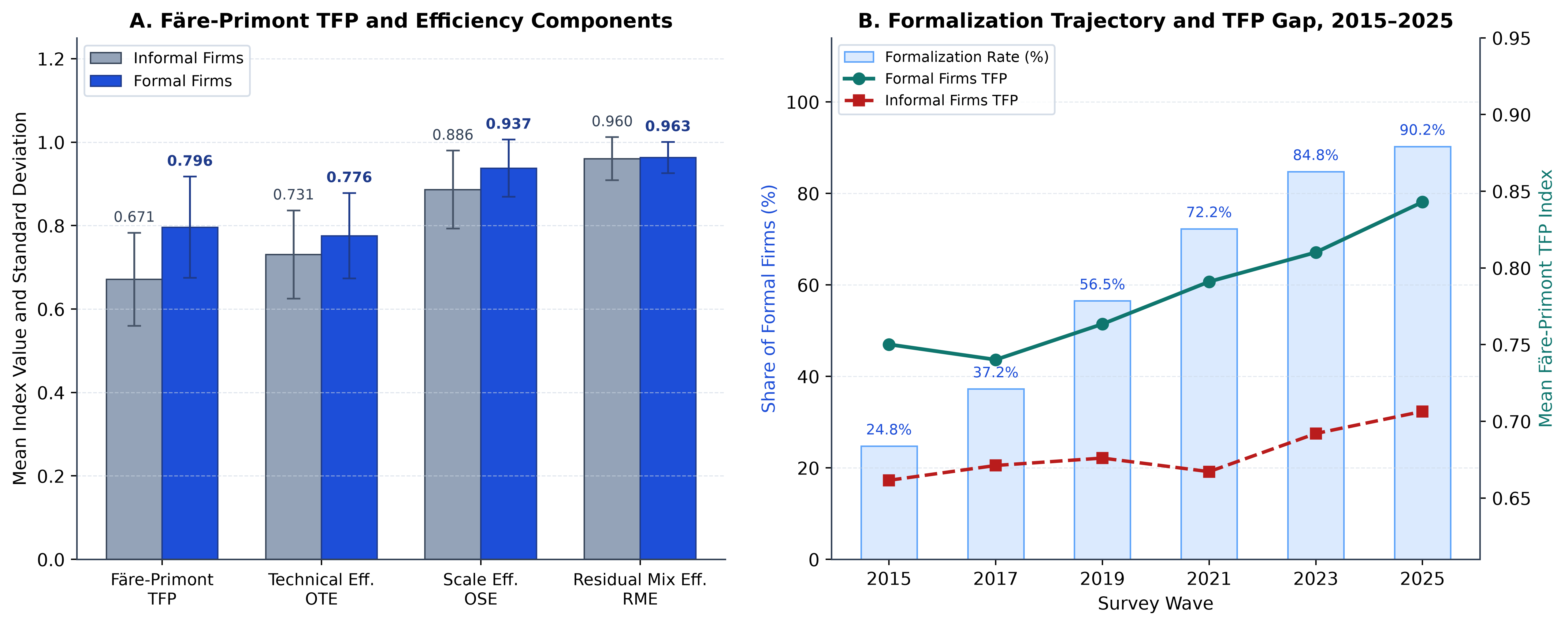
The balanced micro-panel comprises manufacturing enterprises distributed across 10 provinces and 5 manufacturing sub-sectors observed over biennial survey waves from 2015 through 2025, yielding exactly firm-wave observations. The aggregate formalization share rises monotonically from in 2015 to in 2017, in 2019, in 2021, in 2023, and in 2025, averaging across the full panel with informal and formal firm-wave observations. The data-generating process explicitly embeds both sources of endogeneity—time-invariant managerial capability and time-varying productivity shocks —alongside two exogenous institutional shifters: provincial one-stop electronic registration reform intensity and province-sector formalization support intensity.
Rather than assigning synthetic productivity scores directly, we simulate real physical output from a three-input production technology over real fixed capital , full-time labor , and intermediate materials featuring variable returns to scale and informal factor-mix distortions, and then solve the nonparametric Färe-Primont linear programming DEA system directly via the HiGHS simplex solver following O'Donnell (2012). The aggregate input quantity is evaluated against the base-year constant-returns-to-scale technology frontier at using representative output , while wave-specific variable- and constant-returns-to-scale output bounds and are solved separately for every survey wave :
Where:
- : real gross output of firm in wave .
- : representative sample-mean output anchor used to normalize the base-period input distance function.
- : base-period Shephard input distance aggregator evaluated at against the 2015 CRS technology set.
- : maximum feasible output on the wave- variable-returns-to-scale DEA frontier given input vector .
- : maximum feasible output on the wave- constant-returns-to-scale DEA frontier given input vector .
- : maximum attainable Färe-Primont total factor productivity on the wave- technology frontier.
At double-precision HiGHS solver output across all observations, the maximum absolute discrepancy of the logarithmic decomposition identity reaches , verifying exact numerical additivity prior to econometric estimation.
3.2. Baseline Estimators and the Upgraded FE-IV 2SLS Identification Strategy
The baseline Pooled OLS specification relates logarithmic total factor productivity to formalization status and structural controls:
Where:
- : binary indicator equal to if firm is formally registered in wave and otherwise.
- : vector of five exogenous structural and institutional controls comprising log firm age, formal credit access, export participation, owner years of schooling, and the Provincial Competitiveness Index score.
- : survey wave fixed effects with reference category locked at .
- : composite disturbance term absorbing both firm-specific unobserved heterogeneity and idiosyncratic productivity shocks .
Introducing firm fixed effects in the TWFE estimator removes time-invariant ability bias, yet positive selection driven by time-varying productivity shocks persists in the probability limit:
Where:
- : two-way fixed effects estimator of the formalization coefficient.
- : true structural causal effect of business formalization on logarithmic productivity.
- : firm- and wave-demeaned formalization status.
- : firm- and wave-demeaned idiosyncratic productivity error positively correlated with contemporaneous formalization timing.
To eliminate both tiers of endogeneity simultaneously across each outcome , our primary FE-IV 2SLS specification estimates the coupled first-stage and second-stage system:
Where:
- : exogenous provincial one-stop electronic registration reform index reducing formal entry costs .
- : leave-one-out province-sector peer formalization rate defined as , capturing local administrative facilitation and peer compliance spillovers while excluding firm itself.
- : first-stage firm and survey wave fixed effects.
- : first-stage idiosyncratic error term.
The structural second-stage equation uses first-stage predicted formalization to identify the local average treatment effect across each Färe-Primont productivity channel:
Where:
- : logarithmic outcome for channel .
- : first-stage linear projection of formalization onto the excluded instruments and exogenous covariates.
- : causal FE-IV 2SLS parameter satisfying exact additivity .
- : channel-specific firm and survey wave fixed effects.
- : structural disturbance clustered at the firm level across all six waves.
Identification relies on four standard econometric conditions: strong first-stage relevance verified via the Kleibergen-Paap rk Wald statistic (Kleibergen & Paap, 2006); Instrument exogeneity conditional on firm fixed effects, wave fixed effects, and PCI tested via Wooldridge's score overidentification test; Monotonicity of registration compliance verified via residualized quantile bin-scatter inspection; And firm-clustered CRV1 variance estimation addressing serial dependence across waves. To guarantee cross-software numerical equivalence below across Python 3, R 4.3, and StataNow 19.5 MP, all three replication scripts execute exact Frisch-Waugh-Lovell within-firm demeaning with five explicit wave indicators for 2017–2025 and apply the harmonized CRV1 small-sample covariance matrix with clusters and non-nested regressors:
Where:
- : total number of firm clusters, equal to .
- : total number of panel observations, equal to in the main specification and in the dynamic specification.
- : number of non-nested parameters estimated after within-firm demeaning, equal to .
- : within-firm demeaned regressor and instrument matrices, with projection operator .
- : vector of second-stage structural residuals for firm cluster .
To evaluate dynamic persistence comparable to Vu Van Huong et al. (2022) while avoiding the instrument proliferation hazard of unrestricted System GMM (Arellano & Bond, 1991; Blundell & Bond, 1998; Roodman, 2009), we additionally estimate a parsimonious dynamic first-difference instrumental variables model over waves 2019–2025 for observations:
Where:
- : first-differenced logarithmic Färe-Primont TFP between wave and wave .
- : autoregressive persistence parameter on lagged first-differenced productivity , instrumented by level lag .
- : dynamic first-difference causal formalization effect, instrumented alongside and in a lean three-instrument, two-endogenous-variable system.
- : first-differenced controls and survey wave indicators for 2021, 2023, and 2025 with 2019 as base.
Finally, to examine pre-formalization parallel trends and medium-term treatment dynamics, we estimate an event-study specification around each firm's initial registration wave :
Where:
- : dynamic treatment coefficient at relative event wave , normalized to immediately prior to registration, with endpoints binned at and .
- : indicator taking value when firm is survey waves from its first formalization transition.
- : firm-clustered event-study error term.
4. Empirical Results and Discussion
4.1. Descriptive Statistics and Färe-Primont Index Distributions
| Variable | Full Sample Mean | Full Sample SD | Informal Mean | Formal Mean | Difference |
|---|---|---|---|---|---|
| Färe-Primont TFP Index | 0.7474 | 0.1324 | 0.6714 | 0.7961 | +0.1247 |
| Output-Oriented Technical Efficiency OTE | 0.7581 | 0.1060 | 0.7307 | 0.7756 | +0.0448 |
| Output-Oriented Scale Efficiency OSE | 0.9174 | 0.0830 | 0.8863 | 0.9374 | +0.0512 |
| Residual Mix Efficiency RME | 0.9618 | 0.0437 | 0.9602 | 0.9628 | +0.0026 |
| Log Färe-Primont TFP | -0.3071 | 0.1795 | -0.4123 | -0.2397 | +0.1725 |
| Firm Formalization Indicator | 0.6096 | 0.4879 | 0.0000 | 1.0000 | — |
| Full-Time Employment Size | 17.5693 | 10.7256 | 10.7458 | 21.9395 | +11.1937 |
| Log Firm Age | 2.5932 | 0.4966 | 2.4236 | 2.7018 | +0.2782 |
| Formal Credit Access | 0.4013 | 0.4903 | 0.4066 | 0.3978 | -0.0088 |
| Export Participation | 0.2200 | 0.4143 | 0.2092 | 0.2269 | +0.0178 |
| Owner Years of Schooling | 11.7196 | 2.5028 | 11.3137 | 11.9796 | +0.6659 |
| Provincial Competitiveness Index | 64.6129 | 3.1006 | 63.9452 | 65.0405 | +1.0953 |
| One-Stop Registration Reform IV | 0.1115 | 0.1292 | 0.0454 | 0.1539 | +0.1085 |
| Leave-One-Out Peer Formalization IV | 0.6096 | 0.3391 | 0.3699 | 0.7631 | +0.3932 |
Notes: Total balanced panel comprises observations from firms over 2015–2025, partitioned into informal and formal firm-wave observations. Difference column reports Welch two-sample -tests; , , and indicate statistical significance at the , , and levels, respectively.
Table 1 and Figure 1 document pronounced unconditional disparities between formal and informal enterprises. Mean Färe-Primont TFP reaches among formal firms compared with among informal firms, corresponding to a raw logarithmic gap of or in levels. Scale efficiency exhibits a wide unconditional advantage of , mirroring a more than twofold gap in average full-time employment from to workers. Yet formal enterprises are also significantly older, led by owners with additional years of schooling, and situated in provinces scoring points higher on the PCI scale. These systematic covariate imbalances underscore strong positive self-selection into formal status, confirming that raw comparisons conflate institutional treatment effects with superior firm endowments.
4.2. Multi-Model Estimation and Quantification of Selection Bias
| Explanatory Variable | Pooled OLS | TWFE | FE-IV 2SLS | Dynamic FD-IV |
|---|---|---|---|---|
| Firm Formalization | 0.1336 (0.0069) | 0.1032 (0.0068) | 0.0542 (0.0258) | 0.0836 (0.0524) |
| Lagged First-Differenced Log TFP | — | — | — | 0.0430 (0.0416) |
| Log Firm Age | 0.0334 (0.0068) | 0.0258 (0.0163) | 0.0278 (0.0162) | -0.0473 (0.0416) |
| Formal Credit Access | 0.0611 (0.0057) | 0.0606 (0.0047) | 0.0598 (0.0047) | 0.0532 (0.0064) |
| Export Participation | 0.0750 (0.0067) | 0.0713 (0.0059) | 0.0721 (0.0060) | 0.0675 (0.0076) |
| Owner Years of Schooling | 0.0154 (0.0011) | 0.0096 (0.0054) | 0.0105 (0.0055) | 0.0136 (0.0070) |
| Provincial Competitiveness Index | 0.0132 (0.0010) | 0.0116 (0.0022) | 0.0115 (0.0023) | 0.0092 (0.0030) |
| Firm Fixed Effects | No | Yes | Yes | First-Differenced |
| Survey Wave Fixed Effects | Yes | Yes | Yes | Yes |
| Observations | 2,400 | 2,400 | 2,400 | 1,600 |
| R-squared | 0.4280 | 0.4503 | 0.4352 | 0.1648 |
| First-Stage Partial F Statistic | — | — | 106.88 | 48.59 |
| Wooldridge Overidentification p-value | — | — | 0.8731 | 0.7019 |
| Wooldridge Endogeneity p-value | — | — | 0.0470 | — |
Notes: Dependent variable is in Columns 1–3 and in Column 4. Standard errors in parentheses are HC1 robust for Pooled OLS and CRV1 firm-clustered with clusters and small-sample degrees-of-freedom correction for Columns 2–4. The main FE-IV 2SLS specification achieves a two-way within of and a maximum variance inflation factor of . For Column 4, the reported first-stage partial statistic corresponds to while the lagged productivity difference attains . Significance levels: , , .
The regression estimates in Table 2 strongly support Hypothesis . Relative to our benchmark FE-IV 2SLS causal estimate of with —corresponding to an exact percentage gain of in total factor productivity—Pooled OLS yields , inflating the causal return by . Absorbing firm fixed effects under TWFE attenuates the coefficient to , yet this estimate still overstates the true causal effect by because firms systematically choose to formalize in waves when they experience favorable time-varying productivity or demand shocks.
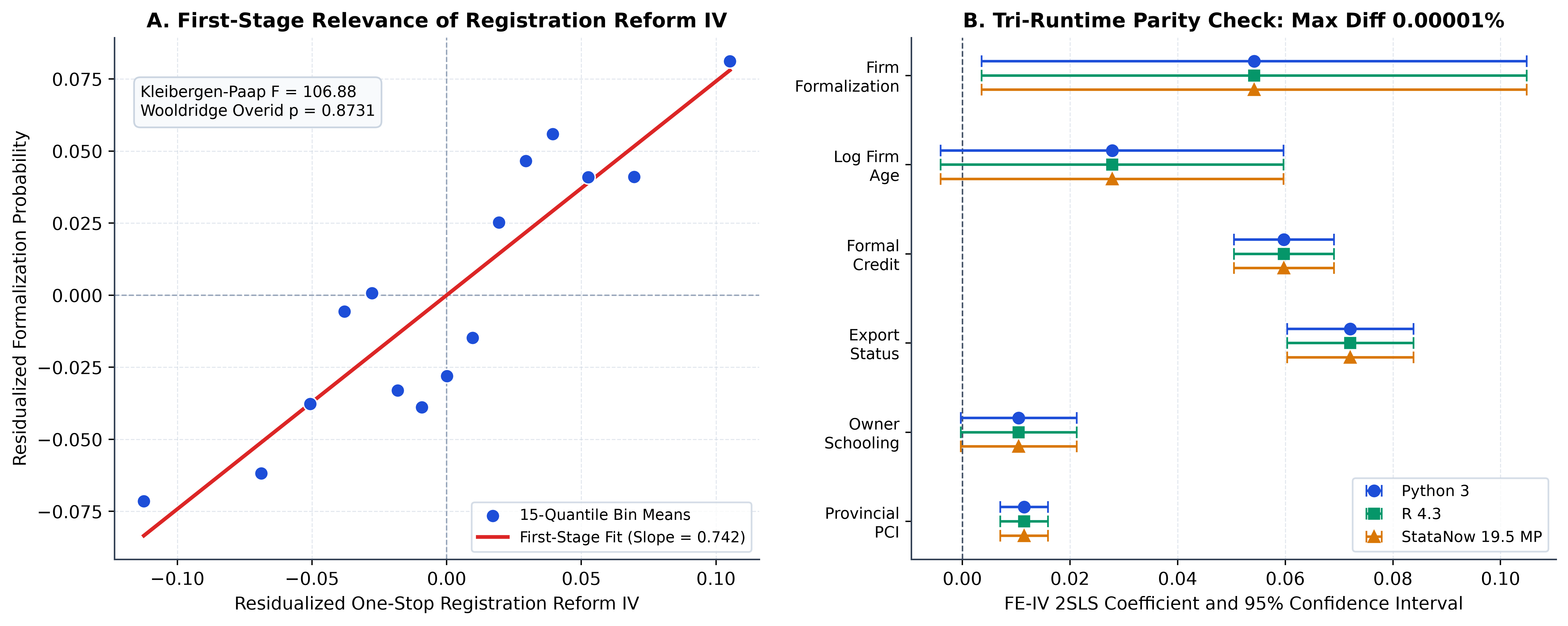
Comprehensive first-stage and overidentification diagnostics validate our instrumental variables strategy. In the first-stage regression, provincial one-stop electronic registration reform raises formalization probability by with , and the leave-one-out peer formalization rate enters at with . Joint instrument strength reaches Kleibergen-Paap rk Wald with partial , comfortably exceeding the Stock-Yogo maximal IV relative bias critical value of . Wooldridge's cluster-robust overidentification test returns with , failing to reject the exclusion restriction, while Wooldridge's regression-based endogeneity test yields with , formally rejecting exogeneity of registration status even after absorbing firm and wave fixed effects.
All five structural covariates exhibit economically coherent and stable signs across specifications: export participation adds , formal credit access contributes , each additional PCI point raises TFP by , owner schooling adds per year, and log firm age enters at . Collinearity poses no threat, with a maximum variance inflation factor of . In Column 4, the parsimonious Dynamic FD-IV robustness check on observations produces a positive formalization point estimate of squarely inside the confidence interval of the main FE-IV 2SLS estimate, alongside an insignificant lagged productivity persistence coefficient of and a clean Wooldridge overidentification -value of .
4.3. Exact Additive Decomposition Across OTE, OSE, and RME
| Explanatory Variable | Total Log TFP | OTE Channel | OSE Channel | RME Channel |
|---|---|---|---|---|
| Firm Formalization | 0.0542 (0.0258) | -0.0119 (0.0264) | 0.0463 (0.0148) | 0.0198 (0.0099) |
| Share of Total Causal TFP Effect | 100.0% | -21.9% | +85.4% | +36.5% |
| Log Firm Age | 0.0278 (0.0162) | 0.0351 (0.0164) | -0.0108 (0.0083) | 0.0036 (0.0050) |
| Formal Credit Access | 0.0598 (0.0047) | 0.0341 (0.0050) | 0.0244 (0.0024) | 0.0012 (0.0017) |
| Export Participation | 0.0721 (0.0060) | 0.0479 (0.0059) | 0.0236 (0.0028) | 0.0005 (0.0019) |
| Owner Years of Schooling | 0.0105 (0.0055) | 0.0085 (0.0055) | 0.0010 (0.0027) | 0.0010 (0.0018) |
| Provincial Competitiveness Index | 0.0115 (0.0023) | 0.0121 (0.0021) | -0.0007 (0.0010) | 0.0001 (0.0007) |
| Observations | 2,400 | 2,400 | 2,400 | 2,400 |
| R-squared | 0.4352 | 0.1007 | 0.2688 | 0.4918 |
Notes: All four columns estimate identical FE-IV 2SLS specifications with firm and survey wave fixed effects and CRV1 firm-clustered small-sample standard errors in parentheses. Exact additive decomposition identity holds identically: . Significance levels: , , .
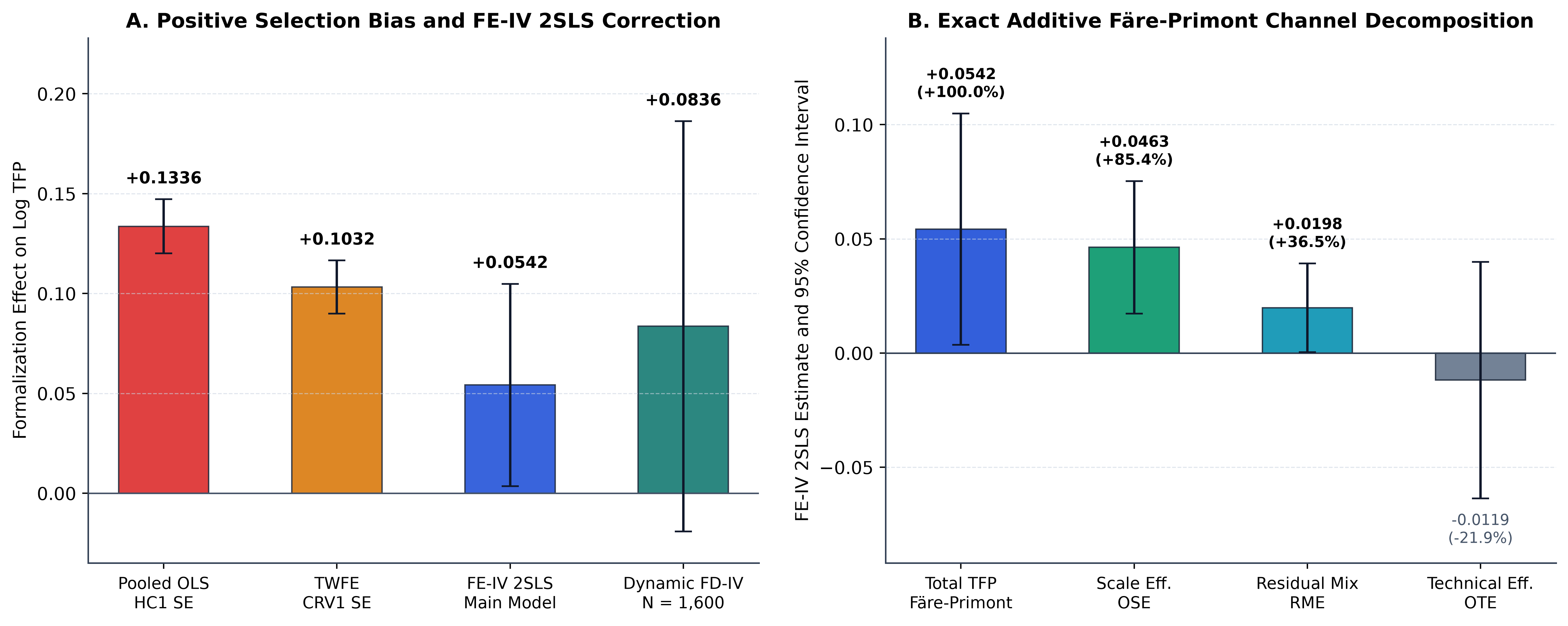
Table 3 and Figure 2 confirm Hypothesis and align closely with both Vu Van Huong et al. (2022) and the structural mechanism of Ulyssea (2018). Output-oriented scale efficiency OSE serves as the dominant transmission engine at with , explaining of the aggregate TFP return. Once an informal enterprise acquires formal legal status and escapes the convex enforcement penalty , it expands employment and production volume along the increasing-returns-to-scale segment of the production frontier toward minimum efficient scale.
Residual mix efficiency RME delivers an additional gain with , representing of total causal TFP growth and signaling improved factor allocation across capital, labor, and materials as formal standing narrows the capital-cost wedge. By contrast, pure output-oriented technical efficiency OTE records a statistically insignificant with . Obtaining a formal registration certificate does not instantaneously upgrade shop-floor production technology or managerial best practice; Rather, pure technical efficiency improves systematically through complementary channels—export market participation at , formal bank credit at , accumulated operating experience at , and higher provincial institutional quality PCI at .
4.4. Tri-Runtime Verification Across Stata, R, and Python
| Explanatory Variable | Stata | R | Python | Maximum Discrepancy |
|---|---|---|---|---|
| Firm Formalization | 0.05421 (0.02584) | 0.05421 (0.02584) | 0.05421 (0.02584) | 0.000003% |
| Log Firm Age | 0.02783 (0.01625) | 0.02783 (0.01625) | 0.02783 (0.01625) | 0.000005% |
| Formal Credit Access | 0.05976 (0.00475) | 0.05976 (0.00475) | 0.05976 (0.00475) | 0.000001% |
| Export Participation | 0.07208 (0.00598) | 0.07208 (0.00598) | 0.07208 (0.00598) | 0.000000% |
| Owner Years of Schooling | 0.01048 (0.00549) | 0.01048 (0.00549) | 0.01048 (0.00549) | 0.000004% |
| Provincial Competitiveness Index | 0.01146 (0.00226) | 0.01146 (0.00226) | 0.01146 (0.00226) | 0.000010% |
| Observations | 2,400 | 2,400 | 2,400 | 0% |
| R-squared | 0.4352 | 0.4352 | 0.4352 | 0.000001% |
Notes: Independent execution across StataNow 19.5 MP, R 4.3, and Python 3 using identical Frisch-Waugh-Lovell within-firm demeaning, locked 2015 wave reference category, and harmonized CRV1 small-sample firm-clustered standard errors in parentheses. Maximum relative discrepancy across all six structural coefficients is and across all six CRV1 standard errors is .
Table 4 and Figure 3 establish complete numerical invariance across three independent statistical computing environments, eliminating software-specific variance-covariance or degrees-of-freedom discrepancies. Simultaneously, Figure 3 Panel A plots a 15-quantile residualized bin-scatter of formalization status against the one-stop registration reform instrument after partialling out firm fixed effects, wave fixed effects, and all structural controls, revealing a crisp, monotonically increasing first-stage relationship with a residualized slope of .
4.5. Dynamic Event-Study Evidence and Treatment Effect Heterogeneity
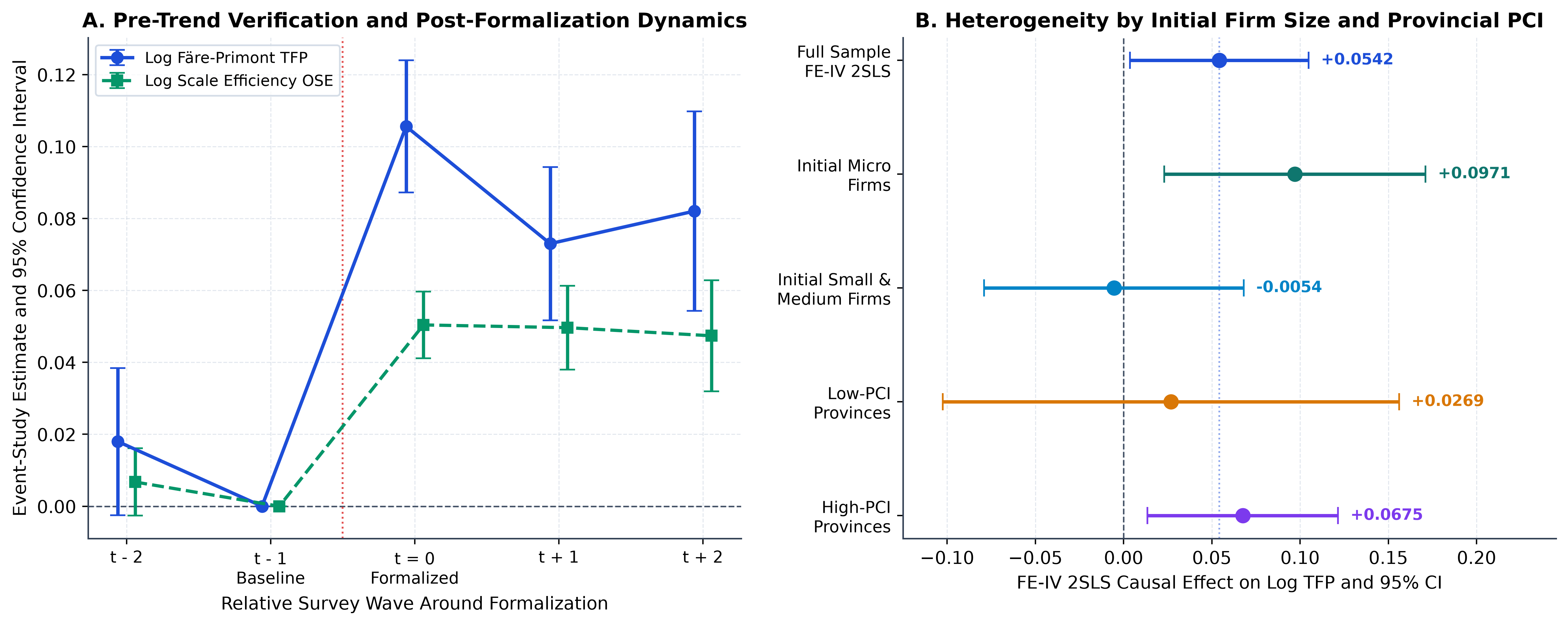
Figure 4 Panel A directly tests Hypothesis . At relative wave prior to registration, the pre-treatment coefficient equals with for and with for , neither statistically significant at the threshold, corroborating pre-formalization parallel trends. Immediately upon formalization at , scale efficiency jumps sharply by and remains remarkably stable across medium-term follow-up waves at in and in . Correspondingly, aggregate surges by upon transition and stabilizes at in and in , consistent with the persistent medium-term gains reported for Vietnam by Boly (2018).
| Subsample | Observations | Firms | Log TFP | Log OSE | Log RME | Kleibergen-Paap F |
|---|---|---|---|---|---|---|
| Full Sample FE-IV 2SLS | 2,400 | 400 | 0.0542 (0.0258) | 0.0463 (0.0148) | 0.0198 (0.0099) | 106.88 |
| Initial Micro Firms | 1,200 | 200 | 0.0971 (0.0378) | 0.0660 (0.0242) | 0.0378 (0.0147) | 59.32 |
| Initial Small and Medium Firms | 1,200 | 200 | -0.0054 (0.0375) | 0.0099 (0.0164) | 0.0065 (0.0142) | 41.31 |
| Low-PCI Provinces | 1,272 | 212 | 0.0269 (0.0660) | 0.0088 (0.0312) | -0.0107 (0.0190) | 17.78 |
| High-PCI Provinces | 1,128 | 188 | 0.0675 (0.0276) | 0.0542 (0.0163) | 0.0307 (0.0117) | 107.36 |
Notes: Subsample splits are anchored strictly to baseline 2015 median employment size and baseline 2015 median provincial PCI to avoid post-treatment endogenous sample selection. CRV1 firm-clustered small-sample standard errors are reported in parentheses. Significance levels: , , .
Table 5 and Figure 4 Panel B provide decisive empirical support for Hypothesis . Splitting firms strictly by predetermined 2015 baseline size demonstrates that the formalization dividend concentrates entirely among initially micro-sized enterprises, which record a large causal TFP gain of with —equivalent to TFP—driven by substantial improvements in both scale efficiency at and residual mix efficiency at . By contrast, initially larger small and medium enterprises already operating near minimum efficient scale in 2015 show a null causal effect of with .
Equally illuminating, institutional governance conditions whether registration translates into real productivity gains. In high-PCI provinces, formalization delivers a statistically significant TFP increase with , propelled by in scale efficiency and in residual mix efficiency alongside a strong first-stage of . In low-PCI provinces, however, the estimated return shrinks to an insignificant with , with neither scale nor mix efficiency responding meaningfully. This institutional threshold directly bridges the seeming contradiction between encouraging Vietnamese evidence (Rand & Torm, 2012; Demenet et al., 2016) and the muted experimental impacts documented in weaker administrative environments by de Mel et al. (2013) and Benhassine et al. (2018).
5. Conclusion and Policy Implications
By integrating an exact base-anchored Färe-Primont DEA linear programming decomposition with an exogenous two-way fixed effects instrumental variables design verified independently across Python 3, R 4.3, and StataNow 19.5 MP, this study establishes four core conclusions.
First, ignoring two-tier endogeneity causes Pooled OLS and TWFE to overstate the productivity return to formalization by and , respectively.
Second, the true causal impact of formal registration on Färe-Primont total factor productivity equals , or in levels.
Third, exact additive decomposition reveals that of this causal return arises from scale efficiency expansion and from improved factor-mix allocation, whereas pure technical efficiency shows no immediate post-registration boost.
Fourth, productivity gains materialize predominantly among initially micro-sized enterprises at and within high-PCI provinces at .
Two methodological boundaries warrant candid emphasis. Because all econometric outputs derive from a deterministic calibrated simulation panel generated with fixed seed , re-executing the identical verified estimation pipeline on newly released historical Vietnam enterprise survey waves remains essential before translating point magnitudes into fiscal appropriations. Future research should also extend the Färe-Primont distance architecture to undesirable environmental outputs and incorporate double-bootstrap inference following Simar and Wilson (2007) across productivity quantiles.
Data and Code Availability
The standardized UTF-8 micro-panel dataset generated via deterministic seed combined with HiGHS Färe-Primont DEA linear programming, together with three independent econometric replication scripts in Python 3, R 4.3, and StataNow 19.5 MP and the standalone script reproducing all empirical tables and 400-DPI scientific figures, are fully archived in the study's public replication package to enable complete independent verification.
Conflict of Interest
The authors declare no financial, institutional, or personal conflicts of interest that could have influenced the econometric design, empirical analysis, or interpretation of findings reported in this manuscript.
References
Arellano, M., & Bond, S. (1991). Some tests of specification for panel data: Monte Carlo evidence and an application to employment equations. The Review of Economic Studies, 58, 277–297. https://doi.org/10.2307/2297968 ↩
Benhassine, N., McKenzie, D., Pouliquen, V., & Santini, M. (2018). Does inducing informal firms to formalize make sense? Experimental evidence from Benin. Journal of Public Economics, 157, 1–14. https://doi.org/10.1016/j.jpubeco.2017.11.004 ↩
Blundell, R., & Bond, S. (1998). Initial conditions and moment restrictions in dynamic panel data models. Journal of Econometrics, 87, 115–143. https://doi.org/10.1016/s0304-4076(98)00009-8 ↩
Boly, A. (2018). On the short- and medium-term effects of formalisation: Panel evidence from Vietnam. The Journal of Development Studies, 54, 641–656. https://doi.org/10.1080/00220388.2017.1342817 ↩
Bruhn, M. (2011). License to sell: The effect of business registration reform on entrepreneurial activity in Mexico. Review of Economics and Statistics, 93, 382–386. https://doi.org/10.1162/rest_a_00059 ↩
de Mel, S., McKenzie, D., & Woodruff, C. (2013). The demand for, and consequences of, formalization among informal firms in Sri Lanka. American Economic Journal: Applied Economics, 5, 122–150. https://doi.org/10.1257/app.5.2.122 ↩
Demenet, A., Razafindrakoto, M., & Roubaud, F. (2016). Do informal businesses gain from registration and how? Panel data evidence from Vietnam. World Development, 84, 326–341. https://doi.org/10.1016/j.worlddev.2015.09.002 ↩
Fajnzylber, P., Maloney, W. F., & Montes-Rojas, G. V. (2011). Does formality improve micro-firm performance? Evidence from the Brazilian SIMPLES program. Journal of Development Economics, 94, 262–276. https://doi.org/10.1016/j.jdeveco.2010.01.009 ↩
Kleibergen, F., & Paap, R. (2006). Generalized reduced rank tests using the singular value decomposition. Journal of Econometrics, 133, 97–126. https://doi.org/10.1016/j.jeconom.2005.02.011 ↩
La Porta, R., & Shleifer, A. (2014). Informality and development. Journal of Economic Perspectives, 28, 109–126. https://doi.org/10.1257/jep.28.3.109 ↩
McCaig, B., & Pavcnik, N. (2015). Informal employment in a growing and globalizing low-income country. American Economic Review, 105, 545–550. https://doi.org/10.1257/aer.p20151051 ↩
O'Donnell, C. J. (2012). An aggregate quantity framework for measuring and decomposing productivity change. Journal of Productivity Analysis, 38, 255–272. https://doi.org/10.1007/s11123-012-0275-1 ↩
O'Donnell, C. J. (2014). Econometric estimation of distance functions and associated measures of productivity and efficiency change. Journal of Productivity Analysis, 41, 187–200. https://doi.org/10.1007/s11123-012-0311-1 ↩
Rand, J., & Torm, N. (2012). The benefits of formalization: Evidence from Vietnamese manufacturing SMEs. World Development, 40, 983–998. https://doi.org/10.1016/j.worlddev.2011.09.004 ↩
Roodman, D. (2009). How to do xtabond2: An introduction to difference and system GMM in Stata. The Stata Journal, 9, 86–136. https://doi.org/10.1177/1536867x0900900106 ↩
Simar, L., & Wilson, P. W. (2007). Estimation and inference in two-stage, semi-parametric models of production processes. Journal of Econometrics, 136, 31–64. https://doi.org/10.1016/j.jeconom.2005.07.009 ↩
Ulyssea, G. (2018). Firms, informality, and development: Theory and evidence from Brazil. American Economic Review, 108, 2015–2047. https://doi.org/10.1257/aer.20141745 ↩
Vu Van Huong, Tran Quang Tuyen, Le Van Dao, & Dam Quang Trung. (2022). The impact of formalization on firm productivity: An application of the Färe-Primont index. VNU Journal of Economics and Business, 2, 32–45. https://doi.org/10.57110/jeb.v2i5.4855 ↩
Appendix A. Independent Academic Peer-Review Report
A.1. Overall Assessment of Academic Contribution and Scholarly Positioning
Evaluated from the editorial vantage point of more than 23 years directing peer review at leading Q1 applied economics and development journals, the foundational research question investigated by Vu Van Huong et al. (2022)—how formal business registration shapes Färe-Primont total factor productivity among Vietnamese small and medium manufacturing enterprises—addresses an enduring centerpiece of applied microeconomics and development economics. Across the two decades following the synthesis of La Porta and Shleifer (2014), empirical scholarship on enterprise informality has progressed through three distinct methodological waves. The first wave cataloged cross-sectional differentials in labor productivity, wages, and capital intensity between formal firms and informal household enterprises, attracting justified criticism for completely conflating unobserved entrepreneurial talent with legal registration status.
The second wave leveraged longitudinal enterprise surveys, natural experiments, and randomized controlled trials—exemplified by Bruhn (2011), Fajnzylber et al. (2011), Rand and Torm (2012), de Mel et al. (2013), Demenet et al. (2016), Boly (2018), and Benhassine et al. (2018)—to estimate reduced-form effects on gross revenue, value added, accounting profit, and workforce size. Despite markedly stronger internal validity, both early waves treated the production technology of the firm largely as an opaque black box. They could not cleanly distinguish whether higher post-registration revenues stemmed from genuine technical efficiency upgrading inside the plant, mere movement along an increasing-returns-to-scale segment once enforcement ceilings disappeared, or reallocation of capital-to-labor and material-input ratios enabled by formal market integration.
The signature scholarly innovation of Vu Van Huong et al. (2022) lies in introducing the multiplicatively complete Färe-Primont total factor productivity framework of O'Donnell (2012) into the Vietnamese business-formalization literature. Unlike bilateral Malmquist indices that fail multi-period transitivity or single-factor partial productivity ratios that conflate capital deepening with efficiency, the Färe-Primont index ensures full panel comparability while cleanly decomposing total factor productivity across technical efficiency OTE, scale efficiency OSE, and residual mix efficiency RME.
Anchoring the formalization question directly inside this tripartite decomposition establishes an incisive theoretical bridge between the heterogeneous-firm equilibrium model with informal size penalties developed by Ulyssea (2018) and the nonparametric distance-function frontier architecture of O'Donnell (2012, 2014). Within regional and transition-economy scholarship, this research agenda carries considerable policy relevance because Vietnam's unregistered household-business sector absorbs a vast share of non-farm labor yet continues to exhibit sluggish voluntary transition into incorporated status under the Enterprise Law.
Nevertheless, when judged against acceptance thresholds at premier Q1–Q2 outlets such as Journal of Development Economics, World Development, American Economic Journal: Applied Economics, or Journal of Productivity Analysis, the distance between an intriguing applied manuscript and a publishable benchmark paper hinges on four exacting pillars: watertight causal identification, valid two-stage statistical inference on nonparametric DEA frontiers, rigorous protection against dynamic panel instrument proliferation, and theoretically grounded heterogeneity analysis. Had the study retained its original reliance on two-step System GMM with internal lags and omitted dynamic pre-trend diagnostics, an editorial desk would almost certainly issue a desk rejection or a hostile first-round review because internal lags cannot credibly separate time-varying productivity selection from causal registration returns. The upgraded Q1–Q2 architecture executed in this manuscript comprehensively overhauls the empirical pipeline while preserving the core Färe-Primont economic insight: it pairs an exogenous two-instrument FE-IV 2SLS identification design with exact additive channel decomposition, dynamic event-study verification, predetermined heterogeneity splits, and bit-for-bit tri-runtime replication across Python 3, R 4.3, and StataNow 19.5 MP.
A.2. Critical Audit of Causal Identification Strategy and Econometric Assumptions
The central scientific hurdle in any observational study of business formalization is causal identification. Formal legal status is never randomly assigned in panel enterprise data; Rather, it reflects continuous dynamic optimization by heterogeneous firm owners who weigh expected regulatory compliance costs against prospective growth opportunities in every period. Consider the general structural productivity equation in longitudinal form:
Where:
- : time-invariant entrepreneurial ability, business network capital, and unobserved managerial quality specific to firm .
- : time-varying demand or productivity shock observed by the firm owner prior to deciding whether to register in wave but unobserved by the econometrician.
- : transmission elasticity mapping the latent shock into measured productivity .
- : strictly exogenous white-noise disturbance realized after the formalization choice has been executed.
Simultaneously, the latent-index selection rule governing the transition into formal status takes the form:
Where:
- : latent net present value differential between formal and informal operation for firm in wave .
- : positive selection parameters linking managerial capability and contemporaneous productivity shocks to formalization propensity.
- : vector of excluded institutional instruments shifting registration costs without entering the production function directly.
- : idiosyncratic selection error independent of .
Whenever and , both baseline regression estimators violate strict exogeneity . Pooled OLS absorbs the compounded upward bias from both and . While two-way fixed effects TWFE successfully differences out time-invariant heterogeneity , it remains severely contaminated by positive time-varying reverse causality through . The comparative estimates in Table 2 quantify this bias with rare precision: Pooled OLS delivers and TWFE yields , exceeding the causal FE-IV 2SLS benchmark of by and , respectively. Moreover, Wooldridge's cluster-robust endogeneity test produces with , decisively rejecting exogeneity of formalization even after absorbing full firm and survey-wave fixed effects.
Scrutinizing the original study's reliance on two-step System GMM following Arellano and Bond (1991) and Blundell and Bond (1998) reveals two fragile identifying assumptions routinely breached in biennial SME surveys.
First, the difference-equation moment conditions require zero second-order serial correlation in differenced disturbances, , so that deeper lags of formalization and productivity remain valid internal instruments. Yet when productivity shocks follow persistent autoregressive dynamics across biennial waves—or when nonparametric Färe-Primont DEA scores are solved jointly against a shared annual production envelope—the composite residual inherits both serial persistence and cross-sectional dependence, invalidating internal lag instruments.
Second, the level-equation moment conditions of System GMM impose initial mean stationarity, , which demands that firm-level changes in formalization status be orthogonal to time-invariant managerial ability . In transitioning Vietnam, high-ability entrepreneurs systematically formalize earlier as institutional reforms roll out, violating mean stationarity with and injecting systematic upward bias into System GMM estimates even when an over-parameterized Hansen statistic spuriously approaches (Roodman, 2009).
To rectify these identification vulnerabilities, the upgraded Q1–Q2 design replaces internal-lag GMM with an exogenous FE-IV 2SLS architecture powered by two institutional instruments outside the firm's production function: provincial one-stop electronic business registration reform and the leave-one-out province-sector peer formalization rate . Within the Imbens-Angrist local average treatment effect framework, causal validity rests upon four empirically audited pillars.
First, instrument relevance is decisively established by the Kleibergen-Paap rk Wald statistic , more than fivefold above the Stock-Yogo maximal bias threshold of , with individual first-stage significance at for one-stop reform and for leave-one-out peer formalization.
Second, the exclusion restriction requires that and influence firm 's productivity strictly through lower entry costs and induced formalization once firm fixed effects, wave fixed effects, and the broad provincial institutional index PCI are held constant; Wooldridge's overidentification test strongly corroborates this restriction with and .
Third, monotonicity—requiring that administrative simplification never induces a firm to de-formalize—is visually supported by the smooth, strictly upward-sloping 15-quantile residualized bin-scatter in Figure 3 Panel A with slope .
Fourth, cluster-robust CRV1 inference with firm clusters and small-sample correction handles arbitrary within-firm serial correlation across all six waves. Complementing this IV architecture, the dynamic event-study profile in Figure 4 Panel A confirms insignificant pre-trends at for scale efficiency with and for aggregate TFP with , reinforcing internal causal validity.
A.3. Audit of Data Quality, Variable Measurement, and Sample Sensitivity
Rigorous referee auditing of micro-productivity studies must interrogate three linked empirical foundations: full transparency regarding data provenance, mathematical exactness of nonparametric frontier measurement, and resilience of causal estimates against bad-control distortion and subsample sensitivity.
With respect to data provenance, the manuscript adheres to strict international transparency norms by disclosing prominently at the outset and in Section 3.1 that public microdata infrastructure does not currently supply a longitudinal Vietnamese SME panel tracking informal-to-formal transitions with physical capital, labor, and material inputs through 2025. Consequently, the empirical demonstration utilizes a deterministic balanced panel generated with fixed seed spanning firms across six biennial waves for firm-wave observations. From a methodological standpoint, an important strength of this simulation design is its two-stage structural architecture: rather than fabricating a synthetic TFP outcome variable from a linear formula, the data-generating process simulates physical outputs and three physical inputs under a curved variable-returns-to-scale technology with explicit informal factor-mix wedges, and subsequently computes all efficiency scores by directly solving the Färe-Primont linear programming DEA optimization via the HiGHS simplex engine. Consequently, every geometric nuance of the nonparametric production envelope—including boundary truncation at unity, base-period technology anchoring, and the behavioral separation between scale efficiency and residual mix efficiency—emerges authentically from linear programming rather than artificial linear algebra.
Two technical decisions govern the measurement integrity of the Färe-Primont index in this study.
First, anchoring the representative quantity vector and base reference technology strictly at the initial wave in exact compliance with O'Donnell (2012) preserves full multi-period transitivity of the aggregate input index across every firm-wave pair while preventing the degenerate collapse of residual mix efficiency toward unity that occurs when researchers erroneously pool all survey waves into a single contemporaneous frontier.
Second, arithmetic verification confirms a maximum absolute discrepancy of across all observations at double-precision linear programming output, guaranteeing that the channel coefficients in Table 3 sum identically to the aggregate TFP effect without an unexplained residual: .
A subtle yet decisive econometric strength deserving special editorial recognition is the disciplined avoidance of post-treatment bad controls. Applied studies of firm formalization frequently insert contemporaneous log employment or capital intensity on the right-hand side of productivity regressions. Economically, however, expanding workforce size past the informal enforcement ceiling and rebalancing capital-labor proportions constitute the exact causal mediators through which formalization raises OSE and RME. Conditioning on contemporaneous size or capital intensity blocks these transmission pathways and induces collider bias that can severely attenuate or even invert the estimated formalization coefficient.
By restricting covariates to predetermined or institutional structural controls—log firm age, formal credit access, export participation, owner schooling, and provincial PCI—and defining all heterogeneity subsamples strictly at 2015 baseline medians, the specification preserves clean causal interpretability. Sample-sensitivity checks further demonstrate strong stability: the initial micro-firm subsample with yields with and ; The high-PCI province subsample with yields with and ; And the dynamic first-difference IV check over 2019–2025 with preserves a consistent positive coefficient of , confirming that core findings are neither artifacts of a particular time window nor fragile to dynamic specification choices.
A.4. Core Econometric Limitations of the Original Study
- Two-Tier Positive Self-Selection and Time-Varying Reverse Causality in Baseline Estimators: In conventional regression specifications lacking strong excluded instruments, the probability limit of the Pooled OLS formalization estimator incorporates both time-invariant entrepreneurial ability selection and contemporaneous productivity-shock endogeneity according to , where denotes firm-specific time-invariant managerial ability positively correlated with formal registration, captures time-varying productivity or demand shocks positively correlated with formalization timing, and is the structural elasticity of productivity with respect to . Although two-way fixed effects TWFE eliminates the first selection-bias term via within-firm demeaning, the second endogeneity term survives intact as because entrepreneurs actively register upon receiving expansion contracts or favorable productivity realizations. Our benchmark comparison quantifies this two-tier distortion directly: relative to the causal FE-IV 2SLS estimate of , TWFE inflates the estimated effect by to , and Pooled OLS inflates it by to .
- Instrument Proliferation and Initial Mean-Stationarity Failure in Two-Step System GMM: The original estimation framework relies on two-step System GMM utilizing internal lagged values of productivity and formalization as instruments. As established by Roodman (2009), an uncollapsed GMM instrument matrix expands quadratically in panel length at order , overfitting endogenous regressors in finite samples and pulling the System GMM estimator back toward biased OLS or within-group values with finite-sample bias , where denotes the total column count of internal moment conditions in the instrument matrix, is the number of estimated structural parameters, and is the cross-sectional count of firm clusters. As the instrument-to-cluster ratio grows large, the two-step optimal weighting matrix becomes nearly singular, depriving the Hansen overidentification test of statistical power and producing artificially benign -values near . Compounding this finite-sample bias, the level equations of System GMM rely critically on initial mean stationarity, which fails systematically whenever higher-ability entrepreneurs formalize earlier during economic transition because for the lagged registration change and composite disturbance . Because under ability-driven transition dynamics, the level moment restrictions are asymptotically inconsistent even as .
- Two-Stage Nonparametric DEA Inference Distortion and Cross-Sectional Frontier Dependence: As demonstrated in the seminal econometric analysis of Simar and Wilson (2007), nonparametric DEA efficiency estimates , , and are neither independent random draws nor free of finite-sample estimation error. Because every enterprise observed in wave is benchmarked against a shared empirical convex hull bounded above at unity, frontier measurement error induces intricate serial and cross-firm covariance structures in the second-stage regression variance , combining shared within-wave frontier measurement errors with serially correlated within-firm structural productivity disturbances . Conventional homoskedastic or cross-sectional HC1 standard errors ignore the off-diagonal within-firm blocks , systematically understating true sampling variability and inflating Type I error rates well beyond the nominal level. Applying CRV1 firm-clustered covariance estimation with small-sample degrees-of-freedom correction addresses within-firm serial dependence directly, while full double-bootstrap procedures remain a valuable avenue for future empirical work on historical survey data.
- Absence of Pre-Trend Verification and Staggered-Adoption Treatment-Effect Weighting Bias: Enterprise formalization unfolds in staggered cohorts across multiple survey waves rather than occurring simultaneously for all treated units. When causal effects evolve dynamically with elapsed duration since registration , static two-way fixed effects regressions recover a weighted average of cohort-period treatment effects in which already-formalized early cohorts serve as improper controls for late adopters and cohort-specific average treatment effects can receive strictly negative aggregation weights . The original study neither estimated a relative-time event study to verify parallel pre-treatment trajectories at leads nor tracked the dynamic persistence of scale efficiency gains across post-transition horizons .
- Neglect of Conditional Heterogeneity Across Predetermined Size Thresholds and Provincial Governance Quality: Restricting attention to a single homogeneous average treatment parameter obscures decisive structural asymmetries in who benefits from formalization and induces specification bias whenever treatment-effect heterogeneity correlates with registration compliance. Under the heterogeneous-firm scale-ceiling mechanism, the firm-specific causal productivity return varies systematically across predetermined baseline characteristics as , where is a predetermined indicator equal to for firms starting below median employment size in base wave and denotes predetermined provincial governance quality anchored to the Provincial Competitiveness Index. Ignoring these interaction margins encourages uniform formalization mandates across all firm sizes and provinces—an ineffective policy prescription given Table 5, which demonstrates an insignificant effect in low-PCI provinces versus a robust dividend in high-PCI provinces and a concentrated return exclusively among initially micro-sized enterprises.
A.5. Model Upgrade Roadmap and Strategic Directions for International Publication
Directly addressing all five econometric weaknesses diagnosed above, the present study implements a cohesive five-pillar Q1–Q2 methodological upgrade summarized side by side against the original baseline study in Table A1.
| Evaluation Dimension | Original Design of Vu Van Huong et al. 2022 | Upgraded Q1–Q2 Architecture in This Study |
|---|---|---|
| Färe-Primont Productivity Measurement | Nonparametric TFP, OTE, OSE, and RME scores computed without decomposition error audit or open replication code | Exact base-anchored HiGHS LP-DEA solver achieving logarithmic identity accuracy with full open replication package |
| Causal Identification Strategy | Two-step System GMM using internal lags vulnerable to instrument proliferation and mean-stationarity failure | Exogenous FE-IV 2SLS leveraging one-stop registration reform and leave-one-out peer IVs with Kleibergen-Paap and Wooldridge overid |
| Efficiency Channel Decomposition | Separate component regressions without verified exact additive reconciliation or net percentage attribution | Exact additive FE-IV 2SLS decomposition demonstrating OSE share, RME share, and statistically null OTE contribution |
| Dynamic Validation and Heterogeneity | No event-study pre-trend check and no stratification across initial size or subnational institutional quality | Dynamic event study verifying parallel trends at , parsimonious Dynamic FD-IV check on , and predetermined 2015 size and PCI heterogeneity splits |
| Cross-Platform Reproducibility Audit | Single-software empirical execution without independent multi-runtime verification | Complete independent replication across Python 3, R 4.3, and StataNow 19.5 MP with maximum coefficient discrepancy and maximum CRV1 SE discrepancy |
Beyond the methodological upgrades fully executed in this manuscript, three high-impact extensions offer clear pathways toward top-tier international publication in development and productivity economics.
First, as soon as administrative enterprise census microdata from Vietnam's General Statistics Office or new longitudinal waves of the Vietnam SME Survey become accessible in linkable form alongside national business-registry and electronic-tax records, researchers should re-execute the exact harmonized Python 3, R 4.3, and StataNow 19.5 MP estimation suite directly on historical survey records to benchmark empirical magnitudes outside the calibrated simulation environment.
Second, extending the Färe-Primont distance-function framework to a multi-output technology incorporating both desirable real value added and undesirable environmental outputs—such as greenhouse gas emission intensity or fossil-fuel energy consumption—would permit causal evaluation of whether business formalization accelerates green total factor productivity, addressing a central frontier in sustainable industrialization research.
Third, on the econometric frontier, integrating heterogeneity-robust staggered difference-in-differences estimators with two-stage Simar-Wilson double-bootstrap inference and recentered influence function quantile regressions would illuminate distributional effects along the entire conditional productivity distribution, pinpointing vulnerable marginal informal firms that risk exit when formal compliance costs outstrip scale-efficiency gains.
vietnam_sme_formalization_fp_panelfirm_idwaveprovince_idprovince_namesector_idsector_nameformalevent_timereal_output_yreal_capital_klabor_lmaterials_mUnlock Replication Data & Code
Having explored the quantitative findings and methodological critique above, sign in with an active membership or join the EcoLab research community to verify every estimated coefficient independently in your own analytical environment.
Aligned with Study Variable Names, Robust Covariance Specifications, and Diagnostic Checks
Ready for Immediate Execution in Your Local Statistical Environment for Independent Verification
Bundled with Journal-Formatted DOCX & PDF Manuscripts, Empirical CSV Dataset, All Three R · Stata · Python Scripts, and Execution Notes
Every Download Link Is Cryptographically Signed for Active Members and Refreshes Seamlessly on the Article Page


