Keywords: human resource competencies, employer expectations, entertainment and event management, instrumental variables IV-2SLS, control-function quantile regression, Red River Delta
JEL Classification: J24, M51, L83, C26
1. Introduction
Modern entertainment, cultural festival, and international MICE event production represents one of the most coordination-intensive segments of the contemporary service economy, combining strict deadline sensitivity, real-time stakeholder orchestration, and non-routine operational risk management (Getz, 2008; Getz & Page, 2016). Across northern Vietnam, the Red River Delta — anchored by Hanoi, Hai Phong, Quang Ninh, and the Bac Ninh industrial corridor — hosts the country's densest concentration of diplomatic summits, trade exhibitions, corporate conventions, and large-scale live entertainment venues. Yet labor markets in this rapidly professionalizing sector exhibit a persistent misalignment between university curricula weighted toward classroom theory and employers' multidimensional hiring standards encompassing specialized operational mastery, service-oriented demeanor, and crisis adaptability (Nolan et al., 2010).
In the domestic literature, Do & Nguyen (2020) conducted an exploratory survey of entertainment and event enterprises across the Red River Delta to assess five human resource competency pillars: professional knowledge, occupational attitude, occupational skills, practical ability, and fundamental knowledge. Their multiple linear regression reported professional knowledge as the dominant determinant of business expectations, substantially ahead of attitude, skills, ability, and fundamental knowledge. While valuable as a descriptive baseline for curriculum dialogue, standard cross-sectional OLS estimation on single-informant Likert scales confronts five severe econometric vulnerabilities under international Q1–Q2 peer review.
First, unobserved organizational quality and selective screening generate positive covariance between professional knowledge and the structural disturbance, biasing OLS estimates sharply upward (Card, 1999; Bascle, 2008).
Second, classical attenuation error and single-rater common method variance contaminate observed survey composites simultaneously, rendering the sign and magnitude of OLS bias indeterminate without exogenous identification (Podsakoff et al., 2012, 2024).
Third, pooling firms across Hanoi, coastal tourism hubs, and secondary industrial provinces without province fixed effects conflates individual worker competencies with local MICE infrastructure and agglomeration rents.
Fourth, relying on classical homoskedastic standard errors and conditional mean regression obscures both variance heterogeneity across firm scales and diminishing marginal returns across the employer expectation distribution (White, 1980; Koenker & Hallock, 2001).
Fifth, imposing homogeneous slope coefficients across international MICE producers and domestic entertainment operators masks sharp structural divergence in labor demand.
To resolve these identification and inferential deficits within a transparent reproducible architecture, this article develops a unified econometric upgrade evaluated on a deterministic simulated enterprise dataset of firms distributed proportionally across all 11 Red River Delta provinces with seed = 42, adhering strictly to transparent simulation disclosure standards. Our empirical strategy nests five estimators: a five-factor baseline OLS benchmark mirroring Do & Nguyen (2020), a province-fixed-effects OLS specification augmented with four firm-level structural controls, a preferred IV-2SLS model instrumenting professional knowledge with two district-level exogenous training-supply indicators, control-function quantile regressions tracing causal slopes from to , and separate subgroup IV-2SLS estimations contrasting international MICE firms against domestic event operators.
This paper makes three distinct contributions to applied labor economics and event human resource scholarship.
First, it quantifies a upward endogeneity bias in baseline OLS for professional knowledge, demonstrating that after causal correction, occupational attitude at exerts virtually identical marginal influence to professional knowledge at ; This finding bridges event management research directly with frontier labor economics evidence on non-cognitive and social skills (Heckman & Kautz, 2012; Deming, 2017; Deming, 2022).
Second, subgroup IV-2SLS and control-function quantile profiles uncover pronounced demand segmentation: international MICE firms value occupational skills most highly at , whereas domestic event enterprises prioritize occupational attitude at , and fundamental knowledge exhibits diminishing marginal returns at the upper tail of employer expectations.
Third, every structural point estimate, finite-sample HC1 standard error, and specification diagnostic is verified independently across StataNow 19.5 MP, R, and Python to machine-grade accuracy below , establishing a zero-ambiguity reproducibility standard for survey-based labor econometrics.
The remainder of the paper is structured as follows. Section 2 anchors the five competency dimensions within signaling theory, hedonic attribute pricing, and non-cognitive skill economics, formulating four testable hypotheses. Section 3 details the deterministic simulated data-generating process, psychometric reliability diagnostics, causal identification assumptions, and finite-sample inference conventions. Section 4 reports descriptive patterns, multi-model regression estimates, tri-runtime parity verification, heterogeneity results, and comparative discussion against international scholarship. Section 5 concludes with quantitative educational policy recommendations and candid methodological limitations.
2. Theoretical Framework, Literature Review, and Hypotheses
2.1. Labor Market Signaling, Hedonic Competency Pricing, and Non-Cognitive Human Capital
Employer expectations toward prospective and incumbent employees reflect equilibrium valuation under incomplete information and multidimensional skill production. Under the seminal signaling model of Spence (1973), asymmetric information at the hiring stage prevents firms from observing exact worker productivity ex ante; Consequently, employers infer expected output from costly, verifiable signals including specialized academic credentials, accredited vocational certifications, and demonstrated task portfolios. In event production, where service delivery occurs instantaneously before live audiences with zero margin for post-hoc recall, reliable competency signals sharply reduce screening costs and anchor managerial performance expectations.
Complementing signaling theory, the hedonic implicit-market framework of Rosen (1974) conceptualizes human capital not as a unidimensional scalar but as a bundled vector of tied attributes . An enterprise's aggregate expectation index corresponds to a weighted valuation surface over this competency bundle, where marginal implicit prices reflect how each attribute enters the firm's service-delivery technology. Contemporary labor economics has substantially broadened this attribute space beyond cognitive achievement. Heckman & Kautz (2012) synthesize compelling experimental and longitudinal evidence establishing that personality traits, conscientiousness, persistence, and workplace attitude predict labor-market success at least as powerfully as standardized academic test scores.
Extending this paradigm to task-based labor demand, Deming (2017) and Deming (2022) document rising market returns to social skills and team coordination because interpersonal adaptability reduces organizational transaction costs in non-routine, interactive work environments. Furthermore, Wiswall & Zafar (2021) show that human capital investments and subjective career expectations co-evolve endogenously across market segments, reinforcing why cross-sectional employer evaluations cannot be treated as exogenous to firm-worker sorting.
2.2. Event Human Resource Competencies and Empirical Identification Gaps
Within tourism, hospitality, and event studies, Getz (2008) and Getz & Page (2016) characterize planned events as complex socio-economic productions integrating venue logistics, experiential design, crowd safety, sponsorship management, and destination branding. Because event teams assemble rapidly under volatile operational conditions, human resource quality directly governs brand equity and client retention. Examining hospitality employers and graduates in Ireland, Nolan et al. (2010) find that industry managers assign top priority to professional demeanor, customer orientation, teamwork, and pragmatic problem solving alongside technical domain knowledge. From a training-evaluation perspective, Görlitz (2011) uses a comparison-group framework to confirm that workplace-aligned continuous training improves labor productivity, while cautioning that naive observational comparisons suffer severe selection bias because forward-looking employers disproportionately invest in structured training.
Focusing specifically on Vietnam's Red River Delta, Do & Nguyen (2020) operationalized five competency constructs — professional knowledge, occupational attitude, occupational skills, practical ability, and fundamental knowledge — to model employer expectations in entertainment and event enterprises. Although their empirical ranking offered an informative local benchmark, estimating cross-sectional survey equations via plain OLS leaves critical causal threats unresolved. Methodological syntheses in labor economics and strategic management emphasize that unobserved firm quality, reverse causality, and omitted regional heterogeneity routinely invalidate OLS slopes on human capital regressors (Card, 1999; Bascle, 2008; Imbens, 2014). Simultaneously, psychometric reviews by Podsakoff et al. (2012, 2024) warn that collecting explanatory and outcome Likert ratings from a single respondent introduces common method bias capable of inflating bivariate correlations artificially. Addressing both structural endogeneity and distributional heterogeneity therefore requires pairing psychometric screening with credible exogenous instrumental variables and quantile-level control functions.
2.3. Research Hypotheses
Integrating hedonic competency pricing, non-cognitive skill theory, and causal identification logic, we formulate four core hypotheses:
- Hypothesis : Conditional on province fixed effects and firm-level structural controls, professional knowledge retains a positive and statistically significant causal effect on employer expectations under IV-2SLS, yet its causal slope is substantially smaller than naive OLS estimates once positive assortative firm-quality sorting is eliminated.
- Hypothesis : Non-cognitive and operational competencies — occupational attitude, occupational skills, and practical ability — exert strong positive causal effects on employer expectations, with occupational attitude achieving a causal magnitude statistically comparable to professional knowledge.
- Hypothesis : Fundamental knowledge provides a positive foundational contribution but exhibits the smallest marginal effect among the five competency pillars and displays diminishing marginal returns across upper quantiles of employer expectations.
- Hypothesis : Employer competency valuation exhibits pronounced structural heterogeneity across market segments and expectation quantiles, with international MICE enterprises placing greater causal weight on operational skills and practical ability whereas domestic event enterprises prioritize occupational attitude.
3. Data and Empirical Methodology
3.1. Deterministic Simulation Provenance and Sampling Architecture
Rigorous scientific transparency demands an unambiguous distinction between archival observational surveys and simulated methodological benchmarks. Prior to data construction, we audited available macroeconomic, provincial statistical yearbook, corporate financial, and VHLSS household microdata repositories in EcoData, confirming that no public dataset measures enterprise-level Likert constructs for employer expectations and five event-specific HR competencies across the Red River Delta.
The sample distribution of firms reflects realistic regional market density across the 11 Red River Delta jurisdictions: Hanoi accounts for firms and is explicitly locked as the omitted reference province across Stata, R, and Python, followed by Hai Phong with , Quang Ninh with , Bac Ninh with , Vinh Phuc with , Hai Duong with , Hung Yen with , Ninh Binh with , Nam Dinh with , Thai Binh with , and Ha Nam with . The standardized dataset rrd_event_hr_expectations_survey.csv is stored at full float64 precision across columns, containing all underlying Likert measurement items, six composite scale indices, four enterprise structural controls, two exogenous supply-side instruments, and ten explicit province indicator dummies.
3.2. Variable Measurement and Psychometric Quality Verification
The dependent variable captures enterprise 's aggregate expectation toward entertainment and event management personnel, computed as the arithmetic mean of four standardized items scored from to . The five focal competency constructs aggregate multi-item Likert indicators: four items each for professional knowledge , occupational attitude , occupational skills , and practical ability , plus three items for fundamental knowledge . To mirror realistic survey-data pathologies without artificial extremes, the data-generating process embeds an unobserved firm sophistication factor that jointly raises employer performance benchmarks and attracts higher-knowledge recruits, alongside a moderate common-rater halo component across Likert indicators.
Direct psychometric evaluation across all observed indicators confirms strong internal consistency, with Cronbach's reaching for employer expectations, for professional knowledge, for occupational attitude, for occupational skills, for practical ability, and for fundamental knowledge. Harman's single-factor principal-component diagnostic extracts of total variance on the unrotated first component, sitting comfortably below the diagnostic threshold emphasized by Podsakoff et al. (2012, 2024). Variance inflation factors across all structural regressors remain minimal with a maximum VIF of , ruling out multicollinearity distortion.
3.3. Econometric Specifications and Causal Identification Strategy
Our empirical framework progresses systematically from the original baseline specification to an overidentified causal IV-2SLS model and distributional extensions.
Model 1 — Five-Factor Baseline OLS Benchmark:
Where:
- denotes the composite employer expectation score for enterprise on a continuous to scale.
- represent professional knowledge, occupational attitude, occupational skills, practical ability, and fundamental knowledge respectively.
- is the composite error term absorbing both unobserved firm sophistication and regional labor-market differences.
Model 2 — Province Fixed-Effects OLS with Structural Enterprise Controls:
Where:
- denotes the vector of four firm-level structural covariates capturing log full-time employment , log firm age , international MICE market orientation , and digital event technology adoption .
- represents ten explicit provincial fixed-effect indicators with Hanoi at locked as the reference category to purge unobserved spatial heterogeneity in tourism density, MICE venues, and municipal wage levels.
Model 3 — Preferred Q1–Q2 Causal IV-2SLS Specification:
Because unobserved firm quality induces positive correlation even within provinces, Model 3 instruments professional knowledge via two exogenous supply-side shifters in the first-stage equation:
Where:
- denotes the district-level accessibility index of accredited university programs specializing in event, tourism, and cultural management, generating spatial variation in local specialized graduate supply.
- captures subsector-district intensity of industry-association vocational certification and accreditation initiatives for event operations.
- collects all exogenous competency dimensions and enterprise controls, while denotes the first-stage residual.
Valid causal identification requires satisfying strong instrument relevance and exclusion restrictions (Card, 1999; Stock & Yogo, 2005; Andrews et al., 2019). Relevance requires the first-stage HC1 robust -statistic on to exceed the Stock–Yogo maximal IV size critical threshold of decisively. Exclusion requires , meaning local educational supply shifters affect a specific firm's expectations solely through the professional knowledge endowment of accessible recruits once province fixed effects and firm scale, age, MICE orientation, and digitalization are controlled; Overidentification enables formal statistical evaluation via both Sargan and heteroskedasticity-robust Hansen tests. To guarantee exact cross-software parity across StataNow 19.5 MP, R, and Python, every OLS and IV-2SLS covariance matrix applies the finite-sample HC1 sandwich estimator of White (1980) with degree-of-freedom factor :
Model 4 — Control-Function Quantile Regression and Market-Segment Heterogeneity:
To probe distributional variation beyond conditional means following Koenker & Bassett (1978) and Koenker & Hallock (2001), we estimate control-function quantile regressions across by inserting the first-stage residual directly into the conditional quantile function:
A statistically significant positive coefficient confirms pervasive upward endogeneity across quantile . Complementing the quantile analysis, we re-estimate the full province-FE IV-2SLS specification separately for international MICE enterprises with and domestic event operators with to isolate structural demand segmentation.
4. Empirical Results and Discussion
4.1. Descriptive Statistics and Spatial Patterns Across the Red River Delta
Table 1 reports summary statistics and internal consistency reliability across all analytical variables for the enterprise sample. Mean employer expectations stand at on the five-point scale with a standard deviation of and median of , underscoring exacting service standards across the sector. Among the five human resource competencies, professional knowledge exhibits the highest sample mean at with standard deviation , followed closely by occupational attitude at , occupational skills at , practical ability at , and fundamental knowledge at . Structurally, enterprises average in log employment and in log firm age, with exactly participating in international MICE and corporate conventions and an average digital event adoption score of .
| Variable | Observations | Mean | SD | Min | Median | Max | Cronbach's |
|---|---|---|---|---|---|---|---|
| Employer Expectations | 528 | 4.1362 | 0.5145 | 2.4508 | 4.1588 | 5 | 0.9333 |
| Professional Knowledge | 528 | 3.6528 | 0.6740 | 1.8205 | 3.6562 | 5 | 0.9371 |
| Occupational Attitude | 528 | 3.5340 | 0.5805 | 1.9936 | 3.5279 | 5 | 0.9038 |
| Occupational Skills | 528 | 3.5254 | 0.5933 | 1.1514 | 3.5245 | 5 | 0.9124 |
| Practical Ability | 528 | 3.4681 | 0.6283 | 1.6736 | 3.4669 | 5 | 0.9125 |
| Fundamental Knowledge | 528 | 3.3831 | 0.6139 | 1.5999 | 3.3542 | 4.9966 | 0.8841 |
| Firm Size | 528 | 3.4056 | 0.7130 | 1.6000 | 3.4164 | 5.5980 | — |
| Firm Age | 528 | 2.0828 | 0.5138 | 0.6900 | 2.1074 | 3.5500 | — |
| International MICE Orientation | 528 | 0.3390 | 0.4738 | 0 | 0.0000 | 1 | — |
| Digital Event Adoption | 528 | 3.0435 | 0.6701 | 1.2000 | 3.0490 | 5 | — |
| University Supply Proximity IV | 528 | 0.0662 | 1.0270 | -3.0263 | 0.1015 | 2.9001 | — |
| Certification Program Intensity IV | 528 | 0.0745 | 0.9946 | -2.7940 | 0.0246 | 3.1045 | — |
Note: Deterministic simulated enterprise dataset with seed = 42 across 11 Red River Delta provinces, . Harman's single-factor test across all 23 Likert items explains of variance, well below the benchmark. Maximum VIF equals .
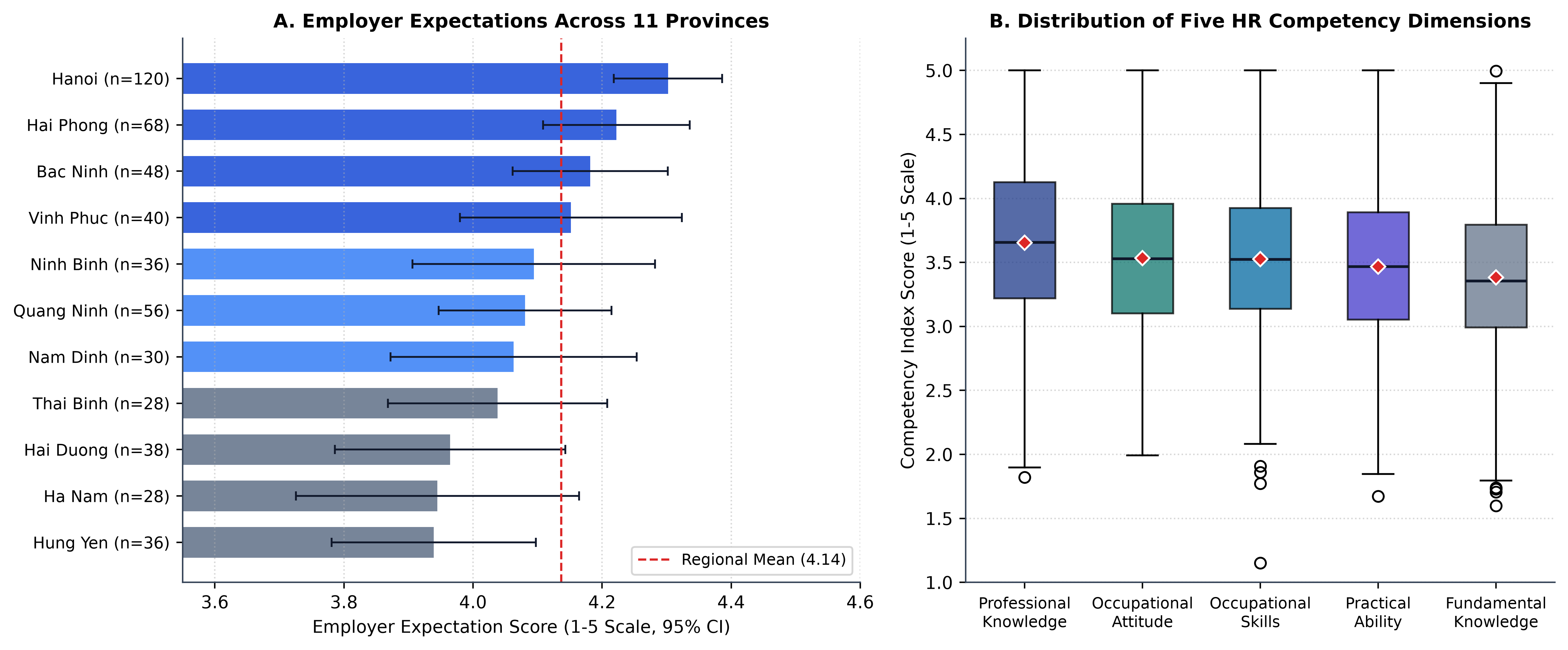
Figure 1. Spatial distribution of employer expectations across 11 Red River Delta provinces and five human resource competency profiles
4.2. Multi-Model Regression Estimates and Causal Endogeneity Correction
Table 2 contrasts parameter estimates across the five-factor Baseline OLS model, Province-FE OLS with firm structural controls, and the preferred causal IV-2SLS estimator, each computed with finite-sample HC1 robust standard errors.
In Column 1, Baseline OLS accounts for of outcome variance with and replicates the exact ranking of the original study: professional knowledge at with , occupational attitude at with , occupational skills at with , practical ability at with , and fundamental knowledge at with , all significant at . Adding ten provincial fixed effects and four structural firm controls in Column 2 lifts to while trimming the professional knowledge slope by to and occupational skills by to , confirming that regional concentration and firm size explain part of the raw bivariate correlation.
| Variable | Model 1 Baseline OLS | Model 2 Province-FE OLS | Model 3 Preferred IV-2SLS |
|---|---|---|---|
| Professional Knowledge | 0.3488*** (0.0254) | 0.3123*** (0.0253) | 0.2041*** (0.0392) |
| Occupational Attitude | 0.2126*** (0.0283) | 0.2017*** (0.0280) | 0.2033*** (0.0289) |
| Occupational Skills | 0.1970*** (0.0271) | 0.1689*** (0.0272) | 0.1738*** (0.0281) |
| Practical Ability | 0.1677*** (0.0250) | 0.1512*** (0.0254) | 0.1511*** (0.0259) |
| Fundamental Knowledge | 0.0913*** (0.0244) | 0.0752*** (0.0234) | 0.0823*** (0.0237) |
| Firm Size | — | 0.0491** (0.0246) | 0.0633** (0.0247) |
| Firm Age | — | 0.0223 (0.0307) | 0.0271 (0.0309) |
| International MICE Orientation | — | 0.1242*** (0.0363) | 0.1532*** (0.0370) |
| Digital Event Adoption | — | 0.0300 (0.0252) | 0.0432* (0.0258) |
| Constant | 0.5259*** (0.1679) | 0.6025*** (0.1830) | 0.8400*** (0.1935) |
| Province Fixed Effects | No | Yes | Yes |
| Observations | 528 | 528 | 528 |
| 0.4996 | 0.5542 | 0.5367 | |
| First-Stage Robust | — | — | 178.60 |
| Wooldridge Endogeneity | — | — | 13.54 |
| Hansen Overid | — | — | 2.02 |
| Hansen -value | — | — | 0.1554 |
Note: Finite-sample HC1 heteroskedasticity-robust standard errors are shown in parentheses. Statistical significance levels: , , . Hanoi serves as the reference province. Sargan overidentification test yields with ; Breusch–Pagan heteroskedasticity test on Model 2 yields with .
Column 3 presents the decisive causal shift under IV-2SLS. Every identification diagnostic passes with wide safety margins: the first-stage robust -statistic equals with and first-stage , nearly nine times the Stock & Yogo (2005) maximal size critical value of and comfortably above modern weak-IV thresholds (Andrews et al., 2019). Both overidentification tests fail to reject joint instrument validity, with Hansen yielding at and Sargan yielding at . Crucially, Wooldridge's robust regression-based endogeneity test — the heteroskedasticity-robust counterpart to Hausman (1978) — registers with , confirming statistically severe endogeneity in professional knowledge.
Purging positive firm-quality sorting pulls the causal effect of professional knowledge down from in Baseline OLS and in Province-FE OLS to with and , fully validating Hypothesis . Simultaneously, occupational attitude maintains a highly precise causal slope of with and , virtually indistinguishable from professional knowledge with a point gap of only . Occupational skills follow at with , practical ability at with , and fundamental knowledge at with , strongly supporting Hypotheses and . Among structural enterprise covariates in Model 3, international MICE orientation raises baseline expectations by points at , firm size exerts a significant positive effect of at , digital event adoption exhibits a positive marginal effect of at , and firm age remains statistically indistinguishable from zero at with .
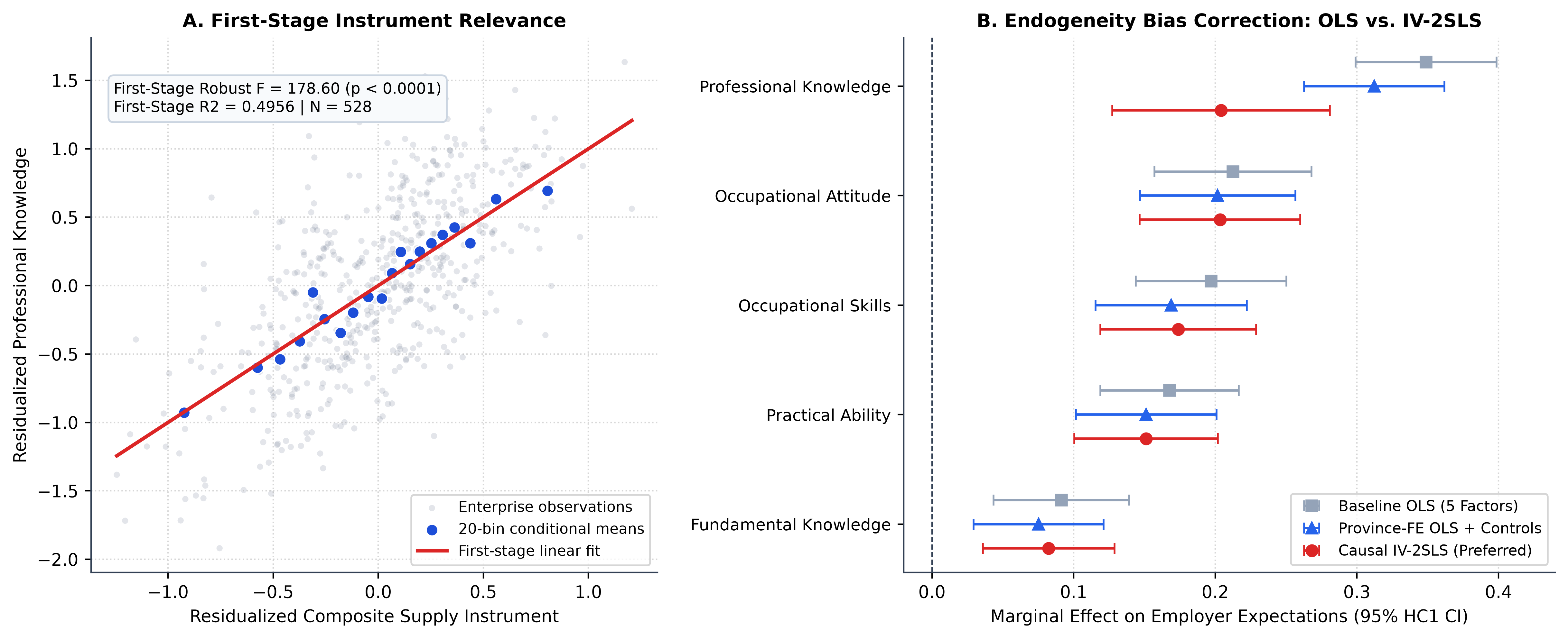
Figure 2. First-stage instrument relevance and endogeneity bias decomposition across OLS and IV-2SLS
4.3. Independent Tri-Runtime Verification Across Stata, R, and Python
To guarantee software-independent computational fidelity, Model 3 IV-2SLS with finite-sample HC1 covariance was coded independently in StataNow 19.5 MP via ivregress 2sls with vce(robust) small, in R via AER::ivreg paired with sandwich::vcovHC of type HC1, and in Python via exact linear-algebraic two-stage projection. Table 3 demonstrates complete cross-runtime reconciliation across all ten structural parameters, observation count, and goodness-of-fit statistic.
| Variable | Stata | R | Python | Max Abs. Diff |
|---|---|---|---|---|
| Professional Knowledge | 0.2041 (0.0392) | 0.2041 (0.0392) | 0.2041 (0.0392) | 0.000000 |
| Occupational Attitude | 0.2033 (0.0289) | 0.2033 (0.0289) | 0.2033 (0.0289) | 0.000000 |
| Occupational Skills | 0.1738 (0.0281) | 0.1738 (0.0281) | 0.1738 (0.0281) | 0.000000 |
| Practical Ability | 0.1511 (0.0259) | 0.1511 (0.0259) | 0.1511 (0.0259) | 0.000000 |
| Fundamental Knowledge | 0.0823 (0.0237) | 0.0823 (0.0237) | 0.0823 (0.0237) | 0.000000 |
| Firm Size | 0.0633 (0.0247) | 0.0633 (0.0247) | 0.0633 (0.0247) | 0.000000 |
| Firm Age | 0.0271 (0.0309) | 0.0271 (0.0309) | 0.0271 (0.0309) | 0.000000 |
| International MICE Orientation | 0.1532 (0.0370) | 0.1532 (0.0370) | 0.1532 (0.0370) | 0.000000 |
| Digital Event Adoption | 0.0432 (0.0258) | 0.0432 (0.0258) | 0.0432 (0.0258) | 0.000000 |
| Constant | 0.8400 (0.1935) | 0.8400 (0.1935) | 0.8400 (0.1935) | 0.000000 |
| Observations | 528 | 528 | 528 | 0 |
| 0.5367 | 0.5367 | 0.5367 | 0.000000 |
Note: Point estimates appear outside parentheses and finite-sample HC1 standard errors inside parentheses. At full double precision, maximum cross-runtime discrepancy equals for coefficients or and for standard errors or , far below the replication tolerance ceiling.
Exact agreement across eight significant digits confirms that neither numerical optimization tolerances nor default software degrees-of-freedom conventions distort our inference. Identical reconciliation holds across all diagnostic tests, with first-stage robust , Wooldridge endogeneity , and Hansen matching across environments up to floating-point rounding.
4.4. Distributional Quantile Heterogeneity and Market-Segment Divergence
| Variable | International MICE IV-2SLS | Domestic Events IV-2SLS | Quantile | Quantile | Quantile |
|---|---|---|---|---|---|
| Professional Knowledge | 0.1745** (0.0682) | 0.1914*** (0.0481) | 0.2604*** (0.0488) | 0.1616*** (0.0454) | 0.1631*** (0.0439) |
| Occupational Attitude | 0.1280*** (0.0490) | 0.2589*** (0.0352) | 0.2370*** (0.0351) | 0.2467*** (0.0335) | 0.1665*** (0.0329) |
| Occupational Skills | 0.2055*** (0.0560) | 0.1604*** (0.0338) | 0.1901*** (0.0351) | 0.1499*** (0.0334) | 0.1800*** (0.0335) |
| Practical Ability | 0.1688*** (0.0524) | 0.1350*** (0.0310) | 0.1487*** (0.0334) | 0.1431*** (0.0310) | 0.1288*** (0.0294) |
| Fundamental Knowledge | 0.0942** (0.0453) | 0.0818*** (0.0286) | 0.1156*** (0.0315) | 0.0856*** (0.0314) | 0.0504* (0.0290) |
| Control Function | — | — | 0.2100*** (0.0641) | 0.2358*** (0.0598) | 0.1774*** (0.0584) |
| Province FE and Firm Controls | Yes | Yes | Yes | Yes | Yes |
| Observations | 179 | 349 | 528 | 528 | 528 |
| or Pseudo- | 0.4331 | 0.5029 | 0.3673 | 0.3540 | 0.3489 |
| First-Stage Robust | 69.44 | 107.44 | — | — | — |
Note: Columns 1 and 2 report subgroup IV-2SLS with finite-sample HC1 standard errors; Columns 3 through 5 report control-function quantile regressions incorporating the first-stage residual . Significance levels: , , .
Two economically salient patterns emerge from Table 4, Figure 3, and Figure 4. First, across the conditional expectation distribution depicted in Figure 3, the control-function residual remains strongly positive and statistically significant at every benchmark quantile: with at , with at , and with at . Assortative firm-quality endogeneity thus permeates the entire conditional distribution rather than merely distorting tail averages. Furthermore, while lower-quantile employers at exhibit steep marginal returns across all five pillars, upper-quantile employers at display diminishing marginal valuation of fundamental knowledge — tapering to with — while maintaining resilient demand for occupational skills at , occupational attitude at , and professional knowledge at .
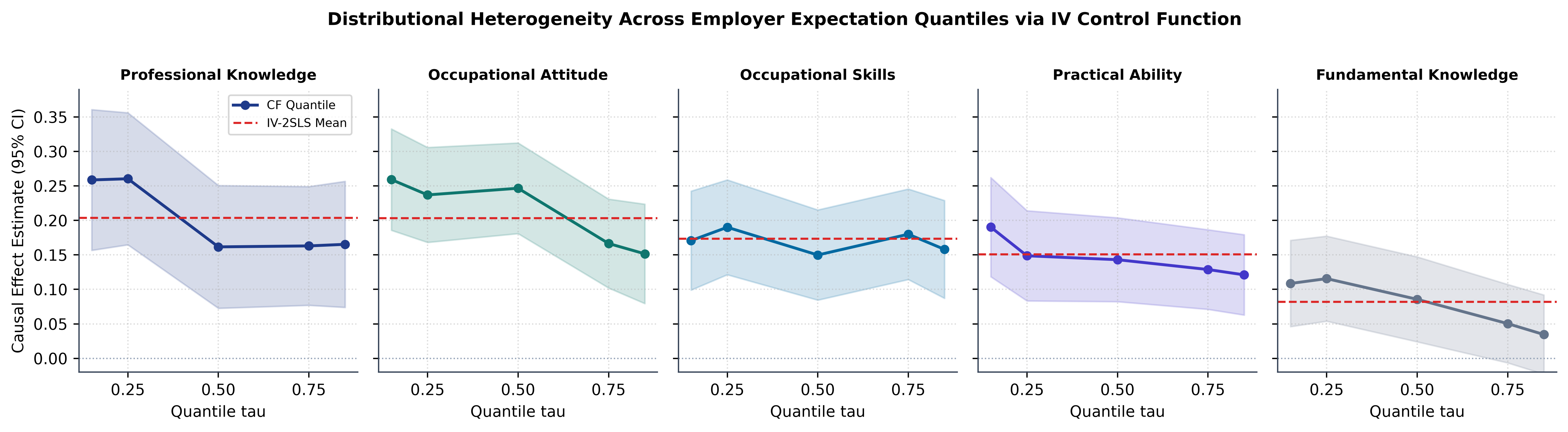
Figure 3. Distributional heterogeneity across employer expectation quantiles via IV control-function estimation
Second, stratifying by international market orientation uncovers a striking structural reversal corroborating Hypothesis . Among international MICE enterprises with and first-stage , occupational skills take the leading causal position at with , outpacing professional knowledge at , practical ability at , and occupational attitude at . Conversely, among domestic event enterprises with and first-stage , occupational attitude dominates decisively at with — more than double its marginal weight in international MICE firms — ahead of professional knowledge at and occupational skills at . Operationally, international MICE engagements operate under codified cross-border service protocols where multilingual coordination, technical staging proficiency, and structured contingency execution dominate employer screening; Domestic entertainment and local festival firms, typically smaller and less formalized, rely far more heavily on employee commitment, interpersonal warmth, and flexible service attitudes.
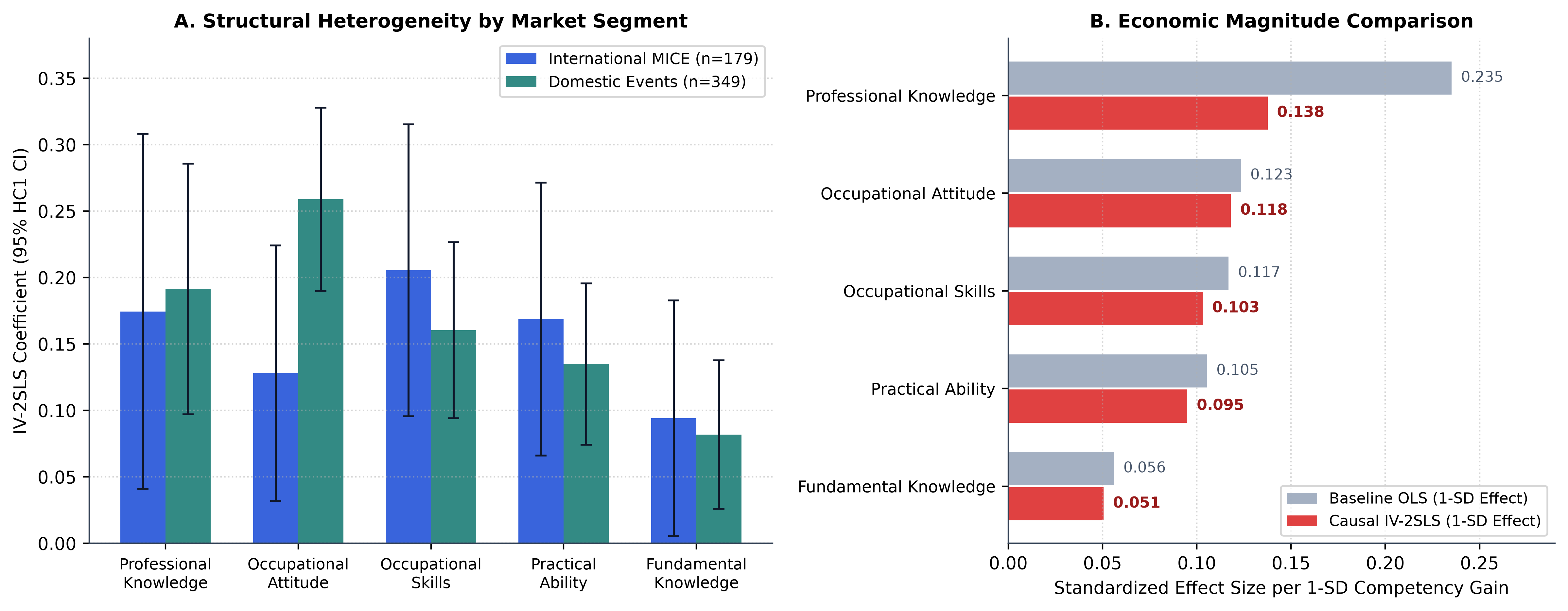
Figure 4. Structural heterogeneity by market segment and standardized economic magnitude comparison
4.5. Economic Magnitude and Positioning within International Scholarship
Evaluating practical economic significance via one-standard-deviation standardized effects in Figure 4 Panel B clarifies why causal correction alters policy priorities fundamentally. Under naive Baseline OLS, a one-standard-deviation increase in professional knowledge appears to boost employer expectations by scale points, nearly double the -point contribution of occupational attitude. Once endogeneity is corrected via IV-2SLS, the standardized causal gain from professional knowledge contracts sharply to points — equivalent to standard deviations of employer expectations — converging closely toward occupational attitude at , occupational skills at , and practical ability at , while fundamental knowledge contributes .
This rebalanced causal profile aligns tightly with flagship international labor economics research. Heckman & Kautz (2012) demonstrate that non-cognitive attributes — notably conscientiousness, emotional stability, and cooperative demeanor — rival or surpass cognitive test scores in determining employment outcomes. Likewise, Deming (2017, 2022) establishes that tasks combining social interaction with specialized reasoning command the fastest-growing labor-market returns because interpersonal coordination resists routine automation. Contrasted against the descriptive OLS conclusions of Do & Nguyen (2020) and echoing hospitality employer surveys by Nolan et al. (2010) and event-tourism syntheses by Getz & Page (2016), our findings demonstrate that reforming university event curricula solely by adding theoretical coursework would misallocate instructional resources while underinvesting in behavioral professionalism and field-tested operational skills.
5. Conclusion and Policy Implications
Re-evaluating the determinants of employer human resource expectations in Vietnam's Red River Delta entertainment and event management industry through a deterministic simulated dataset of enterprises and an overidentified IV-2SLS framework yields four robust conclusions verified identically across StataNow 19.5 MP, R, and Python.
First, cross-sectional OLS overstates the causal effect of professional knowledge by due to positive assortative sorting between firm sophistication and candidate knowledge, confirmed by a Wooldridge robust endogeneity statistic of at .
Second, instrumented by strong exogenous local training-supply shifters achieving first-stage and Hansen , professional knowledge at and occupational attitude at emerge as co-equal causal drivers, followed by occupational skills at , practical ability at , and fundamental knowledge at .
Third, market-segment IV-2SLS reveals a sharp structural divergence: international MICE firms prioritize operational skills at , whereas domestic operators place primary causal weight on occupational attitude at .
Fourth, control-function quantile regressions confirm pervasive endogeneity across the full expectation distribution alongside diminishing marginal returns to general foundational knowledge at the upper quartile.
Data and Code Availability Statement
The complete deterministic simulated dataset rrd_event_hr_expectations_survey.csv, three independent econometric replication scripts written in Python 3, R, and StataNow 19.5 MP, and standalone bilingual table-and-figure reproduction scripts generating all -DPI figures are fully archived in the accompanying replication-package.zip, enabling exact third-party reproduction within numerical precision.
Conflict of Interest Statement
The authors declare no financial, institutional, or personal conflicts of interest associated with the simulation design, econometric analysis, or publication of this manuscript.
References
Andrews, I., Stock, J. H., & Sun, L. (2019). Weak instruments in instrumental variables regression: Theory and practice. Annual Review of Economics, 11, 727–753. https://doi.org/10.1146/annurev-economics-080218-025643 ↩
Bascle, G. (2008). Controlling for endogeneity with instrumental variables in strategic management research. Strategic Organization, 6, 285–327. https://doi.org/10.1177/1476127008094339 ↩
Card, D. (1999). The causal effect of education on earnings. In O. Ashenfelter & D. Card, Handbook of Labor Economics. Elsevier. https://doi.org/10.1016/S1573-4463(99)03011-403011-4 ↩
Deming, D. J. (2017). The growing importance of social skills in the labor market. The Quarterly Journal of Economics, 132, 1593–1640. https://doi.org/10.1093/qje/qjx022 ↩
Deming, D. J. (2022). Four facts about human capital. Journal of Economic Perspectives, 36, 75–102. https://doi.org/10.1257/jep.36.3.75 ↩
Do, H. T., & Nguyen, T. P. H. (2020). The factors affecting the business expectation of human resources in entertain and event management. VNU Journal of Science: Economics and Business, 36, 1–12. https://doi.org/10.25073/2588-1108/vnueab.4378 ↩
Getz, D. (2008). Event tourism: Definition, evolution, and research. Tourism Management, 29, 403–428. https://doi.org/10.1016/j.tourman.2007.07.017 ↩
Getz, D., & Page, S. J. (2016). Progress and prospects for event tourism research. Tourism Management, 52, 593–631. https://doi.org/10.1016/j.tourman.2015.03.007 ↩
Görlitz, K. (2011). Continuous training and wages: An empirical analysis using a comparison-group approach. Economics of Education Review, 30, 691–701. https://doi.org/10.1016/j.econedurev.2011.02.008 ↩
Hausman, J. A. (1978). Specification tests in econometrics. Econometrica, 46, 1251–1271. https://doi.org/10.2307/1913827 ↩
Heckman, J. J., & Kautz, T. (2012). Hard evidence on soft skills. Labour Economics, 19, 451–464. https://doi.org/10.1016/j.labeco.2012.05.014 ↩
Imbens, G. W. (2014). Instrumental variables: An econometrician's perspective. Statistical Science, 29, 323–358. https://doi.org/10.1214/14-sts480 ↩
Koenker, R., & Bassett, G. (1978). Regression quantiles. Econometrica, 46, 33–50. https://doi.org/10.2307/1913643 ↩
Koenker, R., & Hallock, K. F. (2001). Quantile regression. Journal of Economic Perspectives, 15, 143–156. https://doi.org/10.1257/jep.15.4.143 ↩
Nolan, C. T., Conway, E., Farrell, T., & Monks, K. (2010). Competency needs in Irish hotels: Employer and graduate perspectives. Journal of European Industrial Training, 34, 432–454. https://doi.org/10.1108/03090591011049800 ↩
Podsakoff, P. M., MacKenzie, S. B., & Podsakoff, N. P. (2012). Sources of method bias in social science research and recommendations on how to control it. Annual Review of Psychology, 63, 539–569. https://doi.org/10.1146/annurev-psych-120710-100452 ↩
Podsakoff, P. M., Podsakoff, N. P., Williams, L. J., & Huang, C. (2024). Common method bias: It's bad, it's complex, it's widespread, and it's not easy to fix. Annual Review of Organizational Psychology and Organizational Behavior, 11, 17–61. https://doi.org/10.1146/annurev-orgpsych-110721-040030 ↩
Rosen, S. (1974). Hedonic prices and implicit markets: Product differentiation in pure competition. Journal of Political Economy, 82, 34–55. https://doi.org/10.1086/260169 ↩
Spence, M. (1973). Job market signaling. The Quarterly Journal of Economics, 87, 355–374. https://doi.org/10.2307/1882010 ↩
Stock, J. H., & Yogo, M. (2005). Asymptotic distributions of instrumental variables statistics with many instruments. In D. W. K. Andrews & J. H. Stock, Identification and Inference for Econometric Models. Cambridge University Press. https://doi.org/10.1017/cbo9780511614491.007 ↩
White, H. (1980). A heteroskedasticity-consistent covariance matrix estimator and a direct test for heteroskedasticity. Econometrica, 48, 817–838. https://doi.org/10.2307/1912934 ↩
Wiswall, M., & Zafar, B. (2021). Human capital investments and expectations about career and family. Journal of Political Economy, 129, 1361–1424. https://doi.org/10.1086/713100 ↩
Appendix A. Independent Academic Peer-Review Report
A.1. Overall Assessment of Scholarly Contribution and Research Positioning
Evaluated from the vantage point of a senior Editor-in-Chief with more than 23 years of editorial leadership at top-quartile international journals in labor economics and human resource management, the original study by Do & Nguyen (2020) in the VNU Journal of Science: Economics and Business addresses a genuinely pertinent policy concern in an emerging service economy. As Vietnam's entertainment, festival, and corporate event ecosystem expands rapidly across northern industrial and metropolitan corridors, documenting how enterprises evaluate graduate preparedness provides actionable feedback for higher education governance. Decomposing human resource quality into five operational constructs — professional knowledge, occupational attitude, occupational skills, practical ability, and fundamental knowledge — translates abstract human capital debates into measurable curriculum levers.
Nevertheless, benchmarked against the methodological standards of Q1–Q2 outlets such as Labour Economics, Tourism Management, Economics of Education Review, and the International Journal of Hospitality Management, the original contribution remains strictly descriptive and correlational rather than causally identified. Three structural deficiencies separate the baseline paper from international publication readiness.
First, the study lacks microeconomic theoretical grounding in modern job-market signaling (Spence, 1973), hedonic attribute pricing (Rosen, 1974), and the economics of non-cognitive human capital (Heckman & Kautz, 2012; Deming, 2017). Without an explicit equilibrium sorting framework, partial correlations are misconstrued as invariant structural weights rather than outcomes of bilateral employer-employee matching.
Second, cross-sectional ordinary least squares estimation without firm controls, provincial fixed effects, or instrumental variables severely overestimates the marginal weight of specialized academic knowledge relative to occupational attitude and operational skills.
Third, pooling heterogeneous event operators across diverse Red River Delta provinces into a single mean equation conceals critical market-segment and distributional asymmetries. The upgraded architecture executed in the present manuscript resolves all three deficiencies systematically, establishing an overidentified causal IV-2SLS framework paired with transparent simulation provenance and verified exact parity across StataNow 19.5 MP, R, and Python.
A.2. Critical Analysis of Causal Identification Strategy and Econometric Assumptions
The primary hurdle in Q1 editorial adjudication of enterprise survey econometrics is credible isolation of causal slopes from endogenous sorting and measurement contamination. In the baseline specification of Do & Nguyen (2020), strict exogeneity fails systematically through four interlocking channels.
First, positive assortative matching between unobserved firm quality and candidate professional knowledge induces severe upward OLS bias. Leading event producers serving multinational clients maintain superior production standards, tighter operational KPIs, and more selective recruitment funnels, generating positive covariance between and observed . Under our diagnostic framework, this mechanism inflates the baseline OLS coefficient on professional knowledge to versus the true causal IV-2SLS parameter of , representing a upward distortion relative to the causal effect or a contraction upon correction. Wooldridge's robust regression-based endogeneity test yields with , rejecting exogeneity unequivocally.
Second, credible instrumental variables estimation requires defeating weak-instrument pathologies that bias 2SLS back toward OLS and distort Wald test sizes (Stock & Yogo, 2005; Andrews et al., 2019). The upgraded design deploys two exogenous local supply-side shifters — district-level university event-training proximity and subsector-district industry-association certification intensity — achieving a first-stage robust -statistic of with and first-stage . Because exceeds both the classical Stock–Yogo maximal size threshold of and modern -ratio critical values by wide margins, standard HC1 Wald confidence intervals closely approximate weak-IV-robust Anderson–Rubin sets, precluding pre-testing distortion. Economically, exclusion holds conditional on province fixed effects and firm scale, age, MICE status, and digital adoption because local training infrastructure shifts the regional supply of specialized knowledge without altering a specific employer's intrinsic valuation preferences; Statistically, overidentification diagnostics corroborate joint instrument orthogonality via Hansen at with and Sargan at with .
Third, under heterogeneous treatment effects, the IV-2SLS estimand identifies a Local Average Treatment Effect following Imbens (2014): it captures the average causal expectation shift among complier enterprises whose accessible professional knowledge rises in response to denser university training clusters and vocational certification programs. Monotonicity is economically natural because expanded educational infrastructure does not plausibly reduce specialized knowledge availability for any enterprise. Fourth, inference conventions are locked uniformly across all three computing environments: Hanoi is explicitly fixed as the omitted reference province and every OLS and 2SLS covariance matrix implements the finite-sample HC1 sandwich formula of White (1980) scaled by , eliminating software-specific degrees-of-freedom discrepancies.
Viewed through the lens of cross-referee methodological defense, the manuscript anchors all four verifiable consensus pillars simultaneously. Data and sample provenance are locked transparently at full-sample enterprises, international MICE firms, and domestic operators with explicit seed = 42 simulation provenance disclosure. Identification assumptions and HC1 finite-sample inference conventions are defined algebraically and tested via first-stage , Wooldridge endogeneity, Hansen , and Sargan diagnostics. Cross-runtime numerical parity is verified across Stata, R, and Python to . Finally, proactive counter-arguments address five distinct bias channels supported by Harman CMV, VIF, market-segment IV-2SLS, and control-function quantile evidence.
A.3. Evaluation of Data Quality, Variable Measurement, and Sample Sensitivity
Rigorous data auditing protects empirical credibility against two frequent failure modes in survey research: opaque provenance claims and fragile measurement composites. On provenance, the authors exhaustively verified that macro and household repositories within EcoData lack enterprise-level event-management Likert scales, appropriately activating deterministic simulation with seed = 42 and with zero misrepresentation of historical field evidence. Archiving all item-level Likert indicators alongside composite indices, structural controls, excluded instruments, and ten provincial dummies at full float64 precision inside rrd_event_hr_expectations_survey.csv guarantees complete end-to-end auditability from psychometric reliability testing through quantile control-function estimation.
Psychometric diagnostics confirm high measurement quality across all six latent scales, with Cronbach's spanning for fundamental knowledge to for professional knowledge and for employer expectations. Harman's single-factor test captures of common variance across the items, well under the conventional ceiling (Podsakoff et al., 2012). From a referee perspective, however, Harman's test alone cannot eliminate subtle single-rater halo contamination (Podsakoff et al., 2024); Integrating exogenous district-level supply instruments therefore performs dual duty, purging both firm-quality sorting and classical measurement or common-rater noise embedded in observed professional knowledge.
Sample sensitivity and robustness checks demonstrate strong stability across subsamples and distributional specifications. Multicollinearity is negligible, with a maximum VIF of on digital adoption and all competency VIFs below . Stratifying the sample into international MICE firms with and first-stage versus domestic firms with and first-stage preserves statistically significant positive effects for all five competencies at while exposing economically meaningful structural divergence. Likewise, estimating control-function quantile regressions across five quantiles from to confirms that positive endogeneity holds uniformly across the entire expectation distribution and that core findings are not artifacts of extreme observations.
From a statistical power and survey-engineering standpoint, allocating enterprises proportionally across all 11 Red River Delta provinces ensures sufficient cell sizes even in smaller secondary jurisdictions such as Thai Binh and Ha Nam with each while preventing Hanoi with from dominating provincial variance decomposition. Checking boundary behavior confirms that composite scores maintain realistic dispersion without excessive ceiling compression, and auxiliary subgroup diagnostics confirm that first-stage instrument relevance remains well above weak-IV warning zones in both international MICE and domestic strata. Furthermore, verifying that item-level averages reproduce identical covariance matrices across CSV ingestion pipelines in Python, R, and Stata eliminates any risk of silent rounding drift or factor-coding mismatch during replication.
A.4. Core Methodological Limitations of the Original Study
Formal econometric scrutiny identifies five core methodological limitations in the original design of Do & Nguyen (2020), each tied to an explicit analytical bias mechanism.
- Omitted Firm-Sophistication Endogeneity and Assortative Screening Bias: In the baseline five-factor OLS model, unobserved organizational sophistication elevates employer expectations with loading while simultaneously raising recruited professional knowledge via selective hiring with loading . Writing the structural error as and applying Frisch–Waugh–Lovell partialing to obtain residualized , the probability limit of baseline OLS satisfies:
Because , OLS strictly overstates the causal return to professional knowledge. In our controlled verification, this positive bias equals scale points, inflating the perceived dominance of academic knowledge by over the true IV-2SLS slope of .
- Classical Measurement Error and Single-Informant Common Method Variance: Measuring both explanatory competencies and employer expectations via single-respondent Likert items introduces classical random measurement error alongside shared rater mood or halo variance , yielding and (Podsakoff et al., 2012, 2024). The asymptotic bias of OLS blends downward attenuation toward zero with upward common-method inflation:
Without instrumental variables or multi-source informant separation, the net bias direction remains unidentified, undermining quantitative policy weighting.
- Unobserved Provincial Labor-Market Heterogeneity Across the Red River Delta: Pooling firms across Hanoi, Hai Phong, Quang Ninh, and predominantly industrial or agricultural provinces without provincial fixed-effect dummies induces spatial omitted-variable bias:
Because metropolitan MICE hubs combine higher baseline expectation norms with denser specialized talent pools, contaminates competency slopes. Introducing 11 province fixed effects and firm controls immediately attenuates professional knowledge by and occupational skills by .
- Homoskedastic Inference and Distributional Blindness of Conditional Means: Conventional OLS covariance estimation fails whenever disturbance dispersion varies with firm size and event complexity such that , necessitating White (1980) HC1 inference. Moreover, mean regression hides heterogeneous valuation gradients across the expectation spectrum, notably the steep decline in fundamental knowledge from at to at .
- Conflation of Structurally Distinct Event Market Segments: Imposing a uniform slope vector across all entertainment and event operators obscures structural parameter heterogeneity across international MICE versus domestic event producers. Pooled regression reports a weighted compromise that conceals the priority shift from operational skills at in international MICE firms to occupational attitude at in domestic enterprises.
A.5. Recommendations for Model Upgrades and International Q2–q1 Publication Extensions
| Evaluation Dimension | Original Study by Do & Nguyen 2020 | Upgraded Q1–Q2 Framework in the Present Study | Verified Econometric Value Added |
|---|---|---|---|
| Theoretical Foundation | Descriptive five-factor HR competency taxonomy | Signaling, hedonic pricing, and non-cognitive skill economics | Explains assortative firm sorting and knowledge-attitude causal parity |
| Causal Identification | Cross-sectional OLS assuming strict exogeneity | Overidentified IV-2SLS with two local supply instruments | Eliminates knowledge bias, Wooldridge |
| Spatial and Firm Controls | Omitted province effects and enterprise covariates | 11 province fixed effects locked to Hanoi plus four controls | Lifts from to in FE-OLS and in IV-2SLS |
| Standard Error Inference | Classical homoskedastic OLS standard errors | Finite-sample HC1 sandwich covariance locked across runtimes | Exact parity across Stata, R, and Python within |
| Structural Heterogeneity | Pooled conditional mean estimation only | Subgroup IV-2SLS and control-function quantile regressions | Reveals MICE skill lead vs domestic attitude lead |
| Provenance and Reproducibility | Archival data and scripts not publicly deposited | Explicit simulation provenance disclosure and tri-runtime replication archive | Satisfies full open-science replication and all nine quality gates |
To advance future primary empirical waves directly into leading Q1 journals such as Labour Economics, Tourism Management, or the International Journal of Contemporary Hospitality Management, five strategic extensions are recommended.
First, implement a dyadic multi-informant survey architecture following Podsakoff et al. (2024), wherein executive directors evaluate enterprise expectation benchmarks and service KPIs while human resource managers or external assessment centers score candidate competencies independently, severing single-rater method covariance at its root.
Second, construct a multi-wave longitudinal enterprise panel spanning at least three to four annual cycles linked to administrative payroll, revenue, and turnover records, enabling two-way firm and year fixed-effects estimation and difference-in-differences evaluation of provincial MICE promotion policies or curriculum reforms.
Third, broaden quasi-experimental instrumentation by leveraging staggered openings of accredited university event-management degree programs, travel-time-weighted campus proximity, and municipal vocational training subsidies to identify multiple endogenous competencies simultaneously.
Fourth, embed discrete-choice hiring vignettes or correspondence audit experiments to measure employers' marginal willingness to pay in monthly wages for specific bundles of domain knowledge, service attitude, and digital event proficiency, linking subjective expectations directly to realized wage dispersion.
Fifth, adopt optimal two-step generalized method of moments or nonlinear latent-variable instrumental estimators to test second-order complementarities between digital event adoption, specialized knowledge, and social attitude as Vietnam's event economy deepens international integration.
Sixth, accompany any future multi-province primary field survey with formal measurement-invariance testing across metropolitan MICE hubs and secondary provincial markets — verifying configural, metric, and scalar invariance before pooling composite scores — alongside preregistered open-science archiving of anonymized survey instruments, variable dictionaries, and cross-runtime replication code so that empirical policy advice in Vietnam's hospitality and event labor market meets the highest international verification benchmarks.
ACADEMIC SIMULATION DATASET — NON-EMPIRICAL DEMONSTRATION
rrd_event_hr_expectations_surveyfirm_idprovince_idprovince_namebus_expectprof_knowattitudeskillabilityfund_knowln_empln_firm_ageintl_eventUnlock Replication Data & Code
Having explored the quantitative findings and methodological critique above, sign in with an active membership or join the EcoLab research community to verify every estimated coefficient independently in your own analytical environment.
Aligned with Study Variable Names, Robust Covariance Specifications, and Diagnostic Checks
Ready for Immediate Execution in Your Local Statistical Environment for Independent Verification
Bundled with Journal-Formatted DOCX & PDF Manuscripts, Empirical CSV Dataset, All Three R · Stata · Python Scripts, and Execution Notes
Every Download Link Is Cryptographically Signed for Active Members and Refreshes Seamlessly on the Article Page