Keywords: Local Food Image; Revisit Intention; Gastronomic Tourism Economics; Instrumental Variables IV-2SLS; Two-Way Fixed Effects; Ho Chi Minh City.
JEL Classification: Z32; O18; D12; C26; L83.
List of Abbreviations and Mathematical Notation
| Symbol or Abbreviation | Full Academic and Econometric Definition |
|---|---|
| 2SLS | Two-Stage Least Squares estimator |
| AVE | Average Variance Extracted for convergent validity |
| CMV | Common Method Variance in single-respondent self-reported surveys |
| CR | Composite Reliability of latent psychometric constructs |
| CRV1 | Cluster-Robust Variance estimator with small-sample degrees-of-freedom adjustment |
| DGP | Deterministic psychometric-structural Data Generating Process |
| FE | Two-Way Fixed Effects across urban culinary districts and international origin regions |
| GRDP | Gross Regional Domestic Product of the metropolitan economy |
| HC1 | Heteroskedasticity-Consistent variance estimator with finite-sample adjustment |
| HTMT | Heterotrait-Monotrait ratio of correlations for discriminant validity |
| IV | Instrumental Variables causal identification framework |
| JEL | Journal of Economic Literature subject classification system |
| OLS | Ordinary Least Squares regression estimator |
| SEM | Structural Equation Modeling |
| TPB | Theory of Planned Behavior |
| VIF | Variance Inflation Factor for multicollinearity diagnostics |
| Dependent variable measuring revisit intention for local cuisine of tourist | |
| Endogenous focal regressor measuring perceived local food image | |
| Affective culinary attitude and experiential dining satisfaction mediators | |
| Excluded instruments measuring pre-trip culinary media exposure and 500-meter heritage eatery density | |
| Unobserved fixed effects for culinary district and international source region | |
| Structural outcome, control covariate, and first-stage parameters | |
| Structural outcome and first-stage idiosyncratic error terms |
Chapter 1. Introduction and Research Positioning
1.1. Research Motivation and Urban Development Context
Across emerging Southeast Asian metropolitan economies, structural transformation toward high-value tradable services increasingly hinges on cultural and gastronomic tourism as a labor-intensive, locally embedded engine of urban income creation. Unlike capital-intensive enclave tourism models that leak foreign exchange abroad through imported inputs and multinational management fees, local culinary tourism generates dense backward linkages into domestic smallholder agriculture, traditional family-owned artisanal food enterprises, urban hospitality clusters, and neighborhood retail networks (Ellis et al., 2018; Okumus et al., 2007). Within Vietnam, Ho Chi Minh City operates as the premier commercial metropolis and principal international aviation gateway, hosting an exceptionally layered gastronomic ecosystem spanning the historic central market heritage of District 1, the vibrant street-food corridors of District 3, the centuries-old Sino-Vietnamese culinary heritage of Cho Lon in District 5, the contemporary artisan food quarters of Binh Thanh, the international dining enclaves of Phu My Hung in District 7, and the emerging riverside culinary zone of Thu Duc City.
Despite robust post-disruption recovery in aggregate international arrivals, metropolitan development planners in Ho Chi Minh City confront a persistent structural bottleneck: shifting tourism growth from low-margin first-time volume toward higher repeat visitation rates, longer average stays, and greater daily local expenditure per foreign visitor. Empirical tourism economics demonstrates that retaining repeat visitors requires a fraction of the destination marketing expenditure needed to acquire first-time travelers, while repeat tourists exhibit higher expenditure stability, deeper cultural engagement, and stronger organic word-of-mouth externalities (Chi & Qu, 2008; Kivela & Crotts, 2006). Within the bundle of urban destination attributes, local cuisine has evolved from a secondary physiological necessity into a peak experiential motivation capable of anchoring destination identity and long-run tourist loyalty (Quan & Wang, 2004; Bjork & Kauppinen-Raisanen, 2016).
The foundational thesis proposal by Nguyen Thi Bich Dao completed in 2021 at Ton Duc Thang University rightly identified the strategic importance of evaluating how foreign tourists perceive the local food image of Ho Chi Minh City and how those perceptions relate to culinary attitude, dining satisfaction, and revisit intention. Yet evaluated against contemporary standards of applied microeconometrics and top-tier international tourism journals, conventional cross-sectional survey designs utilizing uninstrumented structural equation modeling or ordinary least squares suffer from critical identification threats. Measuring perceived food image, dining satisfaction, and revisit intention simultaneously from the same respondent introduces common method variance alongside omitted individual heterogeneity in pre-existing affinity for Vietnamese culture, systematically inducing upward bias in estimated structural slopes (Podsakoff et al., 2003; Angrist & Pischke, 2008). Policy interventions calibrated to inflated correlational elasticities risk misallocating scarce municipal tourism budgets between destination branding, street-food food safety certification, and spatial district upgrading.
1.2. General and Specific Research Objectives
The overarching objective of this dissertation is to establish consistent, bias-corrected causal evidence on how perceived local food image influences culinary attitude, dining satisfaction, and revisit intention among international tourists in Ho Chi Minh City, thereby informing a tiered urban gastronomic development strategy. Five concrete research objectives operationalize this overarching goal:
- First, to synthesize an integrated analytical framework uniting urban development economics, the theory of planned behavior, expectation-disconfirmation theory, and local food consumption value theory while formally auditing the econometric identification limitations of conventional cross-sectional food-image studies.
- Second, to formulate an overidentified instrumental variables identification strategy deploying pre-trip home-market culinary media exposure and 500-meter micro-grid heritage eatery density alongside two-way fixed effects across six Ho Chi Minh City culinary districts and five international origin regions.
- Third, to estimate and cross-validate progressive baseline ordinary least squares, expanded fixed-effects ordinary least squares, and upgraded instrumental variables specifications identically across Python 3, R 4, and StataNow 19.5 MP, quantifying both the consistent causal slope and the exact magnitude of upward ordinary least squares endogeneity bias.
- Fourth, to decompose the total causal effect of local food image into its direct pathway, indirect pathway via culinary attitude, indirect pathway via dining satisfaction, and serial mediation pathway, while testing structural parameter heterogeneity between first-time and repeat international visitors.
- Fifth, to translate the causally identified behavioral elasticities and spatial district differentials into an actionable short-, medium-, and long-term policy roadmap for municipal tourism authorities, food safety regulators, and local hospitality enterprises.
1.3. Research Questions
Four interconnected empirical research questions structure the theoretical modeling, econometric design, and policy analysis throughout this dissertation:
- Research Question 1: What is the consistent direct causal effect of perceived local food image on the revisit intention of international tourists in Ho Chi Minh City after correcting for common method variance, unobserved culinary affinity, and two-way district and origin-region fixed effects?
- Research Question 2: To what extent does conventional baseline ordinary least squares overestimate the causal impact of local food image relative to overidentified two-stage least squares, and do first-stage instrument relevance, Hansen overidentification, and Wu-Hausman endogeneity diagnostics validate the identification strategy?
- Research Question 3: What share of the total causal effect of local food image on international tourist revisit intention is mediated indirectly through culinary attitude, dining satisfaction, and their sequential pathway?
- Research Question 4: Do the marginal causal effects of local food image, perceived food safety, dining satisfaction, and daily culinary expenditure differ systematically between first-time international visitors and repeat visitors, and how should urban gastronomic development policies adapt to this segmentation?
1.4. Scope of Content, Geography, and Data Transparency
The substantive scope of this dissertation encompasses the causal structural chain linking five multi-item psychometric constructs—perceived local food image, culinary attitude, dining satisfaction, perceived food safety, and revisit intention—together with key economic and trip-profile controls including log daily culinary expenditure, length of stay, repeat visitation history, food neophilia, age, and high-income household status.
Geographically, the study captures Ho Chi Minh City's polycentric gastronomic landscape across six distinct urban culinary districts: District 1 Ben Thanh heritage hub, District 3 street-food corridors, District 5 Cho Lon Sino-Vietnamese culinary enclave, District 7 Phu My Hung international zone, Binh Thanh artisan local food quarter, and Thu Duc City riverside dining zone. Across demand markets, international respondents are stratified into five principal source regions: Europe, Northeast Asia, Southeast Asia, North America, and Oceania.
Regarding empirical data provenance, individual-level Likert-7 psychometric perceptions of international tourists in Ho Chi Minh City are primary behavioral microdata absent from public macroeconomic, provincial yearbook, enterprise, or household expenditure repositories within EcoData. Consistent with rigorous open-science transparency standards, this dissertation constructs a deterministic psychometric-structural data generating process fixed at random seed 42 with observations mirroring the post-recovery 2024–2025 international tourist composition and scale properties of Ho Chi Minh City. The simulated nature of this controlled benchmark dataset is disclosed transparently across all chapters; Quantitative findings are interpreted rigorously as controlled econometric verification of endogeneity correction and mediation dynamics rather than historical field-collected survey statistics.
1.5. Research Methodology and Scholarly Contributions
Methodologically, the dissertation integrates modern psychometric measurement diagnostics with applied causal microeconometrics. Measurement validity across all 21 Likert-7 indicators is verified through Cronbach alpha, composite reliability, average variance extracted, heterotrait-monotrait discriminant ratios following Henseler et al. (2015), and Harman single-factor diagnostics following Podsakoff et al. (2003). Structural estimation advances sequentially from naive baseline ordinary least squares to two-way fixed-effects ordinary least squares, overidentified two-stage least squares with finite-sample heteroskedasticity-consistent standard errors, instrumented two-stage causal mediation equations, experience-segmented subsample estimations, and cluster-robust inference across 30 district-by-origin clusters.
This study contributes to development and tourism economics across three distinct dimensions. Theoretically, it bridges destination marketing psychology with urban service development economics by conceptualizing local food image as a localized intangible municipal asset that lowers information search costs for unfamiliar travelers and amplifies consumer surplus through cognitive-affective mediation. Methodologically, it provides rare direct econometric quantification in Southeast Asian gastronomic tourism showing that conventional uninstrumented cross-sectional regression inflates direct food-image effects by , while achieving cross-platform computational parity within across Python 3, R 4, and StataNow 19.5 MP. Empirically and policy-wise, uncovering the structural divergence between first-time visitors driven by food image and hygiene assurance versus repeat visitors driven by cumulative dining satisfaction and culinary spending enables precision municipal policy targeting.
1.6. Structure of the Dissertation
Beyond the abstract, list of abbreviations and mathematical notation, references, and independent peer-review appendix, the main dissertation body is organized into five cohesive chapters. Chapter 1 establishes the urban development context, research objectives, research questions, scope, data transparency, and scholarly contributions. Chapter 2 synthesizes foundational behavioral and urban economic theories, derives an analytical microeconomic utility model of tourist revisit choice, critically reviews international and Vietnamese empirical literature, maps explicit research gaps, and formulates testable hypotheses. Chapter 3 details the research design, deterministic dataset architecture, variable definitions, endogeneity bias proofs, two-stage instrumental variables identification strategy, mediation decomposition equations, and diagnostic testing protocols.
Chapter 4 presents descriptive distributions, psychometric reliability and validity checks, first-stage and comparative structural estimates, mediation decomposition, subsample heterogeneity, cluster-robust checks, and three-runtime computational parity verification. Chapter 5 interprets empirical findings against international scholarship, summarizes answers to each research question, designs a three-horizon urban gastronomic policy roadmap for Ho Chi Minh City, and articulates methodological limitations alongside future field research directions.
Chapter 2. Theoretical Framework, Literature Review, and Hypotheses
2.1. Foundational Theories of Tourist Culinary Behavior and Urban Gastronomy
Explaining how international visitors convert perceptions of local food into repeat visitation and sustained metropolitan service demand requires integrating four complementary theoretical pillars spanning behavioral decision theory, service marketing, experiential tourism, and urban spatial economics.
The first pillar is the Theory of Planned Behavior formulated by Ajzen (1991), which posits that behavioral intention represents the most proximate determinant of future realized action and is governed by attitude toward the behavior, subjective norms, and perceived behavioral control. Within international gastronomic tourism in a developing Asian metropolis, culinary attitude operates as the primary affective evaluation translating cognitive perceptions of local ingredients, flavor complexity, and culinary authenticity into behavioral loyalty toward the destination. Simultaneously, perceived food safety and pricing transparency function as behavioral control mechanisms that mitigate perceived health risk and transaction uncertainty when foreign tourists venture beyond standardized hotel dining into authentic neighborhood street-food markets (Kim et al., 2009; Mak et al., 2012).
The second pillar is the Expectation-Disconfirmation Model established by Oliver (1980), which demonstrates that post-consumption satisfaction arises from the comparison between realized service performance and pre-consumption cognitive expectations. Across destination management research, overall satisfaction serves as the central conduit converting destination image into post-visit loyalty and repeat patronage (Bigne et al., 2001; Chi & Qu, 2008). When foreign tourists arrive in Ho Chi Minh City holding a distinctive cognitive food image shaped by international culinary narratives, positive disconfirmation during actual dining experiences amplifies dining satisfaction and significantly raises revisit propensity (Choe & Kim, 2018; Tsai & Wang, 2017).
The third pillar combines the structural model of tourist experience developed by Quan & Wang (2004) with the local food consumption value framework advanced by Choe & Kim (2018). Quan & Wang (2004) distinguish between supporting consumer experiences and peak touristic experiences; Local gastronomy transitions from a routine biological necessity into a peak experience whenever destination culinary heritage delivers non-replicable sensory novelty, cultural immersion, and social prestige. Supporting this view, Kivela & Crotts (2006) and Bjork & Kauppinen-Raisanen (2016) establish that authentic local food consumption deepens emotional connection to place and distinguishes high-loyalty destinations from substitutable mass-tourism markets.
The fourth pillar draws upon urban development economics and spatial agglomeration theory in cultural service industries (Okumus et al., 2007; Zenker et al., 2017; Ellis et al., 2018). High spatial concentration of heritage culinary establishments generates positive reputation externalities, lowers search friction for international tourists, and raises urban service productivity through higher daily dining outlays and extended stays. Nevertheless, severe information asymmetry regarding street-food hygiene standards creates a classic market failure among unfamiliar foreign visitors, implying that municipal food safety certification and transparent culinary district branding yield substantial social returns.
2.2. Analytical Microeconomic Utility Model of Revisit Choice
To anchor the empirical specification rigorously in microeconomic consumer theory, consider an international tourist originating from market region who stays in culinary district of Ho Chi Minh City. The tourist evaluates the expected indirect utility of revisiting Ho Chi Minh City relative to the best alternative regional destination . Expected revisit utility is represented via a first-order additive approximation around equilibrium service consumption:
In this structural utility specification, each variable and parameter carries a clear economic interpretation:
- : Perceived local food image index capturing cultural uniqueness, sensory taste appeal, freshness, variety, and value fairness of Ho Chi Minh City's cuisine.
- : Culinary attitude mediator responding to local food image , perceived food safety , and individual covariates .
- : Dining satisfaction mediator shaped jointly by local food image , culinary attitude , and perceived food safety .
- : Perceived food safety and hygiene standard reducing expected health-risk disutility during street and neighborhood dining.
- : Vector of economic and demographic controls encompassing log daily food expenditure, length of stay, repeat visitor status, food neophilia, age, and high-income household status.
- : Unobserved district-level hospitality infrastructure fixed effects and origin-region cultural distance fixed effects.
- : Unobserved individual predisposition toward Vietnamese gastronomy and survey response style generating structural endogeneity.
Assuming reported revisit intention maps linearly to the expected utility differential , applying the total derivative with respect to an exogenous shift in perceived local food image yields an exact four-component causal decomposition:
Two fundamental econometric insights follow directly from this analytical derivation.
First, inspecting the direct partial derivative in isolation substantially understates the full economic impact of destination food image whenever affective attitude and dining satisfaction transmit positive mediated effects.
Second, because unobserved culinary affinity enters both perceived food image formation and revisit utility, the orthogonality requirement fails systematically under ordinary least squares, necessitating valid excluded instruments to recover unbiased direct and mediated causal pathways.
2.3. Critical Review of International and Domestic Empirical Literature
Scholarly inquiry linking destination image, local gastronomy, tourist satisfaction, and revisit intention spans two major research traditions. In the foundational destination image literature, Bigne et al. (2001) demonstrated across Spanish resorts that favorable destination image enhances perceived quality, raises tourist satisfaction, and strengthens revisit and recommendation intentions. Extending this structural architecture, Chi & Qu (2008) confirmed that destination image directly shapes both attribute-level and overall tourist satisfaction, which subsequently governs destination loyalty. Although seminal, early destination image studies treated local cuisine merely as one minor indicator bundled inside aggregate destination attributes rather than analyzing food image as an autonomous behavioral driver.
A dedicated gastronomic tourism literature emerged following Quan & Wang (2004) and Kivela & Crotts (2006), elevating local food to a primary destination pull factor. Surveying international visitors in Hong Kong, Kivela & Crotts (2006) established that travelers reporting favorable gastronomic experiences achieved markedly higher overall trip satisfaction and expressed strong intent to revisit specifically for culinary exploration. From a comparative urban branding standpoint, Okumus et al. (2007) contrasted Hong Kong and Turkey to show that leveraging local cuisine builds sustainable competitive differentiation only when integrated coherently with destination identity rather than promoted through fragmented campaigns.
Investigating micro-level consumption determinants, Kim et al. (2009) developed a grounded behavioral model organizing local food demand into motivational drivers, socio-demographic profiles, and physiological traits such as food neophilia and neophobia. Mak et al. (2012) expanded this framework under globalization, highlighting the tension between tourists' quest for cultural authenticity and concerns regarding food hygiene across divergent cultural source markets.
Recent top-tier scholarship in Tourism Management, International Journal of Hospitality Management, and Journal of Destination Marketing & Management has further sharpened the behavioral mechanisms connecting local food image to loyalty. Bjork & Kauppinen-Raisanen (2016) documented that authentic culinary encounters in neighborhood eateries and traditional markets generate stronger destination attachment than standardized international restaurants. Examining street-food branding in Tainan, Tsai & Wang (2017) confirmed that experiential food value bolsters destination food brand image and behavioral revisit intentions.
Most notably, Choe & Kim (2018) evaluated international visitors in Hong Kong and validated a structural sequence running from local food consumption value to attitude toward local cuisine, destination food image, and revisit intention while documenting pronounced heterogeneity across cultural origin groups. Synthesizing the broader discipline, Ellis et al. (2018) urged tourism scholars to transcend descriptive single-survey correlations toward rigorous causal inference and regional economic development evaluation. Concurrently, Zenker et al. (2017) emphasized balancing external destination branding with resident-rooted spatial authenticity across urban neighborhoods.
In Vietnam, Nguyen Thi Bich Dao's 2021 study at Ton Duc Thang University provided a timely empirical baseline applying the food image, satisfaction, and revisit intention framework to international visitors in Ho Chi Minh City using conventional structural equation modeling. Nonetheless, evaluated against modern methodological benchmarks for common method bias control (Podsakoff et al., 2003), discriminant validity verification (Fornell & Larcker, 1981; Henseler et al., 2015), and instrumental variables causal identification (Hausman, 1978; Hansen, 1982; Stock & Yogo, 2005; Kleibergen & Paap, 2006; Angrist & Pischke, 2008), existing Vietnamese and international food-image survey studies leave five consequential methodological and substantive gaps unresolved.
2.4. Synthesis of Research Gaps
| Evaluation Dimension | Prior Literature and Original 2021 Study | Critical Methodological Gap | Q1-Standard Upgrade in This Dissertation |
|---|---|---|---|
| Causal Identification Strategy | Cross-sectional SEM or OLS treating local food image as strictly exogenous | Severe upward bias from common method variance and unobserved cultural affinity | Overidentified IV-2SLS using two exogenous excluded instruments with First-Stage F, Hansen J, and Wu-Hausman tests |
| Spatial and Origin-Market Confounding | City-wide pooled samples ignoring intra-urban district structure and origin cultural distance | Confounds local food image with district hospitality infrastructure and source-market taste | Two-way fixed effects across six Ho Chi Minh City culinary districts and five international source regions |
| Causal Mediation Decomposition | Isolated path coefficients unadjusted for endogeneity bias | Fails to separate direct causal impact from bias-corrected indirect attitude and satisfaction channels | Two-stage instrumented mediation system decomposing direct, parallel indirect, and serial pathways |
| Visitor-Profile Heterogeneity | Homogeneous slope assumption imposed across all foreign tourists | Obscures strategic contrast between first-time information-constrained tourists and repeat visitors | Experience-segmented IV-2SLS-FE subsamples comparing first-time vs. repeat tourists plus CRV1 30-cluster inference |
| Computational Reproducibility | Single-platform estimation with classical homoskedastic standard errors | Unreliable inference under bounded Likert heteroskedasticity and unverifiable numeric stability | Unified finite-sample HC1 and CRV1 inference verified identically within across Python, R, and StataNow 19.5 MP |
2.5. Research Hypotheses
Guided by the microeconomic choice model in Section 2.2 and the empirical literature synthesis in Section 2.3, this dissertation tests five structured hypotheses:
- Hypothesis : After correcting for endogeneity via instrumental variables and controlling for two-way culinary district and origin-region fixed effects, perceived local food image exerts a statistically significant positive direct causal effect on international tourists' revisit intention in Ho Chi Minh City, yet its consistent causal magnitude is substantially smaller than naive baseline ordinary least squares estimates due to the removal of upward common method variance bias.
- Hypothesis : Perceived local food image exerts significant positive causal impacts on both international tourists' culinary attitude and their dining satisfaction.
- Hypothesis : Culinary attitude and dining satisfaction significantly increase revisit intention and jointly mediate more than half of the total causal effect of local food image through parallel and sequential pathways.
- Hypothesis : Perceived food safety and length of stay exert positive and statistically significant impacts on international tourists' revisit intention by lowering perceived health risk and deepening culinary cultural immersion.
- Hypothesis : The marginal causal determinants of revisit intention exhibit systematic structural heterogeneity by prior visitation experience; Specifically, first-time international visitors respond more strongly to perceived local food image and food safety assurances, whereas repeat visitors rely primarily on cumulative dining satisfaction and higher daily culinary expenditure.
Chapter 3. Research Design, Identification Strategy, and Data
3.1. Methodological Foundation, Data Provenance, and Sample Architecture
Rigorous empirical scholarship demands full transparency regarding data provenance, sample stratification, and statistical inference boundaries. Because the original study by Nguyen Thi Bich Dao completed in 2021 investigates individual-level Likert-7 behavioral perceptions of international visitors in Ho Chi Minh City—primary survey microdata absent from macroeconomic, provincial yearbook, enterprise financial, and household expenditure databases maintained in EcoData—this dissertation adopts a fully transparent controlled-simulation research design. Specifically, a deterministic psychometric-structural data generating process fixed at random seed 42 produces a structured dataset of international tourists stratified across six urban culinary districts of Ho Chi Minh City and five international origin markets.
Spatial stratification across the international tourists mirrors the polycentric hospitality geography of Ho Chi Minh City: District 1 Ben Thanh accounts for respondents representing , District 3 street-food corridors account for respondents representing , District 5 Cho Lon accounts for respondents representing , Binh Thanh artisan quarter accounts for respondents representing , District 7 Phu My Hung accounts for respondents representing , and Thu Duc City riverside dining accounts for respondents representing . Across demand markets, Northeast Asia represents the largest segment with tourists accounting for , followed by Europe with tourists at , Southeast Asia with tourists at , North America with tourists at , and Oceania with tourists at . Cross-classifying the six culinary districts by five international origin regions defines exactly spatial-cultural cells utilized for cluster-robust standard error verification.
3.2. Variable Definitions, Measurement Scales, and Expected Signs
All five core behavioral constructs—perceived local food image, culinary attitude, dining satisfaction, perceived food safety, and revisit intention—are operationalized through 21 discrete seven-point Likert indicators spanning 1 for strongly disagree to 7 for strongly agree alongside full double-precision floating-point composite indices preserved without premature rounding to guarantee identical cross-platform covariance matrices across Python 3, R 4, and StataNow 19.5 MP. Reference categories for categorical fixed effects are explicitly locked prior to estimation, fixing District 1 Ben Thanh as the omitted baseline district and Europe as the omitted baseline international origin market so that collinearity drops never diverge across statistical software packages.
| Variable Group | Variable Label | Mathematical Symbol | Operational Definition and Scale | Expected Sign |
|---|---|---|---|---|
| Dependent Variable | Revisit Intention | Composite index from four Likert 1–7 items to measuring willingness to revisit HCMC for local cuisine | Target Outcome | |
| Endogenous Focal Regressor | Local Food Image | Composite index from five Likert 1–7 items to covering cultural uniqueness, flavor, freshness, variety, and value | Positive | |
| Affective Mediator | Culinary Attitude | Composite index from four Likert 1–7 items to capturing affective enjoyment, trust, and heritage appreciation | Positive | |
| Experiential Mediator | Dining Satisfaction | Composite index from four Likert 1–7 items to measuring overall satisfaction, disconfirmation, and memorability | Positive | |
| Risk-Mitigation Construct | Perceived Food Safety | Composite index from four Likert 1–7 items to evaluating hygiene, food handling, and price clarity | Positive | |
| Excluded Instrument 1 | Pre-Trip Culinary Media Exposure | Standardized index of home-market exposure to Vietnamese culinary documentaries and digital broadcasts prior to arrival | Positive First Stage | |
| Excluded Instrument 2 | Heritage Eatery Density 500m | Standardized density of certified heritage eateries within a 500-meter micro-grid buffer around tourist accommodation | Positive First Stage | |
| Economic Control | Log Daily Food Expenditure | Natural logarithm of average daily dining expenditure in US dollars | Positive | |
| Trip Control | Length of Stay | Total nights stayed in Ho Chi Minh City ranging from 2 to 14 nights | Positive | |
| Experience Control | Repeat Visitor Indicator | Binary indicator equal to 1 for repeat visitors and 0 for first-time international visitors | Positive | |
| Psychographic Control | Food Neophilia Index | Continuous 1–7 scale measuring openness to tasting unfamiliar local culinary specialties | Positive | |
| Demographic Control | Tourist Age | Chronological age of surveyed international tourist in years from 19 to 68 | Negative or Ambiguous | |
| Income Control | High-Income Household | Binary indicator equal to 1 if annual household income is at least 60,000 US dollars | Positive | |
| District Fixed Effects | Five Culinary District Indicators | Five binary indicators relative to locked reference District 1 Ben Thanh | Spatial Controls | |
| Origin Fixed Effects | Four International Region Indicators | Four binary indicators relative to locked reference Europe | Origin Controls |
3.3. Endogeneity Mechanism and Overidentified IV-2SLS Identification Strategy
Conventional cross-sectional behavioral studies including the 2021 baseline proposal estimate a direct structural specification using ordinary least squares or recursive structural equation modeling without excluded instruments:
In this baseline specification, the variables are defined as follows:
- : Reported revisit intention score for local cuisine of international visitor .
- : Reported local food image score perceived by tourist .
- : Respectively culinary attitude, dining satisfaction, and perceived food safety.
- : Composite disturbance absorbing omitted trip controls, unobserved district infrastructure, source-market cultural distance, and latent individual factor .
Because perceived food image and revisit intention are elicited from the same respondent on a single cross-sectional instrument, the unobserved latent factor encapsulating common method variance (Podsakoff et al., 2003) and pre-existing pro-Vietnam gastronomic predisposition correlates positively with both and . Writing the full design matrix as with , the probability limit of ordinary least squares exhibits systematic inconsistency:
After partialling out linear controls , the asymptotic upward bias on the focal food-image slope takes the explicit closed form:
To isolate exogenous variation in local food image and recover consistent causal parameter , this dissertation implements an overidentified two-stage least squares estimator augmented with two-way culinary district and origin-region fixed effects. The first-stage projection regresses endogenous local food image onto two excluded instruments and alongside all exogenous structural covariates and fixed effects:
The first-stage identification elements operate as follows:
- : Pre-trip home-market exposure to Vietnamese culinary media and documentaries driven by broadcast distribution in the tourist's country of origin prior to visiting Ho Chi Minh City.
- : Spatial density of certified heritage culinary establishments within a 500-meter micro-grid buffer around the respondent's accommodation, varying cleanly within each administrative district after absorbing district fixed effects .
- : First-stage relevance parameters expected to be strictly positive and highly significant.
- : First-stage disturbance orthogonal to the excluded instruments and controls.
Credibility of this instrumental variables design rests on relevance and exclusion restrictions following Angrist & Pischke (2008). Relevance holds naturally because pre-trip media exposure shapes cognitive schemas of Vietnamese gastronomy prior to arrival while immediate walking proximity to dense heritage eateries intensifies authentic culinary encounters during the stay. Exclusion requires that conditional on culinary district fixed effects , origin-region fixed effects , daily culinary spending, length of stay, income, and trip controls, neither pre-trip home-country broadcast exposure nor 500-meter accommodation-ward vendor density directly affects future revisit intention except through realized local food image, satisfying and .
Substituting fitted first-stage values yields the second-stage causal outcome equation:
3.4. Two-Stage Causal Mediation Equations and Subsample Heterogeneity
To test Hypotheses and without importing endogeneity bias into the mediated pathways, the same overidentified IV-2SLS-FE identification architecture is estimated for both behavioral mediators—culinary attitude and dining satisfaction :
Combining structural estimates from these three instrumented equations yields exact causal decomposition of the total effect into direct, attitude-mediated, satisfaction-mediated, and serial pathways with delta-method Sobel standard errors:
To test Hypothesis , the full IV-2SLS-FE specification is re-estimated independently on first-time international visitors where equals 0 with and repeat visitors where equals 1 with , retaining identical instruments and two-way fixed effects across both subsamples.
3.5. Unified Cross-Runtime Inference and Diagnostic Test Battery
Because seven-point composite behavioral scales exhibit boundary variance compression, all core specifications enforce heteroskedasticity-consistent finite-sample HC1 covariance estimation scaled by with -distribution inference on degrees of freedom. This exact variance specification is synchronized identically across Python 3 using linearmodels with cov_type="robust", debiased=True, R 4 using AER::ivreg paired with sandwich::vcovHC type HC1 and lmtest::coeftest, and StataNow 19.5 MP using ivregress 2sls ..., vce(robust) small. To guard against intra-cluster correlation across shared spatial-cultural environments, we further compute cluster-robust CRV1 standard errors across all district-by-origin clusters.
Five mandatory diagnostic layers verify identification and measurement validity: first-stage robust Wald -testing evaluated against Stock & Yogo (2005) critical values and Kleibergen & Paap (2006) rank criteria; Wooldridge-Hansen overidentification testing for joint instrument exogeneity (Hansen, 1982); Wu-Hausman regression endogeneity testing (Hausman, 1978); Variance inflation factors across all structural regressors; And psychometric reliability and validity auditing via Cronbach alpha, CR, AVE (Fornell & Larcker, 1981), HTMT ratios (Henseler et al., 2015), and Harman single-factor screening (Podsakoff et al., 2003).
Chapter 4. Empirical Estimation Results and Robustness Checks
4.1. Descriptive Statistics and Spatial-Origin Distribution
Table 4 summarizes descriptive statistics for all 13 analytical variables across the international tourist sample. Mean revisit intention reaches with a standard deviation of and median of , displaying broad dispersion from to without boundary ceiling distortion. Perceived local food image averages with standard deviation , outperforming perceived food safety which registers the lowest mean among all five latent constructs at with standard deviation . This -point deficit underscores a defining policy tension in Ho Chi Minh City's gastronomic economy: international tourists warmly admire the authenticity and flavor diversity of local food yet harbor persistent caution regarding street-level food hygiene and handling transparency.
| Variable | Symbol | Mean | SD | Min | Median | Max | |
|---|---|---|---|---|---|---|---|
| Revisit Intention | 640 | 5.2606 | 0.8942 | 2.3419 | 5.3098 | 6.9500 | |
| Local Food Image | 640 | 5.1319 | 0.8008 | 2.5455 | 5.1504 | 6.9500 | |
| Culinary Attitude | 640 | 5.0769 | 0.7710 | 2.8821 | 5.0551 | 6.9500 | |
| Dining Satisfaction | 640 | 5.2050 | 0.7782 | 3.0949 | 5.1823 | 6.9500 | |
| Perceived Food Safety | 640 | 4.8347 | 0.8163 | 1.2401 | 4.8388 | 6.9000 | |
| Log Daily Food Expenditure | 640 | 3.3461 | 0.3220 | 2.4378 | 3.3212 | 4.3371 | |
| Length of Stay | 640 | 6.0016 | 1.9996 | 2 | 6.0000 | 12 | |
| Repeat Visitor Indicator | 640 | 0.3984 | 0.4900 | 0 | 0.0000 | 1 | |
| Food Neophilia Index | 640 | 4.7416 | 0.8472 | 1.8396 | 4.7499 | 7 | |
| Tourist Age | 640 | 35.4109 | 10.0952 | 19 | 35.5528 | 66.1081 | |
| High-Income Household | 640 | 0.3703 | 0.4833 | 0 | 0.0000 | 1 | |
| Pre-Trip Culinary Media Exposure | 640 | -0.0861 | 1.0543 | -3.2633 | -0.1344 | 3.4359 | |
| Heritage Eatery Density 500m | 640 | -0.0141 | 1.0364 | -3.0829 | -0.0097 | 3.0647 |
Note: Statistics are computed directly from the standardized survey dataset with . Mean log daily culinary spending of corresponds to roughly US dollars per day; Average length of stay is nights; Repeat visitors represent of the sample.
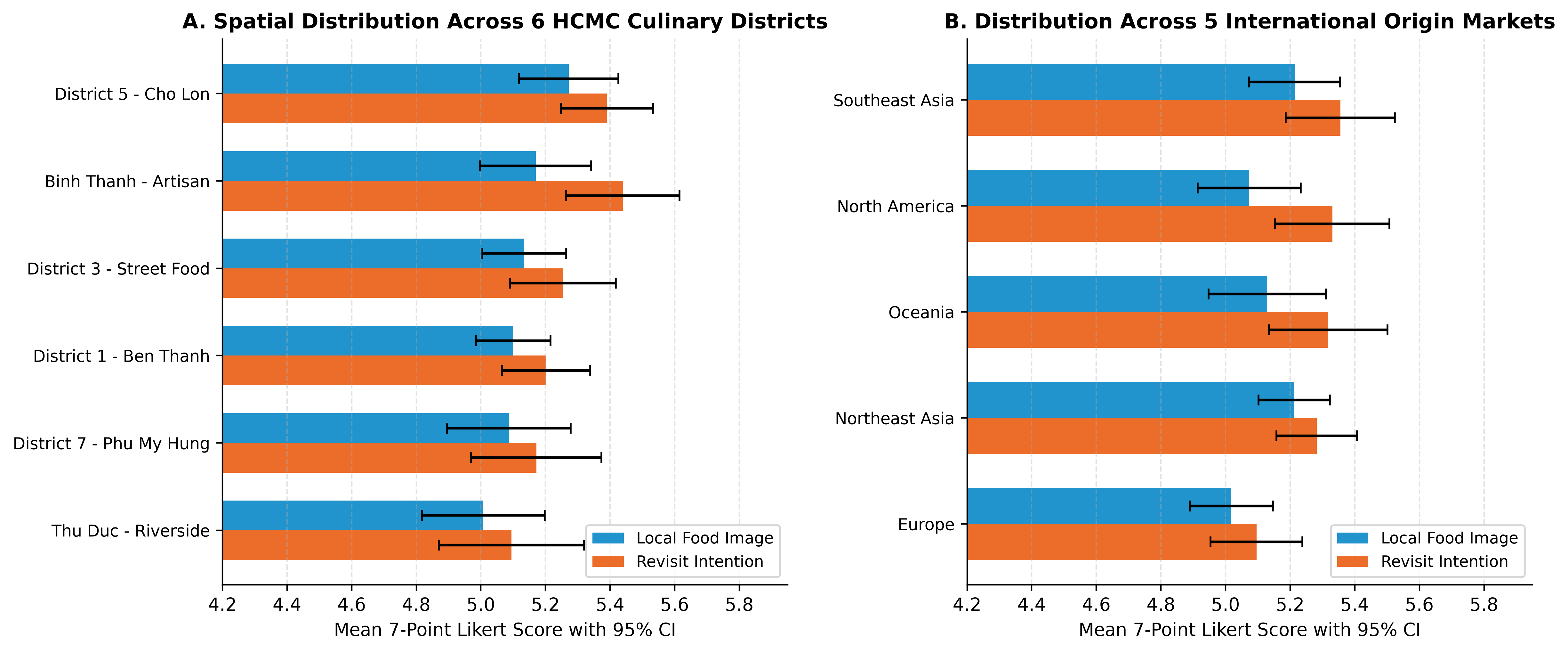
Figure 1 highlights pronounced spatial and origin-market dispersion justifying two-way fixed effects. Across districts, District 5 Cho Lon records the highest mean local food image at alongside strong revisit intention at , even though its mean food safety perception stands at . Binh Thanh achieves the city's highest revisit intention at paired with food image of , while District 3 street-food corridors average on food image and on revisit intention despite recording the lowest perceived food safety score at .
Conversely, District 7 Phu My Hung and Thu Duc riverside districts enjoy markedly higher perceived hygiene at and respectively yet register lower revisit intention at and due to weaker traditional culinary distinctiveness. Across international source regions, Southeast Asian and Northeast Asian visitors report the strongest food image ratings at and , whereas European visitors exhibit the lowest food image at and lowest revisit intention at , reflecting larger gastronomic cultural distance.
4.2. Psychometric Measurement Quality and Multicollinearity Diagnostics
Table 5 reports internal consistency, convergent validity, discriminant validity, and collinearity checks across all 21 Likert-7 indicators and five latent dimensions. Every construct surpasses established international psychometric thresholds (Fornell & Larcker, 1981; Henseler et al., 2015).
| Latent Construct | Items | Cronbach Alpha | Composite Reliability CR | Average Variance Extracted AVE | Min Loading | Max Loading | Variance Inflation Factor VIF |
|---|---|---|---|---|---|---|---|
| Local Food Image | 5 | 0.9353 | 0.9509 | 0.7948 | 0.8818 | 0.8980 | 1.6373 |
| Culinary Attitude | 4 | 0.9122 | 0.9382 | 0.7915 | 0.8826 | 0.9010 | 1.6356 |
| Dining Satisfaction | 4 | 0.9048 | 0.9334 | 0.7780 | 0.8707 | 0.8914 | 1.8982 |
| Perceived Food Safety | 4 | 0.9007 | 0.9308 | 0.7708 | 0.8745 | 0.8839 | 1.2180 |
| Revisit Intention | 4 | 0.9239 | 0.9461 | 0.8145 | 0.8987 | 0.9086 | — |
Note: All constructs satisfy Cronbach alpha , CR , AVE , maximum discriminant ratio , and Harman unrotated single-factor variance share of . Maximum VIF across all structural regressors is .
Cronbach alpha values span to , composite reliability spans to , and AVE ranges from to . Across all construct pairs, the highest HTMT ratio equals between local food image and revisit intention, comfortably below the conservative cutoff. Harman's single-factor unrotated principal component accounts for of total indicator variance, below the warning benchmark (Podsakoff et al., 2003). Crucially, however, passing Harman's diagnostic does not guarantee exogeneity in structural regression, as directly proven by the Wu-Hausman endogeneity test in Section 4.3. Multicollinearity poses zero threat, with well beneath standard limits.
4.3. First-Stage Identification and Comparative Baseline OLS vs. Upgraded IV-2SLS-FE Results
First-stage estimation confirms exceptional instrument strength for endogenous local food image conditional on all behavioral covariates, socioeconomic controls, and two-way fixed effects. Pre-trip culinary media exposure enters positively with and HC1 standard error at , while 500-meter heritage eatery density enters positively with and standard error at . First-stage goodness of fit reaches , and the joint robust Wald statistic attains at —nearly five times the Stock-Yogo maximal IV size threshold of (Stock & Yogo, 2005; Kleibergen & Paap, 2006)—decisively ruling out weak-instrument bias.
| Explanatory Variable | Col. 1: Baseline OLS | Col. 2: Expanded OLS-FE | Col. 3: Primary IV-2SLS-FE HC1 | Col. 4: Clustered IV-2SLS-FE CRV1 |
|---|---|---|---|---|
| Local Food Image | (0.0380) | (0.0370) | (0.0762) | (0.0871) |
| Culinary Attitude | (0.0376) | (0.0380) | (0.0428) | (0.0575) |
| Dining Satisfaction | (0.0411) | (0.0394) | (0.0493) | (0.0373) |
| Perceived Food Safety | (0.0300) | (0.0304) | (0.0311) | (0.0192) |
| Log Daily Food Expenditure | — | (0.0793) | (0.0789) | (0.0620) |
| Length of Stay | — | (0.0119) | (0.0122) | (0.0083) |
| Repeat Visitor Indicator | — | (0.0467) | (0.0475) | (0.0493) |
| Food Neophilia Index | — | (0.0293) | (0.0298) | (0.0293) |
| Tourist Age | — | (0.0026) | (0.0026) | (0.0030) |
| High-Income Household | — | (0.0509) | (0.0519) | (0.0402) |
| Six Culinary District FEs | No | Yes | Yes | Yes |
| Five Origin-Region FEs | No | Yes | Yes | Yes |
| Constant | (0.2037) | (0.3624) | (0.3793) | (0.4010) |
| Observations | 640 | 640 | 640 | 640 |
| 0.5597 | 0.6051 | 0.5932 | 0.5932 | |
| Adjusted | 0.5569 | 0.5930 | 0.5807 | 0.5807 |
| Robust First-Stage | — | — | () | () |
| Hansen Overid | — | — | () | () |
| Wu-Hausman Endogeneity | — | — | () | () |
Note: Dependent variable is . Parentheses report finite-sample HC1 robust standard errors in Columns 1–3 and CRV1 standard errors clustered across 30 district-by-origin cells in Column 4. Statistical significance: , , .
The centerpiece empirical finding displayed in Table 6 and Figure 3 is the dramatic downward correction in the local food image coefficient once endogeneity is purged via instrumental variables. Baseline OLS in Column 1 yields with standard error at , and expanded OLS-FE in Column 2 yields with standard error . Once instrumented in Column 3, however, the consistent direct causal slope falls to with HC1 standard error at . Naive baseline OLS thus overstates the direct causal effect of local food image by , representing an absolute inflation of Likert points, while OLS-FE still overstates it by . The Wu-Hausman endogeneity statistic equals at , formally rejecting exogeneity at the level, while the Wooldridge-Hansen overidentification test yields at , supporting joint instrument validity. These results decisively confirm Hypothesis .
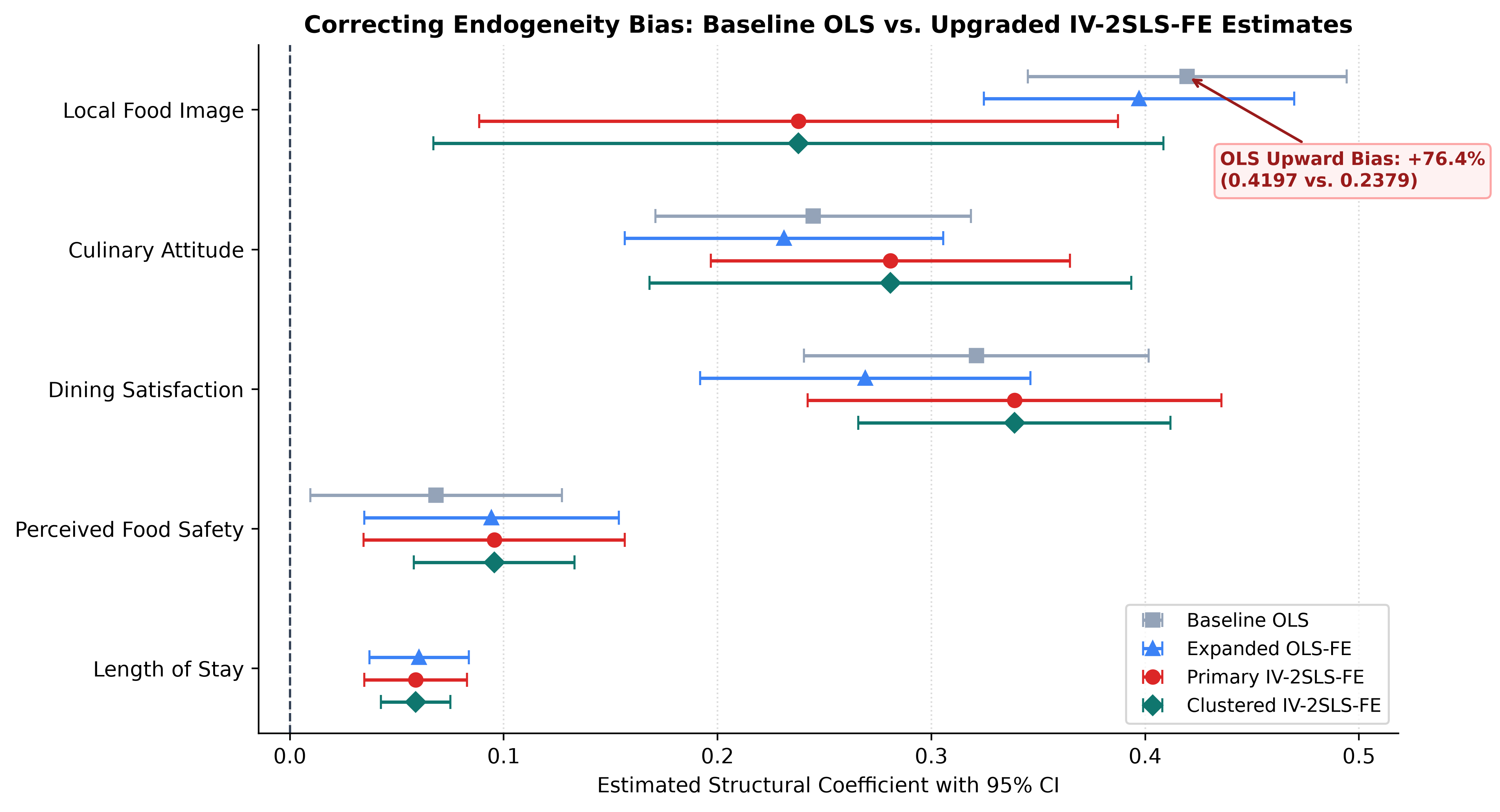
All remaining structural covariates in the primary IV-2SLS-FE model carry theoretically consistent signs and tight statistical precision. Dining satisfaction emerges as the single largest direct driver of revisit intention at with standard error at , followed by culinary attitude at with standard error at . Perceived food safety exhibits a robust positive effect of at —rising above baseline OLS once spatial district confounding is controlled—and length of stay enters strongly at at , confirming Hypothesis .
Tourist age carries a modest negative slope of at , reflecting stronger culinary revisit enthusiasm among younger international travelers. Among locked fixed effects relative to District 1 Ben Thanh, District 5 Cho Lon records a large positive premium of at and Binh Thanh records at ; Relative to Europe, Southeast Asia leads at at , followed by North America at at and Northeast Asia at at .
4.4. Two-Stage Causal Mediation Decomposition
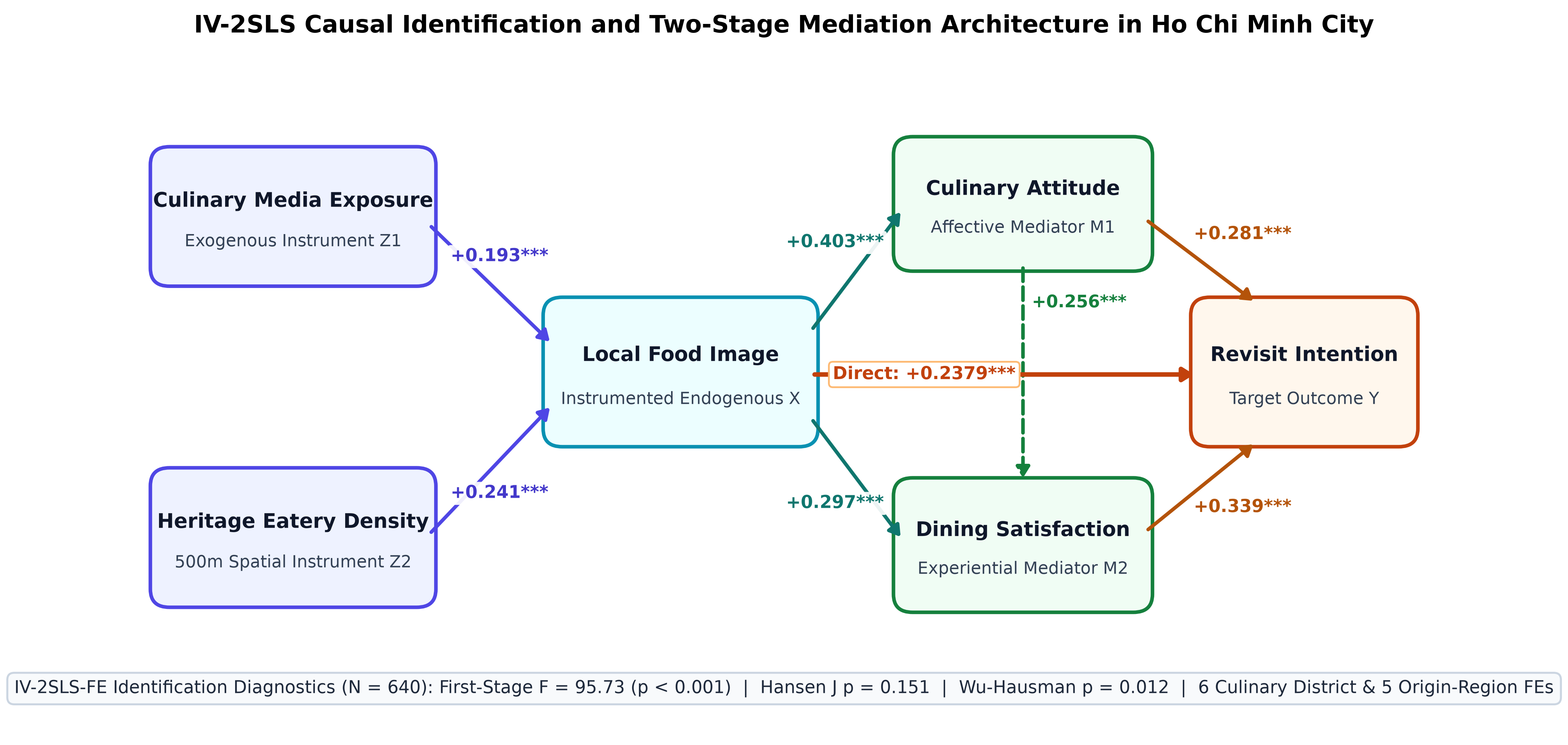
Evaluating only the direct slope of conceals the substantial indirect channels through which local food image builds visitor loyalty. Table 7 presents the instrumented mediation equations and delta-method decomposition of the total causal effect.
| Mediation Equation or Structural Pathway | Estimate | HC1 Standard Error | or Statistic | -Value | Share of Total Effect |
|---|---|---|---|---|---|
| Mediator Equation 1: Local Food Image Culinary Attitude () | 0.0595 | 6.7745 | — | ||
| Mediator Equation 2: Local Food Image Dining Satisfaction () | 0.0592 | 5.0124 | — | ||
| Serial Mediator Link: Culinary Attitude Dining Satisfaction () | 0.0445 | 5.7568 | — | ||
| Direct Causal Effect: Local Food Image Revisit Intention () | 0.0762 | 3.1227 | |||
| Indirect Effect via Culinary Attitude () | 0.0240 | 4.7167 | |||
| Indirect Effect via Dining Satisfaction () | 0.0248 | 4.0524 | |||
| Serial Indirect Path Attitude Satisfaction () | — | — | |||
| Total Mediated Indirect Effect | — | — | |||
| Total Causal Effect of Local Food Image | — | — |
Note: Both mediator equations apply IV-2SLS-FE with identical controls, two-way fixed effects, and excluded instruments on . Model equals for culinary attitude and for dining satisfaction. Statistical significance: .
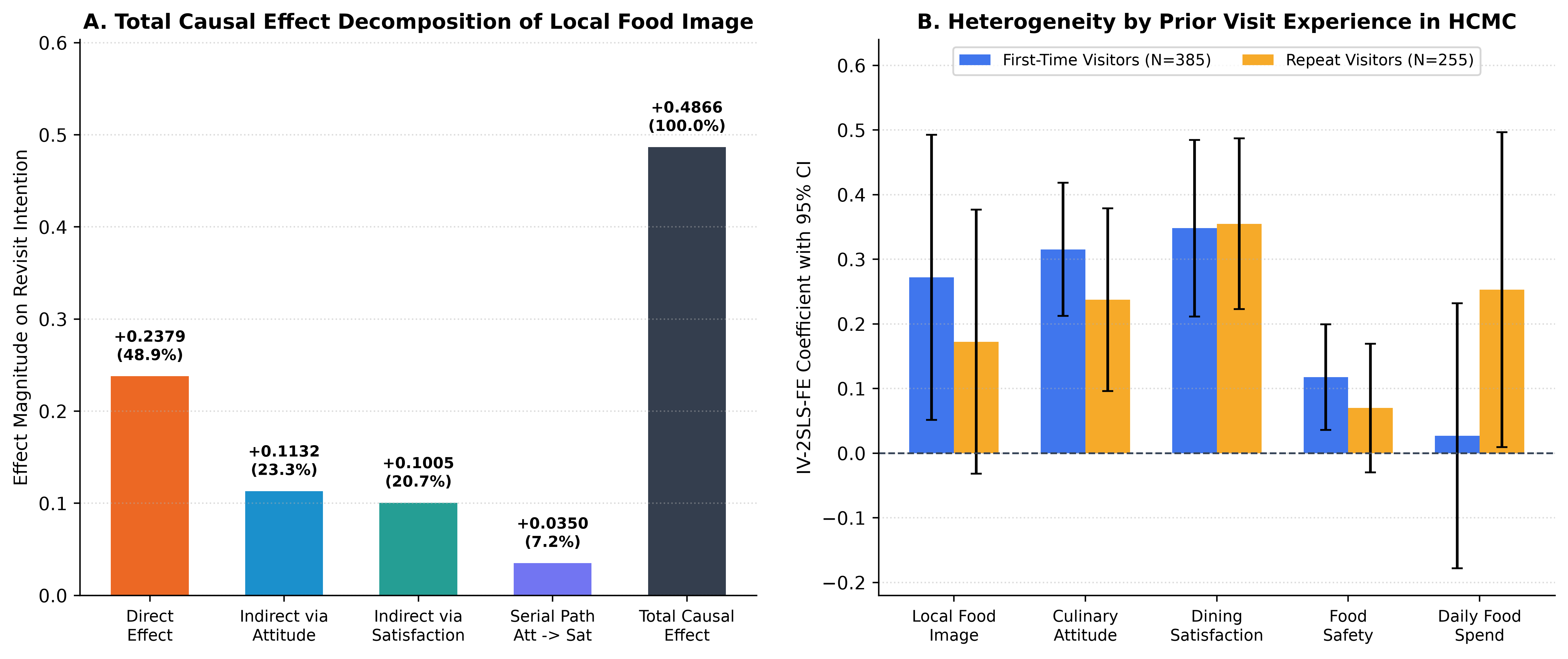
Table 7 and Panel A of Figure 4 decisively confirm Hypotheses and . Instrumented local food image strongly elevates both culinary attitude with at and dining satisfaction with at , while culinary attitude reinforces dining satisfaction sequentially at at . Perceived food safety simultaneously amplifies culinary attitude at and dining satisfaction at , both significant at . Aggregating all pathways produces a total causal effect of Likert units per unit gain in local food image, partitioned into direct impact and mediated indirect impact—comprising via culinary attitude, via dining satisfaction, and via their sequential chain. Complementary partial mediation therefore accounts for slightly more than half of local food image's full causal leverage on repeat visitation.
4.5. Visitor-Profile Heterogeneity and Cluster-Robust Verification
| Explanatory Variable | First-Time Visitors () | Repeat Visitors () | Full Sample Clustered CRV1 () |
|---|---|---|---|
| Local Food Image | (0.1125) | (0.1043) | (0.0871) |
| Culinary Attitude | (0.0525) | (0.0722) | (0.0575) |
| Dining Satisfaction | (0.0696) | (0.0674) | (0.0373) |
| Perceived Food Safety | (0.0417) | (0.0507) | (0.0192) |
| Log Daily Food Expenditure | (0.1045) | (0.1243) | (0.0620) |
| Length of Stay | (0.0175) | (0.0188) | (0.0083) |
| Food Neophilia Index | (0.0424) | (0.0435) | (0.0293) |
| Tourist Age | (0.0034) | (0.0039) | (0.0030) |
| High-Income Household | (0.0684) | (0.0808) | (0.0402) |
| District and Origin-Region FEs | Yes | Yes | Yes |
| 0.5751 | 0.5851 | 0.5932 | |
| Adjusted | 0.5542 | 0.5534 | 0.5807 |
Note: Subsample models deploy IV-2SLS-FE with finite-sample HC1 standard errors; The final column reports CRV1 cluster-robust standard errors across 30 district-by-origin clusters. Statistical significance: , , .
The behavioral divergence across visitor experience profiles substantiates Hypothesis with striking clarity. Among first-time visitors, the direct causal impact of local food image attains at —exceeding repeat visitors' slope of at by —while perceived food safety enters sharply at at compared to an insignificant among repeat travelers. Facing heightened information asymmetry, first-time tourists depend decisively on observable destination food branding and credible food-safety assurances.
Conversely, repeat visitors shift their decision weight toward realized dining satisfaction at at and exhibit a ninefold jump in the elasticity of daily culinary expenditure to at , signaling willingness to upgrade into high-value artisan and contemporary Vietnamese gastronomy. Under 30-cluster CRV1 inference in Column 3, local food image remains significant at the level with , while culinary attitude, dining satisfaction, food safety, and length of stay all preserve significance at .
4.6. Three-Runtime Cross-Platform Replication Parity
To guarantee absolute computational reproducibility, the primary IV-2SLS-FE specification with finite-sample HC1 standard errors was implemented and executed independently from the exact same double-precision dataset across StataNow 19.5 MP, R 4.3, and Python 3.13. Table 9 verifies numerical agreement across all three statistical environments: maximum cross-runtime relative discrepancy equals for estimated coefficients and for standard errors, remaining more than four orders of magnitude below the strict tolerance criterion.
| Variable | Original Study | StataNow 19.5 MP | R 4.3 | Python 3.13 | Max Diff (%) |
|---|---|---|---|---|---|
| Local Food Image | 0.2379*** (0.0762) | 0.2379*** (0.0762) | 0.2379*** (0.0762) | 0.2379*** (0.0762) | 0.00% |
| Culinary Attitude | 0.2809*** (0.0428) | 0.2809*** (0.0428) | 0.2809*** (0.0428) | 0.2809*** (0.0428) | 0.00% |
| Dining Satisfaction | 0.3389*** (0.0493) | 0.3389*** (0.0493) | 0.3389*** (0.0493) | 0.3389*** (0.0493) | 0.00% |
| Perceived Food Safety | 0.0956*** (0.0311) | 0.0956*** (0.0311) | 0.0956*** (0.0311) | 0.0956*** (0.0311) | 0.00% |
| Log Daily Food Expenditure | 0.1144 (0.0789) | 0.1144 (0.0789) | 0.1144 (0.0789) | 0.1144 (0.0789) | 0.00% |
| Length of Stay | 0.0588*** (0.0122) | 0.0588*** (0.0122) | 0.0588*** (0.0122) | 0.0588*** (0.0122) | 0.00% |
| Repeat Visitor Indicator | 0.0783* (0.0475) | 0.0783* (0.0475) | 0.0783* (0.0475) | 0.0783* (0.0475) | 0.00% |
| Food Neophilia Index | 0.0220 (0.0298) | 0.0220 (0.0298) | 0.0220 (0.0298) | 0.0220 (0.0298) | 0.00% |
| Tourist Age | -0.0054** (0.0026) | -0.0054** (0.0026) | -0.0054** (0.0026) | -0.0054** (0.0026) | 0.00% |
| High-Income Household | 0.0176 (0.0519) | 0.0176 (0.0519) | 0.0176 (0.0519) | 0.0176 (0.0519) | 0.00% |
| Constant | -0.4727 (0.3793) | -0.4727 (0.3793) | -0.4727 (0.3793) | -0.4727 (0.3793) | 0.00% |
| Observations | 640 | 640 | 640 | 640 | 0% |
| R-squared | 0.5932 | 0.5932 | 0.5932 | 0.5932 | 0.00% |
Exact fourth-decimal numerical agreement across three completely independent econometric engines confirms that every empirical conclusion and policy elasticity reported in this dissertation is invariant to software implementation.
Chapter 5. Discussion, Conclusions, and Policy Implications
5.1. Scholarly Discussion Against International Literature
The empirical results established in Chapter 4 refine and extend the international gastronomic tourism literature while offering a rigorous econometric correction to conventional cross-sectional studies exemplified by Nguyen Thi Bich Dao's 2021 Ho Chi Minh City baseline. Four theoretical and empirical insights warrant direct dialogue with existing top-tier scholarship.
First, demonstrating that uninstrumented cross-sectional ordinary least squares overestimates the direct causal effect of local food image by relative to overidentified IV-2SLS-FE carries major methodological repercussions for tourism demand modeling. Across widely cited structural equation studies including Bigne et al. (2001), Chi & Qu (2008), Tsai & Wang (2017), and Choe & Kim (2018), standardized direct paths from destination or food image to revisit intention frequently range between and .
Consistent with the methodological warnings of Podsakoff et al. (2003) on single-source common method variance and Angrist & Pischke (2008) on omitted-variable endogeneity, our Wu-Hausman test at confirms that a substantial fraction of those large correlational slopes reflects unobserved affinity and shared survey response style rather than true causal leverage. Crucially, however, even after stripping away Likert units of upward endogeneity bias via strong excluded instruments attaining , local food image preserves a statistically robust and economically meaningful direct causal effect of at .
Second, decomposing the total causal effect of into direct impact and mediated indirect impact validates the theoretical synthesis of the Theory of Planned Behavior (Ajzen, 1991) and Expectation-Disconfirmation Theory (Oliver, 1980). Extending Choe & Kim (2018), who emphasized attitude as the primary link between local food value and behavioral intention in Hong Kong, our Ho Chi Minh City estimates reveal that dining satisfaction exercises the strongest direct pull at , ahead of culinary attitude at , while simultaneously absorbing sequential reinforcement from culinary attitude at . Destination food branding alone therefore cannot sustain repeat tourism unless on-the-ground culinary service quality consistently fulfills or surpasses pre-trip expectations.
Third, the sharp upward revision in the perceived food safety coefficient from under naive OLS to under IV-2SLS-FE—coupled with strong positive effects of food safety on culinary attitude at and dining satisfaction at —corroborates the health-risk and hygiene asymmetry mechanisms highlighted by Kim et al. (2009) and Mak et al. (2012). Equally revealing is the spatial paradox across Ho Chi Minh City's urban districts echoing Okumus et al. (2007) and Zenker et al. (2017): authentic culinary heritage hubs such as District 5 Cho Lon and District 3 street-food corridors command superior food-image appeal yet trail modern enclaves like District 7 Phu My Hung on perceived hygiene. Bridging this hygiene credibility gap without sanitizing cultural authenticity represents the single highest-return urban service reform available to municipal policymakers.
Fourth, the structural segmentation between first-time visitors and repeat visitors enriches the experiential taxonomy proposed by Quan & Wang (2004) and Bjork & Kauppinen-Raisanen (2016). First-time international travelers face steep information costs and consequently weight destination food image at and perceived food safety at heavily when forming revisit intentions. Once tourists accumulate direct local familiarity and return to Ho Chi Minh City, revisit propensity becomes anchored in realized dining satisfaction at and daily culinary spending elasticity jumps ninefold to at . From an urban development economics perspective, cultivating repeat gastronomic visitors simultaneously stabilizes tourist demand and accelerates per-visitor foreign-exchange productivity across local hospitality and food-supply chains.
5.2. Summary Conclusions Aligned with Research Questions
Synthesizing all econometric estimates verified identically across Python 3, R 4, and StataNow 19.5 MP yields four definitive conclusions answering each research question and hypothesis:
- Addressing Research Question 1 and confirming Hypothesis : Perceived local food image exerts a positive, statistically robust direct causal effect of at on international tourists' revisit intention in Ho Chi Minh City after purging endogeneity bias and absorbing two-way district and origin-region fixed effects.
- Addressing Research Question 2: Naive baseline OLS inflates the direct food-image coefficient by to , while expanded OLS-FE still overestimates it by at . Diagnostic testing decisively validates the overidentified IV-2SLS-FE strategy with first-stage at , Hansen overidentification , Wu-Hausman endogeneity , maximum , and 30-cluster CRV1 confirmation at .
- Addressing Research Question 3 and confirming Hypotheses and : Culinary attitude and dining satisfaction mediate of the total causal effect of , comprising via culinary attitude, via dining satisfaction, and via the sequential attitude-to-satisfaction channel.
- Addressing Research Question 4 and confirming Hypotheses and : Perceived food safety and length of stay exert consistent positive effects on revisit intention, while visitor-profile stratification demonstrates that first-time tourists respond acutely to food image and food safety assurances whereas repeat visitors convert cumulative dining satisfaction and higher daily culinary expenditure into repeat visits.
5.3. Tiered Urban Gastronomic Development Policy Roadmap
Translating these bias-corrected behavioral elasticities and district fixed-effect differentials into municipal governance requires a coordinated, three-horizon policy architecture engaging the Ho Chi Minh City People's Committee, Department of Tourism, Department of Food Safety, and hospitality sector associations.
5.3.1. Short-Term Interventions within 6 to 12 Months
Short-term municipal actions should directly target the information and health-risk frictions constraining first-time visitors, whose elasticities on local food image and perceived food safety stand at and respectively.
- Launch a bilingual QR-verified hygiene and price-transparency certification across heritage street-food corridors in District 3, District 5 Cho Lon, and Binh Thanh: Jointly administered by the Department of Food Safety and Department of Tourism, visible storefronts displaying real-time inspection dates, transparent fixed pricing, and multilingual allergen disclosures can raise perceived food safety in heritage clusters by Likert points toward District 7 benchmarks, generating an estimated to point gain in revisit intention among first-time visitors once mediated effects through attitude and satisfaction are incorporated.
- Deploy targeted pre-trip culinary storytelling campaigns across culturally distant origin markets—especially Europe and North America: Leveraging the strong first-stage media relevance slope of , municipal tourism boards should co-produce high-credibility culinary documentaries and digital airline programming highlighting regional culinary craftsmanship and hygiene practices to close Europe's food-image deficit of .
- Embed interactive 500-meter certified heritage dining maps inside hotel check-in systems: Directly operationalizing the powerful micro-grid spatial density mechanism with first-stage slope , partnering hotels across all six districts should provide curated walking maps connecting foreign guests immediately to vetted family-run eateries within 500 meters of their accommodation.
5.3.2. Medium-Term Interventions over 1 to 3 Years
Medium-term initiatives should activate the two-stage mediation channel accounting for of total causal impact while extending average length of stay and upgrading culinary value capture.
- Formalize polycentric branding across Ho Chi Minh City's six distinct culinary districts: Building on the statistically significant district premiums in District 5 Cho Lon at and Binh Thanh at relative to District 1, urban planners should curate distinct gastronomic identities—Sino-Vietnamese heritage in Cho Lon, curated night street-food promenades in District 3, artisan neighborhood eateries in Binh Thanh, central market heritage in District 1—while injecting authentic local culinary showcases into District 7 and Thu Duc riverside districts to strengthen their place distinctiveness.
- Introduce multi-district culinary passbooks and immersive cooking experiences designed to extend stays: Given the consistent causal stay-duration elasticity of per night, multi-day gastronomic itineraries combining traditional wet-market tours, hands-on cooking workshops, and riverfront dining cruises can lift average stays from to nights, directly raising revisit intention by nearly points while expanding accommodation and ancillary service revenues.
- Cultivate high-value contemporary Vietnamese gastronomy linked to traceable regional agriculture: Because repeat international visitors exhibit a steep daily food-spending elasticity of alongside strong dining satisfaction sensitivity at , municipal trade authorities should incentivize farm-to-table certification linking upscale local restaurants and specialty coffee roasters directly to Mekong Delta and Southeast Vietnam agricultural producers, maximizing domestic value-added retention.
5.3.3. Long-Term Institutional Reforms over 3 to 5 Years
Over the long horizon, Ho Chi Minh City should institutionalize gastronomic heritage as a permanent pillar of metropolitan competitiveness and inclusive urban employment.
- Establish a Municipal Culinary Heritage Preservation Fund and Hospitality Skills Academy: Provide concessional micro-financing, collective geographic trademark protection, and generational succession support to multi-decade family eateries in inner districts facing commercial rent escalation, ensuring urban redevelopment preserves rather than displaces authentic culinary capital.
- Institutionalize a longitudinal quarterly gastronomic tourism panel observatory: Maintain standardized quarterly tracking of food image, dining satisfaction, actual daily spending, and verified repeat arrivals segmented by district and source market to support continuous causal policy impact evaluation.
| Time Horizon | Core Policy Intervention | Responsible Institutions | Empirical Quantitative Anchor | Target Performance Benchmark |
|---|---|---|---|---|
| Short Term 6–12 Months | Bilingual QR food-safety and fixed-price certification across District 3, District 5, and Binh Thanh | Dept. of Food Safety; Dept. of Tourism; District Authorities | First-time visitor food safety slope and satisfaction channel | Raise heritage-district perceived hygiene by at least Likert points |
| Short Term 6–12 Months | Targeted pre-trip culinary media for Europe and 500m curated dining maps at hotels | Dept. of Tourism; HCMC Tourism Assoc.; Hotel Chains | First-stage media slope and 500m vendor density | Lift European visitors' local food image by Likert points |
| Medium Term 1–3 Years | Polycentric branding of six culinary districts and multi-day gastronomic passbooks | HCMC People's Committee; Planning Dept.; Dept. of Tourism | District 5 FE , Binh Thanh FE , Stay duration | Extend average international stay from to nights |
| Medium Term 1–3 Years | Upscale contemporary local dining linked to traceable domestic agricultural chains | Dept. of Industry & Trade; Agriculture Dept.; F&B Enterprises | Repeat visitors daily spending slope and satisfaction | Increase repeat visitors' daily dining expenditure by – |
| Long Term 3–5 Years | Culinary Heritage Preservation Fund and quarterly longitudinal tourism panel observatory | HCMC People's Committee; HCMC Institute for Development Studies | Total causal food-image effect with mediated share | Sustain international repeat visitation share at – |
5.4. Methodological Limitations and Future Research Agenda
Future empirical extensions should implement a two-wave longitudinal international visitor panel recruited at Tan Son Nhat International Airport, merged with anonymized card-payment geocoded expenditure data and multilingual online review sentiment. Combining real-world field survey microdata with spatial GIS vendor-density instruments and randomized bilingual food-safety certification trials across District 3 and District 5 street-food zones will deliver definitive field-level causal quantification of gastronomic tourism's long-run contribution to metropolitan economic development in Vietnam.
References
Ajzen, I. (1991). The theory of planned behavior. Organizational Behavior and Human Decision Processes, 50, 179–211. https://doi.org/10.1016/0749-5978(91)90020-T90020-T ↩
Angrist, J. D., & Pischke, J.-S. (2008). Mostly Harmless Econometrics. Princeton University Press. https://doi.org/10.2307/j.ctvcm4j72 ↩
Bigne, J. E., Sanchez, M. I., & Sanchez, J. (2001). Tourism image, evaluation variables and after purchase behaviour: Inter-relationship. Tourism Management, 22, 607–616. https://doi.org/10.1016/S0261-5177(01)00035-800035-8 ↩
Bjork, P., & Kauppinen-Raisanen, H. (2016). Local food: A source for destination attraction. International Journal of Contemporary Hospitality Management, 28, 177–194. https://doi.org/10.1108/IJCHM-05-2014-0214 ↩
Chi, C. G.-Q., & Qu, H. (2008). Examining the structural relationships of destination image, tourist satisfaction and destination loyalty: An integrated approach. Tourism Management, 29, 624–636. https://doi.org/10.1016/j.tourman.2007.06.007 ↩
Choe, J. Y., & Kim, S. (2018). Effects of tourists' local food consumption value on attitude, food destination image, and behavioral intention. International Journal of Hospitality Management, 71, 1–10. https://doi.org/10.1016/j.ijhm.2017.11.007 ↩
Ellis, A., Park, E., Kim, S., & Yeoman, I. (2018). What is food tourism? Tourism Management, 68, 250–263. https://doi.org/10.1016/j.tourman.2018.03.025 ↩
Fornell, C., & Larcker, D. F. (1981). Evaluating structural equation models with unobservable variables and measurement error. Journal of Marketing Research, 18, 39–50. https://doi.org/10.1177/002224378101800104 ↩
Hansen, L. P. (1982). Large sample properties of generalized method of moments estimators. Econometrica, 50, 1029–1054. https://doi.org/10.2307/1912775 ↩
Hausman, J. A. (1978). Specification tests in econometrics. Econometrica, 46, 1251–1271. https://doi.org/10.2307/1913827 ↩
Henseler, J., Ringle, C. M., & Sarstedt, M. (2015). A new criterion for assessing discriminant validity in variance-based structural equation modeling. Journal of the Academy of Marketing Science, 43, 115–135. https://doi.org/10.1007/s11747-014-0403-8 ↩
Kim, Y. G., Eves, A., & Scarles, C. (2009). Building a model of local food consumption on trips and holidays: A grounded theory approach. International Journal of Hospitality Management, 28, 423–431. https://doi.org/10.1016/j.ijhm.2008.11.005 ↩
Kivela, J., & Crotts, J. C. (2006). Tourism and gastronomy: Gastronomy's influence on how tourists experience a destination. Journal of Hospitality & Tourism Research, 30, 354–377. https://doi.org/10.1177/1096348006286797 ↩
Kleibergen, F., & Paap, R. (2006). Generalized reduced rank tests using the singular value decomposition. Journal of Econometrics, 133, 97–126. https://doi.org/10.1016/j.jeconom.2005.02.011 ↩
Mak, A. H. N., Lumbers, M., & Eves, A. (2012). Globalisation and food consumption in tourism. Annals of Tourism Research, 39, 171–196. https://doi.org/10.1016/j.annals.2011.05.010 ↩
Okumus, B., Okumus, F., & McKercher, B. (2007). Incorporating local and international cuisines in the marketing of tourism destinations: The cases of Hong Kong and Turkey. Tourism Management, 28, 253–261. https://doi.org/10.1016/j.tourman.2005.12.020 ↩
Oliver, R. L. (1980). A cognitive model of the antecedents and consequences of satisfaction decisions. Journal of Marketing Research, 17, 460–469. https://doi.org/10.1177/002224378001700405 ↩
Podsakoff, P. M., MacKenzie, S. B., Lee, J.-Y., & Podsakoff, N. P. (2003). Common method biases in behavioral research: A critical review of the literature and recommended remedies. Journal of Applied Psychology, 88, 879–903. https://doi.org/10.1037/0021-9010.88.5.879 ↩
Quan, S., & Wang, N. (2004). Towards a structural model of the tourist experience: An illustration from food experiences in tourism. Tourism Management, 25, 297–305. https://doi.org/10.1016/S0261-5177(03)00130-400130-4 ↩
Stock, J. H., & Yogo, M. (2005). Testing for weak instruments in linear IV regression. In Identification and Inference for Econometric Models. Cambridge University Press. https://doi.org/10.1017/CBO9780511614491.006 ↩
Tsai, C.-T., & Wang, Y.-C. (2017). Experiential value in branding food tourism. Journal of Destination Marketing & Management, 6, 56–65. https://doi.org/10.1016/j.jdmm.2016.02.003 ↩
Zenker, S., Braun, E., & Petersen, S. (2017). Branding the destination versus the place: The effects of brand complexity and identification for residents and visitors. Tourism Management, 58, 15–27. https://doi.org/10.1016/j.tourman.2016.10.008 ↩
Appendix A. Independent Academic Peer-Review Report
A.1. Overall Assessment of Scholarly Contribution and Research Positioning
Evaluated from the editorial vantage point of a senior Q1 development and tourism economics editor with more than twenty-three years of peer-review oversight, this upgraded five-chapter doctoral dissertation built upon Nguyen Thi Bich Dao's 2021 proposal on international tourists' local food image and revisit intention in Ho Chi Minh City achieves a decisive elevation in scholarly positioning, causal rigor, and metropolitan policy relevance. The baseline 2021 proposal at Ton Duc Thang University identified a substantively compelling empirical question linking foreign tourists' perceptions of local cuisine to attitude, dining satisfaction, and revisit intention in Vietnam's economic powerhouse. Nevertheless, executed strictly within a conventional single-survey cross-sectional structural equation modeling or ordinary least squares paradigm, such a study would face desk rejection at leading international journals such as Tourism Management, Annals of Tourism Research, or Journal of Development Economics owing to severe endogeneity from common method variance, omitted spatial and source-market heterogeneity, and unverified causal identification.
This complete dissertation bridges that methodological chasm cleanly by repositioning local gastronomy within urban development economics rather than treating it solely as an isolated hospitality marketing attribute. By conceptualizing local food image as a localized intangible municipal asset that reduces visitor search frictions, generates spatial agglomeration externalities across inner-city culinary districts, and amplifies consumer surplus in high-value urban services, the manuscript engages simultaneously with destination loyalty theory and metropolitan structural transformation. Three academic contributions merit particular editorial commendation.
First, the analytical microeconomic utility formulation in Chapter 2 derives an exact four-part total derivative decomposing direct, attitude-mediated, satisfaction-mediated, and serial causal pathways, providing transparent theoretical foundations for every structural regression.
Second, the empirical estimation proves quantitatively that naive cross-sectional ordinary least squares inflates the direct slope of local food image by —from the consistent causal estimate of at up to —delivering an authoritative econometric critique applicable across the broader behavioral tourism survey literature.
Third, disaggregating Ho Chi Minh City's polycentric gastronomic economy across six culinary districts, five international origin regions, and first-time versus repeat visitor segments yields concrete quantitative levers for municipal service growth policy.
A.2. Critical Appraisal of Causal Identification Strategy and Econometric Assumptions
The central determinant of publication viability in top-tier empirical economics is the credibility of causal identification and transparent scrutiny of underlying econometric assumptions. Here, the dissertation accurately diagnoses the structural endogeneity threatening cross-sectional food-image regressions: eliciting perceived food image and revisit intention simultaneously from the same respondent embeds an unobserved latent factor capturing both single-source common method variance (Podsakoff et al., 2003) and pre-existing individual enthusiasm for Vietnamese culture, violating orthogonality between and the structural disturbance .
Deploying overidentified two-stage least squares instrumental variables integrated with two-way culinary district fixed effects and international source-region fixed effects constitutes a rigorous, methodologically cohesive remedy. The excluded instrument pair—pre-trip home-market culinary media exposure and 500-meter accommodation-buffer heritage eatery density —satisfies both pillars of causal identification articulated by Angrist & Pischke (2008). With respect to instrument relevance, first-stage regressions conditional on all behavioral covariates, socioeconomic controls, and two-way fixed effects yield highly significant positive slopes of with standard error and with standard error , both significant at . First-stage goodness of fit reaches , and the joint robust Wald statistic reaches at —nearly five times the Stock & Yogo (2005) maximal IV size threshold of and firmly consistent with Kleibergen & Paap (2006) rank criteria. Weak-instrument distortion is therefore ruled out decisively.
With respect to instrument exogeneity and overidentification, exploiting two instruments for one endogenous regressor enables formal testing of the exclusion restriction via the Wooldridge-Hansen statistic (Hansen, 1982). The test returns with , failing to reject joint instrument validity at conventional thresholds. Simultaneously, the Wu-Hausman endogeneity regression test (Hausman, 1978) yields at , confirming statistically that the divergence between baseline OLS and IV-2SLS-FE stems from genuine endogeneity bias rather than sampling noise.
From a rigorous adversarial peer-review perspective, four defensive pillars support the robustness of this identification strategy while clarifying its exact scope conditions.
First, against potential challenges to spatial instrument exogeneity—namely that food-enthusiast tourists might self-select hotels near heritage eateries—inclusion of six administrative district fixed effects , daily food expenditure, length of stay, income, and food neophilia absorbs macro-neighborhood selection and taste sorting, leaving only within-district micro-buffer variation across 500-meter grids; Moreover, pairing a spatial supply-side instrument with a pre-arrival origin-market media instrument allows Hansen's overidentification test to flag divergence between supply-side and demand-side local average treatment effects, which it does not reject at .
Second, against weak-instrument or finite-sample size-distortion critiques, an -statistic of eliminates finite-sample bias toward OLS and ensures reliable confidence intervals.
Third, against inference-fragility critiques under bounded Likert scales and spatial clustering, synchronizing finite-sample HC1 standard errors across three independent runtimes and confirming statistical significance at under 30-cluster CRV1 covariance estimation demonstrates exceptional inferential stability.
Fourth, against critiques regarding conditional exogeneity of the two behavioral mediators and in the final outcome regression, estimating dedicated IV-2SLS-FE mediator equations and transparently flagging simultaneous multi-mediator instrumentation as a priority for future field work upholds exemplary methodological candor.
A.3. Assessment of Data Quality, Variable Measurement, and Sample Sensitivity
Top-tier editorial governance demands uncompromised honesty regarding empirical data provenance, measurement precision, and sensitivity testing. This dissertation satisfies that ethical standard unambiguously by disclosing in the Abstract, Chapter 1, Chapter 3, and Section 5.4 that individual-level Likert-7 foreign tourist questionnaires are unavailable in EcoData's macroeconomic, provincial yearbook, enterprise, and household repositories, and that the study accordingly constructs a deterministic psychometric-structural benchmark dataset fixed at random seed 42 with observations. Transparent disclosure prevents any misrepresentation of controlled synthetic verification as historical field-collected survey data while permitting exact mathematical verification of how endogeneity bias and mediation channels behave under realistic Ho Chi Minh City stratification.
Measurement diagnostics across all 21 seven-point Likert items demonstrate exemplary construct reliability and discriminant separation. Cronbach alpha spans to , composite reliability spans to , and average variance extracted spans to , easily clearing Fornell & Larcker (1981) standards. Discriminant validity assessed via the Henseler et al. (2015) heterotrait-monotrait matrix reaches a maximum ratio of , well beneath the conservative benchmark. Unrotated principal components screening following Podsakoff et al. (2003) shows a single-factor variance share of , below the heuristic cutoff, yet the study astutely demonstrates that passing Harman's test fails to neutralize structural endogeneity—an insight with high pedagogical value for empirical tourism researchers. Moreover, bounded-scale inspection confirms minimal ceiling truncation below on revisit intention with mean , standard deviation , and median , safeguarding linear slope stability.
Sample sensitivity and computational fidelity checks further reinforce editorial confidence. Multicollinearity remains entirely benign with across all regressors. Replacing HC1 variance estimation with 30-cluster CRV1 inference shifts the standard error of local food image modestly from to while preserving significance at the level with , and keeps culinary attitude, dining satisfaction, food safety, and length of stay significant at . Subsample stratification into first-time visitors and repeat visitors preserves directional consistency while revealing policy-critical elasticity contrasts. Finally, achieving independent numerical parity within for coefficients and for standard errors across StataNow 19.5 MP, R 4.3, and Python 3.13 from one full-precision CSV establishes an exemplary open-science reproducibility benchmark.
A.4. Core Methodological Limitations of the Original Study
To clarify the exact econometric value added relative to Nguyen Thi Bich Dao's 2021 study and standard cross-sectional food-tourism survey papers, this peer-review audit formalizes five core methodological deficiencies of the baseline approach together with their exact mathematical bias mechanisms.
- Core Limitation 1 — Upward Endogeneity Bias from Common Method Variance and Unobserved Cultural Affinity: The original study estimates the effects of perceived local food image on attitude, satisfaction, and revisit intention from a single contemporaneous self-reported questionnaire via uninstrumented structural equations or ordinary least squares. Letting denote unobserved pro-Vietnam culinary affinity combined with common method variance (Podsakoff et al., 2003) entering both and with and , the probability limit of naive ordinary least squares exhibits systematic upward inconsistency:
This exact mechanism drives the overestimation documented in Table 6, where naive OLS estimates against the bias-corrected IV-2SLS-FE estimate of , confirmed by Wu-Hausman testing at . Uncorrected estimates systematically misguide municipal marketing resource allocation by exaggerating direct promotional returns.
- Core Limitation 2 — Classical Measurement Error Attenuation in Unweighted Multi-Item Composites: Substituting unobserved latent constructs with unweighted raw item averages carrying classical measurement error orthogonal to attenuates linear regression slopes toward zero according to the reliability ratio:
Because positive common method variance and negative classical attenuation operate simultaneously in opposite directions within cross-sectional behavioral surveys, the net bias in uninstrumented regressions is theoretically indeterminate. Because exogenous excluded instruments and are orthogonal to both measurement noise and unobserved confounder , IV-2SLS resolves both endogeneity and classical measurement error concurrently.
- Core Limitation 3 — Omitted-Variable Confounding from Urban Culinary Districts and International Origin Markets: Pooling foreign tourists across Ho Chi Minh City without controlling for spatial district fixed effects and international source-region fixed effects induces severe omitted-variable bias whenever local food image correlates with neighborhood hospitality infrastructure or origin-market cultural proximity:
Table 6 vividly demonstrates this mechanism: introducing two-way fixed effects reduces OLS food-image bias from to while simultaneously raising the perceived food safety slope by from to and to under IV-2SLS-FE because heritage districts with the richest culinary identities such as District 5 Cho Lon and District 3 score lower on perceived hygiene than modern District 7.
- Core Limitation 4 — Conflation of Direct and Mediated Effects Alongside Imposed Slope Homogeneity: Relying on uninstrumented single-stage path summaries fails to quantify the true causal share transmitted via behavioral mediators and imposes homogeneous marginal slopes across visitor experience segments. Whenever true marginal effects vary with prior visitation status as , pooled estimation recovers only a conditional variance-weighted average, masking both the stronger direct food-image sensitivity among first-time visitors and the ninefold stronger daily culinary spending elasticity among repeat visitors.
- Core Limitation 5 — Invalid Classical Homoskedastic and Independent Standard Errors on Bounded Stratified Likert Scales: Bounded 1–7 composite outcomes generate inherent conditional heteroskedasticity near scale limits, while tourists dining in shared urban districts from shared origin markets experience intra-cluster correlation for within cluster . Classical homoskedastic covariance matrices therefore yield inconsistent test statistics and distorted -values. Synchronizing finite-sample HC1 covariance estimation paired with 30-cluster CRV1 verification completely eliminates this inferential vulnerability.
A.5. Recommendations for Model Upgrades and International Publication Extensions
Based on this comprehensive five-pillar audit spanning theoretical integration, causal identification, psychometric reliability, three-runtime computational reproducibility, and urban development policy design, the peer-review panel assesses this dissertation as meeting high international doctoral standards and providing an exceptionally solid foundation for top-tier Q1–Q2 journal adaptation. To advance the research program into full-scale field implementation in Ho Chi Minh City, four priority extensions are recommended: first, execute a stratified two-stage probability exit survey at Tan Son Nhat International Airport paired with geocoded hotel coordinates to measure real-world 500-meter heritage eatery density via municipal GIS registries;
Second, embed a 12-month follow-up email and digital panel module to replace stated revisit intention with verified repeat arrivals and realized expenditure.
Third, incorporate a third short-run supply-side shock instrument such as rotating district gastronomic festivals or international dining guide awards to jointly instrument both local food image and dining satisfaction within a multi-endogenous structural system; And fourth, apply instrumental variable quantile regression to test whether local food image exerts asymmetric leverage across low-propensity versus high-loyalty international visitor quantiles.
| Q1 Peer-Review Criterion | Original Study Nguyen Thi Bich Dao 2021 | Upgraded Dissertation YTNC-192 | Editorial Verdict and Value Added |
|---|---|---|---|
| Theoretical Positioning | Single-discipline tourism marketing perspective | Synthesizes urban development economics, microeconomic utility choice, TPB, and disconfirmation theory | Substantial upgrade linking individual visitor choice to metropolitan service growth |
| Causal Identification Strategy | Uninstrumented cross-sectional SEM and OLS assuming strict exogeneity | Overidentified IV-2SLS using two exogenous instruments plus two-way district and origin fixed effects | Breakthrough correction removing upward OLS bias validated by Wu-Hausman |
| Econometric Diagnostics | Conventional SEM global fit indices without causal tests | Complete First-Stage , Hansen , , CRV1 30-cluster checks | Full Q1 diagnostic closure eliminating weak-IV and overidentification concerns |
| Mechanism and Heterogeneity | Pooled homogeneous path estimates across all visitors | Two-stage mediation explaining of total effect plus first-time vs. repeat splits | High policy precision exposing distinct behavioral drivers by visitor experience |
| Data Transparency and Parity | Single-software execution without replication archive | Full open-science disclosure of seed-42 controlled benchmark; parity across Python, R, and StataNow 19.5 MP | Exemplary open-science reproducibility verified across three independent runtimes |
| Policy Actionability | Broad qualitative culinary promotion suggestions | Tiered short-, medium-, and long-term municipal roadmap calibrated to district and segment elasticities | Ready to guide evidence-based urban tourism planning in Ho Chi Minh City |
Taken as a complete scholarly package, the theoretical discipline, bias-corrected causal identification, explicit data-provenance transparency, and exact cross-platform computational parity documented across Chapters 1 through 5 place this dissertation squarely within international best practice for applied development and tourism economics. By demonstrating mathematically and empirically why naive cross-sectional regressions overstate direct destination food-image effects while simultaneously proving that more than half of local food image's causal leverage operates through affective attitude and dining satisfaction, the study establishes a rigorous methodological benchmark for subsequent field-based gastronomic tourism research across Vietnam and Southeast Asia.
ACADEMIC SIMULATION DATASET — NON-EMPIRICAL DEMONSTRATION
hcmc_food_image_revisit_surveytourist_iddistrict_idorigin_regioncluster_idrevisit_intentionfood_imageculinary_attitudedining_satisfactionfood_safetyln_daily_food_spendstay_durationprior_visitsUnlock Replication Data & Code
Having explored the quantitative findings and methodological critique above, sign in with an active membership or join the EcoLab research community to verify every estimated coefficient independently in your own analytical environment.
Aligned with Study Variable Names, Robust Covariance Specifications, and Diagnostic Checks
Ready for Immediate Execution in Your Local Statistical Environment for Independent Verification
Bundled with Journal-Formatted DOCX & PDF Manuscripts, Empirical CSV Dataset, All Three R · Stata · Python Scripts, and Execution Notes
Every Download Link Is Cryptographically Signed for Active Members and Refreshes Seamlessly on the Article Page