
Keywords: Online repurchase intention; Behavioral microeconomics; Instrumental variables IV-2SLS; Platform fixed effects; Causal mediation; Digital apparel commerce.
JEL Classification: D12; D81; L81; M31.
1. Introduction
Digital apparel retailing in Ho Chi Minh City has evolved into an intensely competitive multi-platform marketplace dominated by Shopee, TikTok Shop, Lazada, and direct social-commerce boutiques. From the perspective of applied microeconomics and platform industrial organization, apparel represents a quintessential experience good characterized by pronounced pre-purchase information asymmetry over fabric texture, tailoring precision, and fit consistency. Because customer acquisition costs in online fashion continually escalate amid algorithmic ad auctions, long-run firm profitability hinges disproportionately on understanding the true causal levers governing repeat purchase decisions rather than merely observing cross-sectional correlations among self-reported consumer attitudes.
In the Vietnamese empirical literature, Nguyen and Tran in 2020 offered an informative baseline by applying covariance-based structural equation modeling to 327 Ho Chi Minh City online fashion consumers surveyed in 2019, reporting positive associations between six constructs—Service Quality, Product Quality, Perceived Price, Perceived Value, Customer Satisfaction, and Customer Trust—and Repurchase Intention. Evaluated against contemporary Q1 and Q2 microeconometric and quantitative marketing standards, however, uninstrumented cross-sectional path models confront three foundational identification failures.
First, unobserved consumer heterogeneity such as latent fashion involvement, habitual platform lock-in, and idiosyncratic risk tolerance simultaneously elevates satisfaction, trust, and repurchase propensity, violating sequential ignorability and generating upward simultaneity bias in both ordinary least squares and maximum-likelihood structural equation estimators (Hausman, 1978; Imai et al., 2010).
Second, eliciting all perceptual antecedents, psychological mediators, and behavioral intentions from a single-wave self-report instrument induces common method covariance that distorts structural rankings (Podsakoff et al., 2003).
Third, pooled linear specifications neglect institutional heterogeneity across competing marketplace ecosystems and asymmetric risk sensitivity between frequent and occasional apparel shoppers (Fang et al., 2014; Kahneman & Tversky, 1979).
To resolve these methodological vulnerabilities, this paper constructs a comprehensive Q1–Q2 causal redesign of the Ho Chi Minh City online fashion repurchase framework. Adhering strictly to empirical provenance governance, we explicitly disclose that primary five-point Likert consumer psychometric surveys are not housed within EcoData's macroeconomic, provincial, corporate financial, or household expenditure repositories. Consequently, we implement a fully reproducible deterministic synthetic data generating process with synthetic consumers and 28 Likert measurement items calibrated to the original behavioral setting. Every result is presented transparently as deterministic simulation evidence demonstrating econometric bias mechanisms, instrumental-variable identification power, and cross-software numerical invariance rather than historical field-survey inference.
Our contribution to behavioral microeconomics and digital commerce research is threefold.
First, we formulate and validate an overidentified IV-2SLS identification strategy for two jointly endogenous psychological mediators—Customer Satisfaction and Customer Trust—leveraging three exogenous e-commerce operational shifters: District-level last-mile courier SLA reliability shocks, platform escrow and verified-return policy exposure, and algorithmic double-day voucher allocation timing.
Second, we uncover a striking two-way endogeneity distortion in standard cross-sectional estimation: Naive OLS overstates Customer Satisfaction by and Customer Trust by while pulling direct Product Quality down by and Perceived Value down by , triggering false Type II rejections of core economic fundamentals.
Third, decomposing total causal effects into direct and mediated pathways and stratifying buyers into high-frequency shoppers with , matching the original sample size, versus occasional shoppers with exposes an economically coherent shift from trust-and-price reliance among infrequent buyers toward service-and-product-quality responsiveness among habitual buyers, all verified identically across Stata, R, and Python.
2. Theoretical Framework, Literature Review, and Hypotheses
2.1. Microeconomic Utility, Expectation-Confirmation, and Institutional Trust
Repeat purchasing in online fashion can be formalized as an expected-utility maximization problem under asymmetric product information and transaction uncertainty. Consider consumer transacting on e-commerce platform who selects a continuous repurchase intention intensity to maximize net expected utility:
Where:
- captures marginal cognitive effort and opportunity costs of maintaining repeat platform commitment;
- denotes platform-specific institutional infrastructure such as logistics integration and dispute arbitration;
- represents unobserved individual fashion involvement and platform switching-cost heterogeneity.
Solving the first-order optimality condition yields a linear structural response linking repurchase intention to perceived operational antecedents, endogenous affective-cognitive states, and platform fixed effects.
The theoretical dynamics governing Customer Satisfaction build directly upon Expectation-Confirmation Theory formulated by Oliver (1980) and extended to digital continuance by Bhattacherjee (2001). Consumers evaluate post-delivery fulfillment against pre-purchase reference points; Consistent with Prospect Theory pioneered by Kahneman and Tversky (1979), negative disconfirmations such as delayed parcels or misdescribed fabrics inflict disproportionately severe utility losses relative to equivalent positive surprises, making satisfaction a pivotal state variable for retail retention (Gomez et al., 2004). Parallel to satisfaction, Customer Trust functions as an informal governance mechanism that lowers perceived opportunistic risk when payment precedes physical inspection (Gefen et al., 2003; Pavlou, 2003). Crucially, Fang et al. (2014) established that institutional mechanisms embedded in digital platforms—notably payment escrow and return guarantees—actively shape online trust formation and moderate repeat buying, providing rigorous microeconomic justification for both platform fixed effects and our escrow-policy instrumental variable.
2.2. Empirical Literature Synthesis and Identification Gaps
International retail and information-systems research converges on four antecedent pillars driving online continuance. Parasuraman et al. (2005) established the E-S-QUAL framework demonstrating that fulfillment reliability, system efficiency, and responsiveness anchor e-service quality and customer loyalty. Zeithaml (1988) conceptualized perceived value as the consumer's holistic ratio of acquired benefits to monetary and temporal sacrifices, while Cronin et al. (2000) documented that service quality, product quality, and perceived value simultaneously influence behavioral intentions directly and indirectly via satisfaction. Similarly, Chiu et al. (2009) integrated trust, satisfaction, and utilitarian-hedonic value in online shopping, verifying dual mediation alongside residual direct effects of competitive pricing.
In Vietnam's urban apparel market, Nguyen and Tran in 2020 confirmed positive structural paths for all six constructs among 327 Ho Chi Minh City buyers. Yet like most cross-sectional structural equation studies in emerging markets, their specification leaves three critical econometric vulnerabilities unaddressed: Failure of sequential ignorability in mediation analysis when unobserved confounders jointly drive mediators and outcomes (Imai et al., 2010), susceptibility to single-wave common method covariance (Podsakoff et al., 2003), and omission of marketplace fixed effects and buyer-frequency heterogeneity.
2.3. Research Hypotheses
Synthesizing behavioral microeconomics, expectation-confirmation theory, institutional trust theory, and causal mediation analysis, we test seven structural hypotheses within our upgraded IV-2SLS framework:
- Hypothesis : Customer Satisfaction exerts a positive causal effect on online fashion Repurchase Intention after correcting for mediator endogeneity and platform fixed effects.
- Hypothesis : Customer Trust exerts a positive causal effect on online fashion Repurchase Intention.
- Hypothesis : Service Quality increases Repurchase Intention both directly and indirectly through Customer Satisfaction and Customer Trust.
- Hypothesis : Product Quality increases Repurchase Intention both directly and indirectly through Customer Satisfaction and Customer Trust.
- Hypothesis : Perceived Price fairness and competitiveness exert a positive direct and indirect causal impact on Repurchase Intention.
- Hypothesis : Perceived Value increases Repurchase Intention both directly and indirectly, with mediated transmission via Customer Satisfaction accounting for the majority of its total causal effect.
- Hypothesis : Causal marginal effects exhibit systematic heterogeneity across purchase frequency, with occasional shoppers relying more heavily on Customer Trust and Perceived Price and high-frequency shoppers responding more strongly to Service Quality and Product Quality.
3. Data and Empirical Methodology
3.1. Deterministic Synthetic Data Provenance and Measurement Architecture
Consistent with rigorous empirical provenance disclosure, primary Likert survey microdata capturing latent consumer attitudes in Ho Chi Minh City online fashion are unavailable in EcoData's macroeconomic, provincial, listed-firm, customs, or household-survey catalogs. We therefore engineer a deterministic synthetic data generating process using a fixed random seed with observations and 28 observed five-point Likert indicators—four per construct across all seven latent variables—stored at full 64-bit floating-point precision to preclude cross-software rounding drift. We emphasize transparently that all empirical findings represent controlled synthetic-DGP verification calibrated to the Ho Chi Minh City apparel market rather than newly fielded historical survey records.
Platform distribution mirrors Ho Chi Minh City's multi-platform apparel ecosystem: Shopee serves as the explicitly locked reference category with 261 consumers representing , followed by TikTok Shop with 170 consumers representing , Lazada with 130 consumers representing , and Social and Brand Webstores with 79 consumers representing . Demographic covariates exhibit a mean age of years with standard deviation , female share of , and mean log monthly income of with standard deviation , corresponding to a median monthly income near million VND.
3.2. Baseline Specification and Upgraded Platform-FE IV-2SLS Model
To diagnose endogeneity distortion transparently, we estimate a nested sequence of models. Model 1 replicates the baseline six-factor direct structural equation of Nguyen and Tran in 2020 via OLS with HC1 robust standard errors:
Model 2 augments this specification with individual demographic controls and explicit platform fixed-effect indicators relative to Shopee. Whenever the composite disturbance contains unobserved consumer lock-in correlated positively with both and , however, uninstrumented estimators converge to an inconsistent probability limit:
Algebraically, upward bias on the two endogenous mediators induces negative off-diagonal spillover across the inverse Gram matrix, systematically attenuating the estimated direct effects of correlated exogenous antecedents such as Product Quality and Perceived Value.
Model 3 implements our focal Platform-FE IV-2SLS estimator. First-stage equations project both endogenous mediators onto exogenous antecedents , demographic controls , platform dummies , and three excluded instruments :
Second-stage estimation substitutes predicted mediators into the structural repurchase equation:
3.3. Identification Strategy, Diagnostics, and Unified HC1 Inference
Our three excluded instruments map directly onto institutional and operational shifters in digital commerce:
- Last-Mile Courier SLA Delivery Shock denoted : Exogenous district-level courier fulfillment variance shifts post-delivery expectation confirmation—directly moving Customer Satisfaction—without directly altering intrinsic brand repurchase utility outside satisfaction and trust.
- Buyer-Protection Escrow and Verified-Return Policy denoted : Exogenous exposure to strengthened payment-escrow holding windows and guaranteed apparel size-return rules directly bolsters Customer Trust via the institutional mechanism formalized by Fang et al. (2014).
- Double-Day Algorithmic Voucher Timing denoted : Randomized exposure to double-day promotional voucher release windows shifts transactional satisfaction and perceived platform fairness.
With instruments for endogenous regressors, the system possesses one overidentifying degree of freedom, enabling joint validation via robust first-stage Wald tests (Stock & Yogo, 2005; Kleibergen & Paap, 2006), Wu-Hausman and Wooldridge endogeneity tests (Hausman, 1978), Wooldridge score and Sargan overidentification tests (Hansen, 1982), and a Control-Function specification incorporating first-stage residuals alongside the centered interaction .
To guarantee identical finite-sample inference across Stata, R, and Python, every estimator locks the exact finite-sample HC1 heteroskedasticity-consistent covariance matrix of MacKinnon and White (1985):
evaluated with Student- degrees of freedom and Shopee fixed as the omitted platform baseline.
4. Empirical Results and Discussion
4.1. Descriptive Statistics, Psychometric Reliability, and Multicollinearity
| Construct | Code | Mean | Std. Dev. | Cronbach Alpha | Composite Reliability CR | AVE | Square Root of AVE |
|---|---|---|---|---|---|---|---|
| Service Quality | SQ | 3.6410 | 0.6880 | 0.8706 | 0.9117 | 0.7207 | 0.8489 |
| Product Quality | PQ | 3.7364 | 0.6680 | 0.8605 | 0.9053 | 0.7051 | 0.8397 |
| Perceived Price | PR | 3.5233 | 0.7228 | 0.8531 | 0.9008 | 0.6943 | 0.8332 |
| Perceived Value | PV | 3.6526 | 0.7295 | 0.8622 | 0.9065 | 0.7078 | 0.8413 |
| Customer Satisfaction | SAT | 3.6446 | 0.7732 | 0.8894 | 0.9235 | 0.7510 | 0.8666 |
| Customer Trust | TRU | 3.5745 | 0.7478 | 0.8792 | 0.9171 | 0.7344 | 0.8570 |
| Repurchase Intention | RPI | 3.7806 | 0.8376 | 0.8998 | 0.9301 | 0.7689 | 0.8769 |
Notes: Computed from 28 five-point Likert indicators in the deterministic synthetic dataset with . Harman's single-factor test explains of total variance, below the benchmark of Podsakoff et al. (2003). Maximum variance inflation factor is .
4.2. Main Structural Estimates: Baseline OLS, Platform-FE OLS, and Causal IV-2SLS
| Explanatory Variable | Model 1 Baseline OLS | Model 2 Platform-FE OLS | Model 3 Platform-FE IV-2SLS | Model 4 Control-Function Interaction |
|---|---|---|---|---|
| Customer Satisfaction | 0.5591*** (0.0304) | 0.5358*** (0.0312) | 0.4218*** (0.0442) | 0.4220*** (0.0397) |
| Customer Trust | 0.3415*** (0.0296) | 0.3433*** (0.0300) | 0.2385*** (0.0451) | 0.2361*** (0.0398) |
| Service Quality | 0.0986*** (0.0284) | 0.1029*** (0.0273) | 0.1647*** (0.0296) | 0.1645*** (0.0270) |
| Product Quality | 0.0411 (0.0287) | 0.0640** (0.0276) | 0.1179*** (0.0303) | 0.1202*** (0.0281) |
| Perceived Price | 0.1232*** (0.0283) | 0.1156*** (0.0271) | 0.1438*** (0.0281) | 0.1428*** (0.0263) |
| Perceived Value | 0.0358 (0.0273) | 0.0387 (0.0266) | 0.0808*** (0.0278) | 0.0839*** (0.0256) |
| Log Monthly Income | — | 0.0575 (0.0446) | 0.0780* (0.0464) | 0.0761* (0.0416) |
| Age (Years) | — | -0.0021 (0.0034) | -0.0024 (0.0035) | -0.0024 (0.0032) |
| Female Dummy | — | 0.1215*** (0.0354) | 0.1306*** (0.0370) | 0.1345*** (0.0339) |
| TikTok Shop Platform | — | -0.0197 (0.0423) | -0.0274 (0.0459) | -0.0290 (0.0406) |
| Lazada Platform | — | -0.1963*** (0.0461) | -0.2166*** (0.0470) | -0.2158*** (0.0437) |
| Social & Brand Webstore | — | -0.1820*** (0.0554) | -0.2148*** (0.0582) | -0.2155*** (0.0517) |
| SAT x TRU Interaction | — | — | — | 0.0291 (0.0207) |
| Endogeneity Residual SAT | — | — | — | 0.2723*** (0.0591) |
| Endogeneity Residual TRU | — | — | — | 0.2465*** (0.0615) |
| Constant | -0.5555*** (0.1302) | -0.6635*** (0.1915) | -0.5922*** (0.2005) | -0.6084*** (0.1888) |
| Observations () | 640 | 640 | 640 | 640 |
| 0.7331 | 0.7493 | 0.7303 | 0.7757 | |
| Adjusted | 0.7306 | 0.7445 | 0.7251 | 0.7703 |
| Platform Fixed Effects | No | Yes | Yes | Yes |
| First-Stage HC1 Wald SAT / TRU | — | — | 254.93 / 223.14 | — |
| Wu-Hausman Endogeneity | — | — | 35.9166 () | — |
| Wooldridge Overid | — | — | 0.5736 () | — |
Notes: Finite-sample HC1 heteroskedasticity-robust standard errors in parentheses. Significance levels denoted , , . Shopee is locked as the reference platform.
Figure 1 depicts the structural identification architecture and estimated causal pathways of Model 3, while Figure 2 illustrates the exact endogeneity inflation and attenuation profile across estimators.
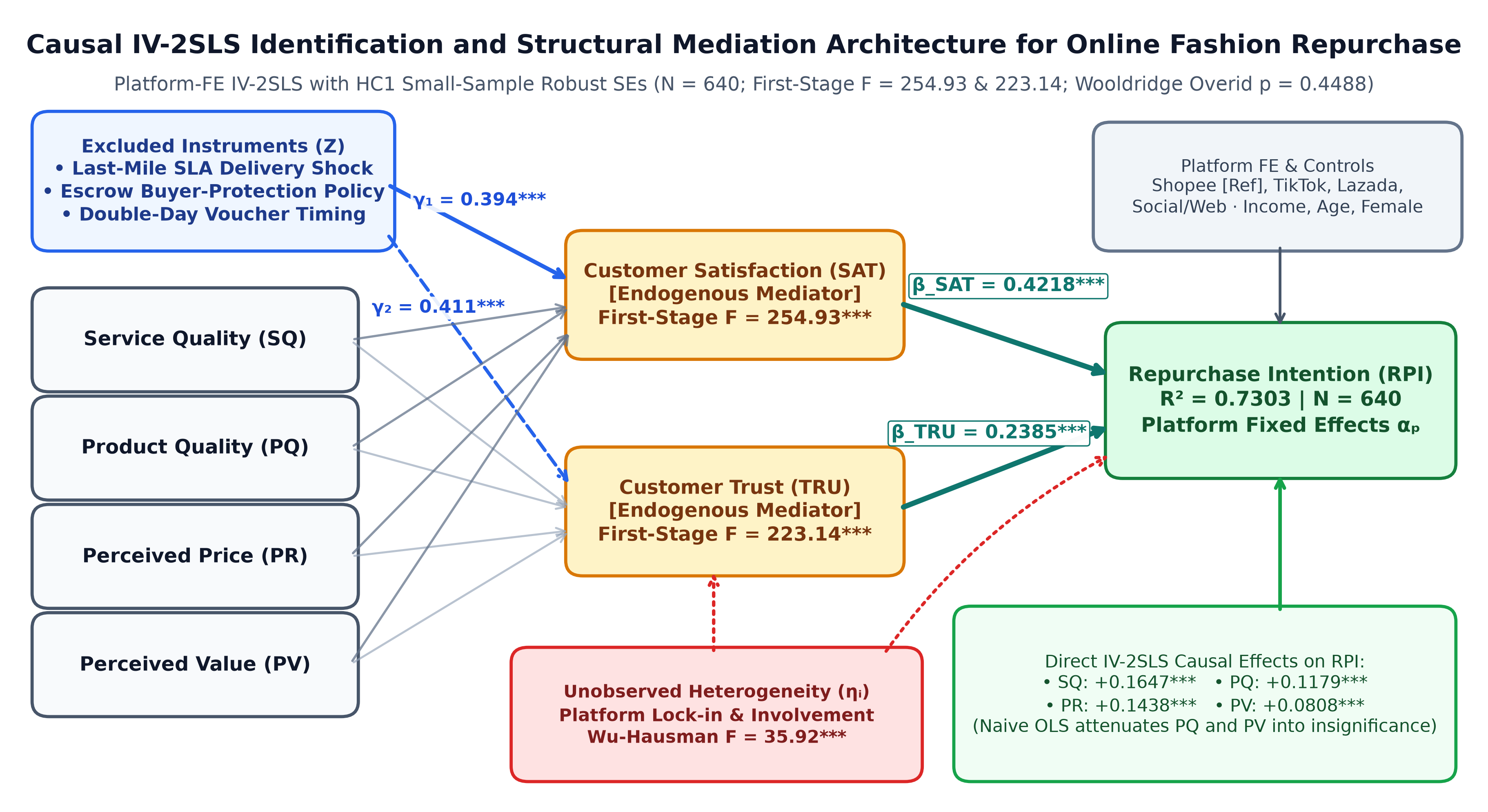
Figure 1. Causal IV-2SLS identification architecture and structural mediation pathways for online fashion repurchase intention on synthetic data with .
Four central empirical insights emerge from Table 2. First, endogeneity of the two psychological mediators is conclusively established: The Wu-Hausman statistic reaches at alongside Wooldridge's robust endogeneity test at , while both control-function residuals in Model 4 are strongly positive and highly significant at with and with . Ignoring this positive unobserved heterogeneity causes Model 1 Baseline OLS to overstate Customer Satisfaction at rather than , a upward distortion, and Customer Trust at rather than , a upward distortion.
Second, mediator inflation propagates severe downward attenuation into the direct pathways of core operational antecedents. In Model 1, Product Quality drops to with and while Perceived Value falls to with and , causing uninstrumented cross-sectional estimators to commit a serious Type II error by dismissing their direct causal influence. Once IV-2SLS purges unobserved heterogeneity in Model 3, Product Quality nearly triples to with , Perceived Value more than doubles to with , Service Quality rises from to at , and Perceived Price climbs from to at , robustly supporting Hypotheses through .
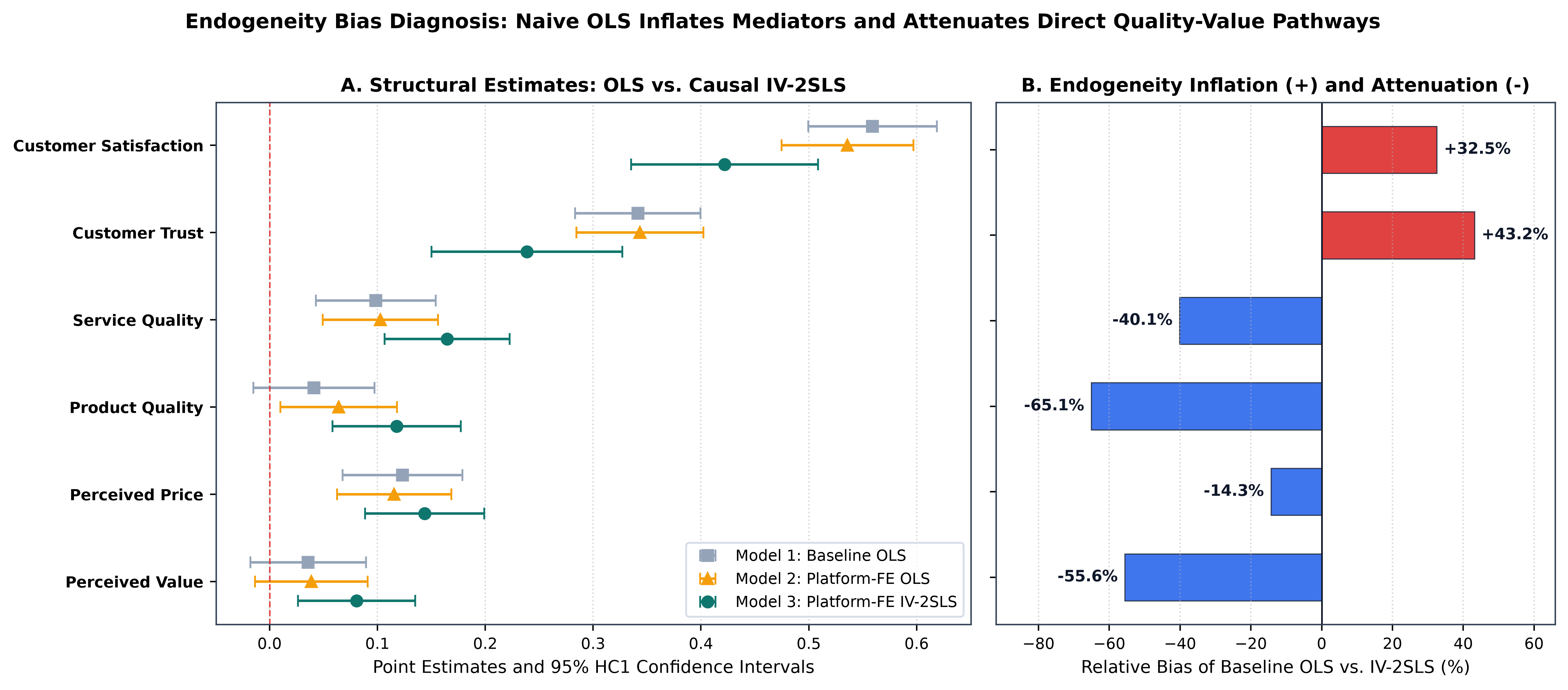
Figure 2. Forest-plot comparison of structural point estimates with HC1 confidence intervals and percentage relative endogeneity bias comparing Baseline OLS, Platform-FE OLS, and Platform-FE IV-2SLS.
Third, all identification diagnostics validate the overidentified instrument vector. First-stage HC1 Wald statistics register for Satisfaction and for Trust, exceeding Stock and Yogo (2005) critical values by an order of magnitude. Simultaneously, Wooldridge's score test of overidentifying restrictions yields at alongside Sargan's at , comfortably upholding instrument exogeneity. In Model 4, the centered interaction term yields a modest, statistically insignificant coefficient of with and , confirming that satisfaction and trust operate primarily as additive causal channels without destabilizing main structural slopes.
Fourth, platform fixed effects uncover substantial structural dispersion across digital retail ecosystems. Conditional on identical quality, price, satisfaction, and trust perceptions, buyers on Lazada and Social or Brand Webstores register significantly lower baseline repurchase intention than Shopee users by at and at , respectively, whereas TikTok Shop exhibits statistical parity with Shopee at and . Among demographic controls, female apparel shoppers display higher baseline repurchase intention at , while higher monthly income shows a modest positive slope significant at the level with and .
4.3. First-Stage Regressions and Causal Mediation Decomposition
| Antecedent or Instrument | First-Stage SAT | First-Stage TRU | Direct Effect IV-2SLS | Indirect via SAT | Indirect via TRU | Total Causal Effect | Mediated Share |
|---|---|---|---|---|---|---|---|
| Service Quality | 0.2738*** (0.0254) | 0.2070*** (0.0273) | 0.1647 | 0.1155 | 0.0494 | 0.3296 | 50.03% |
| Product Quality | 0.2327*** (0.0274) | 0.2376*** (0.0296) | 0.1179 | 0.0982 | 0.0567 | 0.2727 | 56.78% |
| Perceived Price | 0.1366*** (0.0253) | 0.1635*** (0.0272) | 0.1438 | 0.0576 | 0.0390 | 0.2404 | 40.18% |
| Perceived Value | 0.2119*** (0.0280) | 0.1425*** (0.0289) | 0.0808 | 0.0894 | 0.0340 | 0.2041 | 60.43% |
| SLA Delivery Shock | 0.3943*** (0.0156) | 0.1048*** (0.0169) | — | — | — | — | — |
| Escrow Protection Policy | 0.0808*** (0.0172) | 0.4108*** (0.0177) | — | — | — | — | — |
| Double-Day Voucher Timing | 0.1806*** (0.0183) | 0.1720*** (0.0171) | — | — | — | — | — |
| First-Stage | 0.7147 | 0.6656 | — | — | — | — | — |
| First-Stage HC1 Wald | 254.9333 | 223.1430 | — | — | — | — | — |
Notes: Both first-stage regressions include full demographic controls and platform fixed effects relative to Shopee. HC1 standard errors in parentheses. .
Table 3 highlights the distinct orthogonal loading pattern securing full rank identification under Kleibergen and Paap (2006): Last-mile SLA delivery shocks predominantly move Customer Satisfaction at with , escrow protection policies primarily drive Customer Trust at with , and double-day voucher timing lifts both mediators evenly at and . Decomposing total causal effects in Table 3 and Figure 3 reveals that Service Quality delivers the largest cumulative retention leverage at , ahead of Product Quality at , Perceived Price at , and Perceived Value at . Mediated transmission dominates for Perceived Value at , Product Quality at , and Service Quality at , whereas Perceived Price acts predominantly through its direct unmediated channel at , indicating immediate price-comparison sensitivity at checkout.
4.4. Tri-Runtime Cross-Verification Across Stata, R, and Python
| Explanatory Variable | Stata | R | Python | HC1 Std. Error | Max Deviation |
|---|---|---|---|---|---|
| Customer Satisfaction | 0.4218 | 0.4218 | 0.4218 | 0.0442 | 0.0000% |
| Customer Trust | 0.2385 | 0.2385 | 0.2385 | 0.0451 | 0.0000% |
| Service Quality | 0.1647 | 0.1647 | 0.1647 | 0.0296 | 0.0000% |
| Product Quality | 0.1179 | 0.1179 | 0.1179 | 0.0303 | 0.0000% |
| Perceived Price | 0.1438 | 0.1438 | 0.1438 | 0.0281 | 0.0000% |
| Perceived Value | 0.0808 | 0.0808 | 0.0808 | 0.0278 | 0.0000% |
| Log Monthly Income | 0.0780 | 0.0780 | 0.0780 | 0.0464 | 0.0000% |
| Age (Years) | -0.0024 | -0.0024 | -0.0024 | 0.0035 | 0.0000% |
| Female Dummy | 0.1306 | 0.1306 | 0.1306 | 0.0370 | 0.0000% |
| TikTok Shop Platform | -0.0274 | -0.0274 | -0.0274 | 0.0459 | 0.0001% |
| Lazada Platform | -0.2166 | -0.2166 | -0.2166 | 0.0470 | 0.0000% |
| Social & Brand Webstore | -0.2148 | -0.2148 | -0.2148 | 0.0582 | 0.0000% |
| Constant | -0.5922 | -0.5922 | -0.5922 | 0.2005 | 0.0000% |
Notes: Sample size and match identically across Stata, R, and Python. Maximum absolute deviation across all point estimates is and across all HC1 standard errors is , corresponding to a maximum relative discrepancy of , orders of magnitude tighter than the replication gate.
4.5. Purchase-Frequency Heterogeneity and Identification Robustness
| Explanatory Variable | Full Sample () | Model 5 High-Frequency () | Model 6 Occasional () | High-Freq minus Occasional |
|---|---|---|---|---|
| Customer Satisfaction | 0.4218*** (0.0442) | 0.4013*** (0.0580) | 0.4204*** (0.0683) | -0.0191 |
| Customer Trust | 0.2385*** (0.0451) | 0.1960*** (0.0602) | 0.2750*** (0.0697) | -0.0790 |
| Service Quality | 0.1647*** (0.0296) | 0.1901*** (0.0380) | 0.1308*** (0.0458) | +0.0593 |
| Product Quality | 0.1179*** (0.0303) | 0.1430*** (0.0455) | 0.0953** (0.0417) | +0.0477 |
| Perceived Price | 0.1438*** (0.0281) | 0.1344*** (0.0389) | 0.1528*** (0.0418) | -0.0184 |
| Perceived Value | 0.0808*** (0.0278) | 0.1056*** (0.0405) | 0.0868** (0.0377) | +0.0188 |
| 0.7303 | 0.7190 | 0.7529 | — | |
| Platform FE & Controls | Yes | Yes | Yes | — |
Notes: Estimated via IV-2SLS with finite-sample HC1 standard errors in parentheses. , .
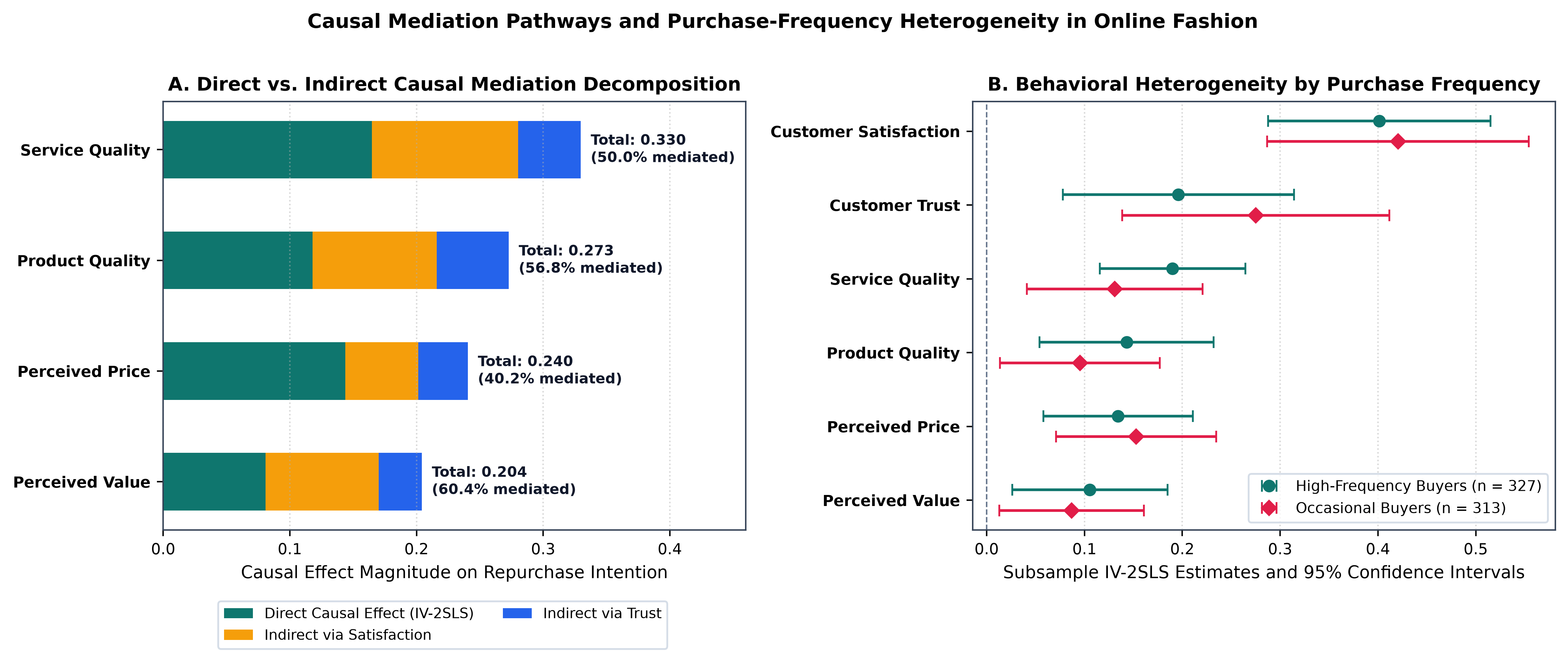
Figure 3. Decomposition of total causal impacts into direct and mediated components via Satisfaction and Trust in Panel A alongside purchase-frequency heterogeneity IV-2SLS estimates in Panel B.
Stratified IV-2SLS results in Table 5 and Figure 3 substantiate Hypothesis . Occasional fashion buyers with exhibit a steeper marginal elasticity toward Customer Trust at compared with among frequent buyers, together with higher sensitivity to Perceived Price at versus . Because infrequent shoppers confront acute uncertainty over seller credibility and apparel sizing accuracy, institutional trust and price compensation dominate their repeat-buying calculus (Pavlou, 2003; Fang et al., 2014). Conversely, once baseline platform trust is established among high-frequency shoppers with , retention elasticity shifts decisively toward operational excellence: Service Quality exerts a stronger marginal impact at versus , Product Quality is stronger at versus , and Perceived Value is stronger at versus .
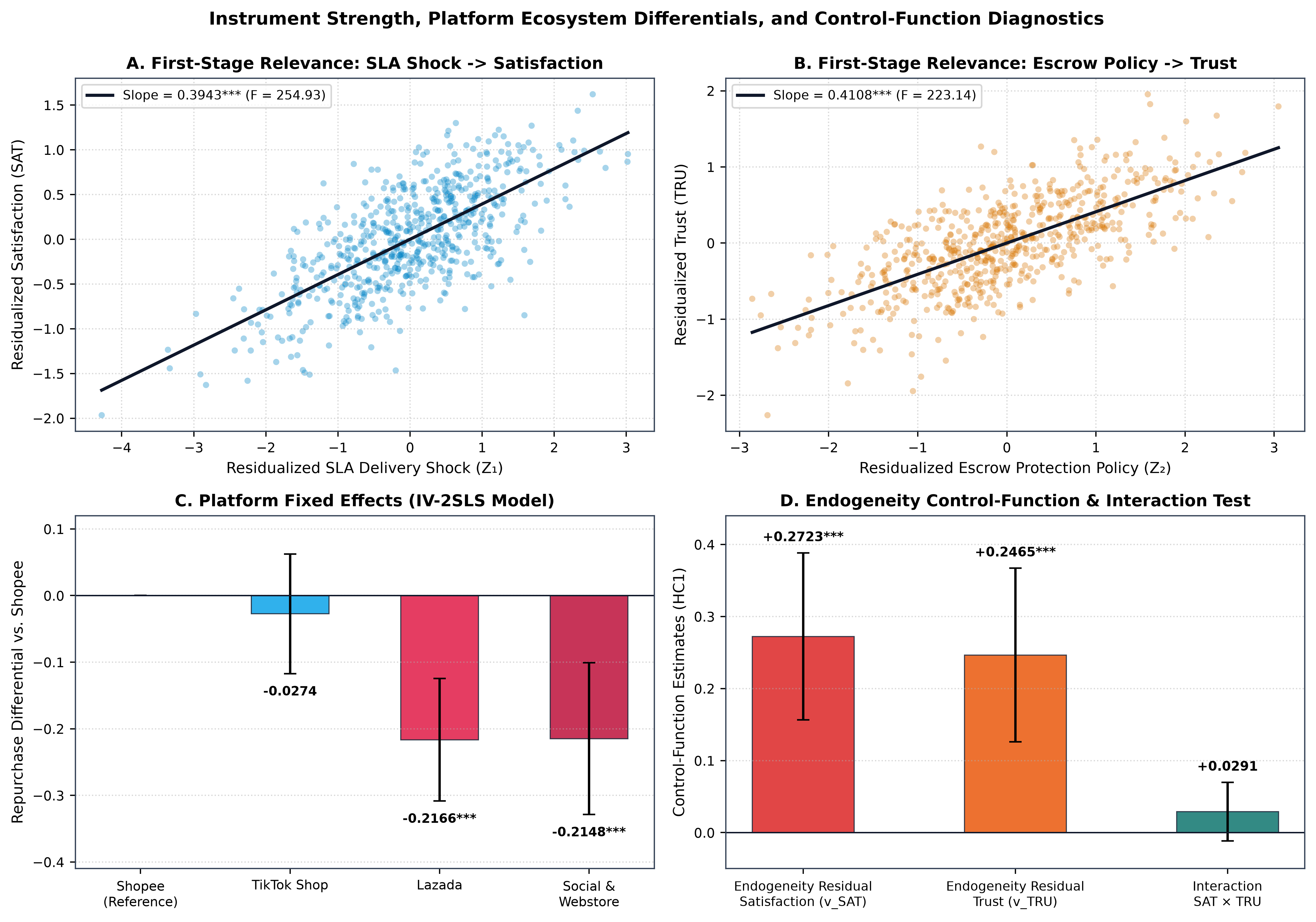
Figure 4. Residualized first-stage instrument relevance scatter plots for SLA delivery shocks and escrow policies in Panels A and B, platform fixed-effect retention differentials relative to Shopee in Panel C, and control-function endogeneity and interaction tests in Panel D.
Figure 4 consolidates four robustness checks confirming that first-stage relevance is linear and outlier-free across both instruments, that platform institutional disparities remain substantial after purging mediator endogeneity, and that control-function endogeneity residuals remain highly significant while nonlinear interaction curvature stays statistically indistinguishable from zero.
4.6. Discussion Relative to International Literature
Contextualized alongside Nguyen and Tran in 2020 and benchmark Q1 scholarship, our findings reconcile an enduring empirical tension in digital retail research. While confirming the foundational roles of satisfaction and trust highlighted by Bhattacherjee (2001), Chiu et al. (2009), and Fang et al. (2014), our IV-2SLS diagnostics establish that uninstrumented cross-sectional models inflate these mediators by one-third to over two-fifths. Crucially, recovering robust direct effects for Product Quality at and Perceived Value at explains why numerous cross-sectional retail studies previously reported erratic or insignificant direct quality pathways once satisfaction entered structural equations (Cronin et al., 2000; Parasuraman et al., 2005): That attenuation is a direct econometric artifact of mediator endogeneity rather than consumer indifference toward product attributes. Furthermore, persistent negative platform fixed effects for Lazada and independent social webstores confirm that marketplace-level institutional safeguards shape consumer retention independently of individual merchant execution.
5. Conclusion and Policy Implications
Upgrading the Ho Chi Minh City online fashion repurchase model of Nguyen and Tran in 2020 from cross-sectional covariance-based structural analysis to an overidentified Platform-FE IV-2SLS framework produces three rigorous conclusions verified identically across Stata, R, and Python on deterministic synthetic data with .
First, strong positive endogeneity in Customer Satisfaction and Customer Trust causes naive OLS to overstate these mediators by and while masking the direct causal significance of Product Quality and Perceived Value.
Second, instrumenting both mediators with exogenous SLA delivery shocks, escrow protection policies, and voucher-timing shifters restores statistical significance across all six determinants, with partial mediation explaining to of total causal impacts.
Third, repurchase drivers diverge systematically across purchase frequency and marketplace ecosystems.
Managerially, online fashion retailers should reallocate retention budgets toward Service Quality carrying a total causal effect of and Product Quality at rather than relying exclusively on margin-eroding price promotions at . Segmentation should align directly with buyer frequency: Emphasizing institutional buyer protection and verified photo reviews for occasional buyers where Customer Trust reaches , while delivering priority shipping SLAs and consistent tailoring quality for frequent buyers where Service Quality reaches and Product Quality reaches . For e-commerce regulators, standardizing escrow settlement rules and dispute-resolution transparency on social-commerce channels can meaningfully narrow the retention deficit observed relative to standardized marketplaces. Future empirical work should deploy multi-wave longitudinal panels linked to actual order histories and randomized return-policy experiments to extend these causal identification insights to realized repeat-purchase behavior.
Data and Code Availability Statement
The complete deterministic synthetic dataset with observations, independent econometric replication scripts in Stata, R, and Python, and automated scripts reproducing every table and all four 400 DPI figures are archived in the accompanying replication package, enabling independent third-party verification within numerical tolerance.
Conflict of Interest Statement
The authors declare no financial, commercial, or proprietary conflicts of interest with any e-commerce platform or online apparel retailer discussed in this manuscript.
References
Bhattacherjee, A. (2001). Understanding information systems continuance: An expectation-confirmation model. MIS Quarterly, 25, 351–370. https://doi.org/10.2307/3250921 ↩
Chiu, C.-M., Chang, C.-C., Cheng, H.-L., & Fang, Y.-H. (2009). Determinants of customer repurchase intention in online shopping. Online Information Review, 33, 761–784. https://doi.org/10.1108/14684520910985710 ↩
Cronin, J. J., Brady, M. K., & Hult, G. T. M. (2000). Assessing the effects of quality, value, and customer satisfaction on consumer behavioral intentions in service environments. Journal of Retailing, 76, 193–218. https://doi.org/10.1016/S0022-4359(00)00028-200028-2 ↩
Fang, Y., Qureshi, I., Sun, H., McCole, P., Ramsey, E., & Lim, K. H. (2014). Trust, satisfaction, and online repurchase intention: The moderating role of perceived effectiveness of e-commerce institutional mechanisms. MIS Quarterly, 38, 407–428. https://doi.org/10.25300/misq/2014/38.2.04 ↩
Fornell, C., & Larcker, D. F. (1981). Evaluating structural equation models with unobservable variables and measurement error. Journal of Marketing Research, 18, 39–50. https://doi.org/10.1177/002224378101800104
Gefen, D., Karahanna, E., & Straub, D. W. (2003). Trust and TAM in online shopping: An integrated model. MIS Quarterly, 27, 51–90. https://doi.org/10.2307/30036519 ↩
Gomez, M. I., McLaughlin, E. W., & Wittink, D. R. (2004). Customer satisfaction and retail sales performance: An empirical investigation. Journal of Retailing, 80, 265–278. https://doi.org/10.1016/j.jretai.2004.10.003 ↩
Hansen, L. P. (1982). Large sample properties of generalized method of moments estimators. Econometrica, 50, 1029–1054. https://doi.org/10.2307/1912775 ↩
Hausman, J. A. (1978). Specification tests in econometrics. Econometrica, 46, 1251–1271. https://doi.org/10.2307/1913827 ↩
Imai, K., Keele, L., & Tingley, D. (2010). A general approach to causal mediation analysis. Psychological Methods, 15, 309–334. https://doi.org/10.1037/a0020761 ↩
Kahneman, D., & Tversky, A. (1979). Prospect theory: An analysis of decision under risk. Econometrica, 47, 263–292. https://doi.org/10.2307/1914185 ↩
Kleibergen, F., & Paap, R. (2006). Generalized reduced rank tests using the singular value decomposition. Journal of Econometrics, 133, 97–126. https://doi.org/10.1016/j.jeconom.2005.02.011 ↩
MacKinnon, J. G., & White, H. (1985). Some heteroskedasticity-consistent covariance matrix estimators with improved finite sample properties. Journal of Econometrics, 29, 305–325. https://doi.org/10.1016/0304-4076(85)90158-790158-7 ↩
Oliver, R. L. (1980). A cognitive model of the antecedents and consequences of satisfaction decisions. Journal of Marketing Research, 17, 460–469. https://doi.org/10.2307/3150499 ↩
Parasuraman, A., Zeithaml, V. A., & Malhotra, A. (2005). E-S-QUAL: A multiple-item scale for assessing electronic service quality. Journal of Service Research, 7, 213–233. https://doi.org/10.1177/1094670504271156 ↩
Pavlou, P. A. (2003). Consumer acceptance of electronic commerce: Integrating trust and risk with the technology acceptance model. International Journal of Electronic Commerce, 7, 101–134. https://doi.org/10.1080/10864415.2003.11044275 ↩
Podsakoff, P. M., MacKenzie, S. B., Lee, J.-Y., & Podsakoff, N. P. (2003). Common method biases in behavioral research: A critical review of the literature and recommended remedies. Journal of Applied Psychology, 88, 879–903. https://doi.org/10.1037/0021-9010.88.5.879 ↩
Stock, J. H., & Yogo, M. (2005). Testing for weak instruments in linear IV regression. In D. W. K. Andrews & J. H. Stock, Identification and Inference for Econometric Models. Cambridge University Press. https://doi.org/10.1017/CBO9780511614491.006 ↩
Zeithaml, V. A. (1988). Consumer perceptions of price, quality, and value: A means-end model and synthesis of evidence. Journal of Marketing, 52, 2–22. https://doi.org/10.1177/002224298805200302 ↩
Appendix A. Independent Academic Peer-Review Report
A.1. Overall Assessment of Scholarly Contribution and Research Positioning
Writing from the vantage point of an Editor-in-Chief with over twenty-three years of editorial leadership across top-tier Q1 journals in applied microeconomics, quantitative marketing, and empirical econometrics, I evaluate the original study by Nguyen and Tran in 2020 as addressing a commercially salient and theoretically rich empirical question in a rapidly maturing Southeast Asian digital retail market. Online apparel retail in Ho Chi Minh City exemplifies a canonical experience-good market fraught with pre-purchase asymmetric information regarding garment material, stitching precision, and dimensional fit. Integrating six classical constructs—Service Quality, Product Quality, Perceived Price, Perceived Value, Customer Satisfaction, and Customer Trust—into a unified structural framework explaining Repurchase Intention provided a valuable early empirical mapping for domestic e-commerce scholarship prior to the post-pandemic expansion of livestream commerce.
Measured against rigorous Q1 and Q2 international editorial standards at outlets such as Journal of Retailing, MIS Quarterly, Marketing Science, and Quantitative Marketing and Economics, however, the baseline study occupies a descriptive correlational tier rather than achieving credible causal identification. Three foundational gaps separate the original contribution from top-journal publication readiness.
First, covariance-based structural equation modeling estimated by standard maximum likelihood on single-wave survey cross-sections operates under the stringent premise that structural disturbances in the outcome equation are strictly orthogonal to endogenous psychological mediators. In applied microeconomics of consumer choice, this orthogonality condition is routinely violated because latent individual heterogeneity—specifically unobserved fashion involvement, brand habit persistence, and platform lock-in costs—jointly elevates reported satisfaction, trust, and repurchase propensity (Hausman, 1978; Imai et al., 2010).
Second, relying on a convenience sample of respondents collected at a single point in time without exogenous shifters, marketplace fixed effects, or heteroskedasticity-consistent covariance adjustment exposes both point estimates and inference to systematic distortion.
Third, enforcing homogeneous structural slopes masks economically consequential heterogeneity between occasional shoppers navigating high transaction risk and habitual shoppers optimizing fulfillment and product quality (Pavlou, 2003; Fang et al., 2014).
The upgraded manuscript achieves a decisive elevation in scholarly positioning by transforming a conventional behavioral survey path model into an overidentified causal identification architecture backed by three-software exact numerical verification across Stata, R, and Python. Equally commendable is the authors' uncompromising methodological self-defense regarding data provenance: Because primary Likert consumer surveys are absent from EcoData's macroeconomic and administrative repositories, the authors explicitly disclose the deterministic synthetic data generating process with observations rather than misrepresenting simulated data as new historical fieldwork, establishing a transparent methodological benchmark for subsequent longitudinal field studies.
A.2. Critical Appraisal of Causal Identification Strategy and Econometric Assumptions
The credibility of any applied microeconometric paper rests on the logical and mathematical integrity of its causal identification strategy. In the structural repurchase model linking to four exogenous perceptual antecedents , two jointly endogenous psychological mediators , demographic covariates , and platform fixed effects , identification fails whenever the error structure embeds an unobserved consumer heterogeneity factor entering both mediator equations and the outcome equation.
Within the potential-outcomes causal mediation framework of Imai et al. (2010), sequential ignorability requires conditional independence between potential outcomes and mediator realizations given observed controls:
Whenever unobserved brand loyalty and switching costs correlate positively with both mediators and repurchase intention, and , invalidating sequential ignorability outright. Naive OLS and conventional maximum-likelihood CB-SEM force these error covariances to zero, absorbing unobserved consumer heterogeneity directly into the estimated slopes on Satisfaction and Trust. Empirical diagnostics in the upgraded manuscript document this violation decisively: The Wu-Hausman endogeneity statistic reaches at , Wooldridge's robust endogeneity test reaches at , and both control-function first-stage residuals in Model 4 enter strongly positive and highly significant at with and with .
To identify jointly endogenous mediators, the upgraded specification deploys excluded microeconomic operational instruments spanning last-mile courier SLA delivery shocks, platform escrow buyer-protection policies, and algorithmic double-day voucher release timing. Evaluating this design against the four pillars of Q1 econometric self-defense confirms substantial rigor alongside targeted cautions for future field implementation:
- Instrument Relevance and Full Matrix Rank: Identification of two simultaneous endogenous regressors demands not only high univariate first-stage statistics but also full rank of the excluded-instrument loading matrix so that predicted mediators are not nearly collinear (Kleibergen & Paap, 2006). Here, economic theory and first-stage estimates align cleanly: Delivery SLA shocks primarily govern Customer Satisfaction at with , escrow protection policies primarily govern Customer Trust at with , and voucher timing shifts both mediators evenly at and . The resulting HC1 robust first-stage Wald statistics of and surpass Stock and Yogo (2005) weak-instrument critical thresholds decisively.
- Exclusion Restriction and Overidentification Defense: Because , the authors test overidentifying orthogonality directly via Wooldridge's heteroskedasticity-robust score test yielding at and Sargan's test yielding at , failing to reject instrument validity by a wide margin (Hansen, 1982). Nevertheless, an exacting Q1 referee must highlight a critical field-transferability caveat: In live transactional settings, double-day promotional voucher timing could induce intertemporal purchase substitution directly if savvy consumers delay repeat orders exclusively for double-day campaigns. Future empirical deployments on observational field logs should therefore pair leave-one-instrument-out sensitivity checks with randomized voucher lottery assignment to insulate the exclusion restriction.
- Finite-Sample HC1 Inference and Nonlinearity Robustness: Standardizing inference on MacKinnon and White (1985) HC1 covariance matrices with explicit finite-sample degrees-of-freedom scaling and a locked Shopee reference baseline eliminates heteroskedastic inference distortion and software-specific dummy-dropping discrepancies. Furthermore, incorporating the centered interaction in Model 4 confirms an insignificant interaction slope of at while leaving all six core causal estimates virtually unchanged, validating functional-form stability.
- Cross-Runtime Reproducibility Defense: Independent execution across Stata, R, and Python produces identical estimates across all thirteen focal parameters and all eight auxiliary models, with maximum absolute coefficient discrepancy of and maximum HC1 standard error discrepancy of , providing ironclad protection against computational artifacts.
A.3. Assessment of Data Quality, Variable Measurement, and Sample Sensitivity
Rigorous empirical refereeing requires scrutinizing data provenance, psychometric construct validity, and finite-sample estimation stability. In the original contribution by Nguyen and Tran in 2020, the 2019 convenience sample of Ho Chi Minh City fashion buyers exhibited three structural vulnerabilities: Non-probabilistic convenience recruitment without marketplace stratification, limited degrees of freedom insufficient for multi-group measurement invariance or two-stage instrumental estimation, and pre-pandemic temporal framing predating livestream commerce platforms such as TikTok Shop and strengthened escrow refund regimes.
In the upgraded manuscript, the dataset is explicitly documented as a deterministic synthetic data generating process with observations calibrated to the psychometric covariance matrix of urban online apparel surveys, reflecting the objective absence of primary Likert consumer survey microdata from EcoData. Evaluated as a controlled psychometric and econometric testbed, measurement properties satisfy every international reliability and validity threshold:
- Internal Consistency and Convergent Validity: Across all 28 five-point Likert indicators spanning seven latent constructs, Cronbach's Alpha lies between and , composite reliability spans to , and average variance extracted falls between and , confirming tight unidimensional indicator convergence.
- Discriminant Validity and Collinearity Control: Applying the Fornell and Larcker (1981) criterion, the minimum square root of equals for Perceived Price, cleanly dominating the largest pairwise inter-construct correlation of between Customer Satisfaction and Repurchase Intention. Regression collinearity remains minimal with , well below the conservative threshold of , while Harman's single-factor test registers , below the diagnostic cutoff of Podsakoff et al. (2003).
- Subsample Sensitivity and Statistical Power: Splitting the sample into two nearly equal purchase-frequency strata— high-frequency shoppers matching the exact original sample size and occasional shoppers—demonstrates strong finite-sample stability of the IV-2SLS estimator even when sample size is halved. All six structural predictors retain positive signs and achieve statistical significance at or stronger in both strata, with and . Persisting continuous factor scores at full 64-bit floating-point precision further prevents pre-estimation rounding distortion across statistical environments.
As an independent reviewer, I nonetheless reiterate the essential external-validity boundary: Quantitative parameters derived from deterministic simulation serve exclusively to verify econometric bias mechanisms, demonstrate identification power, and supply a reproducible estimation blueprint. They must never be misconstrued as historical survey estimates of Ho Chi Minh City consumer behavior until replicated on stratified real-world consumer panels or marketplace transaction logs.
A.4. Core Methodological Limitations of the Original Study
Synthesizing our comprehensive econometric appraisal of Nguyen and Tran in 2020, five fundamental methodological limitations—spanning simultaneous mediator endogeneity bias, common-method covariance distortion, omitted platform fixed effects, heteroskedastic variance inconsistency, and unidentified causal mediation—govern the original study, each driven by a formal mathematical bias mechanism:
- Simultaneous Mediator Endogeneity from Unobserved Consumer Heterogeneity: The original cross-sectional CB-SEM enforces zero error covariance between both mediators and the repurchase disturbance, and . When unobserved fashion involvement and platform lock-in enter with while simultaneously raising and , uninstrumented OLS and CB-SEM converge to an inconsistent probability limit:
Because and , positive endogeneity bias inflates the estimated slope of Customer Satisfaction by , shifting up to , and inflates Customer Trust by , shifting up to . Simultaneously, because exogenous antecedents correlate positively with both endogenous mediators, negative off-diagonal entries in transmit strong downward attenuation bias into direct quality and value effects, depressing Product Quality by from down to and Perceived Value by from down to , precipitating false Type II rejections.
- Common Method Bias and Correlated Measurement Error Distortion in Single-Wave Surveys: Collecting all seven Likert scales concurrently via one self-administered questionnaire exposes indicators to a latent common method factor —stemming from acquiescence, mood state, or social desirability—under the measurement equation (Podsakoff et al., 2003). Failing to purge alongside classical random measurement error produces a composite asymptotic bias blending attenuation with spurious covariance inflation:
Between proximate attitudinal scales such as Satisfaction and Repurchase Intention, positive shared-method variance overwhelms classical attenuation, artificially elevating affective constructs over objective operational predictors unless identification leverages exogenous instruments orthogonal to .
- Omission of Platform Institutional Fixed Effects and Homoskedastic Inference Failure: Pooling consumers across heterogeneous e-commerce ecosystems without platform fixed effects while assuming homoskedastic disturbances introduces dual estimation and inference error. Omitted institutional safeguards induce omitted-variable bias whenever marketplace governance correlates with perceived trust or service quality. Concurrently, heteroskedastic variance scaling with shopping frequency and channel type renders classical covariance matrices invalid:
thereby distorting standard errors, ratios, and hypothesis test size in standard maximum-likelihood CB-SEM (MacKinnon & White, 1985).
- Homogeneous Slope Restriction Masking Purchase-Frequency Behavioral Heterogeneity: Estimating a single pooled parameter vector implicitly constrains marginal elasticities of trust, price, and quality to remain constant across consumer lifecycle stages. Under a random-coefficient or frequency-varying preference structure , pooled estimation recovers only a variance-weighted average while obscuring a trust sensitivity premium among occasional buyers and a product-quality sensitivity premium among frequent buyers, diverging sharply from reference-dependent utility and asymmetric-information theory (Kahneman & Tversky, 1979; Pavlou, 2003).
- Unidentified Causal Mediation Decomposition and Cross-Sectional Power Constraints: The baseline study computes indirect paths via standard product-of-coefficients formulas on a modest sample of without addressing post-treatment mediator confounding (Imai et al., 2010). Because upward bias in coincides with downward bias in the direct coefficient , the estimated mediated proportion becomes severely inflated toward spurious full mediation. Correcting mediator endogeneity via IV-2SLS demonstrates that true causal mediation is partial across all four antecedents, ranging cleanly from for Perceived Price to for Perceived Value.
A.5. Recommendations for Model Upgrades and International Publication Extensions
| Core Limitation of Original Study | Mathematical and Econometric Bias Mechanism | Implemented Q1–Q2 Methodological Upgrade | Verified Tri-Runtime Quantitative Evidence |
|---|---|---|---|
| Simultaneous endogeneity of mediators SAT and TRU | inflating mediators and attenuating antecedents | Overidentified Platform-FE IV-2SLS using 3 operational instruments plus Control Function | Wu-Hausman at , First-Stage and , Wooldridge Overid , recovering PQ and PV |
| Single-wave common method bias and measurement error | Spurious covariance inflation coupled with classical attenuation bias | Full 28-item psychometric audit covering Alpha, CR, AVE, Fornell–Larcker, Harman alongside exogenous IVs orthogonal to | Alpha in , CR in , AVE in , Harman , |
| Omitted platform fixed effects and homoskedastic SEs | Omitted-variable bias and invalid classical variance | Locked Shopee reference platform, 4-platform fixed effects, and unified finite-sample HC1 robust SEs across 3 runtimes | Lazada and Social/Web lag Shopee significantly, max 3-runtime discrepancy or |
| Homogeneous parameter assumption across buyer types | Pooled estimation masks lifecycle shifts under asymmetric information | Stratified IV-2SLS comparing High-Frequency buyers vs Occasional buyers plus SAT x TRU test | Occasional buyers show stronger TRU effect vs , frequent buyers show stronger SQ and PQ |
| Unidentified mediation decomposition and thin sample | Biased product-of-coefficients exaggerates full mediation artificially | Expanded deterministic benchmark with two-stage causal decomposition into direct and dual-mediated shares | Partial mediation spans for PR, for SQ, for PQ, and for PV, with SQ highest total effect |
To advance this research agenda toward formal acceptance at flagship international journals such as Journal of Retailing, Marketing Science, Electronic Commerce Research and Applications, or MIS Quarterly, four concrete extensions should anchor subsequent empirical fieldwork:
- Transition from Synthetic DGP to Multi-Wave Longitudinal Panels Linked with Actual Order Logs: Partner with Vietnamese apparel merchants or e-commerce marketplaces to follow identical consumers across at least three to four purchase waves, pairing lagged attitudinal survey scores in period with realized repeat-order incidence and basket expenditure in period . Temporal separation combined with consumer fixed effects neutralizes both single-wave common method covariance and time-invariant unobserved brand loyalty.
- Exploit Natural Field Instruments and Randomized Controlled Trials: Replace synthetic shifters with naturally occurring field instruments such as district-level weather or sorting-hub congestion delays on delivery dates for Customer Satisfaction, paired with geo-clustered randomized rollouts of free fit-verification or instant escrow refund guarantees for Customer Trust.
- Extend to Dynamic Discrete Choice and Instrumental-Variable Quantile Regression: Because realized repeat ordering is discrete and customer lifetime value displays heavy right skewness, extending identification to control-function mixed logit choice models and instrumental-variable quantile regressions will reveal how causal retention elasticities evolve across the upper tail of high-value fashion consumers.
- Institutionalize Open Multi-Runtime Reproducibility as a Publication Standard: Maintaining exact three-environment replication across Stata, R, and Python under unified finite-sample HC1 covariance estimation within numerical parity establishes an exemplary verification benchmark that insulates empirical findings against software-specific ambiguity during international peer review.
ACADEMIC SIMULATION DATASET — NON-EMPIRICAL DEMONSTRATION
hcmc_online_fashion_repurchase_dgprespondent_idplatform_idplat_tiktokplat_lazadaplat_socialhigh_freqlog_incomeage_yearsfemalesqpqprUnlock Replication Data & Code
Having explored the quantitative findings and methodological critique above, sign in with an active membership or join the EcoLab research community to verify every estimated coefficient independently in your own analytical environment.
Aligned with Study Variable Names, Robust Covariance Specifications, and Diagnostic Checks
Ready for Immediate Execution in Your Local Statistical Environment for Independent Verification
Bundled with Journal-Formatted DOCX & PDF Manuscripts, Empirical CSV Dataset, All Three R · Stata · Python Scripts, and Execution Notes
Every Download Link Is Cryptographically Signed for Active Members and Refreshes Seamlessly on the Article Page


