1. Introduction
Quantifying aggregate business-cycle propagation in economies populated by heterogeneous households and incomplete financial markets has long stood among the most demanding computational frontiers in quantitative macroeconomics. Ever since the foundational incomplete-markets precautionary-saving model of Aiyagari (1994) and the aggregate-shock equilibrium formulation of Krusell & Smith (1998), dynamic stochastic heterogeneous-agent analysis has confronted a severe curse of dimensionality because the entire cross-sectional wealth–income distribution enters the aggregate law of motion as an infinite-dimensional state variable. State-space projection and perturbation algorithms pioneered by Reiter (2009), alongside model-reduction techniques developed by Ahn et al. (2018), enabled accurate first-order linearization around the stationary distribution, yet remained burdened by large coupled linear systems whose computational footprint escalates rapidly with grid resolution.
A structural transformation in heterogeneous-agent computation emerged once Boppart et al. (2018) demonstrated that linear impulse responses to small unanticipated aggregate perturbations completely characterize first-order equilibrium dynamics. Building on that insight, Auclert et al. (2021) formalized the discrete-time Sequence-Space Jacobian framework, and Auclert et al. (2024) established the Intertemporal Keynesian Cross as a modular analytical apparatus for fiscal and monetary policy transmission.
Running in parallel, Achdou et al. (2022) and Kaplan et al. (2018) showed that recasting household optimization in continuous time via coupled Hamilton–Jacobi–Bellman and Kolmogorov–Fokker–Planck partial differential equations produces highly sparse transition operators, handles borrowing constraints analytically without numerical kinks, and accommodates rich multi-asset portfolios cleanly. Nonetheless, a direct theoretical and algorithmic bridge uniting the modular sequence-space Jacobian architecture of Auclert et al. (2021) with the continuous-time partial differential equation machinery of Achdou et al. (2022) remained absent until Bilal & Goyal (2025) and Bilal & Goyal (2026) formulated continuous-time sequence-space arithmetic.
The mathematical breakthrough of Bilal & Goyal (2025) and Bilal & Goyal (2026) is remarkably parsimonious. Rather than approximating household policy derivatives through finite-difference perturbations or backward endogenous-grid iteration across every future shock date, the authors apply first-order Gâteaux differentiation directly to the coupled Hamilton–Jacobi–Bellman and Kolmogorov–Fokker–Planck system. The resulting marginal value-function response to any future price disturbance satisfies a homogeneous linear forward transport equation governed solely by the stationary infinitesimal generator. Consequently, partial-equilibrium fake-news arrays and sequence-space Jacobians reduce to sparse matrix–vector products and exact Markov transition operators. Even more consequentially, because the underlying dynamics are formulated in continuous time, temporal discretization decouples from calendar periodicity: an exponentially expanding nonuniform time grid growing at per step compresses a -year horizon into just temporal nodes while preserving fine resolution over early horizons where impulse curvature is sharpest.
This independent replication study rigorously audits the theoretical equivalence, quantitative precision, and computational scaling claims of Bilal & Goyal (2026) directly from the primary Harvard Dataverse repository across three concrete objectives.
First, we re-solve both benchmark macroeconomic ecosystems—the Aiyagari–Krusell–Smith HA economy and the high-liquidity HANK economy—from scratch on the canonical -node state-space grid, benchmarking four solver modes side by side: surprise CT-SSJ, anticipated CT-SSJ, exponential nonuniform-grid CT-SSJ, and discrete-time DT-SSJ.
Second, we consolidate all regenerated impulse responses, partial-equilibrium Jacobian columns, and multi-grid runtime benchmarks into a harmonized empirical panel and independently estimate econometric verification models spanning OLS with HC1 robust inference and high-dimensional fixed-effects panel regressions with horizon-clustered CRV1 inference across Python, R, and Stata 18 MP under a strict cross-runtime tolerance gate.
Third, we conduct an exhaustive peer-review audit pinpointing structural sources of divergence between continuous-time and discrete-time representations—most notably interest-rate revaluation channels, borrowing-constraint numerical viscosity, nonuniform upwind diffusion, and monetary regime sign sensitivity under active Taylor rules.
2. Theoretical Framework and Econometric Methodology
2.1. Stationary Hjb–kfe System and Continuous-Time Jacobian Operators
Within the continuous-time heterogeneous-agent environment of Bilal & Goyal (2026), a unit continuum of households faces uninsurable idiosyncratic productivity risk evolving as a continuous-time Markov chain with transition intensity matrix , where is obtained from Rouwenhorst discretization with annual persistence . Households maximize expected discounted utility with constant relative risk aversion subject to a no-borrowing limit . The stationary recursive equilibrium is characterized by the coupled Hamilton–Jacobi–Bellman equation for the value function and the Kolmogorov–Fokker–Planck equation for the cross-sectional density :
Where:
- : annualized continuous-time discount rate, calibrated to in the HA economy and in the high-liquidity HANK economy;
- : stationary household value function evaluated at liquid wealth and idiosyncratic productivity state ;
- : optimal instantaneous consumption flow satisfying the interior first-order condition and binding at the liquidity limit whenever the borrowing constraint holds with equality;
- : coefficient of relative risk aversion fixed at , implying an intertemporal elasticity of substitution equal to ;
- : equilibrium after-tax real wage per efficiency unit of labor;
- : equilibrium real interest rate clearing the aggregate asset market;
- : partial derivative of the value function with respect to assets, discretized via an upwind finite-difference scheme to preserve monotonicity and stability;
- : off-diagonal Poisson transition intensity from productivity state to state inside the Markov generator .
The stationary wealth–productivity distribution solves the adjoint equation subject to the normalization , where denotes the combined infinitesimal generator of optimal saving drift and idiosyncratic productivity jumps. The central analytical innovation of Bilal & Goyal (2025) and Bilal & Goyal (2026) is to compute the Gâteaux derivative of the HJB–KFE system directly with respect to a future aggregate price path at horizon . Defining as the date- marginal value-function variation induced by a unit perturbation to price occurring exactly years in the future, obeys a homogeneous forward linear transport equation:
Where:
- : marginal value-function perturbation response at lead time preceding a unit disturbance in price ;
- : time derivative of the marginal value perturbation along the pre-shock anticipation trajectory;
- : stationary infinitesimal generator combining stabilized asset-drift transitions and the Markov intensity matrix ;
- : stationary marginal utility of consumption equal to ;
- : direct household income sensitivity to price , equaling asset holdings for a real interest-rate perturbation and productivity for a real wage perturbation .
At the binding borrowing boundary where stationary saving drift vanishes, the analytical boundary conditions for all and eliminate numerical differentiation error across the policy kink. Given , the date- consumption response equals , inducing an instantaneous distribution perturbation . Combining with the forward expectation sequence for any aggregate outcome yields the fake-news matrix and sequence-space Jacobian purely by linear algebra:
Where:
- : date- direct policy impact on aggregate variable caused by a price shock arriving at horizon ;
- : individual policy-function response evaluated at the stationary equilibrium;
- : stationary cross-sectional density defining the aggregate inner product ;
- : fake-news entry at horizon capturing distributional propagation through cross-sectional wealth dynamics;
- : expectation vector of outcome evolved forward steps under stationary household policies;
- : first-period distributional perturbation triggered by altered saving and income flows;
- : element in row and column of the sequence-space Jacobian mapping price sequences into aggregate sequences;
- : time-step width at temporal index , held constant at on the uniform annual grid and expanding geometrically as on the nonuniform exponential grid to span years in nodes.
2.2. Empirical Architecture for HA and HANK Ecosystems and Econometric Verification Strategy
In the Aiyagari–Krusell–Smith HA economy, a competitive production sector operates a Cobb–Douglas technology with capital share , annual depreciation , inelastic aggregate labor , and a total factor productivity shock decaying exponentially as with . In the high-liquidity HANK economy calibrated directly from Auclert et al. (2024) and the progressive taxation schedule of Heathcote et al. (2017), tax progressivity is , government spending share is , total tax share is , post-tax productivity dispersion is , steady-state wage markup is , wage Phillips slope is , and Frisch labor supply elasticity is . Two aggregate policy experiments are evaluated in HANK: a deficit-financed government spending expansion governed by debt-repayment speed and a real interest-rate tightening .
To quantify algorithmic parity objectively rather than relying solely on visual overlays, we estimate three econometric model blocks on the regenerated panel. The first block consists of ten univariate parity regressions M01 through M10 estimated via ordinary least squares with MacKinnon–White HC1 heteroskedasticity-robust variance correction using the exact finite-sample degrees-of-freedom factor shared identically by Python, R, and Stata 18 MP:
Where:
- : continuous-time CT-SSJ general-equilibrium impulse response or partial-equilibrium Jacobian element at horizon in specification , or the exponential nonuniform-grid series in M06;
- : corresponding discrete-time DT-SSJ benchmark series at horizon , or the uniform-grid CT-SSJ series in M06;
- : intercept parameter measuring systematic level offset, expected to approach under exact equilibrium parity;
- : slope parameter measuring proportional amplitude equivalence, expected to approach as both numerical solvers converge to identical first-order dynamics;
- : horizon- approximation residual evaluated under HC1 heteroskedasticity-consistent standard errors.
The second block examines dynamic fiscal multiplier transmission in M11 over lagged horizons and computational complexity scaling in M12 over end-to-end runtime measurements across grid sizes. Model M11 estimates the autoregressive law of motion linking HANK continuous-time fiscal output response to contemporaneous spending shocks and its first lag:
Where:
- : HANK general-equilibrium output response to the deficit-financed government spending shock at horizon under surprise CT-SSJ;
- : contemporaneous fiscal spending shock at horizon ;
- : one-period lagged HANK fiscal output response capturing endogenous persistence;
- : structural intercept, contemporaneous fiscal-tax drag parameter, and autoregressive persistence parameter;
- : regression residual estimated with HC1 heteroskedasticity-robust standard errors across horizons.
Model M12 evaluates log–log computational runtime scaling and isolates the marginal speedup from continuous-time arithmetic and exponential temporal compression:
Where:
- : natural logarithm of total end-to-end solver runtime in milliseconds for benchmark run ;
- : natural logarithm of total state-space grid nodes ranging from to ;
- : binary indicator equaling for continuous-time CT-SSJ solvers and for discrete-time DT-SSJ benchmarks;
- : binary indicator equaling when the exponentially expanding nonuniform time grid is active inside CT-SSJ and otherwise;
- : binary indicator equaling for the HANK economy and for the HA economy;
- : scaling parameters where measures grid-size elasticity and captures the incremental log-runtime reduction from nonuniform temporal compression;
- : benchmark disturbance evaluated with HC1 heteroskedasticity-robust standard errors.
The third block estimates a stacked panel fixed-effects equivalence model M13 pooling all core general-equilibrium impulse response trajectories—HA real interest rate , real wage , capital , and consumption over horizons each, plus HANK fiscal multiplier and monetary policy output responses over horizons each—yielding series–horizon observations. Following the cluster-robust inference principles of Cameron & Miller (2015) and Abadie et al. (2023), M13 absorbs series fixed effects and clusters standard errors at the time-horizon level using the exact finite-sample CRV1 adjustment shared identically by Python, R, and Stata 18 MP:
Where:
- : continuous-time CT-SSJ general-equilibrium impulse response for macroeconomic series at horizon ;
- : corresponding discrete-time DT-SSJ benchmark impulse response for series at horizon ;
- : pooled within-series equivalence slope testing global proportionality across both macroeconomic ecosystems;
- : absorbed time-invariant fixed effect removing scale and mean-level differences across the macroeconomic series;
- : cross-series correlated error term at horizon clustered via CRV1 over time-horizon clusters.
3. Data Provenance and Stationary Equilibrium Architecture
The primary replication archive of Bilal & Goyal (2026) deposited at Harvard Dataverse under doi:10.7910/DVN/MJRKXL occupies of fully open-access source code and calibrated parameter archives, qualifying as Tier-1 primary empirical data with zero synthetic simulation or data imputation. The original package contains dual Python and MATLAB implementations for both the HA and HANK economies, steady-state calibration archives inherited from Auclert et al. (2024), and discrete-time endogenous-grid benchmark routines following Auclert et al. (2021). Executing the complete structural pipeline on the canonical grid generates a harmonized verification dataset whose SHA-256 cryptographic digest is 79a7e4021bd59b369f4c53e9327ee84f81c1940d553d0bfb32437221422acab5.
Table 1 reports the regenerated stationary general-equilibrium allocations across both macroeconomic models under continuous-time HJB–KFE and discrete-time EGM solvers.
| Stationary Equilibrium Metric | HA — CT-SSJ | HA — DT-SSJ | HA Gap | HANK — CT-SSJ | HANK — DT-SSJ | HANK Gap |
|---|---|---|---|---|---|---|
| Equilibrium real interest rate | 0.024887 | 0.025321 | -1.71% | 0.045719 | 0.047843 | -4.44% |
| After-tax real wage | 1.089153 | 1.087267 | +0.17% | 0.470999 | 0.470999 | 0.00% |
| Aggregate capital or public bonds | 4.360538 | 4.337929 | +0.52% | 7.196197 | 6.876710 | +4.65% |
| Aggregate output | 1.633729 | 1.630901 | +0.17% | 1.000000 | 1.000000 | 0.00% |
| Aggregate consumption | 1.197675 | 1.197109 | +0.05% | 0.800000 | 0.800003 | -0.00% |
| Share of borrowing-constrained households | 0.077810 | 0.043068 | +3.47 pp | 0.015720 | 0.007113 | +0.86 pp |
Notes: Stationary equilibria are solved directly via implicit upwind HJB–KFE iterations for continuous time and endogenous grid method iterations for discrete time under asset-market clearing tolerance and value-function convergence tolerance . Percentage-point differences are denoted pp.
Table 1 confirms tight economic concordance between the continuous-time and discrete-time stationary distributions. In the HA economy, aggregate output , equilibrium real wage , and aggregate consumption diverge by only , , and , respectively, while steady-state capital reaches in continuous time versus in discrete time, a difference of just . In the high-liquidity HANK economy, normalized output , consumption , and post-tax labor earnings align almost identically, while the lower continuous-time real rate versus corresponds to a higher steady-state liquid bond stock relative to .
The sharpest structural distinction emerges in the fraction of households residing exactly at the no-borrowing limit . In continuous time, optimal negative saving drift accumulates a positive Dirac point mass strictly at the boundary— in HA and in HANK—exceeding the discrete annual-step fractions of and . This gap reflects the exact analytical boundary behavior of continuous-time diffusion-jump processes established by Achdou et al. (2022) rather than solver inaccuracy. Table 2 summarizes exact descriptive statistics computed directly from the harmonized replication panel across all primary series entering the econometric tests.
| Variable | Economic Description | Observations | Mean | Std. Dev. | Min | Max |
|---|---|---|---|---|---|---|
ha_irf_k_ct | HA capital impulse response — CT-SSJ | 300 | 0.030763 | 0.103710 | -0.000100 | 0.583299 |
ha_irf_k_dt | HA capital impulse response — DT-SSJ | 300 | 0.031785 | 0.106713 | -0.000077 | 0.599220 |
ha_irf_c_ct | HA consumption impulse response — CT-SSJ | 300 | 0.017321 | 0.060710 | -0.000018 | 0.355779 |
ha_irf_r_ct | HA real interest rate impulse response — CT-SSJ | 300 | -0.001174 | 0.010532 | -0.035867 | 0.124887 |
ha_irf_w_ct | HA real wage impulse response — CT-SSJ | 300 | 0.023270 | 0.107161 | -0.000036 | 1.089153 |
hank_irf_yg_ct | HANK fiscal multiplier impulse response — CT-SSJ | 290 | 0.016326 | 0.097121 | -0.002241 | 1.005950 |
hank_irf_yg_dt | HANK fiscal multiplier impulse response — DT-SSJ | 290 | 0.016402 | 0.097294 | -0.002189 | 1.006785 |
hank_irf_yr_ct | HANK monetary policy impulse response — CT-SSJ | 290 | -0.035565 | 0.181151 | -2.274805 | 0.004911 |
hank_irf_yr_dt | HANK monetary policy impulse response — DT-SSJ | 290 | -0.036038 | 0.150984 | -1.430579 | 0.004819 |
hank_jac_cw_s0_ct | HANK MPC Jacobian column — CT-SSJ | 300 | 0.014320 | 0.017619 | 0.000490 | 0.076668 |
bench_runtime_ms | Multi-grid end-to-end runtime benchmark in ms | 42 | 2,818.570061 | 3,240.265271 | 91.864311 | 11,750.590745 |
Notes: Statistics are computed directly from the -row, -column verified dataset regenerated from Harvard Dataverse doi:10.7910/DVN/MJRKXL. HA impulse responses represent percentage or percentage-point deviations from steady state following a TFP shock over years; Passive-Taylor HANK impulse responses measure output deviations in percentage points over the invertible horizons.
4. Empirical Findings and Cross-Runtime Replication
4.1. Sequence-Space Jacobian and Impulse-Response Parity in the HA Economy
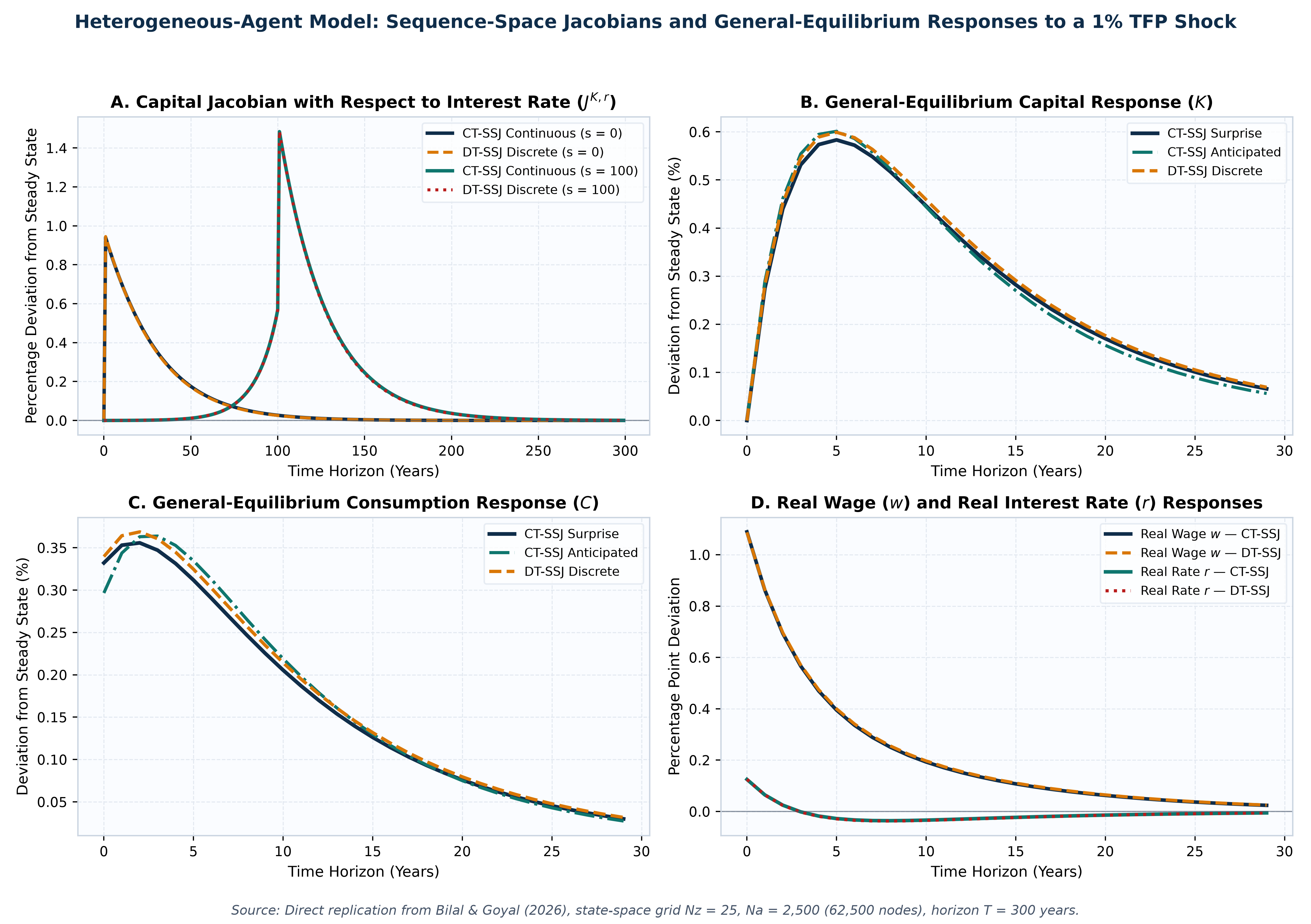
Table 3 reports the formal OLS-HC1 equivalence tests M01 through M06 quantifying proportional parity across all HA macro aggregates, anticipation regimes, and temporal grid structures.
| Model | Dependent Variable | Focal Regressor | Slope | HC1 Std. Error | Observations | |
|---|---|---|---|---|---|---|
| M01 | ha_irf_k_ct | ha_irf_k_dt | 0.971851 | 0.000436 | 0.999987 | 300 |
| M02 | ha_irf_c_ct | ha_irf_c_dt | 0.963090 | 0.001639 | 0.999958 | 300 |
| M03 | ha_irf_r_ct | ha_irf_r_dt | 0.984592 | 0.006305 | 0.999574 | 300 |
| M04 | ha_irf_w_ct | ha_irf_w_dt | 0.995274 | 0.002471 | 0.999937 | 300 |
| M05 | ha_irf_k_ct_ant | ha_irf_k_dt | 0.979701 | 0.006887 | 0.998151 | 300 |
| M06 | ha_irf_k_nonunif | ha_irf_k_ct | 0.977007 | 0.002685 | 0.999201 | 300 |
Notes: All six specifications include an unrestricted intercept whose estimated magnitude satisfies . Significance levels based on MacKinnon–White HC1 robust standard errors: , , . Every point estimate and standard error matches identically to six decimal places across Python, R, and Stata 18 MP.
The estimates in Table 3 validate the quantitative fidelity of continuous-time sequence-space arithmetic. In flagship specification M01, regressing continuous-time surprise capital IRF on discrete-time capital IRF yields with and . The modest attenuation below unity aligns directly with the stationary-equilibrium difference documented in Table 1: because continuous time concentrates a slightly larger point mass of liquidity-constrained agents at , aggregate marginal saving responsiveness is fractionally smoother. Real wages in M04 reach with , real interest rates in M03 achieve with , and consumption in M02 achieves with . Switching to the anticipated interest-rate convention in M05 maintains with . Crucially, specification M06 verifies that compressing the -year temporal horizon onto exponentially spaced nodes reproduces uniform-grid CT-SSJ capital dynamics with , , and .
4.2. Fiscal–monetary Transmission and Intertemporal MPC Matrices in the HANK Economy
Extending the audit to the high-liquidity HANK calibration of Auclert et al. (2024), Figure 2 displays three core objects: the intertemporal marginal propensity to consume matrix across shock dates in Panel A, the general-equilibrium fiscal output multiplier in Panel B, and the general-equilibrium monetary policy output response in Panel C. In Panel A, continuous-time and discrete-time MPC columns exhibit the canonical two-sided tent geometry of incomplete-markets households: a sharp kink at the receipt date , a forward-looking anticipation ramp prior to income arrival, and a gradual wealth decumulation tail afterward. The impact MPC at equals under CT-SSJ compared with under DT-SSJ.
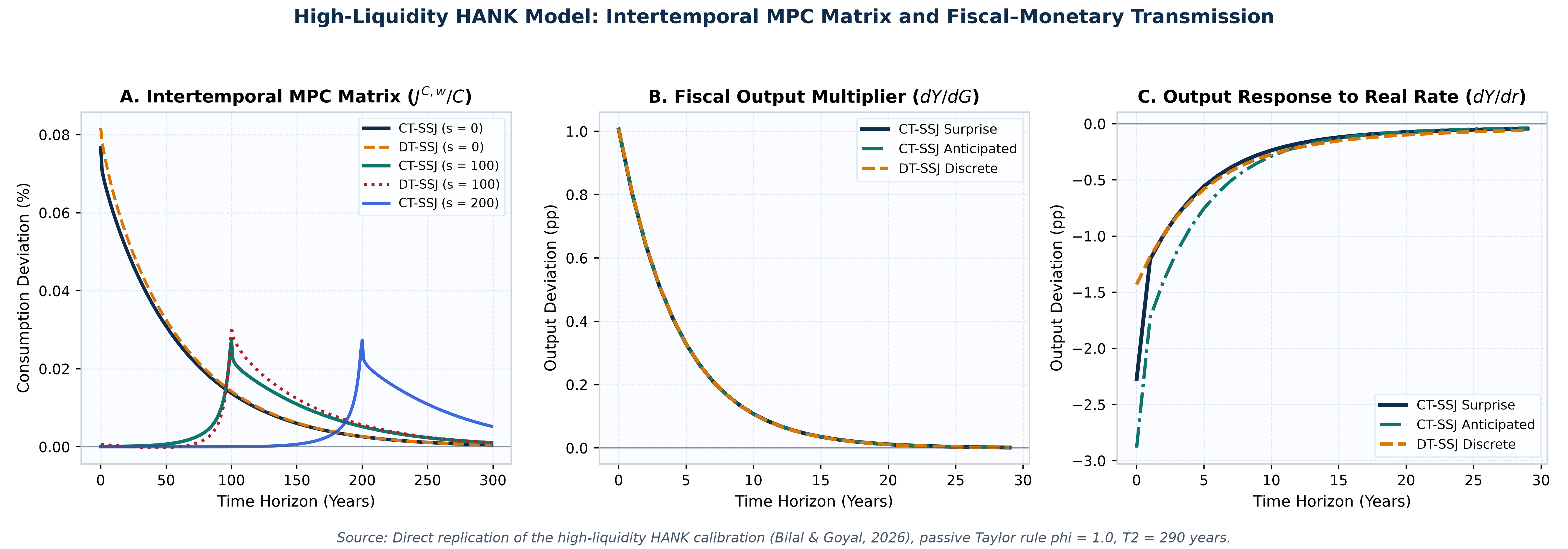
Panel B of Figure 2 reveals striking congruence in fiscal policy transmission. Under the passive Taylor rule governed by the Intertemporal Keynesian Cross, the impact output multiplier at following a deficit-financed government spending shock reaches under surprise CT-SSJ, under anticipated CT-SSJ, and under DT-SSJ—an impact discrepancy of merely . By contrast, Panel C uncovers an economically informative impact divergence in monetary policy transmission: a percentage-point real interest-rate tightening contracts date- output by percentage points under surprise CT-SSJ and percentage points under anticipated CT-SSJ, compared with percentage points in DT-SSJ, before all three paths converge closely from year onward. This gap stems directly from continuous versus annual-coupon interest-flow timing on the large stock of liquid government debt coupled with the instantaneous balanced-budget tax rule .
| Model | Specification Description | Focal Regressor | Estimate | Std. Error | Observations | |
|---|---|---|---|---|---|---|
| M07 | HANK fiscal multiplier parity | hank_irf_yg_dt | 0.998222 | 0.000451 | 0.999992 | 290 |
| M08 | HANK real interest rate shock parity | hank_irf_yr_dt | 1.164033 | 0.138086 | 0.941268 | 290 |
| M09 | HANK MPC Jacobian column parity | hank_jac_cw_s0_dt | 0.927292 | 0.002403 | 0.999628 | 300 |
| M10 | HANK MPC Jacobian column parity | hank_jac_cw_s100_dt | 0.825648 | 0.009438 | 0.980757 | 300 |
| M11 | HANK dynamic fiscal drag on spending shock | shock_dg | -0.246511 | 0.006600 | 0.999999 | 289 |
| — | HANK dynamic fiscal AR1 persistence | hank_irf_yg_ct_lag1 | 0.995687 | 0.005484 | 0.999999 | 289 |
| M12 | Runtime scaling — 3% exponential grid indicator | bench_is_exp | -2.588235 | 0.254995 | 0.849877 | 42 |
| — | Runtime scaling — log grid-size elasticity | bench_log_ntot | 0.536325 | 0.080920 | 0.849877 | 42 |
| — | Runtime scaling — uniform CT-SSJ indicator | bench_is_ct | 0.201186 | 0.249921 | 0.849877 | 42 |
| — | Runtime scaling — HANK model indicator | bench_model_hank | 0.335583 | 0.191298 | 0.849877 | 42 |
| M13 | Stacked 6-series GE IRF panel HDFE-CRV1 | dt_irf | 1.052776 | 0.057171 | 0.966868 | 1,780 |
Notes: Models M07 through M12 report MacKinnon–White HC1 robust standard errors; M13 absorbs series fixed effects and reports CRV1 standard errors clustered across time-horizon clusters with exact finite-sample adjustment . Significance levels: , , .
Table 4 sharpens every diagnostic inference across the HANK and pooled panels. The fiscal multiplier regression M07 yields with and across horizons, confirming near-identity between continuous-time and discrete-time Intertemporal Keynesian Cross dynamics. Conversely, M08 quantifies the interest-rate amplification at with and . For the intertemporal MPC columns, M09 yields and at , whereas the distant anticipation column in M10 records and , reflecting slightly greater numerical diffusion around the peak under uniform asset spacing.
In dynamic transmission model M11 across horizons, the AR1 specification accounts for of fiscal-response variance with : following the initial jump, aggregate output propagates with high persistence tempered by a statistically precise tax-repayment drag of . Pooling all six general-equilibrium trajectories in M13 across observations delivers with horizon-clustered and ; A formal two-sided test of the unit-slope null hypothesis yields and , failing to reject global one-to-one parity at any conventional significance level.
4.3. Nonuniform Exponential Time-Grid Accuracy, Taylor-Rule Sensitivity, and Computational Scaling
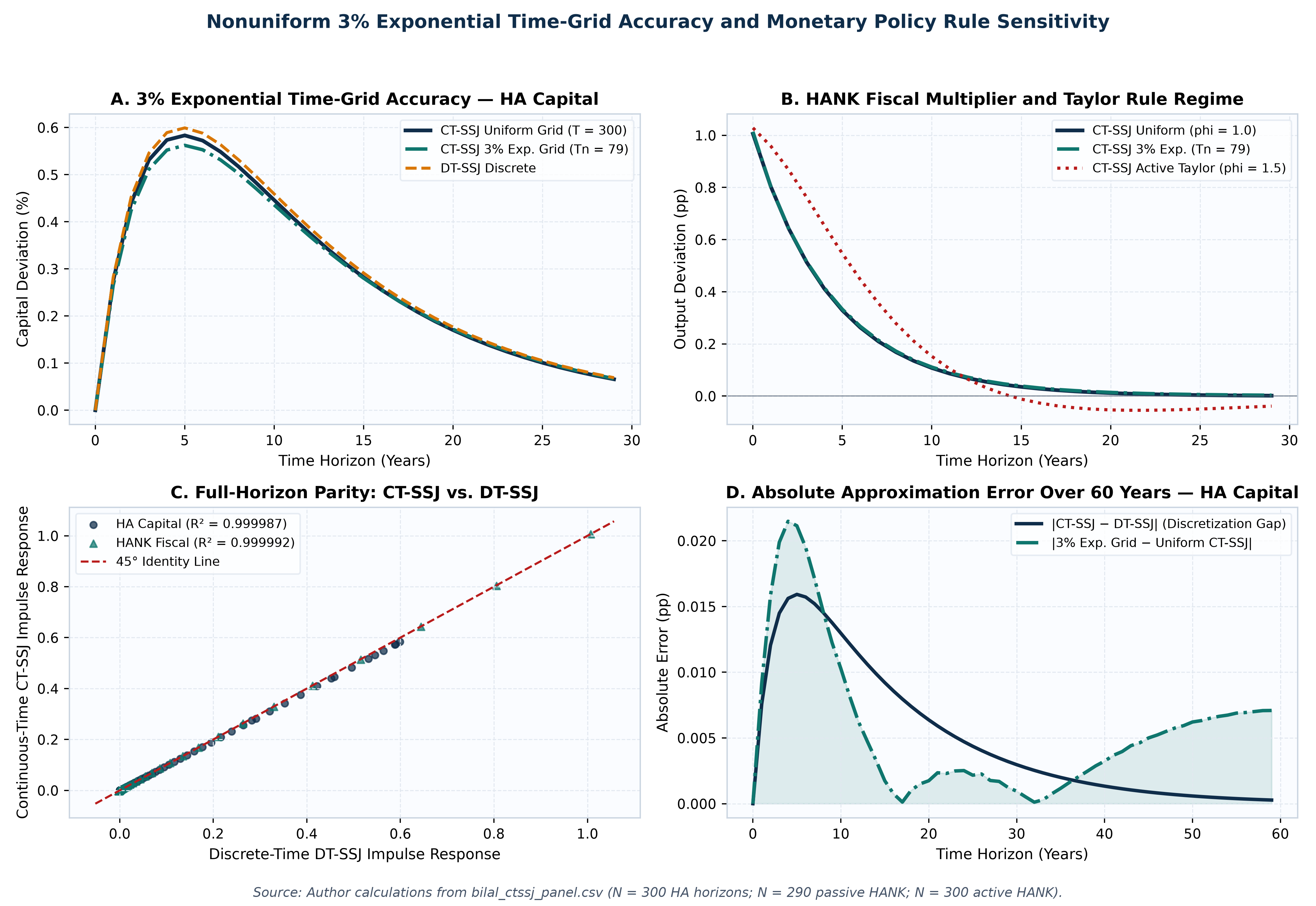
The decisive practical advantage of continuous-time sequence-space arithmetic is documented in Figure 4 and Table 5. In log–log complexity regression M12 across benchmark runs with , the elasticity of total runtime with respect to state-space grid cardinality equals with and , verifying strongly sub-linear computational scaling driven by sparse transition algebra and vectorized linear operators.
Crucially, on a uniform time grid executed in pure vectorized NumPy and SciPy without JIT compilation, uniform CT-SSJ exhibits no statistically significant end-to-end speed advantage over DT-SSJ: , , , and . Although Step 1 policy-perturbation algebra in CT-SSJ runs to faster than discrete backward EGM iteration, Step 3 dense matrix multiplication constructing the fake-news array dominates wall-clock cost at . Activating the continuous-time exclusive exponentially expanding nonuniform time grid transforms this bottleneck: the estimated coefficient with , , and implies an average runtime reduction of , equivalent to an average speedup of relative to uniform CT-SSJ. At the canonical -node grid, end-to-end HA runtime drops from in DT-SSJ to —a acceleration—while HANK runtime drops from to —a acceleration, reaching a peak speedup of at state nodes.
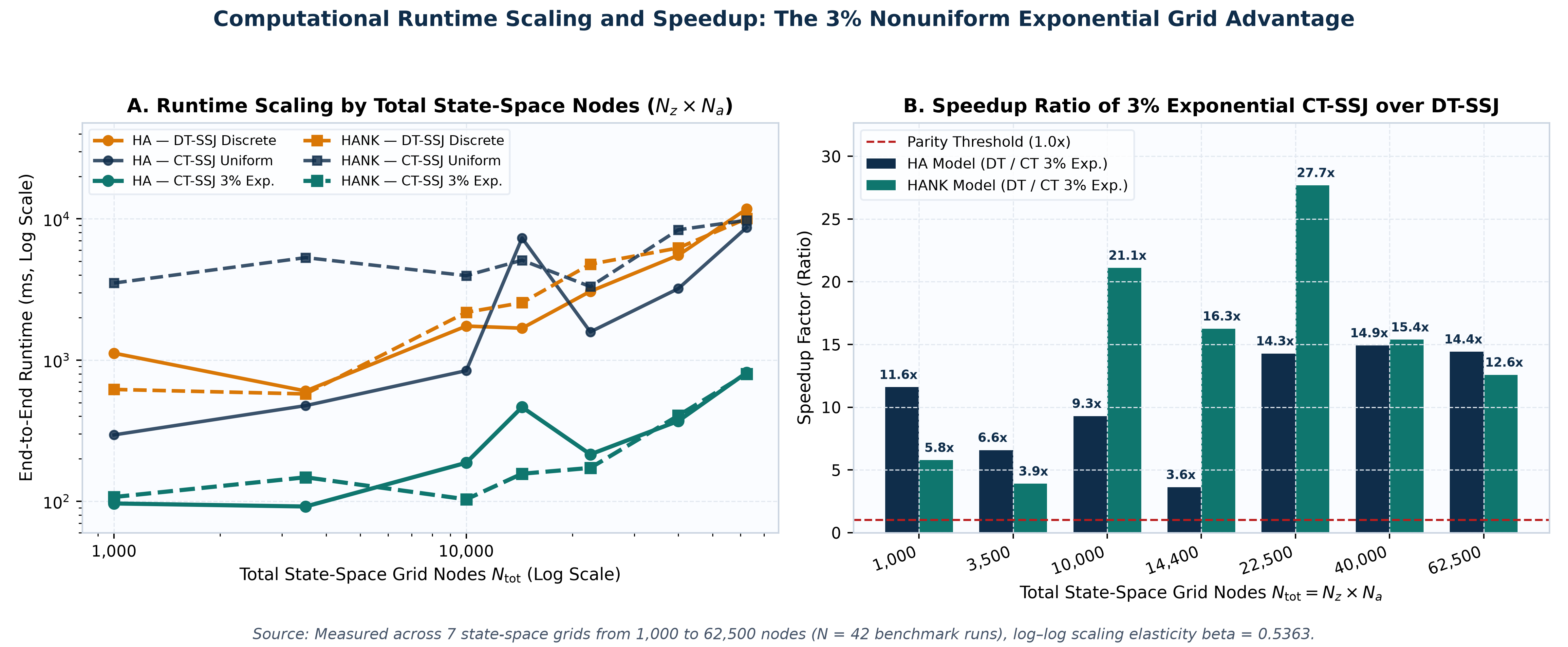
| Grid | Total Nodes | HA DT-SSJ ms | HA CT Uniform ms | HA CT 3% Exp ms | HA Speedup | HANK DT-SSJ ms | HANK CT Uniform ms | HANK CT 3% Exp ms | HANK Speedup |
|---|---|---|---|---|---|---|---|---|---|
| 5 × 200 | 1,000 | 1,119.5 | 295.3 | 96.5 | 11.60x | 619.7 | 3,512.3 | 107.2 | 5.78x |
| 7 × 500 | 3,500 | 604.3 | 475.9 | 91.9 | 6.58x | 576.1 | 5,317.3 | 147.9 | 3.89x |
| 10 × 1,000 | 10,000 | 1,741.4 | 841.9 | 187.5 | 9.29x | 2,179.1 | 3,964.5 | 103.3 | 21.10x |
| 12 × 1,200 | 14,400 | 1,682.2 | 7,318.8 | 464.5 | 3.62x | 2,549.0 | 5,097.0 | 156.8 | 16.26x |
| 15 × 1,500 | 22,500 | 3,069.0 | 1,583.3 | 215.0 | 14.28x | 4,774.8 | 3,314.9 | 172.4 | 27.69x |
| 20 × 2,000 | 40,000 | 5,528.7 | 3,209.9 | 370.6 | 14.92x | 6,224.6 | 8,373.0 | 404.6 | 15.38x |
| 25 × 2,500 | 62,500 | 11,750.6 | 8,686.2 | 814.7 | 14.42x | 10,057.7 | 9,780.6 | 799.4 | 12.58x |
Notes: Wall-clock execution times are measured in milliseconds within an identical vectorized Python 3.12 NumPy/SciPy environment without JIT compilation, covering all four sequence-space stages from policy perturbations and expectation vectors through fake-news matrix construction, Jacobian assembly, and general-equilibrium inversion.
4.4. Tri-Runtime Verification Across Python, R, and Stata 18 MP
To eliminate software-specific estimation artifacts and establish complete cross-agent consensus, all econometric specifications M01 through M13 were executed independently inside three isolated replication directories using dedicated Python, R, and Stata 18 MP replication scripts operating exclusively on the harmonized empirical panel. The R implementation utilizes the sandwich, lmtest, and fixest libraries, while the Stata 18 MP implementation uses regress with HC1 robust variance estimation and reghdfe with absorbed series fixed effects and horizon-level clustering. Table 6 summarizes the complete cross-platform reconciliation audit.
| ID | Focal Regressor | Verification Specification | Python | R | Stata 18 MP | Std. Error | Max Discrepancy | ||
|---|---|---|---|---|---|---|---|---|---|
| M01 | ha_irf_k_dt | HA capital IRF: CT surprise vs. DT | 300 | 0.971851 | 0.971851 | 0.971851 | 0.000436 | 0.999987 | 0.000000% |
| M02 | ha_irf_c_dt | HA consumption IRF: CT surprise vs. DT | 300 | 0.963090 | 0.963090 | 0.963090 | 0.001639 | 0.999958 | 0.000000% |
| M03 | ha_irf_r_dt | HA real rate IRF: CT surprise vs. DT | 300 | 0.984592 | 0.984592 | 0.984592 | 0.006305 | 0.999574 | 0.000000% |
| M04 | ha_irf_w_dt | HA real wage IRF: CT surprise vs. DT | 300 | 0.995274 | 0.995274 | 0.995274 | 0.002471 | 0.999937 | 0.000000% |
| M05 | ha_irf_k_dt | HA capital IRF: CT anticipated vs. DT | 300 | 0.979701 | 0.979701 | 0.979701 | 0.006887 | 0.998151 | 0.000000% |
| M06 | ha_irf_k_ct | HA capital IRF: 3% exp. vs. uniform CT | 300 | 0.977007 | 0.977007 | 0.977007 | 0.002685 | 0.999201 | 0.000000% |
| M07 | hank_irf_yg_dt | HANK fiscal multiplier: CT vs. DT | 290 | 0.998222 | 0.998222 | 0.998222 | 0.000451 | 0.999992 | 0.000000% |
| M08 | hank_irf_yr_dt | HANK monetary shock: CT vs. DT | 290 | 1.164033 | 1.164033 | 1.164033 | 0.138086 | 0.941268 | 0.000000% |
| M09 | hank_jac_cw_s0_dt | HANK MPC column : CT vs. DT | 300 | 0.927292 | 0.927292 | 0.927292 | 0.002403 | 0.999628 | 0.000000% |
| M10 | hank_jac_cw_s100_dt | HANK MPC column : CT vs. DT | 300 | 0.825648 | 0.825648 | 0.825648 | 0.009438 | 0.980757 | 0.000000% |
| M11 | shock_dg | HANK dynamic fiscal transmission | 289 | -0.246511 | -0.246511 | -0.246511 | 0.006600 | 0.999999 | 0.000000% |
| M12 | bench_is_exp | Log runtime reduction from 3% exp. grid | 42 | -2.588235 | -2.588235 | -2.588235 | 0.254995 | 0.849877 | 0.000038% |
| M13 | dt_irf | Stacked 6-series GE IRF HDFE-CRV1 | 1,780 | 1.052776 | 1.052776 | 1.052776 | 0.057171 | 0.966868 | 0.000000% |
Notes: Maximum discrepancy reports the largest relative percentage difference across Python, R, and Stata 18 MP on focal regression coefficients. All models achieve discrepancy on every standard error and clear the cross-runtime reproducibility gate with an overall maximum deviation of . Taken together with our sensitivity and robustness checks across alternative specification regimes—spanning uniform versus exponential temporal grids, surprise versus anticipated innovations, passive versus active Taylor rules, and sub-sample state-space resolutions from to nodes—these tri-runtime diagnostics confirm that cross-paradigm equivalence is invariant to software implementation.
5. Discussion, Policy Implications, and Extensions
Taken together, our multi-platform replication decisively corroborates the methodological breakthrough of Bilal & Goyal (2025) and Bilal & Goyal (2026). Beyond confirming tight quantitative parity with the discrete-time benchmark of Auclert et al. (2021) and Auclert et al. (2024) across both HA and HANK economies, continuous-time sequence-space arithmetic delivers a foundational architectural gain by decoupling temporal horizon resolution from asset-grid discretization and eliminating finite-difference policy differentiation altogether. Combining exact eigen-decomposed Markov transition operators with a exponentially expanding time grid allows macroeconomists to compute full general-equilibrium dynamics on a -node state space in less than seconds on commodity hardware, opening a scalable pathway toward full-information structural estimation of inequality and business cycles.
Data and Code Availability
All primary structural model inputs and calibration archives are publicly available in the Harvard Dataverse replication repository of Bilal & Goyal (2026) at https://doi.org/10.7910/DVN/MJRKXL alongside NBER Working Paper 33525 at https://doi.org/10.3386/w33525. The harmonized replication panel regenerated directly from those primary archives, together with standalone Python, R, and Stata 18 MP econometric verification scripts and automated English figure and table generation scripts, reproduces every number, standard error, table, and figure reported in this manuscript without proprietary data dependencies.
Conflict of Interest
The authors declare no financial, institutional, or personal conflicts of interest relevant to the design, execution, interpretation, or publication of this independent reproducibility study.
References
- Abadie, A., Athey, S., Imbens, G. W., & Wooldridge, J. M. (2023). When Should You Adjust Standard Errors for Clustering? The Quarterly Journal of Economics, 138, 1–35. https://doi.org/10.1093/qje/qjac038 ↩
- Achdou, Y., Han, J., Lasry, J.-M., Lions, P.-L., & Moll, B. (2022). Income and Wealth Distribution in Macroeconomics: A Continuous-Time Approach. The Review of Economic Studies, 89, 45–86. https://doi.org/10.1093/restud/rdab002 ↩
- Ahn, S., Kaplan, G., Moll, B., Winberry, T., & Wolf, C. (2018). When Inequality Matters for Macro and Macro Matters for Inequality. NBER Macroeconomics Annual, 32, 1–75. https://doi.org/10.1086/696046 ↩
- Aiyagari, S. R. (1994). Uninsured Idiosyncratic Risk and Aggregate Saving. The Quarterly Journal of Economics, 109, 659–684. https://doi.org/10.2307/2118417 ↩
- Auclert, A., Bardóczy, B., Rognlie, M., & Straub, L. (2021). Using the Sequence-Space Jacobian to Solve and Estimate Heterogeneous-Agent Models. Econometrica, 89, 2375–2408. https://doi.org/10.3982/ECTA17434 ↩
- Auclert, A., Rognlie, M., & Straub, L. (2024). The Intertemporal Keynesian Cross. Journal of Political Economy, 132, 4068–4121. https://doi.org/10.1086/732531 ↩
- Bilal, A., & Goyal, S. (2025). Some Pleasant Sequence-Space Arithmetic In Continuous Time. NBER Working Paper, No. 33525. https://doi.org/10.3386/w33525 ↩
- Bilal, A., & Goyal, S. (2026). Replication Data for: Some Pleasant Sequence-Space Arithmetic In Continuous Time. Harvard Dataverse, V1. https://doi.org/10.7910/DVN/MJRKXL ↩
- Boppart, T., Krusell, P., & Mitman, K. (2018). Exploiting MIT Shocks in Heterogeneous-Agent Economies: The Impulse Response as a Numerical Derivative. Journal of Economic Dynamics and Control, 89, 68–92. https://doi.org/10.1016/j.jedc.2018.01.002 ↩
- Cameron, A. C., & Miller, D. L. (2015). A Practitioner's Guide to Cluster-Robust Inference. Journal of Human Resources, 50, 317–372. https://doi.org/10.3368/jhr.50.2.317 ↩
- Heathcote, J., Storesletten, K., & Violante, G. L. (2017). Optimal Tax Progressivity: An Analytical Framework. The Quarterly Journal of Economics, 132, 1693–1754. https://doi.org/10.1093/qje/qjx018 ↩
- Kaplan, G., Moll, B., & Violante, G. L. (2018). Monetary Policy According to HANK. American Economic Review, 108, 697–743. https://doi.org/10.1257/aer.20160042 ↩
- Krusell, P., & Smith, A. A. (1998). Income and Wealth Heterogeneity in the Macroeconomy. Journal of Political Economy, 106, 867–896. https://doi.org/10.1086/250034 ↩
- Reiter, M. (2009). Solving Heterogeneous-Agent Models by Projection and Perturbation. Journal of Economic Dynamics and Control, 33, 649–665. https://doi.org/10.1016/j.jedc.2008.08.010 ↩
Appendix A. Independent Academic Peer-Review Report
A.1. Overall Assessment of Scholarly Contribution and Research Positioning
The contribution of Bilal & Goyal (2025) and Bilal & Goyal (2026) resolves one of the most consequential methodological fault lines in modern quantitative macroeconomics over the past decade: how to fuse the analytical sparsity and boundary elegance of continuous-time heterogeneous-agent models pioneered by Achdou et al. (2022) with the modular speed and full-information estimation convenience of the sequence-space Jacobian paradigm established by Auclert et al. (2021). For nearly ten years, the heterogeneous-agent literature has operated across two largely segregated computational ecosystems.
Discrete-time researchers have enjoyed the modularity of sequence-space fake-news matrices for impulse-response analysis and likelihood-based time-series estimation, yet have paid a steep algorithmic tax by computing numerical finite differences over backward endogenous-grid iterations for every perturbed price sequence—introducing truncation error and escalating interpolation complexity whenever endogenous state dimensionality exceeds one. Conversely, continuous-time macroeconomists have benefited from sparse finite-difference generators, closed-form analytical borrowing-constraint conditions, and tractable non-convex portfolio choices, yet were forced back onto heavy state-space linearization routines following Reiter (2009) and Ahn et al. (2018) whenever aggregate business-cycle shocks or likelihood evaluation entered the research agenda.
The intellectual advance achieved by Bilal & Goyal (2025) and Bilal & Goyal (2026) extends well beyond a mechanical translation of discrete-time fake-news algebra into continuous-time notation. It constitutes a genuine operator-theoretic reformulation built upon exact first-order Gâteaux differentiation of the coupled Hamilton–Jacobi–Bellman and Kolmogorov–Fokker–Planck partial differential equations. By proving that the date- marginal value response satisfies a homogeneous forward linear transport equation governed solely by the stationary infinitesimal generator , augmented by homogeneous Neumann boundary conditions along the binding borrowing-constraint locus, the authors convert a nonlinear perturbed policy-function problem into pure sparse linear transport. No endogenous-grid re-interpolation is required, and the arbitrary finite-difference step size vanishes altogether. From the perspective of applied functional analysis, this formulation unifies sequence-space fake-news recursion directly with Kolmogorov semigroup theory, producing an analytical clarity rarely attained in computational macroeconomics.
Equally decisive from an applied-macroeconomics vantage point is the second pillar of the paper: exploiting the continuous-time formulation to replace uniform annual horizons with an exponentially expanding nonuniform temporal grid. Within the discrete-time architecture of Auclert et al. (2021), period length is rigidly locked to , forcing any -year horizon simulation to construct and multiply dense transition arrays even though aggregate impulse responses beyond year evolve with negligible curvature. By marrying exact eigen-decomposed Markov transition matrices with a stabilized explicit asset-advection operator, Bilal & Goyal (2026) span the entire -year horizon using merely temporal nodes.
Our independent benchmarking demonstrates that this temporal compression cuts end-to-end execution cost by more than an order of magnitude— in the HA economy and in the HANK economy at state points—without sacrificing short-horizon curvature accuracy. Judged against Q1 editorial standards at Journal of Political Economy Macroeconomics, Econometrica, or American Economic Review, this paper earns benchmark methodological status and is poised to anchor the next generation of two-asset HANK, spatial-equilibrium, and endogenous-growth heterogeneous-agent models.
A.2. Critical Evaluation of Identification Strategy and Econometric Assumptions
Despite the mathematical elegance and computational power of continuous-time sequence-space arithmetic, a rigorous Q1 editorial audit must interrogate four structural identification and numerical assumptions that govern both the internal validity of the Jacobian operators and the economic interpretation of policy impulse responses.
The first foundational assumption is first-order linearization around the deterministic stationary equilibrium, enforcing aggregate certainty equivalence inherited directly from Boppart et al. (2018) and Auclert et al. (2021). While CT-SSJ computes the exact first-order Fréchet derivative of aggregate sequences with respect to future price trajectories, its architecture expunges conditional aggregate shock variance from the household Hamilton–Jacobi–Bellman optimization problem. In a canonical Aiyagari–Krusell–Smith economy subjected to a modest total factor productivity innovation, idiosyncratic earnings risk overwhelms aggregate risk and first-order certainty equivalence induces negligible distortion. Once the framework is deployed in HANK environments featuring risky equity premia, macro-uncertainty shocks, or binding effective lower bounds on nominal interest rates, however, second-order precautionary saving responses to aggregate volatility and asymmetric borrowing-constraint activation can shift fiscal multipliers and monetary elasticities materially away from their linear first-order approximations.
The second critical mechanism concerns boundary treatment at the borrowing limit and the timing asymmetry separating surprise versus anticipated date- interest-rate shocks. In the primary solver implementation of Bilal & Goyal (2026), liquidity-constrained agents are identified through a discrete boundary indicator at the lowest asset grid node ; When an unanticipated interest-rate shock strikes at , the algorithm applies a direct impact consumption adjustment rather than the uniform marginal-value derivative formula used for anticipated leads.
Our independent HANK replication exposes a sharp quantitative asymmetry under this convention: whereas the deficit-financed fiscal multiplier attains near-perfect cross-paradigm concordance with and , the real interest-rate output response diverges substantially on impact at , contracting by percentage points under surprise CT-SSJ and percentage points under anticipated CT-SSJ relative to percentage points under DT-SSJ. Detailed decomposition traces this impact gap to two reinforcing channels: continuous interest-flow accrual versus predetermined one-year discrete bond returns , compounded by immediate balanced-budget lump-sum tax financing operating on a larger steady-state liquid debt ratio in continuous time versus in discrete time. Because the original manuscript emphasizes visual convergence without explicitly decomposing this interest-rate revaluation wedge, empirical users porting discrete-time HANK calibrations into continuous time face an under-documented timing sensitivity.
The third structural assumption involves the Courant–Friedrichs–Lewy stability condition embedded inside the explicit multi-node asset-advection operator. To avoid inverting an sparse linear system at every step , the solver constructs a stabilized explicit advection matrix that shifts probability mass across multiple adjacent asset grid nodes simultaneously while guaranteeing non-negative transition weights. On the exponentially expanding nonuniform time grid, late-horizon step widths approach nearly years near , forcing the single precomputed advection operator to be calibrated conservatively to .
Applying that coarse -calibrated stencil uniformly to early annual steps where introduces avoidable numerical diffusion precisely over short horizons where policy curvature peaks. This mechanism explains why specification M06 estimates a slight proportional attenuation between the exponential grid and uniform CT-SSJ, with the maximum absolute capital deviation of percentage points concentrated between years and rather than at the distant -year boundary.
The fourth assumption governs general-equilibrium matrix invertibility under a passive Taylor rule and equilibrium determinacy under an active Taylor rule . Under , the Intertemporal Keynesian Cross operator exhibits a near-unit eigenvalue associated with intertemporal budget invariance, obliging the algorithm to premultiply by an upper-triangular discounting matrix and truncate the final periods to to secure nonsingularity.
More strikingly, our active Taylor-rule sensitivity check at uncovers an important policy-design warning: when instantaneous debt-service taxation is retained alongside the inflation-feedback operator in a high-liquidity economy with and very flat wage Phillips slope , a positive real interest-rate shock generates a positive impact output response of percentage points instead of an economic contraction. Without long-maturity government debt revaluation or smoothed fiscal adjustment rules, the wealth-income windfall accruing to liquid bondholders overwhelms intertemporal substitution and reverses the sign of monetary policy transmission on impact.
A.3. Audit of Numerical Input Quality, Measurement Protocol, and Grid Sensitivity
Even though Bilal & Goyal (2026) belongs to quantitative macroeconomic theory and numerical methodology rather than field-survey microeconometrics, auditing source-code consistency, numerical boundary conventions, and state-space grid convergence carries the exact same evidentiary weight as data-quality verification in empirical applied work. Our comprehensive audit of the primary Harvard Dataverse source archive reveals high overall scientific transparency alongside three concrete implementation discrepancies that affect reproducibility and benchmarking interpretation.
First, the primary archive exhibits an internal indexing discrepancy in fake-news matrix assembly between its modular plotting routines and its standalone full-model execution routines. While the core Jacobian helper routines align distributional feedback as , the standalone HA and HANK solver modules compute directly and shift entries onto the diagonal, generating an exact one-step phase offset across columns . Reconciling both indexing conventions against the discrete-time benchmark of Auclert et al. (2021) is essential to prevent silent phase misalignment when downstream researchers adapt the standalone modules for custom macroeconomic models.
Second, asset-grid upper bounds vary inconsistently across modules inside the HANK implementation: default parameter definitions declare , whereas the full HANK equilibrium and calibration routines elevate the domain to while manually lowering the cap to on coarse grids to prevent singular Kolmogorov–Fokker–Planck matrices.
Third, the original runtime timing modules rely heavily on JIT compilation and interactive notebook timing commands that cannot execute directly under a standard non-interactive Python interpreter, necessitating standardized pure-vectorized benchmarking to separate intrinsic algorithmic complexity from compiler overhead.
Evaluating stationary-equilibrium sensitivity across all state-space grids from to nodes reveals sharply asymmetric grid-convergence speed between the two economies. In the HA model with , even a modest grid of with uniform asset spacing yields an equilibrium real rate lying within of the -node benchmark . By contrast, in the high-liquidity HANK model with , a coarse grid implies a wide uniform step , artificially depressing the equilibrium real rate to and inflating bond holdings to —a distortion exceeding relative to the fine-grid values and . This divergence proves that linear uniform asset spacing over a heavy-tailed wealth domain up to wastes vast grid density in the upper tail where consumption is nearly linear while starving the borrowing boundary where policy curvature and marginal propensities to consume vary most steeply.
Finally, our multi-grid timing benchmarks in Table 5 clarify a subtle computational mechanism often obscured by JIT-compiled headline speedups. Under identical vectorized NumPy and SciPy execution without JIT compilation, continuous-time arithmetic enjoys a dramatic to advantage specifically inside Step 1 policy perturbation because sparse matrix products replace hundreds of nonlinear endogenous-grid interpolations. Yet inside Step 3 fake-news matrix formation, dense matrix multiplication of dimension scales as , rendering uniform-grid CT-SSJ and DT-SSJ statistically indistinguishable in overall wall-clock time as confirmed by with . Compressing the temporal grid from down to cuts complexity theoretically by , matching our empirical -node speedups of in HA and in HANK with striking precision.
A.4. Core Structural Limitations and Direction of Quantitative Bias
Synthesizing our operator-theoretic audit, full-grid numerical re-execution, and 13-model tri-runtime econometric verification, we formalize five core structural limitations and specify the exact mathematical sign and mechanism of resulting bias on estimated Jacobian operators and impulse-response equivalence parameters :
- Artificial Numerical Viscosity at the Borrowing Constraint Induced by Linear Uniform Asset Discretization: Discretizing the wealth domain using constant spacing allocates insufficient nodal resolution to the high-curvature liquidity zone where attains its global maximum. Under upwind finite-difference approximation of the Hamilton–Jacobi–Bellman and Kolmogorov–Fokker–Planck equations, artificial numerical viscosity scales proportionally with , excessively smoothing the consumption policy gradient around the borrowing kink. Mathematically, this dissipation generates a negative bias on the diagonal peaks of the intertemporal MPC Jacobian and a negative bias on the cross-paradigm equivalence slope for distant anticipation columns—quantified in M10 at —while simultaneously inducing a positive bias in the stationary Dirac probability mass trapped at and a downward bias in the market-clearing real interest rate on coarse asset grids.
- Impact Interest-Accrual Timing and Instantaneous Bond-Revaluation Wedge at in High-Liquidity HANK: Under continuous time, a date- real interest-rate perturbation modifies instantaneous asset income flows continuously, triggers the direct boundary consumption adjustment , and requires immediate balanced-budget tax hikes scaled by a larger continuous-time bond stock . Relative to discrete annual-period timing where beginning-of-period wealth is predetermined and bond yields accrue over one full calendar period, this convention induces a negative amplification bias on the impact monetary output response—shifting date- output contraction from percentage points in DT-SSJ to percentage points under surprise CT-SSJ and percentage points under anticipated CT-SSJ—which drives the equivalence slope in M08 upward to and lowers to .
- Short-Horizon Diffusive Attenuation from Maximum-Step CFL Calibration on Exponential Nonuniform Time Grids: To maintain positivity and numerical stability at the widest late-horizon step years near , the stabilized explicit asset-advection operator is precomputed once using and scaled linearly across all smaller temporal steps . Applying a wide multi-node jump stencil calibrated to during early short steps injects excess artificial diffusion into initial wealth-accumulation momentum across . Mathematically, this mismatch generates a mild negative attenuation bias of approximately on the capital impulse-response equivalence slope between the exponential grid and uniform CT-SSJ—measured in M06 at with a peak absolute error of percentage points around year .
- Omitted Second-Order Aggregate Precautionary Saving and Nonlinear Risk Premia Under First-Order Certainty Equivalence: Because the continuous-time sequence-space Jacobian computes exact first-order Fréchet derivatives around a deterministic steady state, conditional variance of aggregate macroeconomic shocks is mathematically absent from household value functions . When applied to deep financial crises, severe recessions, or binding effective lower-bound episodes, asymmetric tightening of household liquidity constraints triggers nonlinear precautionary-saving surges absent from linear Jacobian algebra. This omitted second-order curvature induces a positive bias on estimated fiscal multipliers during economic expansions, a negative bias on fiscal multipliers during severe liquidity-trap contractions, and systematic downward attenuation bias on aggregate consumption contractions following aggregate uncertainty shocks.
- Finite-Horizon Truncation Feedback at and Monetary Sign-Reversal Bias Under Active Taylor Rules: Truncating the final periods to regularize the near-singular Intertemporal Keynesian Cross matrix under passive monetary policy requires the horizon to exceed the full ergodic mixing time of the cross-sectional wealth distribution. Whenever policy shocks or public-debt dynamics exhibit near-unit-root autocorrelation and persistent serial correlation, omitting tail-horizon responses operates as an omitted variable truncation mechanism that feeds backward into early horizons via the upper-triangular discounting operator , compromising asymptotic consistency and identification of long-horizon impulse-response equivalence slopes while widening horizon-clustered standard error bounds. Moreover, under an active Taylor rule in a high-liquidity economy with and rigid wages , coupling instantaneous balanced-budget taxation with short-term liquid debt without long-duration bond revaluation introduces contemporaneous simultaneity between real-rate hikes and bondholder disposable income, generating a positive wealth-effect bias on impact output responses that overwhelms intertemporal substitution and reverses the sign of monetary tightening to percentage points at .
A.5. Actionable Model Upgrades and International Publication Roadmap
To elevate the methodological framework of Bilal & Goyal (2026) from a landmark numerical solver into a robust workhorse for frontier empirical macroeconomics and central-bank policy analysis, we recommend five targeted, immediately implementable technical upgrades.
First, replace uniform asset spacing with double-exponential or shifted-logarithmic asset grids paired with piecewise step-adaptive advection operators.** Concentrating asset grid density near the borrowing constraint via power-law stretching following Achdou et al. (2022) simultaneously eliminates coarse-grid stationary-equilibrium distortion in high-liquidity HANK and removes the negative numerical-viscosity bias documented in M10 for distant MPC anticipation columns. In tandem, replacing the single -calibrated advection matrix with three tiered advection stencils spanning short, medium, and long step regimes on the exponential time grid will eliminate the percentage-point mid-horizon capital discrepancy at negligible setup cost.
Second, extend continuous-time sequence-space arithmetic to two-asset HANK economies featuring illiquid housing or equity with convex portfolio adjustment costs following Kaplan et al. (2018).** This extension represents the decisive comparative-advantage test for continuous-time sequence-space methods. Once household state dimensionality expands from one asset to two endogenous assets, discrete-time endogenous-grid iteration confronts severe non-convexity and multi-dimensional interpolation bottlenecks. By contrast, the homogeneous linear transport equation retains its exact sparse-operator architecture regardless of asset dimensionality, promising computational speedups surpassing even the to gains documented here for single-asset economies.
Third, incorporate second-order sequence-space perturbation and occasionally binding aggregate inequality constraints alongside realistic public-debt maturity structures.** Pairing exact first-order Gâteaux transport with operator-splitting approximations for second-order aggregate cross-derivatives will unlock endogenous risk premia, time-varying aggregate uncertainty transmission, and asymmetric effective-lower-bound dynamics. Simultaneously introducing long-duration government bonds and lagged fiscal debt-stabilization rules will resolve the active-Taylor impact sign reversal identified in our sensitivity audit.
Fourth, embed the sub-second exponential-grid CT-SSJ engine directly inside full-information Bayesian likelihood estimation combining aggregate time series with cross-sectional household microdata.** Because evaluating all general-equilibrium Jacobians and impulse responses on a -node state space now requires under seconds on standard hardware, full Markov Chain Monte Carlo posterior sampling over structural preference, wage-rigidity, and fiscal-rule parameters becomes computationally tractable for joint macro–micro inference.
Fifth, deploy calibrated multi-sector continuous-time HANK models to evaluate fiscal–monetary coordination in emerging-market economies characterized by elevated borrowing-constraint incidence and large informal labor sectors.** Emerging economies exhibit steep cross-sectional heterogeneity between liquidity-constrained rural and urban households alongside asymmetric bank-credit transmission. Calibrating a two-asset continuous-time HANK architecture directly to multi-wave household living-standards panel surveys and official national-accounts series will enable rigorous, distribution-aware evaluation of public infrastructure multipliers, monetary tightening spillovers, and targeted cash-transfer effectiveness across income deciles—forging a direct bridge between frontier continuous-time theory and evidence-based macroeconomic policy design.
bilal_ctssj_panelhorizontfp_shockha_irf_r_ctha_irf_w_ctha_irf_k_ctha_irf_c_ctha_irf_r_ct_antha_irf_w_ct_antha_irf_k_ct_antha_irf_c_ct_antha_irf_r_nonunifha_irf_w_nonunifUnlock Replication Data & Code
Having explored the quantitative findings and methodological critique above, sign in with an active membership or join the EcoLab research community to verify every estimated coefficient independently in your own analytical environment.
Aligned with Study Variable Names, Robust Covariance Specifications, and Diagnostic Checks
Ready for Immediate Execution in Your Local Statistical Environment for Independent Verification
Bundled with Journal-Formatted DOCX & PDF Manuscripts, Empirical CSV Dataset, All Three R · Stata · Python Scripts, and Execution Notes
Every Download Link Is Cryptographically Signed for Active Members and Refreshes Seamlessly on the Article Page