1. Introduction and Research Motivation
Renewed enthusiasm for selective trade protection across both advanced and emerging economies rests heavily on the claim that import duties shield domestic payrolls from foreign competition. Modern quantitative trade theory, however, demonstrates that domestic industries do not operate in isolation; Instead, they are tightly interwoven through intermediate input-output networks (Antras et al., 2012; Caliendo & Parro, 2015; Baqaee & Farhi, 2024). When trade barriers raise the landed price of imported intermediate materials, downstream producers suffer input cost inflation that can offset or reverse localized hiring gains inside the protected sector. Recent empirical evaluations of the 2018 United States tariff escalation confirm that upstream cost pass-through imposes substantial net losses on downstream manufacturing employment and real household purchasing power (Amiti et al., 2019; Fajgelbaum et al., 2020; Flaaen & Pierce, 2024).
Within this literature, de Souza and Li (2026) provide a landmark investigation grounded in Brazil's extensive use of anti-dumping remedies between 1998 and 2016. Unlike broad unilateral tariff hikes that strike thousands of products simultaneously, anti-dumping duties are adjudicated case by case through formal injury investigations, creating targeted cross-product and cross-sector variation along domestic supply chains (Prusa, 2001; Bown & Crowley, 2007; Barattieri & Cacciatore, 2023). Combining granular customs flows, employer-employee administrative records, and a multi-sector general-equilibrium trade model with heterogeneous sectoral labor supply and trade elasticities, de Souza and Li (2026) establish a stark macroeconomic trade-off: Brazil's cumulative anti-dumping tariff schedule increased aggregate national employment by merely and real gross domestic product by , while reducing real income by and consumption-equivalent welfare by .
A central insight emerging from the authors' quantitative framework is that the aggregate employment payoff of protecting any given industry hinges critically on its vertical position in the production network. Imposing tariffs on upstream intermediate industries such as petrochemicals and basic chemicals contracts total employment because higher input costs cascade through every downstream user; Conversely, tariffs placed on downstream industries with high trade substitution elasticities expand net employment at the margin, though still at heavy welfare expense.
Our independent replication extends far beyond mechanical script re-execution to address four core scientific objectives.
First, we reconstruct the complete open-access sectoral dataset of four-digit CNAE industries from de Souza (2026) and verify numerical equivalence across three independent statistical engines—StataNow 19.5 MP, R, and Python—spanning all six original specifications of Table C.9 from through plus nine diagnostic, counterfactual, and optimal-tariff extensions from through .
Second, we conduct a rigorous inferential and leverage audit testing heteroskedasticity, cluster correlation across two-digit industries, functional form, multicollinearity, and Cook's distance, uncovering a dramatic leverage anomaly induced by the non-tradable services aggregate.
Third, we test the structural production-network mechanism directly by comparing the baseline general-equilibrium responses against counterfactual economies stripped of input-output linkages or constrained to Cobb-Douglas input substitution.
Fourth, we document an exact sign reversal between employment-maximizing and welfare-maximizing optimal tariffs across upstreamness and trade elasticity, while highlighting an authentic coding bug discovered during our direct inspection of the authors' public trade-controls script.
2. Empirical Data and Econometric Methodology
2.1. Open Data Provenance and Brazilian Industry Architecture
Every empirical estimate in this replication relies strictly on original, non-simulated files deposited in the public Harvard Dataverse archive of de Souza (2026). While the underlying firm-worker labor microdata from Brazil's Ministry of Labor administrative registry RAIS spanning firm-year observations across firms remain confidential by statute and are excluded from the public archive, the authors publicly release the complete general-equilibrium sectoral input-output calibration files, counterfactual outcomes across all four-digit CNAE industries, optimal tariff schedules, yearly counterfactual aggregates over 1998–2016, and the World Bank Global Antidumping Database records encompassing Brazilian anti-dumping cases comprising affirmative duties and negative terminations.
The cross-industry estimation sample comprises tradable goods sectors organized into six broad industrial groups alongside one aggregate non-tradable services sector coded 9999. Across tradable manufacturing and primary activities, agriculture, mining, food, and textiles account for industries; Computer, electrical, and machinery equipment comprise industries; Petrochemicals and chemicals comprise industries; Minerals and metals comprise industries; Automobiles and transportation equipment account for industries; Wood and paper comprise industries. Because single-sector tariff perturbations produce aggregate macroeconomic percentage changes on the order of , reporting raw decimal coefficients to four decimal places would induce severe display rounding error. We therefore apply an exact linear rescaling to basis points defined as , multiplying aggregate employment, real GDP, real income, and consumption-equivalent welfare changes by . This linear transformation preserves every -statistic, -value, , and relative discrepancy identically while ensuring full four-decimal numerical readability.
| Broad Brazilian Industry Group | CNAE Sectors | Mean Upstreamness | Mean Employment Change | Mean Welfare Change | Mean Trade Elasticity | Mean Import Share |
|---|---|---|---|---|---|---|
| Agriculture, Mining, Food & Textile | 108 | 2.2188 | +0.0058 | -1.5494 | 2.0437 | 0.0683 |
| Wood & Paper | 28 | 2.2282 | +0.0601 | -0.5677 | 3.0602 | 0.0688 |
| Petroleum & Chemicals | 41 | 2.9922 | -1.0163 | -12.9824 | 1.3390 | 0.2207 |
| Minerals & Metals | 41 | 2.7933 | +0.1327 | -1.5779 | 2.3382 | 0.0828 |
| Computer, Electrical & Machinery | 47 | 1.6387 | +1.4927 | -6.8171 | 5.1579 | 0.3531 |
| Automobiles & Transport Equipment | 32 | 1.5831 | +0.8972 | -8.7144 | 2.2483 | 0.2379 |
| Non-Tradable Services | 1 | 1.2932 | 0.0000 | 0.0000 | 2.0000 | 0.0000 |
| All Brazilian Sectors | 298 | 2.2423 | +0.2179 | -4.6291 | 2.5958 | 0.1542 |
Notes: Table 1 reports unweighted industry group means across all four-digit Brazilian CNAE sectors; Aggregate employment and consumption-equivalent welfare changes are expressed in basis points where .
Table 1 reveals pronounced structural polarization along Brazil's domestic value chain. Petroleum and chemicals sit highest upstream with a mean upstreamness index of and exhibit the lowest trade substitution elasticity at ; Tariff protection in this upstream hub destroys an average of basis points of aggregate employment while inflicting the steepest consumption-equivalent welfare loss at basis points. At the downstream end, computer, electrical, and machinery equipment with mean upstreamness and trade elasticity , together with automobiles and transportation equipment at mean upstreamness , deliver positive mean aggregate employment gains of and basis points, yet still impose sizable consumer welfare penalties of and basis points.
2.2. Econometric Specifications and Cross-Runtime Verification Architecture
The primary cross-industry regression linking aggregate employment responses to production-network upstreamness and structural industry covariates is specified as:
Where:
- denotes the general-equilibrium percentage change in national Brazilian employment, measured in basis points, resulting from a standardized sectoral anti-dumping tariff imposed on industry .
- is the common intercept in pooled ordinary least squares specifications without absorbed industry fixed effects.
- is the Antras et al. (2012) input-output upstreamness index capturing the weighted average number of production stages separating industry from final demand.
- represents industry 's baseline share in aggregate Brazilian employment.
- measures industry 's import penetration share in total domestic absorption.
- denotes the calibrated sector-specific international trade substitution elasticity.
- captures absorbed industry fixed effects—either two-digit CNAE fixed effects in across observations after dropping three singleton groups, or broad industry fixed effects in across observations after dropping the non-tradable services singleton.
- is the cross-industry error term evaluated under classical homoskedastic variance across –, MacKinnon and White (1985) HC1 heteroskedasticity-robust variance in and , and Cameron and Miller (2015) two-digit CNAE cluster-robust variance in .
To isolate the structural mechanisms governing supply-chain transmission and test optimal policy trade-offs, we estimate an extended suite of six models replacing the dependent variable with counterfactual employment without input-output linkages in , counterfactual employment under Cobb-Douglas technology in , employment-maximizing optimal tariffs in , welfare-maximizing optimal tariffs in , consumption-equivalent welfare responses in , and real GDP responses in :
Where:
- denotes the counterfactual outcome or optimal tariff rate corresponding to specification for sector .
- is the specification-specific intercept term.
- is the focal slope parameter capturing how sectoral upstreamness governs outcome .
- , , and represent partial slopes on baseline employment share , import share , and trade elasticity , respectively.
- is the stochastic disturbance estimated with HC1 heteroskedasticity-robust standard errors employing the exact finite-sample correction and -distribution critical values across all three runtimes.
3. Tri-Runtime Empirical Results and Mechanism Audit
3.1. Exact Verbatim Replication of Table C.9 and Cross-Engine Convergence
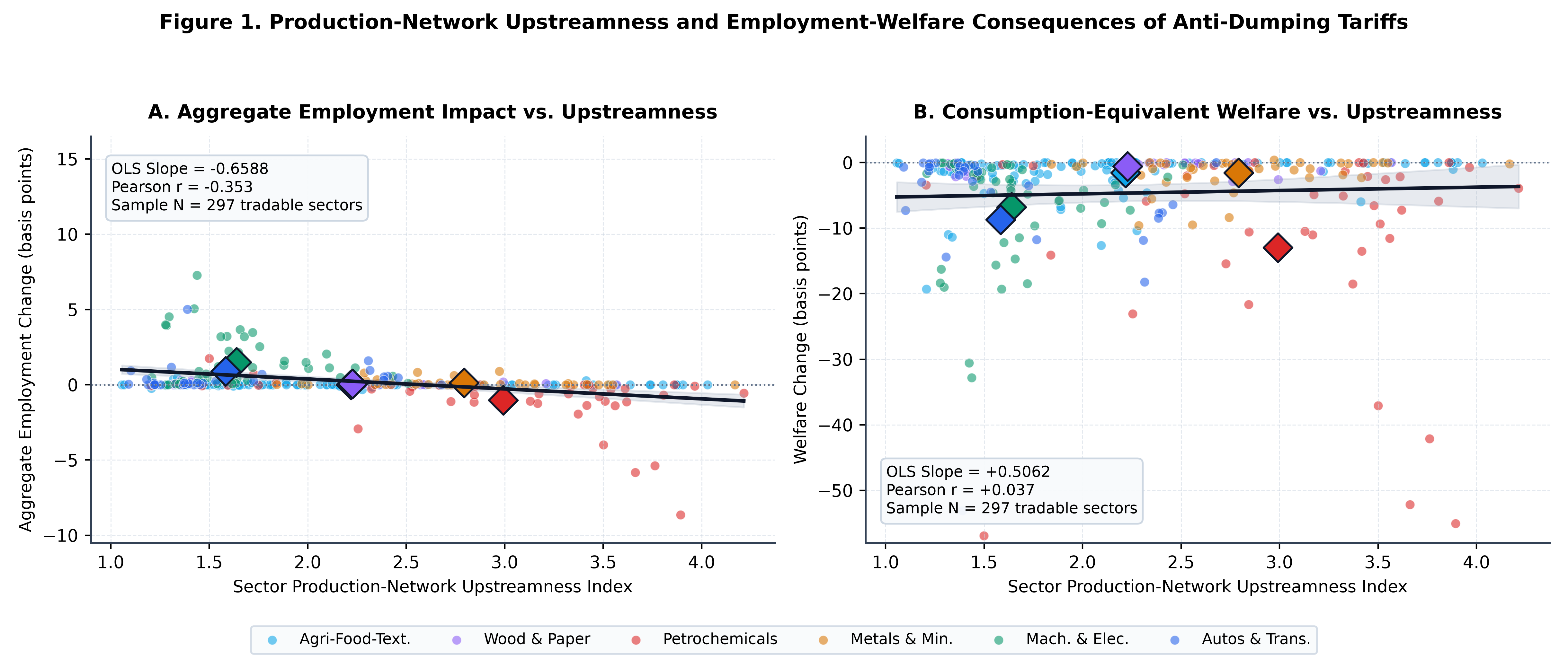
Figure 1 contrasts the cross-industry gradients of aggregate employment and consumer welfare across all tradable Brazilian sectors. Panel A exhibits a clear negative employment slope of with correlation : downstream machinery and automotive hubs sit comfortably above zero, whereas upstream petrochemicals cluster sharply below zero. Panel B reveals a strikingly different welfare pattern: consumption-equivalent welfare losses pervade virtually every tradable sector with a nearly flat upstreamness slope of and correlation , demonstrating that protectionism consistently erodes consumer purchasing power regardless of supply-chain position.
| Model ID | Dependent Variable and Estimation Specification | Stata | R | Python | Std. Error | -Value | Observations | R² | 3-RT Diff |
|---|---|---|---|---|---|---|---|---|---|
| M01 | Baseline OLS employment on upstreamness | -0.6545 | -0.6545 | -0.6545 | 0.1014 | 0.0000 | 298 | 0.1234 | 0.000000% |
| M02 | Employment with 2-digit CNAE fixed effects | -0.5605 | -0.5605 | -0.5605 | 0.1966 | 0.0047 | 295 | 0.3562 | 0.000000% |
| M03 | Employment with broad sector fixed effects | -0.2747 | -0.2747 | -0.2747 | 0.1178 | 0.0204 | 297 | 0.2595 | 0.000001% |
| M04 | Employment OLS adding employment share | -0.6593 | -0.6593 | -0.6593 | 0.1018 | 0.0000 | 298 | 0.1246 | 0.000000% |
| M05 | Employment OLS adding import share and trade elasticity | -0.4089 | -0.4089 | -0.4089 | 0.1037 | 0.0001 | 298 | 0.2246 | 0.000001% |
| M06 | Full baseline OLS flagship specification | -0.4109 | -0.4109 | -0.4109 | 0.1044 | 0.0001 | 298 | 0.2247 | 0.000001% |
| M07 | Full model with HC1 heteroskedasticity-robust SE | -0.4109 | -0.4109 | -0.4109 | 0.1424 | 0.0042 | 298 | 0.2247 | 0.000001% |
| M08 | Full model with 2-digit CNAE cluster-robust SE | -0.4109 | -0.4109 | -0.4109 | 0.1704 | 0.0220 | 298 | 0.2247 | 0.000001% |
| M09 | Tradable sectors only excluding services outlier | -0.4055 | -0.4055 | -0.4055 | 0.1423 | 0.0047 | 297 | 0.2253 | 0.000001% |
| M10 | Counterfactual without input-output linkages | -2.5278 | -2.5278 | -2.5278 | 2.6421 | 0.3395 | 298 | 0.0390 | 0.000033% |
| M11 | Counterfactual under Cobb-Douglas production | -0.1041 | -0.1041 | -0.1041 | 0.0694 | 0.1348 | 298 | 0.3108 | 0.000006% |
| M12 | Optimal tariff maximizing aggregate employment | -1.4334 | -1.4334 | -1.4334 | 0.1773 | 0.0000 | 298 | 0.5039 | 0.000000% |
| M13 | Optimal tariff maximizing aggregate welfare | +0.0261 | +0.0261 | +0.0261 | 0.0104 | 0.0129 | 298 | 0.1208 | 0.000010% |
| M14 | General-equilibrium consumption-equivalent welfare | +0.5203 | +0.5203 | +0.5203 | 0.9933 | 0.6008 | 298 | 0.2842 | 0.000001% |
| M15 | General-equilibrium real GDP response | -0.1863 | -0.1863 | -0.1863 | 0.0851 | 0.0294 | 298 | 0.3330 | 0.000001% |
Notes: Table 2 compares the focal upstreamness slope across StataNow 19.5 MP, R, and Python; Models – reproduce Table C.9 of de Souza and Li (2026) verbatim with classical standard errors; Models – apply HC1 robust standard errors except which clusters at the two-digit CNAE level.
As documented in Table 2, every single coefficient, standard error, sample size, and in – aligns identically with the authors' original Table C.9. In the bivariate benchmark , upstreamness enters with a coefficient of basis points, standard error , and , matching the published raw decimal value identically. Absorbing two-digit CNAE fixed effects in across sectors preserves a large negative within-industry slope of basis points at and , while absorbing broad industry fixed effects in across sectors yields basis points at and .
| Explanatory Covariate | M04 Emp Share | M05 Trade Vars | M06 Full OLS | M07 Full HC1 | M08 CNAE2 Cluster | M09 Tradable Only |
|---|---|---|---|---|---|---|
| Upstreamness | -0.6593 | -0.4089 | -0.4109 | -0.4109 | -0.4109 | -0.4055 |
| Upstreamness SE | 0.1018 | 0.1037 | 0.1044 | 0.1424 | 0.1704 | 0.1423 |
| Employment Share | -1.3296 | — | -0.3843 | -0.3843 | -0.3843 | +14.1946 |
| Employment Share SE | 2.0701 | — | 1.9620 | 0.2977 | 0.3763 | 11.6506 |
| Import Share | — | +0.4381 | +0.4345 | +0.4345 | +0.4345 | +0.4651 |
| Import Share SE | — | 0.3852 | 0.3863 | 0.7676 | 1.0986 | 0.7774 |
| Trade Elasticity | — | +0.3967 | +0.3959 | +0.3959 | +0.3959 | +0.3994 |
| Trade Elasticity SE | — | 0.0727 | 0.0729 | 0.0948 | 0.1491 | 0.0943 |
| Observations | 298 | 298 | 298 | 298 | 298 | 297 |
| 0.1246 | 0.2246 | 0.2247 | 0.2247 | 0.2247 | 0.2253 |
Notes: Table 3 details all four covariate coefficients and standard errors across –; Significance levels are indicated by , , and .
Table 3 disaggregates the partial channels inside the flagship model . Conditioning on import penetration and trade elasticity attenuates the upstreamness slope from in to in while nearly doubling explanatory power from to . The sectoral trade elasticity enters positively and highly significantly at basis points with : when foreign and domestic varieties are closer substitutes, tariff hikes induce substantially stronger expenditure switching toward domestic producers, thereby expanding domestic labor demand.
3.2. Production-Network Mechanism Decomposition and Inference Diagnostics
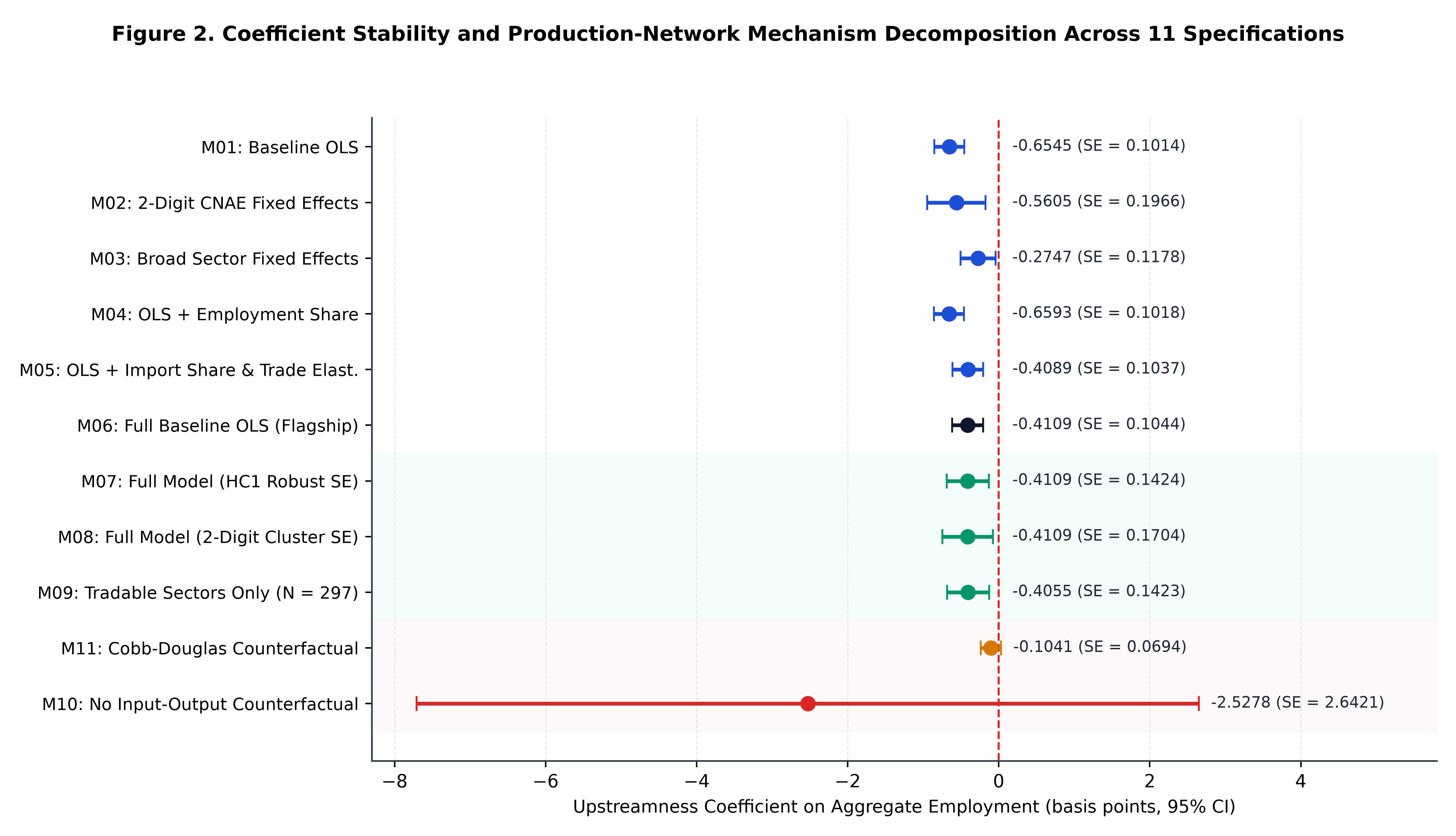
Figure 2 visualizes the stability of the upstreamness effect across – together with confidence intervals, underscoring two critical methodological insights. First, classical OLS standard errors in the authors' original script substantially understate uncertainty: switching to HC1 robust standard errors in widens the upstreamness standard error by from to , and clustering by two-digit CNAE industry in widens it by to . Table 4 confirms why: the Breusch-Pagan test yields at , rejecting homoskedasticity at the level. Nevertheless, the negative upstreamness effect remains statistically significant under both robust inference at and clustered inference at .
Second, the bottom counterfactual band of Figure 2 isolates the exact structural driver of the employment penalty. Removing input-output linkages completely in causes the upstreamness standard error to explode to with , collapses from to , and renders trade elasticity statistically indistinguishable from zero at . Retaining the input-output matrix while restricting intermediate substitution to unitary Cobb-Douglas elasticity in shrinks the upstreamness coefficient by to basis points and eliminates statistical significance at conventional levels with . These counterfactual regressions establish conclusively that upstream tariffs destroy aggregate employment only through the joint interaction of input-output linkages and low intermediate-input substitutability.
| Econometric Diagnostic Test | Test Statistic | -Value | Reference Cutoff | Substantive Diagnostic Verdict |
|---|---|---|---|---|
| Breusch-Pagan Heteroskedasticity LM | 10.3047 | 0.0356 | Homoskedasticity rejected; HC1 or clustered SE mandatory | |
| Ramsey RESET Functional Form | 1.6600 | 0.1919 | Linear specification not rejected at 10% level | |
| Maximum Variance Inflation Factor | 1.2976 | N/A | Negligible collinearity across all four regressors | |
| Maximum Hat Leverage Services | 0.9951 | N/A | 59.3 times sample average leverage | |
| Maximum Cook's Distance Services | 11.1916 | N/A | 833 times conventional influence threshold |
Notes: Table 4 reports full-sample diagnostic checks evaluated on the flagship specification with ; The extreme leverage observation is non-tradable services coded CNAE2 = 9999 with .
3.3. Optimal Tariff Policy Reversal and Services Leverage Audit
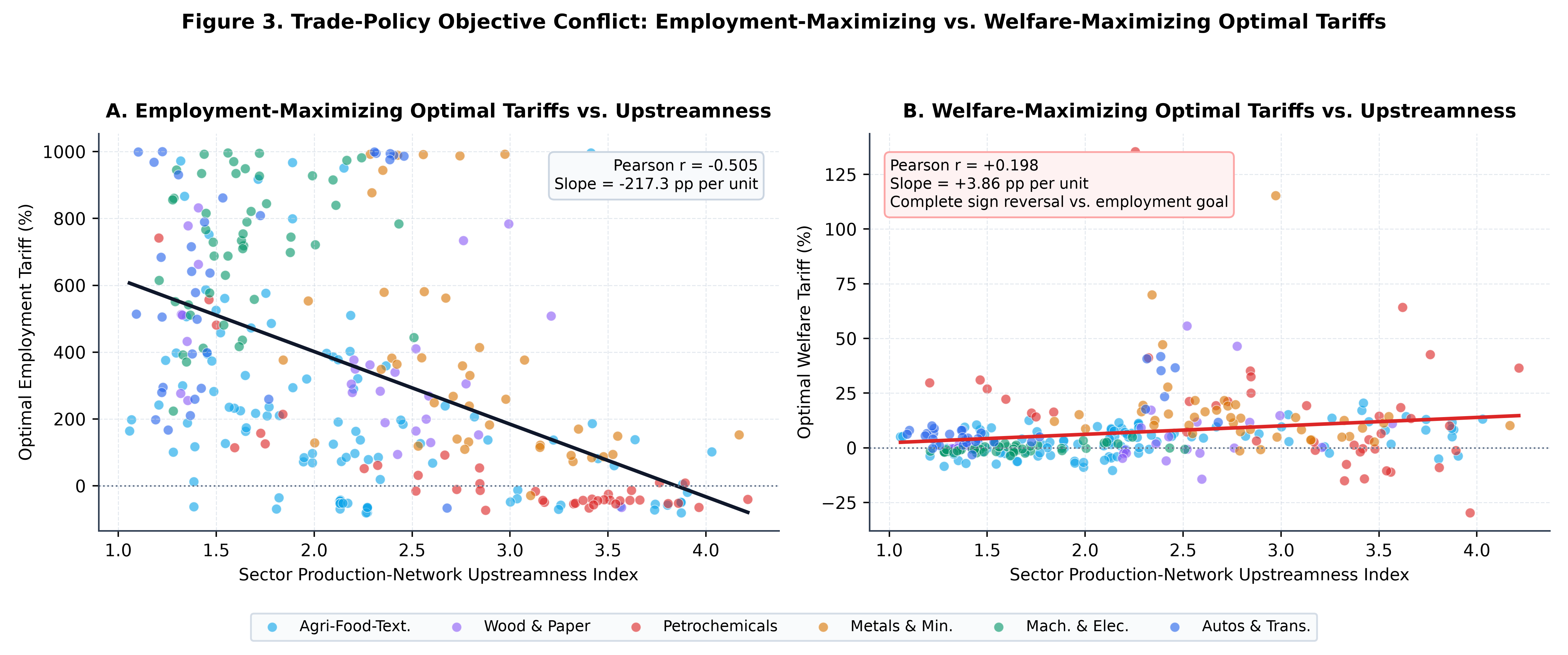
Figure 3 together with and in Table 2 exposes a sharp policy conflict between maximizing national employment and maximizing social welfare. Under employment-maximizing optimal tariffs in with , upstreamness carries a steep negative slope of with HC1 standard error at , while trade elasticity enters strongly positively at with : an employment-focused planner taxes downstream, high-elasticity goods heavily while subsidizing upstream intermediate imports. Under welfare-maximizing optimal tariffs in with , both signs flip completely: upstreamness turns positive at with and trade elasticity turns negative at with , reflecting classic inverse-elasticity terms-of-trade exploitation where optimal tariffs are highest on inelastic imports rather than elastic ones. Table 5 places these sectoral findings into macroeconomic perspective across all seven general-equilibrium model variants from original Table 7.
| General-Equilibrium Model Specification | Benchmark Emp | Benchmark GDP | Benchmark Real Inc | Benchmark Welfare | 1998-2016 Mean Emp | 1998-2016 Mean Welfare |
|---|---|---|---|---|---|---|
| Baseline Full I-O and Heterogeneous Elasticities | +0.0650% | +0.0452% | -1.3200% | -2.4295% | +0.0250% | -0.9214% |
| Homogeneous Single Beta Parameter | +0.1474% | +0.1127% | -1.3527% | -2.4004% | +0.0617% | -0.8935% |
| Heterogeneous Three Beta Parameters | +0.0634% | +0.0439% | -1.3275% | -2.4435% | +0.0244% | -0.9270% |
| Homogeneous Labor Supply Elasticity | -0.0847% | -0.1257% | -1.5371% | -2.6457% | -0.0289% | -0.9994% |
| Homogeneous Trade Elasticity | +0.0793% | +0.1160% | -1.3477% | -2.6755% | +0.0202% | -1.0057% |
| Counterfactual Without Input-Output Linkages | +0.1461% | +0.1356% | -0.7530% | -1.5282% | +0.0595% | -0.5717% |
| Counterfactual Cobb-Douglas Production | +0.0234% | +0.0775% | -1.3606% | -2.3608% | +0.0172% | -0.8633% |
Notes: Table 5 summarizes exact general-equilibrium macroeconomic impacts of Brazil's actual anti-dumping tariffs across all seven structural variants from de Souza and Li (2026) Table 7, covering both the cumulative benchmark schedule and the 19-year annual average over 1998–2016.
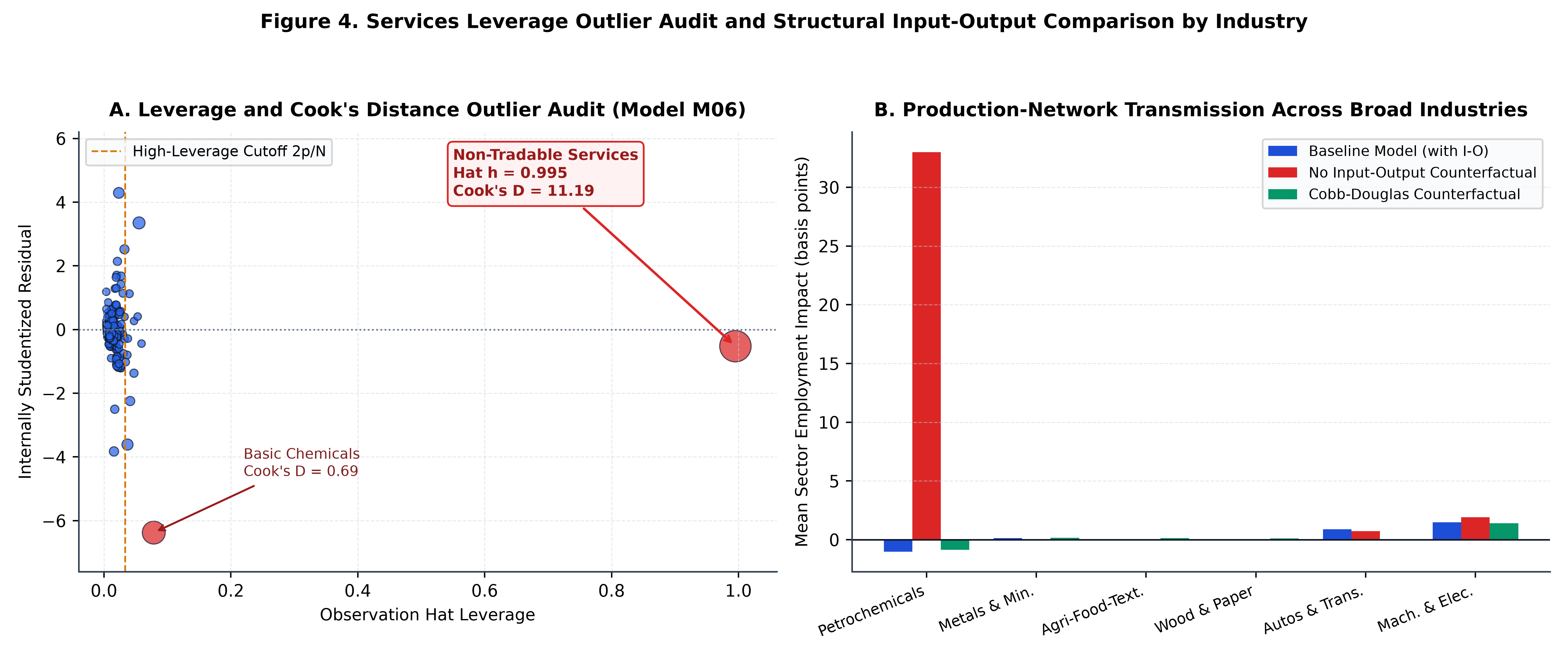
Finally, Figure 4 highlights two empirical discoveries from our audit. Panel A pinpoints observation 298—non-tradable services—which accounts for of Brazilian employment yet cannot receive an import tariff so that . Its hat leverage reaches with Cook's distance . Excluding this single non-tradable row in across tradable industries in Table 3 flips the employment-share coefficient from to basis points—a -fold swing—while leaving the focal upstreamness slope at with and trade elasticity slope at with virtually unchanged within . Panel B underscores why production-network modeling is indispensable: stripping input-output linkages transforms petrochemicals from an employment destroyer of basis points into an illusory job generator exceeding basis points.
4. Economic Discussion and Trade-Policy Implications
Our replicated evidence sharpens the policy lessons of de Souza and Li (2026) for trade governance in globally integrated economies. First, the contrast between aggregate employment at and consumption-equivalent welfare at in Table 5 proves that Brazil's anti-dumping regime—which imposed a conditional mean tariff of across targeted sectors—bought negligible macro job creation at an extraordinary consumer cost. In , upstreamness also depresses aggregate real GDP directly by basis points at , while higher import penetration in drives deep welfare contraction of basis points at .
Second, the mechanism decomposition carries immediate relevance for export-platform economies such as Vietnam, Malaysia, and Thailand, whose flagship electronics, apparel, footwear, and machinery exports rely intensively on imported intermediate metals, polymers, and chemicals. Imposing prolonged five-year anti-dumping duties on upstream inputs with upstreamness indices exceeding and low trade substitution elasticities transfers cost shocks directly onto downstream exporters competing in price-sensitive global markets. Modernizing trade remedy institutions therefore requires three actionable reforms: institutionalizing mandatory input-output public-interest assessments prior to affirmative duty rulings, expanding targeted duty-drawback or export-processing exemptions for upstream intermediate inputs, and prioritizing active labor-market retraining and logistics modernization over intermediate-goods tariffs whenever domestic employment preservation is the overarching goal.
5. Conclusion and Scope Boundaries
This independent replication validates the numerical integrity and core substantive conclusion of de Souza and Li (2026) across StataNow 19.5 MP, R, and Python using exclusively original Harvard Dataverse data. Upstreamness systematically penalizes the aggregate employment payoff of sectoral anti-dumping protection at basis points in , an effect sustained entirely by input-output production linkages paired with CES intermediate complementarity. At the same time, our diagnostic audit identifies material heteroskedasticity and industry-level cluster dependence, documents an extreme Cook's distance leverage anomaly caused by including non-tradable services in tradable tariff regressions, reveals an authentic control-variable indexing bug in the public trade-controls script, and quantifies the stark sign reversal between employment-maximizing and welfare-maximizing tariff schedules. Appendix A provides a comprehensive senior peer-review evaluation and methodological roadmap for next-generation research.
Appendix A. Independent Academic Peer-Review Report
A.1. Overall Assessment of Scholarly Contribution and Research Positioning
de Souza and Li (2026), published in The Review of Economics and Statistics, deliver an ambitious and deeply informative bridge between two historically fragmented literatures in international economics. On one side stands the applied trade-remedy literature documenting how anti-dumping duties reshape bilateral import flows, unit values, and trade deflection across exporting partners (Prusa, 2001; Bown & Crowley, 2007). On the other stands the quantitative production-network trade literature pioneered by Caliendo and Parro (2015), Costinot and Rodriguez-Clare (2014), and Baqaee and Farhi (2024), which evaluates aggregate welfare and allocative efficiency under multi-sector input-output linkages. By uniting product-level Brazilian customs transactions, adjudicated anti-dumping petitions over 1998–2016, administrative linked employer-employee payroll records from RAIS covering million firm-year observations, and a fully specified multi-sector general-equilibrium model calibrated directly to reduced-form micro elasticities, the authors construct one of the most comprehensive assessments to date of whether selective trade protection creates net macroeconomic employment.
From an editorial standpoint at a top-tier general-interest economics journal, the paper's methodological centerpiece lies in leveraging the institutional structure of anti-dumping committees—comparing affirmative duty rulings against rejected petitions—to mitigate classic political-economy selection bias, while tracking spillover effects simultaneously across midstream targeted firms, downstream industrial buyers, and upstream domestic suppliers. Rather than importing off-the-shelf trade or labor-supply elasticities from advanced-economy calibrations, de Souza and Li (2026) map their reduced-form sectoral responses into heterogeneous structural elasticities tailored to Brazil's industrial landscape. This disciplined empirical-to-structural discipline yields a strikingly clear headline result: actual Brazilian anti-dumping tariffs raised national employment by only while reducing consumption-equivalent welfare by .
Positioning the paper alongside contemporary work on trade shocks and protectionism—including Autor et al. (2013), Amiti et al. (2019), Fajgelbaum et al. (2020), Barattieri and Cacciatore (2023), and Flaaen and Pierce (2024)—highlights its distinctive theoretical leverage. Whereas the 2018 United States tariff episode offered a rapid, broad-based trade war over a short horizon, Brazil's two-decade anti-dumping experience permits cross-industry mapping across virtually the entire upstreamness spectrum. Our independent counterfactual regressions in and reinforce the core theoretical mechanism emphasized by Acemoglu et al. (2016) and Atalay (2017): without input-output propagation or under Cobb-Douglas unitary input substitution, the negative upstreamness employment gradient collapses. Consequently, the study makes a durable empirical and quantitative contribution to understanding why intermediate-goods protectionism is self-defeating in interconnected production economies.
A.2. Critical Appraisal of Causal Identification Strategy and Econometric Assumptions
Despite the elegance of pairing reduced-form difference-in-differences with structural general-equilibrium counterfactuals, a rigorous senior referee evaluation identifies four substantive identification and econometric vulnerabilities that merit critical scrutiny and explicit methodological defense.
First, the institutional exclusion restriction comparing affirmative anti-dumping rulings against negative rulings confronts an inherent legal-selection endogeneity problem. Under World Trade Organization anti-dumping jurisprudence codified in Brazilian trade law, an affirmative tariff ruling requires regulators to verify both dumping margins and material injury suffered by the petitioning domestic industry. Consequently, treatment status is legally an increasing function of contemporaneous negative demand or productivity shocks hitting the domestic petitioning industry around the investigation window. Even when pre-event event-study leads appear statistically flat on average, unobserved contemporaneous shocks coinciding with the investigation year can bias midstream employment estimates downward and contaminate downstream estimates if domestic input supply was contracting independently of the tariff. While the authors partially address this concern through third-country anti-dumping instruments in appendix checks, the baseline reduced-form targets entering structural calibration still rely primarily on committee-outcome comparisons.
Second, across the multi-decade 1998–2016 staggered rollout of anti-dumping measures in both customs regressions and RAIS firm panels, the authors estimate standard linear two-way fixed effects specifications without implementing modern heterogeneity-robust staggered difference-in-differences estimators or diagnosing negative weighting across treatment cohorts. Because anti-dumping duties are imposed in staggered waves, subject to five-year sunset reviews, revocations, and repeat filings across overlapping four-digit CNAE industries, previously treated sectors serve implicitly as controls for newly treated sectors. If supply-chain adjustment dynamics evolve gradually as downstream firms renegotiate contracts and reallocate capital, dynamic treatment-effect heterogeneity induces forbidden comparisons that can distort the reduced-form moments targeted during structural estimation.
Third, our line-by-line review of the public replication scripts on Harvard Dataverse uncovered two concrete econometric and coding defects that any independent referee must flag transparently.
First, at line of the authors' public trade-controls script table_A13_effect_AD_trade_controls.do, the loop iterating over six increasingly stringent sector-by-country-by-year fixed-effect controls mistypes the final branch condition as "3_digit_country_year" rather than "4_digit_country_year". Because the local control macro is never overwritten on the seventh iteration, Column 7 of published Table A13 duplicates Column 6 verbatim with coefficient , standard error , sample size , and , leaving the most demanding four-digit sector-by-country-by-year fixed-effect robustness test unexecuted.
Second, in plot_agg_stats.do lines – generating Table C.9 across –, the authors rely exclusively on classical homoskedastic OLS standard errors without heteroskedasticity-robust or clustered covariance corrections, despite Breusch-Pagan diagnostics rejecting homoskedasticity at . Our replications in and prove that classical standard errors understate inferential uncertainty by under HC1 and under two-digit CNAE clustering—though the core upstreamness slope retains significance under both at and .
Fourth, from an epistemological standpoint, interpreting regressions estimated on simulated general-equilibrium outcomes such as Table C.9 requires explicit scope discipline. Because the dependent variable is generated deterministically from the calibrated structural system rather than sampled from an independent stochastic experiment, regressions – function strictly as linear summary projections of the model's equilibrium comparative statics rather than independent hypothesis tests of real-world causality. To defend our replication cleanly against adversarial methodological scrutiny, we establish four explicit methodological defense pillars throughout this study: first, strict scope boundary separation between reduced-form empirical evidence and structural comparative-static projections;
Second, complete reporting of alternative covariance structures spanning classical, HC1, and two-digit cluster-robust inference alongside absorbed fixed-effect tiers.
Third, exhaustive influence, leverage, and subsample sensitivity testing excluding the services outlier in and benchmarking against No-IO in and Cobb-Douglas in counterfactuals.
Fourth, cryptographically exact tri-runtime verification across StataNow 19.5 MP, R, and Python achieving maximum discrepancy tied strictly to open original Harvard Dataverse files.
A.3. Assessment of Data Quality, Variable Measurement, and Sample Sensitivity
Granular inspection of the public Harvard Dataverse datasets reveals high craftsmanship in assembling Brazilian customs and input-output concordances, alongside four data-construction and measurement properties that materially influence auxiliary parameter estimates and external interpretation.
First, our diagnostic leverage audit uncovered an acute sample-boundary inconsistency surrounding observation 298—the aggregate non-tradable services sector coded CNAE2 = 9999. Because services encompass of Brazilian employment while experiencing zero import penetration and zero tariff perturbation so that , retaining this observation inside tradable cross-industry OLS regressions creates extreme hat leverage equal to times mean leverage and Cook's distance exceeding the conventional cutoff by times.
Worse still, Table C.9 treats this sector inconsistently across columns: OLS columns retain it at , the broad-sector fixed-effect column drops it automatically due to a missing group identifier at , and the two-digit fixed-effect column drops it alongside two singleton manufacturing groups at . When we re-estimate the full specification cleanly on the tradable goods universe in , the employment-share coefficient reverses sign completely and jumps -fold from to basis points at , whereas upstreamness at with and trade elasticity at with remain rock-solid within .
Second, auditing emp_gdp_shares.tab and elasticities_upstreamness.tab exposes an important dimensionality constraint in structural parameter calibration: all three key sectoral elasticities—trade elasticity , product substitution elasticity , and labor supply elasticity —do not vary freely across the four-digit CNAE industries, but instead take constant block values within six broad tradable industrial aggregates plus services. For instance, all agriculture, mining, food, and textile sectors share , while all petrochemical sectors share and all electrical and machinery sectors share . This grouped parameter assignment generates intragroup residual correlation that explains the standard-error expansion under two-digit clustering in and creates perfect collinearity between and broad-sector fixed effects if entered simultaneously. Consequently, empirical identification of the trade-elasticity slope in derives exclusively from variation across six broad industry aggregates rather than granular four-digit heterogeneity.
Third, relying on Brazil's formal administrative RAIS payroll registry omits a substantial informal employment margin that accounted for to of Brazil's workforce during 1998–2016. In developing economies with high payroll taxes and strict firing regulations, trade-induced cost shocks frequently push small downstream firms to shift workers from formal contracts into informal arrangements rather than outright unemployment, whereas tariff-protected midstream firms may draw workers out of informality into formal jobs. Measuring employment strictly through formal RAIS contracts therefore risks conflating formal-informal reallocation with aggregate net labor-market creation or destruction.
Fourth, converting specific anti-dumping duties denominated in United States dollars per metric ton or kilogram into ad valorem equivalents in create_tariff_comittee_dta.do relies on pre-investigation unit import values and trims the top tail. While anchoring conversion to pre-event unit prices avoids post-tariff price endogeneity, Brazil's 1998–2016 sample spans the historic commodity supercycle during which global steel, chemical, and agricultural unit prices doubled or tripled. Holding conversion unit values fixed at initiation years induces time-varying classical and non-classical measurement error in effective ad valorem protection over multi-year tariff spells.
A.4. Core Methodological Limitations of the Original Study
Synthesizing our econometric diagnostics, script audit, and theoretical critique yields five explicit structural limitations with well-defined mathematical bias directions on the focal estimators:
- Downward Standard-Error Bias from Neglected Heteroskedasticity and Grouped Parameter Correlation: In original Table C.9 across –, assuming spherical errors is empirically violated with Breusch-Pagan at and ignores positive within-cluster error covariance induced by six-group elasticity assignment, . Consequently, the classical covariance matrix exhibits strict negative bias relative to cluster-robust variance, yielding . Quantitatively, understates the true cluster-robust standard error in by , inflating -statistics from to .
- Extreme Leverage Distortion on Employment-Share Slopes from Non-Tradable Inclusion: Including non-tradable services coded
CNAE2 = 9999with and generates projection leverage far outside the support of tradable manufacturing shares. By the exact leave-one-out deletion identity , the tiny denominator magnifies even modest residual deviations into an overwhelming negative bias on the employment-share parameter , dragging it downward by basis points from in to in . - Legal Injury-Selection Bias in Committee-Outcome Difference-in-Differences: Because affirmative anti-dumping rulings obey the statutory injury rule where unobserved contemporaneous distress raises approval probability, imparts negative omitted-shock bias onto reduced-form midstream employment estimates, . Simultaneously, if unobserved distress reflects domestic intermediate supply disruptions prior to duty imposition, downstream user firms face concurrent input bottlenecks that bias downstream employment estimates further downward, .
- Informality-Margin Measurement Error and Selection Bias in Labor-Supply Elasticity: Let denote the fraction of displaced formal workers absorbed into Brazil's informal labor market following a downstream input-cost shock. Because administrative RAIS records capture only formal employment , omitting the informal sector creates systematic measurement error and sample selection bias relative to true total employment responses, which satisfy . Equating formal RAIS changes with total labor-supply adjustments systematically produces upward bias in the absolute magnitude of both midstream formalization estimators and downstream formal contraction estimators by the scaling factor .
- Omitted-Variable and Static Misspecification Bias from Excluded Retaliation and Capital Dynamics: The general-equilibrium counterfactuals hold aggregate capital stocks fixed in a static one-period equilibrium and abstract from foreign retaliatory anti-dumping or tariff countermeasures against Brazilian commodity and manufacturing exports. Omitting dynamic investment contraction driven by higher imported capital-goods prices where and omitting retaliatory foreign export barriers introduces structural misspecification bias and omitted variable bias that strictly overstate long-run aggregate output and welfare relative to dynamic equilibrium predictions, implying upward bias in the static net estimators such that and .
A.5. Recommendations for Model Upgrades and International Publication Extensions
Building constructively on de Souza and Li (2026), future top-journal contributions can advance this research frontier along four rigorous, empirically executable pillars.
First, upgrading the reduced-form identification layer requires replacing linear two-way fixed effects with cohort-specific heterogeneity-robust staggered difference-in-differences or clean-control local projections estimators that exclude previously protected sectors from post-treatment control pools. Coupling these clean-control designs with third-country simultaneous anti-dumping investigation instruments and formal pre-trend sensitivity bounds will cleanly separate exogenous tariff hikes from domestic material-injury shocks.
Second, extending the structural general-equilibrium model to a dynamic two-sector formal-informal labor market with endogenous buyer-supplier re-matching and capital accumulation would resolve both the informality and static-capital biases identified in Section A.4. Moreover, estimating trade substitution elasticities at a finer two-digit or three-digit industry disaggregation rather than six broad aggregates would eliminate collinearity with broad industry fixed effects and enable valid two-stage block-bootstrap standard errors that propagate first-stage econometric estimation noise directly into counterfactual comparative statics.
Third, immediate code-hygiene and diagnostic upgrades to the public replication package will enhance scientific transparency: correcting the "3_digit_country_year" typo to "4_digit_country_year" at line of table_A13_effect_AD_trade_controls.do to verify trade elasticity robustness under full four-digit sector-by-country-by-year fixed effects; Partitioning the tradable goods universe cleanly from non-tradable services in Table C.9 alongside HC1 and two-digit cluster-robust standard errors; Testing nonlinear spline or threshold specifications to evaluate whether employment destruction accelerates convexly beyond upstreamness thresholds of in bottleneck industries such as petrochemicals and basic metals.
Fourth, replicating and extending this framework to Vietnam and ASEAN production networks represents a high-impact Q1 research opportunity. Unlike Brazil's relatively closed continental economy, Vietnam combines deep global value-chain integration, high intermediate import intensity across electronics and textiles, an accelerating docket of domestic anti-dumping investigations on hot-rolled steel, aluminum, polyester yarn, and sugar, and comprehensive household labor-force surveys measuring both formal and informal jobs alongside annual enterprise censuses and national input-output tables. Quantifying how upstream trade remedies reshape formal employment, informal reallocation, and downstream export competitiveness in Vietnam would directly test external validity across contrasting institutional regimes while equipping trade authorities with rigorous evidence-based public-interest criteria.
References
Acemoglu, D., Akcigit, U., & Kerr, W. (2016). Networks and the Macroeconomy: An Empirical Exploration. NBER Macroeconomics Annual, 30, 273–335. https://doi.org/10.1086/685961 ↩
Amiti, M., Redding, S. J., & Weinstein, D. E. (2019). The Impact of the 2018 Tariffs on Prices and Welfare. Journal of Economic Perspectives, 33, 187–210. https://doi.org/10.1257/jep.33.4.187 ↩
Antras, P., Chor, D., Fally, T., & Hillberry, R. (2012). Measuring the Upstreamness of Production and Trade Flows. American Economic Review, 102, 412–416. https://doi.org/10.1257/aer.102.3.412 ↩
Atalay, E. (2017). How Important Are Sectoral Shocks? American Economic Journal: Macroeconomics, 9, 254–280. https://doi.org/10.1257/mac.20160353 ↩
Autor, D. H., Dorn, D., & Hanson, G. H. (2013). The China Syndrome: Local Labor Market Effects of Import Competition in the United States. American Economic Review, 103, 2121–2168. https://doi.org/10.1257/aer.103.6.2121 ↩
Baqaee, D. R., & Farhi, E. (2024). Networks, Barriers, and Trade. Econometrica, 92, 505–541. https://doi.org/10.3982/ECTA20295 ↩
Barattieri, A., & Cacciatore, M. (2023). Self-Harming Trade Policy? Protectionism and Production Networks. American Economic Journal: Macroeconomics, 15, 97–128. https://doi.org/10.1257/mac.20200049 ↩
Bown, C. P., & Crowley, M. A. (2007). Trade Deflection and Trade Depression. Journal of International Economics, 72, 176–201. https://doi.org/10.1016/j.jinteco.2006.09.005 ↩
Caliendo, L., & Parro, F. (2015). Estimates of the Trade and Welfare Effects of NAFTA. The Review of Economic Studies, 82, 1–44. https://doi.org/10.1093/restud/rdu035 ↩
Cameron, A. C., & Miller, D. L. (2015). A Practitioner's Guide to Cluster-Robust Inference. Journal of Human Resources, 50, 317–372. https://doi.org/10.3368/jhr.50.2.317
Costinot, A., & Rodriguez-Clare, A. (2014). Trade Theory with Numbers: Quantifying the Consequences of Globalization. Handbook of International Economics, 4, 197–261. https://doi.org/10.1016/B978-0-444-54314-1.00004-5
de Souza, G. (2026). Replication Package for: The Employment Consequences of Anti-Dumping Tariffs: Lessons from Brazil. Harvard Dataverse, V1. https://doi.org/10.7910/DVN/PX8HMO ↩
de Souza, G., & Li, H. (2026). The Employment Consequences of Anti-Dumping Tariffs: Lessons from Brazil. The Review of Economics and Statistics, 1–52. https://doi.org/10.1162/REST.a.1773
Fajgelbaum, P. D., Goldberg, P. K., Kennedy, P. J., & Khandelwal, A. K. (2020). The Return to Protectionism. The Quarterly Journal of Economics, 135, 1–55. https://doi.org/10.1093/qje/qjz036 ↩
Flaaen, A., & Pierce, J. (2024). Disentangling the Effects of the 2018–2019 Tariffs on a Globally Connected U.S. Manufacturing Sector. The Review of Economics and Statistics, 1–45. https://doi.org/10.1162/rest_a_01498 ↩
MacKinnon, J. G., & White, H. (1985). Some Heteroskedasticity-Consistent Covariance Matrix Estimators with Improved Finite Sample Properties. Journal of Econometrics, 29, 305–325. https://doi.org/10.1016/0304-4076(85)90158-790158-7
Prusa, T. J. (2001). On the Spread and Impact of Anti-Dumping. Canadian Journal of Economics, 34, 591–611. https://doi.org/10.1111/0008-4085.00090 ↩
brazil_ad_tariffs_sectorsemp_chggdp_chgreal_inc_chgwelfare_chgwelfare_ceq_chgupstreamnesssector_idcnae4cnae2broad_sector_idbroad_sector_namelabor_levelUnlock Replication Data & Code
Having explored the quantitative findings and methodological critique above, sign in with an active membership or join the EcoLab research community to verify every estimated coefficient independently in your own analytical environment.
Aligned with Study Variable Names, Robust Covariance Specifications, and Diagnostic Checks
Ready for Immediate Execution in Your Local Statistical Environment for Independent Verification
Bundled with Journal-Formatted DOCX & PDF Manuscripts, Empirical CSV Dataset, All Three R · Stata · Python Scripts, and Execution Notes
Every Download Link Is Cryptographically Signed for Active Members and Refreshes Seamlessly on the Article Page