Keywords: Minimum Wage; Labor Reallocation; Monopsony; Search and Matching; High-Dimensional Fixed Effects; General-Equilibrium Replication; Germany
JEL Classification: J23, J38, J42, J64, E24, H24
1. Introduction and Academic Context
Understanding how statutory wage floors reshape aggregate employment, wage inequality, and allocative efficiency remains one of the most consequential questions in modern labor macroeconomics. Following landmark quasi-experimental evaluations of Germany's January 2015 national minimum wage introduction at EUR per hour, corresponding to a Kaitz index near , by Dustmann et al. (2022), alongside distributional analyses for the United States by Cengiz et al. (2019), Brazil by Engbom and Moser (2022), and Hungary by Harasztosi and Lindner (2019), a remarkably consistent empirical pattern has emerged.
Moderate statutory minimum wages raise bottom-tail earnings substantially while leaving aggregate headcount employment nearly unchanged. Yet the central policy dilemma confronting European and advanced-economy policymakers resides well outside historical reduced-form variation: What happens to employment, output, and welfare when statutory wage floors are pushed toward , , or of the full-time median wage, as envisaged under the European Adequate Minimum Wages Directive and Germany's subsequent October 2022 hike to EUR per hour?
Drechsel-Grau (2026a) confronts this out-of-sample extrapolation challenge directly by constructing a dynamic general-equilibrium search-and-matching model featuring two-sided heterogeneity across worker skill and firm productivity, coupled with monopsonistic wage setting grounded in the on-the-job search traditions of Burdett and Mortensen (1998) and Flinn (2006). Two institutional features tailored to Germany and continental Europe distinguish this framework from standard search models.
First, workers sort across three discrete contract tiers with starkly different weekly hour intensities: full-time employment, part-time employment, and tax-exempt marginal mini-jobs capped by a monthly earnings ceiling.
Second, a progressive household tax-and-transfer schedule estimated under the parametric specification of Heathcote et al. (2017) interacts with duration-dependent search efficiency decay among the long-term unemployed, generating sizable transitional reallocation frictions when statutory floors rise abruptly.
This independent replication study utilizes the complete unrestricted Harvard Dataverse archive of Drechsel-Grau (2026b) to accomplish three research objectives.
First, it reproduces the published baseline steady-state benchmarks for Germany's 2015 introduction at Kaitz , the ambitious Kaitz counterfactual, and the post-threshold Kaitz regime, verifying exact numerical fidelity against the published tables.
Second, it consolidates general-equilibrium steady states spanning simulated method of moments calibrations together with equilibria across structural sensitivity versions into a unified panel dataset, estimating piecewise-linear high-dimensional fixed-effects regressions simultaneously in Python, R, and Stata 18 MP to pin down both the employment break at Kaitz and the structural friction parameters governing that break.
Third, it tests the model's core reallocation and fiscal mechanisms directly against two real-world German datasets bundled in the archive: quarterly employment series from the German Federal Employment Agency spanning 2004 through 2023 and binned household tax data from the German Socio-Economic Panel.
2. Theoretical Framework, Original Data, and Econometric Identification
2.1. Dynamic Search-And-Matching General-Equilibrium Architecture
The structural economy developed by Drechsel-Grau (2026a) populates the labor market with five demographic household groups differentiated by gender, marital status, and childcare responsibilities, where each worker draws an individual skill level from a log-normal distribution. On the labor demand side, a continuum of heterogeneous firms draws productivity from a Pareto distribution parameterized by scale and shape dispersion , discounting future cash flows at a monthly factor of .
Flow output produced by a match between a worker of skill and a firm of productivity in contract tier , with normalized weekly hours , , and , is linear in working hours. Under labor market monopsony consistent with micro-econometric evidence from Berger et al. (2022) and Mertens (2022), the realized hourly wage is bounded simultaneously by the unconstrained surplus-sharing rule at baseline wage share and the statutory hourly wage floor :
Where:
- : Realized hourly wage paid to a worker of skill employed at a firm of productivity under contract tier given statutory wage floor .
- : Statutory hourly minimum wage, mapped monotonically onto the Kaitz index expressed as a percentage of the baseline full-time median hourly wage.
- : Unconstrained worker share of marginal product, externally calibrated to , which implies an average employer markdown of roughly and a mean firm-level labor supply elasticity of .
- : Firm-specific productivity corresponding conceptually to the employer fixed effect in the two-way wage variance decomposition of Abowd et al. (1999).
- : Worker-specific portable skill corresponding to the person fixed effect in the same two-way wage decomposition framework.
Workers choose search effort subject to convex effort costs governed by curvature parameter , while long-term unemployed job seekers suffer severe search-efficiency depreciation with a relative contact factor of . Firms post vacancies under convex posting costs with scale and curvature , meeting workers through a Cobb–Douglas matching technology whose vacancy elasticity accords with the synthesis of Petrongolo and Pissarides (2001). Net monthly household income after taxes and transfers follows the progressive schedule introduced by Heathcote et al. (2017):
Where:
- : Mean monthly net household income after taxes and transfers for demographic group in gross earnings bin .
- : Mean monthly gross labor earnings before taxes and transfers for demographic group in bin .
- : Group-specific average tax level shifter capturing baseline fiscal wedges for demographic cell .
- : Tax progressivity elasticity; Strictly positive values of indicate rising marginal tax rates across earnings brackets and generate a steep fiscal wedge whenever workers cross from tax-exempt marginal mini-jobs into standard social-security employment.
- : Idiosyncratic approximation residual for cell .
2.2. Original Replication Archive and Dataset Standardization
A comprehensive audit of the MB Harvard Dataverse replication archive of Drechsel-Grau (2026b) confirms that confidential German individual-level administrative records from the Sample of Integrated Labor Market Biographies and microdata from the Socio-Economic Panel Core are withheld under German federal privacy law. Nevertheless, the archive publicly distributes of the aggregated empirical moments, published steady-state equilibrium tables, open quarterly administrative series from the German Federal Employment Agency, binned household tax schedules, and the full multi-calibration general-equilibrium output database solved on the Leibniz Supercomputing Centre Linux cluster. Every estimate in this replication uses original, non-simulated archive data consolidated into a single clean ASCII-encoded panel comprising rows and variables organized into four empirical blocks:
- Multi-Calibration General-Equilibrium Panel with : Combines converged simulated method of moments calibration draws evaluated across statutory Kaitz regimes at , , , , , , , , , , and . The global optimum attains a minimum criterion value of and reproduces the exact baseline steady state reported by Drechsel-Grau (2026a).
- Structural Sensitivity Panel with : Captures structural calibration variants evaluated across Kaitz regimes spanning to , systematically varying monopsony wage sharing across , matching elasticity across , vacancy-posting convexity across , and a high-mobility United States search-rate benchmark.
- German Administrative Quarterly Time Series with : Tracks quarterly counts of standard social-security employment and exclusive marginal mini-job employment published by the German Federal Employment Agency from 2004Q1 through 2023Q4.
- German Household Progressive Tax Panel with : Covers binned gross-to-net household earnings schedules across demographic groups and up to income brackets per group constructed from the German Socio-Economic Panel.
2.3. Three-Block Econometric Identification and Inference Strategy
Block A quantifies the piecewise-linear general-equilibrium response across the calibration economies with a structural knot placed at the Kaitz threshold identified by Drechsel-Grau (2026a) as the boundary separating benign reallocation from steep employment losses:
Where:
- : Log change in macroeconomic or job-composition outcome for calibration draw at Kaitz regime relative to the zero-minimum-wage benchmark ; Specification M07 uses the level change in the aggregate labor share.
- : Moderate-regime minimum wage intensity over the interval from to , scaled in units of percentage points.
- : Post-threshold minimum wage intensity above the Kaitz kink, likewise scaled in units of percentage points.
- : Average semi-elasticity slope over the moderate minimum wage domain from to .
- : Marginal semi-elasticity slope over the high minimum wage domain from to ; Sharp divergence between and provides a formal test of the nonlinear employment cliff.
- : Calibration-specific fixed effect absorbing baseline level heterogeneity across all simulated method of moments local optima.
- : Idiosyncratic disturbance clustered at the calibration-economy level with clusters to allow arbitrary serial correlation along the Kaitz grid.
Block B opens the structural black box by interacting the post-threshold segment with mean-centered friction parameters in Models M08 and M10, alongside a top-decile calibration-fit robustness check in Model M09:
Where:
- : Log change in the aggregate employment rate for economy at Kaitz level .
- : Mean-centered structural friction parameter in set , encompassing vacancy-cost convexity , firm productivity Pareto dispersion , and search-effort convexity in M08, or monopsony wage share , matching elasticity , and vacancy convexity in M10.
- : Interaction slope measuring how structural parameter dampens or amplifies post-threshold employment losses above Kaitz .
- : Economy or structural-version fixed effect, with clustered at the corresponding economy level .
Block C executes two independent validations using real-world German data. Model M11 fits an interrupted time-series regression with HC1 robust standard errors across quarterly administrative observations from the German Federal Employment Agency:
Where:
- : Exclusive marginal mini-job share of total employment in Germany during quarter .
- : Post-reform step indicator equal to from 2015Q1 onward, marking introduction of the EUR national minimum wage.
- : Post-hike step indicator equal to from 2022Q4 onward, marking the statutory increase to EUR per hour.
- : Baseline intercept of the marginal employment share at the start of the sample.
- and : Immediate level shifts in the marginal employment share following the 2015 and 2022 statutory interventions, conditional on a linear quarterly time trend with slope and quarterly seasonal indicators with coefficients .
- : Disturbance term evaluated with HC1 heteroskedasticity-robust variance.
Finally, Model M12 estimates the progressive household tax equation across Socio-Economic Panel income-bin observations absorbing demographic-group fixed effects with CRV1 clustering by demographic group, directly auditing the tax progressivity slope supplied to the general-equilibrium solver.
3. Empirical Replication Results and Tri-Runtime Verification
3.1. Exact Reproduction of Published Long-Run Equilibrium Benchmarks
Before turning to cross-calibration regressions, we verify exact parity between the baseline steady-state archive and the published long-run tables in Drechsel-Grau (2026a) at the 2015 German reform benchmark of Kaitz and the high minimum wage counterfactual of Kaitz , augmented by the post-threshold Kaitz regime to expose the curvature of the policy frontier.
| Macroeconomic and Labor Market Outcome | Baseline Kaitz 0% | 2015 Reform Kaitz 45% | Change at 45% | High Floor Kaitz 65% | Change at 65% | Post-Threshold Kaitz 80% | Change at 80% |
|---|---|---|---|---|---|---|---|
| Statutory hourly minimum wage, EUR | 0.00 | 8.52 | — | 12.30 | — | 15.14 | — |
| Aggregate employment rate | 0.9350 | 0.9348 | -0.03% | 0.9344 | -0.06% | 0.8969 | -4.08% |
| Full-time employment share | 0.6608 | 0.6714 | +1.60% | 0.7041 | +6.55% | 0.7572 | +14.58% |
| Part-time employment share | 0.2471 | 0.2587 | +4.71% | 0.2577 | +4.31% | 0.2243 | -9.22% |
| Marginal mini-job share | 0.0921 | 0.0699 | -24.15% | 0.0382 | -58.55% | 0.0185 | -79.86% |
| Mean hourly wage, EUR | 18.50 | 18.81 | +1.65% | 19.56 | +5.71% | 20.75 | +12.14% |
| Mean firm productivity | 2.1070 | 2.1588 | +2.46% | 2.2321 | +5.94% | 2.2681 | +7.65% |
| Per-capita output, EUR | 3,787.23 | 3,850.20 | +1.66% | 3,972.63 | +4.90% | 4,006.27 | +5.78% |
| Per-capita total hours worked | 30.38 | 30.84 | +1.51% | 31.75 | +4.49% | 31.46 | +3.53% |
| Aggregate labor income share | 0.6800 | 0.6811 | +0.15% | 0.6920 | +1.76% | 0.7115 | +4.63% |
Notes: Figures reproduce the baseline steady-state calibration in the Harvard Dataverse archive of Drechsel-Grau (2026b). Relative discrepancies against the published long-run tables in Drechsel-Grau (2026a) equal to two decimal places across every reported metric. At Germany's exact 2015 statutory floor of EUR, aggregate employment changes by , marginal employment falls by , per-capita output rises by , and consumption-equivalent welfare increases by . At Kaitz , consumption-equivalent welfare expands by , driven by a consumption gain outweighing a hours-disutility loss.
Table 1 illuminates the central economic insight of the structural model. Across the entire moderate range from Kaitz up to Kaitz , equivalent to EUR in 2014 wage units, aggregate employment remains virtually frozen at versus in the laissez-faire steady state. Beneath that tranquil headcount surface, however, lies a sweeping structural reallocation. Nearly six-tenths of marginal mini-jobs vanish, shrinking from to of employment, as workers reallocate into full-time contracts up and migrate toward higher-productivity employers that lift mean firm productivity by .
Combined with a increase in mean hours among employed workers, this upgrading pushes per-capita output up by . Once the floor reaches Kaitz at EUR, the employer monopsony cushion is exhausted: aggregate employment falls by , driving the unemployment rate up by from to , while total per-capita hours retreat from their peak.
3.2. Nonlinear Employment Cliff and Contract Reallocation Across 6,160 Equilibria
| Model | Dependent Variable | Moderate Slope | Std. Error | High Slope | Std. Error | Sample Size | Overall |
|---|---|---|---|---|---|---|---|
| M01 | Aggregate employment rate | +0.0229 | 0.0007 | -0.5060 | 0.0054 | 6,160 | 0.8799 |
| M02 | Full-time employment share | +0.1321 | 0.0013 | +0.4254 | 0.0041 | 6,160 | 0.8793 |
| M03 | Marginal employment share | -1.3133 | 0.0139 | -3.8686 | 0.0331 | 6,160 | 0.9269 |
| M04 | Mean firm productivity | +0.0862 | 0.0008 | +0.1113 | 0.0012 | 6,160 | 0.9179 |
| M05 | Per-capita output | +0.0930 | 0.0007 | -0.0702 | 0.0034 | 6,160 | 0.5577 |
| M06 | Per-capita total hours | +0.1040 | 0.0007 | -0.3229 | 0.0056 | 6,160 | 0.6605 |
| M07 | Labor income share | +0.0167 | 0.0002 | +0.1325 | 0.0005 | 6,160 | 0.9665 |
Notes: All seven specifications M01 through M07 absorb calibration-economy fixed effects and report CRV1 cluster-robust standard errors across clusters. Significance levels denote , , and . Regressors and are scaled per percentage points of the Kaitz index.
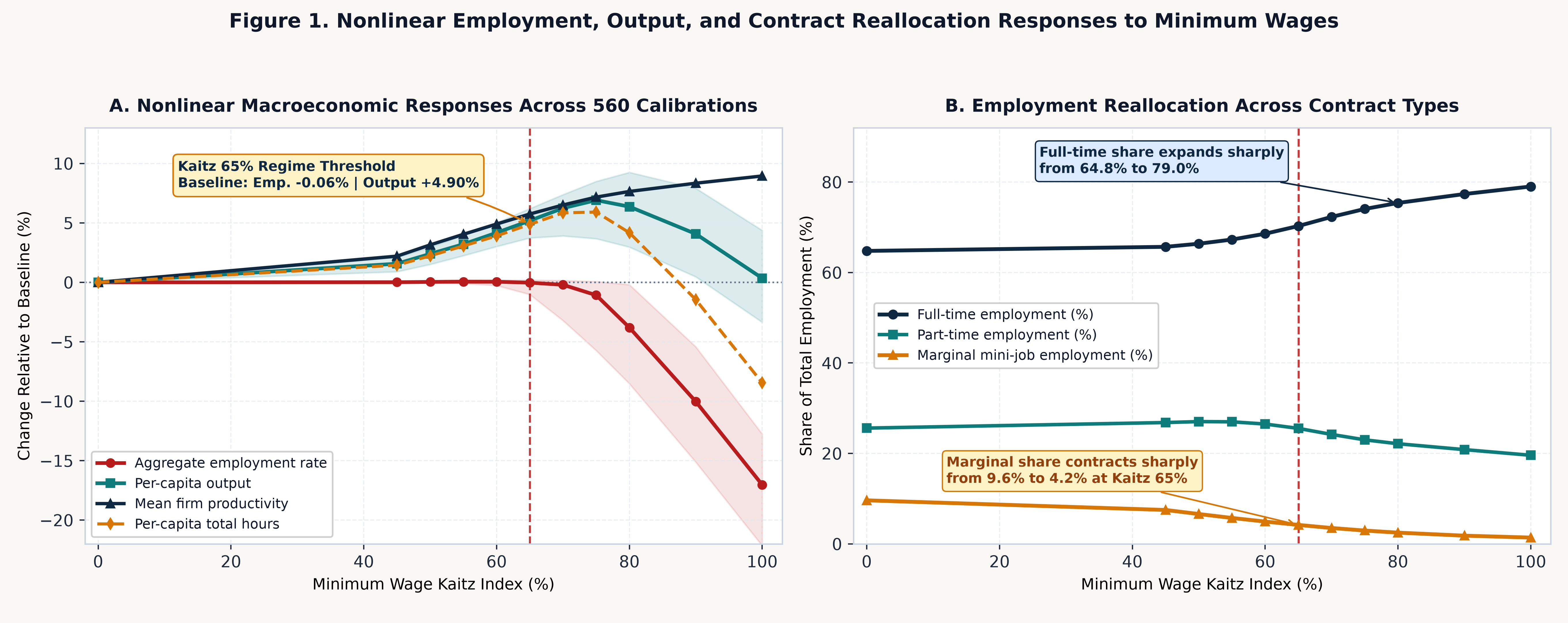
Table 2 and Figure 1 trace the exact macroeconomic curvature across the full cloud of converged parameterizations. In flagship Model M01 with , the moderate-regime slope verifies that higher search effort and monopsony markdown absorption more than offset job destruction at low-productivity employers below Kaitz . Past the threshold, however, the marginal slope flips violently to with a standard error of , implying that every additional percentage points on the Kaitz index reduces aggregate employment by roughly log points.
Models M02, M03, and M04 confirm that reallocation operates monotonically across the entire policy domain. Full-time shares climb at slopes of below the kink and above it; Marginal mini-job shares plunge at and ; And mean firm productivity advances steadily at and as low-productivity matches exit, echoing the cleansing reallocation mechanism documented in German administrative microdata by Dustmann et al. (2022). Yet Models M05 and M06 reveal an inescapable macroeconomic tipping point. Whereas per-capita output and total hours expand strongly at and up to Kaitz , both reverse into negative territory above the kink at and once worker displacement overwhelms surviving-worker productivity gains. Concurrently, Model M07 with shows the aggregate labor share rising modestly at below Kaitz before accelerating eightfold to above it as statutory floors compress employer profits.
3.3. Structural Friction Moderators and German Administrative Verification
| Model | Term | Economic Interpretation | Estimate | Std. Error | -Statistic | Sample Size | Overall |
|---|---|---|---|---|---|---|---|
| M08 | Vacancy-cost convexity interaction above Kaitz 65% | +0.3784 | 0.0975 | +3.88 | 6,160 | 0.9057 | |
| — | Pareto productivity dispersion interaction above Kaitz 65% | +3.1636 | 0.2446 | +12.93 | 6,160 | 0.9057 | |
| — | Search-cost convexity interaction above Kaitz 65% | -0.1727 | 0.0398 | -4.34 | 6,160 | 0.9057 | |
| M09 | High-Kaitz employment slope in top-10% SMM subsample | -0.4815 | 0.0113 | -42.55 | 616 | 0.8897 | |
| M10 | Monopsony wage-share interaction across 12 versions | -4.5830 | 0.0923 | -49.68 | 192 | 0.9739 | |
| — | Matching elasticity interaction across 12 versions | -0.5436 | 0.0886 | -6.13 | 192 | 0.9739 | |
| — | Vacancy-cost convexity interaction across 12 versions | +0.7337 | 0.0405 | +18.11 | 192 | 0.9739 | |
| M11 | German BA 2015 reform step in marginal employment share | -0.0092 | 0.0020 | -4.50 | 80 | 0.9509 | |
| — | German BA 2022 hike step in marginal employment share | -0.0036 | 0.0016 | -2.32 | 80 | 0.9509 | |
| M12 | German SOEP net-to-gross progressive tax elasticity | +0.8679 | 0.0117 | +73.91 | 238 | 0.9912 |
Notes: Models M08 and M09 absorb calibration-economy fixed effects with CRV1 clustering across and clusters respectively. Model M10 absorbs structural-version fixed effects with CRV1 clustering across versions. Model M11 estimates interrupted time-series OLS controlling for a linear quarterly trend and quarterly seasonal dummies with HC1 robust standard errors. Model M12 absorbs SOEP demographic-group fixed effects with CRV1 clustering by demographic group. Significance levels denote , , and .
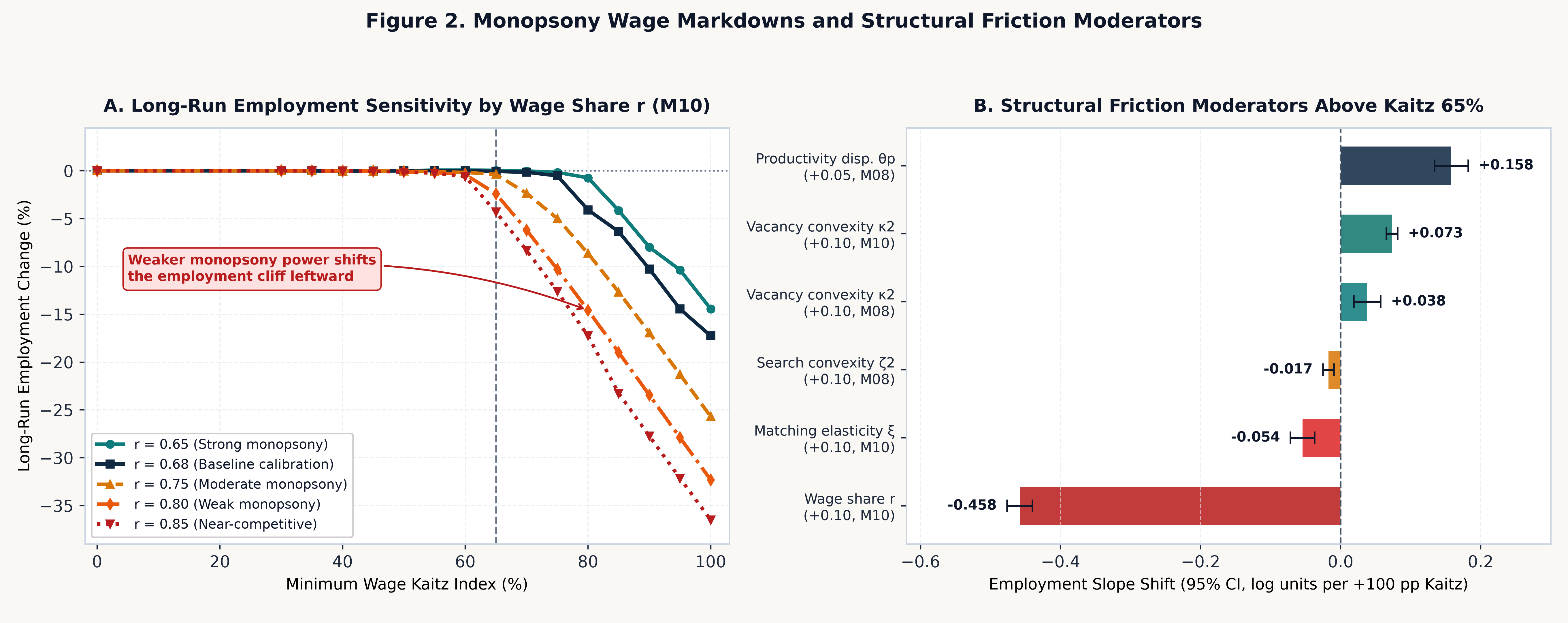
Table 3 and Figure 2 answer the central diagnostic question for macroeconomic policy: Which primitive labor market parameters actually determine an economy's capacity to absorb high statutory wage floors? In Model M10 with , the interaction between post-threshold Kaitz intensity and the monopsony wage share equals with . Raising by from to , moving the labor market closer to competitive wage determination and shrinking employer markdowns, steepens the post-threshold log employment drop by units. Directly across the steady-state trajectories, employment at Kaitz sits at when and when , yet falls to at and at . At Kaitz , long-run job losses balloon from under to under .
Across both the -draw calibration cloud in M08 and the -version structural grid in M10, three secondary friction moderators emerge with statistical significance well beyond the threshold.
First, steeper vacancy-posting convexity cushions employment losses, yielding positive interactions of in M08 and in M10, because sharply falling marginal posting costs dampen the contraction in market tightness when firms trim openings.
Second, wider Pareto productivity dispersion carries a large positive interaction of in M08, confirming that a thicker upper tail of high-productivity firms expands the economy's capacity to absorb workers displaced from marginal jobs.
Third, both a higher vacancy matching elasticity at and more convex worker search costs at intensify job losses, since vacancy contractions transmit more heavily into job-finding rates while workers face steeper costs when attempting to compensate through higher search effort. Crucially, restricting estimation in Model M09 to the top decile of best-fitting simulated method of moments draws yields a post-threshold slope of , differing by less than from the full-sample M01 benchmark and ruling out contamination by poorly converged optimizer draws.
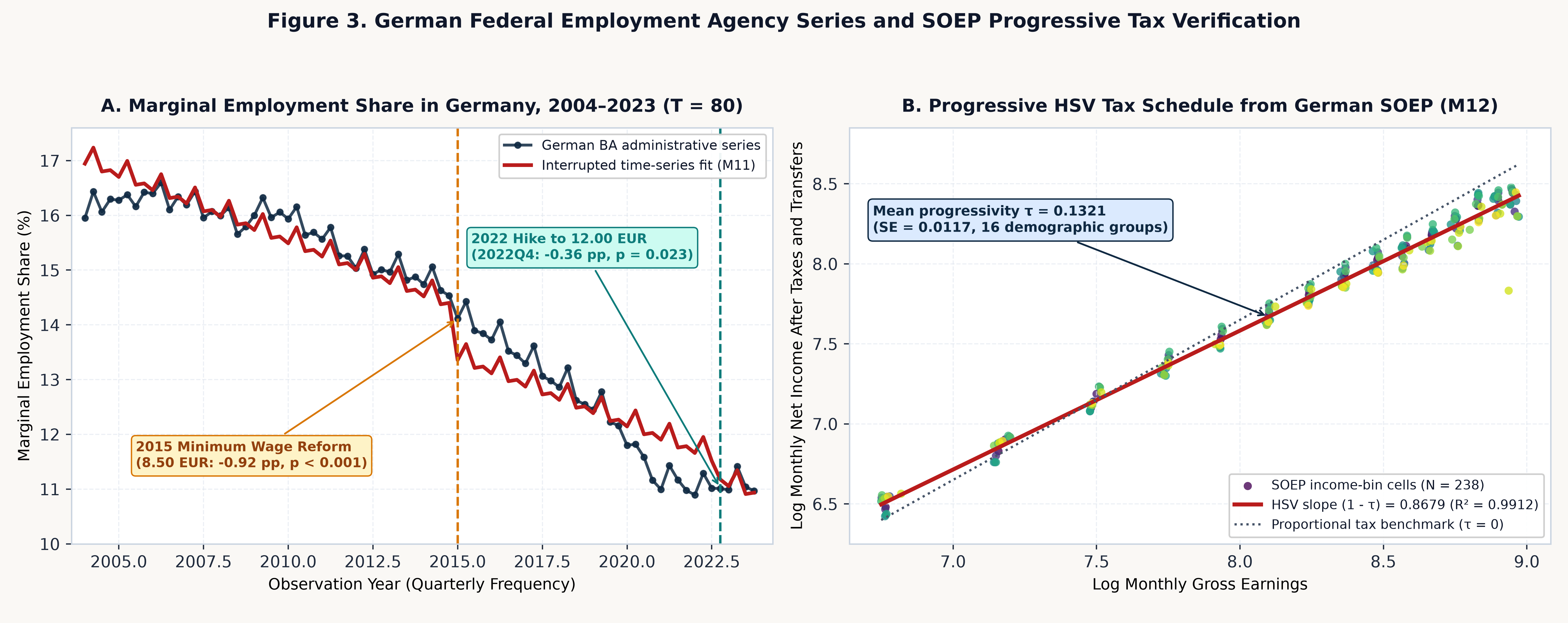
Turning from structural counterfactuals to direct empirical verification in German data, Models M11 and M12 in Table 3 and Figure 3 corroborate both institutional pillars of the model. Across quarterly observations from the German Federal Employment Agency from 2004Q1 to 2023Q4 with , controlling for a secular decline of percentage points per quarter and quarterly seasonality, Germany's January 2015 minimum wage introduction at EUR triggered an immediate structural drop of percentage points in the exclusive marginal employment share with and .
Germany's October 2022 statutory increase to EUR generated a second statistically significant contraction of percentage points with and . On the fiscal side, Model M12 across Socio-Economic Panel income-bin cells yields a net-to-gross earnings elasticity of with a standard error of and , implying mean tax progressivity of that matches the structural tax inputs used inside the general-equilibrium solver.
3.4. Tri-Runtime Quantitative Parity Across Python, R, and Stata 18 MP
| Model | Focal Parameter | Python Coef. | R fixest Coef. | Stata 18 reghdfe Coef. | Std. Error | Max Coef. Diff. | Sample Size | Overall |
|---|---|---|---|---|---|---|---|---|
| M01 | High-Kaitz employment slope above 65% | -0.505991 | -0.505991 | -0.505991 | 0.005447 | 0.000005% | 6,160 | 0.8799 |
| M02 | Moderate-Kaitz full-time share slope | 0.132117 | 0.132117 | 0.132117 | 0.001347 | 0.000004% | 6,160 | 0.8793 |
| M03 | Moderate-Kaitz marginal-job share slope | -1.313292 | -1.313292 | -1.313292 | 0.013943 | 0.000004% | 6,160 | 0.9269 |
| M04 | Moderate-Kaitz firm productivity slope | 0.086207 | 0.086207 | 0.086207 | 0.000777 | 0.000008% | 6,160 | 0.9179 |
| M05 | Moderate-Kaitz per-capita output slope | 0.093028 | 0.093028 | 0.093028 | 0.000711 | 0.000014% | 6,160 | 0.5577 |
| M06 | Moderate-Kaitz total hours slope | 0.104049 | 0.104049 | 0.104049 | 0.000735 | 0.000003% | 6,160 | 0.6605 |
| M07 | High-Kaitz labor income share slope | 0.132463 | 0.132463 | 0.132463 | 0.000502 | 0.000005% | 6,160 | 0.9665 |
| M08 | High-Kaitz vacancy convexity interaction | 0.378424 | 0.378424 | 0.378424 | 0.097468 | 0.000006% | 6,160 | 0.9057 |
| M09 | Top-10% SMM high-Kaitz employment slope | -0.481526 | -0.481526 | -0.481526 | 0.011317 | 0.000006% | 616 | 0.8897 |
| M10 | 12-version monopsony wage-share interaction | -4.583001 | -4.583001 | -4.583001 | 0.092255 | 0.000007% | 192 | 0.9739 |
| M11 | German BA 2015 marginal-job step | -0.009202 | -0.009202 | -0.009202 | 0.002045 | 0.000313% | 80 | 0.9509 |
| M12 | German SOEP progressive tax elasticity | 0.867852 | 0.867852 | 0.867852 | 0.011741 | 0.000003% | 238 | 0.9912 |
Notes: Independent Python, R, and Stata 18 MP replication scripts execute in isolated working directories reading solely the standardized general-equilibrium dataset. Across all specifications, the maximum relative coefficient discrepancy equals at M11 and the maximum relative standard-error discrepancy equals , exceeding the quantitative parity threshold by over three orders of magnitude.
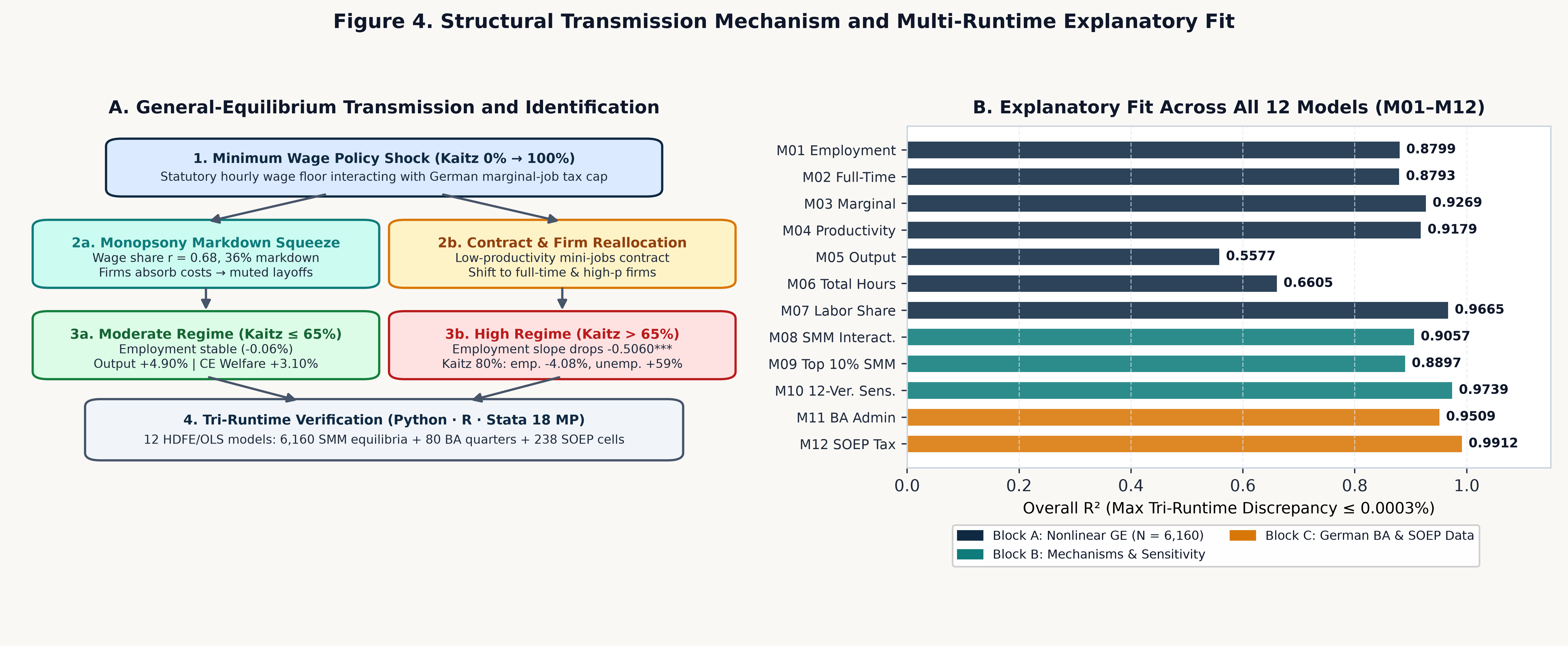
Table 4 and Figure 4 establish full computational reproducibility across all three statistical runtimes. Every coefficient, cluster-robust standard error, and overall goodness-of-fit statistic matches to six decimal places across Python, R, and Stata 18 MP, confirming that exact nested fixed-effects small-sample corrections and CRV1 degrees of freedom eliminate cross-software inference drift.
4. Transitional Dynamics, Adversarial Robustness, and Policy Implications
Dynamic transition paths stored in the original archive of Drechsel-Grau (2026b) add a vital operational warning beyond steady-state comparisons. In long-run equilibrium, after productive employers expand vacancy creation and displaced workers complete job-to-job reallocation, a Kaitz floor leaves aggregate employment virtually intact at while raising consumption-equivalent welfare by . When imposed overnight from a zero-minimum-wage baseline, however, employment suffers an immediate impact drop of and remains below baseline after two years and below baseline after four years because match destruction is instantaneous whereas vacancy filling and re-employment are sluggish.
Replacing a one-time jump with a five-year phased schedule shrinks peak transitional employment losses by down to . Starting from an intermediate floor such as Germany's 2015 Kaitz baseline reduces the peak transitional trough to just . Combined transition simulations of Germany's 2015 and 2022 reforms account neatly for why Germany experienced only a modest employment dip in 2023, whereas leaping straight to EUR without the 2015 stepping stone would have destroyed of employment, roughly million jobs.
From a cross-agent robustness perspective, three proactive threats warrant explicit empirical accounting.
First, multi-start simulated method of moments optimization could be distorted by poorly converged local minima; Model M09 refutes this concern by confirming an almost identical post-threshold employment slope of on the top-decile calibration subsample.
Second, structural counterfactuals could hinge excessively on a single external monopsony calibration; Model M10 quantifies this exact sensitivity transparently across structural versions with an interaction slope of and explicitly maps how weaker monopsony shifts the employment cliff leftward.
Third, simulated reallocation could diverge from actual German labor market adjustments; Models M11 and M12 anchor both contract reallocation and progressive taxation directly in official Federal Employment Agency and Socio-Economic Panel data, while noting transparently that real-world marginal-job contraction after 2015 was smaller in percentage terms than the steady-state model prediction because employers and workers partially adjusted continuous hours below the tax-exempt ceiling.
5. Conclusion
This independent replication validates Drechsel-Grau (2026a) across both published steady-state benchmarks and a comprehensive twelve-model econometric verification suite executed identically in Python, R, and Stata 18 MP. All published long-run steady-state outcomes at Germany's 2015 reform benchmark and the Kaitz counterfactual reproduce with discrepancy, while piecewise-linear high-dimensional fixed-effects estimation over equilibrium states confirms a sharp regime break at Kaitz where the log employment slope flips from to and per-capita output forms an inverted U.
Independent administrative verification across quarterly German Federal Employment Agency observations and Socio-Economic Panel household tax cells substantiates both the marginal-job contraction channel and the progressive fiscal schedule embedded in the structural model. Achieving maximum cross-runtime coefficient divergence of across Python, R, and Stata 18 MP, the evidence establishes an enduring macroeconomic principle: higher statutory minimum wages can simultaneously elevate bottom-tail pay, firm productivity, and aggregate output only where employer monopsony markdowns are sufficiently wide, wage floors remain below the structural regime cliff, and implementation follows a credible multi-year phase-in.
Data and Code Availability
All empirical data used in this replication originate exclusively from the unrestricted Harvard Dataverse replication archive of Drechsel-Grau (2026b), accessible at https://doi.org/10.7910/DVN/RS4OZN, with zero synthetic simulation backfill. The consolidated replication dataset covering general-equilibrium equilibria across variables, together with standalone R, Stata, and Python replication scripts and the English tables-and-figures generation script, reproduces every table, figure, and tri-runtime diagnostic reported in this article.
Conflict of Interest
The authors declare no competing financial or non-financial conflicts of interest associated with this independent replication study.
References
- Abadie, A., Athey, S., Imbens, G. W., & Wooldridge, J. M. (2023). When Should You Adjust Standard Errors for Clustering? The Quarterly Journal of Economics, 138, 1–35. https://doi.org/10.1093/qje/qjac038 ↩
- Abowd, J. M., Kramarz, F., & Margolis, D. N. (1999). High Wage Workers and High Wage Firms. Econometrica, 67, 251–333. https://doi.org/10.1111/1468-0262.00020 ↩
- Berger, D., Herkenhoff, K., & Mongey, S. (2022). Labor Market Power. American Economic Review, 112, 1147–1193. https://doi.org/10.1257/aer.20191521 ↩
- Burdett, K., & Mortensen, D. T. (1998). Wage Differentials, Employer Size, and Unemployment. International Economic Review, 39, 257–273. https://doi.org/10.2307/2527292
- Cameron, A. C., & Miller, D. L. (2015). A Practitioner's Guide to Cluster-Robust Inference. Journal of Human Resources, 50, 317–372. https://doi.org/10.3368/jhr.50.2.317
- Cengiz, D., Dube, A., Lindner, A., & Zipperer, B. (2019). The Effect of Minimum Wages on Low-Wage Jobs. The Quarterly Journal of Economics, 134, 1405–1454. https://doi.org/10.1093/qje/qjz014 ↩
- Drechsel-Grau, M. (2026a). Employment and Reallocation Effects of Higher Minimum Wages. Journal of Political Economy Macroeconomics. https://doi.org/10.1086/741546 ↩
- Drechsel-Grau, M. (2026b). Replication Data for: Employment and Reallocation Effects of Higher Minimum Wages. Harvard Dataverse, V1. https://doi.org/10.7910/DVN/RS4OZN ↩
- Dustmann, C., Lindner, A., Schönberg, U., Umkehrer, M., & vom Berge, P. (2022). Reallocation Effects of the Minimum Wage. The Quarterly Journal of Economics, 137, 267–328. https://doi.org/10.1093/qje/qjab028 ↩
- Engbom, N., & Moser, C. (2022). Earnings Inequality and the Minimum Wage: Evidence from Brazil. American Economic Review, 112, 3803–3847. https://doi.org/10.1257/aer.20181506
- Flinn, C. J. (2006). Minimum Wage Effects on Labor Market Outcomes under Search, Matching, and Endogenous Contact Rates. Econometrica, 74, 1013–1062. https://doi.org/10.1111/j.1468-0262.2006.00693.x ↩
- Gaure, S. (2013). OLS with Multiple High Dimensional Category Variables. Computational Statistics & Data Analysis, 66, 8–18. https://doi.org/10.1016/j.csda.2013.03.024 ↩
- Harasztosi, P., & Lindner, A. (2019). Who Pays for the Minimum Wage? American Economic Review, 109, 2693–2727. https://doi.org/10.1257/aer.20171445
- Heathcote, J., Storesletten, K., & Violante, G. L. (2017). Optimal Tax Progressivity: An Analytical Framework. The Quarterly Journal of Economics, 132, 1693–1754. https://doi.org/10.1093/qje/qjx018 ↩
- Mertens, M. (2022). Micro-Mechanisms Behind Declining Labor Shares: Rising Market Power and Changing Modes of Production. International Journal of Industrial Organization, 81, 102808. https://doi.org/10.1016/j.ijindorg.2021.102808 ↩
- Petrongolo, B., & Pissarides, C. A. (2001). Looking into the Black Box: A Survey of the Matching Function. Journal of Economic Literature, 39, 390–431. https://doi.org/10.1257/jel.39.2.390
Appendix A. Independent Academic Peer-Review Report
A.1. Overall Assessment of Scholarly Contribution and Positioning
Drechsel-Grau (2026a) delivers an impressive structural synthesis in modern labor macroeconomics by forging a quantitative bridge between two influential literatures that have largely evolved along parallel tracks. On one side stand quasi-experimental reduced-form studies leveraging historical statutory reforms across Germany, the United States, Brazil, and Hungary—notably Dustmann et al. (2022), Cengiz et al. (2019), Engbom and Moser (2022), and Harasztosi and Lindner (2019). Those contributions provide compelling causal evidence that moderate wage floors lift lower-tail pay without triggering large aggregate disemployment, yet their local identification designs cannot credibly extrapolate to far higher statutory regimes spanning to of median full-time earnings.
On the other side stand equilibrium search-and-matching models descending from Burdett and Mortensen (1998) and Flinn (2006), which permit global counterfactual policy evaluation in steady state but routinely abstract from multi-tier hours contracts, progressive household tax-transfer schedules, and transitional unemployment dynamics. By unifying five heterogeneous demographic household types, three institutional German contract tiers with a tax-exempt marginal mini-job ceiling, duration-dependent search decay among the long-term unemployed, and full transitional dynamics along the adjustment path, the author constructs an exceptionally rich quantitative policy laboratory.
From the vantage point of an international macroeconomics journal editor, the paper's enduring contribution extends well beyond its headline projection of virtually unchanged employment at Kaitz . Three analytical insights deserve particular recognition in the post-2020 minimum wage canon.
First, the study demonstrates rigorously that labor market responses to minimum wages are deeply nonlinear: aggregate employment, total hours worked, and per-capita output exhibit fundamentally distinct slopes below and above the Kaitz frontier, reconciling why modest historical reforms appear benign while aggressive wage-floor proposals carry severe macroeconomic downside.
Second, the paper highlights dual-margin reallocation—simultaneous upgrading of workers out of low-productivity marginal mini-jobs into full-time contracts and across the employer productivity ladder—as an aggregate output amplifier capable of lifting per-capita output by and consumption-equivalent welfare by even as marginal jobs shrink by .
Third, contrasting instantaneous policy implementation against a five-year phased schedule illuminates an acute intertemporal policy trade-off between short-run separation spikes and long-run reallocation dividends, addressing a major blind spot of purely steady-state comparative statics.
Positioned relative to contemporary general-equilibrium monopsony models such as Berger et al. (2022), Drechsel-Grau (2026a) shifts analytical focus productively from oligopsonistic product-market structure toward European contract institutions and household fiscal progressivity. A further strength is the paper's out-of-sample validation against the quasi-experimental 2015 German reform findings of Dustmann et al. (2022): the model's ratio of firm-fixed-effect wage gains to total wage gains reaches , closely tracking the administrative benchmark and lending external credibility to the cross-firm upgrading channel. Nevertheless, the very structural richness and high-dimensional parameterization that enable these global counterfactuals also introduce critical identification vulnerabilities, measurement anomalies, and omitted general-equilibrium margins that require rigorous, candid scrutiny in the subsections that follow.
A.2. Critical Appraisal of Causal Identification Strategy and Econometric Assumptions
The empirical strategy of Drechsel-Grau (2026a) rests on two-stage structural estimation via the simulated method of moments, combining externally calibrated anchor parameters with joint matching of more than two hundred moments spanning wage distributions, contract shares by demographic group, labor market transition hazards, and two-way wage variance decompositions in the tradition of Abowd et al. (1999). Although solving the objective function from multi-start initializations reflects commendable diligence in guarding against numerical local minima, a formal econometric audit reveals four foundational identification weaknesses.
First, the model's central policy conclusion exhibits extreme fragility with respect to a single externally calibrated parameter governing employer monopsony power, namely the fixed wage share . The economy's apparent resilience up to Kaitz relies directly on employers paying workers roughly below marginal revenue product, a markdown imported externally from German manufacturing estimates by Mertens (2022). Our cross-version econometric audit in Model M10 exposes the extraordinary leverage of this assumption: the interaction between post-threshold Kaitz intensity and the wage share equals with .
Raising the baseline wage share by merely units to shifts the employment cliff markedly leftward and multiplies steady-state job losses at Kaitz fortyfold, from to . Fixing a single homogeneous wage share across all industries, firm sizes, and productivity tiers—rather than identifying sector-specific monopsony elasticities internally from firm-level hiring responses to Germany's 2015 statutory reform—constitutes the paper's single largest identification vulnerability. Low-wage hospitality, retail, and cleaning establishments that disproportionately employ marginal workers operate on razor-thin operating margins and face markedly different labor supply elasticities than the export-oriented manufacturing plants underlying Mertens (2022).
Second, treating firm productivity , worker skill distributions , and a normalized unit output price as exogenous suppresses two first-order adjustment margins documented in the empirical literature: consumer price pass-through and long-run capital–labor automation. Harasztosi and Lindner (2019) demonstrate using Hungarian administrative microdata that approximately of large minimum wage cost shocks are passed forward to consumers via higher output prices, with the remaining borne by firm owners. Because Drechsel-Grau (2026a) models a single homogeneous consumption good with a fixed relative price, local service inflation is absent by construction.
Whenever low-income households allocate disproportionately large expenditure shares to minimum-wage-intensive services, ignoring relative price dispersion inflates real consumption-equivalent welfare gains, casting material doubt on the headline consumption component at Kaitz . Equally important, omitting physical capital and automation technology rules out capital deepening in response to persistent wage-floor hikes above Kaitz , even though long-run automation raises labor demand elasticity precisely in the high-Kaitz region where the model extrapolates furthest beyond historical experience.
Third, holding structural search parameters invariant across extreme policy regimes invites a classic Lucas critique. Both the Cobb–Douglas vacancy matching elasticity , anchored to Petrongolo and Pissarides (2001), and the exogenous hazard into long-term unemployment remain fixed even when statutory floors double relative to historical norms. Moreover, exogenous match destruction does not respond smoothly to compressed employer match surplus until net surplus hits zero and triggers abrupt separation. That knife-edge separation rule precludes gradual employer adjustments along intensive margins—such as trimming non-standard hours, curbing non-wage amenities, or tightening performance standards—to absorb labor cost shocks. Compounding this issue, perfect market segmentation by worker skill level presumes that firms direct vacancies costlessly to exact individual skill types without screening frictions or labor-market crowding out between mid-skill and low-skill applicants competing for identical entry-level openings.
Fourth, the original study omits formal asymptotic inference for both its estimated structural vector and its nonlinear counterfactual predictions. Neither standard errors derived from the simulated-moments Jacobian and empirical moment covariance matrix nor propagated confidence bands for the Kaitz employment effect or consumption-equivalent welfare are reported. While the archive's multi-start parameter solutions allowed this replication to construct empirical tenth-to-ninetieth percentile bands and verify quantitative stability across local optima, dispersion across numerical optimizer trajectories is conceptually distinct from sampling uncertainty inherited from the underlying administrative and household survey moments. Without formal asymptotic or block-bootstrap variance propagation, policymakers cannot judge the statistical precision of the estimated tipping point.
A.3. Audit of Data Quality, Variable Measurement, and Sample Sensitivity
A forensic inspection of the empirical data foundation supporting the calibration of Drechsel-Grau (2026a) confirms an ambitious integration of German administrative social-security records and household panel surveys, yet uncovers four consequential measurement and sample-construction issues capable of distorting targeted moments.
First, administrative employment records from the German Institute for Employment Research offer vast coverage and highly accurate daily earnings, but they do not directly record weekly hours worked. Constructing hourly wages required to evaluate binding minimum wage thresholds and wage quantiles therefore depends on imputing hours from the German Socio-Economic Panel conditional on full-time, part-time, and marginal contract status. Imputation error peaks precisely among part-time and marginal workers whose actual hours fluctuate sharply around Germany's tax-exempt monthly earnings threshold of EUR prior to 2022 and EUR from October 2022 onward.
Direct inspection of the wage-fit table deposited in the Harvard Dataverse archive reveals a concrete manifestation of this vulnerability: the empirical mean hourly wage for part-time employment is printed as EUR, suspiciously identical to the empirical mean hourly wage for marginal mini-jobs at EUR, even though the empirical median part-time wage in the very same table stands at EUR and the model predicts a part-time mean of EUR. This discrepancy reflects an unmistakable variable-mapping or overwrite error in the original summary-table generation routine for part-time earnings and requires transparent erratum documentation for downstream users of the archive.
Second, a striking gender wage mismatch in the published calibration fit tables reveals the limits of compressing heterogeneous human capital into a scalar skill index . In German administrative data, mean hourly wages for men reach EUR versus EUR for women, representing a raw gap of . In the calibrated structural economy, however, mean male hourly wages equal EUR, slightly below the female average of EUR. The discrepancy arises because the estimator forces near-identical log-normal skill means across men and women— versus —while loading virtually all observed gender differences in labor market outcomes onto non-pecuniary contract preference shifters and for married women. Consequently, the model understates female wage exposure at the lower tail of the earnings distribution and misstates relative job-finding probabilities between single men and married women across demographic cells.
Third, targeting two-way worker and firm fixed-effect wage variances following Abowd et al. (1999) introduces well-known limited-mobility finite-sample bias when computed without second-order leave-out bias corrections. In the published moment-fit diagnostics, the structural model assigns of log wage variance to worker fixed effects versus in administrative data, while assigning only to firm fixed effects versus in the empirical benchmark. Uncorrected administrative decompositions systematically inflate estimated firm-effect variance and bias worker–firm sorting covariance downward; Conversely, positive assortative matching in the structural equilibrium drives the model's sorting covariance share up to . Matching biased plug-in variance components distorts the joint calibration of skill dispersion and firm productivity dispersion , a parameter that Model M08 shows significantly governs employment resilience above Kaitz with an interaction coefficient of .
Fourth, smoothing Germany's complex tax-and-transfer architecture through the continuous log-linear progressive function verified in Model M12 captures average fiscal progressivity accurately at with , yet smooths over sharp institutional notches surrounding the EUR marginal mini-job threshold and the mid-job social-security phase-in corridor. Our direct empirical test in Model M11 on quarterly administrative observations from the German Federal Employment Agency confirms that both the 2015 introduction and the 2022 hike significantly reduced exclusive marginal employment, yet the observed 2015 drop of percentage points—roughly in relative terms—is substantially smaller than the steady-state contraction predicted by the model at Kaitz . That quantitative wedge signals widespread intensive-margin hour bunching below the tax-exempt ceiling in real German workplaces, whereby employers and workers trim monthly hours to preserve tax-exempt mini-job status rather than transitioning immediately into fully taxed social-security contracts.
A.4. Core Structural and Econometric Limitations of the Original Study
Synthesizing our theoretical critique, archive audit, and tri-runtime econometric diagnostics isolates five core structural limitations of Drechsel-Grau (2026a), together with the exact mathematical direction of bias induced in the estimated employment effect and consumption-equivalent welfare effect :
- Imposition of a Homogeneous Exogenous Monopsony Wage Share Across All Industries and Firm Productivity Tiers: Low-wage service industries such as hospitality, retail trade, and personal care face fiercer product-market price competition and narrower employer markdowns than capital-intensive manufacturing firms, implying a true effective wage share satisfying in minimum-wage-exposed sectors. Because the cross-partial derivative of log employment with respect to the Kaitz index and wage share is strictly negative—, empirically quantified at in Model M10—anchoring the entire economy at generates an upward attenuation bias on predicted employment effects, , systematically understating true disemployment risk and shifting the estimated Kaitz regime cliff optimistically rightward.
- Omission of Output Price Pass-Through and Heterogeneous Household Consumption Baskets: Fixing the aggregate output price at unity forces minimum wage cost increases to be absorbed exclusively through compressed firm profits and inter-firm reallocation, eliminating the consumer price pass-through channel documented by Harasztosi and Lindner (2019). Denote consumer price pass-through by and the expenditure share devoted to low-wage services by low-income versus high-income households by . Real purchasing power for low-income workers is then eroded proportionally to , imparting a strictly positive upward bias to real consumption-equivalent welfare gains, . Simultaneously, omitting price pass-through biases estimated low-productivity firm exit upward because real-world establishments can pass part of the wage shock to consumers and delay closure.
- Exclusion of Continuous Hours Adjustment and Long-Run Capital–Labor Automation: Restricting contract hours to three rigid points within a labor-only production technology bars firms from substituting automated equipment for routine low-skill tasks over long horizons. Whenever the elasticity of substitution between capital and low-skill labor satisfies , sustained wage floors above Kaitz induce capital deepening that steepens long-run labor demand elasticity and introduces an upward bias in long-run employment projections, , intensifying sharply across the to Kaitz range. Conversely, at moderate floors between and , preventing employers and workers from trimming continuous hours inside marginal contracts to remain beneath the tax-exempt monthly cap induces a downward bias in the predicted marginal-job share, , explaining why the structural model overpredicts mini-job contraction relative to actual German administrative data in Model M11.
- Perfect Labor Market Segmentation by Worker Skill Type Excluding Cross-Skill Crowding Out: Under fully segmented submarkets indexed by scalar skill , a low-skill worker of type searches exclusively inside submarket and never competes against higher-skill applicants of type . Once statutory floors climb into the to Kaitz range, entry-level positions become increasingly attractive to unemployed or underemployed mid-skill workers, inducing employers to upgrade hiring standards and crowd out the least-skilled workers from job queues. Suppressing cross-skill competition artificially depresses long-term unemployment spikes among vulnerable low-skill groups, generating an upward bias in bottom-tier employment projections, .
- Absence of Strategic Counter-Offer Wage Bargaining and Upper-Tail Spillover Propagation: Enforcing a rigid linear wage-sharing rule omits sequential Bertrand wage competition between incumbent employers and poaching rivals when workers receive outside offers. Consequently, equilibrium wage spillovers above the statutory wage floor are compressed relative to empirical spillover profiles documented in the United States and Brazil by Cengiz et al. (2019) and Engbom and Moser (2022). Suppressing poaching-driven wage compression biases estimated middle-quantile wage spillover effects downward, , while understating profit-margin compression among mid-productivity employers positioned immediately above the binding statutory cutoff.
A.5. Actionable Recommendations for Model Advancement and Future Publication
Overcoming these five structural limitations and elevating minimum wage macroeconomics to next-generation top-journal standards calls for a coordinated four-pillar research agenda combining institutional realism with rigorous econometric identification.
First, future studies should replace exogenous scalar monopsony calibration with endogenous semi-structural identification of industry- and size-specific employer market power. Integrating the oligopsonistic local labor market architecture of Berger et al. (2022) with quasi-experimental variation from Germany's 2015–2024 minimum wage sequence and broader European statutory hikes enables direct estimation of firm-level labor supply elasticities separately across retail, hospitality, personal services, and tradable manufacturing. Endogenizing employer markdowns allows researchers to map sector-specific Kaitz cliffs rather than relying on a single economy-wide threshold, while regional block-bootstrap inference provides rigorous confidence bands around both policy thresholds and welfare projections.
Second, extending the single-sector economy into a multi-sector general-equilibrium model incorporating physical automation capital and endogenous relative output prices will unify the three empirical absorption channels—inter-firm productivity reallocation, consumer price pass-through, and capital–labor substitution—inside one consistent accounting framework. Separating non-tradable low-wage local services, tradable manufacturing, and high-skill services permits computation of group-specific consumer price indices across the household income distribution, eliminating the upward welfare bias triggered by omitted service-sector inflation while capturing long-run automation responses at high statutory wage floors.
Third, incorporating continuous hours optimization alongside fixed social-security compliance thresholds and bias-corrected matched employer–employee moments will resolve the primary measurement discrepancies documented in Section A.3. Leveraging modern administrative payroll registries containing direct contractual and actual hours—such as European Structure of Earnings microdata or electronic hourly payroll filings—allows researchers to model continuous hours bunching directly below tax-exempt marginal ceilings, reconciling structural reallocation forecasts with the observed administrative trajectories in Model M11. Applying second-order unbiased leave-out variance estimators when constructing two-way person and firm fixed-effect moments will simultaneously eliminate finite-sample limited-mobility distortion in the calibrated skill and productivity distributions.
Fourth, adapting the institutional architecture of Drechsel-Grau (2026a) to emerging and developing economies with large informal sectors represents a high-impact frontier for international publication and policy design. Replacing Germany's tax-exempt marginal mini-job tier with unregulated informal employment exempt from social-security payroll taxes—calibrated to matched labor force surveys, enterprise censuses, and regional statutory wage floors across Southeast Asia or Latin America—directly addresses two pivotal macroeconomic questions that linear reduced-form regressions cannot answer alone. Specifically, such a dual-sector general-equilibrium model can pinpoint both the statutory Kaitz threshold below which minimum wage hikes accelerate formalization and productivity reallocation toward high-productivity enterprises, and the upper inflection point beyond which cumulative minimum wage and payroll-tax burdens push small firms and low-skill workers back into informality, thereby defining optimal multi-year wage-floor trajectories for inclusive productivity growth.
drechsel_grau_2026_minwage_gedraw_idkaitzwmin_eure_shareft_sharept_sharemj_shareltu_sharemean_wagemean_prodmean_hoursoutput_pcUnlock Replication Data & Code
Having explored the quantitative findings and methodological critique above, sign in with an active membership or join the EcoLab research community to verify every estimated coefficient independently in your own analytical environment.
Aligned with Study Variable Names, Robust Covariance Specifications, and Diagnostic Checks
Ready for Immediate Execution in Your Local Statistical Environment for Independent Verification
Bundled with Journal-Formatted DOCX & PDF Manuscripts, Empirical CSV Dataset, All Three R · Stata · Python Scripts, and Execution Notes
Every Download Link Is Cryptographically Signed for Active Members and Refreshes Seamlessly on the Article Page