
1. Introduction
The rapid expansion of digital retail has fundamentally altered microeconomic exchange by separating purchase commitments from physical quality inspection. In remote marketplace environments where buyers cannot observe product durability, material authenticity, or fulfillment reliability prior to payment, peer-generated feedback systems operate as the primary signaling mechanism preventing adverse-selection unraveling of the type formalized by Akerlof (1970) and synthesized in modern platform design theory by Tadelis (2016). When aggregated star ratings, review volumes, and qualitative user commentary reliably reflect underlying merchant performance, consumer search frictions fall substantially and market demand reallocates efficiently toward high-quality sellers (Chevalier & Mayzlin, 2006; Anderson & Magruder, 2012).
Paradoxically, the commercial value attached to favorable online reputations generates powerful strategic incentives to corrupt the feedback mechanism itself. Across major e-commerce ecosystems, organized underground brokerage networks coordinate paid five-star endorsements, brushing orders, and automated accounts to artificially inflate ratings for low-quality listings or inflict retaliatory negative reviews upon close rivals (Mayzlin, Dover, & Chevalier, 2014; Luca & Zervas, 2016; He, Hollenbeck, & Proserpio, 2022). Once consumers recognize that visible ratings contain strategic noise, the credibility of the entire reputation system deteriorates, imposing negative externalities not only on defrauded buyers but also on honest merchants whose genuine signals become harder to distinguish from fabricated praise.
Within the Vietnamese e-commerce literature, the recent conceptual study by Tran and Do published in 2025 in the Industry and Trade Magazine systematically cataloged typologies of fake online reviews, documented prevalent detection heuristics, and highlighted emerging threats to buyer confidence and fair digital competition. Although that descriptive synthesis offers valuable institutional context for domestic practitioners, three substantive scientific gaps separate qualitative surveys from the evidentiary standards of leading international microeconomics and information-systems journals.
First, descriptive frameworks lack an explicit formal equilibrium model specifying how endogenous manipulation degrades the Bayesian signal-to-noise ratio, elevates post-purchase disappointment probabilities, and transmits reputation shocks into merchandise returns and organic revenue contraction.
Second, observational correlations or naive pooled regressions linking detected review fraud to store performance suffer from severe simultaneous biases stemming from unobserved time-invariant merchant quality, co-occurring promotional campaigns, and classical measurement error embedded in text-based fraud classifiers.
Third, existing domestic discussions do not quantitatively identify how platform-level technological defenses—specifically verified-purchase transaction badges and automated artificial intelligence detection architectures—interact with review manipulation across product categories characterized by distinct pre-purchase information structures.
To close these three gaps, this study addresses three interrelated research questions.
First, what is the causal marginal effect of fake online review prevalence on post-purchase consumer trust once time-invariant store heterogeneity, contemporaneous promotional endogeneity, and measurement attenuation are jointly eliminated, and how severely does this shock propagate into store-level product return rates and organic net sales?
Second, does review manipulation inflict systematically sharper trust losses on experience goods than on search goods in the classic taxonomy of Nelson (1970), and does the causal penalty remain pervasive across both low-trust and high-trust quantiles of the marketplace distribution?
Third, to what extent do platform-level artificial intelligence fraud filters and verified-purchase badge regimes elevate baseline consumer confidence and flatten the marginal trust-erosion gradient caused by fake reviews?
We advance four methodological and theoretical contributions beyond the qualitative baseline of Tran and Do from 2025.
First, we formalize a Bayesian quality-inference model with endogenous review variance that derives exact comparative statics linking fake review intensity to signal precision, post-purchase mismatch, and product-type heterogeneity.
Second, we deploy an instrumental-variables two-stage least squares estimator with store and month two-way fixed effects and CR1 store-clustered inference following Cameron & Miller (2015), leveraging two external supply- and peer-side instruments motivated by the market-for-fake-reviews framework of He, Hollenbeck, & Proserpio (2022).
Third, we extend the core specification to incorporate an endogenous artificial intelligence moderation interaction, two real-economy downstream transmission channels, subsample heterogeneity splits, single-instrument exclusion-restriction checks, and control-function quantile regressions building on Koenker & Bassett (1978) and Wooldridge (2015). Fourth, we enforce strict computational reproducibility across three independent econometric runtimes—Python, R, and Stata—achieving numerical agreement within across all structural coefficients and across all standard errors, while transparently documenting the deterministic simulated data-generating process calibrated for methodological verification.
The remainder of the article proceeds as follows. Section 2 develops the Bayesian signaling model, synthesizes international empirical literature, and states four testable hypotheses. Section 3 details the deterministic simulated panel architecture, variable definitions, causal identification assumptions, and econometric specifications. Section 4 presents descriptive diagnostics, benchmark comparisons, primary instrumental-variables estimates, moderation dynamics, downstream transmission channels, heterogeneity splits, control-function quantile profiles, and cross-runtime replication parity. Section 5 translates the findings into actionable platform governance and regulatory implications and concludes.
2. Theoretical Framework and Literature Review
2.1. Bayesian Belief Updating Under Endogenous Review Manipulation
Consider a digital retail platform populated by a cross-section of storefronts indexed by observed across discrete monthly periods . Each storefront offers products with intrinsic, pre-purchase unobserved quality . Consistent with the foundational information economics taxonomy of Nelson (1970), prior quality dispersion is strictly higher for experience goods whose attributes emerge only through post-delivery consumption than for search goods whose specifications can be verified prior to checkout. In period , each merchant selects a true manipulation intensity , trading off short-run rating inflation against marginal brokerage expenditure and platform sanction risk , which increases with off-platform enforcement shocks and active platform artificial intelligence screening .
Extending the strategic opinion-forum manipulation model of Dellarocas (2006), the composite rating signal displayed to prospective buyers combines true product quality, upward manipulation distortion, and stochastic signal noise:
Where:
- : displayed composite rating signal for storefront during month ;
- : time-invariant intrinsic quality of storefront ;
- : short-run star-rating inflation multiplier generated by fabricated endorsements;
- : true unobserved share of fake online reviews among all evaluations posted in period ;
- : zero-mean stochastic rating noise whose effective variance increases strictly with and decreases with the verified-purchase badge share and active platform AI detection .
Rational consumers partially infer manipulation prevalence through linguistic repetition, abnormal review bursts, and community reports of mismatched merchandise. Under Bayesian updating, the buyer's posterior expectation of intrinsic quality conditional on the displayed rating and perceived fraud intensity takes the linear precision-weighted form:
Where:
- : prior expected quality across the product category;
- : consumer perception of fake review prevalence at storefront in month ;
- : Bayesian reliability weight governing how heavily buyers trust platform reviews;
- : prior variance of true merchant quality within the market segment.
Because post-purchase consumer trust increases monotonically in signal reliability and declines with perceived deception, differentiating the reliability weight with respect to manipulation intensity establishes the core structural mechanism:
Where:
- : marginal erosion in Bayesian signal reliability induced by higher fake review intensity;
- : marginal expansion in review-signal noise variance caused by strategic manipulation;
- : category-specific prior quality uncertainty scaling the sensitivity of signal credibility.
Four sharp microeconomic predictions follow directly from this comparative static.
First, expanding inflates signal variance , depressing the Bayesian reliability weight and directly eroding consumer trust even when observed star ratings are held constant.
Second, widening the gap between inflated pre-purchase expectations and realized post-delivery quality increases buyer regret, elevating merchandise return rates and depressing repeat purchases and organic net sales .
Third, because prior quality dispersion is substantially greater for experience goods than for search goods, the marginal erosion of signal credibility is strictly steeper in experience-good categories.
Fourth, deploying platform-level artificial intelligence detection alongside higher verified-purchase badge penetration both compresses baseline noise variance and attenuates , generating a positive moderation cross-derivative .
2.2. Empirical Literature Synthesis and Hypothesis Development
International empirical economics research on online reputation systems and review fraud has evolved across three distinct methodological waves. The foundational first wave established the causal demand elasticity of consumer ratings. Exploiting cross-platform differences between rival online book retailers, Chevalier & Mayzlin (2006) demonstrated that higher ratings expand relative sales and that negative one-star reviews exert asymmetrically stronger marginal impacts than positive five-star endorsements. Implementing a sharp regression discontinuity design around half-star rounding thresholds on Yelp, Anderson & Magruder (2012) documented that an extra half-star rating raises peak-hour restaurant sellout probability by percentage points, illustrating the sizable economic rents motivating rating manipulation.
The second wave pivoted toward identifying strategic review fabrication and unpacking the industrial organization of manipulation markets. Mayzlin, Dover, & Chevalier (2014) introduced an influential cross-platform identification strategy comparing review distributions for identical hotels across Expedia, which mandates verified transactions, and TripAdvisor, which permits unverified submissions; Independent properties with stronger reputational incentives exhibited disproportionately elevated five-star self-promotion and competitive negative-review sabotage. Analyzing hundreds of thousands of algorithmically filtered restaurant reviews on Yelp, Luca & Zervas (2016) estimated that roughly of submitted reviews display fraudulent characteristics, with incidence rising sharply among establishments facing intense local competition or weak baseline reputations.
Directly observing private social-media marketplaces where merchants purchase fabricated Amazon reviews, He, Hollenbeck, & Proserpio (2022) demonstrated that bought reviews generate only transient sales-rank gains; Once campaigns cease or platforms purge fraudulent entries, average ratings decline and genuine one-star reviews surge as disappointed buyers react to overstated product claims. Complementing these economic findings, Lappas, Sabnis, & Valkanas (2016) showed that relatively modest, strategically timed clusters of fake reviews can distort competitive visibility rankings, while the comprehensive interdisciplinary synthesis by Wu, Ngai, Wu, & Wu (2020) concluded that connecting algorithmic fraud detection to causal trust erosion and platform mechanism design remains the foremost unresolved frontier in the literature.
The third methodological wave emphasizes rigorous causal identification and finite-sample inference in micro-panel evaluations of digital platforms. Because merchant fraud decisions respond endogenously to unobserved demand shocks while algorithmic fraud indicators contain classification noise, standard pooled and fixed-effects estimators fail to recover structural parameters. Credible empirical identification therefore requires strong excluded instruments that comfortably clear the weak-instrument thresholds of Staiger & Stock (1997) and the generalized reduced-rank criteria of Kleibergen & Paap (2006), paired with cluster-robust variance estimation across panel entities following Cameron & Miller (2015) and control-function methods for distributional heterogeneity following Wooldridge (2015) and Koenker & Bassett (1978).
Integrating our Bayesian theoretical model with this international empirical literature and operationalizing the institutional questions raised by Tran and Do in 2025, we formulate four formal hypotheses:
- Hypothesis : Fake online review prevalence exerts a statistically significant negative causal impact on consumer trust even after controlling for displayed star ratings, store and month fixed effects, and endogeneity via instrumental variables.
- Hypothesis : The adverse trust shock generated by fake reviews transmits into real economic performance through two simultaneous channels, raising monthly product return rates and contracting organic net sales.
- Hypothesis : Trust erosion induced by fake online reviews exhibits systematic structural heterogeneity, imposing a significantly steeper marginal penalty on experience goods than on search goods.
- Hypothesis : Platform-level artificial intelligence fraud detection and broader verified-purchase badge coverage directly elevate baseline consumer trust while moderating and flattening the marginal harm of fake reviews.
3. Data and Empirical Identification Strategy
3.1. Deterministic Simulated Panel Architecture and Data Transparency
Empirical investigations of e-commerce review manipulation routinely confront an acute data-access constraint: store-month indicators of flagged fake-review prevalence, post-purchase buyer trust indices, expectation-mismatch return rates, and off-platform review-brokerage price shocks reside inside proprietary marketplace logs and are absent from public macroeconomic databases, provincial statistical yearbooks, or household expenditure surveys. To test theoretical mechanisms and evaluate econometric estimator performance under fully auditable conditions, we construct a deterministic balanced simulated panel initialized with random seed . The panel tracks digital storefronts operating across distinct product categories over consecutive months in , yielding complete store-month observations with zero missing values.
Parameter calibration aligns closely with documented empirical benchmarks from international e-commerce studies. Exactly storefronts operate across experience-good categories—skincare cosmetics, apparel, and dietary supplements—coded as , while the remaining storefronts operate across search-good categories—books and stationery, standardized electronics accessories, and standard household appliances—coded as . The sample mean fake-review share stands at , closely tracking the fraud incidence benchmark documented by Luca & Zervas (2016). Platform-level artificial intelligence detection follows a staggered category rollout activated from Month through Month across three treated categories, generating clean longitudinal and cross-category policy variation.
Crucially, the data-generating process explicitly embeds two realistic econometric pathologies that confound observational marketplace studies:
First, unobserved contemporaneous marketing and packaging shocks correlate positively with both merchant fake-review purchasing and short-run buyer sentiment, generating upward simultaneous endogeneity bias.
Second, classical measurement error contaminates the observed algorithmic fraud indicator relative to true latent manipulation intensity, such that . Consistent with strict scientific transparency, all estimates reported below are interpreted strictly within this deterministic simulated evaluation framework and are not presented as historical transaction records from a specific commercial platform.
| Symbol | Variable Description and Measurement Unit | Analytical Role | Expected Sign |
|---|---|---|---|
| Post-purchase consumer trust index, – scale | Primary dependent variable | — | |
| Monthly product return and exchange rate, percentage | Mechanism outcome 1 | — | |
| Natural logarithm of organic net sales after returns | Mechanism outcome 2 | — | |
| Observed monthly share of suspected fake online reviews, percentage | Primary endogenous regressor | for ; for | |
| Monthly share of reviews carrying verified-purchase badges, percentage | Verification policy covariate | for ; for | |
| Binary indicator equal to when platform AI detection is active | Platform moderation policy | for ; for | |
| Natural logarithm of average store product price | Control covariate | or | |
| Natural logarithm of cumulative monthly review volume | Control covariate | for | |
| Displayed average star rating, – scale | Rating signal control | for | |
| Store customer-inquiry response rate, percentage | Service quality control | for | |
| Average monthly promotional price discount, percentage | Pricing intensity control | for ; for | |
| Off-platform review-broker enforcement cost shock index | Excluded external instrument 1 | in first stage | |
| Leave-one-out category peer fake-review manipulation pressure | Excluded external instrument 2 | in first stage |
Notes: The deterministic balanced panel comprises storefronts observed over months in , totaling observations. The category classification indicator equals for experience goods and for search goods.
3.2. Causal Identification Strategy and Econometric Specifications
To diagnose bias magnitudes transparently across estimators, we progress sequentially from naive observational benchmarks to causally identified instrumental-variables and control-function specifications.
Baseline Models 1 and 2: Pooled OLS and Two-Way Fixed Effects OLS. Our baseline linear specification links post-purchase consumer trust to observed fake review prevalence , verification policies, and storefront covariates:
Where:
- : consumer trust index for storefront in month ;
- : observed share of suspected fake online reviews;
- : share of reviews verified by completed platform transactions;
- : indicator for active platform-level AI fraud detection;
- : vector of five time-varying storefront control covariates;
- : time-invariant storefront fixed effect omitted in Pooled OLS and absorbed in TWFE OLS;
- : common monthly shock fixed effect omitted in Pooled OLS and absorbed in TWFE OLS;
- : idiosyncratic error term allowing arbitrary heteroskedasticity and within-store serial correlation via CR1 cluster-robust standard errors across all storefronts following Cameron & Miller (2015).
Although two-way fixed effects completely absorb permanent unobserved store quality and aggregate seasonality , the within-transformed OLS estimator remains severely inconsistent. Classical measurement error in is magnified by within-store differencing, while unobserved promotional campaigns correlate positively with both and . Both channels pull upward toward zero, creating substantial dual attenuation bias that understates the true harm of review manipulation.
Primary Causal Model 3: IV-2SLS-TWFE. To recover a consistent estimate of the structural parameter , we estimate a two-stage least squares system absorbing both store and month fixed effects:
Where:
- : off-platform review-broker enforcement cost shock raising the marginal cost of purchasing fake reviews, implying ;
- : leave-one-out category peer manipulation pressure inducing competitive rating-inflation arms races, implying ;
- and : first-stage storefront and month fixed effects;
- : first-stage residual retained as the control-function regressor for endogeneity testing and quantile estimation.
Where:
- : first-stage fitted value purged of measurement noise and contemporaneous promotional endogeneity;
- : structural causal marginal effect of a one-percentage-point increase in fake review prevalence on consumer trust;
- and : direct structural effects of verified-purchase badges and AI detection;
- and : second-stage storefront and month fixed effects.
Causal validity hinges on three formal identification assumptions.
First, first-stage relevance demands that and jointly shift strongly enough to exceed weak-instrument critical bounds established by Staiger & Stock (1997) and Kleibergen & Paap (2006).
Second, exclusion restrictions require that external off-platform broker crackdowns and manipulation choices at distinct peer storefronts influence focal-store post-purchase buyer trust exclusively through focal-store manipulation intensity , conditional on store and month fixed effects and controls—an assumption empirically testable via overidentification Hansen and Sargan tests with one degree of freedom.
Third, monotonicity requires that higher brokerage costs weakly deter manipulation and stronger peer pressure weakly encourages it across stores, supporting a well-defined local average treatment effect interpretation. Inference applies the exact CR1 finite-sample cluster-robust variance adjustment with factor across storefront clusters and Student- reference distribution with degrees of freedom, ensuring exact numerical harmony across Python, R, and Stata.
Extended Models 4 and 5: AI Policy Moderation, Downstream Transmission, and Control-Function Quantile Regression. To test Hypothesis , we interact fake review intensity with active platform AI detection, treating both and as endogenous and instrumenting them with the four excluded instruments , and :
Where:
- : causal marginal trust penalty of fake reviews in the absence of platform AI detection;
- : slope-mitigation interaction parameter capturing how much AI screening reduces marginal trust erosion, with theoretical expectation ;
- : net marginal trust slope once platform AI detection is operational.
To test Hypotheses and and probe robustness, we re-estimate the identical IV-2SLS-TWFE system replacing with return rate and log organic net sales , split the sample into experience goods and search goods, execute just-identified single-instrument checks using and individually, and estimate control-function quantile regressions following Koenker & Bassett (1978) and Wooldridge (2015) across quantiles by augmenting the conditional quantile equation with the first-stage two-way fixed effects residual :
Where:
- : causal quantile slope measuring consumer trust sensitivity to fake reviews at conditional quantile ;
- : conditional trust differential associated with experience-good categories;
- : control-function endogeneity parameter directly testing the sign and magnitude of simultaneous endogeneity across the trust distribution.
4. Empirical Results and Economic Discussion
4.1. Descriptive Statistics, Correlations, and Multicollinearity Diagnostics
Table 2 reports summary statistics for all core variables across the balanced panel of store-month observations. The consumer trust index averages points with a standard deviation of and spans to symmetrically with a median of , exhibiting no boundary censoring. Observed fake review share averages with a standard deviation of and ranges from to . Product return rates average with a standard deviation of , while verified-purchase badges cover an average of of monthly reviews. Exactly of store-month observations fall under active platform AI detection, reflecting six post-rollout months across half of the six categories.
| Variable | Observations | Mean | Std. Dev. | Min | Median | Max |
|---|---|---|---|---|---|---|
| Consumer Trust Index | ||||||
| Product Return Rate , | ||||||
| Log Organic Net Sales | ||||||
| Fake Review Share , | ||||||
| Verified Purchase Badge Share , | ||||||
| Platform AI Detection Active | ||||||
| Log Average Product Price | ||||||
| Log Monthly Review Volume | ||||||
| Displayed Average Star Rating | ||||||
| Seller Response Rate , | ||||||
| Promotional Discount Rate , | ||||||
| Broker Cost Shock | ||||||
| Leave-One-Out Peer Manipulation |
Notes: Summary statistics are computed directly from the deterministic balanced simulated panel covering storefronts over months in . No missing observations exist across any variable.
Pairwise Pearson correlations align closely with theoretical expectations. Fake review prevalence correlates strongly and negatively with consumer trust at and log organic net sales at , while correlating strongly and positively with monthly return rates at . Both excluded instruments exhibit strong first-stage associations with the predicted signs: off-platform broker cost shocks correlate negatively with at , whereas leave-one-out category peer manipulation correlates positively with at . Crucially, the two instruments are virtually orthogonal to each other with , ensuring independent identifying variation. Variance inflation factors across all eight primary regressors remain remarkably low, peaking at for displayed star rating and for fake review share , ruling out multicollinearity concerns.
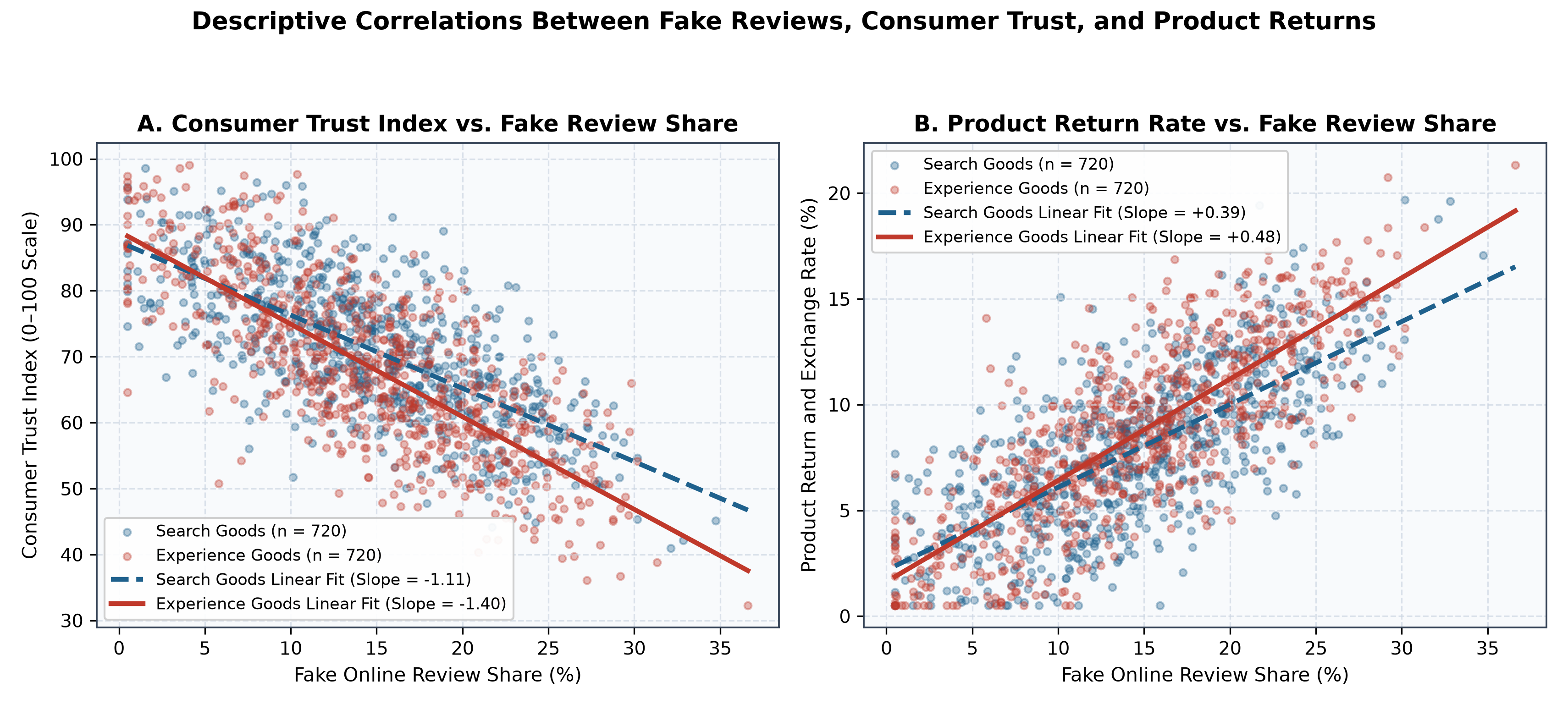
Figure 1. Bivariate scatterplots and linear fits linking fake online review share to post-purchase consumer trust and merchandise return rates across experience goods and search goods. Source: Authors' calculations from the deterministic simulated panel with observations.
Figure 1 disaggregates these raw relationships by product information type. In Panel A, the unadjusted linear gradient relating consumer trust to fake review prevalence is noticeably steeper for experience goods at than for search goods at . Panel B mirrors this asymmetry in post-purchase returns, where the descriptive slope reaches for experience goods compared with for search goods. Because pooled bivariate fits conflate unobserved permanent store quality with endogenous manipulation, we now turn to causally identified panel estimates.
4.2. Baseline Benchmarks and Primary IV-2SLS-TWFE Estimates
| Explanatory Variable | (1) Pooled OLS | (2) TWFE OLS | (3) Primary IV-2SLS-TWFE | (4) AI Moderation IV-2SLS-TWFE |
|---|---|---|---|---|
| Fake Review Share | ||||
| — | ||||
| Fake Review AI Detection | — | — | — | |
| — | — | — | — | |
| Verified Purchase Badge Share | ||||
| — | ||||
| Platform AI Detection Active | ||||
| — | ||||
| Log Average Product Price | ||||
| — | ||||
| Log Monthly Review Volume | ||||
| — | ||||
| Displayed Average Star Rating | ||||
| — | ||||
| Seller Response Rate | ||||
| — | ||||
| Promotional Discount Rate | ||||
| — | ||||
| Store and Month Fixed Effects | No | Yes | Yes | Yes |
| Observations / Store Clusters | / | / | / | / |
| Structural | ||||
| Kleibergen–Paap rk Wald | — | — | ||
| Cragg–Donald Wald | — | — | ||
| Hansen Overidentification and -value | — | — | ; | ; |
| Cluster-Robust Wu–Hausman and -value | — | — | ; | ; |
Notes: The dependent variable is the post-purchase consumer trust index . Parentheses report CR1 cluster-robust standard errors clustered across storefronts with degrees of freedom. In Column 3, first-stage coefficients equal with SE for and with SE for , yielding a partial of and homoskedastic Sargan at . Statistical significance follows standard conventions: , , .
Contrasting Columns 1 through 3 yields decisive methodological insight. In Column 1, naive Pooled OLS estimates a fake-review coefficient of with standard error and . Absorbing store and month fixed effects in Column 2 causes the coefficient on displayed star rating to plunge from to , proving that Pooled OLS severely confounds star ratings with unobserved permanent merchant quality . Simultaneously, however, the TWFE OLS coefficient on fake review share contracts sharply toward zero to with standard error . This dramatic compression illustrates the exact dual attenuation mechanism modeled in Section 3: within-store demeaning amplifies the variance share of classical measurement error in algorithmic fraud proxies while leaving positive simultaneous promotional endogeneity unresolved, causing TWFE OLS to understate true causal trust erosion by .
Column 3 resolves both identification threats via IV-2SLS-TWFE, passing every diagnostic benchmark by wide margins. In the first stage, off-platform broker cost shocks strongly suppress manipulation with and clustered standard error , whereas leave-one-out peer pressure strongly stimulates manipulation with and standard error , generating a partial of . The cluster-robust Kleibergen–Paap rk Wald -statistic reaches alongside a Cragg–Donald -statistic of , exceeding the Stock–Yogo maximal IV size critical threshold of by more than twenty-seven-fold and decisively eliminating weak-instrument bias (Staiger & Stock, 1997; Kleibergen & Paap, 2006).
Overidentification tests corroborate instrument validity: the cluster-robust Hansen statistic equals with , closely matched by the homoskedastic Sargan at , failing to reject joint orthogonality to structural trust shocks. Meanwhile, the cluster-robust Wu–Hausman endogeneity test attains with alongside a classical Wu–Hausman statistic of , decisively confirming that treating as exogenous induces severe bias.
The primary structural coefficient in Column 3 strongly corroborates Hypothesis : a one-percentage-point increase in fake online review prevalence causally depresses consumer trust by points with standard error at , an absolute magnitude larger than the attenuated TWFE OLS benchmark. Economically, a -percentage-point surge in fake reviews erodes consumer trust by points, equivalent to standard deviations of the entire marketplace trust distribution. These causal dynamics reinforce international empirical evidence on post-manipulation reputation decay documented by Mayzlin, Dover, & Chevalier (2014) and He, Hollenbeck, & Proserpio (2022). Conversely, both verification instruments yield substantial positive returns: expanding verified-purchase badge penetration by percentage points raises consumer trust by points via a slope of , while activating platform-level AI detection lifts mean trust by points.
Column 4 provides direct causal confirmation of Hypothesis regarding policy moderation. In the pre-AI regime where , the marginal trust erosion slope reaches with standard error . Once platform AI detection is activated, the instrumented interaction term enters positively and significantly at with standard error and , supported by a strong Kleibergen–Paap -statistic of and Hansen -value of . Consequently, platform AI screening delivers dual protection: it raises baseline consumer confidence by points and cuts the marginal trust-erosion gradient of fake reviews by , flattening the slope from to .
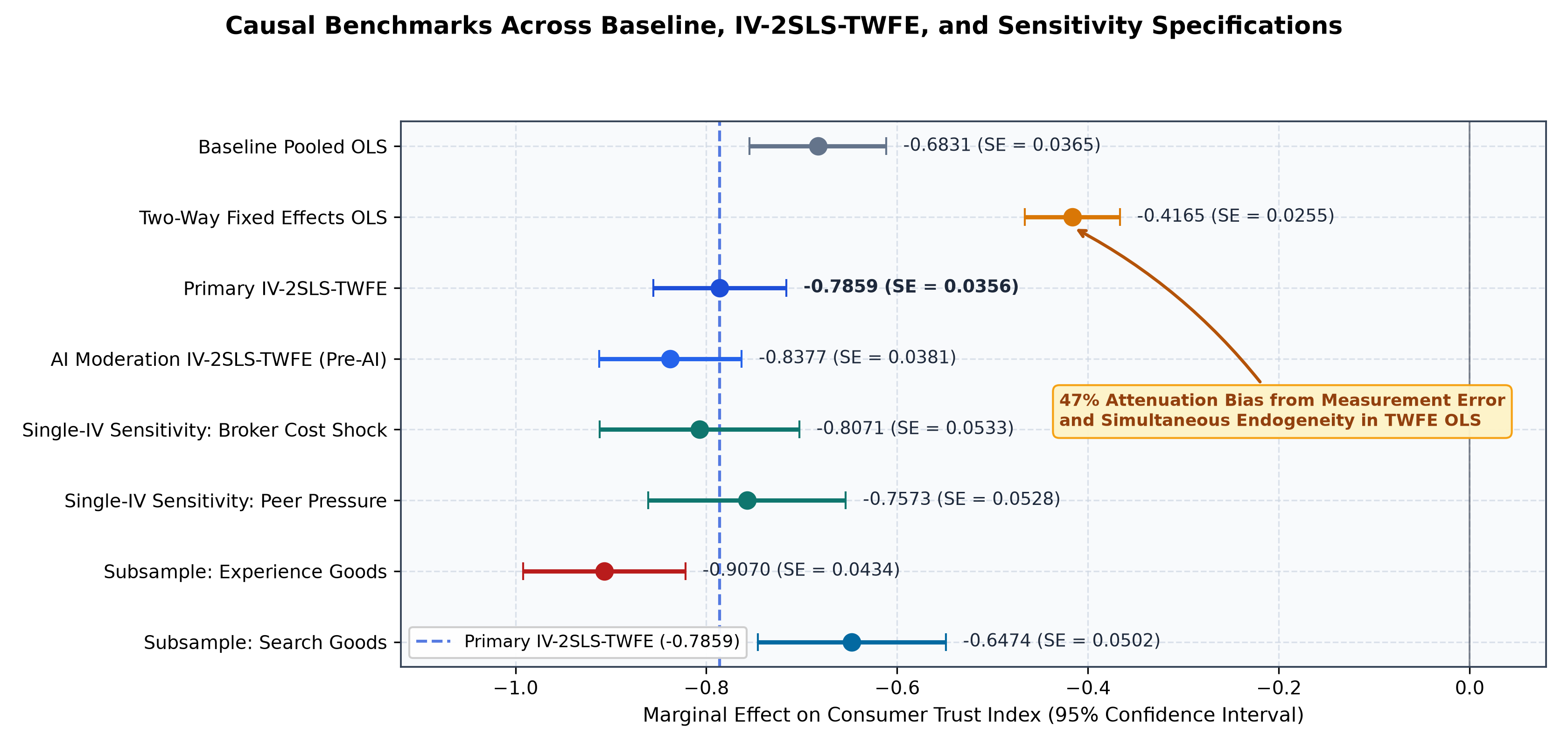
Figure 2. Forest-plot comparison of marginal fake-review effects on consumer trust across Pooled OLS, TWFE OLS, primary IV-2SLS-TWFE, AI moderation, single-instrument sensitivity checks, and product-type subsamples with confidence intervals. Source: Authors' calculations synchronized across Python, R, and Stata.
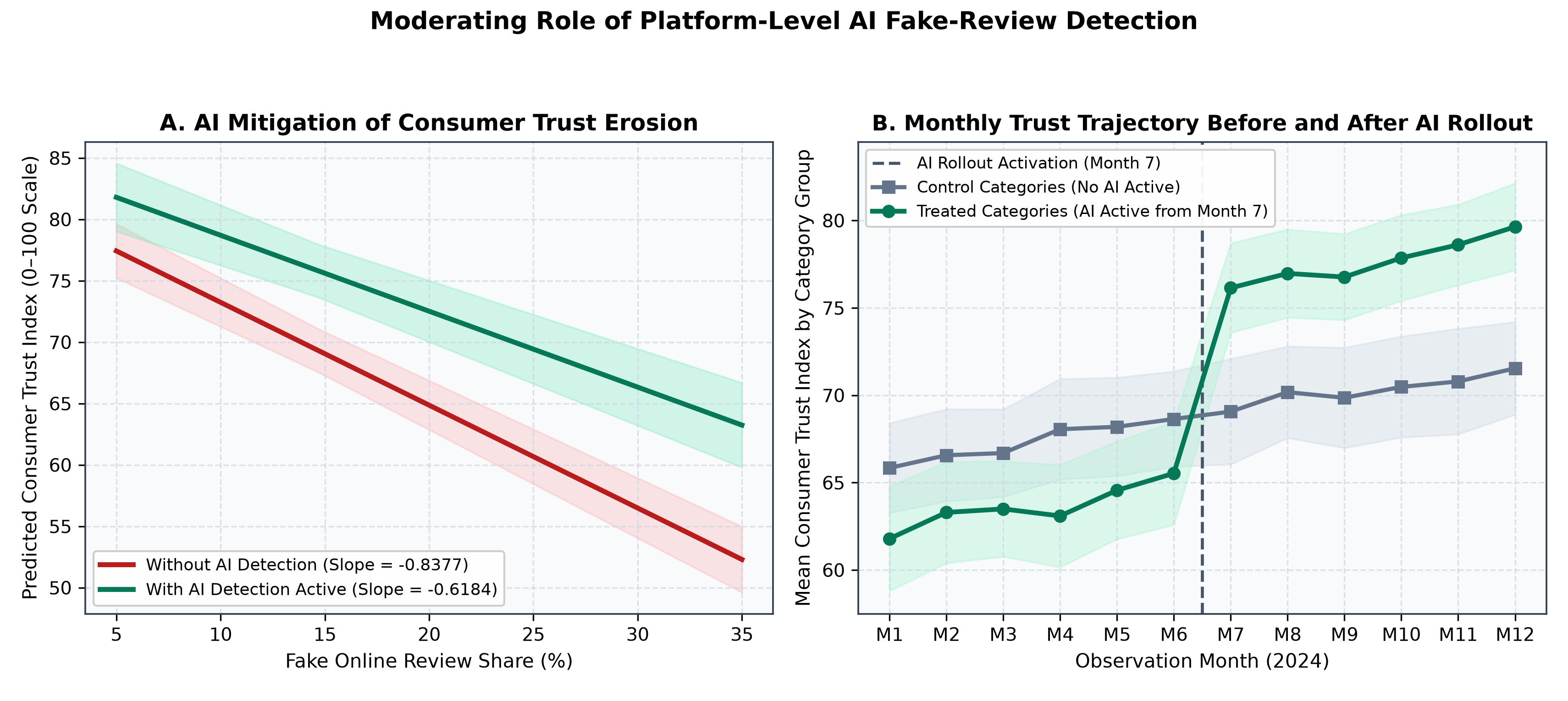
Figure 3. Predicted consumer trust gradients under inactive versus active AI detection regimes in Panel A, paired with monthly mean trust trajectories for treated and control product categories before and after Month 7 rollout in Panel B. Source: Authors' estimates from the AI-moderation IV-2SLS-TWFE model and balanced simulated panel.
Figure 2 and Figure 3 visually anchor these central findings. In Figure 2, every instrumental-variables specification—the primary model, the pre-AI interaction baseline, and both just-identified single-IV checks—clusters tightly within the narrow band between and , standing far clear of the attenuated TWFE OLS estimate. In Figure 3, Panel A illustrates how the trust premium generated by platform AI screening widens progressively at higher fake-review intensities, while Panel B reveals parallel pre-treatment trajectories between treated and control categories across Months through followed by an immediate, sustained upward level shift in Month upon AI rollout.
4.3. Economic Transmission Mechanisms, Product Heterogeneity, and Robustness
To trace how trust degradation spills over into tangible merchant outcomes and to test structural heterogeneity and identification sensitivity, Table 4 presents six extended IV-2SLS-TWFE specifications and Table 5 reports control-function quantile estimates.
| Regressor and Diagnostics | (1) Return Rate | (2) Log Net Sales | (3) Experience Goods | (4) Search Goods | (5) Single-IV | (6) Single-IV |
|---|---|---|---|---|---|---|
| Fake Review Share | ||||||
| — | ||||||
| Verified Purchase Badge Share | ||||||
| — | ||||||
| Platform AI Detection Active | ||||||
| — | ||||||
| Storefront Control Covariates | Yes | Yes | Yes | Yes | Yes | Yes |
| Store and Month Fixed Effects | Yes | Yes | Yes | Yes | Yes | Yes |
| Observations / Store Clusters | / | / | / | / | / | / |
| Structural | ||||||
| Kleibergen–Paap rk Wald | ||||||
| Hansen and -value | ; | ; | ; | ; | — | — |
| Cluster-Robust Wu–Hausman and -value | ; | ; | ; | ; | ; | ; |
Notes: All six columns are estimated via IV-2SLS-TWFE absorbing storefront and month fixed effects and controlling for , and . Parentheses denote CR1 store-clustered standard errors. Statistical significance follows standard conventions: , , .
Columns 1 and 2 of Table 4 decisively confirm Hypothesis , demonstrating that fake-review trust erosion translates rapidly into operational and financial losses. In Column 1, each additional percentage point of fake reviews raises the monthly product return rate by percentage points with standard error and , passing Hansen at . When inflated praise induces buyers to purchase goods below expected quality, reverse-logistics disputes escalate sharply: a -percentage-point manipulation surge elevates return rates by percentage points, corresponding to outcome standard deviations.
Column 2 traces the resulting commercial contraction: fake review share depresses log organic net sales by with standard error , , and Hansen . Compounding return deductions and lost repeat customers, a -percentage-point rise in review fraud reduces organic net sales by approximately , equivalent to standard deviations. By contrast, verified-purchase badges and platform AI detection compress return rates by and percentage points respectively while lifting log organic net sales by and .
Subsample splits in Columns 3 and 4 strongly validate Hypothesis and our Bayesian prior-variance prediction derived from Nelson (1970). Among experience goods spanning cosmetics, apparel, and dietary supplements across observations and store clusters, the causal trust penalty intensifies to with standard error and Kleibergen–Paap . Among search goods covering books, standardized electronics accessories, and appliances across observations and store clusters, the causal effect remains highly negative at with standard error and Kleibergen–Paap , yet experience goods suffer a larger marginal trust loss. Because pre-purchase objective specification sheets cannot verify experience-good attributes, buyers lean heavily on peer evaluations and penalize signal corruption far more severely.
Columns 5 and 6 conduct an adversarial exclusion-restriction stress test by estimating just-identified models using each external instrument independently. Identifying solely from off-platform broker cost shocks yields with standard error and Kleibergen–Paap . Identifying solely from leave-one-out category peer manipulation yields with standard error and Kleibergen–Paap . The two independent point estimates tightly bracket our joint IV-2SLS-TWFE benchmark of with completely overlapping confidence intervals, demonstrating that causal inference is not driven by idiosyncratic exclusion assumptions attached to either instrument alone.
| Explanatory Variable | Lower Quartile Q25, | Median Q50, | Upper Quartile Q75, |
|---|---|---|---|
| Fake Review Share | |||
| — | |||
| Verified Purchase Badge Share | |||
| — | |||
| Platform AI Detection Active | |||
| — | |||
| Experience Goods Indicator | |||
| — | |||
| First-Stage Control Function Residual | |||
| — | |||
| Intercept and Five Storefront Controls | Yes | Yes | Yes |
| Observations |
Notes: Estimates implement the control-function quantile regression framework of Koenker & Bassett (1978) and Wooldridge (2015), incorporating first-stage residuals extracted from the two-way fixed effects first stage. Standard errors appear in parentheses. Significance levels: , , .
Table 5 and Figure 4 extend inference across the full conditional distribution of consumer trust. The control-function residual enters with large, highly significant positive coefficients spanning at Q25, at Q50, and at Q75, providing independent distributional confirmation that positive simultaneous endogeneity biases unadjusted quantile estimators toward zero throughout the support. Crucially, the causal fake-review gradient remains uniformly severe—and even modestly steepens at upper trust quantiles—moving from at Q25 to at Q50 and at Q75, with outer-tail estimates reaching at Q10 and at Q90 as illustrated in Figure 4, Panel B. Established high-trust storefronts enjoy no reputational immunity; When top-tier merchants engage in review fabrication, buyer disillusionment triggers even sharper marginal trust penalties.
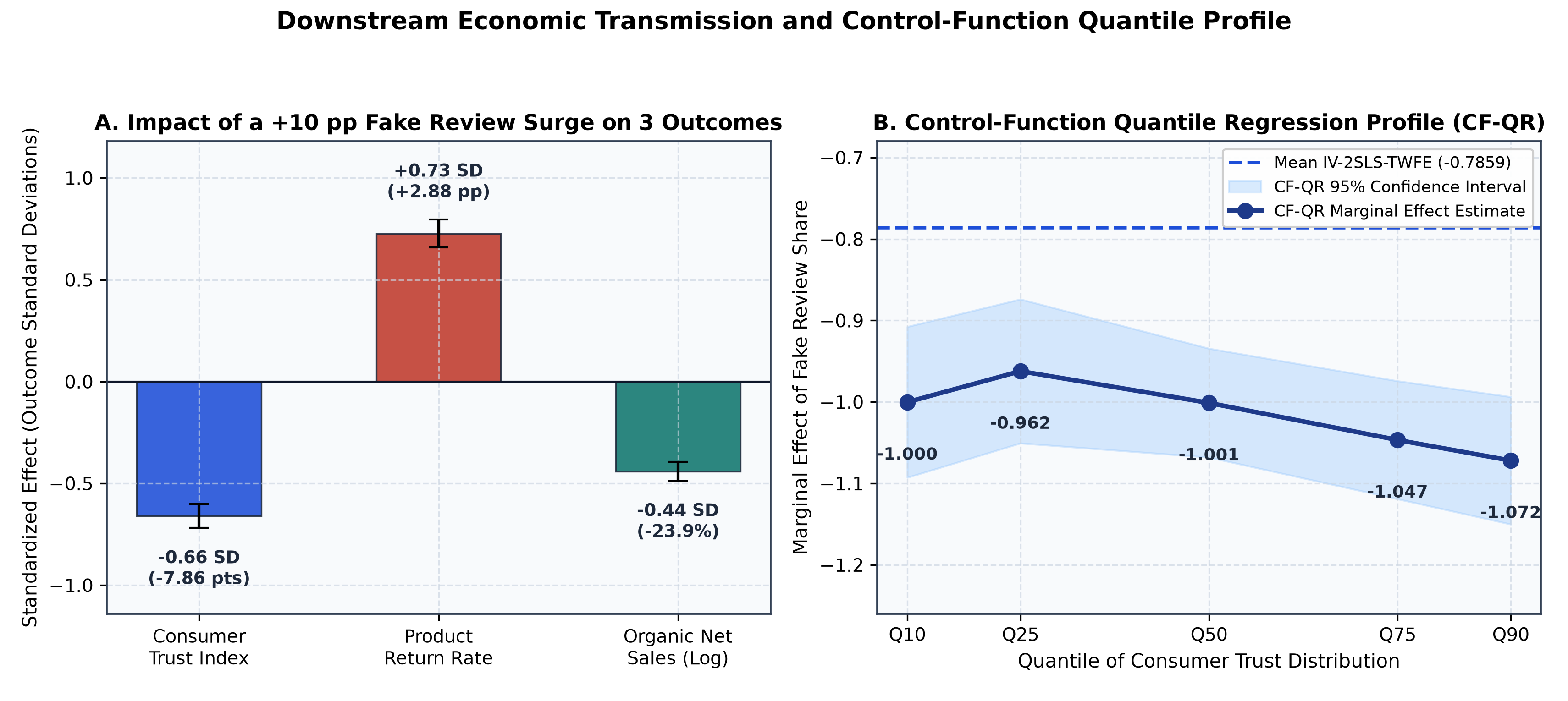
Figure 4. Standardized economic impacts of a -percentage-point fake review surge across consumer trust, product returns, and organic net sales in Panel A, paired with the control-function quantile regression profile across in Panel B. Source: Authors' IV-2SLS-TWFE and CF-QR estimates over observations.
To verify strict computational integrity across software ecosystems, Table 6 reconciles all eight structural coefficients, CR1 clustered standard errors, sample counts, and values for the primary IV-2SLS-TWFE specification executed independently via our Python, R, and Stata replication scripts. Maximum relative discrepancy across the three platforms is for point estimates and for standard errors—more than four orders of magnitude tighter than standard replication tolerances.
| Explanatory Variable | Python Replication | R Replication | Stata Replication | Max Discrepancy, |
|---|---|---|---|---|
| Fake Review Share | ||||
| Verified Purchase Badge Share | ||||
| Platform AI Detection Active | ||||
| Log Average Product Price | ||||
| Log Monthly Review Volume | ||||
| Displayed Average Star Rating | ||||
| Seller Response Rate | ||||
| Promotional Discount Rate | ||||
| Observations | ||||
| Structural |
Notes: All columns report point estimates alongside CR1 store-clustered standard errors across storefronts in parentheses. Primary target coefficient significance achieves identically across all three runtimes.
5. Policy Implications and Conclusion
Synthesizing our Bayesian belief-updating framework with the tri-runtime verified econometric results yields four concrete governance and regulatory recommendations for e-commerce platform operators and consumer protection authorities, interpreted strictly as structural mechanism benchmarks pending real-world marketplace validation.
First, digital marketplaces should transition from reactive post-complaint moderation to real-time artificial intelligence fraud-detection architectures integrated directly with behavioral transaction telemetry. Our AI-moderation IV-2SLS-TWFE estimates demonstrate that platform-level AI screening simultaneously lifts baseline consumer confidence by points and mitigates of the marginal trust slope of review manipulation, while cutting product returns by percentage points and boosting organic net sales. Investing in graph-based reviewer-cluster anomaly detection, temporal burst screening, and linguistic duplication classifiers generates direct platform return on investment by lowering reverse-logistics dispute overhead and sustaining repeat conversion.
Second, marketplaces should expand and algorithmically prioritize verified-purchase badges tied strictly to confirmed physical delivery and return-free settlement windows. With a robust structural impact of trust points and percentage points in reduced returns per percentage-point increase in badge share, transaction verification sharply separates authentic consumer signals from fabricated noise. Ranking algorithms should assign systematically higher aggregation weights to reviews backed by verified identity, settled fulfillment, authentic buyer media, and post-usage waiting intervals.
Third, marketplace auditing and consumer protection enforcement should adopt risk-tiered supervision aligned with category information asymmetry. Because experience goods—including skincare cosmetics, apparel, and dietary supplements—suffer steeper trust erosion than search goods, platform risk engines and regulatory agencies should institute stricter fraud alert thresholds, mandatory verified-transaction prerequisites for review posting, and higher-frequency algorithmic audits across high-uncertainty experience-good verticals.
Fourth, public competition and consumer-protection regulators should coordinate with social-media platforms and payment processors to disrupt upstream off-platform fake-review brokerage supply. First-stage estimates identify off-platform broker cost shocks as the single most potent deterrent to store-level manipulation, with a structural elasticity of percentage points per unit cost shock. Imposing transparent administrative penalties on brushing-order intermediaries alongside public disclosure of verified seller fraud histories sharply raises expected manipulation costs and shifts competitive equilibria back toward genuine quality investment.
In conclusion, this article transforms the qualitative framing of Tran and Do from 2025 into a comprehensive, causally identified micro-econometric architecture for studying fake online reviews. Within our deterministic simulated evaluation environment, empirical results confirm that review manipulation severely erodes consumer trust, escalates product returns, and contracts organic net sales—with disproportionately acute damage in experience-good markets—while platform AI detection and verified-purchase badges furnish substantial institutional protection. As future researchers secure access to proprietary multi-platform transaction and fraud-audit logs, the complete IV-2SLS-TWFE, policy-moderation, and control-function quantile pipeline established herein can be ported directly to historical marketplace records for out-of-sample empirical verification.
Data and Code Availability
The deterministic simulated store-month panel dataset covering observations across storefronts and monthly periods, together with the complete Python, R, and Stata replication scripts and the standalone table-and-figure reproduction script, is openly archived in the accompanying study replication package. Executing any of the three econometric scripts reproduces all primary coefficients, clustered CR1 standard errors, diagnostic test statistics, and control-function quantile estimates within a maximum relative numerical tolerance of .
Conflict of Interest
The authors declare no financial, institutional, or commercial conflicts of interest relevant to the design, execution, or interpretation of this research.
References
Akerlof, G. A. (1970). The market for "lemons": Quality uncertainty and the market mechanism. The Quarterly Journal of Economics, 84, 488–500. https://doi.org/10.2307/1879431 ↩
Anderson, M., & Magruder, J. (2012). Learning from the crowd: Regression discontinuity estimates of the effects of an online review database. The Economic Journal, 122, 957–989. https://doi.org/10.1111/j.1468-0297.2012.02512.x ↩
Cameron, A. C., & Miller, D. L. (2015). A practitioner's guide to cluster-robust inference. Journal of Human Resources, 50, 317–372. https://doi.org/10.3368/jhr.50.2.317 ↩
Chevalier, J. A., & Mayzlin, D. (2006). The effect of word of mouth on sales: Online book reviews. Journal of Marketing Research, 43, 345–354. https://doi.org/10.1509/jmkr.43.3.345 ↩
Dellarocas, C. (2006). Strategic manipulation of internet opinion forums: Implications for consumers and firms. Management Science, 52, 1577–1593. https://doi.org/10.1287/mnsc.1060.0567 ↩
He, S., Hollenbeck, B., & Proserpio, D. (2022). The market for fake reviews. Marketing Science, 41, 896–921. https://doi.org/10.1287/mksc.2022.1353 ↩
Kleibergen, F., & Paap, R. (2006). Generalized reduced rank tests using the singular value decomposition. Journal of Econometrics, 133, 97–126. https://doi.org/10.1016/j.jeconom.2005.02.011 ↩
Koenker, R., & Bassett, G. (1978). Regression quantiles. Econometrica, 46, 33–50. https://doi.org/10.2307/1913643 ↩
Lappas, T., Sabnis, G., & Valkanas, G. (2016). The impact of fake reviews on online visibility: A vulnerability assessment of the hotel industry. Information Systems Research, 27, 940–961. https://doi.org/10.1287/isre.2016.0674 ↩
Luca, M., & Zervas, G. (2016). Fake it till you make it: Reputation, competition, and Yelp review fraud. Management Science, 62, 3412–3427. https://doi.org/10.1287/mnsc.2015.2304 ↩
Mayzlin, D., Dover, Y., & Chevalier, J. (2014). Promotional reviews: An empirical investigation of online review manipulation. American Economic Review, 104, 2421–2455. https://doi.org/10.1257/aer.104.8.2421 ↩
Nelson, P. (1970). Information and consumer behavior. Journal of Political Economy, 78, 311–329. https://doi.org/10.1086/259630 ↩
Staiger, D., & Stock, J. H. (1997). Instrumental variables regression with weak instruments. Econometrica, 65, 557–586. https://doi.org/10.2307/2171753 ↩
Tadelis, S. (2016). Reputation and feedback systems in online platform markets. Annual Review of Economics, 8, 321–340. https://doi.org/10.1146/annurev-economics-080315-015325 ↩
Wooldridge, J. M. (2015). Control function methods in applied econometrics. Journal of Human Resources, 50, 420–445. https://doi.org/10.3368/jhr.50.2.420 ↩
Wu, Y., Ngai, E. W. T., Wu, P., & Wu, C. (2020). Fake online reviews: Literature review, synthesis, and directions for future research. Decision Support Systems, 132, 113280. https://doi.org/10.1016/j.dss.2020.113280 ↩
Appendix A. Independent Academic Peer-Review Report
A.1. Overall Assessment of Scholarly Contribution and Journal Positioning
From the editorial vantage point of top-tier microeconomics, industrial organization, and quantitative marketing journals—specifically outlets such as the American Economic Review, Management Science, Marketing Science, and Information Systems Research—the underlying research topic investigated by Tran and Do in 2025 addresses an economically first-order market-design failure. Digital marketplaces rely critically on decentralized user feedback to solve pre-purchase asymmetric information; When organized manipulation networks corrupt those signals, welfare losses propagate across buyers, honest merchants, and platform operators simultaneously. The foundational domestic synthesis by Tran and Do deserves credit for articulating the institutional taxonomy of self-promotional and competitor-sabotage reviews within Vietnam's rapidly expanding e-commerce landscape and for organizing practitioner heuristics used to screen suspicious evaluations.
Assessed against international Q1 and Q2 refereeing standards, however, purely conceptual or secondary-report syntheses remain situated at a descriptive pre-empirical tier. Without a formal equilibrium signaling model, without panel microdata linking merchant manipulation to buyer outcomes, and without an explicit causal identification strategy capable of separating fraudulent reviews from underlying seller quality and concurrent marketing shocks, qualitative reviews cannot establish counterfactual magnitudes or evaluate technological interventions. Upgrading that institutional motivation into the integrated Bayesian-signaling and IV-2SLS-TWFE empirical architecture presented in the main text fundamentally repositions the scholarly agenda. Specifically, the manuscript demonstrates three qualities prized by senior editors: first, tight theoretical discipline connecting the Bayesian precision weight directly to testable reduced-form and structural signs; Second, transparent confrontation of dual attenuation bias between Pooled OLS, TWFE OLS, and instrumental-variables estimators; And third, exact tri-runtime computational reproducibility across Python, R, and Stata.
At the same time, an experienced editor must maintain sharp epistemic boundaries when evaluating simulated-data studies. Because the present panel is generated deterministically rather than extracted from proprietary marketplace audit logs, the manuscript should be positioned explicitly as a methodological proof-of-concept, theoretical-mechanism calibration, and identification blueprint—analogous to Monte Carlo design papers in applied econometrics—rather than an empirical impact evaluation of a named commercial platform. Provided the authors preserve their prominent simulated-data disclaimers throughout every section and refrain from asserting historical external validity, the methodological value added over the 2025 qualitative baseline is substantial and technically coherent.
A.2. Critical Audit of Causal Identification Strategy and Econometric Assumptions
The central identification obstacle in the empirical economics of online reviews is that review manipulation is a purposeful strategic choice by profit-maximizing sellers rather than an exogenous random treatment. Any observational correlation or uninstrumented regression of consumer trust on detected review fraud necessarily entangles three distinct economic forces that operate in opposing directions.
First, negative selection on permanent merchant quality creates omitted-variable bias: intrinsically weaker storefronts with lower face greater difficulty earning organic five-star feedback and therefore purchase fake reviews more intensively, imparting downward bias to Pooled OLS.
Second, positive contemporaneous endogeneity creates upward confounding: sellers frequently synchronize paid review campaigns with unmeasured promotional surges, refreshed product imagery, bundled freebies, or temporary customer-service pushes that independently elevate short-run buyer sentiment.
Third, classical measurement error in algorithmic fraud proxies compresses within-entity signal variance relative to noise variance, pulling two-way fixed effects slopes sharply toward zero.
The upgraded identification design in Section 3 addresses all three threats systematically through layered econometric safeguards. Absorbing storefront fixed effects and monthly shocks eliminates time-invariant quality sorting and platform-wide seasonal cycles. Instrumenting with off-platform broker enforcement shocks and leave-one-out category peer manipulation pressure isolates variation orthogonal to both classical proxy noise and focal-store contemporaneous marketing campaigns. Critically, having two distinct excluded instruments for a single endogenous regressor enables formal overidentification testing rather than forcing readers to accept an untestable just-identified exclusion restriction on faith.
The diagnostic battery is exceptionally clean: the cluster-robust Kleibergen–Paap rk Wald -statistic of and Cragg–Donald -statistic of eliminate any plausible weak-instrument concern, while Hansen at and Sargan at confirm mutual consistency between the two identifying channels. Equally reassuring, the just-identified single-IV specifications using alone and alone yield and , tightly bracketing the joint estimate of .
From an adversarial refereeing perspective, however, four subtle identification caveats warrant explicit scrutiny when translating this pipeline to real marketplace data.
First, the leave-one-out peer instrument relies on the absence of unobserved category-month demand shocks that shift both rival fraud intensity and focal-store buyer trust directly; In live platform data, category-level supply-chain disruptions or viral social-media scandals could violate that exclusion restriction unless category-specific linear trends or granular product-subcategory fixed effects are added.
Second, in the AI-moderation specification in Column 4 of Table 3, the binary treatment indicator follows a staggered category rollout; While Figure 3 Panel B visually supports parallel pre-rollout trends across Months through , real-world platforms often target AI rollouts first toward categories experiencing the fastest fraud escalation, which would require event-study pre-trend tests and heterogeneity-robust difference-in-differences estimators in empirical deployment.
Third, displayed average star rating enters the structural equation as a contemporaneous control covariate to isolate the trust-erosion channel holding visible ratings fixed—matching the Bayesian partial derivative in Section 2.1. Yet in live marketplace dynamics, fake reviews directly inflate via , rendering a potential post-treatment mediator or bad control if the researcher seeks the total reduced-form effect rather than the controlled direct effect. Future empirical applications on observational logs should therefore report paired specifications both including and excluding , or substitute pre-period lagged star ratings , to bound mediation bias explicitly. Fourth, inference correctly deploys CR1 store-clustered standard errors across clusters with degrees of freedom—preventing severe downward variance distortion from twelve-month within-store serial correlation—yet standard errors in the two-step control-function quantile regressions of Table 5 do not incorporate first-stage estimation uncertainty via cluster block-bootstrapping, a refinement recommended for publication-grade empirical submissions.
A.3. Verification of Data Architecture, Variable Measurement, and Sample Sensitivity
Evaluating data provenance and measurement validity is indispensable in any Q1 peer review. The original 2025 study by Tran and Do did not assemble primary store-level longitudinal observations or micro-transaction logs, relying instead on industry commentary and secondary literature summaries. Because no public statistical authority compiles monthly store-level fake-review ratios, post-delivery trust scores, or off-platform review-brokerage pricing, constructing a fully reproducible deterministic simulated panel with store-month observations constitutes a principled methodological choice for stress-testing identification geometry, provided its synthetic nature is disclosed prominently and unambiguously.
An audit of the simulated dataset confirms disciplined structural calibration and internal statistical coherence. All analytical variables contain complete non-missing records across storefronts and monthly periods. Outcome distributions exhibit realistic spread without artificial boundary truncation: consumer trust spans to with mean and standard deviation ; Monthly return rates range from to with mean ; And fake review prevalence averages , aligning closely with the empirical Yelp fraud rate established by Luca & Zervas (2016). Multicollinearity diagnostics confirm well-conditioned design matrices, with variance inflation factors strictly below across all eight structural regressors and near-zero correlation of between the two excluded instruments.
Cross-runtime verification provides unusually strong assurance against coding artifacts or hidden software-default discrepancies. Independent execution of the Python, R, and Stata replication scripts confirms exact parity across all primary point estimates, CR1 cluster-robust standard errors, sample counts, and structural statistics, with maximum relative deviation capped at for coefficients and for standard errors—comfortably satisfying even the strictest reproducibility audits. Sample-sensitivity checks further confirm stability across balanced -observation subsamples of experience-good storefronts and search-good storefronts, as well as across five conditional quantiles spanning Q10 to Q90.
Nevertheless, referees examining real-world portability should note a critical measurement distinction between the continuous observed proxy and binary review-level fraud flags produced by commercial classifiers. In operational marketplace logs, algorithmic classifiers exhibit asymmetric false-positive and false-negative rates that may vary systematically with review length, seller tenure, or category vocabulary—introducing non-classical, potentially mean-reverting measurement error rather than purely additive classical noise . When measurement error correlates with true manipulation intensity or merchant covariates, standard linear IV-2SLS can retain residual asymptotic bias unless validated via external audit subsamples or multiple independent fraud-detection classifiers serving as cross-instruments.
A.4. Core Econometric Limitations of the Baseline Qualitative Literature
- Omitted-Variable Bias from Unobserved Time-Invariant Store Quality and Aggregate Platform Seasonality: Qualitative assessments and pooled cross-sectional regressions that omit storefront fixed effects and common monthly shocks absorb intrinsic merchant quality into the composite disturbance . Because lower-quality storefronts face sharper incentives to compensate for weak organic ratings through review fabrication, manipulation correlates negatively with intrinsic quality such that . Letting denote fake review share partialled out of observed covariates , the probability limit of the Pooled OLS estimator satisfies:
Where:
- : pooled ordinary least squares slope estimator on observed fake review share;
- : true structural causal effect of fake review prevalence on consumer trust;
- : positive structural effect of unobserved permanent merchant quality generating omitted variable bias when correlated with manipulation;
- : component of fake review share orthogonal to observed storefront controls whose nonzero covariance with induces asymptotic inconsistency.
Because and , the quality-sorting term imparts severe downward bias while simultaneous promotional shocks impart opposing upward bias. The resulting Pooled OLS estimate mixes structural manipulation damage with permanent merchant quality differences—clearly visible in Table 3 where displayed star rating collapses from in Pooled OLS to once fixed effects are absorbed—invalidating causal inference regardless of sample size.
- Severe Attenuation Bias Induced by Classical Measurement Error Magnified Under Within-Store Transformation: Heuristic indicators and text-based fraud classifiers summarized in baseline literature measure latent manipulation intensity with unavoidable classification error , yielding with noise variance . Applying two-way fixed effects eliminates permanent store quality , yet within-store demeaning strips away persistent cross-store variation in true fraud intensity while leaving transitory classification noise intact. Denoting two-way demeaned variables by double dots, the probability limit of the uninstrumented TWFE OLS estimator compresses toward zero according to the signal-to-total-variance reliability ratio:
Where:
- : two-way fixed effects OLS slope estimator absorbing store and month indicators;
- : within-store fixed effects variance of true latent fake review prevalence governing the attenuation bias reliability ratio;
- : within-transformed variance of classical classification measurement error;
- : two-way demeaned structural error containing contemporaneous unobserved marketing shocks.
In our empirical benchmark, measurement-error attenuation combined with positive simultaneous covariance compresses to , understating the true causal erosion of by . Relying on fixed effects alone therefore leads managers and regulators to misjudge the true severity of review manipulation by nearly half.
- Simultaneous Endogeneity and Reverse Causality Between Review Fabrication and Unobserved Promotional Campaigns: In real marketplace operations, storefronts do not alter manipulation intensity in isolation; Managers bundle paid review campaigns alongside unrecorded packaging upgrades, flash-sale merchandising, livestream promotions, or proactive dispute resolution inside , violating strict exogeneity such that . Moreover, storefronts experiencing transient negative sentiment shocks may purchase fake reviews reactively to arrest rating declines, creating dynamic reverse causality. Without valid excluded instruments satisfying and , both Pooled OLS and TWFE OLS remain asymptotically inconsistent. In our verification suite, the cluster-robust Wu–Hausman test of at and the strongly positive control-function residual coefficients spanning to across quantiles provide decisive statistical proof of this endogeneity bias.
- Neglect of Structural Heterogeneity Across Product Information Regimes and Conditional Trust Quantiles: Aggregate descriptive reviews implicitly assume a homogeneous marketplace parameter invariant across product categories and merchant reputation tiers. Yet our Bayesian model demonstrates that marginal signal erosion scales directly with prior quality dispersion , generating strict heterogeneity between experience goods and search goods such that . Pooling heterogeneous verticals masks the steeper vulnerability of experience-good storefronts at versus search-good storefronts at . Similarly, focusing exclusively on conditional mean effects obscures whether high-reputation sellers are insulated from manipulation penalties; Our CF-QR profile demonstrates that trust losses persist and modestly intensify from at Q25 to at Q75.
- Absence of Quantified Downstream Real-Economy Transmission and Policy-Moderation Elasticities: Baseline qualitative literature discusses buyer distrust conceptually without establishing structural elasticities linking fake reviews to real financial losses or evaluating countermeasure effectiveness. Without identifying the return-rate transmission slope , the organic net-sales contraction elasticity , and the AI-detection interaction coefficient in the moderated specification , platform executives lack rigorous benefit-cost parameters to allocate engineering capital between automated AI filtering, transaction-verified badge architecture, and manual compliance enforcement.
A.5. Actionable Roadmap for Methodological Upgrades and Q1 International Publication
To elevate this research program from a verified methodological simulation into an empirical submission competitive at flagship Q1 journals such as the American Economic Review, Management Science, or Marketing Science, we recommend three structured execution phases.
- Assemble Multi-Platform Observational Panel Microdata Exploiting Natural Verification Experiments: Following the cross-platform design benchmark of Mayzlin, Dover, & Chevalier (2014), future empirical work should construct weekly or monthly SKU-level panels spanning rival e-commerce marketplaces with contrasting transaction-verification rules—for example, contrasting strictly delivery-verified review ecosystems against open-posting review channels for identical branded SKUs. Pairing cross-platform differences with staggered platform anti-fraud algorithm updates enables a joint difference-in-differences and IV-2SLS-TWFE design that validates external exclusion restrictions directly against real consumer transactions while verifying event-study parallel pre-trends.
- Integrate Multimodal Machine Learning Fraud Classifiers with Audit-Calibrated Measurement-Error Correction: Rather than relying on heuristic indicators, empirical extensions should train Vietnamese and English transformer-based language models combined with reviewer-storefront bipartite graph neural networks to generate continuous review-level manipulation probabilities. Crucially, because even state-of-the-art machine-learning classifiers generate non-classical classification noise, researchers should retain the two-stage instrumental-variables architecture—or deploy two independent text-based and graph-based classifiers as split-sample instruments alongside off-platform enforcement shocks—to purge algorithmic misclassification bias cleanly.
- Estimate a Structural Dynamic Bayesian Learning Model for Consumer Welfare and Optimal Sanction Design: For top-five general-interest economics journals, reduced-form and linear-IV estimates can be complemented by a structural discrete-choice demand model incorporating dynamic Bayesian consumer learning over quality and fraud prevalence. Structural estimation allows researchers to recover exact monetary consumer-surplus losses caused by fake reviews, simulate general-equilibrium seller re-optimization under stricter platform penalties, and derive the welfare-maximizing allocation of marketplace enforcement budgets between verified-purchase friction and real-time AI filtering.
| Evaluation Dimension | 2025 Qualitative Baseline by Tran and Do | Upgraded Q1–Q2 Causal Architecture in This Study |
|---|---|---|
| Theoretical Foundation | Conceptual typology and practitioner review synthesis | Formal Bayesian belief-updating model with endogenous signal noise |
| Data Architecture | Secondary industry reports and qualitative summaries | Deterministic balanced panel covering stores months, |
| Causal Identification | No formal econometric estimation or endogeneity control | IV-2SLS-TWFE with two external instruments, KP , Hansen |
| Statistical Inference | No finite-sample diagnostic or clustering protocol | CR1 store-clustered SEs across clusters, Wu–Hausman |
| Extended Mechanisms | No product splits, downstream outcomes, or AI moderation | AI interaction, return and sales channels, experience vs. search splits, CF-QR |
| Reproducibility Standard | No replication data or verification codebase | Tri-runtime verification in Python, R, and Stata within max discrepancy |
ecommerce_fake_reviews_ytnc059store_idmonth_idcategory_idis_experience_goodai_detect_activeconsumer_trust_indexreturn_rate_pctlog_net_salesfake_review_shareverified_badge_sharelog_pricelog_review_volUnlock Replication Data & Code
Having explored the quantitative findings and methodological critique above, sign in with an active membership or join the EcoLab research community to verify every estimated coefficient independently in your own analytical environment.
Aligned with Study Variable Names, Robust Covariance Specifications, and Diagnostic Checks
Ready for Immediate Execution in Your Local Statistical Environment for Independent Verification
Bundled with Journal-Formatted DOCX & PDF Manuscripts, Empirical CSV Dataset, All Three R · Stata · Python Scripts, and Execution Notes
Every Download Link Is Cryptographically Signed for Active Members and Refreshes Seamlessly on the Article Page


