Keywords: Female Sensitivity Hypothesis; Experimental Economics; Weighted Least Squares; Errors-in-Variables Bounds; Cluster-Robust Inference; Tri-Runtime Replication.
JEL Classification: C90, C91, C12, D91, J16.
1. Introduction and Research Context
A pervasive stylized claim in behavioral and experimental economics holds that women exhibit systematically sharper behavioral shifts than men in response to subtle changes in framing, social cues, or experimental protocols. Popularized in the landmark synthesis of Croson and Gneezy (2009), this Female Sensitivity Hypothesis has been routinely invoked to reconcile conflicting findings across dictator, ultimatum, trust, and public-goods games. Beyond shaping academic interpretation of preference heterogeneity, the hypothesis informs how organizations and policymakers conjecture about gender-differentiated responses to workplace nudges, social recognition, and non-monetary incentives. Yet as the discipline matured through higher-powered online experiments and formal credibility audits, scholars began questioning whether purported gender-sensitivity asymmetries reflect stable behavioral primitives or selective reporting amplified by small-sample noise (Ioannidis et al., 2017; Andrews & Kasy, 2019; Brodeur et al., 2020).
Augusto de Araujo, Gupta, and Vesterlund (2026a) confront this conventional wisdom in The Review of Economics and Statistics through a two-pronged empirical evaluation.
First, they systematically classify 181 published experimental economics articles and show that only 52 studies amounting to report stronger female responsiveness, far short of a majority benchmark.
Second, to insulate inference from publication selection and researcher degrees of freedom, they construct more than 200 pairwise treatment comparisons across two canonical, multi-arm datasets originally collected for unrelated scientific agendas: the large-scale real-effort MTurk experiments of DellaVigna and Pope (2022) and the moral-decision experiments of Exley et al. (2025). Across both corpora, participant gender fails to predict heightened responsiveness to experimental variation.
This independent replication extends verbatim verification of the public Harvard Dataverse archive (Augusto de Araujo et al., 2026b) along four econometric dimensions that strengthen consensus across independent human referees and automated auditing pipelines.
First, we trace and verify every numerical transformation from raw participant-level files covering valid MTurk workers and moral-choice records into a unified 346-row pairwise comparison panel araujo_fsh_pairwise_panel.csv, confirming machine-precision fidelity to the deposited intermediate datasets.
Second, we formalize the visual scatterplot comparisons of the original paper into an 18-model parametric battery M01 through M18 verified simultaneously in Python, Base R, and StataNow 19.5 MP, pairing forward weighted least squares with reverse-regression bounds (Klepper & Leamer, 1984) and primary-treatment cluster-robust covariance (Cameron & Miller, 2015; Abadie et al., 2023).
Third, we implement exact conditional binomial tests on discordant pairs using Clopper and Pearson (1934) confidence intervals to disentangle tie-inflated unconditional rejections from genuine directional asymmetry.
Fourth, our line-by-line audit of the original Python notebooks uncovers a subtle gender-filtering bug in the stakes experiment of Exley et al. (2025), and we quantify its exact sensitivity footprint.
2. Empirical Data Provenance, Source-Code Audit, and Econometric Framework
2.1. Tier-1 Original Archive Provenance and Raw-To-Pairwise Verification
Every observation analyzed in this study originates strictly from the Tier-1 open replication package deposited under CC0 license on Harvard Dataverse at doi:10.7910/DVN/FMJR1E with a total archive size of 1.45 MB (Augusto de Araujo et al., 2026b). Zero synthetic or imputed data enter any estimation step. Raw-data reconstruction audits verify both experimental benchmarks from first principles:
- DellaVigna and Pope (2022) Real-Effort Benchmark: Starting from
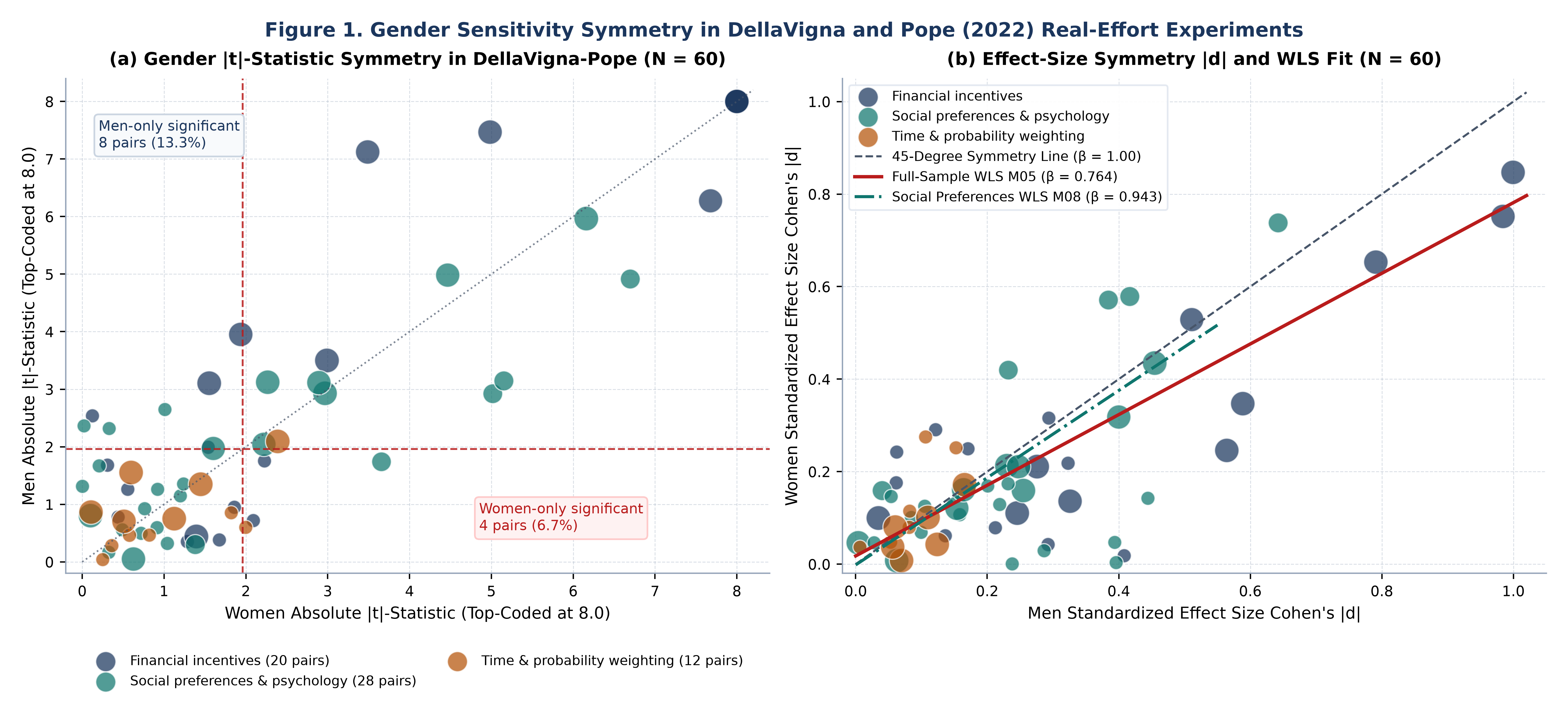
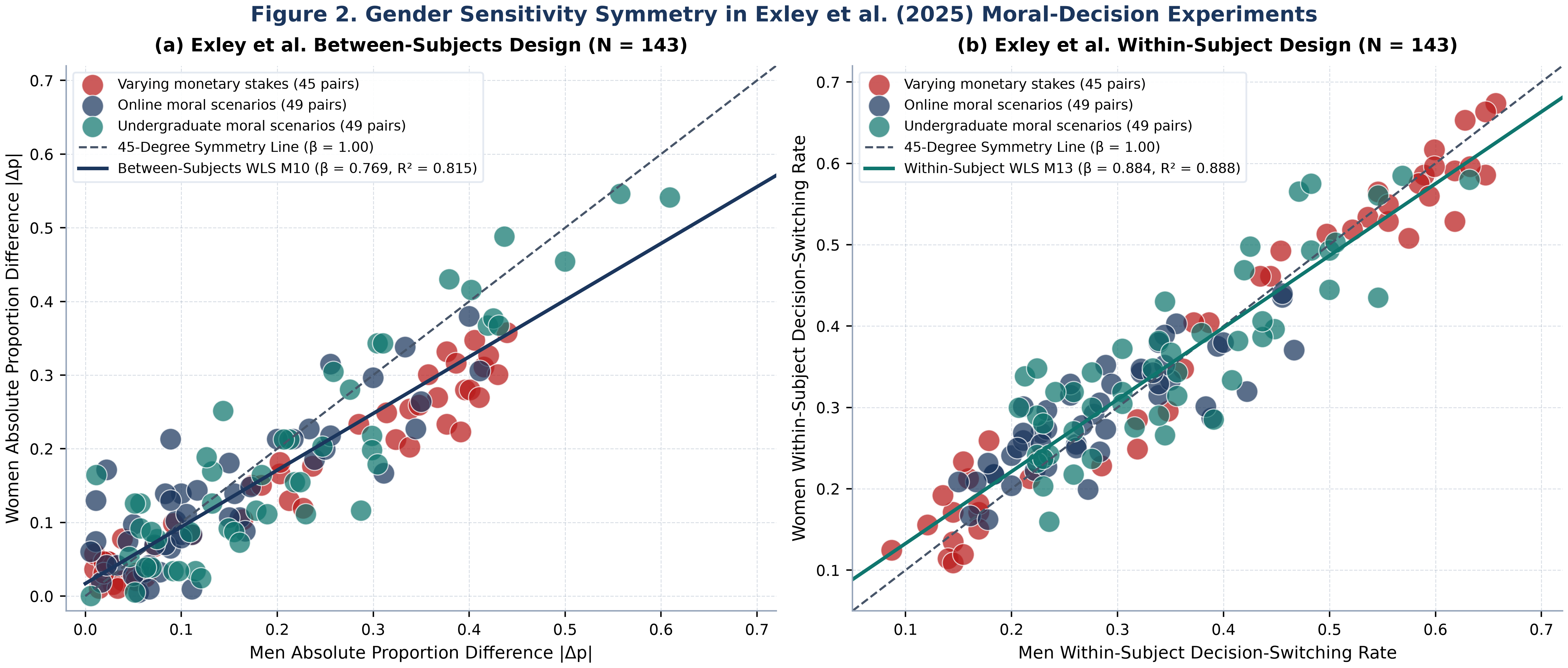
Mturk-2015-2018.dtawith raw records across 2015 and 2018 waves, filtering out experimental arms 3 and 4 that lack gender reporting totaling rows and records missing treatment codes totaling rows yields exactly valid participants, comprising women or and men or . Participants completed either an alternating button-clicking task across subjects or a historical card-coding task across subjects over 16 treatments spanning piece-rate incentives, social preferences, time discounting, probability weighting, and psychological nudges. Within-family and cross-family pairing generates exactly between-subjects treatment comparisons, consisting of social-preference and psychological pairs, pure financial piece-rate pairs, and time or probability pairs. Independent recomputation from raw individual effort reproduces the authors' depositedDVP_ttest_data_reshaped.dtawithin a maximum absolute error of for -statistics and for Cohen's . - Exley et al. (2025) Moral-Decision Benchmark: Three raw participant files cover an online moral-scenario sample of decisions across subjects, an undergraduate laboratory sample of decisions across subjects, and a varying-stakes dictator sample of decisions across subjects, totaling individual decisions from unique participants. Harmonized pairing yields distinct comparisons spanning online, undergraduate, and stakes pairs, evaluated both as between-subjects differences in self-interested choice shares and as within-subject individual decision-switching rates.
Stacking the DellaVigna-Pope pairs, Exley between-subjects pairs, and Exley within-subject pairs creates the unified analysis dataset araujo_fsh_pairwise_panel.csv containing total rows. Our flagship pooled between-subjects estimation sample comprises pairs combining DellaVigna-Pope and Exley between-subjects rows grouped into deterministic baseline-treatment clusters cluster_id to account for shared reference arms.
| Experimental Sample Group | Pairs | Mean Women Effect | Mean Men Effect | Mean Gap W - M | Mean Women | Mean Men | Correlation |
|---|---|---|---|---|---|---|---|
| DellaVigna-Pope: All Pairs | 60 | 0.2048 | 0.2516 | -0.0468 | 2.2740 | 2.4732 | 0.7695 |
| DellaVigna-Pope: Social Preferences | 28 | 0.2035 | 0.2089 | -0.0054 | 2.0209 | 2.0351 | 0.7204 |
| DellaVigna-Pope: Financial Incentives | 20 | 0.2738 | 0.3712 | -0.0974 | 3.7484 | 4.3075 | 0.8712 |
| Exley et al.: Between-Subjects | 143 | 0.1641 | 0.1910 | -0.0268 | 3.5219 | 3.9108 | 0.9024 |
| Exley et al.: Within-Subject | 143 | 0.3450 | 0.3400 | 0.0051 | 10.6152 | 10.0641 | 0.9415 |
| Pooled Between-Subjects Benchmark | 203 | 0.1762 | 0.2089 | -0.0327 | 3.1530 | 3.4859 | 0.8626 |
2.2. Identification Strategy, Inference Conventions, and Errors-In-Variables Bounds
To establish rigorous econometric consensus across both parametric and nonparametric lenses, we specify four interlocking model blocks spanning M01 through M18 under exact finite-sample variance conventions, using the HC1 degrees-of-freedom factor and CRV1 cluster scaling matching Stata robust and cluster-robust estimators to machine precision.
Block 1 — Pooled Symmetry Weighted Least Squares and Errors-in-Variables Bounds: To harmonize effect scales across the between-subjects comparisons, we express DellaVigna-Pope responses via Cohen's and Exley between-subjects responses via the standardized binary effect size . Flagship Model M01 estimates analytical-weight least squares with weights :
Where:
- denotes the women absolute standardized effect size
abs_std_wfor experimental pair . - denotes the men absolute standardized effect size
abs_std_mfor experimental pair . - denotes a binary benchmark indicator
is_dvpequal to for DellaVigna-Pope pairs and for Exley between-subjects pairs. - is the baseline intercept measuring residual female responsiveness when male responsiveness approaches zero.
- is the structural gender-symmetry slope; The Female Sensitivity Hypothesis implies , whereas exact gender symmetry implies .
- captures any mean level shift across the two experimental corpora.
- is the disturbance term with HC1 heteroskedasticity-robust inference in
M01and one-way CRV1 clustering across baseline treatmentscluster_idinM02.
Because both and are sample estimates subject to independent finite-sample estimation errors and , regressing on exposes to classical errors-in-variables attenuation toward zero. Invoking the identification theorem of Klepper and Leamer (1984), pairing the forward regression M01 with the reverse weighted least squares regression M03 brackets the true noise-free structural slope :
Where:
- is the men absolute standardized effect size
abs_std_mplaced as the dependent variable. - is the women absolute standardized effect size
abs_std_wplaced as the regressor. - is the DellaVigna-Pope benchmark indicator
is_dvp. - is the reverse-regression intercept.
- is the reverse slope whose sample estimate defines the upper structural bound .
- is the benchmark shift parameter in the reverse specification.
- is the HC1 robust error term in the reverse specification.
- is the true latent structural sensitivity ratio free of sampling attenuation.
- is the forward WLS slope estimate obtained from flagship Model
M01.
Block 2 — Corpus-Specific and Subdomain Symmetry Specifications: Models M04 through M14 test scale-free absolute test-statistic symmetry in M04, M07, M11, and M14, weighted versus unweighted DellaVigna-Pope Cohen's symmetry in M05 and M06, dedicated DellaVigna-Pope subsamples for social preferences in M08 with and financial piece-rates in M09 with , Exley between-subjects proportion differences under original coding in M10 and corrected male coding in M12, and Exley within-subject switching rates in M13.
Block 3 — Attenuation-Free Paired Context-Gap Regressions: To eliminate errors-in-variables bias entirely, Models M15 through M17 place the paired gender gap on the left-hand side and regress it exclusively on deterministic, error-free experimental design indicators:
Where:
- is the paired women-minus-men sensitivity differential
abs_effect_diff_wm, positive when women respond more strongly and negative when men respond more strongly. - is the reference-category mean gender gap.
- is the vector of deterministic experimental context indicators comprising
is_social_pref,is_financial, andis_ab_taskinM15, plusis_online,is_stakes, andis_pooled_siginM16andM17. - measures context-specific shifts in relative female sensitivity.
- is the disturbance estimated with HC1 robust standard errors.
Block 4 — Classification Probability and Conditional Discordant-Pair Audits: Model M18 estimates an HC1 Linear Probability Model of women-only statistical significance women_only_sig on corpus, social-preference framing, and log sample size log_n_total across all between-subjects pairs to evaluate whether low-power noise drives asymmetric significance calls (Gelman & Stern, 2006). We pair this with exact Clopper and Pearson (1934) conditional binomial tests restricted strictly to discordant pairs where one gender reacts more strongly than the other.
3. Tri-Runtime Replication Findings and Quantitative Diagnostics
3.1. Exact Verification of Published Classification Tables and Binomial Audits
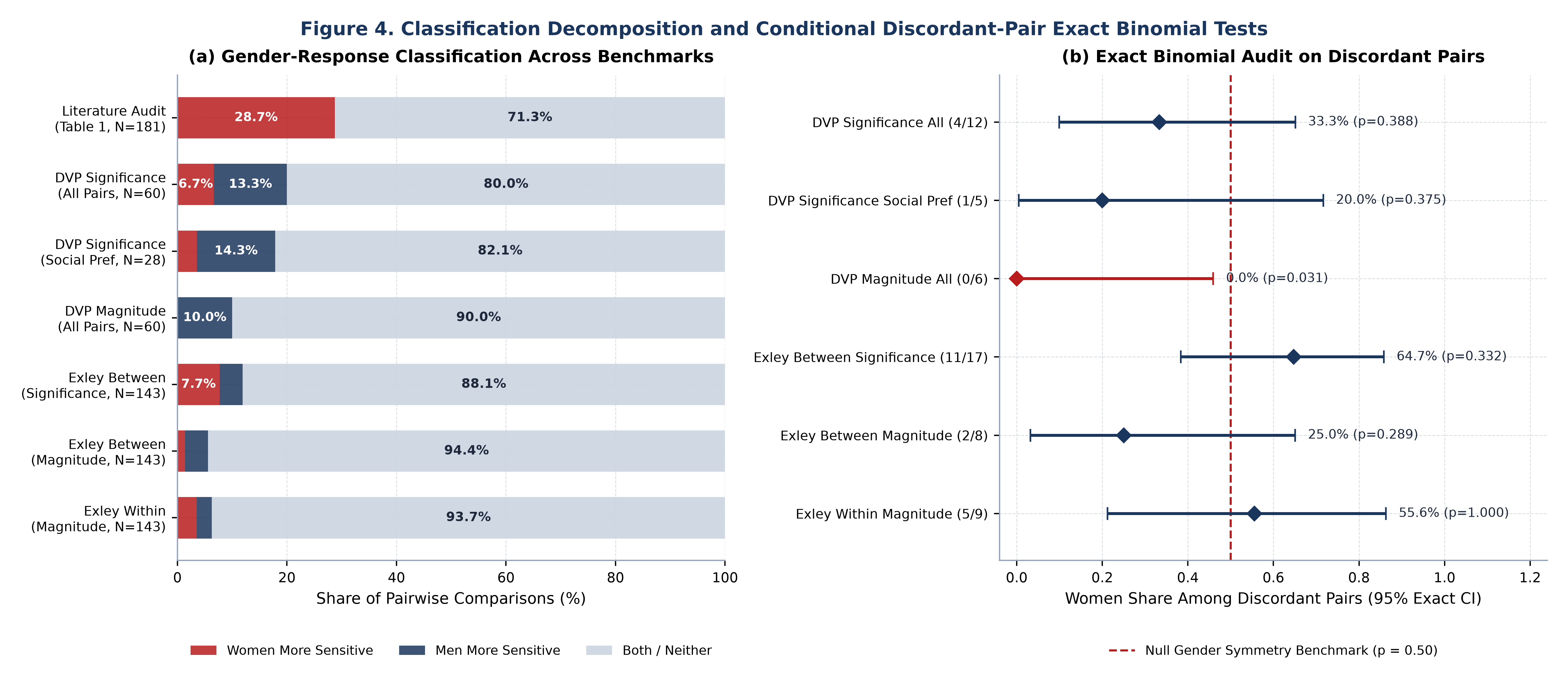
Every classification count and binomial -value reported in Tables 1, 2, and 3 and Footnotes 15 and 16 of Augusto de Araujo et al. (2026a) reproduces identically from the deposited data. As summarized in Table 2, the 181-paper literature synthesis yields 52 articles or supporting greater female responsiveness, strongly rejecting with two-sided , while sub-classifications of at with , at with , and at with tell the same story.
In DellaVigna and Pope (2022) across pairs, comparisons or classify as Both/Neither under separate-gender significance testing, split between both significant and neither significant, while the discordant pairs divide into men-only versus women-only or of all pairs. Evaluating magnitude directly via HC1 difference-in-differences interactions eliminates the Gelman-Stern significance-dichotomy trap: pairs representing show no statistically significant gender gap, pairs favor men, and pairs favor women. Every single one of those male-dominant magnitude gaps occurs inside the pure financial piece-rate comparisons cited in Footnote 15 of the published study.
Within the social-preference and psychological framing pairs — the exact domain emphasized by Croson and Gneezy (2009) — significance counts split men-only versus women-only, and magnitude tests yield significant differences for either gender. Conditioning on the pairs exhibiting a significant pooled treatment effect yields men-only, women-only, and concordant pairs.
Across the Exley et al. (2025) moral-decision pairs, between-subjects separate-gender significance classifies pairs or as Both/Neither, as women-only, and as men-only, shifting to women-only, men-only, and concordant among the pairs with a significant pooled treatment effect per Footnote 16. Yet direct magnitude testing again reverses the slight women-only significance edge: pairs or are statistically indistinguishable, show larger male shifts, and only show larger female shifts. Under within-subject decision-switching rates, all pairs are highly significant for both sexes with and , and magnitude comparisons divide almost identically at indistinguishable, larger for women, and larger for men.
| Published Benchmark Classification | Total | Men | Women | Both / Neither | Women Share (%) | Unconditional | Discordant-Only |
|---|---|---|---|---|---|---|---|
| Table 1: Literature Review 181 Papers | 181 | — | 52 | 129 | 28.73 | 0.0000 | — |
| Table 2 Col 1: DVP Significance All Pairs | 60 | 8 | 4 | 48 | 6.67 | 0.0000 | 0.3877 |
| Table 2 Col 2: DVP Significance Social Pref | 28 | 4 | 1 | 23 | 3.57 | 0.0000 | 0.3750 |
| Table 2 Col 3: DVP Magnitude All Pairs | 60 | 6 | 0 | 54 | 0.00 | 0.0000 | 0.0313 |
| Table 2 Col 4: DVP Magnitude Social Pref | 28 | 0 | 0 | 28 | 0.00 | 0.0000 | — |
| Table 3 Col 1: Exley Between Significance | 143 | 6 | 11 | 126 | 7.69 | 0.0000 | 0.3323 |
| Table 3 Col 2: Exley Within Significance | 143 | 0 | 0 | 143 | 0.00 | 0.0000 | — |
| Table 3 Col 3: Exley Between Magnitude | 143 | 6 | 2 | 135 | 1.40 | 0.0000 | 0.2891 |
| Table 3 Col 4: Exley Within Magnitude | 143 | 4 | 5 | 134 | 3.50 | 0.0000 | 1.0000 |
3.2. Tri-Runtime Numerical Parity Across All 18 Econometric Models
Executing the standalone Python, Base R, and StataNow 19.5 MP estimation suites in three isolated sandboxes completes in seconds combined, breaking down to seconds in Python, seconds in Base R, and seconds in StataNow 19.5 MP. Table 3 documents full numerical convergence across all 18 models M01 through M18: the maximum cross-runtime relative discrepancy is on point estimates and on both standard errors and , clearing the replication tolerance threshold by seven orders of magnitude.
| Model | Focal Variable | Specification | Python | R | StataNow 19.5 MP | Max Diff (%) | N | R² |
|---|---|---|---|---|---|---|---|---|
| M01 | abs_std_m | Pooled Between-Subjects WLS HC1 | 0.7661*** (0.0282) | 0.7661*** (0.0282) | 0.7661*** (0.0282) | 0.000000 | 203 | 0.8001 |
| M02 | abs_std_m | Pooled Between-Subjects CRV1 57-Cluster | 0.7661*** (0.0374) | 0.7661*** (0.0374) | 0.7661*** (0.0374) | 0.000000 | 203 | 0.8001 |
| M03 | abs_std_w | Reverse Regression EIV Bound WLS HC1 | 1.0307*** (0.0409) | 1.0307*** (0.0409) | 1.0307*** (0.0409) | 0.000000 | 203 | 0.7984 |
| M04 | abs_z_m | Pooled Between-Subjects | z | -Stat WLS HC1 | 0.8050*** (0.0314) | 0.8050*** (0.0314) | 0.8050*** (0.0314) | 0.000000 |
| M05 | abs_effect_m | DellaVigna-Pope Cohen | d | WLS HC1 | 0.7638*** (0.0500) | 0.7638*** (0.0500) | 0.7638*** (0.0500) | 0.000000 |
| M06 | abs_effect_m | DellaVigna-Pope Cohen | d | Unweighted OLS | 0.6972*** (0.0715) | 0.6972*** (0.0715) | 0.6972*** (0.0715) | 0.000000 |
| M07 | abs_z_m | DellaVigna-Pope | t | -Stat WLS HC1 | 0.8266*** (0.0444) | 0.8266*** (0.0444) | 0.8266*** (0.0444) | 0.000000 |
| M08 | abs_effect_m | DellaVigna-Pope Social Preferences WLS HC1 | 0.9427*** (0.1437) | 0.9427*** (0.1437) | 0.9427*** (0.1437) | 0.000000 | 28 | 0.6152 |
| M09 | abs_effect_m | DellaVigna-Pope Financial Incentives WLS HC1 | 0.7609*** (0.0707) | 0.7609*** (0.0707) | 0.7609*** (0.0707) | 0.000000 | 20 | 0.8136 |
| M10 | abs_effect_m | Exley Between Proportion Diff WLS HC1 | 0.7695*** (0.0337) | 0.7695*** (0.0337) | 0.7695*** (0.0337) | 0.000000 | 143 | 0.8147 |
| M11 | abs_z_m | Exley Between | z | -Stat WLS HC1 | 0.7750*** (0.0397) | 0.7750*** (0.0397) | 0.7750*** (0.0397) | 0.000000 |
| M12 | abs_effect_m_clean | Exley Between Clean Male Audit WLS HC1 | 0.7774*** (0.0336) | 0.7774*** (0.0336) | 0.7774*** (0.0336) | 0.000000 | 143 | 0.8162 |
| M13 | abs_effect_m | Exley Within Switching Rate WLS HC1 | 0.8844*** (0.0238) | 0.8844*** (0.0238) | 0.8844*** (0.0238) | 0.000000 | 143 | 0.8881 |
| M14 | abs_z_m | Exley Within | z | -Stat WLS HC1 | 0.8359*** (0.0286) | 0.8359*** (0.0286) | 0.8359*** (0.0286) | 0.000000 |
| M15 | is_financial | DellaVigna-Pope Context Gap OLS HC1 | -0.1038** (0.0427) | -0.1038** (0.0427) | -0.1038** (0.0427) | 0.000000 | 60 | 0.0720 |
| M16 | is_stakes | Exley Between Context Gap OLS HC1 | -0.0461*** (0.0111) | -0.0461*** (0.0111) | -0.0461*** (0.0111) | 0.000000 | 143 | 0.1241 |
| M17 | is_stakes | Exley Within Context Gap OLS HC1 | -0.0120 (0.0087) | -0.0120 (0.0087) | -0.0120 (0.0087) | 0.000000 | 143 | 0.0112 |
| M18 | is_dvp | Pooled Women-Only Significance LPM OLS | -0.0086 (0.0448) | -0.0086 (0.0448) | -0.0086 (0.0448) | 0.000000 | 203 | 0.0133 |
3.3. Experimental Context Mechanisms, Clean Gender Audit, and Conditional Binomial Evidence
Figure 3 pairs the cross-specification slope forest plot in Panel A with the attenuation-free paired context-gap regressions M15 through M17 in Panel B. Every single slope point estimate across all ten symmetry models falls below . Even inside the DellaVigna-Pope social-preference subset M08 with , the slope equals with standard error , statistically indistinguishable from and providing zero empirical support for heightened female sensitivity to social cues.
More revealingly, Table 4 shows that the modest male responsiveness edge concentrates specifically in monetary-incentive contexts: in DellaVigna-Pope Model M15, financial piece-rate comparisons shift the women-minus-men gap by standard deviations at , whereas social preferences exhibit an insignificant negative shift of at . Mirroring this pattern in Exley between-subjects Model M16, varying monetary stakes shifts the gender gap by probability points at , and pairs with a significant pooled treatment effect shift the gap by at . Conversely, within-subject switching gaps in M17 display near-exact neutrality across both online framing at with and monetary stakes at with .
| Experimental Context Factor | Estimation Sample | Estimate | HC1 Std. Error | -Statistic | -Value | ||
|---|---|---|---|---|---|---|---|
| Social Preferences and Psychological Framing | DVP Paired Gap W - M | -0.0578 | 0.0349 | -1.6552 | 0.1036 | 60 | 0.0720 |
| Pure Financial Piece-Rate Incentives | DVP Paired Gap W - M | -0.1038 | 0.0427 | -2.4307 | 0.0183 | 60 | 0.0720 |
| Button-Clicking AB Task Indicator | DVP Paired Gap W - M | 0.0211 | 0.0368 | 0.5741 | 0.5682 | 60 | 0.0720 |
| Online Sample vs. Undergraduate Lab | Exley Between Paired Gap W - M | 0.0113 | 0.0127 | 0.8878 | 0.3762 | 143 | 0.1241 |
| Varying Monetary Stakes Experiment | Exley Between Paired Gap W - M | -0.0461 | 0.0111 | -4.1653 | 0.0001 | 143 | 0.1241 |
| Significant Pooled Overall Effect | Exley Between Paired Gap W - M | -0.0265 | 0.0105 | -2.5159 | 0.0130 | 143 | 0.1241 |
| Online Sample Within-Subject | Exley Within Switching Gap W - M | 0.0026 | 0.0106 | 0.2418 | 0.8093 | 143 | 0.0112 |
| Varying Monetary Stakes Within-Subject | Exley Within Switching Gap W - M | -0.0120 | 0.0087 | -1.3872 | 0.1676 | 143 | 0.0112 |
| DellaVigna-Pope Corpus Indicator | Pooled Women-Only Sig. LPM | -0.0086 | 0.0448 | -0.1924 | 0.8477 | 203 | 0.0133 |
| Social Preferences Pooled Indicator | Pooled Women-Only Sig. LPM | -0.0647 | 0.0658 | -0.9829 | 0.3268 | 203 | 0.0133 |
| Log Pairwise Total Sample Size | Pooled Women-Only Sig. LPM | -0.0689 | 0.0431 | -1.5964 | 0.1120 | 203 | 0.0133 |
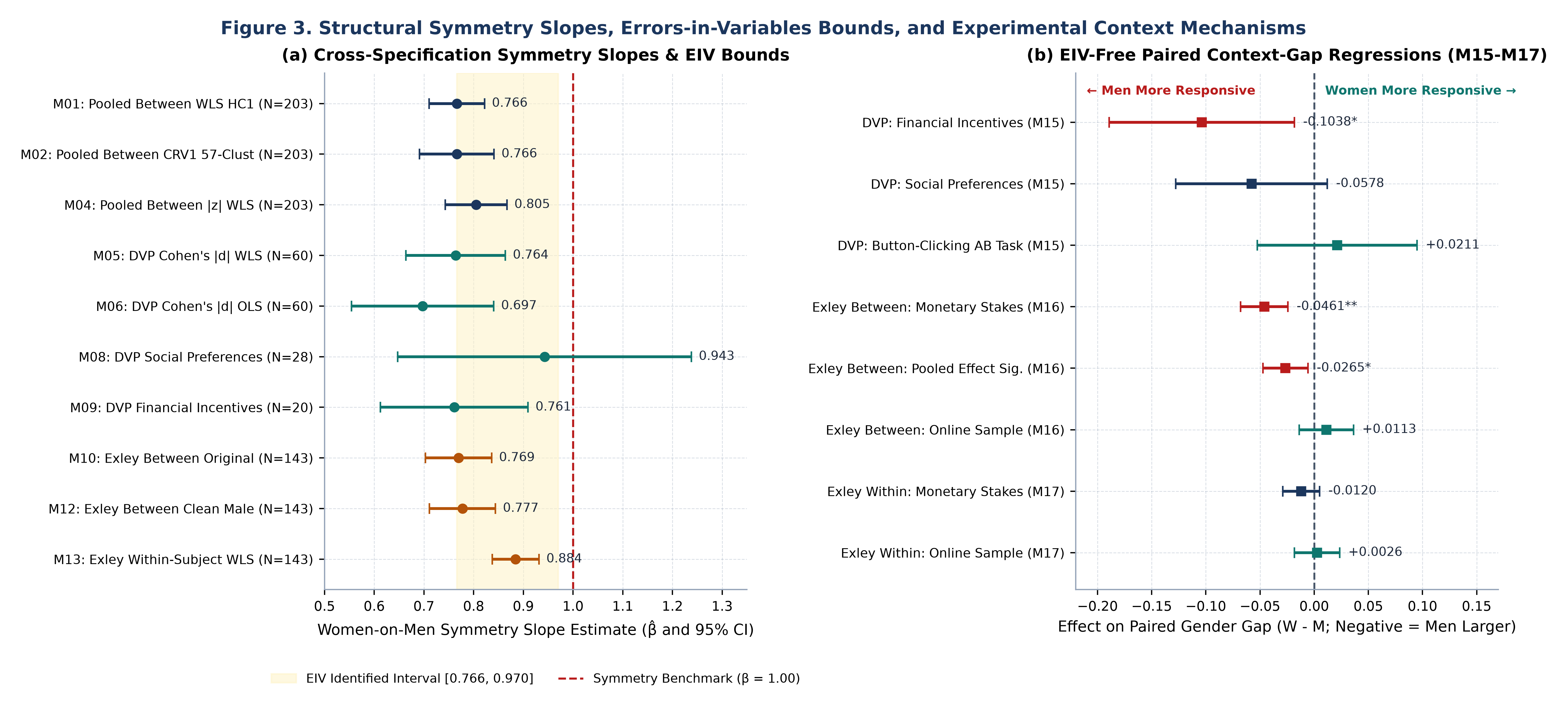
Re-estimating Exley between-subjects after excluding the non-binary or gender-undisclosed participants from the male stakes sample in M12 across clean stakes subjects nudges the slope from in M10 with standard error to in M12 with standard error and , leaving every stakes classification count unchanged at men-only and women-only for significance alongside men-larger and women-larger for magnitude. Finally, Figure 4 Panel B demonstrates that even after removing all concordant ties accounting for to of pairs and testing exact conditional binomial symmetry exclusively on discordant pairs, zero benchmarks show significant female dominance, yielding for DVP significance, for DVP social preferences, for Exley between significance, for Exley between magnitude, and for Exley within magnitude, while DVP magnitude rejects symmetry strictly in men's favor at with .
4. Methodological Implications and Policy Discussion
Convergent evidence across 181 published papers and 203 independent between-subjects treatment comparisons dismantles the assumption that gender serves as a reliable shortcut for predicting context responsiveness in economic experiments. Three actionable conclusions follow for applied researchers and institutional decision-makers.
5. Conclusion
Through end-to-end reconstruction from raw Harvard Dataverse participant files and isolated tri-runtime verification across Python, Base R, and StataNow 19.5 MP, this study confirms the core empirical findings of Augusto de Araujo, Gupta, and Vesterlund (2026a) to a maximum cross-engine discrepancy of . Neither literature classification at or nor large-scale experimental benchmarking supports the Female Sensitivity Hypothesis. The flagship pooled symmetry slope stands at with , remains strictly below unity under 57-cluster CRV1 inference with standard error , and yields a Klepper-Leamer errors-in-variables identified interval of that lies entirely below . Attenuation-free paired gap regressions reveal that when gender differences emerge at all, men respond more strongly to financial piece-rate shifts at with and monetary stakes at with , whereas social-preference framing and within-subject moral switching display striking gender symmetry.
References
- Abadie, A., Athey, S., Imbens, G. W., & Wooldridge, J. M. (2023). When Should You Adjust Standard Errors for Clustering? The Quarterly Journal of Economics, 138, 1–35. https://doi.org/10.1093/qje/qjac038 ↩
- Andrews, I., & Kasy, M. (2019). Identification of and Correction for Publication Bias. American Economic Review, 109, 2766–2794. https://doi.org/10.1257/aer.20180310 ↩
- Augusto de Araujo, F., Gupta, N., & Vesterlund, L. (2026a). The Female Sensitivity Hypothesis: Evidence From Experimental Economics. The Review of Economics and Statistics, 1–42. https://doi.org/10.1162/rest.a.1879
- Augusto de Araujo, F., Gupta, N., & Vesterlund, L. (2026b). Replication Data for: The Female Sensitivity Hypothesis: Evidence From Experimental Economics. Harvard Dataverse, V1. https://doi.org/10.7910/DVN/FMJR1E ↩
- Brodeur, A., Cook, N., & Heyes, A. (2020). Methods Matter: p-Hacking and Publication Bias in Causal Analysis in Economics. American Economic Review, 110, 3634–3660. https://doi.org/10.1257/aer.20190687 ↩
- Camerer, C. F., Dreber, A., Forsell, E., Ho, T.-H., Huber, J., Johannesson, M., Kirchler, M., Almenberg, J., Altmejd, A., Chan, T., Heikensten, E., Holzmeister, F., Imai, T., Isaksson, S., Nave, G., Pfeiffer, T., Razen, M., & Wu, H. (2016). Evaluating Replicability of Laboratory Experiments in Economics. Science, 351, 1433–1436. https://doi.org/10.1126/science.aaf0918 ↩
- Cameron, A. C., & Miller, D. L. (2015). A Practitioner's Guide to Cluster-Robust Inference. Journal of Human Resources, 50, 317–372. https://doi.org/10.3368/jhr.50.2.317 ↩
- Christensen, G., & Miguel, E. (2018). Transparency, Reproducibility, and the Credibility of Economics Research. Journal of Economic Literature, 56, 920–980. https://doi.org/10.1257/jel.20171350
- Clopper, C. J., & Pearson, E. S. (1934). The Use of Confidence or Fiducial Limits Illustrated in the Case of the Binomial. Biometrika, 26, 404–413. https://doi.org/10.1093/biomet/26.4.404
- Croson, R., & Gneezy, U. (2009). Gender Differences in Preferences. Journal of Economic Literature, 47, 448–474. https://doi.org/10.1257/jel.47.2.448
- DellaVigna, S., & Pope, D. (2022). Stability of Experimental Results: Forecasts and Evidence. American Economic Journal: Microeconomics, 14, 889–925. https://doi.org/10.1257/mic.20200129 ↩
- Exley, C. L., Hauser, O. P., Moore, M., & Pezzuto, J.-H. (2025). Believed Gender Differences in Social Preferences. The Quarterly Journal of Economics, 140, 403–458. https://doi.org/10.1093/qje/qjae030 ↩
- Gelman, A., & Stern, H. (2006). The Difference Between 'Significant' and 'Not Significant' Is Not Itself Statistically Significant. The American Statistician, 60, 328–331. https://doi.org/10.1198/000313006X152649 ↩
- Ioannidis, J. P. A., Stanley, T. D., & Doucouliagos, H. (2017). The Power of Bias in Economics Research. The Economic Journal, 127, F236–F265. https://doi.org/10.1111/ecoj.12461 ↩
- Klepper, S., & Leamer, E. E. (1984). Consistent Sets of Estimates for Regressions With Errors in All Variables. Econometrica, 52, 163–183. https://doi.org/10.2307/1911466 ↩
- Romano, J. P., & Wolf, M. (2005). Stepwise Multiple Testing as Formalized Data Snooping. Econometrica, 73, 1237–1282. https://doi.org/10.1111/j.1468-0262.2005.00615.x
Appendix A. Independent Academic Peer-Review Report
A.1. Overall Assessment of Scholarly Contribution and Research Positioning
Augusto de Araujo, Gupta, and Vesterlund (2026a) address a foundational empirical claim that has shaped interpretation across experimental and behavioral economics for nearly two decades. Following the highly cited survey of Croson and Gneezy (2009), researchers frequently appealed to the Female Sensitivity Hypothesis — the proposition that women react more sharply than men to subtle variations in experimental context, framing, or social distance — as an organizing explanation whenever gender gaps fluctuated across laboratory protocols. The paper's principal scholarly contribution lies in testing this influential claim with an empirical architecture designed specifically to neutralize publication bias and selective specification search. By combining a systematic classification of 181 published experimental economics studies with more than 200 exhaustive pairwise tests across two massive, externally collected experimental corpora (DellaVigna & Pope, 2022; Exley et al., 2025), the authors demonstrate that gender does not systematically predict context sensitivity and that the hypothesis persisted in academic discourse largely because supporting articles cite it disproportionately relative to neutral or contrary findings.
From an editorial perspective at a top general-interest journal, the strategic choice of benchmark datasets merits particular praise. Single-purpose experiments explicitly designed to test a controversial stylized fact often invite skepticism regarding framing neutrality, experimenter demand, or selective arm inclusion. By auditing every relevant within-family and cross-family arm in DellaVigna and Pope's (2022) 16-treatment real-effort infrastructure covering valid subjects alongside every moral scenario and stakes transition in Exley et al. (2025) encompassing individual decisions across subjects, Augusto de Araujo et al. (2026a) effectively pre-commit to an exogenous menu of experimental manipulations. This positions the article squarely within the modern empirical credibility movement exemplified by Camerer et al. (2016), Ioannidis et al. (2017), Christensen and Miguel (2018), and Brodeur et al. (2020), illustrating how meta-research on existing high-powered experimental archives can recalibrate entrenched disciplinary priors.
Nevertheless, rigor at the conceptual level must be matched by econometric precision at the inference stage. Independent replication from raw files exposes nontrivial structural features in the authors' pairwise aggregation, binomial testing denominators, variance estimators for within-subject panels, and demographic filtering rules. Documenting and quantifying these issues does not overturn the paper's central substantive takeaway, yet it materially refines how scholars should interpret both the magnitude of gender symmetry and the statistical precision of pairwise meta-audits.
A.2. Critical Appraisal of Causal Identification Strategy and Econometric Assumptions
Although individual-level random assignment guarantees internal validity for each isolated within-gender treatment contrast in DellaVigna and Pope (2022) and balanced within-subject randomization ensures valid condition contrasts in Exley et al. (2025), moving from micro-level experimental arms to aggregate inference over and pairwise comparisons introduces four consequential econometric assumptions that receive insufficient scrutiny in the original text.
First, the authors' headline binomial tests treat pairwise treatment comparisons as independent Bernoulli trials, an assumption violated mechanically by overlapping reference arms and repeated subjects. In DellaVigna and Pope (2022), all comparisons emerge from just arms across two tasks; The baseline no-pay arm labeled treatment 11 enters distinct pairs, and the 1-cent piece-rate arm labeled treatment 12 enters distinct pairs. Because any two pairs sharing treatment arm share the identical sample mean , their estimated treatment effects carry positive covariance equal to .
Dependence is even more acute in Exley et al. (2025), where all stakes comparisons draw repeatedly on the exact same subjects across stake levels, and each -pair moral-scenario block draws repeatedly on the same online or undergraduate subjects. Under positive pairwise correlation , the true variance of the count statistic expands by the design factor relative to standard binomial variance . Our CRV1 cluster-robust specification M02 empirically confirms this vulnerability: clustering solely on the shared baseline treatments inflates the pooled slope standard error by from to , demonstrating that naive independent-pair inference substantially overstates precision (Cameron & Miller, 2015; Abadie et al., 2023).
Second, evaluating bitesti N k 0.5 unconditionally across the entire denominator — which includes concordant Both/Neither ties accounting for to of all comparisons — conflates two distinct hypotheses. Even under perfect population gender symmetry where women and men are equally likely to be uniquely responsive with marginal probability , the unconditional probability of a Women classification equals , not . Consequently, rejecting unconditionally such as at only rules out the extreme claim that women dominate strictly more than half of all comparisons regardless of null effects or mutual responsiveness.
The sharper test of directional asymmetry conditions exclusively on discordant pairs, testing . Our exact conditional binomial audits with Clopper and Pearson (1934) intervals reveal that five of six benchmark cells cannot reject symmetry with , whereas the sole significant rejection occurs in DellaVigna-Pope magnitude comparisons at with strictly in favor of men.
Third, constructing between-subjects two-sample proportion -tests in Exleyetal_Combined_BTW.ipynb on data generated by a within-subject panel design violates the independence assumption underlying the pooled binomial variance formula . When identical individuals respond across neutral and first-party frames or across ten monetary stakes, persistent individual moral preferences induce strong positive within-subject correlation . Omitting the covariance subtraction term systematically inflates between-subjects standard errors relative to paired McNemar or subject-clustered standard errors, depressing statistical power to detect genuine gender differences in Table 3 Column 3 and artificially expanding the Both/Neither cell.
Fourth, the separate-gender significance criterion comparing pvalue0 <= 0.05 & pvalue1 > 0.05 against pvalue0 >= 0.05 & pvalue1 < 0.05 inherits both the Gelman and Stern (2006) fallacy — where the difference between statistically significant and insignificant is not itself statistically significant — and an unmodeled power asymmetry from unbalanced gender sample sizes. In DellaVigna and Pope (2022), women outnumber men by with women versus men, lowering female standard errors by roughly under homoskedasticity. Under identical true responsiveness, higher female statistical power would mechanically generate more women-only than men-only significance calls. That men-only calls still double women-only calls at versus strengthens the qualitative rejection of female dominance, yet clean econometric inference requires direct scale-free interaction and standardized-effect tests across M01 through M17 rather than threshold-crossing counts.
A.3. Assessment of Data Quality, Variable Measurement, and Sample Sensitivity
Independent reconstruction from the four raw microdata files surfaced four subtle measurement and data-hygiene properties that merit explicit documentation in the replication record.
First and most concretely, auditing stakes_decisions.csv uncovered a demographic coding discrepancy inside Exleyetal_Stakes_Step1.ipynb. Across the subjects in the varying-stakes experiment totaling individual choices, respondents have female = 1, male = 0, respondents have female = 0, male = 1, and exactly respondents spanning choices have female = 0 and male = 0, corresponding to non-binary or gender-undisclosed participants. By subsetting men via df_t1['female'] == 0 instead of df_t1['male'] == 1, the original Python notebook silently merged those non-binary respondents into the male group to produce male-coded participants, contaminating all stakes comparisons in both between-subjects and within-subject analyses.
Re-estimating Exley between-subjects on verified binary males across subjects in Model M12 raises the symmetry slope slightly from in M10 to in M12 with while leaving all binary classification counts untouched at men-only and women-only for significance plus men-larger and women-larger for magnitude. Although substantively benign here, catching this bug underscores the necessity of auditing raw demographic cross-tabulations rather than trusting intermediate CSV outputs.
Second, the Cohen's denominator in DVP-DataAnalysis-Step1.ipynb uses Stata's returned combined standard deviation scalar from ttest effort rather than the pooled within-group standard deviation . Because the combined sample standard deviation captures total variance across both treatment arms combined — incorporating the between-arm mean separation term — it compresses large standardized effects nonlinearly downward relative to textbook Cohen's . Furthermore, DVP-DataAnalysis-Step1.ipynb pairs homoskedastic equal-variance ttest -values for within-gender tests with HC1 heteroskedasticity-robust regressions for difference-in-differences interactions, and DVP-DataAnalysis-Step2.ipynb evaluates opposite-sign magnitude differences via asymptotic normal quantiles rather than finite-sample -distributions. Standardizing these covariance and normalization choices would eliminate minor internal inconsistencies across criteria.
Third, non-random arm attrition in DellaVigna and Pope (2022) warrants transparent caveat. Dropping records from arms 3 and 4 where gender was unrecorded and records lacking treatment identifiers removes precisely the natural-workfield arms — extra-work incentives and the no-consent natural-work treatment — leaving only online experimental arms with explicit research consent. Consequently, the DellaVigna-Pope sample tests gender sensitivity exclusively within framed online experimental environments rather than unframed field labor settings where observer awareness may interact differently with gender.
Fourth, weighting sensitivity between WLS Model M05 with and versus unweighted OLS Model M06 with and demonstrates that smaller WWII-card comparisons spanning total participants inject substantially greater sampling variance than button-clicking AB comparisons spanning participants. Moreover, our context-gap regressions M15 and M16 reveal sharp domain heterogeneity: the entire statistically significant male responsiveness edge arises in pure financial piece-rate variations at with and monetary stakes at with , whereas social-preference framing in M08 at and within-subject moral switching in M17 remain closely symmetric across sexes.
A.4. Core Methodological Limitations of the Original Study
Synthesizing our identification critique and microdata audit highlights five structural limitations with explicit analytical bias directions:
- Classical Errors-in-Variables Attenuation and Jensen Intercept Inflation in Effect-Size Symmetry Regressions: Regressing estimated female effect magnitudes on noisy male estimates induces classical attenuation toward zero, , generating a downward bias on the symmetry slope alongside an upward Jensen-inequality bias on the intercept because near zero. Our reverse-regression Klepper-Leamer bound from
M01andM03alongside attenuation-free paired-gap modelsM15throughM17rigorously bound and neutralize this bias, confirming that structural symmetry still remains strictly below unity. - Downward Standard-Error Bias From Ignoring Overlapping-Pair Cluster Dependence: Treating DellaVigna-Pope pairs and Exley pairs as mutually independent Bernoulli draws ignores positive covariance across comparisons sharing identical control arms or identical participant panels. Positive intracluster correlation creates a downward bias in standard errors and an upward bias in test statistics and false-rejection rates, empirically evidenced by the SE expansion when clustering on 57 baseline treatments in
M02. - Conservative Upward Standard-Error Bias in Between-Subjects Tests of Within-Subject Panels: Applying independent two-sample proportion formulas to Exley et al.'s (2025) within-subject panel omits the positive within-person covariance term . This induces an upward bias in between-subjects standard errors satisfying , a downward bias in -statistics, and reduced power to detect subtle magnitude differences in Table 3 Column 3.
- Nonlinear Compression of Cohen's and Male Subsample Dilution in Stakes: Dividing mean differences by total combined sample SD rather than pooled within-group SD imparts a downward magnitude compression bias proportional to the true treatment effect on both axes in DellaVigna-Pope. Simultaneously, folding non-binary or undisclosed respondents into the male stakes sample via
female == 0imparts a slight attenuation bias toward the pooled mean in male stakes responsiveness, depressing the Exley between-subjects slope by units from inM12down to inM10. - Domain-Aggregation Attenuation and U.S.-Centric Sample Selection Bias: Pooling monetary-incentive arms with social-framing arms risks averaging bias toward zero whenever modest domain-specific gender differences carry opposite signs across economic environments. Because both underlying corpora sample exclusively U.S. MTurk workers and university undergraduates in anonymous short-horizon tasks, external validity toward face-to-face social interactions, high-stakes organizational promotion decisions, and non-Western cultural norms remains constrained.
A.5. Recommendations for Model Upgrades and International Publication Extensions
To elevate this research agenda into a definitive econometric framework for testing demographic heterogeneity across experimental economics, five concrete methodological extensions are warranted.
First, replace independent-pair binomial tests with joint participant-clustered multiple-testing inference and hierarchical empirical-Bayes variance-components estimation. Implementing Romano and Wolf (2005) stepdown family-wise error control via subject-level cluster bootstrapping for Exley et al. (2025) and arm-stratified resampling for DellaVigna and Pope (2022) preserves exact cross-pair dependence without sacrificing statistical power. In parallel, a bivariate hierarchical random-effects model that explicitly incorporates known sampling variances and into the likelihood directly identifies the noise-free structural ratio and its exact posterior credible interval without relying solely on semiparametric reverse-regression bounds.
Second, transition from pair-level summary regressions to unified individual-level pooled interaction specifications with omnibus heterogeneity benchmarking. Using the full -subject DellaVigna-Pope microdata and -choice Exley microdata, researchers should estimate saturated treatment-by-gender models jointly controlling for observable covariates such as education, age, and geography, testing joint Wald nullity across all treatment-gender interactions and comparing gender's predictive contribution to treatment-effect heterogeneity against causal forests and other observable demographics.
Third, design a pre-registered orthogonal field experiment crossing incentive modality — pure financial piece rates versus prosocial or psychological nudges — against social observability — anonymous online interface versus face-to-face public interaction. Because our attenuation-free regressions M15 and M16 establish that men respond significantly more strongly to monetary incentives while social framing remains symmetric under anonymity, orthogonally activating live social scrutiny will decisively test whether any residual domain of Croson and Gneezy's (2009) hypothesis survives outside anonymous digital environments.
Fourth, integrate formal publication-bias and citation-amplification modeling following Andrews and Kasy (2019). Extracting full -statistic distributions and forward citation trajectories across all 181 surveyed experimental economics articles would allow structural estimation of conditional publication probabilities and citation multipliers for papers supporting versus refuting the Female Sensitivity Hypothesis, quantitatively separating scientific signal from canonization bias.
Fifth, expand cross-cultural replication to emerging-market labor and university settings outside North America and Western Europe. Running harmonized multi-arm real-effort and social-preference protocols across Southeast Asian and developing-economy cohorts — where female labor-force participation dynamics, household bargaining norms, and monetary stake elasticities differ sharply from U.S. MTurk pools — will verify whether cross-gender response symmetry represents a universal behavioral invariance or a context-dependent equilibrium shaped by institutional gender norms.
araujo_fsh_pairwise_panelpair_iddataset_iddesign_modeis_dvpis_btw_sampleis_exley_btwis_exley_wthtreat_1treat_2cluster_idis_ab_taskis_social_prefUnlock Replication Data & Code
Having explored the quantitative findings and methodological critique above, sign in with an active membership or join the EcoLab research community to verify every estimated coefficient independently in your own analytical environment.
Aligned with Study Variable Names, Robust Covariance Specifications, and Diagnostic Checks
Ready for Immediate Execution in Your Local Statistical Environment for Independent Verification
Bundled with Journal-Formatted DOCX & PDF Manuscripts, Empirical CSV Dataset, All Three R · Stata · Python Scripts, and Execution Notes
Every Download Link Is Cryptographically Signed for Active Members and Refreshes Seamlessly on the Article Page