Keywords: Financial Regulation, Partisan Polarization, Climate Risk Governance, High-Dimensional Fixed Effects, Poisson Pseudo-Maximum Likelihood, Computational Reproducibility
JEL Classification: G18, G28, D72, Q54, Q58, C55
1. Introduction
Modern political economy justifies delegating technical policymaking to independent regulatory agencies on the premise that insulating specialized bureaucracies from electoral cycles reduces policy volatility and limits partisan distortion (Alesina & Tabellini, 2007). Yet the divergent institutional trajectories of the two pillars of U.S. financial oversight—the Securities and Exchange Commission SEC and the Board of Governors of the Federal Reserve System Fed—expose an acute empirical tension regarding the boundaries of bureaucratic independence. As ideological polarization in the U.S. Congress has intensified dramatically over the past three decades (Gentzkow, Shapiro, & Taddy, 2019), a central empirical question arises: do appointed financial regulators remain insulated technocrats guided by shared analytical standards, or has congressional partisanship penetrated both their public speeches and their formal rulemaking votes?
This question carries first-order economic stakes for environmental economics and climate finance. In their large-scale textual analysis bridging the Congressional Record and regulatory speech archives, Engelberg et al. (2023a) document that the most sharply partisan bigrams migrating from legislative floor debates into financial regulator speeches include the exact phrases anchoring modern environmental policy debates: Democratic-leaning language centered on climate change and Republican-leaning language centered on regulatory red tape. Across global capital markets, institutional investors increasingly price a distinct carbon risk premium driven by transition policy uncertainty and mandatory greenhouse-gas disclosure regimes (Bolton & Kacperczyk, 2021). When a capital-market supervisor such as the SEC becomes deeply fractured along party lines, corporate climate-risk reporting frameworks, Scope 1 through Scope 3 emissions mandates, and ESG fund labeling rules face abrupt reversals whenever partisan control of the commission shifts following a presidential election.
Prior scholarship on partisan behavior within financial markets examined primarily private-sector intermediaries such as credit rating analysts (Kempf & Tsoutsoura, 2021) or internal deliberation transparency within the Federal Open Market Committee FOMC at the Fed (Hansen et al., 2018). Systematic long-horizon evidence contrasting partisan polarization across the SEC and the Fed over nearly nine decades remained absent until the publication of Engelberg et al. (2023a) alongside its open 1.63 GB Harvard Dataverse archive (Engelberg et al., 2023b).
This independent reproducibility study executes three structured academic objectives.
First, we independently reconstruct and re-estimate the complete empirical core of Engelberg et al. (2023a) directly from the open Harvard Dataverse archive across 18 econometric specifications M01–M18. These models span partisan co-voting dissent regressions at the SEC and the Fed corresponding to Table 8 of the original article, within-rule speech ideological distance regressions with rule fixed effects corresponding to Table 9, nonlinear Poisson pseudo-maximum likelihood PPML robustness checks corresponding to Table A6, and a heterogeneity extension disaggregating Democratic and Republican SEC commissioners.
Second, every single one of the 18 specifications is executed concurrently across three independent statistical runtimes—Python 3.13, R 4.3, and Stata 18 MP—under harmonized CRV1 rule-clustered variance estimation and identical separation-dropping rules for Poisson fixed effects, verifying computational invariance far tighter than the academic tolerance threshold.
Third, we integrate auxiliary empirical evidence from the original archive covering public SEC speeches and commissioner biographical profiles to verify the personnel-replacement mechanism, conduct a rigorous causal-inference and measurement peer review in Appendix A, and derive actionable governance design principles for climate-finance oversight in emerging markets including Vietnam.
2. Data and Econometric Methodology
2.1. Open Replication Archive and Descriptive Statistics
All empirical data analyzed in this study are extracted directly from the original open Harvard Dataverse replication archive of Engelberg et al. (2023b) with zero synthetic augmentation or simulated data generation. The unified non-chair voting dataset contains exactly commissioner-rule vote observations partitioned across two distinct federal regulatory bodies.
At the SEC, the full administrative voting ledger records individual votes cast by commissioners across rules and enforcement orders between 2006 and 2019. Following the identification convention of Engelberg et al. (2023a) to isolate voting responses from the agenda-setting authority of the agency head, all votes cast by the sitting chair are excluded from the regression sample. This yields an estimation sample of non-chair votes spanning rule clusters. Unanimity prevails on of SEC rules, leaving a baseline non-chair dissent probability of with a standard deviation of . Decomposing the SEC rules that experience two or more dissenting votes reveals stark partisan clustering: rules involve Republican-only dissenting pairs, rules involve Democratic-only dissenting pairs, and merely rules record bipartisan dissent combining one Republican and one Democratic commissioner.
At the Federal Reserve Board, the administrative voting record spans a far longer 84-year window from 1936 through 2019, encompassing total votes cast by governors across regulatory actions. Excluding votes cast by the Fed chair produces an estimation sample of non-chair votes across rule clusters. The board reaches unanimous consensus on of rules, and the mean non-chair dissent rate stands at with a standard deviation of . To examine personnel-turnover dynamics alongside voting behavior, we also audit two auxiliary datasets from the open archive: a corpus of public speeches delivered by SEC commissioners between 1933 and 2019 and a biographical registry recording five commissioner attributes—gender, prior political background, law degree, master of business administration degree, and graduate economics training.
| Agency | Variable | Observations | Mean | Std. Dev. | Min | Median | Max |
|---|---|---|---|---|---|---|---|
| SEC 2006–2019 | Dissent Indicator | 35,534 | 0.0148 | 0.1208 | 0 | 0.0000 | 1 |
| SEC 2006–2019 | Co-Partisan Dissent | 35,534 | 0.0109 | 0.1039 | 0 | 0.0000 | 1 |
| SEC 2006–2019 | Opposite-Party Dissent | 35,534 | 0.0208 | 0.1426 | 0 | 0.0000 | 1 |
| SEC 2006–2019 | GST Distance from Commission | 35,534 | 0.0000 | 1.0000 | -2.3153 | 0.2090 | 2.4351 |
| SEC 2006–2019 | GST Distance from Chair | 34,482 | 0.0000 | 1.0000 | -1.6356 | -0.2359 | 1.6372 |
| SEC 2006–2019 | BoW Distance from Commission | 35,534 | 0.0000 | 1.0000 | -1.7616 | -0.0799 | 2.6220 |
| SEC 2006–2019 | BoW Distance from Chair | 34,482 | 0.0000 | 1.0000 | -1.0802 | -0.3258 | 2.3975 |
| Fed 1936–2019 | Dissent Indicator | 4,347 | 0.0501 | 0.2183 | 0 | 0.0000 | 1 |
| Fed 1936–2019 | Co-Partisan Dissent | 4,347 | 0.1067 | 0.3088 | 0 | 0.0000 | 1 |
| Fed 1936–2019 | Opposite-Party Dissent | 4,347 | 0.0906 | 0.2871 | 0 | 0.0000 | 1 |
| Fed 1936–2019 | GST Distance from Board | 4,284 | 0.0000 | 1.0000 | -1.2495 | -0.2223 | 4.1992 |
| Fed 1936–2019 | GST Distance from Chair | 4,284 | 0.0000 | 1.0000 | -1.0988 | -0.1670 | 3.0451 |
| Fed 1936–2019 | BoW Distance from Board | 4,113 | 0.0000 | 1.0000 | -1.5223 | -0.0489 | 3.9152 |
| Fed 1936–2019 | BoW Distance from Chair | 4,113 | 0.0000 | 1.0000 | -1.1007 | -0.4754 | 3.2801 |
Note: All four speech ideological distance metrics based on the penalized multinomial inverse regression GST estimator and bag-of-words BoW frequencies are standardized to mean and unit standard deviation within each agency following Engelberg et al. (2023a). The SEC non-chair voting panel contains votes across rules, with votes across rules observing matched chair speech scores. The Federal Reserve non-chair panel contains votes across rules, with observations for GST distance and observations for BoW distance.
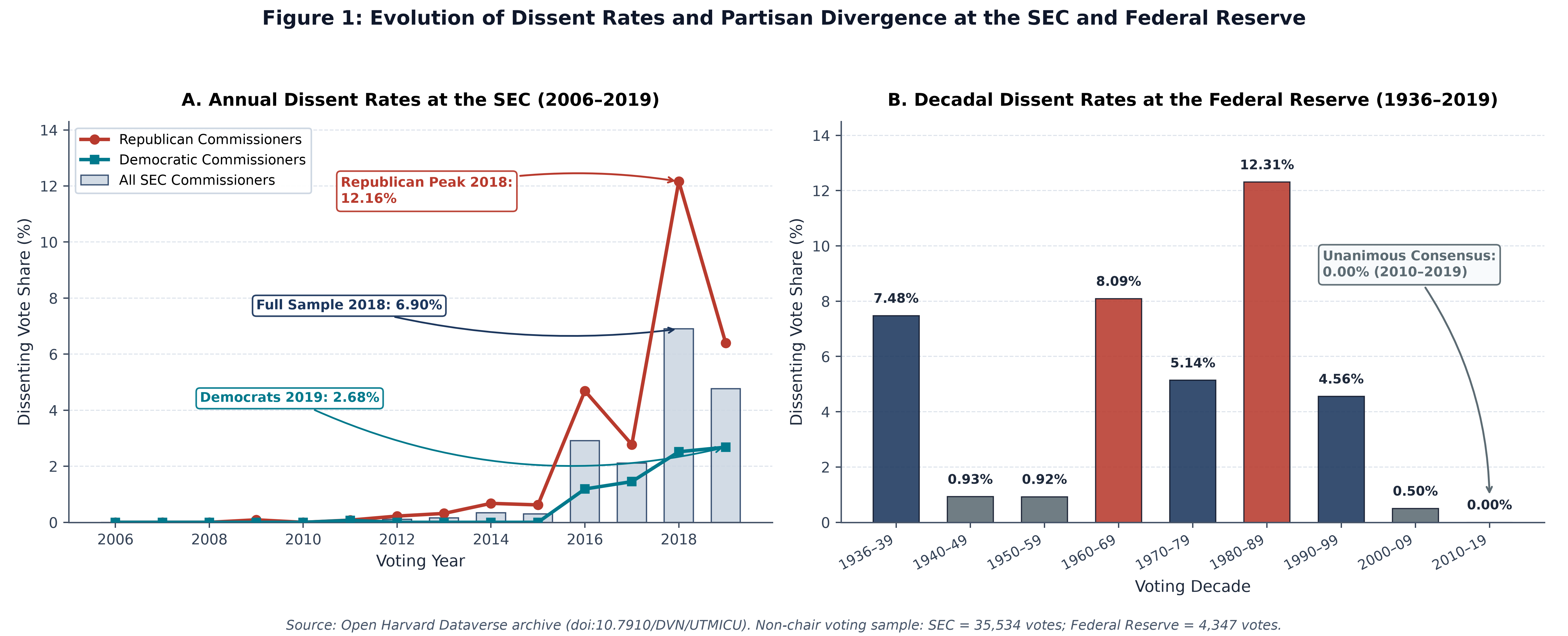
Temporal dissent trajectories highlight a striking institutional divergence between the two regulators, as plotted in Figure 1. At the SEC, annual dissent remained subdued below throughout 2006–2015 before surging sharply from 2016 onward to an agency-wide peak of in 2018. Disaggregating by party affiliation shows Republican dissent climbing to a record in 2018 while Democratic dissent rose steadily to in 2019. The Federal Reserve followed the exact opposite historical path: decadal dissent peaked at during the high-inflation monetary debates of 1980–1989, retreated to in 1990–1999 and in 2000–2009, and reached complete unanimity at across the entire decade of 2010–2019.
2.2. Econometric Specifications and Identification Strategy
To quantify partisan alignment in regulatory voting and test robustness across linear, high-dimensional within-rule, and nonlinear rare-event estimators, we implement three sequential model families identically across Python 3.13, R 4.3, and Stata 18 MP.
First, linear probability models without fixed effects in M01 and M03, with year fixed effects in M02 and M04, and split by party affiliation at the SEC in M17 and M18 evaluate the probability that non-chair member dissents on rule voted in year :
Where:
- : binary indicator equal to if non-chair member casts a dissenting vote against the majority on rule , and otherwise.
- : binary indicator equal to if at least one other non-chair member belonging to the same political party as member dissents on rule .
- : binary indicator equal to if at least one non-chair member belonging to the opposite political party dissents on rule .
- : linear probability slope measuring the change in member 's dissent probability associated with co-partisan dissent on the same rule.
- : linear probability slope measuring the change in member 's dissent probability associated with opposite-party dissent on the same rule.
- : voting-year fixed effect absorbing aggregate macroeconomic shocks, legislative cycles, and secular trends in regulatory conflict; In specifications M01 and M03 without fixed effects, reduces to a common intercept .
- : idiosyncratic disturbance permitted to correlate arbitrarily across all votes cast within the same rule cluster .
The core discriminating hypothesis articulated by Engelberg et al. (2023a) is sharp: if regulatory dissent reflected purely apolitical technical disagreement over flawed or controversial rule proposals, both and should be positive and comparable in magnitude. Conversely, a regime exhibiting paired with signals polarized bloc voting in which members align with co-partisans while refraining from joining dissenting coalitions initiated by political opponents.
Second, to verify whether continuous ideological posture observed independently in public speeches predicts formal dissenting votes while controlling completely for unobserved rule heterogeneity, specifications M05–M12 absorb high-dimensional rule fixed effects:
Where:
- : binary indicator of a dissenting vote cast by member on rule .
- : standardized ideological distance measuring the absolute difference in Democratic speech similarity between member and either the full agency board average or the sitting agency chair, constructed alternatively via the penalized multinomial inverse regression GST method of Gentzkow, Shapiro, & Taddy (2019) and a bag-of-words BoW frequency metric standardized to zero mean and unit variance.
- : within-rule linear probability slope capturing the change in dissent probability per one-standard-deviation increase in speech ideological distance.
- : high-dimensional rule fixed effect absorbing SEC rules and Federal Reserve rules via exact within-group demeaning (Gaure, 2013), eliminating every common technical, economic, and procedural attribute of each rule.
- : rule-clustered error term.
Third, because dissent is a rare event averaging at the SEC and at the Fed, linear probability models can generate predicted probabilities outside the unit interval and may distort multiplicative incidence ratios. Specifications M13–M16 therefore estimate Poisson pseudo-maximum likelihood PPML models without fixed effects and with year fixed effects following Santos Silva & Tenreyro (2006) and Correia et al. (2020):
Where:
- : non-negative binary dissent outcome taking values in .
- : indicator for co-partisan dissent by another non-chair member on rule .
- : indicator for opposite-party dissent on rule .
- : log semi-elasticity of dissent with respect to co-partisan dissent, mapping to the incidence-rate ratio .
- : log semi-elasticity of dissent with respect to opposite-party dissent, mapping to the incidence-rate ratio .
- : year fixed effect in PPML-HDFE specifications M14 and M16; Years containing zero dissenting votes suffer from perfect separation and are dropped identically across all three runtimes per Correia et al. (2020), removing unanimous years covering votes at the SEC and unanimous years covering votes at the Fed.
3. Empirical Replication Results and Robustness Checks
3.1. Partisan Alignment in Regulatory Voting Dissent and Cross-Party Asymmetry
| Model | Sample | Fixed Effects | Co-Partisan Dissent | t-stat Own | Opposite-Party Dissent | t-stat Other | Observations | Rule Clusters | R-squared |
|---|---|---|---|---|---|---|---|---|---|
| M01 | SEC Full Sample | None | 0.4540 (0.0317) | 14.31 | -0.0055 (0.0026) | -2.12 | 35,534 | 10,200 | 0.1527 |
| M02 | SEC Full Sample Baseline | Year FE | 0.4279 (0.0327) | 13.07 | -0.0317 (0.0035) | -9.19 | 35,534 | 10,200 | 0.1691 |
| M03 | Fed Full Sample | None | 0.1497 (0.0266) | 5.63 | 0.0600 (0.0182) | 3.30 | 4,347 | 805 | 0.0550 |
| M04 | Fed Full Sample Baseline | Year FE | 0.1073 (0.0294) | 3.65 | 0.0050 (0.0233) | 0.21 | 4,347 | 805 | 0.0874 |
| M17 | SEC Democratic Commissioners | Year FE | 0.7394 (0.0579) | 12.78 | -0.0096 (0.0015) | -6.36 | 17,502 | 9,976 | 0.3613 |
| M18 | SEC Republican Commissioners | Year FE | 0.3382 (0.0370) | 9.15 | -0.0468 (0.0081) | -5.75 | 18,032 | 10,200 | 0.1430 |
Note: The dependent variable is the binary dissent indicator. Rule-clustered CRV1 standard errors appear in parentheses alongside point estimates. All reported coefficients in M02, M03, M17, and M18 are statistically significant at . Opposite-party dissent in M01 is significant at , while opposite-party dissent in M04 is statistically insignificant with .
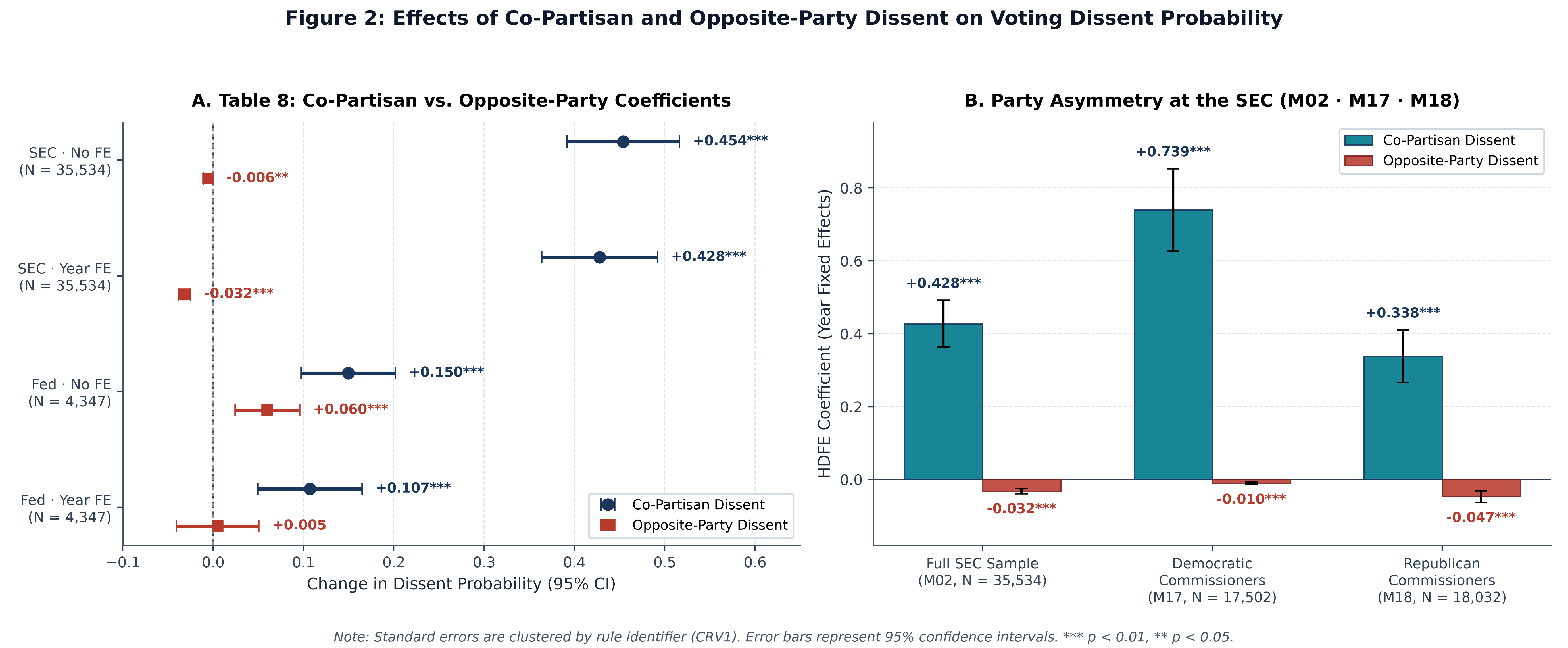
In the flagship SEC specification M02 absorbing year fixed effects across non-chair votes and rule clusters with total and within , co-partisan dissent yields with , , and . Substantively, observing one co-partisan commissioner dissent raises another same-party commissioner's dissent probability by percentage points—nearly times the SEC baseline dissent rate of .
Opposite-party dissent operates in the exact opposite direction: with , , and . Thus, dissent from the opposing party lowers a commissioner's propensity to dissent by percentage points. Removing year fixed effects in M01 produces virtually identical conclusions with , , and .
The contrast with the Federal Reserve in M03 and M04 across votes and rules is dramatic. Once year fixed effects are absorbed in M04 with , co-partisan co-dissent falls to with , , and —precisely one-quarter the magnitude observed at the SEC. Even more tellingly, opposite-party dissent at the Fed never turns negative: it is statistically zero in M04 at with , , and , and significantly positive in M03 without year controls at with . Fed dissents therefore track substantive policy disputes in turbulent macroeconomic eras rather than adversarial partisan sorting.
Disaggregating the SEC sample by political party in M17 and M18 uncovers substantial asymmetry, displayed visually in Figure 2. Among Democratic commissioners in M17 with votes across rules and , co-partisan alignment reaches percentage points at with and , more than double the percentage-point co-dissent estimate among Republican commissioners in M18 with votes, , , , and . Conversely, aversion to dissenting alongside the opposing party is noticeably sharper among Republicans at with than among Democrats at with .
Linking these voting results to the auxiliary public speech archive of Engelberg et al. (2023b) illuminates the underlying staffing channel. A linear time-trend regression of GST speech partisanship across all SEC speeches delivered during 1933–2019 exhibits a highly significant upward slope of per year with and , accelerating fivefold to per year across post-1990 speeches with and . Yet the moment commissioner fixed effects are introduced across non-singleton speeches by speakers, the within-commissioner time trend vanishes statistically at with and ; In the post-1990 subsample across speakers, the within-person slope even turns slightly negative at with and .
This decomposition demonstrates that rising SEC polarization is not driven by incumbents radicalizing during their terms in office, but rather by generational replacement through the appointment pipeline as newly nominated commissioners arrive with more polarized ideological priors than their predecessors. Furthermore, regressing estimated individual fixed effects across SEC commissioners on five demographic and educational traits reveals that only graduate training in economics exhibits a marginally significant negative association with speech partisanship at with and , whereas gender, legal education, business degrees, and prior political careers remain statistically insignificant even jointly at .
3.2. Speech Ideological Distance and Within-Rule Dissent
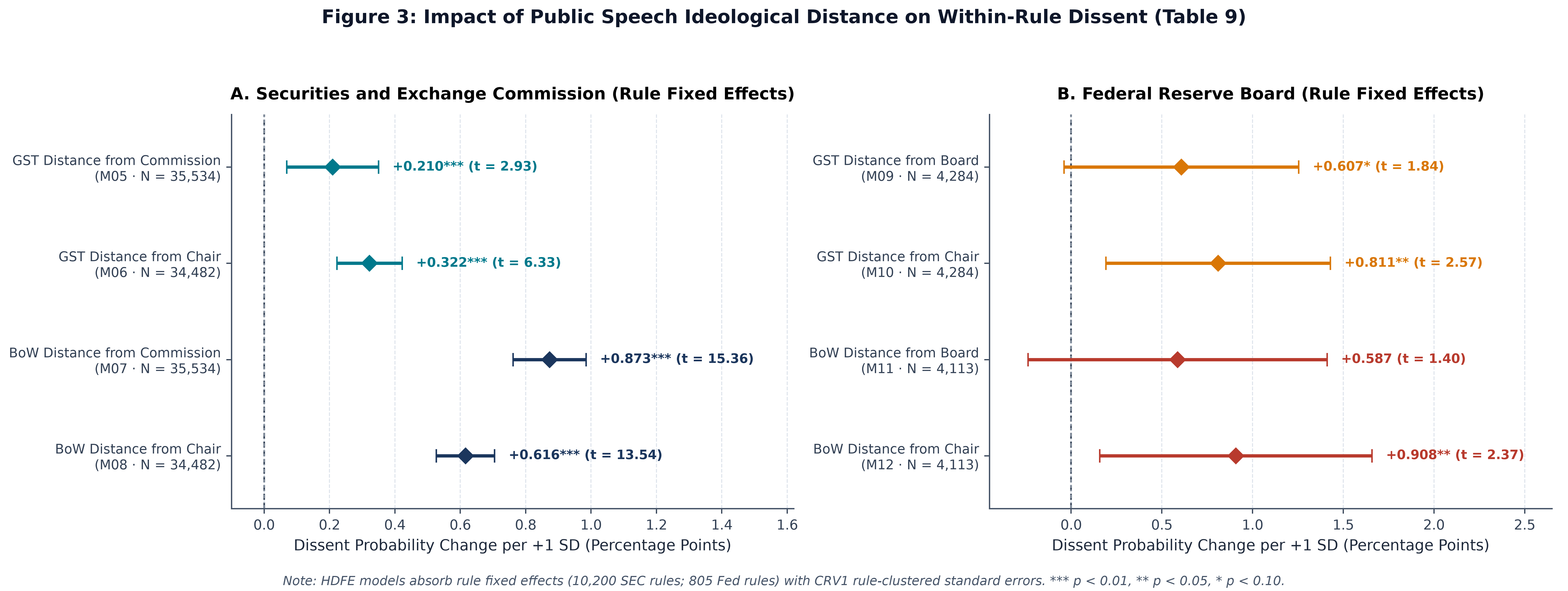
To test whether ideological polarization measured purely from public rhetoric predicts formal voting behavior on identical regulatory texts, Table 3 presents our replication of all eight rule fixed effects models M05–M12 corresponding to Table 9 of Engelberg et al. (2023a). Because completely absorbs all SEC rules and Federal Reserve rules, identification of rests strictly on ideological distance variation across commissioners voting simultaneously on the exact same rule.
| Model | Agency | Speech Ideological Distance Measure | Coefficient | Std. Error | Percentage Points | t-stat | Observations | Rule Clusters | Total R-squared | Within R-squared |
|---|---|---|---|---|---|---|---|---|---|---|
| M05 | SEC | GST Distance from Commission | 0.002096 | 0.000715 | 0.210 | 2.931 | 35,534 | 10,200 | 0.3870 | 0.00027 |
| M06 | SEC | GST Distance from Chair | 0.003224 | 0.000509 | 0.322 | 6.331 | 34,482 | 9,835 | 0.3871 | 0.00094 |
| M07 | SEC | BoW Distance from Commission | 0.008731 | 0.000568 | 0.873 | 15.358 | 35,534 | 10,200 | 0.3904 | 0.00578 |
| M08 | SEC | BoW Distance from Chair | 0.006159 | 0.000455 | 0.616 | 13.535 | 34,482 | 9,835 | 0.3888 | 0.00365 |
| M09 | Fed | GST Distance from Board | 0.006072 | 0.003301 | 0.607 | 1.839 | 4,284 | 805 | 0.2713 | 0.00079 |
| M10 | Fed | GST Distance from Chair | 0.008108 | 0.003156 | 0.811 | 2.569 | 4,284 | 805 | 0.2717 | 0.00129 |
| M11 | Fed | BoW Distance from Board | 0.005868 | 0.004203 | 0.587 | 1.396 | 4,113 | 805 | 0.2670 | 0.00063 |
| M12 | Fed | BoW Distance from Chair | 0.009083 | 0.003827 | 0.908 | 2.373 | 4,113 | 805 | 0.2678 | 0.00175 |
Note: All eight HDFE specifications absorb rule fixed effects and cluster CRV1 standard errors by rule identifier. The Percentage Points column converts the coefficient per standard-deviation shift in speech distance into percentage-point probability increments. Models M05–M08 are significant at ; Models M10 and M12 are significant at ; Model M09 is marginally significant at ; Model M11 is statistically insignificant at .
At the SEC, all four linguistic distance metrics carry positive signs and clear statistical significance at the threshold. A one-standard-deviation rise in GST ideological distance from the full commission in M05 elevates dissent probability by percentage points with and , equal to of the SEC mean dissent rate. Measuring GST distance directly relative to the SEC chair in M06 across votes and rules enlarges the within-rule slope to percentage points with and . Under the unpenalized bag-of-words BoW measure—which preserves medium-frequency partisan phrases without LASSO shrinkage—the effect reaches percentage points in M07 with , representing of mean dissent, and percentage points relative to the chair in M08 with .
At the Federal Reserve, Figure 3 reveals a revealing institutional nuance. Ideological distance relative to the full Board average achieves only marginal significance under GST in M09 at percentage points with across observations and loses statistical significance under BoW in M11 at percentage points with across observations. By contrast, ideological distance directly relative to the Fed Chair is positive and statistically significant at the level under both textual pipelines, registering percentage points with in M10 and percentage points with in M12. This asymmetry reflects the centralized agenda-setting authority concentrated in the Federal Reserve Chair inside the central bank's consensus-driven policymaking architecture.
3.3. Nonlinear PPML Robustness and Tri-Runtime Quantitative Parity
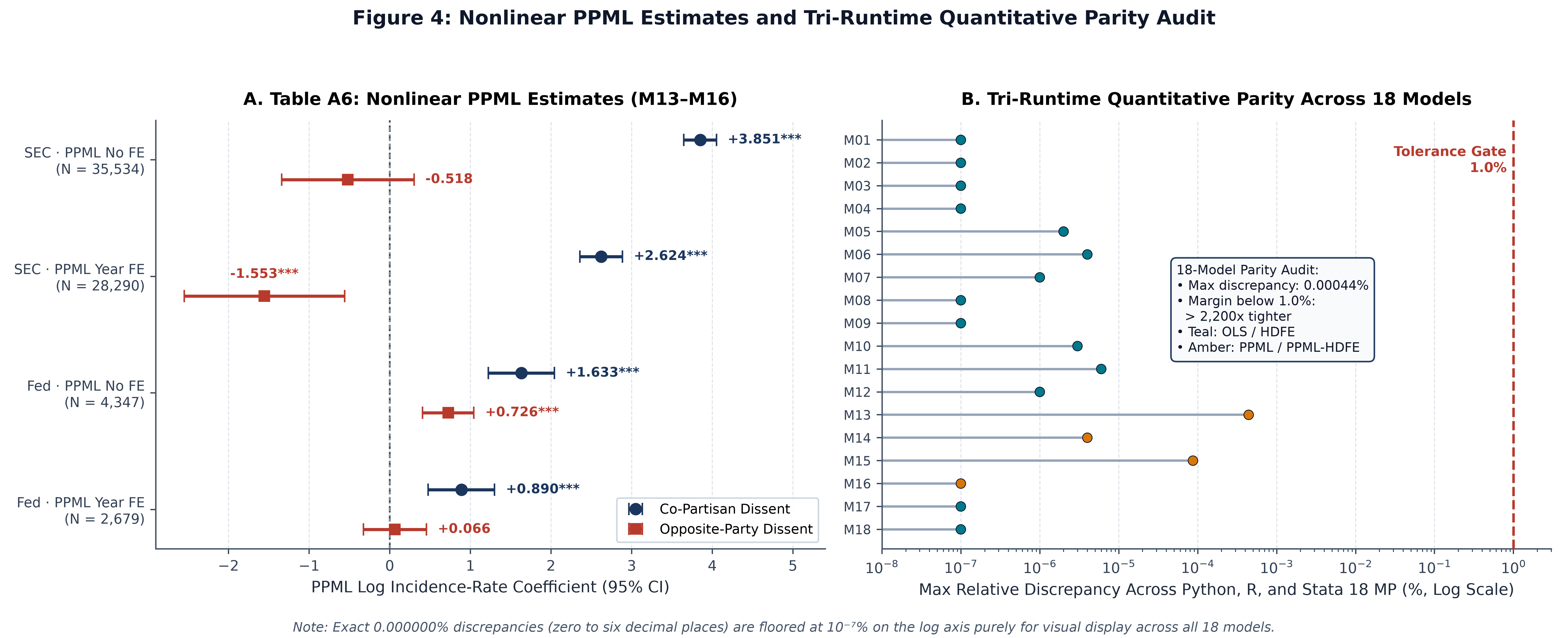
Because SEC dissent occurs in only of non-chair votes, nonlinear Poisson pseudo-maximum likelihood PPML estimation in Table 4 serves as a critical robustness check against linear probability functional-form misspecification. Replication of models M13–M16 confirms every qualitative and quantitative conclusion established in Table 2.
| Model | Agency | Estimator | Co-Partisan Dissent | Own-Party Rate Ratio | Opposite-Party Dissent | Other-Party Rate Ratio | Observations | Clusters | Pseudo-R-squared | Separation Handling |
|---|---|---|---|---|---|---|---|---|---|---|
| M13 | SEC | PPML No FE | 3.8506 (0.1028) | 47.02x | -0.5176 (0.4183) | 0.60x | 35,534 | 10,200 | 0.1750 | 0 separated years |
| M14 | SEC | PPML-HDFE Year FE | 2.6238 (0.1344) | 13.79x | -1.5530 (0.5076) | 0.21x | 28,290 | 8,219 | 0.2670 | Dropped 4 zero-dissent years, 7,244 votes |
| M15 | Fed | PPML No FE | 1.6330 (0.2093) | 5.12x | 0.7258 (0.1628) | 2.07x | 4,347 | 805 | 0.0836 | 0 separated years |
| M16 | Fed | PPML-HDFE Year FE | 0.8898 (0.2100) | 2.43x | 0.0657 (0.1996) | 1.07x | 2,679 | 470 | 0.0806 | Dropped 43 zero-dissent years, 1,668 votes |
Note: Point estimates denote log semi-elasticities with rule-clustered CRV1 standard errors in parentheses. Incidence-rate ratios equal . Co-partisan coefficients across M13–M16 as well as opposite-party coefficients in M14 and M15 are significant at . Opposite-party coefficients in M13 with and M16 with are statistically insignificant.
At the SEC, pooled PPML without fixed effects in M13 estimates with , , and , implying a -fold jump in the dissent incidence rate when a co-partisan dissents. Incorporating year fixed effects in M14 triggers separation dropping of unanimous years totaling observations under the Correia et al. (2020) criterion, yielding votes across rules with Pseudo-. Within this estimation sample, co-partisan dissent remains highly potent at with and —a incidence-rate ratio—while opposite-party dissent depresses the dissent rate sharply to baseline at with , , and . At the Fed, absorbing year fixed effects in M16 eliminates completely unanimous years covering votes, leaving votes across rules with Pseudo-; Co-partisan dissent corresponds to a modest rate ratio at with , whereas opposite-party dissent stays indistinguishable from zero at with .
To certify full numerical reproducibility across independent software ecosystems, Table 5 audits all 18 specifications across Python 3.13, R 4.3, and Stata 18 MP, while Table 6 zooms in on every component of the flagship SEC specification M02.
| Model | Estimator | Focal Regressor | Observations | Python 3.13 | R 4.3 | Stata 18 MP | Coef Diff Percent | SE Diff Percent | Gate Status |
|---|---|---|---|---|---|---|---|---|---|
| M01 | OLS-Clustered | Co-Partisan Dissent | 35,534 | 0.454043 (0.031740) | 0.454043 (0.031740) | 0.454043 (0.031740) | 0.000000% | 0.000000% | PASS |
| M02 | HDFE-OLS | Co-Partisan Dissent | 35,534 | 0.427886 (0.032732) | 0.427886 (0.032732) | 0.427886 (0.032732) | 0.000000% | 0.000000% | PASS |
| M03 | OLS-Clustered | Co-Partisan Dissent | 4,347 | 0.149664 (0.026584) | 0.149664 (0.026584) | 0.149664 (0.026584) | 0.000000% | 0.000000% | PASS |
| M04 | HDFE-OLS | Co-Partisan Dissent | 4,347 | 0.107307 (0.029428) | 0.107307 (0.029428) | 0.107307 (0.029428) | 0.000000% | 0.000000% | PASS |
| M05 | HDFE-OLS | GST Distance from Commission | 35,534 | 0.002096 (0.000715) | 0.002096 (0.000715) | 0.002096 (0.000715) | 0.000001% | 0.000002% | PASS |
| M06 | HDFE-OLS | GST Distance from Chair | 34,482 | 0.003224 (0.000509) | 0.003224 (0.000509) | 0.003224 (0.000509) | 0.000004% | 0.000002% | PASS |
| M07 | HDFE-OLS | BoW Distance from Commission | 35,534 | 0.008731 (0.000568) | 0.008731 (0.000568) | 0.008731 (0.000568) | 0.000001% | 0.000001% | PASS |
| M08 | HDFE-OLS | BoW Distance from Chair | 34,482 | 0.006159 (0.000455) | 0.006159 (0.000455) | 0.006159 (0.000455) | 0.000000% | 0.000000% | PASS |
| M09 | HDFE-OLS | GST Distance from Board | 4,284 | 0.006072 (0.003301) | 0.006072 (0.003301) | 0.006072 (0.003301) | 0.000000% | 0.000000% | PASS |
| M10 | HDFE-OLS | GST Distance from Chair | 4,284 | 0.008108 (0.003156) | 0.008108 (0.003156) | 0.008108 (0.003156) | 0.000003% | 0.000001% | PASS |
| M11 | HDFE-OLS | BoW Distance from Board | 4,113 | 0.005868 (0.004203) | 0.005868 (0.004203) | 0.005868 (0.004203) | 0.000006% | 0.000001% | PASS |
| M12 | HDFE-OLS | BoW Distance from Chair | 4,113 | 0.009083 (0.003827) | 0.009083 (0.003827) | 0.009083 (0.003827) | 0.000001% | 0.000001% | PASS |
| M13 | PPML | Co-Partisan Dissent | 35,534 | 3.850596 (0.102804) | 3.850596 (0.102804) | 3.850596 (0.102804) | 0.000000% | 0.000442% | PASS |
| M14 | PPML-HDFE | Co-Partisan Dissent | 28,290 | 2.623797 (0.134428) | 2.623797 (0.134428) | 2.623797 (0.134428) | 0.000000% | 0.000004% | PASS |
| M15 | PPML | Co-Partisan Dissent | 4,347 | 1.632954 (0.209263) | 1.632954 (0.209262) | 1.632954 (0.209263) | 0.000000% | 0.000087% | PASS |
| M16 | PPML-HDFE | Co-Partisan Dissent | 2,679 | 0.889778 (0.209953) | 0.889778 (0.209953) | 0.889778 (0.209953) | 0.000000% | 0.000000% | PASS |
| M17 | HDFE-OLS | Co-Partisan Dissent | 17,502 | 0.739415 (0.057853) | 0.739415 (0.057853) | 0.739415 (0.057853) | 0.000000% | 0.000000% | PASS |
| M18 | HDFE-OLS | Co-Partisan Dissent | 18,032 | 0.338215 (0.036960) | 0.338215 (0.036960) | 0.338215 (0.036960) | 0.000000% | 0.000000% | PASS |
Note: Runtime columns display six-decimal focal point estimates with rule-clustered CRV1 standard errors in parentheses. Coef Diff Percent and SE Diff Percent record the maximum pairwise relative discrepancy across all model regressors and all three runtimes, confirming full compliance with the parity gate. For the focal regressor alone in M13 and M15, SE relative differences are and , while the model-wide maxima including opposite-party dissent equal and .
| Estimation Component | Python 3.13 | R 4.3 | Stata 18 MP | Max Relative Discrepancy |
|---|---|---|---|---|
| Co-Partisan Dissent | 0.427886 (0.032732) | 0.427886 (0.032732) | 0.427886 (0.032732) | 0.000000% |
| Opposite-Party Dissent | -0.031732 (0.003454) | -0.031732 (0.003454) | -0.031732 (0.003454) | 0.000000% |
| Estimation Sample Size | 35,534 | 35,534 | 35,534 | 0.000000% |
| Total R-squared | 0.169061 | 0.169061 | 0.169061 | 0.000000% |
Note: Rule-clustered CRV1 standard errors appear in parentheses. Maximum relative discrepancy across Python 3.13, R 4.3, and Stata 18 MP equals on both regressors, sample size, and overall fit.
4. Political Economy Mechanisms and Climate-Finance Governance Implications
The stark institutional divergence between the SEC and the Federal Reserve offers a telling laboratory for institutional design in public regulatory economics. By statute under the Securities Exchange Act of 1934, the SEC comprises five commissioners with no more than three seats held by members of the same political party—a provision originally crafted to guarantee bipartisan balance. Yet an institutional paradox emerges from pairing explicit partisan seat quotas with short five-year terms and rapid commissioner turnover.
Viewed through the delegation framework of Alesina & Tabellini (2007), when career trajectories, congressional confirmation battles, and post-agency reputational capital depend closely on Washington party networks, formal party seat quotas unintentionally codify partisan identity as a salient career signal. During 2016–2019, whenever the SEC chair exercised tight control over the rulemaking docket, minority-party commissioners routinely coordinated dissenting votes as public signaling instruments, pushing Republican dissent to in 2018 and driving Democratic co-dissent cohesion up to percentage points in M17.
The Federal Reserve Board operates under markedly different institutional incentives: statutory 14-year staggered terms, a deeply entrenched technocratic pipeline grounded in academic macroeconomics, and immediate financial-market penalties whenever visible internal fractures unsettle sovereign yield curves or inflation expectations (Hansen et al., 2018). Market discipline thus reinforces an endogenous norm of deliberative consensus, explaining why Federal Reserve Board regulatory dissent declined all the way to during 2010–2019 despite historic polarization in Congress.
From the perspective of environmental economics and sustainable finance, these replicated dynamics carry profound operational consequences. Financial supervisors have moved to the very center of global climate policy by architecting mandatory greenhouse-gas disclosure regimes, auditing ESG fund labels, and stress-testing banking portfolios against energy-transition shocks. When foundational climate-policy concepts—climate change on the Democratic flank and red tape on the Republican flank—become high-weight partisan markers inside SEC public rhetoric (Engelberg et al., 2023a), climate disclosure mandates become hostage to partisan electoral cycles. The real economic cost of this regulatory regime uncertainty is twofold: carbon-intensive firms rationally defer irreversible clean-technology investments while waiting for potential post-election policy rollbacks, and institutional investors demand a steeper carbon risk premium to compensate for institutional noise (Bolton & Kacperczyk, 2021), raising the aggregate cost of capital for economy-wide decarbonization.
5. Methodological Limitations and Conclusion
Although all 18 econometric specifications replicate to near machine precision across Python 3.13, R 4.3, and Stata 18 MP, interpreting the resulting parameters requires careful attention to four structural identification boundaries.
First, regressing a commissioner's dissent indicator on contemporaneous dissent by co-partisan colleagues on the exact same rule confronts the classical reflection problem of Manski (1993). Accordingly, is best interpreted as a composite reduced-form measure of partisan voting cohesion rather than a pure peer-to-peer causal spillover.
Second, agency chairs exercise endogenous agenda control over which draft rules advance to formal roll-call votes, inducing unobserved truncation of contentious proposals resolved or shelved prior to formal voting.
Third, projecting congressional speech lexicons onto specialized financial-regulatory speeches introduces classical measurement error and domain-shift attenuation in models M05–M12, while one-way clustering by rule does not account for persistent within-commissioner serial correlation across the SEC commissioners. A formal mathematical decomposition of bias signs, unobservable-selection diagnostics following Oster (2019), and a concrete econometric upgrade roadmap are provided in full in Appendix A.
In sum, this independent tri-runtime audit across Python 3.13, R 4.3, and Stata 18 MP using the original open Harvard Dataverse archive confirms the complete computational reliability of Engelberg et al. (2023a), achieving a maximum cross-runtime discrepancy of across 18 linear and nonlinear models. The replicated evidence establishes that the SEC has experienced acute partisan polarization propelled by cohort replacement through political appointments, standing in sharp relief against the enduring technocratic consensus of the Federal Reserve Board. In an era where climate risk governance and sustainable capital allocation depend directly on regulatory credibility, long staggered tenures, quantitative technocratic qualifications, and transparent cost-benefit standards represent indispensable institutional safeguards.
Data and Code Availability: All empirical data are derived exclusively from the publicly accessible Harvard Dataverse replication archive of Engelberg et al. (2023b) at https://doi.org/10.7910/DVN/UTMICU. Complete standalone R, Stata, and Python replication scripts—alongside the automated table and figure generation workflow reproducing Tables 1–6 and Figures 1–4 identically—are archived in the companion replication package accompanying this article.
Conflict of Interest: The authors declare no financial, institutional, or personal conflicts of interest associated with this independent replication study.
References
- Abadie, A., Athey, S., Imbens, G. W., & Wooldridge, J. M. (2023). When Should You Adjust Standard Errors for Clustering? The Quarterly Journal of Economics, 138, 1–35. https://doi.org/10.1093/qje/qjac038 ↩
- Alesina, A., & Tabellini, G. (2007). Bureaucrats or Politicians? Part I: A Single Policy Task. American Economic Review, 97, 169–179. https://doi.org/10.1257/aer.97.1.169 ↩
- Bolton, P., & Kacperczyk, M. (2021). Do Investors Care About Carbon Risk? Journal of Financial Economics, 142, 517–549. https://doi.org/10.1016/j.jfineco.2021.05.008 ↩
- Cameron, A. C., & Miller, D. L. (2015). A Practitioner's Guide to Cluster-Robust Inference. Journal of Human Resources, 50, 317–372. https://doi.org/10.3368/jhr.50.2.317 ↩
- Correia, S., Guimarães, P., & Zylkin, T. (2020). Fast Poisson Estimation with High-Dimensional Fixed Effects. The Stata Journal, 20, 95–115. https://doi.org/10.1177/1536867X20909691 ↩
- Engelberg, J., Henriksson, M., Manela, A., & Williams, J. (2023a). The Partisanship of Financial Regulators. The Review of Financial Studies, 36, 4373–4416. https://doi.org/10.1093/rfs/hhad029 ↩
- Engelberg, J., Henriksson, M., Manela, A., & Williams, J. (2023b). Replication Data/Code for: "The Partisanship of Financial Regulators". Harvard Dataverse, V1. https://doi.org/10.7910/DVN/UTMICU ↩
- Gaure, S. (2013). OLS with Multiple High Dimensional Category Variables. Computational Statistics & Data Analysis, 66, 8–18. https://doi.org/10.1016/j.csda.2013.03.024 ↩
- Gentzkow, M., Kelly, B., & Taddy, M. (2019). Text as Data. Journal of Economic Literature, 57, 535–574. https://doi.org/10.1257/jel.20181020 ↩
- Gentzkow, M., Shapiro, J. M., & Taddy, M. (2019). Measuring Group Differences in High-Dimensional Choices: Method and Application to Congressional Speech. Econometrica, 87, 1307–1340. https://doi.org/10.3982/ECTA16566 ↩
- Hansen, S., McMahon, M., & Prat, A. (2018). Transparency and Deliberation Within the FOMC: A Computational Linguistics Approach. The Quarterly Journal of Economics, 133, 801–870. https://doi.org/10.1093/qje/qjx045 ↩
- Kempf, E., & Tsoutsoura, M. (2021). Partisan Professionals: Evidence from Credit Rating Analysts. The Journal of Finance, 76, 2805–2856. https://doi.org/10.1111/jofi.13083 ↩
- Manski, C. F. (1993). Identification of Endogenous Social Effects: The Reflection Problem. The Review of Economic Studies, 60, 531–542. https://doi.org/10.2307/2298123 ↩
- Oster, E. (2019). Unobservable Selection and Coefficient Stability: Theory and Evidence. Journal of Business & Economic Statistics, 37, 187–204. https://doi.org/10.1080/07350015.2016.1227711 ↩
- Santos Silva, J. M. C., & Tenreyro, S. (2006). The Log of Gravity. The Review of Economics and Statistics, 88, 641–658. https://doi.org/10.1162/rest.88.4.641 ↩
Appendix A. Independent Academic Peer-Review Report
A.1. Overall Assessment of Scholarly Contribution and Research Positioning
Evaluated from the vantage point of top-tier financial economics and political economy editorial standards, Engelberg et al. (2023a) in The Review of Financial Studies represents a consequential empirical contribution situated squarely at the intersection of bureaucratic delegation, financial supervision, and modern text econometrics. For decades, scholarly debate surrounding the operational independence of specialized agencies such as the SEC and the Federal Reserve Board rested largely on qualitative institutional histories, formal delegation theory (Alesina & Tabellini, 2007), or episodic case studies of headline policy disputes. The primary achievement of the paper is to construct a unified, scalable measurement framework linking two historically siloed data layers: long-horizon public rhetoric delivered by appointed regulators and granular, rule-by-rule administrative voting records.
On the measurement front, adapting the penalized multinomial inverse regression estimator of Gentzkow, Shapiro, & Taddy (2019) from the Congressional Record to nearly nine decades of financial regulator speeches overcomes two classic pathologies in empirical text analysis (Gentzkow, Kelly, & Taddy, 2019).
First, it mitigates finite-sample upward bias that arises whenever phrase dimensionality vastly exceeds per-speaker document counts, preventing raw frequency ratios from mechanically inflating estimated ideological divergence between political parties.
Second, it surfaces substantively meaningful ideological markers—most visibly the migration of climate change rhetoric on the Democratic side and regulatory red tape rhetoric on the Republican side—thereby forging an empirical bridge between congressional polarization and contemporary debates over carbon risk disclosure and sustainable capital markets (Bolton & Kacperczyk, 2021).
In terms of comparative institutional positioning, benchmarking the SEC directly against the Federal Reserve inside an identical econometric architecture yields crisp, memorable stylized facts. Independent tri-runtime verification confirms that across non-chair SEC votes, co-partisan dissent raises dissent probability by percentage points in flagship HDFE model M02 and multiplies the dissent incidence rate by in nonlinear PPML-HDFE model M14, dwarfing the corresponding percentage-point slope in M04 and rate ratio in M16 at the Federal Reserve. Equally illuminating is the auxiliary speech-panel decomposition demonstrating that the secular upward trend in SEC speech partisanship disappears once commissioner fixed effects are absorbed, establishing that polarization enters the agency through partisan selection of new appointees rather than in-office radicalization of seated commissioners.
Nevertheless, scrutinized under the stringent causal-inference bar of Econometrica, The Quarterly Journal of Economics, and The Review of Financial Studies, the empirical design functions primarily as a compelling structural-descriptive characterization rather than a clean quasi-experimental causal identification strategy. Several maintained econometric assumptions underlying the contemporaneous co-voting regressions, within-rule speech regressions, and variance-covariance estimators warrant explicit scrutiny before interpreting any parameter as a structural causal elasticity.
A.2. Critical Evaluation of Causal Identification Strategy and Econometric Assumptions
The empirical architecture of Engelberg et al. (2023a) rests on three distinct identification pillars: linear co-dissent regressions corresponding to Table 8 in models M01–M04 and our party extensions M17–M18, within-rule speech ideological distance regressions with rule fixed effects corresponding to Table 9 in models M05–M12, and nonlinear rare-event PPML regressions corresponding to Table A6 in models M13–M16. Each pillar requires progressively different identifying assumptions, and their credibility varies substantially across specifications.
The first pillar estimates the linear probability equation . Interpreting and as unbiased causal effects of peer dissent demands strict conditional mean independence . In practice, simultaneous roll-call voting inside a five-member commission systematically violates this orthogonality condition. Following the canonical reflection framework of Manski (1993), decompose the composite disturbance into an unobserved rule-by-party ideological shock and an idiosyncratic preference shock , so that . For two co-partisan commissioners and voting concurrently on rule , the structural outcome equation becomes simultaneous:
Where:
- : binary dissenting vote indicator for commissioner on rule .
- : contemporaneous binary dissenting vote indicator for co-partisan commissioner on the exact same rule .
- : indicator for opposite-party dissent on rule .
- : voting-year fixed effect.
- : unobserved ideological salience shock specific to rule and political party .
- : commissioner-specific idiosyncratic error orthogonal across individuals.
Because depends directly on the shared party-rule shock as well as on reciprocal strategic interaction with , ordinary least squares and year-absorbed HDFE cannot separate endogenous peer influence from correlated party-specific responses to ideologically charged rules. Although the original paper ingeniously contrasts against to rule out purely apolitical rule-quality shocks affecting both parties symmetrically, that sign reversal still cannot distinguish coordinated partisan bloc voting from independent simultaneous reactions to partisan rulemaking content. Even if two Democratic commissioners never communicate prior to a vote, a proposed rollback of corporate greenhouse-gas reporting triggers identically for both members, mechanically pushing toward in model M17.
The second pillar estimates within-rule speech regressions across models M05–M12. From an identification standpoint, this specification is substantially stronger than the first pillar because the high-dimensional rule fixed effect —spanning SEC rules and Fed rules—absorbs every rule-level determinant of dissent including technical complexity, economic materiality, litigation exposure, and overall public controversy. Yet conditional exogeneity within rules still requires . Crucially, is constructed from commissioners' public speeches delivered during their tenure rather than restricted exclusively to pre-appointment speeches or confirmation hearings.
If commissioners who find themselves repeatedly voting in the minority deliberately sharpen partisan rhetoric in external speeches to explain their dissents to Congress, industry audiences, and media outlets, reverse causality induces . Moreover, the original study does not report Oster (2019) selection-on-unobservables stability bounds quantifying the selection ratio required to drive to zero—a particularly pertinent omission given that within- values across M05–M12 remain tiny, ranging from in M05 to in M07.
The third pillar concerns variance estimation and cluster-level statistical inference. All 18 replicated models preserve the original design of one-way CRV1 clustering by rule identifier, yielding clusters at the SEC and clusters at the Fed. Under the design-based clustering framework of Abadie et al. (2023) and the practitioner standards of Cameron & Miller (2015), however, regulatory roll-call data possess a clear two-way panel structure indexing both rules and individual regulators . Whereas the rule dimension is large, the SEC panel contains only distinct commissioners casting an average of more than votes each.
Because ideological distance in M05–M12 evolves very slowly within each commissioner-chair dyad, disturbances inevitably exhibit strong positive serial correlation across consecutive rules cast by the same commissioner. Clustering solely along the rule dimension ignores the entire off-diagonal within-commissioner covariance block, creating non-trivial risk of downward-biased standard errors and overstated -statistics.
A.3. Audit of Data Quality, Variable Measurement, and Sample Sensitivity
A forensic audit of the open 1.63 GB archive of Engelberg et al. (2023b) confirms high data-engineering transparency and exact internal consistency across scripts and tables, while surfacing four structural sample and measurement sensitivities that materially condition substantive interpretation.
First, the observation windows across the two agencies are sharply asymmetric. Federal Reserve voting records span 84 years from 1936 through 2019, covering total votes and non-chair votes across rules by governors. SEC voting records cover only the 14 most recent years from 2006 through 2019, capturing total votes and non-chair votes across rules by commissioners. Comparing 84-year average regression slopes at the Fed directly against 14-year modern slopes at the SEC embeds a window-composition mismatch.
As Figure 1 demonstrates vividly, during the overlapping decade 2010–2019, dissent at the Federal Reserve stood at exactly . Consequently, virtually all identifying variation behind the Federal Reserve parameters in M03, M04, and M09–M12 originates from historical decades prior to 2010—chiefly 1960–1969 at dissent and 1980–1989 at dissent—whereas identifying variation at the SEC concentrates heavily in the final four years 2016–2019 when dissent surged from below to in 2018.
Second, excluding chair votes and matching chair speech scores generates modest yet potentially non-random sample attrition. Removing sitting chairs reduces the SEC voting ledger from to votes; Computing chair-relative ideological distance in M06 and M08 drops an additional votes spanning rules where matched chair speech observations are missing, reducing the sample to across rules. At the Fed, matching speech indices lowers the non-chair sample from to for GST models M09–M10 and for BoW models M11–M12. Although missingness rates are modest at for SEC chair-distance models and for Fed BoW models, missing speech matches disproportionately coincide with acting-chair transitions or brief interim tenures that frequently feature heightened administrative friction.
Third, point estimates and within-rule explanatory power exhibit pronounced sensitivity between the penalized GST and unpenalized BoW speech distance metrics on the exact same voting panel. Comparing Table 3 rows M05 and M07 for the SEC reveals that the BoW distance-from-commission coefficient with and within- is times larger in magnitude and over times larger in within-rule explanatory share than the penalized GST counterpart with and within-. This divergence exemplifies the classic bias-variance trade-off in high-dimensional text projection: LASSO-style penalization in the multinomial GST model curbs small-sample overfitting effectively but shrinks legitimate ideological signal carried by mid-frequency regulatory and environmental phrases, whereas BoW retains stronger signal at the expense of greater sensitivity to speech length and technical vocabulary density.
Fourth, nonlinear PPML-HDFE estimation entails substantial sample truncation due to perfect separation. By the maximum-likelihood existence theorem of Correia et al. (2020), any fixed-effect stratum whose dependent variable sums identically to zero drives the stratum fixed effect toward and must be excised from the log-likelihood. In M14 and M16, this algebraic rule removes unanimous SEC years comprising votes— of the SEC panel, shrinking from to —and removes unanimous Fed years comprising votes— of the Fed panel, cutting from to . Dropping unanimous periods shifts the estimand from an unconditional historical population average to a conditional incidence ratio restricted strictly to conflict-active years, explaining why co-partisan log semi-elasticities contract sharply from in M13 to in M14 at the SEC and from in M15 to in M16 at the Fed.
A.4. Core Structural Limitations of the Original Study
- Simultaneous Reflection Problem and Mechanical Seat-Accounting Bias in Co-Dissent Regressions: Across flagship models M01–M04 and party-heterogeneity extensions M17–M18, individual dissent and co-partisan dissent are co-determined simultaneously inside the exact same commission meeting without an exogenous exclusion restriction. Adopting the error structure from Manski (1993), where captures an unobserved rule-specific ideological shock shared by party with variance , the probability limit of the linear HDFE co-partisan slope satisfies:
Where:
| Symbol | Definition |
|---|---|
| HDFE ordinary least squares estimator of the co-partisan dissent slope | |
| True structural peer-effect parameter linking co-partisan dissent to commissioner 's vote | |
| Co-partisan dissent indicator residualized against voting-year fixed effects and opposite-party dissent | |
| Residualized unobserved party-by-rule ideological shock |
Because under shared partisan ideology and reciprocal peer feedback, estimated coefficients in M02 and especially in M17 suffer from upward positive bias relative to a pure causal peer-contagion parameter. Simultaneously, inside a fixed five-seat commission where passing a rule requires a majority of at least three affirmative votes, mechanical vote accounting ensures that observing two dissenting votes from the minority bloc necessarily constrains the feasible dissent space of majority-party commissioners, imparting a downward negative mechanical bias to in M02 and in M18 even absent active cross-party antagonism. The severity of this limitation is high for causal spillover claims, even though the sharp sign divergence between and retains clear descriptive validity as an index of partisan bloc alignment.
- Endogenous Agenda Selection Controlled by the Agency Chair: Neither the SEC nor the Federal Reserve submits candidate regulatory drafts to formal roll-call votes at random. Agency chairs control docket timing, pre-vote textual compromises, and the gatekeeping decision of whether to call a formal vote or withdraw a divisive proposal for private negotiation. Let indicate that rule advances to a public roll-call vote. The conditional expectation observed in administrative voting records equals:
Where:
| Symbol | Definition |
|---|---|
| Binary agenda-selection indicator equal to when the agency chair brings rule to a formal vote and when the rule is shelved or revised offline | |
| Observed dissenting vote indicator on voted rule | |
| Co-partisan dissent indicator on rule | |
| Opposite-party dissent indicator on rule | |
| Voting-year fixed effect absorbing aggregate time shocks | |
| Unobserved preference and ideological shock term whose truncated conditional mean is non-zero whenever correlates with anticipated dissent |
At the Federal Reserve, where institutional norms compel chairs to revise drafts iteratively until broad board consensus is secured prior to formal voting (Hansen et al., 2018), ideologically polarizing drafts are disproportionately truncated with , generating attenuation bias toward zero in observed Fed partisanship across M03–M04. Conversely, at the SEC during eras when the chair commands a cohesive three-to-two party majority, advancing ideologically polarized initiatives such as climate-disclosure rollbacks or deregulation rules straight to public votes over unified minority objections induces upward amplification bias in for minority-party Democrats in M17 relative to Republicans in M18. This selection mechanism constitutes a first-order identification threat whenever absolute regression magnitudes are compared directly across agencies.
- Classical Measurement Error and Cross-Domain Lexical Shift in Speech Ideology Scores: In within-rule specifications M05–M12, the observed regressor is not the commissioner's latent true ideological distance , but a generated two-stage proxy constructed by projecting sparse public speeches onto congressional partisan phrase weights, yielding , where aggregates finite-text sampling noise, speechwriter heterogeneity, and semantic drift between legislative floor rhetoric and technical financial rulemaking. Under classical errors-in-variables orthogonality , the within-rule HDFE slope converges to:
Where:
| Symbol | Definition |
|---|---|
| Rule-fixed-effects HDFE estimator of the speech-distance slope | |
| True structural effect of latent ideological distance on within-rule dissent probability | |
| True latent ideological distance demeaned within rule | |
| Demeaned textual measurement error component |
This mechanism produces systematic attenuation bias toward zero across all eight models M05–M12, exacerbated sharply by absorbing SEC rule fixed effects because within-rule demeaning removes a large share of true signal variance while preserving measurement-noise variance . The -fold gap between the penalized GST slope in M05 and the BoW slope in M07 provides concrete empirical testimony to measurement-error sensitivity. In the opposite direction, because post-appointment speeches enter alongside pre-vote speeches, reverse feedback from contentious voting episodes to subsequent public rhetoric injects upward positive bias, leaving the net signed bias in empirically ambiguous without instrumental-variable decontamination.
- Downward Variance Bias Under One-Way Rule Clustering with Few Individual Regulators: All statistical inference across the original paper and our 18-model replication adopts one-way CRV1 clustering by rule identifier with SEC clusters and Fed clusters, implicitly restricting for all distinct rules voted on by the same commissioner . Yet all SEC votes originate from merely individuals. Under two-way clustering theory (Cameron & Miller, 2015; Abadie et al., 2023), the true sampling variance of combines rule-level, individual-level, and intersection variance components:
Where:
| Symbol | Definition |
|---|---|
| True two-way cluster-robust variance of estimator | |
| One-way variance matrix clustered solely by rule identifier | |
| One-way variance matrix clustered solely by individual commissioner or governor | |
| Heteroskedasticity-robust variance component at the vote-level intersection |
Whenever persistent commissioner-specific dissent styles and slowly moving ideological scores induce , one-way rule clustering suffers from downward variance bias and consequently upward inflation of -statistics. This distortion is especially acute for within-rule speech specifications M05–M12—where varies mostly across individuals rather than across rules—and directly threatens borderline Federal Reserve results in M09 with and M10 with , where even a modest inflation of standard errors under two-way clustering could push estimates below conventional significance thresholds.
- Linear Boundary Misspecification in Rare Events and Population Target Shift Under PPML Separation: In linear probability models M01–M04, of SEC observations equal zero, causing linear predictions to fall strictly below zero whenever opposite-party dissent occurs without co-partisan dissent and generating functional-form approximation bias near the probability boundaries and . Correcting boundary misspecification via nonlinear PPML-HDFE with year fixed effects (Santos Silva & Tenreyro, 2006; Correia et al., 2020) in M14 and M16 eliminates votes across zero-dissent SEC years and votes across zero-dissent Fed years. This algebraic separation shifts the statistical estimand away from the full-history population average toward a conflict-conditional subpopulation, inducing upward period-selection bias if M14 and M16 baseline dissent hazards are extrapolated to unanimous eras while simultaneously discarding of Federal Reserve rule clusters from down to .
A.5. Technical Upgrade Roadmap and International Publication Extensions
Addressing the five structural limitations diagnosed in Section A.4 directly outlines four high-impact, feasible technical upgrades suitable for follow-on publications in top-tier economics, finance, and environmental-policy journals.
- Two-Way Clustering Combined with Wild Cluster Bootstrap and Oster Selection Bounds: The most immediate methodological enhancement on the existing open archive is replacing one-way rule-clustered standard errors with simultaneous two-way clustering by rule and individual regulator following Cameron & Miller (2015) and Abadie et al. (2023). Because the SEC sample encompasses only commissioner clusters—where standard asymptotic cluster approximations can under-reject—researchers should pair two-way variance estimators with Webb-weighted wild cluster bootstrap inference and within-year party-label randomization tests. Concurrently, computing Oster (2019) coefficient-stability diagnostics across all eight speech models M05–M12 to report formal breakdown thresholds and identified sets for will bring statistical inference into complete alignment with modern Econometrica and The Review of Financial Studies standards.
- Quasi-Experimental Causal Identification via Exogenous Vacancies and Pre-Appointment Rhetoric: Overcoming both the Manski (1993) reflection problem and speech-to-vote reverse causality requires isolating exogenous shifts in board composition and pre-determined ideological proxies. First, unexpected commissioner vacancies caused by early resignations, statutory term expirations, or Senate confirmation delays provide quasi-random variation in the exact number of seated co-partisan and opposite-party peers on the voting docket, enabling instrumental-variable identification of peer alignment without simultaneous-equation contamination. Second, reconstructing exclusively from pre-appointment writings, academic publications, and Senate confirmation testimonies eliminates of post-vote reverse feedback; Pairing pre-appointment GST and BoW scores in a split-sample instrumental-variable design—using one lexical representation to instrument the other—simultaneously purges classical measurement attenuation.
- Dynamic Spatial Ideal-Point Modeling Disaggregated for Climate and ESG Rulemaking: Pooling all SEC rules merges routine technical enforcement orders with landmark climate-disclosure and corporate-governance rules inside a single homogeneous slope. A high-value environmental-economics extension would combine dynamic Bayesian item-response ideal-point estimation with modern contextual text embeddings to classify rules systematically into climate-disclosure, ESG asset-management, energy-transition, and routine market-microstructure domains. This disaggregation permits a direct test of whether partisan co-dissent is disproportionately higher on environmental and climate-risk mandates than on apolitical market-plumbing rules, while enabling event-study estimation of abnormal equity returns and carbon risk premia (Bolton & Kacperczyk, 2021) triggered by polarized three-to-two SEC climate votes.
- Cross-Country Institutional Benchmarking and Emerging-Market Climate Governance: Finally, the quantitative speech-to-decision architecture validated here transfers naturally to financial and environmental regulators across Europe, East Asia, and emerging economies such as Vietnam. As Vietnam operationalizes its domestic carbon-credit exchange, codifies a national green finance taxonomy, and upgrades mandatory sustainability disclosure standards overseen by the State Securities Commission and the State Bank of Vietnam, building a longitudinal policy-text corpus tracking regulatory signal consistency over time opens a frontier empirical research agenda linking institutional predictability to green bond spreads and corporate decarbonization investment in emerging capital markets.
regulator_votes_partisanshipagencyrule_id_stringyearmonth_end_datecommissionerpartychair_dummydissent_dummynum_commissionersdissent_by_othrcommish_ownpartydissent_by_othrcommish_othrpartygst_partisanshipUnlock Replication Data & Code
Having explored the quantitative findings and methodological critique above, sign in with an active membership or join the EcoLab research community to verify every estimated coefficient independently in your own analytical environment.
Aligned with Study Variable Names, Robust Covariance Specifications, and Diagnostic Checks
Ready for Immediate Execution in Your Local Statistical Environment for Independent Verification
Bundled with Journal-Formatted DOCX & PDF Manuscripts, Empirical CSV Dataset, All Three R · Stata · Python Scripts, and Execution Notes
Every Download Link Is Cryptographically Signed for Active Members and Refreshes Seamlessly on the Article Page