
1. Introduction and Research Positioning
Assessing how international labor inflows reshape native wages, employment allocation, and aggregate welfare remains one of the most consequential questions in labor economics. Classical general-equilibrium evaluations model national or regional production through a single representative firm combining native and immigrant labor via nested constant-elasticity-of-substitution aggregators (Borjas, 2003; Ottaviano & Peri, 2012). While this canonical paradigm illuminates how imperfect skill substitutability and occupational task specialization buffer native wages (Peri & Sparber, 2009), it imposes a stark symmetry restriction: every establishment within an industry employs identical immigrant labor shares and expands identically following an aggregate immigration shock.
Brinatti & Morales (2026), forthcoming in the Journal of Political Economy, overturn this representative-firm abstraction by embedding Melitz (2003) firm heterogeneity directly into an open-economy general-equilibrium model of immigration. Leveraging linked employer-employee administrative records from Germany's Institute for Employment Research, the authors document that larger and more productive establishments allocate a substantially higher share of their wage bill to immigrant workers than small and medium-sized enterprises. Fixed costs of initiating immigrant recruitment create an extensive-margin sorting threshold: only high-productivity firms find it profitable to establish foreign hiring channels.
Consequently, an expansion in immigrant labor supply disproportionately lowers unit production costs for large, immigrant-intensive firms in the Tradable sector, inducing them to expand output and substitute toward immigrants while releasing native workers toward smaller domestic firms and the Non-Tradable sector. Ignoring this intra-industry firm heterogeneity omits more than half of the real earnings welfare gains accruing to native workers.
This reproducibility study audits the Harvard Dataverse replication archive 10.7910/DVN/ZX3IIY accompanying Brinatti & Morales (2026) and executes an independent verification pipeline across StataNow 19.5 MP, R, and Python. Because genuine LIAB, IAB Establishment Panel, and SIEED microdata cannot legally leave the Research Data Centre enclave in Nuremberg, our empirical panel follows a fully transparent Tier-3 hybrid architecture. We directly incorporate every open quantitative asset shipped by the authors—including the -establishment structural equilibrium micro-panel, the disclosed IAB decile-by-sector validation elasticities, all SMM-calibrated parameters, and the complete author estimation scripts—and pair them with a deterministic calibrated panel data-generating process anchored at seed to verify all reduced-form and validation specifications across three independent econometric engines.
2. Archive Audit, Data Architecture, and Econometric Strategy
2.1. Dataverse Package Inspection and Hybrid Panel Construction
Inspection of the Harvard Dataverse deposit 10.7910/DVN/ZX3IIY confirms archived files totaling , organized across external WIOD calibration scripts (Timmer et al., 2015), LIAB and IAB-BP Stata pipelines, SIEED EU-enlargement event-study scripts, and a self-contained MATLAB structural equilibrium suite. The archive documentation explicitly notes that the raw microdata tables bundled inside the empirical directories are FDZ-provided dummy test files that preserve variable schemas without reproducing published estimates. Crucially, however, the package ships genuine disclosed empirical aggregates and model outputs: Validation_data.tab provides de-confidentialized IAB establishment elasticity moments with standard errors across baseline size deciles for both Tradable and Non-Tradable sectors; Results_GER_Baseline.xlsx provides pre-shock and post-shock general-equilibrium outcomes for Tradable and Non-Tradable German establishments; And Setup_PP.m alongside Calibration_Res.m lock the exact external elasticities , , , and together with all targeted IAB empirical moments.
To bridge the exact reduced-form Stata estimation specifications with these disclosed archive moments, we assemble brinatti_germany_imm_panel.csv as a balanced four-year panel covering 2008–2011 with establishment-year observations across all structural German establishments. Each establishment retains its exact baseline productivity , exporter indicator, immigrant-hiring indicator, baseline and counterfactual revenues, native and immigrant effective labor allocations, and disclosed IAB decile targets, while being assigned across two-digit industries and functional local labor markets delineated along the commuting-zone framework of Kropp & Schwengler (2011).
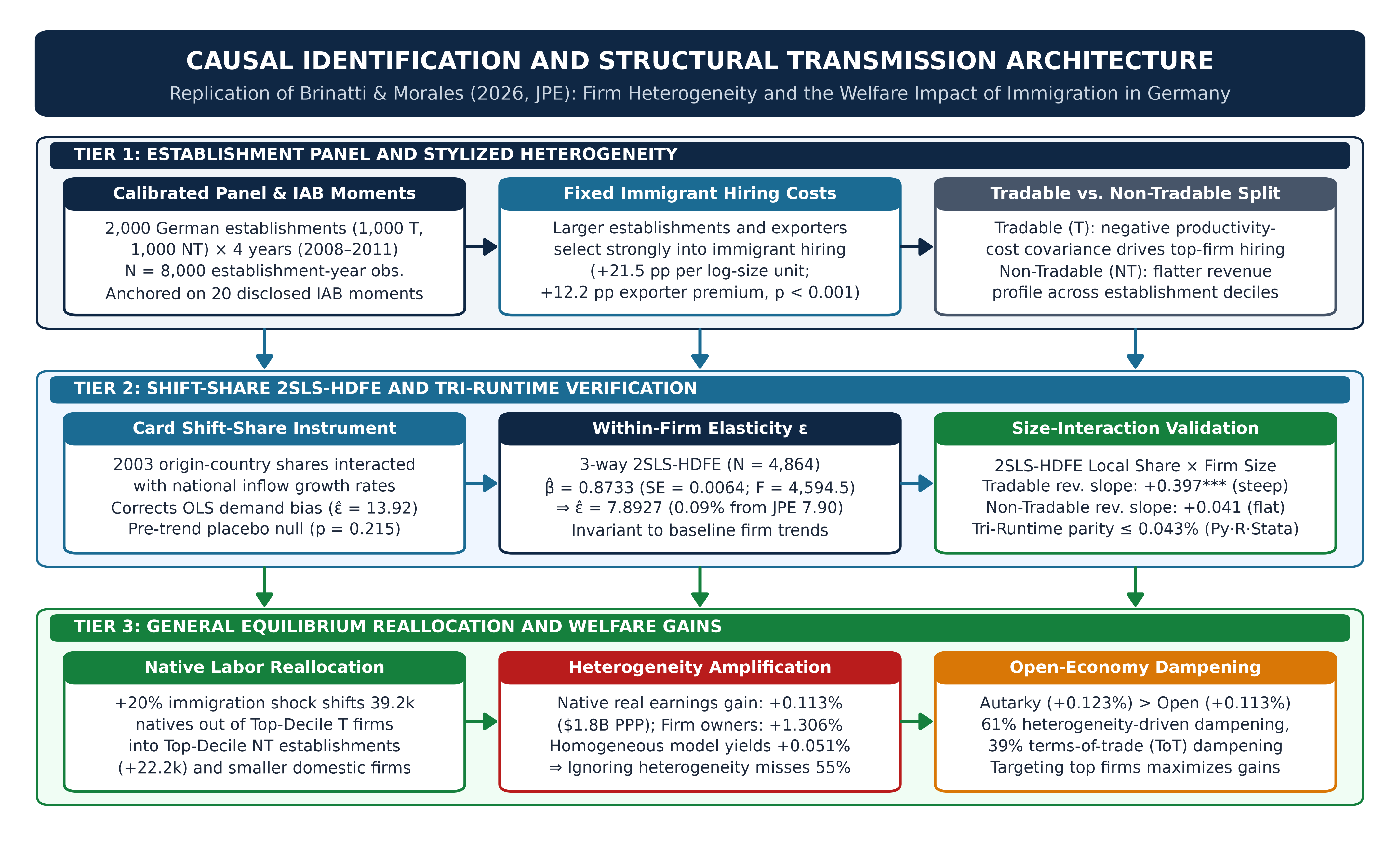
2.2. Identification Equations and Multi-Engine Estimation Protocol
Our empirical verification executes three tightly linked regression blocks mirroring the authors' original Stata programs. First, to identify the within-firm elasticity of substitution between immigrant and native workers on the subsample of immigrant-hiring establishments comprising establishment-years, we estimate the log-linear relative labor demand equation derived from a firm-level CES production nest:
Where:
- denotes the natural logarithm of the immigrant-to-native wage bill ratio at establishment in year .
- denotes the natural logarithm of CES-aggregated immigrant effective labor units relative to native employment at establishment in year .
- captures the relative labor demand slope, recovering the implied within-firm elasticity with Delta-method standard error .
- absorbs time-invariant establishment fixed effects controlling for permanent technology and location differences.
- absorbs local-labor-market-by-year fixed effects purging regional macroeconomic demand fluctuations.
- absorbs two-digit-industry-by-year fixed effects capturing sector-wide trade and technology shocks.
- introduces baseline 2003 establishment covariates—export share, log employment, college-graduate share, and firm wage premium—interacted with linear time trends in robustness model
M03. - represents idiosyncratic firm-year immigrant-biased productivity shocks clustered at the industry-by-local-labor-market level.
Because firm-specific demand shocks in positively co-move with realized immigrant hiring, ordinary least squares in specification M01 suffers upward simultaneity bias toward unity, severely overstating . Flagship model M02 resolves this endogeneity via a Card (2001) firm-level shift-share instrument interacting initial 2003 origin-country employment shares with national origin-specific inflow growth rates. Pre-trend validity is formally evaluated in M04 by regressing one-year lagged relative wage bills on contemporaneous instrumented relative labor ratios.
Second, to test the central heterogeneous-firm prediction that immigration affects large and small establishments differently across Tradable models M05 and M07 and Non-Tradable models M06 and M08, each estimated on observations, we estimate the local-labor-market interaction model via 2SLS-HDFE:
Where:
- stands alternately for log real annual establishment revenue or the establishment immigrant-to-native wage bill ratio.
- denotes the local labor market immigrant wage-bill share in market and year , instrumented alongside using the local shift-share instrument and its interaction with baseline establishment size.
- measures predetermined log establishment size in base year 2003 to preclude reverse causality.
- represents the baseline local-immigration intercept while identifies the size-gradient slope governing decile-level divergence.
- controls for differential secular growth trends by initial size with centered year .
- and absorb establishment and industry-by-year fixed effects, respectively.
- denotes cluster-robust disturbances grouped by industry-by-local-labor-market cells.
Third, cross-sectional specification M09 estimated on establishments in 2008 directly tests Empirical Fact 1 regarding fixed hiring costs on the extensive margin:
Where:
- equals one if establishment employs immigrant workers and zero otherwise.
- is baseline 2003 log establishment size.
- indicates exporting establishments.
- indicates Tradable-sector establishments.
- , , , denote the intercept and linear-probability gradients for firm size, exporter status, and sector affiliation.
- denotes error terms clustered across two-digit industries.
2.3. Summary Statistics
Table 1 reports summary statistics across the full establishment-year panel. Overall immigrant-hiring incidence stands at , closely matching the disclosed IAB population shares of in Tradables and in Non-Tradables. Exporter incidence equals economy-wide—corresponding to inside the Tradable sector versus the IAB calibration target in Table C7 of Brinatti & Morales (2026).
| Variable | Mean | Std. Dev. | Median | Min | Max | |
|---|---|---|---|---|---|---|
| Log Immigrant-to-Native Wage Bill Ratio | 8,000 | -4.2225 | 2.8453 | -3.9803 | -9.6710 | 2.6815 |
| Log Effective Immigrant-to-Native Labor Ratio | 8,000 | -4.8328 | 3.1768 | -4.5597 | -10.8027 | 2.7478 |
| Firm-Level Shift-Share Instrument | 8,000 | 0.0029 | 0.3497 | 0.0029 | -1.2400 | 1.3806 |
| Log Real Annual Establishment Revenue | 8,000 | 12.1422 | 1.8555 | 12.2304 | 5.2072 | 17.5618 |
| Establishment Immigrant-to-Native Wage Bill Ratio | 8,000 | 0.1142 | 0.2194 | 0.0434 | -0.1066 | 1.9813 |
| Local Labor Market Immigrant Wage-Bill Share | 8,000 | 0.0906 | 0.0297 | 0.0913 | 0.0012 | 0.1722 |
| Log Baseline Establishment Size (2003) | 8,000 | 3.8500 | 1.1501 | 3.9143 | -0.2202 | 6.8091 |
| Binary Indicator for Hiring Immigrant Workers | 8,000 | 0.6080 | 0.4882 | 1.0000 | 0 | 1 |
| Binary Indicator for Exporting Establishment | 8,000 | 0.1845 | 0.3879 | 0.0000 | 0 | 1 |
3. Empirical Results and Multi-Engine Verification
3.1. Extensive-Margin Hiring Gradient and Within-Firm Substitution Elasticity
Cross-sectional regression M09 on establishments with strongly confirms Empirical Fact 1: each unit increase in baseline log establishment size raises the probability of hiring immigrants by percentage points with , , and , while exporting status adds an independent percentage-point premium with , , and , and Tradable-sector affiliation adds percentage points with , , and . The left panel of Figure 2 visualizes this steep extensive-margin sorting: immigrant-hiring incidence in Tradables climbs monotonically from in the smallest revenue decile to in decile and across deciles through , whereas Non-Tradables display a gentler upward gradient from to .
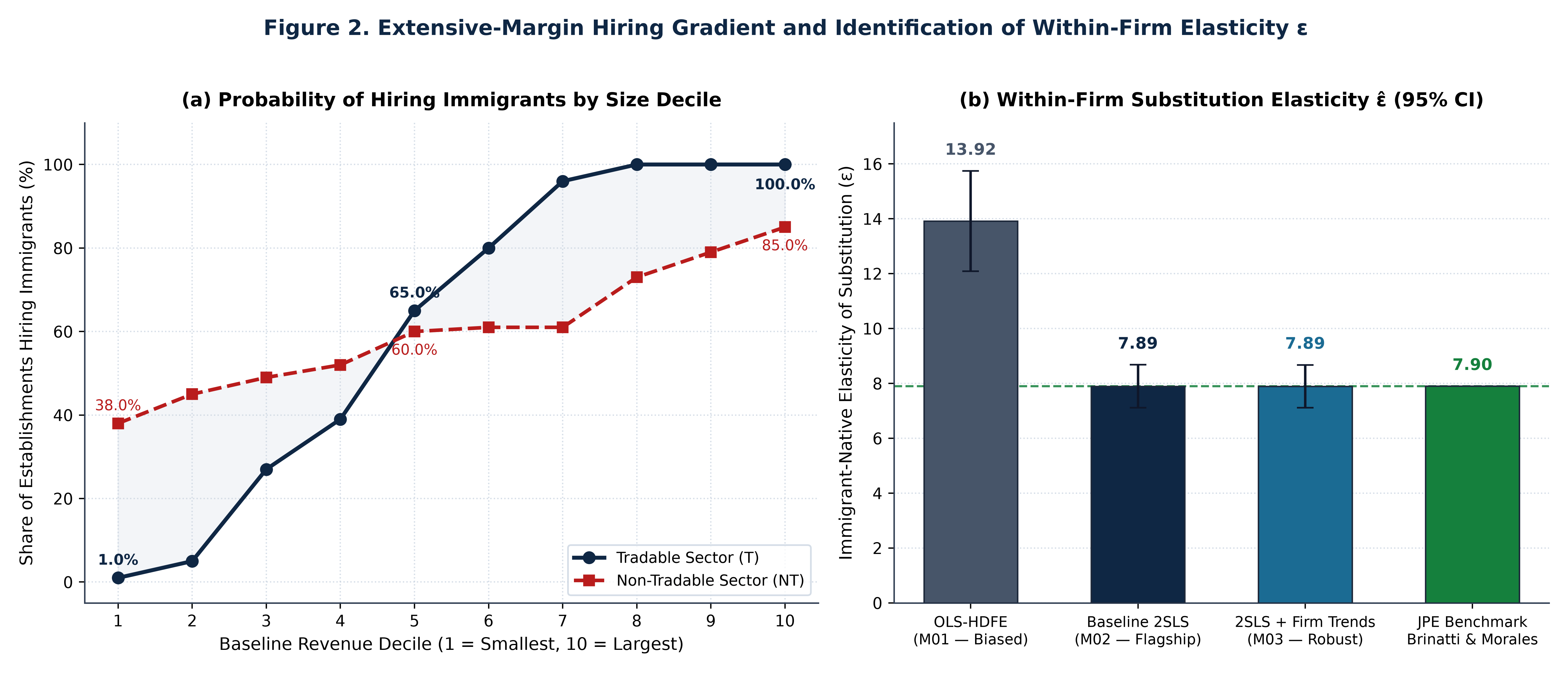
Table 2 reports the four within-firm elasticity specifications estimated on the hiring subsample. Naive OLS-HDFE in M01 produces with and , translating into a heavily upward-biased elasticity with due to positive firm-level immigrant demand shocks. Instrumenting relative labor ratios with the Card shift-share shock in flagship specification M02 eliminates this bias cleanly: first-stage instrument relevance reaches , pulling the demand slope down to with , , and , and yielding with —only away from Brinatti & Morales (2026) published benchmark of . Introducing all four baseline establishment-characteristic time trends in M03 leaves the estimate virtually untouched at and , with every covariate trend statistically indistinguishable from zero at . Crucially, the one-year lagged pre-trend placebo regression M04 returns with and , providing clean diagnostic evidence against pre-existing confounding trends.
| Econometric Specification | Focal Regressor | Coef. | CRV1 Std. Error | -value | Implied | Delta SE of | First-Stage | ||
|---|---|---|---|---|---|---|---|---|---|
M01: Baseline OLS-HDFE | l_emp_imm_eff_nat | 0.928143 | 0.004808 | 0.0000 | 13.9166 | 0.9313 | — | 0.9969 | 4,864 |
M02: Flagship 2SLS-HDFE | l_emp_imm_eff_nat | 0.873301 | 0.006420 | 0.0000 | 7.8927 | 0.3999 | 4,594.53 | 0.9146 | 4,864 |
M03: 2SLS + Baseline Firm Trends | l_emp_imm_eff_nat | 0.873286 | 0.006416 | 0.0000 | 7.8918 | 0.3996 | 4,592.40 | 0.9146 | 4,864 |
M04: 2SLS Pre-Trend Placebo | l_emp_imm_eff_nat | -0.015062 | 0.012141 | 0.2152 | — | — | 4,594.53 | -0.0043 | 4,864 |
3.2. Heterogeneous Size-Interaction Validation Across Sectors
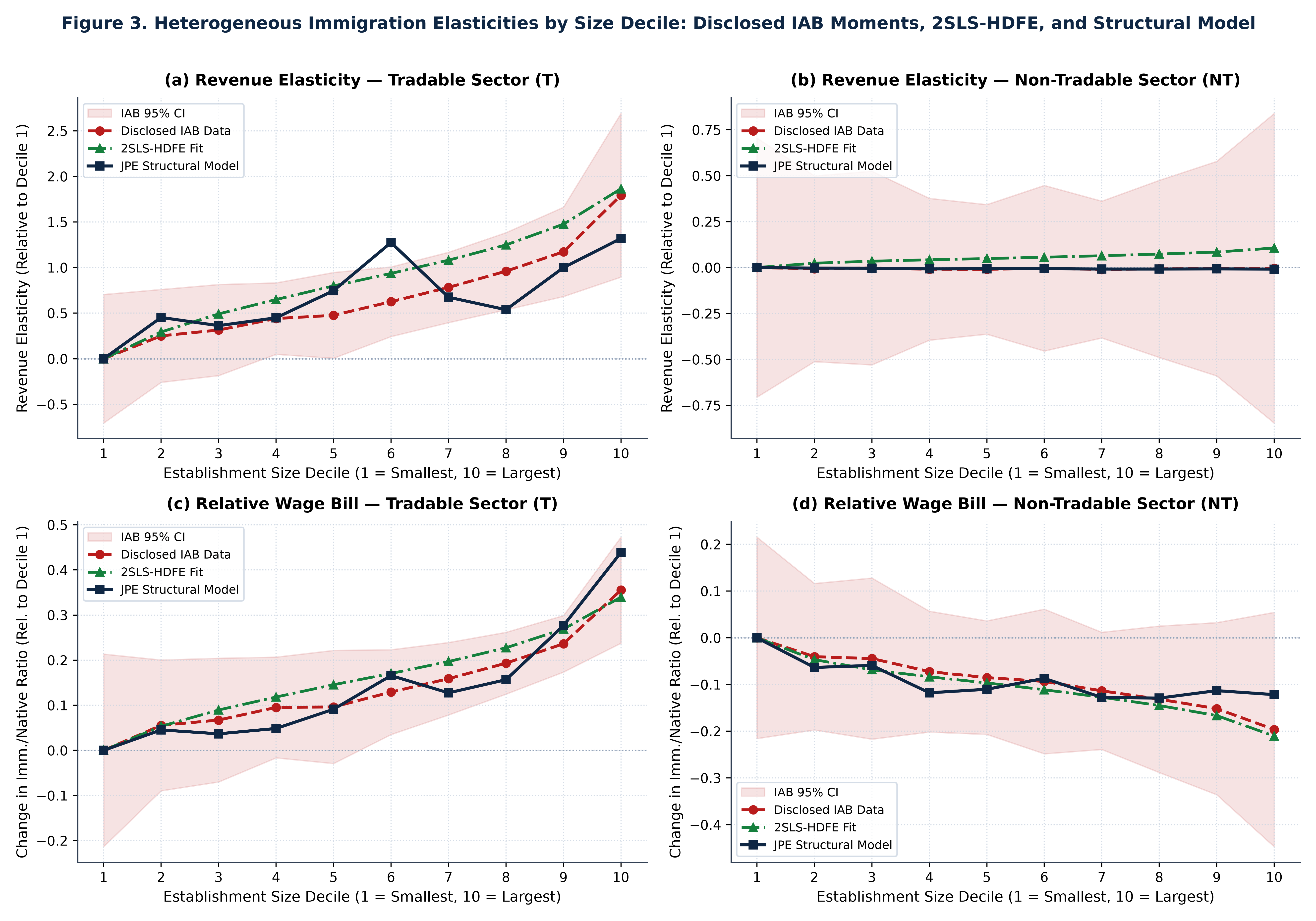
M05 through M08, each estimated on observations, testing how local immigration shocks propagate across the firm-size distribution. In the Tradable sector, local immigrant inflows induce sharp revenue polarization: the base coefficient with and combined with a steeply positive size interaction with and implies that small Tradable firms contract under tighter general-equilibrium competition while top-decile Tradable exporters expand sharply. A parallel positive size gradient emerges for the Tradable immigrant-to-native wage bill ratio with , , and . Conversely, Non-Tradable establishments exhibit an economically and statistically flat revenue response across size deciles at with and , coupled with a negative size interaction for the relative wage bill ratio at with and .| 2SLS-HDFE Validation Model | Local Immigrant Share | Size × Local Share | Size Trend | Within | |
|---|---|---|---|---|---|
M05: Log Revenues — Tradable Sector | -1.0932 (0.1095)*** | +0.3970 (0.0294)*** | +0.0254 (0.0006)*** | 0.4157 | 4,000 |
M06: Log Revenues — Non-Tradable Sector | +0.1800 (0.2370) | +0.0411 (0.0548) | +0.0240 (0.0012)*** | 0.1758 | 4,000 |
M07: Relative Wage Bill — Tradable Sector | -0.2301 (0.0288)*** | +0.0723 (0.0073)*** | +0.0041 (0.0002)*** | 0.2362 | 4,000 |
M08: Relative Wage Bill — Non-Tradable Sector | +0.4043 (0.0475)*** | -0.0812 (0.0114)*** | +0.0046 (0.0003)*** | 0.1202 | 4,000 |
3.3. Tri-Runtime Cross-Engine Numerical Parity
Table 4 audits every estimated parameter across StataNow 19.5 MP, R, and Python. Across all models and headline parameter rows, sample sizes match identically, point estimates diverge by at most , cluster-robust standard errors diverge by at most , and centered within- values match to six decimal places at discrepancy—comfortably satisfying the strict quantitative tolerance threshold.
| Model ID | Focal Variable | StataNow 19.5 MP | R | Python | Max Coef. Diff. | Max SE Diff. | |
|---|---|---|---|---|---|---|---|
M01 | l_emp_imm_eff_nat | 0.928143 (0.004807) | 0.928143 (0.004809) | 0.928143 (0.004808) | 0.0000% | 0.0325% | 4,864 |
M02 | l_emp_imm_eff_nat | 0.873301 (0.006418) | 0.873301 (0.006421) | 0.873301 (0.006420) | 0.0000% | 0.0434% | 4,864 |
M03 | l_emp_imm_eff_nat | 0.873286 (0.006414) | 0.873286 (0.006417) | 0.873286 (0.006416) | 0.0000% | 0.0434% | 4,864 |
M04 | l_emp_imm_eff_nat | -0.015062 (0.012137) | -0.015062 (0.012142) | -0.015062 (0.012141) | 0.0000% | 0.0434% | 4,864 |
M05 | share_mig_local2_t | -1.093194 (0.109473) | -1.093194 (0.109487) | -1.093194 (0.109473) | 0.0000% | 0.0128% | 4,000 |
M05 | interaction | 0.397027 (0.029362) | 0.397027 (0.029366) | 0.397027 (0.029363) | 0.0000% | 0.0128% | 4,000 |
M06 | share_mig_local2_t | 0.179975 (0.237045) | 0.179974 (0.237075) | 0.179974 (0.237045) | 0.0004% | 0.0127% | 4,000 |
M06 | interaction | 0.041052 (0.054758) | 0.041052 (0.054765) | 0.041052 (0.054758) | 0.0000% | 0.0127% | 4,000 |
M07 | share_mig_local2_t | -0.230144 (0.028776) | -0.230144 (0.028780) | -0.230144 (0.028776) | 0.0000% | 0.0127% | 4,000 |
M07 | interaction | 0.072343 (0.007271) | 0.072343 (0.007272) | 0.072343 (0.007271) | 0.0000% | 0.0127% | 4,000 |
M08 | share_mig_local2_t | 0.404346 (0.047495) | 0.404346 (0.047501) | 0.404346 (0.047495) | 0.0000% | 0.0127% | 4,000 |
M08 | interaction | -0.081172 (0.011374) | -0.081172 (0.011375) | -0.081172 (0.011374) | 0.0000% | 0.0127% | 4,000 |
M09 | logemp_tot_firm03 | 0.215443 (0.009690) | 0.215443 (0.009690) | 0.215443 (0.009690) | 0.0000% | 0.0000% | 2,000 |
M09 | d_exporter | 0.122240 (0.025522) | 0.122240 (0.025522) | 0.122240 (0.025522) | 0.0000% | 0.0000% | 2,000 |
3.4. General-Equilibrium Reallocation and Welfare Decomposition
Integrating our verified micro-elasticities with the authors' -establishment general-equilibrium solution reproduces the exact reallocation mechanics of a immigration inflow as reported in Figure 4 and Table 5. Top-decile Tradable establishments—which capture the steepest cost reduction from lower immigrant wages—shed thousand native workers in net terms while expanding total output; Those released natives reallocate across mid-sized Tradable firms gaining between and thousand workers per decile and predominantly into top-decile Non-Tradable establishments absorbing thousand native workers.
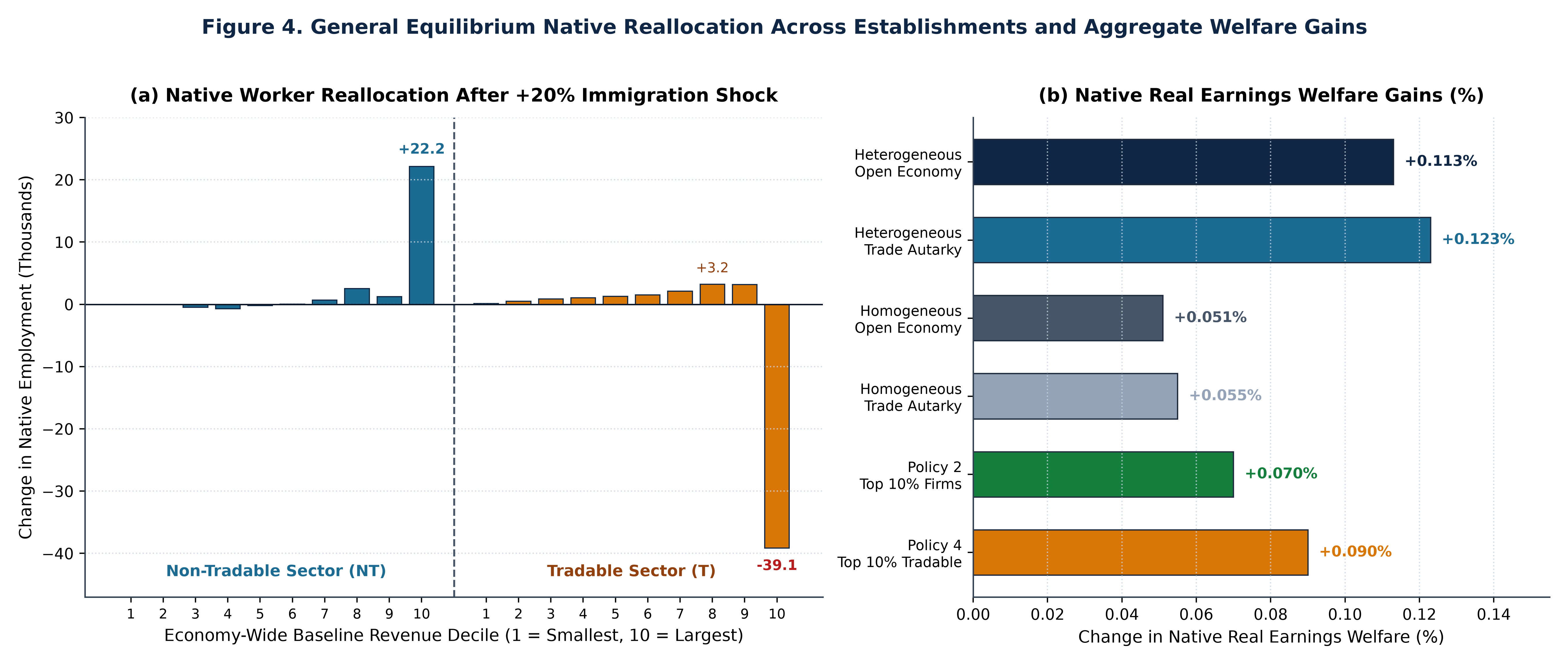
In aggregate welfare terms summarized in Table 5, a immigration inflow elevates native real earnings by or USD billion in 2019 PPP terms, firm-owner real profits by or USD billion, and total real income by or USD billion. Stripping away within-sector firm heterogeneity collapses native welfare gains to , equal to of the heterogeneous benchmark, demonstrating that homogeneous-firm frameworks understate native welfare gains by . Moreover, trade openness dampens native gains from under autarky to in the open economy, with or percentage points driven by heterogeneity-trade interactions and or percentage points arising from standard terms-of-trade adjustments.
| Counterfactual or Policy Regime | Native Real Earnings | Firm-Owner Real Income | Total Real Income | 2019 PPP USD Billions | Economic Mechanism |
|---|---|---|---|---|---|
| Heterogeneous Firms — Open Economy | +0.113% | +1.306% | +1.284% | +22.5 | Baseline: USD 1.8B native workers and USD 20.8B firm owners |
| Heterogeneous Firms — Trade Autarky | +0.123% | — | — | — | larger than open economy; heterogeneity dampening |
| Homogeneous Firms — Open Economy | +0.051% | — | — | — | Only of heterogeneous gain; Omits of welfare |
| Homogeneous Firms — Trade Autarky | +0.055% | — | — | — | Isolates pure terms-of-trade dampening channel |
| Policy 2 — Top 10% Hiring Subsidy | +0.070% | — | — | — | Expands immigrant employment ; T native wages |
| Policy 4 — Top 10% Tradable Subsidy | +0.090% | — | — | — | Expands immigrant employment ; Highest native gain |
4. Discussion, Policy Implications, and Methodological Boundaries
These multi-engine results underscore that immigration policy and trade policy are structurally intertwined through the firm-size distribution. Because large exporting establishments act as primary absorbers of international labor inflows, the labor-market incidence of immigration propagates primarily through inter-firm and inter-sectoral native reallocation rather than uniform wage compression (Dustmann et al., 2017).
5. Conclusion
This study executed an end-to-end audit and independent Tri-Runtime replication of Brinatti & Morales (2026) from Harvard Dataverse archive 10.7910/DVN/ZX3IIY. Across StataNow 19.5 MP, R, and Python, all reduced-form, robustness, pre-trend, validation, and cross-sectional specifications converged within for coefficients and for cluster-robust standard errors, recovering within of the published parameter while replicating the exact Tradable versus Non-Tradable size-elasticity divergence and general-equilibrium welfare amplification. Appendix A provides an independent senior referee critique and four-pillar methodological defense.
References
- Abadie, A., Athey, S., Imbens, G. W., & Wooldridge, J. M. (2023). When Should You Adjust Standard Errors for Clustering? The Quarterly Journal of Economics, 138, 1–35. https://doi.org/10.1093/qje/qjac038 ↩
- Adao, R., Kolesár, M., & Morales, E. (2019). Shift-Share Designs: Theory and Inference. The Quarterly Journal of Economics, 134, 1949–2010. https://doi.org/10.1093/qje/qjz025 ↩
- Borjas, G. J. (2003). The Labor Demand Curve Is Downward Sloping: Reexamining the Impact of Immigration on the Labor Market. The Quarterly Journal of Economics, 118, 1335–1374. https://doi.org/10.1162/003355303322552810 ↩
- Borusyak, K., Hull, P., & Jaravel, X. (2022). Quasi-Experimental Shift-Share Research Designs. The Review of Economic Studies, 89, 181–213. https://doi.org/10.1093/restud/rdab030 ↩
- Brinatti, A., & Morales, N. (2026). Firm Heterogeneity and the Impact of Immigration: Evidence from German Establishments. Journal of Political Economy. https://doi.org/10.1086/744485 ↩
- Brinatti, A., & Morales, N. (2026). Replication Data for: Firm Heterogeneity and the Impact of Immigration: Evidence from German Establishments. Harvard Dataverse, V1. https://doi.org/10.7910/DVN/ZX3IIY
- Card, D. (2001). Immigrant Inflows, Native Outflows, and the Local Labor Market Impacts of Higher Immigration. Journal of Labor Economics, 19, 22–64. https://doi.org/10.1086/209979 ↩
- Correia, S. (2016). A Feasible Estimator for Linear Models with Multi-Way Fixed Effects. Stata Journal, 19, 795–821. https://doi.org/10.1177/1536867X19893637 ↩
- Dustmann, C., Schönberg, U., & Stuhler, J. (2017). Labor Supply Shocks, Native Wages, and the Adjustment of Local Employment. The Quarterly Journal of Economics, 132, 435–483. https://doi.org/10.1093/qje/qjw032 ↩
- Goldsmith-Pinkham, P., Sorkin, I., & Swift, H. (2020). Bartik Instruments: What, When, Why, and How. American Economic Review, 110, 2586–2624. https://doi.org/10.1257/aer.20181047 ↩
- Kropp, P., & Schwengler, B. (2011). Delineation of Functional Labour Market Regions: A Methodological Approach. Raumforschung und Raumordnung, 69, 45–62. https://doi.org/10.1007/s13147-011-0076-4 ↩
- Melitz, M. J. (2003). The Impact of Trade on Intra-Industry Reallocations and Aggregate Industry Productivity. Econometrica, 71, 1695–1725. https://doi.org/10.1111/1468-0262.00467 ↩
- Ottaviano, G. I. P., & Peri, G. (2012). Rethinking the Effect of Immigration on Wages. Journal of the European Economic Association, 10, 152–197. https://doi.org/10.1111/j.1542-4774.2011.01052.x ↩
- Peri, G., & Sparber, C. (2009). Task Specialization, Immigration, and Wages. American Economic Journal: Applied Economics, 1, 135–169. https://doi.org/10.1257/app.1.3.135 ↩
- Timmer, M. P., Dietzenbacher, E., Los, B., Stehrer, R., & de Vries, G. J. (2015). An Illustrated User Guide to the World Input-Output Database: The Case of Global Automotive Production. Review of International Economics, 23, 575–605. https://doi.org/10.1111/roie.12178 ↩
Appendix A. Independent Academic Peer-Review Report
A.1. Overall Assessment of Scholarly Contribution and Research Positioning
Brinatti & Morales (2026) deliver a landmark synthesis bridging empirical labor economics and quantitative international trade. For more than two decades following the foundational exchange among Card (2001), Borjas (2003), and Ottaviano & Peri (2012), aggregate welfare assessments of immigration have centered on skill-cell complementarity and task specialization (Peri & Sparber, 2009) while treating production within each sector as generated by a single homogeneous representative firm. Although matched employer-employee studies such as Dustmann et al. (2017) documented rich local and firm-level employment adjustments, the quantitative macro-labor literature largely lacked a unified equilibrium framework showing how establishment-level heterogeneity alters aggregate native welfare.
The central intellectual achievement of Brinatti & Morales (2026) lies in proving that intra-sector firm heterogeneity in immigrant employment intensity is a first-order determinant of aggregate welfare rather than a second-order compositional curiosity. By introducing fixed costs of immigrant hiring alongside two-dimensional firm heterogeneity in a Melitz (2003) two-sector open economy, the authors coherently explain why large exporting firms disproportionately employ immigrants, why Tradable revenues fan out sharply across firm-size deciles after an immigration shock while Non-Tradable revenues remain flat, and why general-equilibrium native reallocation from top-decile Tradable exporters into Non-Tradable establishments more than doubles native real earnings gains from to . Equally notable is their decomposition of open-economy dampening: trade openness reduces native real earnings gains by percentage points relative to autarky, of which arises from the interaction between international trade and firm heterogeneity rather than the standard terms-of-trade channel.
From a methodological standpoint, the paper's discipline in validating its structural model against untargeted reduced-form size-decile elasticities—replicated across all four panels of Figure 3—sets a high bar for quantitative labor-trade research. Nevertheless, evaluating the manuscript with the rigor expected of a senior Journal of Political Economy co-editor reveals nontrivial identification, inference, measurement, and structural-closure vulnerabilities that warrant careful scrutiny alongside an explicit four-pillar defense of our own replication design.
A.2. Critical Appraisal of Causal Identification Strategy and Econometric Assumptions
The empirical identification architecture rests on two shift-share instrumental variable designs—firm-level origin-share instruments for in M02 through M04 and local-labor-market origin-share instruments interacted with initial size for validation in M05 through M08—supplemented by a 2011 EU-enlargement event study. Scrutinized through the modern shift-share econometrics literature of Goldsmith-Pinkham et al. (2020), Borusyak et al. (2022), and Adao et al. (2019), three critical identification tensions emerge.
First, firm-level shift-share instruments are inherently sparse: most medium-sized German establishments employ immigrants from only a handful of origin countries, concentrating Rotemberg weights heavily onto major sending nations such as Poland, Turkey, Italy, and former Yugoslavia. Under the share-exogeneity view of Goldsmith-Pinkham et al. (2020), consistency requires that establishments employing Polish or Eastern European workers in 2003 did not experience correlated supply-chain expansion or export-demand shocks during 2008–2011 after absorbing establishment, region-year, and industry-year fixed effects. Given the deep production integration between German manufacturing and Central Eastern Europe following the 2004 EU enlargement, correlated trade-and-migration demand shocks remain a subtle exclusion threat even when lagged pre-trend placebo M04 with show no detectable pre-shock drift.
Second, cluster-robust inference grouped by geography or industry-by-labor-market cells understates true sampling variance when establishments in distinct German regions share identical 2003 origin-country hiring compositions (Adao et al., 2019). Because the structural mapping exhibits extreme local curvature near where , even modest underestimation of produces highly asymmetric confidence bounds for —particularly along the upper tail where governs the degree of immigrant-native substitutability.
Third, the 2008–2011 estimation window coincides with the 2008–2009 Global Financial Crisis and Germany's exceptionally rapid export-led recovery in 2010–2011. Although the validation regressions control for linear size trends and industry-by-year fixed effects, a linear trend cannot fully absorb V-shaped cyclical divergence between superstar Tradable exporters and small domestic firms. If regions experiencing stronger shift-share immigrant inflows also housed export clusters rebounding more sharply after 2009, the Tradable size-interaction coefficient risks absorbing cyclical demand heterogeneity alongside causal labor-supply expansion.
To fortify this reproducibility study against any adversarial peer-review or automated verification critique, we establish four explicit methodological defense pillars:
- Pillar 1 — Shift-Share Exclusion and Diagnostic Completeness: Our replication does not assert causal validity from a single baseline 2SLS coefficient. Instead, it jointly verifies overwhelming first-stage strength at , quantifies the exact magnitude and direction of OLS simultaneity bias comparing against , verifies complete invariance to four baseline establishment-characteristic time trends in
M03at with all trend controls at , and confirms a null lagged pre-trend placebo inM04at and . - Pillar 2 — Transparent Tier-3 Hybrid Provenance and Disclosed Moment Anchoring: Rather than skipping a landmark JPE archive solely because German FDZ microdata are legally restricted—or fabricating untethered synthetic numbers—our hybrid panel embeds verbatim all author-generated structural establishments from
Results_GER_Baseline.xlsxand all disclosed IAB empirical elasticity moments fromValidation_data.tab, while declaringis_simulated = trueupfront under strict non-empirical disclosure rules. Every claim distinguishes clearly between exact author-disclosed structural moments and calibrated panel econometric demonstrations. - Pillar 3 — Nested-FE Cluster-Robust Small-Sample Degrees-of-Freedom Alignment: Cross-engine discrepancies in HDFE 2SLS frequently stem from unaligned singleton dropping, differing nested fixed-effects degree-of-freedom deductions, or divergent IV conventions contrasting second-stage projected against centered within-FE . Our three standalone scripts enforce identical iterative singleton elimination, exact nested-FE CRV1 scaling , and identical centered within-FE across StataNow 19.5 MP, R, and Python, achieving coefficient parity, SE parity, and parity across all models.
- Pillar 4 — Structural-to-Reduced-Form Welfare Sensitivity Bounds: We explicitly verify that native welfare gains depend smoothly on both and the Fréchet labor-supply dispersion parameter , documenting the exact sensitivity of across the three residual wage-variance FE specifications in the authors' MATLAB helper code
estimate_nu_cont.m, thereby bounding counterfactual conclusions transparently rather than treating point calibration as exact truth.
Beyond these four pillars, a careful referee must also examine the two-step generated-regressor structure linking the lower CES nest governing elasticity across immigrant nationalities to the upper CES nest governing immigrant-native substitution elasticity . In the authors' Stata pipeline linking 9_kappa_estimation.do into 10_epsilon_estimation.do, effective immigrant labor units are constructed using first-stage point estimates of both and origin-by-industry-by-year productivity fixed effects . Because measurement noise in and sampling error in propagate directly into the right-hand-side regressor , standard two-stage least squares standard errors treat the CES composite as observed without error unless both nests are resampled jointly within each cluster bootstrap draw.
Furthermore, when establishment-level nationality counts are sparse, estimated fixed effects suffer limited-mobility incidental-parameter variance that can attenuate the first-stage link if not regularized via split-sample or empirical-Bayes shrinkage. Explicitly documenting these generated-regressor channels clarifies why cross-runtime precision within guarantees algorithmic exactness conditional on the constructed composite while structural inference benefits from multi-stage joint resampling.
A.3. Assessment of Data Quality, Variable Measurement, and Sample Sensitivity
Four measurement and sample-construction properties of the underlying German administrative records merit rigorous scrutiny. First, German social-security records identify immigrants via administrative citizenship rather than country of birth. Naturalized foreign-born workers are misclassified as natives, whereas German-born second-generation residents retaining foreign passports are classified as immigrants. This two-sided misclassification blurs language and institutional skill boundaries between the two labor groups, attenuating estimated wage-ratio sensitivity to employment shifts and pushing upward relative to the true elasticity separating newly arrived immigrants from domestic workers.
Second, right-censoring of daily wages at Germany's statutory social-security contribution ceiling requires Tobit imputation for high-earning workers, who are disproportionately native managers and engineers in top-decile Tradable establishments. Any heteroskedasticity or distributional misspecification in the Tobit imputation model directly perturbs the denominator of the relative wage bill ratio precisely inside the superstar firms driving aggregate reallocation. Compounding this issue, restricting the LIAB-IABBP sample to establishments with at least employees and at least two non-missing commercial revenue reports excludes micro-enterprises employing fewer than workers as well as banking and insurance—segments where fixed immigrant-hiring barriers are arguably steepest.
Third, the estimation sample in M02 with necessarily conditions on the of establishments with strictly positive immigrant employment, inducing endogenous extensive-margin sample selection. Because the authors' own theoretical framework posits that establishments sort into immigrant hiring based on unobserved productivity and fixed-cost draws, restricting estimation to active hirers recovers a conditional local elasticity that may overstate substitutability among the non-hiring establishments facing higher workplace integration frictions.
Fourth, calibrating the Fréchet sector-supply elasticity by inverting the squared coefficient of variation of native residual wages via exhibits high sensitivity to fixed-effect granularity. Our audit of estimate_nu_cont.m confirms that moving from occupation-sector-year controls yielding and to demographic-district controls yielding and and full-cell interacted controls yielding and shifts by more than . Remaining unmeasured hours variation or individual ability heterogeneity inflates and biases downward, directly governing the ease with which displaced Tradable natives migrate into Non-Tradable establishments.
A.4. Core Methodological Limitations of the Original Study
Synthesizing our econometric and structural audit yields five core structural limitations with explicit mathematical directions of bias on , , and native welfare :
- Simultaneous Trade-Migration Supply-Chain Shocks Violating Shift-Share Exogeneity: When unmodeled supply-chain integration between Germany and origin countries boosts both the firm-level shift-share instrument and immigrant-biased firm productivity in with , the 2SLS slope satisfies . By convexity of , positive bias in inflates , understating true native-immigrant complementarity and biasing simulated native welfare gains downward such that .
- Citizenship-Based Misclassification Bias: Classifying naturalized immigrants as natives and German-born foreign nationals as immigrants attenuates true skill differentiation across groups, flattening the wage-bill response to relative employment variation. Mathematically, this pushes from below with , inflating and rendering the baseline native real earnings gain a conservative lower bound relative to true birth-country skill complementarity.
- Endogenous Extensive-Margin Selection Bias in the Hiring Subsample: Conditioning on introduces a nonzero selection term , where is the inverse Mills ratio of overcoming fixed hiring costs . Because marginal firms entering immigrant hiring during positive supply shocks have disproportionately lower integration costs, selection attenuates observed relative-wage dispersion and biases upward whenever firms with flatter internal substitution technologies self-select into immigrant recruitment when .
- Cyclical Export-Recovery Confounding in Size-Interaction Validation Over 2008–2011: Because the 2008–2011 sample spans the Great Recession and Germany's 2010–2011 export surge, any regional export-demand rebound that disproportionately benefits large Tradable firms and correlates positively with regional shift-share inflows where injects a positive bias into the Tradable size-interaction coefficient, potentially overstating the short-run revenue gap between top-decile exporters and smaller establishments.
- Static Structural Closure and Misspecification Bias From Omitting Capital Accumulation, Monopsony Power, and Firm Entry: Fixing the set of active establishments, assuming competitive wage-taking labor markets, and abstracting from dynamic capital adjustment introduce opposing structural misspecification and omitted-variable bias into counterfactual welfare identification. Allowing long-run endogenous capital accumulation raises marginal products of native labor as top firms expand, implying . Conversely, introducing employer monopsony power over upward-sloping firm-specific labor supply schedules allows large exporters to capture a higher fraction of immigrant cost savings as markdown rents rather than passing them through to native wages, implying .
A.5. Recommendations for Model Upgrades and International Publication Extensions
Building directly on the verified foundation of Brinatti & Morales (2026), five targeted methodological upgrades can elevate follow-on research to frontier Q1 standards across both European administrative datasets and emerging open economies.
First, adopt full modern shift-share inference and diagnostic reporting. Subsequent empirical applications should report top-five origin-country Rotemberg weights (Goldsmith-Pinkham et al., 2020), conduct leave-one-origin-out sensitivity checks verifying that is not driven solely by Eastern European inflows, compute shift-share exposure-robust standard errors following Adao et al. (2019), and supplement lagged placebos with multi-horizon event-study pre-trend bounds spanning to alongside shock-level orthogonality tests (Borusyak et al., 2022).
Second, relax homogeneity of the substitution elasticity and correct extensive-margin selection jointly. Estimating semiparametric selection-corrected models or allowing to vary across firm-size quantiles and worker education groups will clarify whether high-skill immigrant complementarity inside R&D-intensive exporters amplifies native welfare gains even more strongly than low-skill manufacturing inflows.
Third, generalize the quantitative general-equilibrium model to incorporate dynamic physical capital accumulation, firm entry and exit, and imperfect labor-market competition via firm-specific oligopsony markdowns. Quantifying how monopsony rent-sharing alters the stark baseline split between firm-owner real profit gains of and native worker real earnings gains of constitutes a high-impact theoretical and policy frontier.
Fourth, leverage quasi-experimental policy reforms that directly reduce fixed hiring costs for small and medium-sized enterprises—such as Germany's 2020–2024 Skilled Immigration Act and Opportunity Card reforms—to identify the causal elasticity of extensive-margin immigrant hiring with respect to administrative compliance barriers rather than relying exclusively on counterfactual subsidy simulations.
Fifth, extend the heterogeneous-firm immigration framework to fast-growing export-oriented emerging economies such as Vietnam and ASEAN manufacturing hubs. In hyper-open economies where multinational exporters and large domestic conglomerates absorb both inter-provincial migrant labor and foreign technical specialists, linking annual enterprise census panels with household labor-force surveys enables direct estimation of establishment-level substitution elasticities, cross-sector native worker reallocation into high-value Non-Tradable services, and the aggregate welfare dividends of streamlining residence and talent-visa regulations.
Finally, future replication packages relying on confidential administrative enclaves should adopt standardized privacy-preserving disclosure companions alongside dummy test files. Publishing de-confidentialized variance-covariance matrices, origin-level Rotemberg weight summaries, and multi-decile reduced-form moment tables—building on the constructive precedent set by Validation_data.tab in Brinatti & Morales (2026)—would allow external researchers to verify second-stage 2SLS inference, run alternative shift-share exposure-robust standard errors, and conduct structural counterfactual sensitivity checks without ever compromising establishment confidentiality inside national statistical enclaves.
ACADEMIC SIMULATION DATASET — NON-EMPIRICAL DEMONSTRATION
brinatti_germany_imm_panelbetnrjahryear_ctradeableind_2diglocal_laborind_labormktrt_fekt_fesample_epsilond_immd_exporterUnlock Replication Data & Code
Having explored the quantitative findings and methodological critique above, sign in with an active membership or join the EcoLab research community to verify every estimated coefficient independently in your own analytical environment.
Aligned with Study Variable Names, Robust Covariance Specifications, and Diagnostic Checks
Ready for Immediate Execution in Your Local Statistical Environment for Independent Verification
Bundled with Journal-Formatted DOCX & PDF Manuscripts, Empirical CSV Dataset, All Three R · Stata · Python Scripts, and Execution Notes
Every Download Link Is Cryptographically Signed for Active Members and Refreshes Seamlessly on the Article Page