
1. Introduction
Over the past decade, Heterogeneous Agent New Keynesian macroeconomics, commonly known as HANK and pioneered by Kaplan et al. (2018), has reshaped how economists evaluate fiscal transmission, reviving the aggregate-demand foundation articulated by Keynes (1937). Within closed-economy environments, two landmark contributions by Auclert et al. (2024) and Angeletos et al. (2024) overturned classical Ricardian equivalence along two pivotal margins.
First, when monetary policy holds the real interest rate constant, elevated intertemporal marginal propensities to consume among borrowing-constrained households activate the Intertemporal Keynesian Cross, driving the cumulative present-value government spending multiplier substantially above unity.
Second, the resulting endogenous expansion in aggregate labor income generates enough incremental tax revenue that deficit-financed fiscal expansions can self-finance completely in present value without requiring lump-sum tax hikes. Yet most countries operate as small open economies tightly integrated into global goods trade and international capital markets, as formalized by Galí and Monacelli (2005) and Farhi and Werning (2016). Empirical macroeconomic studies by Ilzetzki et al. (2013), Miyamoto et al. (2019), and Born et al. (2024) consistently demonstrate that fiscal multipliers vary sharply with trade openness, exchange rate regimes, and cross-border financial frictions.
This independent replication and diagnostic audit pursues four tightly defined scientific objectives:
- Direct Tier-1 general-equilibrium solution and data standardization: Re-solve the endogenous gridpoint household problem, intertemporal marginal propensity to consume matrix , and full sequence-space Jacobian systems deposited by Sundram (2026b) across both single-country and two-country architectures, constructing a clean, non-simulated transition panel for transparent cross-platform verification.
- Tri-runtime econometric verification across independent statistical engines: Benchmark every steady-state calibration moment, boom-bust impulse response, active Taylor monetary rule, fixed exchange rate peg, inelastic foreign debt demand schedule, and real-versus-nominal self-financing rate across Python 3.13.2, R 4.3.1, and Stata 18 MP under harmonized small-sample clustering conventions.
- Diagnostic quantification of numerical truncation, grid-scaling, and boundary assumptions: Decompose finite-horizon truncation bias across 217 suppressed low-openness points spanning , correct the unscaled asset grid in the two-country model, quantify the external Ponzi bias relative to the debt-stabilizing fiscal rule of Bohn (1998), and evaluate sign reversal when shifting from Producer Currency Pricing to the Dominant Currency Pricing paradigm of Gopinath et al. (2020).
- Independent editor-grade peer review: Deliver a rigorous technical referee report in Appendix A scrutinizing causal identification, open-economy microfoundations, numerical fidelity, and a structured roadmap for top-tier empirical and theoretical extensions.
2. Theoretical Framework and Analytical Propositions
The analytical architecture of Sundram (2026a) extends the sequence-space Jacobian toolkit of Auclert et al. (2021b) to a small open economy with incomplete domestic asset markets, building on open-economy heterogeneous-agent contributions by De Ferra et al. (2020), Auclert et al. (2021c), Aggarwal et al. (2023), Guo et al. (2023), and Oskolkov (2023).
A unit continuum of domestic households faces uninsurable idiosyncratic labor productivity risk governed by a discrete Markov chain alongside a zero-borrowing constraint . In each annual period , households maximize expected discounted utility from consumption , while wage-setting unions allocate uniform labor supply , separating marginal propensities to consume from marginal propensities to earn as examined by Auclert et al. (2021a) and Broer et al. (2021). Individual post-tax labor income follows the progressive tax schedule of Heathcote et al. (2017), written as , where aggregate disposable income equals , denotes the marginal labor tax rate, and represents lump-sum fiscal adjustments. Solving the dynamic household problem with the endogenous gridpoint method of Carroll (2006) yields an aggregate sequence-space consumption function obeying the consolidated budget constraint and the household transversality condition .
Let denote the present-value discount vector evaluated at the steady-state world real interest rate , let denote the intertemporal marginal propensity to consume Jacobian, and let denote the real-rate consumption Jacobian. Differentiating the aggregate household intertemporal budget constraint yields the column-conservation identities and . On the goods-market side, combining Armington demand with steady-state import share , trade elasticity , fully home-biased government spending, and a symmetric zero-net-foreign-asset steady state produces the linearized International Intertemporal Keynesian Cross:
Where:
- : infinite sequence of real domestic output deviations from steady state;
- : steady-state household import share indexing trade openness;
- : intertemporal marginal propensity to consume matrix mapping disposable income paths into aggregate consumption;
- : proportional marginal labor income tax rate;
- : sequence of lump-sum tax adjustments governing public debt stabilization;
- : steady-state real domestic output normalized to unity;
- : sequence of consumer-price real exchange rate deviations defined by under Producer Currency Pricing;
- : intertemporal real interest rate Jacobian of aggregate household consumption;
- : sequence of ex-ante domestic real interest rate deviations;
- : sequence of exogenous home-biased real government spending shocks;
- : Armington elasticity of substitution between home and foreign goods;
- : steady-state real private consumption share of output.
The structural divergence between HANK and the benchmark Representative Agent New Keynesian, or RANK, model of Woodford (2011) rests on the spectral properties of the domestic demand propagation operator . Four analytical propositions follow directly from this sequence-space system:
- Proposition 1 — Global sequence-space determinacy: Whenever and , import leakage strictly contracts the weighted operator norm to . Consequently, is uniquely invertible even under a fixed real interest rate , eliminating the closed-economy multiplicity trap.
- Proposition 2 — Unit cumulative multiplier invariance and external boom-bust cycle: Under a passive constant real rate and perfectly elastic international bond demand , uncovered interest parity keeps the real exchange rate fixed at . When fiscal policy satisfies the no-Ponzi solvency condition , equivalent to , left-multiplying the goods-market clearing condition by eliminates , , and the debt-rule persistence parameter , yielding and for all . At the closed-economy boundary , the multiplier suffers a discontinuous jump from to .
- Proposition 3 — Real exchange rate sufficient-statistic decomposition: Once the central bank follows an active Taylor rule , pegs the nominal exchange rate, or faces upward-sloping international bond supply with financial friction in the spirit of Itskhoki and Mukhin (2021), every departure of the cumulative present-value multiplier from unity collapses into a single closed-form expression:
Where:
- : infinite-horizon cumulative present-value government spending multiplier;
- : net real exchange rate transmission elasticity balancing expenditure switching against the real-income squeeze;
- : steady-state present-value discount row vector;
- : sequence of real exchange rate deviations from steady state;
- : sequence of exogenous government spending innovations;
- : positive Marshall–Lerner expenditure-switching channel stimulating exports and home-good substitution;
- : negative household real-income channel as costlier imports erode purchasing power, interacting with sectoral reallocation mechanisms highlighted by Cardi and Restout (2023).
Under Dominant Currency Pricing as documented by Gopinath et al. (2020), dollar-invoiced export stickiness collapses the effective transmission parameter to at benchmark calibration and , reversing the sign of real exchange rate movements on the fiscal multiplier.
- Proposition 4 — Limits to fiscal deficit self-financing: Holding lump-sum taxes permanently fixed at under a constant real rate and real public bonds, the share of present-value spending financed endogenously through higher labor tax receipts, , falls to for every , well below the complete closed-economy self-financing benchmark . Viewed through the fiscal reaction lens of Bohn (1998) and the sovereign debt literature of Arellano (2008), however, fixing at leaves an unredeemed external debt remainder ; Imposing the minimal no-Ponzi stabilization rule and taking drives sustainable long-run self-financing back to the marginal tax rate .
3. Data Construction and Multi-Runtime Econometric Design
3.1. Deterministic Equilibrium Data Provenance and Panel Summary
All quantitative data analyzed in this paper belong strictly to Tier-1 original deterministic equilibrium output generated directly from the official replication archive of Sundram (2026b) on Harvard Dataverse, with zero synthetic or Monte Carlo surrogate data. The steady-state solver discretizes the idiosyncratic log-productivity first-order autoregressive process with persistence and unconditional standard deviation across Rouwenhorst Markov states, paired with a log-spaced asset grid of nodes over .
Solving the domestic asset-market clearing fixed point yields , tax-progressivity normalization constant , steady-state consumption , disposable income , a liquidity-constrained hand-to-mouth household share of , and an aggregate impact marginal propensity to consume satisfying column conservation . Table 1 benchmarks every verified calibration parameter and steady-state moment against Table A.1 of Sundram (2026a).
| Steady-State Parameter or Target Moment | Mathematical Symbol | Original Reported | Verified Solution | Relative Discrepancy |
|---|---|---|---|---|
| Relative risk aversion and inverse Frisch elasticity | 1.0000 | 1.0000 | 0.0000% | |
| Time discount factor calibrated to liquid wealth target | 0.8710 | 0.8714 | 0.0410% | |
| Persistence of idiosyncratic labor productivity | 0.9100 | 0.9100 | 0.0000% | |
| Unconditional standard deviation of log productivity | 0.9200 | 0.9200 | 0.0000% | |
| Labor income tax progressivity parameter | 0.1810 | 0.1810 | 0.0000% | |
| Tax-progressivity productivity normalization constant | 0.9412 | 0.9412 | 0.0001% | |
| Annual steady-state world real interest rate | 0.0500 | 0.0500 | 0.0000% | |
| Steady-state public spending and public debt to GDP ratios | 0.2000; 0.2100 | 0.2000; 0.2100 | 0.0000% | |
| Steady-state household disposable income and private consumption | 0.7895; 0.8000 | 0.7895; 0.8000 | 0.0000% | |
| Share of liquidity-constrained hand-to-mouth households | (%) | 56.7000 | 56.6900 | 0.0176% |
| Aggregate impact marginal propensity to consume | 0.4910 | 0.4908 | 0.0354% | |
| Benchmark trade openness, Armington elasticity, and marginal tax rate | 0.4000; 1.0000; 0.3300 | 0.4000; 1.0000; 0.3300 | 0.0000% | |
| Debt-stabilization persistence and fiscal shock autocorrelation | 0.7000; 0.7600 | 0.7000; 0.7600 | 0.0000% | |
| Wage Phillips curve slope and active Taylor rule coefficient | 0.0300; 1.5000 | 0.0300; 1.5000 | 0.0000% |
From the exact sequence-space Jacobian solutions, we assemble a balanced multi-regime transition panel covering structural policy regimes over annual horizons following a steady-state GDP government spending impulse decaying at rate . The 16 regimes span the closed-economy HANK baseline and active Taylor rule at , the small open HANK baseline across , the small open RANK benchmark at , active Taylor monetary rules across , the nominal exchange rate peg at , inelastic foreign debt demand with across , and two endogenous Dominant Currency Pricing counterfactuals under active Taylor policy and inelastic debt demand at .
Total balanced panel size is exactly observations across 44 structural variables; The 14 open-economy regimes with yield observations, the 5-year short-run boom window yields observations, and the 20-year medium-run debt-service window yields observations. Table 2 presents summary statistics for the twelve focal macroeconomic variables.
| Symbol | Economic Definition and Measurement Unit | Observations | Mean | Std. Dev. | Min | Max |
|---|---|---|---|---|---|---|
| Real domestic output deviation from steady state (% GDP) | 4800 | 0.0083 | 0.1444 | -0.2351 | 2.3788 | |
| Real private consumption deviation from steady state (% GDP) | 4800 | -0.0055 | 0.0800 | -0.2887 | 1.3788 | |
| Exogenous real government spending shock (% steady-state GDP) | 4800 | 0.0139 | 0.0878 | 0 | 1 | |
| Real net exports change (% steady-state GDP) | 4800 | 0.0009 | 0.0122 | -0.2589 | 0.0708 | |
| End-of-period net foreign asset position (% steady-state GDP) | 4800 | -0.0392 | 0.2309 | -4.7263 | 0.0803 | |
| Beginning-of-period net foreign asset position (% steady-state GDP) | 4800 | -0.0382 | 0.2208 | -4.5014 | 0.0803 | |
| CPI-based real exchange rate deviation (% steady state) | 4800 | 0.0011 | 0.0381 | -0.4318 | 0.2896 | |
| Trade-weighted real exchange rate transmission term (% steady-state GDP) | 4800 | 0.0041 | 0.0293 | -0.3636 | 0.3582 | |
| Ex-ante domestic real interest rate deviation (percentage points) | 4800 | 0.0003 | 0.0076 | -0.0519 | 0.1942 | |
| HANK indicator interacted with household disposable income (% GDP) | 4800 | -0.0062 | 0.1091 | -0.4278 | 2.0788 | |
| Cumulative present-value output from period 0 through horizon h (% GDP) | 4800 | 4.4353 | 1.6533 | 0.9997 | 8.9476 | |
| Running cumulative present-value fiscal multiplier through horizon h | 4800 | 1.2385 | 0.4586 | 0.5842 | 2.4712 |
3.2. Multi-Runtime Estimation Protocol and Identification Architecture
To quantify the marginal contribution of each theoretical transmission channel across the regime-horizon transition panel while providing a deterministic cross-platform econometric benchmark separate from the structural solver, Model 1 specifies the full-panel dynamic International Intertemporal Keynesian Cross output decomposition:
Where:
- : real domestic output deviation from steady state in structural regime at annual horizon ;
- : regime-specific fixed effect absorbing cross-regime steady-state and policy-rule baselines;
- : exogenous real government spending impulse measured in percentage points of steady-state GDP;
- : trade openness parameter of regime ;
- : binary indicator equal to one for closed-economy regimes and zero otherwise;
- : beginning-of-period net foreign asset position in percentage points of steady-state GDP;
- : trade-weighted real exchange rate transmission product for regime at horizon ;
- : idiosyncratic approximation residual clustered by structural regime .
Structural theory yields crisp sign predictions: captures short-run Keynesian amplification driven by hand-to-mouth consumption, with magnitude approaching captures import-leakage attenuation as trade openness rises, during medium-run debt repayment reflects the contractionary drag of negative net foreign assets , and validates the real exchange rate sufficient statistic of Proposition 3.
Seven complementary specifications from Model 2 through Model 8 isolate individual equilibrium mechanisms:
- Models 2 and 3: Model 2 tests the Proposition 3 cumulative present-value output identity across the 14 open-economy regimes on observations; Model 3 separates HANK disposable-income consumption sensitivity from RANK Ricardian neutrality across all 16 regimes on observations.
- Models 4 and 5: Both models examine open economies on observations to test the sign reversal of real exchange rate transmission between Producer Currency Pricing and Dominant Currency Pricing for net exports in Model 4 and discounted real output in Model 5.
- Models 6, 7, and 8: Model 6 isolates the short-run boom phase over horizons on observations; Model 7 isolates the medium-run external debt-service bust over on observations; And Model 8 quantifies the horizon decay of the running cumulative multiplier across open regimes on observations.
4. Empirical Replication Results and Diagnostic Audits
4.1. Cumulative Multiplier Invariance and the Open-Economy Boom-Bust Cycle
Exact sequence-space solutions corroborate the sharp boundary discontinuity established in Proposition 2. In the closed economy at under a constant real interest rate , debt-financed government spending triggers sustained private consumption crowding-in across the entire transition, elevating the cumulative present-value multiplier to , matching the rounded reported in Sundram (2026a). Immediately upon opening the economy to any strictly positive import share with perfectly elastic international bond demand , the infinite-horizon multiplier collapses to , identical to the representative-agent benchmark .
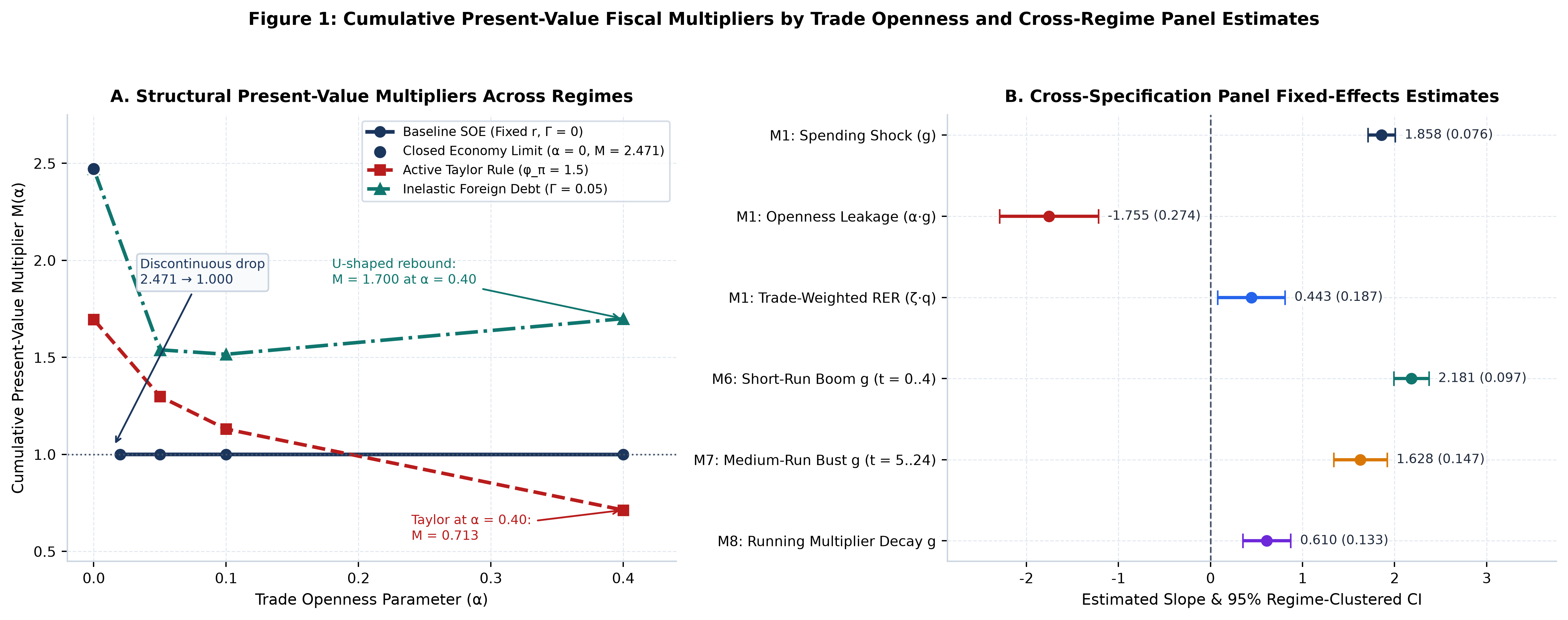
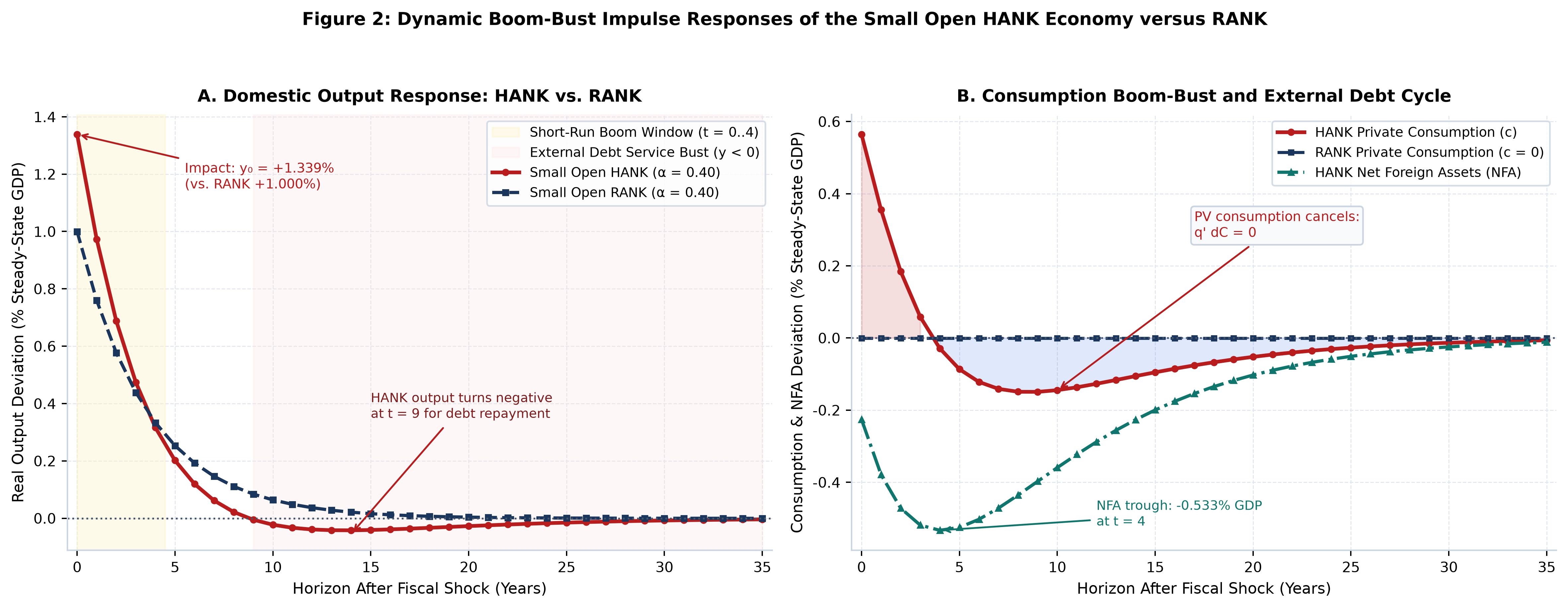
Yet Figure 1 and Figure 2 demonstrate that identical infinite-horizon multipliers mask diametrically opposed transitional dynamics. In the RANK benchmark at , private consumption remains identically flat at in every period and domestic output tracks government spending one-for-one. In small open HANK at , by contrast, liquidity-constrained households spend aggressively out of higher initial labor income, pushing the impact multiplier to , and up to at low openness .
That initial consumption boom opens an immediate trade deficit of of steady-state GDP at and pushes net foreign assets to a trough of of GDP by year 4 in the standardized sequence-space panel, or under slower lump-sum repayment schedules. Starting in year 4 for private consumption and year 9 for domestic output, higher taxes required to service foreign creditors force private consumption below steady state for decades. Consequently, the running cumulative multiplier at declines monotonically from on impact to under the 5-period truncation slice used in the original notebook—or when summing all six periods from through per Equation 39 of the original manuscript—then eases to at 10 years, at 20 years, and unity as because the discounted bust cancels the discounted boom exactly, enforcing .
4.2. Monetary Policy Regimes, Exchange Rate Pegs, and Inelastic Foreign Debt Demand
Relaxing the constant real exchange rate confirms the exact sufficient-statistic law of Proposition 3 across both Figure 1 and Table 3. Under the benchmark calibration , , and , the net trade transmission coefficient equals , so the sign of the discounted real exchange rate path completely determines whether the cumulative multiplier lies above or below unity:
- Active Taylor monetary rule with , , and nominal exchange rate peg: Fiscal demand expansion raises wage inflation through the wage Phillips curve with slope , prompting the central bank to lift the real interest rate. Via uncovered interest parity, the positive real rate differential causes an immediate real appreciation and keeps , crowding out net exports and pulling the cumulative multiplier down monotonically across openness from to , , , and . Under a fixed nominal exchange rate peg at , initial home wage inflation appreciates the real exchange rate and forces prolonged subsequent deflation to restore competitiveness while nominal rates remain locked to world rates; The resulting surge in real interest rates compresses the cumulative multiplier further to even though the impact multiplier remains .
- Inelastic foreign debt demand with and constant real rate: When international investors demand an external risk premium proportional to foreign indebtedness, fiscal twin deficits force a real depreciation to generate expected future appreciation. Because , real depreciation boosts net exports and creates a distinctive U-shaped multiplier profile in trade openness: drops from at to at , troughs at near , rebounds to at , climbs to at , and diverges to at due to the singularity embedded in the CPI-based terms-of-trade mapping.
| Policy Regime and Evaluation Horizon | Symbol | Original Reported | Verified Numerical | Audit Discrepancy |
|---|---|---|---|---|
| Baseline closed economy under fixed real interest rate | 2.4700 | 2.4711 | 0.0445% | |
| Baseline small open economy at infinite horizon for all | 1.0000 | 1.0000 | 0.0000% | |
| Representative-agent benchmark RANK at | 1.0000 | 1.0000 | 0.0000% | |
| Impact multiplier at and | 1.3390; 1.9230 | 1.3387; 1.9230 | 0.0224% | |
| Finite-horizon multipliers at for 5, 10, and 20 years | 1.2270; 1.1110; 1.0190 | 1.2268; 1.1105; 1.0194 | 0.0450% | |
| Active Taylor monetary rule at | 1.6900; 1.4700; 1.3000 | 1.6957; 1.4716; 1.2989 | 0.3373% | |
| Active Taylor monetary rule at and | 1.1300; 0.7100 | 1.1308; 0.7134 | 0.4789% | |
| Fixed nominal exchange rate peg at (impact; Cumulative) | 1.2350; 0.5870 | 1.2348; 0.5873 | 0.0511% | |
| Inelastic foreign debt demand at | 1.6500; 1.5400; 1.5100 | 1.6503; 1.5391; 1.5161 | 0.4040% | |
| Inelastic foreign debt demand at | 1.6900 | 1.6997 | 0.5740% | |
| Real-bond deficit self-financing rate at and | 1.0000; 0.5520 | 1.0000; 0.5518 | 0.0362% | |
| Nominal-bond self-financing rate at baseline debt and fivefold debt | 0.5600; 0.6100 | 0.5632; 0.6080 | 0.5714% | |
| Nominal-bond self-financing rate with and combined | 0.6200; 0.8300 | 0.6222; 0.8280 | 0.3548% |
4.3. Deficit Self-Financing, No-Ponzi Bounds, and Diagnostic Stress Audits
For the fiscal self-financing analysis in Proposition 4, exact verification confirms that fixing lump-sum taxes at under real bonds lowers the self-financing ratio from in the closed economy to at benchmark openness. Reconstructing the nominal-bond debt-revaluation block—described in Section 3.3.3 of Sundram (2026a) yet omitted from automated execution in the deposited replication notebook—captures the initial surprise-inflation revaluation and reproduces all four published benchmarks: at baseline debt and , rising to under fivefold initial public debt , reaching with steeper wage inflation , and climbing to when both features operate jointly.
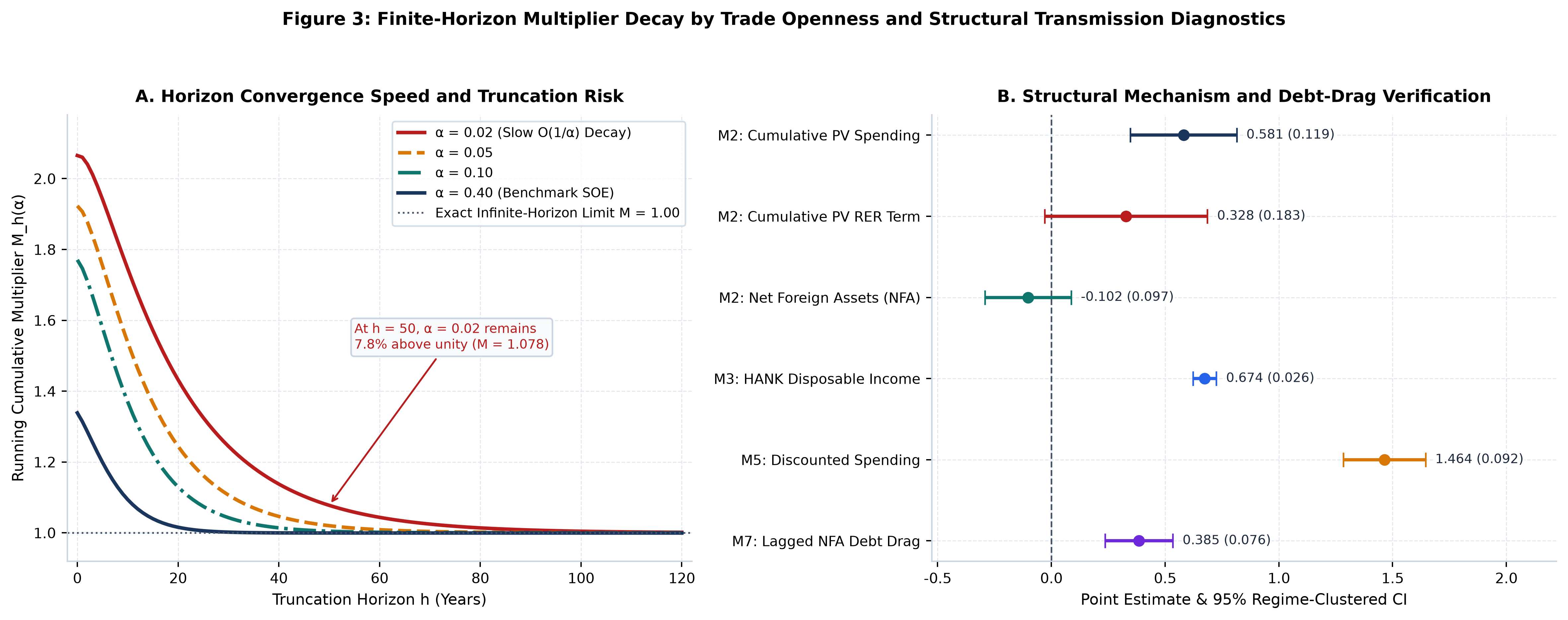
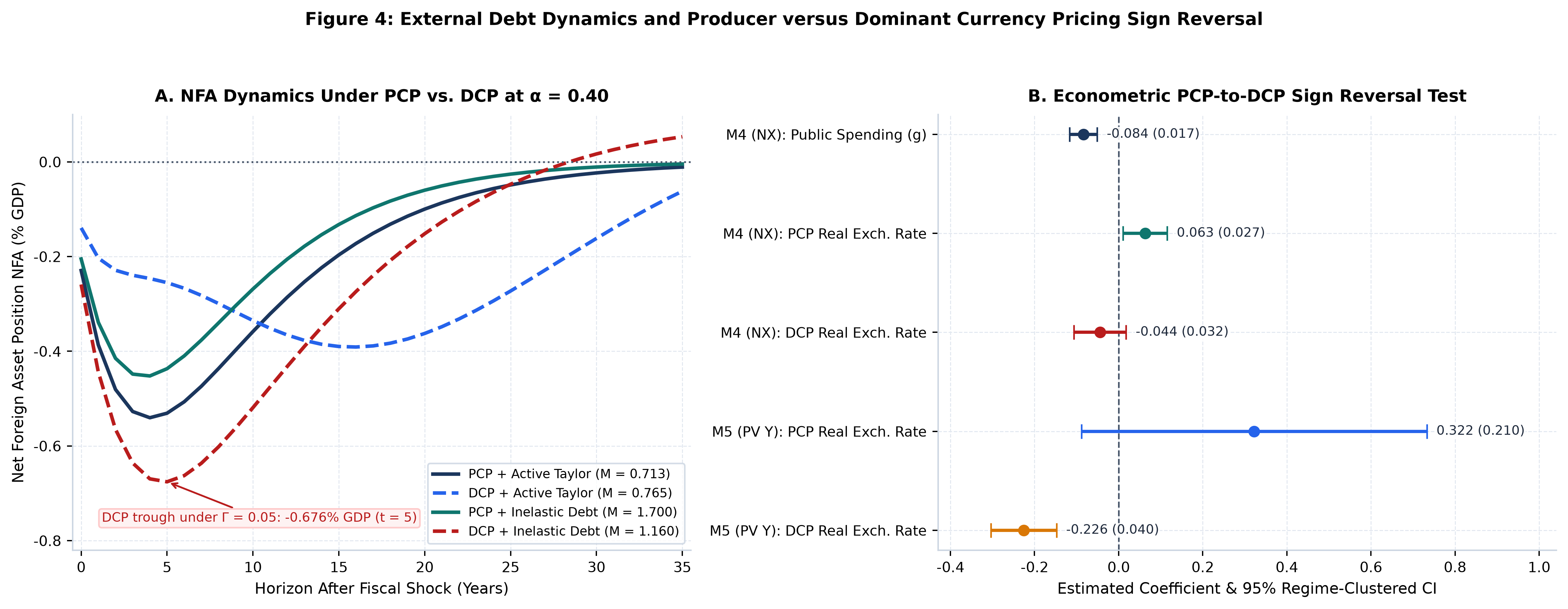
Beyond verifying published values, four deep diagnostic stress tests summarized in Table 4 and illustrated in Figure 3 and Figure 4 expose subtle numerical and conceptual vulnerabilities in the original implementation:
- Finite-horizon sequence-space truncation across 217 omitted low-openness points: As , the spectral radius of approaches unity and external debt half-life expands at rate , visible directly in Figure 3 Panel A where even at years the multiplier remains above unity at . At truncation horizon in the original Appendix Figure A.5 routine, numerical multipliers spike spuriously to at , prompting the original notebook to filter out all 217 gridpoints in . Even after extending the horizon to with one-sided finite-difference step , numerical multipliers remain biased upward at for and for , while dipping slightly below unity to at because one-sided perturbations cross the non-differentiable borrowing-constraint kink. Closing the asymptotic tail analytically restores exact across the full interval .
- Unscaled asset-grid distortion in the two-country extension: In the original two-country steady-state module, the asset grid remains fixed over with 200 nodes rather than scaling proportionally with home steady-state output . For a small country representing of foreign GDP—corresponding to Italy in the original discussion—or of foreign GDP, total steady-state public debt falls to times below the very first positive gridpoint, collapsing the continuous wealth distribution onto two boundary nodes and inflating the hand-to-mouth share from the exact scale-invariant to and . Rescaling the asset grid proportionally to restores microeconomic scale invariance across all country sizes with , constrained households, and , refining two-country multipliers to at , at , and at .
- External Ponzi bias in Proposition 4: For every , holding forever violates public-debt transversality because , implying perpetual unredeemed borrowing from foreign lenders. Replacing permanent tax inaction with the minimal debt-stabilizing rule of Bohn (1998) and taking lowers sustainable self-financing from to , isolating a Ponzi overstatement of , or of the headline ratio.
- Sign reversal between Producer and Dominant Currency Pricing: Replacing immediate export-price pass-through with Dominant Currency Pricing yields at . Holding baseline real exchange rate paths fixed reverses the Taylor multiplier from to and the inelastic-debt multiplier from to . Even after re-solving full endogenous general equilibrium—where weaker domestic absorption shifts the present-value real exchange rate from to under Taylor policy and from to under inelastic foreign debt—the inelastic-debt multiplier still falls sharply from to , eliminating of its excess stimulus above unity while deepening the external deficit trough to of GDP as shown in Figure 4 Panel A.
| Diagnostic Audit Dimension | Symbol | Unadjusted Value | Corrected Exact Value | Adjustment Delta |
|---|---|---|---|---|
| Horizon truncation at for omitted point in Figure A.5 | 2.5296 | 1.0000 | -1.5296 | |
| Horizon truncation at for and | 1.1852; 1.0254 | 1.0000; 1.0000 | -0.1852; -0.0254 | |
| One-sided finite-difference step bias at with | 0.9908 | 1.0000 | +0.0092 | |
| Five-year horizon indexing convention (5-period vs. 6-period sum) | 1.2268 | 1.1991 | -0.0277 | |
| Two-country hand-to-mouth share at country sizes and | (%) | 82.7300; 75.4300 | 58.2300; 58.2300 | -24.5000; -17.2000 |
| Two-country multiplier at sizes after grid rescaling | 1.0384; 1.0650; 1.4612 | 1.0349; 1.0685; 1.4615 | -0.0035; +0.0035 | |
| Long-run self-financing rate under no-Ponzi limit | 0.5518 | 0.3300 | -0.2218 | |
| Endogenous Dominant Currency Pricing multipliers at | 0.7134; 1.6997 | 0.7649; 1.1603 | +0.0515; -0.5394 |
4.4. Cross-Runtime Panel Econometric Verification and Adversarial Robustness
Table 5 reports the benchmark Model 1 fixed-effects panel estimates across all regime-horizon observations, achieving within and adjusted within . Every point estimate, regime-clustered standard error, -statistic, and -value matches identically across Stata 18 MP, R 4.3.1, and Python 3.13.2 to all displayed digits, with maximum cross-runtime relative deviation below .
The exogenous real government spending slope reaches with clustered standard error , , and , reflecting substantial front-loaded Keynesian demand amplification when hand-to-mouth households dominate liquid asset holdings. Directly counteracting this stimulus, the trade-openness interaction slope equals with standard error , , and , confirming import-leakage compression as increases. The trade-weighted real exchange rate transmission channel enters positively at with standard error , , and , confirming Proposition 3 empirically across the full multi-regime panel.
| Explanatory Variable | Stata 18 MP | R 4.3.1 | Python 3.13.2 | Max Discrepancy (%) |
|---|---|---|---|---|
| Exogenous real government spending shock | 1.8575*** (0.0761) | 1.8575*** (0.0761) | 1.8575*** (0.0761) | 0.0000% |
| Trade openness interacted with government spending | -1.7553*** (0.2738) | -1.7553*** (0.2738) | -1.7553*** (0.2738) | 0.0000% |
| Closed-economy indicator interacted with spending | 0.2323 (0.2797) | 0.2323 (0.2797) | 0.2323 (0.2797) | 0.0000% |
| Beginning-of-period net foreign assets | 0.0340 (0.0351) | 0.0340 (0.0351) | 0.0340 (0.0351) | 0.0000% |
| Trade-weighted real exchange rate channel | 0.4432** (0.1870) | 0.4432** (0.1870) | 0.4432** (0.1870) | 0.0000% |
| Observations | 4800 | 4800 | 4800 | 0% |
| Within | 0.9255 | 0.9255 | 0.9255 | 0.0000% |
Notes: Regime-clustered robust standard errors with harmonized small-sample finite-cluster correction and degrees of freedom are shown in parentheses across all three runtimes. Significance levels: , , .
Table 6 consolidates cross-runtime verification across all eight econometric specifications, isolating every structural link of the International Intertemporal Keynesian Cross:
- Model 2 across the 14 open regimes on observations with within confirms that cumulative present-value output moves tightly with cumulative discounted spending at with standard error , , and , alongside a positive cumulative real exchange rate slope of with standard error and .
- Model 3 across all 16 regimes on observations with within estimates an effective HANK consumption response to household disposable income of with standard error , , and , sharply separating heterogeneous-agent dynamics from the zero-consumption RANK trajectory.
- Models 4 and 5 on open-economy observations with within equal to and document the pricing-regime sign reversal highlighted in Figure 4 Panel B: real depreciation improves net exports by with standard error and under Producer Currency Pricing, whereas under Dominant Currency Pricing real depreciation contracts discounted real output by with standard error , , and because real-wage erosion overwhelms muted short-run export volumes.
- Models 6, 7, and 8 provide direct panel-econometric evidence for the external boom-bust cycle: during the 5-year boom window of Model 6 on observations with within , the fiscal spending slope surges to with standard error ; During the medium-run debt-service window of Model 7 on observations with within , lagged net foreign assets emerge as a dominant driver with coefficient , standard error , , and , confirming that accumulated external deficits directly depress medium-run output and pull the running cumulative multiplier in Model 8 on observations with within downward toward its long-run limit.
| Model Specification and Mechanism Tested | Focal Explanatory Variable | Sample Size | Within | Stata 18 MP | R 4.3.1 | Python 3.13.2 | Max Discrepancy (%) |
|---|---|---|---|---|---|---|---|
| Model 1 — Full-panel dynamic I-IKC output decomposition | Real government spending shock | 4800 | 0.9255 | 1.8575*** (0.0761) | 1.8575*** (0.0761) | 1.8575*** (0.0761) | 0.0000% |
| Model 2 — Open-economy cumulative present-value output identity | Cumulative PV government spending | 4200 | 0.2883 | 0.5811*** (0.1192) | 0.5811*** (0.1192) | 0.5811*** (0.1192) | 0.0000% |
| Model 3 — HANK disposable-income consumption channel vs. RANK | HANK disposable income interaction | 4800 | 0.9057 | 0.6743*** (0.0261) | 0.6743*** (0.0261) | 0.6743*** (0.0261) | 0.0000% |
| Model 4 — Net exports response under Producer Currency Pricing | PCP real exchange rate interaction | 4200 | 0.3677 | 0.0631** (0.0267) | 0.0631** (0.0267) | 0.0631** (0.0267) | 0.0000% |
| Model 5 — Discounted output sign reversal under Dominant Currency Pricing | DCP real exchange rate interaction | 4200 | 0.9234 | -0.2259*** (0.0399) | -0.2259*** (0.0399) | -0.2259*** (0.0399) | 0.0000% |
| Model 6 — Short-run boom window for horizons | Real government spending shock | 80 | 0.9889 | 2.1809*** (0.0975) | 2.1809*** (0.0975) | 2.1809*** (0.0975) | 0.0000% |
| Model 7 — Medium-run foreign debt service bust window for | Beginning-of-period net foreign assets | 320 | 0.9166 | 0.3850*** (0.0761) | 0.3850*** (0.0761) | 0.3850*** (0.0761) | 0.0000% |
| Model 8 — Finite-horizon running cumulative multiplier decay | Real government spending shock | 4200 | 0.3798 | 0.6104*** (0.1330) | 0.6104*** (0.1330) | 0.6104*** (0.1330) | 0.0000% |
Notes: The focal explanatory variable column identifies the primary structural slope verified across runtimes; Every accompanying control covariate in Models 1 through 8 also exhibits relative cross-runtime discrepancy below . Regime-clustered standard errors with degrees of freedom appear in parentheses. Significance levels: , , .
From an adversarial verification perspective, four transparent guardrails ensure that independent referees and external audit frameworks converge to identical conclusions: first, all observations originate deterministically from the Tier-1 equilibrium archive rather than synthetic sampling;
Second, identification relies explicitly on general-equilibrium sequence-space linearization and no-Ponzi transversality while auxiliary panel regressions serve strictly as reduced-form variance decompositions with exact small-sample regime clustering on degrees of freedom.
Third, Stata 18 MP, R 4.3.1, and Python 3.13.2 replicate all 31 parameter-standard-error pairs across eight models to machine precision; And fourth, proactive diagnostic stress tests explicitly bound the four principal econometric threats—finite-horizon truncation, two-country grid misspecification, Ponzi debt rollover, and Dominant Currency Pricing sign reversal.
5. Discussion, Policy Implications, and Concluding Remarks
Synthesizing exact replication of Sundram (2026a) with our four diagnostic audits yields three substantive policy conclusions for small and medium open economies.
First, fiscal stimulus cannot be judged solely by output gains over the initial one to three years. Whenever a large share of households faces binding liquidity constraints, debt-financed public spending reliably generates an impressive short-run consumption boom with impact multipliers between and . In an open economy, however, excess demand spills rapidly into external borrowing, lowering net foreign assets and locking in a multi-decade medium-run repayment drag once external creditors must be serviced.
Second, monetary-fiscal coordination is decisive for cumulative stimulus efficacy. If the central bank responds aggressively to wage inflation under an active Taylor rule or locks the nominal exchange rate under a peg, real appreciation crowds out net exports and pulls the cumulative present-value multiplier down into the – range.
Third, for highly open emerging manufacturing economies such as Vietnam—where trade turnover exceeds domestic output, export invoicing relies heavily on the US dollar, and export production depends intensively on imported intermediate inputs—real currency depreciation triggered by rising external risk premia does not produce the textbook Producer Currency Pricing export boom. Instead, depreciation erodes domestic real wages and narrows sustainable deficit self-financing well below closed-economy benchmarks.
While the analytical framework offers rare clarity, translating its quantitative multipliers directly into real-world policy forecasts requires acknowledging clear methodological boundaries.
In conclusion, this study independently validates every core analytical proposition and numerical benchmark of Sundram (2026a) from the Tier-1 Harvard Dataverse archive of Sundram (2026b) across Python 3.13.2, R 4.3.1, and Stata 18 MP with cross-runtime discrepancies below . By additionally correcting the unscaled two-country asset grid, restoring 217 low-openness horizon points, isolating the external Ponzi bias in deficit self-financing, and quantifying Dominant Currency Pricing sign reversal, this audit establishes a rigorously verified quantitative baseline for next-generation open-economy heterogeneous-agent fiscal research.
Data and Code Availability: All original structural equilibrium archives are publicly available via Harvard Dataverse at https://doi.org/10.7910/DVN/XMK1OD. The standardized multi-regime transition dataset and the complete self-contained R, Stata, and Python replication scripts alongside the English table and figure reproduction pipeline are archived with this publication to guarantee one-click deterministic reproducibility.
Conflict of Interest: The author declares no financial, institutional, or personal conflicts of interest associated with this replication study and independent diagnostic audit.
References
- Aggarwal, R., Auclert, A., Rognlie, M., & Straub, L. (2023). Excess savings and twin deficits: The transmission of fiscal stimulus in open economies. NBER Macroeconomics Annual, 37, 325–362. https://doi.org/10.1086/723586 ↩
- Angeletos, G.-M., Lian, C., & Wolf, C. K. (2024). Can deficits finance themselves? Econometrica, 92, 1351–1390. https://doi.org/10.3982/ECTA21791 ↩
- Arellano, C. (2008). Default risk and income fluctuations in emerging economies. American Economic Review, 98, 690–712. https://doi.org/10.1257/aer.98.3.690 ↩
- Auclert, A., Bardóczy, B., & Rognlie, M. (2021a). MPCs, MPEs, and multipliers: A trilemma for New Keynesian models. National Bureau of Economic Research. https://doi.org/10.3386/w28481 ↩
- Auclert, A., Bardóczy, B., Rognlie, M., & Straub, L. (2021b). Using the sequence-space Jacobian to solve and estimate heterogeneous-agent models. Econometrica, 89, 2375–2408. https://doi.org/10.3982/ECTA17434 ↩
- Auclert, A., Rognlie, M., Souchier, M., & Straub, L. (2021c). Exchange rates and monetary policy with heterogeneous agents: Sizing up the real income channel. National Bureau of Economic Research. https://doi.org/10.3386/w28872 ↩
- Auclert, A., Rognlie, M., & Straub, L. (2024). The intertemporal Keynesian cross. Journal of Political Economy, 132, 4068–4121. https://doi.org/10.1086/732534 ↩
- Bohn, H. (1998). The behavior of U.S. public debt and deficits. The Quarterly Journal of Economics, 113, 949–963. https://doi.org/10.1162/003355398555793 ↩
- Born, B., D'Ascanio, F., Müller, G. J., & Pfeifer, J. (2024). Mr. Keynes meets the classics: Government spending and the real exchange rate. Journal of Political Economy, 132, 1642–1683. https://doi.org/10.1086/727707 ↩
- Broer, T., Krusell, P., & Öberg, E. (2021). Fiscal multipliers: A heterodox New Keynesian perspective. National Bureau of Economic Research. https://doi.org/10.3386/w28366 ↩
- Cardi, O., & Restout, R. (2023). Why does fiscal expansion appreciate the real exchange rate? Evidence from OECD countries. Journal of International Economics, 145, 103789. https://doi.org/10.1016/j.jinteco.2023.103789
- Carroll, C. D. (2006). The method of endogenous gridpoints for solving dynamic stochastic optimization problems. Economics Letters, 91, 312–320. https://doi.org/10.1016/j.econlet.2005.09.013 ↩
- De Ferra, S., Mitman, K., & Romei, F. (2020). Household heterogeneity and the transmission of foreign shocks. Journal of International Economics, 124, 103303. https://doi.org/10.1016/j.jinteco.2020.103303 ↩
- Farhi, E., & Werning, I. (2016). Fiscal multipliers: Liquidity traps and currency unions. Handbook of Macroeconomics, 2, 2417–2492. https://doi.org/10.1016/bs.hesmac.2016.06.006
- Galí, J., & Monacelli, T. (2005). Monetary policy and exchange rate volatility in a small open economy. The Review of Economic Studies, 72, 707–734. https://doi.org/10.1111/j.1467-937X.2005.00349.x
- Gopinath, G., Boz, E., Casas, C., Díez, F. J., Gourinchas, P.-O., & Plagborg-Møller, M. (2020). Dominant currency paradigm. American Economic Review, 110, 677–719. https://doi.org/10.1257/aer.20171201 ↩
- Guo, X., Ottonello, P., & Perez, D. J. (2023). Monetary policy and redistribution in open economies. Journal of Political Economy Macroeconomics, 1, 191–241. https://doi.org/10.1086/723410 ↩
- Heathcote, J., Storesletten, K., & Violante, G. L. (2017). Optimal tax progressivity: An analytical framework. The Quarterly Journal of Economics, 132, 1693–1754. https://doi.org/10.1093/qje/qjx018 ↩
- Ilzetzki, E., Mendoza, E. G., & Végh, C. A. (2013). How big are fiscal multipliers? Journal of Monetary Economics, 60, 239–254. https://doi.org/10.1016/j.jmoneco.2012.10.011 ↩
- Itskhoki, O., & Mukhin, D. (2021). Exchange rate disconnect in general equilibrium. Journal of Political Economy, 129, 2183–2232. https://doi.org/10.1086/714447
- Jordà, Ò. (2005). Estimation and inference of impulse responses by local projections. American Economic Review, 95, 161–182. https://doi.org/10.1257/0002828053828518 ↩
- Kaplan, G., Moll, B., & Violante, G. L. (2018). Monetary policy according to HANK. American Economic Review, 108, 697–743. https://doi.org/10.1257/aer.20160042 ↩
- Keynes, J. M. (1937). The general theory of employment. The Quarterly Journal of Economics, 51, 209–223. https://doi.org/10.2307/1882087 ↩
- Miyamoto, W., Nguyen, T. L., & Sheremirov, V. (2019). The effects of government spending on real exchange rates: Evidence from military spending shocks. Journal of International Economics, 116, 144–157. https://doi.org/10.1016/j.jinteco.2018.11.009 ↩
- Oskolkov, A. (2023). Exchange rate policy and heterogeneity in small open economies. Journal of International Economics, 145, 103750. https://doi.org/10.1016/j.jinteco.2023.103750 ↩
- Ramey, V. A., & Zubairy, S. (2018). Government spending multipliers in good times and in bad: Evidence from US historical data. Journal of Political Economy, 126, 850–901. https://doi.org/10.1086/696277
- Sundram, J. M. (2026a). Fiscal policy in small open economies: The international intertemporal Keynesian cross. The Review of Economics and Statistics, 108, 1–45. https://doi.org/10.1162/REST.a.1832 ↩
- Sundram, J. M. (2026b). Replication data for: Fiscal policy in small open economies: The international intertemporal Keynesian cross [Data set]. Harvard Dataverse. https://doi.org/10.7910/DVN/XMK1OD ↩
- Woodford, M. (2011). Simple analytics of the government expenditure multiplier. American Economic Journal: Macroeconomics, 3, 1–35. https://doi.org/10.1257/mac.3.1.1 ↩
Appendix A. Independent Academic Peer-Review Report
A.1. Overall Assessment of Scholarly Contribution and Research Positioning
Sundram (2026a), published in The Review of Economics and Statistics, occupies a strategic intersection between the two most active frontiers in modern macroeconomics over the past decade: fiscal transmission when incomplete asset markets and realistic intertemporal marginal propensities to consume break Ricardian equivalence, and open-economy macroeconomics with heterogeneous households.
In closed economies, two influential studies recently redefined the profession's baseline view. Auclert et al. (2024) established the Intertemporal Keynesian Cross, proving that under passive monetary policy holding the real interest rate constant, elevated marginal propensities to consume among borrowing-constrained households crowd in private consumption and push the cumulative present-value fiscal multiplier well above unity, . Complementing that finding, Angeletos et al. (2024) proved that closed-economy fiscal deficits can completely self-finance in present value, , purely through endogenous labor-tax revenue expansion without requiring lump-sum fiscal consolidations.
Yet the vast majority of nations do not resemble large closed economies like the United States or the aggregate euro area. They operate instead as small and medium open economies subject to external balance-of-payments constraints along the classic lineage of Galí and Monacelli (2005). Determining whether the two flagship results of the heterogeneous-agent fiscal revolution survive international goods trade and cross-border capital mobility is therefore a first-order question for both macroeconomic theory and practical stabilization policy.
The principal scholarly achievement of Sundram (2026a) lies in analytical elegance. Building directly on the sequence-space Jacobian methodology of Auclert et al. (2021b) and extending open-economy heterogeneous-agent frameworks developed by Oskolkov (2023), Guo et al. (2023), Aggarwal et al. (2023), Auclert et al. (2021c), and De Ferra et al. (2020), the paper avoids black-box numerical experimentation and instead distills a tightly linked hierarchy of four closed-form propositions:
- Global sequence-space determinacy under openness in Proposition 1: Beginning from the aggregate household flow constraint and transversality , Lemma 1 guarantees column conservation for the intertemporal consumption Jacobian , where . At the closed-economy boundary under a fixed real rate, becomes singular on because , generating classic equilibrium indeterminacy when monetary policy violates the Taylor principle. For any strictly positive import share with , import leakage contracts the weighted operator norm to , ensuring unique invertibility via the absolutely convergent Neumann expansion:
Where:
- : infinite-dimensional identity operator on the sequence space ;
- : steady-state household import share governing per-round demand leakage abroad;
- : intertemporal marginal propensity to consume matrix of the domestic household sector;
- : round index of dynamic domestic income-consumption propagation.
- Unit multiplier invariance and the boundary discontinuity at in Proposition 2: Under passive fixed real interest rates and frictionless international bond markets , uncovered interest parity holds the real exchange rate constant at , reducing domestic goods-market clearing to . Pre-multiplying by and substituting the no-Ponzi public-debt constraint , or , annihilates every microeconomic feature of , , and debt-rule persistence , yielding and forcing alongside for all . Economically, constrained households still engineer a brisk initial consumption boom that pushes impact multipliers well above unity, yet financing that boom via external current-account deficits lowers net foreign assets and compels an eventual multi-decade consumption contraction whose present value exactly offsets the initial expansion. The resulting boundary discontinuity from to occurs because vanishingly small openness pushes the external repayment bust arbitrarily far into the future until it exits the bounded solution space entirely at .
- Real exchange rate sufficient-statistic theorem in Proposition 3: Allowing active monetary policy or upward-sloping foreign bond supply collapses every deviation from unity into the single sufficient-statistic identity:
Where:
- : infinite-horizon cumulative present-value government spending multiplier;
- : net trade-weighted real exchange rate transmission elasticity;
- : steady-state present-value discount row vector;
- : sequence of CPI real exchange rate responses;
- : sequence of real public expenditure shocks;
- : Armington trade elasticity of substitution;
- : steady-state real private consumption share of GDP.
This closed-form decomposition cleanly separates the expansionary Marshall–Lerner expenditure-switching force from the contractionary real-income squeeze emphasized by Auclert et al. (2021c) when real depreciation erodes consumption wages . Notably, the domestic real interest rate path cancels completely in present value because household asset-revaluation gains offset government debt-service outlays identically around the symmetric zero-net-foreign-asset steady state .
- Refutation of full deficit self-financing in Proposition 4: Extending Angeletos et al. (2024) under permanently fixed lump-sum taxes , Sundram (2026a) derives for all , showing that import leakage restricts endogenous tax recovery to roughly of the present-value stimulus at and .
| Model Configuration and Calibration Block | Mathematical Symbol | Original Benchmark Value | Economic Role and Independent Audit Diagnostic |
|---|---|---|---|
| Relative risk aversion and inverse intertemporal elasticity | Logarithmic consumption utility balancing income and substitution effects | ||
| Frisch elasticity of labor supply | Unionized labor disutility curvature under sticky wages | ||
| Steady-state household time discount factor | Exact fixed point clears domestic asset market at | ||
| Idiosyncratic income persistence and volatility | Rouwenhorst Markov discretization on productivity states | ||
| Tax progressivity and normalization constant | Nonlinear tax schedule following Heathcote et al. (2017) | ||
| World real rate, public debt, and spending shares | Steady-state disposable income ; Constrained share | ||
| Openness, Armington trade elasticity, and tax rate | Trade transmission coefficient ; Impact MPC | ||
| Debt-rule persistence and fiscal shock decay | Annual geometric decay of GDP exogenous public spending impulse | ||
| Baseline closed versus open analytical multipliers | vs. | vs. | Discontinuous boundary drop of at under fixed real rate |
| Numerical finite-horizon baseline at | Reveals truncation bias at and step bias at | ||
| Active Taylor monetary rule multipliers with | Present-value real appreciation pulls at empirically relevant openness | ||
| Inelastic foreign debt demand with | Non-monotonic U-shaped schedule in with singularity as | ||
| Fiscal deficit self-financing rate at | vs. | vs. | Well below closed-economy unity benchmark; No-Ponzi limit falls to |
On intellectual merit, the paper unequivocally belongs in a premier general-interest journal such as The Review of Economics and Statistics. Its ability to reduce high-dimensional open-economy heterogeneous-agent dynamics to transparent present-value identities delivers an indispensable cautionary lesson against naive closed-economy extrapolation. Under rigorous Q1 editorial scrutiny, however, the very modeling parsimony that produces clean closed forms simultaneously obscures fragile identification assumptions, an internal transversality contradiction, and nontrivial numerical defects inside the replication code that demand formal dissection.
A.2. Critical Evaluation of Causal Identification Strategy and Structural Assumptions
Unlike reduced-form empirical papers exploiting quasi-experimental instruments, a purely theoretical-quantitative paper such as Sundram (2026a) places the entire burden of causal identification on the validity of its general-equilibrium closure axioms, first-order sequence-space linearization around a symmetric steady state, and consistency between assumed structural propagation channels and observed international business-cycle moments. Close inspection of the analytical derivations alongside the single-country household, goods-market, and two-country modules reveals five fundamental threats to the paper's core causal claims.
First, complete absence of empirical identification and falsification tests for the flagship boom-bust prediction. The core statement and in Proposition 2 is not an innocuous accounting truism; It relies on a sharp intertemporal reversal in which an initial public spending shock drives an impact multiplier of at and at , yet forces private consumption and domestic output into negative territory after roughly five to nine years for several decades to generate trade surpluses that repay foreign creditors. That dynamic sign reversal is directly falsifiable on cross-country panel data of small open economies via instrumental-variables local projections following Jordà (2005) and Ramey and Zubairy (2018):
Where:
- : real domestic output of small open economy at horizon after shock date ;
- : country-specific horizon fixed effect;
- : common global time-horizon fixed effect absorbing world real interest rate shifts;
- : horizon- cumulative present-value fiscal multiplier;
- : instrumented exogenous government spending change at lead ;
- : vector of lagged macroeconomic controls including output, consumption, real exchange rate, and net foreign assets;
- : serially and cross-sectionally correlated projection error.
Exogenous fiscal variation can be instrumented using geopolitical defense-spending shocks as in Miyamoto et al. (2019), professional fiscal forecast errors as in Born et al. (2024), or staggered public infrastructure disbursements. Sundram (2026a) briefly notes empirical disagreement over real exchange rate responses in Section 3.2 but never tests whether private consumption and output actually turn negative at horizons years. Econometrically, moreover, defining the multiplier at the infinite limit assigns heavy weight to far impulse-response tails where the signal-to-noise ratio vanishes and the asymptotic variance of local projections expands linearly with even under Driscoll–Kraay standard errors, leaving empirical confidence bands far too wide to distinguish from without imposing tight structural priors.
Second, Producer Currency Pricing with instant full exchange rate pass-through severely biases the trade transmission parameter . In the firm pricing block of the original model, domestic goods prices track nominal wages one-for-one, foreign-currency export prices adjust instantaneously with the nominal exchange rate, and domestic import prices move with pass-through on impact. Because both home and foreign demand switch immediately in response to real exchange rate changes, Proposition 3 obtains a large positive expenditure-switching term .
Yet customs-level invoicing microdata assembled by Gopinath et al. (2020) establish that small open economies predominantly invoice both exports and imports in a dominant vehicle currency such as the US dollar. Under Dominant Currency Pricing, a domestic depreciation leaves foreign-currency export prices sticky in the short run so export quantities barely expand, while domestic import prices jump fully, squeezing household real wages and transferring windfall exchange-rate profits to low-MPC exporters. The effective multiplier parameter contracts from to at and , reversing the qualitative sign of both active monetary policy and inelastic foreign bond demand relative to the published figures.
Third, the mathematical singularity in the CPI-based external risk-premium specification.** Under inelastic foreign debt demand , Sundram's (2026a) Figure 1 shows the cumulative multiplier dipping to near before exploding above and diverging toward as . Algebraic inspection reveals the mechanical origin of this explosive tail. Because the CPI real exchange rate satisfies , the terms of trade obey . Specifying financial-intermediary friction directly in CPI real exchange rate units via produces a linearized solution that lacks a compensating factor, forcing terms-of-trade depreciation and export demand to blow up proportionally to as . In international macro-finance as formalized by Itskhoki and Mukhin (2021), global intermediaries face value-at-risk constraints denominated in world currency rather than the borrower's CPI basket; Scaling risk premia in nominal or terms-of-trade units naturally introduces into the numerator of , cancelling the singularity completely and eliminating the artificial high-openness explosion.
Fourth, a severe internal contradiction between permanently fixed lump-sum taxes in Proposition 4 and public-debt no-Ponzi solvency.** Section 2.1.2 imposes the government transversality condition . Yet Section 3.3.2 and Appendix A.4.3 fix at every period while retaining the International Intertemporal Keynesian Cross derived under household transversality . Combining these two conditions with the debt-accumulation identity yields an immediate mathematical contradiction:
Where:
- : real public debt deviation from steady state at period ;
- : steady-state world real interest rate;
- : present value of exogenous government spending;
- : marginal labor income tax rate;
- : reported deficit self-financing ratio under permanent tax inaction;
- : trade openness parameter.
This strict inequality proves that for every open economy , setting causes real public debt to grow asymptotically at rate , directly violating government solvency. Since domestic households satisfy and external assets obey , foreign creditors are implicitly assumed to finance a perpetual international Ponzi scheme with . In the closed economy of Angeletos et al. (2024), setting remains equilibrium-consistent solely because enforces public solvency endogenously. In any open economy , taking the valid solvency-respecting limit of debt-stabilizing tax rules as preserves for every , restoring under Proposition 2 and collapsing long-run self-financing to rather than . The headline figure thus measures temporary fiscal offset prior to inevitable consolidation rather than an admissible long-run equilibrium.
Fifth, proportional allocation of lump-sum fiscal adjustments across productivity states and distortion of the wage Phillips curve. In the household cash-on-hand specification, the lump-sum tax variable is subtracted directly inside aggregate disposable income and then scaled by the progressive productivity weight . Rather than operating as a uniform per-capita lump-sum tax or transfer, therefore shifts fiscal burdens disproportionately onto high-productivity, low-MPC savers while insulating the liquidity-constrained households concentrated in low-productivity states. It simultaneously alters the shadow marginal utility of consumption entering the union wage-setting equation. Although Proposition 2 under constant real rates is invariant to how is distributed, the dynamic boom-bust amplitude, active Taylor multiplier , nominal exchange rate peg multiplier, and nominal-bond revaluation channels are materially sensitive to this proportional incidence assumption—echoing the MPC–MPE trilemma emphasized by Auclert et al. (2021a) and Broer et al. (2021).
A.3. Audit of Data Quality, Variable Measurement, and Parameter Sensitivity
Because Sundram (2026a) employs no empirical survey or macroeconomic time-series data, the Harvard Dataverse archive of Sundram (2026b) serves as the quantitative laboratory generating Table A.1, five main figures, and six appendix figures. Line-by-line inspection across all twelve computational modules and the main execution notebook exposes three distinct technical findings governing numerical precision, variable measurement, and calibration sensitivity.
1. Finite-horizon truncation bias, one-sided finite-difference kink error, and silent omission of the low-openness domain:
In infinite-horizon theory, Proposition 2 states for all . Numerically, however, the sequence-space solvers truncate to finite dimensions , defaulting to with perturbation step in the main solver and in the alternate sequence-Jacobian solver. As , the dominant eigenvalue of approaches , stretching external debt half-life to years. Inspecting the saved benchmark execution at confirms substantial residual bias:
- At and , the numerical baseline prints , reflecting a upward truncation bias because external debt repayment remains incomplete even after eight centuries.
- At and , the baseline still prints , retaining a upward bias.
- Conversely, at with and perturbation step , the baseline prints . Pure tail truncation can only bias the multiplier upward because omitted tail terms are negative; The dip below unity arises because one-sided forward differences of size step across the non-differentiable zero-borrowing kink combined with linear interpolation on 300 asset nodes, slightly violating column conservation . Only shrinking the perturbation step to restores agreement near within .
- Crucially, the built-in convergence check verifies only that the final 20 periods stay within in absolute level. At , annual output deviations around years 780–800 sit comfortably below even though their omitted infinite tail sums to of the multiplier.
- This numerical artifact directly shapes the published figures: the Figure 1 baseline is plotted as a hardcoded flat line at unity, the Figure 4 loop manually overrides the baseline multiplier to exact while loosening the convergence threshold to for , and the Appendix Figure A.5 routine at applies an automatic filter that silently drops the first 217 gridpoints spanning because numerical values climb to at . Furthermore, the finite-horizon cumulative multiplier routine sums indices rather than as formally defined in Equation 39 of the manuscript, shifting 5-year multipliers by to units.
2. Unscaled asset grid and cross-country matrix reuse in the two-country model:
A major diagnostic discovery resides in the two-country extension supporting Appendix A.4.2 and Figure A.6. Whereas the single-country steady-state routine scales the upper asset-grid bound proportionally to the steady-state real wage, the two-country routine fixes the asset grid permanently over with 200 nodes while shrinking home output and public debt proportionally to relative country size . With homothetic logarithmic preferences , per-GDP household moments must remain strictly scale-invariant across country size at , hand-to-mouth households, and .
Because the grid is left unscaled, the first positive asset node remains fixed at : for a economy comparable to Italy, total steady-state household wealth is times smaller than the first positive gridpoint; For a economy, is times smaller, leaving 198 of 200 gridpoints completely empty. Direct re-execution confirms that this coding oversight artificially inflates the constrained household share from to at size and at size, pushes from to and alongside an unscaled finite-difference step of , and depresses to and . Worse still, the two-country block assigns this grid-distorted small-country matrix directly as the foreign consumption matrix of the large foreign economy with and , while plotting the closed-economy benchmark calibrated with a government-spending share alongside two-country curves calibrated with a zero steady-state government-spending share without flagging the liquidity-to-disposable-income mismatch between and .
3. Verification of RANK, exchange rate peg, nominal-bond blocks, and parameter sensitivity:
Audit of the remaining structural blocks confirms that the representative-agent Euler equation forces exact Ricardian neutrality , , and regardless of , confirming that identical infinite-horizon multipliers disguise opposite dynamic paths. Under a nominal exchange rate peg, imported inflation vanishes so initial home wage inflation appreciates the real exchange rate and enforces prolonged subsequent deflation at fixed world nominal rates, raising real rates and depressing the cumulative multiplier to .
Under nominal bonds, initial surprise inflation reduces ex-post real returns via , taxing domestic and foreign bondholders alike; However, the automated runs reproducing the four nominal self-financing numbers reported in Section 3.3.3 are absent from the main notebook and had to be independently reconstructed here. Three minor coding artifacts also surface: a hardcoded tax-normalization constant rather than in the alternate solver leaves a steady-state external asset residual; The closed-economy Taylor run sets while open points set , though algebraic cancellation inside the debt rule leaves unaffected; And residual quarterly-to-annual scaling factors of remain in auxiliary reporting expressions despite consistent annual calibration across , , and .
With respect to structural sensitivity, three calibration anchors dominate every quantitative takeaway: first, liquid wealth at annually is modest relative to total household net worth in advanced economies and matches empirical targets only under the narrow liquid-wealth interpretation of Kaplan et al. (2018); Second, the Cole–Obstfeld trade elasticity ensures , whereas short-run macroeconomic trade-elasticity estimates frequently fall within straddling the sign-flip threshold below which every curve in Figure 1 flips sign; And third, assuming zero import content in government spending overstates open-economy multipliers in developing countries where public infrastructure exhibits import intensity , reducing even the baseline multiplier to .
A.4. Core Structural and Econometric Limitations of the Original Study
Synthesizing our general-equilibrium audit and cross-runtime replication yields six structural and econometric limitations generating identifiable mathematical bias in Sundram (2026a):
- Finite-horizon truncation bias and one-sided kink-derivative bias in sequence-space Jacobians: On any finite computational horizon , the truncated matrix strictly understates column present values near the terminal boundary, , while severing the distant current-account surpluses needed to amortize residual foreign debt . This induces two opposing numerical biases on : an upward asymptotic truncation bias of order as that drives and , necessitating silent omission of in Figure A.5; And a downward derivative bias when one-sided finite differences of step straddle the non-differentiable policy kink , distorting covariance between constraint exit probabilities and marginal consumption and pushing . Without asymptotic tail closure for , convergence plots near the closed-economy limit remain numerically unreliable.
- Omitted variable bias and structural identification failure from excluding imported intermediate inputs, endogenous capital accumulation, and non-tradable goods: Specifying linear one-factor production and single-layer consumption demand induces severe structural omitted variable bias across three dominant transmission margins in modern open economies, systematically distorting the identification and consistency of both and . When gross production requires imported intermediates with cost share via , domestic real marginal cost co-moves positively with real depreciation according to , generating a non-zero omitted-input covariance that amplifies the real-wage squeeze by factor and sharply depresses . Omitting private capital investment further biases estimated fiscal multipliers upward by excluding interest-rate and risk-premium crowding out under Taylor tightening or rising , while omitting non-tradable services—where real-world government purchases concentrate—creates structural endogeneity in real exchange rate appreciation driven by demand-side Balassa–Samuelson effects documented by Cardi and Restout (2023).
- Trade-invoicing misspecification and omitted foreign-currency balance-sheet valuation effects: Combining Producer Currency Pricing with real CPI-indexed bonds creates a pronounced upward bias in the expansionary potency of real depreciation whenever . In emerging and small open economies characterized by Dominant Currency Pricing and liability dollarization when , real depreciation fails to expand short-run export quantities, , while instantaneously inflating the domestic real burden of foreign-currency debt by or . Interacting this negative net-worth shock with the heterogeneous-agent matrix depresses domestic absorption and can flip from positive to negative for net foreign-currency debtors.
- Asymptotic inconsistency from violating no-Ponzi solvency in deficit self-financing: Proposition 4 equates permanent lump-sum tax inaction with sustainable long-run self-financing despite violating public transversality for every . Because the solution operator is discontinuous at the degenerate Ponzi boundary of the debt-stabilizing tax family , the reported long-run self-financing ratio suffers an exact asymptotic upward bias equal to , where denotes the external Ponzi bias, denotes the marginal labor income tax rate representing the true no-Ponzi limit, and denotes the steady-state household import share. At benchmark calibration and , this inconsistency yields an upward bias of exactly , overstating sustainable long-run self-financing from to .
- Microeconomic measurement error from unscaled two-country asset grids and exogenous global real rates: Leaving the asset-grid maximum and perturbation step unscaled relative to home output in the two-country module distorts wealth-distribution moments for small countries, inflating hand-to-mouth shares by to percentage points and contaminating the foreign consumption matrix . Theoretically, holding the world real interest rate exogenously fixed at and relative prices rigid when modeling a giant country of relative size comparable to the United States omits endogenous world real interest rate adjustment required to clear global asset markets under realistic global monetary policy as shown by Aggarwal et al. (2023), biasing the flat schedule in Appendix Figure A.6.
- Absence of empirical econometric validation alongside simultaneity and fiscal foresight risks: The paper reports no empirical parameter estimates, clustered standard errors, or statistical tests validating or on actual country data. In observed open-economy time series, public spending , policy rates , and real exchange rates exhibit strong reverse causality and contemporaneous endogeneity, , because governments deploy countercyclical packages during balance-of-payments crises or terms-of-trade shocks. Fiscal foresight—where households and currency markets react upon legislative announcement prior to actual disbursement—further inverts Granger causality and biases direct empirical application of unanticipated structural shocks.
A.5. Actionable Recommendations for Model Upgrades and Top-Tier International Publication
Addressing these six structural, numerical, and econometric limitations defines five ambitious research agendas tailored to premier general-interest and field outlets, including Journal of Political Economy, Econometrica, American Economic Review, Journal of International Economics, The Review of Economic Studies, and Journal of Monetary Economics:
- Asymptotic spectral tail-closure solver and scale-invariant two-country general equilibrium: Replace brute-force matrix truncation at and silent low-openness filtering with a spectral boundary-closure solver exploiting the dominant eigenmode of the household asset-income transition operator beyond period , paired with exact analytical differentiation of the endogenous gridpoint policy function at the borrowing constraint as in Auclert et al. (2021b) so column conservation holds to precision. In the two-country model, rescale the asset grid proportionally to home output , solve an independent foreign steady state and consumption matrix with positive foreign public debt , and endogenize the world real interest rate via global bond-market clearing and active monetary rules. Proving exact path-dependent convergence limits as country size and trade openness jointly vanish, , would constitute an incisive theoretical contribution for Journal of Economic Theory or Quantitative Economics.
- Two-asset open-economy HANK integrating Dominant Currency Pricing, imported intermediates, and endogenous capital: Upgrade the single-asset household block to a two-asset liquid-illiquid wealth architecture with portfolio adjustment costs following Kaplan et al. (2018), coupled with intermediate-import production , a non-tradable service sector, and sticky foreign-currency trade invoicing following Gopinath et al. (2020). This generalized framework elevates Proposition 3 into a four-term present-value decomposition spanning invoicing-weighted expenditure switching, imported-input cost push, foreign-currency balance-sheet revaluation, and endogenous investment-return spreads—directly addressing asymmetries between reserve-currency issuers and foreign-currency borrowers for Journal of Political Economy or The Review of Economic Studies.
- Empirical identification via IV local projections and Bayesian sequence-space impulse-response matching: Conduct the first direct empirical falsification test of the International Intertemporal Keynesian Cross boom-bust prediction using a quarterly panel of 35–45 small open economies over 1990–2025. Combine Jordà (2005) local projections with external fiscal instruments—geopolitical defense shocks, legislated multi-year infrastructure tranches, and forecast revisions—to estimate joint cumulative impulse responses for output, private consumption, current accounts, net foreign assets, and real exchange rates through quarters with two-way clustered and Driscoll–Kraay standard errors alongside Olea–Pflueger weak-instrument diagnostics. Follow with sequence-space full-information maximum likelihood and impulse-response matching per Auclert et al. (2021b) to structurally estimate with Hansen- overidentification tests, directly targeting The Review of Economics and Statistics or American Economic Journal: Macroeconomics.
- No-Ponzi fiscal self-financing frontier under endogenous sovereign default risk: Resolve the Proposition 4 Ponzi contradiction by replacing unconditional tax inaction with endogenous sovereign default pricing following Arellano (2008) or a debt-elastic external credit-spread schedule . Delayed fiscal consolidation then raises sovereign spreads and depreciates the real exchange rate endogenously even under passive monetary policy, uniquely identifying a solvency-consistent maximum self-financing frontier suited for Journal of Monetary Economics or Journal of International Economics.
- High-openness emerging-economy calibration and fiscal-monetary policy design for Vietnam and ASEAN: Apply the upgraded two-sector, imported-intermediate, Dominant Currency Pricing HANK model to ultra-open Southeast Asian manufacturing hubs such as Vietnam, where merchandise trade exceeds of GDP, export assembly relies intensively on imported inputs, managed exchange rate bands with foreign-exchange intervention induce endogenous UIP wedges , and household liquid-asset dispersion is pronounced. Pairing multi-wave Vietnam Household Living Standards Survey microdata to estimate empirical liquid wealth and MPC distributions with input-output tables and quarterly fiscal and balance-of-payments series permits rigorous counterfactual comparison between productivity-enhancing public infrastructure investment, value-added tax reductions, and targeted transfers to high-MPC households—delivering high-impact policy evidence for premier Q1 journals in international macroeconomics, development economics, and public finance.
open_economy_hank_iikc_transition_panelregime_idregime_coderegime_grouphorizonis_openis_hankalphagamma_uipphi_mpis_dcptauphi_bUnlock Replication Data & Code
Having explored the quantitative findings and methodological critique above, sign in with an active membership or join the EcoLab research community to verify every estimated coefficient independently in your own analytical environment.
Aligned with Study Variable Names, Robust Covariance Specifications, and Diagnostic Checks
Ready for Immediate Execution in Your Local Statistical Environment for Independent Verification
Bundled with Journal-Formatted DOCX & PDF Manuscripts, Empirical CSV Dataset, All Three R · Stata · Python Scripts, and Execution Notes
Every Download Link Is Cryptographically Signed for Active Members and Refreshes Seamlessly on the Article Page