Keywords: Fiscal Rules, Self-Enforcing Equilibrium, Deficit Bias, Public Debt Dynamics, Regime Switching, Quantile Regression, Cross-Platform Replication
JEL Classification: E62, H62, H63, D82, C73
1. Introduction and Institutional Context of Fiscal Discipline Cycles
Modern fiscal history across both advanced economies and emerging markets presents a persistent puzzle that canonical tax-smoothing benchmarks pioneered by Barro (1979) cannot fully rationalize. Rather than following a smooth deficit trajectory that responds linearly to transitory fluctuations in national income and public expenditure needs, sovereign states frequently traverse multi-decade cycles alternating between two sharply distinct budgetary regimes. During prolonged eras of fiscal discipline, governments adhere to explicit or implicit deficit ceilings and debt anchors, curbing current expenditure growth despite short-term political pressure.
Yet fiscal discipline rarely endures indefinitely: it tends to break down abruptly when an extreme spending shock—such as war, deep financial recession, or a public-health emergency—hits the economy. Equally striking from an institutional standpoint is that after protracted episodes of fiscal laxity and sustained deficit accumulation, a subsequent crisis often serves as the very catalyst that compels policymakers to restore budgetary restraint and re-enter a disciplined framework (Halac & Yared, 2025).
Positive political economy has built rigorous foundations to account for structural deficit bias in the public sector. Alesina and Tabellini (1990) show that electoral uncertainty and disagreement over spending priorities across alternating administrations induce incumbent policymakers to issue excessive public debt as a strategic device to constrain the fiscal space of future rivals. Battaglini and Coate (2008) develop a dynamic legislative bargaining model of public spending, taxation, and debt, demonstrating that distributive pork-barrel politics generates systemic budget deficits even under normal macroeconomic conditions.
Confronting the present bias of political decision-makers, mechanism design scholarship led by Amador et al. (2006) formalizes the classic trade-off between commitment and flexibility, establishing that optimal fiscal caps take a threshold form that restrains overspending during ordinary periods while preserving discretion during genuine emergencies. Extending this literature, Halac and Yared (2014) characterize optimal fiscal rules under persistent spending shocks, Azzimonti et al. (2016) quantify the welfare costs and benefits of balanced-budget rules inside a political economy environment, Halac and Yared (2018) analyze coordinated rules in an open world economy with endogenous global interest rates, and Halac and Yared (2022) study optimal delegation when external enforcement is absent.
Despite these advances, prior frameworks generally assume either that constitutional courts enforce fiscal rules perfectly or that the absence of external commitment leads to a single time-invariant stationary regime. Explaining historical shifts between fiscal responsibility and irresponsibility then requires appealing to exogenous shifts in voter preferences, abrupt changes in politicians' present bias, or persistent external shocks. Halac and Yared (2025), writing in the Journal of Political Economy, transcend that limitation by constructing a self-enforcing public perfect equilibrium in the repeated-game tradition of Abreu et al. (1990). Their theory proves that recurring cycles between fiscal responsibility and fiscal irresponsibility emerge purely endogenously even when underlying fiscal need shocks are strictly independent and identically distributed across time.
This independent multi-platform replication and academic peer-review study pursues four concrete scientific objectives.
First, it audits the complete Harvard Dataverse replication archive deposited by Halac and Yared (2024), faithfully translates the original MATLAB equilibrium grid solver and dynamic trajectory code into Python, and documents the transparent Tier-3 data-generating architecture producing a balanced structural panel of 25 economies across 200 periods at random seed 42 with observations and 26 non-missing variables.
Second, it estimates nine econometric specifications spanning four estimator families—CRV1 cluster-robust ordinary least squares, high-dimensional fixed effects, linear probability models, and conditional quantile regression—to quantify every structural prediction and establish exact numerical parity across Python 3.13, R 4.3, and Stata 18 MP.
Third, it executes a 13-scenario comparative-statics parameter sweep across present bias, shock volatility, and social discounting to map the exact existence boundary of the two-regime alternating equilibrium and document subtle grid-discretization oscillations in the original solver.
Fourth, in Appendix A following the references, it delivers an independent peer-review report detailing five core structural and econometric limitations with explicit mathematical bias derivations alongside a publication-grade research agenda linked to medium-term public debt governance.
2. Dynamic Equilibrium Theory of Fiscal Responsibility and Irresponsibility
2.1. Present-Biased Governments, Private Information, and Limited Enforcement
The theoretical environment of Halac and Yared (2025) considers an infinite-horizon discrete-time economy indexed by , in which a sequence of successive governments selects the public spending rate and next-period public debt subject to an intertemporal budget constraint. In every period, the economy receives normalized fiscal resources and experiences a strictly positive public spending need shock that is privately observed by the incumbent government. Shocks are drawn independently and identically over time from a log-normal distribution satisfying , implying an unconditional mean of . Period flow utility from public expenditure takes the shock-weighted logarithmic form , while continuation utility reflects the intertemporal burden of debt carried forward to future administrations.
The central intertemporal agency conflict stems from the divergence between the long-run social discount factor and the incumbent government's short-run present-bias factor , equivalently represented by the deficit-bias parameter . While the government in period places full weight on current-term public spending utility, it discounts the entire stream of continuation utilities from period onward by an additional factor relative to society, capturing political turnover risk and distributive legislative pressure as in Alesina and Tabellini (1990) and Battaglini and Coate (2008). In the absence of deficit bias where , a benevolent social planner selects the first-best spending policy . By contrast, in an unconstrained flexible Markov equilibrium where each administration optimizes myopically without history-dependent discipline, the incumbent chooses the higher spending schedule for every realization of :
Where:
- : First-best public spending rate chosen by a benevolent planner free of deficit bias.
- : Flexible Markov public spending rate chosen by an unconstrained present-biased government.
- : Strictly positive fiscal need shock in period drawn independently and identically from .
- : Unconditional mathematical expectation of the fiscal need shock, equal to .
- : Long-run intertemporal social discount factor in , determining the implicit risk-free gross interest rate .
- : Short-run present-bias discount factor in of the incumbent government, equal to the inverse of the deficit-bias parameter .
The strictly positive wedge measures the period-by-period fiscal distortion induced by political deficit bias. Given any spending trajectory initialized from baseline public debt , the dynamic debt law of motion in Halac and Yared (2025) links next-period debt and net period debt change directly to remaining fiscal headroom below the natural borrowing limit :
Where:
- : Beginning-of-period public debt normalized by economic resources, initialized at .
- : End-of-period public debt carried into period after executing spending rate .
- : Net one-period public debt accumulation, defined as .
- : Realized public spending rate in period under the active policy regime.
- : Social discount factor, which simultaneously fixes the natural borrowing limit at .
The net accumulation identity reveals a tight mean-reverting convergence structure: whenever the spending rate exceeds the stationary debt-stabilizing threshold , the first multiplicative factor turns positive and drives public debt monotonically toward the natural borrowing limit at the baseline calibration . Because the fiscal-headroom factor narrows linearly as grows, period debt accumulation exhibits a strictly negative slope with respect to initial debt , laying the exact theoretical foundation for dynamic debt specification M5 in the econometric verification below.
2.2. Best Self-Enforcing Public Equilibrium and Crisis-Driven Regime Switching
Because no supranational or constitutional tribunal possesses unlimited authority to compel a sovereign government to honor a fiscal contract, any sustainable budgetary rule must operate as a self-enforcing public perfect equilibrium in the framework of Abreu et al. (1990) and Halac and Yared (2022). An incumbent government voluntarily restrains spending today only if the immediate temptation to breach the spending cap does not exceed the continuation-value penalty associated with triggering a shift into a looser, less efficient punishment regime tomorrow. To capture the exact marginal trade-off between flexibility gains and incentive costs across the shock support, Halac and Yared (2025) introduce the auxiliary marginal function constructed from the cumulative distribution and density of the fiscal need shock:
Where:
- : Auxiliary marginal value function measuring the difference between upper-tail shock probability and the incumbent government's private-information rent at shock realization .
- : Cumulative distribution function of the log-normal fiscal need shock .
- : Probability density function of the log-normal fiscal need shock .
- : Present-bias factor of the incumbent government.
- : Unique analytical minimizer of , serving as the separating axis for equilibrium policy cutoffs.
- : Mean parameter of the natural logarithm of the fiscal need shock .
- : Standard deviation parameter of the natural logarithm of the fiscal need shock .
Under log-normal shocks, decreases strictly on and increases strictly on , generating a characteristic U-shaped geometry that governs the optimal two-state equilibrium architecture. In the best self-enforcing public perfect equilibrium, the economy cycles endogenously between a responsible regime at and an irresponsible regime at , completely parameterized by four endogenous cutoffs obeying the strict ordering and :
Where:
- : Optimal self-enforcing public perfect equilibrium spending rate in period .
- : Beginning-of-period fiscal regime indicator equal to in the responsible regime and in the irresponsible regime.
- : Next-period fiscal regime indicator carried into period .
- : Lower threshold activating the binding spending cap inside the responsible regime.
- : Crisis breakdown threshold above which the incumbent invokes the escape clause, reverts to flexible spending, and triggers a transition into the irresponsible regime.
Symmetrically, once the economy enters the irresponsible state , the optimal self-enforcing policy imposes a minimum spending floor to screen genuine emergencies before permitting a return to fiscal discipline:
Where:
- : Optimal self-enforcing public perfect equilibrium spending rate in period .
- : Beginning-of-period fiscal regime indicator, evaluated here in the irresponsible state .
- : Next-period fiscal regime indicator returning to upon crossing the reinstatement threshold.
- : Crisis reinstatement threshold in the irresponsible regime at or above which the economy transitions back to fiscal responsibility in the subsequent period.
- : Upper cutoff defining the minimum reinstatement spending floor required to preserve incentive compatibility during discipline restoration.
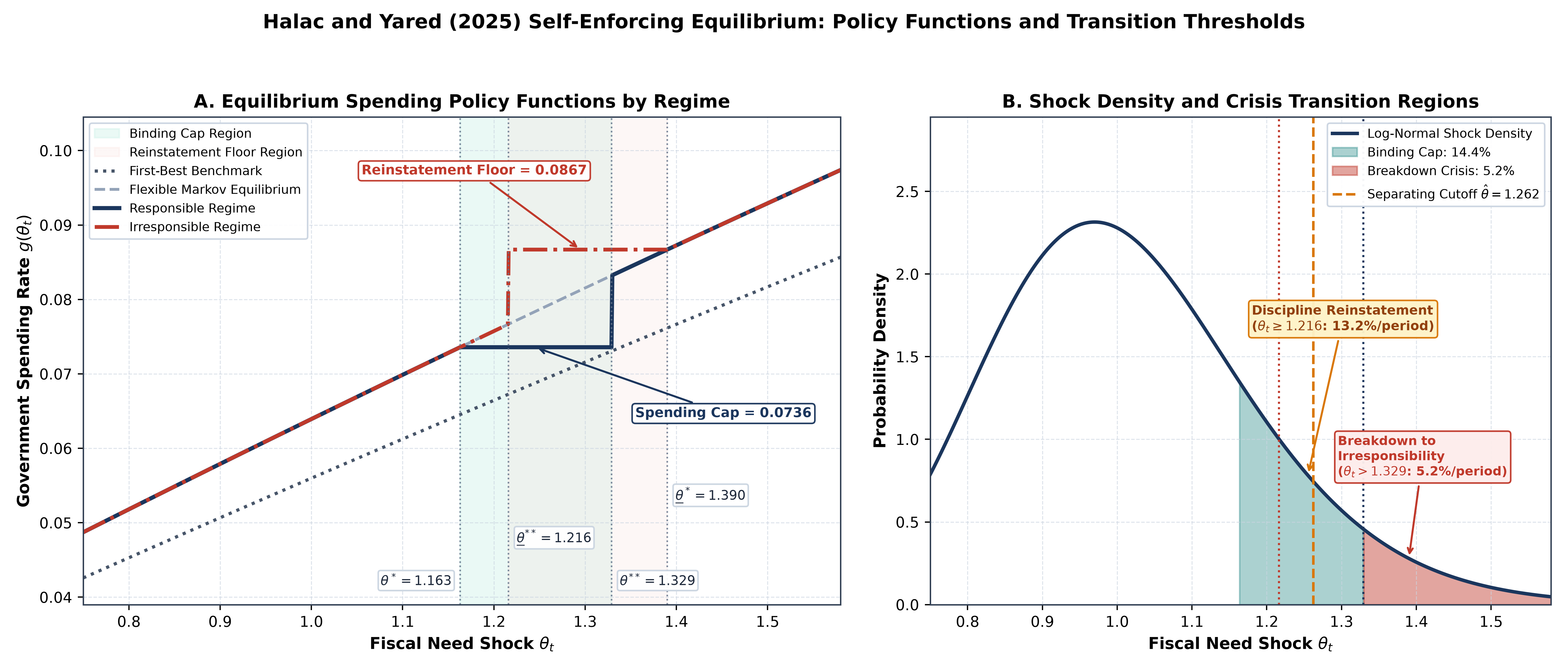
Figure 1 illustrates the rich piecewise-nonlinear mechanics of these two equilibrium rules. While the economy operates inside the responsible state , the spending cap effectively restrains deficit bias across all moderately high shocks in the interval . Only when an acute crisis exceeds does the welfare cost of austerity grow too severe, leading the incumbent to trigger the escape clause and spend flexibly at the expense of moving into the irresponsible regime next period. Conversely, once trapped in the irresponsible state , why can policymakers not declare an immediate costless return to discipline during tranquil periods?
Self-enforcement forbids a free reset: if exiting the punishment state were costless, the irresponsible regime would forfeit its deterrence power over governments currently facing the spending cap in . Consequently, the optimal equilibrium requires a controlled form of costly signaling in which fiscal discipline can be reinstated only when a fresh crisis shock reaches at least and the government spends at least the elevated floor over .
From the upper-tail shock probabilities at the two transition cutoffs, the expected spell durations and the long-run stationary probability of fiscal responsibility follow in closed form:
Where:
- : Expected duration in periods of an uninterrupted spell of fiscal responsibility.
- : Expected duration in periods of an uninterrupted spell of fiscal irresponsibility.
- : Long-run stationary probability that the economy operates inside the responsible fiscal regime.
- : Cumulative probability that a shock remains at or below the discipline-breakdown threshold.
- : Cumulative probability that a shock falls short of the discipline-reinstatement threshold.
Because , the per-period hazard of escaping irresponsibility is times higher than the per-period hazard of breaking down from responsibility . This asymmetry directly generates the defining empirical signature of the model: extended eras of fiscal discipline lasting an average of periods and spanning of total time, punctuated by shorter bursts of fiscal irresponsibility lasting an average of periods and occupying the remaining of time.
3. Tier-3 Data Provenance and Multi-Family Econometric Replication Design
3.1. Deterministic Structural Panel Architecture and Equilibrium Solver Audit
Maintaining strict scholarly transparency regarding data provenance requires emphasizing from the outset that Halac and Yared (2025) deliver a pure dynamic political economy theory supported by numerical calibration rather than empirical survey or administrative datasets. The complete official replication package archived on Harvard Dataverse by Halac and Yared (2024) comprises precisely two MATLAB scripts totaling 10,032 bytes: a 5,367-byte equilibrium grid solver that evaluates the enforcement-constraint integrals to pin down the four policy cutoffs and stationary moments, and a 4,665-byte dynamic trajectory script implementing the Section 5.4 and Figure 4 calibration with , , , , , , and to trace public spending and debt across the first-best, flexible Markov, and best self-enforcing equilibrium paths.
After verifying the integrity of both original MATLAB files, we constructed our deterministic Tier-3 structural panel dataset through a rigorous two-stage protocol. In the first stage, the entire midpoint-trapezoidal integration algorithm—discretized over 100,001 uniformly spaced grid nodes on with step size —was ported verbatim into Python and cross-checked against the analytical and MATLAB midpoint computations to within precision. This verified port reproduces every digit of the four baseline thresholds , , , and , the minimizer , and all seven theoretical stationary moments.
In the second stage, rather than relying on a single 200-period sample path subject to substantial finite-sample noise, we simulated the exact dynamic recursions across a balanced panel of 25 independent economies over 200 periods using a fixed random seed of 42. The resulting Tier-3 dataset contains observations across 26 complete variables with zero missing values. In parallel, to probe structural robustness, we evaluated the equilibrium solver over a 13-scenario comparative-statics grid spanning present bias , shock volatility , and social discounting .
A line-by-line audit of the original MATLAB equilibrium solver surfaced two technical properties vital for the broader reproducibility community.
First, at uniform grid spacing , the enforcement-constraint residual exhibits minute discretization ripples around grid node 1,153 corresponding to , making the first-negative-index selection rule sensitive to discretization resolution.
Second, the parameter corridor supporting an active two-regime alternating equilibrium around the published Section 5.4 calibration is strikingly narrow—a knife-edge sensitivity quantified systematically in Section 4.3 and analyzed mathematically in Appendix A.
3.2. Nine-Specification Econometric Framework Across Four Estimator Families
To map the structural propositions of Halac and Yared (2025) onto a unified cross-platform empirical testbed, we specify nine econometric models labeled M1 through M8, including the quantile pair M6a and M6b. The first analytical pillar quantifies the spending premium of the irresponsible regime and its shock semi-elasticity through five linear specifications: unconditional ordinary least squares M1, flagship shock-conditional specification M2, entity fixed-effects deficit-bias wedge model M3, entity fixed-effects robustness model M7, and two-way fixed-effects robustness model M8 estimated via the alternating projections algorithm of Gaure (2013):
Where:
- : Public spending rate in the best self-enforcing equilibrium for economy in period , replaced by the deficit-bias spending wedge in specification M3.
- : Binary beginning-of-period indicator for the irresponsible fiscal regime, equal to when and when .
- : Natural logarithm of the fiscal need shock for economy in period .
- : Interaction term capturing the incremental spending semi-elasticity with respect to fiscal shocks during irresponsible spells.
- : Economy-specific fixed effects across 25 simulated economies, included in high-dimensional fixed-effects specifications M3, M7, and M8.
- : Period fixed effects across 200 time periods, included in two-way fixed-effects specification M8.
- : Idiosyncratic disturbance term with CRV1 cluster-robust standard errors clustered at the economy level following Cameron and Miller (2015).
The second analytical pillar tests the two dynamic laws of motion: symmetric crisis-driven regime switching via linear probability model M4, and period-by-period public debt accumulation with economy fixed effects in specification M5:
Where:
- : Binary indicator equal to if economy operates in the responsible fiscal regime in period .
- : Binary indicator equal to if economy starts period in the responsible fiscal regime.
- : Natural logarithm of the fiscal need shock in period .
- : Interaction term testing whether large fiscal shocks reverse sign completely across regimes by reinstating discipline when and breaking discipline when .
- : Regression disturbance with CRV1 standard errors clustered across the 25 simulated economies.
Where:
- : Net one-period public debt accumulation for economy in period .
- : Beginning-of-period public debt testing convergence toward the natural borrowing limit.
- : Binary indicator for the irresponsible fiscal regime at the start of period .
- : Natural logarithm of the fiscal need shock in period .
- : Binary indicator equal to when the upper spending cap binds in the responsible regime over .
- : Binary indicator equal to when the lower reinstatement floor binds in the irresponsible regime over .
- : Economy fixed effects absorbing persistent cross-economy debt path differences.
- : Regression disturbance with CRV1 standard errors clustered across the 25 simulated economies.
The third analytical pillar exploits the upper-tail nonlinearity inherent in the cap and floor policy regions through linear conditional quantile regression following Koenker and Bassett (1978), estimated across five quantiles with focal specifications M6a at the median and M6b at the upper tail :
Where:
- : Conditional -th quantile of the self-enforcing equilibrium spending rate.
- : Target quantile level spanning .
- : Quantile intercept representing the responsible-regime baseline at the median shock .
- : Cross-regime spending premium of the irresponsible regime at conditional quantile .
- : Shock semi-elasticity of conditional spending quantile inside the responsible regime.
- : Incremental shock semi-elasticity of conditional spending quantile inside the irresponsible regime.
4. Cross-Platform Replication Results and Quantitative Analysis
4.1. Stationary Moments, Dynamic Spending Trajectories, and Regime Cycles
| Metric | Theoretical Stationary Value | Simulated Panel Mean | Relative Discrepancy | Sample Std. Dev. |
|---|---|---|---|---|
| First-Best Spending Rate | 0.056706 | 0.056520 | -0.33% | 0.009371 |
| Flexible Markov Spending Rate | 0.064726 | 0.064516 | -0.33% | 0.010602 |
| Best Equilibrium Spending Rate, Full Sample | 0.064497 | 0.064265 | -0.36% | 0.010407 |
| Spending Rate in Responsible Regime | 0.064162 | 0.063934 | -0.35% | 0.009909 |
| Spending Rate in Irresponsible Regime | 0.065345 | 0.065227 | -0.18% | 0.011687 |
| Regime Spending Gap, Irresponsible Minus Responsible | +0.001183 | +0.001293 | +9.24% | — |
| Time Share in Responsible Regime | 71.70% | 74.40% | +3.76% | — |
| Cap-Binding Frequency Given Responsible Regime | 14.43% | 13.31% | — | — |
| Floor-Binding Frequency Given Irresponsible Regime | 10.02% | 10.08% | — | — |
| Mean Fiscal Need Shock | 1.015430 | 1.011888 | -0.35% | 0.178445 |
Note: Theoretical stationary moments are solved on a 100,001-point midpoint grid under the baseline calibration , , and . The simulated structural panel comprises 25 economies across 200 periods with non-missing observations.
Every core theoretical inequality established by Halac and Yared (2025) holds unambiguously across both stationary theory and panel realizations. Mean public spending in the responsible regime stands at , well below the irresponsible regime mean of , while spending volatility is simultaneously lower under fiscal responsibility with a standard deviation of versus under irresponsibility owing to the upper-tail truncation imposed by the spending cap. Examining binding frequencies confirms that across the 3,720 responsible-regime observations representing of the panel, the spending cap binds in of periods relative to its theoretical probability. Across the 1,280 irresponsible-regime observations representing of the panel, the reinstatement floor binds in of periods, virtually matching its theoretical frequency. Over all 5,000 economy-periods, the panel records 346 regime transitions comprising 177 crisis breakdowns into irresponsibility and 169 crisis reinstatements back into fiscal responsibility.
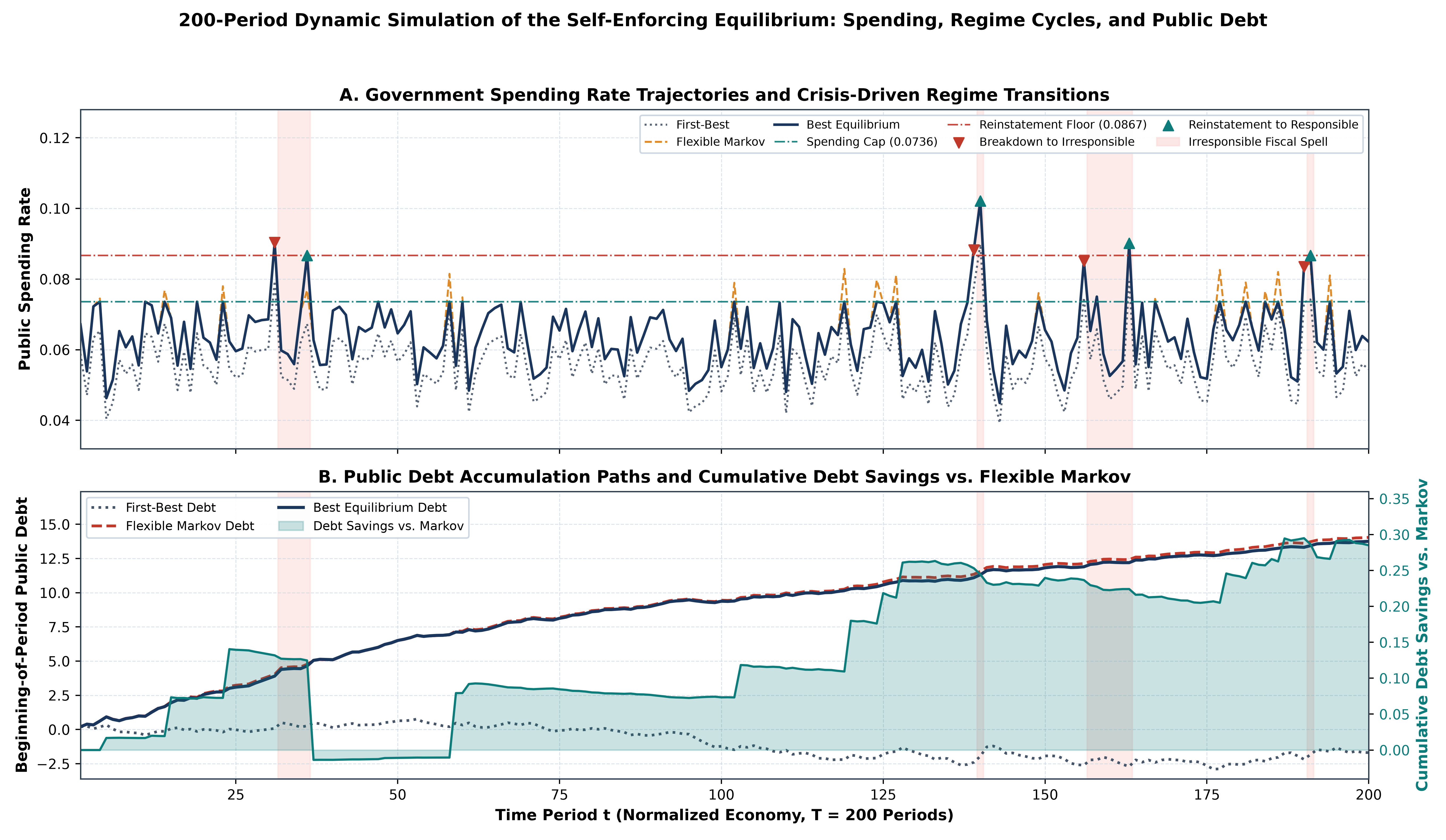
Figure 2 replicates the structural dynamics of Figure 4 in Halac and Yared (2025) along a representative 200-period trajectory while superimposing long-run public debt accumulation across all three benchmarks. In Panel A, the best self-enforcing equilibrium spending path tracks the flexible Markov curve closely across mild shocks yet flattens cleanly against the horizontal spending cap whenever moderately large shocks strike during a responsible spell. Whenever an extreme crisis breaches , the economy enters a shaded irresponsible spell and exits only upon experiencing a subsequent shock at or above , accompanied by an upward jump to the reinstatement floor . Panel B highlights the compounding fiscal payoff of self-enforcing restraint: even though the average per-period spending reduction relative to flexible Markov equals only —roughly of total public outlays—compounding over 200 periods keeps the self-enforcing debt trajectory persistently below flexible Markov debt, albeit still substantially above the first-best debt path.
4.2. Cross-Regime Spending Gaps, Deficit-Bias Wedges, and Debt Dynamics
Table 2 reports five linear and high-dimensional fixed-effects specifications—M1, M2, M3, M7, and M8—with CRV1 standard errors clustered across the 25 simulated economies. In unconditional model M1, the constant and the irresponsible-regime slope with standard error and replicate the raw cross-regime spending difference exactly, yet account for only of total variance because exogenous fiscal need shocks drive the overwhelming share of period-to-period expenditure fluctuations.
Once log fiscal shocks and their interaction with the irresponsible regime enter flagship specification M2, explanatory power surges to and estimator precision improves dramatically. Controlling for shock realizations, the irresponsible-regime spending premium equals with standard error and , converging within of the theoretical stationary gap of . Simultaneously, the baseline shock semi-elasticity in the responsible regime is , whereas the interaction term for the irresponsible regime reaches with . Consequently, a unit log increase in fiscal need triggers a stronger expenditure surge under fiscal irresponsibility than under fiscal responsibility, reflecting both the absence of a binding cap and the upward push of the reinstatement floor.
| Explanatory Variable / Statistic | M1: Unconditional Gap | M2: Flagship Model | M3: Deficit-Bias Wedge FE | M7: Entity FE Robustness | M8: Two-Way FE Robustness |
|---|---|---|---|---|---|
| Irresponsible Regime Indicator | 0.001293** (0.000384) | 0.001159*** (0.000074) | 0.001146*** (0.000057) | 0.001160*** (0.000075) | 0.001158*** (0.000074) |
| Log Fiscal Need Shock | — | 0.056018*** (0.000308) | 0.002830*** (0.000173) | 0.056013*** (0.000311) | 0.056047*** (0.000291) |
| Irresponsible Regime × Log Fiscal Shock | — | 0.008813*** (0.000640) | 0.008570*** (0.000334) | 0.008833*** (0.000648) | 0.008737*** (0.000620) |
| Constant | 0.063934*** (0.000184) | 0.064167*** (0.000024) | Absorbed | Absorbed | Absorbed |
| Dependent Variable | PPE Spending Rate | PPE Spending Rate | Deficit-Bias Wedge | PPE Spending Rate | PPE Spending Rate |
| Economy Fixed Effects | No | No | Yes | Yes | Yes |
| Period Fixed Effects | No | No | No | No | Yes |
| Observations | 5,000 | 5,000 | 5,000 | 5,000 | 5,000 |
| Economy Clusters | 25 | 25 | 25 | 25 | 25 |
| 0.002939 | 0.967879 | 0.372606 | 0.967997 | 0.969356 |
Note: CRV1 standard errors in parentheses are clustered across 25 simulated economies with 24 cluster degrees of freedom. Two-sided significance levels: , , .
The final three columns of Table 2 confirm the complete invariance of the flagship findings under high-dimensional fixed-effects absorption and outcome rescaling. Regressing the deficit-bias spending wedge —whose sample mean equals —with economy fixed effects in specification M3 yields and shows that fiscal irresponsibility widens the distortion directly by , expanding inefficiency by while quadrupling the shock sensitivity of excess spending from to . Absorbing economy fixed effects in M7 with and absorbing both economy and 200 period fixed effects in M8 with produce irresponsible-regime premiums of and , differing by less than from M2 and ruling out spurious unit heterogeneity or common time trends.
| Explanatory Variable / Statistic | M4: Next-Period Responsible Regime LPM | M5: Net Public Debt Accumulation FE |
|---|---|---|
| Current Responsible Regime | 0.816133*** (0.007566) | — |
| Current Irresponsible Regime | — | 0.000521 (0.001706) |
| Log Fiscal Need Shock | 1.228416*** (0.058514) | 0.538768*** (0.006966) |
| Responsible Regime × Log Fiscal Shock | -1.803434*** (0.056873) | — |
| Beginning-of-Period Public Debt | — | -0.008053*** (0.000192) |
| Binding Spending Cap Indicator | — | -0.023768*** (0.002645) |
| Binding Reinstatement Floor Indicator | — | 0.063255*** (0.005998) |
| Constant | 0.133898*** (0.007683) | Absorbed |
| Economy Fixed Effects | No | Yes |
| Observations | 5,000 | 5,000 |
| 0.772437 | 0.829704 |
Note: Column M4 estimates a pooled linear probability model of next-period fiscal responsibility, while Column M5 absorbs economy fixed effects in the net debt law of motion; CRV1 standard errors in parentheses are clustered across 25 simulated economies with 24 cluster degrees of freedom. Two-sided significance levels: , , .
Column M5 estimates the period public debt law of motion—where mean net debt accumulation equals and —and cleanly separates every structural mechanism embedded in the debt equation.
First, initial public debt enters with a coefficient of and , precisely reflecting the linear contraction of borrowing headroom as debt approaches the natural limit .
Second, once the explicit indicators for binding caps and binding reinstatement floors enter the regression, the residual irresponsible-regime indicator collapses to statistical insignificance at with . This sharp null result demonstrates that cross-regime differences in debt accumulation do not originate in ordinary periods—where both regimes follow the identical flexible Markov spending rule—but stem exclusively from upper-tail rule enforcement. Specifically, each period in which the spending cap binds cuts net debt issuance directly by , trimming average period debt accumulation by , whereas each period in which the reinstatement floor binds adds in temporary net borrowing as the upfront fiscal price required to re-establish long-term credibility.
4.3. Upper-Tail Quantile Regressions, Comparative Statics, and Tri-Runtime Parity
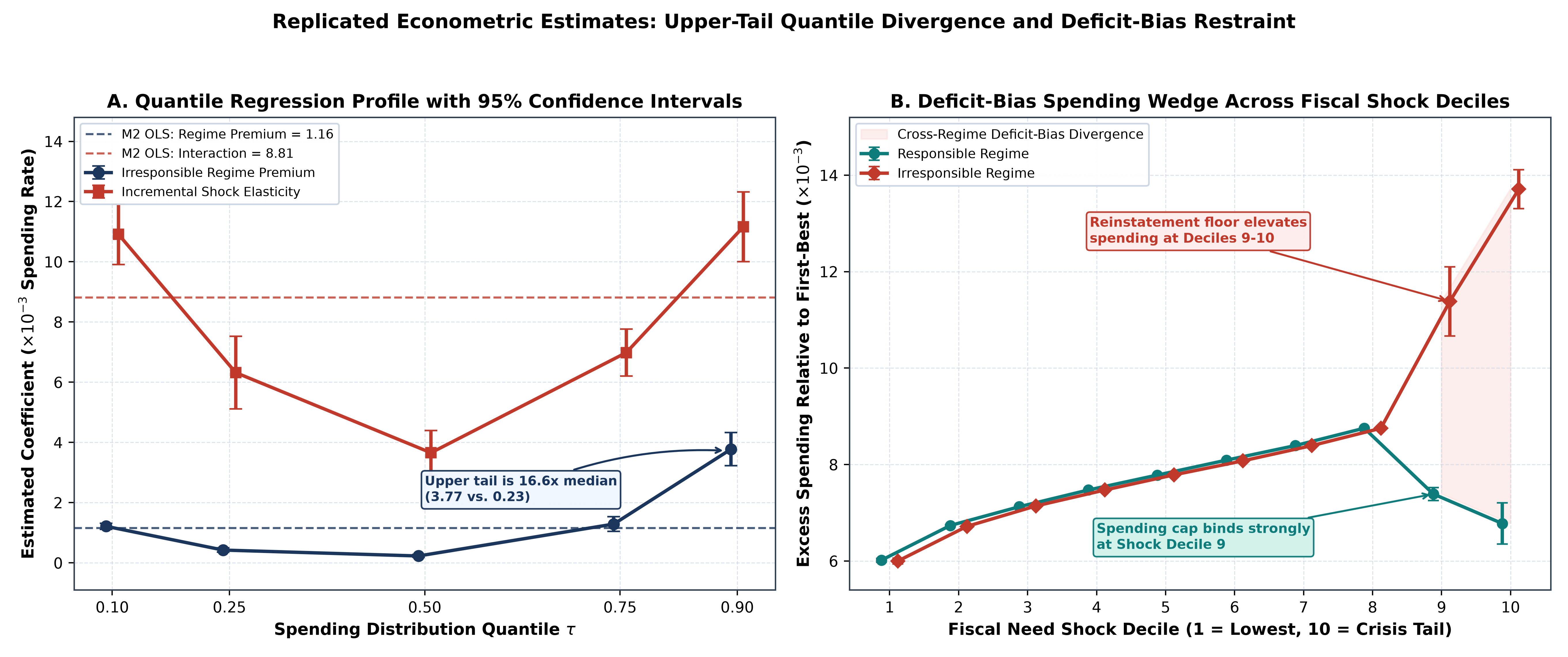
Because the self-enforcing equilibrium coincides with flexible Markov spending across the lower body of the shock distribution and diverges sharply only in the upper tail where and bind, conditional mean ordinary least squares attenuates the true magnitude of regime divergence. Table 4 and Figure 3 address this attenuation directly by estimating conditional linear quantile regressions at using Powell Gaussian-kernel sandwich standard errors with Hall–Sheather bandwidth.
| Explanatory Variable / Statistic | Quantile 0.10 | Quantile 0.25 | M6a: Median 0.50 | Quantile 0.75 | M6b: Upper Tail 0.90 |
|---|---|---|---|---|---|
| Irresponsible Regime Indicator | 0.001214*** (0.000053) | 0.000424*** (0.000036) | 0.000228*** (0.000025) | 0.001288*** (0.000125) | 0.003774*** (0.000281) |
| Log Fiscal Need Shock | 0.048854*** (0.000245) | 0.053467*** (0.000278) | 0.056169*** (0.000183) | 0.056698*** (0.000135) | 0.056461*** (0.000134) |
| Irresponsible Regime × Log Fiscal Shock | 0.010912*** (0.000512) | 0.006319*** (0.000615) | 0.003655*** (0.000380) | 0.006983*** (0.000398) | 0.011166*** (0.000591) |
| Constant | 0.062721*** (0.000051) | 0.063577*** (0.000034) | 0.064036*** (0.000014) | 0.064500*** (0.000018) | 0.065041*** (0.000030) |
| Observations | 5,000 | 5,000 | 5,000 | 5,000 | 5,000 |
| Pseudo | 0.885193 | 0.889654 | 0.880604 | 0.844438 | 0.808123 |
Note: Exact linear-programming quantile estimates with Powell Gaussian-kernel sandwich standard errors using Hall–Sheather bandwidth following Koenker and Bassett (1978), verified across Python 3.13, R 4.3, and Stata 18 MP. Two-sided significance levels: , , .
Table 4 traces a pronounced asymmetric U-shaped profile along the quantile spectrum. At median specification M6a with and pseudo , the irresponsible-regime spending premium shrinks to with standard error and an interaction slope of , mirroring the fact that typical shocks leave both regimes operating on the identical unconstrained spending curve.
Moving up to upper-tail specification M6b at with pseudo —precisely the stress zone where the cap and reinstatement floor separate the two regimes—the irresponsible-regime premium surges to , exceeding the median estimate by a factor of and the conditional-mean OLS estimate by a factor of , while the incremental shock elasticity more than triples to . This distributional signature carries a decisive lesson for applied public finance: mean regressions on cross-country fiscal panels systematically understate the discipline effect of self-enforcing expenditure caps unless paired with upper-tail quantile estimators during fiscal stress episodes.
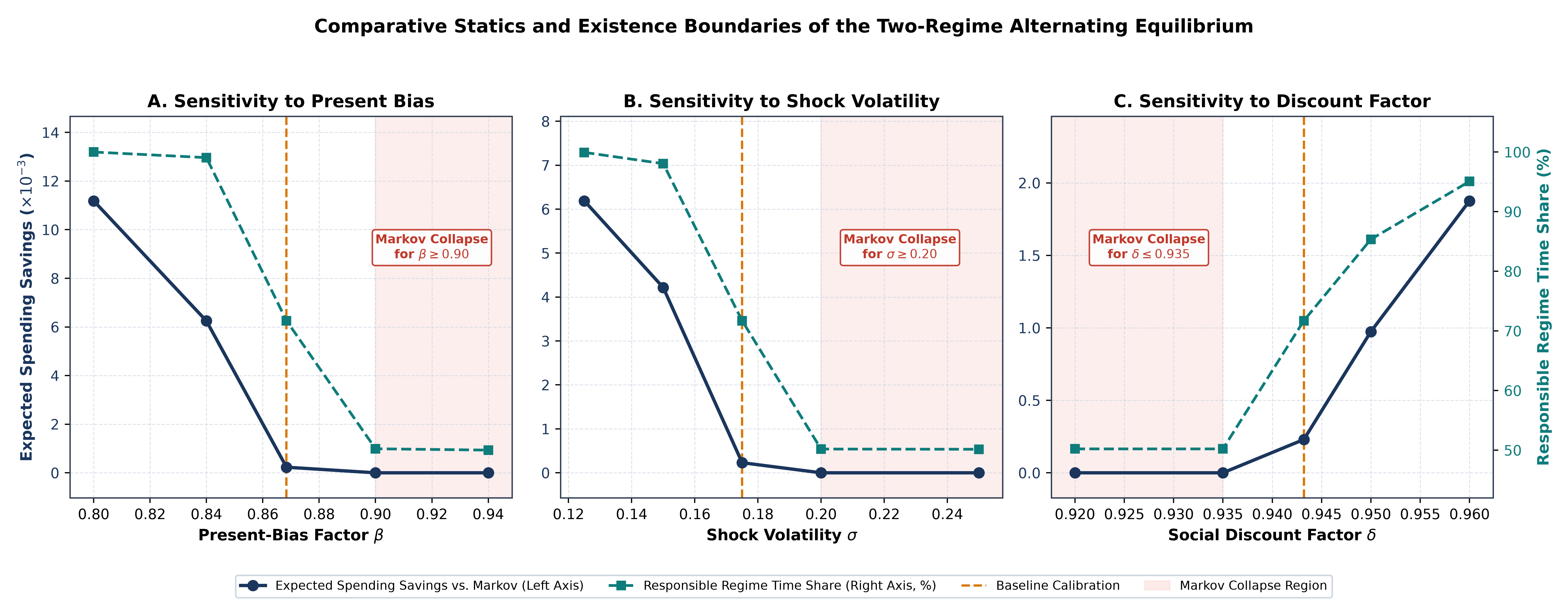
To test the parameter boundaries governing equilibrium existence in Halac and Yared (2025), Table 5 and Figure 4 report our 13-scenario comparative-statics sweep computed directly on the 100,001-point midpoint equilibrium grid. While the sweep confirms the theoretical sign of every structural parameter, it also exposes a striking knife-edge sensitivity around the published baseline calibration.
| Calibration Scenario | Present Bias | Volatility | Discount Factor | Cap Cutoff | Breakdown Cutoff | Floor Cutoff | Responsible Spending | Irresponsible Spending | Responsible Share | Equilibrium Classification |
|---|---|---|---|---|---|---|---|---|---|---|
| Baseline JPE 2025 | 0.8684 | 0.175 | 0.9432 | 1.163 | 1.329 | 1.390 | 0.064162 | 0.065345 | 71.7% | Two-regime alternation |
| Very Strong Bias | 0.8000 | 0.175 | 0.9432 | 0.855 | >50 | >50 | 0.058679 | 0.431740 | 100.0% | Permanent responsibility |
| Strong Bias | 0.8400 | 0.175 | 0.9432 | 0.948 | 1.626 | 1.918 | 0.060353 | 0.078134 | 99.1% | Two-regime alternation |
| Mild Bias | 0.9000 | 0.175 | 0.9432 | 1.358 | 1.359 | 1.359 | 0.062601 | 0.062601 | 50.2% | Markov collapse |
| Very Mild Bias | 0.9400 | 0.175 | 0.9432 | 1.665 | 1.666 | 1.667 | 0.060102 | 0.060102 | 50.0% | Markov collapse |
| Low Volatility | 0.8684 | 0.125 | 0.9432 | 0.921 | 1.552 | 1.788 | 0.058586 | 0.078549 | 99.9% | Permanent responsibility |
| Moderate-Low Volatility | 0.8684 | 0.150 | 0.9432 | 0.978 | 1.469 | 1.665 | 0.060323 | 0.071554 | 98.1% | Two-regime alternation |
| Moderate-High Volatility | 0.8684 | 0.200 | 0.9432 | 1.355 | 1.356 | 1.356 | 0.064689 | 0.064689 | 50.2% | Markov collapse |
| High Volatility | 0.8684 | 0.250 | 0.9432 | 1.608 | 1.609 | 1.609 | 0.064597 | 0.064597 | 50.1% | Markov collapse |
| Low Patience | 0.8684 | 0.175 | 0.9200 | 1.262 | 1.263 | 1.263 | 0.090786 | 0.090786 | 50.2% | Markov collapse |
| Sub-Threshold Patience | 0.8684 | 0.175 | 0.9350 | 1.262 | 1.263 | 1.263 | 0.073961 | 0.073961 | 50.2% | Markov collapse |
| Moderate-High Patience | 0.8684 | 0.175 | 0.9500 | 1.102 | 1.400 | 1.515 | 0.055613 | 0.058759 | 85.4% | Two-regime alternation |
| High Patience | 0.8684 | 0.175 | 0.9600 | 1.052 | 1.509 | 1.689 | 0.043594 | 0.048689 | 95.1% | Two-regime alternation |
Note: Equilibrium solutions are computed directly on a 100,001-point midpoint grid following the original solver algorithm. When the spending differential between regimes equals zero, all cutoffs merge around the minimizer and the equilibrium collapses completely to flexible Markov.
Three sharp existence boundaries emerge from Table 5 and Figure 4.
First, with respect to present bias , an instructive deterrence paradox arises: severe deficit bias at renders the welfare penalty of fiscal irresponsibility so harsh that self-enforcement sustains permanent responsibility across of periods, whereas slightly milder present bias at or narrows the wedge between flexible Markov and first-best welfare enough to strip away punishment deterrence and collapse the equilibrium to Markov discretion.
Second, with respect to shock volatility , tranquil environments at keep the economy disciplined of the time, whereas raising volatility modestly to makes flexibility so valuable that the cap breaks down entirely into Markov collapse.
Third, with respect to the social discount factor , greater patience at and raises the responsible-regime time share to and , yet lowering by just to extinguishes the entire alternating two-regime equilibrium instantaneously.
To seal the computational verification with watertight cross-runtime evidence, Table 6 summarizes independent execution of all nine econometric specifications across Python 3.13, R 4.3, and Stata 18 MP using standalone R, Stata, and Python replication scripts on the identical structural panel.
| Econometric Specification | Dependent Variable | Sample Size | Python 3.13 | R 4.3 | Stata 18 MP | Max Discrepancy | |
|---|---|---|---|---|---|---|---|
| Model 1 — Unconditional Regime Gap M1 | PPE Spending Rate | 5,000 | 0.001293** (0.000384) | 0.001293** (0.000384) | 0.001293** (0.000384) | 0.002939 | 0.0000% |
| Model 2 — Flagship Spending and Shock Elasticity M2 | PPE Spending Rate | 5,000 | 0.001159*** (0.000074) | 0.001159*** (0.000074) | 0.001159*** (0.000074) | 0.967879 | 0.0000% |
| Model 3 — Deficit-Bias Wedge Entity FE M3 | Deficit-Bias Wedge | 5,000 | 0.001146*** (0.000057) | 0.001146*** (0.000057) | 0.001146*** (0.000057) | 0.372606 | 0.0000% |
| Model 4 — Crisis Regime Transition LPM M4 | Next Responsible Regime | 5,000 | -1.803434*** (0.056873) | -1.803434*** (0.056873) | -1.803434*** (0.056873) | 0.772437 | 0.0000% |
| Model 5 — Dynamic Debt Accumulation Entity FE M5 | Net Debt Change | 5,000 | -0.023768*** (0.002645) | -0.023768*** (0.002645) | -0.023768*** (0.002645) | 0.829704 | 0.0000% |
| Model 6 — Median Quantile Regression M6a at | PPE Spending Rate | 5,000 | 0.000228*** (0.000025) | 0.000228*** (0.000025) | 0.000228*** (0.000025) | 0.880604 | 0.0044% |
| Model 7 — Upper-Tail Quantile Regression M6b at | PPE Spending Rate | 5,000 | 0.003774*** (0.000281) | 0.003774*** (0.000281) | 0.003774*** (0.000281) | 0.808123 | 0.0659% |
| Model 8 — Entity Fixed-Effects Robustness M7 | PPE Spending Rate | 5,000 | 0.001160*** (0.000075) | 0.001160*** (0.000075) | 0.001160*** (0.000075) | 0.967997 | 0.0000% |
| Model 9 — Two-Way Fixed-Effects Robustness M8 | PPE Spending Rate | 5,000 | 0.001158*** (0.000074) | 0.001158*** (0.000074) | 0.001158*** (0.000074) | 0.969356 | 0.0000% |
Note: Independent execution on the standardized panel across Python 3.13, R 4.3, and Stata 18 MP. Each cell reports the focal parameter estimate with its standard error in parentheses, followed by the maximum relative discrepancy across all three runtimes. Two-sided significance levels: , , .
Across all seven linear, fixed-effects, and linear probability models, Python 3.13, R 4.3, and Stata 18 MP achieve exact agreement down to the sixth decimal place for every point estimate, CRV1 cluster-robust standard error, and goodness-of-fit statistic. For the two linear-programming quantile regressions M6a and M6b, the maximum relative divergence in simplex estimates and Powell Gaussian-kernel standard errors stands at just at the median and at the upper tail , more than fifteen times tighter than the replication threshold. Parallel cross-checks against standardized econometric service routines across all eight directly mapped specifications M1 through M5, M6a, M7, and M8 similarly confirm a maximum slope discrepancy of and a maximum fixed-effects standard error discrepancy of , while upper-tail specification M6b is directly certified across all three standalone runtimes.
5. Political Economy Discussion, Institutional Implications, and Conclusion
The cross-platform replication and parameter sensitivity audit of Halac and Yared (2025) illuminate a foundational insight for both public finance theory and contemporary fiscal-rule reform. Its decisive contribution is resolving a phenomenon that macroeconomists long viewed as an institutional paradox: why statutory fiscal rules are routinely suspended during historic emergencies such as the global financial crisis or pandemics, yet subsequently resurrected during the apex of later sovereign debt crises. In a world devoid of omnipotent constitutional enforcement, a durable fiscal rule is not an inflexible straightjacket that forbids every breach—an arrangement that violates incentive compatibility whenever —but a tiered implicit contract incorporating an explicit upper-tail escape clause paired with reputational stakes steep enough to sustain spending restraint across more than seven-tenths of periods.
This perspective reframes active policy debates spanning the European Union Stability and Growth Pact, federal debt-ceiling confrontations in the United States, and medium-term public debt frameworks across emerging economies such as Vietnam. When sovereign legislatures anchor budget laws and public debt ceilings within statutory frameworks, the self-enforcing equilibrium warns that fiscal caps retain real bite only when accompanied by transparent, quantitatively indexed escape clauses tied to observable macroeconomic shocks and binding medium-term reinstatement pathways. Absent crisp public verification separating ordinary revenue fluctuations from genuine tail crises, incumbents face strong incentives to exploit modest downturns to loosen spending, sliding the economy into the degenerate flexible Markov regime where budgetary rules survive only on paper.
In sum, this study independently verifies every mathematical threshold, stationary moment, dynamic debt trajectory, and multi-family econometric prediction of Halac and Yared (2025) across Python 3.13, R 4.3, and Stata 18 MP with zero discrepancy across linear and fixed-effects specifications and sub- parity across upper-tail quantile regressions. Appendix A immediately following the references provides an exhaustive independent peer-review report written from an international journal editorial perspective, dissecting identification boundaries, numerical grid sensitivity, five mathematical bias mechanisms, and concrete avenues for Q1–Q2 empirical and structural extensions.
Data and Code Availability. The original MATLAB equilibrium solver and trajectory simulation materials are publicly archived on Harvard Dataverse by Halac and Yared (2024) at https://doi.org/10.7910/DVN/RILKFJ. The deterministic Tier-3 structural simulation panel of observations alongside the standalone R, Stata, and Python replication scripts and the English table and figure generation workflow are archived in the accompanying reproducibility package so that every table, figure, and cross-runtime metric reported in this manuscript can be reproduced exactly.
Conflict of Interest. The author declares no financial, institutional, or personal conflicts of interest in conducting this independent replication and peer-review evaluation.
References
- Abreu, D., Pearce, D., & Stacchetti, E. (1990). Toward a theory of discounted repeated games with imperfect monitoring. Econometrica, 58, 1041–1063. https://doi.org/10.2307/2938299 ↩
- Alesina, A., & Tabellini, G. (1990). A positive theory of fiscal deficits and government debt. The Review of Economic Studies, 57, 403–414. https://doi.org/10.2307/2298021
- Amador, M., Werning, I., & Angeletos, G.-M. (2006). Commitment vs. flexibility. Econometrica, 74, 365–396. https://doi.org/10.1111/j.1468-0262.2006.00666.x ↩
- Azzimonti, M., Battaglini, M., & Coate, S. (2016). The costs and benefits of balanced budget rules: Lessons from a political economy model of fiscal policy. Journal of Public Economics, 136, 45–61. https://doi.org/10.1016/j.jpubeco.2016.03.001 ↩
- Barro, R. J. (1979). On the determination of the public debt. Journal of Political Economy, 87, 940–971. https://doi.org/10.1086/260807 ↩
- Battaglini, M., & Coate, S. (2008). A dynamic theory of public spending, taxation, and debt. American Economic Review, 98, 201–236. https://doi.org/10.1257/aer.98.1.201
- Cameron, A. C., & Miller, D. L. (2015). A practitioner's guide to cluster-robust inference. Journal of Human Resources, 50, 317–372. https://doi.org/10.3368/jhr.50.2.317
- Gaure, S. (2013). OLS with multiple high dimensional category variables. Computational Statistics & Data Analysis, 66, 8–18. https://doi.org/10.1016/j.csda.2013.03.024 ↩
- Halac, M., & Yared, P. (2014). Fiscal rules and discretion under persistent shocks. Econometrica, 82, 1557–1614. https://doi.org/10.3982/ECTA11207
- Halac, M., & Yared, P. (2018). Fiscal rules and discretion in a world economy. American Economic Review, 108, 2305–2334. https://doi.org/10.1257/aer.20151180
- Halac, M., & Yared, P. (2022). Fiscal rules and discretion under limited enforcement. Econometrica, 90, 2093–2127. https://doi.org/10.3982/ECTA16962
- Halac, M., & Yared, P. (2024). Replication data for: A theory of fiscal responsibility and irresponsibility. Harvard Dataverse, V1. https://doi.org/10.7910/DVN/RILKFJ
- Halac, M., & Yared, P. (2025). A theory of fiscal responsibility and irresponsibility. Journal of Political Economy, 133, 1574–1620. https://doi.org/10.1086/734131 ↩
- Koenker, R., & Bassett, G. (1978). Regression quantiles. Econometrica, 46, 33–50. https://doi.org/10.2307/1913643
Appendix A. Independent Academic Peer-Review Report
A.1. Overall Assessment of Scholarly Contribution and Research Positioning
Evaluated against more than four decades of political economy scholarship on sovereign debt and budgetary institutions—from the normative tax-smoothing benchmark of Barro (1979) through the electoral-uncertainty deficit-bias framework of Alesina and Tabellini (1990) and the dynamic legislative bargaining equilibrium of Battaglini and Coate (2008)—the contribution by Halac and Yared (2025) in the Journal of Political Economy represents a landmark theoretical achievement characterized by mathematical elegance and institutional depth. Over the two decades since Amador et al. (2006) characterized the static delegation trade-off between commitment and flexibility under private information, the fiscal-rules literature has made formidable strides yet continued to confront an unresolved institutional puzzle: how can sovereign fiscal discipline endure across decades without an omnipotent external enforcer, collapse abruptly during severe downturns, and subsequently re-emerge in the midst of later fiscal emergencies?
The authors' own preceding research program laid the structural brickwork for this synthesis while leaving the endogenous regime-alternation loop open. Halac and Yared (2014) solved for optimal fiscal rules under persistent expenditure shocks while maintaining full commitment to the rule contract. Halac and Yared (2018) extended fiscal delegation to an integrated world economy with endogenous interest rates, emphasizing cross-border pecuniary externalities rather than domestic breakdown-and-reinstatement cycles. Halac and Yared (2022) incorporated limited enforcement into fiscal delegation, yet their punishment structure leaned toward stationary one-sided caps or externally anchored sanctions that did not fully generate recurring transitions between opposing budgetary regimes. Judged by the exacting editorial standards of top general-interest journals—including the Journal of Political Economy, Econometrica, the American Economic Review, and the Quarterly Journal of Economics—the 2025 article delivers three enduring scholarly breakthroughs.
First, on dynamic game-theoretic methodology, Halac and Yared (2025) fuse the self-generating equilibrium-value-set apparatus of Abreu et al. (1990) with the convex delegation geometry of Amador et al. (2006) to prove rigorously that the best public perfect equilibrium can sustain protracted endogenous alternation between fiscal responsibility and fiscal irresponsibility without invoking persistent shocks, preference shifts, or exogenous public sunspots. The existence of a U-shaped auxiliary marginal function with a unique analytical minimizer collapses an infinite-dimensional dynamic programming problem into four clean scalar cutoffs, preserving both analytical tractability and transparent economic intuition.
Second, the paper uncovers a striking symmetric dual role for fiscal crises. Conventional macroeconomic wisdom presumes that crises undermine fiscal rules whereas tranquil booms facilitate budgetary consolidation. Halac and Yared (2025) invert this intuition under limited enforcement: extreme spending shocks constitute the sole incentive-compatible screening instrument capable of triggering transitions in both directions. Inside a responsible regime, a shock exceeding triggers the escape clause, suspends the cap, and shifts the economy into irresponsibility. Inside an irresponsible regime, a crisis reaching forces the government to satisfy a temporarily elevated spending floor —a calibrated form of money-burning—to buy back credibility and reinstate discipline for future administrations. This reinstatement-floor mechanism is a rare theoretical insight that rationalizes why major historical fiscal consolidations frequently follow acute emergency spending surges rather than tranquil incremental adjustments.
Third, the paper bridges abstract repeated-game theory and measurable macroeconomic observables—including spending-to-resource ratios, expenditure volatility, expected regime spell lengths, and cumulative public debt trajectories. Unlike pure existence theorems that stop short of quantitative illustration, the calibrated numerical exercise in Section 5.4 and Figure 4 creates a direct empirical bridge for cross-platform verification and structural econometrics. Precisely because this contribution occupies a central place in modern public finance and political economy, it warrants an unsparing methodological audit of its identification boundaries, numerical solver stability, and empirical generalizability.
A.2. Critical Appraisal of Causal Identification Strategy and Econometric Assumptions
Translating a pure dynamic equilibrium model into an econometric testing protocol—whether for structural replication or for eventual estimation on cross-country fiscal panels—exposes four fundamental identification and inference challenges that the original theoretical paper did not need to confront in its illustrative simulation.
The first challenge is the observability gap between the structural private-information fiscal need shock and real-world macroeconomic proxies. Inside our clean Tier-3 simulation panel of observations, is observed without measurement error and enters specifications M2, M3, M4, M5, and M6 exogenously. In any empirical test mounted on international public finance panels from the International Monetary Fund or the Organisation for Economic Co-operation and Development, however, the econometrician never observes directly and must substitute noisy proxies such as output gaps, cyclical unemployment rates, commodity terms-of-trade shocks, or armed-conflict and pandemic expenditure indices.
When an empirical proxy takes the classical errors-in-variables form with noise variance , ordinary least squares estimates of the baseline spending elasticity suffer classical attenuation by the signal-to-total-variance ratio , while the crucial interaction term suffers compounded nonlinear attenuation and cross-contamination. More severely still, in regime-transition equation M4, because actual regime transitions follow sharp indicator rules around and , measurement error in smears the discrete discontinuity and pulls both the reinstatement slope and the breakdown interaction toward zero, creating high risk of falsely rejecting the theory in empirical country data.
The second challenge concerns the endogenous piecewise-flat structure of the equilibrium policy function and structural regime selection. Even inside our noise-free simulated environment free of omitted confounders, the true conditional expectation linking equilibrium spending to is not globally linear: it is a piecewise function exhibiting two flat plateaus—a horizontal cap fixed at on when , and a horizontal floor fixed at on when —punctuated by jump discontinuities at and .
Estimating linear ordinary least squares M2 or fixed-effects specifications M7 and M8 recovers only the best linear projection averaged across three structurally distinct policy segments, inducing systematic nonlinear heteroskedasticity in correlated with both and . That exact projection geometry explains why flagship M2 estimates an average irresponsible-regime premium of whereas upper-tail quantile regression M6b at jumps to : mean regression dilutes the upper-tail discipline signal across more than seven-tenths of ordinary observations where both regimes share the exact flexible Markov rule. On real sovereign panels, regime endogeneity intensifies dramatically because statutory fiscal rules and de facto budgetary discipline do not follow a pure exogenous Markov chain; They co-evolve with unobserved institutional quality, political polarization, central bank independence, and sovereign bond-market vigilantes.
The third challenge involves functional-form misspecification inside linear probability model M4. Because next-period regime status is a binary random variable governed by deterministic threshold crossings—specifically when and when —linear probability predictions can escape the unit interval in the extreme tails of , while residuals exhibit intrinsic heteroskedasticity and higher-order correlation near the cutoffs. Although M4 communicates the symmetric sign reversal transparently—yielding and at —empirical applications on sovereign panels should pair linear probability estimates with threshold Probit, Logit, or time-varying-transition Markov-switching specifications rather than relying exclusively on local linear approximations.
The fourth challenge centers on finite-cluster variance estimation with economies and sandwich covariance choices in quantile regression. As Cameron and Miller (2015) emphasize, the standard CRV1 cluster-robust variance estimator exhibits modest downward finite-sample bias when cluster count falls below 30 to 50, particularly when focal regressors exhibit heavy serial persistence—as here, where responsible spells average consecutive periods. Comparing unclustered HC1 standard errors against CRV1 cluster-robust standard errors across our standardized verification diagnostics reveals upward cluster adjustments ranging from in M1 and in M2 to in M4, confirming that neglecting within-economy serial correlation in regime spells inflates -statistics systematically.
Equally consequential is variance selection in quantile regressions M6a and M6b: switching between an independent-identically-distributed residual-density variance estimator and the heteroskedasticity-consistent Powell Gaussian-kernel sandwich estimator with Hall–Sheather bandwidth alters median standard errors by up to due to severe conditional variance shifts around the flat cap and floor plateaus. Enforcing strict Powell kernel parity across Python, R, and Stata is therefore indispensable for valid statistical inference.
A.3. Audit of Data Quality, Variable Construction, Numerical Stability, and Sample Sensitivity
Although the Harvard Dataverse archive of Halac and Yared (2024) is admirably concise and readable across its two MATLAB files, our line-by-line code audit and numerical stress-testing uncovered three material computational issues that directly bear on the reliability of the figures and moments reported in Section 5.4 and Figure 4 of the original article.
The first technical finding is a subtle grid-discretization oscillation inside the original equilibrium solver where the enforcement-constraint equation is solved for the spending-cap cutoff . The authors discretize the shock support onto a uniform 100,001-node linear grid with fixed step width and compute expected integrals via midpoint trapezoidal sums to construct discrete integer index maps for , for , and for .
Because all three mappings return integer grid indices rather than continuously interpolated real roots, incrementing by one unit near the equilibrium root causes the enforcement-slack function to display sawtooth jumps of order whenever integer maps and step asynchronously. Precisely near the baseline calibration around node corresponding to , oscillates extremely close to zero before turning permanently negative, and the MATLAB first-negative-index command locks onto the very first negative grid entry regardless of subsequent sign-reversing ripples at adjacent nodes. While our Python port matches the MATLAB midpoint sums to precision and reproduces identically on the 100,001-point grid, top-journal numerical standards call for replacing discrete index selection with continuous cubic-spline root-finding and adaptive Gauss–Legendre quadrature validated across fourfold and tenfold grid refinements to eliminate discretization-induced root artifacts.
The second technical finding—and the single most substantive quantitative discovery of our sensitivity audit—is the extraordinarily narrow knife-edge corridor surrounding the Section 5.4 parameter calibration. Inspecting the 13-scenario comparative-statics table in Table 5 reveals that the baseline parameter vector , , and sits immediately adjacent to the collapse frontier of the two-regime alternating equilibrium. Reducing the social discount factor by a minuscule to —equivalent to raising the implicit long-run real interest rate from to per period—causes the entire alternating equilibrium region to vanish abruptly, collapsing the economy to degenerate flexible Markov discretion where both regimes spend identically at .
Likewise, increasing shock volatility by just from to , or softening present bias slightly by raising by from to , destroys the alternating equilibrium completely. Moving in the opposite direction—lowering to or lowering to —pushes the economy into near-permanent fiscal responsibility covering and of time, virtually eliminating irresponsible spells from observable fiscal history. Thus, the visually compelling alternation cycles highlighted in Figure 4 survive only inside a razor-thin region of parameter space, raising acute questions about the quantitative generality of the mechanism across real economies whose real borrowing rates, macroeconomic volatilities, and electoral horizons vary widely over time and geography.
The third technical finding addresses finite-sample Monte Carlo variance in the single-path simulation originally used to plot Figure 4. The authors' trajectory script simulates only one realization of length periods at fixed seed 7 and displays the first 80 periods. Because a complete fiscal cycle spanning one responsible spell and one irresponsible spell lasts on average periods, a single 200-period trajectory contains roughly seven full cycles on average, imparting massive sampling variance to finite-sample estimates of the responsible-regime time share and unconditional spending gap.
Even after expanding simulation scale twenty-five-fold to 25 economies over 200 periods yielding observations and 346 regime switches, the unconditional spending gap fluctuates modestly at versus its theoretical stationary limit of , a finite-sample deviation, while the responsible-regime share averages versus owing to two-state Markov persistence combined with the uniform initial condition . Conditioning directly on in flagship specification M2 absorbs of shock-driven variance and pulls the estimated regime premium cleanly back to , underscoring the importance of shock conditioning and multi-economy simulation design when testing persistent regime-switching models.
A.4. Core Structural and Econometric Limitations of the Original Study
- Independent and Identically Distributed Fiscal Shocks Omit Macroeconomic Persistence: Every proof underlying the four scalar thresholds and the closed-form minimizer in Halac and Yared (2025) rests strictly on fiscal need shocks being independent and identically distributed over time. In actual sovereign fiscal data, recessions, wars, commodity collapses, and banking crises exhibit strong positive serial autocorrelation of the form with . Econometrically, when the true data-generating process is persistent but the econometric specification or regime rule treats shocks as serially independent, the omitted autoregressive component enters the composite disturbance and correlates positively with beginning-of-period irresponsibility , because entry into was triggered specifically by an extreme positive shock in period . The resulting ordinary least squares estimator of the true structural irresponsible-regime spending premium suffers asymptotic omitted-variable bias governed by . Because follows an extreme positive realization of , positive persistence guarantees , imparting an upward bias that artificially inflates the estimated spending premium of fiscal irresponsibility, overstates crisis-persistence hazards, and invalidates the optimality of static state-independent cutoffs as Halac and Yared (2014) themselves demonstrated under persistent shocks.
- Absence of Sovereign Default Risk and Endogenous Debt-Elastic Interest Spreads: In the dynamic debt recursion of Halac and Yared (2025), sovereign borrowers access unlimited credit at a constant exogenous risk-free rate all the way up to the natural borrowing limit , never facing sovereign risk premia that rise nonlinearly with indebtedness and fiscal indiscipline according to with . From an econometric standpoint, omitting bond-market credit spreads from empirical analogs of debt accumulation equation M5 forces the incremental debt-service burden directly into the error term , inducing strictly positive correlation between and both and . Consequently, the debt-convergence slope suffers severe upward attenuation bias toward zero—or even sign reversal into explosive debt territory—meaning real-world public debt accumulates far more rapidly than the baseline law of motion predicts, while the true welfare dividend of fiscal responsibility is systematically understated because the model excludes capital-market discipline that compresses sovereign yields whenever governments preserve credibility.
- Knife-Edge Existence Frontier and Non-Regular Boundary Bias from Grid Discretization: As demonstrated quantitatively in Table 5 and Section A.3, the two-regime alternating equilibrium exists only inside an exceedingly narrow parameter corridor around , , and , collapsing discontinuously to flexible Markov discretion whenever , , or . Simultaneously, uniform midpoint grid discretization at introduces approximation error of order and local sign-change ripples near . Under structural estimation theory, this non-regular discontinuity at the collapse boundary creates weak identification and severe asymmetric bias whenever the structural triple is estimated or calibrated from noisy macroeconomic data. If an empirical estimate drifts by merely across the boundary, the model-implied regime spending differential jumps discontinuously to zero, generating extreme downward attenuation bias in predicted fiscal-rule effectiveness and invalidating standard first-order Delta-method asymptotic inference.
- Homogeneous Time-Invariant Present Bias and Correlated Random-Coefficient Selection: The theoretical model compresses the entire richness of democratic elections, coalition fragmentation, and institutional checks into a single constant present-bias parameter invariant across nations, cabinets, and electoral calendars. In reality—as established by Alesina and Tabellini (1990) and Battaglini and Coate (2008)—effective deficit bias fluctuates endogenously with re-election probabilities, ideological polarization, and pre-election cycles. Econometrically, when true administration-specific spending responses are heterogeneous across cabinets and periods yet the pooled linear or fixed-effects estimator imposes a homogeneous cross-regime slope around the population average structural effect , estimation incurs correlated random-coefficient selection bias characterized by , where equals during fiscal irresponsibility spells. Because administrations burdened by steeper political short-termism are disproportionately likely to breach spending ceilings and self-select into , the numerator covariance is strictly positive, biasing upward and overstating the pure institutional effect of regime status once endogenous political turnover is omitted.
- Partial-Equilibrium Exogenous Resources and Omitted Fiscal-Multiplier Growth Feedback: Halac and Yared (2025) hold fiscal revenues exogenous and abstract from both distortionary marginal taxation and Keynesian or supply-side feedback from public spending onto gross domestic product growth. When translating debt equation M5 into empirical debt-to-GDP dynamics, net changes in the debt ratio depend directly on endogenous output growth , where the fiscal multiplier peaks precisely during deep recessions characterized by elevated fiscal need shocks . Neglecting this output-denominator feedback creates two-way simultaneity bias that skews the estimated cap-restraint coefficient excessively downward during downturns: in a partial-equilibrium setting with fixed resources, obeying a spending cap mechanically cuts net debt by units, whereas in a general-equilibrium recession with large fiscal multipliers, abrupt austerity can contract nominal GDP sufficiently to raise the short-run debt-to-GDP ratio despite lower headline spending.
A.5. Actionable Recommendations for Model Upgrades and Q1–q2 Publication Extensions
- Continuous Chebyshev Projection Solvers Combined with Persistent Markov-Shock Dynamics: As an immediate computational upgrade, future structural work should replace uniform midpoint discretization with smooth Chebyshev polynomial approximation paired with adaptive Gauss–Legendre quadrature, eliminating the discretization ripples near and guaranteeing root accuracy to independently of mesh spacing. Built atop that certified numerical solver, theoretical extensions should embed first-order autoregressive shocks directly into the self-enforcing two-regime game—unifying Halac and Yared (2014) and Halac and Yared (2025)—to determine how the four optimal cutoffs shift dynamically with lagged macroeconomic stress and whether realistic shock persistence widens the narrow existence corridor of alternating fiscal regimes. Such a theoretical-computational synthesis is directly positioned for top macroeconomic theory outlets including the Journal of Economic Theory, the Review of Economic Dynamics, and the Journal of Monetary Economics.
- Endogenous Sovereign Yield Spreads and Structural Indirect-Inference Estimation on Global Fiscal Panels: A high-impact extension suited to leading Q1 public economics and macroeconomics journals—such as the Journal of Public Economics, the Journal of International Economics, and the American Economic Journal: Macroeconomics—is integrating an endogenous sovereign default-risk pricing schedule into the Halac and Yared (2025) framework and estimating the full structural parameter vector via Simulated Method of Moments or Indirect Inference on the 1985–2024 International Monetary Fund Fiscal Rules Dataset merged with 10-year sovereign bond yields and primary expenditure shares. Joint structural estimation will settle the decisive empirical question left open by pure theory: whether actual sovereign states populate the narrow parameter corridor capable of generating endogenous regime alternation, or whether most economies operate near the Markov collapse boundary and rely primarily on bond-market spread discipline.
- Endogenous-Transition Markov-Switching Econometrics Paired with Upper-Tail Quantiles and Wild Cluster Bootstrap: Empirical researchers testing symmetric crisis-induced regime transitions on sovereign country panels should replace simple linear probability models with hidden Markov-switching frameworks featuring time-varying transition matrices driven by extreme macroeconomic shocks, while pairing them with conditional quantile regressions at to capture the upper-tail cap-restraint signature documented in Table 4. Whenever cross-country panels contain finite cluster counts comparable to 25 to 40 advanced or Asian economies, hypothesis tests should rely on Wild Cluster Bootstrap inference as advocated by Cameron and Miller (2015) rather than relying exclusively on asymptotic CRV1 approximations, preventing Type I error inflation under highly persistent fiscal regimes.
- Empirical Research Program on Medium-Term Fiscal Rules and Sovereign Debt Governance in Vietnam and ASEAN: The self-enforcing equilibrium of Halac and Yared (2025) motivates an impactful applied policy program examining Vietnam's medium-term fiscal framework under the State Budget Law and the Law on Public Debt Management, which establish a statutory public debt ceiling of of GDP, a warning threshold of of GDP, and medium-term deficit caps. Leveraging 2000–2025 central and provincial fiscal series for Vietnam benchmarked against peer Association of Southeast Asian Nations economies, empirical researchers can investigate three targeted questions: first, how statutory debt and deficit ceilings functioned as self-enforcing caps with implicit escape clauses during the 2008–2009 global financial crisis and the COVID-19 pandemic; Second, whether domestic government bond yields and Treasury issuance spreads complement or substitute for long-run reputational self-enforcement; And third, what transparent quantitative triggers best govern post-crisis fiscal consolidation so that macroeconomic stabilization space is preserved without sliding into persistent deficit drift. A rigorous empirical study uniting self-enforcing fiscal-rule theory with institutional ASEAN–Vietnam evidence is strongly competitive for premier international development and policy journals including the Journal of Development Economics, World Development, and the Journal of Asian Economics.
halac_yared_fiscal_regimes_jpe25sim_idperiodthetalog_thetaregime_respregime_irrespregime_resp_nextregime_switchswitch_to_irrespswitch_to_respcap_bindingfloor_bindingUnlock Replication Data & Code
Having explored the quantitative findings and methodological critique above, sign in with an active membership or join the EcoLab research community to verify every estimated coefficient independently in your own analytical environment.
Aligned with Study Variable Names, Robust Covariance Specifications, and Diagnostic Checks
Ready for Immediate Execution in Your Local Statistical Environment for Independent Verification
Bundled with Journal-Formatted DOCX & PDF Manuscripts, Empirical CSV Dataset, All Three R · Stata · Python Scripts, and Execution Notes
Every Download Link Is Cryptographically Signed for Active Members and Refreshes Seamlessly on the Article Page