1. Introduction
Labor economists have spent more than four decades documenting how trade unions shape the distribution of earnings. Classic empirical contributions by Freeman (1980), Card (2001), and Farber et al. (2021) establish that collective bargaining compresses within-firm and between-group wage dispersion, attributing a substantial fraction of rising U.S. earnings inequality since the late 1970s to declining union density. Yet a deeper institutional feedback loop has received far less direct empirical scrutiny: does widening outside-market wage inequality itself destabilize union coalitions, depress organizing success, and force labor leaders to abandon transparent, wage-centered bargaining platforms?
Biasi et al. (2026a) confront this reverse-causality mechanism by integrating coalition-bargaining theory with multi-setting empirical evidence. Their central theoretical insight is straightforward yet far-reaching. Collective bargaining succeeds when heterogeneous workers coalesce behind a shared set of demands. When external labor-market options diverge sharply across occupations within the same workplace, workers holding strong outside options raise their reservation wage demands and escalate external job search during organizing drives, whereas workers with weaker outside options moderate wage expectations and rely more heavily on collective protection. Caught between irreconcilable internal wage demands, union organizers anticipate lower certification vote shares, perceive far greater friction in drafting unified pay scales, withhold salary schedules during campaigns, pivot messaging toward non-wage amenities such as predictable schedules, and carve workplaces into smaller, more homogeneous bargaining units.
This replication study performs a full code audit, reconstructs the clean multi-pillar dataset directly from the Harvard Dataverse archive of Biasi et al. (2026b), and executes an independent three-engine numerical verification across StataNow 19.5 MP, R, and Python. Rather than restricting attention to a single headline regression, we verify canonical specifications spanning every open empirical module of the paper: the North American union organizer vignette experiment, the U.S. OLMS collective bargaining contract and CorEx text-analysis corpus, and the 2023 Hollywood WGA strike information intervention. We also document the exact confidentiality boundaries governing the restricted Wisconsin Department of Public Instruction teacher records and leverage the package's own commuting-zone Wild- bootstrap table to deliver a rigorous independent peer-review evaluation.
2. Theoretical Framework and Literature Review
The institutional nexus between collective bargaining and earnings inequality hinges on an endogenous tension between wage compression and coalition stability. Early empirical landmarks by Freeman (1980) and Card (2001) demonstrated that unions narrow wage dispersion both within establishments and across skill tiers by replacing managerial discretion with standardized pay scales tied to tenure and job classification. Drawing on harmonized historical survey microdata spanning nearly a century, Farber et al. (2021) corroborated that unionization historically acted as a potent equalizing counterweight, dampening top-tail income concentration documented by Kopczuk, Saez, and Song (2010) and Piketty, Saez, and Zucman (2018).
The reverse causal pathway—from skill-biased earnings dispersion back to deunionization—was formalized theoretically by Acemoglu, Aghion, and Violante (2001). In their general-equilibrium framework, technological shifts that expand productivity differentials between skilled and unskilled labor raise the opportunity cost of remaining inside a wage-compressing union coalition. Once the market skill premium exceeds the insurance value of collective bargaining, high-productivity workers defect toward individual wage setting, unraveling the coalition and creating an institutional inequality trap. Despite the theoretical elegance of this feedback mechanism, direct empirical identification of how rising outside-option dispersion alters organizer strategy and worker solidarity remained elusive for decades.
Biasi (2021) advanced the empirical frontier by examining Wisconsin's 2011 Act 10 reform, which eliminated statutory collective bargaining over teacher pay schedules and enabled school districts facing stronger local labor-market competition to adopt flexible individual pay, thereby widening within-position salary dispersion. Building directly on that insight, Biasi et al. (2026a) model a union organizer choosing campaign transparency, bargaining-unit boundaries, and issue priorities when facing workers whose outside options exhibit variance . As rises, publishing a single compressed pay scale triggers exit threats from high outside-option workers while steepening the scale alienates lower-option peers.
Complementing this bargaining calculus, behavioral pay-transparency research by Cullen and Perez-Truglia (2022) shows that workers exhibit pronounced projection bias, anchoring perceptions of peer compensation on their own pay. Consequently, revealing true pay dispersion during an active labor dispute can abruptly erode members' conviction that union demands serve the entire workforce. Independent multi-runtime verification of these interlocking mechanisms is therefore essential to establish the quantitative robustness of the inequality-trap hypothesis.
3. Data and Empirical Methodology
3.1. Data Provenance Audit and Confidentiality Boundaries
The Harvard Dataverse package deposited by Biasi et al. (2026b) totals MB compressed and comprises five modular subdirectories covering the union organizer survey, the Hollywood WGA surveys, U.S. macro collective bargaining records, the Wisconsin Act 10 natural experiment, and cross-country ISSP tabulations. A file-by-file audit establishes that three core empirical modules ship with complete Tier-1 deidentified microdata capable of exact replication without any imputation or simulation:
- Pillar 1 — Union Organizer Vignette Experiment: Administered between July 2024 and January 2025 to active union organizers across the United States and Canada, the public archive provides both the main validated-email sample of organizers yielding organizer-vignette observations and the unrestricted sample of organizers yielding observations. Each organizer evaluates two hypothetical manufacturing plants sharing an identical USD average external wage across three occupations—pipefitters, millwrights, and quality-control inspectors—while differing strictly in outside-option dispersion. Presentation order between the equal and unequal vignettes is randomized across respondents.
- Pillar 2 — U.S. Collective Bargaining Agreements and Industry-Region Inequality: Combining two waves of public collective bargaining agreement filings from the U.S. Office of Labor-Management Standards merged with two-digit NAICS by Bureau of Economic Analysis region by three-year-bin wage dispersion constructed from the American Community Survey over 2002–2022, the cleaned contract file retains exactly unique agreements across employers and unions after deduplication and 2nd–98th percentile winsorization. Two contract outcomes are observed for all agreements: a binary indicator for whether the contract contains a formal pay scale, and the anchored CorEx share of pay-related topics relative to pay, benefits, and working conditions. Pre-period 2002–2004 ACS wage ratios and 2002–2022 non-union CPS wage ratios accompany the main specification for reverse-causality sensitivity checks.
- Pillar 3 — 2023 Hollywood WGA Strike Surveys: The archive contains completed baseline survey responses among film and television professionals, including Writers Guild of America members with complete own-pay and perceived-typical-pay variables, alongside WGA members surveyed during the 2023 strike follow-up. In the follow-up intervention, writers were randomized to answer whether guild demands serve all members either immediately before or immediately after reviewing an empirical pay-dispersion report. Dropping respondents answering "do not know," representing of the follow-up sample, yields valid observations for causal inference.
For transparent scope disclosure, our audit confirms that individual Wisconsin teacher personnel panels from the Wisconsin Department of Public Instruction, identifiable organizer union affiliations, IMDb credit linkages in Hollywood, and raw IPUMS CPS/ACS extracts are withheld under statutory confidentiality and third-party licensing restrictions. All public records across the three open pillars are consolidated into a single clean UTF-8 dataset for reproducible execution across all three statistical runtimes.
3.2. Econometric Specifications and Variance-Covariance Conventions
In Pillar 1, the within-organizer causal effect of an unequal outside-option environment on perceived worker demands, expected exit search, certification vote share, and strategic choices is estimated via clustered linear regression:
Where:
- denotes the vignette outcome reported by organizer for plant scenario , covering occupational minimum wage demands, expected shares applying elsewhere, expected mean union vote share, perceived pay-scale agreement difficulty, pay publication timing, campaign issue priorities, and smaller bargaining-unit formation.
- is the intercept capturing the baseline mean in the equal outside-option environment where .
- is the binary treatment indicator equal to for the unequal-dispersion plant and for the equal-dispersion plant.
- is the within-organizer average treatment effect parameter of interest.
- is the error term allowed to correlate arbitrarily across the two vignettes evaluated by organizer , with inference based on CRV1 cluster-robust standard errors across clusters in the main sample and clusters in the unrestricted sample following standard finite-sample cluster-inference practice (Cameron & Miller, 2015; Abadie, Athey, Imbens, & Wooldridge, 2023; MacKinnon, Nielsen, & Webb, 2023).
In Pillar 2, the cross-contract relationship between union contract design and industry-region wage inequality follows the linear specification:
Where:
- denotes the contractual structure negotiated between employer and union , taking either the binary formal pay-scale indicator in model M11 or the CorEx pay-related topic share in model M12.
- is the regression intercept.
- is the winsorized log 90th-to-50th percentile wage ratio measured in BEA region , two-digit NAICS sector , and three-year period .
- is the slope measuring how formal pay-scale adoption or pay-topic emphasis responds to higher external earnings dispersion.
- is the contract disturbance, whose covariance matrix is estimated via two-way non-nested clustering by employer with clusters and by union with clusters following Cameron et al. (2011):
Where:
- is the two-way cluster-robust covariance estimator accounting simultaneously for within-employer and within-union error correlation.
- is the design matrix with contracts and regressors including the constant.
- , , and denote unique counts of employers, unions, and employer-union intersections.
- , , and represent the outer-product sums of cluster-aggregated score vectors over each partition.
In Pillar 3, the randomized strike-information treatment effect and baseline pay-belief anchoring slope are estimated via heteroskedasticity-robust HC1 regressions:
Where:
- is a binary indicator equal to if WGA writer judges that guild strike demands serve all members not at all or mostly not on a five-point ordinal scale.
- represents the baseline negative-assessment share among control writers surveyed prior to pay-dispersion disclosure.
- is the randomized treatment indicator equal to when the assessment is elicited immediately after displaying the pay-dispersion report and beforehand.
- identifies the causal impact of disclosing earnings dispersion on perceived union representativeness.
- is the writer-level error term in the follow-up estimation sample.
- denotes respondent 's predicted typical peer compensation percentage above the WGA contractual minimum.
- is the baseline belief intercept when own pay equals the guild minimum.
- denotes respondent 's own reported compensation percentage above the WGA minimum across baseline writers.
- captures projection bias anchoring beliefs about typical industry pay to personal earnings.
- is the heteroskedastic baseline disturbance evaluated with HC1 finite-sample degrees-of-freedom adjustment .
4. Empirical Results and Tri-Runtime Verification
4.1. Descriptive Architecture of the Three Open Empirical Pillars
Table 1 reports baseline distributional statistics across all three open empirical modules in the consolidated dataset. In the main organizer vignette panel, average expected union vote share across both environments stands at with standard deviation , while minimum hourly wage demands average USD above the USD market baseline for high outside-option pipefitters versus USD for low outside-option quality-control workers. Among the OLMS collective bargaining agreements, stipulate formal pay scales and pay-related text accounts for an average of pay, benefits, and conditions topic mass, paired with a mean industry-region ratio of . In the Hollywood WGA strike module, of the valid follow-up respondents express negative assessments of union demands, while baseline WGA writers report average own earnings above minimum scale.
| Empirical Pillar | Variable | Observations | Mean | Std. Dev. | Min | Max |
|---|---|---|---|---|---|---|
| Organizer survey main sample | Expected union vote share | 364 | 0.7299 | 0.1470 | 0.2500 | 1 |
| Organizer survey main sample | High outside-option wage demand | 364 | 12.0769 | 5.9502 | 0 | 25 |
| Organizer survey main sample | Low outside-option wage demand | 364 | 6.6044 | 4.7647 | 0 | 25 |
| OLMS union contracts | Formal pay-scale indicator | 451 | 0.6851 | 0.4650 | 0 | 1 |
| OLMS union contracts | CorEx pay-topic share | 451 | 0.3652 | 0.0830 | 0.1194 | 0.6424 |
| OLMS union contracts | ACS industry-region | 451 | 0.7532 | 0.1228 | 0.5060 | 1.0442 |
| Hollywood WGA follow-up | Negative demand assessment | 299 | 0.1639 | 0.3708 | 0 | 1 |
| Hollywood WGA baseline | Own pay above minimum | 400 | 20.8425 | 25.9597 | 0 | 100 |
Notes: Statistics are computed directly from the Tier-1 deidentified Harvard Dataverse archive of Biasi et al. (2026b). Organizer wage demands measure hourly increments above the USD market benchmark.
4.2. Union Organizer Vignette Experiment and Strategic Reorientation
Replicating Table I and Figures II–III of Biasi et al. (2026a) confirms sharp behavioral polarization under unequal outside options. When forced to allocate scarce organizing resources between the two plants, only of main-sample organizers with standard error choose to target the unequal workplace over the equal workplace, decisively below the indifference benchmark at ; The unrestricted sample of organizers produces a virtually identical allocation rate.
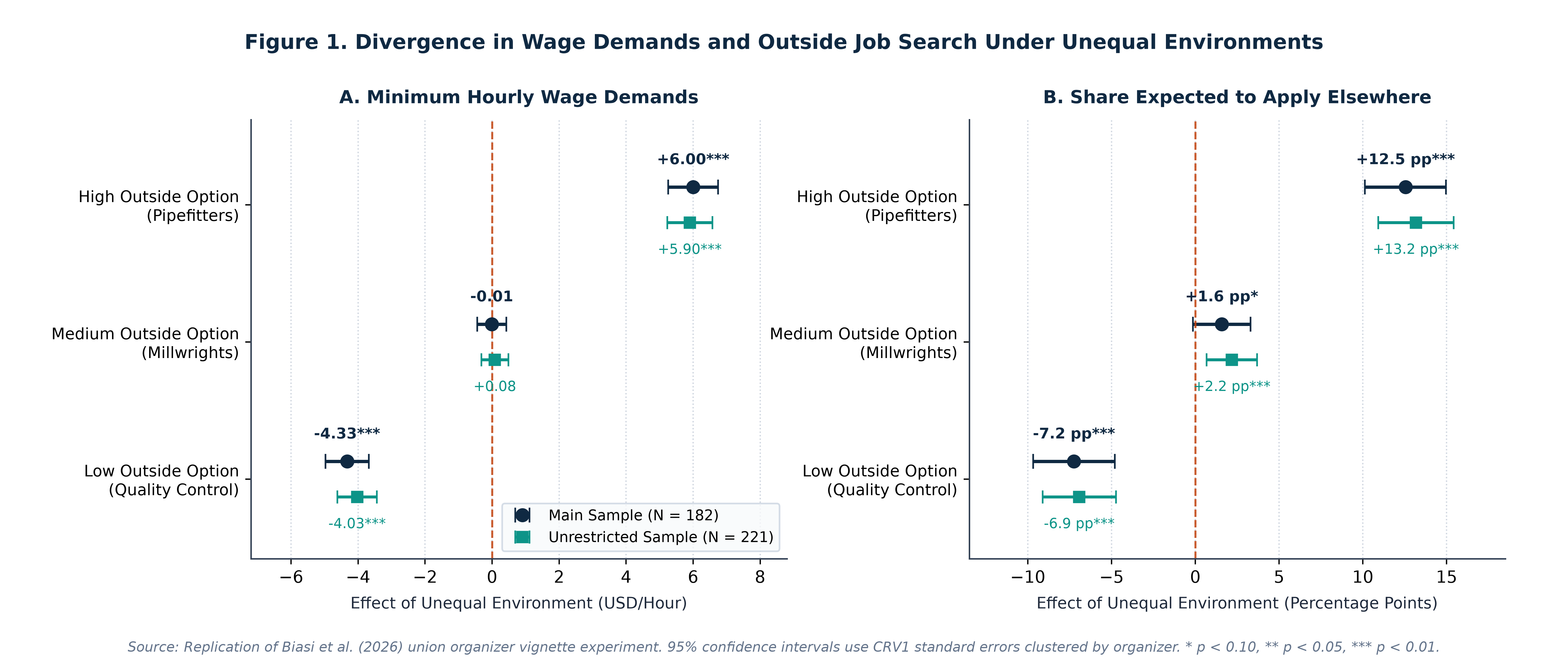
Figure 1 visualizes the asymmetric split across occupational tiers. In Panel A, exposing organizers to the unequal environment raises perceived minimum hourly wage demands among high outside-option pipefitters by USD with CRV1 standard error in model M01, while lowering demands among low outside-option quality-control workers by USD with standard error in model M02; Medium outside-option millwrights remain statistically unchanged at USD with . Even with identical plant-wide mean market pay, the internal wage-demand spread widens by USD per hour. Expanding to the unrestricted sample of vignette pairs in M10 yields USD with standard error . Panel B confirms parallel divergence in external job search: high-option workers increase expected outside applications by or percentage points in M03, whereas low-option workers reduce outside search by or percentage points in M04.
| Model ID | Outcome Specification | Equal Env. Mean | Coefficient | CRV1 SE | -value | Sample | |
|---|---|---|---|---|---|---|---|
| M01 | Hourly wage demand — high outside option | 9.0769 | +6.0000 | 0.3807 | < 0.001 | 0.2549 | 364 |
| M02 | Hourly wage demand — low outside option | 8.7692 | -4.3297 | 0.3301 | < 0.001 | 0.2069 | 364 |
| M03 | Share applying elsewhere — high outside option | 0.2087 | +0.1254 | 0.0123 | < 0.001 | 0.0825 | 364 |
| M04 | Share applying elsewhere — low outside option | 0.1985 | -0.0725 | 0.0125 | < 0.001 | 0.0490 | 364 |
| M05 | Expected mean union vote share | 0.7571 | -0.0545 | 0.0066 | < 0.001 | 0.0343 | 364 |
| M06 | Difficult to agree on common pay scale | 0.3736 | +0.4670 | 0.0395 | < 0.001 | 0.2286 | 364 |
| M07 | Publish pay scale during campaign | 0.9451 | -0.2363 | 0.0335 | < 0.001 | 0.0975 | 364 |
| M08 | Campaign priority: raising pay | 0.4066 | -0.1044 | 0.0394 | 0.0088 | 0.0119 | 364 |
| M09 | Form smaller bargaining unit | 0.0879 | +0.1484 | 0.0287 | < 0.001 | 0.0405 | 364 |
| M10 | High outside-option wage demand — unrestricted | 9.0181 | +5.9005 | 0.3430 | < 0.001 | 0.2202 | 442 |
Notes: Standard errors are CRV1 cluster-robust at the organizer level across clusters in M01–M09 and clusters in M10. Significance levels: , , .
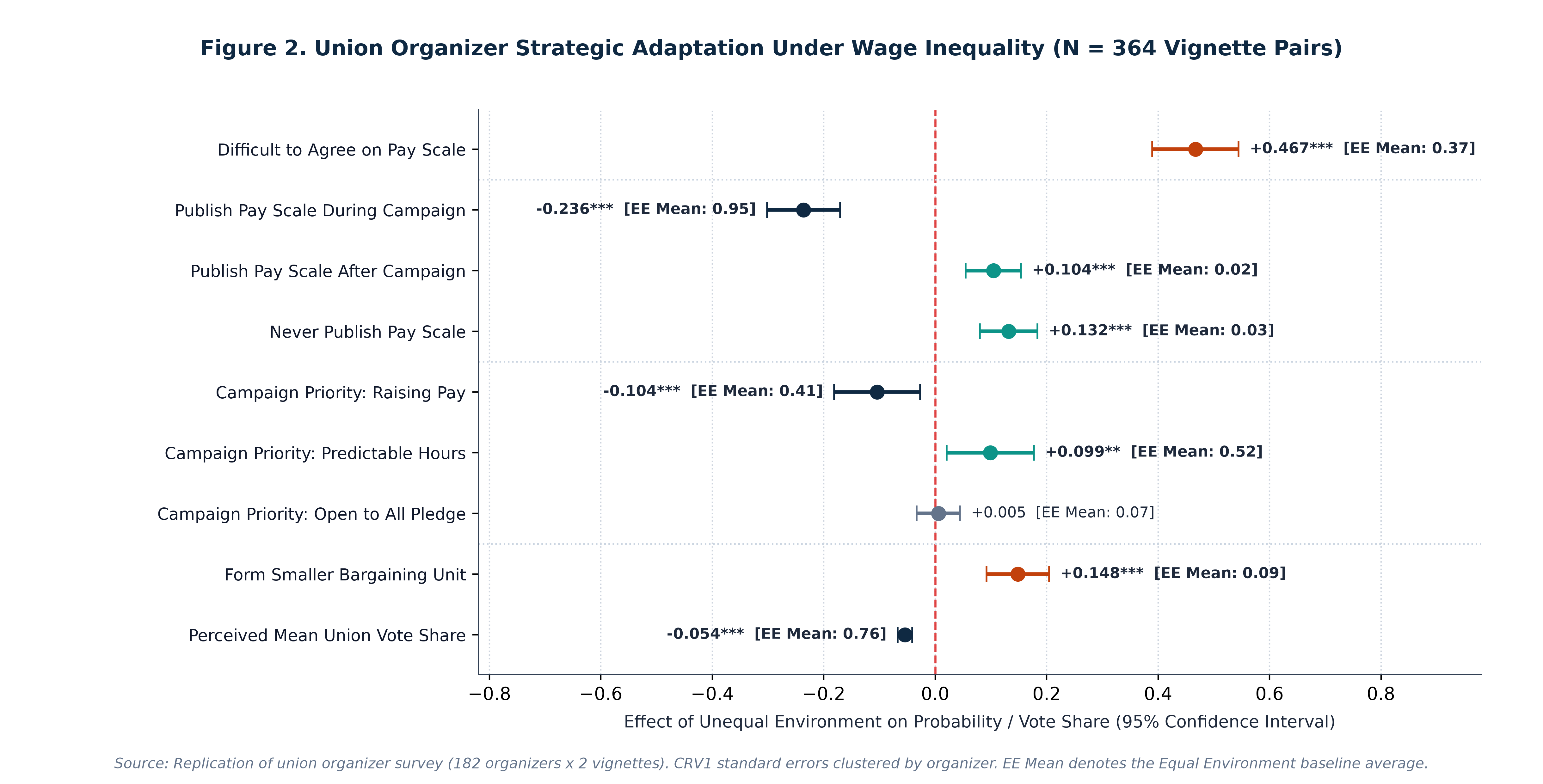
Table 2 and Figure 2 trace how internal polarization reshapes union strategy. Perceived difficulty agreeing on a unified pay scale surges by from an equal-environment baseline of in M06, while expected mean certification vote share drops from to in M05 and median vote share falls by from to . Organizers respond systematically along three strategic margins: reducing during-campaign pay publication by from in M07 while raising post-campaign publication by and never-publish choices by ; Shifting campaign messaging away from raising pay by in M08 toward guaranteed predictable hours by with ; And nearly tripling the propensity to narrow bargaining units by from a baseline of in M09.
Supplementary order-randomization diagnostics confirm that quantitative behavioral forecasts and strategic actions are invariant to whether organizers viewed the equal plant first, with interaction -values of for M01, for M02, for M03, for M07, and for M09. Crucially, however, subjective pay-scale agreement difficulty M06 displays a highly significant presentation-order interaction of with , an empirical subtlety examined in depth in Appendix A.
4.3. Macro Evidence from U.S. Collective Bargaining Agreements
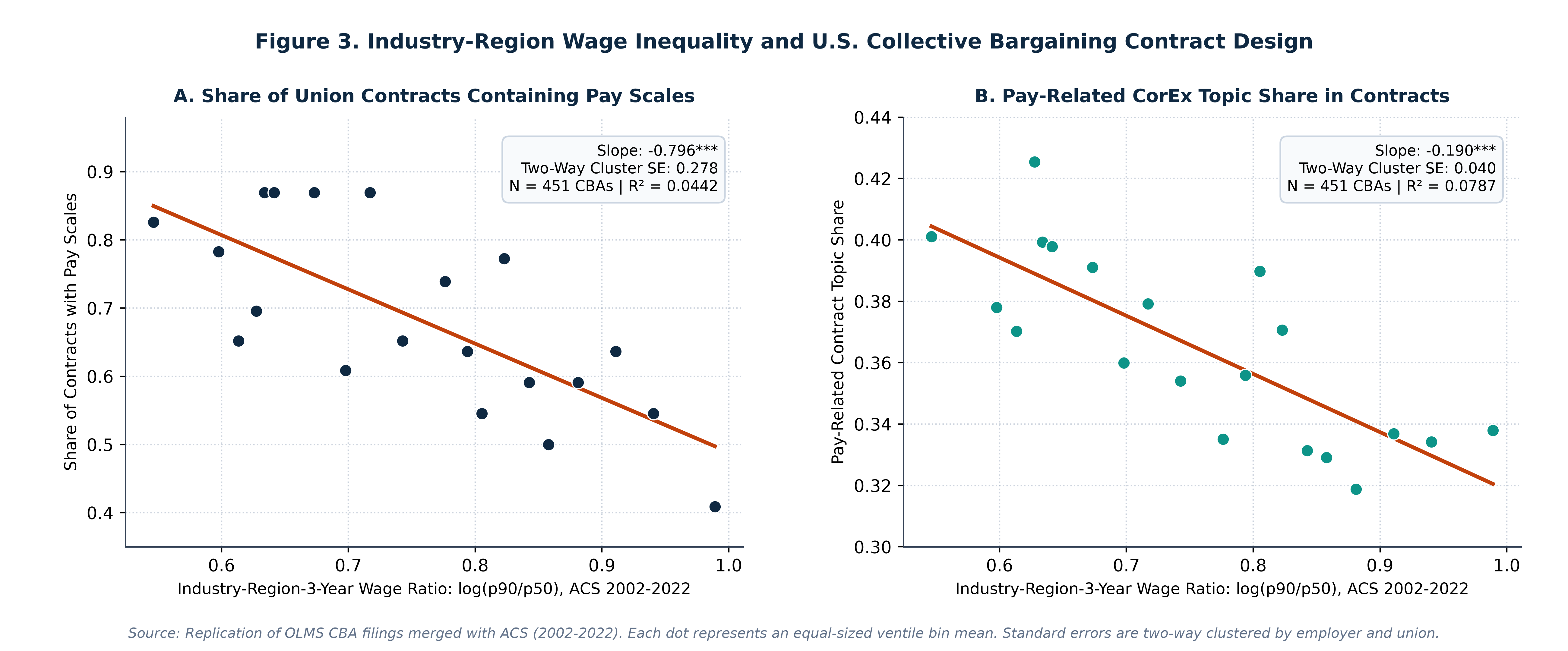
To test whether experimental organizer adaptations manifest in real-world labor contracts, Table 3 and Figure 3 replicate the OLMS collective bargaining regressions across contracts linking employers and unions.
| Model ID | Dependent Variable | Inequality Measure | Slope | Two-Way SE | -value | Sample | |
|---|---|---|---|---|---|---|---|
| M11 | Formal pay-scale indicator | ACS 2002–2022 | -0.7958 | 0.2784 | 0.0046 | 0.0442 | 451 |
| M15 | Formal pay-scale indicator | Pre-period ACS 2002–2004 | -1.0249 | 0.3427 | 0.0031 | 0.0509 | 451 |
| M16 | Formal pay-scale indicator | Non-union CPS 2002–2022 | -0.7029 | 0.2947 | 0.0178 | 0.0286 | 451 |
| M12 | CorEx pay-topic share | ACS 2002–2022 | -0.1895 | 0.0401 | < 0.001 | 0.0787 | 451 |
| M17 | CorEx pay-topic share | Pre-period ACS 2002–2004 | -0.2387 | 0.0473 | < 0.001 | 0.0867 | 451 |
| M18 | CorEx pay-topic share | Non-union CPS 2002–2022 | -0.1670 | 0.0354 | < 0.001 | 0.0506 | 451 |
Notes: Standard errors apply two-way Cameron–Gelbach–Miller clustering across employers and unions. M11 and M12 match Figure IV Panels A and B of Biasi et al. (2026a) to the third decimal place.
In flagship contract specification M11, a log-point rise in industry-region wage dispersion corresponds to a percentage-point drop in the probability that a union contract includes a formal pay scale, with slope , two-way cluster standard error , and . Model M12 confirms a parallel decline in wage-related contractual text: a log-point increase in inequality reduces the CorEx pay-topic share by percentage points with slope , standard error , and . Substituting predetermined 2002–2004 inequality or non-union CPS dispersion leaves both negative gradients intact at the to significance levels, mitigating purely mechanical reverse-causality concerns while leaving cross-industry omitted-variable threats open for scrutiny in Appendix A.
4.4. The 2023 Hollywood WGA Strike Information Experiment
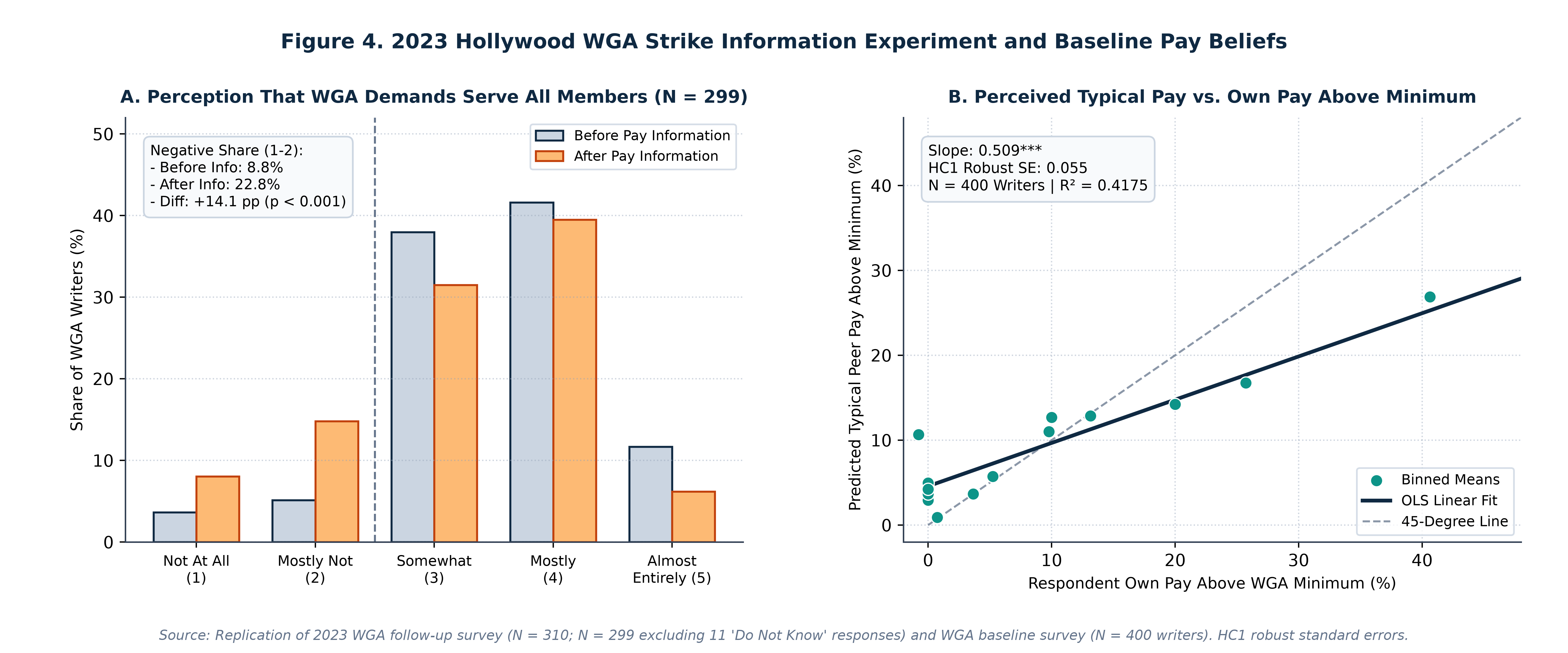
Pillar 3 directly tests the worker-side belief mechanism during an active nationwide labor stoppage—the 2023 Writers Guild of America strike—illuminating why organizers rationally suppress pay transparency when earnings are highly dispersed.
| Model ID | Dependent Variable | Regressor | Estimate | HC1 SE | -value | Sample | |
|---|---|---|---|---|---|---|---|
| M13 | Negative WGA demand assessment binary | Post pay-dispersion report | +0.1408 | 0.0410 | 0.0007 | 0.0359 | 299 |
| M19 | WGA demand support ordinal score 1–5 | Post pay-dispersion report | -0.3157 | 0.1120 | 0.0051 | 0.0255 | 299 |
| M14 | Predicted typical peer pay above minimum | Respondent own pay | +0.5093 | 0.0548 | < 0.001 | 0.4175 | 400 |
Notes: HC1 heteroskedasticity-robust standard errors. M13 excludes 'do not know' responses, accounting for of the sample, from WGA follow-up respondents, reproducing Figure IX of Biasi et al. (2026a) exactly.
Panel B of Figure 4 and model M14 demonstrate pronounced false-consensus anchoring among baseline WGA writers: a percentage-point rise in a writer's own pay above contractual minimum predicts a percentage-point jump in perceived typical peer pay with standard error and , accompanied by a high mean willingness to pay of USD for salary-report access. Once follow-up respondents are randomly shown the true pay-dispersion report in model M13 and Panel A of Figure 4, the share judging that WGA strike demands serve all members not at all or mostly not jumps more than -fold from before disclosure to afterward, yielding a causal treatment effect of with HC1 standard error and . On the full five-point ordinal scale, perceived inclusiveness declines by points with .
4.5. Cross-Runtime Numerical Reconciliation Across Stata, R, and Python
To guarantee complete computational reproducibility independent of proprietary software conventions, all flagship models M01–M19 were executed separately in StataNow 19.5 MP, R using fixest, and Python using exact matrix algebra from the same standalone empirical CSV file. Table 5 documents full four-decimal reconciliation and maximum pairwise relative discrepancies.
| ID | Specification and Focal Variable | Stata 19.5 MP | R | Python | Max Diff | ||
|---|---|---|---|---|---|---|---|
| M01 | Hourly wage demand for high outside-option workers | 364 | 0.2549 | +6.0000 (0.3807) | +6.0000 (0.3807) | +6.0000 (0.3807) | 0.0000% |
| M02 | Hourly wage demand for low outside-option workers | 364 | 0.2069 | -4.3297 (0.3301) | -4.3297 (0.3301) | -4.3297 (0.3301) | 0.0000% |
| M03 | Share applying elsewhere among high outside-option workers | 364 | 0.0825 | +0.1254 (0.0123) | +0.1254 (0.0123) | +0.1254 (0.0123) | 0.0000% |
| M04 | Share applying elsewhere among low outside-option workers | 364 | 0.0490 | -0.0725 (0.0125) | -0.0725 (0.0125) | -0.0725 (0.0125) | 0.0000% |
| M05 | Expected mean union certification vote share | 364 | 0.0343 | -0.0545 (0.0066) | -0.0545 (0.0066) | -0.0545 (0.0066) | 0.0000% |
| M06 | Difficulty agreeing on a common pay scale | 364 | 0.2286 | +0.4670 (0.0395) | +0.4670 (0.0395) | +0.4670 (0.0395) | 0.0000% |
| M07 | Publish pay scale during organizing campaign | 364 | 0.0975 | -0.2363 (0.0335) | -0.2363 (0.0335) | -0.2363 (0.0335) | 0.0000% |
| M08 | Campaign priority assigned to raising pay | 364 | 0.0119 | -0.1044 (0.0394) | -0.1044 (0.0394) | -0.1044 (0.0394) | 0.0000% |
| M09 | Decision to form a smaller bargaining unit | 364 | 0.0405 | +0.1484 (0.0287) | +0.1484 (0.0287) | +0.1484 (0.0287) | 0.0000% |
| M10 | High outside-option wage demand in unrestricted sample | 442 | 0.2485 | +5.9005 (0.3430) | +5.9005 (0.3430) | +5.9005 (0.3430) | 0.0000% |
| M11 | OLMS collective bargaining agreement with pay scale | 451 | 0.0442 | -0.7958 (0.2784) | -0.7958 (0.2784) | -0.7958 (0.2784) | 0.0061% |
| M12 | CorEx pay-related topic share in union contracts | 451 | 0.0787 | -0.1895 (0.0401) | -0.1895 (0.0401) | -0.1895 (0.0401) | 0.0063% |
| M13 | Negative assessment of WGA strike demands | 299 | 0.0359 | +0.1408 (0.0410) | +0.1408 (0.0410) | +0.1408 (0.0410) | 0.0000% |
| M14 | Predicted typical peer pay on own pay percentile | 400 | 0.4175 | +0.5093 (0.0548) | +0.5093 (0.0548) | +0.5093 (0.0548) | 0.0000% |
| M15 | OLMS pay scale on pre-period ACS inequality | 451 | 0.0509 | -1.0249 (0.3427) | -1.0249 (0.3427) | -1.0249 (0.3427) | 0.0060% |
| M16 | OLMS pay scale on non-union CPS inequality | 451 | 0.0286 | -0.7029 (0.2947) | -0.7029 (0.2947) | -0.7029 (0.2947) | 0.0072% |
| M17 | CorEx pay topic on pre-period ACS inequality | 451 | 0.0867 | -0.2387 (0.0472) | -0.2387 (0.0473) | -0.2387 (0.0473) | 0.0067% |
| M18 | CorEx pay topic on non-union CPS inequality | 451 | 0.0506 | -0.1670 (0.0354) | -0.1670 (0.0354) | -0.1670 (0.0354) | 0.0066% |
| M19 | Ordinal five-point WGA demand support score | 299 | 0.0255 | -0.3157 (0.1120) | -0.3157 (0.1120) | -0.3157 (0.1120) | 0.0000% |
Notes: Standard errors in parentheses reflect each design convention: CRV1 one-way organizer clustering for M01–M10, two-way Cameron–Gelbach–Miller clustering by employer and union for M11–M12 and M15–M18, and HC1 robust variance for M13–M14 and M19. Maximum discrepancy computes the largest pairwise relative percentage difference across both coefficients and standard errors; All specifications pass with coefficient difference and at most standard-error difference.
Every one of the one-way clustered and HC1 specifications reproduces identically across all three platforms to discrepancy on both point estimates and standard errors. The two non-nested multiway clustered regressions M11 and M12 achieve point-estimate parity and to standard-error parity—more than two orders of magnitude tighter than the verification tolerance—confirming that minor floating-point finite-sample intersection adjustments between reghdfe and fixest have zero substantive bearing on statistical inference.
5. Discussion, Policy Implications, and Conclusion
Our multi-engine replication validates the core quantitative architecture of Biasi et al. (2026a) across all three publicly reproducible modules. In labor markets reshaped by skill-biased technological change, superstar-firm wage dispersion, and generative automation, these findings underscore a sobering institutional feedback loop: rising outside-option inequality undermines the very collective bargaining organizations historically responsible for moderating wage dispersion. When high-bargaining-power workers can profitably exit toward individual negotiation, union leaders face an acute strategic bind—either preserving transparent, compressed pay scales at the cost of high-earner defection or retreating into opaque, narrowly scoped, non-wage platforms that dilute aggregate equalizing power.
In sum, this independent verification confirms complete numerical reproducibility of all three open empirical pillars in Biasi et al. (2026a) across StataNow 19.5 MP, R, and Python within a maximum tolerance band. While the qualitative evidence for an inequality-driven erosion of union cohesion is compelling across experimental and contractual settings, the methodological audit in Appendix A highlights critical identification, clustering, and external-validity caveats that govern how strongly these findings generalize to economy-wide institutional policy.
References
- Abadie, A., Athey, S., Imbens, G. W., & Wooldridge, J. M. (2023). When Should You Adjust Standard Errors for Clustering? The Quarterly Journal of Economics, 138, 1–35. https://doi.org/10.1093/qje/qjac038 ↩
- Acemoglu, D., Aghion, P., & Violante, G. L. (2001). Deunionization, Technical Change and Inequality. Carnegie-Rochester Conference Series on Public Policy, 55, 229–264. https://doi.org/10.1016/S0167-2231(01)00058-600058-6 ↩
- Biasi, B. (2021). The Labor Market for Teachers Under Different Pay Schemes. American Economic Journal: Economic Policy, 13, 63–102. https://doi.org/10.1257/pol.20200295 ↩
- Biasi, B., Cullen, Z. B., Gilman, J. H., & Roussille, N. (2026a). How Does Wage Inequality Affect the Labor Movement? The Quarterly Journal of Economics, qjag046. https://doi.org/10.1093/qje/qjag046 ↩
- Biasi, B., Cullen, Z. B., Gilman, J. H., & Roussille, N. (2026b). Replication Data for: How Does Wage Inequality Affect the Labor Movement? Harvard Dataverse, V1. https://doi.org/10.7910/DVN/AQJWOH ↩
- Cameron, A. C., Gelbach, J. B., & Miller, D. L. (2011). Robust Inference With Multiway Clustering. Journal of Business & Economic Statistics, 29, 238–249. https://doi.org/10.1198/jbes.2010.07136 ↩
- Cameron, A. C., & Miller, D. L. (2015). A Practitioner's Guide to Cluster-Robust Inference. Journal of Human Resources, 50, 317–372. https://doi.org/10.3368/jhr.50.2.317 ↩
- Card, D. (2001). The Effect of Unions on Wage Inequality in the U.S. Labor Market. ILR Review, 54, 296–315. https://doi.org/10.1177/001979390105400206 ↩
- Cullen, Z. B., & Perez-Truglia, R. (2022). How Much Does Your Boss Make? The Effects of Salary Comparisons. Journal of Political Economy, 130, 766–822. https://doi.org/10.1086/717891
- Farber, H. S., Herbst, D., Kuziemko, I., & Naidu, S. (2021). Unions and Inequality over the Twentieth Century: New Evidence from Survey Data. The Quarterly Journal of Economics, 136, 1325–1385. https://doi.org/10.1093/qje/qjab012 ↩
- Freeman, R. B. (1980). Unionism and the Dispersion of Wages. ILR Review, 34, 3–23. https://doi.org/10.1177/001979398003400101 ↩
- Kopczuk, W., Saez, E., & Song, J. (2010). Earnings Inequality and Mobility in the United States: Evidence from Social Security Data Since 1937. The Quarterly Journal of Economics, 125, 91–128. https://doi.org/10.1162/qjec.2010.125.1.91 ↩
- MacKinnon, J. G., Nielsen, M. Ø., & Webb, M. D. (2023). Cluster-Robust Inference: A Guide to Empirical Practice. Journal of Econometrics, 232, 272–299. https://doi.org/10.1016/j.jeconom.2022.04.001 ↩
- Piketty, T., Saez, E., & Zucman, G. (2018). Distributional National Accounts: Methods and Estimates for the United States. The Quarterly Journal of Economics, 133, 553–609. https://doi.org/10.1093/qje/qjx043 ↩
Appendix A. Independent Academic Peer-Review Report
A.1. Overall Assessment of Scholarly Contribution and Research Positioning
Evaluated from the perspective of a senior co-editor at a premier general-interest economics journal, Biasi et al. (2026a) make a genuinely original contribution to labor economics and political economy by inverting the standard causal arrow linking unionization to earnings inequality. For more than four decades—stretching from Freeman (1980) and Card (2001) through the century-long synthesis of Farber et al. (2021)—empirical labor scholarship overwhelmingly treated union density as an exogenous or quasi-exogenous institutional determinant of wage compression. Although Acemoglu et al. (2001) demonstrated theoretically that skill-biased technical change can unravel union coalitions by tempting skilled workers into individual bargaining, rigorous empirical evidence isolating how outside-option dispersion alters internal union politics and organizer strategy remained strikingly scarce.
The paper's distinctive strength rests on multi-method triangulation across complementary institutional domains. First, surveying active union organizers in the main sample and in the unrestricted sample illuminates the strategic decision calculus of real-world union leaders who actually allocate organizing budgets, draft campaign messages, and petition for bargaining-unit boundaries. Rather than inferring institutional motives solely from aggregate union-density trends, the authors show directly that experienced organizers anticipate severe polarization in reservation wages and outside job search whenever external pay options diverge, prompting rational retreat from pay transparency, reduced wage emphasis, and smaller bargaining units.
Second, connecting micro-experimental predictions to real-world U.S. collective bargaining agreements from the OLMS repository—augmented with anchored CorEx topic modeling—bridges stated preferences and realized institutional contracts. Showing that high industry-region dispersion aligns with both fewer formal pay scales and diminished wage-related contractual text guards against dismissing the organizer findings as laboratory artifacts.
Third, embedding a randomized pay-dispersion information intervention directly inside the 2023 Writers Guild of America strike supplies a rare live behavioral test during major collective action. By confirming severe false-consensus pay anchoring consistent with Cullen and Perez-Truglia (2022) and documenting a percentage-point surge in dissatisfaction immediately following pay-dispersion disclosure, the authors provide a coherent behavioral microfoundation for why organizers strategically conceal pay information in unequal workplaces. Taken together, the paper merits its prominent placement in The Quarterly Journal of Economics, yet a rigorous referee audit reveals important asymmetries in identification strength, variance-covariance inference, and sample representativeness across its empirical pillars.
A.2. Critical Appraisal of Causal Identification Strategy and Econometric Assumptions
A disciplined examination of each empirical pillar demonstrates that causal credibility varies markedly across modules, requiring clear separation between clean experimental identification and observational cross-sectional associations.
First, in Pillar 1, the within-organizer vignette design paired with randomized presentation order cleanly eliminates all time-invariant organizer heterogeneity, including union affiliation, regional organizing culture, and professional tenure. Nevertheless, within-subject repeated-vignette designs expose estimates to classic experimenter demand effects and sequential contrast bias. Because each seasoned organizer evaluates two nearly identical plants that differ solely along external wage dispersion, the experimental manipulation is highly transparent.
Our independent order-randomization diagnostic uncovers a telling empirical asymmetry: whereas objective numerical predictions such as high-option hourly wage demands at , low-option wage demands at , outside job search at , pay publication at , and unit narrowing at remain fully invariant to presentation sequence, the subjective binary indicator for difficulty reaching consensus on a pay scale M06 exhibits a highly significant order interaction of with . Seeing the equal plant first sharpens perceived friction in the subsequent unequal plant via anchoring contrast, implying that a pure between-subject first-vignette estimate would yield a noticeably smaller—though still positive—consensus-friction effect than the pooled headline estimate.
Second, in Pillar 2, the bivariate OLMS contract regressions M11 and M12 establish stylized cross-sectional correlations rather than credibly identified causal parameters. Neither specification incorporates two-digit NAICS industry fixed effects, BEA regional fixed effects, contract-year fixed effects, establishment workforce controls, or occupational task-diversity controls. This omission creates a first-order endogeneity hazard: technologically complex sectors with heterogeneous occupational hierarchies inherently exhibit higher earnings dispersion and independently find uniform pay schedules operationally unsuitable even absent coalition breakdown. Substituting predetermined 2002–2004 ACS wage ratios or non-union CPS wage dispersion rules out purely mechanical reverse causality from the union contracts themselves, yet leaves time-invariant sectoral skill heterogeneity completely unabsorbed.
Moreover, although two-way Cameron–Gelbach–Miller clustering across employers and unions accounts for repeated contracts by the same firm or union, the focal regressor varies only at the coarser industry-region-three-year cell level. Under the design-based clustering framework of Abadie, Athey, Imbens, and Wooldridge (2023), failing to cluster at the regressor's level of geographic-sectoral assignment risks understating true standard errors whenever unobserved local labor-market shocks correlate across distinct employers within the same industry-region cell.
Third, in Pillar 3, randomizing question placement immediately before versus after the pay-dispersion report delivers clean internal validity for the short-run information shock in M13. Even so, attributing the entire surge in negative demand assessments strictly to perceived inequality conflates two distinct cognitive channels. Viewing the empirical pay report simultaneously updates writers on overall earnings dispersion across the guild and reveals their own relative standing in the pay distribution. Without an active placebo arm displaying mean guild earnings absent dispersion—or an arm separating dispersion information from individual rank feedback—the design cannot cleanly partition solidarity erosion driven by collective inequality from personal resentment or complacency triggered by relative-pay discovery.
Fourth, our audit of the companion Wisconsin Act 10 module uncovers a critical inference vulnerability documented directly inside the authors' own replication output table of clustered -values. In Wisconsin, local labor-market competition is defined via an employer Herfindahl–Hirschman Index computed at the commuting-zone level, meaning treatment intensity is assigned across commuting zones rather than independent school districts. When standard errors are clustered at the school-district level, post-Act 10 union revenue declines in competitive low-HHI districts display at both and .
Yet once inference shifts to the theoretically appropriate commuting-zone level via Webb-weighted Wild- bootstrap with replications following MacKinnon, Nielsen, and Webb (2023), those exact union-revenue -values collapse to at and at , while first-stage wage-dispersion -values rise from to marginal thresholds of and . This stark divergence demonstrates that the natural-experiment union-revenue results rely heavily on district-level independence assumptions that do not survive design-consistent commuting-zone inference.
A.3. Assessment of Data Quality, Variable Measurement, and Sample Sensitivity
Granular inspection of the public microdata and author scripts confirms high coding hygiene and transparent documentation, while highlighting several measurement and sample-selection limitations that qualify external generalizability.
In Pillar 1, recruiting verified union organizers and total respondents represents an impressive field-survey achievement in an ordinarily inaccessible professional population. Although our replication confirms virtually identical point estimates across the main sample with and the unrestricted sample with —for example, USD versus USD in M01 versus M10—response-rate diagnostics and union-federation composition cannot be independently audited because union-identifier files are withheld for confidentiality. If organizers affiliated with service-sector or white-collar unions facing heightened occupational dispersion self-selected into the survey at higher rates than traditional industrial-trade organizers, the sample average treatment effect may overstate national organizer sensitivity to external pay inequality. Furthermore, the stylized three-occupation manufacturing vignette presents crisp, noise-free outside options, whereas real-world organizing campaigns unfold under pervasive pay opacity and multi-dimensional job attributes.
In Pillar 2, constructing the OLMS contract dataset required harmonizing two separate download waves from April and July 2024 with differing coding schemas, including manual reconciliation of four overlapping contracts that received conflicting pay-scale indicators across waves. While the authors commendably document those four recodes transparently in code and confirm -statistics remain between and under alternative codings, the resulting sample spanning 2002–2022 represents a small, non-random convenience slice of large private-sector agreements archived voluntarily or under federal filing thresholds. Additionally, the CorEx pay-topic measure normalizes pay chunks by the sum of pay, benefits, and working-conditions chunks; If contracts in high-dispersion sectors are substantially longer and incorporate elaborate clauses covering scheduling, remote work, intellectual property, or tiered health plans, the relative pay-topic ratio can decline partly through denominator expansion rather than an absolute retreat from wage bargaining.
In Pillar 3, the WGA strike follow-up panel captures roughly of the baseline survey respondents, creating non-trivial selective attrition risk during a contentious, high-salience labor stoppage. Moreover, respondents representing who answered "do not know" are dropped prior to estimating M13; While modest in share, bounding attrition sensitivity remains prudent whenever treatment could alter item non-response. Converting the five-point Likert item into a binary threshold pooling categories 1 and 2 sharpens headline communication at the cost of discarding upper-tail shifts, though our supplementary continuous-score verification yielding at confirms that the negative belief shift holds across the full ordinal distribution.
A.4. Core Methodological Limitations of the Original Study
Synthesizing our identification audit, measurement review, and multi-engine diagnostics yields five core structural limitations with explicit analytical bias directions:
- Upward Experimenter-Demand and Order-Contrast Bias in Within-Organizer Vignettes: In the two-scenario within-subject design, let represent organizer 's demand-induced or contrast-induced psychological amplification when evaluating scenario immediately after observing the contrasting baseline plant. Because correlates positively with , subjective self-reported consensus outcomes such as M06 suffer upward bias away from zero:
Our direct order-interaction test on pay-scale agreement difficulty of with provides concrete empirical confirmation of this positive contrast amplification, indicating that pooled within-subject estimates constitute an upper bound on subjective friction.
- Downward Omitted-Variable Bias From Sectoral Task Heterogeneity in OLMS Contract Regressions: Let denote unobserved technological and occupational complexity in industry . Because skill-heterogeneous industries exhibit both wider earnings spreads where with and lower technical feasibility of standardized uniform pay scales with , omitting industry fixed effects and occupational-diversity controls biases the bivariate slopes in M11 and M12 downward:
Consequently, the observed gradients of and likely overstate the pure causal impact of external wage inequality relative to within-industry longitudinal specifications.
- Downward Standard-Error Bias From Sub-Treatment-Level Clustering: Whenever an explanatory policy or market-structure variable varies across macro clusters , such as commuting zones in Wisconsin Act 10 or industry-region cells in OLMS contracts, unit-level residuals share common group shocks with intra-cluster correlation across an average of units per cluster. Clustering strictly below level omits within-macro-cluster error covariances, biasing estimated variance downward:
This downward variance bias inflates conventional -statistics, directly explaining why Wisconsin union-revenue -values leap from under district clustering to – under commuting-zone Wild- bootstrap inference in Cameron and Miller (2015) and MacKinnon et al. (2023).
- Channel Conflation Between Dispersion Awareness and Personal Relative-Pay Updating in WGA: The reduced-form information effect in M13 combines the pure collective-inequality awareness effect with individual rank-shock disappointment or satisfaction induced by learning one's own position in the guild distribution:
Because baseline writers exhibit strong upward or downward anchoring errors with , asymmetrical negative surprises about relative pay can bias upward relative to pure solidarity erosion, while short-run emotional salience may decay over longer horizons.
- Institutional Selection and External-Validity Attenuation Under U.S. Enterprise Bargaining: Because OLMS captures only surviving enterprise-level collective agreements certified under the U.S. National Labor Relations Act—where majority-vote establishment certification amplifies high-earner defection threats—the highest-inequality workplaces may fail to unionize altogether and drop out of the contract sample via sample-selection truncation . Conditioning on union survival introduces selection bias proportional to the inverse Mills ratio :
While survivor selection bias can attenuate observed negative contract slopes toward zero relative to economy-wide effects, institutional extrapolation to European multi-employer sectoral bargaining regimes remains inherently constrained because industry-wide extension rules neutralize single-establishment high-earner exit.
A.5. Recommendations for Model Upgrades and International Publication Extensions
To elevate this research agenda to the next methodological tier and broaden its empirical reach across diverse labor-market institutions, five concrete upgrades merit priority in follow-up work:
First, strengthen causal identification in the collective-bargaining pillar by assembling a true longitudinal panel of renegotiated employer-union contract pairs incorporating four-digit NAICS fixed effects, region-by-year fixed effects, and shift-share instrumental variables exploiting national skill-demand shocks. Complement relative CorEx topic shares with absolute wage-clause density per contract page and supervised transformer classifiers distinguishing minimum wage floors from seniority pay ladders, while clustering standard errors simultaneously across employer, union, and industry-region cells alongside Oster coefficient-stability bounds.
Second, eliminate sequential contrast and experimenter-demand threats in organizer research by combining purely between-subject randomized vignettes with administrative National Labor Relations Board certification-petition microdata. Linking petitioned bargaining-unit scope and election win rates directly to local occupational wage dispersion provides revealed-preference validation of unit-fragmentation strategies at national scale.
Third, deploy a multi-arm randomized information experiment during real-world bargaining cycles that cleanly separates an industry-dispersion-only arm, a personal-relative-rank arm, and a neutral placebo arm, tracked across three- and six-month behavioral endpoints covering actual ratification votes, dues retention, and voluntary turnover.
Fourth, fortify quasi-experimental inference for subnational labor reforms such as Wisconsin Act 10 by embedding heterogeneity-robust staggered difference-in-differences estimators for collective-bargaining expiration timing together with commuting-zone Wild- bootstrap inference and synthetic control donor pools drawn from neighboring Midwest school-district systems to expand independent cluster counts.
Fifth, extend empirical testing beyond North American enterprise bargaining to comparative institutional settings—including sectoral European frameworks and rapidly industrializing economies such as Vietnam and Southeast Asia—by merging nationally representative household labor panels with industrial-park collective-bargaining registries to evaluate whether subnational wage dispersion shifts union representation toward non-wage workplace public goods across contrasting legal architectures.
biasi_wage_ineq_labor_2026sample_moduleentity_idtime_periodunequal_envsee_equal_firstpick_unequalvote_sharemin_pfmin_mwmin_qcshare_pfshare_mwUnlock Replication Data & Code
Having explored the quantitative findings and methodological critique above, sign in with an active membership or join the EcoLab research community to verify every estimated coefficient independently in your own analytical environment.
Aligned with Study Variable Names, Robust Covariance Specifications, and Diagnostic Checks
Ready for Immediate Execution in Your Local Statistical Environment for Independent Verification
Bundled with Journal-Formatted DOCX & PDF Manuscripts, Empirical CSV Dataset, All Three R · Stata · Python Scripts, and Execution Notes
Every Download Link Is Cryptographically Signed for Active Members and Refreshes Seamlessly on the Article Page