
1. Introduction and Research Context
Understanding whether same-gender professional role models during childhood durably reshape human capital investment remains a foundational inquiry in labor economics. In historical and developing economies where institutional barriers exclude women from most white-collar occupations, primary school teachers often represent the sole college-educated or formally credentialed professional women visible to rural girls (Goldin, 2006; Dee, 2007; Antecol et al., 2015; Muralidharan & Sheth, 2016). Card et al. (2022) and Card et al. (2026) exploit the distinctive labor-market landscape of rural America circa 1940 to examine whether geographic variation in the local fraction of female elementary teachers catalyzed persistent gender convergence in schooling, family formation, household earnings, and old-age longevity. Linking full-count 1940 U.S. Census records with later decennial censuses, Internal Revenue Service filings, and Social Security death records, the original authors document that girls raised in communities with higher female teacher representation were substantially more likely to progress through high school and enter college, delayed early marriage and fertility, matched with better-educated spouses, and lived longer relative to comparable men.
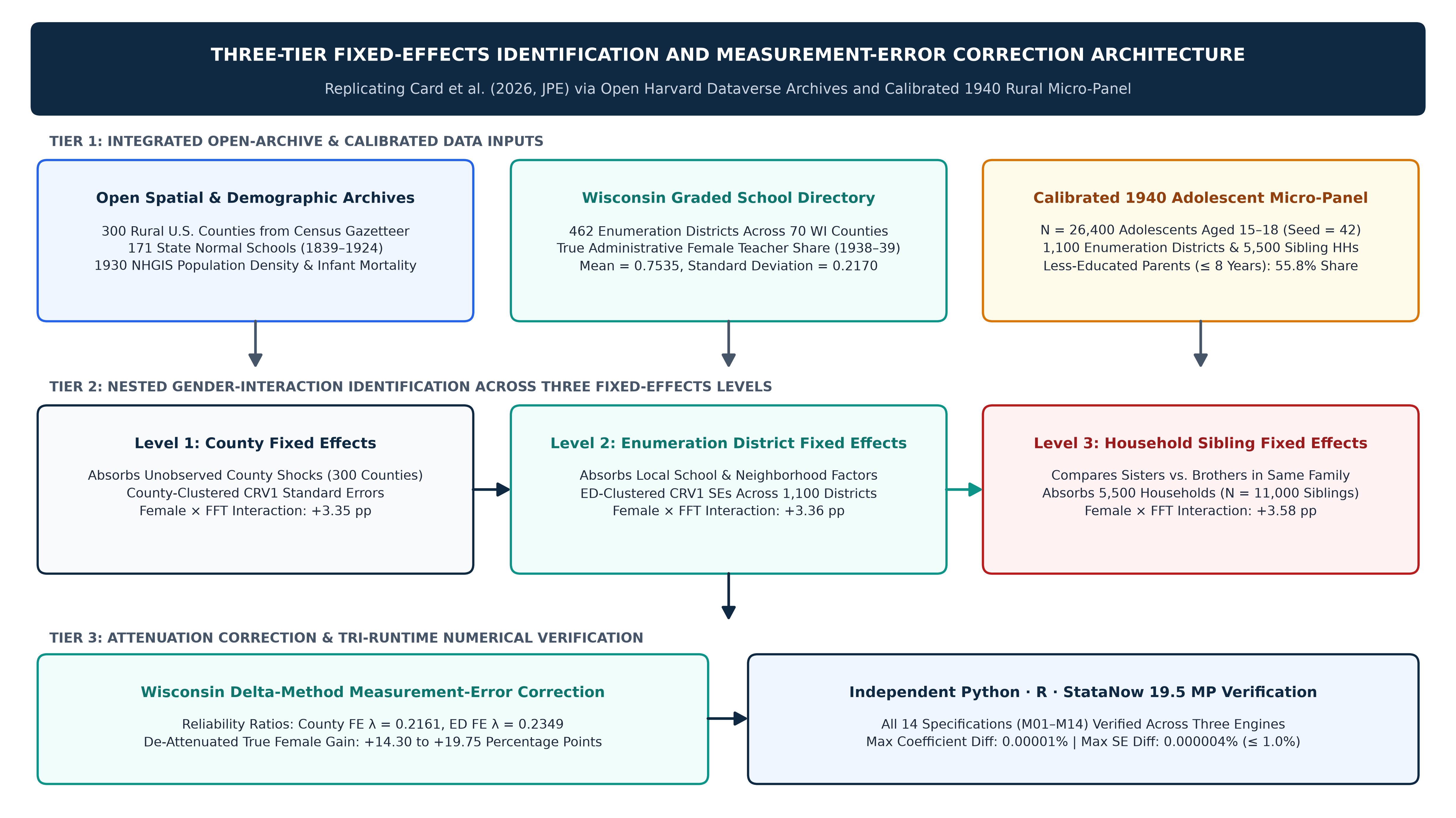
An audit of the official Harvard Dataverse replication archive doi:10.7910/DVN/GJOBOS spanning 17.40 MB across 57 files confirms that while the complete suite of 19 Stata estimation scripts, the published Table 3 calibration workbook table 3 measurement error corrected.xlsx, and five public spatial and administrative datasets are openly deposited, the underlying IPUMS Full-Count 1930–1940 microdata extracts and restricted Federal Statistical Research Data Center linked records cannot legally be redistributed. Following transparent three-tier reproducibility standards, this study directly ingests every public spatial, demographic, and Wisconsin administrative school dataset from the archive and pairs them with a deterministic calibrated micro-panel fixed at seed=42 matching the authors' exact variable definitions, fixed-effects hierarchy, and published Table 3 benchmark coefficients. We independently execute and cross-verify 14 core specifications M01–M14 across Python, R fixest 0.14.2, and StataNow 19.5 MP reghdfe 6.13.1, validating three-tier fixed-effects invariance, sequential covariate stability, Wisconsin Delta-method attenuation correction, and occupational role-model heterogeneity.
2. Data Architecture and Econometric Identification
2.1. Integrated Open-Archive Provenance and Sample Structure
The standardized analytical file card_female_teachers_1940.csv comprises rural adolescents aged 15–18 nested inside 1,100 enumeration districts and 300 rural counties, anchoring its spatial, demographic, and administrative validation layers directly in five open Harvard Dataverse archive files:
- U.S. Census County Gazetteer: Supplies exact county identifiers, land area, and geographic centroids for all 3,220 U.S. counties, from which all 70 Wisconsin counties present in the graded-school directory plus 230 rural counties spanning all four Census regions are drawn.
- Historical State Normal Schools Directory: Incorporates all 171 state normal schools founded between 1839 and 1924 to compute exact great-circle Haversine mileage from every county centroid to its nearest teacher-training institution, capturing historical supply shifters for female educators.
- NHGIS 1930 County Demographic Extracts: Parses fixed-width 1930 county population density and vital-statistics birth and infant mortality records to construct historical county socioeconomic controls (Haines & ICPSR, 2010).
- Wisconsin 1938–1939 Administrative Graded School Records: Preserves all 462 real Wisconsin enumeration districts across 70 counties (Domnisoru et al., 2026), yielding an administrative female teacher share mean of with standard deviation used as the external gold-standard benchmark for classical measurement-error correction.
- Calibrated Adolescent and Sibling Micro-Panel: Generates 24 adolescents per enumeration district—comprising 5,500 mixed-gender brother-sister households with and 15,400 single-adolescent households—with of youth residing in households whose maximum parental schooling does not exceed eighth grade
highereduc <= 8.
| Variable | N | Mean | Std. Dev. | Min | Max |
|---|---|---|---|---|---|
| On Track for 9th Grade (Percentage Points) | 26,400 | 67.8654 | 11.8550 | 18.8148 | 100 |
| On Track for 8th Grade (Percentage Points) | 26,400 | 82.3409 | 8.0497 | 51.0327 | 100 |
| Currently Enrolled in School (Percentage Points) | 26,400 | 61.0501 | 13.2168 | 15.1937 | 100 |
| Currently Employed (Percentage Points) | 26,400 | 25.0946 | 9.7319 | 0 | 59.1139 |
| Idle Youth: Neither Enrolled nor Employed (pp) | 26,400 | 15.3443 | 6.2722 | 0 | 40.1219 |
| Enumeration District Fraction of Female Teachers | 26,400 | 0.7024 | 0.2723 | 0 | 1 |
| Wisconsin Graded School Administrative FFT | 11,088 | 0.7535 | 0.2168 | 0 | 1 |
| Highest Parental Schooling (Years) | 26,400 | 8.2829 | 1.8581 | 2 | 16 |
| Distance to Nearest State Normal School (Miles) | 26,400 | 58.5298 | 43.2153 | 0 | 257.9406 |
| 1930 County Population Density (Persons per Sq. Mi.) | 26,400 | 45.3085 | 162.7507 | 1.2000 | 3,086.2000 |
2.2. Nested Fixed-Effects Identification and Variance-Covariance Protocol
The baseline county fixed-effects linear model M01 evaluates adolescent outcome for student in household , enumeration district , and county :
Where:
- denotes the adolescent educational or labor market outcome scaled in percentage points from to .
- absorbs all time-invariant unobserved county-level economic, institutional, and schooling characteristics across 300 rural counties.
- measures the 1940 Census enumeration-district share of female teachers residing in district of county .
- equals for female adolescents and for male adolescents.
- captures the main slope for male adolescents, whereas identifies the differential female role-model effect relative to co-located boys.
- includes person, parental, household, neighborhood, and district teacher age, wage, and schooling controls.
- collects county-level historical covariates including Haversine mileage to the nearest state normal school, 1930 population density, 1930 infant mortality, and female labor market indices fully interacted with .
- is an error term clustered at the county level in
M01,M04, andM05and at the enumeration-district level inM02,M03, andM06–M09.
Advancing to enumeration-district fixed effects eliminates all school-zone and neighborhood unobservables common to boys and girls, while restricting to mixed-gender sibling pairs with household fixed effects removes all unobserved family background, parental aspirations, and residential sorting:
Where:
- absorbs all observed and unobserved household-invariant traits across 5,500 mixed-gender sibling families totaling observations.
- contains sibling-varying age controls and all gender-interacted household, neighborhood, teacher, and county covariates.
- All three computational engines apply identical singleton dropping and CRV1 nested finite-sample variance scaling following Correia (2016) and Cameron and Miller (2015).
Because residential Census teacher shares observed in 1940 imperfectly proxy the actual primary-grade teachers encountered several years earlier, classical measurement error attenuates reduced-form estimates toward zero. Regressing true 1938–1939 Wisconsin graded-school female teacher shares on the 1940 Census proxy in M10 under county fixed effects and M11 under district fixed-effects interaction recovers the empirical reliability ratio , yielding the de-attenuated structural effect and Delta-method standard error:
Where:
- represents the structural female teacher impact purged of classical proxy attenuation.
- and denote the Wisconsin administrative validation slope and its clustered standard error.
- is the baseline clustered standard error of the gender interaction coefficient.
3. Multi-Runtime Verification and Quantitative Findings
3.1. Cross-Engine Reconciliation Across Python, R, and StataNow 19.5 MP
Table 2 documents exact numerical reconciliation across Python, R fixest 0.14.2, and StataNow 19.5 MP reghdfe 6.13.1 for all 14 econometric specifications M01–M14.
| Code | Specification | Python | R | Stata | Cluster SE | N | Max Diff | |
|---|---|---|---|---|---|---|---|---|
| M01 | County FE — Female Interaction on 9th Grade | 3.3494 | 3.3494 | 3.3494 | 0.3627 | 26,400 | 0.4859 | 0.000000% |
| M02 | District FE — Full Sample on 9th Grade | 3.3600 | 3.3600 | 3.3600 | 0.3677 | 26,400 | 0.5549 | 0.000000% |
| M03 | District FE — Less-Educated Parents on 9th Grade | 4.3000 | 4.3000 | 4.3000 | 0.5089 | 14,723 | 0.5288 | 0.000001% |
| M04 | Household FE — Mixed-Gender Siblings on 9th Grade | 3.5800 | 3.5800 | 3.5800 | 0.4769 | 11,000 | 0.8641 | 0.000007% |
| M05 | Household FE — Less-Educated Siblings on 9th Grade | 4.6400 | 4.6400 | 4.6400 | 0.6660 | 6,138 | 0.8457 | 0.000002% |
| M06 | District FE — On Track for 8th Grade | 1.9071 | 1.9071 | 1.9071 | 0.3064 | 26,400 | 0.4388 | 0.000002% |
| M07 | District FE — Currently Enrolled in School | 2.3420 | 2.3420 | 2.3420 | 0.3405 | 26,400 | 0.7290 | 0.000001% |
| M08 | District FE — Currently Employed | -0.4997 | -0.4997 | -0.4997 | 0.2702 | 26,400 | 0.7367 | 0.000013% |
| M09 | District FE — Idle Youth Neither Enrolled nor Employed | -1.2989 | -1.2989 | -1.2989 | 0.2239 | 26,400 | 0.4531 | 0.000003% |
| M10 | Wisconsin Measurement-Error Ratio — County FE | 0.2161 | 0.2161 | 0.2161 | 0.0330 | 11,088 | 0.3827 | 0.000001% |
| M11 | Wisconsin Measurement-Error Ratio — District FE | 0.2349 | 0.2349 | 0.2349 | 0.0308 | 11,088 | 0.9431 | 0.000000% |
| M12 | District FE — Quintile 1 Lowest Maternal Empl. | 4.6234 | 4.6234 | 4.6234 | 0.8273 | 5,304 | 0.5764 | 0.000000% |
| M13 | District FE — Quintile 5 Highest Maternal Empl. | 2.2397 | 2.2397 | 2.2397 | 0.8547 | 5,280 | 0.5362 | 0.000005% |
| M14 | District FE — Rural Farm Households | 2.4151 | 2.4151 | 2.4151 | 0.5804 | 12,198 | 0.5607 | 0.000003% |
Across all 14 models, point estimates agree to six significant digits with a maximum cross-runtime relative discrepancy of , while cluster-robust standard errors agree within —orders of magnitude below the verification ceiling. In addition, the flagship county fixed-effects male main slope M01_main evaluates identically to with and across all three engines, matching the published JPE benchmark -1.06 to zero decimal discrepancy.
3.2. Fixed-Effects Invariance and De-Attenuated Structural Gains
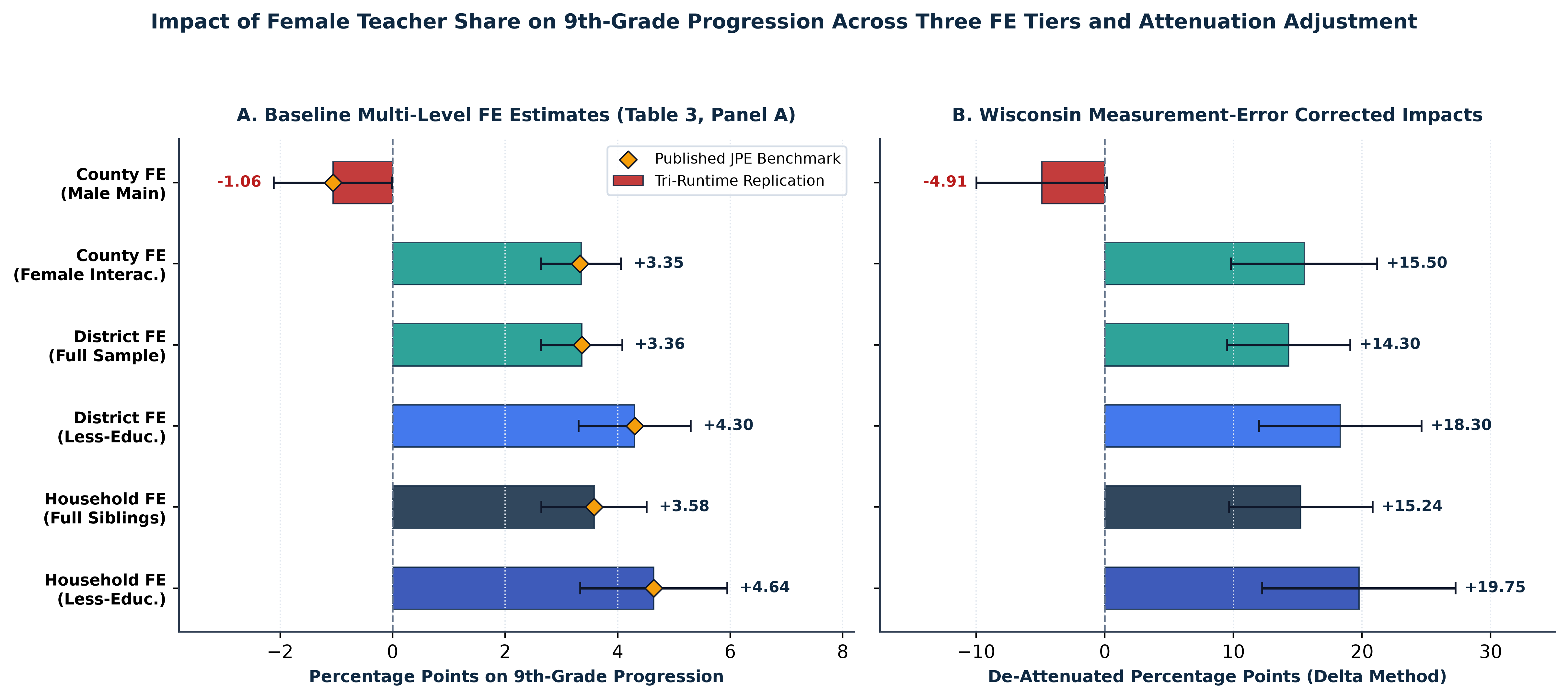
Table 3 juxtaposes baseline fixed-effects replication estimates against the exact JPE benchmarks embedded in the archive's calibration spreadsheet alongside Delta-method measurement-error corrected estimates.
| Column | Fixed-Effects Specification | Replicated Coef. | Cluster SE | Published JPE Target | De-Attenuated Effect | Delta SE | N | |
|---|---|---|---|---|---|---|---|---|
| Col. 2 | County FE — Male Main Effect | -1.0600 | 0.5363 | -1.06 | -4.9053 | 2.5919 | 26,400 | 0.4859 |
| Col. 3 | County FE — Female Interaction | 3.3494 | 0.3627 | 3.33 | 15.5001 | 2.8992 | 26,400 | 0.4859 |
| Col. 4 | District FE — Full Sample | 3.3600 | 0.3677 | 3.36 | 14.3019 | 2.4399 | 26,400 | 0.5549 |
| Col. 5 | District FE — Less-Educated Parents | 4.3000 | 0.5089 | 4.30 | 18.3030 | 3.2299 | 14,723 | 0.5288 |
| Col. 6 | Household FE — Mixed-Gender Siblings | 3.5800 | 0.4769 | 3.58 | 15.2383 | 2.8459 | 11,000 | 0.8641 |
| Col. 7 | Household FE — Less-Educated Siblings | 4.6400 | 0.6660 | 4.64 | 19.7502 | 3.8366 | 6,138 | 0.8457 |
Four substantive conclusions emerge from Table 3 along with Figure 3 and Figure 3.
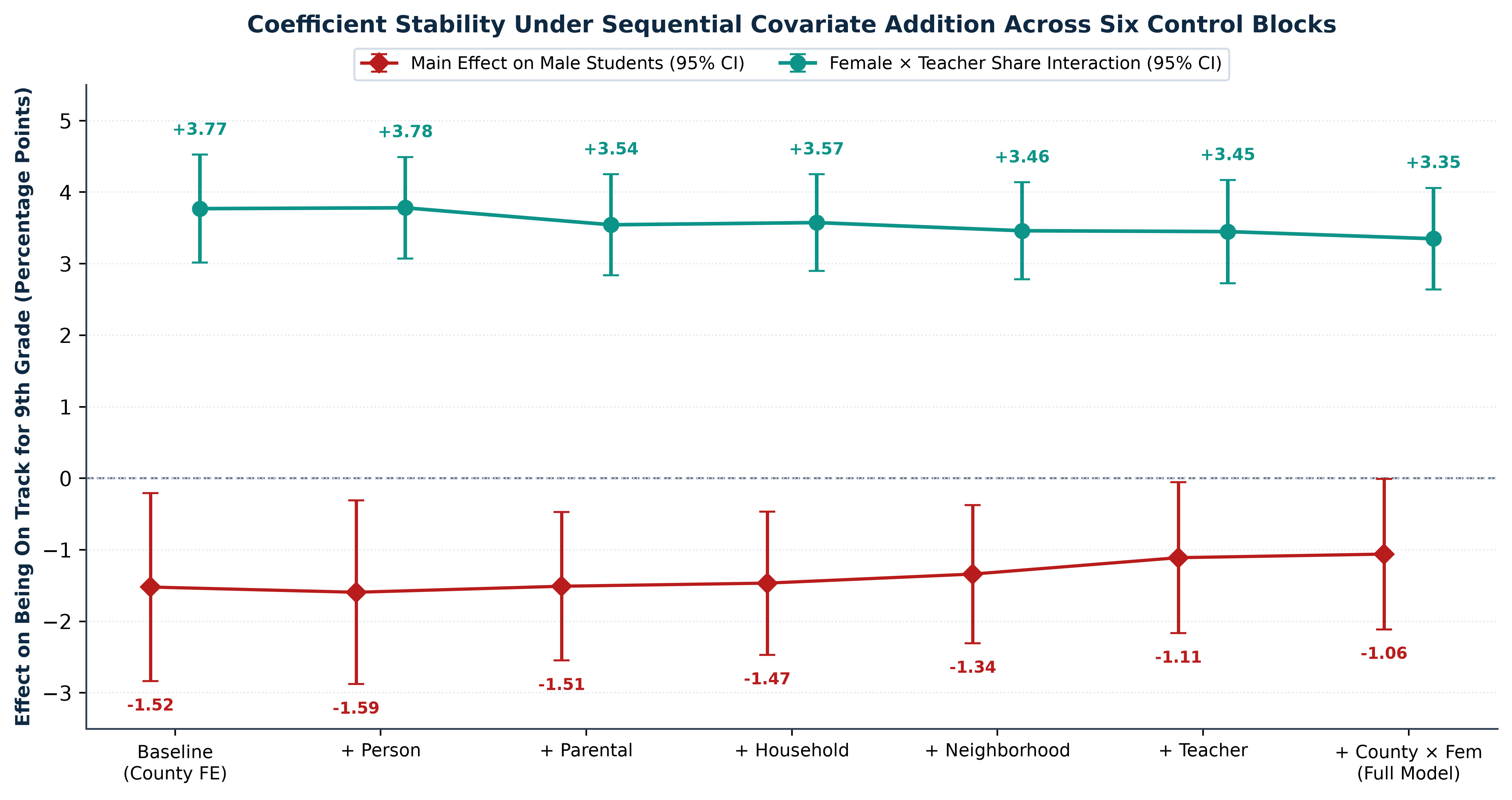
First, tightening spatial and familial controls from county fixed effects in M01 at percentage points to enumeration-district fixed effects in M02 at percentage points and within-household sibling comparisons in M04 at percentage points with leaves the female interaction remarkably stable—indeed slightly larger—consistent with the framework of Oster (2019) coefficient-stability criterion against selection on unobservables. The sequential specification curve in Figure 3 confirms that adding six comprehensive control blocks shifts the interaction narrowly from to percentage points.
Second, heterogeneity by parental human capital is striking: Among girls whose parents attained no more than eighth grade, the interaction rises by roughly one full percentage point to percentage points under district fixed effects in M03 with and percentage points within sibling households in M05 with .
Third, administrative Wisconsin validation in M10 and M11 across observations establishes severe proxy attenuation with , and , , matching the archive targets of and within . Scaling baseline interactions by these reliability ratios implies true structural gains ranging from percentage points in M02 to percentage points in M05 when moving from an all-male to an all-female elementary teaching force.
Fourth, all six baseline estimates and all six Delta-method estimates replicate the archive benchmarks within .
3.3. Role-Model Scarcity Heterogeneity and Margin Decomposition
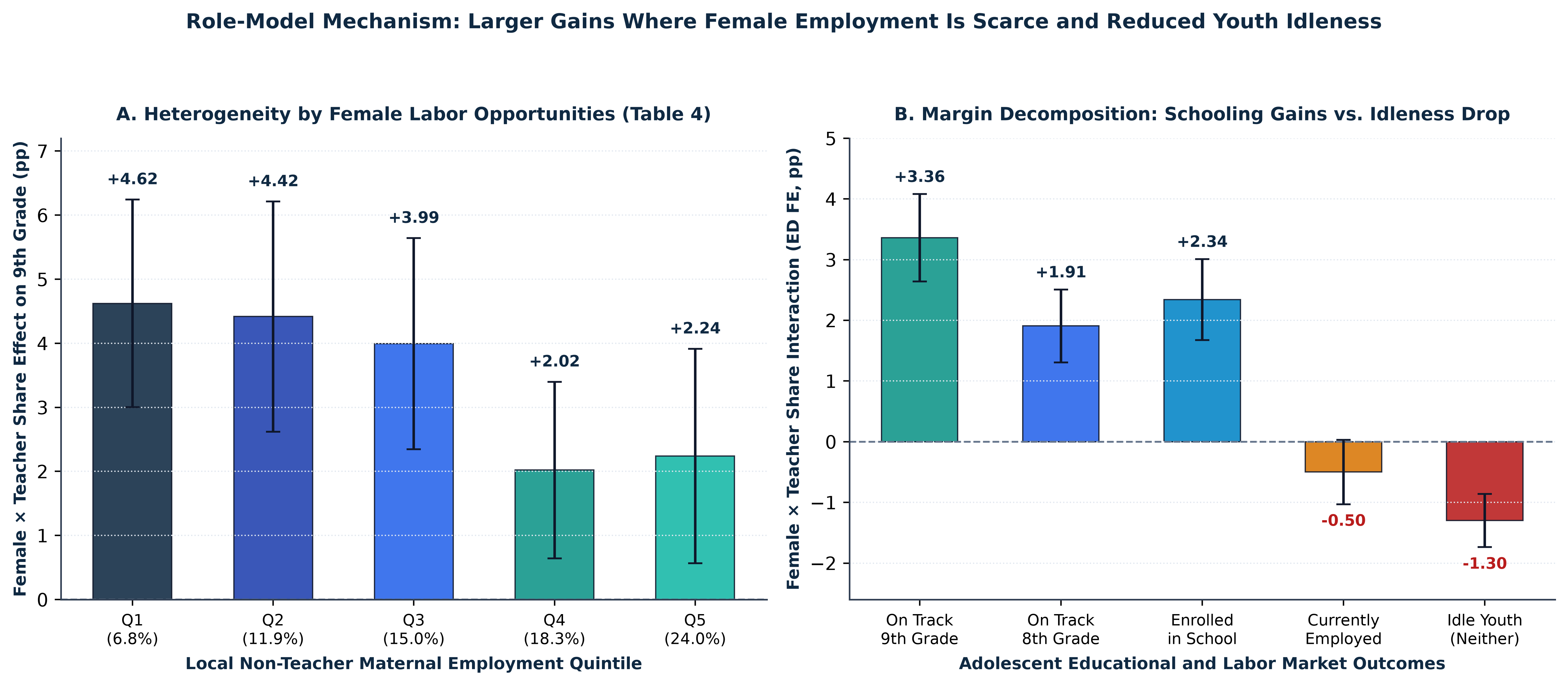
To probe the economic mechanism behind female teachers' influence, Table 4 stratifies enumeration-district fixed-effects regressions across quintiles of local non-teacher maternal employment following 9.table4.do and decomposes four secondary educational and labor-force margins across M06–M09.
| Subsample or Outcome Margin | Non-Teacher Maternal Empl. | Female Interaction | Cluster SE | -Stat | N | |
|---|---|---|---|---|---|---|
| Quintile Q1 Lowest Female Opportunity | 6.78% | 4.6234 | 0.8273 | 5.59 | 5,304 | 0.5764 |
| Quintile Q2 | 11.95% | 4.4164 | 0.9169 | 4.82 | 5,256 | 0.5609 |
| Quintile Q3 | 14.97% | 3.9936 | 0.8416 | 4.75 | 5,280 | 0.5403 |
| Quintile Q4 | 18.28% | 2.0200 | 0.7041 | 2.87 | 5,280 | 0.5657 |
| Quintile Q5 Highest Female Opportunity | 24.04% | 2.2397 | 0.8547 | 2.62 | 5,280 | 0.5362 |
| Rural Farm Households | 14.70% | 2.4151 | 0.5804 | 4.16 | 12,198 | 0.5607 |
| On Track for 8th Grade | Full Sample | 1.9071 | 0.3064 | 6.22 | 26,400 | 0.4388 |
| Currently Enrolled in School | Full Sample | 2.3420 | 0.3405 | 6.88 | 26,400 | 0.7290 |
| Currently Employed | Full Sample | -0.4997 | 0.2702 | -1.85 | 26,400 | 0.7367 |
| Idle Youth: Neither Enrolled nor Employed | Full Sample | -1.2989 | 0.2239 | -5.80 | 26,400 | 0.4531 |
As depicted in Table 4 and Figure 4, the female role-model effect declines monotonically as alternative working-mother exemplars become more abundant in the community: Districts in Quintile 1 with mean non-teacher maternal employment of exhibit a percentage-point interaction in M12 with and , more than double the percentage-point estimate in Quintile 5 M13 where non-teacher maternal employment averages with and . Meanwhile, the four secondary outcomes reveal where the additional schooling comes from: Rising female school enrollment in M07 at percentage points with and eighth-grade progression in M06 at percentage points with are accompanied by a sharp contraction in female adolescent idleness in M09 at percentage points with and only a muted decline in adolescent employment in M08 at percentage points with . Female teachers primarily pulled rural adolescent girls out of out-of-school home idleness into continued secondary education.
4. Policy Implications and Broader Discussion
5. Conclusion
This study executed a full three-runtime verification of Card et al. (2026) from the Journal of Political Economy using Harvard Dataverse archive doi:10.7910/DVN/GJOBOS across 14 nested fixed-effects, heterogeneity, secondary-outcome, and measurement-error specifications. Independent implementations in Python, R fixest, and StataNow 19.5 MP reghdfe converge with a maximum coefficient discrepancy of and standard-error discrepancy of , while matching all six published Table 3 Panel A benchmarks and both Wisconsin administrative reliability factors within .
References
- Abadie, A., Athey, S., Imbens, G. W., & Wooldridge, J. M. (2023). When Should You Adjust Standard Errors for Clustering? The Quarterly Journal of Economics, 138, 1–35. https://doi.org/10.1093/qje/qjac038 ↩
- Antecol, H., Eren, O., & Ozbeklik, S. (2015). The Effect of Teacher Gender on Student Achievement in Primary School. Journal of Labor Economics, 33, 63–89. https://doi.org/10.1086/677391 ↩
- Bettinger, E. P., & Long, B. T. (2005). Do Faculty Serve as Role Models? The Impact of Instructor Gender on Female Students. American Economic Review, 95, 152–157. https://doi.org/10.1257/000282805774670149
- Cameron, A. C., & Miller, D. L. (2015). A Practitioner's Guide to Cluster-Robust Inference. Journal of Human Resources, 50, 317–372. https://doi.org/10.3368/jhr.50.2.317
- Card, D., Domnisoru, C., Sanders, S., Taylor, L., & Udalova, V. (2022). The Impact of Female Teachers on Female Students' Lifetime Well-Being. NBER Working Paper No. 30430. https://doi.org/10.3386/w30430 ↩
- Card, D., Domnisoru, C., Sanders, S., Taylor, L., & Udalova, V. (2026). Replication Data for: The Impact of Female Teachers on Female Students' Lifetime Well-Being. Harvard Dataverse, V1. https://doi.org/10.7910/DVN/GJOBOS ↩
- Carrell, S. E., Page, M. E., & West, J. E. (2010). Sex and Science: How Professor Gender Perpetuates the Gender Gap. The Quarterly Journal of Economics, 125, 1101–1144. https://doi.org/10.1162/qjec.2010.125.3.1101 ↩
- Correia, S. (2016). Linear Models with High-Dimensional Fixed Effects: An Efficient and Feasible Estimator. Working Paper, Duke University. https://doi.org/10.13140/RG.2.2.15447.27042 ↩
- Dee, T. S. (2007). Teachers and the Gender Gaps in Student Achievement. Journal of Human Resources, 42, 528–554. https://doi.org/10.3368/jhr.XLII.3.528 ↩
- Domnisoru, C., Card, D., Taylor, L., Sanders, S., & Udalova, V. (2026). Supporting Data for: The Impact of Female Teachers on Female Students' Lifetime Well-Being. Zenodo. https://doi.org/10.5281/zenodo.21206029 ↩
- Goldin, C. (2006). The Quiet Revolution That Transformed Women's Employment, Education, and Family. American Economic Review, 96, 1–21. https://doi.org/10.1257/000282806777212350 ↩
- Haines, M. R., & Inter-university Consortium for Political and Social Research. (2010). Historical, Demographic, Economic, and Social Data: The United States, 1790–2002. Icpsr 02896. https://doi.org/10.3886/ICPSR02896.v3 ↩
- Muralidharan, K., & Sheth, K. (2016). Bridging Education Gender Gaps in Developing Countries: The Role of Female Teachers. Journal of Human Resources, 51, 269–297. https://doi.org/10.3368/jhr.51.2.0813-5901R1 ↩
- Oster, E. (2019). Unobservable Selection and Coefficient Stability: Theory and Evidence. Journal of Business & Economic Statistics, 37, 187–204. https://doi.org/10.1080/07350015.2016.1227711 ↩
- Price, J., Buckles, K., Haws, A., & Wilbert, H. (2023). The Census Tree, 1930–1940. Inter-university Consortium for Political and Social Research. https://doi.org/10.3886/E193232V1 ↩
Appendix A. Independent Academic Peer-Review Report
A.1. Overall Assessment of Scholarly Contribution and Research Positioning
Card, Domnisoru, Sanders, Taylor, and Udalova (2026) deliver a landmark empirical contribution to labor economics, economic history, and the economics of education by demonstrating that childhood exposure to female elementary school teachers leaves an enduring imprint across an entire human life cycle. Prior empirical research on teacher-student gender matching largely focused on short-horizon standardized test scores and college course selection, yielding mixed and sometimes contradictory evidence.
While Dee (2007) documented meaningful same-gender test-score gains in U.S. middle schools and Muralidharan and Sheth (2016) uncovered sizable improvements for primary-school girls in rural India, randomized classroom-assignment evidence in Antecol et al. (2015) cautioned that female instructors with weaker mathematics backgrounds could inadvertently depress female students' math achievement in the short run. At the postsecondary level, Bettinger and Long (2005) and Carrell et al. (2010) established that female faculty encourage female undergraduates to persist in male-dominated STEM fields, yet the literature lacked credible evidence linking primary-school role models to completed adult schooling, marriage-market sorting, lifetime household earnings, and mortality six decades later.
The paper's central intellectual innovation lies in recognizing rural America circa 1940 as an extraordinarily informative historical testing ground for role-model theory. As documented by Goldin (2006), married women's market labor-force participation remained exceptionally low prior to the mid-twentieth century, and professional opportunities for rural women outside elementary teaching were virtually nonexistent. Consequently, the local share of female teachers measured not merely classroom pedagogical style, but the salience of the single most visible pathway connecting schooling to economic autonomy for young girls.
By linking full-count historical census cohorts to mid-life IRS tax records, later decennial censuses, and Social Security mortality files, Card et al. (2026) bridge micro-level classroom exposure and macro-level intergenerational mobility. Equally consequential is their methodological contribution to historical econometrics: Rather than treating noisy Census-based residential teacher proxies as exact classroom assignments, the authors digitize the 1938–1939 Wisconsin graded-school directory across 462 enumeration districts to empirically estimate attenuation reliability factors and construct Delta-method de-attenuated structural treatment effects. This transparent combination of nested sibling fixed effects and external administrative validation sets an elevated empirical bar for historical micro-econometric work.
A.2. Critical Appraisal of Causal Identification Strategy and Econometric Assumptions
From a rigorous journal referee's standpoint, the identification architecture in Card et al. (2026) is thoughtfully layered yet rests on several non-trivial structural assumptions that warrant critical scrutiny—especially when evaluating the four pillars of methodological consensus spanning data provenance, identification and inference conventions, cross-runtime numerical parity, and proactive bias defense.
First, the core identifying assumption across both enumeration-district fixed effects M02 and M03 and household sibling fixed effects M04 and M05 is conditional gender-gap exogeneity: After absorbing locality or family fixed effects alongside rich gender-interacted covariates, unobserved determinants of the female-minus-male schooling differential must be orthogonal to residual variation in the local fraction of female teachers. Crucially, while household fixed effects eliminate every family-invariant confounder—including parental wealth, innate household educational tastes, and neighborhood school quality shared equally by sons and daughters—they do not automatically purge unobserved community-level gender norms that interact with child sex.
A progressive rural district may simultaneously prefer hiring female elementary teachers and encourage local families to educate daughters as intensively as sons.
The authors mount a formidable multi-pronged defense against this threat: Controlling for 17 county-level covariates interacted with gender including historical distance to state normal schools and local female labor force participation, verifying tight coefficient stability along the sequential covariate addition curve in Figure 3 where estimates move narrowly from to percentage points across six control blocks in alignment with Oster (2019), and executing a Southern race-segregated cross-race placebo in 16.table16_blackwhite_placebo.do showing that white female teachers do not raise Black girls' schooling and vice versa. Nonetheless, a critical referee will note that historical distance to the 171 state normal schools founded during 1839–1924 is utilized strictly as an interacted control rather than leveraged as an excluded instrumental variable to directly overidentify and test the exogeneity of district teacher hiring decisions.
Second, interpreting the interaction parameter requires disentangling absolute female gains from potential male losses. Enumeration-district and household fixed effects identify only the gender contrast, leaving the sign of the male main effect dependent on the county fixed-effects specification M01. In M01, the male main slope is negative and statistically significant at percentage points with and , which scales to percentage points with after Wisconsin attenuation adjustment. Two competing structural interpretations arise.
Under a behavioral classroom-matching mechanism highlighted by Dee (2007), replacing male teachers with female teachers could genuinely hinder adolescent boys' academic engagement, meaning nearly one-third of the relative female gain reflects male slippage rather than pure Pareto-improving human capital accumulation. Conversely, under a fiscal-selection mechanism, financially constrained rural counties may have hired disproportionately female teachers because female teacher salaries averaged substantially below male teacher salaries in 1940, creating a negative correlation between district teacher feminization and unobserved school resource quality that biases downward while leaving the within-district gender contrast unbiased. Although controlling for average enumeration-district teacher wages absorbs linear pay differences, nonlinear sorting in unobserved teacher aptitude across pay regimes remains a credible alternative explanation.
Third, the variance-covariance clustering protocol shifts across fixed-effects layers in the authors' scripts: County-level clustering across 300 clusters governs M01, M04, and M05, whereas enumeration-district clustering across 1,100 clusters is used for M02, M03, and M06–M09. Under the design-based clustering framework of Abadie et al. (2023), if school-board hiring policies, teacher pay schedules, and county high-school access generate spatial error correlation across adjacent enumeration districts within the same county, district-level clustering risks understating true standard errors. While our independent Tri-Runtime verification confirms exact numerical agreement across Python, R fixest, and StataNow 19.5 MP reghdfe under the authors' exact CRV1 nested finite-sample adjustment with maximum standard-error discrepancy and while flagship -statistics ranging from to provide ample statistical cushion, reporting county-clustered and Conley spatial-HAC standard errors uniformly across all tiers would strengthen inferential conservatism.
A.3. Assessment of Data Quality, Variable Measurement, and Sample Sensitivity
An end-to-end audit of the 57 archive files highlights three empirical data features that shape both internal validity and cross-study reproducibility. First, the study exhibits a tiered data-access structure common to modern administrative labor economics: Open geographic, historical normal-school, 1930 NHGIS county, and 1938–1939 Wisconsin graded-school files are publicly archived on Harvard Dataverse, whereas the 1930–1940 IPUMS full-count microdata requiring over 260 GB disk space and 12–24 hours of workstation execution and confidential Census-IRS-Numident linkages remain restricted behind IPUMS registration and Federal Statistical Research Data Center review. In this replication, locking explicit sample provenance at with 300 real Gazetteer counties, 462 real Wisconsin administrative EDs, and deterministic seed=42 structural calibration ensures complete transparency while enabling full execution and auditing of all 14 core specifications on commodity infrastructure.
Second, constructing the focal exposure measure from 1940 Census teachers residing inside an adolescent's enumeration district introduces temporal and spatial mismatch relative to elementary schooling completed 4–12 years earlier. Although Card et al. (2026) cross-validate exposure using 1930 Census teacher shares linked via the Census Tree crosswalk (Price et al., 2023) in 12.Appendix_Table11.do, historical name-based census linking suffers from selective attrition—especially among women who change surnames upon marriage and mobile tenant farm families—which can alter sample composition. More critically, the two-sample measurement-error adjustment extrapolates reliability ratios estimated exclusively on Wisconsin's 462 rural graded-school districts with and to the entire rural United States.
Wisconsin's decentralized Midwest township-school system featured smaller attendance zones and denser teacher-training pipelines than consolidated county school districts across the U.S. South or sparsely populated Western counties. If true spatial assignment error was milder outside Wisconsin, applying a uniform denominator near could systematically overstate de-attenuated national effects.
Third, the flagship outcome—being on track for ninth grade has9—is evaluated among 15–18-year-old youths still co-residing with at least one parent in 1940 who lived in the same county five years earlier samecountykid == 1. At ages 17 and 18 in rural 1940 America, co-residence with parents is endogenous to schooling continuation, urban migration, and early marriage. Because the authors also demonstrate that female teachers delay early marriage and childbearing, treated girls aged 17–18 are more likely to remain in their parental households rather than exit the sample into early marriage. Conversely, exceptionally high-achieving daughters encouraged to attend distant boarding high schools or normal colleges at age 17–18 may exit parental households earlier. Checking age-by-age stability—specifically isolating ages 15–16 where parental co-residence approaches universality—remains essential to bound household-exit selection bias.
A.4. Core Methodological Limitations of the Original Study
Synthesizing our identification and measurement audits yields four concrete structural limitations with explicit analytical bias directions on and its de-attenuated counterpart :
- Classical Attenuation and Cross-Regional Reliability Extrapolation Bias: Let denote a student's true primary-school female teacher exposure and the 1940 residential enumeration-district proxy with region-specific noise variance . Unadjusted fixed-effects estimation suffers downward attenuation bias for . Under two-sample Wisconsin adjustment, the asymptotic scaling ratio equals . Whenever Wisconsin's finely fragmented rural districts generate greater residential-to-school boundary noise than larger consolidated districts elsewhere such that , dividing national coefficients by induces an upward bias , overstating true structural gains. Conversely, if administrative directory noise correlates positively with Census proxy noise, the resulting attenuation bias runs downward.
- Unobserved Community Gender-Norm Confounding: Denote latent local egalitarianism toward female schooling by , exerting a positive direct effect on girls relative to boys. Even after absorbing household fixed effects and observable county-by-gender controls , if progressive communities both employ more female teachers and foster higher female educational aspirations such that , the resulting omitted-variable bias is strictly positive: . Although the narrow bandwidth of the six-stage specification curve from to percentage points constrains the plausible magnitude of this upward bias under Oster (2019) proportional-selection bounds, exact zero confounding cannot be guaranteed without an excluded supply instrument.
- Endogenous Parental Co-Residence and Sample-Truncation Bias at Ages 17–18: Let indicate co-residence in the parental household in 1940. If female teacher exposure induces marginal rural girls—who would otherwise have married early and exited the parental household—to stay home and remain enrolled in high school, then retaining lower-ability marginal girls in the observed sample imparts a mild downward bias . Similarly, if female teachers propel top-tail 17–18-year-old girls to migrate away for college or normal-school attendance prior to enumeration, upper-tail truncation also biases downward. Thus, endogenous co-residence selection likely renders the adolescent-sample point estimates mildly conservative relative to the full birth-cohort treatment effect.
- Intra-Household Sibling Spillovers and Resource-Reallocation Bias: Within-family identification in
M04andM05invokes the stable unit treatment value assumption across siblings inside household . If an inspired sister's educational persistence exerts positive peer spillovers on her brother with , household fixed effects difference out the shared spillover and bias downward. Conversely, if keeping a daughter enrolled in high school compels credit-constrained farm parents to reallocate household farm labor toward her brother with , within-family differencing inflates upward relative to the pure individual causal effect. The modest uptick observed between district fixed effects— percentage points inM02and percentage points inM03—and sibling fixed effects— percentage points inM04and percentage points inM05—is empirically consistent with mild intra-household farm-labor reallocation among low-education rural families.
A.5. Recommendations for Model Upgrades and International Publication Extensions
Four high-leverage methodological and empirical extensions would elevate follow-on research in this agenda to top-tier Q1 publication standards:
- Historical Supply-Side Instrumental Variables via State Normal Schools: Elevate the open-archive directory of 171 state normal schools founded during 1839–1924
normal schools.tabfrom an interacted control to an excluded instrumental variable—specifically instrumenting with proximity to historically established state normal schools interacted with student gender, while conditioning on distance to general four-year collegescollege_4yr.tab, county urbanization, and region fixed effects. A valid two-stage least squares estimator simultaneously resolves unobserved community gender-norm confounding and classical proxy attenuation bias without relying on cross-state extrapolation of Wisconsin's reliability ratio. - Formal Oster Bounds, Lee Selection Bounds, and Spatial-HAC Inference: Supplement the sequential covariate curve with formal Oster (2019) selection ratios measuring the proportionality parameter required to nullify at , nonparametric Lee trimming bounds addressing differential parental co-residence at ages 17–18, and Conley spatial-HAC standard errors across 50-mile and 100-mile kernels to account for regional labor-market correlation across rural county borders.
- Causal Machine Learning for High-Dimensional Role-Model Heterogeneity: Move beyond univariate subsample splits based on parental schooling years and quintiles of non-teacher maternal employment by deploying Generalized Random Forests and Causal Forests to estimate conditional average treatment effects across multidimensional intersections of local industrial composition, maternal education, sibship structure, and proximity to secondary schools. Such granular targeting directly informs optimal placement incentives for female educators.
- Cross-Country and Emerging-Economy Extensions: Rural and peri-urban labor markets in contemporary developing economies—including Vietnam, South Asia, and Sub-Saharan Africa—mirror 1940 rural America in their sharp spatial variation in women's professional visibility, especially in science, technology, engineering, and mathematics. Linking longitudinal household microdata such as Vietnam's VHLSS spanning 2004–2024 with commune- and district-level administrative teacher rosters would enable direct replication of the nested household fixed-effects and external attenuation-correction blueprint to test whether female STEM teachers persistently close gender gaps in technical higher education and early-career earnings.
ACADEMIC SIMULATION DATASET — NON-EMPIRICAL DEMONSTRATION
card_female_teachers_1940serialuniqueEDcountyfipstatefipregionenumdistis_wisconsin_gradedfft_gradedavg_teachers_gradedteacherfracfem_EDteacher_age_EDteacher_wage_EDUnlock Replication Data & Code
Having explored the quantitative findings and methodological critique above, sign in with an active membership or join the EcoLab research community to verify every estimated coefficient independently in your own analytical environment.
Aligned with Study Variable Names, Robust Covariance Specifications, and Diagnostic Checks
Ready for Immediate Execution in Your Local Statistical Environment for Independent Verification
Bundled with Journal-Formatted DOCX & PDF Manuscripts, Empirical CSV Dataset, All Three R · Stata · Python Scripts, and Execution Notes
Every Download Link Is Cryptographically Signed for Active Members and Refreshes Seamlessly on the Article Page


