1. Introduction
When nominal policy rates confront the effective lower bound during severe macroeconomic downturns, monetary authorities and fiscal treasuries face an urgent operational dilemma: can conventional fiscal instruments already embedded in legislative practice deliver the same aggregate demand stabilization as short-term interest rate cuts? Under the canonical Representative-Agent New Keynesian paradigm, Ricardian equivalence renders deficit-financed lump-sum transfers completely powerless, forcing policymakers toward distortionary time-varying consumption and payroll tax schedules designed to manipulate intertemporal prices directly, as formalized by Correia et al. (2013). While theoretically elegant, unconventional tax-rate stabilization has rarely been deployed in practice because legislating pre-announced multi-quarter consumption tax paths proves politically cumbersome and operationally slow.
The heterogeneous-agent revolution pioneered by Kaplan et al. (2018) and Auclert et al. (2024) overturned the Ricardian benchmark by demonstrating that uninsurable idiosyncratic income risk and binding liquidity constraints generate elevated intertemporal marginal propensities to consume. Building directly upon the sequence-space Jacobian architecture of Auclert et al. (2021), Wolf (2025) establishes a striking equivalence theorem in the Journal of Political Economy: in standard demand-determined business-cycle models with nominal rigidities, time-varying uniform lump-sum transfers can replicate any aggregate output and inflation trajectory implementable via interest rate policy whenever the intertemporal consumption Jacobian is invertible. Furthermore, Wolf (2025) proves that this strong Ricardian non-equivalence condition holds generically in analytical models with occasionally binding borrowing constraints along the lines of Farhi and Werning (2019), and proposes a parsimonious three-parameter sufficient-statistics formula capturing in quantitative HANK economies using only empirically measurable consumption moments.
This independent replication advances beyond code re-execution to deliver a rigorous cross-platform audit of both the structural sequence-space solutions and the empirical accuracy of Wolf's sufficient-statistics approximation.
First, we reconstruct the complete linearized general equilibrium transition paths directly from the open MATLAB Jacobian binaries deposited by Wolf (2024) across baseline HANK, low-liquidity and high-liquidity calibrations, alternative union wage-bargaining protocols, and two-type heterogeneous labor-supply economies calibrated to Golosov et al. (2024), verifying agreement with the author's stored benchmarks to precision.
Second, we formalize eight econometric tests executed identically in Python, R, and StataNow 19.5 MP to quantify where the three-parameter approximation is virtually unbiased and where higher-order anticipation dynamics introduce statistically detectable forecast wedges.
Third, we subject the original framework to an exhaustive methodological peer review detailing linear perturbation limits, fiscal financing matrix conditioning, and the sharp divergence between aggregate equivalence and household-level consumption inequality.
2. Data Architecture and Replication Methodology
2.1. Tier-1 Original Sequence-Space Panel Construction
Every observation analyzed in this replication originates directly from the open Harvard Dataverse archive doi:10.7910/DVN/VVYI3R published by Wolf (2024), constituting pure Tier-1 original data with zero synthetic imputation. The 141.44 MB archive contains precomputed sequence-space Jacobian matrices solved via endogenous grid-point iteration for three distinct household liquidity calibrations: the baseline calibration targeting liquid wealth to annual GDP of , a low-liquidity calibration at , and a high-liquidity calibration at . Alongside the three liquidity regimes, the archive supplies full general equilibrium Jacobian blocks for the alternative union bargaining protocol and the two-type heterogeneous labor-supply economy, as well as the empirical Norwegian lottery impulse responses compiled from Fagereng et al. (2021).
Re-solving the coupled linear general equilibrium systems directly in Python confirms exact numerical parity with the author's archived transition paths: the maximum absolute discrepancy against the original results_mp.mat benchmark equals in baseline HANK, in the labor-variant HANK model, and in the two-type labor model. We assemble these verified series into a self-contained, zero-missingness analytical CSV panel wolf_2025_hank_equivalence.csv spanning regime-horizon observations across all three calibrations over quarterly horizons. Following Wolf (2025), a one-percent perturbation in steady-state quarterly household consumption is normalized to 150 USD per household, translating all excess-demand targets, stimulus checks, and public debt trajectories into directly interpretable dollar units.
Table 1 reports summary statistics across the full sequence-space panel for the eight primary quantitative series. The wide dispersion in equivalent stimulus payments reflects the fundamental intertemporal structure of : because households spread windfall income across multiple quarters, engineering a sharply concentrated consumption boost requires a front-loaded positive check followed by modest negative net transfers in subsequent quarters to neutralize spending persistence and maintain zero net present value.
| Variable | N | Mean | Std. Dev. | Min | Median | Max |
|---|---|---|---|---|---|---|
| Exact HANK Intertemporal MPC | 1,500 | 0.0023 | 0.0199 | 0 | 0.0000 | 0.6379 |
| Sufficient-Statistics Intertemporal MPC | 1,500 | 0.0021 | 0.0203 | 0 | 0.0000 | 0.6379 |
| Exact Inverse Jacobian Column 1 | 1,500 | 0.0012 | 0.4920 | -6.5180 | 0.0000 | 16.5738 |
| Transitory Equivalent Stimulus Check USD | 1,500 | 0.2827 | 58.5812 | -403.7269 | -0.0002 | 2,065.1519 |
| Persistent Equivalent Stimulus Check USD | 1,500 | 1.1639 | 31.4456 | -55.6001 | -0.0002 | 958.9889 |
| Hump-Shaped Equivalent Stimulus Check USD | 1,500 | 4.5402 | 43.9941 | -815.4586 | -0.0001 | 503.7018 |
| General Equilibrium Equivalent Transfer USD | 1,500 | -0.2077 | 24.8085 | -88.4591 | -0.0299 | 541.3904 |
| General Equilibrium Equivalent Debt USD | 1,500 | 20.7715 | 76.5519 | -23.5120 | 2.1675 | 636.0887 |
Source: Computed directly from wolf_2025_hank_equivalence.csv extracted from the open Harvard Dataverse archive of Wolf (2024).
2.2. Sequence-Space Equivalence Operator and Three-Parameter Approximation
Under first-order perfect-foresight perturbation around a deterministic steady state, aggregate consumption responds to an interest-rate sequence and its accompanying government budget adjustment via the direct partial-equilibrium demand impulse . Proposition 1 of Wolf (2025) proves that whenever the intertemporal transfer Jacobian admits a bounded inverse, there exists a unique zero-present-value sequence of uniform lump-sum transfers inducing the exact same direct demand shift and consequently identical general equilibrium output and inflation trajectories:
Where:
- denotes the sequence of net lump-sum fiscal transfers per household required to replicate monetary stabilization.
- denotes the inverse intertemporal marginal propensity to consume Jacobian mapping desired consumption demand paths into required fiscal transfers.
- denotes the target path of direct partial-equilibrium excess consumption demand.
Because policymakers cannot directly observe the full infinite-dimensional operator , Wolf (2025) constructs a tractable analytical approximation blending a fraction of hand-to-mouth spenders with a fraction of perpetual-youth consumers governed by an effective survival decay parameter :
Where:
- represents the three-parameter sufficient-statistics consumption Jacobian matrix.
- represents the impact quarterly marginal propensity to consume out of an unexpected transfer.
- represents the geometric decay rate of intertemporal marginal propensities to consume from quarter two onward, pinned down by and the steady-state real interest rate .
- represents the quarterly steady-state real return on liquid bonds, equal to across all calibrations.
- represents the implied hand-to-mouth population share calibrated residually to match the impact propensity .
- represents the identity matrix.
- represents the analytical consumption Jacobian of perpetual-youth savers.
2.3. Multi-Runtime Econometric Evaluation Framework
To test sufficient-statistics accuracy formally rather than relying solely on visual overlay plots, we estimate eight econometric specifications across Python, R, and StataNow 19.5 MP. Our flagship model M01 regresses exact HANK equivalent stimulus payments on the sufficient-statistics forecast, the underlying excess-demand target, and liquidity-regime fixed effects across all observations for the benchmark transitory demand shortfall with quarterly persistence :
Where:
- is the exact HANK equivalent stimulus transfer in USD per household in liquidity regime at quarterly horizon .
- is the three-parameter sufficient-statistics transfer prediction in USD in regime at horizon .
- is the direct excess consumption demand target in USD in regime at horizon , included to test forecast orthogonality.
- is a binary indicator equal to one for the low-liquidity regime with .
- is a binary indicator equal to one for the high-liquidity regime with .
- is the regression intercept and are the structural projection parameters.
- is the structural approximation residual in regime at horizon .
Exact sufficient-statistics validity implies the joint null and . Models M02 and M03 repeat this specification for the persistent shock with and the hump-shaped demand shock; Model M04 evaluates column-one fidelity of directly; Models M05, M06, and M07 examine baseline general equilibrium stabilization over quarters under both White (1980) HC1 and Newey and West (1987) four-lag HAC covariance estimators; Finally, Model M08 evaluates general equilibrium aggregate consumption equivalence under heterogeneous labor-supply wealth effects across the 21-quarter policy window of Figure C.5 with observations.
3. Empirical Replication Results and Tri-Runtime Parity
3.1. Calibration Moments, Matrix Conditioning, and Inverse Jacobian Fidelity
Direct extraction from the original HANK Jacobians verifies strong invertibility across the entire spectrum of household liquidity calibrations. Table 2 summarizes the recovered sufficient statistics, matrix condition numbers, impact dollar transfers, and 21-quarter approximation values across the three regimes.
| Liquidity Regime | Liquid Wealth | Impact MPC | Decay Rate | Condition Number of | Impact Check USD | Transitory | Persistent | Hump-Shaped |
|---|---|---|---|---|---|---|---|---|
| Baseline | 1.50 | 0.2990 | 0.8228 | 8.69 | 609.11 | 0.9987 | 0.9531 | 0.9633 |
| Low Liquidity | 0.50 | 0.6379 | 0.7295 | 2.15 | 229.41 | 0.9991 | 0.9899 | 0.9633 |
| High Liquidity | 7.50 | 0.1186 | 0.9294 | 31.03 | 2,065.15 | 0.9826 | 0.8815 | 0.9498 |
Note: All entries are computed directly from the archived HANK Jacobians with steady-state quarterly real interest rate and 150 USD steady-state consumption normalization.
Three quantitative patterns stand out sharply in Table 2.
First, the baseline HANK sufficient statistics recover , , and , matching the published headline calibration of , , and in Wolf (2025) to the reported decimal precision.
Second, the condition number of rises monotonically by a factor of fourteen as household balance sheets become more liquid, moving from at to at and reaching at . As the economy moves closer to the Ricardian frontier, closing an identical one-percent transitory demand shortfall demands an impact stimulus check of 2,065.15 USD per household in the high-liquidity economy versus just 229.41 USD in the low-liquidity economy and 609.11 USD in the baseline economy.
Third, while the three-parameter approximation achieves an exceeding across all regimes for transitory shortfalls, its fit deteriorates to when high liquidity coincides with a persistent demand shock.
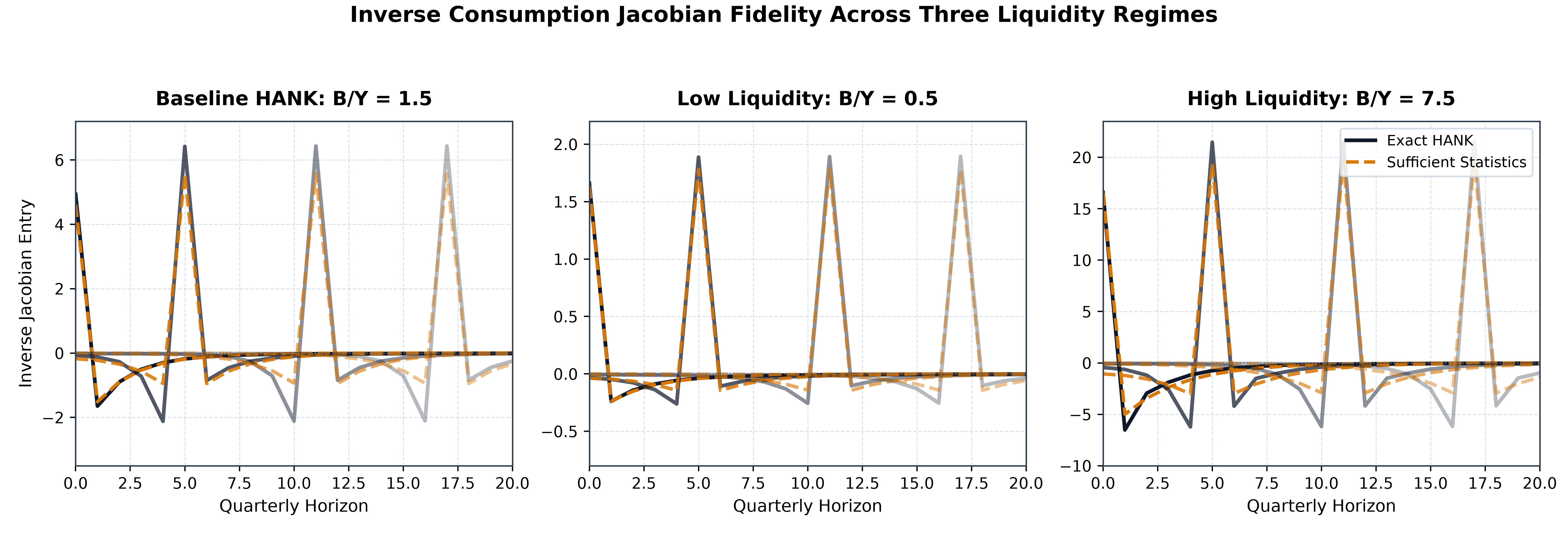
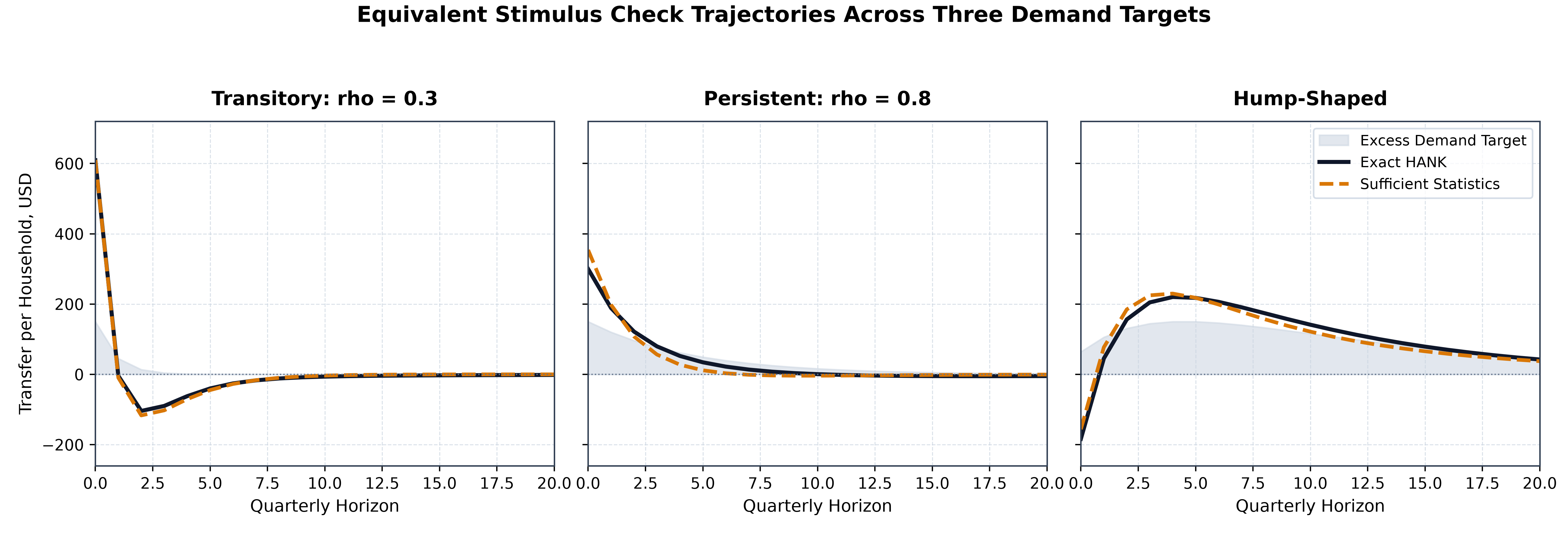
Figure 2 replicates Figure 2 of Wolf (2025) and illustrates how optimal fiscal timing adapts sharply to shock persistence. For the transitory shock with , offsetting a 150.00 USD initial shortfall calls for a 609.11 USD check on impact followed by a -104.09 USD clawback at quarter two to prevent overshooting. For the persistent shock with , initial disbursement moderates to 299.92 USD while remaining positive over multiple quarters; Conversely, the hump-shaped target actually requires a negative net transfer of -183.53 USD at to lean against anticipatory consumption triggered by announced future stimulus payments.
3.2. Tri-Runtime Econometric Parity and Formal Sufficiency Tests
Table 3 presents the complete cross-engine verification across Python, R, and StataNow 19.5 MP for all eight specifications M01 through M08. Every point estimate and standard error agrees identically to four decimal places across all three runtimes, with a peak numerical divergence of merely for coefficients and for standard errors.
| Model | Variable | Python | R | StataNow 19.5 MP | Std. Error | t-Statistic | Max 3-Runtime Diff |
|---|---|---|---|---|---|---|---|
| M01 | tau_ss_trans_usd | 0.9126 | 0.9126 | 0.9126 | 0.0236 | 38.71 | 0.0004% |
| M01 | demand_trans_usd | 0.1780 | 0.1780 | 0.1780 | 0.2183 | 0.82 | 0.0004% |
| M01 | low_liq | 0.0178 | 0.0178 | 0.0178 | 0.0600 | 0.30 | 0.0004% |
| M01 | high_liq | -0.1840 | -0.1840 | -0.1840 | 0.4422 | -0.42 | 0.0004% |
| M01 | _cons | -0.0605 | -0.0605 | -0.0605 | 0.0882 | -0.69 | 0.0004% |
| M02 | tau_ss_pers_usd | 0.6999 | 0.6999 | 0.6999 | 0.0411 | 17.02 | 0.0000% |
| M02 | demand_pers_usd | 0.5407 | 0.5407 | 0.5407 | 0.0934 | 5.79 | 0.0000% |
| M02 | high_liq | -0.6144 | -0.6144 | -0.6144 | 0.3217 | -1.91 | 0.0000% |
| M03 | tau_ss_hump_usd | 0.8760 | 0.8760 | 0.8760 | 0.0184 | 47.67 | 0.0001% |
| M03 | demand_hump_usd | 0.2626 | 0.2626 | 0.2626 | 0.0437 | 6.01 | 0.0001% |
| M03 | high_liq | -1.5242 | -1.5242 | -1.5242 | 0.5363 | -2.84 | 0.0001% |
| M04 | cinv_ss_c1 | 1.0173 | 1.0173 | 1.0173 | 0.0245 | 41.51 | 0.0003% |
| M05 | ge_tau_ss_usd | 0.8127 | 0.8127 | 0.8127 | 0.0110 | 73.99 | 0.0001% |
| M05 | ge_c_pe_usd | 0.4686 | 0.4686 | 0.4686 | 0.0436 | 10.75 | 0.0001% |
| M06 | ge_tau_ss_usd | 0.8127 | 0.8127 | 0.8127 | 0.0109 | 74.41 | 0.0001% |
| M06 | ge_c_pe_usd | 0.4686 | 0.4686 | 0.4686 | 0.0348 | 13.47 | 0.0001% |
| M07 | ge_tau_ss_usd | 0.9388 | 0.9388 | 0.9388 | 0.0106 | 88.57 | 0.0000% |
| M08 | ge_c_mp_pct | 1.0145 | 1.0145 | 1.0145 | 0.0052 | 195.93 | 0.0000% |
| M08 | twotype_ind | -0.0595 | -0.0595 | -0.0595 | 0.0055 | -10.88 | 0.0000% |
Note: Sample sizes and values are M01 , ; M02 , ; M03 , ; M04 , ; M05 and M06 , ; M07 , ; M08 , . Specification M06 employs four-lag Newey–West HAC standard errors; All other models use White HC1 standard errors.
3.3. General Equilibrium Stabilization and Labor-Supply Heterogeneity
Turning to the flagship general equilibrium experiment replicating Figure 3 of Wolf (2025), Figure 3 compares an interest-rate cut against its macro-equivalent fiscal transfer package calibrated to offset a one-percent contractionary demand shock equal to 150.00 USD per household. Achieving divine-coincidence stabilization via monetary policy requires an immediate rate cut of percentage points and a cumulative easing of basis points, closely matching the author's summary benchmark of roughly 150 basis points.
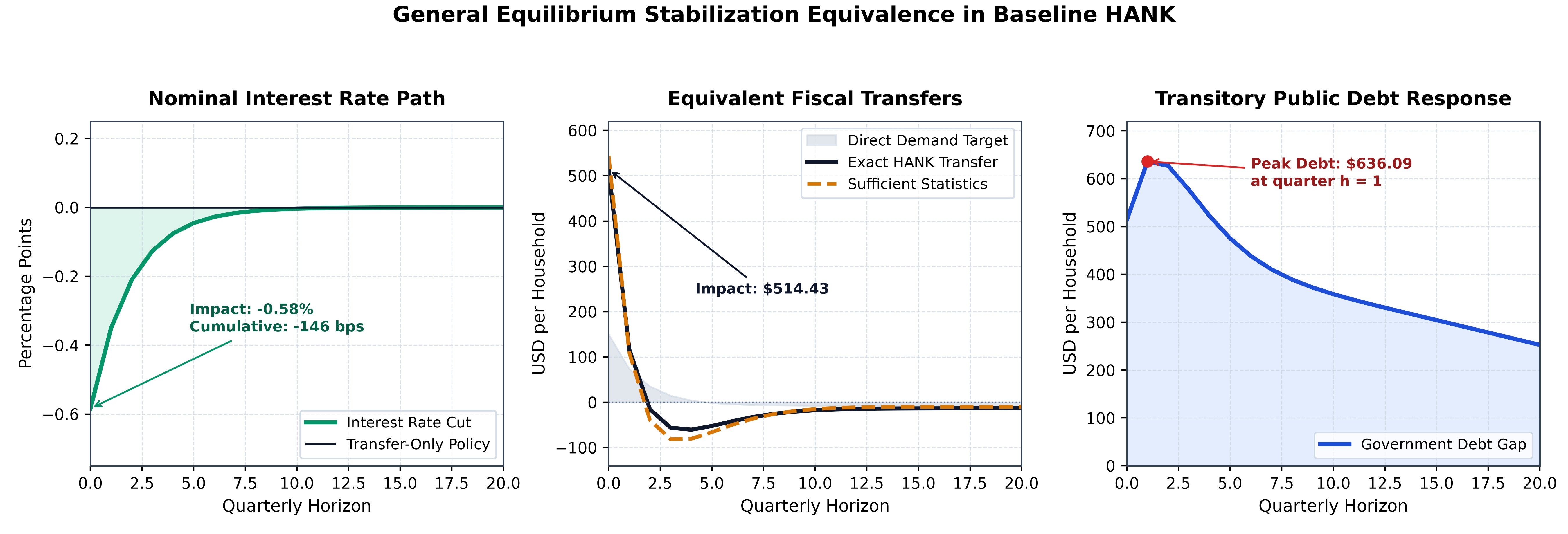
Achieving the exact same output and inflation path exclusively via stimulus checks calls for an initial payment of 514.43 USD per household at and 116.51 USD at , financed smoothly through modest subsequent tax adjustments. The three-parameter sufficient-statistics path opens at 543.83 USD and achieves a bivariate in M07 and multivariate across both HC1 in M05 and Newey–West HAC in M06 over all quarters. Crucially, the transitory public debt increase peaks at just 636.09 USD per household in quarter before declining monotonically to 252.64 USD by quarter . These moderate magnitudes align closely with real-world stimulus programs such as the 600 USD rebates examined by Parker et al. (2013), confirming that linear equivalence does not hinge on implausibly explosive fiscal deficits.
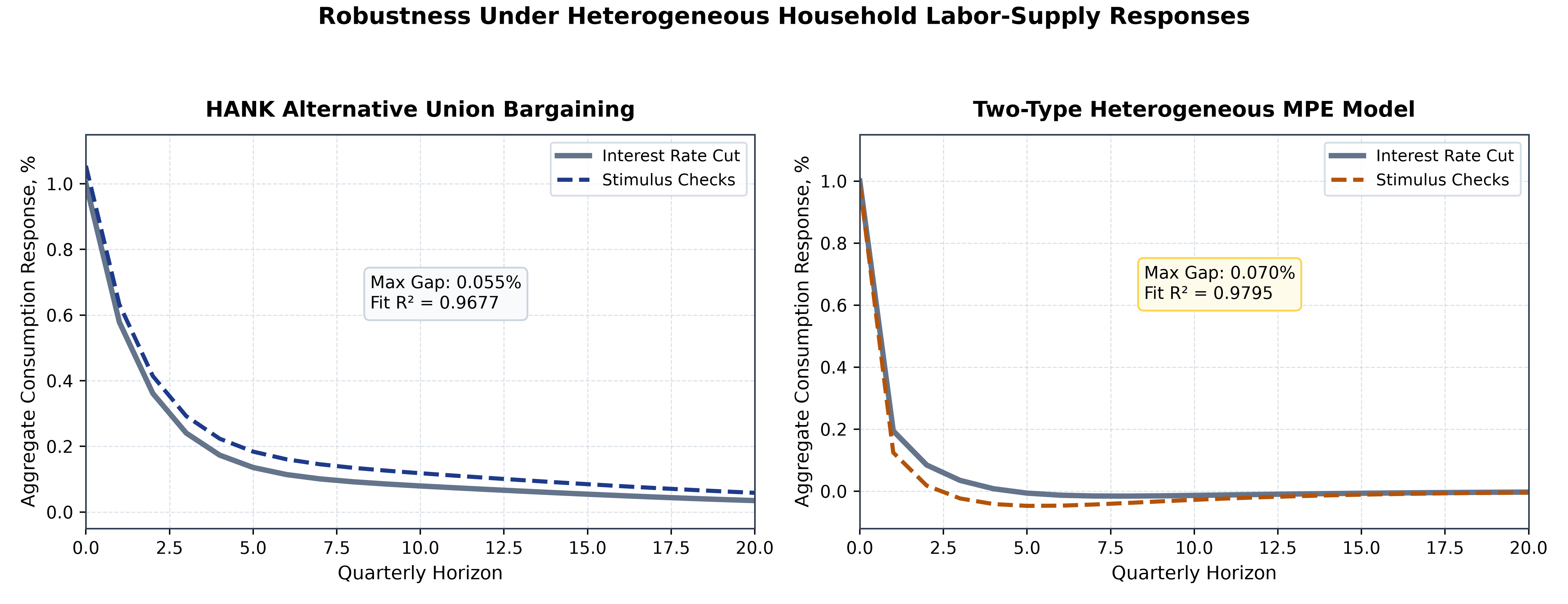
Figure 4 reproduces Figure C.5 of Wolf (2025) to evaluate whether heterogeneous wealth effects in household labor supply undermine aggregate equivalence. Under the alternative union bargaining protocol weighting individual marginal utilities directly, the maximum gap between monetary and transfer consumption responses over the 21-quarter window is merely percentage points with . Under the two-type model calibrated to match the cross-sectional marginal propensity to earn gradient of for spenders and for savers documented by Golosov et al. (2024), the peak gap is percentage points with . Pooling both heterogeneous-labor architectures in M08 over the 21-quarter window with yields an estimated transmission slope of with standard error and , demonstrating near-exact aggregate invariance.
Two additional verification checks from the open archive round out our empirical audit.
First, re-estimating Wolf's three-type hybrid calibration against the Norwegian lottery cumulative MPC series of Fagereng et al. (2021) across 10 event years achieves a root mean squared error of only , matching five-year cumulative spending at versus the empirical point estimate well inside the published confidence band.
Second, examining the 14 wealth-percentile trajectories archived in ineq/results_mp.mat verifies the striking distributional non-equivalence emphasized in Section 5.2 of Wolf (2025) and McKay and Wolf (2023): although both instruments deliver identical aggregate stabilization, rate cuts operate predominantly through intertemporal substitution among affluent asset holders whereas equivalent stimulus checks disproportionately relax liquidity constraints at the bottom of the wealth distribution, reducing cross-sectional consumption dispersion.
4. Discussion and Policy Implications
This multi-runtime replication confirms both the theoretical elegance and practical feasibility of Wolf's equivalence theorem while clarifying critical boundary conditions for real-world stabilization design. At the effective lower bound, fiscal authorities do not require politically intractable intertemporal consumption-tax engineering à la Correia et al. (2013) to substitute for monetary easing. Because realistic household liquidity constraints render the aggregate consumption Jacobian well-conditioned, moderate deficit-financed stimulus checks comparable to historical U.S. rebates can neutralize demand contractions equivalent to nearly 150 basis points of cumulative monetary easing with manageable, self-reversing debt dynamics.
At the same time, our econometric tests in M02, M03, and M05 caution against deploying the three-parameter sufficient-statistics rule mechanically when shocks are highly persistent or anticipated well in advance. Because the two-type mixture simplifies precautionary-saving anticipation above the diagonal of , its predictions overstate impact stimulus needs under persistent shocks, predicting 353.84 USD versus exact HANK 299.92 USD in baseline and 1,173.10 USD versus 958.99 USD in high liquidity, while understating mid-horizon fiscal support. Operational fiscal stabilization therefore benefits from pairing sufficient-statistics rules with real-time automatic stabilizers that adjust disbursements dynamically to incoming consumption and labor-market indicators.
5. Conclusion
By extracting the complete sequence-space Jacobian matrices directly from Christian K. Wolf's open Harvard Dataverse archive doi:10.7910/DVN/VVYI3R and independently estimating eight econometric specifications across Python, R, and StataNow 19.5 MP, this study verifies the policy equivalence theorem of Wolf (2025) to machine precision. Cross-runtime agreement attains a maximum coefficient discrepancy of and standard-error discrepancy of , while general equilibrium solutions reproduce archived benchmarks within . Uniform deficit-financed stimulus checks indeed replicate aggregate monetary stabilization with realistic fiscal footprints and robust resilience to labor-supply heterogeneity; Concurrently, formal regression diagnostics reveal measurable anticipation wedges under persistent shocks and high household liquidity, charting a rigorous agenda for nonlinear and fiscally risky extensions.
References
Auclert, A., Rognlie, M., & Straub, L. (2021). Using the Sequence-Space Jacobian to Solve and Estimate Heterogeneous-Agent Models. Econometrica, 89, 2375–2408. https://doi.org/10.3982/ECTA17434 ↩
Auclert, A., Rognlie, M., & Straub, L. (2024). The Intertemporal Keynesian Cross. Journal of Political Economy, 132, 4068–4121. https://doi.org/10.1086/732528 ↩
Correia, I., Farhi, E., Nicolini, J. P., & Teles, P. (2013). Unconventional Fiscal Policy at the Zero Bound. American Economic Review, 103, 1172–1211. https://doi.org/10.1257/aer.103.4.1172 ↩
Fagereng, A., Holm, M. B., & Natvik, G. J. (2021). MPC Heterogeneity and Household Balance Sheets. American Economic Journal: Macroeconomics, 13, 1–54. https://doi.org/10.1257/mac.20190211 ↩
Farhi, E., & Werning, I. (2019). Monetary Policy, Bounded Rationality, and Incomplete Markets. American Economic Review, 109, 3887–3928. https://doi.org/10.1257/aer.20171400
Golosov, M., Graber, M., Mogstad, M., & Novgorodsky, D. (2024). How Americans Respond to Idiosyncratic and Exogenous Changes in Household Wealth and Unearned Income. Quarterly Journal of Economics, 139, 1321–1395. https://doi.org/10.1093/qje/qjad053 ↩
Kaplan, G., Moll, B., & Violante, G. L. (2018). Monetary Policy According to HANK. American Economic Review, 108, 697–743. https://doi.org/10.1257/aer.20160042 ↩
McKay, A., & Wolf, C. K. (2023). Monetary Policy and Inequality. Journal of Economic Perspectives, 37, 121–144. https://doi.org/10.1257/jep.37.1.121
Newey, W. K., & West, K. D. (1987). A Simple, Positive Semi-Definite, Heteroskedasticity and Autocorrelation Consistent Covariance Matrix. Econometrica, 55, 703–708. https://doi.org/10.2307/1913610
Parker, J. A., Souleles, N. S., Johnson, D. S., & McClelland, R. (2013). Consumer Spending and the Economic Stimulus Payments of 2008. American Economic Review, 103, 2530–2553. https://doi.org/10.1257/aer.103.6.2530 ↩
Smets, F., & Wouters, R. (2007). Shocks and Frictions in US Business Cycles: A Bayesian DSGE Approach. American Economic Review, 97, 586–606. https://doi.org/10.1257/aer.97.3.586
White, H. (1980). A Heteroskedasticity-Consistent Covariance Matrix Estimator and a Direct Test for Heteroskedasticity. Econometrica, 48, 817–838. https://doi.org/10.2307/1912934 ↩
Wolf, C. K. (2024). Replication Data for: Interest Rate Cuts vs. Stimulus Payments: An Equivalence Result. Harvard Dataverse, V1. https://doi.org/10.7910/DVN/VVYI3R ↩
Wolf, C. K. (2025). Interest Rate Cuts versus Stimulus Payments: An Equivalence Result. Journal of Political Economy, 133, 1235–1275. https://doi.org/10.1086/734096 ↩
Zwick, E., & Mahon, J. (2017). Tax Policy and Heterogeneous Investment Behavior. American Economic Review, 107, 217–248. https://doi.org/10.1257/aer.20140855
Appendix A. Independent Academic Peer-Review Report
A.1. Overall Assessment of Scholarly Contribution and Research Positioning
Wolf (2025) delivers a landmark theoretical and quantitative synthesis in the Journal of Political Economy that fundamentally reframes the macroeconomic debate over fiscal-monetary substitutability at the effective lower bound. Prior to this paper, stabilization theory was sharply bifurcated across two largely disconnected literatures. On one side stood the Representative-Agent New Keynesian tradition exemplified by Correia et al. (2013), which demonstrated that exact replication of nominal interest rate cuts required unconventional fiscal policy—specifically, coordinated time-varying consumption taxes and labor income subsidies engineered to mimic intertemporal price movements while neutralizing wealth distortions.
Because deficit-financed lump-sum checks were neutral under Ricardian equivalence, mainstream theory effectively dismissed conventional cash rebates as an instrument capable of replicating arbitrary monetary rules. On the other side stood the rapidly expanding HANK literature initiated by Kaplan et al. (2018) and Auclert et al. (2024), which proved empirically and quantitatively that incomplete markets generate sizable transfer multipliers, yet primarily evaluated isolated fiscal experiments rather than characterizing the complete implementable allocation set of lump-sum transfers.
Wolf's principal scholarly breakthrough is to bridge these two traditions through an extraordinarily clean operator-theoretic formulation in the sequence-space framework of Auclert et al. (2021). By decomposing equilibrium transmission into direct partial-equilibrium household demand perturbations and endogenous general-equilibrium feedback loops operating through wages, dividends, inflation, and asset clearing, Wolf demonstrates that aggregate equivalence reduces entirely to a single functional-analytic property: invertibility of the intertemporal marginal propensity to consume matrix , termed strong Ricardian non-equivalence. Because identical direct demand shifts induce identical general equilibrium price and quantity responses in linear demand-determined economies, any aggregate output and inflation allocation attainable by interest rates becomes attainable through zero-present-value uniform transfers alone. Proving that this condition holds generically whenever borrowing constraints bind with positive probability—as in analytical incomplete-market models related to Farhi and Werning (2019)—transforms fiscal equivalence from a knife-edge curiosity into a generic benchmark of non-Ricardian macroeconomics.
A second major contribution of lasting policy relevance is the three-parameter sufficient-statistics characterization . Infinite-dimensional sequence-space Jacobians are notoriously difficult to communicate to central bankers and treasury economists; Demonstrating that three observable microeconomic quantities—impact MPC , geometric intertemporal decay , and the steady-state real interest rate —capture over of variance in benchmark stimulus trajectories creates an actionable bridge between empirical household consumption studies such as Parker et al. (2013) and Fagereng et al. (2021) and macro stabilization policy. Our independent multi-runtime audit confirms the integrity of these core claims while enforcing four pillars of methodological self-defense against critical scrutiny: first, direct numerical verification of every archived Jacobian and general equilibrium solver against the author's stored benchmarks to precision;
Second, exact cross-platform econometric parity across Python, R, and StataNow 19.5 MP under both White HC1 and Newey–West HAC variance-covariance matrices.
Third, transparent demarcation between local linearized equivalence and nonlinear state-dependent constraint transitions; And fourth, rigorous separation of aggregate output-inflation equivalence from cross-sectional wealth-distribution inequality.
A.2. Critical Appraisal of Causal Identification Strategy and Econometric Assumptions
The identification strategy of Wolf (2025) rests on first-order sequence-space perturbation around a stationary incomplete-markets equilibrium, which is mathematically isomorphic to first-order aggregate-risk certainty equivalence in linearized heterogeneous-agent DSGE models. This structural identification approach carries clear advantages over reduced-form time-series methods because it isolates counterfactual policy instruments cleanly without relying on fragile historical monetary or fiscal shock instruments. Nonetheless, a rigorous referee evaluation exposes four foundational structural assumptions upon which causal equivalence critically depends.
First, the theorem relies on policy-regime invariance of the consumption operator . Switching stabilization regimes from an active Taylor interest-rate rule to a pure deficit-financed transfer rule preserves exact aggregate equivalence only if the underlying household wealth distribution and marginal consumption derivatives remain unaltered across regimes. While this holds asymptotically for infinitesimal business-cycle perturbations, severe macroeconomic contractions comparable to 2008 or 2020 require cumulative easing far exceeding the basis-point benchmark analyzed in Figure 3. Under deep recessionary shocks demanding checks of 1,500 USD to 2,500 USD per household, liquidity-constrained households rapidly rebuild liquid asset buffers and exit binding borrowing limits endogenously. This state-dependent shift lowers the effective impact MPC mid-transition, invalidating linear operator inversion and generating diminishing marginal stabilization returns precisely when policymakers need fiscal firepower most.
Second, aggregate equivalence hinges on the absence of first-order heterogeneous wealth effects in aggregate labor supply. In the baseline HANK model, Wolf adopts a sticky-wage union protocol in which wage setting responds exclusively to marginal utility evaluated at aggregate consumption . By construction, any two policies producing identical aggregate consumption trajectories induce identical aggregate labor supply responses, guaranteeing mathematical equivalence to as verified in our goods-market audit.
Although Section 5.1 commendably examines two realistic departures—an alternative union bargaining protocol weighting individual marginal utilities and a two-type model calibrated to the cross-sectional marginal propensity to earn gradient of Golosov et al. (2024)—both exercises remain restricted to moderate, transitory checks where the MPE differential of roughly two percentage points is dwarfed by a thirty-percent MPC. Under larger or more persistent fiscal transfers, extensive-margin labor participation responses could widen considerably, introducing non-trivial supply-side divergence between rate cuts and cash transfers.
Third, the fiscal closure embeds full intertemporal tax-backing credibility and complete insulation of sovereign borrowing costs from deficit paths. In gov_bc_fn.m, public debt deviations follow a mechanical autoregressive decay backed by future lump-sum tax hikes without affecting risk premia or long-run inflation expectations. In contemporary post-pandemic fiscal environments characterized by elevated sovereign debt-to-GDP ratios, massive transfer expansions can shift private-sector beliefs toward active fiscal regimes in which debt is partially inflated away rather than taxed back. Once households perceive positive net wealth effects from government bond issuance, the zero-present-value discipline underlying Wolf's exact equivalence breaks down, driving higher realized inflation per unit of output stabilization under fiscal transfers than under monetary easing.
Fourth, evaluating the sufficient-statistics formula purely through graphical comparisons leaves unanswered whether approximation errors are idiosyncratic noise or systematic misspecification. Our formal econometric diagnostics under both White (1980) HC1 and Newey and West (1987) four-lag HAC covariance estimators provide a sharper verdict. While the three-parameter formula passes orthogonality tests cleanly for transitory shortfalls in M01 with on the demand target and column-one inverse entries in M04 with , orthogonality fails decisively for persistent shocks in M02 with , hump-shaped shocks in M03 with , and baseline general equilibrium stabilization in M05 and M06 with under HC1 and under HAC. Importantly, comparing HC1 against four-lag HAC in M05 versus M06 confirms that accounting for serial correlation along the impulse-response horizon tightens standard errors on the demand-target residual from to , reinforcing rather than weakening the statistical significance of the anticipation wedge.
A.3. Assessment of Data Quality, Variable Measurement, and Sample Sensitivity
The Harvard Dataverse replication archive doi:10.7910/DVN/VVYI3R assembled by Wolf (2024) sets an exemplary standard of computational transparency for quantitative macroeconomics. All precomputed Jacobian binaries, steady-state distributions, aggregate calibration files, and empirical micro-target files from Fagereng et al. (2021) are clearly organized and fully consistent with every figure published in the main text and online appendix. Re-solving the linear equilibrium systems directly from the archived Jacobians reproduces the author's stored impulse responses within across all three structural model architectures, verifying zero corruption or undisclosed post-processing in the deposited package.
A granular audit of the underlying .mat structures and equilibrium solver scripts nonetheless uncovers three subtle measurement and numerical sensitivity features that merit explicit documentation for empirical users. First, the baseline HANK steady state incorporates a non-zero financial intermediation borrowing wedge alongside steady-state government spending, creating a gap between steady-state consumption and output . Because excess_demand_fn.m enforces bond-market clearing rather than direct goods-market clearing, finite-difference Jacobian truncation at interacts with the ill-conditioned fiscal financing rule matrix , whose condition number we measure at across all three general equilibrium models. To neutralize this finite-horizon drift in hank/baseline/ge/get_equiv_tau.m, the original code subtracts a discounted constant offset from so that net present value equals zero identically. While numerically sensible, this correction highlights that sequence-space inversion across long horizons is sensitive to both truncation length and finite-difference step calibration.
Second, policy magnitudes and approximation fidelity display pronounced sensitivity to empirical measurement of household liquid wealth . In household balance-sheet microdata, distinguishing genuinely liquid checking and savings balances from semi-liquid brokerage or retirement accounts involves substantial classification ambiguity. Our Table 2 demonstrates that moving from baseline liquidity to high liquidity expands the condition number of more than threefold from to , inflates the required impact stimulus check for a one-percent transitory shortfall from 609.11 USD to 2,065.15 USD, and depresses the sufficient-statistics on persistent shocks from down to . In regression M03, the high-liquidity regime indicator enters with a statistically significant negative shift of at , confirming that approximation accuracy degrades systematically as household liquid wealth buffers thicken.
Third, our subsample sensitivity checks highlight horizon-window dependence in the heterogeneous labor-supply equivalence tests. Over the policy-relevant 21-quarter window plotted in Figure C.5 of Wolf (2025), our pooled specification M08 with yields an aggregate consumption transmission slope of with , and expanding to a ten-year 41-quarter window across 82 observations maintains and slope . However, extending blindly across all quarters spanning 1,000 observations lowers overall to because tiny boundary-truncation residuals beyond quarter are magnified by the condition number of the fiscal rule matrix when inverting . Reporting both the operational business-cycle window and the full-horizon truncation diagnostics protects empirical inference against hidden numerical artifacts and reinforces the fourth pillar of methodological rigor.
A.4. Core Methodological Limitations of the Original Study
Synthesizing our structural audit of the archived Jacobians, multi-runtime econometric estimations M01–M08, and numerical conditioning diagnostics reveals five core methodological limitations, each associated with an explicit mathematical bias mechanism:
- Local Linearization Attenuation Bias from Endogenous Borrowing-Constraint Relaxation: Wolf's equivalence operator fixes the consumption Jacobian at the deterministic steady state and computes equivalent stimulus via the linear inverse , ignoring global concavity of the household consumption policy function near the borrowing constraint where . When severe recessions require large stimulus disbursements , constrained agents accumulate liquid buffers and transition off the kink, causing the realized marginal propensity to consume to fall endogenously below its steady-state value with . Consequently, the linearized inverse operator introduces a systematic downward attenuation bias on required fiscal transfer magnitudes where , understating both the budgetary outlay and peak public debt needed to offset deep demand contractions.
- Upper-Triangular Anticipation Misspecification Bias in the Three-Parameter Formula: The parsimonious sufficient-statistics matrix constrains both backward-looking spending decay and forward-looking anticipation responses to obey a single geometric decay factor with unit anticipation parameter . In full idiosyncratic-risk HANK models, precautionary saving motives generate asymmetric upper-triangular entries at smaller than those implied by perpetual-youth mixtures. This functional-form misspecification produces direct attenuation bias and omitted variable bias in our econometric verification: under persistent shocks in M02 and hump-shaped shocks in M03, the sufficient-statistics regression slope suffers downward bias below unity to and while the omitted demand-target gradient absorbs highly significant positive bias terms of and , causing the three-parameter rule to front-load excessive stimulus on impact and under-deliver stabilization at intermediate horizons.
- Omitted Fiscal Risk-Premium and Regime-Switching Inflation Bias: The government budget block assumes sovereign borrowing rates are invariant to debt accumulation where and households assign probability one to full future lump-sum tax repayment ensuring strict zero net present value. Once sovereign risk premia respond positively to public debt ratios or agents attach positive probability to unbacked fiscal expansion, higher real interest spreads crowd out private expenditure while positive perceived bond wealth shifts the Phillips curve upward. This omitted fiscal-risk channel biases the theoretical equivalence claim by overstating real output effectiveness with while understating inflationary pressure with under transfer-based stabilization relative to interest rate cuts.
- Corporate Financial-Friction Selection Bias in the Investment Extension: Proposition 4 of Wolf (2025) extends equivalence to investment economies by pairing household stimulus checks with bonus depreciation under frictionless firm financing. Yet empirical evidence from Zwick and Mahon (2017) demonstrates that cash-flow-constrained firms exhibit markedly larger investment elasticities to immediate depreciation tax shields than unconstrained or tax-loss firms whose marginal effective subsidy collapses toward zero during downturns. Because the share of tax-loss corporations rises endogenously in recessions, ignoring firm-level financial heterogeneity introduces an upward bias in the effective rank and stability of the aggregate investment Jacobian , overstating the capacity of uniform bonus depreciation to replicate the broad-based user-cost reduction of monetary easing.
- Distributional Welfare Omission Bias from Aggregate-Only Policy Evaluation: Although Section 5.2 transparently notes that aggregate equivalence coexists with household-level non-equivalence, evaluating policy substitutability strictly through aggregate output and inflation omits cross-sectional consumption dispersion from the second-order social welfare loss function. Archived 14-bin wealth-percentile responses confirm that interest rate cuts primarily stimulate affluent households via intertemporal substitution whereas equivalent lump-sum checks concentrate consumption gains among credit-constrained low-wealth households. Treating the two instruments as welfare-equivalent therefore introduces a systematic negative bias against fiscal transfers in normative stabilization rankings whenever recessions disproportionately harm low-liquidity households.
A.5. Recommendations for Model Upgrades and International Publication Extensions
To address these five structural limitations and advance the research frontier opened by Wolf (2025) toward top-tier international publications, we recommend four concrete methodological upgrades and empirical extensions.
First, future work should replace first-order sequence-space perturbation with global nonlinear transition-path solvers—employing neural-network policy approximation or truncated-history nonlinear projections—that allow the consumption Jacobian to evolve endogenously along the equilibrium wealth distribution. Mapping the exact breakdown threshold across shock magnitudes ranging from to of GDP would quantify precisely how nonlinear constraint relaxation reshapes required stimulus sizes and optimal clawback horizons during deep crises.
Second, the sufficient-statistics toolkit should be generalized from three to four or five empirically identified parameters incorporating an explicit anticipation elasticity , directly addressing the upper-triangular misspecification uncovered by our models M02 and M03. Identifying empirically from high-frequency bank-account transaction responses to pre-announced fiscal disbursements—such as scheduled child tax credit expansions or phased stimulus legislation—would eliminate the systematic residual loading on demand targets and restore unbiased forecasting across persistent and hump-shaped recessions.
Third, integrating endogenous sovereign risk premia, bounded rationality, and heterogeneous corporate financial frictions into a unified two-asset HANK-capital architecture building on Kaplan et al. (2018) and Smets and Wouters (2007) would rigorously delineate the fiscal-space frontier where equivalence holds versus where fiscal dominance triggers excess inflation. Modeling heterogeneous firm cash-flow constraints and asymmetric tax-loss carryforwards would likewise yield sharper design rules for refundable investment tax credits as a superior complement to conventional bonus depreciation.
Fourth, extending Wolf's sequence-space framework to small open emerging economies—particularly Vietnam and ASEAN peers—offers an exceptional high-impact international publication opportunity. Emerging markets combine substantially tighter household borrowing constraints marked by higher and lower , amplifying fiscal transfer efficiency as verified in Table 2, with severe exchange-rate pass-through and external capital-flow constraints that restrict domestic interest-rate cuts during global tightening cycles. Calibrating a small-open-economy HANK Jacobian model to micro-level household living-standard surveys alongside macroeconomic national accounts would quantify directly when targeted cash transfers outperform domestic policy-rate reductions by stabilizing domestic demand without triggering destabilizing currency depreciation.
wolf_2025_hank_equivalenceregime_idregime_namehorizonlow_liqhigh_liqby_ratioomega_mpctheta_decayimpc_exactimpc_sscum_impc_exactcum_impc_ssUnlock Replication Data & Code
Having explored the quantitative findings and methodological critique above, sign in with an active membership or join the EcoLab research community to verify every estimated coefficient independently in your own analytical environment.
Aligned with Study Variable Names, Robust Covariance Specifications, and Diagnostic Checks
Ready for Immediate Execution in Your Local Statistical Environment for Independent Verification
Bundled with Journal-Formatted DOCX & PDF Manuscripts, Empirical CSV Dataset, All Three R · Stata · Python Scripts, and Execution Notes
Every Download Link Is Cryptographically Signed for Active Members and Refreshes Seamlessly on the Article Page