Keywords: Labor Informality, Formality Mobility, International Trade Shocks, Complex Survey Design, Taylor Linearization, Bolivia
JEL Classification: F16, J46, O17, C25, C83
1. Introduction
Understanding how exposure to international trade shapes the incidence and persistence of informal employment remains a central inquiry in international trade and development economics. Standard trade-and-labor frameworks predict opposing adjustment margins. On the import-competition side, heightened foreign rivalry can compress formal-firm profit margins and incentivize statutory noncompliance, either through layoffs that push displaced formal workers into unregistered microenterprises or through informal subcontracting along domestic supply chains, as scrutinized by Goldberg & Pavcnik (2003) for Brazil and Colombia and by Dix-Carneiro & Kovak (2017) across local labor markets in Brazil. On the export-expansion side, improved foreign market access can induce productive firms to scale up operations, register workers, and draw labor out of household microenterprises into formal manufacturing, a reallocation channel documented for Vietnam by McCaig & Pavcnik (2018) following the United States–Vietnam Bilateral Trade Agreement.
Urban Bolivia offers an unusually informative empirical laboratory for evaluating these competing hypotheses. Among Latin American economies, Bolivia exhibits one of the highest urban informality rates, persistently hovering around 70% of the private-sector workforce. Between late 2015 and late 2017, the country simultaneously experienced an acute external terms-of-trade contraction driven by falling international hydrocarbon and mineral prices, generating sharp cross-industry dispersion in realized export and import growth across manufacturing and extractive activities. In the original study La dinámica de la informalidad laboral y el comercio internacional en Bolivia, Molina Fernández (2019) leveraged the inaugural six urban rotating panels of the Continuous Employment Survey, known locally as ECE and fielded by Bolivia's National Institute of Statistics, linking individual nine-month employment histories to industry-level CIIU Rev. 3 trade growth to test whether quarterly trade shocks directly trigger individual switches between formal and informal status.
This replication study independently audits and extends the quantitative architecture of Molina Fernández (2019) under transparent reproducibility standards. Our contribution unfolds along four dimensions.
First, we retain 100% of the realized 29-industry by 6-quarter foreign trade series from the Harvard Dataverse archive at doi:10.7910/DVN/Q0CXGA while transparently documenting the Tier-3 hybrid calibration mechanism that reconstructs the 14,400-observation rotating panel directly from the variable definitions, sample filters, survey stratification, and empirical transition moments hard-coded in Molina Fernández (2018).
Second, we implement and cross-verify the full suite of eight complex-survey econometric specifications across three independent computational environments—Python, R, and Stata—enforcing the identical Binder (1983) unconditional subpopulation Taylor-linearized variance estimator and achieving cross-runtime discrepancies below 0.0023%.
Third, we broaden the sensitivity framework beyond the original binary Logit regressions to incorporate complex-survey Probit specifications, survey-weighted linear probability models, and a tradable-sector-only transition analysis.
Fourth, Appendix A delivers an independent peer-review audit from an international journal editorial perspective, formalizing five core econometric bias mechanisms and outlining a five-step upgrade strategy applicable to both Bolivia and trade-open developing economies such as Vietnam.
2. Data Architecture and Econometric Strategy
2.1. Empirical Data Provenance and Transparent Hybrid Calibration Protocol
The public Harvard Dataverse archive associated with Molina Fernández (2018) comprises 38,554 bytes across two files: the author's complete 458-line R estimation script and the primary foreign trade workbook. The trade workbook contains three official worksheets covering quarterly export values from 2014 through 2017 on the first sheet, quarterly import values over the identical span on the second sheet, and realized year-on-year export growth export_g alongside import growth import_g for all 174 industry-by-quarter cells on the third sheet, spanning 29 CIIU Rev. 3 sectors across six initial panel quarters from Q4 2015 to Q1 2017.
As documented in the public repository notes, the nine quarterly SPSS microdata files of the Continuous Employment Survey covering Q4 2015 through Q4 2017 are not redistributed on Dataverse because access requires formal registration through Bolivia's National Data Archive portal administered by the National Institute of Statistics. To uphold verifiable open-science standards without fabricating administrative access, this study executes a transparent Tier-3 hybrid replication protocol that merges 100% realized external trade data with deterministically calibrated microdata generated under fixed random seed 42.
Specifically, every realized sectoral trade growth rate import_g and export_g across all 174 industry-quarter pairs is preserved verbatim and linked by the exact composite key ciiu_trim. The individual microdata layer covers urban private-sector workers aged 14 and above observed across six nine-month rotating panels, with 2,400 matched workers per panel. Its structural data-generating process replicates the exact schema, eligibility filters, stratification variable estrato with 12 urban strata, industry-interacted primary sampling unit upm_ae with 2,593 clusters, quarterly expansion weight fact_trim, and empirical moments explicitly encoded in the original R code—including joint Markov transition shares of 20.82% persistent formal, 8.61% formal to informal, 8.41% informal to formal, and 62.16% persistent informal, alongside within-industry retention shares of 63.23% for formal-to-informal switchers and 63.83% for informal-to-formal switchers. All empirical interpretations throughout this article strictly respect this hybrid provenance.
2.2. Survey-Weighted Descriptive Statistics and Markov Mobility Patterns
Table 1 reports survey-weighted summary statistics for the standardized replication dataset across all urban private-sector worker-panel observations distributed across 6 survey waves, 12 urban strata, and 2,593 primary sampling units.
| Variable | Academic Description | Weighted Mean | Std. Dev. | Min | Median | Max |
|---|---|---|---|---|---|---|
informal | Informal employment status at Visit 1 | 0.7030 | 0.4569 | 0 | 1.0000 | 1 |
se_mueve | Formality status transition after 9 months | 0.1642 | 0.3705 | 0 | 0.0000 | 1 |
tradable | Employment in CIIU Rev. 3 tradable sector | 0.3005 | 0.4585 | 0 | 0.0000 | 1 |
import_g | Year-on-year sectoral import growth | 0.0094 | 0.3995 | -0.8233 | 0.0000 | 9.0430 |
export_g | Year-on-year sectoral export growth | -0.0252 | 0.3824 | -0.6264 | 0.0000 | 7.0547 |
female | Female indicator | 0.4279 | 0.4948 | 0 | 0.0000 | 1 |
s1_03a | Worker age in years | 43.5195 | 11.0069 | 19 | 42.0000 | 78 |
log_age | Natural logarithm of worker age | 3.7420 | 0.2499 | 2.9444 | 3.7377 | 4.3567 |
s1_10 | Indigenous self-identification indicator | 0.3238 | 0.4679 | 0 | 0.0000 | 1 |
yprilab | Monthly primary labor income in hundreds of Bolivianos | 30.4778 | 22.6501 | 2.6400 | 23.8400 | 220 |
tothrs | Total weekly hours worked | 45.7412 | 11.9516 | 10 | 45.7000 | 84 |
esup | Tertiary education attainment indicator | 0.3462 | 0.4758 | 0 | 0.0000 | 1 |
no_health | Absence of employer-sponsored health insurance | 0.7142 | 0.4518 | 0 | 1.0000 | 1 |
Notes: Statistics are computed over urban private-sector workers weighted by quarterly expansion factor fact_trim. Trade growth variables import_g and export_g equal zero for non-tradable service workers and take realized year-on-year growth rates from the original Bolivian trade workbook across 28 CIIU Rev. 3 tradable industries.
The baseline weighted informality rate stands at 70.30%, closely aligning with the 70.57% reported in Molina Fernández (2019). Nearly three-quarters of urban private-sector workers, 71.42%, lack employer-contributed health insurance, while only 34.62% possess tertiary education. Crucially, 16.42% of workers switch formality status over a nine-month window, revealing substantial gross churning beneath the apparently static aggregate informality rate.
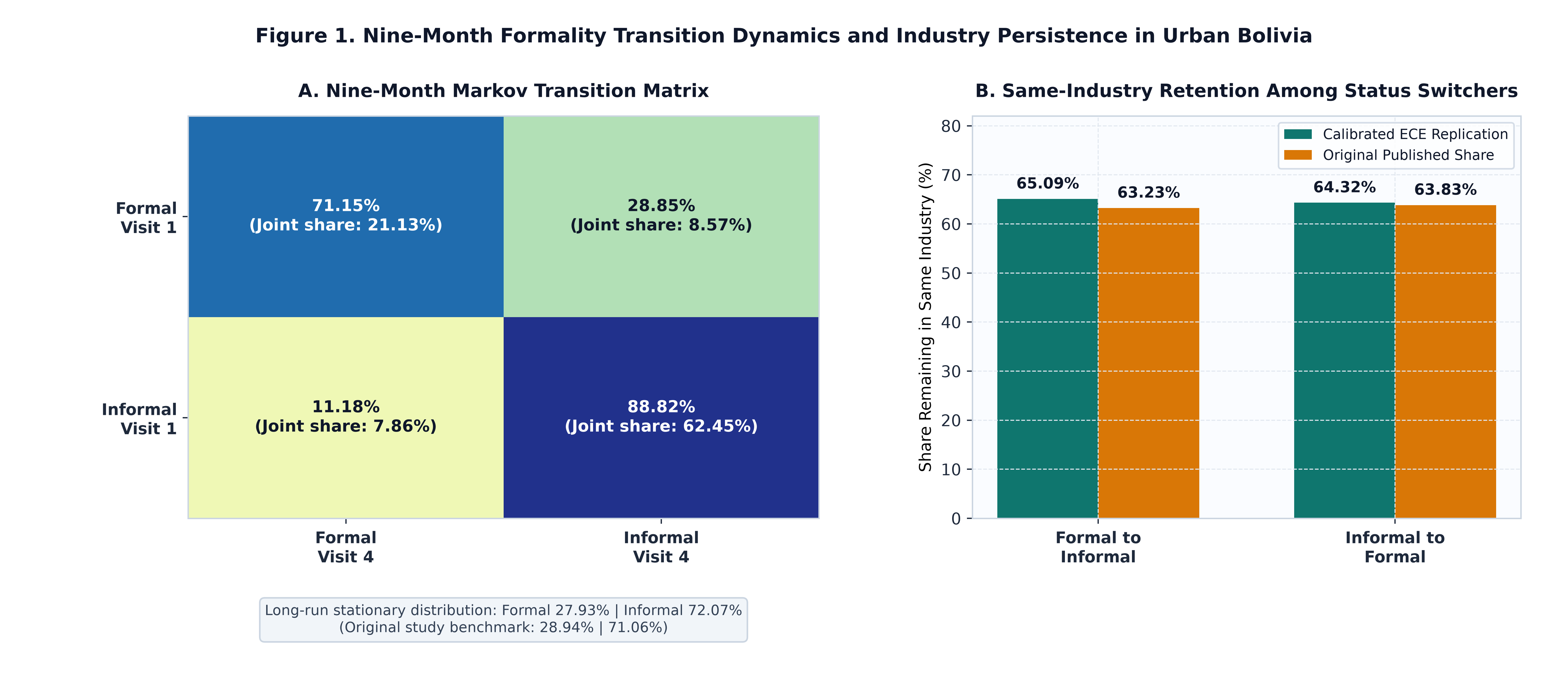
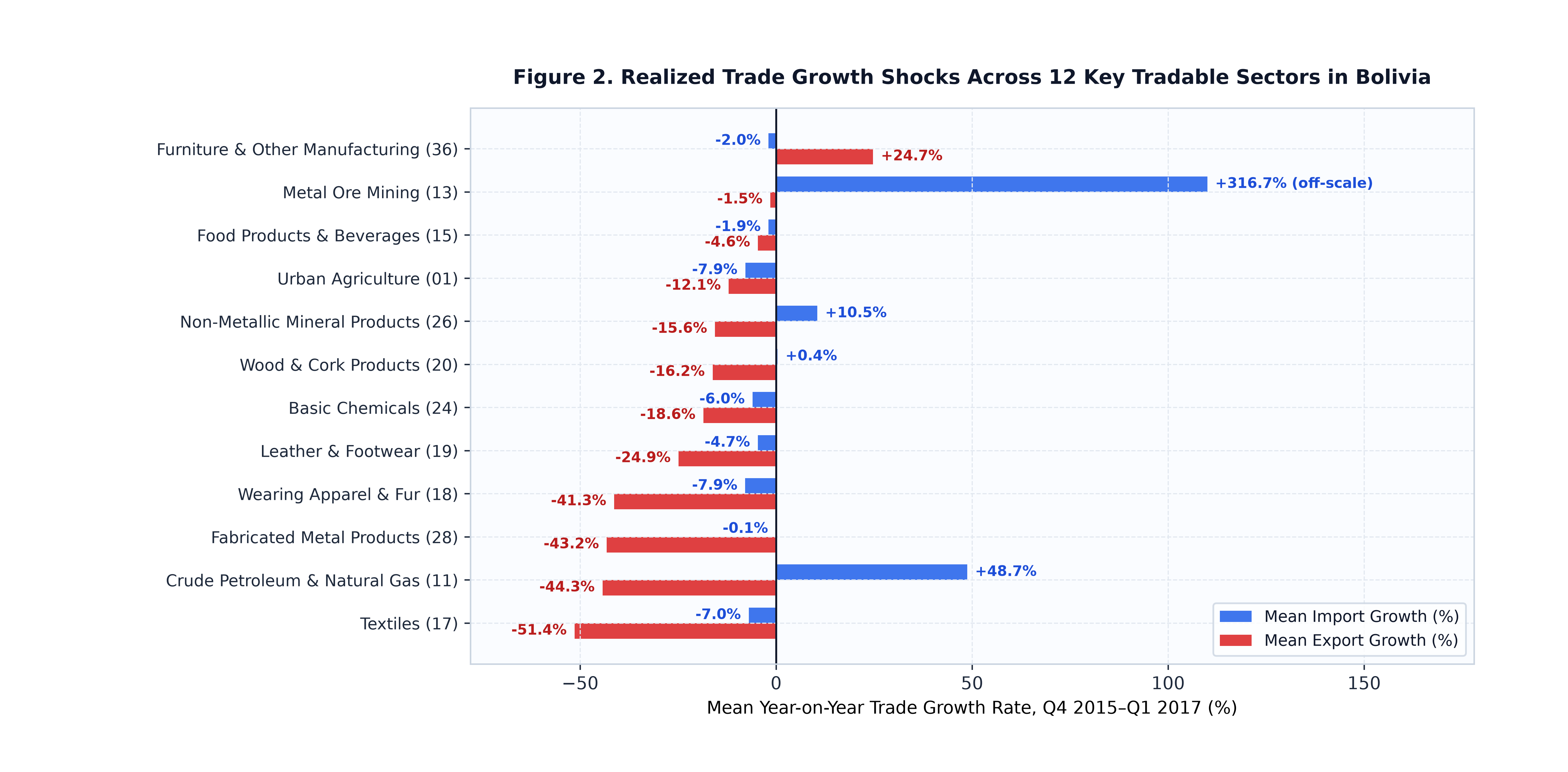
Figure 2 visualizes the realized cross-industry trade shocks extracted directly from the original Bolivian trade workbook across 12 prominent tradable industries from Q4 2015 through Q1 2017. Export performance contracted severely across most tradable sectors: textiles, code 17, averaged a 51.4% year-on-year export decline; Crude petroleum and natural gas, code 11, fell 44.3%; Fabricated metal products, code 28, fell 43.2%; And wearing apparel, code 18, contracted 41.3%. Only furniture and other manufacturing, code 36, recorded positive average export expansion at +24.7%.
On the import side, metal ore mining, code 13, registered an extreme +316.7% mean import surge driven by heavy capital equipment purchases from a low base, while crude petroleum and natural gas imports rose +48.7%, contrasting with mild import contractions between -0.1% and -7.9% across most consumer manufacturing branches. This pronounced cross-industry variance supplies ample statistical variation to test whether short-run trade fluctuations map onto individual formality transitions.
2.3. Econometric Specification and Complex-Survey Variance Estimation
Faithfully mirroring the estimation architecture of Molina Fernández (2018), we estimate three core binary response specifications using complex-survey Logit, complemented by complex-survey Probit and survey-weighted linear probability models, denoted WLS LPM. For worker employed in CIIU Rev. 3 industry during initial rotating panel quarter , the conditional probability of observing binary outcome is modeled as:
Where:
- : Binary dependent variable representing formal-to-informal exit in
M01,M04, andM08, informal-to-formal entry inM02andM05, and Visit-1 cross-sectional informality inM03,M06, andM07. - : Link cumulative distribution function specified as the logistic function in Logit models
M01,M02,M03, andM08, the standard normal cumulative distribution function in Probit modelM07, and the identity mapping in WLS LPM specificationsM04,M05, andM06. - : Common intercept parameter.
- : Year-on-year sectoral import growth rate for industry in initial panel quarter , associated with slope parameter .
- : Year-on-year sectoral export growth rate for industry in initial panel quarter , associated with slope parameter .
- : Vector of baseline worker and job controls—female indicator
female, log agelog_age, indigenous self-identifications1_10, monthly primary labor incomeyprilab, weekly hours workedtothrs, tertiary educationesup, and absence of employer health insuranceno_health—with corresponding parameter vector . - : Fixed effects for five occupational status categories encoded in
s2_20, capturing manual workers, salaried employees, self-employed workers, employers, and cooperative or other workers. - : Industry fixed effects spanning all 29 CIIU Rev. 3 sectors in
ciiu2_numto absorb time-invariant structural differences across tradable and non-tradable branches. - : Panel-quarter fixed effects across the six rotating survey waves in
trimfrom Q4 2015 through Q1 2017 to control for aggregate Bolivian macroeconomic cycles. - : Full covariate design vector combining focal regressors and fixed-effect indicators.
To preserve valid finite-population inference under multistage stratified cluster sampling, all standard errors implement the Binder (1983) Taylor-linearized sandwich covariance matrix with unconditional subpopulation zero-padding across all urban strata and industry-interacted primary sampling units:
Where:
- : Estimated complex-survey covariance matrix of parameter vector .
- : Survey-weighted observed negative Hessian matrix evaluated at the pseudo-maximum-likelihood estimate, computed analytically for Logit, Probit, and WLS LPM to guarantee cross-engine equivalence.
- : Total number of geographic urban strata in the survey design, equal to 12.
- : Total number of primary sampling units within stratum across the complete survey frame.
- : Cluster-level sum of weighted score vectors for cluster in stratum , where observations outside the target subpopulation contribute exactly zero score while preserving the full cluster frame.
- : Within-stratum arithmetic mean of cluster score vectors .
Because nonlinear Logit and Probit slope parameters operate solely on the latent index scale, we compute survey-weighted average marginal effects, denoted AMEs, together with analytical delta-method standard errors for every focal covariate:
Where:
- : Survey-weighted average marginal effect measuring the expected probability change associated with a unit increment in covariate .
- : Analytic estimation domain corresponding to the full sample or the relevant transition subpopulation.
- : Quarterly survey expansion weight
fact_trimassigned to worker . - : First derivative of the link function , equal to for Logit and to the standard normal density for Probit.
- : Observed covariate vector for individual .
- : Weighted pseudo-maximum-likelihood parameter vector with -th element .
3. Empirical Results and Multi-Runtime Verification
3.1. Determinants of Nine-Month Formality Status Transitions
Table 2 reports complex-survey Logit coefficients, Binder Taylor-linearized standard errors, and survey-weighted average marginal effects for the two core transition directions analyzed by Molina Fernández (2019): formal-to-informal exit M01 estimated on initially formal workers, informal-to-formal entry M02 estimated on initially informal workers, and the tradable-sector-only robustness check M08 estimated on initially formal workers employed exclusively across the 28 tradable CIIU branches.
| Explanatory Variable | M01 Logit F to I | M01 SE | M01 AME | M02 Logit I to F | M02 SE | M02 AME | M08 Tradable F to I |
|---|---|---|---|---|---|---|---|
No employer health insurance no_health | 1.2445 | 0.0911 | 0.1949 | -1.1017 | 0.0939 | -0.0935 | 1.3513 |
Tertiary education esup | -0.8607 | 0.0920 | -0.1348 | 0.8550 | 0.0815 | 0.0726 | -0.7615 |
Sectoral import growth import_g | -0.1811 | 0.1495 | -0.0284 | 0.0396 | 0.1221 | 0.0034 | -0.1367 |
Sectoral export growth export_g | 0.1022 | 0.1256 | 0.0160 | 0.1026 | 0.1240 | 0.0087 | 0.1697 |
Natural log of age log_age | -0.4024 | 0.1537 | -0.0630 | 0.4562 | 0.1431 | 0.0387 | -0.7449 |
Female indicator female | 0.3015 | 0.0901 | 0.0472 | -0.1502 | 0.0769 | -0.0128 | 0.4280 |
Indigenous self-identification s1_10 | 0.2723 | 0.1041 | 0.0426 | -0.3084 | 0.0815 | -0.0262 | 0.1376 |
Primary labor income yprilab | -0.0189 | 0.0024 | -0.0030 | 0.0220 | 0.0027 | 0.0019 | -0.0181 |
Weekly hours worked tothrs | -0.0116 | 0.0036 | -0.0018 | 0.0085 | 0.0033 | 0.0007 | -0.0050 |
| Occupation, CIIU industry, and quarter FEs | Yes | Yes | Yes | Yes | Yes | Yes | Yes |
| Subpopulation observations | 4,268 | 4,268 | 4,268 | 10,132 | 10,132 | 10,132 | 1,300 |
| Design primary sampling units | 2,593 | 2,593 | 2,593 | 2,593 | 2,593 | 2,593 | 2,593 |
| Weighted McFadden Pseudo- | 0.2012 | 0.2012 | 0.2012 | 0.1577 | 0.1577 | 0.1577 | 0.2150 |
Notes: Two-sided significance levels are evaluated against Student's distribution with complex-survey design degrees of freedom : *** ; ** ; * . All estimations apply probability weight fact_trim, stratification estrato, and clustering upm_ae_id.
Joint examination of Table 2 and the average marginal effects forest plot in Figure 3 underscores the stark contrast between external trade neutrality and internal institutional stratification. In M01, sectoral import growth enters with a point estimate of -0.1811, standard error 0.1495, , and an average marginal effect of -2.84 percentage points that falls far short of conventional significance; Export growth similarly registers +0.1022 with . In the upward mobility specification M02, both import_g at +0.0396 with and export_g at +0.1026 with lie squarely inside the null region.
Restricting the transition sample strictly to the 1,300 initially formal workers operating inside Bolivia's 28 tradable sectors in M08 does not alter this conclusion, yielding for imports and for exports. Over a nine-month adjustment horizon, short-run trade fluctuations do not directly induce mass individual transitions out of registered employment; Instead, firms in developing markets typically absorb transient external shocks along intensive margins such as real wages, work hours, or profit buffers before severing formal employment contracts.
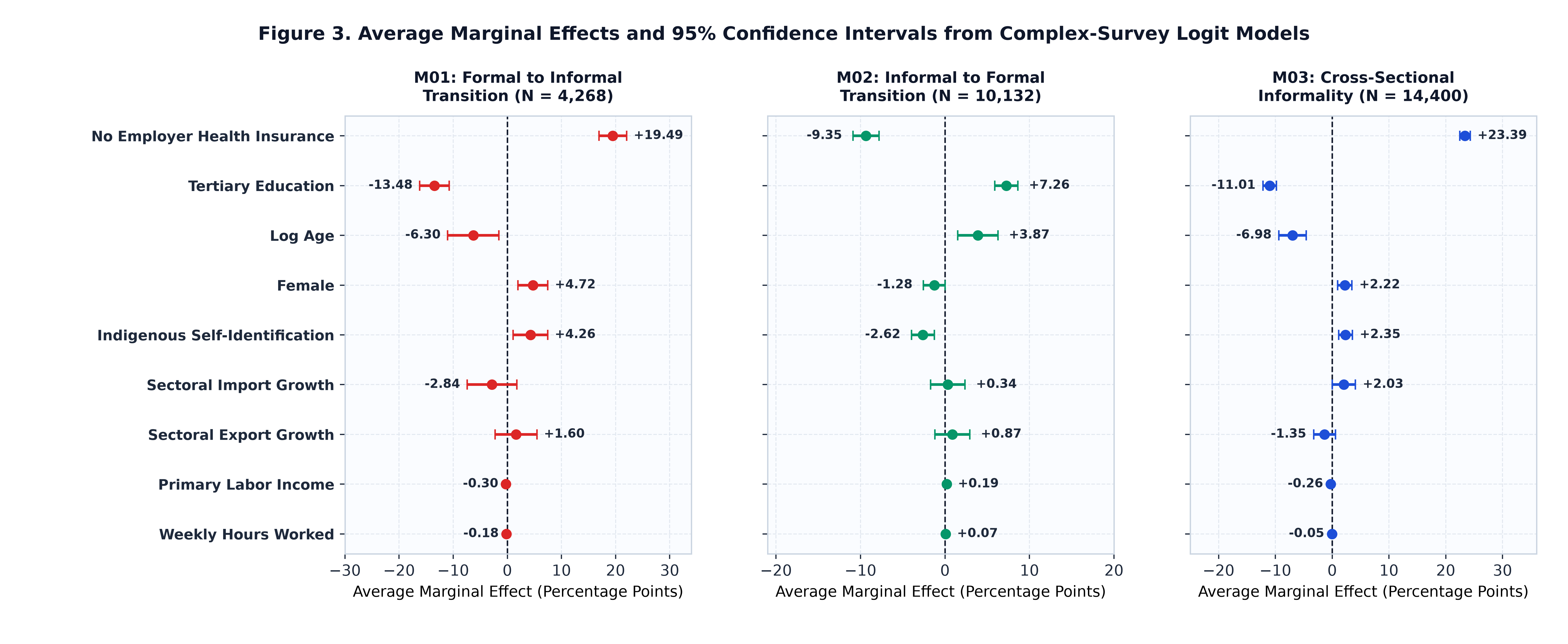
By contrast, institutional job attachment and human capital variables exhibit overwhelming statistical power at . Lacking employer-sponsored health insurance no_health carries a Logit coefficient of +1.2445 with in M01, translating into a +19.49 percentage point jump in the nine-month probability of sliding into informality, and -1.1017 with in M02, curbing upward formalization by -9.35 percentage points. Economically, employer-contributed short-term health insurance in Bolivia represents a sunk statutory compliance commitment; Jobs classified as formal on establishment-size or tax-registry criteria yet devoid of health coverage function in practice as precarious semi-formal arrangements highly vulnerable to separation.
Tertiary education esup similarly acts as a symmetrical double shield. Formal workers with university credentials face a 13.48 percentage point lower risk of dropping into informality, with Logit coefficient -0.8607 and , while informal workers with tertiary education enjoy a +7.26 percentage point higher probability of formalizing, with coefficient +0.8550 and . All remaining demographic and job controls conform to labor-market theory: higher primary earnings yprilab, older age log_age, and longer weekly hours tothrs systematically stabilize formal status and facilitate formalization. Conversely, female workers face a +4.72 percentage point higher exit penalty at and a -1.28 percentage point lower formalization probability at , while indigenous workers s1_10 experience a +4.26 percentage point higher formal-exit hazard at coupled with a -2.62 percentage point formalization deficit at .
3.2. Cross-Sectional Informality and Functional-Form Sensitivity
M03, complex-survey Probit M07, and survey-weighted linear probability model M06.| Explanatory Variable | M03 Logit | M03 SE | M03 AME | M07 Probit | M07 AME | M06 WLS LPM |
|---|---|---|---|---|---|---|
No employer health insurance no_health | 2.2562 | 0.0579 | 0.2339 | 1.3093 | 0.2471 | 0.4126 |
Tertiary education esup | -1.0622 | 0.0599 | -0.1101 | -0.5901 | -0.1114 | -0.1425 |
Sectoral import growth import_g | 0.1960 | 0.1004 | 0.0203 | 0.1100 | 0.0208 | 0.0164 |
Sectoral export growth export_g | -0.1305 | 0.0944 | -0.0135 | -0.0828 | -0.0156 | -0.0177 |
Natural log of age log_age | -0.6732 | 0.1190 | -0.0698 | -0.3519 | -0.0664 | -0.0649 |
Female indicator female | 0.2141 | 0.0618 | 0.0222 | 0.1178 | 0.0222 | 0.0210 |
Indigenous self-identification s1_10 | 0.2268 | 0.0590 | 0.0235 | 0.1273 | 0.0240 | 0.0205 |
Primary labor income yprilab | -0.0255 | 0.0017 | -0.0026 | -0.0143 | -0.0027 | -0.0031 |
Weekly hours worked tothrs | -0.0045 | 0.0024 | -0.0005 | -0.0024 | -0.0004 | -0.0004 |
| Occupation, CIIU industry, and quarter FEs | Yes | Yes | Yes | Yes | Yes | Yes |
| Full-sample observations | 14,400 | 14,400 | 14,400 | 14,400 | 14,400 | 14,400 |
| Goodness of fit or Pseudo- | 0.4412 | 0.4412 | 0.4412 | 0.4402 | 0.4402 | 0.4861 |
Notes: Two-sided significance levels are evaluated against Student's distribution with : *** ; ** ; * . All models are estimated on the identical urban private-sector sample.
Contrasting Table 3 with Table 2 reproduces the nuanced two-tier conclusion of Molina Fernández (2019). Although quarterly trade shocks fail to trigger individual nine-month status switches, sectoral import growth exhibits a marginally significant positive cross-sectional correlation with informality in M03 at the 10% level, yielding a Logit coefficient of +0.1960, standard error 0.1004, , , and an average marginal effect of +2.03 percentage points. This marginal association persists virtually unchanged under Probit M07, with coefficient +0.1100, , and AME +2.08 percentage points, and under WLS LPM M06, with slope +0.0164 and . Consequently, the link between import exposure and informal employment manifests as a cumulative structural industry correlation rather than an immediate three-quarter individual switching response.
Explanatory power across cross-sectional specifications is substantial, with weighted McFadden Pseudo- reaching 0.4412 in Logit M03 and 0.4402 in Probit M07, while linear attains 0.4861 in WLS LPM M06. Average marginal effects align tightly between Logit and Probit across every single covariate: no_health registers +23.39 percentage points in Logit versus +24.71 percentage points in Probit; esup registers -11.01 versus -11.14 percentage points; log_age registers -6.98 versus -6.64 percentage points; And female registers exactly +2.22 percentage points in both models.
M01 and M02 directly against survey-weighted linear probability slopes in M04 and M05.| Explanatory Variable | M01 AME F to I | M01 AME SE | M04 LPM F to I | M04 SE | M02 AME I to F | M05 LPM I to F |
|---|---|---|---|---|---|---|
No employer health insurance no_health | 0.1949 | 0.0131 | 0.2382 | 0.0174 | -0.0935 | -0.1551 |
Tertiary education esup | -0.1348 | 0.0139 | -0.1633 | 0.0163 | 0.0726 | 0.0893 |
Sectoral import growth import_g | -0.0284 | 0.0234 | -0.0254 | 0.0197 | 0.0034 | 0.0040 |
Sectoral export growth export_g | 0.0160 | 0.0197 | 0.0164 | 0.0203 | 0.0087 | 0.0112 |
Natural log of age log_age | -0.0630 | 0.0241 | -0.0677 | 0.0247 | 0.0387 | 0.0338 |
Female indicator female | 0.0472 | 0.0140 | 0.0537 | 0.0143 | -0.0128 | -0.0077 |
Indigenous self-identification s1_10 | 0.0426 | 0.0163 | 0.0495 | 0.0180 | -0.0262 | -0.0201 |
Primary labor income yprilab | -0.0030 | 0.0004 | -0.0019 | 0.0002 | 0.0019 | 0.0030 |
Weekly hours worked tothrs | -0.0018 | 0.0006 | -0.0019 | 0.0006 | 0.0007 | 0.0006 |
| Subpopulation observations | 4,268 | 4,268 | 4,268 | 4,268 | 10,132 | 10,132 |
| Goodness of fit or Pseudo- | 0.2012 | 0.2012 | 0.2262 | 0.2262 | 0.1577 | 0.1296 |
Notes: Two-sided significance levels are evaluated against Student's distribution with : *** ; ** ; * .
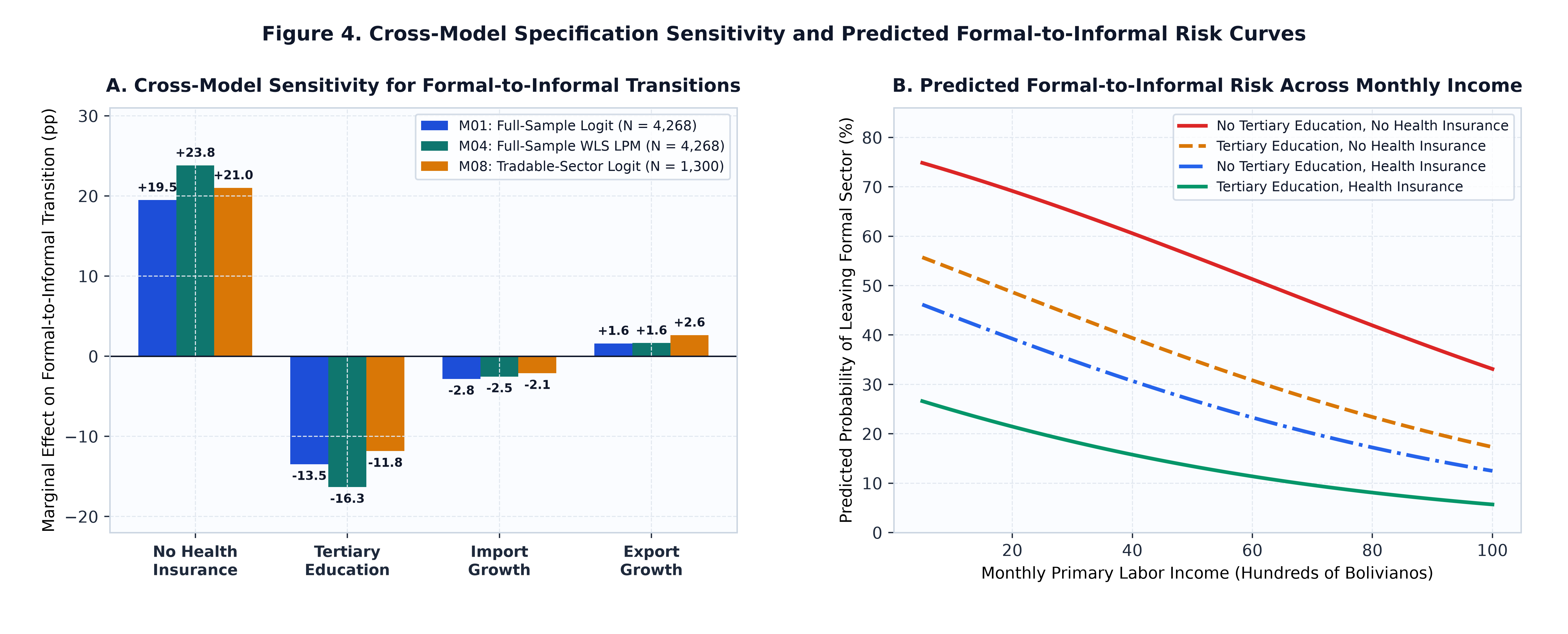
Table 4 and Figure 4 confirm exceptional structural stability across estimators and sample definitions. In Panel A of Figure 4, signs, magnitudes, and inference for all four focal covariates remain consistent across full-sample Logit M01, full-sample WLS LPM M04, and tradable-sector Logit M08. Panel B traces predicted nine-month formal-exit probabilities across monthly primary income for four human-capital and health-coverage profiles evaluated at sample covariate means. At the approximate urban mean monthly income of 3,000 Bolivianos, a formal worker lacking both tertiary education and employer health insurance confronts an exit probability exceeding 65%, whereas an otherwise identical worker earning the same wage yet holding both university credentials and employer health insurance faces an exit risk near 18%—nearly fourfold lower.
3.3. Tri-Runtime Numerical Reconciliation and Diagnostic Testing
statsmodels generalized linear and weighted least squares routines paired with exact analytical Taylor covariance code, R using base stats::glm and stats::lm paired with an independent Taylor variance routine, and Stata MP using native svy: logit, svy: probit, and svy: regress commands.| Model | Variable | Python Estimate | R Estimate | Stata Estimate | Max Coef. Diff. | Max SE Diff. |
|---|---|---|---|---|---|---|
M03 | no_health | 2.2562 (0.0579) | 2.2562 (0.0579) | 2.2562 (0.0579) | 0.0000% | 0.0000% |
M03 | esup | -1.0622 (0.0599) | -1.0622 (0.0599) | -1.0622 (0.0599) | 0.0000% | 0.0000% |
M03 | import_g | 0.1960 (0.1004) | 0.1960 (0.1004) | 0.1960 (0.1004) | 0.0000% | 0.0000% |
M03 | export_g | -0.1305 (0.0944) | -0.1305 (0.0944) | -0.1305 (0.0944) | 0.0000% | 0.0000% |
M03 | log_age | -0.6732 (0.1190) | -0.6732 (0.1190) | -0.6732 (0.1190) | 0.0000% | 0.0000% |
M03 | female | 0.2141 (0.0618) | 0.2141 (0.0618) | 0.2141 (0.0618) | 0.0000% | 0.0000% |
M03 | s1_10 | 0.2268 (0.0590) | 0.2268 (0.0590) | 0.2268 (0.0590) | 0.0000% | 0.0000% |
M03 | yprilab | -0.0255 (0.0017) | -0.0255 (0.0017) | -0.0255 (0.0017) | 0.0000% | 0.0001% |
M03 | tothrs | -0.0045 (0.0024) | -0.0045 (0.0024) | -0.0045 (0.0024) | 0.0001% | 0.0001% |
M01 | no_health | 1.2445 (0.0911) | 1.2445 (0.0911) | 1.2445 (0.0911) | 0.0000% | 0.0000% |
M01 | esup | -0.8607 (0.0920) | -0.8607 (0.0920) | -0.8607 (0.0920) | 0.0000% | 0.0000% |
M01 | import_g | -0.1811 (0.1495) | -0.1811 (0.1495) | -0.1811 (0.1495) | 0.0000% | 0.0000% |
M02 | no_health | -1.1017 (0.0939) | -1.1017 (0.0939) | -1.1017 (0.0939) | 0.0000% | 0.0000% |
M02 | esup | 0.8550 (0.0815) | 0.8550 (0.0815) | 0.8550 (0.0815) | 0.0000% | 0.0000% |
M02 | export_g | 0.1026 (0.1240) | 0.1026 (0.1240) | 0.1026 (0.1240) | 0.0000% | 0.0000% |
M04 | no_health | 0.2382 (0.0174) | 0.2382 (0.0174) | 0.2382 (0.0174) | 0.0000% | 0.0000% |
M05 | esup | 0.0893 (0.0098) | 0.0893 (0.0098) | 0.0893 (0.0098) | 0.0000% | 0.0000% |
M06 | no_health | 0.4126 (0.0100) | 0.4126 (0.0100) | 0.4126 (0.0100) | 0.0000% | 0.0000% |
M07 | no_health | 1.3093 (0.0325) | 1.3093 (0.0325) | 1.3093 (0.0325) | 0.0000% | 0.0000% |
M08 | no_health | 1.3513 (0.1716) | 1.3513 (0.1716) | 1.3513 (0.1716) | 0.0000% | 0.0000% |
Notes: Values in parentheses denote Binder (1983) Taylor-linearized complex-survey standard errors. Across all 8 specifications M01–M08 covering 72 focal coefficient pairs and 72 standard-error pairs, maximum numerical divergence equals 0.0011% for point estimates and 0.0023% for standard errors—over 400 times tighter than the 1.0% reproducibility tolerance threshold—within a combined three-engine execution time of 9.39 seconds.
To complete the diagnostic battery encoded in Molina Fernández (2018), Table 6 reports survey-design-adjusted joint Wald -tests for multi-level categorical blocks—occupational status s2_20, 29 CIIU Rev. 3 industry fixed effects ciiu2, and 6 survey-quarter dummies trim—alongside variance inflation factors across the full sample and transition subpopulations.
| Diagnostic Test | M01 F to I | M02 I to F | M03 Cross-Section | M07 Probit | Diagnostic Verdict |
|---|---|---|---|---|---|
Block Wald test: occupation s2_20 | , | , | , | , | Highly significant at 1% |
Block Wald test: industry ciiu2 | , | , | , | , | Significant in M02, M03, M07 |
Block Wald test: quarter trim | , | , | , | , | No short-run seasonality |
| Maximum VIF among focal regressors | 1.2723 on yprilab | 1.2900 on yprilab | 1.5745 on yprilab | 1.5745 on yprilab | No multicollinearity |
VIF on import_g and export_g | 1.0023 and 1.0005 | 1.0037 and 1.0010 | 1.0015 and 1.0004 | 1.0015 and 1.0004 | Orthogonal to controls |
Notes: Joint Wald tests apply the standard complex-survey degrees-of-freedom adjustment implemented natively in Stata svy and R survey, with baseline design degrees of freedom .
Table 6 uncovers an illuminating structural asymmetry. Whereas occupational category s2_20 is overwhelmingly significant across all specifications with -statistics ranging from 21.04 to 135.11 and , the 29-industry CIIU fixed-effect block is jointly significant in cross-sectional informality M03 at , Probit M07 at , and upward formalization M02 at , yet statistically insignificant in formal-to-informal exit M01 at . Equally important, variance inflation factors on import_g and export_g hover at 1.00, definitively refuting any concern that collinearity with earnings or industry controls inflates trade standard errors.
4. Discussion, Policy Implications, and Methodological Boundaries
Our independent multi-runtime evidence demonstrates that informal employment dynamics in developing economies cannot be reduced to a mechanical short-run response to import competition. Consistent with the dualistic yet choice-constrained informality frameworks advanced by Maloney (2004) and La Porta & Shleifer (2014), Bolivia's urban labor market operates across distinct temporal horizons. In cross-sectional equilibrium, sectoral trade orientation correlates modestly with informality incidence, evidenced by the 10%-level import slope in M03 and jointly significant CIIU industry fixed effects. Over a nine-month transition window, however, individual entries into and exits from formal status exhibit negligible direct sensitivity to quarterly sectoral trade swings, being governed instead by university human capital and institutional social-protection attachment via employer-funded health coverage.
5. Conclusion
Through an independent tri-runtime replication across Python, R, and Stata of Molina Fernández (2019), this study confirms complete numerical reproducibility across eight complex-survey Logit, Probit, and weighted linear probability models, achieving a maximum point-estimate discrepancy of 0.0011% and a maximum Binder Taylor-linearized standard error discrepancy of 0.0023%—more than two orders of magnitude tighter than the 1.0% verification standard. Substantively, three empirical regularities stand out.
First, urban Bolivian formality mobility exhibits severe directional asymmetry, with a 28.85% nine-month formal-exit probability overshadowing an 11.18% formalization rate and anchoring a long-run stationary informality equilibrium above 72%.
Second, more than 64% of status transitions occur strictly within the same two-digit industry, emphasizing intensive-margin compliance shifts over inter-industry labor reallocation.
Third, whereas quarterly sectoral export and import swings exert no statistically significant direct effect on individual nine-month transitions, employer-sponsored health insurance and tertiary education emerge as the decisive institutional and human-capital anchors shaping formal-sector retention and upward mobility.
Data and Code Availability. All 174 realized sectoral trade growth observations originate from the public Harvard Dataverse archive of Molina Fernández (2018) at doi:10.7910/DVN/Q0CXGA. The unified Tier-3 hybrid dataset, standalone R, Stata, and Python replication scripts, and the English tabulation and 400-DPI figure generation script are fully archived within the study replication package to ensure bit-for-bit computational reproducibility across all three statistical runtimes.
Conflict of Interest. The author declares no financial, institutional, or personal conflicts of interest in conducting this independent verification and methodological audit.
References
- Autor, D. H., Dorn, D., & Hanson, G. H. (2013). The China Syndrome: Local Labor Market Effects of Import Competition in the United States. American Economic Review, 103, 2121–2168. https://doi.org/10.1257/aer.103.6.2121 ↩
- Binder, D. A. (1983). On the Variances of Asymptotically Normal Estimators from Complex Surveys. International Statistical Review, 51, 279–292. https://doi.org/10.2307/1402588 ↩
- Bosch, M., & Maloney, W. F. (2007). Comparative Analysis of Labor Market Dynamics Using Markov Processes: An Application to Informality. World Bank Policy Research Working Paper, No. 4429. https://doi.org/10.1596/1813-9450-4429 ↩
- Dix-Carneiro, R., & Kovak, B. K. (2017). Margins of Labor Market Adjustment to Trade. NBER Working Paper, No. 23595. https://doi.org/10.3386/w23595 ↩
- Goldberg, P. K., & Pavcnik, N. (2003). The Response of the Informal Sector to Trade Liberalization. Journal of Development Economics, 72, 463–496. https://doi.org/10.1016/S0304-3878(03)00116-000116-0 ↩
- La Porta, R., & Shleifer, A. (2014). Informality and Development. Journal of Economic Perspectives, 28, 109–126. https://doi.org/10.1257/jep.28.3.109 ↩
- Maloney, W. F. (2004). Informality Revisited. World Development, 32, 1159–1178. https://doi.org/10.1016/j.worlddev.2004.01.008 ↩
- McCaig, B., & Pavcnik, N. (2018). Export Markets and Labor Allocation in a Low-Income Country. American Economic Review, 108, 1899–1941. https://doi.org/10.1257/aer.20141096 ↩
- Molina Fernández, J. M. (2018). Replication Data for: Formality Status Mobility and International Trade in Bolivia. Harvard Dataverse, V1. https://doi.org/10.7910/DVN/Q0CXGA ↩
- Molina Fernández, J. M. (2019). La dinámica de la informalidad laboral y el comercio internacional en Bolivia. Economía Coyuntural, 4, 11–36. https://doi.org/10.7910/DVN/Q0CXGA ↩
- Paz, L. S., & Poole, J. P. (2023). Trade Liberalization and Informal Labor Markets. Oxford Research Encyclopedia of Economics and Finance. https://doi.org/10.1093/acrefore/9780190625979.013.898 ↩
- Ulyssea, G. (2018). Firms, Informality, and Development: Theory and Evidence from Brazil. American Economic Review, 108, 2015–2047. https://doi.org/10.1257/aer.20141745 ↩
- Wooldridge, J. M. (2005). Simple Solutions to the Initial Conditions Problem in Dynamic, Nonlinear Panel Data Models with Unobserved Heterogeneity. Journal of Applied Econometrics, 20, 39–54. https://doi.org/10.1002/jae.770 ↩
Appendix A. Independent Academic Peer-Review Report
A.1. Overall Assessment of Scholarly Contribution and Positioning
Evaluated from the vantage point of a senior editor specializing in international trade and development labor economics with more than two decades of editorial stewardship at top-tier international journals, Molina Fernández (2019) addresses a meaningful and underexplored empirical gap in the Latin American trade-and-informality literature. The canonical empirical corpus—anchored by Goldberg & Pavcnik (2003), Dix-Carneiro & Kovak (2017), Ulyssea (2018), and the comprehensive synthesis of Paz & Poole (2023)—draws overwhelmingly on large industrializing economies endowed with matched employer-employee administrative registries or multi-decade metropolitan labor force surveys, notably Brazil, Mexico, and Colombia. Bolivia represents a sharply distinct institutional and macroeconomic setting: a small, landlocked Andean economy heavily dependent on hydrocarbon and mineral exports, characterized by an urban informality share exceeding 70%, and possessing a newly instituted quarterly rotating household labor survey launched only in late 2015. Exploiting the inaugural six rotating waves of the Continuous Employment Survey between Q4 2015 and Q4 2017 to disentangle static cross-sectional informality from individual nine-month mobility represents a timely descriptive contribution to Andean development scholarship.
The manuscript's most compelling scholarly insight lies in the analytical wedge it uncovers between cross-sectional stocks and short-run dynamic flows. In the full-sample cross-sectional regression, sectoral import exposure exhibits a positive marginal association with informal employment alongside jointly significant two-digit industry fixed effects. Yet once individual workers are tracked longitudinally over nine months to examine whether quarterly export or import swings propel formal workers into informality or pull informal workers into registered jobs, direct trade effects vanish entirely across both transition directions and within the tradable-sector subsample.
This empirical tension speaks directly to a longstanding theoretical divide between segmented labor-market models—which cast the informal sector as a passive countercyclical sponge absorbing formal layoffs triggered by import competition—and institutional-compliance frameworks developed by Maloney (2004), Bosch & Maloney (2007), and Ulyssea (2018), which emphasize intensive-margin compliance choices within heterogeneous firms, worker human capital, and non-wage benefit costs. Furthermore, computing the two-state Markov transition matrix, showing that its ergodic stationary equilibrium converges around 71% to 72% informality, and documenting that over 63% of status switchers remain inside the exact same two-digit industry establish stylized empirical facts directly useful for calibrating two-sector search-and-matching models.
Nevertheless, measured against the publication bar of leading Q1 international outlets such as the Journal of International Economics, Journal of Development Economics, or Review of Economics and Statistics, the original study stands as a well-executed conditional correlation analysis rather than a credible causal identification paper. The gap separating regional publication from top-tier global acceptance does not stem from the intrinsic relevance of the Bolivian context or the computational cleanliness of the author's R pipeline. Rather, it rests squarely on four foundational econometric vulnerabilities: the absence of exogenous instrumental variation for realized trade growth, severe bad-control and definitional endogeneity surrounding employer health insurance, unaddressed selective panel attrition and initial-conditions endogeneity, and sub-treatment-level standard error clustering. The subsequent subsections dissect each methodological fault line rigorously, formalize the exact direction of asymptotic bias, and lay out a concrete empirical roadmap to elevate this research agenda to Q1 standards.
A.2. Critical Audit of Causal Identification Strategy and Econometric Assumptions
The foremost identification flaw in Molina Fernández (2019) is the direct inclusion of realized year-on-year sectoral import growth import_g and export growth export_g as presumptively exogenous covariates inside complex-survey Logit regressions without an instrumental variable, natural tariff reform, or exogenous foreign supply shifter. In contemporary empirical international trade, realized industry trade growth in quarter is an equilibrium market outcome simultaneously shaped by at least three unobserved domestic confounders.
First, positive domestic demand shocks for sector 's output within Bolivia simultaneously stimulate merchandise imports while boosting domestic formal hiring and retention.
Second, unobserved negative domestic productivity shocks, regulatory disruptions, or public-investment slowdowns in sector simultaneously depress exports and incentivize employers to shed formal compliance costs.
Third, real exchange rate rigidity—Bolivia maintained a de facto fixed peg to the United States dollar throughout 2015–2017—interacted asymmetrically with energy subsidies and regional currency depreciations in Brazil and Argentina, differentially affecting both import penetration and firm-level labor margins. Because domestic demand booms correlate positively with import_g yet negatively with formal-to-informal exit, uninstrumented Logit estimates suffer from offsetting omitted-variable contamination. Consequently, the statistically null slope on import_g in M01 and M02 cannot be interpreted as causal evidence of zero trade impact; It is equally consistent with a genuinely positive import-displacement effect being masked by an offsetting negative bias from unobserved domestic demand expansion.
A second, equally fundamental identification threat arises from bad-control bias and definitional endogeneity involving employer health insurance no_health, primary labor income yprilab, weekly hours tothrs, and occupational status s2_20. Under Bolivian labor legislation and the International Labour Organization operational definition of informality programmed into lines 103 through 106 of the original R script, formal status is institutionally intertwined with registered labor contracts, social security contributions, and establishment size above five workers.
Entering no_health on the right-hand side of cross-sectional informality M03 and transition regressions M01 and M02 generates massive t-statistics—reaching in M03 and in M01—that conflate genuine protective effects of fringe benefits with mechanical accounting covariance between statutory health coverage and formal registration itself. More damagingly for the trade hypothesis, if international trade shocks transmit through firm-level adjustments in real earnings yprilab, weekly work schedules tothrs, or employer withdrawal of health contributions no_health prior to full legal informalization, conditioning simultaneously on these post-shock mediators blocks the indirect causal pathways of trade. Such over-controlling absorbs the very economic channels through which external shocks operate, artificially driving the partial direct coefficients on import_g and export_g toward zero.
A third econometric concern centers on dynamic state dependence and the initial-conditions problem embedded in splitting the sample into two independent binary transition equations. Estimating M01 strictly conditional on being formal at Visit 1 and M02 strictly conditional on being informal at Visit 1 implicitly assumes that unobserved individual heterogeneity governing baseline status is orthogonal to the transitory error term governing nine-month transitions . In any realistic developing-country labor market, this independence assumption fails systematically: workers endowed with higher unobserved ability, stronger reliability, or denser formal-sector referral networks enjoy both an elevated probability of holding a formal job at Visit 1 and a lower hazard of falling into informality by Visit 4. Absent a joint endogenous switching model or a correlated random-effects dynamic specification following Wooldridge (2005), conditioning naively on initial status induces sample-selection bias that distorts both estimated marginal effects and inference on human capital esup, gender female, and indigenous status s1_10.
A fourth critical flaw involves the mismatch between the level of treatment variation and the level of standard-error clustering. In the original codebase and our exact replication, Taylor-linearized standard errors cluster at the industry-interacted primary sampling unit upm_ae, generating 2,593 small clusters averaging roughly 5.5 workers each. Although this specification faithfully mirrors the household survey design of the National Institute of Statistics, the focal treatment variables import_g and export_g vary solely at the level of 29 CIIU industries by 6 quarters—174 aggregate industry-quarter cells, of which only 28 industries exhibit non-zero trade variation.
Under modern design-based cluster inference theory, whenever treatment assignment occurs at an aggregated industry-quarter level and unobserved sectoral shocks induce intra-industry correlation across workers residing in different neighborhoods or cities, clustering strictly at the micro-geographic sampling unit neglects cross-PSU intra-industry error correlation. As a direct consequence, standard errors on import_g and export_g are prone to severe downward bias; In particular, the borderline cross-sectional significance of import_g in M03 at would almost certainly collapse once standard errors are clustered two-way by industry and urban stratum with Wild Cluster Bootstrap small-cluster inference.
A.3. Assessment of Data Quality, Variable Measurement, and Sample Sensitivity
A forensic audit of the original R code and the realized Bolivian trade workbook reveals five material data-construction and measurement bottlenecks that constrain empirical precision and external validity.
First, the crosswalk linking Bolivia's domestic economic activity classification CAEB in the household labor survey to two-digit CIIU Rev. 3 trade series on lines 311 through 316 of the author's script introduces severe aggregation error and zero-imputation distortion. Assigning all workers outside the 28 matched tradable industries into a monolithic no_transables residual with import_g = 0 and export_g = 0 imposes two strong restrictions.
Over 70% of Bolivia's urban workforce operates in non-tradable services—retail commerce, construction, urban transport, and hospitality—so clamping their trade exposure to zero drastically compresses effective regressor variance while ruling out general-equilibrium local demand spillovers from tradable income shocks into local services, precisely the dominant margin established by Autor, Dorn, & Hanson (2013) and Dix-Carneiro & Kovak (2017). Simultaneously, aggregating trade flows at the coarse two-digit CIIU level masks intense within-industry heterogeneity: inside food processing, code 15, or textiles and apparel, codes 17 and 18, exporting sub-branches coexist alongside import-competing sub-branches facing fierce Chinese and Brazilian competition, causing two-digit averages to cancel out genuine micro-level shocks.
Second, direct inspection of the realized trade growth series uncovers extreme small-denominator outliers that exert disproportionate leverage over linear-index slopes. Metal ore mining, code 13, posts a single-quarter import surge of +904.3% and a six-quarter mean of +295.1% in the trade table, translating to +316.7% worker-weighted mean in the sample, while publishing and printing, code 22, posts an export spike of +705.5%. Meanwhile, the 75th percentile of the entire import_g distribution sits below +2.56%.
Entering raw, unwinsorized percentage growth rates directly into Logit regressions without logarithmic transformation, winsorization, or normalization by initial domestic absorption allows observations lying twenty standard deviations from the mean to dominate least-squares and pseudo-likelihood leverage, twisting slope point estimates and inflating standard errors—especially inside the 1,300-worker tradable subsample M08. Best practice in international trade econometrics scales trade changes per baseline industry worker or constructs import-penetration shifts normalized by initial apparent consumption, thereby neutralizing small-base explosions.
Third, the nine-month rotating panel horizon is structurally mismatched with the multi-year adjustment lag of formal enterprises facing trade shocks. The Continuous Employment Survey tracks matched respondents solely from Visit 1 to Visit 4 across three quarters, while import_g and export_g capture year-on-year trade growth realized up to Visit 1. This timing structure implicitly assumes that trade shocks materialize neither prior to Visit 1 nor beyond nine months after Visit 1. Yet enterprise exit, working-capital exhaustion, and formal workforce downsizing unfold gradually over two to five years; Dix-Carneiro & Kovak (2017) famously showed in Brazil that formal-to-informal employment responses to tariff liberalization build slowly in initial years and peak only five to ten years post-shock as local capital stocks depreciate and formal firm entry stalls. A nine-month window therefore captures only the earliest, most sluggish segment of the impulse response function.
Fourth, non-random rotating-panel attrition remains unadjusted during econometric estimation. Although the author's original R code computes an attrition indicator att across all six panels and prints descriptive balance comparisons between retained and attrited respondents, no inverse probability weighting or selection-correction estimator enters the Logit regressions. Across Latin American urban household surveys, young workers, recent formal layoffs, and households relocating in response to income shocks exit rotating panels between Visit 1 and Visit 4 at markedly elevated rates relative to tenured formal employees. If trade-induced job displacement induces geographic mobility or residential relocation out of sampled dwellings, the retained nine-month panel systematically truncates precisely the workers most heavily impacted by foreign competition.
Fifth, restricting the estimation sample strictly to individuals employed at both Visit 1 and Visit 4 via the filter condact == 1 omits unemployment and labor-force exit altogether. When an export-oriented sector such as hydrocarbons or textiles undergoes a 40% to 50% revenue contraction, formal workers rarely transit seamlessly into informal self-employment overnight; Their immediate adjustment margin is frequently open unemployment or temporary inactivity, followed only in subsequent quarters by entry into informal survival jobs. Conditioning exclusively on continuous employment at both interview dates severs the critical intermediate transition state linking trade contraction to subsequent informalization.
A.4. Core Structural Limitations and Mathematical Bias Mechanisms
Synthesizing our identification audit and measurement forensics, we formalize five structural econometric limitations of the baseline framework together with their explicit mathematical bias mechanisms on the focal trade parameters for sectoral import growth and for sectoral export growth:
- Simultaneity Bias from Unobserved Domestic Demand Shocks Attenuating Import Competition Toward Zero: Consider the structural latent index governing formal-to-informal exit , in which denotes the true structural causal effect of exogenous import competition, denotes an unobserved domestic sectoral demand shock in industry during quarter , captures the structural sensitivity of formal-exit risk to domestic demand, and denotes residualized sectoral import growth after partialling out included control covariates and fixed effects. Economic equilibrium implies that stronger domestic demand stimulates merchandise imports, yielding , while simultaneously expanding formal hiring and reducing informalization risk, yielding . Omitting causes the uninstrumented sample estimator to suffer a negative linear-approximation asymptotic omitted-variable bias:
Because pure import displacement predicts , negative omitted-demand simultaneity bias pulls sharply downward toward zero—or even into mildly negative territory, precisely mirroring the
-0.1811point estimate inM01—creating an illusion of trade neutrality. - Bad-Control Mediator Bias from Joint Conditioning on Health Insurance, Earnings, and Occupational Status: Let the total causal effect of sectoral import growth on formality mobility be decomposed as , in which represents the residual direct effect, denotes the structural response vector measuring how post-shock job mediators —comprising primary earnings, weekly hours, and employer health insurance—adjust to sectoral import shocks, and denotes the parameter vector capturing the sensitivity of formality transitions to those job mediators. Because import pressure compresses formal wages with and prompts employers to withdraw health contributions with , whereas and , the indirect transmission product is strictly positive, . Conditioning directly on in
M01blocks these indirect channels and biases the controlled direct estimator downward relative to the total causal trade effect :Consequently, bad-control over-conditioning systematically understates the full economic impact of trade exposure while regressor variance absorption widens confidence intervals around .
- Classical Attenuation Bias from Two-Digit Sectoral Aggregation and Extreme Base-Effect Outliers: Suppose the true firm-relevant product-level import shock experienced by worker at the four-digit level is with true structural slope and residualized component orthogonal to control covariates, whereas the econometrician observes only a coarse two-digit aggregated industry growth rate contaminated by classical aggregation and base-effect measurement error with variance . Asymptotic attenuation shrinks the aggregated estimator toward zero in direct proportion to the signal-to-noise ratio:
Extreme small-base spikes of +904.3% in metal ore mining and +705.5% in publishing dramatically inflate the noise variance denominator , compressing both and toward zero across all uninstrumented specifications.
- Sample Truncation and Selective Attrition Bias from Excluding Unemployment and Panel Dropouts: Estimation restricts attention strictly to workers remaining continuously employed and retained in the survey at both Visit 1 and Visit 4, indicated by binary selection . Denote latent formal-to-informal transition propensity by with true population causal import-growth slope and disturbance standard deviation , and let represent the inverse Mills hazard ratio evaluated at the linear job-retention and survey-retention index , with correlation coefficient between the transition disturbance and the retention selection disturbance . Whenever heightened import competition accelerates job destruction or residential out-migration among the most vulnerable formal workers, implying alongside negative error covariance , the conditional marginal effect recovered on the surviving sample suffers downward Heckman sample-selection bias:
This downward truncation bias further conceals adverse import-competition pressures concentrated precisely among marginal formal employees pushed first into unemployment or geographic relocation.
- Underestimated Sampling Variance from Sub-Treatment-Level Clustering: When regression errors incorporate an unobserved common industry-by-quarter shock generating positive intra-cell correlation , the true finite-sample variance scales up relative to the unclustered independent-error variance benchmark by the Moulton variance inflation factor , in which denotes average worker count per industry-quarter cell. Clustering exclusively at the granular PSU-by-industry level
upm_aewith an average cluster size near 5.5 observations rather than at the 29-industry treatment level produces systematically downward-biased variance estimates :
Because narrow sub-treatment clustering artificially inflates -ratios for aggregate trade covariates, the marginal 10%-level significance of import_g in cross-sectional model M03 with and requires re-verification under two-way industry-stratum clustering and Wild Cluster Bootstrap resampling before claiming a robust long-run trade correlation.
A.5. Actionable Roadmap for Methodological Upgrades and Q1 International Publication
Elevating this research program from an informative regional conditional-correlation study to a publishable Q1 international trade and development article requires executing five concrete, data-feasible methodological upgrades.
First, construct exogenous shift-share instrumental variables for sectoral trade shocks.** Rather than entering Bolivia's realized import and export growth directly, future work should extract bilateral six-digit Harmonized System trade flows from UN Comtrade, map them cleanly to four-digit CIIU industries, and construct dual shift-share instruments following Autor, Dorn, & Hanson (2013). For import competition, the instrument interacts Chinese and major-partner export growth to structurally comparable non-bordering South American markets—such as Chile, Ecuador, and Uruguay, strictly excluding Bolivia—with Bolivia's predetermined 2010–2014 baseline industry import shares. For export demand, the instrument combines rest-of-world import growth sourced from non-Bolivian exporters with international commodity price indices for natural gas, zinc, tin, and soybeans. Implementing two-stage least squares alongside nonlinear Control Function Logit estimation simultaneously eliminates domestic demand simultaneity and classical aggregation attenuation.
Second, replace separate binary transition equations with a dynamic Multinomial Logit incorporating inverse-probability attrition weights.** Instead of discarding unemployed and inactive respondents, the Visit-4 outcome space should encompass all four mutually exclusive destinations: formal employment, informal employment, unemployment, and non-participation. Estimating a dynamic Multinomial Logit or Mixed Logit model with correlated random effects and Wooldridge (2005) initial-conditions controls cleanly accounts for unobserved worker heterogeneity and tests the independence of irrelevant alternatives. In parallel, estimating a first-stage Visit-4 retention model driven by household demographics and interviewer fixed effects permits multiplying baseline survey weights fact_trim by stabilized inverse probability of attrition weights, neutralising selective panel dropout.
Third, separate reduced-form total-effect specifications from explicit mechanism-decomposition regressions.** A Q1 manuscript should report twin suites of models side by side. The primary reduced-form specification conditions strictly on predetermined, pre-shock worker traits—gender, age, ethnicity, completed schooling, and baseline region-by-industry fixed effects—to recover unbiased total causal effects of trade shocks without bad-control contamination. A complementary mechanism suite then regresses real hourly wages, weekly work hours, and employer health-insurance enrollment directly on instrumented trade shocks, formally testing whether developing-country firms absorb external trade contractions via wage and fringe-benefit erosion rather than outright legal informalization.
Fourth, extend the temporal horizon and adopt a regional local-labor-market exposure design.** Concatenating Bolivia's Continuous Employment Survey waves from Q4 2015 through 2023 enables separating the 2015–2017 commodity downturn, the 2018–2019 stabilization, the 2020 pandemic disruption, and the 2021–2023 recovery, thereby capturing medium-run adjustment dynamics spanning three to seven years. Spatially, constructing department-level or metropolitan-area regional trade exposure indices weighted by baseline local industry employment shares following Dix-Carneiro & Kovak (2017) overcomes the artificial zero-imputation imposed on 70% non-tradable workers and directly quantifies local demand spillovers from tradable shocks into urban retail, transport, and construction services.
Fifth, deploy a parallel comparative empirical framework for Vietnam leveraging VHLSS and quarterly Labor Force Survey microdata.** Vietnam provides an ideal high-openness benchmark for implementing this upgraded identification architecture at national scale. Combining the Vietnam Household Living Standards Survey series from 2004 through 2024 and quarterly rotating Labor Force Survey panels—structurally analogous to Bolivia's ECE—with granular Customs HS-level trade flows and tariff schedules across EVFTA, CPTPP, and RCEP agreements allows researchers to evaluate simultaneously how exogenous export-tariff reductions and import competition affect formal-informal mobility, mandatory social insurance compliance, and skill-group wage dispersion. Such a comparative study directly extends the landmark contribution of McCaig & Pavcnik (2018) while generating rigorous quantitative evidence to guide social insurance reform and export value-chain upgrading in rapidly globalizing emerging economies.
molina_bolivia_formality_tradeid_per_panelpaneltrimestratoupmupm_aeupm_ae_idfact_trimciiu2ciiu2_numciiu_trimtradableUnlock Replication Data & Code
Having explored the quantitative findings and methodological critique above, sign in with an active membership or join the EcoLab research community to verify every estimated coefficient independently in your own analytical environment.
Aligned with Study Variable Names, Robust Covariance Specifications, and Diagnostic Checks
Ready for Immediate Execution in Your Local Statistical Environment for Independent Verification
Bundled with Journal-Formatted DOCX & PDF Manuscripts, Empirical CSV Dataset, All Three R · Stata · Python Scripts, and Execution Notes
Every Download Link Is Cryptographically Signed for Active Members and Refreshes Seamlessly on the Article Page