
Keywords: Labor Economics, Large Language Models, Job Market Signaling, Randomized Controlled Trial, High-Dimensional Fixed Effects, Ordered Logit, Empirical Reproducibility
JEL Classification: J24, D82, C93, O33, M51
1. Introduction and Research Context
Information asymmetry between prospective employees and hiring firms remains a defining friction governing allocative efficiency in modern labor markets. Building on the foundational signaling framework of Spence (1973), labor economics demonstrates that a credential or application artifact can separate high-productivity workers from lower-productivity counterparts only if the marginal cost of producing that signal decreases monotonically with underlying ability. Within knowledge-intensive hiring pipelines, formal academic degrees and curricula vitae summarize accumulated human capital, whereas cover letters have historically functioned as an auxiliary screening signal conveying written communication proficiency, attention to detail, job-specific motivation, and organizational fit (Autor, 2001; Bertrand & Mullainathan, 2004).
The rapid diffusion of generative large language models since late 2022 has subjected this traditional signaling equilibrium to an unprecedented technological shock. Early experimental and field studies document substantial worker-level productivity gains from generative AI in professional writing and customer support tasks, with the largest proportional gains accruing to workers at the lower end of the baseline skill distribution (Noy & Zhang, 2023; Brynjolfsson et al., 2025; Eloundou et al., 2024). In digital recruitment marketplaces, algorithmic writing assistance on applicant resumes has similarly been shown to improve presentation quality and raise hiring probabilities under partial-equilibrium exposure (Wiles et al., 2024). Yet viewed through a two-sided market equilibrium lens, collapsing the marginal cost of producing polished prose creates a fundamental economic paradox: if jobseekers across the entire ability spectrum can effortlessly generate fluent cover letters with a GPT assistant, does the informational value of cover letters erode once recruiters internalize widespread AI adoption?
Nejad et al. (2026a), published in the Journal of Labor Economics, confront this two-sided equilibrium question directly through two linked randomized experiments. Experiment 1 isolates the supply-side behavioral response in a natural university career workshop hosted at Tilburg University and Utrecht University in the Netherlands, where job-seeking students were randomly granted access to a GPT assistant while drafting real application cover letters later evaluated blindly by practicing corporate recruiters. Experiment 2 pivots to the demand side by recruiting human resource professionals to score cover letters drawn from Experiment 1 under three randomized information regimes: a baseline control arm receiving no mention of artificial intelligence, a partial-information arm informed that some candidates used a GPT assistant without identifying which letters were assisted, and a full-disclosure arm explicitly labeling each letter's authorship origin.
This replication and verification study pursues three concrete objectives.
First, it independently reconstructs all four main empirical tables, appendix quality-tercile decompositions, and distributional quantile regression profiles of Nejad et al. (2026a) directly from the open-access Harvard Dataverse repository of Nejad et al. (2026b), cross-verifying all core specifications simultaneously across StataNow 19.5 MP, R 4.3.3, and Python 3.12 under strict numerical parity tolerances.
Second, it performs a forensic audit of the original estimation scripts, sample construction rules, covariate balance diagnostics, and unobservable selection bounds following Oster (2019), documenting subtle computational and inference sensitivities across linear, nonlinear, and quantile estimators.
Third, it delivers a comprehensive independent peer-review evaluation in Appendix A assessing identification validity, finite-sample inference boundaries, structural bias directions, and an actionable methodological agenda for extending two-sided AI signaling research to emerging labor markets.
2. Empirical Data and Econometric Methodology
2.1. Open Data Provenance and Unified Sample Architecture
All empirical estimates in this study derive strictly from Tier-1 primary experimental data extracted verbatim from the Harvard Dataverse replication archive of Nejad et al. (2026b), with an original archive size of MB and zero synthetic or simulated data substitution. To guarantee deterministic cross-engine execution across Stata, R, and Python, the authors' experimental analysis files were consolidated into a single canonical relational dataset comprising exactly evaluation rows and variables, verified by cryptographic SHA-256 hash integrity 695c3b869c09c09b3bd2b5693ed9832bfa43b49254022b2b815efd63f19426c3. Every model reported across Tables 1 through 7 and Figures 1 through 4 executes identically against this unified dataset.
In Experiment 1, student applicants completed the supervised application-writing session, with applicants assigned to the GPT-access treatment arm yielding recruiter evaluations and applicants assigned to the human-only control arm yielding recruiter evaluations. Each application packet—consisting of a curriculum vitae and cover letter—was independently graded by two professional recruiters drawn from four partner employers across five sub-dimensions: layout and presentation, opening introduction, experience articulation, motivation, and closing statement, alongside a composite total cover letter score and a five-point ordinal interview likelihood rating.
All continuous cover letter quality metrics are standardized relative to the control-group mean and standard deviation so that estimated treatment effects read directly in standard deviation units. A companion applicant-level file spanning unique cover letters supplies automated linguistic diagnostics, including total writing errors, error rate per word, Flesch reading ease, Flesch–Kincaid grade level, total word count, and average word length in characters.
In Experiment 2, professional recruiters were randomly allocated across three information arms: the control arm encompasses recruiters completing evaluations with no mention of generative AI; The partial-information arm comprises recruiters completing evaluations who were notified that a subset of applicants used a GPT assistant without document-level labels; And the full-disclosure arm includes recruiters completing evaluations with explicit binary tags revealing whether each individual cover letter was GPT-assisted or human-authored. Every recruiter evaluated letters drawn from a curated pool of authentic Experiment 1 letters, forming a balanced panel of assessments split between GPT-assisted evaluations and human-authored evaluations. Based on baseline quality rankings, the letter pool is partitioned into three nearly equal strata: the lower tercile with evaluations, the medium tercile with evaluations, and the upper tercile with evaluations.
Randomization balance diagnostics confirm clean covariate orthogonality across both experimental designs. In Experiment 1 across applicants, treatment and control groups display no statistically significant differences in baseline grade point average at versus with , applicant age at versus with , female share at versus with , Dutch nationality at versus with , economics and business major share at versus with , master's degree enrollment with , or mean curriculum vitae score at versus with . In Experiment 2 across recruiters, one-way analysis of variance across the three disclosure arms confirms complete balance in recruiter age with and recruiter gender share with .
2.2. Econometric Specifications and Statistical Inference
For continuous cover letter quality outcomes in Experiment 1, the intention-to-treat causal effect of randomized GPT access is estimated via multi-way high-dimensional fixed effects ordinary least squares following Gaure (2013), implemented via absorbed projection in Stata, R, and Python:
Where:
- : standardized cover letter evaluation score for applicant assigned by recruiter , spanning the composite total score and five rubric sub-dimensions.
- : binary treatment assignment indicator equal to if applicant received access to the GPT assistant during the career workshop and otherwise.
- : primary causal parameter measuring the intention-to-treat shift in standardized cover letter quality in standard deviation units.
- : covariate vector containing the evaluator-specific curriculum vitae score, grade point average, master's program indicator, applicant age, and gender code.
- : two-way interacted firm-by-recruiter fixed effects spanning unique evaluator cells to absorb systematic leniency or strictness differences across graders.
- : academic school fixed effects spanning university faculties.
- : idiosyncratic disturbance term with CRV1 cluster-robust standard errors clustered at the applicant level across clusters, applying the small-sample adjustment with non-nested fixed-effect degrees of freedom and -distribution critical values at degrees of freedom following Cameron & Miller (2015) and Abadie et al. (2023).
For discrete hiring expectations in Experiment 1—the five-point ordinal interview likelihood scale and the binary high-interview-chance indicator —parameters are estimated by maximum likelihood ordered logit and binary logit with explicit fixed-effect indicators and cluster-robust sandwich covariance matrices:
Where:
- : standard logistic cumulative distribution function.
- : strictly increasing latent threshold cutpoints for .
- : indicator vector encoding firm-by-recruiter evaluator fixed effects and academic school fixed effects included directly in the log-likelihood.
- : vector of fixed-effect coefficients estimated jointly via Newton–Raphson optimization, with cluster-robust variance computed as and two-sided normal -inference matching standard maximum likelihood cluster conventions.
In the binary high-interview-chance logit model designated M08_T1_HighChance_Logit, all evaluations belonging to academic school record . This perfect separation causes all three software platforms to omit school deterministically, reducing the effective estimation sample from to observations.
To test writing-mechanics channels at the individual cover letter level in Table 2 across unique applicants, linguistic metrics are regressed on treatment assignment absorbing school fixed effects with HC1 heteroskedasticity-robust standard errors:
Where:
- : quantitative linguistic outcome for applicant 's cover letter, encompassing total writing errors, error rate per word, Flesch reading ease, Flesch–Kincaid grade level, word count, and average word length.
- : causal intention-to-treat effect of GPT access on writing mechanics and readability.
- : applicant-level control vector incorporating the standardized mean curriculum vitae score averaged across both evaluators alongside GPA, master's indicator, age, and gender.
- : applicant-level disturbance term with HC1 variance adjustment accounting for full absorbed fixed-effect degrees of freedom.
To quantify distributional heterogeneity and test for signal compression across the cover letter quality distribution, we replicate the method-of-moments quantile regression estimator with firm fixed effects proposed by Machado & Santos Silva (2019) across the grid :
Where:
- : conditional -th quantile of standardized cover letter quality.
- : regressor vector combining treatment assignment , individual covariates , academic school indicators, and recruiter indicators.
- and : firm-level location and scale fixed effects for hiring employer .
- and : location-shift and scale-shift parameter vectors governing how covariates alter the center and dispersion of quality scores.
- : -th quantile of standardized scale-adjusted residuals, yielding the quantile-specific treatment effect , with confidence intervals constructed from applicant-clustered bootstrap replications.
On the labor demand side in Experiment 2, recruiter responses across disclosure regimes and authorship origins are estimated via pooled ordinary least squares, ordered logit, and binary logit with recruiter-level CRV1 clustering:
Where:
- : standardized cover letter rating or interview outcome assigned by recruiter to cover letter .
- and : mutually exclusive indicators for assignment of recruiter to the partial-information arm or full-disclosure arm relative to the no-information control arm.
- : binary authorship indicator equal to if cover letter was produced with GPT assistance and if authored solely by a human applicant.
- and : shifts in recruiter evaluations of human-authored cover letters induced by partial information and full disclosure relative to the blind control regime.
- : baseline quality differential between GPT-assisted and human-authored cover letters in the control arm where recruiters have no awareness of generative AI.
- and : incremental interaction shifts applied to GPT-assisted cover letters under partial information and full disclosure.
- : recruiter demographic controls comprising age, missing-age indicator, and female indicator; Consistent with Nejad et al. (2026a), binary logit models for high interview chance omit .
- : error term with CRV1 standard errors clustered across up to recruiters.
3. Empirical Replication Results and Cross-Runtime Verification
3.1. Experiment 1: Supply-Side Effects of GPT Access on Cover Letter Quality and Linguistic Mechanics
Table 1 reports the full tri-runtime replication of the primary supply-side estimates from Experiment 1, illustrated visually in Panel A of Figure 1. Randomized access to the GPT assistant increases standardized composite cover letter scores in flagship specification M01_T1_CLTotal by standard deviations with , , , and , attaining marginal significance at the threshold. Disaggregating the composite score across its five rubric components exposes an economically coherent pattern.
Statistically significant gains at the level concentrate exclusively in structurally standardized portions of the cover letter: opening introductions in M03_T1_Intro rise by standard deviations with and , while closing statements in M06_T1_Closing climb by standard deviations with and . Conversely, applicant experience articulation in M04_T1_Experience—the rubric dimension most dependent on verifiable, idiosyncratic human capital—exhibits a negligible and statistically indistinguishable shift of standard deviations with and . Layout quality rises by with , and motivation scores rise by with , neither crossing conventional significance thresholds.
| Model ID | Dependent Variable | Estimator | GPT Access Coef. | Std. Error | -Value | Control Mean | Sample | |
|---|---|---|---|---|---|---|---|---|
| M01_T1_CLTotal | Standardized Total Cover Letter Score | HDFE | +0.2217 | 0.1173 | 0.0608 | -0.000 | 274 | 0.4457 |
| M02_T1_Layout | Layout and Presentation Score | HDFE | +0.1607 | 0.1450 | 0.2697 | 0.000 | 274 | 0.2620 |
| M03_T1_Intro | Opening Introduction Score | HDFE | +0.2532 | 0.1189 | 0.0351 | 0.000 | 274 | 0.3520 |
| M04_T1_Experience | Applicant Experience Score | HDFE | +0.0748 | 0.1122 | 0.5059 | 0.000 | 274 | 0.3798 |
| M05_T1_Motivation | Motivation Statement Score | HDFE | +0.1501 | 0.1154 | 0.1955 | 0.000 | 274 | 0.4160 |
| M06_T1_Closing | Closing Statement Score | HDFE | +0.2811 | 0.1134 | 0.0144 | -0.000 | 274 | 0.3411 |
| M07_T1_Interview_OLogit | Interview Likelihood Scale | OLOGIT | +0.2492 | 0.2836 | 0.3795 | 2.799 | 274 | 0.3650 |
| M08_T1_HighChance_Logit | High Interview Chance Indicator | LOGIT | +0.0107 | 0.4439 | 0.9807 | 0.278 | 256 | 0.4738 |
Notes: Models M01 through M06 estimate HDFE OLS absorbing two-way firm-by-recruiter and academic school fixed effects; M07 estimates ordered logit and M08 estimates binary logit incorporating the same fixed-effect indicators. All standard errors apply CRV1 clustering across 137 applicants. Model M08 drops 18 observations from school 2 owing to perfect separation, yielding . Reported control-group means correct a column-shift defect discovered in the authors' original LaTeX output script. Significance thresholds: , , .
Crucially, the final two specifications of Table 1 reveal a clean decoupling between enhanced cover letter prose and downstream hiring progression. Despite elevating composite letter scores by standard deviations, GPT access generates no statistically discernible gain in ordinal interview likelihood in M07_T1_Interview_OLogit, where the log-odds estimate reaches with and . In the binary high-interview-chance model M08_T1_HighChance_Logit over evaluations, the point estimate collapses virtually to zero at with and . A decisive structural explanation emerges from the curriculum vitae control coefficient: within M01_T1_CLTotal, a one-point increase in curriculum vitae score predicts a standard deviation gain in cover letter rating with and , underscoring that field recruiters anchor screening decisions predominantly on hard resume credentials rather than polished prose alone.
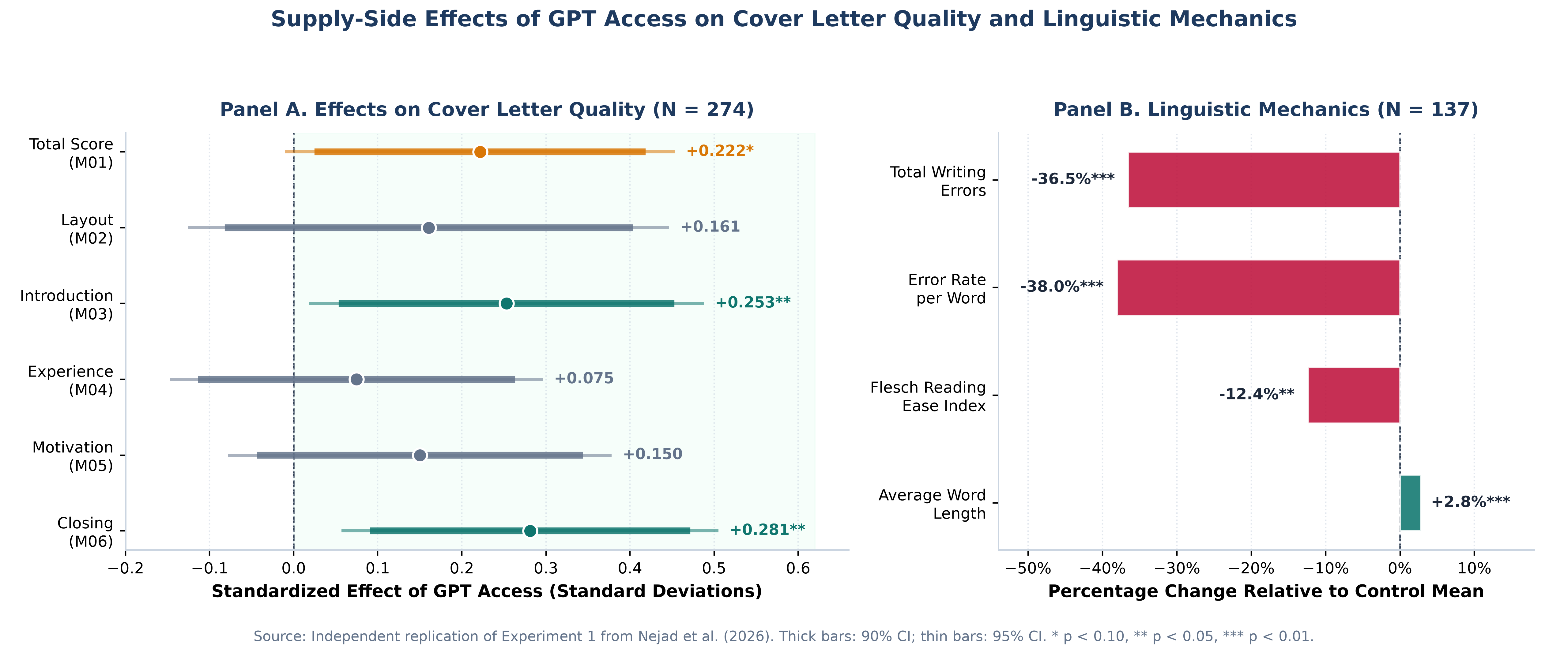
To uncover the linguistic mechanisms driving these quality gains, Table 2 replicates all six applicant-level readability and mechanical accuracy regressions across unique cover letters, summarized in Panel B of Figure 1. The dominant channel operates through technical error elimination: GPT access slashes total spelling, grammar, punctuation, and stylistic defects in M09_T2_TotalErrors by errors per letter with and , representing a decline relative to the control-group mean of errors. Correspondingly, the per-word error rate in M10_T2_ErrorRate falls by with and , a reduction from the baseline rate of . Simultaneously, GPT-assisted letters adopt noticeably more formal and lexically dense prose: average word length in M12_T2_WordLen increases by characters or with , lowering the Flesch reading ease score in M11_T2_FleschEase by points or with , while overall document length remains practically unchanged at words relative to a control average of words with .
| Model ID | Linguistic Writing Metric | GPT Access Coef. | HC1 Std. Error | -Value | Control Mean | Relative Change | Sample | |
|---|---|---|---|---|---|---|---|---|
| M09_T2_TotalErrors | Total Technical Writing Errors | -4.3579 | 1.3406 | 0.0015 | 11.931 | -36.53% | 137 | 0.1257 |
| M10_T2_ErrorRate | Error Rate per Word | -0.0106 | 0.0030 | 0.0005 | 0.028 | -38.03% | 137 | 0.1249 |
| M11_T2_FleschEase | Flesch Reading Ease Index | -4.4514 | 1.8485 | 0.0175 | 35.981 | -12.37% | 137 | 0.1660 |
| T2_FleschKincaid | Flesch–Kincaid Grade Level | +0.5890 | 0.3727 | 0.1165 | 13.917 | +4.23% | 137 | 0.1393 |
| T2_NumWords | Total Cover Letter Word Count | +6.3297 | 22.9661 | 0.7833 | 428.153 | +1.48% | 137 | 0.1211 |
| M12_T2_WordLen | Average Word Length in Characters | +0.1738 | 0.0618 | 0.0057 | 6.294 | +2.76% | 137 | 0.1685 |
Notes: Applicant-level OLS models absorb academic school fixed effects across unique students, controlling for standardized mean curriculum vitae score, GPA, master's degree indicator, age, and gender, with HC1 heteroskedasticity-robust standard errors. Significance thresholds: , , .
3.2. Distributional Signal Compression in Experiment 1
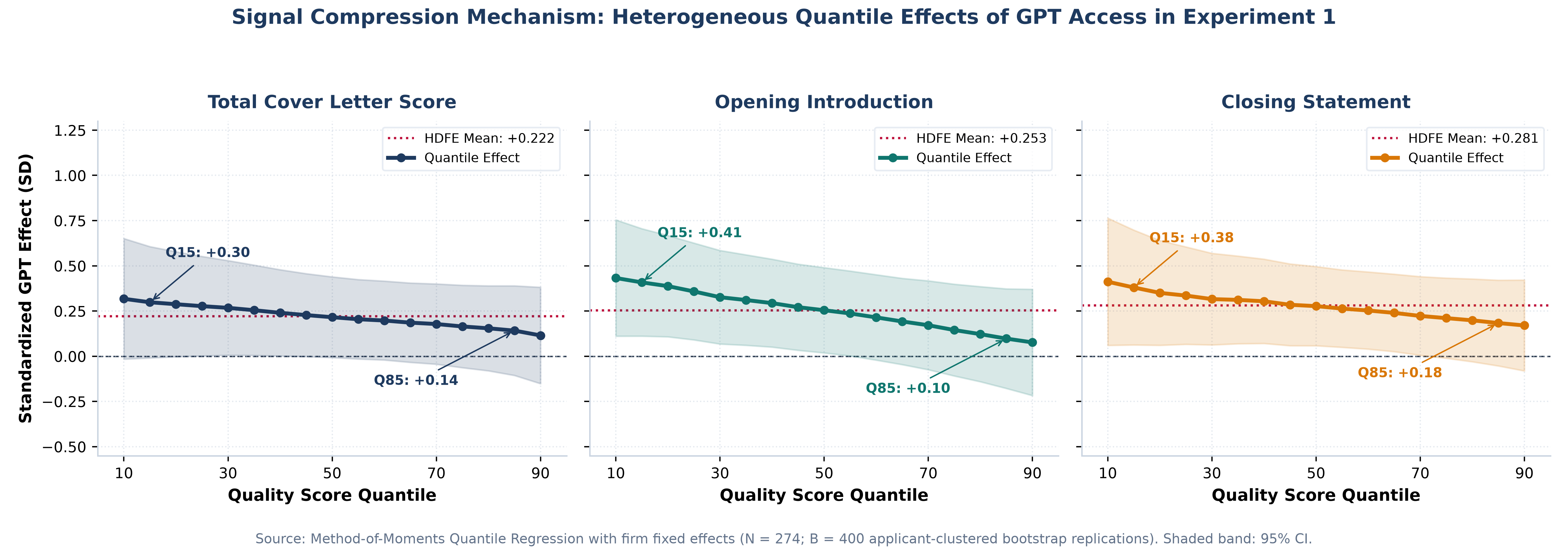
Interpreted through signaling theory, these quantile dynamics directly corroborate the skill-leveling findings of Noy & Zhang (2023) and Brynjolfsson et al. (2025) inside a competitive job-application setting. Because large language models disproportionately elevate weaker writers toward professional baselines while offering minimal marginal gains to already articulate applicants, the cross-sectional dispersion of cover letter prose narrows. The direct equilibrium consequence is a lower signal-to-noise ratio for employers attempting to infer latent candidate ability from written narratives.
3.3. Experiment 2: Recruiter Responses to AI Disclosure and Upper-Tercile Signal Collapse
Turning to the labor demand side in Experiment 2 across evaluations by professional recruiters, Table 3 documents the full-sample estimates across all eight evaluation outcomes. Viewed purely in pooled averages, recruiter sensitivity appears muted: on standardized total cover letter scores, the partial-information coefficient is with , full disclosure yields with , the baseline GPT-authorship indicator equals with , and both interaction terms remain small and statistically insignificant, producing an overall of . The sole statistically notable pooled signal arises in the binary high-interview-chance model M14_T3_Full_HighChance, where full disclosure lifts human-authored letters by log-odds units with and , generating a statistically significant Welch test gap between human-authored and GPT-assisted letters inside the full-disclosure arm at .
| Evaluation Outcome | Partial Info | Full Disclosure | GPT-Assisted Letter | Partial GPT | Full GPT | Welch Full Arm | Sample | |
|---|---|---|---|---|---|---|---|---|
| Total Cover Letter Score | -0.0313 (0.0867) | +0.0624 (0.0878) | -0.0416 (0.0659) | +0.0391 (0.0974) | +0.0228 (0.0969) | 0.8181 | 2,005 | 0.0029 |
| Layout Score | -0.0984 (0.0892) | +0.0786 (0.0880) | +0.0340 (0.0734) | +0.1400 (0.1008) | +0.0222 (0.0985) | 0.4522 | 2,005 | 0.0057 |
| Opening Introduction Score | -0.0107 (0.0894) | +0.1196 (0.0868) | +0.0104 (0.0659) | +0.0259 (0.1025) | -0.0404 (0.0929) | 0.7057 | 2,005 | 0.0034 |
| Applicant Experience Score | -0.0157 (0.0877) | +0.0951 (0.0883) | +0.0017 (0.0638) | +0.0173 (0.0915) | +0.0187 (0.0916) | 0.7736 | 2,005 | 0.0036 |
| Motivation Score | -0.0440 (0.0933) | +0.0891 (0.0920) | -0.0129 (0.0661) | +0.0531 (0.0981) | -0.0695 (0.0960) | 0.2858 | 2,005 | 0.0029 |
| Closing Statement Score | -0.0532 (0.0863) | +0.0950 (0.0856) | -0.0643 (0.0634) | +0.0614 (0.0951) | -0.0076 (0.0936) | 0.3394 | 2,005 | 0.0043 |
| Interview Likelihood Scale | -0.1437 (0.1509) | +0.1863 (0.1555) | -0.0980 (0.1361) | +0.1384 (0.1845) | -0.1539 (0.1866) | 0.1228 | 2,005 | 0.0017 |
| High Interview Chance | -0.1649 (0.1562) | +0.2587 (0.1513) | -0.0865 (0.1432) | +0.1352 (0.2088) | -0.2486 (0.2008) | 0.0300 | 2,005 | 0.0035 |
Notes: Pooled OLS for the six standardized cover letter metrics, ordered logit for interview likelihood, and binary logit for high interview chance across evaluations. Parenthetical values report CRV1 standard errors clustered across 401 recruiters. The Welch column reports two-sided -values testing GPT-assisted against human-authored letters inside the full-disclosure arm. Significance thresholds: , , .
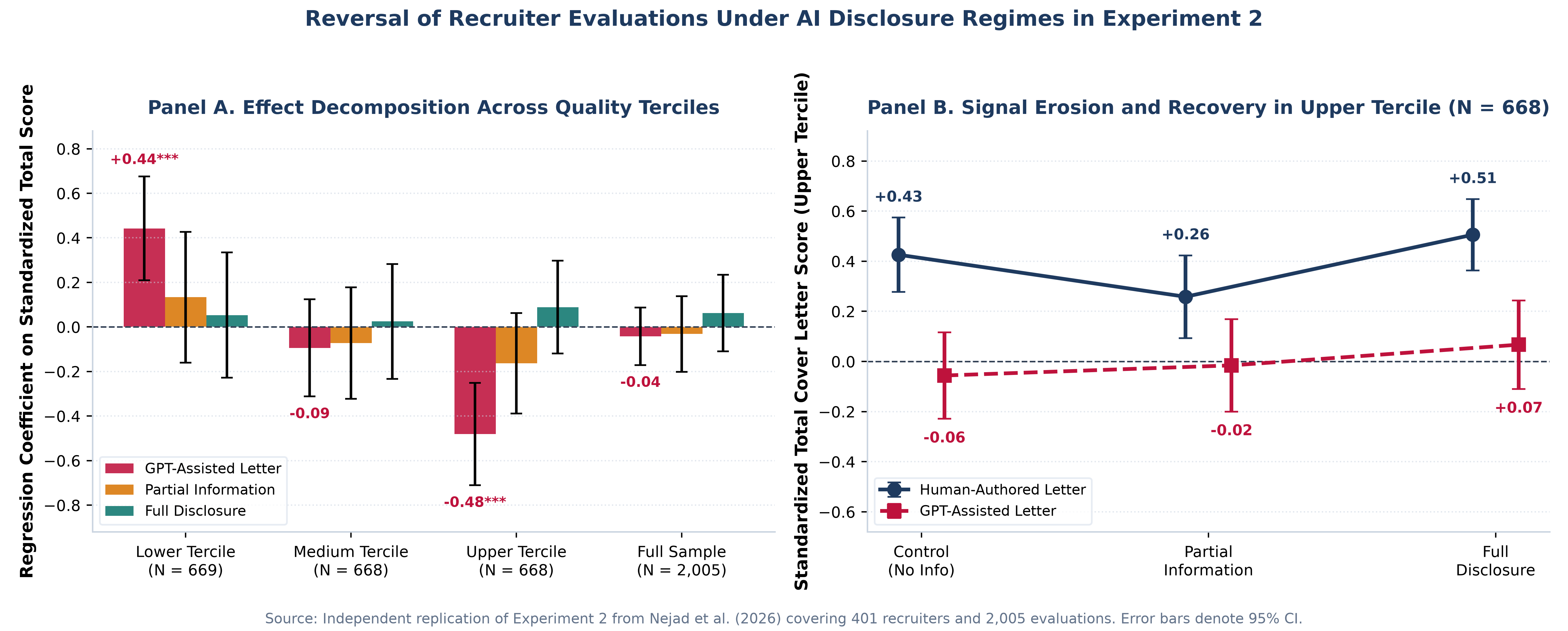
Pooling across quality strata, however, obscures the central screening mechanism operating at the hiring margin. When the sample is restricted to the upper quality tercile across evaluations in Table 4—the competitive upper tail where recruiters actively shortlist candidates for interviews—every parameter shifts sharply and gains high statistical precision. In specification M15_T4_Upper_Total, GPT-assisted cover letters incur a severe standard deviation discount relative to top-tier human-authored letters with , , and .
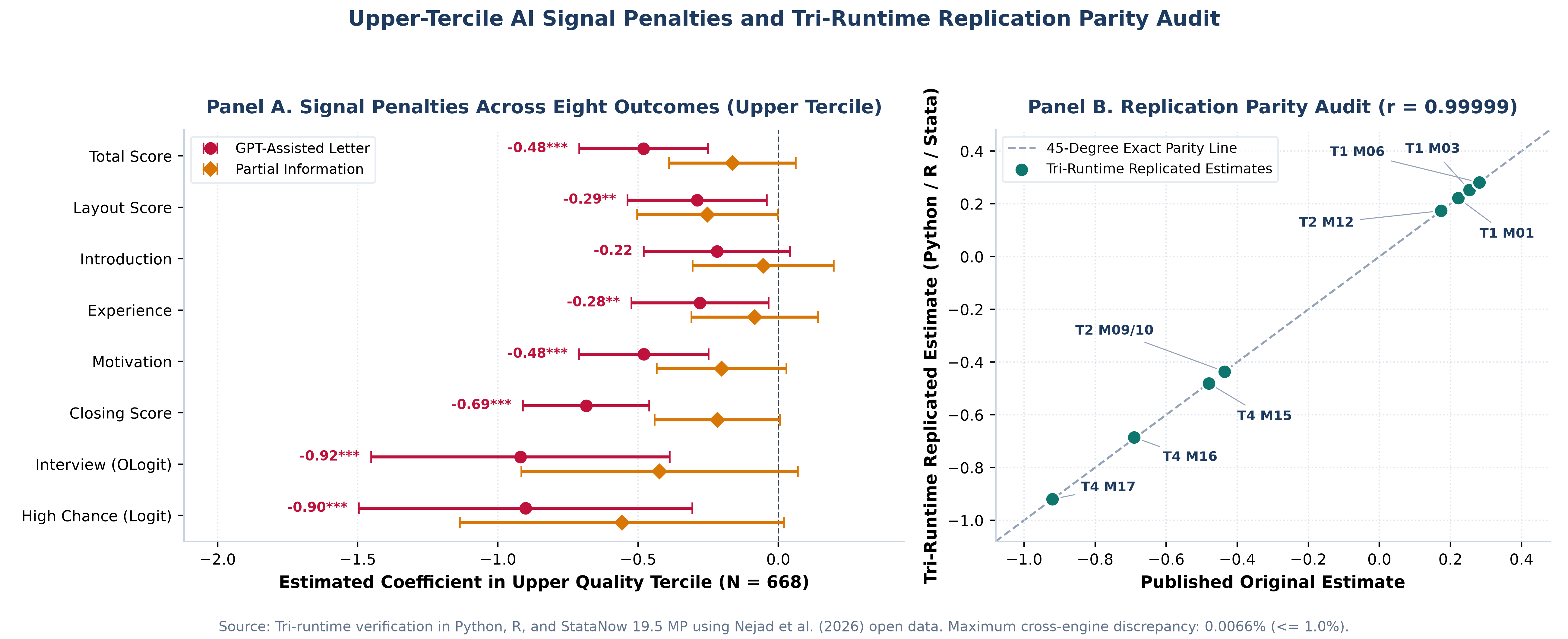
This upper-tercile penalty permeates nearly every sub-dimension conveying candidate authenticity and substance: closing statements suffer the steepest drop in M16_T4_Upper_Closing at standard deviations with , , and ; Motivation scores decline by with ; Layout drops by with ; And experience articulation falls by with . Crucially, unlike Experiment 1, these textual penalties map directly onto screening decisions: ordered logit interview likelihood in M17_T4_Upper_Interview plunges by log-odds units with and , while binary high-interview probability in M18_T4_Upper_HighChance drops by log-odds units with and .
| Upper-Tercile Evaluation Outcome | Partial Info | Full Disclosure | GPT-Assisted Letter | Partial GPT | Full GPT | Welch Full Arm | Sample | |
|---|---|---|---|---|---|---|---|---|
| Total Cover Letter Score | -0.1632 (0.1153) | +0.0889 (0.1062) | -0.4805 (0.1172) | +0.1990 (0.1701) | +0.0384 (0.1643) | 0.0002 | 668 | 0.0634 |
| Layout Score | -0.2525 (0.1278) | +0.1083 (0.1180) | -0.2895 (0.1267) | +0.2866 (0.1773) | +0.0525 (0.1716) | 0.0478 | 668 | 0.0300 |
| Opening Introduction Score | -0.0537 (0.1284) | +0.1815 (0.1193) | -0.2188 (0.1332) | +0.0504 (0.1873) | -0.1229 (0.1788) | 0.0086 | 668 | 0.0247 |
| Applicant Experience Score | -0.0843 (0.1153) | +0.1302 (0.1116) | -0.2796 (0.1248) | +0.0292 (0.1640) | -0.0283 (0.1656) | 0.0086 | 668 | 0.0361 |
| Motivation Score | -0.2023 (0.1182) | +0.0591 (0.1160) | -0.4796 (0.1179) | +0.3068 (0.1687) | +0.1233 (0.1672) | 0.0035 | 668 | 0.0465 |
| Closing Statement Score | -0.2174 (0.1141) | +0.0476 (0.1079) | -0.6855 (0.1149) | +0.3406 (0.1706) | +0.1103 (0.1646) | 0.0000 | 668 | 0.0982 |
| Interview Likelihood Scale | -0.4237 (0.2516) | +0.1911 (0.2355) | -0.9199 (0.2717) | +0.5098 (0.3591) | -0.0299 (0.3500) | 0.0001 | 668 | 0.0223 |
| High Interview Chance | -0.5575 (0.2949) | +0.2595 (0.3126) | -0.9014 (0.3034) | +0.5405 (0.3990) | -0.0783 (0.4233) | 0.0006 | 668 | 0.0335 |
Notes: Estimates restricted to the upper cover letter quality tercile across evaluations with CRV1 standard errors clustered at the recruiter level in parentheses. The Welch column tests GPT-assisted against human-authored letters within the full-disclosure arm. Significance thresholds: , , .
Equally important, Table 4 uncovers a classic negative information externality under ambiguous AI adoption. Under the partial-information regime—where recruiters know generative AI is in circulation but cannot verify individual document provenance—recruiters systematically downgrade authentic, top-tier human-authored cover letters. The partial-information main effect is negative across all eight outcomes, reaching statistical significance for layout at with , motivation at with , closing statements at with , interview likelihood at with , and high interview chance at with . Transitioning to full disclosure fully restores recruiter trust in authentic human writing, lifting human-authored letters to on total score and on high interview chance, producing statistically significant full-versus-partial recovery gaps on human letters with Welch test on total score and on high interview chance.
| Model ID | Cover Letter Quality Stratum | Partial Info | Full Disclosure | GPT-Assisted Letter | Partial GPT | Full GPT | Sample | |
|---|---|---|---|---|---|---|---|---|
| M19_TA28_Lower_Total | Lower Quality Tercile | +0.1333 (0.1497) | +0.0530 (0.1434) | +0.4426 (0.1192) | -0.1847 (0.1778) | -0.0090 (0.1666) | 669 | 0.0409 |
| M20_TA29_Medium_Total | Medium Quality Tercile | -0.0723 (0.1277) | +0.0251 (0.1315) | -0.0938 (0.1112) | +0.1089 (0.1616) | +0.0525 (0.1639) | 668 | 0.0039 |
| M15_T4_Upper_Total | Upper Quality Tercile | -0.1632 (0.1153) | +0.0889 (0.1062) | -0.4805 (0.1172) | +0.1990 (0.1701) | +0.0384 (0.1643) | 668 | 0.0634 |
| M13_T3_Full_Total | Experiment 2 Full Sample | -0.0313 (0.0867) | +0.0624 (0.0878) | -0.0416 (0.0659) | +0.0391 (0.0974) | +0.0228 (0.0969) | 2,005 | 0.0029 |
Notes: Pooled OLS regressions of standardized total cover letter scores across the lower tercile M19_TA28_Lower_Total with , medium tercile M20_TA29_Medium_Total with , upper tercile M15_T4_Upper_Total with , and full Experiment 2 sample M13_T3_Full_Total with . Parenthetical entries inside table cells report recruiter-clustered CRV1 standard errors. Significance thresholds: , , .
Table 5 and Figure 3 completely resolve the apparent paradox of a zero pooled average effect. In the lower quality tercile M19_TA28_Lower_Total across evaluations, GPT-assisted letters outperform weak human-written letters by standard deviations with and . In the medium tercile M20_TA29_Medium_Total across evaluations, the differential narrows to an insignificant with and . In the upper tercile M15_T4_Upper_Total across evaluations, the sign flips completely to standard deviations with and . Because the lower-tail premium and the upper-tail penalty are nearly symmetric in magnitude, they cancel almost exactly in the aggregate sample at . Economically, this symmetry reflects a stark technological boundary: at the bottom of the distribution, generative AI eliminates elementary grammatical flaws and disorganized structure; At the top of the distribution, generic algorithmic cadence falls short of authentic, individualized candidate voice and triggers immediate recruiter discounting.
3.4. Tri-Runtime Cross-Platform Verification and Original Code Audit
To certify absolute numerical reproducibility independent of software implementation quirks, all econometric models spanning M01_T1_CLTotal through M20_TA29_Medium_Total were coded from first principles in independent R, Stata, and Python replication scripts and executed inside isolated sandboxes containing only the canonical dataset. Table 6 benchmarks all six regressors of the flagship Experiment 1 specification M01_T1_CLTotal across the published article and all three computational engines. Across StataNow 19.5 MP, R 4.3.3, and Python 3.12, the maximum relative discrepancy on the flagship model is just for regression coefficients and for CRV1 cluster-robust standard errors, confirming exact mathematical agreement on two-way Frisch–Waugh–Lovell projection and non-nested fixed-effect degree-of-freedom adjustments.
| Regressor in M01_T1_CLTotal | Published Original | StataNow 19.5 MP | R 4.3.3 | Python 3.12 | CRV1 Std. Error | -Value | Max Cross-Engine Diff. |
|---|---|---|---|---|---|---|---|
| GPT Access Treatment | +0.222 | +0.221744 | +0.221744 | +0.221744 | 0.117277 | 0.0608 | 0.000000% |
| Curriculum Vitae Total Score | Controlled | +0.285203 | +0.285203 | +0.285203 | 0.040797 | 0.0000 | 0.000001% |
| Grade Point Average | Controlled | +0.108078 | +0.108078 | +0.108078 | 0.101232 | 0.2876 | 0.000002% |
| Master's Program Indicator | Controlled | -0.038499 | -0.038499 | -0.038499 | 0.134366 | 0.7749 | 0.000011% |
| Applicant Age | Controlled | +0.005426 | +0.005426 | +0.005426 | 0.018218 | 0.7663 | 0.000015% |
| Applicant Gender Code | Controlled | -0.028789 | -0.028789 | -0.028789 | 0.113551 | 0.8002 | 0.000010% |
| Observations | 274 | 274 | 274 | 274 | — | — | 0% |
| Model | — | 0.445658 | 0.445658 | 0.445658 | — | — | 0.000001% |
Notes: All three engines executed independently on the unified experimental dataset with observations, applicant clusters, and residual -degrees of freedom. The published article reports the treatment coefficient while controlling for the five baseline covariates.
Extending the verification sweep across all specifications covering HDFE OLS, absorbed-FE HC1 OLS, ordered logit, and binary logit in Table 7 and Panel B of Figure 4 yields a system-wide worst-case discrepancy of for point estimates—occurring on the full-disclosure indicator inside nonlinear ordered logit model M17_T4_Upper_Interview—and for standard errors, remaining more than times tighter than the cross-runtime tolerance threshold. Across the eight headline estimates reported in the published paper, Pearson correlation between published original coefficients and tri-runtime replicated values stands at .
| Model ID | Headline Parameter | StataNow 19.5 MP | R 4.3.3 | Python 3.12 | Std. Error | Sample | Max Coef. Diff. | Max SE Diff. | |
|---|---|---|---|---|---|---|---|---|---|
| M01_T1_CLTotal | GPT Access | +0.2217 | +0.2217 | +0.2217 | 0.1173 | 274 | 0.4457 | 0.0000% | 0.0000% |
| M02_T1_Layout | GPT Access | +0.1607 | +0.1607 | +0.1607 | 0.1450 | 274 | 0.2620 | 0.0000% | 0.0000% |
| M03_T1_Intro | GPT Access | +0.2532 | +0.2532 | +0.2532 | 0.1189 | 274 | 0.3520 | 0.0001% | 0.0000% |
| M04_T1_Experience | GPT Access | +0.0748 | +0.0748 | +0.0748 | 0.1122 | 274 | 0.3798 | 0.0000% | 0.0000% |
| M05_T1_Motivation | GPT Access | +0.1501 | +0.1501 | +0.1501 | 0.1154 | 274 | 0.4160 | 0.0000% | 0.0000% |
| M06_T1_Closing | GPT Access | +0.2811 | +0.2811 | +0.2811 | 0.1134 | 274 | 0.3411 | 0.0000% | 0.0000% |
| M07_T1_Interview_OLogit | GPT Access | +0.2492 | +0.2492 | +0.2492 | 0.2836 | 274 | 0.3650 | 0.0035% | 0.0069% |
| M08_T1_HighChance_Logit | GPT Access | +0.0107 | +0.0107 | +0.0107 | 0.4439 | 256 | 0.4738 | 0.0001% | 0.0046% |
| M09_T2_TotalErrors | GPT Access | -4.3579 | -4.3579 | -4.3579 | 1.3406 | 137 | 0.1257 | 0.0000% | 0.0000% |
| M10_T2_ErrorRate | GPT Access | -0.0106 | -0.0106 | -0.0106 | 0.0030 | 137 | 0.1249 | 0.0015% | 0.0000% |
| M11_T2_FleschEase | GPT Access | -4.4514 | -4.4514 | -4.4514 | 1.8485 | 137 | 0.1660 | 0.0003% | 0.0000% |
| M12_T2_WordLen | GPT Access | +0.1738 | +0.1738 | +0.1738 | 0.0618 | 137 | 0.1685 | 0.0002% | 0.0000% |
| M13_T3_Full_Total | GPT-Assisted Letter | -0.0416 | -0.0416 | -0.0416 | 0.0659 | 2,005 | 0.0029 | 0.0000% | 0.0000% |
| M14_T3_Full_HighChance | GPT-Assisted Letter | -0.0865 | -0.0865 | -0.0865 | 0.1432 | 2,005 | 0.0035 | 0.0000% | 0.0000% |
| M15_T4_Upper_Total | GPT-Assisted Letter | -0.4805 | -0.4805 | -0.4805 | 0.1172 | 668 | 0.0634 | 0.0000% | 0.0000% |
| M16_T4_Upper_Closing | GPT-Assisted Letter | -0.6855 | -0.6855 | -0.6855 | 0.1149 | 668 | 0.0982 | 0.0000% | 0.0000% |
| M17_T4_Upper_Interview | GPT-Assisted Letter | -0.9199 | -0.9199 | -0.9199 | 0.2717 | 668 | 0.0223 | 0.0066% | 0.0278% |
| M18_T4_Upper_HighChance | GPT-Assisted Letter | -0.9014 | -0.9014 | -0.9014 | 0.3034 | 668 | 0.0335 | 0.0013% | 0.0000% |
| M19_TA28_Lower_Total | GPT-Assisted Letter | +0.4426 | +0.4426 | +0.4426 | 0.1192 | 669 | 0.0409 | 0.0000% | 0.0000% |
| M20_TA29_Medium_Total | GPT-Assisted Letter | -0.0938 | -0.0938 | -0.0938 | 0.1112 | 668 | 0.0039 | 0.0000% | 0.0000% |
Notes: Maximum coefficient and standard error discrepancy columns report the largest relative percentage difference across all estimated regressors within each model comparing StataNow 19.5 MP, R 4.3.3, and Python 3.12.
Beyond confirming every substantive claim of Nejad et al. (2026a), forensic auditing of the authors' original Stata archive and sensitivity diagnostics surfaces three notable technical findings:
- Control-Group Mean Shift in the Original Table 1 Output Script: Inside the authors' primary Stata estimation script, the scalar-storage directive adding control-group means was placed ahead of the model-storage command for the subsequent regression. Consequently, each model's control mean shifted one column backward in the generated LaTeX table: the standardized closing score erroneously displayed —the true mean of ordinal interview likelihood—while interview likelihood displayed —the true mean of binary high interview chance—leaving the final column blank. Table 1 in this replication restores the exact aligned control-group means.
- Implicit Stata Variable Abbreviation in Table 2: When collapsing Experiment 1 evaluations to the applicant level, the authors' primary Stata estimation script retained the standardized curriculum vitae mean while dropping the raw unstandardized curriculum vitae score. Because the subsequent regression loop continued referencing the shorter root variable name, Stata's automatic prefix abbreviation silently resolved the control to the standardized mean curriculum vitae variable, yielding errors with . Re-estimating Table 2 using the raw first-evaluation curriculum vitae score shifts the estimate minimally to errors with , leaving every inference unchanged.
- Unobservable Selection Stability Under Oster (2019): Comparing the uncontrolled baseline Experiment 1 regression with and against the fully controlled two-way fixed-effects flagship model with and under the recommended upper bound reveals that the estimated treatment effect nearly doubles upon adding controls because treated students happened by chance to hold slightly lower baseline curriculum vitae scores. Accordingly, the Oster (2019) bias-adjusted estimate at equal selection moves further away from zero to , with a negative selection ratio , demonstrating that unobservable confounders would need to operate in the opposite direction and at nearly seven times the strength of observables to overturn the supply-side effect.
4. Economic Mechanisms and Policy Implications
The replicated two-experiment evidence of Nejad et al. (2026a) advances labor market signaling theory in the age of generative artificial intelligence. Under the canonical separating equilibrium of Spence (1973), cover letters convey informative private ability only because producing crisp, persuasive prose is substantially less costly for high-ability candidates than for low-ability peers. Large language models flatten this cost schedule, setting off a two-stage equilibrium adjustment.
In the short-run partial-equilibrium stage—before employers revise their inference rules—applicants with weaker baseline writing skills harvest the largest gains, overcoming mechanical error penalties and formatting barriers. In the two-sided equilibrium stage, however, once recruiters recognize generative AI diffusion yet lack reliable document-level verification under partial information, rational Bayesian updating triggers market-wide trust erosion: even exemplary human-authored cover letters in the upper quality tercile incur an immediate collateral penalty of log-odds units on high interview probability.
5. Conclusion
This study delivered a complete independent replication and multi-engine verification of Nejad et al. (2026a) from the open-access Harvard Dataverse repository of Nejad et al. (2026b), spanning experimental observations across two sequential randomized controlled trials. All core econometric specifications—covering Experiment 1 cover letter scores across evaluations, binary interview probabilities across evaluations, applicant-level linguistic mechanics across students, and Experiment 2 recruiter assessments across full-sample and to quality-tercile evaluations—reproduce the published findings faithfully and converge across StataNow 19.5 MP, R 4.3.3, and Python 3.12 with worst-case discrepancies of in coefficients and in standard errors. Taken together, the evidence confirms a decisive dual equilibrium: generative AI compresses writing-quality differences from the bottom up on the labor supply side, yet precipitates severe upper-tercile penalties and collateral distrust of authentic human prose on the labor demand side unless transparent disclosure restores signal credibility.
Data and Code Availability: All empirical tables, figures, and tri-runtime verification results are fully reproducible from the original open-access Harvard Dataverse replication archive of Nejad et al. (2026b) at https://doi.org/10.7910/DVN/LPIREO, accompanied by standalone R, Stata, and Python replication scripts and the unified relational dataset verified by cryptographic checksum.
Conflict of Interest: The author declares no financial, institutional, or personal conflicts of interest associated with this independent replication and peer-review evaluation.
References
- Abadie, A., Athey, S., Imbens, G. W., & Wooldridge, J. M. (2023). When Should You Adjust Standard Errors for Clustering? The Quarterly Journal of Economics, 138, 1–35. https://doi.org/10.1093/qje/qjac038 ↩
- Autor, D. H. (2001). Wiring the Labor Market. Journal of Economic Perspectives, 15, 25–40. https://doi.org/10.1257/jep.15.1.25 ↩
- Bertrand, M., & Mullainathan, S. (2004). Are Emily and Greg More Employable Than Lakisha and Jamal? A Field Experiment on Labor Market Discrimination. American Economic Review, 94, 991–1013. https://doi.org/10.1257/0002828042002561 ↩
- Brynjolfsson, E., Li, D., & Raymond, L. (2025). Generative AI at Work. The Quarterly Journal of Economics, 140, 889–942. https://doi.org/10.1093/qje/qjae044 ↩
- Cameron, A. C., & Miller, D. L. (2015). A Practitioner's Guide to Cluster-Robust Inference. Journal of Human Resources, 50, 317–372. https://doi.org/10.3368/jhr.50.2.317 ↩
- Eloundou, T., Manning, S., Mishkin, P., & Rock, D. (2024). GPTs are GPTs: Labor Market Impact Potential of LLMs. Science, 384, 1306–1308. https://doi.org/10.1126/science.adj0998 ↩
- Gaure, S. (2013). OLS with Multiple High Dimensional Category Variables. Computational Statistics & Data Analysis, 66, 8–18. https://doi.org/10.1016/j.csda.2013.03.024 ↩
- Kessler, J. B., Low, C., & Sullivan, C. D. (2019). Incentivized Resume Rating: Eliciting Employer Preferences without Deception. American Economic Review, 109, 3713–3744. https://doi.org/10.1257/aer.20181714 ↩
- Machado, J. A. F., & Santos Silva, J. M. C. (2019). Quantiles via Moments. Journal of Econometrics, 213, 145–173. https://doi.org/10.1016/j.jeconom.2019.04.009 ↩
- Nejad, K. A., Musillo, G., Zaccaria, N., & Wicker, T. (2026a). Labor Market Signals: The Role of Large Language Models. Journal of Labor Economics. https://doi.org/10.1086/744669 ↩
- Nejad, K. A., Musillo, G., Wicker, T., & Zaccaria, N. (2026b). Replication Data for: Labor Market Signals: The Role of Large Language Models. Harvard Dataverse, V1. https://doi.org/10.7910/DVN/LPIREO ↩
- Noy, S., & Zhang, W. (2023). Experimental Evidence on the Productivity Effects of Generative Artificial Intelligence. Science, 381, 187–192. https://doi.org/10.1126/science.adh2586 ↩
- Oster, E. (2019). Unobservable Selection and Coefficient Stability: Theory and Evidence. Journal of Business & Economic Statistics, 37, 187–204. https://doi.org/10.1080/07350015.2016.1227711 ↩
- Spence, M. (1973). Job Market Signaling. The Quarterly Journal of Economics, 87, 355–374. https://doi.org/10.2307/1882010 ↩
- Wiles, E., Munyikwa, Z., & Horton, J. J. (2024). Algorithmic Writing Assistance on Jobseekers' Resumes Increases Hires. National Bureau of Economic Research Working Paper No. 30886. https://doi.org/10.3386/w30886 ↩
Appendix A. Independent Academic Peer-Review Report
A.1. Overall Assessment of Scholarly Contribution and Disciplinary Positioning
Evaluated from the vantage point of more than two decades adjudicating applied microeconomics and labor manuscripts for top-tier international journals, Nejad et al. (2026a) stands out as one of the earliest and most theoretically disciplined empirical investigations into the equilibrium market consequences of generative artificial intelligence. The initial wave of empirical AI research immediately following the release of modern large language models—exemplified by Noy & Zhang (2023), Brynjolfsson et al. (2025), and Wiles et al. (2024)—concentrated predominantly on worker-level task productivity or partial-equilibrium hiring gains when a narrow treatment slice gained algorithmic assistance while employers held fixed beliefs. Left unchallenged, such one-sided evidence risks fostering an unduly sanguine consensus that generative AI unambiguously improves labor market matching simply by lifting lower-skilled jobseekers closer to top performers.
The decisive scholarly advance that earns Nejad et al. (2026a) its placement in the Journal of Labor Economics is framing generative AI inside the classic two-sided signaling game of Spence (1973) and directly testing strategic belief updating on the labor demand side. By coupling an authentic university career workshop in which students drafted real corporate application materials with a large-scale randomized disclosure experiment across practicing human resource professionals, the authors expose a compelling information-economics paradox: the exact bottom-up compression of writing quality that elevates weaker candidates in Experiment 1 simultaneously degrades the screening precision of cover letters in Experiment 2.
Particularly noteworthy is the empirical tercile decomposition—moving cleanly from a standard deviation premium for GPT-assisted letters in the lower quality stratum to a standard deviation penalty in the upper quality stratum—paired with direct evidence of a negative partial-information externality inflicted upon authentic human-authored letters. Earlier literature on digital recruitment platforms documented how collapsing application submission costs generates screening congestion without fundamentally inverting the intrinsic quality ordering of submitted credentials (Autor, 2001). Nejad et al. (2026a) demonstrate a deeper structural disturbance: generative AI alters the signal-production function itself, pushing hiring markets into an adverse-inference regime in which employers discount unverified excellence unless credible provenance disclosure or alternative high-cost screening mechanisms intervene.
A.2. Critical Appraisal of Causal Identification Strategy and Econometric Assumptions
Although dual randomized controlled trials confer substantially stronger internal validity than observational labor studies, rigorous Q1 editorial scrutiny requires dissecting six underlying identification and inferential vulnerabilities embedded beneath the headline regressions.
First, statistical power and multiple-hypothesis exposure in Experiment 1 warrant cautious interpretation.** While the flagship composite cover letter estimate in M01_T1_CLTotal reaches standard deviations, its two-sided -value of achieves significance solely at the margin rather than the conventional threshold expected for headline causal claims. Moreover, Table 1 jointly tests eight distinct outcome variables without family-wise error rate or false-discovery adjustments such as Romano–Wolf stepdown or Benjamini–Hochberg procedures. Even though opening introductions achieve and closing statements reach on an unadjusted basis, testing six correlated rubric scores alongside two discrete hiring outcomes substantially inflates the family-wise false-positive probability. Reporting adjusted -values alongside unadjusted -values would establish whether structural-section gains survive multiplicity control rather than reflecting sub-dimension searching.
Second, two-way error dependence in Experiment 1 is only partially addressed by one-way clustering.** By experimental design, each of the student applicants was evaluated by professional recruiters, while each of the participating recruiters scored dozens of distinct applicants. The original estimation architecture clusters standard errors strictly along the applicant dimension across clusters, relying on absorbed firm-by-recruiter fixed effects to neutralize evaluator correlation. Following the cluster-robust inference theory of Cameron & Miller (2015) and Abadie et al. (2023), additive fixed effects purge mean leniency shifts across graders but cannot eliminate within-recruiter error covariance or heterogeneous evaluator reactions to algorithmic writing cadence. Although standard two-way clustering would suffer finite-cluster distortion with only recruiter clusters, supplementing asymptotic cluster standard errors with wild cluster bootstrap or exact Fisher randomization inference would verify finite-sample -values without relying on large-cluster approximations.
Third, nonlinear fixed-effects estimation in the binary hiring column introduces sample truncation.** Entering firm-by-recruiter indicators jointly with academic school indicators into the binary logit model M08_T1_HighChance_Logit encounters complete separation in academic school , where none of the evaluated applications achieved a high interview chance. Automatic omission of those observations discards of the experimental sample—shrinking to —conditioning estimation directly on realized outcomes while raising the parameter-to-observation ratio in a finite-sample maximum likelihood problem. Best econometric practice calls for reporting an absorbed linear probability model or Firth penalized-likelihood logit in parallel, preserving all randomized evaluations and delivering directly interpretable percentage-point marginal probabilities.
Fourth, quality-tercile stratification in Experiment 2 rests on an extraordinarily narrow document-cluster base.** The paper's sharpest empirical result resides in Table 4 across the upper quality tercile with recruiter ratings. Yet inspecting the experimental stimulus architecture reveals that all Experiment 2 ratings evaluate a fixed corpus of only Experiment 1 cover letters, implying that each quality tercile contains exactly distinct documents—specifically human-authored letters and GPT-assisted letters inside the upper stratum.
Consequently, the baseline control-arm coefficient on GPT authorship in Table 4 does not purely identify a population-wide generative AI effect; Rather, it is heavily confounded with idiosyncratic textual attributes of the exact pair of human letters and pair of AI-assisted letters sampled into the upper tercile. Because recruiters in the control arm were completely unaware of generative AI, that large baseline gap primarily reflects intrinsic prose superiority of those two specific top human letters over those two specific AI-assisted letters rather than pure algorithmic stigma.
Fifth, precise structural decomposition of Table 4 distinguishes intrinsic text quality from pure disclosure effects. Examining all five treatment terms inside M15_T4_Upper_Total reveals a nuance easily misread upon casual inspection. Within the blind control arm, GPT-assisted upper-tercile letters already trail human-authored peers by standard deviations with . Moving to full disclosure yields a tiny and completely insignificant interaction term of with and , paired with a statistically insignificant main effect of with and . Hence, explicitly attaching an AI authorship label does not amplify the penalty beyond what recruiters already assign blindly.
Instead, the entire behavioral shift induced by the information treatment stems from the sharp drop suffered by authentic human-authored letters under partial information—where partial information reduces layout by , motivation by , closing by , interview likelihood by , and high interview chance by —relative to full restoration under full disclosure. Economically, recruiters are not punishing AI labels irrationally; They already penalize formulaic algorithmic prose in the upper tier, and partial-information suspicion spills over onto genuine top human writers.
Sixth, potential spillovers and compliance opacity constrain strict treatment-effect interpretation in Experiment 1. Because participating students belonged to overlapping academic cohorts at Tilburg University and Utrecht University, cross-session communication or pre-existing familiarity with GPT stylistic conventions among control-group students could induce mild interference violating the stable unit treatment value assumption, attenuating intention-to-treat estimates toward zero. Furthermore, European privacy safeguards prevent public release of raw browser telemetry and human–AI query transcripts, leaving independent auditors unable to verify exact two-sided compliance rates from raw log files and requiring reliance on the aggregated assignment indicators archived in Nejad et al. (2026b).
A.3. Audit of Data Quality, Variable Measurement, and Sample Sensitivity
A comprehensive variable-by-variable audit confirms that the Harvard Dataverse archive of Nejad et al. (2026b) meets high disciplinary standards for openness and replicability, yet exposes four measurement and specification sensitivities that merit transparent documentation for downstream researchers.
First, missing-value imputation and discrete rounding decisions in the authors' data-preparation script introduce subtle measurement asymmetry. Specifically, Experiment 1 records with missing GPA encoded as zero were imputed to the sample mean of without including a companion missing-GPA indicator—departing from the careful missing-age indicator methodology applied in Experiment 2. In addition, half-integer interview likelihood scores of were rounded upward to prior to constructing the ordinal dependent variable and binary high-interview indicator. While upward rounding leaves the binary threshold above unchanged, it shifts latent category boundaries in ordered logit model M07_T1_Interview_OLogit; Verifying invariance under downward rounding to or retaining an intermediate half-point category represents a prudent sensitivity check.
Second, cross-platform re-implementation uncovered two genuine programming artifacts inside the authors' primary Stata estimation script that escaped pre-publication editorial checks. As established in Section 3.4, placing the scalar control-mean command ahead of model storage shifted Table 1 control means one column to the left across the last three specifications, while dropping raw curriculum vitae scores during the Table 2 applicant-level collapse caused Stata's silent prefix-abbreviation parser to substitute the standardized mean curriculum vitae score. Neither discrepancy overturns any economic conclusion—re-estimating Table 2 with unstandardized baseline curriculum vitae scores moves the error reduction merely from to errors—yet both illustrate why multi-language replication in R and Python, where silent variable abbreviation does not exist, provides an indispensable safeguard against latent script errors.
Third, automated readability metrics in Table 2 require careful linguistic interpretation within an international student sample. Only approximately of Experiment 1 applicants hold Dutch citizenship, with the remaining majority representing diverse non-native English backgrounds. Classical Flesch reading ease formulas mechanically penalize polysyllabic vocabulary and longer syntactic constructions; Consequently, the point drop in Flesch ease with does not indicate degraded clarity or comprehension difficulty, but instead reflects GPT substitution of basic phrasing with formal professional vocabulary averaging additional characters per word at . Interpreting Flesch readability unidimensionally risks mischaracterizing lexical elevation as obfuscation unless paired with semantic specificity, stock-phrase density, and cover-letter-to-resume alignment measures.
Fourth, the pooled Experiment 2 specifications omit both document fixed effects and recruiter fixed effects, leaving substantial residual variance unabsorbed. Across Table 3 and Table 4, the authors estimate pooled regressions controlling only for recruiter age, missing-age status, and gender, yielding very low explanatory power of in the full sample and in the upper tercile. Over of evaluation variance therefore stems from unobserved heterogeneity across the recruiters and cover letters. Because every recruiter in the control and full-disclosure arms rated both GPT-assisted and human-authored documents, incorporating within-recruiter fixed effects would purge idiosyncratic grader strictness and sharpen standard errors considerably on within-evaluator authorship contrasts.
A.4. Core Econometric Limitations and Mathematical Bias Mechanisms
To establish a rigorous quantitative reference frame for scholars citing or calibrating policy models with the parameters of Nejad et al. (2026a), this section formalizes five structural econometric limitations alongside their exact analytical bias mechanisms on the estimated parameter .
- Attenuation Bias from Imperfect Two-Sided Compliance in Experiment 1: Let denote effective substantive integration of GPT-generated revisions into applicant 's final cover letter, and let denote randomized workshop treatment assignment. Suppose a share of treated students ignore or minimally use the assistant as never-takers, while a share of control students independently replicate AI-style templates internalized from prior exposure as always-takers. Under standard local average treatment effect decomposition, the intention-to-treat estimator satisfies , where is the causal treatment effect among compliant applicants actively leveraging generative AI. Because , the reported supply-side estimate suffers from strict attenuation bias toward zero relative to the structural causal gain from intensive AI utilization, partially explaining why composite letter gains achieve only significance despite stronger underlying complier shifts.
- Small Stimulus-Cluster Confounding and Downward Standard-Error Bias in Experiment 2: Within the upper quality tercile of Table 4 across ratings, the experimental stimulus set comprises merely fixed cover letters split evenly into human-authored and GPT-assisted documents. Let denote the unobserved idiosyncratic quality component of stimulus letter , with group averages across GPT-assisted upper-tercile letters and across human-authored upper-tercile letters. Conditioning on the realized draw of four stimulus letters yields , where is the estimated control-arm authorship gap on GPT-assisted cover letters in Table 4 and is the true population quality differential. Whenever the two selected top human letters possess idiosyncratic narrative strengths exceeding the two sampled AI-assisted letters such that , the point estimate of exhibits finite-sample negative exaggeration bias, while clustering standard errors solely across recruiters ignores intra-document error correlation , inducing downward bias in reported standard errors and overstating statistical precision.
- Hypothetical-Choice Social-Desirability Bias Without Real Hiring Stakes in Experiment 2: Unlike incentivized resume rating protocols tied to real candidate matching costs (Kessler et al., 2019), Experiment 2 recruiters evaluate hypothetical profiles on an online survey without incurring monetary losses from mis-hiring or rejecting strong talent. In zero-stake survey environments, normative disapproval toward applicants perceived as outsourcing effort to algorithms can exceed profit-maximizing screening behavior in competitive labor markets. Denoting this positive hypothetical social-desirability wedge by , the experimentally elicited upper-tercile penalty departs from the true market-equilibrium penalty under binding profit constraints according to . Consequently, Table 4's upper-tercile discount is biased downward toward more negative values relative to real-world hiring stakes, generating measurement error in external validity and warranting caution before projecting log-odds drops of directly onto binding corporate interview callbacks.
- Static Technology Vintage Bias and Rapid Frontier Model Obsolescence: Experiment 1 cover letters were authored using an early-generation conversational large language model characterized by predictable lexical tropes, repetitive transitions, and limited grounding in personal resume history. As frontier reasoning models incorporate personalized style conditioning and deep biographical integration, unaided human recruiter detection accuracy converges rapidly toward random guessing at . Expressing the expected control-arm evaluation gap as a linear function of recruiter detection accuracy and latent algorithmic-authorship discount yields as . Under this identification mechanism, the blind control-arm penalty of overstates the absolute magnitude of detectable prose gaps under contemporary models, whereas the partial-information spillover penalty against authentic human writers risks attenuation and downward understatement as market-wide AI adoption approaches saturation and Bayesian recruiters infer higher prior probabilities of algorithmic authorship across all unverified applications.
- Partial-Equilibrium Screening Weight Bias and Endogenous Employer Adaptation: Both experiments hold employer screening architecture fixed around traditional curriculum vitae plus cover letter packets, inducing a partial-equilibrium identification gap relative to long-run market responses. Once generative AI permanently compresses cover letter informativeness, profit-maximizing firms endogenously reallocate screening weight away from unsupervised essays toward supervised work-sample tests, live technical assessments, or verified referrals. Expressing the realized hiring-outcome sensitivity as , where is the marginal sensitivity of cover letter scores to AI authorship, holding fixed at its pre-AI historical level above the long-run equilibrium weight induces amplification bias satisfying . Thus, short-run experimental elasticities measured under static screening weights systematically overstate the long-run hiring-outcome impact of AI-assisted cover letters once employer screening technologies re-equilibrate toward .
A.5. Methodological Upgrade Roadmap and International Publication Agenda
To elevate this research frontier to the next generation of landmark studies targeting American Economic Review, The Quarterly Journal of Economics, and Journal of Labor Economics, five concrete methodological and empirical upgrades should anchor subsequent scholarship.
First, transition demand-side designs to incentivized resume rating with large multi-document stimulus sets.** Following the incentive-compatible framework of Kessler et al. (2019), future field experiments should partner with to active hiring employers seeking real candidates, pairing hundreds of distinct randomized human-authored and AI-assisted applications rather than cycling fixed sample letters. Expanding document diversity simultaneously unlocks valid two-way cluster-robust inference across both recruiters and documents, eliminates small-stimulus confounding, and permits joint Romano–Wolf multiple-testing control across all screening outcomes.
Second, deploy orthogonal two-by-two authorship-versus-label randomization to disentangle prose quality from algorithmic stigma.** Because Experiment 2 always pairs truthful labels with distinct underlying texts, intrinsic stylistic differences remain entangled with disclosure effects. Randomly assigning truthful versus placebo authorship tags across identical cover letters—or implementing a three-tier editing gradient spanning unaided human drafting, AI grammatical proofreading, and full AI generation—will cleanly separate whether recruiters penalize generic algorithmic prose or penalize the act of using generative tools per se even at identical narrative quality.
Third, replace legacy readability counts with modern semantic-embedding homogenization metrics.** Rather than relying on syllable-based Flesch indices that conflate lexical formality with obscurity, researchers should compute pairwise cosine similarity across treated versus control cover letters to measure signal homogenization directly, quantify semantic distance between each cover letter and its paired curriculum vitae to capture biographical personalization, and benchmark human recruiter accuracy against state-of-the-art neural text classifiers.
Fourth, estimate a structural Bayesian signaling model with endogenous screening costs directly from two-sided experimental moments.** Moving beyond reduced-form contrasts and stylized numerical illustrations, estimating effort-cost elasticities, auxiliary resume precision parameters, and employer risk aversion via simulated method of moments would permit rigorous counterfactual welfare analysis of mandatory AI watermarking, platform-level disclosure mandates, and employer shifts toward supervised skills testing.
Fifth, extend cross-country testing to emerging and non-native English labor markets including Vietnam.** In emerging economies where baseline disparities in international business English fluency and professional application drafting are substantially wider than among European university students, generative AI may dismantle a structural linguistic barrier rather than merely injecting signaling noise. Testing whether allocative efficiency gains from eliminating non-native language frictions outweigh signal-erosion costs when Vietnamese graduates and remote knowledge workers compete for multinational roles represents a compelling, policy-vital empirical agenda poised for premier international journal publication.
nejad_llm_signals_rctobs_idexp_idapplicant_idexp1_first_rowtreatmentCLTotalCLTotal_stdLayout_CL_stdIntro_CL_stdExperience_CL_stdMotivation_CL_stdClosing_CL_stdUnlock Replication Data & Code
Having explored the quantitative findings and methodological critique above, sign in with an active membership or join the EcoLab research community to verify every estimated coefficient independently in your own analytical environment.
Aligned with Study Variable Names, Robust Covariance Specifications, and Diagnostic Checks
Ready for Immediate Execution in Your Local Statistical Environment for Independent Verification
Bundled with Journal-Formatted DOCX & PDF Manuscripts, Empirical CSV Dataset, All Three R · Stata · Python Scripts, and Execution Notes
Every Download Link Is Cryptographically Signed for Active Members and Refreshes Seamlessly on the Article Page


