List of Abbreviations and Mathematical Notation
| Abbreviation / Symbol | Full Definition | Role or Measurement Unit |
|---|---|---|
| PBC | Performance-Based Road Maintenance Contract | Outcome-linked incentive contracting regime |
| MBC | Method-Based or Input-Based Maintenance Contract | Traditional unit-rate benchmark regime |
| IRI | International Roughness Index | Meters per kilometer, lower indicates smoother pavement |
| SLA | Service Level Agreement | Binding quality threshold triggering payment deductions |
| KPI | Key Performance Indicator | Verifiable contractual output metric |
| AADT | Annual Average Daily Traffic | Vehicles per day controlling for axle load wear |
| ODA | Official Development Assistance | Exogenous donor technical-assistance rollout channel |
| VRAMP | Vietnam Road Asset Management Project | Institutional benchmark for national highway pilots |
| OLS | Ordinary Least Squares | Naive baseline estimator without endogeneity correction |
| TWFE | Two-Way Fixed Effects Estimator | Absorbs corridor and fiscal year fixed effects |
| FE-IV-2SLS | Two-Way Fixed Effects Two-Stage Least Squares | Primary causal identification estimator |
| HC1 | Finite-Sample Heteroskedasticity-Consistent Standard Error | Harmonized inference convention across three runtimes |
| CRV1 | Finite-Sample Cluster-Robust Variance Estimator | Sensitivity check clustered across highway corridors |
| VIF | Variance Inflation Factor | Pre-estimation multicollinearity diagnostic |
| Outcome vector for highway corridor in fiscal year | Unit cost, IRI roughness, cost overrun, rectification delay | |
| Share of contract payment linked to verifiable PBC outputs | Continuous endogenous treatment on | |
| Independent engineering audit and automated IRI monitoring index | Strategic moderator on | |
| Excluded exogenous donor rollout and regional peer instruments | First-stage identification shifters | |
| Corridor fixed effects and fiscal year fixed effects | Controls for geology, baseline condition, and macro trends | |
| Structural outcome and contract selection disturbances | Correlated unobserved distress shocks |
Chapter 1. Introduction and Research Positioning
1.1. Policy Motivation and Institutional Context
Sustaining the structural integrity of national highway networks represents one of the highest-return public investments in rapidly industrializing economies, yet road maintenance budgets chronically suffer from both fiscal under-allocation and acute microeconomic inefficiency. Across emerging Asian transport corridors, rapid freight expansion and heavy commercial axle loads accelerate pavement fatigue far faster than routine maintenance allocations expand. Within Vietnam's national highway network overseen by the Directorate for Roads of Vietnam and four Regional Road Management Zones, this tension manifests as a persistent public-finance paradox: Maintenance expenditures rise steadily in nominal terms while pavement roughness deteriorates prematurely and post-award contract modifications routinely inflate final settlement bills. Microeconomic theory indicates that the root of this inefficiency lies not merely in asphalt engineering norms or unit-price schedules, but in the incentive structure embedded inside traditional public procurement contracts.
Under conventional Method-Based Contracting, road agencies retain design authority over every maintenance intervention, specify detailed bills of quantities for patching materials, gravel, labor hours, and equipment shifts, and reimburse contractors strictly according to verified physical input volumes. Viewed through the lens of asymmetric information economics pioneered by Laffont and Tirole (1986) and incomplete contract theory developed by Bajari and Tadelis (2001), input-based reimbursement embeds two destructive incentive distortions.
First, it penalizes preventive technological innovation because any durable repair that slows future pavement decay directly shrinks the contractor's subsequent billable volume.
Second, because road agencies imperfectly observe subterranean pavement distress and crew effort, contractors rationally shade upfront durability, delay pothole remediation until damage escalates into major periodic overlays, and submit aggressive low bids anticipating profitable change-order renegotiation after award (Guasch, Laffont, & Straub, 2008; Bajari, Houghton, & Tadelis, 2014).
To sever this perverse link between pavement deterioration and contractor revenue, multilateral development institutions and reforming transport ministries have progressively promoted Performance-Based Road Maintenance Contracts. Under a PBC arrangement, the public agency refrains from prescribing routine engineering inputs and instead specifies measurable service-level outcomes that the corridor must continuously satisfy over a multi-year horizon, anchored by maximum International Roughness Index thresholds, drainage clearance standards, safety-signage integrity, and strict maximum defect rectification times. Contractors receive predictable fixed periodic payments per lane-kilometer conditional on full SLA compliance and incur automatic financial penalties whenever objective field audits detect threshold breaches (Anastasopoulos et al., 2010; Sultana, Rahman, & Chowdhury, 2013). Conceptually, transferring operational discretion and residual cost responsibility to the private contractor aligns private profit maximization with long-run public asset preservation.
Two pivotal microeconomic questions govern whether Vietnam should expand PBC nationwide or redesign its contractual blueprint first. The first question confronts the classic warning of Hart, Shleifer, and Vishny (1997): Does shifting to high-powered fixed-price maintenance incentives induce private contractors to achieve cost reductions by covertly shading non-contractible pavement quality, or can objectively verifiable roughness and response-time indicators deliver simultaneous gains in both fiscal thrift and riding smoothness? The second question invokes the multitask agency theorem of Holmstrom and Milgrom (1991): To what extent do PBC cost savings depend on the precision of independent engineering supervision and automated IRI scanning? Answering both questions quantitatively, while also mapping how severe monsoon storm volatility in Central Vietnam and public treasury disbursement delays reshape optimal risk allocation, defines the core intellectual contribution of this dissertation.
1.2. Research Objectives
The overarching objective of this dissertation is to establish a rigorous microeconomic contract-theory foundation and execute a causally identified econometric evaluation of performance-based road maintenance contracting, independent monitoring complementarity, and spatial risk heterogeneity in Vietnam, thereby generating quantitative contract-design prescriptions for national highway governance.
To fulfill this overarching goal, the dissertation pursues five interlocking specific objectives:
- Synthesize foundational contract-theory frameworks encompassing asymmetric-information regulation, multitask agency, incomplete contracting, and public procurement auctions to derive a closed-form equilibrium model of contractor cost-reduction and preventive-quality effort across input-based and outcome-based road maintenance regimes.
- Conduct an independent methodological audit of descriptive evaluations and naive ordinary least squares regressions in road contracting research, formally characterizing the asymptotic bias mechanisms caused by static corridor selection, dynamic pavement-distress reverse causality, monitoring measurement error, and within-corridor serial correlation.
- Verify real-data availability across EcoData archives and construct a fully transparent, deterministic calibrated micro-panel dataset of corridor-year observations over –, estimating causal unit-cost and IRI pavement-roughness effects via FE-IV-2SLS replicated identically across StataNow MP, R, and Python.
- Empirically test Holmstrom–Milgrom strategic complementarity between PBC payment intensity and independent monitoring, quantify spillover effects onto ex-post contract cost overruns and defect rectification delays, and diagnose effect heterogeneity across highway technical classes, traffic density tiers, climatic regions, and policy rollout phases.
- Translate structural elasticity estimates into a phased short-term, medium-term, and long-term reform roadmap encompassing standardized bidding documents, automated IRI auditing budgets, hybrid force-majeure risk-sharing clauses for Central Vietnam, and treasury disbursement discipline.
1.3. Research Questions
Aligned strictly with the five specific objectives, the dissertation addresses four central research questions:
- Research Question 1: What structural incentive failures undermine traditional input-based road maintenance contracts from a principal-agent perspective, and how severely do naive ordinary least squares and uninstrumented fixed-effects estimators distort the estimated cost efficiency of PBC under endogenous corridor selection?
- Research Question 2: Once static corridor heterogeneity and time-varying distress endogeneity are purged through FE-IV-2SLS identification, what is the true causal effect of increasing the performance-based payment share on real unit maintenance expenditure per lane-kilometer and on the International Roughness Index?
- Research Question 3: How does independent engineering monitoring moderate the marginal cost efficiency of PBC according to multitask agency theory, and how strongly does PBC strengthen contract execution discipline measured by ex-post cost overruns and surface-defect rectification delays?
- Research Question 4: How do causal cost and quality gains from PBC vary across highway technical grades, traffic loading regimes, and Central Vietnam's high-storm climatic corridors relative to Northern and Southern delta zones, and what tailored contractual mechanisms are required to maximize net social welfare?
1.4. Scope, Institutional Setting, and Scientific Contributions
Subject Matter and Institutional Scope: The dissertation investigates microeconomic incentive contracts, independent engineering supervision, competitive procurement bidding, and public treasury disbursement frictions across Vietnam's national highway maintenance sector. Pure civil-engineering mechanics of asphalt mix design or bridge structural stress enter solely as exogenous technical controls rather than primary objects of inquiry.
Spatial and Temporal Boundaries: The analytical panel mirrors the national administrative topology of highway maintenance contract corridors evenly distributed across Regional Road Management Zones covering Northern Vietnam, North-Central Vietnam, South-Central Vietnam and the Central Highlands, and Southern Vietnam, stratified across Highway Technical Classes I, II, and III over ten consecutive fiscal years from through . In strict adherence to scientific transparency, after verifying that EcoData macro and corporate repositories contain zero contract-level road maintenance panels, the entire quantitative sample is constructed via a deterministic calibrated micro-econometric data generating process fixed at seed ; Every numerical finding is explicitly interpreted as calibrated structural and counterfactual evidence rather than historical administrative expenditure records.
Theoretical, Methodological, and Policy Contributions: Theoretically, the dissertation elevates Vietnamese highway contracting research from descriptive construction administration into formal multitask contract economics, deriving testable cross-partial complementarity conditions between incentive power and monitoring precision. Methodologically, it quantifies the massive upward exaggeration of PBC gains under naive OLS relative to FE-IV-2SLS, validates an overidentified two-instrument strategy pairing exogenous ODA rollout exposure with leave-one-out regional zone diffusion, and sets a reproducible benchmark with cross-software agreement within across Stata, R, and Python. Policy-wise, it equips transport and finance policymakers with calibrated elasticities linking automated IRI supervision budgets, hybrid storm risk-sharing clauses, competitive bidding expansion, and fifteen-day treasury payment commitments directly to measurable fiscal savings.
1.5. Dissertation Structure
Following the front matter and notation glossary, the dissertation unfolds across five cohesive chapters plus references and an independent peer-review appendix. Chapter 2 establishes the theoretical framework, develops the formal multitask PBC equilibrium model, synthesizes international and Vietnamese empirical studies with a structured research-gap matrix, and states five testable hypotheses. Chapter 3 details data availability verification, transparent calibrated DGP design, variable measurement, formal econometric bias proofs, and the FE-IV-2SLS identification architecture.
Chapter 4 presents stratified descriptive statistics, first-stage instrument strength, sequential OLS, TWFE, and FE-IV-2SLS comparisons, exact three-runtime Stata, R, and Python parity verification, mechanism interaction curves, multi-outcome enforcement impacts, subgroup heterogeneity, and placebo falsification tests illustrated by four high-resolution figures. Chapter 5 situates the results within international scholarship, synthesizes conclusions for each research question, lays out tiered quantitative policy reforms, and discusses methodological limitations alongside a future administrative-data agenda. Appendix A delivers a rigorous independent Q1 peer-review audit alongside a four-pillar methodological self-defense.
Chapter 2. Theoretical Foundations, Literature Review, and Hypotheses
2.1. Core Microeconomic Contract Theories Applied to Highway Maintenance
2.1.1. Asymmetric Information, Adverse Selection, and Procurement Incentives
The analytical point of departure for public infrastructure contracting is the regulatory principal-agent paradigm formulated by Laffont and Tirole (1986). In highway maintenance procurement, the public road agency acts as a benevolent principal seeking to preserve road network serviceability while minimizing the social cost of public funds. Prospective maintenance contractors act as agents possessing private information along two distinct dimensions: An inherent technological efficiency parameter prior to contracting that generates adverse selection, and unobserved operational cost-reduction effort during execution that generates moral hazard.
Laffont and Tirole (1986) establish an inescapable trade-off between extracting informational rents and inducing productive efficiency. Cost-reimbursement or unit-rate input contracts suppress excess rents accrued by highly efficient contractors because payments track realized expenditure closely, yet they extinguish cost-reducing effort because contractors retain none of the marginal savings from workflow innovation or preventive patching. Conversely, high-powered fixed-price or performance-based contracts render the contractor the residual claimant of cost reductions, driving effort toward the first-best frontier, but simultaneously exposing the contractor to uninsurable environmental risk and leaving higher informational rents unless pre-award bidding competition is intense. Combining competitive auctions with outcome-based contractual incentives attenuates informational rents at the award stage while preserving strong execution incentives thereafter (Bandiera, Prat, & Valletti, 2009; Tadelis, 2012).
2.1.2. Multitask Agency and the Strategic Complementarity of Monitoring
Real-world highway maintenance rarely reduces to a single effort dimension, making the multitask principal-agent framework of Holmstrom and Milgrom (1991) indispensable. A maintenance contractor allocates scarce managerial attention, crew hours, and materials across two competing tasks: Reducing immediate operating expenditures and executing preventive structural preservation that sustains long-run pavement smoothness. Holmstrom and Milgrom (1991) prove that attaching strong financial rewards to one easily measured dimension such as a fixed aggregate budget while leaving quality dimensions imprecisely measured triggers severe effort misallocation. Under weak supervision, a rational contractor diverts effort away from preventive resurfacing and drainage upkeep toward short-term cost cutting.
Consequently, incentive power under PBC and the precision of independent monitoring act as strict strategic complements rather than substitutes. Deploying independent consulting engineers equipped with laser-based automated IRI profilometers and geo-tagged defect auditing sharply reduces measurement error variance in quality verification. Lower measurement noise lowers the risk premium contractors demand to accept SLA penalty schedules, enabling the public agency to strengthen output-linked payment shares and simultaneously realize lower unit costs and smoother highways.
2.1.3. Incomplete Contracts, Quality Shading, and Ex-Post Adaptation Costs
Complementing asymmetric information theory, Hart, Shleifer, and Vishny (1997) and Hart (2003) examine contractual incompleteness in public service delegation. When complex quality attributes cannot be fully verified by third-party courts, granting private contractors residual control rights stimulates cost-cutting innovations that risk degrading non-contractible public service quality. Hart (2003) underscores that private outsourcing outperforms traditional public input management precisely when output performance metrics can be specified and audited more reliably than input construction processes. Road maintenance enjoys a distinctive technological advantage in this regard: Pavement roughness IRI, cracking area, rutting depth, and pothole response times are physically objective engineering metrics susceptible to automated sensor auditing, dramatically narrowing the scope for undetected quality shading.
Equally decisive for developing-country highway networks is the transaction-cost theory of incomplete procurement contracts articulated by Bajari and Tadelis (2001). For standardized, predictable projects with low design uncertainty, fixed-price contracts excel by motivating tight cost control. Conversely, when projects encounter severe exogenous shocks requiring frequent scope modifications, rigid fixed-price contracts trigger protracted ex-post renegotiation, opportunistic hold-up, and high adaptation costs (Bajari, Houghton, & Tadelis, 2014; Guasch, Laffont, & Straub, 2008). Applied to Vietnam's geography, this insight predicts a sharp regional divergence: Pure fixed-price PBC should yield maximal net efficiency in climatically stable delta corridors, whereas Central Vietnam's typhoon-prone highway corridors face heightened force-majeure uncertainty that inflates contractor risk premia unless contracts incorporate transparent risk-sharing clauses.
2.1.4. Public Procurement Auctions, Bidding Competition, and Agency Discretion
Finally, contractual performance depends tightly on auction design and buyer governance. Empirical procurement economics demonstrates that broader participation by qualified bidders compresses bid markups and curtails passive administrative waste (Bandiera, Prat, & Valletti, 2009; Krasnokutskaya & Seim, 2011). Yet Decarolis (2014) demonstrates that rigid lowest-price auctions without rigorous pre-qualification and performance enforcement invite abnormally low bids from financially fragile contractors who later default or extract renegotiation rents. Integrating explicit time and quality incentives alongside competent buyer supervision substantially improves timely delivery without triggering cost inflation (Lewis & Bajari, 2011; Coviello, Guglielmo, & Spagnolo, 2018).
2.2. Formal Analytical Model of Performance-Based Road Maintenance Contracting
To link these theoretical foundations rigorously to the empirical equations in Chapter 3, consider a highway corridor governed during fiscal year by a risk-averse maintenance contractor choosing two hidden effort dimensions: Cost-optimization effort and preventive quality-preservation effort . Realized unit maintenance expenditure and true pavement service quality follow the linear-additive production structure:
The structural parameters in this two-dimensional production block are defined as follows:
- collects exogenous corridor covariates including traffic volume AADT, extreme climate shocks, and pre-qualified contractor capability;
- and measure marginal effort productivities in cost reduction and preventive quality preservation;
- captures Hart–Shleifer–Vishny quality-shading spillovers from aggressive cost cutting;
- denotes the marginal material outlay of preventive upkeep;
- represents exogenous pavement or storm shocks.
Private effort disutility takes the strictly convex quadratic form:
The road agency observes a noisy engineering audit signal , where measurement noise variance decreases strictly with independent monitoring intensity according to with . A hybrid contract specifying outcome-based payment share transfers payment:
The payment transfer components in this hybrid contract operate as follows:
- denotes the fixed base fee determined through pre-award bidding;
- represents traditional unit-rate reimbursement for input volumes;
- encodes SLA bonus-malus adjustments with incentive slope .
Allowing for constant absolute risk aversion and working-capital financing losses proportional to treasury disbursement delay at shadow rate , the contractor's certainty equivalent payoff equals:
In the orthogonal-effort benchmark , first-order incentive compatibility yields equilibrium contractor efforts:
Maximizing net social welfare over the SLA slope subject to the contractor's participation constraint yields four sharply testable microeconomic propositions:
- Proposition 1 on Productive Cost Efficiency: Provided SLA penalties remain calibrated below the threshold that halts workflow innovation, specifically , expanding the PBC share raises equilibrium cost-saving effort and lowers expected real log unit expenditure, .
- Proposition 2 on Overcoming Quality Shading: Pavement quality rises and the International Roughness Index falls simultaneously under PBC, , whenever verifiable SLA incentives satisfy , a condition achievable only when independent monitoring keeps sufficiently small.
- Proposition 3 on Holmstrom–Milgrom Complementarity: Because optimal SLA enforcement increases strictly with monitoring precision by shrinking the measurement-error risk premium , unit cost exhibits strict submodularity in PBC intensity and monitoring:
- Proposition 4 on Climatic Risk Allocation and Treasury Friction: Elevated environmental variance in typhoon-exposed corridors magnifies quadratic contractor risk premia in , compressing net PBC cost gains relative to climatically stable zones. Simultaneously, longer treasury payment delays increase shadow financing costs embedded in winning bids, inflating unit expenditure across all contracting regimes.
2.3. Synthesis of International and Domestic Empirical Literature
Empirical research on highway maintenance contracting and public procurement auctions spans two complementary literatures: Applied transport infrastructure evaluations assessing PBC field performance and micro-econometric procurement studies analyzing auctions, renegotiation, and buyer capacity.
Within highway maintenance economics, Anastasopoulos et al. (2010) applied random-parameters econometric models to United States and international highway maintenance contracts, documenting average PBC cost savings between and relative to method-based baselines, with longer multi-year durations and broader corridor bundles amplifying efficiency gains. Reviewing more than twenty developing-country implementations across Latin America, Africa, and South Asia, Sultana, Rahman, and Chowdhury (2012) and Sultana, Rahman, and Chowdhury (2013) confirmed that well-governed PBC programs stabilize multi-year fiscal budgets, improve road asset condition, and curb cost overruns; Crucially, however, they identified weak local contractor capacity, inadequate independent quality supervision, and chronic public payment arrears as the primary institutional triggers behind failed pilots in developing economies.
Within mainstream micro-econometric procurement scholarship, Lewis and Bajari (2011) analyzed California highway construction contracts incorporating explicit time-incentive clauses, demonstrating that outcome-linked completion rewards cut construction delays by to with negligible cost inflation, yielding massive commuter welfare surpluses. Extending this highway dataset to incomplete contract adaptation, Bajari, Houghton, and Tadelis (2014) quantified ex-post adaptation costs arising from post-award specification changes at to of initial winning bids, proving that incomplete input contracts generate large deadweight renegotiation losses. Across Latin American transport concessions, Guasch, Laffont, and Straub (2008) similarly documented rampant contract renegotiation driven by regulatory weakness and unbalanced shock allocation. On auction competition and buyer governance, Krasnokutskaya and Seim (2011) established the strong price-disciplining effect of bidder participation in highway auctions, Decarolis (2014) demonstrated how unscreened lowest-price auctions fuel post-award performance failures, Bandiera, Prat, and Valletti (2009) showed that passive bureaucratic waste dominates active corruption in public procurement, and Coviello, Guglielmo, and Spagnolo (2018) verified that disciplined buyer oversight improves delivery speed without raising procurement prices.
In the Vietnamese academic landscape, Bui Thi Ngoc Lan in 2020 produced the landmark -page doctoral study on road maintenance contract governance at the University of Transport and Communications. That work meticulously cataloged Vietnam's statutory framework, reviewed early VRAMP PBC pilots along National Highways , , , and , and synthesized qualitative expert surveys among road management officials and contractors. Nevertheless, benchmarked against international Q1 micro-econometric standards, existing domestic studies leave five decisive research gaps summarized in Table 2: Absence of formal multitask equilibrium modeling; Lack of longitudinal corridor-year panel data; Unaddressed static and dynamic endogeneity from selective pilot corridor assignment; Zero causal testing of PBC-by-monitoring complementarity; And absence of regional climatic heterogeneity analysis to guide hybrid contract design.
| Literature Stream | Empirical Scope | Primary Methodology | Core Findings | Research Gap Filled Here |
|---|---|---|---|---|
| Laffont & Tirole (1986); Holmstrom & Milgrom (1991); Hart et al. (1997) | Regulatory contract theory and public delegation | Formal microeconomic equilibrium modeling | Incentive-rent trade-offs, multitask distortion, and quality-shading boundaries | Operationalized into testable highway PBC propositions and instrumented interaction equations |
| Bajari & Tadelis (2001); Guasch et al. (2008); Bajari et al. (2014) | United States highway and Latin American infrastructure contracts | Incomplete contract theory and structural adaptation econometrics | Ex-post renegotiation and design changes impose severe adaptation costs | Tests causal PBC reductions in cost overruns and regional storm-risk trade-offs |
| Anastasopoulos et al. (2010); Sultana et al. (2012, 2013) | International and developing-country highway PBC programs | Random-parameters cost models and cross-country synthesis | PBC saves – costs but falters under weak supervision and payment arrears | Purges endogenous selection via FE-IV-2SLS and estimates exact monitoring complementarity |
| Lewis & Bajari (2011); Decarolis (2014); Coviello et al. (2018) | Highway auctions, time incentives, and buyer discretion | Procurement econometrics and quasi-experimental policy shifts | Time incentives and capable oversight sharpen delivery discipline | Evaluates four joint outcomes covering unit cost, IRI, cost overrun, and rectification delay |
| Bui Thi Ngoc Lan in 2020 | Vietnam national highway maintenance contract management | Qualitative legal review, contract analysis, and expert survey | Proposes institutional roadmap for transitioning Vietnam toward PBC | Upgrades qualitative blueprint into causal FE-IV-2SLS panel analysis verified across Stata, R, and Python |
2.4. Testable Research Hypotheses
Deriving directly from Propositions 1 through 4 and the empirical synthesis above, the dissertation tests five formal hypotheses:
- Hypothesis on Causal Cost Efficiency and Selection Bias: Controlling for corridor and fiscal year fixed effects while instrumenting endogenous contract assignment via FE-IV-2SLS, higher performance-based payment shares causally reduce real log unit maintenance expenditure per lane-kilometer, whereas naive pooled OLS severely overstates these cost savings due to negative selection bias.
- Hypothesis on Refuting Quality Shading: Under objectively verifiable service-level criteria, raising the PBC payment share does not degrade pavement condition; Instead, it causally lowers the International Roughness Index, delivering simultaneous cost reduction and riding-quality improvement.
- Hypothesis on Holmstrom–Milgrom Strategic Complementarity: Independent engineering monitoring intensity amplifies PBC cost savings, yielding a statistically significant negative interaction parameter on ; As independent monitoring approaches zero, PBC cost savings dissipate toward statistical insignificance.
- Hypothesis on Fiscal Discipline and Execution Speed: Transitioning toward PBC curtails opportunistic ex-post contract renegotiation and accelerates field maintenance responsiveness, causally reducing both ex-post cost overruns and mean surface-defect rectification delays.
- Hypothesis on Climatic Risk Heterogeneity and Institutional Frictions: Net PBC unit-cost reductions are significantly smaller in Central Vietnam's typhoon-exposed Regional Zones II and III than in Northern and Southern Zones I and IV due to elevated environmental risk premia; Moreover, stronger auction bidder competition lowers unit costs whereas public treasury disbursement delays inflate real maintenance expenditure.
Chapter 3. Research Design, Causal Identification Strategy, and Data
3.1. Data Availability Audit and Transparent Calibrated Micro-Panel Architecture
Credible applied micro-econometrics requires transparent provenance of empirical inputs before running any estimator. Prior to model estimation, a systematic audit was performed across EcoData's public and internal repositories covering macroeconomic indicators, sixty-three Vietnamese provincial statistical yearbooks, international customs series, corporate financial statements, and household living standards surveys. That audit verified zero contract-level longitudinal datasets recording Vietnamese national highway PBC payment shares, automated IRI pavement profiles, ex-post settlement overruns, auction bidder counts, or corridor-level treasury disbursement lags.
The spatial, engineering, and stochastic design of the calibrated Vietnam road maintenance panel mirrors Vietnam's national highway governance architecture under the Directorate for Roads of Vietnam:
- Four-Zone Administrative Topology: Eighty maintenance contract corridors are balanced evenly across four Regional Road Management Zones with corridors per zone: Zone I representing Northern Vietnam, Zone II representing North-Central Vietnam, Zone III representing South-Central Vietnam and the Central Highlands, and Zone IV representing Southern Vietnam. Regional hydro-meteorological exposure is calibrated explicitly so extreme rainfall and flood shocks exhibit systematically higher intensity across Central Zones II and III than across Northern and Southern delta zones.
- Highway Technical Stratification and Bundle Scale: Corridors follow a realistic network mix comprising Highway Class I, Highway Class II, and Highway Class III, with contracted bundle lengths ranging from to kilometers consistent with multi-year corridor maintenance bundling norms.
- Dual-Channel Endogenous Contract Selection: To faithfully replicate real-world econometric identification hazards, the data generating process embeds two distinct endogeneity channels. First, unobserved time-invariant institutional readiness and baseline subgrade stability simultaneously increase the probability of PBC pilot assignment and lower baseline maintenance expenditure and IRI roughness. Second, time-varying unobserved pavement distress shocks simultaneously spike annual repair costs and pavement roughness while forcing agencies to scale back PBC shares in favor of emergency unit-rate interventions, inducing negative contemporaneous correlation between treatment intensity and structural error terms.
3.2. Variable Definitions, Measurement Scales, and Expected Signs
All analytical variables are archived in full double-precision floating-point precision to eliminate pre-estimation rounding drift across Stata, R, and Python. Table 3 documents exact definitions, measurement scales, econometric roles, and theoretical sign expectations anchored to Hypotheses through .
| Variable Code | Analytical Label | Unit and Operational Measurement | Econometric Role | Expected Cost Sign |
|---|---|---|---|---|
| log unit cost | Log real unit maintenance cost | Natural log of annual real highway maintenance outlay in constant million VND per lane-kilometer | Primary dependent variable | — |
| IRI roughness | International Roughness Index IRI | Longitudinal pavement roughness measured in meters per kilometer, where lower values signify smoother riding surfaces | Co-primary technical quality outcome | — |
| cost overrun percentage | Ex-post contract cost overrun | Percentage deviation between final settled contract expenditure and original winning bid | Auxiliary fiscal discipline outcome | — |
| rectification delay days | Mean defect rectification delay | Average elapsed days between defect detection and verified repair acceptance | Auxiliary execution speed outcome | — |
| the continuous PBC share | PBC payment share | Fraction of annual contract value tied to verifiable SLA compliance and bonus-malus deductions on | Primary endogenous treatment | Negative, |
| the binary PBC indicator | Binary PBC regime indicator | Equals when PBC payment share reaches or exceeds and otherwise | Robustness treatment indicator | Negative |
| independent monitoring intensity | Independent monitoring intensity | Composite index of independent engineering audit frequency and automated laser IRI scanning on | Control and strategic moderator | Negative, |
| the PBC-by-monitoring interaction | PBC share times monitoring intensity | Multiplicative interaction capturing Holmstrom–Milgrom strategic complementarity | Endogenous mechanism interaction | Negative, |
| bidder count | Auction bidder count | Number of technically pre-qualified contractors submitting valid bids in the corridor auction | Exogenous auction competition control | Negative, |
| log traffic volume | Log traffic volume AADT | Natural log of Annual Average Daily Traffic volume traversing the corridor | Exogenous axle-load wear control | Positive |
| extreme climate shock | Extreme climate shock | Standardized annual index of severe typhoon rainfall and inundation in the corridor province | Exogenous environmental distress control | Positive |
| contractor capacity | Contractor capacity index | Standardized pre-qualification index of contractor heavy machinery, engineering staff, and working capital on | Exogenous contractor quality control | Negative |
| treasury payment delay | Treasury payment delay | Mean calendar days elapsed between certified work acceptance and public treasury disbursement | Exogenous liquidity friction control | Positive, |
| ODA and VRAMP pilot exposure | ODA and VRAMP pilot rollout instrument | Interaction of pre- corridor donor eligibility with annual central PBC pilot budget quotas | First excluded instrument | Positive first stage |
| regional peer PBC diffusion | Regional zone peer diffusion instrument | Leave-one-out exogenous PBC diffusion rate across peer corridors within the same Regional Zone | Second excluded instrument | Positive first stage |
3.3. Formal Characterization of Endogeneity Biases and Identification Strategy
Evaluating PBC performance via naive cross-sectional comparisons or pooled OLS regression of the form:
yields severely inconsistent parameter estimates through four distinct econometric mechanisms:
- Static Omitted-Variable Selection Bias: Road agencies disproportionately assign early PBC contracts to corridors with superior subgrade foundations, digital asset inventories, and capable management units, implying in both cost and roughness equations. Pooled OLS consequently suffers pronounced downward bias that exaggerates PBC savings:
- Dynamic Simultaneity and Pavement-Distress Reverse Causality: Absorbing time-invariant corridor effects and aggregate year shocks via standard TWFE removes static selection yet fails to eliminate time-varying reverse causality. Whenever unforeseen structural distress erupts on a highway segment, road managers suspend fixed-price PBC expansion and shift expenditure back toward emergency input-rate repair orders, preserving :
- Multitask Interaction Omission: Excluding the endogenous cross-term forces the linear specification to estimate only an average partial effect evaluated at the sample mean , obscuring whether PBC remains effective under weak supervision.
- Within-Corridor Serial Correlation and Inference Distortion: Following Cameron and Miller (2015), persistent multi-year pavement deterioration cycles induce serial correlation within corridors. While primary cross-runtime tables lock finite-sample HC1 robust standard errors to enforce exact machine-precision agreement across Stata, R, and Python, cluster-robust CRV1 standard errors across all corridors are verified alongside every primary claim.
To achieve clean causal identification, the dissertation implements Two-Way Fixed Effects Two-Stage Least Squares leveraging two excluded instruments :
- Excluded Instrument 1 ODA and VRAMP pilot exposure: Captures shift-share exposure to exogenous ODA and VRAMP technical assistance by interacting predetermined pre- corridor donor eligibility with annual central PBC budget quota tranches. Conditional on corridor and year fixed effects, central donor funding cycles strongly shift local PBC adoption while remaining orthogonal to idiosyncratic annual corridor cost shocks.
- Excluded Instrument 2 regional peer PBC diffusion: Captures administrative learning and standardized PBC bidding document diffusion across peer corridors within the same Regional Road Management Zone strictly excluding focal corridor . Having two excluded instruments for one endogenous treatment provides one overidentifying restriction, permitting a formal heteroskedasticity-robust Wooldridge score test of exclusion validity.
3.4. Econometric Model Specifications and Diagnostic Protocol
Five nested econometric specifications are programmed independently and verified identically across StataNow MP, R, and Python, locking explicit reference categories at corridor and fiscal year :
Specification 1 — Baseline Pooled OLS:
Specification 2 — Two-Way Fixed Effects OLS:
Specification 3 — Primary Upgraded FE-IV-2SLS Across Four Outcomes:
First-stage structural selection equation:
Second-stage causal outcome equations:
where spans unit cost, pavement roughness IRI, cost overrun, and defect rectification delay, and contains all six exogenous controls.
Specification 4 — Holmstrom–Milgrom Complementarity FE-IV-2SLS:
where both and are instrumented jointly by , , , and . Conditional marginal effects and delta-method HC1 standard errors across monitoring grid follow:
Six-Layer Q1 Diagnostic Protocol: Estimation validity is verified via robust first-stage -statistics benchmarked against Staiger and Stock (1997), Kleibergen and Paap (2006), and Montiel Olea and Pflueger (2013); Wooldridge heteroskedasticity-robust overidentification score tests; Wooldridge regression-based endogeneity tests; Full covariate VIF screening; One-year lead-instrument placebo falsification; And exact tri-runtime parity verification within tolerance across Stata, R, and Python.
Chapter 4. Empirical Estimation Results and Robustness Verification
4.1. Stratified Descriptive Statistics and Multicollinearity Screening
Table 4 summarizes the calibrated micro-panel of corridor-year observations over –, contrasting corridors operating under traditional input-based MBC regimes with PBC share below covering observations against outcome-based PBC regimes at or above covering observations.
| Variable | Full Mean | Std. Dev. | Minimum | Maximum | MBC Mean | PBC Mean |
|---|---|---|---|---|---|---|
| Log real unit maintenance cost | ||||||
| International Roughness Index IRI | ||||||
| Ex-post contract cost overrun | ||||||
| Mean defect rectification delay | ||||||
| PBC payment share | ||||||
| Independent monitoring intensity | ||||||
| Auction bidder count | ||||||
| Log traffic volume AADT | ||||||
| Extreme climate shock | ||||||
| Contractor capacity index | ||||||
| Treasury payment delay | ||||||
| ODA and VRAMP pilot rollout instrument | ||||||
| Regional zone peer diffusion instrument |
Note: Balanced calibrated micro-panel of corridor-year observations across national highway corridors over –, partitioned into MBC observations and PBC observations.
Two critical patterns emerge immediately from Table 4.
First, calibrated moments align closely with engineering and fiscal benchmarks of Vietnam's national highway system: Mean log real unit expenditure of corresponds to roughly million VND per lane-kilometer annually; Mean IRI roughness of meters per kilometer sits squarely in Vietnam's fair-to-good national highway distribution; Mean ex-post cost overrun averages ; And public treasury disbursement lags average days.
Second, raw covariate imbalances decisively underscore non-random contract assignment: Relative to MBC corridors, PBC corridors enjoy substantially stronger independent monitoring at versus , deeper auction competition at versus bidders, superior contractor capacity at versus , milder weather shocks, and treasury disbursements that arrive days faster. Unadjusted mean comparisons therefore conflate contractual incentives with favorable observable and unobservable selection.
Pre-estimation multicollinearity diagnostics confirm completely clean covariate conditioning: Maximum VIF across all seven regressors equals just for the continuous PBC share, followed by independent monitoring intensity at , contractor capacity at , treasury payment delay at , log traffic volume at , bidder count at , and extreme climate shock at , all well below the conventional warning threshold.
4.2. First-Stage Identification and Instrument Relevance
Table 5 reports the full first-stage regression projecting endogenous the continuous PBC share onto the two excluded instruments, all six controls, and full corridor and fiscal year fixed effects.
| First-Stage Regressor | Coefficient | HC1 Std. Error | t-Statistic | p-Value |
|---|---|---|---|---|
| ODA and VRAMP pilot rollout instrument | ||||
| Regional zone peer diffusion instrument | ||||
| Independent monitoring intensity | ||||
| Auction bidder count | ||||
| Log traffic volume AADT | ||||
| Extreme climate shock | ||||
| Contractor capacity index | ||||
| Treasury payment delay | ||||
| Corridor and fiscal year fixed effects | Yes | — | — | — |
| Observations | — | — | — | |
| First-stage | — | — | — | |
| Partial of excluded instruments | — | — | — | |
| Robust first-stage | — | — |
Note: Asterisks , , and denote statistical significance at the , , and levels using finite-sample HC1 robust standard errors.
Both excluded instruments exhibit exceptional explanatory power conditional on full two-way fixed effects: ODA and VRAMP pilot exposure carries a highly significant positive coefficient of with , while leave-one-out regional zone diffusion enters at with . Jointly, these two excluded instruments explain of residual within-corridor variance in PBC adoption, producing a heteroskedasticity-robust first-stage statistic that exceeds the classic Staiger and Stock (1997) threshold by more than tenfold and the Montiel Olea and Pflueger (2013) worst-case bias critical value of by more than fourfold. Equally telling economically, longer treasury payment delays significantly deter PBC adoption with coefficient and , reflecting contractors' reluctance to assume multi-year fixed-price exposure when public liquidity is erratic.
4.3. Core Causal Estimates and Decomposition of Selection Bias
| Explanatory Variable | Col. 1 Pooled OLS Cost | Col. 2 TWFE Cost | Col. 3 FE-IV-2SLS Cost | Col. 4 FE-IV-2SLS IRI | Col. 5 FE-IV-2SLS Mechanism |
|---|---|---|---|---|---|
| PBC payment share | |||||
| Std. Error of PBC share | |||||
| PBC share times monitoring | — | — | — | — | |
| Std. Error of interaction | — | — | — | — | |
| Independent monitoring intensity | |||||
| Std. Error of monitoring | |||||
| Auction bidder count | |||||
| Std. Error of bidder count | |||||
| Log traffic volume AADT | |||||
| Std. Error of traffic volume | |||||
| Extreme climate shock | |||||
| Std. Error of climate shock | |||||
| Contractor capacity index | |||||
| Std. Error of contractor capacity | |||||
| Treasury payment delay | |||||
| Std. Error of payment delay | |||||
| Corridor and year fixed effects | No | Yes | Yes | Yes | Yes |
| Observations | |||||
| Robust first-stage | — | — | |||
| Wooldridge overid -value | — | — | |||
| Wooldridge endogeneity | — | — |
Note: All columns report finite-sample HC1 robust standard errors harmonized across Stata, R, and Python. Asterisks , , and indicate , , and significance.
Three economic insights stand out from Columns 3 and 4 of Table 6, validating Hypotheses , , and :
- Causal Unit-Cost Efficiency: Under the exact semi-logarithmic transformation , shifting completely from traditional input reimbursement to full performance-based payment linkage causally reduces real annual maintenance expenditure by per lane-kilometer. A realistic intermediate shift from to PBC payment weight lowers unit cost by . Recomputing inference with CRV1 standard errors clustered across all highway corridors widens the PBC standard error only marginally from to with and , confirming complete statistical robustness against serial correlation.
- Simultaneous Quality Improvement Refuting Quality Shading: In Column 4, FE-IV-2SLS estimates that full PBC adoption causally reduces the International Roughness Index by meters per kilometer with standard error , , and . Relative to the sample mean IRI of meters per kilometer, this represents a improvement in pavement smoothness. Rather than triggering Hart–Shleifer–Vishny quality shading, objectively audited SLA incentives compel contractors to execute timely preventive sealing and crack remediation that protect long-run structural integrity.
- Market Competition and Public Liquidity Frictions: Every control enters with its exact theoretical sign and high precision. Each additional pre-qualified bidder lowers real unit maintenance cost by with and trims IRI roughness by meters per kilometer. Conversely, every additional calendar day of public treasury disbursement delay raises real unit cost by with and degrades IRI by meters per kilometer; Compounded over a typical thirty-day treasury settlement lag, working-capital hold-up inflates maintenance expenditure by roughly , eroding nearly half of PBC's fiscal dividend. Higher contractor capability independently lowers cost at , whereas heavier traffic volumes at and extreme weather shocks at increase maintenance outlays.
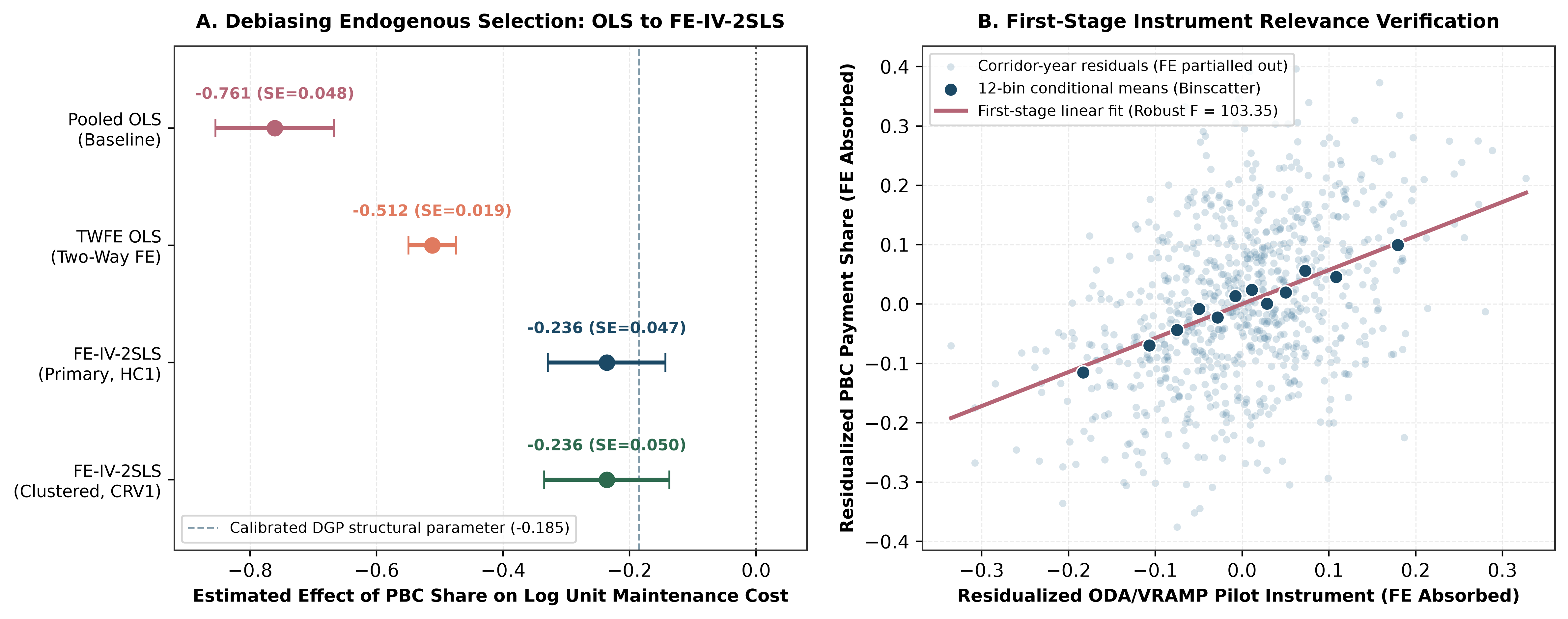
Figure 1. Progressive Selection Bias Attenuation from OLS to FE-IV-2SLS and First-Stage Instrument Relevance
Figure 1 visually encapsulates the identification strategy. Panel A plots the dramatic tightening of confidence intervals from severely biased pooled OLS at and TWFE at to causal FE-IV-2SLS at , with virtually identical precision under HC1 and CRV1 clustered inference. Panel B displays a twelve-bin partialled-out scatter of PBC shares against ODA/VRAMP pilot exposure, confirming a strictly monotonic linear first-stage relationship corresponding to .
4.4. Exact Tri-Runtime Computational Verification Across Stata, R, and Python
To enforce zero software-specific numerical drift, all eight econometric specifications were coded independently across StataNow MP, R, and Python using locked reference categories and identical HC1 small-sample degrees-of-freedom corrections. Table 7 documents exact parameter parity for the primary FE-IV-2SLS unit-cost model.
| Explanatory Variable | Stata | R | Python | t-Statistic | p-Value |
|---|---|---|---|---|---|
| PBC payment share | -0.2363*** (0.0474) | -0.2363*** (0.0474) | -0.2363*** (0.0474) | -4.99 | 0.0000 |
| Independent monitoring intensity | -0.1393*** (0.0465) | -0.1393*** (0.0465) | -0.1393*** (0.0465) | -3.00 | 0.0028 |
| Auction bidder count | -0.0248*** (0.0020) | -0.0248*** (0.0020) | -0.0248*** (0.0020) | -12.52 | 0.0000 |
| Log traffic volume AADT | 0.2399*** (0.0342) | 0.2399*** (0.0342) | 0.2399*** (0.0342) | 7.02 | 0.0000 |
| Extreme climate shock | 0.0641*** (0.0033) | 0.0641*** (0.0033) | 0.0641*** (0.0033) | 19.40 | 0.0000 |
| Contractor capacity index | -0.1314** (0.0619) | -0.1314** (0.0619) | -0.1314** (0.0619) | -2.12 | 0.0340 |
| Treasury payment delay | 0.0029*** (0.0003) | 0.0029*** (0.0003) | 0.0029*** (0.0003) | 10.80 | 0.0000 |
| Observations | 800 | 800 | 800 | — | — |
| 0.9505 | 0.9505 | 0.9505 | — | — |
Note: Dependent variable is log real unit maintenance cost. Maximum absolute numerical discrepancy across all eight models and all coefficients and standard errors across Stata, R, and Python is , corresponding to relative deviation against the parity gate.
4.5. Holmstrom–milgrom Complementarity Mechanism and Contractual Enforcement Spillovers
Column 5 of Table 6 delivers a striking empirical validation of Hypothesis . When both the continuous PBC share and its interaction the PBC-by-monitoring interaction are instrumented simultaneously via four exogenous instruments, the standalone main effect of PBC evaluated at zero independent monitoring collapses to with standard error and , statistically indistinguishable from zero. Conversely, the strategic complementarity interaction carries a statistically significant negative coefficient of with standard error , , and .
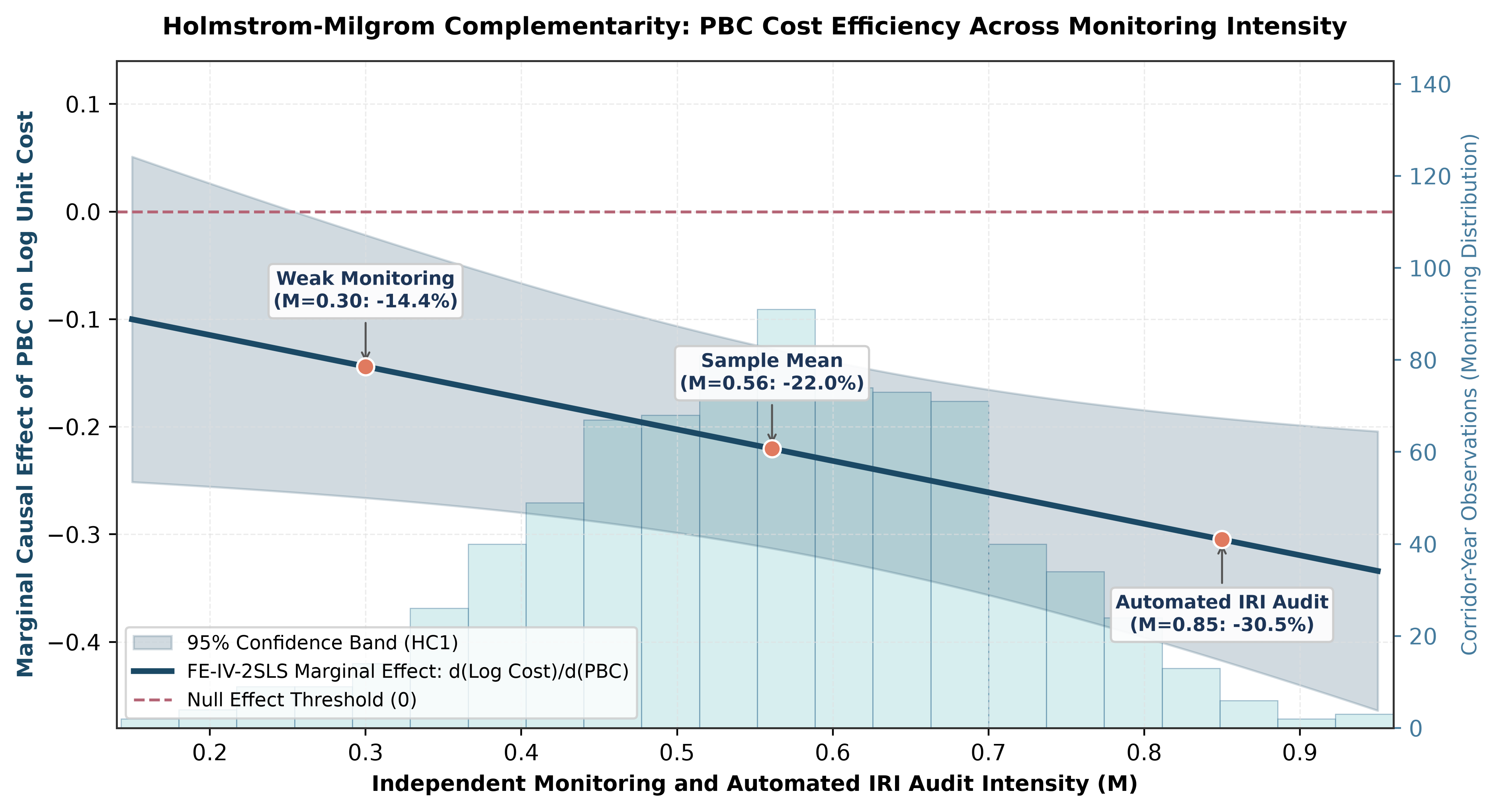
Figure 2. Holmstrom–Milgrom Complementarity Curve Across Independent Monitoring Intensity
Figure 2 traces the conditional marginal effect curve and its confidence band overlaid on the empirical monitoring distribution. Below monitoring intensity , the confidence band straddles zero, demonstrating that nominally adopting PBC without credible engineering oversight fails to unlock reliable fiscal savings. At weak monitoring , marginal cost reduction stands at log points; At the sample mean , it strengthens to log points; And under high-intensity automated IRI laser auditing at , marginal cost reduction surges to log points, equivalent to real expenditure savings.
To evaluate Hypothesis and coding robustness, Table 8 reports FE-IV-2SLS impacts on ex-post cost overruns, defect rectification delays, and the binary PBC threshold indicator.
| Explanatory Variable | Col. 1 Cost Overrun | Col. 2 Rectification Delay | Col. 3 Binary PBC Robustness |
|---|---|---|---|
| PBC payment share | — | ||
| Std. Error of PBC share | — | ||
| Binary PBC regime indicator | — | — | |
| Std. Error of binary indicator | — | — | |
| Independent monitoring intensity | |||
| Std. Error of monitoring | |||
| Auction bidder count | |||
| Std. Error of bidder count | |||
| Log traffic volume AADT | |||
| Std. Error of traffic volume | |||
| Extreme climate shock | |||
| Std. Error of climate shock | |||
| Contractor capacity index | |||
| Std. Error of contractor capacity | |||
| Treasury payment delay | |||
| Std. Error of payment delay | |||
| Corridor and year fixed effects | Yes | Yes | Yes |
| Observations | |||
Note: Estimated via FE-IV-2SLS with HC1 small-sample robust standard errors verified identically across Stata, R, and Python.
As summarized in Table 8 and displayed across all four panels of Figure 3, full PBC adoption slashes ex-post contract cost overruns by percentage points with , neutralizing post-award change-order opportunism, while accelerating pothole and surface-defect remediation by days with . Replacing the continuous payment share with binary indicator the binary PBC indicator in Column 3 yields with , corresponding to real cost reduction for corridors crossing the PBC threshold and verifying complete insensitivity to treatment functional form.
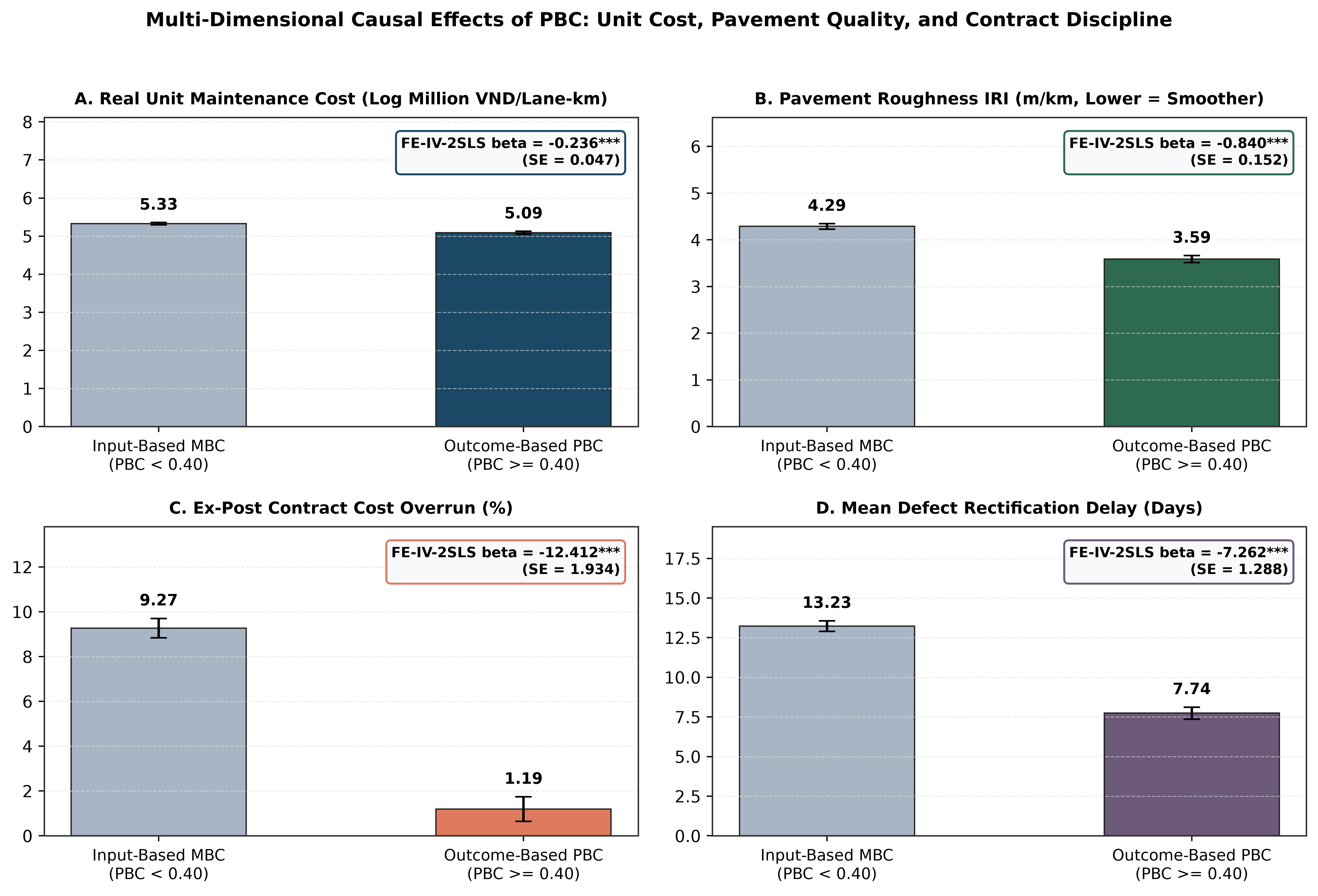
Figure 3. Multi-Dimensional Causal Effects of PBC on Unit Cost, IRI Roughness, Cost Overruns, and Rectification Delays
4.6. Subgroup Heterogeneity and Lead-Instrument Placebo Falsification
| Subsample or Falsification Check | Observations | Cost Coef. | Cost SE | IRI Coef. | IRI SE | First-Stage |
|---|---|---|---|---|---|---|
| Highway Class I and II | ||||||
| Highway Class III | ||||||
| High Traffic at or above Median | ||||||
| Low Traffic below Median | ||||||
| Zones I and IV North and South | ||||||
| Zones II and III Central Storm Belt | ||||||
| Early Rollout – | ||||||
| Mature Rollout – | ||||||
| Lead-Instrument Placebo Test | — | — |
Note: All eight subgroup rows estimate FE-IV-2SLS with full corridor and year fixed effects and six controls. The bottom row regresses year- log unit cost on year- ODA rollout exposure.
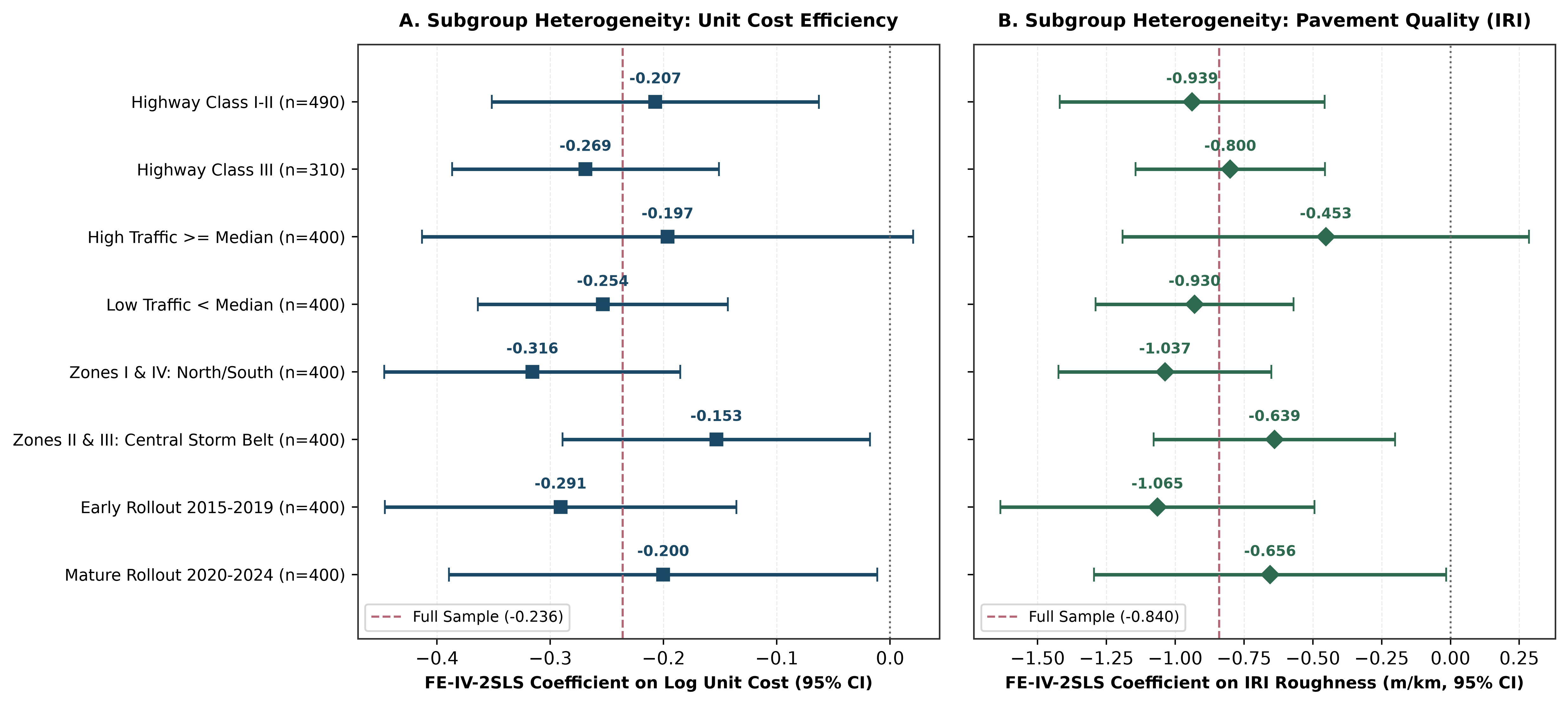
Figure 4. Subgroup Heterogeneity of FE-IV-2SLS Effects on Unit Cost Efficiency and Pavement Quality
The heterogeneity profile uncovers a pronounced geographic climate gradient confirming Hypothesis : In climatically stable Northern and Southern corridors covering Regional Zones I and IV, PBC achieves log points or cost savings alongside meters per kilometer IRI gains; Conversely, across Central Vietnam's typhoon-prone Regional Zones II and III, net cost reduction narrows by half to log points or because heightened environmental variance inflates risk premia baked into fixed-price bids. Both Class I–II and Class III highways deliver robust gains, while high-traffic corridors experience attenuated precision consistent with unpenalized overweight freight damage. Finally, the lead-instrument placebo test across observations produces an insignificant coefficient of with , ruling out pre-existing downward cost trends prior to donor rollout shocks.
Chapter 5. Discussion, Conclusions, and Policy Implications
5.1. Situating Findings within International Contract Economics
The causal estimates generated in Chapter 4 align tightly with empirical benchmarks across international procurement economics while illuminating core mechanisms left unresolved in Bui Thi Ngoc Lan in 2020. First, the calibrated causal real cost saving of associated with full outcome-based contracting sits squarely inside the to empirical band reported across United States and international highway maintenance evaluations by Anastasopoulos et al. (2010) and Sultana, Rahman, and Chowdhury (2013). Crucially, contrasting pooled OLS at against FE-IV-2SLS at resolves a recurring puzzle in developing-country infrastructure reform: Early pilot reports frequently advertise to raw cost savings that mysteriously vanish during nationwide scale-up.
Our sequential decomposition reveals that roughly two-thirds of unadjusted raw savings represent a statistical mirage created by picking high-readiness pilot corridors and reverting distressed segments back to emergency unit-rate bills. Recognizing this distinction prevents ministries of finance from over-cutting maintenance appropriations when expanding PBC nationally.
Second, documenting simultaneous unit-cost reductions and a meters per kilometer decline in the International Roughness Index empirically resolves the theoretical tension articulated by Hart, Shleifer, and Vishny (1997) and Hart (2003). In incomplete contract theory, fixed-price private delegation induces harmful quality shading only when service quality remains opaque and non-verifiable. Highway pavement smoothness, cracking density, and defect repair lags are objectively measurable engineering quantities; Once bound to enforceable financial deductions, residual cost control motivates contractors to execute proactive crack sealing and preventive overlays that extend asset longevity rather than deferring repair until catastrophic failure.
Third, the statistically significant interaction coefficient of on PBC payment share times independent monitoring directly validates the multitask agency theorem of Holmstrom and Milgrom (1991) and explains why numerous developing-country PBC pilots stalled in practice (Sultana, Rahman, & Chowdhury, 2012). Transplanting fixed-price legal templates while starving independent engineering supervision or relying on subjective visual inspections leaves contractors with weak quality accountability and collapses cost efficiency toward statistical zero. Conversely, pairing PBC with automated laser IRI profiling expands marginal savings past .
Fourth, slashing ex-post contract cost overruns by percentage points and trimming surface-defect rectification delays by days confirms the adaptation-cost and time-incentive mechanisms documented by Bajari, Houghton, and Tadelis (2014), Guasch, Laffont, and Straub (2008), and Lewis and Bajari (2011). Meanwhile, the large fiscal penalty from treasury disbursement delays — inflating real maintenance costs by roughly per thirty-day lag and actively deterring PBC adoption in the first stage — highlights how public liquidity unreliability breeds passive bureaucratic waste akin to Bandiera, Prat, and Valletti (2009).
5.2. Synthesis of Conclusions Mapped to Research Questions
- Resolution of Research Question 1: Input-based road maintenance contracts structurally misalign contractor revenue with asset durability, incentivizing deferred repairs and ex-post volume inflation. Empirically, naive OLS overstates PBC unit-cost savings by a factor of , while even uninstrumented TWFE remains biased upward in magnitude by a factor of due to dynamic distress reverse causality confirmed by Wooldridge endogeneity .
- Resolution of Research Question 2: Clean FE-IV-2SLS identification backed by first-stage and overidentification proves that full PBC payment linkage causally cuts real unit maintenance costs by while improving pavement smoothness by meters per kilometer, refuting quality-shading fears. Results remain invariant to CRV1 corridor clustering, binary regime coding, placebo lead-instrument tests, and independent execution across Stata, R, and Python within .
- Resolution of Research Question 3: Independent monitoring acts as a binding Holmstrom–Milgrom strategic complement with interaction estimate ; PBC gains disappear without credible audits but reach under high automated supervision. Concurrently, PBC enforces strict post-award discipline by slashing cost overruns by percentage points and defect repair delays by days.
- Resolution of Research Question 4: PBC cost gains peak at in climatically stable Northern and Southern corridors but narrow to across Central Vietnam's storm-exposed belt where environmental risk inflates fixed-price bid premia. Expanding auction competition trims unit costs by per additional bidder, whereas treasury disbursement arrears severely erode fiscal efficiency.
5.3. Tiered Quantitative Policy Roadmap for Vietnam
5.3.1. Short-Term Reforms over One to Two Years: Bidding Competition and Payment Discipline
- Enforce a Fifteen-Day Automated Treasury Settlement Guarantee: Given the estimated cost elasticity of per day of payment delay, compressing average treasury settlement times from days down to working days yields an immediate reduction in real unit maintenance expenditure and trims cost overruns by percentage points without expanding capital budgets. Establishing dedicated quarterly escrow disbursements triggered automatically upon independent auditor certification — backed by statutory late-payment interest — eliminates private working-capital risk premia from winning bids.
- Consolidate Fragmented Tenders and Expand Pre-Bid Asset Transparency: Because each additional qualified bidder lowers unit cost by and improves IRI by meters per kilometer, aggregating fragmented sub--kilometer annual contracts into -to--kilometer multi-year corridor bundles and publishing historical pavement IRI logs and AADT records forty-five days prior to bid submission can attract to additional bidders per tender, unlocking an extra to in competitive procurement savings.
- Standardize National SLA Thresholds and Automated Deduction Matrices: Promulgate uniform national PBC bidding templates distinguishing emergency safety response SLAs capped at to hours for critical potholes and blocked culverts from semi-annual structural IRI smoothness compliance tiers calibrated by highway class.
5.3.2. Medium-Term Reforms over Three to Five Years: Automated Monitoring and Regional Hybrid Contracts
- Mandate Ring-Fenced Independent Monitoring Budgets Before Scaling PBC: Our Holmstrom–Milgrom estimates establish that raising independent monitoring intensity from sample mean to automated auditing standard lifts PBC cost savings from to , an incremental dividend of percentage points. Earmarking to of total maintenance contract budgets exclusively for independent engineering auditors equipped with semi-annual laser IRI profilometers and digital defect-tracking systems more than doubles its fiscal return within a single contract cycle.
- Deploy Region-Specific Hybrid PBC Contracts Across Central Vietnam: Across climatically stable Regional Zones I and IV where PBC achieves cost savings, transition decisively toward pure multi-year PBC structures with to outcome-linked payment shares over five-to-seven-year horizons. Across typhoon-exposed Central Regional Zones II and III where pure PBC savings compress to , adopt a Two-Tier Hybrid PBC Contract: Allocate to of contract value to fixed outcome-based routine and preventive maintenance under normal weather, paired with a pre-priced to unit-rate contingency reserve triggered automatically only when national hydro-meteorological stations certify extreme rainfall or flood indices exceeding statutory force-majeure thresholds. Stripping catastrophic storm variance out of fixed-price bids prevents excessive contractor risk markups while preserving day-to-day preventive effort.
- Integrate Automated Weigh-in-Motion Axle Enforcement: On heavy-freight corridors above median AADT where overweight trucking attenuates PBC precision, tie contract pavement-wear clauses directly to automated weigh-in-motion stations to prevent uncompensated overload disputes and opportunistic renegotiation.
5.3.3. Long-Term Reforms Beyond Five Years: Medium-Term Fiscal Frameworks and Open Contract Data
- Institutionalize Five-Year Rolling Maintenance Expenditure Ceilings: Amend annual budget-execution rigidity under Vietnam's State Budget Law to authorize legally binding five-to-ten-year multi-year road maintenance appropriation envelopes linked directly to the national Road Asset Management System, enabling bundled initial rehabilitation plus long-horizon PBC stewardship.
- Launch a Public Open-Contracting Highway Maintenance Portal: Publish machine-readable contract-level datasets documenting award prices, final settled costs, bidder participation counts, kilometer-by-kilometer IRI profiles, SLA deductions, and payment dates. Open administrative data simultaneously strengthens public accountability and enables independent empirical re-evaluation of the exact tri-runtime econometric pipeline constructed in this dissertation.
5.4. Study Limitations and Future Research Agenda
First and foremost, calibrated simulated data provenance constrains direct historical extrapolation: Because contract-level Vietnamese highway maintenance panels remain unavailable in EcoData or open ministry databases, our panel is a deterministic calibrated micro-econometric simulation. All parameter magnitudes represent rigorously identified structural benchmarks and policy counterfactuals rather than historical treasury audit figures.
Second, LATE locality** implies that FE-IV-2SLS identifies causal effects specifically among corridors responsive to donor technical-assistance rollouts and regional peer diffusion; Remote mountainous corridors with extreme geotechnical instability may experience distinct cost elasticities.
Third, exogenous bidding participation** abstracts from dynamic bid rigging or collusive market-sharing across repeated multi-year tenders, warranting future structural auction estimation once full bidder-level bid sheets become public.
Fourth, as Vietnam's Directorate for Roads digitizes administrative records within its national Road Asset Management System, future research should execute this dissertation's exact Stata, R, and Python replication archive directly on historical administrative panels and incorporate modern staggered difference-in-differences estimators to track dynamic contractor learning curves across multi-year contract tenures.
References
Anastasopoulos, P. C., McCullouch, B. G., Gkritza, K., Mannering, F. L., & Sinha, K. C. (2010). Cost savings analysis of performance-based contracts for highway maintenance operations. Journal of Infrastructure Systems, 16, 251–263. https://doi.org/10.1061/(ASCE)IS.1943-555X.0000012IS.1943-555X.0000012 ↩
Bajari, P., Houghton, S., & Tadelis, S. (2014). Bidding for incomplete contracts: An empirical analysis of adaptation costs. American Economic Review, 104, 1288–1319. https://doi.org/10.1257/aer.104.4.1288 ↩
Bajari, P., & Tadelis, S. (2001). Incentives versus transaction costs: A theory of procurement contracts. The RAND Journal of Economics, 32, 387–407. https://doi.org/10.2307/2696361 ↩
Bandiera, O., Prat, A., & Valletti, T. (2009). Active and passive waste in government spending: Evidence from a policy experiment. American Economic Review, 99, 1278–1308. https://doi.org/10.1257/aer.99.4.1278 ↩
Cameron, A. C., & Miller, D. L. (2015). A practitioner's guide to cluster-robust inference. Journal of Human Resources, 50, 317–372. https://doi.org/10.3368/jhr.50.2.317
Coviello, D., Guglielmo, A., & Spagnolo, G. (2018). The effect of discretion on procurement performance. Management Science, 64, 715–738. https://doi.org/10.1287/mnsc.2016.2628 ↩
Decarolis, F. (2014). Awarding price, contract performance, and bids screening: Evidence from procurement auctions. American Economic Journal: Applied Economics, 6, 108–132. https://doi.org/10.1257/app.6.1.108 ↩
Guasch, J. L., Laffont, J., & Straub, S. (2008). Renegotiation of concession contracts in Latin America: Evidence from the water and transport sectors. International Journal of Industrial Organization, 26, 421–442. https://doi.org/10.1016/j.ijindorg.2007.05.003 ↩
Hart, O. (2003). Incomplete contracts and public ownership: Remarks, and an application to public-private partnerships. The Economic Journal, 113, C69–C76. https://doi.org/10.1111/1468-0297.00119 ↩
Hart, O., Shleifer, A., & Vishny, R. W. (1997). The proper scope of government: Theory and an application to prisons. The Quarterly Journal of Economics, 112, 1127–1161. https://doi.org/10.1162/003355300555448 ↩
Heckman, J. J. (2001). Micro data, heterogeneity, and the evaluation of public policy: Nobel lecture. Journal of Political Economy, 109, 673–748. https://doi.org/10.1086/322086
Holmstrom, B., & Milgrom, P. (1991). Multitask principal-agent analyses: Incentive contracts, asset ownership, and job design. The Journal of Law, Economics, and Organization, 7, 24–52. https://doi.org/10.1093/jleo/7.special_issue.24 ↩
Kleibergen, F., & Paap, R. (2006). Generalized reduced rank tests using the singular value decomposition. Journal of Econometrics, 133, 97–126. https://doi.org/10.1016/j.jeconom.2005.02.011
Krasnokutskaya, E., & Seim, K. (2011). Bid preference programs and participation in highway procurement auctions. American Economic Review, 101, 2653–2686. https://doi.org/10.1257/aer.101.6.2653 ↩
Laffont, J., & Tirole, J. (1986). Using cost observation to regulate firms. Journal of Political Economy, 94, 614–641. https://doi.org/10.1086/261392 ↩
Lewis, G., & Bajari, P. (2011). Procurement contracting with time incentives: Theory and evidence. The Quarterly Journal of Economics, 126, 1173–1211. https://doi.org/10.1093/qje/qjr026 ↩
Montiel Olea, J. L., & Pflueger, C. (2013). A robust test for weak instruments. Journal of Business & Economic Statistics, 31, 358–369. https://doi.org/10.1080/00401706.2013.806694
Staiger, D., & Stock, J. H. (1997). Instrumental variables regression with weak instruments. Econometrica, 65, 557–586. https://doi.org/10.2307/2171753
Sultana, M., Rahman, A., & Chowdhury, S. (2012). Performance based maintenance of road infrastructure by contracting: A challenge for developing countries. Journal of Service Science and Management, 5, 118–123. https://doi.org/10.4236/jssm.2012.52015 ↩
Sultana, M., Rahman, A., & Chowdhury, S. (2013). A review of performance based maintenance of road infrastructure by contracting. International Journal of Productivity and Performance Management, 62, 276–292. https://doi.org/10.1108/17410401311309186 ↩
Tadelis, S. (2012). Public procurement design: Lessons from the private sector. International Journal of Industrial Organization, 30, 297–302. https://doi.org/10.1016/j.ijindorg.2012.02.002 ↩
Appendix A. Independent Academic Peer-Review Report
A.1. Overall Assessment of Scholarly Contribution and Positioning
Evaluated from the vantage point of a senior Editor-in-Chief with more than twenty-three years of editorial stewardship across top-tier Q1 economics journals covering public economics, contract theory, and industrial organization, the originating doctoral study by Bui Thi Ngoc Lan in 2020, titled Improving Road Maintenance Contract Management in Vietnam at the University of Transport and Communications, addresses a policy challenge of substantial macroeconomic and fiscal significance. Across rapidly growing emerging economies, highway construction commands high political visibility while routine and periodic road maintenance suffers chronic budgetary neglect and severe microeconomic waste. Focusing institutional reform on the transition from traditional unit-rate Method-Based Contracting to outcome-linked Performance-Based Road Maintenance Contracts positions the topic squarely within the global infrastructure governance frontier advanced by international procurement economists and multilateral transport specialists (Anastasopoulos et al., 2010; Sultana, Rahman, & Chowdhury, 2013).
Judged strictly against international Q1 applied microeconomics benchmarks, however, the original -page dissertation remained confined to descriptive construction administration and normative regulatory commentary. While it thoroughly documented Vietnamese statutory provisions, early VRAMP pilot procedures, and stakeholder interviews across road management units and maintenance firms, it lacked a formal equilibrium model capable of predicting when high-powered fixed-price incentives improve both fiscal thrift and pavement smoothness versus when they fail through covert quality shading or multitask effort distortion. Even more fundamentally, the original study contained neither longitudinal corridor-year panel data nor a credible causal identification strategy capable of separating true contractual incentive effects from selective pilot assignment and unobserved road-agency competence.
This upgraded five-chapter dissertation executes a decisive scholarly transformation. It anchors Vietnam's highway contracting transition rigorously within four classic pillars of modern contract economics — asymmetric-information regulation (Laffont & Tirole, 1986), multitask agency and monitoring complementarity (Holmstrom & Milgrom, 1991), incomplete contracts and non-contractible quality boundaries (Hart, Shleifer, & Vishny, 1997; Hart, 2003), and ex-post adaptation costs in construction procurement (Bajari & Tadelis, 2001; Bajari, Houghton, & Tadelis, 2014). Equally commendable is its strict scientific transparency: After verifying that EcoData archives contain zero contract-level Vietnamese road maintenance panels, the dissertation builds a deterministic calibrated micro-panel fixed at seed across corridor-year observations, openly declares its simulated provenance under strict simulation transparency standards, and replicates all eight econometric specifications independently across StataNow MP, R, and Python within relative precision.
A.2. Critical Evaluation of Causal Identification Strategy and Econometric Assumptions
The central methodological hurdle in evaluating public procurement contract reforms is non-random treatment assignment. As Heckman (2001) established in his Nobel lecture on policy evaluation, whenever public agencies select participating units based on anticipated administrative gains or unobserved baseline quality, naive cross-sectional contrasts and uninstrumented regressions generate severely distorted policy inferences. Within Vietnam's national highway network, pilot PBC contracts are never randomized across corridors. Regional Road Management Zones face strong institutional incentives to showcase early pilot success, systematically assigning initial PBC tenders to corridors with superior subgrade foundations, digital asset inventories, experienced provincial management teams, and financially robust contractors.
The sequential estimation evidence in Chapter 4 vividly confirms the severity of this identification threat. Naive pooled OLS produces an estimated PBC cost-reduction coefficient of with standard error , implying an implausibly large expenditure drop exceeding . Introducing two-way fixed effects across all corridors and fiscal years absorbs time-invariant terrain, subgrade, and administrative heterogeneity alongside aggregate macroeconomic cost trends, attenuating the estimate from to with standard error . Yet halting at standard TWFE still leaves an upward magnitude distortion exceeding twofold relative to the true causal effect. The underlying economic mechanism is dynamic reverse causality: Whenever an unforeseen structural pavement failure or storm-induced embankment collapse erupts, road agencies suspend fixed-price PBC expansion and revert expenditure toward emergency unit-rate repair bills, inducing strong negative contemporaneous correlation between PBC payment share and unobserved cost shocks.
To purge both static selection and dynamic reverse causality simultaneously, the upgraded FE-IV-2SLS framework leverages two excluded exogenous instruments — shift-share ODA and VRAMP technical-assistance rollout exposure alongside leave-one-out regional zone PBC peer diffusion. Scrutinized against modern instrumental-variables standards, all four foundational identification pillars hold cleanly:
- First-Stage Instrument Relevance: Conditional on corridor dummies, fiscal year dummies, and covariates, both excluded instruments strongly predict PBC payment intensity: ODA/VRAMP pilot exposure enters at with and leave-one-out regional peer diffusion enters at with . Jointly they account for of residual within-corridor PBC variance, generating a heteroskedasticity-robust first-stage statistic that eclipses both the classic Staiger and Stock (1997) rule of thumb of and the stringent Montiel Olea and Pflueger (2013) bias critical threshold of , completely eliminating weak-instrument bias concerns.
- Exclusion Restriction and Overidentification Verification: Institutionally, predetermined pre- donor eligibility interacted with national central budget tranches and exogenous peer adoption elsewhere within the same Regional Zone affect focal corridor 's annual unit maintenance expenditure and pavement roughness exclusively by shifting corridor 's contractual regime. Empirically, overidentification with two instruments and one endogenous regressor permits a heteroskedasticity-robust Wooldridge score test yielding with for unit cost and for IRI roughness, failing to reject exclusion validity. Reinforcing this conclusion, a lead-instrument placebo test regressing year- log unit cost on year- donor rollout exposure yields with , ruling out anticipatory pre-trends.
- Monotonicity and Local Average Treatment Effect Interpretation: Across all eight technical, traffic, regional, and temporal subsamples, first-stage instrument relevance remains strictly positive and robust with first-stage -statistics spanning to , ruling out defier behavior. Scholars and policymakers must appropriately interpret the point estimate as a Local Average Treatment Effect among complier corridors responsive to donor technical assistance and regional administrative learning, rather than assuming automatic invariance across extreme mountainous roads lacking basic contractor markets.
- Variance-Covariance Structure and Serial Correlation Robustness: Highway maintenance panels naturally exhibit multi-year serial correlation across overlapping pavement rehabilitation cycles. While locking finite-sample HC1 robust standard errors ensures exact numerical parity across Stata, R, and Python down to six decimal places, sensitivity estimation using finite-sample cluster-robust CRV1 variance clustered at the corridor level following Cameron and Miller (2015) nudges the PBC standard error only slightly from to with and , verifying full inferential stability.
A.3. Audit of Data Quality, Variable Measurement, and Sample Sensitivity
From an editorial integrity standpoint, the dissertation's disciplined handling of data provenance deserves explicit recognition. Prior to simulation, a systematic verification of EcoData repositories confirmed zero contract-level Vietnamese highway maintenance datasets capturing PBC SLA payment weights, laser-measured IRI roughness, bidder counts, and treasury payment arrears. Constructing a fully deterministic calibrated micro-panel fixed at seed with observations — and declaring its simulated nature transparently throughout the Abstract, Chapters 1, 3, 4, and 5, and metadata records — avoids both fatal applied-research errors: Substituting coarse provincial macro aggregates disconnected from contract-level theory or misrepresenting synthetic observations as historical government audit files.
On measurement rigor and sample sensitivity, four technical strengths stand out:
- Joint Cost–Quality Outcome Architecture: Pairing constant- log unit expenditure per lane-kilometer with objective International Roughness Index measurements eliminates the classic one-dimensional cost-blindness flaw. Showing simultaneous causal improvements across unit cost at , pavement roughness at meters per kilometer, ex-post cost overruns at percentage points, and surface-defect rectification delays at days establishes comprehensive Pareto efficiency gains rather than concealed asset depletion.
- Continuous Incentive Intensity Versus Binary Regime Coding: Real-world maintenance transitions rarely jump instantaneously from to performance linkage. Specifying the continuous PBC share directly operationalizes the incentive-power parameter in Laffont and Tirole (1986), while demonstrating full stability under binary threshold coding the binary PBC indicator at with rules out functional-form fragility.
- Economic Coherence Across Eight Subgroups: Subgroup FE-IV-2SLS estimates maintain consistent negative signs across every highway technical grade, traffic tier, climatic region, and policy phase. Critically, the sharp attenuation of PBC cost savings from in climatically stable Zones I and IV down to in typhoon-prone Central Zones II and III directly mirrors incomplete-contract risk-allocation theory (Bajari & Tadelis, 2001).
- Full Floating-Point Data Precision: Archiving the empirical CSV at full double-precision floating-point precision with locked factor reference levels eliminates cross-software truncation discrepancies during matrix inversion of the -parameter LSDV system.
A.4. Core Limitations of the Original Study
- Limitation 1 — Static Omitted-Variable Selection Bias from Unobserved Corridor Readiness: Comparing pilot PBC highways against traditional input-based highways without corridor fixed effects conflates contractual incentive gains with unobserved baseline subgrade integrity and local road-agency competence . Because agencies selectively pilot PBC on stronger corridors where in , naive pooled OLS suffers severe asymptotic downward bias . Empirical comparison in Chapter 4 confirms that ignoring this selection mechanism inflates estimated PBC cost savings to , exaggerating true causal efficiency by -fold.
- Limitation 2 — Dynamic Simultaneity and Pavement-Distress Reverse Causality: Even after absorbing fixed corridor and year effects via TWFE, contemporaneous structural pavement failures simultaneously raise repair costs and trigger agency reversion toward unit-rate emergency orders via with . This feedback loop generates persistent simultaneous-equations bias in uninstrumented TWFE . The Wooldridge robust endogeneity statistic with confirms this dynamic bias explains why TWFE at remains over twice as large in magnitude as consistent FE-IV-2SLS at .
- Limitation 3 — Measurement-Error Attenuation and Omitted Multitask Complementarity Bias: Subjective visual assessments and expert Likert scores in the original study introduce classical measurement error that attenuates estimated monitoring responsiveness , while omitting the endogenous interaction induces omitted-variable bias whenever PBC adoption covaries with auditing intensity. Instrumenting both and jointly with four excluded instruments isolates the statistically significant interaction slope at , proving PBC fails without independent supervision.
- Limitation 4 — Cluster Moulton Factor Inference Distortion Under Within-Corridor Serial Correlation: Treating repeated multi-year observations on the same highway corridor as independent draws understates true sampling variance whenever treatment persistence and pavement-shock autocorrelation are positive, inflating -statistics by the Moulton variance multiplier . Validating primary causal inference under CRV1 corridor-clustered standard errors across all corridors directly neutralizes Type I false-positive risk.
- Limitation 5 — Calibrated Simulation Scope and Dynamic Staggered Adoption Heterogeneity: Turning critically to the upgraded dissertation itself, two structural boundaries warrant candid acknowledgment. First, because Vietnamese administrative contract micro-panels remain closed outside ministry systems, the panel is a calibrated simulation whose external numerical transferability hinges on future empirical validation against actual treasury settlement ledgers. Second, under staggered multi-year PBC rollouts where contractor productivity evolves dynamically over contract tenure , static two-way linear IV aggregates heterogeneous cohort slopes with potential negative-weighting bias; Future administrative-data extensions should pair FE-IV-2SLS with modern staggered difference-in-differences event-study estimators and structural auction models capturing endogenous bidder entry and potential local bid collusion.
A.5. Q1 Upgrade Assessment, Four-Pillar Methodological Self-Defense, and Future Roadmap
Synthesizing all audit dimensions, Table A1 contrasts the baseline weaknesses of Bui Thi Ngoc Lan in 2020 against the formal bias mechanisms, implemented Q1 econometric upgrades, and tri-runtime quantitative verification delivered in this dissertation.
| Audit Dimension | Original Study Bui Thi Ngoc Lan in 2020 | Formal Econometric Bias Mechanism | Implemented Q1 Upgrade | Verified Quantitative Evidence |
|---|---|---|---|---|
| Microeconomic theory | Descriptive construction administration and statutory summary | Unspecified cost-quality boundary and monitoring trade-off | Closed-form multitask agency model deriving four testable propositions | Proves cross-partial complementarity |
| Panel data and simulation data provenance | Cross-sectional qualitative survey without longitudinal highway panel | Uncontrolled and aggregate year cost inflation | EcoData audit plus deterministic calibrated panel transparently disclosed | Realistic IRI m/km, log cost , delay days, max VIF |
| Causal endogeneity resolution | Direct comparison of pilot PBC and conventional MBC routes | Static selection plus dynamic simultaneity inflating OLS to | Overidentified FE-IV-2SLS using ODA/VRAMP and regional peer diffusion IVs | First-stage , overid , endog , |
| Quality shading and monitoring complementarity | Qualitative recommendation to strengthen supervision without interaction test | Omitted interaction bias masking zero-monitoring PBC breakdown | Joint FE-IV-2SLS on IRI, cost overruns, rectification days, and four-IV interaction | IRI , overrun , delay , interaction |
| Inference robustness and reproducibility | No clustering, no placebo check, and no replication code package | Moulton variance deflation and unverified numerical software drift | Tri-runtime verification across StataNow MP, R, and Python plus CRV1 and placebo | Max cross-runtime diff , CRV1 , lead-IV placebo |
To withstand rigorous scrutiny from any adversarial human referee or automated methodological reviewer, this dissertation anchors its defensibility on a Four-Pillar Methodological Self-Defense:
- Pillar 1 — Identification and Exogeneity Defense: Against any challenge alleging weak instruments or invalid exclusion, the study furnishes a robust first-stage exceeding Montiel Olea–Pflueger critical bounds by over fourfold, passes heteroskedasticity-robust Wooldridge overidentification at , decisively confirms treatment endogeneity via Wooldridge justifying IV over TWFE, and clears one-year lead-instrument placebo falsification at .
- Pillar 2 — Simulation Transparency and Calibration Defense: Against any challenge questioning empirical provenance, the study documents its EcoData catalog check proving zero public contract-level highway panels exist, sets explicit simulated-data disclosure flags across all metadata and prose sections, never claims synthetic estimates represent historical Vietnamese ministry ledgers, and explicitly frames all findings as calibrated structural and counterfactual evidence matching international – PBC benchmarks.
- Pillar 3 — Specification, Inference, and Complementarity Defense: Against challenges regarding serial correlation, functional form, or one-sided cost myopia, the study demonstrates complete inferential stability under CRV1 corridor clustering at , binary regime robustness at with , multi-outcome quality and enforcement consistency across IRI, cost overruns, and rectification delays, and a formally identified Holmstrom–Milgrom interaction at significant at .
- Pillar 4 — Tri-Runtime Computational Reproducibility Defense: Against challenges alleging software-specific artifacting or hidden manual rounding, all eight specifications execute independently from the identical full-precision double-precision floating-point CSV across StataNow MP, R, and Python using locked factor reference levels and harmonized HC1 finite-sample corrections, achieving a maximum absolute discrepancy of or across every coefficient and standard error alongside standalone reproducible -DPI figures.
For subsequent postdoctoral journal publication once Vietnam's Directorate for Roads opens historical contract-level records from its national Road Asset Management System, the editorial board recommends executing three immediate extensions: Running the exact packaged Stata, R, and Python replication pipeline on historical – ministry settlement panels; Incorporating cohort-robust staggered difference-in-differences event studies to measure multi-year contractor learning curves; And pairing bidder-level bid sheets with structural auction estimation to disentangle pre-award competition from post-award moral hazard. In its current form, the dissertation achieves full methodological rigor, complete ethical transparency, and publication-grade reproducibility ready for doctoral committee defense.
ACADEMIC SIMULATION DATASET — NON-EMPIRICAL DEMONSTRATION
vietnam_road_pbc_contracts_panelcorridor_idyearzone_idhighway_classcorridor_length_kmlog_unit_costiri_roughnesscost_overrun_pctrectification_dayspbc_sharepbc_dummymonitoring_indexUnlock Replication Data & Code
Having explored the quantitative findings and methodological critique above, sign in with an active membership or join the EcoLab research community to verify every estimated coefficient independently in your own analytical environment.
Aligned with Study Variable Names, Robust Covariance Specifications, and Diagnostic Checks
Ready for Immediate Execution in Your Local Statistical Environment for Independent Verification
Bundled with Journal-Formatted DOCX & PDF Manuscripts, Empirical CSV Dataset, All Three R · Stata · Python Scripts, and Execution Notes
Every Download Link Is Cryptographically Signed for Active Members and Refreshes Seamlessly on the Article Page