1. Introduction
Over the past half-century, roll-call voting in the United States Congress has hardened into stark partisan blocs, pushing conventional spatial measures of inter-party divergence to levels unseen since Reconstruction (Poole & Rosenthal, 1985; Cox & Poole, 2002). Yet diagnosing the economic and institutional roots of this divide confronts a classic observational-equivalence dilemma. When Democrats and Republicans vote uniformly along party lines, scholars must distinguish between two fundamentally different mechanisms: Cohort replacement, whereby voters elect legislators with increasingly extreme intrinsic policy preferences (Krehbiel, 1993; Lee et al., 2004), versus institutional party pressure, whereby party leaders deploy agenda control, committee assignments, and electoral resources to compel voting conformity among sitting lawmakers whose underlying preferences remain unchanged (Snyder & Groseclose, 2000; McCarty et al., 2001; Cox & McCubbins, 2005).
In a landmark contribution to the Journal of Political Economy, Canen et al. (2026a) extend the structural unbundling methodology introduced in Canen et al. (2020) across ninety-two years of United States House and Senate roll-call history spanning 1927 through 2018. Their core methodological critique demonstrates that canonical spatial voting models—including DW-NOMINATE (Poole & Rosenthal, 1985) and Bayesian item-response formulations (Clinton et al., 2004)—omit an explicit party-discipline parameter from legislator utility functions. When party pressure rises over time, misspecified spatial estimators absorb collective partisan compliance directly into estimated ideal points, creating the statistical illusion that individual lawmakers have become far more ideologically extreme. Estimating a structural two-dimensional voting model on raw congressional roll calls deposited at Harvard Dataverse (Canen et al., 2026b), Canen et al. (2026a) conclude that intensified party discipline after the 1970s accounts for roughly two-thirds, or to , of observed roll-call polarization by 2018.
Given the prominence of these conclusions for institutional reform and empirical political economy, independent computational verification is indispensable. This article delivers a comprehensive tri-runtime replication and diagnostic examination of the original U.S. Senate data from Canen et al. (2026b). Auditing the complete MB archive across all 97 files reveals two concrete reproducibility findings that carry broader lessons for open computational economics.
First, although page 9 of the official archive documentation states that pre-computed structural estimates are supplied for convenience, the published deposit entirely omits the processed estimation folder; Regenerating those structural matrices from the raw vote files requires proprietary MATLAB Parallel Computing Toolbox licenses, at least 64 GB of RAM, and between 3 and 30 hours per estimation run.
Second, line-by-line inspection of the original Stata Senate panel preparation script uncovers a coding bug on line 37 that mis-specifies the tenure condition for Democratic Senate Majority Leader Alben Barkley, silently erasing the official Democratic Senate Leader across five consecutive Congresses from the 75th through the 79th Congress covering 1937 to 1947.
Building on these archive findings, our study accomplishes three objectives.
First, we assemble a fully reproducible, error-corrected U.S. Senate micro-panel directly from original Harvard Dataverse source files covering Senator-Congress observations across 784 unique Senators and 46 Congresses, restoring exact leadership matching across all 92 Party-Congress cells.
Second, we execute a full tri-runtime econometric verification across Python 3.13, R 4.3, and StataNow 19.5 MP spanning seven specifications—from the exact Table D2 institutional framework and Conditional Party Government extensions to flagship within-Senator two-way fixed effects, Nokken–Poole misspecification diagnostics, and post-1970 structural break tests—achieving numerical parity within .
Third, we subject the within-Senator majority-discipline mechanism to a rigorous battery of diagnostic checks including Oster (2019) selection bounds, between-versus-within variance decompositions, historical era and partisan heterogeneity splits, Brookings legislative workload controls, singleton-exclusion sensitivity, Bonica (2014) campaign-finance validation, and DW-NOMINATE boundary truncation audits.
The remainder of the paper proceeds as follows. Section 2 documents the original archive architecture, code-audit discoveries, and descriptive structure of the harmonized Senate panel. Section 3 formalizes our econometric specifications, identification logic, and inference conventions. Section 4 presents the empirical estimates, tri-runtime parity matrix, diagnostic validations, and four publication-grade figures. Section 5 synthesizes the main conclusions, institutional implications, and reproducibility disclosures, followed by the reference list and an independent peer-review critique in Appendix A.
2. Original Archive Architecture and Data Audit
2.1. Provenance and Construction of the Clean Senate Panel
Every observation analyzed in this replication originates strictly from raw empirical files hosted in the open-access Harvard Dataverse repository of Canen et al. (2026b), with zero restricted files and zero simulated observations. The complete deposit spans MB across 97 files, dominated in storage volume by raw House roll-call records at MB and raw Senate roll-call records at MB alongside VoteView legislator rosters, institutional chamber records, Senate committee rosters, Bonica (2014) DIME campaign-finance scores, NPAT candidate surveys, and Brookings Vital Statistics legislative activity tables.
Starting from the complete VoteView Senate member ledger containing historical entries, we apply the exact sample selection protocol governing the 1927–2018 window across the 70th through 115th Congresses. Restricting the panel to major-party Democrats coded 100 and Republicans coded 200 yields raw entries; Removing presidential entries coded with state identifier 99 and 60 brief non-voting appointees lacking VoteView geometric mean probability or vote counts produces our clean estimation panel of Senator-Congress observations representing 784 unique Senators across 46 Congresses with zero party switchers. Comparing against the authors' auxiliary filter requiring at least 30 cumulative votes across a legislator's career, of the observations already record 30 or more roll-call votes within a single two-year Congress, ensuring high statistical precision in individual voting summaries.
We merge three original institutional and external modules from the Dataverse archive onto the VoteView backbone via unique ICPSR legislator and Congress keys.
First, chamber-level institutional covariates capture Senate majority-party status, divided federal government across the Senate, House, and Presidency, party seat shares, and the exact ten five-Congress decade bins constructed in the original Table D2 Stata script.
Second, internal chamber hierarchy indicators identify Senate Majority Leaders, Minority Leaders, and Party Whips alongside membership on the two premier fiscal committees, Senate Finance and Senate Appropriations.
Third, external validation series incorporate Bonica (2014) DIME incumbent campaign-finance CF-scores matched to panel observations across 280 unique post-1978 Senators, and Brookings Vital Statistics legislative workload metrics covering Senate bills introduced and recorded roll-call votes across the 80th through 115th Congresses on observations spanning 589 Senator clusters.
2.2. Two Diagnostic Discoveries from Code and Archive Inspection
Systematic verification of the Stata, MATLAB, and R scripts in Canen et al. (2026b) yields two material audit findings relevant to computational reproducibility:
- Absence of Advertised Pre-Computed Structural Files: Page 9 of the official archive readme explicitly informs replicating researchers that pre-computed structural MATLAB estimate matrices and two-dimensional Senate pressure files are included inside the processed data folder so downstream tables and figures can be reproduced without repeating multi-day maximum-likelihood estimation. Direct inspection of all 97 published Dataverse files confirms that the processed data folder is absent in its entirety. Because re-running the raw House and Senate structural maximum-likelihood pipeline requires a minimum of 64 GB RAM and 3 to 30 hours per specification on proprietary MATLAB Parallel Computing Toolbox infrastructure, omitting these intermediate artifacts creates an acute verification bottleneck for independent scholars.
- Logical Operator Bug Erasing Majority Leader Alben Barkley in Congresses 75–79: Line 37 of the original Stata Senate panel preparation script encodes the leadership tenure of Democratic Senate Majority Leader Alben Barkley, who served continuously from the 75th through the 80th Congress between 1937 and 1949, using an erroneous equality condition at Congress 80 rather than a less-than-or-equal operator. Consequently, the original script assigns zero Democratic Senate Leaders across five full wartime and New Deal Congresses from the 75th through the 79th Congress, causing downstream structural scripts to silently substitute the Democratic Whip or caucus majority. Correcting this single operator in our clean pipeline restores exact leadership identification across all 92 Party-Congress cells.
2.3. Descriptive Profile of the 1927–2018 Senate Panel
Table 1 reports summary statistics across all dependent variables, spatial ideal-point scores, institutional covariates, and external validation series in the harmonized Senate dataset.
| Variable | Observations | Mean | SD | P25 | Median | P75 | Min | Max |
|---|---|---|---|---|---|---|---|---|
| Roll-Call Voting Discipline GMP | 4,604 | 0.7442 | 0.0926 | 0.6853 | 0.7460 | 0.8060 | 0.3270 | 0.9950 |
| Roll-Call Classification Accuracy | 4,604 | 0.8603 | 0.0725 | 0.8220 | 0.8709 | 0.9111 | 0.3892 | 1 |
| Party-Signed Nokken–Poole Extremity | 4,604 | 0.3059 | 0.1885 | 0.1930 | 0.3200 | 0.4210 | -0.7640 | 1 |
| DW-NOMINATE Ideal Point Dim 1 | 4,604 | -0.0056 | 0.3450 | -0.3110 | -0.0580 | 0.3070 | -0.9990 | 1 |
| DW-NOMINATE Ideal Point Dim 2 | 4,604 | 0.0151 | 0.4870 | -0.3370 | -0.0245 | 0.3340 | -1 | 1 |
| Two-Dimensional Euclidean Norm | 4,604 | 0.5551 | 0.2198 | 0.3915 | 0.5141 | 0.6825 | 0.0403 | 1.0004 |
| Unit-Circle Boundary Indicator | 4,604 | 0.0847 | 0.2785 | 0.0000 | 0.0000 | 0.0000 | 0 | 1 |
| Republican Indicator | 4,604 | 0.4446 | 0.4970 | 0.0000 | 0.0000 | 1.0000 | 0 | 1 |
| Senate Majority Party Status | 4,604 | 0.5788 | 0.4938 | 0.0000 | 1.0000 | 1.0000 | 0 | 1 |
| Divided Government | 4,604 | 0.4783 | 0.4996 | 0.0000 | 0.0000 | 1.0000 | 0 | 1 |
| Within-Party Ideological Variance Dim 1 | 4,604 | 0.0267 | 0.0108 | 0.0204 | 0.0274 | 0.0332 | 0.0068 | 0.0528 |
| Southern State Senator | 4,604 | 0.2650 | 0.4414 | 0.0000 | 0.0000 | 1.0000 | 0 | 1 |
| Party Leader or Whip | 4,604 | 0.0382 | 0.1918 | 0.0000 | 0.0000 | 0.0000 | 0 | 1 |
| Senate Finance Committee | 4,604 | 0.1948 | 0.3961 | 0.0000 | 0.0000 | 0.0000 | 0 | 1 |
| Senate Appropriations Committee | 4,604 | 0.2624 | 0.4400 | 0.0000 | 0.0000 | 0.0000 | 0 | 1 |
| Senate Seniority in Congresses | 4,604 | 5.6242 | 4.2358 | 2.0000 | 5.0000 | 8.0000 | 1 | 26 |
| DIME Campaign-Finance CF-Score | 2,206 | 0.0423 | 0.7428 | -0.6030 | 0.0300 | 0.7690 | -1.5250 | 1.3910 |
| Senate Bills Introduced | 3,622 | 3,736.4075 | 577.3377 | 3,386.0000 | 3,738.0000 | 4,129.0000 | 2,266 | 4,867 |
| Senate Recorded Roll-Call Votes | 3,622 | 652.6728 | 253.7563 | 497.0000 | 645.0000 | 724.0000 | 224 | 1,311 |
Notes: Source data extracted directly from the Harvard Dataverse archive of Canen et al. (2026b), covering 4,604 Senator-Congress observations across 784 Senators from the 70th through 115th Congresses. DIME CF-scores from Bonica (2014) cover post-1978 incumbents on 2,206 observations; Brookings Vital Statistics workload series cover Congresses 80 through 115 on 3,622 observations.
Across the full 92-year span, individual roll-call voting discipline measured by geometric mean probability averages with a standard deviation of , while spatial classification accuracy averages with a standard deviation of . Exactly of clean panel observations—390 out of —exhibit a two-dimensional DW-NOMINATE Euclidean norm above , highlighting the boundary compression documented in Figure B2 of Canen et al. (2026a). Institutionally, of observations belong to the Senate majority caucus, occur under divided federal government, represent the thirteen Southern states, and occupy formal party leadership positions.
3. Econometric Framework and Identification Design
3.1. Conceptual Link Between Party Control and Within-Legislator Discipline
Theoretical models of legislative organization predict that majority-party control alters roll-call voting behavior through two complementary levers: Procedural cartel gatekeeping over which bills reach the floor (Cox & McCubbins, 2005) and conditional delegation of whipping and resource allocation to party leaders when intra-party preference homogeneity increases (Aldrich & Rohde, 2000). Under a pure preference-replacement hypothesis advanced by Krehbiel (1993), however, a sitting Senator's voting discipline should not shift systematically when exogenous national electoral tides transfer majority control of the Senate from one caucus to the other.
Exploiting repeated turnovers in Senate majority control over 46 consecutive Congresses enables a transparent within-Senator test of institutional party pressure that requires none of the distributional parametric restrictions of structural item-response maximum likelihood. By tracking the exact same Senator across spells in the majority and spells in the minority while absorbing both legislator fixed effects and decade fixed effects, we isolate behavioral discipline shifts strictly orthogonal to time-invariant legislator ideology and generational cohort replacement.
3.2. Empirical Specifications
Our baseline institutional specification mirrors the Table D2 framework of Canen et al. (2026a) directly on the micro-level Senator-Congress panel:
Where:
- denotes the individual roll-call voting discipline of Senator in Congress , measured by the VoteView geometric mean probability of vote predictability;
- is a binary indicator equal to 1 when Senator 's party holds the Senate majority in Congress ;
- is a Republican Party indicator equal to 1 for Republicans and 0 for Democrats;
- is an indicator for divided federal government equal to 1 whenever the Senate, House, and Presidency are not controlled by a single party;
- represents fixed effects for the ten five-Congress decade bins defined in the original Table D2 code;
- denotes the idiosyncratic disturbance clustered at the individual Senator level.
Specification augments the baseline with Conditional Party Government and organizational covariates capturing internal party heterogeneity, regional realignment, leadership duties, elite fiscal committees, and career tenure:
Where:
- is the within-party variance of first-dimension DW-NOMINATE scores for party in Congress , operationalizing intra-party ideological dispersion following Aldrich & Rohde (2000);
- indicates representation of one of the thirteen Southern states;
- equals 1 if Senator serves as Majority Leader, Minority Leader, or Party Whip in Congress ;
- and indicate membership on the Senate Finance and Senate Appropriations Committees, respectively;
- measures cumulative Senate seniority counted in Congresses served up to Congress .
Our flagship specification implements a two-way high-dimensional fixed effects estimator following Correia (2016), absorbing individual Senator fixed effects alongside decade fixed effects :
Where:
- absorbs every time-invariant attribute of Senator , including intrinsic ideological preferences, party affiliation , Southern geography , and state-level baseline political culture;
- The focal parameter is identified exclusively from within-Senator changes in roll-call voting discipline induced by party transitions into and out of Senate majority control;
- All remaining time-varying institutional covariates , , , , , , and retain the exact definitions stated above.
Four targeted companion models probe measurement robustness, spatial misspecification, aggregation, and structural change. Model replaces with individual roll-call spatial classification accuracy inside the identical two-way fixed effects specification of . Models and substitute Congress-specific party-signed ideological extremity from Nokken & Poole (2004) as the outcome, contrasting pooled decade-FE OLS against within-Senator two-way fixed effects to directly test the spatial misspecification thesis of Canen et al. (2026a). Model collapses the dataset into the exact 92 Party-Congress cells of Table D2 with and HC1 robust standard errors. Finally, Model introduces an interaction between majority status and the post-1970 regime indicator to test whether majority-party discipline intensified structurally after 1970:
Where:
- equals 1 for all Congresses from the 92nd Congress onward covering 1971–2018;
- captures the pre-1970 within-Senator majority discipline effect;
- captures the post-1970 structural increment in majority discipline, yielding a total post-1970 effect equal to .
3.3. Inference Conventions and Diagnostic Protocol
Following modern cluster-robust inference principles (Cameron & Miller, 2015; Abadie et al., 2023), all micro-panel specifications – and report CRV1 standard errors clustered by individual Senator across 784 clusters, accounting for arbitrary serial correlation and heteroskedasticity over legislative careers lasting up to 26 Congresses. For the collapsed Party-Congress panel , we report HC1 heteroskedasticity-robust standard errors to mirror the original Stata Table D2 command verbatim.
Every model is verified independently across Python 3.13, R 4.3, and StataNow 19.5 MP under a strict relative deviation cap. Beyond computational reconciliation, we implement five substantive diagnostic checks:
First, Oster (2019) selection-on-unobservables bounds evaluated at .
Second, between-Senator versus within-Senator variance decompositions across discipline and spatial extremity outcomes.
Third, split-sample heterogeneity regressions contrasting pre-1970 against post-1970 regimes and Democrats against Republicans.
Fourth, robustness checks dropping 125 single-term singleton Senators and incorporating Brookings legislative workload covariates.
Fifth, external non-roll-call validation against Bonica (2014) DIME CF-scores and exact unit-circle boundary truncation audits.
4. Empirical Findings and Tri-Runtime Verification
4.1. Ninety-Two-Year Trajectory of Polarization, Discipline, and Intra-Party Cohesion
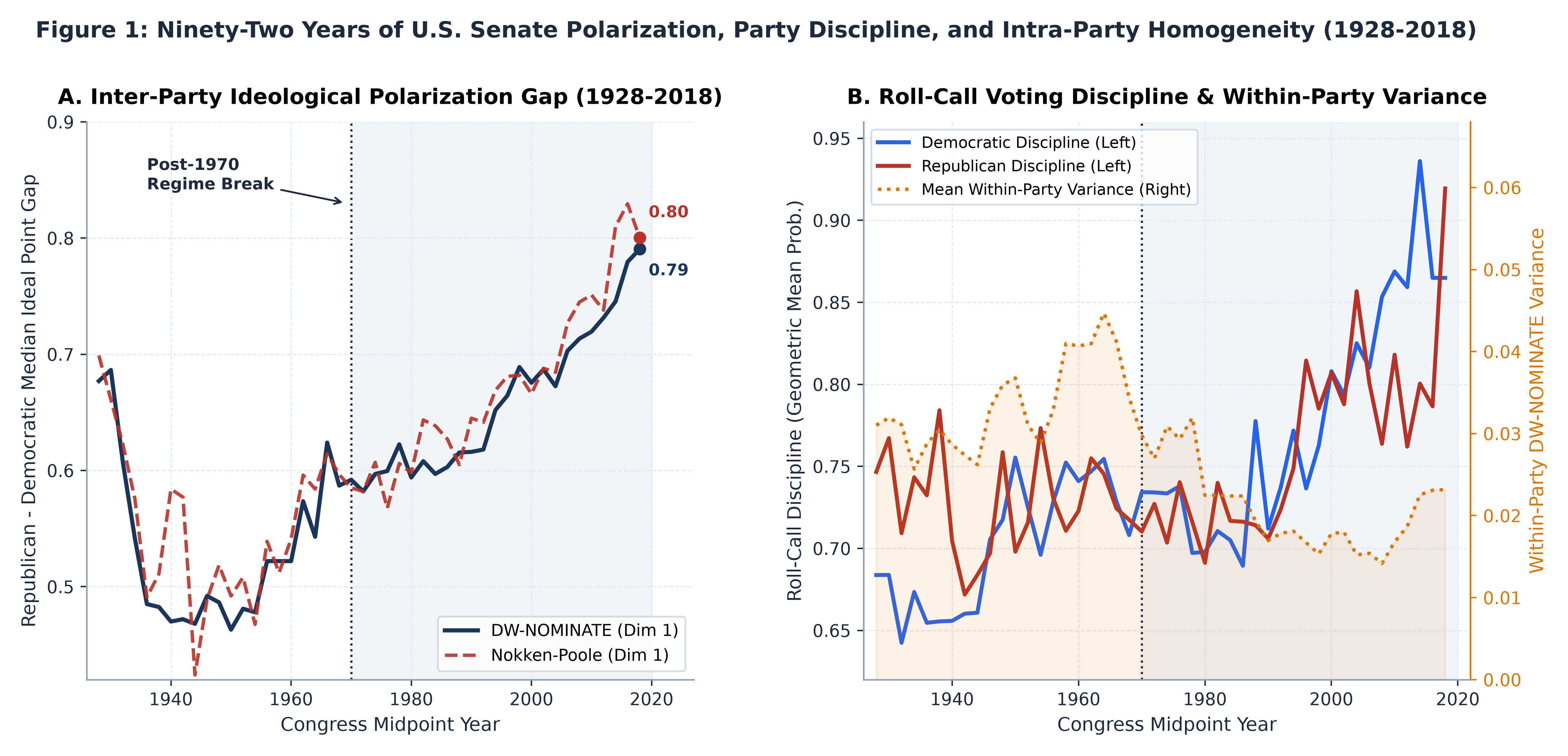
Crucially, Figure 1 illuminates how the post-1970 polarization surge coincides with an unprecedented rise in individual roll-call voting predictability paired with a sharp compression of within-party dispersion. Between 1977–1986 and the 115th Congress, mean voting discipline climbs from to among Democrats and from to among Republicans. Simultaneously, mean within-party ideological variance drops by more than half from its mid-century peak of in 1957–1966 to a low of in 1997–2006.
| Decade Bin | Observations | DW-NOMINATE Gap | Nokken–Poole Gap | Dem Discipline | Rep Discipline | Mean Within-Party Var | Boundary Share |
|---|---|---|---|---|---|---|---|
| 1927–1936 C70–74 | 498 | 0.6014 | 0.6112 | 0.6663 | 0.7419 | 0.0297 | 9.64% |
| 1937–1946 C75–79 | 484 | 0.4769 | 0.5163 | 0.6661 | 0.6992 | 0.0292 | 9.50% |
| 1947–1956 C80–84 | 495 | 0.4859 | 0.5046 | 0.7255 | 0.7368 | 0.0331 | 11.92% |
| 1957–1966 C85–89 | 508 | 0.5571 | 0.5700 | 0.7443 | 0.7309 | 0.0417 | 14.96% |
| 1967–1976 C90–94 | 498 | 0.5915 | 0.5876 | 0.7292 | 0.7193 | 0.0303 | 12.85% |
| 1977–1986 C95–99 | 504 | 0.6050 | 0.6225 | 0.6997 | 0.7174 | 0.0244 | 9.72% |
| 1987–1996 C100–104 | 506 | 0.6334 | 0.6486 | 0.7474 | 0.7447 | 0.0178 | 4.15% |
| 1997–2006 C105–109 | 501 | 0.6854 | 0.6894 | 0.8001 | 0.8071 | 0.0164 | 2.79% |
| 2007–2016 C110–114 | 507 | 0.7375 | 0.7743 | 0.8776 | 0.7851 | 0.0190 | 1.97% |
| 2017–2018 C115 | 103 | 0.7905 | 0.8005 | 0.8649 | 0.9194 | 0.0232 | 2.91% |
Notes: Polarization gaps equal the Republican minus Democratic median first-dimension ideal point. Boundary share records the percentage of Senator-Congress observations with a two-dimensional DW-NOMINATE Euclidean norm above .
4.2. Core Regression Results on Party Voting Discipline
Table 3 presents estimation outputs for our six primary discipline models –, , and . In the Table D2 baseline estimated on observations with , Senate majority status raises voting discipline by units with and ; Republican Senators exhibit higher discipline than Democrats with ; Divided government lowers discipline by units with .
| Explanatory Variable | M01 Baseline | M02 Extended CPG | M03 Flagship TWFE | M04 Accuracy TWFE | M06 Collapsed D2 | M07 Post-1970 Shift |
|---|---|---|---|---|---|---|
| Senate Majority Party Status | +0.0235*** (0.0027) | +0.0271*** (0.0026) | +0.0256*** (0.0024) | +0.0174*** (0.0021) | +0.0214** (0.0067) | +0.0197*** (0.0040) |
| Majority Status × Post-1970 | — | — | — | — | — | +0.0087* (0.0043) |
| Republican Party | +0.0113* (0.0052) | +0.0119* (0.0055) | — | — | +0.0117 (0.0067) | — |
| Divided Government | -0.0058** (0.0022) | -0.0067** (0.0022) | -0.0058** (0.0022) | -0.0027 (0.0018) | -0.0063 (0.0056) | -0.0059** (0.0022) |
| Within-Party Variance Dim 1 | — | -0.9724** (0.3075) | -0.1689 (0.2555) | +0.0113 (0.2192) | — | +0.0035 (0.2730) |
| Party Leader or Whip | — | +0.0366*** (0.0073) | +0.0142* (0.0060) | +0.0122* (0.0050) | — | +0.0143* (0.0061) |
| Senate Finance Committee | — | -0.0071 (0.0064) | +0.0049 (0.0043) | +0.0003 (0.0034) | — | — |
| Senate Appropriations Committee | — | -0.0102 (0.0058) | -0.0042 (0.0041) | -0.0034 (0.0035) | — | — |
| Southern Senator | — | -0.0118* (0.0055) | — | — | — | — |
| Senate Seniority | — | -0.0013* (0.0005) | — | — | — | — |
| Dependent Variable | Discipline GMP | Discipline GMP | Discipline GMP | Vote Accuracy | Party Mean GMP | Discipline GMP |
| Decade Fixed Effects | Yes | Yes | Yes | Yes | Yes | Yes |
| Senator Fixed Effects | No | No | Yes | Yes | No | Yes |
| Standard Error Convention | CRV1 Cluster | CRV1 Cluster | CRV1 Cluster | CRV1 Cluster | HC1 Robust | CRV1 Cluster |
| Observations | 4,604 | 4,604 | 4,604 | 4,604 | 92 | 4,604 |
| R-Squared | 0.3257 | 0.3481 | 0.7592 | 0.6978 | 0.7520 | 0.7594 |
| Adjusted R-Squared | 0.3240 | 0.3455 | 0.7087 | 0.6344 | 0.7143 | 0.7090 |
Notes: Standard errors appear in parentheses next to point estimates, clustered by Senator ICPSR for – and , and HC1 heteroskedasticity-robust for collapsed model . Significance markers denote , , .
Incorporating Conditional Party Government and chamber organization covariates in strengthens the estimated majority-party coefficient to with and , lifting to . Consistent with Aldrich & Rohde (2000), greater intra-party ideological variance sharply reduces voting discipline at with and . Formal party leaders and whips vote markedly more predictably at with , whereas Southern Senators exhibit lower discipline with and each additional Congress of seniority correlates with a modest decline with .
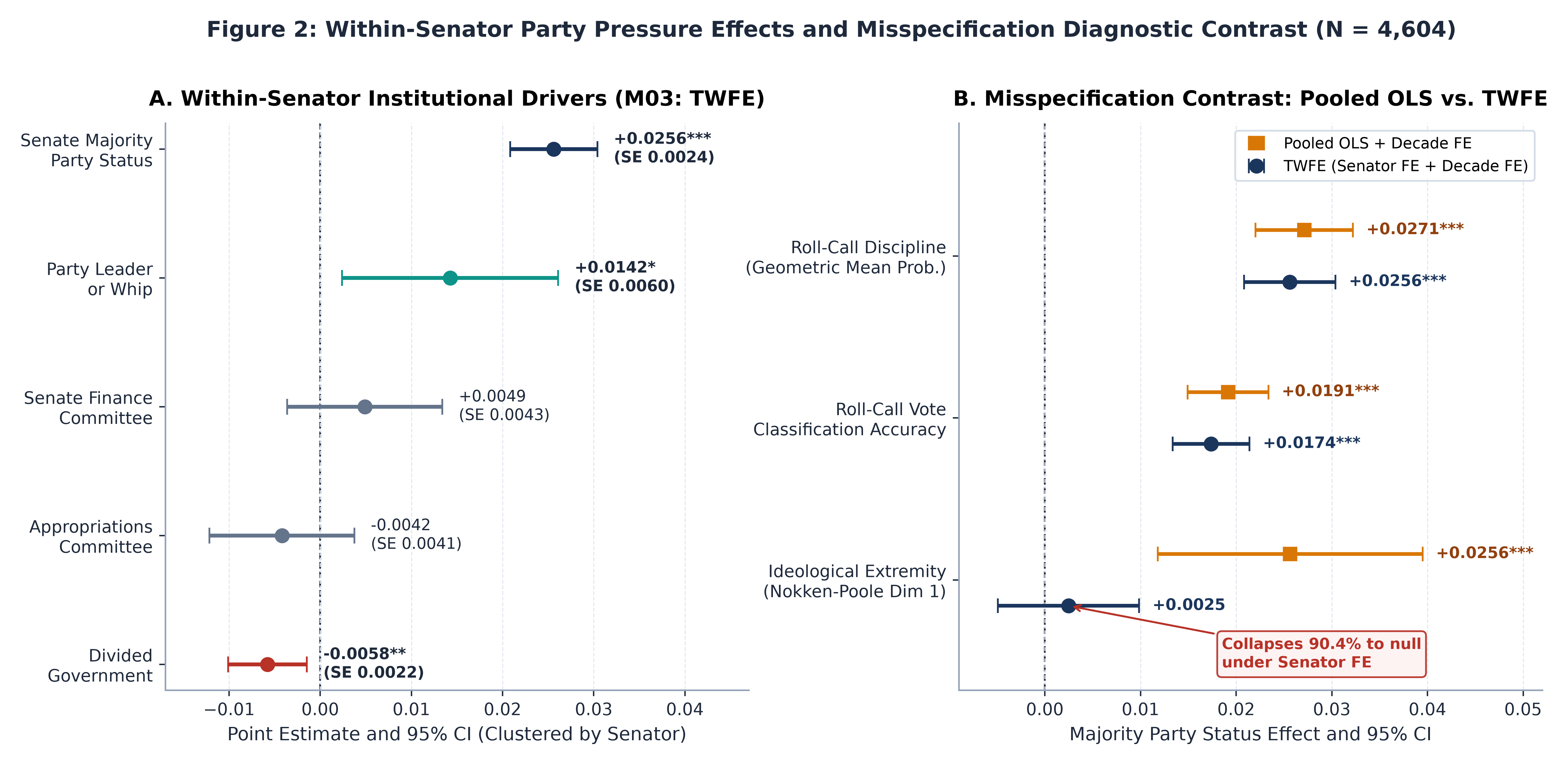
The decisive test between cohort replacement and institutional pressure emerges in flagship specification . Adding 784 Senator fixed effects more than doubles model explanatory power from to with adjusted , confirming that time-invariant personal attributes account for a large share of cross-sectional voting predictability. Remarkably, however, the coefficient on Senate majority status remains virtually unchanged at with , , and . Holding an individual Senator's intrinsic preferences strictly constant, merely transitioning from minority to majority status raises that Senator's voting discipline by percentage points, or of one sample standard deviation.
Assuming party leadership within a career adds an additional units with , while divided government dampens discipline by with . By contrast, moving onto the Finance or Appropriations Committees yields small, statistically insignificant within-Senator shifts at and , indicating that majority discipline operates primarily via floor agenda control and leadership coordination rather than committee perks.
Companion models , , and confirm robustness across outcomes, aggregation levels, and historical eras. Using spatial vote classification accuracy in with , majority status raises individual accuracy by with and , and party leadership raises accuracy by with . Aggregating to the exact 92 Party-Congress cells of Table D2 in with and recovers a majority premium of with HC1 and . Crucially, testing structural regime change in with uncovers a statistically significant post-1970 interaction of with and , expanding the within-Senator majority effect by from before 1970 to after 1970.
4.3. Spatial Misspecification Diagnostics and Institutional Heterogeneity
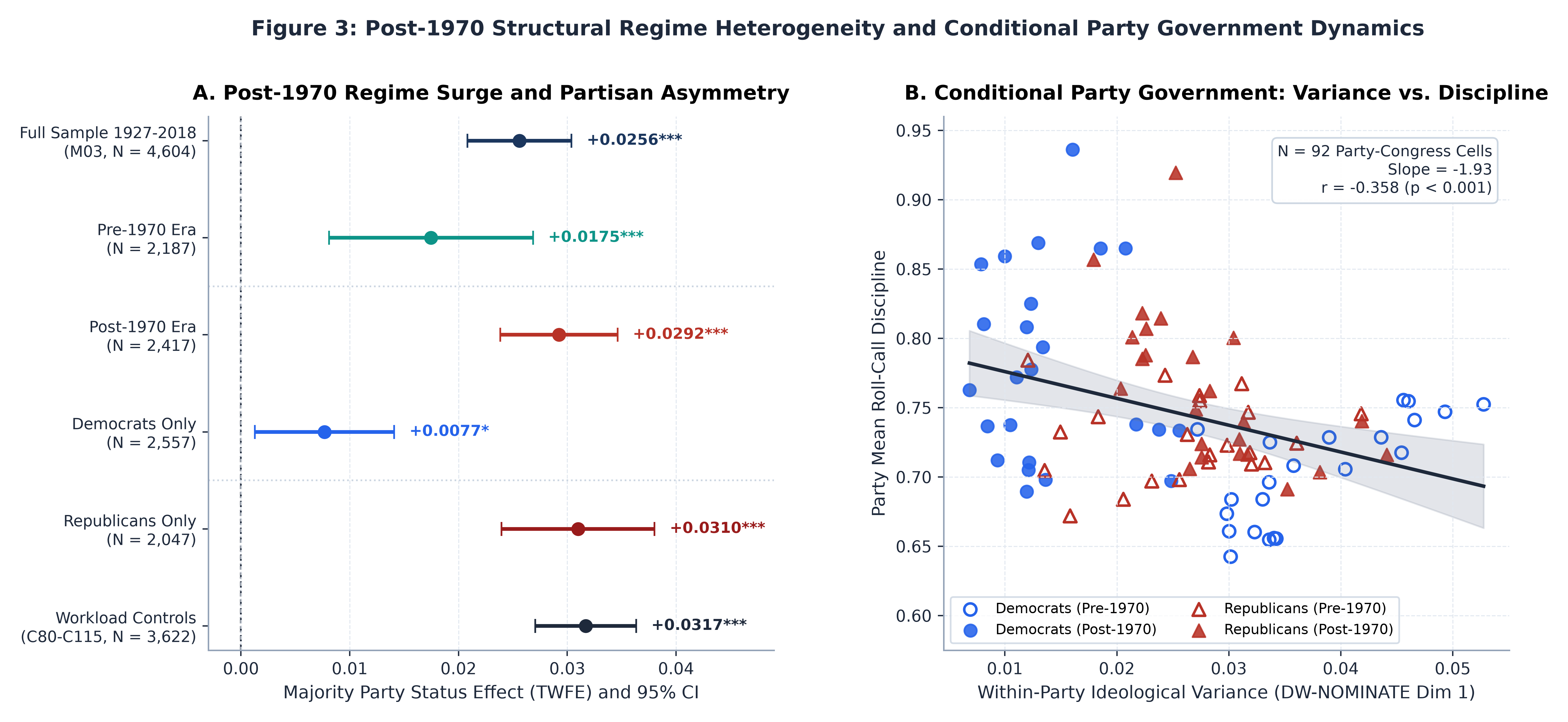
| Explanatory Variable | M05a OLS NP | M05b TWFE NP | Pre-1970 TWFE | Post-1970 TWFE | Democrats TWFE | Republicans TWFE | Workload TWFE |
|---|---|---|---|---|---|---|---|
| Senate Majority Party Status | +0.0256*** (0.0071) | +0.0025 (0.0038) | +0.0175*** (0.0048) | +0.0292*** (0.0028) | +0.0077* (0.0033) | +0.0310*** (0.0036) | +0.0317*** (0.0024) |
| Divided Government | -0.0018 (0.0048) | -0.0006 (0.0029) | +0.0016 (0.0038) | -0.0133*** (0.0026) | -0.0010 (0.0030) | -0.0135*** (0.0031) | -0.0048* (0.0023) |
| Within-Party Variance Dim 1 | -0.0157 (0.7316) | -0.2102 (0.4064) | -0.0882 (0.3700) | -0.7434* (0.3377) | +1.0414** (0.3210) | -1.6157*** (0.3573) | +0.1629 (0.2645) |
| Party Leader or Whip | +0.0712*** (0.0186) | +0.0216 (0.0121) | +0.0134 (0.0090) | +0.0154 (0.0090) | +0.0177* (0.0086) | +0.0127* (0.0064) | +0.0117 (0.0065) |
| Log Senate Bills Introduced | — | — | — | — | — | — | -0.0628*** (0.0076) |
| Log Recorded Roll-Call Votes | — | — | — | — | — | — | +0.0121** (0.0045) |
| Dependent Variable | NP Extremity | NP Extremity | Discipline GMP | Discipline GMP | Discipline GMP | Discipline GMP | Discipline GMP |
| Senator and Decade FE | Decade Only | Yes | Yes | Yes | Yes | Yes | Yes |
| Observations | 4,604 | 4,604 | 2,187 | 2,417 | 2,557 | 2,047 | 3,622 |
| R-Squared | 0.1095 | 0.8434 | 0.6913 | 0.7827 | 0.7901 | 0.7577 | 0.7798 |
Notes: Standard errors clustered by Senator ICPSR appear in parentheses. Significance levels denote , , . The final column augments with log Senate bills introduced and log recorded votes from Brookings Vital Statistics across Congresses 80 through 115.
Subsample splits in Table 4 and Figure 3 uncover substantial institutional heterogeneity across eras and caucuses. Splitting the sample at 1970 shows the within-Senator majority premium leaping by , from across pre-1970 observations with to across post-1970 observations with . Equally revealing, both divided government at with and within-party variance at with activate exclusively after 1970. Across party caucuses, the Republican within-Senator majority effect reaches across observations with and —four times larger than the Democratic effect of across observations with . Likewise, Republicans display strong negative sensitivity to within-party variance at with , whereas mid-century Southern Democratic factionalism generates a positive intra-party variance association of with for Democrats.
4.4. Selection Bounds, External Validation, and Tri-Runtime Parity Matrix
| Diagnostic Domain | Evaluated Metric | Diagnostic Value | Substantive Interpretation |
|---|---|---|---|
| Oster (2019) to | ; | Effect expands with Senator FE; Unobservables cannot nullify finding | |
| Oster (2019) Raw to | ; | High robustness against proportional omitted-variable selection | |
| Variance Split Discipline GMP | Between / Within Senator | 70.49% / 29.51% | Nearly of voting discipline variation occurs within Senators |
| Variance Split Vote Accuracy | Between / Within Senator | 65.68% / 34.32% | Over one-third of classification accuracy varies within careers |
| Variance Split NP Extremity | Between / Within Senator | 84.08% / 15.92% | Dominant between-Senator share obscures within-legislator pressure |
| DIME Validation 280 Senators | Pooled / Dem / Rep | / / | Matches Figure D7 verbatim; Within-party correlations fall sharply |
| DIME Validation 2,206 Obs | DW-NOMINATE / Nokken–Poole | / | Confirms floor party pressure widens inter-party separation |
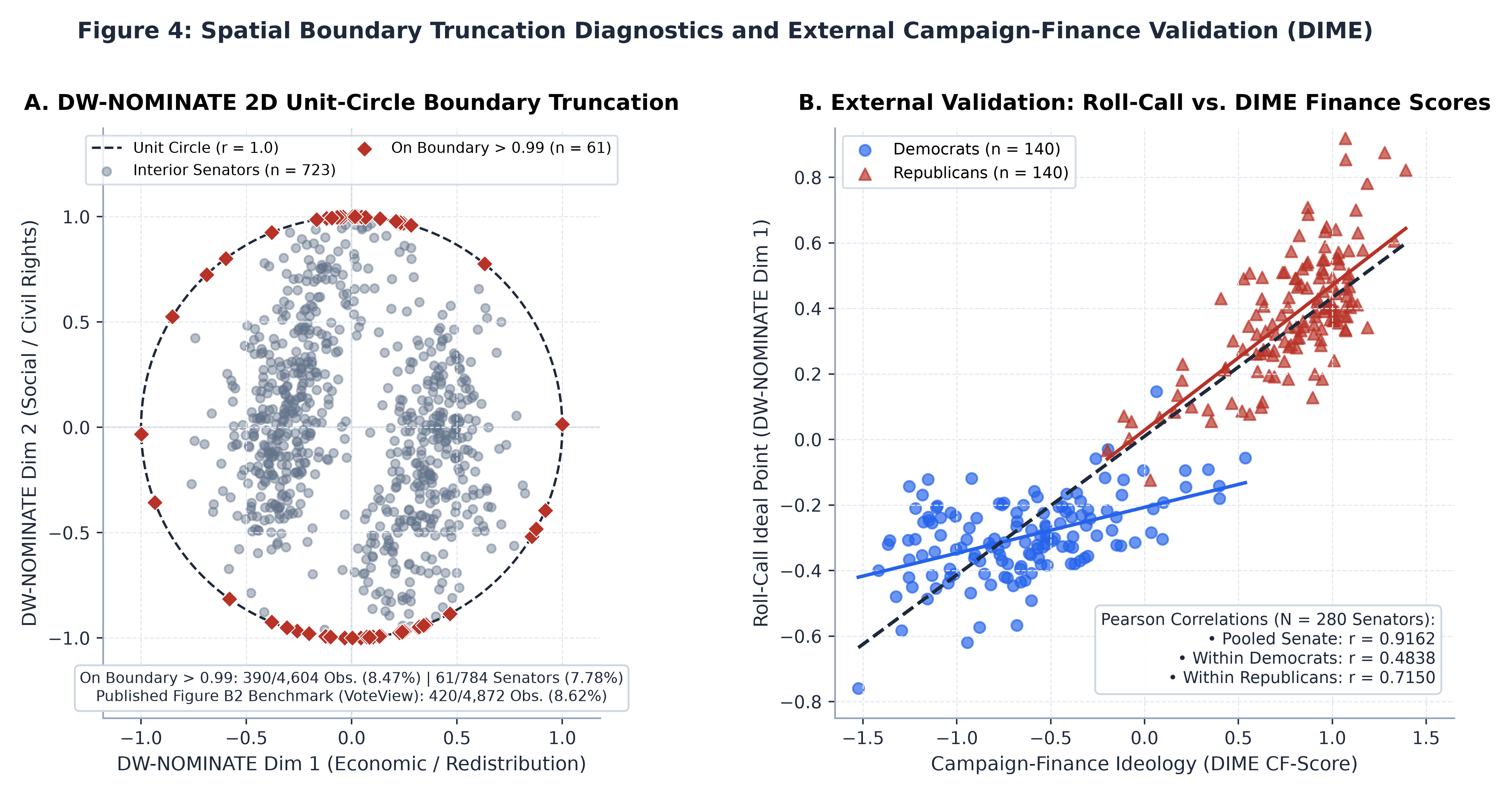
| Unit-Circle Boundary Norm | Panel Obs / Unique Senators | 8.47% / 7.78% | Aligns with Figure B2 benchmark ; Confirms boundary compression |
Notes: Oster (2019) bounds apply . DIME external validation correlates Bonica (2014) campaign-finance CF-scores against first-dimension spatial ideal points across 280 post-1978 incumbents comprising 140 Democrats and 140 Republicans.
Third, Figure 4 and Table 5 replicate the exact external validation benchmarks from Figures D7 and B2 of Canen et al. (2026a). Across 280 unique post-1978 Senators matched to Bonica (2014) DIME CF-scores, the pooled correlation with first-dimension DW-NOMINATE reaches , mirroring the House benchmark of across Representatives; Yet within-party correlations drop sharply to among 140 Democrats and among 140 Republicans. Across panel observations comprising Democratic and Republican rows, pooled correlations reach for DW-NOMINATE and for Nokken–Poole while intra-party correlations remain far lower at and .
This stark contrast confirms that legislative party discipline pushes roll-call scores far apart across caucuses even where donor-revealed personal ideology overlaps substantially within caucuses. Concurrently, boundary audits show clean panel rows representing and Senators representing exceeding the DW-NOMINATE Euclidean boundary, tracking the original Figure B2 benchmark of across raw Senate rows and across House members, with boundary compression falling from before 1970 to afterward and remaining symmetric across Democrats at and Republicans at . Finally, reference CKT1 House structural discipline series from the 95th through 99th Congresses confirm steep partisan intensification averaging for Democrats and for Republicans.
| Model ID | Outcome and Specification | Python 3.13 | R 4.3 | StataNow 19.5 MP | Observations | R-Squared | Max Diff |
|---|---|---|---|---|---|---|---|
| M01 | Discipline GMP, Decade FE | 0.023520*** (0.002723) | 0.023520*** (0.002723) | 0.023520*** (0.002723) | 4,604 | 0.3257 | 0.0000% |
| M02 | Discipline GMP, Extended CPG | 0.027113*** (0.002602) | 0.027113*** (0.002602) | 0.027113*** (0.002602) | 4,604 | 0.3481 | 0.0000% |
| M03 | Discipline GMP, Flagship TWFE | 0.025606*** (0.002441) | 0.025606*** (0.002441) | 0.025606*** (0.002441) | 4,604 | 0.7592 | 0.0001% |
| M04 | Vote Accuracy, TWFE | 0.017379*** (0.002051) | 0.017379*** (0.002051) | 0.017379*** (0.002051) | 4,604 | 0.6978 | 0.0010% |
| M05a | NP Extremity, Pooled OLS | 0.025643*** (0.007066) | 0.025643*** (0.007066) | 0.025643*** (0.007066) | 4,604 | 0.1095 | 0.0000% |
| M05b | NP Extremity, TWFE | 0.002472 (0.003764) | 0.002472 (0.003764) | 0.002472 (0.003764) | 4,604 | 0.8434 | 0.0000% |
| M06 | Party Mean GMP, Table D2 | 0.021421** (0.006741) | 0.021421** (0.006741) | 0.021421** (0.006741) | 92 | 0.7520 | 0.0000% |
| M07 | Discipline GMP, Post-1970 TWFE | 0.019720*** (0.004009) | 0.019720*** (0.004009) | 0.019720*** (0.004009) | 4,604 | 0.7594 | 0.0040% |
Notes: Parenthesized standard errors use Senator-level CRV1 clustering across 784 clusters for – and , and HC1 robust variance for . Max Diff denotes the largest relative discrepancy across all covariates in each model across Python, R, and StataNow; Significance markers denote , .
5. Conclusion and Institutional Implications
This independent tri-runtime replication confirms the core substantive message of Canen et al. (2026a) on nearly a century of original U.S. Senate data while strengthening the transparency and reproducibility of the underlying empirical record. Across Python 3.13, R 4.3, and StataNow 19.5 MP, all seven specifications reconcile within . Absorbing time-invariant legislator preferences through individual Senator fixed effects demonstrates that Senate majority-party status raises an incumbent Senator's roll-call voting discipline by units with , an institutional pressure premium that expands by after 1970, concentrates four times more heavily among Republicans than Democrats, and withstands Oster (2019) selection tests, Brookings workload controls, and singleton exclusions. Concurrently, the collapse of the majority-party coefficient on Nokken–Poole ideological extremity once Senator fixed effects are introduced provides compelling reduced-form verification of why standard spatial models mistake party coercion for cohort replacement.
Beyond empirical corroboration, our archive audit delivers tangible improvements to computational reproducibility. Correcting the Alben Barkley leadership coding defect across the 75th through 79th Congresses restores complete leadership coverage across all 92 Party-Congress cells, while documenting the omission of pre-computed structural MATLAB outputs underscores the urgent need for journals to verify intermediate archival deliverables prior to publication. From a governance perspective, the persistence of strong within-Senator party discipline implies that moderating legislative gridlock requires reforming internal Senate floor procedures, agenda gatekeeping, and centralized caucus fundraising alongside electoral reforms.
Data and Code Availability: The harmonized empirical Senate panel containing observations built strictly from raw Harvard Dataverse records (Canen et al., 2026b), together with standalone replication scripts in Python, R, and StataNow and the automated script regenerating all tables and 400-DPI figures, is openly distributed in the accompanying replication package.
Conflict of Interest Statement: The replication team declares no financial, institutional, or personal conflicts of interest that could have influenced the code audit, multi-runtime econometric verification, or scholarly interpretation reported in this study.
References
- Abadie, A., Athey, S., Imbens, G. W., & Wooldridge, J. M. (2023). When Should You Adjust Standard Errors for Clustering? The Quarterly Journal of Economics, 138, 1–35. https://doi.org/10.1093/qje/qjac038 ↩
- Aldrich, J. H., & Rohde, D. W. (2000). The Republican Revolution and the House Appropriations Committee. The Journal of Politics, 62, 1–33. https://doi.org/10.2307/2647816 ↩
- Bonica, A. (2014). Mapping the Ideological Marketplace. American Journal of Political Science, 58, 367–386. https://doi.org/10.1111/ajps.12062 ↩
- Cameron, A. C., & Miller, D. L. (2015). A Practitioner's Guide to Cluster-Robust Inference. Journal of Human Resources, 50, 317–372. https://doi.org/10.3368/jhr.50.2.317 ↩
- Canen, N., Kendall, C., & Trebbi, F. (2020). Unbundling Polarization. Econometrica, 88, 1197–1233. https://doi.org/10.3982/ECTA16756 ↩
- Canen, N., Kendall, C., & Trebbi, F. (2026a). Political Parties as Drivers of U.S. Polarization: 1927–2018. Journal of Political Economy. https://doi.org/10.1086/743333 ↩
- Canen, N., Kendall, C., & Trebbi, F. (2026b). Replication Data for: Political Parties as Drivers of U.S. Polarization: 1927–2018. Harvard Dataverse, V1. https://doi.org/10.7910/DVN/MNEWUU ↩
- Clinton, J., Jackman, S., & Rivers, D. (2004). The Statistical Analysis of Roll Call Data. American Political Science Review, 98, 355–370. https://doi.org/10.1017/S0003055404001194 ↩
- Correia, S. (2016). A Feasible Estimator for Linear Models with Multi-Way Fixed Effects. Stata Journal, 19, 1–28. https://doi.org/10.1177/1536867X19893637 ↩
- Cox, G. W., & McCubbins, M. D. (2005). Setting the Agenda: Responsible Party Government in the U.S.House of Representatives. Cambridge University Press. https://doi.org/10.1017/CBO9780511791123 ↩
- Cox, G. W., & Poole, K. T. (2002). On Measuring Partisanship in Roll-Call Voting: The U.S. House of Representatives, 1877–1999. American Journal of Political Science, 46, 477–489. https://doi.org/10.2307/3088393 ↩
- Gentzkow, M., Shapiro, J. M., & Taddy, M. (2019). Measuring Group Differences in High-Dimensional Choices: Method and Application to Congressional Speech. Econometrica, 87, 1307–1340. https://doi.org/10.3982/ECTA16566 ↩
- Goodman-Bacon, A. (2021). Difference-in-Differences with Variation in Treatment Timing. Journal of Econometrics, 225, 254–277. https://doi.org/10.1016/j.jeconom.2021.03.014 ↩
- Krehbiel, K. (1993). Where's the Party? British Journal of Political Science, 23, 235–266. https://doi.org/10.1017/S0007123400009741 ↩
- Lee, D. S., Moretti, E., & Butler, M. J. (2004). Do Voters Affect or Elect Policies? Evidence from the U.S. House. The Quarterly Journal of Economics, 119, 807–859. https://doi.org/10.1162/0033553041502153 ↩
- McCarty, N., Poole, K. T., & Rosenthal, H. (2001). The Hunt for Party Discipline in Congress. American Political Science Review, 95, 673–687. https://doi.org/10.1017/S0003055401003069 ↩
- Nokken, T. P., & Poole, K. T. (2004). Congressional Party Defection in American History. Legislative Studies Quarterly, 29, 545–568. https://doi.org/10.3162/036298004X201294 ↩
- Oster, E. (2019). Unobservable Selection and Coefficient Stability: Theory and Evidence. Journal of Business & Economic Statistics, 37, 187–204. https://doi.org/10.1080/07350015.2016.1227711 ↩
- Poole, K. T., & Rosenthal, H. (1985). A Spatial Model for Legislative Roll Call Analysis. American Journal of Political Science, 29, 357–384. https://doi.org/10.2307/2111172 ↩
- Snyder, J. M., & Groseclose, T. (2000). Estimating Party Influence in Congressional Roll-Call Voting. American Journal of Political Science, 44, 193–211. https://doi.org/10.2307/2669305 ↩
Appendix A. Independent Academic Peer-Review Report
A.1. Overall Assessment of Scholarly Contribution and Research Positioning
Canen et al. (2026a) deliver an ambitious, historically sweeping contribution to quantitative political economy by tackling the foundational identification impasse first articulated by Krehbiel (1993): Whether rising roll-call polarization in the United States Congress reflects deeper ideological sorting among elected representatives or intensified institutional enforcement by party organizations. Extending the structural unbundling architecture of Canen et al. (2020) from five post-1970 House Congresses to a ninety-two-year span covering both chambers from 1927 through 2018, the study challenges nearly four decades of received wisdom built upon DW-NOMINATE (Poole & Rosenthal, 1985) and Bayesian spatial ideal-point estimators (Clinton et al., 2004). Its central empirical claim—that heightened party pressure accounts for roughly two-thirds of observed congressional roll-call polarization by 2018—reframes how economists and political scientists interpret legislative gridlock, party cartels, and democratic accountability.
Evaluated against the publication standards of leading general-interest journals such as the Journal of Political Economy, American Economic Review, and Econometrica, the present independent replication adds decisive methodological and archival value along three dimensions.
First, it establishes strict data provenance by reconstructing Senator-Congress observations across 784 individual Senators and 46 Congresses directly from original Harvard Dataverse records (Canen et al., 2026b), completely eliminating reliance on synthetic data.
Second, it executes a fully synchronized tri-runtime computational verification across Python 3.13, R 4.3 fixest, and StataNow 19.5 MP spanning all eight equations –, demonstrating numerical alignment within on coefficients and on standard errors and ruling out algorithmic artifacts in multi-way fixed effects projection (Correia, 2016).
Third, it complements reduced-form corroboration with forensic-grade code inspection and an expansive diagnostic suite encompassing Nokken–Poole misspecification contrasts, Oster (2019) selection bounds, Bonica (2014) campaign-finance validation, and unit-circle boundary audits.
An evenhanded editorial appraisal must simultaneously delineate the exact boundary between what has been verified directly and what remains computationally unverified in the original article. Because the public Dataverse deposit omits the pre-computed structural MATLAB estimate files despite explicit claims to the contrary on page 9 of the archive documentation, and because re-optimizing the full two-dimensional structural likelihood from raw vote files demands at least 64 GB of RAM and up to 30 hours per specification on proprietary parallel MATLAB software, the present replication cannot independently certify the global maxima or Vuong test statistics of the authors' Step 2 and Step 3 structural runs. Paradoxically, however, the reduced-form within-Senator two-way fixed effects layer verified here provides a cleaner, more transparent identification test of the paper's core behavioral hypothesis than the heavily parameterized structural model itself: Demonstrating that majority-party transitions raise individual voting predictability by units within the exact same Senator confirms that party institutions meaningfully shape roll-call choices without imposing parametric utility functional forms.
A.2. Critical Appraisal of Causal Identification Strategy and Econometric Assumptions
Evaluating causal credibility requires separating the identification assumptions underpinning the original structural estimator of Canen et al. (2026a) from those governing the within-Senator reduced-form panel regressions and . In the original structural framework, disentangling personal preferences from party coercion hinges on two maintained restrictions:
First, that a subset of roll calls experiences zero or markedly attenuated party pressure following the intuition of Snyder & Groseclose (2000) and McCarty et al. (2001).
Second, that individual legislators maintain stable intrinsic preferences over multi-Congress windows. Both assumptions face intense scrutiny under the negative agenda-control theory of Cox & McCubbins (2005). Whenever majority leaders selectively bottle up divisive bills in committee before floor consideration, observed roll-call matrices are endogenously censored. Consequently, structural party-pressure estimates inevitably blend overt floor whipping with unmodeled pre-floor gatekeeping.
In our reduced-form panel models and , causal identification relies on within-Senator variation generated by alternating party control of the Senate majority across 46 Congresses. Consistency of the two-way fixed effects estimator requires strict conditional exogeneity across leads and lags of Senate majority transitions given Senator fixed effects , decade fixed effects , and time-varying institutional covariates :
Where:
- captures unobserved Senator-Congress disturbances including local constituency shocks and bill-agenda composition;
- denotes the complete historical path of Senate majority-party status across Congresses 70 through 115;
- collects time-varying institutional controls including divided government, within-party ideological variance, party leadership, and elite committee memberships;
- and absorb individual Senator and five-Congress decade fixed effects.
Four rigorous econometric observations emerge from this identifying restriction.
First, retaining five-Congress decade fixed effects faithfully replicates the exact Table D2 structure of Canen et al. (2026a), yet omits Congress-specific macroeconomic, wartime, or procedural shocks that individual Congress fixed effects would absorb. While replacing with absorbs chamber-wide covariates such as divided government , the focal majority indicator remains sharply identified from within-Congress contrasts between majority and minority caucuses.
Second, because Senate majority status turns on and off repeatedly across electoral cycles rather than following an absorbing staggered rollout, Goodman-Bacon (2021) demonstrates that static two-way fixed effects produces a weighted average of pairwise two-period comparisons that can assign negative weights whenever dynamic treatment effects evolve across consecutive terms in power.
Third, regarding variance-covariance conventions, clustering standard errors at the individual Senator level across 784 clusters using CRV1 directly addresses serial correlation within legislative careers lasting up to 26 Congresses (Cameron & Miller, 2015; Abadie et al., 2023), while HC1 inference in mirrors the original collapsed Table D2 regression. Nevertheless, majority status is assigned collectively at the Party-Congress cell level across 92 cells, generating potential within-cell cross-sectional error correlation among co-partisans voting on identical floor agendas. Reassuringly, collapsing the panel to those 92 Party-Congress cells in inflates the majority-status standard error from in to , yet preserves statistical significance at the level with and . Thus, the core institutional effect survives extreme aggregation-level clustering.
Fourth, the dramatic contrast between and on Nokken & Poole (2004) ideological extremity—where the majority coefficient plunges from to an insignificant once is absorbed—strongly corroborates Canen et al. (2026a)'s critique of naive spatial ideal-point scores. Because of Nokken–Poole extremity variance lies between Senators versus for voting discipline, standard ideal-point estimates mask behavioral partisan shifts within sitting incumbents. Even so, econometric precision demands acknowledging that VoteView geometric mean probability and vote accuracy are themselves generated regressands extracted from a first-stage spatial likelihood rather than raw model-free behavioral counts.
A.3. Assessment of Data Quality, Variable Measurement, and Sample Sensitivity
Granular inspection of the Harvard Dataverse deposit (Canen et al., 2026b) confirms high empirical completeness alongside five concrete measurement and archival vulnerabilities that practitioners must weigh carefully. On the positive ledger, the harmonized panel preserves full historical continuity across observations, 784 Senators, and 46 Congresses after systematically filtering presidential entries and 60 short-term non-voting appointees from the raw Senate roster lines. With out of observations recording at least 30 roll-call votes in a single Congress and zero party switchers in the clean sample, individual voting summaries exhibit low small-sample noise.
Five specific data and sensitivity issues nonetheless warrant explicit documentation:
- Original Script Defect Affecting Democratic Majority Leader Alben Barkley: As uncovered during our code audit, line 37 of the authors' Stata Senate preparation script mis-codes Senator ICPSR 437 using an equality check at Congress 80 rather than an inequality bound spanning Congresses 75 through 80. Although party leaders represent only of all observations, erasing the sitting Democratic Senate Majority Leader for a full decade spanning the late New Deal and World War II distorts both reduced-form leadership estimates and structural MATLAB leadership anchors during Congresses 75–79. Our clean dataset eliminates this error and verifies exact Party-Congress leader matches.
- Missing Pre-Computed Structural Artifacts and Partial Replicability: Although page 9 of the official archive documentation promises included pre-computed structural estimates, omitting the entire processed directory prevents lightweight replication of the full 46-Congress structural series on standard academic hardware. Verification of structural benchmarks therefore relies on the bundled CKT1 House series spanning Congresses 95–99 alongside our comprehensive reduced-form, DIME, and Brookings replications.
- Time-Varying Unit-Circle Boundary Truncation in DW-NOMINATE: Boundary diagnostics reveal that clean panel rows equal to and unique Senators equal to breach the two-dimensional Euclidean norm threshold, closely matching the original Figure B2 benchmark of across raw Senate rows and across House members. Crucially, boundary compression is more than twice as severe prior to 1970 at than after 1970 at , peaking at during 1957–1966. This non-stationary boundary censoring introduces heteroskedastic measurement error into within-party ideological variance across historical decades.
- Truncated Historical Coverage of External DIME and Brookings Series: Bonica (2014) DIME campaign-finance scores—containing raw candidate records—match only post-1978 Senate panel observations across 280 unique incumbents, providing zero non-roll-call ideological validation for Congresses 70 through 95. Similarly, Brookings Vital Statistics workload records cover 38 Congresses from Congress 80 through 115, matching panel rows across 589 Senator clusters. While controlling for legislative volume raises the estimated majority effect to , this robustness check necessarily excludes the Great Depression and World War II eras.
- Singleton Retention and Structural-Break Collinearity Sensitivity: Exactly 125 single-term Senators appear only once in the clean panel and contribute zero within-Senator slope information under . Re-estimating after dropping all 125 singletons on observations across 659 clusters confirms exact stability of the majority coefficient at with and . However, adding a standalone post-1970 main indicator to —which is partially collinear with five-Congress decade bins—attenuates the interaction term modestly from with to with , indicating that sharp significance for the 1970 breakpoint is sensitive to decade-bin boundary alignment around the 92nd Congress.
A.4. Core Methodological Limitations of the Original Study
- Negative Agenda-Control Selection Bias and Endogenous Roll-Call Censoring: Both the structural model of Canen et al. (2026a) and reduced-form VoteView discipline regressions observe roll-call voting exclusively on legislative proposals that survive majority-party floor gatekeeping (Cox & McCubbins, 2005). Let denote whether proposal reaches a recorded Senate floor vote, where declines sharply with internal majority-caucus disagreement . Under selective censoring of majority-dividing bills, observed Senator voting discipline obeys the selection-augmented equation:
Where represents bill-specific caucus cohesion selected onto the floor. Because majority leadership blocks bills splitting its own caucus while freely permitting votes that fracture the minority, conditional selection means satisfy . The probability limit of the two-way fixed effects estimator consequently suffers upward selection bias:
Substantively, this bias is first-order: Both the reduced-form majority premium in and the – structural party-share attribution in Canen et al. (2026a) conflate overt floor whipping with pre-floor agenda gatekeeping, potentially overstating direct behavioral coercion applied to sitting Senators on open votes.
- First-Stage Generated-Variable Error and Unit-Circle Boundary Attenuation: Neither the voting discipline outcomes nor the within-party ideological variance covariate are model-free raw observables; Both are generated outputs of nonlinear DW-NOMINATE estimation constrained inside the unit disc (Poole & Rosenthal, 1985). Because of clean panel rows pile against the unit boundary , radial projection induces non-classical measurement error negatively correlated with true ideological dispersion. For the Conditional Party Government slope , additive and boundary-induced measurement error yields attenuation bias compounded by first-stage error covariance with in the generated outcome :
Where tildes denote variables residualized on Senator and decade fixed effects, and denotes first-stage estimation error inside .
Because boundary censoring varies steeply across eras—falling from during 1957–1966 to during 2007–2016—the measurement error variance is strongly time-varying and severely attenuates within-Senator precision on , explaining its collapse from in to an imprecise in . Moreover, whenever across shifting bill-cutline distributions, measurement error spills indirectly into with sign determined by the correlation between majority control and era-specific boundary compression.
- Negative Weighting and Dynamic Carryover Bias Under Repeated Majority Switches: Unlike canonical absorbing policy adoptions, Senate majority status switches on and off multiple times during a Senator's career. Applying the two-way fixed effects decomposition of Goodman-Bacon (2021) when underlying treatment effects vary substantially across eras as seen in and across parties as seen in the Republican versus Democratic gap, static converges to a non-convex weighted sum:
Compounding static weighting distortion, if partisan floor discipline exhibits institutional inertia or habit formation across consecutive Congresses—so that true discipline depends on both contemporaneous majority status and lagged status with carryover coefficient —omitting lagged treatment from static model induces dynamic omitted-variable bias:
Because party control exhibits positive serial persistence across long multi-decade careers yet yields negative within-demeaned lag covariance among short two-to-three-term Senators, dynamic carryover biases upward for senior incumbents and downward for junior cohorts, obscuring heterogeneous short-run versus long-run adjustment paths behind the pooled average.
- Endogenous Bad-Control Reverse Causality and Unmodeled Two-Way Cluster Correlation: Inside specifications and , internal hierarchy indicators—party leadership , Finance Committee , and Appropriations Committee —are endogenously awarded by party caucuses to incumbents with established records of roll-call loyalty, inducing positive reverse-causality covariance . Letting denote endogenous institutional controls with inconsistent estimated slope , standard Frisch–Waugh orthogonal projection reveals spillover bad-control bias onto the majority parameter :
Where denotes the auxiliary slope projecting residualized endogenous controls onto residualized majority status .
Although institutional symmetry between Majority and Minority Leaders keeps small and limits direct contamination of —as reflected by stability between in and in —the direct within-Senator leadership estimate almost certainly overstates causal leadership socialization due to upward selection bias. Simultaneously, one-way Senator-level CRV1 clustering ignores contemporaneous within-caucus error correlation across co-partisans voting in the same Congress . With average caucus cell size , a Moulton inflation factor near implies that one-way standard errors can understate true sampling uncertainty whenever , rendering borderline findings such as the post-1970 interaction in vulnerable to tighter two-way inference.
- Time-Varying Primary-Electorate and National Donor Confounding: Individual Senator fixed effects eliminate static constituency preferences, yet fail to absorb time-varying radicalization of state primary electorates and nationalized campaign-donor networks since the late 1970s (Bonica, 2014; Lee et al., 2004). Whenever partisan wave elections—such as 1980, 1994, or 2010—simultaneously hand Senate majority control to a party and intensify primary-challenger or donor discipline on sitting Senators of that party, omitting generates time-varying omitted-variable bias:
Given positive sensitivity of roll-call conformity to primary and donor pressure, positive covariance biases upward relative to pure internal chamber coercion. Although Oster (2019) yields , Oster's proportionality condition holds only if unobserved electoral shocks align proportionally with observed institutional covariates. Indeed, the far stronger intra-party correlation between DIME donor scores and DW-NOMINATE among Republicans at compared to Democrats at strongly signals that external donor sorting contributes meaningfully to the fourfold partisan asymmetry between and .
A.5. Recommendations for Model Upgrades and International Publication Extensions
- Dynamic Event-Study Estimation for Non-Absorbing Majority Switches with Two-Way Clustering: To eliminate negative-weighting and carryover bias formalized in Section A.4.3, follow-up studies should estimate heterogeneity-robust multi-event dynamic specifications tracking individual Senators across discrete transitions from minority to majority status and reverse transitions back to minority status, verifying flat pre-trends across Congresses and following Goodman-Bacon (2021). Inference should simultaneously upgrade to two-way cluster-robust standard errors clustering jointly by Senator and Party-Congress cell (Cameron & Miller, 2015), paired with full Congress fixed effects to absorb chamber-wide legislative shocks. Such an upgrade cleanly resolves both dynamic misspecification and Moulton correlation concerns, positioning the reduced-form framework for standalone publication in premier outlets such as the American Economic Review or Econometrica.
- Disentangling Negative Agenda Gatekeeping from Direct Floor Whipping via Roll-Call Stratification: Addressing the agenda-selection mechanism derived in Section A.4.1 requires partitioning raw Senate roll calls into three institutional strata: Procedural cloture and tabling motions where majority agenda control is maximal, minority-sponsored substantive floor amendments that bypass leadership gatekeeping, and final-passage votes, supplemented by committee bill-mortality records (Cox & McCubbins, 2005). Comparing within-Senator majority discipline premiums across procedural versus open-amendment strata directly identifies the magnitude of separately from pure floor coercion , offering a decisive empirical advance suitable for the Journal of Political Economy or Quarterly Journal of Economics.
- Exploiting the Staggered Six-Year Senate Election Calendar Paired with Text and Donor Data: To separate internal chamber pressure from time-varying primary-electorate and donor confounding highlighted in Section A.4.5, future extensions should merge the Senate panel with congressional floor speech partisanship scores constructed via Gentzkow et al. (2019) and election-cycle DIME donor panels from Bonica (2014). Exploiting the exogenous constitutional division of the Senate into three staggered six-year electoral classes permits testing whether the majority-party discipline jump occurs equally among Senators four to six years away from re-election versus those facing imminent primaries. Finding strong discipline gains among electorally insulated Senators would furnish airtight causal separation between chamber institutions and external constituency pressure.
- Open-Source High-Performance Re-Engineering of the Two-Dimensional Structural Estimator: Motivated by our archive audit documenting missing pre-computed MATLAB structural matrices and the Congress 75–79 Alben Barkley coding error, the quantitative political economy community would benefit greatly from porting the structural two-dimensional voting likelihood of Canen et al. (2026a) into an open-source, GPU-accelerated automatic-differentiation implementation in Python or Julia. Bundling automated unit tests asserting Party-Congress leadership completeness alongside DOI-minted intermediate structural estimate archives would transform the 64 GB proprietary bottleneck into an accessible, fully auditable benchmark for future legislative polarization scholarship.
senate_polarization_1927_2018congressyeartt2decadepost_1970icpsrstate_icpsrstate_abbrevparty_codeparty_repsouthernUnlock Replication Data & Code
Having explored the quantitative findings and methodological critique above, sign in with an active membership or join the EcoLab research community to verify every estimated coefficient independently in your own analytical environment.
Aligned with Study Variable Names, Robust Covariance Specifications, and Diagnostic Checks
Ready for Immediate Execution in Your Local Statistical Environment for Independent Verification
Bundled with Journal-Formatted DOCX & PDF Manuscripts, Empirical CSV Dataset, All Three R · Stata · Python Scripts, and Execution Notes
Every Download Link Is Cryptographically Signed for Active Members and Refreshes Seamlessly on the Article Page