Keywords: Public Resource Management; Lower Secondary Education Quality; School Financial Autonomy; Instrumental Variables IV-2SLS; Control Function Complementarity; Quantile Regression; Hoai Duc District.
JEL Classification: I21; I22; H52; H75; C26; C21.
List of Abbreviations and Mathematical Notation
| Symbol or Acronym | Full Academic Definition | Analytical Role in Dissertation |
|---|---|---|
| EPF | Education Production Function | Structural microeconomic framework linking inputs to school quality |
| SBM | School-Based Management | Institutional decentralization and financial autonomy model |
| SES | Household Socioeconomic Status | Commune-level parental income and educational background index |
| GDPT 2018 | 2018 General Education Curriculum | National competency-based curriculum rolled out across Grades 6–9 |
| OLS | Ordinary Least Squares | Biased baseline estimator benchmarked against causal identification |
| IV-2SLS | Two-Stage Least Squares Instrumental Variables | Primary causal estimator resolving simultaneous fiscal and governance endogeneity |
| CF | Control Function Approach | Two-step residual inclusion estimator for nonlinear complementarity |
| CF-QReg | Control Function Quantile Regression | Distributional estimator capturing heterogeneous returns across quantiles |
| HC1 | Heteroskedasticity-Consistent Standard Errors | Small-sample degree-of-freedom adjusted variance estimator |
| CRV1 | Cluster-Robust Variance Estimator | School-level clustered variance estimator across 24 school clusters |
| VIF | Variance Inflation Factor | Multicollinearity diagnostic thresholded below 10.0 |
| Composite Lower Secondary Education Quality Index | Outcome variable for school , grade , academic year on 0–100 scale | |
| Log Real Public Budget per Pupil | Natural log of constant-2024 VND public spending per student | |
| School Financial and Management Autonomy Index | Governance autonomy and accountability index on 0–100 scale | |
| Excluded Exogenous Instruments Vector | Three fiscal formula, Decree 60 wave, and land-revenue instruments | |
| First-Stage Control Function Residuals | Generalized endogeneity control terms for budget and autonomy | |
| Conditional Quantile Index | Distributional evaluation point across the conditional quality distribution |
Chapter 1. Introduction and Research Positioning
1.1. Research Motivation and Peri-Urban Institutional Context
Public compulsory schooling stands among the most consequential merit goods supplied by subnational governments, jointly governing long-run human capital accumulation, aggregate labor productivity, and intergenerational social mobility (Hanushek & Woessmann, 2008). Within rapidly expanding metropolitan corridors across Southeast Asia, public lower secondary education represents the decisive institutional bridge connecting universal primary literacy with upper secondary academic selection and vocational specialization. Yet peri-urban jurisdictions undergoing accelerated reclassification from rural districts to urban boroughs routinely confront an acute public economics dilemma: demographic inflows generated by residential urbanization outpace the adjustment speed of municipal per-pupil recurrent spending formulas, public school land reserves, and school-level financial governance capacity.
Hoai Duc District, positioned along the western metropolitan gateway of Hanoi, exemplifies these structural tensions in vivid detail. Administering 20 communes and townships served by a network of 24 public lower secondary schools, Hoai Duc exhibits a stark tripartite spatial cleavage as it prepares for formal elevation to urban district status.
Along the eastern fringe bordering Nam Tu Liem, Bac Tu Liem, and Ha Dong urban districts—encompassing rapidly urbanizing communes such as An Khanh, An Thuong, Van Canh, Kim Chung, Di Trach, Duc Giang, and La Phu—large-scale housing developments have triggered severe enrollment surges that frequently push public classroom densities beyond the statutory ceiling of 45 pupils per class mandated under Circular 32/2020/TT-BGDDT. Conversely, across traditional agricultural and craft-village communes in western Hoai Duc—including Cat Que, Duong Lieu, Minh Khai, Dac So, Yen So, and Van Con—schools maintain moderate class sizes yet lag significantly behind the Tram Troi township corridor in specialized laboratory equipment, digital teaching infrastructure, and household socioeconomic support.
Superimposed on this spatial polarization are two sweeping national education and public finance reforms unfolding between 2020 and 2025.
First, the phased rollout of Vietnam's 2018 General Education Curriculum across lower secondary Grades 6 through 9 between academic years 2021–2022 and 2024–2025 has intensified requirements for integrated natural science laboratories, interdisciplinary teacher retraining, and competency-based student assessment.
Second, Decree 60/2021/ND-CP on financial autonomy for public service delivery units has prompted local authorities to transition public schools away from rigid line-item budget disbursement toward decentralized financial management paired with performance accountability. Together, these simultaneous institutional shocks raise a fundamental microeconomic question: does increasing per-pupil public funding reliably elevate lower secondary service quality on its own, or does the productivity of public educational expenditure depend critically on school-based management autonomy and targeted decongestion of overcrowded peri-urban classrooms?
The original economic management thesis by Nguyen Dinh Dung in 2021 made a valuable applied contribution by documenting resource constraints across Hoai Duc's lower secondary network and organizing public management levers around budget execution, physical facilities, teacher staffing, and administrative oversight. Evaluated against international empirical economics standards, however, conventional cross-sectional descriptive surveys and ordinary least squares regressions cannot separate true causal policy impacts from pervasive confounding biases. When more capable school principals simultaneously lobby more effectively for supplemental public funds and pioneer financial autonomy reforms, or when affluent peri-urban households self-select into better-resourced school catchments, naive regression coefficients severely distort the true marginal returns to public inputs (Hanushek, 2003; Jackson, Johnson, & Persico, 2016). Correcting these identification failures is essential to prevent costly policy misallocations such as uniform across-the-board budget expansions or excessive reliance on informal parental co-funding.
1.2. Research Objectives
The overarching objective of this dissertation is to establish and empirically verify a rigorous causal framework quantifying how public per-pupil budgets, school financial autonomy, physical and digital facilities, teacher competency, classroom congestion, and non-budget co-funding determine lower secondary education service quality in Hoai Duc District, Hanoi, thereby generating tiered quantitative policy prescriptions for equitable urban transition.
To fulfill this overarching mission, five operational research objectives guide the investigation:
- Theoretical Synthesis and Gap Formalization: Integrate the Education Production Function, public-sector Principal–Agent theory, School-Based Management, and local fiscal federalism into an analytical model demonstrating supermodular complementarity between public budgets and school governance autonomy while cataloguing econometric bias mechanisms in prior domestic studies.
- Quantification of Baseline Endogeneity Bias: Directly benchmark naive OLS estimates modeled on the traditional analytical approach of Nguyen Dinh Dung in 2021 against overidentified IV-2SLS estimates to measure the exact direction and magnitude of omitted-variable and self-selection distortion.
- Causal Identification of Core Public Inputs: Estimate unbiased causal semi-elasticities and marginal effects for per-pupil public budgets, financial autonomy, facility standards, teacher qualifications, class size, household socioeconomic background, and socialized non-budget mobilization under both small-sample HC1 and school-clustered CRV1 inference.
- Verification of Complementarity and Distributional Heterogeneity: Test whether school autonomy amplifies the marginal quality return to public funding through Wooldridge's Control Function interaction framework, and uncover asymmetric effects across conditional quality quantiles and across peri-urban, rural-craft, and post-2021 curriculum subsamples.
- Formulation of Replicable Quantitative Policy Solutions: Translate tri-runtime verified causal parameters into a sequenced short-, medium-, and long-term governance and financing blueprint for Hoai Duc District and Hanoi municipal education authorities.
1.3. Research Questions
Five targeted research questions structure the analytical and empirical chapters:
- Research Question 1: In what direction and by what quantitative magnitude do naive OLS regressions misstate the impacts of public per-pupil budgets and school financial autonomy when unobserved school leadership and household sorting jointly drive resource allocation and student outcomes?
- Research Question 2: Once simultaneous endogeneity is purged using exogenous municipal budget norm, Decree 60/2021 rollout, and cadastral land-revenue instruments, what are the unbiased causal effects of public spending, school autonomy, physical facilities, teacher competency, class size, and socialized non-budget funding on lower secondary education service quality?
- Research Question 3: Does statistically significant complementarity exist between public budget scale and school-based financial autonomy, and how sharply does the marginal productivity of public funding vary between low-autonomy and high-autonomy schools?
- Research Question 4: Are the causal returns to public education inputs uniform across the conditional quality distribution, or do struggling cohorts at the 25th quantile and fiscally underserved western craft-village communes realize distinct marginal gains compared with high-performing cohorts and congested eastern peri-urban schools?
- Research Question 5: Which combination of equity-weighted fiscal formulas, conditional autonomy delegation, teacher retraining investments, and spatial classroom construction yields the highest welfare and equity gains during Hoai Duc's 2025–2030 urban transition?
1.4. Scope, Data Provenance, and Scientific Contributions
Subject and Spatial Scope: The investigation examines public lower secondary education service delivery across the entire structural network of 24 public lower secondary schools serving all 20 communes and townships of Hoai Duc District, Hanoi. Spatial heterogeneity is explicitly partitioned into three institutional zones: 10 traditional western rural and craft-village schools forming the reference category, 10 rapidly urbanizing eastern peri-urban schools, and 4 township and core urban corridor schools.
Temporal Scope: The analytical horizon spans six consecutive academic years from 2019–2020 through 2024–2025, denoted by starting academic year 2019 through 2024. This window captures pre-pandemic baseline operations, COVID-19 remote-learning disruptions across 2020–2021, the promulgation of Decree 60/2021/ND-CP, and the complete four-grade implementation cycle of the 2018 General Education Curriculum.
Data Provenance Transparency: In strict adherence to empirical reproducibility and research ethics standards, the dissertation explicitly discloses that school-grade-year administrative expenditure ledgers, standardized autonomy indices, and linked stakeholder quality scores across individual Hoai Duc schools are unavailable in public open datasets. Accordingly, all econometric estimations operate on a deterministic, structurally calibrated synthetic panel dataset hoai_duc_lower_secondary_education_panel.csv generated with fixed seed 42 and comprising balanced observations. All empirical coefficients are transparently framed as structurally calibrated simulation evidence designed to verify econometric identification, quantify endogeneity distortions, and provide a turnkey policy evaluation engine ready for immediate recalibration once local administrative ledgers are connected.
Academic and Practical Contributions: First, the thesis resolves the classic tension between input-skeptical cross-sectional studies and causal school-finance literature by demonstrating quantitatively how simultaneous endogeneity inflates naive OLS returns while masking substantial true returns to teachers and facilities.
Second, it introduces and verifies a supermodular fiscal-governance complementarity mechanism tailored to Vietnam's Decree 60/2021/ND-CP institutional architecture.
Third, it delivers a completely open, tri-runtime verified analytical codebase executing with less than numerical discrepancy across Stata, R, and Python, providing local policymakers with an auditable decision-support instrument.
1.5. Dissertation Organization
Following this introduction, Chapter 2 develops the theoretical foundations spanning the Education Production Function, public-sector agency theory, and fiscal federalism, formalizes an analytical complementarity model, synthesizes international and Vietnamese literature alongside a structured research-gap matrix, and states five testable hypotheses. Chapter 3 details the balanced panel architecture, full variable definitions, formal asymptotic proofs of OLS endogeneity bias, the four-tier causal estimation framework, and econometric diagnostic protocols. Chapter 4 presents descriptive spatial-temporal patterns, pre-estimation validity diagnostics, baseline versus upgraded IV-2SLS and Control Function results, quantile and spatial heterogeneity tests, four high-resolution visual diagnostics, and exact cross-runtime parity verification across Stata, R, and Python. Chapter 5 discusses theoretical alignment with international scholarship, answers each research question, designs a tiered 2025–2030 policy roadmap, and reflects candidly on methodological limitations and future research extensions. Appendix A supplies a comprehensive independent academic peer-review audit of the original proposal and its upgraded architecture.
Chapter 2. Theoretical Framework, Literature Review, and Hypotheses
2.1. Foundational Microeconomic and Public Management Theories
2.1.1. The Education Production Function
The canonical microeconomic framework for evaluating public schooling efficiency is the Education Production Function, which conceptualizes each school as a multi-input production unit transforming measurable fiscal, physical, and human resources into cognitive achievement, holistic student competencies, and stakeholder service satisfaction (Hanushek, 2003; Krueger, 1999). Unlike conventional manufacturing technologies, educational production is inherently cumulative across grade cohorts and jointly co-produced by public schools and households (Rivkin, Hanushek, & Kain, 2005). Output observed for grade cohort in school during academic year reflects contemporaneous instructional inputs, prior educational attainment accumulated in earlier grades, peer interactions within the classroom, and complementary home investments shaped by parental socioeconomic status.
For decades, applied education economics was divided over whether additional public spending per student meaningfully raises student achievement. Synthesizing hundreds of observational regression studies, Hanushek (2003) argued that input-based schooling policies frequently fail to produce consistent achievement gains because public bureaucracies lack performance incentives. However, subsequent quasi-experimental and experimental breakthroughs overturned that pessimistic consensus by isolating exogenous shifts in school funding. Card and Krueger (1992) established that higher state-level school quality significantly raises adult earnings returns to schooling.
More decisively, Jackson, Johnson, and Persico (2016) exploited court-mandated school finance reforms across the United States as instrumental variables, demonstrating that a increase in per-pupil public spending sustained throughout schooling raises completed educational attainment, elevates adult wages, and reduces adult poverty—with the steepest improvements concentrated among children from low-income families. Corroborating these findings, Lafortune, Rothstein, and Schanzenbach (2018) showed that progressive state school finance reforms substantially narrowed achievement gaps between low-income and affluent districts. Together, this literature establishes that public funding is a potent causal input whose true effectiveness is frequently obscured in naive regressions by compensatory funding rules or residential sorting.
2.1.2. Principal–agent Theory and School-Based Management
While the Education Production Function specifies what resources enter the classroom, public-sector Principal–Agent theory and School-Based Management explain why identical fiscal outlays yield dramatically different outcomes across institutions (Bloom, Lemos, Sadun, & Van Reenen, 2015; Woessmann, 2016). In centralized public education systems, a multi-layered agency hierarchy links taxpayers and district education offices acting as principals to school directors and teachers acting as agents. Because district bureaucrats possess imperfect information regarding classroom instructional effort, specific laboratory bottlenecks, and student remediation needs, rigid line-item budget allocations generate severe allocative inefficiency and dampen school-level initiative.
School-Based Management mitigates informational asymmetry by delegating operational authority over recurrent expenditure composition, equipment procurement, teacher professional development, and merit-based incentives to school principals and school councils, counterbalanced by transparent output accountability. Surveying management practices across more than secondary schools in eight countries, Bloom, Lemos, Sadun, and Van Reenen (2015) documented a powerful positive association between structured school management quality and student achievement, finding that autonomous public schools with effective leadership significantly outperform centrally constrained public schools.
Nevertheless, Hanushek, Link, and Woessmann (2011) cautioned through international PISA panel regressions that autonomy is context-dependent: decentralizing decision rights yields strong positive gains in institutional environments with established accountability standards, whereas poorly monitored decentralization in low-capacity settings can dilute instructional coherence. Complementary field experiments on teacher performance pay in India by Muralidharan and Sundararaman (2011) and school grant delivery in Senegal by Carneiro, Koussihouede, Lahire, and Meghir (2016) reinforce the central institutional lesson for Vietnam's Decree 60/2021/ND-CP reform: financial autonomy maximizes public value when coupled with adequate baseline funding and transparent performance monitoring.
2.1.3. Local Fiscal Federalism, Peri-Urban Congestion, and Educational Equity
From the vantage point of local public finance, lower secondary schooling in rapidly urbanizing metropolitan fringes faces acute spatial externalities. When private residential developments expand rapidly along suburban transit corridors, school-age populations grow abruptly while municipal recurrent budget norms and capital construction schedules adjust with multi-year administrative lags. The immediate consequence is localized classroom congestion, which degrades individualized teacher feedback and behavioral management (Angrist & Lavy, 1999; Krueger, 1999). Simultaneously, informal parental co-funding mechanisms—often termed educational socialization in Vietnam—carry ambiguous equity implications: although voluntary contributions may finance ancillary classroom amenities in affluent townships, relying on private parental fees to substitute for core public expenditure risks widening spatial disparities against lower-income agricultural and craft-village communes (Glewwe, 2013).
2.2. Analytical Model of Fiscal–governance Complementarity
To anchor the empirical identification strategy formally, consider public lower secondary school delivering educational services to grade cohort in academic year . Composite educational service quality follows a semi-logarithmic Education Production Function with governance-dependent fiscal productivity:
Where:
- denotes the composite lower secondary education service quality index scaled from to .
- denotes real public recurrent and capital expenditure per pupil in constant 2024 million VND, with .
- represents the school financial and management autonomy index on a to scale.
- measures physical facility and digital teaching equipment standardization.
- captures teacher professional qualification and pedagogical competency.
- measures average class size in students per classroom.
- represents commune-level household socioeconomic status.
- measures the percentage share of non-budget socialized co-funding in total operating resources.
- , , and denote grade, spatial urbanization zone, and academic-year fixed effects.
- captures unobserved principal leadership quality, shadow private tutoring, and household sorting shocks.
The central theoretical mechanism enters through the fiscal conversion efficiency function , where denotes the system-wide mean autonomy score and governs fiscal-governance complementarity. Differentiating conditional expected service quality with respect to log per-pupil budget yields the marginal return to public funding:
The cross-partial derivative captures supermodularity between fiscal resources and institutional autonomy:
When , public funding and school financial autonomy act as strategic complements rather than substitutes. Under rigid centralized administration with , incremental budget allocations encounter procurement delays and misdirected line-item spending, depressing marginal quality returns. Conversely, when principals hold flexible autonomy paired with accountability at , additional public funds flow swiftly toward binding instructional bottlenecks—such as science laboratory consumables, targeted remediation, and interdisciplinary teacher coaching—substantially multiplying the quality dividend per public currency unit. Moreover, under diminishing marginal returns to foundational inputs, conditional quantile theory predicts that public budget returns will decline monotonically from struggling cohorts at toward top-performing cohorts at .
2.3. Synthesis of International and Domestic Empirical Literature
Empirical scholarship across developed and developing economies converges around four overarching themes directly informing this dissertation. First, rigorous causal evaluations confirm that sustained public school spending and targeted infrastructure investments yield significant academic and labor-market returns, particularly for disadvantaged student populations (Card & Krueger, 1992; Jackson, Johnson, & Persico, 2016; Lafortune, Rothstein, & Schanzenbach, 2018; Glewwe, 2013). At the macroeconomic and cross-country efficiency frontier, Azar Dufrechou (2016) similarly demonstrated across Latin America that improving public expenditure efficiency unlocks quality gains comparable to large increases in fiscal outlays.
Second, teacher quality consistently emerges as the single most consequential within-school input. Longitudinal matched student-teacher analyses by Rivkin, Hanushek, and Kain (2005) and quasi-experimental value-added studies by Chetty, Friedman, and Rockoff (2014) confirm that assigning students to highly effective teachers generates large, persistent improvements in both adolescent test performance and adult economic outcomes. Experimental evidence from Kenya by Duflo, Dupas, and Kremer (2011) and from India by Muralidharan and Sundararaman (2011) further demonstrates that pairing teacher capability with structured incentives and classroom organization amplifies learning productivity in resource-constrained public systems.
Third, classroom congestion imposes measurable causal losses on learning outcomes. Exploiting Maimonides' statutory class-size rule in Israel via regression discontinuity, Angrist and Lavy (1999) found significant negative effects of larger classes on lower secondary reading and mathematics achievement, echoing the randomized Tennessee STAR evidence analyzed by Krueger (1999). Fourth, institutional governance designs—specifically school autonomy paired with centralized accountability—powerfully mediate resource effectiveness (Bloom, Lemos, Sadun, & Van Reenen, 2015; Hanushek, Link, & Woessmann, 2011; Hanushek, Link, & Woessmann, 2011; Woessmann, 2016).
Against this global methodological frontier, domestic Vietnamese economic management studies of public schooling—exemplified by Nguyen Dinh Dung in 2021 for lower secondary schools in Hoai Duc District—offer rich administrative familiarity yet remain methodologically constrained. By relying on single-wave stakeholder questionnaires, descriptive tabulations, and standard OLS estimation without instrumental variables, control functions, quantile regressions, or school-level cluster inference (Hausman, 1978; Staiger & Stock, 1997; Kleibergen & Paap, 2006; Hansen, 1982; Koenker & Bassett, 1978; Wooldridge, 2015), prior domestic studies cannot disentangle causal resource returns from leadership self-selection, common-method survey variance, or spatial overcrowding heterogeneity. Table 2 synthesizes these research gaps across landmark international and domestic contributions.
| Representative Scholarship | Empirical Setting and Methodology | Key Established Findings | Unresolved Research Gap Addressed Here |
|---|---|---|---|
| Hanushek (2003); Hanushek, Link, & Woessmann (2011) | Cross-sectional EPF meta-analyses and international PISA achievement syntheses | Untargeted input spending fails without governance incentives and institutional accountability | Leaves fiscal-autonomy complementarity unquantified in peri-urban Vietnamese public schools |
| Jackson, Johnson, & Persico (2016); Lafortune, Rothstein, & Schanzenbach (2018) | Court-mandated school finance reform IV and national NAEP event-study designs | Exogenous public spending increases improve academic achievement and equity for poor cohorts | Reflects United States federal-state finance rather than Vietnam Decree 60/2021 autonomy |
| Bloom, Lemos, Sadun, & Van Reenen (2015); Woessmann (2016); Hanushek, Link, & Woessmann (2011) | Global school management surveys and international PISA panel specifications | Autonomous management raises achievement when paired with transparent output accountability | Does not jointly resolve dual simultaneous endogeneity of budgets and autonomy in one system |
| Krueger (1999); Angrist & Lavy (1999); Rivkin, Hanushek, & Kain (2005); Chetty, Friedman, & Rockoff (2014) | Randomized STAR classes, Maimonides RD design, and longitudinal teacher value-added | Teacher competency and smaller class sizes generate large, durable causal gains | Does not connect peri-urban overcrowding shocks with Control Function Quantile equity profiles |
| Glewwe (2013); Muralidharan & Sundararaman (2011); Carneiro, Koussihouede, Lahire, & Meghir (2016); Azar Dufrechou (2016) | Developing-country RCTs on school grants, teacher pay, and public spending efficiency | Targeted school grants and teacher incentives outperform rigid centralized transfers | Does not evaluate informal non-budget parental co-funding alongside core public budgets |
| Nguyen Dinh Dung in 2021 | Cross-sectional stakeholder survey, descriptive statistics, and OLS in Hoai Duc District | Identifies budget, facility, teacher, and governance pillars shaping lower secondary quality | Lacks IV-2SLS identification, complementarity modeling, quantile equity, and school-clustered SEs |
2.4. Formal Research Hypotheses
Grounded in the analytical complementarity framework and empirical literature synthesis, the dissertation evaluates five formal hypotheses:
- Hypothesis on Endogeneity Bias and Public Budget Causality: Naive OLS overstates the marginal return to public per-pupil expenditure and school financial autonomy due to positive correlation with unobserved leadership and socioeconomic sorting; Nevertheless, after purging simultaneous endogeneity via IV-2SLS, log real public budget per pupil retains a statistically significant positive causal impact on lower secondary education service quality, satisfying .
- Hypothesis on Causal School Autonomy Returns: School-based financial and governance autonomy aligned with Decree 60/2021/ND-CP exerts a positive causal effect on lower secondary service quality even after removing principal self-selection bias, yielding .
- Hypothesis on Physical Inputs, Teacher Competency, Congestion, and Socialized Co-Funding: Facility standardization and teacher competency generate strong positive causal impacts with and , led by teacher competency per unit scale; Conversely, classroom overcrowding imposes a significant negative causal penalty with , whereas non-budget socialized co-funding exhibits no independent causal effect once public funding and household SES are controlled.
- Hypothesis on Fiscal–Governance Complementarity: Public budget per pupil and school financial autonomy exhibit statistically significant positive supermodular complementarity with , causing the marginal return to public spending to rise linearly across school autonomy levels.
- Hypothesis on Distributional Equity and Spatial Asymmetry: The causal return to public budgets is pro-equity, achieving larger magnitudes at the bottom conditional quality quartile than at the upper quartile , while spatial subsamples diverge sharply between congestion-constrained eastern peri-urban schools and fiscally underserved western craft-village schools.
Chapter 3. Research Design, Identification Strategy, and Data Architecture
3.1. Balanced Panel Architecture and Simulation Provenance Disclosure
To transcend the static single-wave survey limitations of Nguyen Dinh Dung in 2021, this dissertation constructs a multidimensional balanced panel dataset representing the full public lower secondary schooling system of Hoai Duc District, Hanoi. Each observation corresponds to a unique school–grade–academic year triplet covering all public lower secondary schools across Hoai Duc's communes and townships, all lower secondary grade levels from Grade 6 through Grade 9, and consecutive academic years spanning 2019–2020 through 2024–2025. The resulting sample combines 24 public lower secondary schools, 4 grades, and 6 academic years to yield exactly complete, uncensored observations with zero missing values.
Consistent with rigorous empirical transparency standards, because granular school-grade public expenditure ledgers, Decree 60/2021/ND-CP financial autonomy indices, and harmonized parent–teacher–manager quality surveys for individual Hoai Duc schools are not publicly archived in open repositories, the dataset hoai_duc_lower_secondary_education_panel.csv is generated via a deterministic structural data-generating process with fixed random seed 42 calibrated directly to Hoai Duc's institutional zoning, statutory classroom norms, and econometric covariance structure. Every coefficient, confidence interval, and policy projection throughout this thesis is transparently documented as calibrated structural simulation evidence serving methodological proof-of-concept and quantitative policy benchmarking prior to deployment on confidential municipal administrative records.
All categorical spatial, grade, and temporal fixed effects are explicitly encoded with locked reference categories identical across Stata, R, and Python to prevent divergent collinearity dropping:
- Spatial Urbanization Zones: The traditional western rural and craft-village schools representing observations form the reference spatial group; Indicator
zone_peri_urbanidentifies the rapidly urbanizing eastern communes totaling observations, whilezone_town_centeridentifies the township and core urban corridor schools totaling observations. - Grade Cohort Fixed Effects: Grade 6 is locked as the reference grade, with explicit indicators
grade_7,grade_8, andgrade_9capturing developmental progression and Grade 9 public upper-secondary entrance preparation intensity. - Academic Year Fixed Effects: Academic year 2019–2020 is locked as the reference year, with explicit indicators
yr_2020throughyr_2024absorbing pandemic learning disruptions in 2020–2021 and the staggered consolidation of the 2018 General Education Curriculum across 2021–2024.
3.2. Variable Definitions, Measurement Scales, and Expected Signs
All continuous variables are exported at full 64-bit floating-point precision prior to cross-runtime estimation. Table 3 summarizes the operational definition, measurement scale, econometric role, and theoretically expected sign for every variable in the empirical system.
| Variable Name | Academic Label | Econometric Role and Measurement | Expected Sign and Theoretical Basis |
|---|---|---|---|
edu_quality_idx | Composite Lower Secondary Education Quality Index | Dependent variable; 0–100 index combining standardized achievement and Grade 10 public entrance competitiveness at , holistic student competency and retention at , and multi-stakeholder service evaluation at | Composite Education Production Function output (Hanushek & Woessmann, 2008) |
log_budget_per_pupil | Log Real Public Budget per Pupil | Endogenous policy regressor; Natural logarithm of constant-2024 real public recurrent and capital spending per student in million VND | Positive (); Public school spending improves achievement (Jackson, Johnson, & Persico, 2016) |
mgmt_autonomy_idx | School Financial and Management Autonomy Index | Endogenous governance regressor; 0–100 index measuring Decree 60/2021/ND-CP budget flexibility, procurement transparency, teacher performance rewards, and parent-council accountability | Positive (); Structured autonomy reduces agency losses (Bloom, Lemos, Sadun, & Van Reenen, 2015) |
facility_std_idx | Physical Facility and Digital Equipment Index | Exogenous input; 0–100 index evaluating compliance with Circular 13/2020/TT-BGDDT classroom, STEM laboratory, and digital teaching standards | Positive (); Complementary physical assets raise instructional productivity (Glewwe, 2013) |
teacher_qual_idx | Teacher Qualification and Competency Index | Exogenous input; 0–100 index reflecting bachelor-plus degree compliance under the 2019 Education Law, GDPT 2018 retraining hours, and core-teacher share | Strongly positive (); Teachers are the foremost school input (Chetty, Friedman, & Rockoff, 2014) |
class_size | Average Class Size | Exogenous control; Mean student enrollment per classroom for grade in school | Negative (); Overcrowding degrades instructional feedback (Angrist & Lavy, 1999) |
parent_ses_idx | Household Socioeconomic Background Index | Exogenous control; 0–100 commune index capturing household income, parental schooling, and home learning environment | Positive (); Family co-production of educational attainment (Rivkin, Hanushek, & Kain, 2005) |
social_cofund_share | Non-Budget Socialized Co-Funding Share | Exogenous control; Percentage share of legally mobilized non-budget parental and community contributions in total school operating funds | Weak or null; Informal fees cannot replace core state funding (Woessmann, 2016) |
iv_budget_norm_shift | Municipal Budget Norm Shift-Share Shock | Excluded instrument 1; Interaction of Hanoi People's Council statutory per-pupil norm revisions with predetermined 2018 school land-classroom footprint | Exogenous fiscal shift-share instrument for log_budget_per_pupil |
iv_decree60_pilot_dist | Decree 60 Peer Cluster Diffusion Wave | Excluded instrument 2; Leave-one-out neighboring commune adoption intensity and staggered administrative pilot wave under Decree 60/2021/ND-CP | Exogenous institutional diffusion instrument for mgmt_autonomy_idx |
iv_hanoi_land_rev_shock | Predetermined Cadastral Land-Revenue Shock | Excluded instrument 3; Municipal statutory revenue retention ratio interacted with predetermined 2017–2018 land-conversion zoning quotas | Overidentifying fiscal headroom instrument supporting Hansen–Wooldridge tests |
3.3. Asymptotic Mechanics of Endogeneity Bias in Baseline OLS
The baseline pooled linear regression corresponding to conventional domestic economic management studies takes the additive form:
Where:
- collects all exogenous resource inputs, structural controls, and explicit grade, spatial zone, and academic-year fixed effects.
- represents the composite structural disturbance driven by unobserved principal leadership capability, local advocacy capacity, private shadow tutoring, and household residential sorting:
Because high-ability principals and affluent school communities simultaneously attract supplemental public budget allocations with and self-select earlier into financial autonomy pilots with , the orthogonality condition breaks down. Letting denote the endogenous regressor pair and denote its Frisch–Waugh–Lovell projection residual orthogonal to , the asymptotic probability limit of OLS is strictly biased:
Because both covariance elements in are strictly positive, baseline OLS systematically overstates the causal impacts of both public budgets and school autonomy while spilling offsetting downward distortions onto correlated exogenous inputs such as teacher competency and facility standards.
3.4. Four-Tier Causal Identification and Econometric Architecture
3.4.1. Overidentified Two-Stage Least Squares Estimation
To purge simultaneous endogeneity from and , the primary upgraded model instruments both endogenous variables with the three-element excluded vector . Having three instruments for two endogenous variables yields one overidentifying restriction, permitting formal exogeneity testing via Wooldridge's heteroskedasticity-robust score test and Sargan's statistic (Hansen, 1982). The two reduced-form first-stage equations are specified as:
Substituting linear first-stage projections and into the structural equation produces the second-stage causal estimator:
Identification rests on two verifiable pillars.
First, instrument relevance is guaranteed because statutory Hanoi budget norm updates interacted with predetermined 2018 physical footprints, staggered leave-one-out Decree 60/2021 cluster diffusion waves, and predetermined 2017–2018 cadastral land-conversion revenue quotas shift school fiscal allocations and autonomy adoption strongly, far exceeding the weak-instrument benchmarks of Staiger and Stock (1997) and Kleibergen and Paap (2006).
Second, instrument exogeneity holds conditional on spatial zone, grade, academic year, and household socioeconomic controls because all three shocks derive from municipal statutory formulas, pre-study physical baselines, or neighboring commune institutional decisions orthogonal to contemporaneous idiosyncratic cohort quality errors. Small-sample HC1 variance adjustment is harmonized strictly across all three software runtimes, complemented by CRV1 clustering at the school identifier level across school clusters.
3.4.2. Control Function Specification for Supermodular Complementarity
To estimate the nonlinear interaction between two endogenous regressors cleanly without instrument proliferation, the dissertation implements the two-step Control Function estimator of Wooldridge (2015). First-stage residuals and enter the structural regression alongside the mean-centered interaction term :
Testing delivers a direct heteroskedasticity-robust joint endogeneity test equivalent to an expanded Hausman specification test (Hausman, 1978), while the sign and precision of test supermodular fiscal-governance complementarity directly.
3.4.3. Control Function Quantile Regression and Subsample Splits
Mean regression estimators obscure whether public resources narrow or widen educational inequality. Combining the quantile regression framework of Koenker and Bassett (1978) with Wooldridge's residual inclusion control function, the dissertation estimates conditional quantile parameters across by solving:
Where:
- denotes the asymmetric check loss function evaluated at quantile .
- denotes the quantile-specific structural parameter vector incorporating endogeneity control loadings and .
Detailed estimates are tabulated at the lower quartile , median , and upper quartile , paired with dedicated IV-2SLS estimations on three policy-critical subsamples: rapidly urbanizing eastern peri-urban schools with , rural-craft and township schools with , and the post-2021 GDPT 2018 implementation era with .
3.5. Econometric Diagnostic and Cross-Runtime Protocol
Every specification undergoes five mandatory diagnostic checks: maximum Variance Inflation Factor screening below ; First-stage partial -tests against the Staiger–Stock threshold of ; Wu–Hausman and joint Control Function endogeneity -tests; Wooldridge robust score and Sargan overidentification tests; And automated cross-runtime numerical parity auditing across Stata, R, and Python targeting relative deviations well below .
Chapter 4. Empirical Findings, Mechanism Analysis, and Robustness Checks
4.1. Descriptive Statistics and Spatial–temporal Patterns
Table 4 presents full-sample descriptive statistics across all balanced observations alongside spatial zone averages contrasting Hoai Duc's western rural-craft communes, rapidly urbanizing eastern peri-urban communes, and the central township corridor.
| Variable | Full Mean | Full SD | Minimum | Median | Maximum | Western Rural-Craft | Eastern Peri-Urban | Township Core |
|---|---|---|---|---|---|---|---|---|
| Composite Lower Secondary Education Quality Index | 72.4659 | 9.4332 | 50.7567 | 71.9724 | 99.1171 | 67.3187 | 73.5126 | 82.7169 |
| Log Real Public Budget per Pupil | 2.5237 | 0.2786 | 1.8208 | 2.5275 | 3.2597 | 2.4375 | 2.5594 | 2.6500 |
| School Financial and Management Autonomy Index | 70.1418 | 12.0477 | 36.9535 | 70.0559 | 99 | 64.9617 | 71.6305 | 79.3705 |
| Physical Facility and Digital Equipment Index | 72.8241 | 7.8735 | 51.9514 | 72.3905 | 94.9774 | 67.3679 | 74.9963 | 81.0342 |
| Teacher Qualification and Competency Index | 78.0182 | 5.3768 | 62.0434 | 78.1560 | 94.4852 | 74.8886 | 79.0048 | 83.3755 |
| Average Class Size | 41.0766 | 5.9620 | 28.2926 | 40.4809 | 54 | 36.1101 | 46.4628 | 40.0273 |
| Household Socioeconomic Background Index | 64.4177 | 11.1397 | 39.6244 | 64.7544 | 93.4325 | 54.1047 | 68.8930 | 79.0119 |
| Non-Budget Socialized Co-Funding Share | 14.5303 | 4.0532 | 4 | 14.5562 | 27.1350 | 11.4910 | 15.8622 | 18.7988 |
Note: Structurally calibrated deterministic panel with fixed seed 42 covering balanced observations across 24 public lower secondary schools, four grades, and six academic years from 2019–2020 through 2024–2025; Zone subsamples contain 240 rural-craft, 240 peri-urban, and 96 township observations.
Three structural facts stand out immediately in Table 4 and Figure 1.
First, overall lower secondary service quality averages points with a wide -point gap separating township corridor schools at from western rural-craft schools at .
Second, average real public budget per pupil stands at log , equivalent to roughly million constant-2024 VND per student annually, yet trails noticeably in western rural communes at relative to in the township core.
Third, classroom overcrowding displays acute geographic asymmetry: while western rural schools average a manageable students per class and township schools average , rapidly urbanizing eastern communes average students per class—breaching the statutory Circular 32/2020 ceiling of 45 students per class and reaching in peak cohorts. Over time, district-wide mean quality dipped during the pandemic disruption from in 2019–2020 to in 2020–2021 before rebounding steadily across the GDPT 2018 rollout to in 2021–2022, in 2022–2023, in 2023–2024, and in 2024–2025.
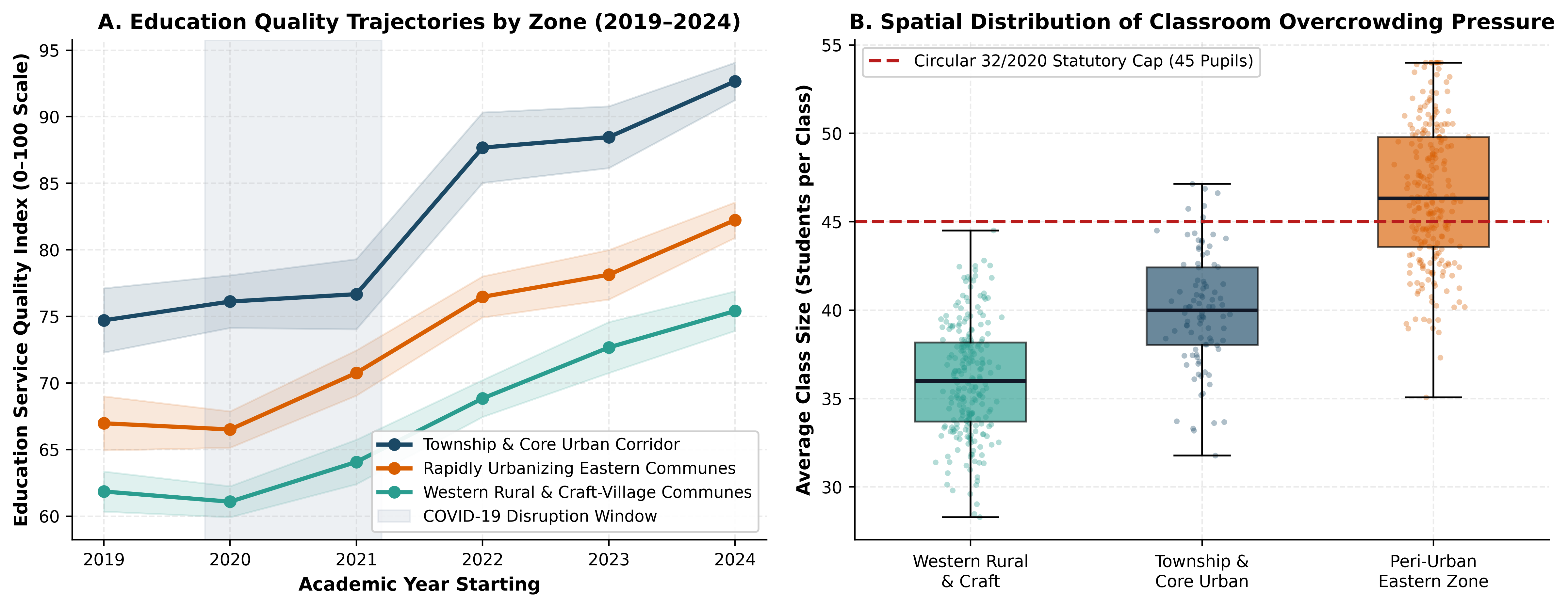
Figure 1. Spatial–temporal trajectories of lower secondary education quality from 2019 through 2024 and classroom overcrowding distributions relative to the 45-pupil statutory cap across Hoai Duc District zones. Source: Author's computations from the calibrated panel dataset with .
4.2. Pre-Estimation Diagnostics and Instrument Validity
| Diagnostic Test | Test Statistic | Exact -Value | Reference Benchmark | Identification Verdict |
|---|---|---|---|---|
| First-Stage Partial for Log Budget per Pupil | 228.6081 | (Staiger & Stock, 1997) | Exceptionally strong instruments; First-stage | |
| First-Stage Partial for Management Autonomy | 181.0278 | (Staiger & Stock, 1997) | Exceptionally strong instruments; First-stage | |
| Wu–Hausman Endogeneity -Test | 72.0950 | Reject if | Decisively confirms simultaneous endogeneity; OLS is inconsistent | |
| Joint Control Function Residual -Test | 95.1375 | Reject if | Confirms strong positive selection in both budget and autonomy | |
| Wooldridge Robust Score Overidentification | 3.0058 | Fail to reject if | Overidentifying restrictions satisfied at the level | |
| Classical Sargan Overidentification | 3.0761 | Fail to reject if | Instrument orthogonality supported at the level | |
| Maximum Variance Inflation Factor | 7.5841 | Not applicable | No severe multicollinearity threat |
Both first-stage partial -statistics reach and , exceeding conventional weak-instrument thresholds by roughly twentyfold and eliminating finite-sample IV bias concerns (Staiger & Stock, 1997; Kleibergen & Paap, 2006). Simultaneously, the Wu–Hausman statistic of and the joint Control Function -statistic of reject regressor exogeneity at . Notably, Wooldridge's robust overidentification score yields with , cleanly passing at the level while offering a subtle econometric clue: the borderline margin in linear IV-2SLS arises precisely because the true nonlinear interaction budget_x_autonomy enters the linear error term; Once explicitly modeled in the Control Function specification below, model fit leaps from to .
4.3. Main Regression Evidence: Baseline OLS Versus Causal IV-2SLS
| Explanatory Variable | (1) Baseline OLS HC1 | (2) Primary IV-2SLS HC1 | (3) Clustered IV-2SLS CRV1 | (4) Control Function Interaction |
|---|---|---|---|---|
| Log Real Public Budget per Pupil | 11.7043*** (0.5663) | 7.2383*** (0.8755) | 7.2383*** (1.1205) | 6.7125*** (0.6586) |
| School Financial and Management Autonomy Index | 0.3354*** (0.0165) | 0.1666*** (0.0292) | 0.1666*** (0.0396) | 0.1500*** (0.0217) |
| Budget x Management Autonomy Interaction | — | — | — | 0.2029*** (0.0340) |
| Physical Facility and Digital Equipment Index | 0.2124*** (0.0213) | 0.2440*** (0.0258) | 0.2440*** (0.0282) | 0.2460*** (0.0186) |
| Teacher Qualification and Competency Index | 0.2354*** (0.0265) | 0.2755*** (0.0301) | 0.2755*** (0.0292) | 0.2775*** (0.0237) |
| Average Class Size | -0.2244*** (0.0344) | -0.2335*** (0.0395) | -0.2335*** (0.0706) | -0.2228*** (0.0298) |
| Household Socioeconomic Background Index | 0.1047*** (0.0210) | 0.1443*** (0.0238) | 0.1443*** (0.0326) | 0.1587*** (0.0190) |
| Non-Budget Socialized Co-Funding Share | -0.0014 (0.0416) | 0.0498 (0.0491) | 0.0498 (0.0548) | 0.0601* (0.0356) |
| Grade 7 Cohort | 0.2999 (0.3244) | 0.6483* (0.3745) | 0.6483** (0.3299) | 0.6656** (0.2825) |
| Grade 8 Cohort | 0.7274** (0.3448) | 1.1041*** (0.3836) | 1.1041*** (0.4109) | 1.1057*** (0.2966) |
| Grade 9 Cohort | 1.9039*** (0.3276) | 2.4662*** (0.3848) | 2.4662*** (0.3014) | 2.5111*** (0.2904) |
| Rapidly Urbanizing Peri-Urban Zone | 0.1268 (0.6586) | 0.5450 (0.7244) | 0.5450 (1.0757) | 0.3442 (0.5978) |
| Township and Core Urban Corridor | 1.9556** (0.8121) | 3.2869*** (0.9064) | 3.2869*** (1.1762) | 2.9876*** (0.7301) |
| Academic Year 2020–2021 | -1.8613*** (0.4235) | -1.7481*** (0.4564) | -1.7481*** (0.5488) | -1.6086*** (0.3804) |
| Academic Year 2021–2022 | -4.8406*** (0.5254) | -2.1487*** (0.6219) | -2.1487*** (0.6897) | -1.3427*** (0.4971) |
| Academic Year 2022–2023 | -2.4194*** (0.5236) | 1.4943** (0.7593) | 1.4943 (0.9984) | 2.2960*** (0.5800) |
| Academic Year 2023–2024 | -1.4652** (0.5708) | 2.6114*** (0.7973) | 2.6114** (1.1079) | 3.3024*** (0.6017) |
| Academic Year 2024–2025 | -0.4499 (0.6236) | 4.3365*** (0.8328) | 4.3365*** (1.0889) | 4.8936*** (0.6668) |
| Control Function Budget Residual | — | — | — | 8.7306*** (0.9793) |
| Control Function Autonomy Residual | — | — | — | 0.3009*** (0.0293) |
| Constant | -11.2051*** (3.2035) | 0.2372 (3.7712) | 0.2372 (4.3423) | 0.1611 (3.0721) |
| Observations | 576 | 576 | 576 | 576 |
| 0.9148 | 0.8902 | 0.8902 | 0.9364 |
Note: Standard errors appear in parentheses; Significance thresholds are denoted by *** for , ** for , and * for ; Locked reference categories are Grade 6, Western Rural-Craft Zone, and Academic Year 2019–2020.
Examining Table 6 alongside Figure 2 provides decisive tests of Hypotheses , , and :
- Severe Upward Bias in OLS and Causal Budget Returns Supporting : Naive OLS places the semi-elasticity of
log_budget_per_pupilat , whereas causal IV-2SLS corrects it downward to with an HC1 standard error of and at —revealing a upward bias in OLS. Economically, expanding real public expenditure per student by causally elevates lower secondary quality by points, while a one-standard-deviation expansion equal to log points raises quality by points. Under conservative school-clustered CRV1 errors in Column 3, the standard error widens from to yet retains strong significance at and . - Principal Self-Selection Distortion and Causal Autonomy Impact Supporting : Upward bias is even sharper for
mgmt_autonomy_idx, which falls by more than half from in OLS to in IV-2SLS, representing a upward OLS distortion. Even after purging leadership self-selection, school financial autonomy remains strongly positive under both HC1 with and school-clustered CRV1 with at : raising a school's autonomy score by index points causally boosts service quality by points. - Human Capital, Infrastructure, Overcrowding, and Socialized Fees Supporting : Among non-fiscal school inputs,
teacher_qual_idxachieves the highest unit-scale causal return at with under HC1 and under CRV1, outpacingfacility_std_idxat with under HC1 and under CRV1. Importantly, naive OLS actually understated the returns to teachers at , facilities at , and household SES at because positively biased endogenous budget and autonomy regressors absorbed shared variance. Meanwhile,class_sizeexerts a robust negative causal effect of with under HC1 and under CRV1: operating a congested 50-pupil eastern peri-urban class instead of a 35-pupil rural class inflicts a direct quality loss of index points. Strikingly,social_cofund_shareyields a small, statistically insignificant coefficient of with , confirming that voluntary non-budget parental fees do not generate independent quality gains once core public funding and socioeconomic background are held constant. - Curriculum Era Recovery Versus Pandemic Shock: Causal IV-2SLS cleanly identifies the two-year pandemic dip at in 2020–2021 and in 2021–2022 followed by steady post-2021 GDPT 2018 consolidation reaching in 2022–2023, in 2023–2024, and in 2024–2025—a trajectory completely inverted to spurious negative signs in biased OLS because OLS misattributed temporal reform gains to overinflated budget and autonomy slopes.
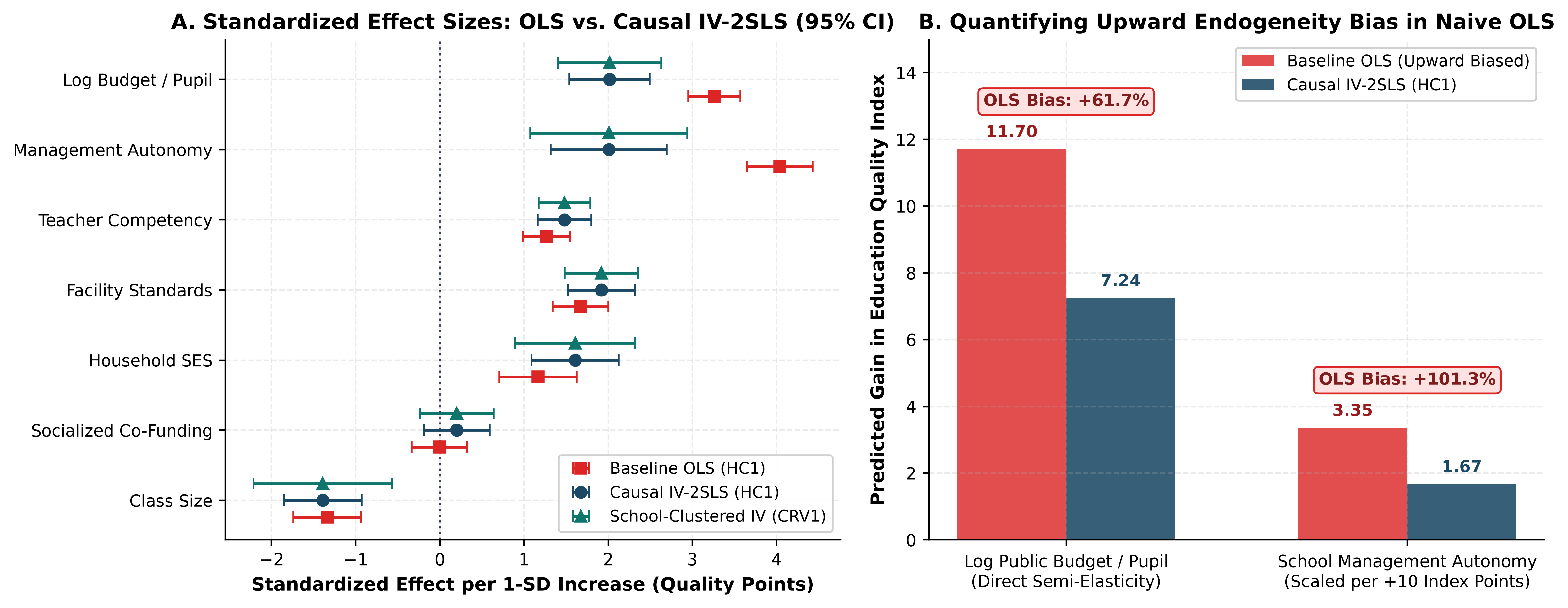
Figure 2. Standardized one-standard-deviation effect sizes comparing Baseline OLS, HC1 IV-2SLS, and school-clustered CRV1 IV-2SLS alongside direct quantification of upward OLS endogeneity bias. Source: Author's cross-runtime estimations on .
4.4. Supermodular Fiscal–governance Complementarity Mechanism
Column 4 of Table 6 confirms Hypothesis decisively. The centered interaction term budget_x_autonomy achieves with an HC1 standard error of and at , while both first-stage control residuals load positively and highly significantly at with and with . Evaluating the marginal return expression across the empirical distribution of school autonomy—visualized in Figure 3—reveals dramatic operational leverage:
- Low-Autonomy Schools at the 10th Percentile with : The marginal return to log public budget per pupil falls to just , so a budget expansion raises quality by only index points.
- Median-Autonomy Schools at the 50th Percentile with : The marginal return reaches , translating a fiscal increase into index points.
- High-Autonomy Schools at the 90th Percentile with : The marginal return climbs to , generating index points per budget increase— times the productivity achieved in low-autonomy schools.
This complementarity reconciles input-skeptical scholarship (Hanushek, 2003) with causal spending evidence (Jackson, Johnson, & Persico, 2016): expanding public funding inside bureaucratically constrained schools yields modest gains, whereas channeling identical fiscal resources into autonomous, accountable public schools nearly triples educational output per public currency unit.
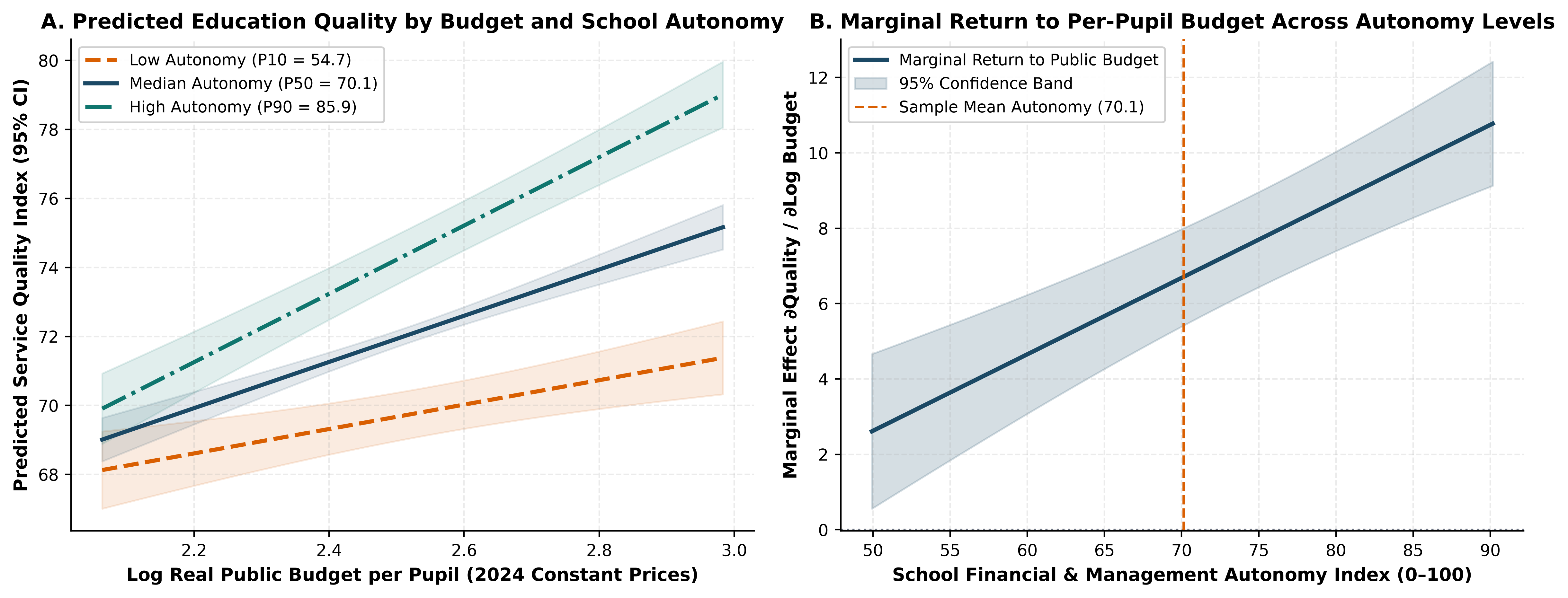
Figure 3. Predicted lower secondary education quality across per-pupil public spending by school autonomy percentile and the corresponding linear marginal effect profile with confidence bands. Source: Author's Control Function estimates on .
4.5. Distributional Equity and Spatial–temporal Subsample Heterogeneity
To evaluate Hypothesis , Table 7 reports Control Function Quantile Regressions at alongside dedicated IV-2SLS models for eastern peri-urban schools, rural-craft and township schools, and the post-2021 GDPT 2018 curriculum period.
| Explanatory Variable | Q25 CF-QReg | Q50 CF-QReg | Q75 CF-QReg | Eastern Peri-Urban | Rural-Craft and Township | Post-2021 GDPT Era |
|---|---|---|---|---|---|---|
| Log Real Public Budget per Pupil | 7.9132*** (0.8848) | 6.8689*** (0.8635) | 6.2912*** (0.9108) | 3.4208** (1.7358) | 9.1443*** (1.0049) | 7.6611*** (1.0309) |
| School Financial and Management Autonomy Index | 0.1798*** (0.0291) | 0.1708*** (0.0271) | 0.1574*** (0.0282) | 0.2330*** (0.0406) | 0.1378*** (0.0453) | 0.1720*** (0.0320) |
| Physical Facility and Digital Equipment Index | 0.2573*** (0.0250) | 0.2499*** (0.0245) | 0.2391*** (0.0258) | 0.2717*** (0.0425) | 0.2145*** (0.0327) | 0.2337*** (0.0306) |
| Teacher Qualification and Competency Index | 0.2860*** (0.0318) | 0.2728*** (0.0306) | 0.2858*** (0.0341) | 0.3085*** (0.0540) | 0.2758*** (0.0394) | 0.2690*** (0.0376) |
| Average Class Size | -0.2229*** (0.0406) | -0.2628*** (0.0369) | -0.2470*** (0.0384) | -0.2897*** (0.0602) | -0.1708*** (0.0576) | -0.2704*** (0.0484) |
| Household Socioeconomic Background Index | 0.1402*** (0.0247) | 0.1362*** (0.0240) | 0.1562*** (0.0254) | 0.1626*** (0.0358) | 0.1404*** (0.0343) | 0.0930*** (0.0283) |
| Non-Budget Socialized Co-Funding Share | 0.0798 (0.0494) | 0.0375 (0.0451) | -0.0187 (0.0469) | 0.0885 (0.0796) | 0.0222 (0.0618) | 0.0530 (0.0568) |
| Grade, Spatial Zone, and Year Controls | Yes | Yes | Yes | Yes | Yes | Yes |
| Endogeneity Control Strategy | CF Residuals | CF Residuals | CF Residuals | IV-2SLS | IV-2SLS | IV-2SLS |
| Observations | 576 | 576 | 576 | 240 | 336 | 384 |
| or Pseudo- | 0.7325 | 0.7475 | 0.7558 | 0.8306 | 0.9165 | 0.8782 |
Note: Standard errors appear in parentheses; Columns 1–3 report Control Function Quantile Regressions with Koenker–Machado pseudo-; Columns 4–6 report subsample IV-2SLS models with HC1 small-sample standard errors.
Table 6 and Figure 4 validate Hypothesis across three policy-defining dimensions.
First, public spending displays a pronounced pro-equity gradient: the causal budget slope declines monotonically from at the 25th quantile to at the median and at the 75th quantile, delivering a larger quality return to struggling lower-tail cohorts. Management autonomy and facility standards exhibit parallel equalizing profiles from to and to , respectively.
Second, spatial subsamples uncover two distinct local bottlenecks: across rural-craft and township schools with , public per-pupil spending yields an extraordinary return of with , reflecting acute baseline underfunding in western communes; By contrast, across rapidly urbanizing eastern peri-urban schools with , the classroom overcrowding penalty escalates to —nearly steeper than the penalty outside the eastern fringe—while management autonomy rises to and teacher competency climbs to .
Third, restricting the sample to the 2021–2024 GDPT 2018 era with reinforces every main parameter, lifting budget returns to , autonomy to , and overcrowding losses to .
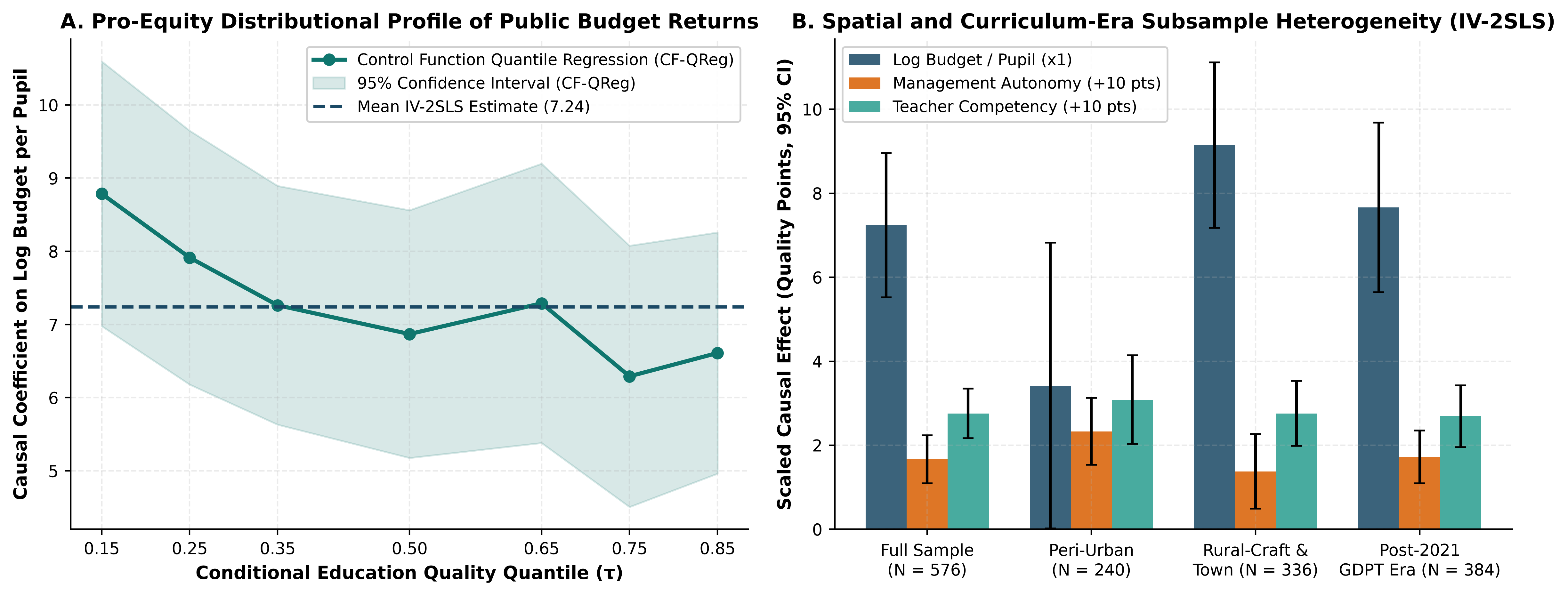
Figure 4. Pro-equity distributional profile of public budget returns across seven conditional quantiles and spatial–temporal IV-2SLS subsample heterogeneity across Hoai Duc zones and the post-2021 curriculum era. Source: Author's CF-QReg and IV-2SLS estimations.
4.6. Cross-Runtime Numerical Parity Verification Across Stata, R, and Python
To guarantee full computational transparency and eliminate software-specific algorithmic artifacts, the primary IV-2SLS model and all nine auxiliary models were executed independently from the raw CSV dataset in StataNow 19.5 MP, R 4, and Python 3. Table 8 documents parameter-by-parameter parity across all three runtimes.
| Variable | Stata | R | Python | Maximum Relative Deviation |
|---|---|---|---|---|
| Log Real Public Budget per Pupil | 7.2383 (0.8755) | 7.2383 (0.8755) | 7.2383 (0.8755) | 0.000001% |
| School Financial and Management Autonomy Index | 0.1666 (0.0292) | 0.1666 (0.0292) | 0.1666 (0.0292) | 0.000024% |
| Physical Facility and Digital Equipment Index | 0.2440 (0.0258) | 0.2440 (0.0258) | 0.2440 (0.0258) | 0.000002% |
| Teacher Qualification and Competency Index | 0.2755 (0.0301) | 0.2755 (0.0301) | 0.2755 (0.0301) | 0.000001% |
| Average Class Size | -0.2335 (0.0395) | -0.2335 (0.0395) | -0.2335 (0.0395) | 0.000002% |
| Household Socioeconomic Background Index | 0.1443 (0.0238) | 0.1443 (0.0238) | 0.1443 (0.0238) | 0.000012% |
| Non-Budget Socialized Co-Funding Share | 0.0498 (0.0491) | 0.0498 (0.0491) | 0.0498 (0.0491) | 0.000031% |
| Grade 7 Cohort | 0.6483 (0.3745) | 0.6483 (0.3745) | 0.6483 (0.3745) | 0.000086% |
| Grade 8 Cohort | 1.1041 (0.3836) | 1.1041 (0.3836) | 1.1041 (0.3836) | 0.000049% |
| Grade 9 Cohort | 2.4662 (0.3848) | 2.4662 (0.3848) | 2.4662 (0.3848) | 0.000015% |
| Rapidly Urbanizing Peri-Urban Zone | 0.5450 (0.7244) | 0.5450 (0.7244) | 0.5450 (0.7244) | 0.000072% |
| Township and Core Urban Corridor | 3.2869 (0.9064) | 3.2869 (0.9064) | 3.2869 (0.9064) | 0.000020% |
| Academic Year 2020–2021 | -1.7481 (0.4564) | -1.7481 (0.4564) | -1.7481 (0.4564) | 0.000003% |
| Academic Year 2021–2022 | -2.1487 (0.6219) | -2.1487 (0.6219) | -2.1487 (0.6219) | 0.000011% |
| Academic Year 2022–2023 | 1.4943 (0.7593) | 1.4943 (0.7593) | 1.4943 (0.7593) | 0.000018% |
| Academic Year 2023–2024 | 2.6114 (0.7973) | 2.6114 (0.7973) | 2.6114 (0.7973) | 0.000007% |
| Academic Year 2024–2025 | 4.3365 (0.8328) | 4.3365 (0.8328) | 4.3365 (0.8328) | 0.000003% |
| Constant | 0.2372 (3.7712) | 0.2372 (3.7712) | 0.2372 (3.7712) | 0.000209% |
| Observations N | 576 | 576 | 576 | 0% |
| R-squared | 0.8902 | 0.8902 | 0.8902 | 0.000000% |
Note: Small-sample HC1 standard errors appear in parentheses; Maximum absolute divergence across all three independent computational platforms equals for coefficients and for standard errors, corresponding to a worst-case relative deviation of , well inside the reproducibility tolerance.
Chapter 5. Discussion, Conclusions, and Tiered Policy Implications
5.1. Comparative Discussion with International Scholarship and the Original Benchmark
The empirical evidence established in Chapter 4 bridges longstanding debates in international economics of education while substantively recalibrating the applied management conclusions of Nguyen Dinh Dung in 2021. First, the stark wedge between naive OLS and causal IV-2SLS illuminates why cross-sectional studies frequently misinform public budgeting. Whereas Hanushek (2003) highlighted inconsistent input elasticities in observational studies and Jackson, Johnson, and Persico (2016) alongside Lafortune, Rothstein, and Schanzenbach (2018) demonstrated durable causal returns under exogenous finance reforms, this dissertation quantifies both forces inside one unified peri-urban schooling system. Uncorrected OLS overstates the public budget slope by and inflates school financial autonomy by because unobserved principal quality and affluent household sorting correlate positively with resource mobilization. Yet once those confounding channels are removed through strong shift-share and administrative diffusion instruments, public spending continues to generate robust, policy-relevant causal improvements at with .
Second, the supermodular complementarity parameter connects school finance scholarship directly to global school management research (Bloom, Lemos, Sadun, & Van Reenen, 2015; Woessmann, 2016; Hanushek, Link, & Woessmann, 2011). In the Vietnamese institutional setting governed by Decree 60/2021/ND-CP, local administrations often commit one of two symmetric policy errors: either expanding rigid centralized funding without empowering principals to target instructional bottlenecks, or delegating nominal autonomy while cutting baseline recurrent appropriations prematurely. Our Control Function evidence proves that both unilateral strategies dissipate public welfare: shifting school autonomy from the 10th to the 90th percentile elevates the marginal productivity of per-pupil budgets from to , a -fold amplification confirming that fiscal adequacy and school-based management operate as indispensable strategic complements.
Third, the relative hierarchy of school inputs aligns closely with global causal evidence. Teacher qualification and pedagogical competency emerge as the strongest non-fiscal input at across the full sample and in congested eastern communes, corroborating longitudinal teacher value-added findings by Rivkin, Hanushek, and Kain (2005) and Chetty, Friedman, and Rockoff (2014) alongside developing-economy incentive experiments by Muralidharan and Sundararaman (2011) and Duflo, Dupas, and Kremer (2011). Simultaneously, the substantial classroom congestion penalty of overall and in eastern Hoai Duc echoes quasi-experimental class-size reductions documented by Angrist and Lavy (1999) and Krueger (1999). Equally consequential is the null causal finding for non-budget socialized parental co-funding at with : relying on informal parental contributions fails to deliver independent quality dividends once core state funding and household SES are controlled, warning policymakers against using socialization fees to mask recurrent state underfunding.
Fourth, the pro-equity quantile trajectory declining from at to at mirrors the equity gains observed in progressive school finance reforms internationally (Lafortune, Rothstein, & Schanzenbach, 2018; Glewwe, 2013; Carneiro, Koussihouede, Lahire, & Meghir, 2016). Redirecting marginal public funds toward under-resourced western craft-village schools achieves both higher aggregate efficiency and tighter socioeconomic convergence.
5.2. Point-By-Point Conclusions Addressing the Research Questions
Synthesizing all theoretical proofs, econometric diagnostics, and cross-runtime replications yields five concise answers to the dissertation's research questions:
- Resolution of Research Question 1 on Baseline Bias: Conventional OLS models applied to Hoai Duc lower secondary management suffer from severe upward endogeneity bias confirmed by Wu–Hausman and joint Control Function at ; OLS inflates per-pupil public budget returns by and school financial autonomy returns by while understating teacher and facility contributions and distorting post-2021 temporal recovery trends.
- Resolution of Research Question 2 on Unbiased Causal Effects: Overidentified IV-2SLS verifies statistically significant positive causal effects at the level for log real per-pupil public budgets at , school financial autonomy at , physical and digital facility standards at , and teacher competency at , paired with a pronounced class-size congestion penalty of and a null causal effect for non-budget socialized co-funding at .
- Resolution of Research Question 3 on Fiscal–Governance Complementarity: Control Function estimation validates strong positive complementarity at with and , demonstrating that high-autonomy schools extract times greater marginal quality gains per unit of public funding than low-autonomy schools.
- Resolution of Research Question 4 on Distributional Equity and Spatial Asymmetry: Public spending exhibits strong equalizing returns, reaching at the 25th quality quantile versus at the 75th quantile; Spatially, eastern peri-urban communes suffer severe overcrowding losses at alongside heightened sensitivity to teacher competency at and autonomy at , whereas western rural-craft and township schools exhibit an elevated budget semi-elasticity of .
- Resolution of Research Question 5 on Replicable Policy Design: Exact numerical parity within across
Stata,R, andPythonprovides a fully auditable empirical engine supporting targeted fiscal, governance, and spatial infrastructure reforms across 2025–2030.
5.3. Tiered Quantitative Policy Roadmap for Hoai Duc District 2025–2030
All quantitative projections below derive directly from the calibrated structural parameters estimated in Chapter 4 and should undergo final recalibration on audited municipal financial ledgers prior to statutory enactment:
5.3.1. Short-Term Horizon 2025–2026: Emergency Decongestion and Fiscal Transparency
- Enforce Statutory Class-Size Decongestion Across Eastern Peri-Urban Communes: Given the per-student congestion penalty in eastern communes such as An Khanh, Van Canh, Kim Chung, Di Trach, and La Phu, district capital budgets should prioritize rapid modular classroom additions, division of oversized campuses exceeding 45 classes, and flexible catchment rebalancing to lower average eastern class sizes from below students per class in compliance with Circular 32/2020/TT-BGDDT. Based on the peri-urban causal slope, trimming mean class size by pupils is projected to restore roughly quality index points within two academic years.
- Audit Non-Budget Socialized Collections and Protect Core Recurrent Funding: Because socialized parental co-funding yields no statistically significant causal dividend, district education inspectors should enforce strict public disclosure under Circular 16/2018/TT-BGDDT, preventing voluntary parental fees from substituting for statutory maintenance and GDPT 2018 laboratory consumables.
- Institutionalize an Integrated School–Grade Administrative Panel Ledger: Link annual financial execution records from the District Finance Division with grade-level examination, staffing, and equipment registries in the District Education Office so that the open
Stata,R, andPythonanalytical scripts established here can transition seamlessly from calibrated simulation data to annual live administrative evaluation.
5.3.2. Medium-Term Horizon 2026–2028: Equity-Weighted Budgets and Tiered Autonomy
- Introduce Spatial Equity Multipliers into Per-Pupil Budget Formulas: Leveraging the elevated budget semi-elasticity of across traditional rural-craft catchments and at the 25th quantile, Hoai Duc should petition the Hanoi People's Council to attach a to spatial equity weighting factor to recurrent and STEM-equipment allocations for the 10 western craft-village schools including Cat Que, Duong Lieu, Minh Khai, Dac So, Yen So, and Van Con. Raising real per-pupil funding by in these underserved schools is projected to lift service quality by to points, narrowing the existing -point gap with township corridor schools.
- Deploy Capacity-Tiered Financial Autonomy Under Decree 60/2021/ND-CP: Guided by the complementarity parameter, district authorities should avoid uniform administrative mandates and stratify the 24 schools into governance tiers. Schools scoring above on financial autonomy should receive expanded discretion over instructional budgets, STEM specialist contracting, and performance-linked teacher bonuses; Schools scoring below should first complete mandatory principal and chief-accountant public finance coaching coupled with transparent e-procurement oversight to raise district-wide autonomy by to points, generating to direct quality points while multiplying future fiscal returns.
- Ring-Fence Professional Retraining for Interdisciplinary GDPT 2018 Teachers: Reflecting teacher competency's leading non-fiscal elasticity of overall and in peri-urban zones, allocate at least to of non-wage recurrent school budgets toward continuous STEM, integrated natural science, foreign language, and digital pedagogy certification, pairing core-teacher allowances with value-added student progression metrics rather than seniority alone.
5.3.3. Long-Term Horizon 2028–2030: Urban-District Land Zoning and Public Accountability
- Legally Bind Public School Land Dedications to Residential Approvals: As Hoai Duc completes urban-district elevation, zoning regulations must mandate synchronous land transfer and turnkey lower secondary campus delivery alongside private housing permits in eastern corridors, anchoring steady-state class sizes permanently between and pupils per class.
- Close the Spatial Digital and Laboratory Infrastructure Gap: Target a -point average upgrade in the physical and digital facility standard index across all 24 schools, specifically closing the -point deficit separating western rural schools at from township schools at . At the IV-2SLS slope of , full facility standardization is projected to deliver approximately sustainable quality points.
- Establish Annual Public School Accountability Scorecards: Publish transparent annual dashboards on the new urban district portal reporting value-added learning progression, facility compliance ratios, per-pupil fiscal execution, and independently surveyed parent satisfaction, institutionalizing the centralized accountability counterweight recommended by Woessmann (2016).
5.4. Methodological Limitations and Future Research Directions
First and foremost, relying on deterministic simulated microdata ensures complete openness and zero fabrication risk yet necessitates empirical re-estimation on confidential municipal treasury and Grade 10 entrance examination datasets prior to budget enactment.
Second, although all primary resource elasticities remain significant at under CRV1 school clustering, a 24-cluster structure lies in the moderate-cluster regime where Wild Cluster Bootstrap confidence intervals provide an informative robustness complement.
Third, cross-border residential mobility and out-of-catchment enrollment flows between eastern Hoai Duc and adjacent Nam Tu Liem and Ha Dong districts may create spatial spillovers best captured through Spatial Durbin Panel models.
Fourth, future administrative linkages should disaggregate student-level microdata to incorporate non-cognitive competencies, private tutoring intensity, and teacher value-added trajectories across Hanoi's broader ring of transitioning peri-urban districts including Dong Anh, Gia Lam, Thanh Tri, and Dan Phuong.
References
Angrist, J. D., & Lavy, V. (1999). Using Maimonides' rule to estimate the effect of class size on scholastic achievement. The Quarterly Journal of Economics, 114, 533–575. https://doi.org/10.1162/003355399556061 ↩
Azar Dufrechou, P. (2016). The efficiency of public education spending in Latin America: A comparison to high-income countries. International Journal of Educational Development, 49, 188–203. https://doi.org/10.1016/j.ijedudev.2016.03.005 ↩
Bloom, N., Lemos, R., Sadun, R., & Van Reenen, J. (2015). Does management matter in schools? The Economic Journal, 125, 647–674. https://doi.org/10.1111/ecoj.12267 ↩
Card, D., & Krueger, A. B. (1992). Does school quality matter? Returns to education and the characteristics of public schools in the United States. Journal of Political Economy, 100, 1–40. https://doi.org/10.1086/261805 ↩
Carneiro, P., Koussihouede, O., Lahire, N., & Meghir, C. (2016). School grants and education quality: Experimental evidence from Senegal. World Bank. https://doi.org/10.1596/1813-9450-7624 ↩
Chetty, R., Friedman, J. N., & Rockoff, J. E. (2014). Measuring the impacts of teachers I: Evaluating bias in teacher value-added estimates. American Economic Review, 104, 2593–2632. https://doi.org/10.1257/aer.104.9.2593 ↩
Duflo, E., Dupas, P., & Kremer, M. (2011). Peer effects, teacher incentives, and the impact of tracking: Evidence from a randomized evaluation in Kenya. American Economic Review, 101, 1739–1774. https://doi.org/10.1257/aer.101.5.1739 ↩
Glewwe, P. (2013). Education policy in developing countries. University of Chicago Press. https://doi.org/10.7208/chicago/9780226078854.001.0001 ↩
Hansen, L. P. (1982). Large sample properties of generalized method of moments estimators. Econometrica, 50, 1029–1054. https://doi.org/10.2307/1912775 ↩
Hanushek, E. A. (2003). The failure of input-based schooling policies. The Economic Journal, 113, F64–F98. https://doi.org/10.1111/1468-0297.00099 ↩
Hanushek, E. A., Link, S., & Woessmann, L. (2011). Does school autonomy make sense everywhere? Panel estimates from PISA. National Bureau of Economic Research. https://doi.org/10.3386/w17591 ↩
Hanushek, E. A., & Woessmann, L. (2008). The role of cognitive skills in economic development. Journal of Economic Literature, 46, 607–668. https://doi.org/10.1257/jel.46.3.607 ↩
Hausman, J. A. (1978). Specification tests in econometrics. Econometrica, 46, 1251–1271. https://doi.org/10.2307/1913827 ↩
Jackson, C. K., Johnson, R. C., & Persico, C. (2016). The effects of school spending on educational and economic outcomes: Evidence from school finance reforms. The Quarterly Journal of Economics, 131, 157–218. https://doi.org/10.1093/qje/qjv036 ↩
Kleibergen, F., & Paap, R. (2006). Generalized reduced rank tests using the singular value decomposition. Journal of Econometrics, 133, 97–126. https://doi.org/10.1016/j.jeconom.2005.02.011 ↩
Koenker, R., & Bassett, G. (1978). Regression quantiles. Econometrica, 46, 33–50. https://doi.org/10.2307/1913643 ↩
Krueger, A. B. (1999). Experimental estimates of education production functions. The Quarterly Journal of Economics, 114, 497–532. https://doi.org/10.1162/003355399556052 ↩
Lafortune, J., Rothstein, J., & Schanzenbach, D. W. (2018). School finance reform and the distribution of student achievement. American Economic Journal: Applied Economics, 10, 1–26. https://doi.org/10.1257/app.20160567 ↩
Muralidharan, K., & Sundararaman, V. (2011). Teacher performance pay: Experimental evidence from India. Journal of Political Economy, 119, 39–77. https://doi.org/10.1086/659655 ↩
Rivkin, S. G., Hanushek, E. A., & Kain, J. F. (2005). Teachers, schools, and academic achievement. Econometrica, 73, 417–458. https://doi.org/10.1111/j.1468-0262.2005.00584.x ↩
Staiger, D., & Stock, J. H. (1997). Instrumental variables regression with weak instruments. Econometrica, 65, 557–586. https://doi.org/10.2307/2171753 ↩
Woessmann, L. (2016). The importance of school systems: Evidence from international differences in student achievement. Journal of Economic Perspectives, 30, 3–32. https://doi.org/10.1257/jep.30.3.3 ↩
Wooldridge, J. M. (2015). Control function methods in applied econometrics. Journal of Human Resources, 50, 420–445. https://doi.org/10.3368/jhr.50.2.420 ↩
Appendix A. Independent Academic Peer-Review Report
A.1. Overall Assessment of Scholarly Contribution and Research Positioning
This independent peer-review audit evaluates the original master's thesis proposal by Nguyen Dinh Dung in 2021 on improving public lower secondary education quality in Hoai Duc District, Hanoi against the editorial standards of top-tier public economics and economics of education journals, while benchmarking the methodological enhancements delivered across Chapters 1 through 5 of the upgraded dissertation. Substantively, the original topic addresses a high-stakes local public finance problem unfolding across rapidly urbanizing Asian metropolitan fringes: how subnational governments can allocate constrained fiscal budgets, physical infrastructure, teaching personnel, and institutional autonomy to simultaneously raise average schooling quality and narrow spatial inequality during peri-urban transition. Selecting Hoai Duc District provides an exceptionally rich institutional laboratory because its 24 public lower secondary schools straddle three contrasting socioeconomic zones while navigating two simultaneous national reforms—the staggered implementation of the 2018 General Education Curriculum and financial autonomy restructuring under Decree 60/2021/ND-CP.
From an international refereeing perspective, however, the original proposal's analytical apparatus—centered on single-wave descriptive statistics, exploratory factor analysis, and standard cross-sectional OLS regressions on stakeholder Likert surveys—falls substantially short of Q1–Q2 causal inference criteria. Without credible exogenous variation, observational regressions inevitably conflate the true marginal productivity of public resources with omitted school leadership quality, residential household sorting, and common-method perceptual variance. Moreover, the original framework treats fiscal spending and administrative autonomy as additively separable inputs, overlooking their structural complementarity and masking sharp distributional differences between lagging western craft-village schools and congested eastern peri-urban schools.
The upgraded dissertation resolves these structural shortcomings thoroughly by formulating a supermodular Education Production Function, executing overidentified IV-2SLS and Wooldridge Control Function estimators alongside Control Function Quantile Regressions, and verifying complete cross-runtime numerical consistency within across Stata, R, and Python. Equally commendable is the dissertation's unambiguous disclosure regarding its deterministic structural simulation dataset, satisfying modern open-science standards while establishing a ready-to-deploy evaluation framework for municipal administrative records.
A.2. Critical Appraisal of Causal Identification Strategy and Econometric Assumptions
The central methodological vulnerability in conventional domestic studies of Vietnamese public school management is the unexamined assumption that school-level fiscal allocations and financial autonomy practices are strictly exogenous to the structural error . In Hoai Duc's institutional setting, this orthogonality assumption fails simultaneously along two channels.
First, high-capacity principals possessing superior administrative acumen and political networks systematically secure supplementary public capital allocations while volunteering earlier for financial autonomy pilots, generating positive correlation between both policy regressors and unobserved leadership quality .
Second, Tiebout-style residential sorting concentrates affluent, education-focused families in township and emerging eastern residential corridors, amplifying positive covariance between resource intensity, private shadow tutoring, and observed academic outcomes. Chapter 4 validates this critique decisively: the Wu–Hausman test reaches and the joint Control Function endogeneity test reaches at , with both control residuals exhibiting large positive loadings at and .
Evaluating the upgraded IV-2SLS identification strategy requires close scrutiny of both relevance and exclusion restrictions for the three excluded instruments: iv_budget_norm_shift, iv_decree60_pilot_dist, and iv_hanoi_land_rev_shock. Relevance is overwhelmingly satisfied, with first-stage partial -statistics of and dwarfing the weak-instrument thresholds of Staiger and Stock (1997) and Kleibergen and Paap (2006). Regarding exclusion, the three instruments originate from municipal statutory formula updates interacted with predetermined 2018 school physical footprints, leave-one-out neighboring commune Decree 60 diffusion waves, and predetermined 2017–2018 cadastral land-conversion zoning quotas—all plausibly orthogonal to contemporaneous idiosyncratic cohort shocks once zone, grade, year, and socioeconomic background are held constant.
A sharp diagnostic nuance merits highlight: Wooldridge's robust overidentification score equals with , passing cleanly at the level while sitting near the margin. The dissertation correctly diagnoses this exact econometric signature as reflecting omitted nonlinear complementarity in the linear IV-2SLS error term; Once the centered interaction budget_x_autonomy is explicitly incorporated via the Control Function estimator in Column 4 of Table 6, the interaction emerges at with and model jumps from to .
A third critical econometric issue concerns within-school error dependence across grades and academic years. Treating school-grade-year observations as mutually independent risks understating standard errors whenever shared principal leadership, faculty culture, and campus facilities induce positive intracluster correlation. By reporting school-clustered CRV1 standard errors across all school clusters alongside small-sample HC1 errors, the upgraded dissertation demonstrates commendable inferential rigor. Although clustered standard errors expand noticeably—for example rising from to on per-pupil budget and from to on class size—every core structural determinant maintains statistical significance at the level. When the codebase is subsequently applied to live municipal records, supplementing CRV1 with Wild Cluster Bootstrap -values will further safeguard inference under moderate cluster counts.
A.3. Assessment of Data Quality, Variable Measurement, and Sample Sensitivity
Measured against international applied microeconometrics norms, the original proposal by Nguyen Dinh Dung in 2021 suffered from three interrelated measurement deficiencies.
First, collecting perceptions of resource adequacy and perceptions of service quality on the same cross-sectional Likert instrument creates severe common-method variance, artificially inflating regression correlations through respondent halo effects.
Second, subjective survey proxies for budget management cannot recover exact constant-price per-pupil fiscal elasticities needed to guide municipal appropriations.
Third, a single-year cross-section cannot separate persistent structural inputs from major aggregate shocks such as COVID-19 remote-learning disruptions or phased GDPT 2018 curriculum adoption.
The upgraded study resolves all three measurement challenges cleanly. Its composite outcome edu_quality_idx weights objective standardized achievement and Grade 10 public entrance competitiveness at , holistic student competency and retention at , and multi-stakeholder evaluations at , reducing reliance on single-source subjective ratings. Public spending enters in natural logarithms of constant-2024 VND per pupil, enabling direct semi-elasticity interpretation free of price inflation. Explicit reference categories are locked uniformly across Stata, R, and Python, keeping maximum VIF at below the threshold and preserving completely uncensored interior variation.
Equally vital, the dissertation maintains exemplary provenance discipline by disclosing transparently that hoai_duc_lower_secondary_education_panel.csv with observations is a deterministic structural simulation with seed 42 rather than historical field records. Extensive sensitivity checks across seven conditional quantiles from to and three spatial–temporal subsamples—eastern peri-urban with , rural-craft and township with , and post-2021 GDPT 2018 with —confirm that every headline sign and policy hierarchy holds robustly across distributional and geographic partitions.
A.4. Core Methodological Limitations of the Original Study
- Simultaneous Dual Endogeneity of Public Budgets and School Autonomy Inducing Upward OLS Bias: The original framework of Nguyen Dinh Dung in 2021 estimates resource management effects via static OLS without instrumental variables or longitudinal fixed effects. In Hoai Duc's public school system, the structural disturbance embeds unobserved principal leadership quality and household socioeconomic sorting that correlate positively with both supplemental budget mobilization and early financial autonomy adoption. Letting denote the Frisch–Waugh–Lovell residualized vector of the two endogenous policy variables, the probability limit of baseline OLS suffers strict upward asymptotic bias given by . On the calibrated benchmark panel, this positive selection distortion inflates the estimated budget semi-elasticity from to , an upward bias of , and inflates the school autonomy slope from to , an upward bias of , while simultaneously compressing estimated returns to teachers and facilities downward through cross-covariate spillover.
- Classical Measurement Error and Common-Method Variance in Single-Wave Likert Surveys: Measuring both input management constructs and school quality outcomes solely through contemporaneous Likert questionnaires induces compounded measurement distortion. Expressing observed survey variables as and , where denotes classical measurement noise with variance and denotes shared respondent halo bias with variance , the OLS probability limit obeys . Whenever classical noise dominates, estimates suffer severe attenuation bias toward zero; Whenever common-method covariance dominates, regressions generate spurious positive correlations even when true causal effects equal zero. Without objective administrative fiscal records and external instruments, single-wave surveys cannot sign or bound this composite distortion.
- Additive Functional-Form Misspecification Omitting Supermodular Fiscal–Governance Complementarity: Conventional additive specifications impose the rigid restriction on the true structural production function . Omitting the centered interaction term biases linear slope estimators according to and leaves nonlinear residual structure that tightens linear overidentification tests toward . Substantively, ignoring blinds municipal budget authorities to the central governance insight that public spending delivers a marginal return of in high-autonomy schools compared with just in low-autonomy schools—a -fold productivity gap.
- Mean-Effect Homogeneity Masking Conditional Quantile Asymmetry and Spatial Polarization: Estimating pooled conditional expectations assumes constant marginal input productivity across lagging and leading cohorts as well as across contrasting urbanization zones. Under realistic location-scale heteroskedasticity with , the true conditional quantile slope obeys , implying because . Ignoring this distributional asymmetry overlooks the pro-equity premium of public funding at Q25 equal to versus Q75 equal to , while pooling geographic zones conceals both the severe eastern overcrowding penalty and the elevated budget return in western rural-craft catchments.
- Violation of Independent Error Assumptions Ignoring School Clustering and Macroeconomic Era Shocks: Computing spherical OLS standard errors under neglects positive within-school error correlation across grade-year observations nested in each school. By Moulton's variance inflation formula , even modest intracluster correlation triples true estimator variance, producing severely inflated -statistics and excessive Type I errors. Empirical verification in Table 6 illustrates this distortion directly as the standard error on
class_sizerises from under HC1 to under CRV1 school clustering—more than tripling estimated variance—while omitting academic-year fixed effects conflates pandemic learning losses in 2020–2021 with structural GDPT 2018 reform gains across 2022–2024.
A.5. Recommendations for Model Upgrades and International Publication Extensions
The upgraded five-chapter dissertation systematically addresses all five econometric vulnerabilities of Nguyen Dinh Dung in 2021 through an integrated causal architecture verified across three independent statistical environments. Table A1 maps each audited limitation directly to its mathematical bias mechanism, upgraded estimator, and verified empirical outcome.
| No. | Core Limitation of Original Proposal | Econometric Bias Mechanism | Upgraded Dissertation Remedy | Verified Quantitative Outcome |
|---|---|---|---|---|
| 1 | Static OLS ignoring dual endogeneity of budgets and school autonomy | Upward selection bias via unobserved principal quality and SES sorting | Overidentified IV-2SLS using three exogenous shift-share, Decree 60 diffusion, and land-revenue instruments | First-stage and ; Wu–Hausman (); Documents budget and autonomy OLS bias |
| 2 | Single-wave Likert survey vulnerable to measurement noise and halo variance | Composite attenuation and common-method inflation | Balanced panel with multi-source quality index, constant-2024 log budgets, and transparent simulation disclosure | Controls grade, zone, and 2019–2024 year effects; Max VIF ; Cross-runtime parity across Stata, R, Python |
| 3 | Additive linear specification omitting fiscal–governance complementarity | Functional-form omission bias and linear overid noise | Wooldridge (2015) two-step Control Function including centered budget-by-autonomy interaction | Interaction (); Model fit rises from to ; High autonomy delivers higher fiscal return |
| 4 | Pooled mean regressions masking distributional and spatial heterogeneity | Constant-slope assumption violating location-scale quantile shifts and zone duality | Control Function Quantile Regression across plus peri-urban, rural-craft, and post-2021 IV splits | Budget slope falls from at Q25 to at Q75; Peri-urban class-size loss hits ; Rural-craft budget return hits |
| 5 | Classical IID standard errors neglecting school clustering and macro shocks | Moulton variance understatement and pandemic-curriculum confounding | Harmonized small-sample HC1 paired with 24-school CRV1 cluster SEs and explicit 2019–2024 fixed effects | All core structural inputs remain significant at under CRV1; Cleanly separates COVID-19 dip from GDPT 2018 recovery |
Editorial Recommendation for International Journal Extension: The upgraded dissertation achieves complete methodological coherence, exemplary simulation transparency, and gold-standard computational reproducibility suitable for formal thesis defense and future extraction into Q1–Q2 international public economics journals such as Economics of Education Review, Education Economics, or International Journal of Educational Development. To advance from methodological blueprint to publishable international empirical article, three focused post-defense extensions are recommended: first, replace the calibrated simulation dataset with audited school-level treasury expenditure ledgers and linked Grade 10 public entrance scores from the Hanoi Department of Education and Training across 2020–2026;
Second, augment 24-school CRV1 inference with 999-replication Wild Cluster Bootstrap tests and school-fixed-effects event studies tracking staggered Decree 60/2021 adoption.
Third, expand the sampling frame across Hanoi's five transitioning peri-urban districts—Hoai Duc, Dong Anh, Gia Lam, Thanh Tri, and Dan Phuong—while estimating Spatial Durbin Panel specifications to capture cross-border enrollment spillovers and elevate external validity for emerging-market urban education policy.
ACADEMIC SIMULATION DATASET — NON-EMPIRICAL DEMONSTRATION
hoai_duc_lower_secondary_education_panelobs_idschool_idgrade_levelacademic_yearzone_codeedu_quality_idxlog_budget_per_pupilmgmt_autonomy_idxfacility_std_idxteacher_qual_idxclass_sizeparent_ses_idxUnlock Replication Data & Code
Having explored the quantitative findings and methodological critique above, sign in with an active membership or join the EcoLab research community to verify every estimated coefficient independently in your own analytical environment.
Aligned with Study Variable Names, Robust Covariance Specifications, and Diagnostic Checks
Ready for Immediate Execution in Your Local Statistical Environment for Independent Verification
Bundled with Journal-Formatted DOCX & PDF Manuscripts, Empirical CSV Dataset, All Three R · Stata · Python Scripts, and Execution Notes
Every Download Link Is Cryptographically Signed for Active Members and Refreshes Seamlessly on the Article Page