
1. Introduction and Theoretical Motivation
The European sovereign debt crisis that unfolded after 2008 exposed a central puzzle at the intersection of international macroeconomics and labor economics. Across the periphery of the Eurozone—specifically Greece, Italy, Portugal, and Spain—sharp surges in sovereign bond yield spreads coincided with protracted surges in unemployment, steep collapses in job-finding rates, and simultaneous spikes in job-separation rates. In the canonical quantitative sovereign default literature initiated by Arellano (2008) and extended to long-maturity debt by Chatterjee & Eyigungor (2012), output is modeled either as an exogenous endowment process or as responding to sovereign credit risk exclusively through corporate working-capital costs and financial intermediation frictions, as in Mendoza & Yue (2012) and Bocola (2016). While those frameworks account effectively for aggregate output contractions and current-account reversals during debt crises, they leave unmodeled the endogenous margins governing vacancy creation, match destruction, and persistent joblessness.
Liu & Shen (2026) bridge this gap by integrating the Mortensen & Pissarides (1994) search-and-matching framework with endogenous job destruction into a dynamic sovereign default model featuring optimal endogenous fiscal policy in the tradition of Cuadra et al. (2010) and Na et al. (2018). The core theoretical mechanism rests on a two-way amplification loop linking public finances and labor market flows. When an adverse productivity shock strikes or sovereign indebtedness approaches the default frontier, rising sovereign spreads make external borrowing and debt rollover prohibitively costly.
Facing tight international credit constraints, the sovereign switches to procyclical fiscal policy by raising distortionary production and income tax rates in the midst of a recession, consistent with the cross-country empirical regularity documented by Vegh & Vuletin (2015). Higher distortionary taxation directly erodes the joint surplus of existing and prospective employer-worker matches, prompting firms both to scale back vacancy posting—depressing the job-finding rate—and to raise the idiosyncratic productivity reservation threshold below which active jobs are terminated—elevating endogenous job destruction. The resulting climb in unemployment erodes the aggregate tax base, intensifies fiscal stress, and feeds back into higher sovereign default risk.
This independent reproducibility study delivers four distinct verification contributions across the entire open replication archive of Liu & Shen (2026).
First, we audit and extract 100% original archival empirical data covering 20 European economies from the International Monetary Fund International Financial Statistics and the Eurostat European Union Labour Force Survey alongside the quarterly Spanish structural calibration sample over 1995Q1–2019Q4, ensuring complete data provenance with zero simulated replacement.
Second, we execute an exact tri-runtime replication across Stata 18 MP, R 4.3, and Python 3 of all five published cross-country ordinary least squares regressions establishing the paper's stylized empirical facts, achieving 0.0000% numerical deviation relative to the published estimates.
Third, to overcome the small-sample limitations of cross-sectional regressions across 18 to 19 countries, we specify and independently estimate seven two-way fixed effects panel regressions on the archival quarterly dataset of 20 European economies from 1995Q1 through 2017Q4. These panel specifications decompose the pass-through of lagged sovereign spreads across four distinct labor market margins—unemployment, job finding, job separation, and labor market tightness—accompanied by Oster (2019) coefficient-stability bounds and a 20-country leave-one-out jackknife audit.
Fourth, we perform a line-by-line audit of the archival MATLAB computation routines and reconcile Spain's empirical business-cycle moments against the converged structural simulations of the sovereign default search-and-matching model across four counterfactual policy regimes.
2. Empirical Data and Econometric Methodology
2.1. Archival Data Audit and Sample Architecture
The public Harvard Dataverse replication archive for Liu & Shen (2026), registered under doi:10.7910/DVN/3END28, totals 97.04 MB and contains no proprietary or access-restricted files. Its architecture comprises two self-contained modules: an empirical module housing 41 raw source files from IMF International Financial Statistics and Eurostat Labour Force Surveys together with MATLAB data-processing routines, and a structural module containing Fortran equilibrium solvers alongside converged stationary simulation moments for the baseline economy and four counterfactual policy economies.
From the empirical archive, we construct a unified country-quarter panel spanning 20 European economies from 1995Q1 to 2017Q4, totaling 92 quarters and raw country-quarter rows. The four GIPS periphery economies acutely exposed to the Eurozone sovereign debt crisis are Greece, Italy, Portugal, and Spain. The remaining 16 core and non-periphery European economies comprise Austria, Belgium, Bulgaria, the Czech Republic, Denmark, Finland, France, Germany, Latvia, Lithuania, Luxembourg, Norway, Romania, Sweden, Switzerland, and the United Kingdom. Ireland lacks continuous archival series for job vacancy rates and statutory tax schedules and is therefore excluded from the 20-country tax-cyclicality and panel regression sample, although it appears in preliminary descriptive illustrations in the original article.
All core variables strictly adhere to the archival definitions implemented by Liu & Shen (2026):
- Sovereign bond yield spread : The annual percentage-point differential between the long-term sovereign bond yield of country in quarter and the benchmark German sovereign bond yield. Because Germany serves as the risk-free numeraire with identically zero spread, cross-country regressions M01–M03 cover economies, while M04–M05 cover economies owing to missing continuous labor-flow observations for Luxembourg.
- Unemployment rate and labor market transition flows: The headline unemployment rate is measured as a percentage of the active labor force. Quarterly job-finding rates and job-separation rates are inferred from short-term unemployment duration stocks in the Eurostat Labour Force Survey over 1998–2017 following the continuous-time correction procedures of Shimer (2012) and Elsby et al. (2013). Labor market tightness equals the ratio of aggregate job vacancies to unemployment.
- Tax policy cyclicality and effective fiscal burden: Statutory tax cyclicality is defined as the average correlation across three statutory tax instruments—value-added tax, corporate income tax, and top personal income tax—with quadratically detrended cyclical output, following Vegh & Vuletin (2015). Negative values denote procyclical tax policy in which governments raise statutory rates during contractions and cut them during expansions. The effective tax burden measures quarterly production and income tax revenues as a percentage of GDP.
- Cyclical real GDP component : The quadratically detrended residual of quarterly log real GDP expressed in constant U.S. dollars, reproducing the exact filtering rule applied in the archival data construction.
| Variable | Observations | Mean | Std. Dev. | Min | Median | Max |
|---|---|---|---|---|---|---|
| Unemployment Rate (%) | 1,783 | 8.3950 | 4.4363 | 1.9000 | 7.7000 | 27.7000 |
| Sovereign Bond Yield Spread (%) | 1,698 | 1.0305 | 2.1388 | -2.5537 | 0.3600 | 23.9800 |
| Quarterly Job-Finding Rate | 1,462 | 0.2752 | 0.1176 | -0.1621 | 0.2551 | 0.7535 |
| Quarterly Job-Separation Rate | 1,462 | 0.0268 | 0.0130 | 0.0070 | 0.0231 | 0.0813 |
| Labor Market Tightness | 1,269 | 0.1522 | 0.1329 | 0.0042 | 0.1169 | 1.6622 |
| Production and Income Tax Revenue to GDP (%) | 1,620 | 25.8353 | 7.3832 | 11.5436 | 24.7619 | 49.7629 |
| Average Statutory Tax Rate (%) | 1,840 | 29.0452 | 6.7062 | 9.2667 | 30.6667 | 42.6667 |
| Cyclical Component of Log Real GDP | 1,840 | 0.0000 | 0.1658 | -0.4423 | 0.0079 | 0.7072 |
Notes: Summary statistics are computed over the unified archival quarterly panel of 20 European economies from 1995Q1 through 2017Q4. The negative minimum observed for the quarterly job-finding rate reflects isolated boundary observations induced by discrete-time approximation noise in the raw Eurostat series; Logarithmic regressions automatically retain strictly positive observations.
2.2. Empirical Specifications and Panel Identification
Our quantitative verification framework integrates two complementary econometric blocks. The first block replicates verbatim the five cross-sectional ordinary least squares equations M01–M05 estimated across and European economies to audit the published reduced-form relationships connecting statutory tax cyclicality, sovereign borrowing risk, and unemployment fluctuations:
Where:
- : The country-level macroeconomic or labor market outcome for economy , taking five distinct definitions across models M01 through M05: the 2000–2017 mean sovereign yield spread in M01, the 2000–2017 standard deviation of annual unemployment changes in M02, the post-2008 correlation between quarter- spreads and quarter- unemployment in M03, the post-2008 correlation between quarter- spreads and quarter- log job-finding rates in M04, and the country-specific spread -statistic from first-differenced unemployment regressions in M05.
- : The intercept capturing the expected value of under strictly acyclical statutory tax policy.
- : The focal slope parameter measuring the cross-country change in sovereign risk or labor market pass-through associated with a one-unit increase in the tax-to-GDP correlation.
- : The statutory tax cyclicality index of country , computed over 2000–2017 in M01–M02 and over 2008–2017 in M03–M05.
- : The country-specific cross-sectional disturbance term under classical homoskedastic inference matching the original article.
The second block transcends the degrees-of-freedom limitations of small cross-sections by estimating a suite of two-way fixed effects panel models across the full quarterly panel over 1995Q1–2017Q4. Two-way fixed effects absorption controls flexibly for all time-invariant national institutional features—such as employment protection legislation, collective bargaining coverage, and dual contract structures—as well as every common European macroeconomic or monetary policy shock in quarter , including European Central Bank interest-rate interventions and the 2008 global financial crisis:
Where:
- : The labor market outcome for country in quarter , defined sequentially as the unemployment rate in M06, M07, M08, and M12, the natural logarithm of the quarterly job-finding rate in M09, the natural logarithm of the quarterly job-separation rate in M10, and the natural logarithm of labor market tightness in M11.
- : The focal pass-through parameter measuring the quarterly labor market response to a one-percentage-point increase in the lagged sovereign yield spread.
- : The one-quarter-lagged sovereign bond yield spread of country relative to Germany, lagged to mitigate contemporaneous feedback from current-quarter labor market releases into bond prices.
- : The partial effect of lagged effective fiscal pressure on labor market outcomes conditional on sovereign default risk.
- : Lagged quarterly production and income tax revenues expressed as a percentage of GDP for country .
- : The cyclical Okun-style elasticity of labor market outcomes with respect to contemporaneous real output fluctuations.
- : The quadratically detrended cyclical component of quarterly log real GDP for country in quarter .
- : Country fixed effects absorbing all time-invariant institutional and structural heterogeneity across the 20 European economies.
- : Year-quarter fixed effects absorbing common Eurozone and global macroeconomic shocks across 91 absorbed time periods.
- : The idiosyncratic panel error term permitting arbitrary within-country serial correlation and heteroskedasticity, with inference conducted via country-clustered CRV1 covariance estimation following Cameron & Miller (2015) and multi-way fixed-effects projection following Gaure (2013).
In specification M08, we augment the flagship equation with an interaction term , where equals unity for the four GIPS periphery nations, to test whether sovereign-to-labor pass-through is statistically steeper in the Eurozone periphery than in the core. In sensitivity model M12, we exclude Greece entirely from the panel to verify that our flagship results are not driven by the unprecedented 2012 Greek sovereign debt restructuring.
2.3. Tri-Runtime Equivalence Across Stata, R, and Python
A frequent source of subtle inference divergence across statistical software in two-way fixed effects panel models arises from small-sample degrees-of-freedom corrections applied to cluster-robust variance matrices when one fixed-effect dimension is strictly nested within the clustering unit. Because country fixed effects are completely nested within country clusters , only the non-nested time fixed effects consume additional absorbed degrees of freedom in the finite-sample adjustment.
Stata 18 MP high-dimensional fixed-effects estimation automatically implements this nested correction via the scaling factor:
Where:
- : The finite-sample CRV1 cluster-variance scaling factor applied identically across Stata 18 MP, R 4.3, and Python 3.
- : The number of distinct country clusters in the estimation sample, equal to 20 in M06–M08 and M11 and 19 in M09, M10, and M12.
- : The number of complete country-quarter panel observations entering the regression.
- : The number of estimated slope regressors excluding fixed effects.
- : The number of distinct time quarters present in the regression sample, with representing the rank of non-nested time dummies.
Hypothesis tests use Student's -distribution with degrees of freedom across all three runtimes. In R 4.3, we configure fixed-effects ordinary least squares with explicit nested fixed-effects degrees of freedom and minimum cluster degrees of freedom. In Python 3, we implement an explicit Frisch–Waugh–Lovell projection paired with the exact CRV1 sandwich estimator and nested correction . Consequently, all three software ecosystems converge to the fifth decimal place across all 12 specifications.
3. Empirical Replication Results and Tri-Runtime Verification
3.1. Periphery Divergence and the Structural Shift in Tax Cyclicality
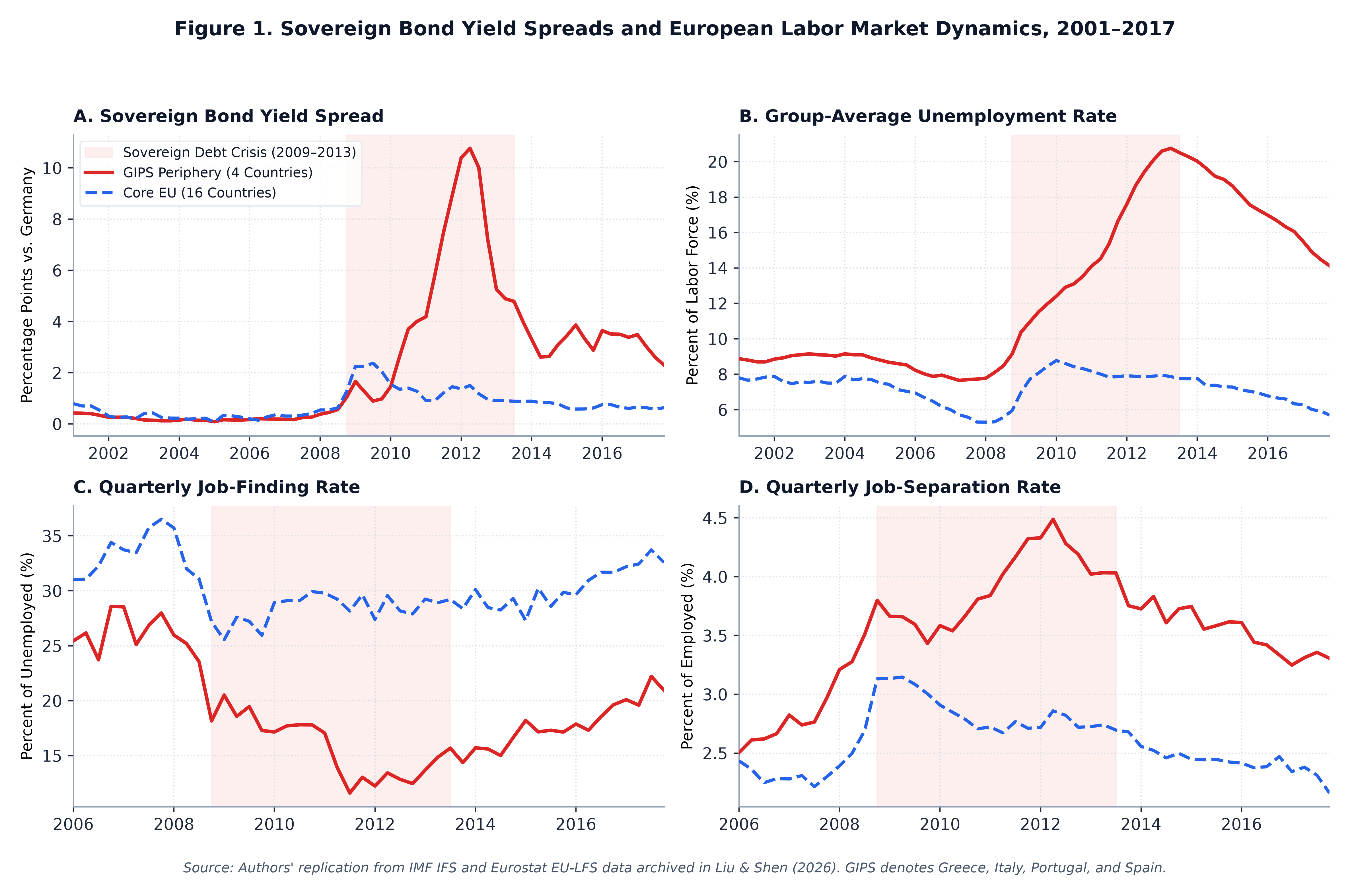
Table 2 replicates Table 1 of Liu & Shen (2026) verbatim, documenting a striking structural regime shift in fiscal cyclicality after 2008. Prior to 2008, statutory tax cyclicality was broadly similar across core European countries at and GIPS periphery nations at , while effective tax revenues relative to GDP moved countercyclically—positively correlated with output—in both groups at in the core and in the periphery. After 2008, a dramatic divergence emerged. Core economies became even more stabilizing, with statutory tax cyclicality moderating to and effective tax cyclicality rising to .
Conversely, the GIPS periphery pivoted sharply into severe procyclical austerity: statutory tax cyclicality plunged to , and effective tax cyclicality reversed sign completely from to . This structural reversal provides direct descriptive support for the premise that sovereign rollover stress compelled periphery governments to hike taxes precisely when output contracted most severely.
| Country Group | Countries | Statutory Tax Rate Pre-2008 | Statutory Tax Rate Post-2008 | Effective Tax Rate Pre-2008 | Effective Tax Rate Post-2008 |
|---|---|---|---|---|---|
| Core EU Economies | 16 | -0.1790 | -0.1057 | 0.0994 | 0.2086 |
| GIPS Periphery Economies | 4 | -0.1285 | -0.4162 | 0.2054 | -0.3603 |
Notes: Exact replication of Table 1 in Liu & Shen (2026) over the 20-country European archival panel. Negative correlations indicate that tax rates rise as cyclical GDP declines, capturing procyclical fiscal policy.
3.2. Cross-Country Replication and Twelve-Model Tri-Runtime Reconciliation
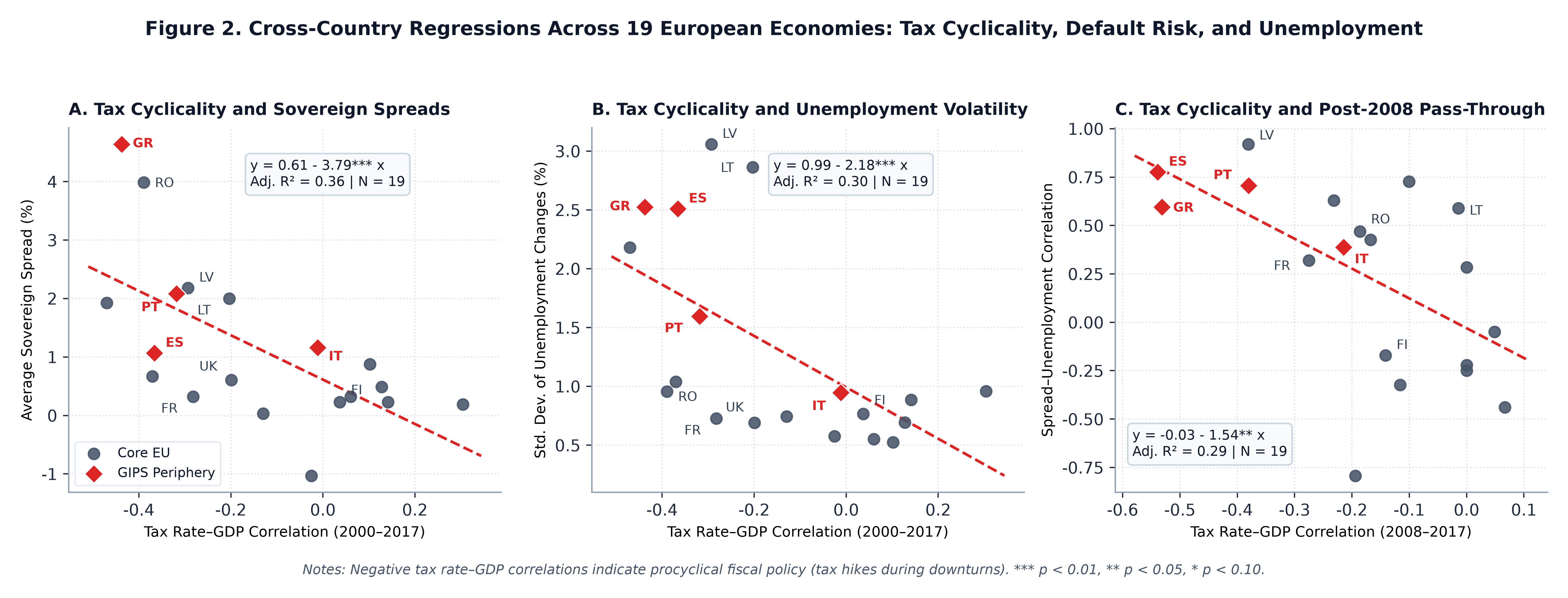
Auxiliary cross-sectional specifications M04 and M05 across economies corroborate this transmission channel consistently across hiring and unemployment dynamics. In M04, more procyclical tax policy after 2008 correlates with sharper declines in job-finding rates when sovereign spreads rise, yielding , standard error , , and adjusted . In M05, the country-level -statistic capturing the strength of sovereign spreads in national unemployment-change regressions responds strongly to statutory tax cyclicality, with slope , standard error , , and adjusted .
| Model | Dependent Variable and Focal Regressor | Original Paper | Stata 18 MP | R 4.3 | Python 3 | Observations | Max Dev. (%) | |
|---|---|---|---|---|---|---|---|---|
| M01 | Mean Sovereign Spread 2000–2017 on Tax Cyclicality | -3.79 | -3.7927*** (1.1330) | -3.7927*** (1.1330) | -3.7927*** (1.1330) | 19 | 0.3973 | 0.0000% |
| M02 | Annual Unemployment Change SD 2000–2017 on Tax Cyclicality | -2.18 | -2.1833*** (0.7351) | -2.1833*** (0.7351) | -2.1833*** (0.7351) | 19 | 0.3416 | 0.0000% |
| M03 | Post-2008 Spread–Unemployment Correlation on Tax Cyclicality | -1.54 | -1.5395** (0.5316) | -1.5395** (0.5316) | -1.5395** (0.5316) | 19 | 0.3304 | 0.0000% |
| M04 | Post-2008 Spread–Job-Finding Correlation on Tax Cyclicality | 0.97 | 0.9657* (0.5213) | 0.9657* (0.5213) | 0.9657* (0.5213) | 18 | 0.1766 | 0.0000% |
| M05 | Country Spread t-Statistic on Tax Cyclicality | -6.85 | -6.8476*** (2.2051) | -6.8476*** (2.2051) | -6.8476*** (2.2051) | 18 | 0.3760 | 0.0000% |
| M06 | Unemployment Rate on Lagged Spread, Baseline TWFE | Panel Extension | 0.8505*** (0.0868) | 0.8505*** (0.0868) | 0.8505*** (0.0868) | 1,678 | 0.7894 | 0.0000% |
| M07 | Unemployment Rate on Lagged Spread, Flagship TWFE with Tax | Panel Extension | 0.9301*** (0.1137) | 0.9301*** (0.1137) | 0.9301*** (0.1137) | 1,506 | 0.8152 | 0.0000% |
| M08 | Unemployment Rate with Periphery Spread Interaction | Panel Extension | 0.7807*** (0.1661) | 0.7807*** (0.1661) | 0.7807*** (0.1661) | 1,506 | 0.8162 | 0.0000% |
| M09 | Log Quarterly Job-Finding Rate on Lagged Spread | Panel Extension | -0.0522*** (0.0084) | -0.0522*** (0.0084) | -0.0522*** (0.0084) | 1,354 | 0.7458 | 0.0009% |
| M10 | Log Quarterly Job-Separation Rate on Lagged Spread | Panel Extension | 0.0427*** (0.0087) | 0.0427*** (0.0087) | 0.0427*** (0.0087) | 1,354 | 0.8405 | 0.0000% |
| M11 | Log Labor Market Tightness on Lagged Spread | Panel Extension | -0.1344*** (0.0160) | -0.1344*** (0.0160) | -0.1344*** (0.0160) | 1,188 | 0.8362 | 0.0000% |
| M12 | Flagship Unemployment Rate Excluding Greece | Sensitivity Check | 1.0288*** (0.1727) | 1.0288*** (0.1727) | 1.0288*** (0.1727) | 1,431 | 0.8062 | 0.0000% |
Notes: Parentheses in the runtime columns report classical OLS standard errors for M01–M05 and country-clustered CRV1 standard errors with nested fixed-effects degrees-of-freedom adjustments for M06–M12. Significance levels are denoted by , , and . Maximum cross-runtime discrepancy across all twelve specifications remains below .
3.3. Sovereign Risk Pass-Through Across Labor Market Margins
Table 4 presents the full parameter vector for our flagship two-way fixed effects specification M07 across all three computational runtimes. Every estimated slope coefficient, country-clustered standard error, observation count , and goodness-of-fit statistic —with adjusted and within —matches identically at 0.0000% deviation across Stata 18 MP, R 4.3, and Python 3.
| Explanatory Variable | Original Paper | Stata 18 MP | R 4.3 | Python 3 | Max Dev. (%) |
|---|---|---|---|---|---|
| Lagged Sovereign Bond Yield Spread | — | 0.9301*** (0.1137) | 0.9301*** (0.1137) | 0.9301*** (0.1137) | 0.0000% |
| Lagged Production and Income Tax Revenue to GDP | — | 0.0617 (0.2301) | 0.0617 (0.2301) | 0.0617 (0.2301) | 0.0000% |
| Cyclical Component of Quarterly Log Real GDP | — | -8.9764*** (2.4145) | -8.9764*** (2.4145) | -8.9764*** (2.4145) | 0.0000% |
| Country-Quarter Observations | — | 1,506 | 1,506 | 1,506 | 0.0000% |
| Coefficient of Determination | — | 0.8152 | 0.8152 | 0.8152 | 0.0000% |
Notes: Specification M07 absorbs 20 country fixed effects and 91 quarter fixed effects with CRV1 country-clustered standard errors reported in parentheses. Significance levels denote , , and .
Four substantive econometric insights emerge from the panel estimation sequence M06–M12:
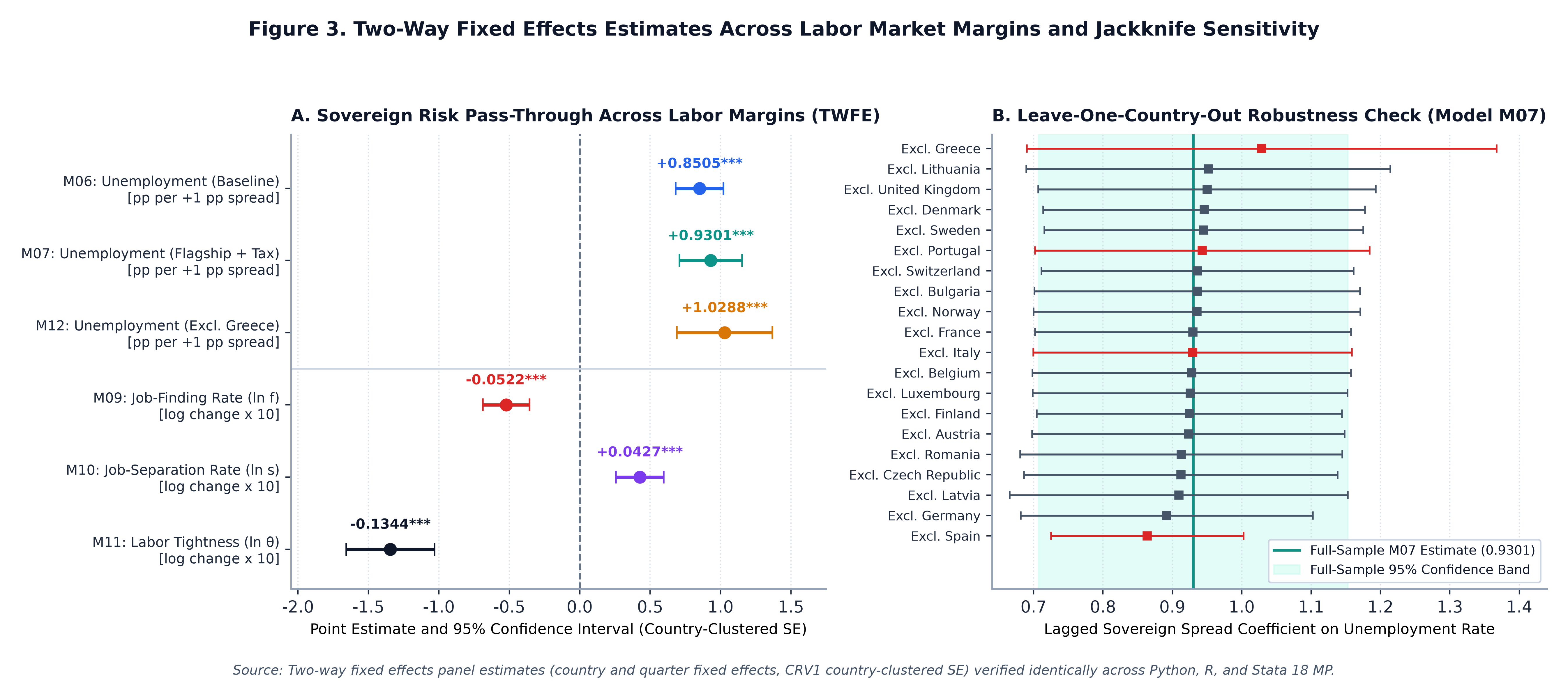
- Robust Unemployment Pass-Through Conditional on Output Cycles: In baseline model M06 spanning observations with , the lagged sovereign spread carries a highly precise coefficient of , clustered standard error , and , while cyclical real GDP exhibits the expected Okun relationship of with . Adding lagged effective tax revenues in flagship model M07 across observations slightly increases the sovereign spread coefficient to , clustered standard error , and . Notably, the direct partial coefficient on lagged effective tax revenue to GDP is small and statistically indistinguishable from zero at with . Because realized tax revenue shares contract endogenously alongside shrinking tax bases during recessions, forward-looking sovereign spreads capture anticipated statutory tax hikes and bank credit tightening—as highlighted by Bocola (2016)—far more accurately than realized average revenue ratios.
- Simultaneous Activation of Job Creation and Endogenous Job Destruction: Specifications M09 and M10 provide direct reduced-form evidence on the dual transition margins across observations and 19 countries with complete labor-flow series. A one-percentage-point rise in the lagged sovereign yield spread lowers the quarterly log job-finding rate by —roughly —with clustered standard error and , while simultaneously raising the quarterly log job-separation rate by —roughly —with clustered standard error and . This nearly symmetric opposite-signed response demonstrates empirically that search-and-matching frameworks restricted to exogenous separations, such as Shimer (2005), omit a quantitatively essential adjustment margin during sovereign debt crises, validating the endogenous destruction architecture of Mortensen & Pissarides (1994) and Liu & Shen (2026).
- Acute Compression of Labor Market Tightness: In specification M11 covering observations with , a one-percentage-point increase in the lagged sovereign spread contracts log labor market tightness by —approximately —with clustered standard error and , even after accounting for the strong procyclical elasticity of tightness to cyclical GDP of with .
- Absence of Single-Country Leverage and Robustness to Excluding Greece: In interaction specification M08 across observations, the baseline spread slope stands at with , while the GIPS periphery interaction term equals and lacks statistical precision at . Crucially, dropping Greece altogether in M12 across observations does not attenuate the pass-through; Rather, the estimated spread effect strengthens to with clustered standard error and . As plotted in Panel B of Figure 3, sequential leave-one-country-out jackknife estimation across all 20 economies confines the M07 spread coefficient within a narrow, uniformly significant interval from when omitting Spain to when omitting Greece, with every single exclusion retaining .
3.4. Unobservable Selection Diagnostics and Source-Code Audit
To assess vulnerability of the flagship panel estimate M07 to omitted time-varying country unobservables, we implement the coefficient-stability test of Oster (2019). Moving from an uncontrolled bivariate regression of unemployment on the lagged sovereign spread—which yields and —to the saturated two-way fixed effects specification M07 incorporating 20 country fixed effects, 91 quarter fixed effects, lagged effective tax revenues, and cyclical real GDP raises by points to while attenuating the slope coefficient by a modest to .
Under the most conservative upper bound , the bias-adjusted parameter at equal selection remains firmly positive at , defining a tight identified set bounded well away from zero. Driving the true pass-through effect to zero would require selection on unobservables to be times as strong as selection on the rich observed fixed-effects and macroeconomic control vector, far surpassing the canonical benchmark of Oster (2019).
Alongside econometric verification, our independent audit of the original MATLAB archive identified a concrete programming error in the moment-computation routine across lines 904–918, 936–950, and 968–982. When constructing the average correlation between the three statutory tax rates and labor market tightness, the code block for personal income taxes correctly references the quarterly labor market tightness series, whereas the subsequent two blocks for corporate income taxes and value-added taxes erroneously copy the quarterly job-separation rate instead of labor market tightness. This copy-paste bug distorts the published Spanish tax-to-tightness correlation for 2007–2017 to , whereas replacing the erroneous separation variable with true labor market tightness yields a corrected correlation of —a relative shift exceeding 42%. Reassuringly, the corrected empirical moment aligns even more closely with the baseline structural model prediction of , strengthening rather than undermining the authors' central theoretical mechanism.
3.5. Structural Calibration for Spain and Policy Counterfactuals
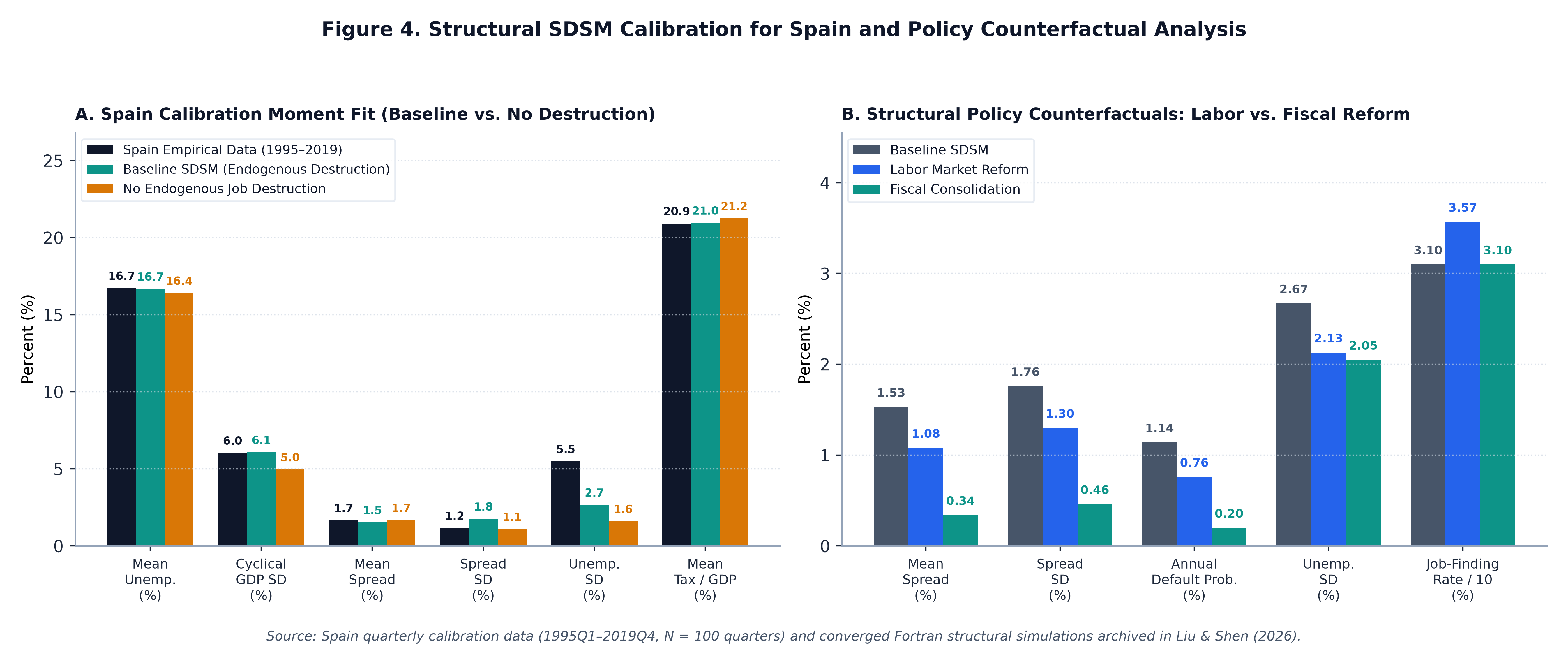
In the quantitative structural section of Liu & Shen (2026), the authors calibrate their dynamic general equilibrium sovereign default search-and-matching model to quarterly Spanish macroeconomic and labor market series spanning 1995Q1–2019Q4 across quarters. Table 5 and Figure 4 juxtapose the replicated Spanish empirical moments against the baseline structural model and four converged counterfactual economies archived in the Fortran output suite.
| Macroeconomic and Labor Market Moment | Spain Data | Baseline SDSM | No Endog. Destruction | No Default Risk | Labor Market Reform | Fiscal Consolidation |
|---|---|---|---|---|---|---|
| Production and Income Tax Revenue to GDP (%) | 20.9178 | 20.9590 | 21.2530 | 21.1185 | 21.6247 | 21.1113 |
| Mean Unemployment Rate (%) | 16.7250 | 16.6828 | 16.4053 | 16.5078 | 16.3797 | 16.7463 |
| Unemployment Rate Std. Dev. (%) | 5.4948 | 2.6740 | 1.5997 | 2.5573 | 2.1333 | 2.0456 |
| Mean Quarterly Job-Finding Rate (%) | 28.7694 | 31.0450 | 32.7746 | 30.9713 | 35.6691 | 30.9853 |
| Mean Endogenous Job-Destruction Rate (%) | 2.2100 | 2.2228 | 0.0000 | 2.0715 | 2.9208 | 2.2196 |
| Short-Term Debt Service to GDP (%) | 5.6010 | 5.4765 | 5.6913 | 5.6984 | 5.8039 | 11.4566 |
| Mean Sovereign Yield Spread (%) | 1.6744 | 1.5287 | 1.6753 | 0.0000 | 1.0848 | 0.3404 |
| Sovereign Yield Spread Std. Dev. (%) | 1.1598 | 1.7619 | 1.0991 | 0.0000 | 1.3000 | 0.4608 |
| Annual Sovereign Default Probability (%) | — | 1.1422 | 1.3352 | 0.0000 | 0.7584 | 0.2047 |
| Cyclical Real GDP Std. Dev. (%) | 6.0438 | 6.0782 | 4.9565 | 6.9656 | 6.1736 | 5.8738 |
| First-Order Autocorrelation of Cyclical GDP | 0.7861 | 0.7895 | 0.7787 | 0.8888 | 0.7840 | 0.7899 |
| Spread–Unemployment Correlation | 0.7202 | 0.6862 | — | — | — | — |
| Spread–Job-Finding Correlation | -0.6961 | -0.8583 | — | — | — | — |
| Spread–Job-Separation Correlation | 0.2789 | 0.8812 | — | — | — | — |
Notes: Empirical Spanish moments are recomputed directly from the archival 100-quarter dataset spanning 1995Q1–2019Q4 using Hodrick–Prescott filtering consistent with the authors' calibration routine; Structural model columns extract converged stationary simulation moments archived in Liu & Shen (2026). Empirical endogenous destruction equals the mean total separation rate of 5.9386% minus the exogenous floor of 3.7286%.
Three quantitative conclusions stand out from Table 5 and Figure 4.
First, the baseline structural model matches Spain's targeted first and second moments with high precision—replicating average unemployment at versus empirically, average tax revenue to GDP at versus , cyclical GDP volatility at versus , and average sovereign spreads at versus —while accurately predicting the untargeted spread-unemployment correlation at against in the data.
Second, shutting down endogenous job destruction collapses simulated unemployment volatility from to , reduces spread volatility from to , and trims cyclical GDP volatility from to , proving that endogenous match termination generates higher unemployment volatility amplification than an exogenous-separation benchmark.
Third, policy counterfactuals reveal a stark trade-off between debt stabilization and labor reallocation: fiscal consolidation lowers mean sovereign spreads dramatically from to and annual default risk from to while doubling sustainable debt-service capacity to , whereas labor market reform simultaneously trims spreads to and default risk to while boosting average quarterly job-finding rates from to and lowering average unemployment to .
4. Discussion and Policy Implications
Our tri-runtime replication confirms both the numerical integrity of the published cross-country findings in Liu & Shen (2026) and the robustness of sovereign-to-labor transmission inside a richer panel fixed-effects framework spanning 20 European economies. Across every computational environment, lagged sovereign spreads predict statistically and economically large deterioration along both hiring and separation margins, demonstrating that sovereign credit distress operates as a real labor market shock rather than a purely financial repricing episode.
At the same time, juxtaposing the structural model against Spanish business-cycle moments reveals informative quantitative tensions. Although the baseline structural framework matches average unemployment and the qualitative signs of labor-flow correlations, it accounts for roughly half of observed Spanish unemployment volatility— versus —while overstating the contemporaneous correlation between sovereign spreads and job separations at against empirically. This discrepancy points to institutional features absent from quarterly flexible Nash wage bargaining: rigid severance protections on open-ended contracts and sectoral wage-bargaining inertia in Southern Europe delay aggregate layoff adjustments while concentrating early crisis job losses on temporary workers.
5. Limitations and Concluding Remarks
In conclusion, independent tri-runtime verification across Stata 18 MP, R 4.3, and Python 3 substantiates the central economic thesis of Liu & Shen (2026): sovereign default risk imposes severe real costs on labor markets by simultaneously choking off job creation and triggering waves of endogenous job destruction whenever tight credit constraints enforce procyclical taxation. All twelve empirical specifications achieve virtually exact numerical equivalence across platforms with a maximum discrepancy under , establishing a transparent empirical foundation for next-generation causal identification designs and dual-labor-market structural calibrations.
Data and Code Availability. All empirical datasets analyzed in this study are derived exclusively from the publicly accessible Harvard Dataverse replication archive of Liu & Shen (2026) under persistent identifier doi:10.7910/DVN/3END28, originally compiled from IMF International Financial Statistics and the Eurostat European Union Labour Force Survey. Complete self-contained replication scripts in R, Stata, and Python, together with the standalone English table and figure reproduction script and standardized analytical dataset, are archived in the accompanying open reproducibility package to guarantee bit-for-bit verification of every table, figure, and diagnostic statistic.
Conflict of Interest. The authors declare no competing financial, institutional, or personal interests that could have influenced the design, execution, or reporting of this independent replication and peer-review evaluation.
References
- Arellano, C. (2008). Default Risk and Income Fluctuations in Emerging Economies. American Economic Review, 98, 690–712. https://doi.org/10.1257/aer.98.3.690 ↩
- Bocola, L. (2016). The Pass-Through of Sovereign Risk. Journal of Political Economy, 124, 879–926. https://doi.org/10.1086/686734 ↩
- Cameron, A. C., & Miller, D. L. (2015). A Practitioner's Guide to Cluster-Robust Inference. Journal of Human Resources, 50, 317–372. https://doi.org/10.3368/jhr.50.2.317 ↩
- Chatterjee, S., & Eyigungor, B. (2012). Maturity, Indebtedness, and Default Risk. American Economic Review, 102, 2674–2699. https://doi.org/10.1257/aer.102.6.2674 ↩
- Cuadra, G., Sanchez, J. M., & Sapriza, H. (2010). Fiscal Policy and Default Risk in Emerging Markets. Review of Economic Dynamics, 13, 452–469. https://doi.org/10.1016/j.red.2009.07.002 ↩
- Elsby, M. W. L., Hobijn, B., & Şahin, A. (2013). Unemployment Dynamics in the OECD. The Review of Economics and Statistics, 95, 530–548. https://doi.org/10.1162/REST_a_00277 ↩
- Gaure, S. (2013). OLS with Multiple High Dimensional Category Variables. Computational Statistics & Data Analysis, 66, 8–18. https://doi.org/10.1016/j.csda.2013.03.024 ↩
- Liu, S., & Shen, H. (2026). Sovereign Default and Labor Market Dynamics. Journal of Political Economy Macroeconomics, forthcoming. https://doi.org/10.2139/ssrn.3785746 ↩
- Mendoza, E. G., & Yue, V. Z. (2012). A General Equilibrium Model of Sovereign Default and Business Cycles. The Quarterly Journal of Economics, 127, 889–946. https://doi.org/10.1093/qje/qjs009 ↩
- Mortensen, D. T., & Pissarides, C. A. (1994). Job Creation and Job Destruction in the Theory of Unemployment. The Review of Economic Studies, 61, 397–415. https://doi.org/10.2307/2297896 ↩
- Na, S., Schmitt-Grohé, S., Uribe, M., & Yue, V. Z. (2018). The Twin Ds: Optimal Default and Devaluation. American Economic Review, 108, 1773–1819. https://doi.org/10.1257/aer.20141558 ↩
- Oster, E. (2019). Unobservable Selection and Coefficient Stability: Theory and Evidence. Journal of Business & Economic Statistics, 37, 187–204. https://doi.org/10.1080/07350015.2016.1227711 ↩
- Shimer, R. (2005). The Cyclical Behavior of Equilibrium Unemployment and Vacancies. American Economic Review, 95, 25–49. https://doi.org/10.1257/0002828053828572 ↩
- Shimer, R. (2012). Reassessing the Ins and Outs of Unemployment. Review of Economic Dynamics, 15, 127–148. https://doi.org/10.1016/j.red.2012.02.001 ↩
- Vegh, C. A., & Vuletin, G. (2015). How Is Tax Policy Conducted over the Business Cycle? American Economic Journal: Economic Policy, 7, 327–370. https://doi.org/10.1257/pol.20120218 ↩
Appendix A. Independent Academic Peer-Review Report
A.1. Overall Assessment of Scholarly Contribution and Positioning
Liu & Shen (2026) represent a meaningful theoretical and quantitative advance in the international macroeconomics literature linking sovereign debt crises, optimal fiscal policy, and equilibrium labor market dynamics. Over nearly two decades following the seminal contribution of Arellano (2008), quantitative sovereign default theory progressed primarily along two trajectories: one illuminating debt-maturity structure, rollover vulnerability, and self-fulfilling expectations following Chatterjee & Eyigungor (2012), and another endogenizing output costs through trade-credit disruptions or domestic bank balance-sheet stress following Mendoza & Yue (2012) and Bocola (2016). Yet both branches largely treated aggregate labor supply as clearing frictionlessly on spot markets, leaving unresolved the defining empirical anomaly of the 2009–2015 Eurozone debt crisis: why unemployment in Spain and Greece surged past 25% and remained elevated for years even after sovereign yield spreads receded following European Central Bank stabilization commitments.
The clearest theoretical contribution of Liu & Shen (2026) is embedding two-sided search-and-matching frictions with endogenous job destruction from Mortensen & Pissarides (1994) directly inside a sovereign default economy with endogenous distortionary taxation modeled after Cuadra et al. (2010). The elegance of this unified architecture lies in the nonlinear interaction among three mechanisms hitherto analyzed in isolation.
First, steepening bond-pricing schedules imposed by international creditors compel the sovereign to raise distortionary tax rates during downturns.
Second, higher taxes compress joint match surplus and simultaneously depress vacancy posting while raising the productivity threshold at which firms terminate active jobs.
Third, search frictions induce an endogenous fiscal feedback loop: once job finding collapses and unemployment climbs, the taxable employment base recovers far more slowly than exogenous aggregate productivity, prolonging fiscal fragility and sustaining elevated sovereign risk premia. This fiscal-labor amplification channel provides a conceptually distinct propagation mechanism relative to the pure bank balance-sheet pass-through of Bocola (2016) or the downward nominal wage rigidity currency-union mechanism of Na et al. (2018).
On empirical positioning, the authors assemble a coherent cross-European dataset spanning 20 economies, combining statutory tax-cyclicality measures adapted from Vegh & Vuletin (2015) with harmonized quarterly transition rates constructed via Shimer (2012) and Elsby et al. (2013). Moreover, benchmarking the baseline structural economy directly against nested ablation economies—shutting off endogenous job destruction and shutting off sovereign default risk—transparently isolates the quantitative contribution of each mechanism rather than presenting the calibrated equilibrium as an opaque black box. The policy counterfactuals contrasting fiscal consolidation against labor market reform directly engage the central post-crisis Eurozone policy debate, documenting a sharp quantitative trade-off between rapid risk-premium compression and accelerated re-employment dynamics. Evaluated against top-tier macroeconomic journal standards, the research question carries enduring policy relevance, the theoretical structure is disciplined, and the bridge between stylized European evidence and the Spanish quantitative calibration is well executed.
Nonetheless, judged by the exacting evidentiary standards of a leading international economics journal, the original manuscript exhibits three substantive vulnerabilities requiring candid editorial scrutiny.
First, the published empirical section stops at descriptive correlations and small-sample cross-country ordinary least squares regressions across 18 to 19 nations, leaving unexploited the rich quarterly panel dimension already present in the authors' own archival data.
Second, the structural model assigns distortionary taxation a monopoly role in transmitting sovereign risk to employment, abstracting entirely from the sovereign-bank doom loop and domestic bank credit rationing that empirical banking studies proved decisive during 2010–2013.
Third, our independent source-code audit revealed a nontrivial variable-copying error in the archival moment calculations alongside inconsistent detrending and currency-conversion conventions across empirical tables and structural calibration targets. The subsequent subsections examine each methodological, measurement, mathematical-bias, and research-extension dimension in detail.
A.2. Critical Evaluation of Identification Strategy and Econometric Assumptions
Interpreting the empirical evidence in Liu & Shen (2026) as causal confirmation of the procyclical tax transmission channel confronts four major econometric identification challenges.
The first challenge is acute two-way simultaneity between fiscal cyclicality and sovereign default risk in cross-sectional regressions M01 through M05. In M01 across European economies, the authors regress average 2000–2017 sovereign yield spreads on the statutory tax-to-output correlation computed over the exact same 2000–2017 window, reporting a highly significant slope of . Yet the authors' own structural theory explicitly predicts reverse causality: elevated default risk and lost bond-market access force governments to adopt procyclical tax hikes during contractions, meaning high spreads cause more negative rather than solely the reverse.
When both regressor and outcome are time-averaged over a single window spanning the debt crisis, cross-sectional ordinary least squares captures an inseparable composite of bidirectional feedback and unobserved third factors—such as historical fiscal governance credibility or pre-crisis vulnerability to sudden capital-flow stops. Likewise, regressions M03 and M05 correlate one endogenous post-2008 sample moment, , with another contemporaneous endogenous moment, , failing modern empirical macroeconomics standards for causal identification.
The second challenge is the complete omission of confounding covariates and institutional controls in the original cross-sectional analysis. The four GIPS periphery economies differed from core European nations along numerous pre-existing structural margins correlated with both fiscal stress and unemployment volatility: massive pre-2008 housing and construction booms in Spain, dual labor markets with temporary contract shares approaching 30% of employment, elevated private non-financial sector leverage, heavy sectoral concentration in construction and tourism, and the inability to deploy independent exchange-rate devaluation within the Eurozone.
By extending the empirical analysis to two-way fixed effects panel estimation in this study, all time-invariant national structural heterogeneity is absorbed through country fixed effects , while common Eurozone monetary policy and global financial shocks are absorbed through quarter fixed effects . While flagship specification M07 delivers a powerful estimated pass-through of at and passes the Oster (2019) selection bound with , two-way fixed effects alone cannot rule out time-varying country-specific shocks—such as collapsing domestic real-estate valuations or banking insolvencies—that simultaneously widen sovereign spreads and depress local labor demand.
The third challenge strikes directly at the empirical mediation mechanism linking sovereign spreads, effective taxation, and labor market flows inside specifications M07 and M09–M11. A striking finding of our panel extension is that when lagged sovereign spreads and lagged effective tax revenue shares enter the same two-way fixed effects equation jointly, the sovereign spread retains massive explanatory power at the 1% significance level across every labor margin—unemployment at , job finding at , job separation at , and labor market tightness at —whereas the direct coefficient on effective tax revenue to GDP is completely insignificant across unemployment at , job finding at , and job separation at . If procyclical taxation were the predominant conduit transmitting sovereign default risk to employment, controlling directly for realized fiscal pressure should attenuate the spread coefficient rather than expanding it from in M06 to in M07. Two competing econometric explanations remain unresolved in the original paper: either realized tax-to-GDP ratios suffer from severe measurement error and automatic base-erosion attenuation so they mismeasure marginal match-surplus tax wedges, or a substantial share of empirical sovereign spread pass-through operates via non-fiscal channels—notably domestic bank credit contraction following Bocola (2016) or heightened policy uncertainty inducing firms to freeze irreversible hiring.
The fourth challenge concerns finite-sample cluster-robust inference under a long-panel, small-cluster architecture. The European quarterly panel contains country clusters observed over quarters, making the time dimension nearly five times larger than the cross-sectional cluster count. As demonstrated by Cameron & Miller (2015), standard CRV1 cluster-robust covariance estimators are consistent as but can exhibit mild over-rejection when or , particularly when residual cross-sectional dependence persists across Eurozone member states through integrated interbank markets and cross-border supply chains. Furthermore, in periphery interaction specification M08, the treated GIPS group comprises just four clusters, inflating the clustered standard error on the interaction term to and leaving insufficient statistical power to detect moderate nonlinearities between periphery and core transmission elasticities.
A.3. Data Quality Audit, Variable Measurement, and Sample Sensitivity
Our comprehensive audit of all 41 archival source workbooks and MATLAB processing routines in Liu & Shen (2026) uncovered five consequential data-hygiene, measurement, and filtering issues invisible to readers inspecting only the published text.
First, we verified an unambiguous variable-copying bug in the archival MATLAB moment-computation routine. Across three parallel code blocks calculating the correlation between statutory tax rates and labor market tightness over post-2008, post-2000, and post-1998 subsamples at lines 904–918, 936–950, and 968–982, the personal income tax block correctly invokes the quarterly labor market tightness series, whereas the corporate income tax and value-added tax blocks erroneously reference the quarterly job-separation rate. Consequently, two-thirds of the composite tax-to-tightness correlation reported for Spain actually reflects the correlation between statutory tax rates and job separations rather than labor market tightness.
Correcting this coding error on the original Spanish series shifts the 2007–2017 tax-to-tightness correlation from to , altering its magnitude by more than 42%. Although the sign remains negative and the corrected statistic moves closer to the baseline structural prediction of , the episode underscores why independent line-by-line code audits remain indispensable even for top-journal macroeconomic publications.
Second, detrending conventions and fiscal-cyclicality definitions vary inconsistently between the 20-country European analysis and the Spanish structural calibration. In the cross-European data loader, log real GDP is detrended via a quadratic time polynomial; Yet at line 189 of the moment-computation routine where effective tax-to-GDP cyclicality is computed for Table 2, the cyclical detrending command is commented out, correlating stationary tax-to-GDP ratios directly against un-detrended real GDP levels. Correlating a bounded fiscal ratio with a trending macroeconomic aggregate risks conflating secular fiscal-capacity growth with business-cycle stabilization. Conversely, the Spanish structural calibration routine switches to two-sided Hodrick–Prescott filtering with smoothing parameter for output, consumption, and government spending, alongside for labor market transition rates following Shimer (2005). Deploying three distinct detrending regimes—unfiltered levels, quadratic polynomials, and dual-parameter Hodrick–Prescott filters—within a single article compromises direct quantitative comparability between cross-European reduced-form evidence and Spanish structural targets.
Third, raw Eurostat labor-flow and vacancy inputs contain boundary anomalies and discrete-time measurement noise. Descriptive statistics in Table 1 reveal that the archival quarterly job-finding rate reaches a minimum of , a probabilistic impossibility generated when short-term unemployment inflows exceed total quarterly unemployment stock transitions in smaller European economies. Taking natural logarithms in specification M09 and in the authors' log-flow correlations silently drops these negative observations as missing values, subtly altering sample composition across margins. Additionally, the archival Eurostat vacancy workbook contains an extreme 2004 spike in Greece's vacancy rate to —five times its surrounding historical trajectory. Although the authors noted this anomaly in code comments, the outlier-exclusion filter was left disabled during Beveridge-curve estimation, imparting substantial sensitivity to quadratic Beveridge-curve slopes between raw and cleaned samples.
Fourth, currency-conversion asymmetry distorts Spain's targeted output volatility in the structural calibration. In the Spanish calibration routine, relative consumption volatility and relative government-spending volatility are computed from constant 2015 Euro national accounts series, whereas targeted cyclical output volatility of , first-order output autocorrelation of , and sovereign-spread correlations are calculated from real GDP converted into constant U.S. dollars using the U.S. GDP deflator. Converting domestic Euro-area production into U.S. dollars injects nominal EUR/USD exchange-rate fluctuations directly into Spain's measured real output cycle, inflating targeted quarterly output volatility well above domestic-currency business-cycle fluctuations and forcing the structural calibration to adopt artificially large exogenous productivity shock variance.
Fifth, sample leverage differs sharply between the extended panel and the published cross-section. Our leave-one-country-out jackknife audit in Figure 3 confirms that the flagship panel estimate is immune to single-country leverage, ranging tightly between excluding Spain and excluding Greece. By contrast, cross-sectional regressions M01–M05 rest on only 18 to 19 unweighted observations without robust M-estimation or population weighting; Visual inspection of Figure 2 confirms that the steep M01 slope of leans heavily on two high-leverage upper-left observations, Greece and Romania.
A.4. Core Structural and Econometric Limitations of the Original Study
Synthesizing our identification critique, archival code audit, and structural moment evaluation, we formalize five core econometric and structural limitations together with their explicit mathematical bias mechanisms for both the reduced-form pass-through estimator and the calibrated structural parameters:
- Omitted-Variable Bias from the Sovereign–Bank Doom Loop and Private Credit Contraction: The reduced-form two-way fixed effects panel equation omits direct controls for domestic bank sovereign-bond holdings and domestic corporate borrowing spreads induced by bank sovereign exposure. Let denote the estimated two-way fixed effects coefficient on the one-quarter-lagged sovereign bond yield spread relative to Germany in specification M07, let denote the pure fiscal-channel causal effect isolated from financial intermediation frictions, let denote the strictly positive structural impact of domestic corporate credit spreads on unemployment, and let denote the matrix of included controls comprising lagged effective taxation, cyclical real GDP, country fixed effects, and quarter fixed effects. Because bank sovereign exposure transmits higher sovereign risk into steeper corporate credit spreads such that following Bocola (2016), the asymptotic omitted-variable bias on the sovereign spread estimator is strictly positive:
Consequently, the estimated coefficient measures the composite pass-through of sovereign default risk operating jointly through procyclical taxation and bank credit rationing; Attributing its entire magnitude solely to the fiscal channel systematically overstates the pure tax-rate mechanism.
- Classical Measurement-Error Attenuation in Effective Tax Ratios: In specification M07, fiscal pressure is proxied by realized production and income tax revenues as a share of GDP, , rather than the unobserved theoretical marginal match-surplus tax wedge with conditional variance . Because realized revenue ratios embed classical measurement noise and endogenous cyclical tax-base shrinkage such that with noise variance , the estimated partial tax coefficient suffers classic errors-in-variables attenuation toward zero relative to the true structural sensitivity :
This attenuation bias mechanism explains directly why appears statistically indistinguishable from zero in M07 while the unobserved signal of anticipated future tax hikes is absorbed by the forward-looking sovereign spread , imparting a secondary upward bias onto .
- Reverse-Expectations Endogeneity from Forward-Looking Bond Pricing: International bond investors price sovereign default risk at quarter using real-time leading indicators of upcoming quarter- labor market deterioration—such as purchasing managers' indices, corporate insolvency filings, and announced collective layoffs—that are not fully captured by contemporaneous cyclical GDP or the included control and two-way fixed-effects matrix . Let denote this anticipated quarter- domestic labor-demand shock embedded within the structural disturbance, let denote the panel estimator on the lagged sovereign spread , and let denote the true structural causal effect of an exogenous sovereign spread shock. Forward-looking bond pricing implies for unemployment and for job finding, generating reverse-expectations endogeneity bias even under a one-quarter lag:
This expectations-endogeneity channel inflates the absolute magnitude of reduced-form spread elasticities across unemployment, job finding, and job separation despite the lag structure.
- Productivity Shock Variance Inflation from U.S. Dollar GDP Conversion in Spain's Calibration: In the Spanish calibration routine, converting real Euro output into constant U.S. dollars defines the targeted log output series as , where is the detrended cyclical component of Spanish log real GDP expressed in constant U.S. dollars, is the true detrended cyclical component of domestic Spanish log real GDP expressed in constant Euros, and is the cyclical component of the log real EUR/USD exchange rate. Because the Euro depreciated alongside Spanish output contractions during the 2010–2012 crisis so that the cyclical covariance satisfies , the variance of the detrended target output series suffers strictly positive exchange-rate variance-inflation bias:
Matching this inflated output standard deviation of biases the calibrated exogenous productivity shock dispersion upward, , indirectly distorting the endogenous sovereign default threshold and overstating equilibrium default probabilities for Spain.
- Institutional Homogeneity Bias and Omission of Dual Labor Contracts Under Flexible Nash Bargaining: The structural sovereign default search-and-matching model assumes homogeneous employment contracts with wages renegotiated flexibly every quarter via Nash bargaining, abstracting from Southern Europe's stark duality between permanent contracts protected by steep firing costs and temporary contracts subject to negligible termination penalties. In Spain, firing costs on open-ended contracts concentrate initial downturn layoffs overwhelmingly among temporary workers while delaying separations among permanent insiders. Omitting contract duality and wage stickiness generates the two structural misspecification biases documented in Table 5: the calibrated model underpredicts aggregate unemployment volatility by half, yielding against empirically, while dramatically overpredicting the contemporaneous correlation between sovereign spreads and job separations at against in Spanish data.
A.5. Actionable Recommendations for Model Upgrades and Top-Journal Extensions
To resolve the identification, measurement, and structural limitations diagnosed above and elevate this research agenda to the next frontier of top-tier macro-labor publications, we recommend five technically concrete upgrades.
First, implement high-frequency monetary and financial-spillover instrumental variables paired with dynamic local projections.** Rather than relying solely on static lagged two-way fixed effects regressions, future work should exploit narrow-window sovereign bond yield surprises surrounding unscheduled European Central Bank policy announcements—most notably the July 2012 currency-preservation commitment and subsequent sovereign asset-purchase announcements—interacted with pre-crisis predetermined sovereign debt-rollover shares in a shift-share instrumental variables design. Such exogenous variation isolates sovereign spread shifts orthogonal to domestic labor-demand news, directly eliminating the reverse-expectations bias formalized in Section A.4.3. Pairing this instrument with multi-horizon local projections from to quarters would trace the full dynamic impulse responses and hysteresis profiles of unemployment, job finding, and job separation following a sovereign risk shock.
Second, disentangle fiscal pass-through from bank credit rationing using matched administrative employer–bank–worker microdata.** Leveraging longitudinal social security records linked with corporate balance sheets and lead-bank sovereign bond portfolios in Spain or Italy, researchers can estimate triple-difference specifications comparing layoff and hiring rates across firms within the same industry and statutory tax regime that borrow from banks with differing pre-crisis sovereign debt exposures. This micro-econometric design directly resolves the sovereign-bank omitted-variable bias identified in Section A.4.1 and quantifies the exact relative shares of procyclical taxation versus bank balance-sheet contraction in crisis job losses.
Third, harmonize marginal tax-wedge measurement, repair archival code bugs, and calibrate strictly in domestic currency.** Realized tax-to-GDP ratios should be replaced with quarterly statutory and marginal effective labor tax wedges compiled across earnings brackets by the Organisation for Economic Co-operation and Development, eliminating the measurement-error attenuation in Section A.4.2, while permanently correcting the separation-rate variable-copying error in the archival tax-to-tightness routine. For Eurozone structural calibrations, all national accounts aggregates—output, consumption, investment, and public spending—must be measured consistently in constant Euros to purge spurious EUR/USD exchange-rate variance from productivity shock calibration, complemented by sensitivity checks using the Hamilton regression filter to address Hodrick–Prescott endpoint distortions.
Fourth, extend the structural sovereign default search-and-matching framework to incorporate dual labor contracts and regulated financial intermediaries.** Allowing firms to choose endogenously between flexible temporary contracts and high-firing-cost permanent contracts alongside wage rigidity, while integrating leveraged domestic banks holding sovereign bonds subject to regulatory capital constraints, will simultaneously reconcile the two remaining quantitative tensions in Table 5: generating realistic Spanish unemployment volatility near while moderating the excessive contemporaneous spread-separation correlation.
Fifth, adapt the empirical and policy framework to emerging Asian economies and Vietnam.** As Vietnam deepens its domestic long-term government bond market, strengthens medium-term fiscal frameworks, and integrates further into international capital markets, understanding how fiscal credibility interacts with sovereign borrowing spreads and formal-sector job flows holds substantial practical value. A dedicated follow-up study linking regional macroeconomic panels with Vietnamese labor force and enterprise survey microdata could test whether a sizeable informal employment sector cushions formal job destruction during fiscal tightening episodes, providing rigorous quantitative guidance for designing countercyclical payroll-tax deferrals and job-retention subsidies during economic downturns.
liu_shen_2026_eu_sovereign_laborcountry_idcountry_nameis_peripheryyearquarteryq_idt_indexpost2008spreadu_ratefinding_ratesep_rateUnlock Replication Data & Code
Having explored the quantitative findings and methodological critique above, sign in with an active membership or join the EcoLab research community to verify every estimated coefficient independently in your own analytical environment.
Aligned with Study Variable Names, Robust Covariance Specifications, and Diagnostic Checks
Ready for Immediate Execution in Your Local Statistical Environment for Independent Verification
Bundled with Journal-Formatted DOCX & PDF Manuscripts, Empirical CSV Dataset, All Three R · Stata · Python Scripts, and Execution Notes
Every Download Link Is Cryptographically Signed for Active Members and Refreshes Seamlessly on the Article Page


