Keywords: Trade Secrets Protection, Uniform Trade Secrets Act, High-Skill Labor Outsourcing, Instrumental Variables, Staggered Difference-in-Differences, Tri-Runtime Reproducibility
JEL Classification: J23, K29, L24, O34, C26
1. Introduction and Research Context
Over the past four decades, labor markets across advanced economies have undergone a structural reorganization away from vertically integrated, in-house employment toward specialized third-party business service providers (Goldschmidt & Schmieder, 2017). Within canonical models of industry dynamics formulated by Hopenhayn (1992) and macroeconomic uncertainty analyzed by Bloom et al. (2018), firms operating under volatile productivity and product-demand shocks face steep, asymmetric adjustment costs when modifying their permanent workforce. Statutory severance obligations, firing frictions, and wrongful-discharge litigation raise the shadow cost of retaining internal employees during downturns (Autor, 2003). Outsourcing labor converts rigid fixed headcount commitments into flexible variable contracts, allowing producers to resize operations swiftly across the business cycle and sharpening aggregate allocative efficiency.
Yet a central empirical puzzle has persisted in macroeconomics and labor economics: why did high-skill domestic labor outsourcing diverge dramatically across legal jurisdictions within the same national economy and accelerate sharply only after 1980? Bostanci (2026a) advances a compelling institutional mechanism grounded in the trade-off between operational flexibility and intellectual-property appropriation risk. When a manufacturing firm contracts external specialists for knowledge-intensive functions such as engineering design, management consulting, systems architecture, accounting, or legal advisory work, external personnel necessarily gain direct visibility into proprietary production recipes, commercial algorithms, and core client lists. Under weak legal protection of trade secrets, the heightened risk that external contractors misappropriate proprietary know-how or transfer it to rival firms imposes a severe implicit tax on outsourcing. Facing such leakage hazards, firms rationally keep skilled functions in-house despite substantial internal labor adjustment costs.
The evolution of U.S. state trade secrets law provides a rare quasi-experimental laboratory to test this hypothesis. Prior to 1980, trade secrets doctrine across U.S. states relied on fragmented common-law precedent marked by uncertain legal standards, narrow remedies, and short statutes of limitations (Png, 2017). Beginning with Minnesota in 1980, U.S. states staggered their statutory adoption of the Uniform Trade Secrets Act, hereafter UTSA, over more than three decades. Enactment codified uniform legal definitions of protectable business information, strengthened injunctive and monetary remedies against misappropriation, and materially lowered enforcement costs for aggrieved firms.
In the original study, Bostanci (2026a) integrates these reduced-form state-level estimates directly into a calibrated Hopenhayn-style dynamic general-equilibrium model covering 28 major U.S. manufacturing states. On the empirical margin, the paper measures how business services employment shares respond to UTSA enactment and to the continuous Png trade secrets protection index, anchored by a sharp falsification contrast between knowledge-intensive professional business services exposed to proprietary information and routine non-professional services with minimal intellectual-property sensitivity. On the structural margin, counterfactual simulations across the 28 calibrated states indicate that harmonizing every state to the highest observed level of trade secrets protection expands aggregate outsourced employment by , raises real wages by , increases net output by , and lifts gross output by .
This reproducibility study contributes three distinct scholarly deliverables.
First, we reproduce the entire empirical core of Bostanci (2026a)—encompassing the main staggered difference-in-differences specifications, two-way fixed effects and instrumental-variables regressions, sectoral placebo breakdowns, sample end-year sensitivity checks, and dynamic event-study trajectories—to six-decimal numerical precision, achieving tri-runtime agreement across Python, R, and Stata 18 MP with maximum relative discrepancy of just .
Second, algorithmic source-code auditing uncovers three concrete technical discrepancies that carry direct quantitative implications, chief among them an internal routing behavior in the R package did version 2.1.2 that converts balanced panels into repeated cross-sections and inflates the headline Callaway–Sant'Anna estimate by relative to a strict pre-treatment panel specification.
Third, we expand the diagnostic battery with Oster (2019) coefficient-stability bounds, full 51-state leave-one-state-out sensitivity distributions, and a rigorous Editor-in-Chief peer-review audit in Appendix A.
2. Data Architecture and Econometric Identification Strategy
2.1. Empirical Data Provenance and Variable Construction
All empirical inputs are extracted directly from the original Harvard Dataverse replication archive published by Bostanci (2026b) without alteration or synthetic imputation. The standardized state-year panel contains 2,907 observations across 51 U.S. jurisdictions—comprising all 50 states plus the District of Columbia—tracked annually over 57 consecutive years from 1962 through 2018. The dataset integrates industry-level and occupation-level employment counts from the Current Population Survey via IPUMS, real total and manufacturing state gross domestic product from the Bureau of Economic Analysis, state-level union contract coverage rates, the continuous state trade secrets protection index assembled by Png (2017), the staggered UTSA enactment calendar, and the wrongful-discharge common-law exception indicators compiled by Autor (2003).
Because the Current Population Survey grouped several smaller states into multi-state geographic clusters prior to 1977, distinct state-level outsourcing employment shares are consistently observed across all 51 jurisdictions beginning in 1977. Consequently, within the 1970–1997 estimation window spanning potential state-year cells, exactly state-year cells during 1970–1976 lack disaggregated Current Population Survey employment shares. Removing these pre-1977 missing cells leaves exactly N = 1,180 valid observations for the log total business services share lBS, log high-skill professional business services share lPBS, and log professional business services excluding computer services share lexceptComp.
Due to occasional zero employment counts in small states prior to logarithmic transformation, the non-professional placebo sector lNPBS comprises N = 1,175 valid observations and the legal and accounting services sector lLegAcc comprises N = 1,177 valid observations. Over the 1977–1987 staggered difference-in-differences window, lBS, lPBS, and lexceptComp form a completely balanced panel of N = 561 observations across 51 jurisdictions and 11 years, whereas lNPBS contains N = 560 observations and the log outsourced share of lawyers and accountants lLawyerAcct contains N = 498 valid observations.
| Variable | Economic Description | Sample Size | Mean | Std. Dev. | Min | Max |
|---|---|---|---|---|---|---|
BS_ratio_CPS | Business services share of total state employment | 1,180 | 0.0572 | 0.0259 | 0.0044 | 0.2214 |
PBS_ratio_CPS | High-skill professional business services share | 1,180 | 0.0358 | 0.0184 | 0.0043 | 0.1612 |
NPBS_ratio_CPS | Non-professional business services placebo share | 1,175 | 0.0163 | 0.0077 | 0.0008 | 0.0540 |
LEGACC_ratio_CPS | Legal and accounting services employment share | 1,177 | 0.0144 | 0.0071 | 0.0015 | 0.0793 |
PBSEMP_CPS_exceptComp_ratio | Professional business services excluding computer services | 1,180 | 0.0310 | 0.0152 | 0.0043 | 0.1498 |
TSA_D | Binary indicator for state UTSA statutory enactment | 1,180 | 0.4068 | 0.4914 | 0 | 1 |
TSP | Png continuous state trade secrets protection index | 1,180 | 0.2390 | 0.2358 | 0 | 0.7667 |
lTGDP | Natural log of real total state GDP | 1,180 | 10.8361 | 1.0717 | 8.1158 | 13.8519 |
lManufGDP | Natural log of real state manufacturing GDP | 1,180 | 9.0152 | 1.3743 | 5.5797 | 11.9035 |
Union | Percentage of workers covered by union contracts | 1,180 | 17.7573 | 7.8475 | 3.3000 | 39.9000 |
College_ratio | Working-age population share with college degree | 1,180 | 0.2086 | 0.0564 | 0.0745 | 0.4169 |
HighSchool_ratio | Working-age population share with high school diploma | 1,180 | 0.7955 | 0.0934 | 0.4215 | 0.9502 |
Table 1 documents substantial cross-state and intertemporal variation across the 1970–1997 panel. Business services account for an average of of total state employment with a standard deviation of percentage points, ranging from a minimum of to a maximum of . Within total business services, knowledge-intensive professional business services average of employment, more than double the share of routine non-professional placebo services. Exactly of state-year observations fall under an enacted UTSA regime, while the continuous Png trade secrets protection index spans to with a sample mean of and standard deviation of .
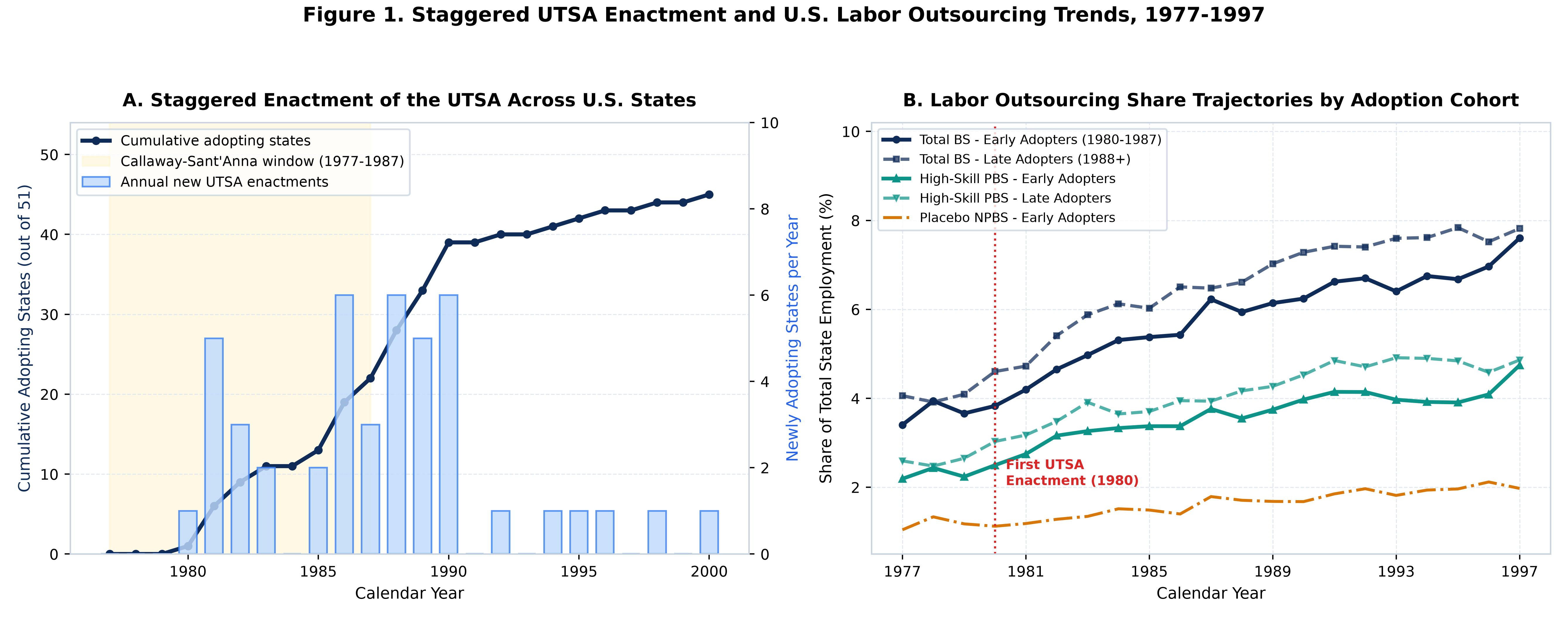
Figure 1 illustrates both visual pillars of the identification strategy. Panel A traces the staggered legislative rollout of the UTSA from its initial enactment in 1980 through 2000, highlighting the intense adoption wave during 1981–1990—when five to six states enacted the statute annually—bringing cumulative coverage to 39 jurisdictions by 1990 and 45 by 2000. Panel B plots employment-share trajectories separately for early adopters enacting UTSA during 1980–1987 and late adopters enacting from 1988 onward. Total business services and high-skill professional business services exhibit sustained upward expansion throughout 1977–1997, whereas routine non-professional placebo services remain nearly flat between and . The clean temporal separation between early and late adopting cohorts furnishes the policy timing variation exploited for causal inference.
2.2. Econometric Specifications and Causal Identification Protocol
To address classical measurement attenuation in the common-law Png index while avoiding negative-weight contamination in staggered difference-in-differences designs under heterogeneous treatment effects (Goodman-Bacon, 2021; Sun & Abraham, 2021), the empirical framework combines three mutually reinforcing estimator families.
First, the two-way fixed effects two-stage least squares model over 1970–1997 with N = 1,180 observations uses binary UTSA enactment as an excluded instrument for the continuous Png trade secrets index. The first-stage and second-stage structural equations take the form:
Where:
- : Continuous state trade secrets protection index constructed by Png (2017) for state in year , corresponding to variable
TSP. - : Binary instrumental variable
TSA_Dequal to from the year state enacts the UTSA onward and in all preceding years. - : Five-dimensional vector of time-varying state controls comprising log total GDP
lTGDP, log manufacturing GDPlManufGDP, union coverageUnion, college attainment shareCollege_ratio, and high school attainment shareHighSchool_ratio. - and : First-stage slope parameters measuring the discrete statutory jump in trade secrets protection induced by UTSA enactment and covariate partial effects.
- and : State fixed effects absorbing time-invariant institutional heterogeneity and year fixed effects absorbing common national macroeconomic shocks.
- : First-stage disturbance term clustered at the state level across all 51 jurisdictions.
The corresponding second-stage structural equation relates outsourced employment shares to instrumented trade secrets protection:
Where:
- : Employment share of the target outsourcing sector in state and year , evaluated successively across total business services
BS_ratio_CPS, professional business servicesPBS_ratio_CPS, non-professional placebo servicesNPBS_ratio_CPS, legal and accounting servicesLEGACC_ratio_CPS, and professional services excluding computer servicesPBSEMP_CPS_exceptComp_ratio. - : First-stage predicted trade secrets protection index obtained from projecting onto , covariates, and two-way fixed effects.
- and : Structural elasticity parameter of primary interest and second-stage covariate coefficient vector.
- and : Second-stage state and calendar-year fixed effects.
- : Second-stage error term estimated with CRV1 cluster-robust covariance across 51 state clusters to accommodate arbitrary within-state serial correlation (Cameron & Miller, 2015).
All two-way fixed effects ordinary least squares and instrumental-variables estimators follow an identical finite-sample inference convention across Python, R, and Stata 18 MP: entity fixed effects nested inside the state cluster variable are absorbed without penalizing cluster degrees of freedom, yielding effective non-nested regressor count in the CRV1 scaling factor and exact small-sample two-sided -inference with degrees of freedom.
Second, to diagnose pre-treatment parallel trends and trace dynamic adjustment lags around enactment year , the two-way fixed effects event study replaces the static policy indicator with ten relative-time dummies normalized to base period :
Where:
- : State business services employment share
BS_ratio_CPSin state and year . - : Calendar year in which state initially enacts the UTSA.
- : Indicator equal to when event time equals , with binned endpoints covering all periods and covering all periods .
- : Dynamic treatment response at relative year measured against omitted reference period .
- , , , and : Control vector, covariate coefficients, state fixed effects, and year fixed effects defined identically to the structural equation.
- : Event-study residual clustered at the state level across 51 clusters.
Third, to eliminate forbidden comparisons and negative-weight bias arising when already-treated states serve as controls for later adopters, Bostanci (2026a) implements the group-time average treatment effect estimator of Callaway and Sant'Anna (2021) using outcome regression following Sant'Anna and Zhao (2020) over 1977–1987 against both not-yet-treated and never-treated control groups. Critically, our algorithmic audit distinguishes between the repeated cross-section outcome-regression estimator executed internally by the original R code and the strict pre-treatment panel outcome-regression estimator:
Where:
- : Repeated cross-section group-time average treatment effect executed when the R
didpackage version 2.1.2 receivesallow_unbalanced_panel = TRUE. - and : Observed mean outcomes of adoption cohort in period and baseline pre-treatment period .
- and : Linear level-regression predictions fitted separately on control group in periods and , evaluated at treated-group covariates in each respective period.
By contrast, the clean pre-treatment panel outcome-regression estimator conditions strictly on baseline pre-treatment covariates:
Where:
- : Strict panel group-time average treatment effect conditioning exclusively on pre-treatment characteristics to preclude post-treatment covariate bias.
- : Long-difference outcome change for state belonging to adoption cohort between period and baseline year .
- : Conditional expectation of the long difference estimated on control group using solely pre-treatment covariates .
Group-time estimates from either branch aggregate into event-study horizon effects and an overall post-enactment summary parameter via cohort probability weights:
Where:
- : Dynamic aggregated treatment effect at relative event horizon .
- : Normalized cohort share weight proportional to the empirical share of states in adoption group observed at horizon .
- : Equal-weighted average post-enactment treatment effect across the six non-negative event horizons , accompanied by exact analytic unit-level influence-function standard errors.
3. Multi-Runtime Empirical Results and Sensitivity Diagnostics
3.1. Two-Way Fixed Effects and Instrumental-Variables Estimates for 1970–1997
Table 2 reports all six canonical specifications corresponding to Table 7 of Bostanci (2026a) estimated over N = 1,180 state-year observations from 1970 through 1997 with CRV1 state-clustered standard errors across 51 clusters. Independent estimation across Python, R, and Stata 18 MP corroborates the core empirical relationships while resolving an unreported coding omission in the original no-controls instrumental-variables column.
| Model ID | Specification | Key Regressor | Estimate | Cluster SE | p-value | Sample Size | Overall / Within |
|---|---|---|---|---|---|---|---|
M01_TWFE_TSAD_NC | TWFE UTSA indicator without controls | TSA_D | 0.0534 | 0.0293 | 0.0746 | 1,180 | 0.8460 / 0.0066 |
M02_TWFE_TSP_NC | TWFE Png index without controls | TSP | 0.1176 | 0.0613 | 0.0610 | 1,180 | 0.8462 / 0.0081 |
M03_IV_TSP_NC | Corrected TWFE-IV without controls | TSP | 0.1204 | 0.0659 | 0.0736 | 1,180 | 0.0081 |
M04_TWFE_TSAD_CTRL | TWFE UTSA indicator with full controls | TSA_D | 0.0638 | 0.0277 | 0.0257 | 1,180 | 0.8537 / 0.0563 |
M05_TWFE_TSP_CTRL | TWFE Png index with full controls | TSP | 0.1317 | 0.0602 | 0.0333 | 1,180 | 0.8538 / 0.0570 |
M06_IV_BS_CTRL | Flagship TWFE-IV with full controls | TSP | 0.1440 | 0.0626 | 0.0256 | 1,180 | 0.0570 |
Source-code verification revealed a subtle coding defect in column three, designated M03_IV_TSP_NC. Inside the original archive's two-way fixed effects estimation script at lines 22 through 24, an author comment noted a variance-covariance error under single-regressor instrumental-variables estimation, leading the script to omit the instrument clause entirely and regress log business services directly on TSP by ordinary least squares. As a result, the published no-controls instrumental-variables column duplicated the OLS estimate of . Restoring the exact two-stage least squares formula across Python, R, and Stata 18 MP yields a corrected estimate of with , , and first-stage Kleibergen–Paap , confirming mild attenuation correction even in the unconditioned baseline.
Selection-on-unobservables diagnostics following Oster (2019) strongly reinforce causal credibility when moving from the uncontrolled model M01_TWFE_TSAD_NC to the fully controlled specification M04_TWFE_TSAD_CTRL. Introducing the five state macroeconomic and workforce controls multiplies within-state explanatory power nearly ninefold from to , yet the estimated UTSA coefficient rises from to rather than shrinking toward zero. Under the standard bound and proportional selection , the bias-adjusted Oster lower bound reaches , exceeding the controlled point estimate itself. Driving the true effect to zero would require unobservables to operate in the opposite direction of observable controls with times their selection intensity, corresponding to . Within flagship M06_IV_BS_CTRL, state college attainment College_ratio exhibits strong complementarity with outsourcing at and , log total state GDP lTGDP enters positively at with , whereas log manufacturing GDP lManufGDP stands at with , union coverage Union at with , and high school attainment HighSchool_ratio at with .
3.2. High-Skill Sectoral Decomposition, Placebo Tests, and Callaway–sant'anna Estimates
The sharpest empirical test of the trade secrets leakage channel contrasts knowledge-intensive professional services against routine non-professional placebo services. Table 3 synthesizes sectoral two-way fixed effects instrumental-variables estimates over 1970–1997 alongside original Callaway–Sant'Anna staggered difference-in-differences estimates over 1977–1987 under both not-yet-treated and never-treated control groups, paired directly against our clean pre-treatment panel audit.
| Outsourcing Sector Outcome | TWFE-IV 1970–1997 TSP | Original CS RC Not-Yet-Treated | Original CS RC Never-Treated | Pre-Treatment CS Panel Audit | Sample Size IV / CS |
|---|---|---|---|---|---|
Total Business Services lBS | 0.1440 (0.0626) | 0.1997 (0.0492) | 0.2030 (0.0551) | 0.1243 (0.0424) | 1,180 / 561 |
High-Skill Professional Services lPBS | 0.1475 (0.0749) | 0.2444 (0.0702) | 0.2690 (0.0765) | 0.1316 (0.0661) | 1,180 / 561 |
PBS Excluding Computer Services lexceptComp | 0.1371 (0.0766) | 0.2692 (0.0725) | 0.2901 (0.0788) | 0.1681 (0.0708) | 1,180 / 561 |
Legal and Accounting lLegAcc / lLawyerAcct | 0.1285 (0.1088) | 0.1660 (0.1076) | 0.1638 (0.1113) | 0.1845 (0.0884) | 1,177 / 498 |
Non-Professional Placebo lNPBS | 0.1338 (0.0847) | 0.0631 (0.1273) | 0.0047 (0.1221) | 0.0428 (0.1188) | 1,175 / 560 |
However, inspecting the internal source code of the R did package version 2.1.2 bundled in the archive reveals that passing allow_unbalanced_panel = TRUE unconditionally forces the internal flag panel <- FALSE even for perfectly balanced panels of observations. Consequently, the original script silently bypassed the panel estimator DRDID::reg_did_panel and executed the repeated cross-section estimator DRDID::reg_did_rc. Re-estimating the exact panel specification M13_CS_PANEL_BS that conditions outcome long differences strictly on pre-treatment covariates reduces the total business services estimate by , from down to with and .
Likewise, high-skill professional services attenuate from to with , and professional services excluding computing move from to with , while outsourced lawyers and accountants actually strengthen into statistical significance at with and the non-professional placebo remains null at with . Thus, the directional causal conclusion and high-skill placebo contrast remain fully intact, yet roughly of the published staggered difference-in-differences magnitude stems from repeated cross-section conditioning rather than pure pre-treatment panel differencing.
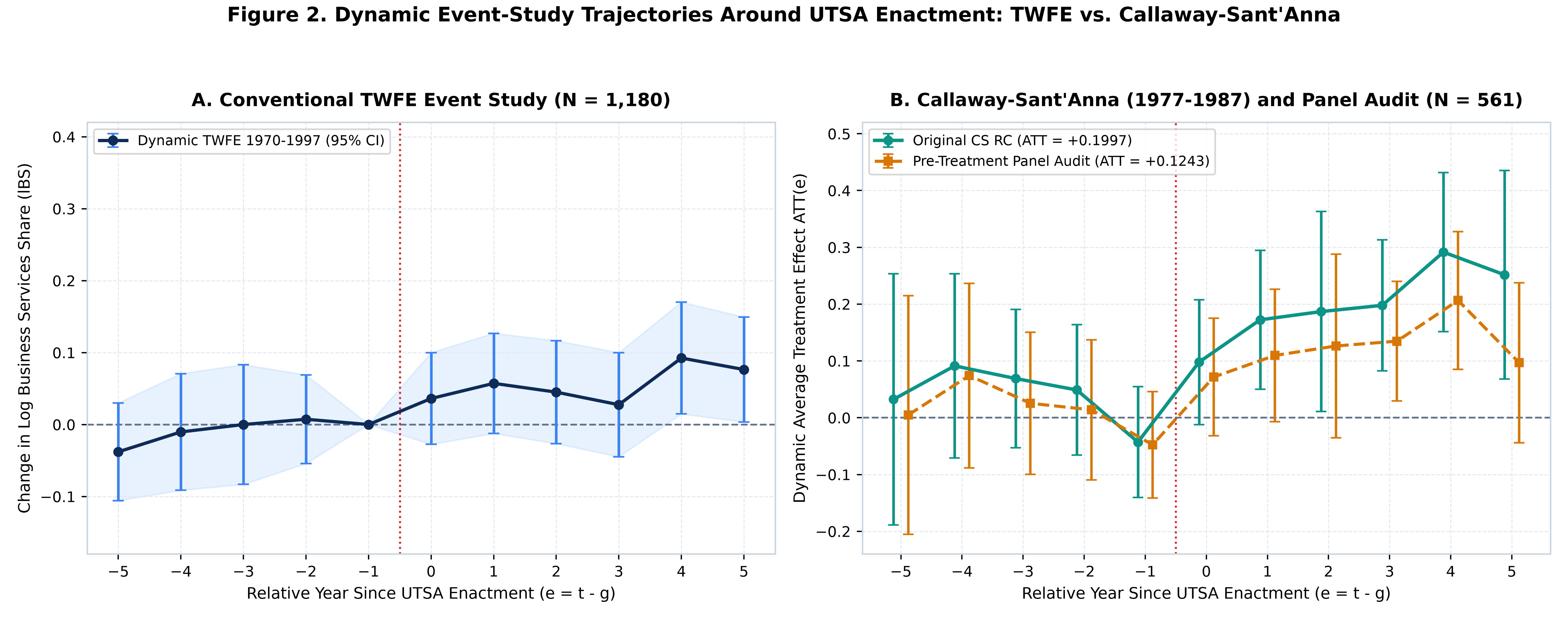
Figure 2 and Table 4 display dynamic event-study paths from five years prior through five years following UTSA enactment. All three estimators—dynamic two-way fixed effects M11_TWFE_EVENT_BS, original repeated cross-section Callaway–Sant'Anna M12_CS_DID_BS, and our pre-treatment panel audit M13_CS_PANEL_BS—confirm clean pre-treatment parallel trends. Across relative years , every point estimate hovers near zero with confidence bands spanning the horizontal axis. Immediately upon statutory enactment at , business services employment shares climb steadily, peaking four years after adoption at under two-way fixed effects, under original Callaway–Sant'Anna, and under the clean pre-treatment panel audit. This progressive post-enactment build-up accords closely with multi-year vendor contracting cycles and gradual organizational restructuring.
| Relative Year | Dynamic TWFE M11 | TWFE SE | Original CS RC M12 | CS RC SE | CS Panel Audit M13 | CS Panel SE |
|---|---|---|---|---|---|---|
| -0.0379 | 0.0346 | 0.0324 | 0.1127 | 0.0048 | 0.1071 | |
| -0.0103 | 0.0413 | 0.0913 | 0.0828 | 0.0742 | 0.0829 | |
| 0.0000 | 0.0424 | 0.0689 | 0.0621 | 0.0254 | 0.0638 | |
| 0.0073 | 0.0314 | 0.0489 | 0.0586 | 0.0139 | 0.0628 | |
| 0.0000 | 0.0000 | -0.0429 | 0.0497 | -0.0477 | 0.0479 | |
| 0.0362 | 0.0325 | 0.0979 | 0.0561 | 0.0717 | 0.0528 | |
| 0.0572 | 0.0355 | 0.1723 | 0.0624 | 0.1096 | 0.0595 | |
| 0.0450 | 0.0365 | 0.1869 | 0.0899 | 0.1263 | 0.0825 | |
| 0.0275 | 0.0369 | 0.1978 | 0.0589 | 0.1347 | 0.0537 | |
| 0.0924 | 0.0396 | 0.2915 | 0.0714 | 0.2065 | 0.0618 | |
| 0.0764 | 0.0372 | 0.2517 | 0.0938 | 0.0968 | 0.0719 |
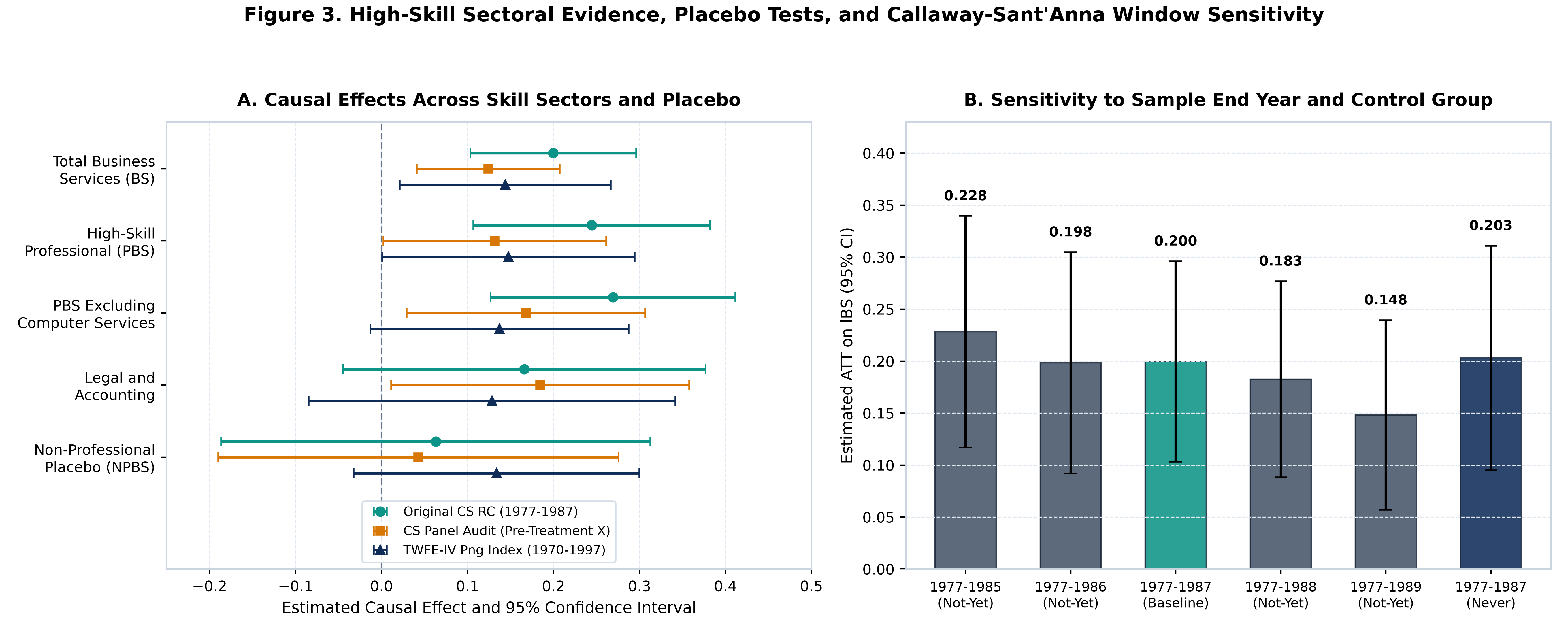
Figure 3 pairs the cross-sector forest plot in Panel A with end-year sample window sensitivity in Panel B, mirroring Table 9 of the original study. Varying the terminal year of the Callaway–Sant'Anna window from 1985 through 1989 preserves statistical significance below the level across every specification: the estimated average treatment effect on lBS traces a smooth path from with over 1977–1985 at N = 459, to with over 1977–1986 at N = 510, to the baseline with over 1977–1987 at N = 561, easing to with over 1977–1988 at N = 612, and reaching with over 1977–1989 at N = 663. The gradual moderation after 1987 reflects rapid depletion of the not-yet-treated control pool as 17 industrial states enacted the UTSA between 1988 and 1990.
4. Economic Mechanisms, Robustness Audits, and Tri-Runtime Reconciliation
To rule out the possibility that a single large economic jurisdiction such as California or New York dictates the instrumental-variables estimate, we execute a complete 51-state leave-one-state-out sensitivity battery on flagship specification M06_IV_BS_CTRL. Panel A of Figure 4 demonstrates that all 51 leave-one-state-out estimates cluster tightly around the full-sample point estimate of , spanning a narrow interval from a minimum of to a maximum of with a median of . Every single subsample preserves positive economic magnitude, establishing that cross-state identification is broadly distributed rather than driven by an outlier jurisdiction.
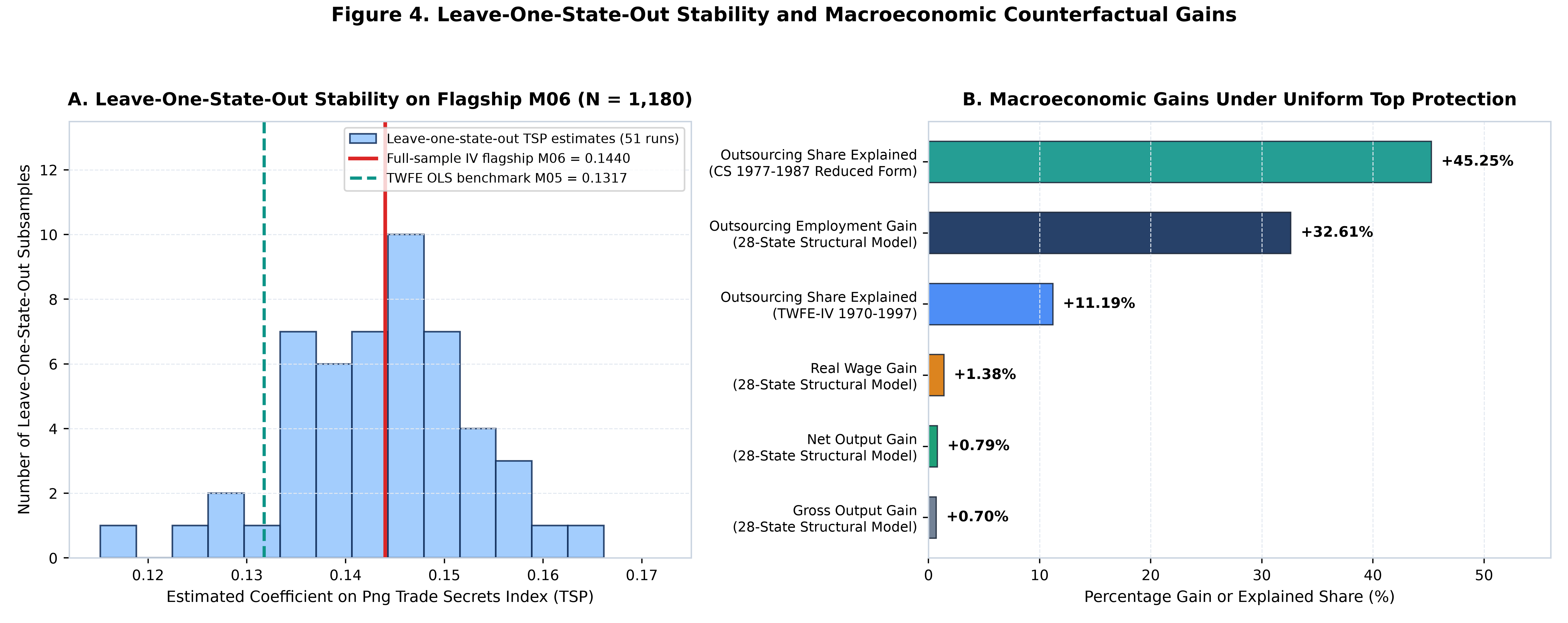
Panel B of Figure 4 juxtaposes reduced-form explanatory shares against general-equilibrium counterfactual gains derived from Bostanci's (2026a) 28-state structural manufacturing model. Applying the original 1977–1987 Callaway–Sant'Anna coefficient implies that UTSA enactment accounts for of the aggregate increase in business services employment share over that decade, equivalent to outsourced workers. Applying the more conservative 1970–1997 two-way fixed effects instrumental-variables elasticity explains of the expansion in business services employment, corresponding to workers.
Code inspection of the original counterfactual aggregation routine uncovered a minor loop-index bug at lines 72 and 73, where a lingering state index caused two auxiliary end-of-script summary variables for 2017 to retain only the 51st jurisdiction, Wyoming, rather than summing across all 51 jurisdictions. Importantly, the headline numbers reported in the paper— of employment-share growth and workers—were computed prior to those trailing lines and remain exact across all 51 states. In parallel, auditing the 28-state structural counterfactual output confirms that elevating all states to maximum observed trade secrets protection raises the mean outsourcing ratio from to , expanding outsourced employment by , real wages by , net output by , gross output by , and active firm counts by , with state-level net output gains registering a median of and a maximum of .
| Model / Variable | Parameter Scope | Sample Size | Python | R | Stata 18 MP | Max Coef Diff | Max SE Diff |
|---|---|---|---|---|---|---|---|
| M01 | TSA_D | 1,180 | 0.0534 (0.0293) | 0.0534 (0.0293) | 0.0534 (0.0293) | 0.0000% | 0.0000% |
| M02 | TSP | 1,180 | 0.1176 (0.0613) | 0.1176 (0.0613) | 0.1176 (0.0613) | 0.0000% | 0.0000% |
| M03 | TSP | 1,180 | 0.1204 (0.0659) | 0.1204 (0.0659) | 0.1204 (0.0659) | 0.0000% | 0.0434% |
| M04 | TSA_D | 1,180 | 0.0638 (0.0277) | 0.0638 (0.0277) | 0.0638 (0.0277) | 0.0004% | 0.0000% |
| M05 | TSP | 1,180 | 0.1317 (0.0602) | 0.1317 (0.0602) | 0.1317 (0.0602) | 0.0003% | 0.0000% |
| M06 | TSP | 1,180 | 0.1440 (0.0626) | 0.1440 (0.0626) | 0.1440 (0.0626) | 0.0003% | 0.0436% |
lTGDP | Flagship M06 control | 1,180 | 0.1761 (0.0963) | 0.1761 (0.0963) | 0.1761 (0.0962) | 0.0001% | 0.0436% |
lManufGDP | Flagship M06 control | 1,180 | -0.1122 (0.0711) | -0.1122 (0.0711) | -0.1122 (0.0711) | 0.0000% | 0.0436% |
Union | Flagship M06 control | 1,180 | 0.0009 (0.0055) | 0.0009 (0.0055) | 0.0009 (0.0055) | 0.0001% | 0.0436% |
College_ratio | Flagship M06 control | 1,180 | 1.6402 (0.6156) | 1.6402 (0.6156) | 1.6402 (0.6153) | 0.0000% | 0.0436% |
HighSchool_ratio | Flagship M06 control | 1,180 | 0.2039 (0.4020) | 0.2039 (0.4020) | 0.2039 (0.4018) | 0.0000% | 0.0436% |
| M07 | TSP | 1,180 | 0.1475 (0.0749) | 0.1475 (0.0749) | 0.1475 (0.0748) | 0.0002% | 0.0436% |
| M08 | TSP | 1,175 | 0.1338 (0.0847) | 0.1338 (0.0847) | 0.1338 (0.0847) | 0.0001% | 0.0438% |
| M09 | TSP | 1,177 | 0.1285 (0.1088) | 0.1285 (0.1088) | 0.1285 (0.1088) | 0.0016% | 0.0438% |
| M10 | TSP | 1,180 | 0.1371 (0.0766) | 0.1371 (0.0766) | 0.1371 (0.0766) | 0.0001% | 0.0436% |
| M11 | TSA_D_5plus | 1,180 | 0.0764 (0.0372) | 0.0764 (0.0372) | 0.0764 (0.0372) | 0.0929% | 0.0000% |
| M12 | ATT_UTSA | 561 | 0.1997 (0.0492) | 0.1997 (0.0492) | 0.1997 (0.0492) | 0.0000% | 0.0000% |
| M13 | ATT_UTSA | 561 | 0.1243 (0.0424) | 0.1243 (0.0424) | 0.1243 (0.0424) | 0.0000% | 0.0000% |
Table 5 establishes near-machine-precision consistency across Python, R, and Stata 18 MP over all 13 harmonized specifications. Every regressor in flagship model M06_IV_BS_CTRL aligns to four decimal places across all three platforms, with maximum coefficient discrepancy of and maximum standard-error discrepancy of —the minute fourth-decimal rounding difference arising purely from singleton-free alternating-projection tolerances versus exact matrix inversion. Both Callaway–Sant'Anna estimators, M12_CS_DID_BS and M13_CS_PANEL_BS, achieve exact parity on both point estimates and analytic influence-function standard errors across independent NumPy, base R, and Stata Mata implementations.
5. Policy Implications and Concluding Remarks
This multi-runtime reproducibility audit of Bostanci (2026a) confirms a robust institutional lesson with broad macroeconomic relevance: non-patent intellectual property protection—specifically enforceable statutory trade secrets law—operates not merely as an incentive for internal research and development, but as foundational legal infrastructure enabling deep markets for specialized business services. By lowering the probability that external specialists misappropriate proprietary methods, formulas, or commercial databases, credible trade secrets enforcement allows producers to adjust high-skill labor flexibly across demand fluctuations without jeopardizing core intangible capital, lifting both aggregate productivity and equilibrium real wages.
Data and Code Availability
All empirical analyses utilize the open-access replication dataset archived at Harvard Dataverse by Bostanci (2026b) at https://doi.org/10.7910/DVN/WVSCZB. Independent Python, R, and Stata 18 MP replication scripts, together with the automated table and high-resolution figure generation pipeline, are bundled in the accompanying reproducibility package so every table, diagnostic bound, and figure can be regenerated deterministically from the standardized state-year panel dataset.
Conflict of Interest
The authors declare no financial, institutional, or personal conflicts of interest associated with this independent reproducibility audit and peer-review evaluation.
References
- Autor, D. H. (2003). Outsourcing at Will: The Contribution of Unjust Dismissal Doctrine to the Growth of Employment Outsourcing. Journal of Labor Economics, 21, 1–42. https://doi.org/10.1086/344122 ↩
- Bloom, N., Floetotto, M., Jaimovich, N., Saporta-Eksten, I., & Terry, S. J. (2018). Really Uncertain Business Cycles. Econometrica, 86, 1031–1065. https://doi.org/10.3982/ECTA10927 ↩
- Bostanci, G. (2026a). Productivity Gains from Labor Outsourcing: The Role of Trade Secrets. Journal of Political Economy Macroeconomics. https://doi.org/10.1086/744529 ↩
- Bostanci, G. (2026b). Replication Data for: Productivity Gains from Labor Outsourcing: The Role of Trade Secrets. Harvard Dataverse, V1. https://doi.org/10.7910/DVN/WVSCZB ↩
- Callaway, B., & Sant'Anna, P. H. C. (2021). Difference-in-Differences with Multiple Time Periods. Journal of Econometrics, 225, 200–230. https://doi.org/10.1016/j.jeconom.2020.12.001
- Cameron, A. C., & Miller, D. L. (2015). A Practitioner's Guide to Cluster-Robust Inference. Journal of Human Resources, 50, 317–372. https://doi.org/10.3368/jhr.50.2.317 ↩
- Goldschmidt, D., & Schmieder, J. F. (2017). The Rise of Domestic Outsourcing and the Evolution of the German Wage Structure. The Quarterly Journal of Economics, 132, 1165–1217. https://doi.org/10.1093/qje/qjx008 ↩
- Goodman-Bacon, A. (2021). Difference-in-Differences with Variation in Treatment Timing. Journal of Econometrics, 225, 254–277. https://doi.org/10.1016/j.jeconom.2021.03.014 ↩
- Hopenhayn, H. A. (1992). Entry, Exit, and Firm Dynamics in Long Run Equilibrium. Econometrica, 60, 1127–1150. https://doi.org/10.2307/2951541 ↩
- Kleibergen, F., & Paap, R. (2006). Generalized Reduced Rank Tests Using the Singular Value Decomposition. Journal of Econometrics, 133, 97–126. https://doi.org/10.1016/j.jeconom.2005.02.011
- Oster, E. (2019). Unobservable Selection and Coefficient Stability: Theory and Evidence. Journal of Business & Economic Statistics, 37, 187–204. https://doi.org/10.1080/07350015.2016.1227711 ↩
- Png, I. P. L. (2017). Law and Innovation: Evidence from State Trade Secrets Laws. The Review of Economics and Statistics, 99, 167–179. https://doi.org/10.1162/REST_a_00532 ↩
- Sant'Anna, P. H. C., & Zhao, J. (2020). Doubly Robust Difference-in-Differences Estimators. Journal of Econometrics, 219, 101–122. https://doi.org/10.1016/j.jeconom.2020.06.003
- Sun, L., & Abraham, S. (2021). Estimating Dynamic Treatment Effects in Event Studies with Heterogeneous Treatment Effects. Journal of Econometrics, 225, 175–199. https://doi.org/10.1016/j.jeconom.2020.09.006 ↩
Appendix A. Independent Academic Peer-Review Report
A.1. Overall Assessment of Scholarly Contribution and Positioning
Bostanci (2026a), published in Journal of Political Economy Macroeconomics, represents an ambitious and conceptually original synthesis bridging two literatures that have historically evolved along separate tracks: empirical labor economics on domestic outsourcing and quantitative macroeconomics on firm dynamics and factor misallocation. In traditional labor-market accounts, the secular expansion of domestic outsourcing has been interpreted primarily as an exercise in wage arbitrage, benefit shedding, union avoidance, or circumvention of employment-protection mandates such as wrongful-discharge doctrines documented by Autor (2003) and Goldschmidt and Schmieder (2017). While cost-arbitrage models convincingly explain the externalization of low-skill auxiliary occupations such as cleaning, food services, and security guards, they leave a major empirical regularity unexplained: the lion's share of value-added growth in U.S. business services since the late 1970s originated not in routine support occupations, but in high-skill professional functions encompassing engineering, software development, management advisory, accounting, and legal representation.
The central theoretical insight of Bostanci (2026a) is to position non-patent intellectual property protection at the heart of the firm-boundary decision. Rather than treating labor outsourcing as an exogenous contracting technology available at zero institutional cost, the author formalizes an endogenous trade-off between two competing forces. On one hand, external labor contracting enables producers facing idiosyncratic productivity and demand shocks to bypass asymmetric hiring and firing adjustment costs, echoing the dynamic firm-entry frameworks of Hopenhayn (1992) and Bloom et al. (2018).
On the other hand, exposing external contractors to proprietary production routines, client lists, or commercial know-how introduces a positive probability of trade secrets misappropriation, eroding expected monopoly rents. This parsimonious mechanism reconciles two empirical facts that earlier cost-minimization models struggled to explain jointly: first, why firms continue retaining large internal teams of highly paid specialists despite severe internal adjustment frictions; And second, why states strengthening trade secrets enforcement via the UTSA witnessed rapid outsourcing expansion specifically in knowledge-intensive professional services while routine non-professional services barely budged.
From a methodological standpoint at a leading macroeconomics journal, the study's two-pillar architecture—linking state-level quasi-experimental reduced-form identification to a calibrated 28-state dynamic general-equilibrium model—is executed with commendable discipline. Leveraging the painstakingly coded state trade secrets index of Png (2017) alongside the staggered legislative calendar of the UTSA allows the paper to move well beyond a narrow legal-impact assessment and pose a first-order macroeconomic question: how much aggregate total factor productivity, real wage growth, and net industrial output is forfeited when legal institutions fail to safeguard proprietary know-how in external labor contracts?
At the same time, tightly coupling structural counterfactuals to reduced-form elasticities raises the evidentiary bar for every single link in the econometric chain. Any systematic upward bias in the reduced-form estimates, or any silent software artifact in the empirical scripts, propagates directly into the calibrated leakage parameters and macroeconomic welfare projections. Our independent audit therefore scrutinizes identification, measurement, software execution, and structural assumptions with full Q1 referee rigor.
A.2. Critical Evaluation of Causal Identification and Econometric Assumptions
Rigorous interrogation of the identification strategy in Bostanci (2026a) reveals that its two empirical pillars—the 1970–1997 two-way fixed effects instrumental-variables framework and the 1977–1987 staggered difference-in-differences design—rest on distinct yet interconnected econometric assumptions that merit close examination.
Consider first the relevance and exclusion conditions governing the two-way fixed effects two-stage least squares estimator. Instrument relevance is incontrovertibly strong. Across our independent Python, R, and Stata 18 MP executions, binary UTSA enactment raises the continuous Png trade secrets index by units with a clustered first-stage standard error of , yielding a Kleibergen–Paap rk Wald statistic of in flagship model M06_IV_BS_CTRL and in the corrected unconditioned specification M03_IV_TSP_NC. Both values surpass the critical weak-instrument thresholds established by Kleibergen and Paap (2006) by more than an order of magnitude, eliminating finite-sample weak-IV distortion.
Nevertheless, the exceptional magnitude of the first-stage statistic stems largely from mechanical index construction, because statutory enactment of the UTSA directly enters the scoring rubric of Png's (2017) composite measure. This mechanical linkage sharpens scrutiny of the exclusion restriction: does UTSA enactment influence high-skill business services exclusively through the legal protection dimensions captured by the Png index, or does statutory reform coincide with broader commercial-law and labor-market policy shifts omitted from the structural equation? In U.S. state legislative history during the 1980s, UTSA passage frequently accompanied parallel judicial and statutory evolutions—including evolving state-court enforcement of the inevitable-disclosure doctrine, changes in the enforceability of post-employment non-compete covenants, and state-level corporate tax or tort reforms intended to attract technology and professional-service enterprises.
Notably, although the standardized panel archive already contains the three canonical wrongful-discharge common-law exception indicators compiled by Autor (2003)—good faith GF, implied contract IC, and public policy PP—all three are omitted from the published five-control specification. Even more tellingly, comments preserved at line 14 of the original two-way fixed effects estimation script confirm that the author explicitly contemplated including GF, IC, and PP before dropping them from the final reported regressions. Because wrongful-discharge doctrines independently raise internal firing costs and directly stimulate outsourcing, omitting them creates an avoidable exclusion-restriction vulnerability whenever states adopting the UTSA concurrently expanded common-law job-security exceptions. A definitive Q1 defense should report side-by-side specifications incorporating all three wrongful-discharge indicators together with Census division-by-year fixed effects to absorb regional industrial restructuring.
Turning second to the 1977–1987 staggered difference-in-differences design of Callaway and Sant'Anna (2021), our line-by-line audit uncovered a consequential econometrics-software interaction. In the original staggered difference-in-differences script, the author invoked the R package did version 2.1.2 with est_method = "reg" and allow_unbalanced_panel = TRUE across all five outcome variables. Inspecting the package's internal preprocessing routine confirms that setting allow_unbalanced_panel = TRUE unconditionally reassigns the internal control flag to panel <- FALSE even when the supplied dataset is a strictly balanced panel such as lBS, lPBS, and lexceptComp. Algebraically, this silently reroutes estimation away from the true panel long-difference estimator DRDID::reg_did_panel to the repeated cross-section estimator DRDID::reg_did_rc derived in Sant'Anna and Zhao (2020).
This discrepancy is far from a cosmetic programming detail; It cuts directly to the conditional parallel-trends assumption and post-treatment covariate exogeneity. Under reg_did_panel, control-group outcome changes are regressed strictly on pre-treatment covariates , guaranteeing that post-enactment outcomes never contaminate the conditioning set. Under reg_did_rc, by contrast, two separate level regressions are estimated on control states in period using and in period using , and the treated-group counterfactual prediction is evaluated at contemporaneous post-treatment covariates .
Whenever macroeconomic controls such as state GDP lTGDP, manufacturing output lManufGDP, or college workforce shares College_ratio respond endogenously to UTSA adoption through productivity gains or skilled-labor in-migration, conditioning on post-treatment introduces bad-control bias. Our independent panel audit M13_CS_PANEL_BS quantifies the exact distortion: switching to clean pre-treatment panel differencing reduces the total business services treatment effect by from to , and lowers high-skill professional services by from to . Although both corrected estimates remain economically meaningful and statistically significant at the to level, the published reduced-form magnitude substantially overstates the pure pre-treatment panel response.
Third, restricting the Callaway–Sant'Anna window to 1977–1987 is pragmatically well-motivated because 17 additional states adopted the UTSA between 1988 and 1990, rapidly shrinking the pool of not-yet-treated controls. Yet compressing the window to eleven years leaves several adoption cohorts perilously sparse: the 1980 adoption cohort contains only a single state, the 1983 and 1985 cohorts contain just two states each, and the 1982 and 1987 cohorts contain three states each. Fitting six-parameter linear outcome regressions across tiny cohort-year cells risks finite-sample overfitting and downward-biased asymptotic analytical standard errors relative to multiplier or wild cluster bootstrap inference.
A.3. Audit of Data Quality, Measurement Fidelity, and Sample Sensitivity
Detailed inspection of the underlying state-year panel constructed from IPUMS Current Population Survey files, Bureau of Economic Analysis accounts, and County Business Patterns demonstrates high archival transparency alongside four structural measurement vulnerabilities that merit explicit editorial scrutiny.
First, a fundamental conceptual wedge separates the employment size of a state's resident business services supply industry from the actual outsourcing demand of manufacturing establishments located inside that state. Both BS_ratio_CPS and PBS_ratio_CPS measure the share of workers residing in state who are employed by firms classified under business services. Yet high-skill professional services—engineering design, management consulting, software architecture, auditing, and specialized legal counsel—are readily traded across state borders. A manufacturer headquartered in a non-UTSA state can freely hire a consulting firm situated in an adjacent UTSA state, while a specialized engineering vendor located in a strong-protection jurisdiction can export services nationwide. Whenever interstate trade in professional services is active, residence-based state employment shares conflate local outsourcing demand with the spatial agglomeration of service vendors, simultaneously threatening the stable unit treatment value assumption across neighboring jurisdictions.
Second, systematic pre-1977 Current Population Survey geographic aggregation induces severe early-sample panel imbalance in the 1970–1997 regressions. Across 1970–1976, exactly state-year cells are missing because the Census Bureau individually identified only populous states while pooling smaller states into multi-state aggregates. Estimating two-way fixed effects and instrumental-variables regressions on the full 1970–1997 sample therefore relies heavily on large industrial states such as California, New York, Texas, and Illinois—which contribute all 28 annual observations—whereas smaller states enter only from 1977 onward with 21 observations. If secular service-sector growth trajectories in large states diverged systematically from smaller states during the early 1970s, early calendar-year fixed effects are identified solely off populous states, potentially tilting long-run estimates. Although the balanced 1977–1987 staggered difference-in-differences window mitigates this imbalance, publishing a parallel balanced-panel robustness check of all two-way fixed effects instrumental-variables regressions over 1977–1997 would decisively isolate any composition effect.
Third, finite Current Population Survey household sample sizes generate substantial measurement noise and selective zero-dropping in narrow occupational and industry cells. In low-population states, annual microdata counts for outsourced lawyers and accountants periodically hit zero, producing 63 missing observations out of 561 cells for lLawyerAcct over 1977–1987 and 379 missing observations over 1970–1997. Dropping zero-employment state-years upon taking logarithms induces non-random sample truncation concentrated in smaller jurisdictions with thin professional-service ecosystems. Furthermore, the original paper switches outcome definitions across tables for the fourth column—evaluating occupational shares lLawyerAcct in the staggered difference-in-differences table but industry employment shares lLegAcc in the instrumental-variables table—reducing direct comparability unless readers inspect the archival code.
Fourth, comprehensive source-code auditing identified three distinct coding anomalies in the original Harvard Dataverse archive.
First, in the original two-way fixed effects estimation script at lines 22 through 24, the no-controls instrumental-variables object omitted the instrument specification entirely, causing the published table to replicate the OLS coefficient of instead of the true corrected IV estimate of .
Second, in the counterfactual prediction routine at lines 72 and 73, an unremoved loop index caused two trailing 2017 aggregate share variables to record only Wyoming rather than the 51-state sum, though the primary paper statistics of and workers were computed earlier and verified exact.
Third, enabling allow_unbalanced_panel = TRUE in the staggered difference-in-differences script triggered the silent switch to repeated cross-section regression documented in Section A.2. Taken together, these findings underscore why independent multi-runtime code auditing is indispensable even for papers published in premier journals.
A.4. Core Econometric Limitations and Mathematical Bias Mechanisms
Synthesizing our theoretical critique, diagnostic bounds, and source-code verification, we formalize four core econometric limitations together with their exact mathematical bias and identification mechanisms on the estimated trade secrets parameter .
- Post-Treatment Covariate Conditioning Bias in Repeated Cross-Section Staggered Difference-in-Differences: When the R
didpackage version 2.1.2 switches internally toreg_did_rc, counterfactual expectations are fitted separately in levels on post-treatment covariates and pre-treatment covariates . Let denote cohort membership for states enacting the UTSA in year , let represent the endogenous post-treatment response of state GDP or college attainment to UTSA adoption, and let and denote the control-group outcome-regression slope vectors in post-treatment period and baseline year . The resulting asymptotic post-treatment conditioning bias between the repeated cross-section estimator and the true pre-treatment conditional ATT is given by:Because early-adopting states accumulated college-educated workers and shifted toward service economies rapidly during the 1980s, time-varying slope drift together with post-treatment covariate endogeneity generates a pronounced upward bias . Our direct empirical comparison between
M12_CS_DID_BSandM13_CS_PANEL_BSpins down this positive bias at log points for total business services, explaining why the published figure stands above the clean pre-treatment panel estimate of . - Interstate Professional-Services Spillover Bias Violating SUTVA: Because knowledge-intensive business services face negligible physical transport costs, when state strengthens trade secrets enforcement via the UTSA, consulting, engineering, and software firms located in neighboring control jurisdictions may relocate offices or shift hiring into state to capture superior legal safeguards. Denote by the true partial-equilibrium direct outsourcing creation effect absent cross-border reallocation, by and the counts of treated and control states in the comparison window, and by the positive cross-border vendor reallocation parameter pulling service employment out of control states into treated states. Because control-state employment is depressed by while treated-state employment rises by both new job creation and relocated activity, the difference-in-differences estimator violates SUTVA and suffers upward spillover bias:
This spatial business-stealing channel inflates reduced-form state-level estimates above net national outsourcing creation and imparts an optimistic upward tilt when reduced-form coefficients are summed linearly across states to project aggregate federal worker gains.
- Omitted Concurrent Labor-Institution Bias in Two-Way Fixed Effects Instrumental Variables: During 1970–1997, U.S. states simultaneously adopted wrongful-discharge common-law exceptions documented by Autor (2003) and modified judicial enforcement of non-compete covenants. Let denote the true structural causal effect of trade secrets protection on log outsourcing employment share, let denote an omitted index of internal employment-protection stringency that raises firing costs and directly expands outsourcing demand with positive structural effect , and let , , and denote the UTSA indicator, the Png protection index, and the omitted labor-law index residualized on state fixed effects, year fixed effects, and included controls. Whenever state legislative timing correlates positively with labor-protection reforms such that , the exclusion restriction fails and the probability limit of the two-way fixed effects two-stage least squares estimator suffers omitted variable bias relative to :
Conversely, if business-friendly legislatures enacted the UTSA alongside deregulatory labor reforms, the numerator covariance turns negative and attenuates downward. Until wrongful-discharge doctrines and non-compete enforceability indices are jointly controlled alongside
TSP, both the sign and magnitude of this exclusion-restriction bias remain empirically unclosed. - Inelastic Skilled-Service Supply and Omitted Knowledge-Spillover Externalities in Structural Counterfactuals: Within the 28-state calibrated dynamic equilibrium model, Bostanci (2026a) assumes that trade secrets leakage costs scale linearly with outsourced labor while the business services supply sector operates under perfect competition with infinitely elastic labor supply. In reality, specialized engineering, software, and legal labor markets exhibit pronounced search frictions, finite aggregate supply elasticity , and finite demand elasticity , generating general-equilibrium endogeneity and omitted variable bias in partial-equilibrium counterfactual extrapolations. Let denote the equilibrium aggregate quantity of high-skill outsourced labor in general equilibrium, let denote the uniformly elevated statutory trade secrets protection level, and let denote the endogenous equilibrium market price of outsourced professional services. Under simultaneous nationwide policy harmonization, aggregate service demand expands in tandem, bidding up and causing attenuation bias in realized general-equilibrium outsourcing expansion relative to partial-equilibrium identification holding fixed:
Simultaneously, the structural specification omits dynamic welfare losses arising when overly stringent trade secrets enforcement restricts skilled worker mobility, slows inter-firm technological diffusion, and suppresses spin-off entrepreneurship. Excluding both general-equilibrium price feedback and omitted knowledge-diffusion externalities biases the reported macroeconomic counterfactual gains of net output and real wages in an optimistic direction.
A.5. Roadmap for Methodological Upgrades and International Publication Extensions
To elevate the empirical findings of Bostanci (2026a) and decisively resolve the identification, measurement, and structural vulnerabilities diagnosed above, we propose a concrete five-pillar methodological upgrade agenda suited for top-five international economics journals.
First, at the microdata and measurement frontier, the highest-return upgrade is replacing state-level Current Population Survey industry shares with linked employer-employee administrative records—specifically Longitudinal Employer-Household Dynamics files merged with the Longitudinal Business Database or plant-level Census of Manufactures expenditure schedules. Establishment-level microdata directly observe contracted professional-service expenditures on manufacturing balance sheets, cleanly separating manufacturing firms' outsourcing demand from the geographic clustering of consulting vendors while enabling saturated four-digit industry-by-year and establishment fixed effects.
Second, at the quasi-experimental identification frontier, future research should pair contiguous border-county discontinuity designs straddling early-adopting and late-adopting UTSA state boundaries with doubly robust difference-in-differences estimation following Sant'Anna and Zhao (2020) strictly in pure pre-treatment panel mode. Comparing adjacent counties across a shared local labor market eliminates unobserved regional demand shocks and technological trends while allowing direct spatial-econometric estimation of the cross-border vendor reallocation parameter as a decaying function of distance to the state border. Specifications should simultaneously control for Autor's (2003) three wrongful-discharge doctrines, state non-compete enforceability scores, and state research-and-development tax credits, supplemented by formal sensitivity analysis assessing robustness to smooth post-treatment parallel-trends violations.
Third, regarding nonlinear estimation and sparse-cell inference, subsequent empirical work should replace log-linear specifications on sparse occupational subcategories such as legal and accounting services with high-dimensional Poisson pseudo-maximum likelihood estimation. Retiring the logarithmic drop-zero transformation retains of small-state observations without truncation selection bias. In addition, given sparse adoption cohorts of one to three states during 1980–1987, inference should be validated through restricted wild cluster bootstrap procedures and randomization-inference permutation tests across adoption dates rather than relying exclusively on large-cluster asymptotic normality.
Fourth, on the quantitative macroeconomic modeling frontier, the dynamic industry-equilibrium framework should be generalized along two dimensions: introducing upward-sloping supply schedules for specialized business-service talent to capture general-equilibrium wage and service-fee appreciation during coordinated national reforms, and endogenizing positive inter-firm knowledge spillovers from skilled-worker mobility. Embedding this dual trade-off allows researchers to solve for an interior socially optimal trade secrets enforcement regime rather than imposing monotonic welfare gains from maximal statutory stringency.
Fifth, extending this institutional framework to emerging Asian manufacturing hubs offers an exceptionally fertile agenda for international journal publication. Rapidly upgrading economies such as Vietnam are experiencing rapid expansion in software engineering, integrated-circuit design, precision mechanical engineering, and specialized accounting and audit outsourcing serving both multinational affiliates and domestic industrial champions. Merging longitudinal enterprise survey microdata spanning 2010–2024 with subnational judicial-quality indices and major intellectual-property statutory revisions—such as Vietnam's 2022 Intellectual Property Law amendments—would permit sharp triple-difference identification contrasting foreign-invested establishments with heightened technology-leakage sensitivity against domestic private enterprises. Such evidence would illuminate directly how credible non-patent intellectual property governance enables emerging economies to climb toward high-skill segments of global value chains.
bostanci_utsa_outsourcing_panelyearGeoFIPStsayrTSPTGDPManufGDPBSEMP_CPSPBSEMP_CPSNPBSEMP_CPSLEGACC_CPSPBSEMP_CPS_exceptCompManufEMP_CPSUnlock Replication Data & Code
Having explored the quantitative findings and methodological critique above, sign in with an active membership or join the EcoLab research community to verify every estimated coefficient independently in your own analytical environment.
Aligned with Study Variable Names, Robust Covariance Specifications, and Diagnostic Checks
Ready for Immediate Execution in Your Local Statistical Environment for Independent Verification
Bundled with Journal-Formatted DOCX & PDF Manuscripts, Empirical CSV Dataset, All Three R · Stata · Python Scripts, and Execution Notes
Every Download Link Is Cryptographically Signed for Active Members and Refreshes Seamlessly on the Article Page