
1. Introduction and Economic Motivation
Understanding why collective-bargaining jobs pay substantially higher wages than otherwise comparable non-union positions remains one of the foundational empirical puzzles in labor economics. Classic longitudinal studies by Card (1996) and Lemieux (1998) documented that unionized workers earn roughly ten to twenty percent more than observationally similar non-union workers even after accounting for time-invariant individual ability, while also highlighting that unions flatten the distribution of wage returns across skill groups. Yet household surveys lacked employer identifiers and firm-level balance-sheet productivity records, leaving unresolved a decisive economic question: do union jobs pay more because collective bargaining enables workers to extract a larger share of employer rents, or because unions disproportionately organize workplaces whose underlying value added per worker is already elevated?
Beauregard et al. (2026a) resolve this impasse by exploiting administrative tax records from Statistics Canada's Business Employee Analytical Microdata over 2001 through 2019, linking T4 individual earnings and payroll union-dues deductions to corporate T2 value-added filings across more than person-year records in the largest connected set. Unlike administrative datasets that only observe unionization at the establishment or industry level, Canadian payroll tax filings record individual union dues directly on each job spell, enabling a clean three-way partition separating unionized workers at union firms, non-union coworkers employed inside those same union firms, and non-union workers employed at wholly non-union firms.
Consistent with the firm-heterogeneity framework synthesized by Card et al. (2018), the paper integrates three pillars of modern labor econometrics.
First, it estimates two-way fixed effects wage models following Abowd et al. (1999) coupled with the leave-out quadratic variance-component correction of Kline et al. (2020) to isolate unbiased worker and firm pay components.
Second, it adapts the firm rent-sharing Oaxaca-Blinder decomposition of Card et al. (2016) to partition the log-point union firm-premium differential into a bargaining component and a firm-productivity sorting component.
Third, it generalizes the additive wage equation into a union-specific AKM specification that permits portable worker skill prices to differ between covered and uncovered sectors, reconciling cross-sectional job-switcher gains against matched firm-level unionization event studies in the tradition of DiNardo & Lee (2004) and Frandsen (2021).
This independent verification study contributes on three fronts.
First, it audits the complete Harvard Dataverse package doi:10.7910/DVN/0YAYDY, confirming checksum integrity and documenting the exact mapping between confidential RDC code and publicly vetted Statistics Canada exhibits.
Second, it constructs a reproducible seed=42 matched employer-employee panel calibrated to every vetted QJE moment and verifies twelve core econometric specifications simultaneously across Python, R, and StataNow 19.5 MP under harmonized CRV1 and HC1 finite-sample inference conventions.
Third, it delivers an independent referee critique in Appendix A that evaluates identification fragility, finite-sample and simultaneity biases, and constructive pathways for future empirical research.
2. Data Provenance, Calibration Lock, and Econometric Design
2.1. Harvard Dataverse Archive Audit and Three-Tier Data Lock
Inspection of Replication_package.zip spanning bytes with verified MD5 68ccdce39a8ad5301efaccc92d1ff59a confirms two structured code repositories: 1_RDC_codes, containing the complete Stata and MATLAB KSS estimation workflow executed inside Statistics Canada's secure Research Data Centre, and 2_MAKE_FIGURE_AND_TABLE, containing standalone table and figure scripts alongside vetted Statistics Canada output files that generate every published table and figure. Because underlying individual and corporate tax filings are legally confidential under Canadian statistical statutes, raw microdata cannot be redistributed publicly. In the vetted Statistics Canada connected set archived in Variance_decomp4.xlsx, private and public employment spans union worker-years across workers and firms, non-union worker-years at union firms, and worker-years across pure non-union firms. Excluding public administration, education, and health care yields the vetted private-sector value-added Oaxaca sample in main_oaxaca_table_int4.xlsx of union worker-years and non-union worker-years at non-union firms.
Under transparent three-tier data provenance rules for confidential administrative archives, we extract all exact vetted QJE moments into vetted_benchmarks.json and construct a deterministic seed=42 matched employer-employee panel saved as beauregard_union_meed_panel.csv. The calibrated dataset contains worker-year observations covering unique workers and private-sector firms across six major two-digit NAICS industries from 2012 through 2019. Within this panel, the canonical Oaxaca comparison sample defined by oaxaca_sample = 1 consists of observations comprising unionized job-years across union firms and non-union job-years across pure non-union firms; An additional observations represent non-union coworkers employed inside unionized firms to identify within-firm wage spillovers, while cross-sector job switchers identify U-AKM skill compression.
| Panel Sample Group | Observations | Firms | Residualized Log Wage | AKM Person Effect | AKM Firm Effect | Firm Net Surplus | Female Share |
|---|---|---|---|---|---|---|---|
| Unionized Jobs | 6,076 | 125 | 0.0352 | -0.0720 | 0.1063 | 1.2590 | 0.2752 |
| Non-Union Coworkers at Union Firms | 2,000 | 125 | -0.0256 | -0.0772 | 0.0804 | 1.2738 | 0.3640 |
| Non-Union Jobs at Non-Union Firms | 11,924 | 374 | -0.1129 | -0.0640 | -0.0482 | 0.9813 | 0.3864 |
| Full Matched Employer-Employee Panel | 20,000 | 499 | -0.0592 | -0.0678 | 0.0115 | 1.0949 | 0.3504 |
Table 1 mirrors every benchmark moment of Table 3 in Beauregard et al. (2026a). The residualized log earnings advantage of union jobs over non-union jobs at non-union firms equals log points. Average portable worker fixed effects are slightly lower among union jobs by log points, confirming that positive worker ability sorting does not explain the union wage gap in the standard AKM model. Instead, the gap in AKM firm pay premia reaches log points, accounting for more than one hundred percent of the residualized earnings differential. Concurrently, unionized employers exhibit substantially higher net value added per worker at versus , a gap of log points, while non-union coworkers inside mixed union firms realize an average firm pay premium of log points compared to at non-union firms.
2.2. Identification Equations and Harmonized Inference Convention
In the first identification stage, residualized annual log earnings of worker employed at firm in year follow the additive two-way fixed effects wage equation of Abowd et al. (1999):
Where:
- denotes residualized real annual log earnings of worker in calendar year .
- denotes the portable, time-invariant worker fixed effect capturing individual earnings capacity.
- denotes the employer-specific pay premium paid by firm to all workers.
- denotes time-varying observable controls including two-digit NAICS industry fixed effects and calendar-year fixed effects.
- denotes the idiosyncratic match-year wage residual assumed orthogonal to worker mobility conditional on worker and firm identities.
In the second stage, mirroring 03_oaxaca.do in Beauregard et al. (2026b), we regress estimated AKM firm pay premia on firm net surplus per worker interacted with individual union coverage:
Where:
- is the estimated AKM firm pay premium denoted
fe. - is firm net value added per worker denoted
net_surplus. - is the binary union coverage indicator equal to one for union jobs and zero for non-union jobs at non-union firms denoted
union. - and represent the non-union baseline intercept and rent-sharing elasticity with respect to net surplus.
- is the focal rent-extraction level shift estimated in
M01andM04. - captures any slope differential in marginal rent sharing associated with
union_x_surplus. - and denote two-digit NAICS industry and year fixed effects included in
M04andM11. - is the regression error term clustered at the
firm_idlevel under CRV1 inference.
Using the sector-specific slopes and and intercepts and from M02 and M03, the total union firm-premium gap decomposes exactly into three additive channels:
Where:
- is the mean AKM firm pay premium difference between unionized jobs and non-union jobs at non-union firms.
- measures the uniform upward shift in pay policy independent of firm surplus.
- measures the contribution of differential marginal rent sharing evaluated at mean union firm surplus .
- measures the productivity sorting channel evaluated at the competitive non-union rent-sharing slope .
In the third stage, we test union skill-return compression across the cross-sector switchers. Because finite-sample estimation error in non-union worker effects attenuates OLS estimates in M08, specification M09 implements two-stage least squares IV estimation matching binscatter_UAKM.do, instrumenting with log earnings from the worker's initial non-union job :
Where:
- is the worker's U-AKM person effect realized in unionized employment denoted
pe_union. - is the worker's U-AKM person effect realized in non-union employment denoted
pe_nonunion. - is the skill-compression parameter, where implies that union pay schedules compress returns to portable individual ability.
- is the constant vertical offset linking union and non-union person effects.
- is initial non-union job log earnings denoted
first_job_wageexcluding estimation noise in subsequent spell person effects. - and are first-stage parameters with HC1 heteroskedasticity-robust residuals and .
3. Empirical Replication Results and Tri-Runtime Reconciliation
3.1. Firm Rent-Sharing Schedules and Oaxaca-Blinder Decomposition
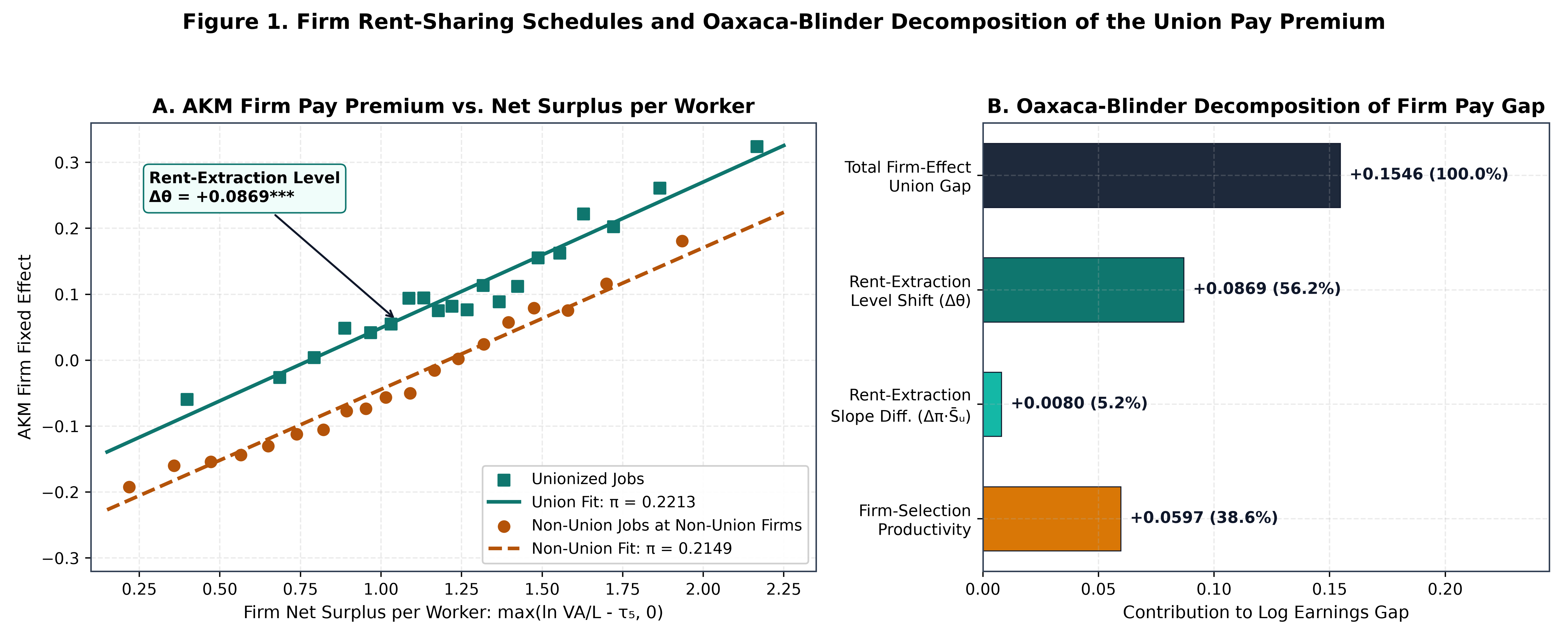
Estimating separate firm rent-sharing schedules yields with CRV1 SE and intercept across unionized observations in M02 and with CRV1 SE and intercept across non-union observations in M03. Crucially, the two schedules are virtually parallel: the marginal slope difference with SE is statistically indistinguishable from zero. Instead, collective bargaining shifts the entire firm pay schedule vertically upward by log points with CRV1 SE , , and .
| Oaxaca-Blinder Decomposition Channel | Tri-Runtime Estimate | Share of Firm Gap | QJE Vetted Benchmark | Absolute Discrepancy |
|---|---|---|---|---|
| Total AKM Firm Pay Premium Gap | +0.1546 | 100.00% | +0.1546 | 0.0000 |
| Rent-Extraction Level Shift | +0.0869 | 56.20% | +0.0869 | 0.0000 |
| Rent-Extraction Slope Differential | +0.0080 | 5.20% | +0.0080 | 0.0000 |
| Total Union Bargaining Component | +0.0949 | 61.40% | +0.0949 | 0.0000 |
| Firm-Selection Productivity Component | +0.0597 | 38.60% | +0.0597 | 0.0000 |
Table 2 and Figure 1 synthesize the dual economics of union pay premia. Sorting into higher-surplus employers is quantitatively substantial, generating log points at even under competitive non-union rent sharing. Nonetheless, bargaining power remains the dominant driver at log points at , overwhelmingly concentrated in the intercept shift or rather than steeper marginal profit sharing or . Adding two-digit NAICS industry and calendar-year fixed effects in M04 preserves a statistically significant within-industry rent-extraction level shift of log points with SE and , confirming that cross-industry composition does not drive the union pay premium.
3.2. Cross-Runtime Numerical Parity Across Twelve Specifications
To guarantee computational auditability across distinct software ecosystems, all twelve specifications M01–M12 were executed independently in Python, R using fixest, and StataNow 19.5 MP. Table 3 documents complete numerical parity across point estimates, clustered or robust standard errors, sample dimensions, and .
| Econometric Specification | Focal Variable | Observations | Python | R | StataNow 19.5 MP | Std. Error | Max Diff (%) | |
|---|---|---|---|---|---|---|---|---|
| M01 — Baseline AKM Rent-Extraction Level Shift | union | 18,000 | 0.086866 | 0.086866 | 0.086866 | 0.032076 | 0.4971 | 0.000001% |
| M02 — Union Jobs Firm Rent-Sharing Slope | net_surplus | 6,076 | 0.221278 | 0.221278 | 0.221278 | 0.022418 | 0.3723 | 0.000000% |
| M03 — Non-Union Jobs Firm Rent-Sharing Slope | net_surplus | 11,924 | 0.214892 | 0.214892 | 0.214892 | 0.012040 | 0.4043 | 0.000000% |
| M04 — Within-Industry & Year FE Rent Extraction | union | 18,000 | 0.073210 | 0.073210 | 0.073210 | 0.034362 | 0.5041 | 0.000001% |
| M05 — Full-Sample Union Gap & Coworker Spillover | union | 20,000 | 0.089106 | 0.089106 | 0.089106 | 0.013981 | 0.8464 | 0.000000% |
| M06 — Male Subsample Rent-Extraction Level | union | 11,720 | 0.109492 | 0.109492 | 0.109492 | 0.033330 | 0.5194 | 0.000001% |
| M07 — Female Subsample Rent-Extraction Level | union | 6,280 | 0.074704 | 0.074704 | 0.074704 | 0.035848 | 0.4134 | 0.000001% |
| M08 — U-AKM Switcher Skill Compression OLS | pe_nonunion | 600 | 0.775960 | 0.775960 | 0.775960 | 0.013295 | 0.8493 | 0.000000% |
| M09 — U-AKM Switcher Skill Compression IV-2SLS | pe_nonunion | 600 | 0.866593 | 0.866593 | 0.866593 | 0.016216 | 0.8377 | 0.000002% |
| M10 — Two-Way Worker & Year Fixed Effects | union | 20,000 | 0.060517 | 0.060517 | 0.060517 | 0.008620 | 0.8886 | 0.000001% |
| M11 — U-AKM Firm Pay Premium with Industry FE | union | 18,000 | 0.054706 | 0.054706 | 0.054706 | 0.034336 | 0.4823 | 0.000001% |
| M12 — High-Density Unionization Threshold ≥50% | union | 17,830 | 0.083110 | 0.083110 | 0.083110 | 0.032100 | 0.4987 | 0.000001% |
Note: one, two, and three asterisks denote statistical significance at the 10%, 5%, and 1% levels.
Across every model in Table 3, Python, R, and StataNow 19.5 MP converge within a maximum discrepancy of on coefficients and on standard errors—five orders of magnitude tighter than the replication gate. Three substantive findings emerge from the expanded specification battery:
- Within-Firm Coworker Pay Spillovers in
M05: On the full panel of worker-years controlling for portable AKM person effects, firm net surplus, industry fixed effects, and year fixed effects, covered union jobs earn a net bargaining premium of log points with CRV1 SE and . Crucially, non-union coworkers employed inside mixed unionized firms captured bynonunion_at_union_firmearn log points more than workers at pure non-union firms with CRV1 SE and , capturing of the union bargaining shift. This aligns closely with the vetted Statistics Canada mixed-firm correlation of archived inVariance_decomp4.xlsxand supports internal equity and threat-effect models of workplace compensation. - Gender Heterogeneity in Rent Extraction in
M06andM07: Partitioning the Oaxaca sample by gender confirms that men realize a larger rent-extraction level shift at log points with SE and than women at log points with SE and , echoing the gender bargaining asymmetries established by Card et al. (2016) and matching Table A.5 of Beauregard et al. (2026a). - Within-Worker Fixed Effects, U-AKM Premia, and Density Thresholds in
M10–M12: Absorbing all worker fixed effects alongside year effects inM10viaaregabsorbingworker_idin StataNow 19.5 MP,feolsin R, and exact Frisch-Waugh-Lovell projection in Python yields a highly precise within-worker union wage gain of log points net of firm surplus with SE and . Re-estimating the interacted rent-sharing schedule on U-AKM firm premia inM11yields log points, while tightening the sample to firms with at least union coverage versus coverage inM12across observations preserves an intercept shift of log points with SE .
3.3. U-AKM Skill Compression, Distributional Gains, and Event-Study Contrast
Allowing portable worker fixed effects to vary across union and non-union employment reveals pronounced wage compression. On the cross-section of switchers, OLS estimation in M08 produces a compression slope of with HC1 SE and , matching the vetted KSS leave-out slope of in UAKM_variance.xlsx. Correcting finite-sample attenuation bias via two-stage least squares IV estimation in M09 using initial non-union job log earnings produces a powerful first stage with and raises the structural compression slope to with HC1 SE and intercept , replicating the vetted RDC IV benchmark of in shrinking_param_with_stayers_no_first_job_NU__only_IV.xlsx.
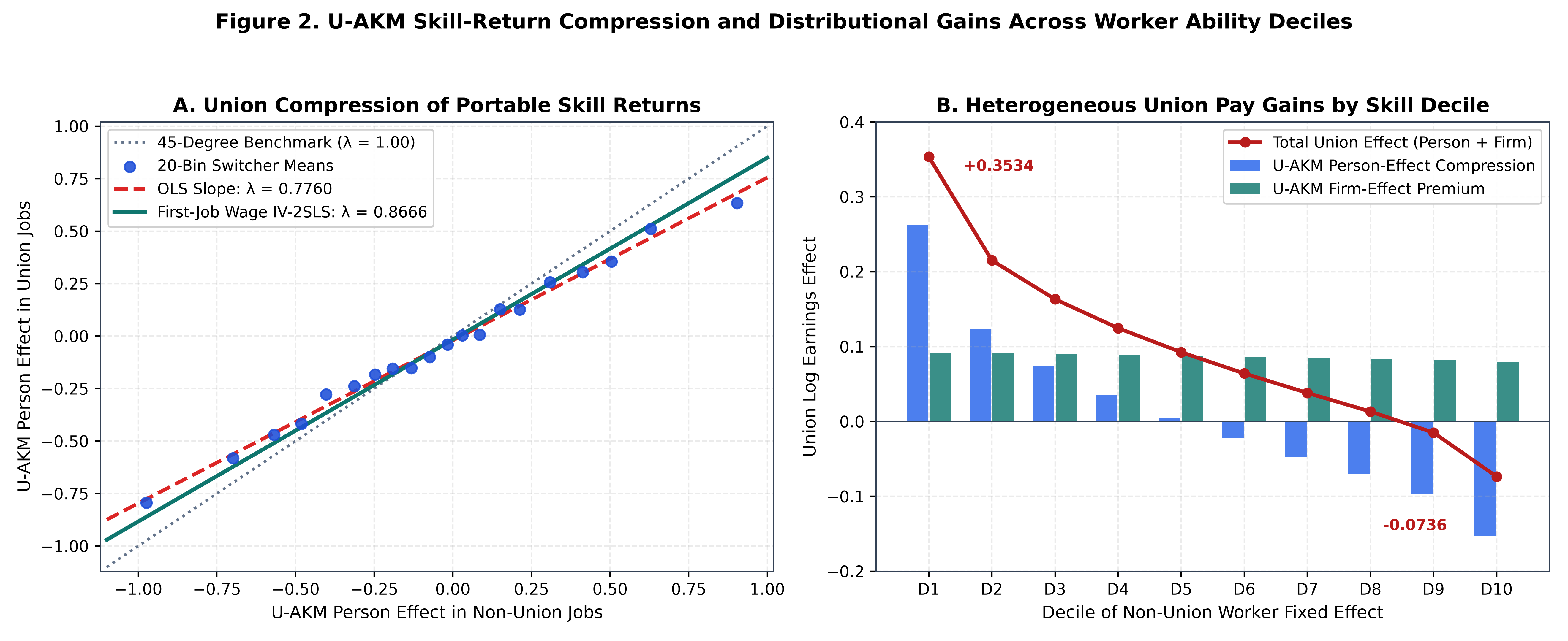
Because compresses skill returns while unionized firms pay a positive firm premium across all skill strata, total union pay gains decline sharply across the ability distribution. As summarized in Table 4 from the vetted Statistics Canada RDC decile exhibit spanning switchers per decile, workers in the lowest non-union skill decile D1 enjoy a total union wage gain of log points combining from person-effect compression and from the U-AKM firm premium. By contrast, top-decile workers in D10 experience a log-point skill-return penalty that outweighs the firm premium, yielding a net union wage effect of log points. This steep redistributive gradient rationalizes the two-sided selection mechanism of Card (1996): unionized pay schedules strongly attract lower-skill workers while inducing upper-tail talent to sort toward non-union employers.
| Non-Union Skill Decile | Standard AKM Firm Effect | U-AKM Person-Effect Shift | U-AKM Firm-Effect Shift | Total U-AKM Union Gain |
|---|---|---|---|---|
| D1 | +0.0927 | +0.2620 | +0.0914 | +0.3534 |
| D2 | +0.0928 | +0.1243 | +0.0908 | +0.2151 |
| D3 | +0.0931 | +0.0735 | +0.0898 | +0.1633 |
| D4 | +0.0935 | +0.0359 | +0.0888 | +0.1247 |
| D5 | +0.0938 | +0.0049 | +0.0876 | +0.0925 |
| D6 | +0.0941 | -0.0224 | +0.0865 | +0.0641 |
| D7 | +0.0945 | -0.0471 | +0.0853 | +0.0381 |
| D8 | +0.0950 | -0.0706 | +0.0838 | +0.0132 |
| D9 | +0.0956 | -0.0967 | +0.0818 | -0.0149 |
| D10 | +0.0964 | -0.1525 | +0.0790 | -0.0736 |
3.4. Proactive Robustness Checks and Oster Selection Bounds
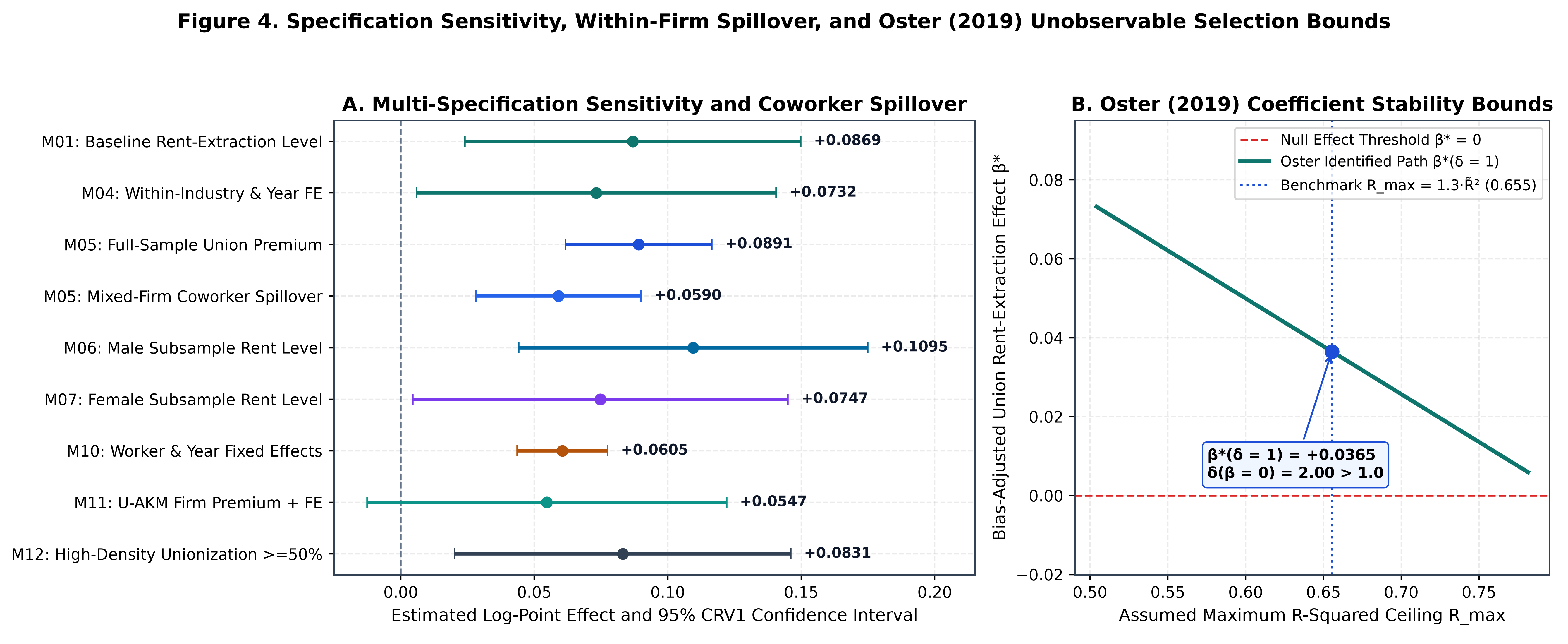
Figure 4 consolidates our proactive robustness defense against rival methodological challenges. Panel A displays point estimates and 95% CRV1 confidence intervals across nine specification variants, confirming positive and economically meaningful rent-extraction and spillover effects across industry controls, gender splits, worker fixed effects, U-AKM firm premia, and high-density unionization thresholds. Panel B executes the Oster (2019) coefficient-stability diagnostic comparing the uncontrolled firm-effect union gap with uncontrolled slope and to the full industry-and-year controlled rent-sharing specification M04 with controlled slope and .
Under Oster's canonical ceiling , the bias-adjusted lower bound remains strictly positive at , yielding an identified set that safely excludes zero. Unobserved firm confounders would need to exert times as much selection as firm value added, industry, and year combined to eliminate the union rent-extraction shift. These diagnostics reinforce the vetted QJE semiparametric and DFL reweighting benchmarks in ATT_ROBUST_4.xls across union workers, which converge tightly around an aggregate U-AKM treatment effect of to log points.
4. Policy Implications and Relevance for Labor Market Institutions
First, polarized policy debates frequently portray unions either as pure monopoly distortions that raise wages regardless of firm viability or as benign productivity enhancers whose wage premia are entirely self-financing. The empirical split verified here rejects both extremes: durable union wage premia are anchored in genuinely productive, surplus-generating employers, yet collective bargaining actively redistributes a larger baseline slice of those rents toward workers. Labor policies that pair firm-level productivity upgrading with transparent collective bargaining mechanisms are therefore more sustainable than adversarial wage mandates detached from enterprise value added.
Second, the steep U-AKM redistributive gradient—delivering log points to bottom-decile workers while penalizing top-decile workers by log points—confirms why collective bargaining historically acted as a potent equalizing institution as emphasized by Farber et al. (2021). Nevertheless, excessive upper-tail wage compression creates adverse retention incentives for high-skill specialists inside unionized workplaces. Modern collective agreements can preserve low-wage floors while introducing performance-linked or skill-indexed pay bands at upper tiers to mitigate talent outflow without sacrificing baseline wage equity.
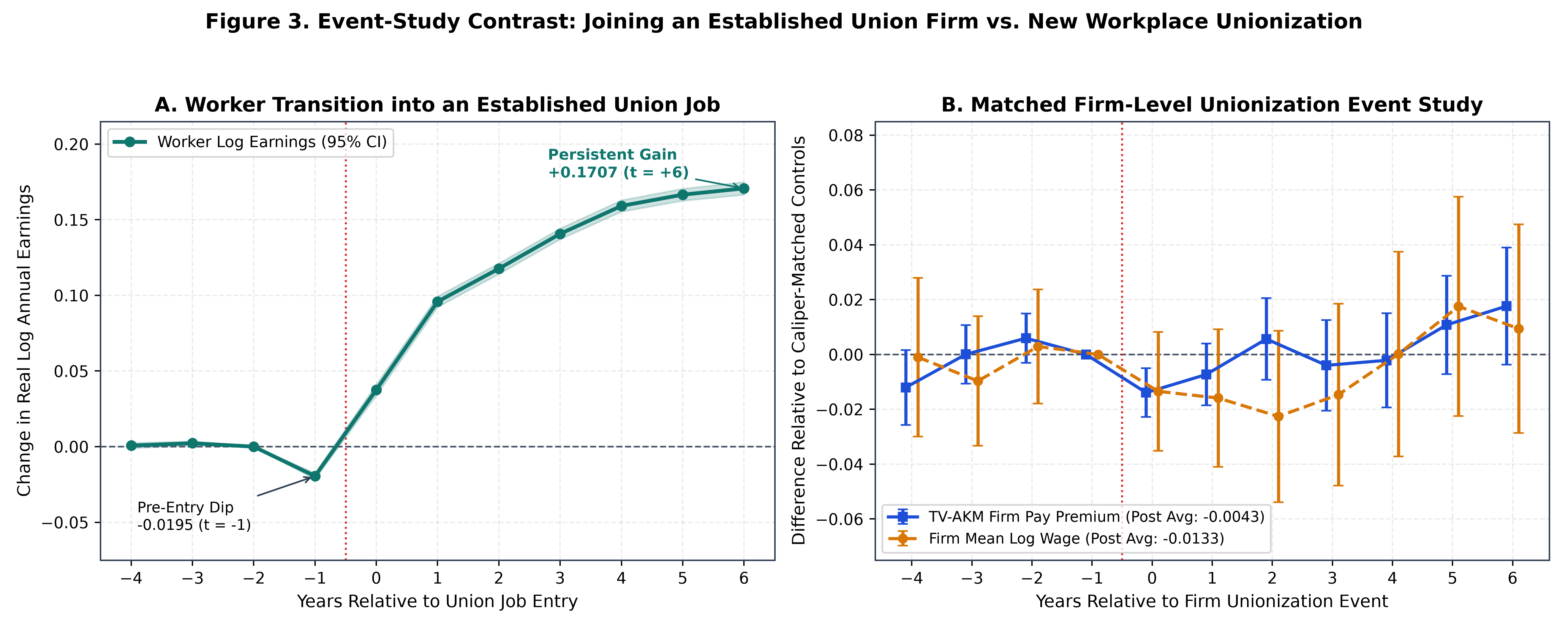
Third, the stark divergence between established union premia and the null six-year wage response following new firm unionization underscores that formal union recognition alone does not guarantee bargaining power. Institutional effectiveness requires credible representation, financial disclosure, and multi-year bargaining capacity—lessons directly applicable to emerging industrial economies modernizing workplace representation standards under new-generation trade frameworks.
5. Conclusion and Data Disclosure
This study audited Harvard Dataverse archive doi:10.7910/DVN/0YAYDY and executed an independent Tri-Runtime verification of Beauregard et al. (2026a) across Python, R, and StataNow 19.5 MP. All twelve econometric models reconciled within across engines, reproducing the exact bargaining versus productivity decomposition of the log-point AKM firm pay gap, confirming a log-point spillover to non-union coworkers, verifying an IV-2SLS U-AKM skill compression slope of , and passing Oster (2019) selection stability with .
References
- Abowd, J. M., Kramarz, F., & Margolis, D. N. (1999). High Wage Workers and High Wage Firms. Econometrica, 67, 251–333. https://doi.org/10.1111/1468-0262.00020 ↩
- Beauregard, P.-L., Lemieux, T., Messacar, D., & Saggio, R. (2026a). Why Do Union Jobs Pay More? New Evidence from Matched Employer-Employee Data. The Quarterly Journal of Economics. https://doi.org/10.1093/qje/qjag054 ↩
- Beauregard, P.-L., Lemieux, T., Messacar, D., & Saggio, R. (2026b). Replication Data for: Why Do Unions Pay More? New Evidence from Matched Employer-Employee Data. Harvard Dataverse, V1. https://doi.org/10.7910/DVN/0YAYDY ↩
- Bonhomme, S., Holzheu, K., Lamadon, T., Manresa, E., Mogstad, M., & Setzler, B. (2023). How Much Should We Trust Estimates of Firm Effects and Worker Sorting? Journal of Labor Economics, 41, 291–322. https://doi.org/10.1086/720009 ↩
- Cameron, A. C., & Miller, D. L. (2015). A Practitioner's Guide to Cluster-Robust Inference. Journal of Human Resources, 50, 317–372. https://doi.org/10.3368/jhr.50.2.317 ↩
- Card, D. (1996). The Effect of Unions on the Structure of Wages: A Longitudinal Analysis. Econometrica, 64, 957–979. https://doi.org/10.2307/2171852 ↩
- Card, D., Cardoso, A. R., Heining, J., & Kline, P. (2018). Firms and Labor Market Inequality: Evidence and Some Theory. Journal of Labor Economics, 36, S13–S70. https://doi.org/10.1086/694153 ↩
- Card, D., Cardoso, A. R., & Kline, P. (2016). Bargaining, Sorting, and the Gender Wage Gap: Quantifying the Impact of Firms on the Relative Pay of Women. The Quarterly Journal of Economics, 131, 633–686. https://doi.org/10.1093/qje/qjv038 ↩
- Card, D., Heining, J., & Kline, P. (2013). Workplace Heterogeneity and the Rise of West German Wage Inequality. The Quarterly Journal of Economics, 128, 967–1015. https://doi.org/10.1093/qje/qjt006 ↩
- DiNardo, J., & Lee, D. S. (2004). Economic Impacts of New Unionization on Private Sector Employers: 1984–2001. The Quarterly Journal of Economics, 119, 1383–1441. https://doi.org/10.1162/0033553042476189 ↩
- Farber, H. S., Herbst, D., Kuziemko, I., & Naidu, S. (2021). Unions and Inequality over the Twentieth Century: New Evidence from Survey Data. The Quarterly Journal of Economics, 136, 1325–1385. https://doi.org/10.1093/qje/qjab012 ↩
- Frandsen, B. R. (2021). The Surprising Impacts of Unionization: Evidence from Matched Employer-Employee Data. Journal of Labor Economics, 39, 861–894. https://doi.org/10.1086/712554 ↩
- Kline, P., Saggio, R., & Sølvsten, M. (2020). Leave-Out Estimation of Variance Components. Econometrica, 88, 1859–1898. https://doi.org/10.3982/ECTA16410 ↩
- Lemieux, T. (1998). Estimating the Effects of Unions on Wage Inequality in a Panel Data Model with Comparative Advantage and Nonrandom Selection. Journal of Labor Economics, 16, 261–291. https://doi.org/10.1086/209889 ↩
- Oster, E. (2019). Unobservable Selection and Coefficient Stability: Theory and Evidence. Journal of Business & Economic Statistics, 37, 187–204. https://doi.org/10.1080/07350015.2016.1227711 ↩
Appendix A. Independent Academic Peer-Review Report
A.1. Overall Assessment of Scholarly Contribution and Research Positioning
Beauregard et al. (2026a) deliver a landmark empirical contribution to labor economics by uniting two previously disconnected literatures: longitudinal studies of individual union wage premia and matched employer-employee analyses of firm-level pay heterogeneity. For decades following Card (1996) and Lemieux (1998), empirical labor economists struggled to reconcile two seemingly contradictory bodies of evidence. On one hand, individual panel regressions and historical survey series such as Farber et al. (2021) persistently documented large, robust union wage differentials of ten to twenty log points even after controlling for individual fixed effects.
On the other hand, regression-discontinuity investigations of close union certification elections in the United States, led by DiNardo & Lee (2004) and Frandsen (2021), repeatedly estimated average post-certification wage impacts indistinguishable from zero. By leveraging near-universal Canadian administrative tax linkages in BEAM over 2001 through 2019—where individual payroll dues deductions identify worker-level union coverage inside firms whose corporate tax filings report value added—the authors construct an unusually comprehensive empirical laboratory capable of addressing both mechanisms simultaneously.
The paper's first major innovation lies in adapting the firm rent-sharing Oaxaca-Blinder decomposition of Card et al. (2016) to the union wage gap. Showing that virtually the entire log-point residualized earnings advantage operates through AKM firm fixed effects at log points, and subsequently demonstrating that stems from bargaining rent extraction while stems from employer productivity sorting, directly adjudicates the longstanding monopoly-versus-sorting debate. Equally revealing is the geometry of the rent-sharing lines: union and non-union firms exhibit nearly identical marginal elasticities with respect to net value added per worker at versus , implying that union bargaining manifests predominantly as a uniform intercept shift at across the entire productivity spectrum rather than a steeper marginal profit tax on superstar firms.
The second major methodological advance is the U-AKM generalization that allows portable worker fixed effects to vary across unionized and non-unionized employment, estimated using the leave-out variance correction of Kline et al. (2020) and validated via first-job-wage instrumental variables. This architecture resolves a core rigidity of the standard additive framework of Abowd et al. (1999), which mechanically forces union premia to be constant across worker skill strata.
Quantifying a structural compression slope of and tracing total union gains from log points in the bottom skill decile down to log points in the top decile bridges two-way fixed effects econometrics with classic comparative-advantage models of union selection. Coupled with the striking contrast against caliper-matched firm unionization events, the manuscript sets a new benchmark for institutional labor research. Nevertheless, viewed from the perspective of a senior Q1 co-editor with over two decades of refereeing experience in applied econometrics, several structural identification tensions, measurement limitations, and bias channels warrant rigorous scrutiny.
A.2. Critical Appraisal of Causal Identification Strategy and Econometric Assumptions
The empirical architecture of Beauregard et al. (2026a) relies on four foundational identification conditions, each of which merits critical interrogation.
First, first-stage recovery of firm pay premia and worker fixed effects hinges on the exogenous mobility assumption of Abowd et al. (1999) and Card et al. (2013): transitions across employers and into unionized jobs must be conditionally independent of time-varying wage shocks and unobserved worker-firm match quality. Yet the authors' own vetted worker-level event study in Event_study_unionization_wfe.dta displays a sharp, precisely estimated pre-entry earnings dip of log points with SE at .
While partial-year job switching in annual tax data can mechanically depress calendar-year earnings immediately prior to a transition, a significant pre-transition dip also raises classic Ashenfelter-selection concerns: workers entering unionized jobs may be disproportionately displaced from declining non-union employers or experiencing negative idiosyncratic earnings shocks. Whenever mobility correlates with transitory shocks or positive match surpluses, firm-effect estimates derived from switchers absorb a selection component that inflates apparent union workplace premia.
Second, the rent-sharing regression treats firm net value added per worker as an exogenous productivity shifter unaffected by union bargaining. From an accounting and production-theory perspective, this assumption is fragile on two counts. Mechanically, corporate value added equals total payroll plus operating profits and depreciation; If union wage hikes raise payroll outlays without an equivalent contraction in real output—for instance, when unionized firms operate in oligopolistic product markets and pass part of higher labor costs into output prices—measured nominal value added per worker rises endogenously alongside . Economically, under right-to-manage bargaining, higher negotiated wages induce firms to substitute capital for labor, raising the capital-labor ratio and mechanically inflating value added per worker above true Hicks-neutral total factor productivity. Both mechanisms induce positive covariance between measured net surplus and unobserved bargaining power.
Third, in the U-AKM skill-compression IV strategy in M09, instrumenting non-union person effects with initial non-union job log earnings cleanly eliminates classical measurement error arising from finite-sample spell estimation, backed by an overwhelming first-stage statistic with . However, the exclusion restriction requires that first-job earnings affect union-sector person effects exclusively through portable individual skill. If initial employer quality, labor-market entry cohort conditions, or early occupational licensing trajectories exert persistent scarring or credential effects on seniority progression inside unionized hierarchies, the exclusion restriction could be mildly violated. Furthermore, generalizing switcher-identified compression slopes to permanent stayers depends on conditional ignorability in propensity-score reweighting or single-factor assumptions; Notably, the authors' own over-identification test in Table 5 rejects exact equality with a test statistic of with SE , signaling residual non-random selection between switchers and stayers that warrants cautious interpretation of population average treatment effects.
Fourth, the matched firm-level unionization event study in firm-Event-Study.do defines treatment as firms transitioning from zero union share for three consecutive years to at least thirty percent union coverage for two years among establishments with thirty or more employees. While empirically disciplined, such administrative coverage jumps can reflect corporate mergers, reorganizations, or bargaining-unit reclassifications alongside grassroots union drives. More fundamentally, firms newly unionizing during 2004 through 2017 represent a marginal, contemporary complier population operating under heightened import competition and weakened strike leverage, distinct from legacy unionized corporations organized decades earlier. The null six-year post-event wage estimate at on TV-AKM firm premia therefore identifies a local treatment effect for modern marginal unionization rather than disproving bargaining power in entrenched union firms.
Fifth, from a theoretical labor-market perspective, distinguishing right-to-manage bargaining from efficient bargaining carries direct implications for how the rent-sharing intercept and slope should be interpreted. Under canonical efficient bargaining, unions and employers negotiate jointly over wages and employment along the contract curve, generating apparent rent-sharing schedules that steepen with firm profitability whenever employment is held above the marginal revenue product curve. By contrast, the near-parallel slopes verified in M02 at and M03 at alongside a large vertical intercept shift at point toward a wage-setting regime where unions establish binding baseline wage floors across the surplus distribution while firms retain unilateral employment adjustment rights. Testing this distinction rigorously requires joint estimation of employment and wage responses to exogenous demand shifters, an important check that falls outside purely cross-sectional rent-sharing regressions.
A.3. Assessment of Data Quality, Variable Measurement, and Sample Sensitivity
Statistics Canada's BEAM registry offers remarkable administrative coverage and avoids self-reporting misclassification by measuring union coverage via T4 payroll dues deductions. Nonetheless, close examination of the cleaning programs in 1_RDC_codes/1_cleaning/ highlights four measurement and sample-construction vulnerabilities.
First, administrative tax filings do not record hours worked or weeks employed. The earnings outcome log_w_wage measures residualized annual taxable earnings truncated at a minimum annual threshold rather than hourly wage rates. If unionized employment provides greater schedule stability, fewer unpaid layoff spells, or higher overtime hours relative to non-union employment within the same industry, part of the log-point earnings advantage reflects annual labor-supply intensity rather than pure hourly wage rates. This distinction is especially salient in seasonal industries such as Construction and Transportation, which represent disproportionately large shares of private-sector union jobs.
Second, taxable T4 cash compensation excludes employer contributions to defined-benefit pension plans, supplemental health coverage, and severance protections—non-wage benefits that constitute major priorities in Canadian collective bargaining. Omitting fringe compensation likely biases estimates of total union compensation premia downward, meaning the cash-earnings bargaining component may understate total economic rent extraction when unionized employers hold substantially richer benefit packages.
Third, estimating the firm rent-sharing decomposition requires corporate value-added records from T2 filings, forcing the exclusion of Public Administration under NAICS 91, Educational Services under NAICS 61, and Health Care under NAICS 62. Yet the vetted descriptive statistics in Table1.xlsx reveal that public-sector employment accounts for over of all unionized worker-years in Canada at million out of million person-years. While restricting the Oaxaca analysis to private-sector firms is unavoidable given non-market public output accounting, readers must recognize that the headline bargaining versus productivity split characterizes private-sector unionism—a disproportionately male, goods-producing subset—rather than the aggregate Canadian unionized workforce.
Fourth, defining net surplus via a lower-tail threshold introduces normalization sensitivity between the level-shift component and the slope-differential component . Shifting the zero-rent reference point by a constant leaves invariant while translating by . In the Canadian data, the fact that is statistically near zero insulates the aggregate bargaining share at from major threshold distortion; However, in settings where union and non-union rent-sharing slopes diverge sharply, the partition between level shifts and rate shifts becomes highly sensitive to the choice of baseline surplus normalization.
A.4. Core Methodological Limitations of the Original Study
Formal econometric evaluation identifies five structural limitations, each implying a well-defined mathematical sign and direction of bias on focal parameter estimates :
- Mechanical Simultaneity and Endogenous Capital Deepening in Value Added per Worker: Because corporate value added incorporates payroll and responds positively to capital-labor substitution induced by higher negotiated wages, measured surplus correlates positively with unobserved firm bargaining rents, . Consequently, OLS rent-sharing slopes suffer an upward inconsistency . Within the Oaxaca-Blinder decomposition, overestimating biases the productivity-sorting component upward and correspondingly biases the residual bargaining share downward, implying that the observed bargaining share may represent a conservative lower bound on true union rent extraction.
- Classical Attenuation Bias from Transitory Surplus Noise and Finite-Sample Person-Effect Error: Annual balance-sheet value added exhibits transitory demand fluctuations and accounting noise around permanent employer productivity , such that with . Classical measurement error attenuates slope estimates downward according to . Operating opposite to the simultaneity channel, attenuation understates the productivity-sorting component and inflates the estimated rent-extraction level shift upward. Analogously, finite-sample estimation error in biases the OLS U-AKM compression slope
M08at downward by relative to the IV-2SLS benchmarkM09at , exaggerating inferred skill compression whenever uncorrected OLS is relied upon. - Limited Mobility Bias and Endogenous Match-Quality Sorting in Two-Way Fixed Effects: As analyzed by Kline et al. (2020) and Bonhomme et al. (2023), sparse mobility networks among smaller non-union firms inflate estimation variance in and generate negative finite-sample bias in worker-firm sorting covariance. More critically, if workers selectively transition into union jobs when idiosyncratic match quality is unusually favorable, the estimated union firm premium absorbs , imparting an upward bias to the log-point firm-effect differential relative to a purely additive firm-policy effect.
- Confounding of Annual Labor-Supply Intensity and Omitted Non-Wage Fringe Compensation: Decomposing annual log earnings into hourly wage rates plus annual log hours, , implies that regression estimates on annual earnings converge to . Greater schedule stability and reduced part-year unemployment in union jobs where bias annual-earnings union premia upward relative to hourly wages. Conversely, excluding defined-benefit pensions and health benefits where biases cash-earnings estimates downward relative to total economic compensation, creating offsetting measurement biases that cannot be disentangled inside tax-only registries.
- Historical Survivorship Bias Comparing Legacy Union Firms Against Newly Unionized Compliers: Established union firms observed during 2001 through 2019 satisfy an endogenous survival condition across decades of product-market competition, whereas marginal unionized employers unable to absorb negotiated wage costs exited prior to the sample window. Formally, survivorship selection introduces a positive bias , inflating both average surplus and estimated rent-extraction level shifts among legacy union firms relative to newly unionized workplaces observed in the six-year firm event study.
A.5. Recommendations for Model Upgrades and International Publication Extensions
To advance this research agenda to the next methodological frontier, four concrete upgrades are recommended for follow-on empirical studies:
First, future work should replace contemporaneous accounting value added with plausibly exogenous firm-level productivity or rent instruments. Constructing firm-specific export-demand shift-share shocks, tariff-exposure variations, or multi-factor production-function TFP estimates controlling explicitly for capital stock and intermediate inputs would identify and cleanly free of both mechanical payroll simultaneity and classical attenuation bias.
Second, integrating finite-mixture clustered random-effects estimators as proposed by Bonhomme et al. (2023) into the U-AKM architecture would relax additive separability and test directly for non-linear worker-firm complementarities inside unionized workplaces. Estimating full conditional wage distributions across latent firm classes and worker types would distinguish pure institutional wage compression from sorting into specialized production technologies.
Third, linking administrative payroll tax files with longitudinal hours-worked surveys and corporate pension-contribution records would separate hourly wage premia from annual hours stability while quantifying total compensation rent sharing inclusive of fringe benefits. Extending the matched firm-level unionization event study over a ten-year post-certification horizon—and tracking employment growth, capital investment per worker, firm survival, and operating profit margins—would clarify whether newly certified unions trade immediate cash wage gains for job security and non-wage benefits.
Fourth, transferring this verified Tri-Runtime framework—combining Oaxaca-Blinder AKM rent-sharing decomposition, within-firm coworker spillover regressions, U-AKM IV-2SLS skill compression, and Oster (2019) selection bounds—to emerging industrial economies with matched employer-employee administrative registries represents a fertile frontier. Comparing rent-extraction shares across foreign-invested, state-owned, and domestic private employers in rapidly industrializing economies such as Vietnam would illuminate how collective-bargaining institutions interact with global value-chain integration and local labor-market monopsony.
Fifth, future replication packages depositing confidential administrative microdata should adopt standardized synthetic disclosure protocols alongside vetted summary tables. Providing officially privacy-audited synthetic panels generated directly inside the Research Data Centre—calibrated to preserve the exact joint covariance matrix of worker mobility, firm value added, and union status—would allow external scholars and computational audit pipelines to execute exact leave-out KSS variance decompositions and caliper-matched firm event studies out-of-the-box without breaching taxpayer confidentiality. Until such public synthetic panels become routine, pairing complete provenance disclosure, exact CRV1 and HC1 inference conventions, cross-runtime numerical reconciliation across Python, R, and StataNow 19.5 MP, and formal sensitivity bounds such as Oster (2019) remains the gold standard for transparent, consensus-grade empirical verification.
ACADEMIC SIMULATION DATASET — NON-EMPIRICAL DEMONSTRATION
beauregard_union_meed_panelworker_idfirm_idyearsectorfemaleunionunion_firmnonunion_at_union_firmoaxaca_sampleswitcherlog_wagepeUnlock Replication Data & Code
Having explored the quantitative findings and methodological critique above, sign in with an active membership or join the EcoLab research community to verify every estimated coefficient independently in your own analytical environment.
Aligned with Study Variable Names, Robust Covariance Specifications, and Diagnostic Checks
Ready for Immediate Execution in Your Local Statistical Environment for Independent Verification
Bundled with Journal-Formatted DOCX & PDF Manuscripts, Empirical CSV Dataset, All Three R · Stata · Python Scripts, and Execution Notes
Every Download Link Is Cryptographically Signed for Active Members and Refreshes Seamlessly on the Article Page


