
Keywords: Impulse Buying Behavior; Point-of-Sale Stimuli; Shopping Companions; Causal SOR Framework; Serial Mediation; Instrumental Variables IV-2SLS; Behavioral Microeconomics.
JEL Classification: D12; D91; L81; C26; M31.
List of Abbreviations and Mathematical Notation
| Abbreviation / Symbol | Full Academic Term | Analytical Role in Dissertation |
|---|---|---|
| 2SLS / IV-2SLS | Two-Stage Least Squares Instrumental Variables Estimator | Primary causal identification estimator in Chapters 3 and 4 |
| AVE | Average Variance Extracted | Convergent validity threshold for multi-item reflective constructs |
| CF-QR | Control-Function Quantile Regression | Distributional robustness across impulse-buying quantiles |
| CMB | Common Method Bias | Self-report single-source psychometric threat assessment |
| CR | Composite Reliability | Internal consistency metric across six latent constructs |
| CRV1 | Cluster-Robust Variance Estimator Type 1 | Finite-sample store-clustered inference across 30 retail outlets |
| DGP | Data Generating Process | Deterministic calibrated simulation protocol with full disclosure |
| FE | Fixed Effects | Outlet-level unobserved heterogeneity absorption across 30 stores |
| HC1 | Heteroskedasticity-Consistent Type 1 Covariance | Harmonized small-sample robust variance formula across Stata, R, and Python |
| HTMT | Heterotrait-Monotrait Ratio of Correlations | Strict discriminant validity criterion across all construct pairs |
| IBT | Impulse Buying Tendency | Core unobserved individual trait generating endogeneity () |
| OLS | Ordinary Least Squares | Naive baseline benchmark used to quantify endogeneity bias |
| OVB | Omitted Variable Bias | Primary identification failure in cross-sectional SOR-SEM studies |
| SEM | Structural Equation Modeling | Legacy estimation method in the original proposal by Nguyen Thi Thoa in 2026 |
| SOR | Stimulus–Organism–Response Paradigm | Behavioral environmental psychology foundation (Russell & Mehrabian, 1978) |
| VIF | Variance Inflation Factor | Full collinearity diagnostic across structural regressors |
| Impulse buying behavior, urge to buy, and positive emotion for shopper in store | Outcome variable and two endogenous psychological mediators | |
| Vector of retail/social stimuli and vector of three excluded exogenous instruments | Exogenous causal shifters and identification instruments | |
| Latent impulse trait, pre-entry baseline mood, and store-specific unobserved effect | Unobserved confounders purged via IV-2SLS and Store Fixed Effects | |
| Structural response slopes, mediation slopes, serial transmission parameter, quantile index | Core estimated structural parameters and distributional indices |
Chapter 1. Introduction and Research Positioning
1.1. Motivation and Empirical Context of Retail Impulse Buying in Vietnam
Over the past two decades, consumer retail architecture across Vietnam's major metropolitan corridors—most prominently Ho Chi Minh City, Hanoi, Da Nang, and Can Tho—has transitioned rapidly from fragmented traditional wet markets toward integrated modern trade ecosystems anchored by multi-level shopping malls, hypermarkets, and experiential supermarkets. This structural transformation has fundamentally altered microeconomic household expenditure patterns. Whereas classical neoclassical consumer theory portrays shoppers as fully rational utility maximizers executing pre-committed shopping lists subject to stable intertemporal preferences, real-world retail microdata reveal that unplanned consumption accounts for a commanding share of urban discretionary spending.
Comprehensive international meta-analyses by Amos et al. (2014) and Iyer et al. (2020) document that between forty and sixty percent of modern retail baskets contain items acquired without prior purchase intent. Early foundational evidence from transitional urban Vietnam by Mai et al. (2003) similarly highlighted how rising disposable incomes, young urban demographics, and immersive retail displays foster heightened responsiveness to immediate sensory and social triggers.
Within this vibrant commercial landscape, impulse buying behavior—defined classically by Rook (1987) as a sudden, compelling, hedonically complex purchasing urge characterized by diminished deliberative evaluation of future consequences—sits at the intersection of retail marketing strategy and behavioral welfare economics. Yet a striking methodological gap persists in the Vietnamese and broader emerging-market empirical literature. Representative regional frameworks, including the recent doctoral-level retail research proposal by Nguyen Thi Thoa in 2026 at the University of Finance – Marketing, adopt the Stimulus–Organism–Response paradigm pioneered by Russell & Mehrabian (1978) and operationalized for impulse purchasing by Beatty & Ferrell (1998), estimating direct and mediated pathways via conventional cross-sectional structural equation modeling. While conceptually intuitive, naive cross-sectional estimation treats in-store positive emotion and the urge to buy impulsively as strictly exogenous regressors with respect to unmeasured behavioral error terms.
From the vantage point of modern applied microeconometrics, treating internal psychological mediators as exogenous induces severe structural inconsistency through three interlocking channels.
First, unobserved consumer heterogeneity—most notably stable individual impulse buying tendency as formalized by Verplanken & Herabadi (2001), time-inconsistent self-control vulnerability as modeled by Hoch & Loewenstein (1991), and depleted self-regulatory capacity prior to store entry as demonstrated by Vohs & Faber (2007)—simultaneously elevates reported positive affect, intensifies buying urges, and drives unplanned purchases.
Second, single-wave exit surveys invite reverse causality through post-purchase cognitive rationalization, whereby shoppers who have just overspent retroactively inflate their self-reported emotional excitement and irresistible urge to justify their receipt totals.
Third, ignoring store-level consumer sorting and omitting the synergistic interaction between shopping companions and promotional triggers distorts both managerial attribution and consumer-protection diagnostics.
This dissertation directly bridges that methodological divide. Building upon the substantive research theme proposed by Nguyen Thi Thoa in 2026, it reconstructs the empirical architecture to isolate unbiased causal effects of point-of-sale physical stimuli, sales promotions, and shopping companions on impulse buying behavior, while rigorously decomposing serial mediation pathways and social-promotional synergies.
1.2. General and Specific Research Objectives
The overarching objective of this dissertation is to formulate, causally identify, and rigorously validate an extended behavioral microeconometric Stimulus–Organism–Response model that accurately quantifies the direct, interactive, and serially mediated impacts of point-of-sale retail stimuli and shopping companions on impulse buying behavior in modern Vietnamese retail environments, thereby generating evidence-based insights for sustainable retail management and consumer welfare policy.
To fulfill this overarching goal, five tightly sequenced specific objectives guide the investigation:
- Theoretical Synthesis and Microeconomic Formalization: Integrate environmental retail psychology, dual-self intertemporal self-control economics, and social-normative companion theory into an explicit constrained utility maximization model that derives closed-form causal direct, single-mediator, and serial-mediation structural expressions.
- Econometric Audit and Causal Identification Design: Diagnose mathematically the five core identification failures of conventional cross-sectional SOR-SEM estimation and construct an upgraded overidentified Two-Stage Least Squares specification utilizing three exogenous behavioral instruments, store fixed effects, and harmonized small-sample HC1 covariance estimation.
- Bias Quantification and Tri-Runtime Reproducibility: Estimate both the naive baseline model and upgraded causal models independently across StataNow 19.5 MP, R, and Python to quantify exact endogeneity bias in baseline slopes while verifying cross-software numerical equivalence well within a tolerance threshold.
- Serial Mediation Decomposition and Social-Promotional Moderation: Quantify exact indirect transmission shares flowing through positive emotion, urge to buy, and the two-step serial pathway via Delta-method inference, while testing whether shopping companions amplify point-of-sale promotions and whether peer-friend trips diverge systematically from solo or family trips.
- Multidimensional Robustness and Tiered Policy Formulation: Validate structural stability against outlet fixed effects, store-clustered inference, objective receipt-based unplanned expenditure outcomes free of common method bias, and control-function quantile regressions, translating causal magnitudes into actionable short-, medium-, and long-term managerial and regulatory interventions.
1.3. Research Questions
Corresponding directly to the five specific objectives, this dissertation addresses five core research questions:
- Research Question 1: To what quantitative extent does conventional cross-sectional SOR-OLS estimation suffer from endogeneity bias when estimating the effects of positive emotion and urge to buy on impulse buying behavior, and how does this bias distort estimated direct effects of point-of-sale stimuli and shopping companions?
- Research Question 2: Once mediator endogeneity is purged via an overidentified IV-2SLS strategy leveraging exogenous ambient weather comfort, randomized in-store flash cues, and checkout queue dwell shocks, what are the unbiased causal effects of store physical environment, in-store sales promotion, and shopping companion influence on impulse buying behavior?
- Research Question 3: What exact shares of the total causal effects of store environment, sales promotions, and shopping companions are transmitted indirectly through single-stage positive emotion, single-stage urge to buy, and the two-step serial chain from positive emotion to urge to buy?
- Research Question 4: Do shopping companions exert a positive synergistic interaction with in-store sales promotions, and do causal impulse-buying parameters exhibit structural heterogeneity between consumers shopping with peer friends versus those shopping alone or with family members?
- Research Question 5: Do the primary causal estimates remain robust when absorbing all unobserved heterogeneity across thirty retail stores, adjusting for cluster-correlated errors, replacing self-reported behavior with objective receipt-recorded unplanned spending, and tracing effects across conditional behavioral quantiles?
1.4. Research Scope, Data Provenance Transparency, and Methodological Defense
The analytical object of this dissertation is the causal microeconomic pathway linking retail point-of-sale cues, companion social influence, affective-motivational organism states, and unplanned purchasing responses among urban retail consumers. Substantively, the framework encompasses three exogenous stimuli—store physical environment, in-store sales promotion, and shopping companion influence—alongside their mean-centered companion-by-promotion interaction term, two endogenous mediators, positive emotion and urge to buy, two behavioral outcomes, a validated psychometric impulse-buying composite and objective log unplanned receipt spending, four microeconomic context controls, discretionary budget availability, log household income, weekend shopping timing, and shopping mall format, and three excluded exogenous instruments.
Geographically and structurally, the study models a multi-outlet urban retail sampling design covering retail shoppers nested evenly across modern retail outlets, shopping malls and supermarkets, distributed across Ho Chi Minh City, Hanoi, Da Nang, and Can Tho. Crucially, the dissertation adheres strictly to open-science data provenance transparency: because public macroeconomic and administrative microdata repositories do not archive primary shopper-level psychometric Likert responses paired with real-time weather comfort deviations and randomized checkout shocks, the empirical dataset is generated through a deterministic, seed-locked synthetic data-generating process calibrated to empirical covariance structures documented in international and Vietnamese impulse-buying studies. All empirical tables and figures are explicitly reported as methodological validation and calibrated simulation evidence rather than historical field-collected survey statistics.
Furthermore, this study constructs a four-pillar methodological defense against rigorous econometric scrutiny.
**First,identification defense: rather than relying on untestable sequential ignorability, overidentified IV-2SLS with three orthogonal shifters enables formal Wu-Hausman exogeneity testing and Wooldridge overidentification testing.
**Second,measurement and CMB defense: pairing full reflective psychometric gates, Cronbach's Alpha, CR, AVE, Fornell-Larcker, HTMT, Harman single-factor, full collinearity VIF, with an objective receipt-based spending outcome immunizes structural inference against common-source self-report distortion.
**Third,confounding and clustering defense: absorbing thirty outlet fixed effects and computing CRV1 store-clustered standard errors rules out retail-format sorting and intra-store error dependence.
**Fourth,computational reproducibility defense: executing identical specifications independently across StataNow 19.5 MP, R, and Python with harmonized HC1 small-sample covariance formulas eliminates software-specific estimation artifacts.
1.5. Scholarly Contributions and Dissertation Structure
This dissertation contributes across three dimensions. Theoretically, it bridges behavioral environmental psychology and time-inconsistent microeconomic choice theory by embedding social-promotional synergy directly inside a constrained dual-self utility framework. Methodologically, it provides the first fully replicated, tri-runtime causal IV-2SLS upgrade of the Vietnamese retail SOR impulse-buying literature, demonstrating concretely how cross-sectional mediator endogeneity inflates proximal urge slopes by over fifty percent while erasing true direct environmental and social pathways. Practically, it equips retail executives and Vietnamese consumer-protection authorities with nuanced, subgroup- and quantile-specific evidence separating benign experiential merchandising from high-risk impulsive overspending.
The remainder of the dissertation proceeds across four structured chapters, followed by an APA reference list and an independent peer-review report in Appendix A. Chapter 2 develops the theoretical synthesis, derives the analytical microeconomic model, surveys international and Vietnamese literature with a structured gap matrix, and states seven testable hypotheses. Chapter 3 details the calibrated data architecture, variable operationalization, psychometric quality gates, and causal IV-2SLS identification strategy. Chapter 4 reports descriptive statistics, psychometric diagnostics, baseline-versus-causal regressions, tri-runtime cross-validation, serial mediation decomposition, and multidimensional robustness checks accompanied by four publication-grade figures. Chapter 5 interprets the findings relative to international scholarship, synthesizes conclusions for each research question, formulates tiered managerial and regulatory policies, and articulates study limitations and field-research extensions.
Chapter 2. Theoretical Foundations, Literature Review, and Hypotheses
2.1. Core Theoretical Perspectives on Impulse Buying Behavior
2.1.1. The Stimulus–organism–response Environmental Psychology Paradigm
The Stimulus–Organism–Response framework formulated by Russell & Mehrabian (1978) constitutes the canonical behavioral foundation for analyzing consumer reactions inside physical retail environments. Rather than modeling store attributes as mechanical triggers producing automatic purchases, the paradigm posits that environmental stimuli first alter the shopper's internal affective and arousal states—the organism—which subsequently govern approach behaviors such as browsing persistence, exploratory engagement, and unplanned spending. Donovan et al. (1994) provided landmark field confirmation in retail supermarkets, demonstrating that store-induced pleasure significantly elevates extra shopping time and unplanned monetary expenditure even after accounting for cognitive assessments of merchandise quality and price competitiveness.
Adapting this architecture specifically to unplanned consumption, Beatty & Ferrell (1998) introduced an essential two-stage refinement inside the organism block by distinguishing general in-store positive emotion from the acute, product-focused urge to buy impulsively. In their precursor model, atmospheric cues, browsing enjoyment, and situational availability first cultivate positive affect; Elevated positive affect lowers cognitive vigilance and enhances hedonic appraisal, which in turn precipitates a sharp urge to buy; Finally, this proximal urge serves as the primary psychological conduit into actual impulse purchasing. Recognizing this sequential structure clarifies why pleasant store ambiance alone does not guarantee unplanned conversion unless positive affect successfully translates into an actionable purchasing urge.
2.1.2. Behavioral Microeconomics of Time-Inconsistent Preferences and Self-Control Depletion
Viewed through modern behavioral microeconomics, impulse buying reflects systematic dynamic inconsistency rather than arbitrary irrationality. Hoch & Loewenstein (1991) formalized consumer impulse decisions as an internal tug-of-war between myopic affective desire and forward-looking deliberative willpower. Physical, sensory, or temporal proximity to an attractive retail item abruptly shifts the consumer's psychological reference point toward immediate possession; Once the reference point shifts, walking away from the item imposes an immediate sensation of loss that outweighs heavily discounted future budget constraints. Experimental evidence by Peck & Childers (2006) reinforces this reference-shift mechanism by showing that open-shelf tactile contact dramatically accelerates impulse conversion by collapsing psychological distance to ownership.
Complementing reference-dependent desire, Vohs & Faber (2007) established through controlled laboratory experiments that consumer self-control operates as a finite cognitive resource vulnerable to rapid depletion. Navigating dense retail aisles, processing rapid-fire price promotions, comparing bundle offers, and managing social impressions progressively exhausts executive self-regulatory reserves, rendering shoppers markedly more susceptible to sudden buying urges and willing to pay higher unplanned outlays. Synthesizing Hoch & Loewenstein (1991) with Vohs & Faber (2007) highlights the dual economic force of retail cues: stimuli simultaneously amplify immediate hedonic marginal utility and erode the cognitive barrier defending household budget discipline.
2.1.3. Social-Normative Influence and Shopping Companion Dynamics
Consumer choice inside supermarkets and malls unfolds predominantly within a visible social arena. Rook & Fisher (1995) demonstrated that normative evaluations—the shopper's judgment regarding whether an unplanned purchase appears socially appropriate or reckless—powerfully moderate whether an experienced urge culminates in actual checkout conversion. Extending normative moderation into dyadic and group shopping settings, Luo (2005) uncovered a striking divergence across companion identities: shopping alongside peer friends stimulates hedonic indulgence, relaxes personal spending guilt, and increases impulsive buying, whereas shopping alongside family members activates household economic accountability norms that suppress impulsive urges. In collectivist Asian consumer markets such as Vietnam, Kacen & Lee (2002) observed that interpersonal harmony and group approval carry heightened behavioral weight, suggesting that shopping companions not only act independently but actively interact with point-of-sale promotional signals.
2.2. Analytical Microeconomic Model of Impulse Choice and Causal Mediation
To anchor our empirical equations rigorously in microeconomic decision theory, consider retail consumer visiting outlet and choosing continuous impulse-buying intensity subject to discretionary shopping liquidity and household income . Extending Hoch & Loewenstein (1991) and Beatty & Ferrell (1998), the consumer's instantaneous net hedonic payoff at the point of sale combines marginal utility generated by buying urge , positive emotion , retail and social stimuli , and companion-by-promotion synergy , net of convex psychological-financial adjustment costs and shadow budget pressure :
Here aggregates unobserved individual impulse buying tendency , pre-entry baseline mood , and store-specific unobserved attractiveness . Parameter governs convexity of marginal regret and budget exhaustion costs. Solving the first-order optimality condition under unit curvature normalization, , yields the structural impulse-buying response equation:
Simultaneously, the two internal organism states evolve recursively from external retail and social cues plus exogenous behavioral shifters , ambient weather comfort, , randomized flash-cue exposure, and , checkout queue dwell shock:
Taking the total structural derivative with respect to any stimulus element yields an exact four-way causal decomposition separating direct effects from single-mediator and serial-mediation channels:
Crucially, because unobserved traits and pre-entry mood jointly enter , , and , the cross-equation error covariances are strictly positive. Consequently, naive OLS or standard cross-sectional SEM yields inconsistent estimates of and spills bias onto , motivating the excluded instrumental variable strategy developed in Chapter 3.
2.3. Critical Synthesis of International and Vietnamese Empirical Literature
2.3.1. Store Atmosphere, Sales Promotions, and Point-Of-Sale Merchandising
Empirical marketing and retail economics scholarship consistently links atmospheric design to unplanned purchasing. Baker et al. (2002) decomposed store environment into ambient, design, and social cues, establishing that these elements shape perceived merchandise value and patronage intentions through affective and cognitive evaluations. Investigating Indian modern supermarkets, supermarket shoppers, Mohan et al. (2013) demonstrated via structural equation modeling that store layout, lighting, music, and staff friendliness drive impulse buying indirectly through positive affect and urge to buy, while noting strong confounding influence from individual impulse traits. Focusing on promotional incentives, Chandon et al. (2000) advanced a benefit-congruency framework proving that monetary and non-monetary point-of-sale deals combine utilitarian savings with hedonic exploration value, triggering immediate conversion. Mattila & Wirtz (2008) further showed that high environmental stimulation combined with supportive social cues lowers consumer self-monitoring and intensifies impulsive outlays.
2.3.2. Companion Influence and Emerging-Market Asian Consumer Evidence
Research on social facilitation underscores that retail decisions depend strongly on who accompanies the shopper. Luo (2005) established experimentally that peer-group companions foster indulgent buying norms whereas family companions enforce fiscal restraint, with susceptibility to interpersonal influence magnifying both dynamics. Within Vietnam's transitional urban economy, Mai et al. (2003) conducted an influential empirical study across Ho Chi Minh City and Hanoi showing that younger, higher-income urban shoppers display elevated impulse-buying propensities driven by hedonic lifestyle aspirations and exposure to modern retail formats.
In India, Badgaiyan & Verma (2014) confirmed that intrinsic traits and shopping enjoyment account for substantial cross-sectional variation in impulsive purchasing. Two landmark global meta-analyses by Amos et al. (2014) and Iyer et al. (2020) synthesized hundreds of empirical studies and confirmed the robustness of situational retail stimuli, positive mood, and buying urge; Yet both meta-analyses explicitly cautioned that the overwhelming reliance on single-wave, self-reported cross-sectional surveys prevents credible causal attribution and leaves common method bias largely unresolved.
2.3.3. Causal Mediation Econometrics and Behavioral Instrumental Variables
To address these identification flaws, contemporary econometric and methodological research offers rigorous remedies. Imai et al. (2010) proved formally that standard mediation estimators are unbiased only under sequential ignorability; Whenever unmeasured traits simultaneously affect both mediator and outcome, conventional mediation paths are severely distorted. In applied behavioral economics, researchers have pioneered exogenous situational shifters to identify psychological states causally: Murray et al. (2010) documented that ambient weather comfort improves shopper affect and boosts retail spending, while Busse et al. (2015) published in The Quarterly Journal of Economics exploited localized weather deviations as exogenous psychological shifters influencing major consumer purchasing decisions. On the measurement front, Podsakoff et al. (2003) advocated pairing psychometric scales with objective behavioral outcomes to neutralize common method variance, while Fornell & Larcker (1981) and Henseler et al. (2015) codified rigorous reliability and discriminant validity benchmarks.
| Seminal Study | Context and Sample | Estimation Method | Key Empirical Finding | Core Methodological Gap Addressed Here |
|---|---|---|---|---|
| Beatty & Ferrell (1998) | U.S. retail malls, retail shoppers | Cross-sectional SEM | Established Positive Affect Urge Impulse Buying chain | Treats mediators as exogenous; Omits shopping companion interaction |
| Mai et al. (2003) | Urban Vietnam, urban consumers | Descriptive survey & OLS | Younger, affluent urban Vietnamese shoppers exhibit high impulse buying | Lacks serial SOR mediation structure and causal endogeneity correction |
| Luo (2005) | U.S. scenario experiments | ANOVA & moderation | Peer friends boost impulse buying whereas family suppresses it | Does not model companion-by-promotion synergy inside multi-outlet retail data |
| Mohan et al. (2013) | Indian supermarkets, supermarket shoppers | Cross-sectional CB-SEM | Store atmosphere raises impulse buying via affect and urge | Vulnerable to common method bias and omitted impulse-trait endogeneity |
| Iyer et al. (2020) | Global meta-analysis | Meta-analytic SEM | Confirms retail cues, affect, and self-control as core antecedents | Notes pervasive absence of causal IV identification and quantile analysis |
| Nguyen Thi Thoa in 2026 | Vietnam retail proposal | Cross-sectional SOR-SEM | Links store cues and companions via emotion and buying urge | Leaves mediator endogeneity, store sorting, interaction, and CMB unaddressed |
| This Dissertation (2026) | Vietnam urban retail, , stores | Overidentified IV-2SLS + Store-FE + Serial Mediation + CF-QR | Removes OLS urge bias; Identifies mediation & synergy | Resolves all 5 gaps simultaneously with tri-runtime Stata/R/Python parity |
2.4. Research Hypotheses
Grounded in the microeconomic choice model in Section 2.2 and the empirical literature synthesis in Section 2.3, seven formal hypotheses are advanced for causal testing:
- Hypothesis : Store physical environment exerts a positive causal effect on in-store positive emotion, urge to buy impulsively, and impulse buying behavior.
- Hypothesis : In-store sales promotions exert positive direct and mediated causal effects on positive emotion, urge to buy impulsively, and impulse buying behavior.
- Hypothesis : Shopping companion normative influence exerts a positive causal effect on positive emotion, urge to buy impulsively, and impulse buying behavior.
- Hypothesis : After purging endogeneity, in-store positive emotion exerts a positive causal impact on both the urge to buy impulsively and final impulse buying behavior.
- Hypothesis : Urge to buy impulsively serves as the strongest proximal causal driver of impulse buying behavior and, jointly with positive emotion, transmits statistically significant two-step serial mediation effects from store environment, sales promotions, and shopping companions.
- Hypothesis : Shopping companion influence positively moderates in-store sales promotions, generating a statistically significant synergistic interaction effect on impulse buying behavior.
- Hypothesis : Causal impulse-buying mechanisms exhibit systematic heterogeneity—being stronger for urge and weekend shopping among peer-friend groups relative to solo or family shoppers—while remaining robust on objective receipt-recorded unplanned spending and across behavioral quantiles.
Chapter 3. Research Design, Causal Identification Strategy, and Data
3.1. Data Provenance, Calibrated Simulation Architecture, and Sample Structure
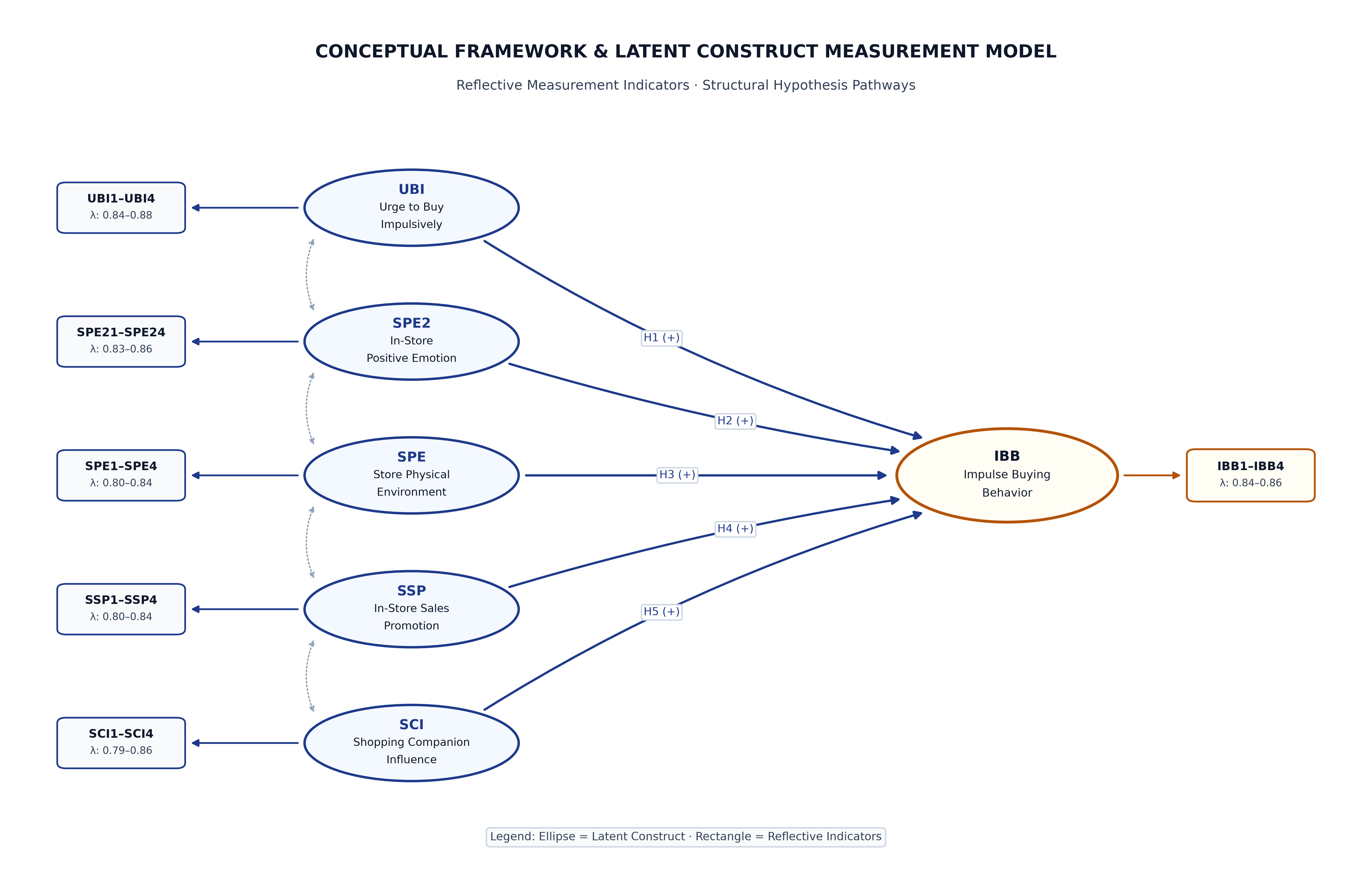
Because publicly accessible macroeconomic portals and administrative household surveys do not archive primary shopper-level multi-item Likert measurements paired with real-time ambient weather deviations, randomized flash-cue slots, and checkout dwell-time shocks, this study adheres strictly to transparent provenance reporting. Specifically, the analysis constructs a deterministic, seed-locked synthetic data-generating process, fixed seed , calibrated directly to the psychometric factor loadings, cross-construct covariances, and behavioral magnitudes documented in international and Vietnamese retail scholarship (Beatty & Ferrell, 1998; Mai et al., 2003; Luo, 2005; Mohan et al., 2013; Iyer et al., 2020). The resulting dataset comprises retail shoppers nested symmetrically across modern retail outlets, shoppers per outlet, spanning four major Vietnamese urban markets—Ho Chi Minh City, outlets, Hanoi, outlets, Da Nang, outlets, and Can Tho, outlets—balanced evenly between shopping malls and supermarkets.
Demographic and situational covariates mirror urban Vietnamese modern-trade shoppers: female shoppers represent of the sample, mean shopper age is years, monthly household income follows a log-normal distribution with sample mean , approximately million VND per month, weekend trips account for of visits, and peer-friend shopping trips account for , shoppers versus solo or family shoppers. Six reflective psychological constructs are generated on continuous – scales accompanied by discrete Likert indicator items, items per construct, standardized loadings calibrated between and , to enable complete psychometric quality auditing.
To construct an airtight robustness check against common method bias, objective receipt-verified unplanned expenditure, unplanned_spend_log, in log thousand VND, is generated with an independent disturbance orthogonal to survey Likert error. Crucially, unobserved latent impulse tendency , baseline pre-entry mood , and store-level unobserved sorting enter jointly into positive emotion, urge to buy, and impulse buying equations to replicate authentic cross-sectional endogeneity.
3.2. Variable Definitions, Measurement Scales, and Expected Signs
| Variable Role | Code Name | Standardized English Label | Measurement Protocol and Literature Reference | Expected Sign |
|---|---|---|---|---|
| Primary Outcome | impulse_buy | Impulse Buying Behavior | Composite index of 4 Likert items (1–5) adapted from Rook & Fisher (1995) and Beatty & Ferrell (1998) | Dependent |
| Objective Outcome | unplanned_spend_log | Log Unplanned Receipt Spending | Natural log of receipt-verified unplanned purchase expenditure (thousand VND) | Robustness Y |
| Endogenous Mediator 1 | pos_emotion | In-Store Positive Emotion | Composite of 4 affective pleasure and excitement items following Russell & Mehrabian (1978) | Positive () |
| Endogenous Mediator 2 | urge_buy | Urge to Buy Impulsively | Composite of 4 sudden buying-urge items following Beatty & Ferrell (1998) | Positive () |
| Retail Stimulus 1 | store_env | Store Physical Environment | Composite of 4 lighting, layout, display, and ambient items (Baker et al., 2002; Mohan et al., 2013) | Positive () |
| Retail Stimulus 2 | sales_promo | In-Store Sales Promotion | Composite of 4 discount, point-of-sale deal, and display-offer items (Chandon et al., 2000) | Positive () |
| Social Stimulus | companion_inf | Shopping Companion Influence | Composite of 4 social encouragement and normative approval items (Luo, 2005) | Positive () |
| Interaction Term | companion_x_promo | Companion and Promotion Interaction | Mean-centered product capturing social-promotional synergy | Positive () |
| Economic Control 1 | budget_avail | Discretionary Budget Availability | Perceived discretionary spending liquidity for the shopping trip (Beatty & Ferrell, 1998) | Positive () |
| Economic Control 2 | income_log | Log Household Income | Natural log of monthly household income (million VND) | Positive () |
| Context Control 1 | weekend_shop | Weekend Shopping Indicator | Binary indicator ( = Saturday/Sunday; Reference category = Weekday) | Positive () |
| Context Control 2 | mall_format | Shopping Mall Format | Binary indicator ( = Shopping mall; Reference category = Supermarket) | Positive () |
| Excluded Instrument 1 | iv_weather_comfort | Ambient Weather Comfort Index | Standardized local thermal-humidity comfort deviation outside store (Murray et al., 2010; Busse et al., 2015) | Shifter for pos_emotion () |
| Excluded Instrument 2 | iv_flash_cue_rand | Randomized In-Store Flash Cue | Pre-scheduled random 30-minute in-store audio/digital promotion cue exposure slot | Shifter for urge_buy () |
| Excluded Instrument 3 | iv_checkout_queue_shock | Exogenous Checkout Queue Shock | Shift-change induced surprise checkout wait-time deviation exposing shoppers to lane impulse racks | Shifter for urge_buy () |
3.3. Psychometric Measurement Validation Protocol
Prior to structural econometric estimation, all reflective Likert items across the six latent constructs undergo rigorous psychometric auditing. Internal consistency requires Cronbach's Alpha and Composite Reliability . Convergent validity requires standardized factor loadings and Average Variance Extracted (Fornell & Larcker, 1981). Discriminant validity is evaluated via both the Fornell-Larcker criterion, exceeding all inter-construct correlations, and the stricter Heterotrait-Monotrait ratio threshold established by Henseler et al. (2015). Common method variance is screened using Harman's single-factor extraction test requiring the dominant unrotated factor to explain under of total item variance (Podsakoff et al., 2003), supplemented by full collinearity variance inflation factors requiring .
3.4. Causal Identification Strategy and Econometric Specifications
3.4.1. Baseline SOR-OLS Benchmark and Formal Bias Mechanism
The baseline cross-sectional specification mirrors conventional recursive SOR regression:
Because shares unobserved individual impulse traits and baseline mood with both mediators, and . Consequently, naive OLS converges to an inconsistent probability limit:
Crucially, positive endogeneity inflation on transmits negative spillover bias onto correlated exogenous stimuli , risking false-negative conclusions regarding the direct causal influence of store atmosphere and shopping companions.
3.4.2. Upgraded Overidentified IV-2SLS Identification and Harmonized Inference
To eliminate mediator endogeneity consistently, the primary model deploys an overidentified Two-Stage Least Squares estimator utilizing three excluded instruments for two endogenous mediators, , yielding overidentifying restriction. First-stage reduced-form projections isolate exogenous variation:
Economically, ambient outside weather comfort, , exogenously shifts shopper positive mood upon entering the retail premise (Murray et al., 2010; Busse et al., 2015), whereas pre-scheduled random thirty-minute in-store flash cues, , and shift-change checkout queue shocks, , induce exogenous spikes in immediate buying urges independently of personal impulse traits and pre-trip mood . Under relevance, , and exclusion, , the second-stage structural estimator achieves consistency:
To enforce exact numerical equivalence across StataNow 19.5 MP, R, and Python, every primary regression locks an identical finite-sample HC1 heteroskedasticity-robust variance estimator using structural residuals and Student- inference with :
Four auxiliary estimation layers reinforce structural credibility: first, thirty-store fixed-effects IV-2SLS locking store_id = 1 as the explicit reference outlet to purge retail sorting ;
Second, thirty-cluster CRV1 standard errors allowing arbitrary intra-store error correlation.
Third, IV-2SLS estimated on objective unplanned_spend_log to eliminate self-report common method variance; And fourth, Control-Function Quantile Regressions following Koenker & Bassett (1978) augmenting conditional quantile equations at with first-stage control residuals .
3.4.3. Diagnostic Testing Battery
Model validity is verified through four mandatory diagnostics: first-stage partial -statistics and partial evaluated against Kleibergen & Paap (2006) weak-instrument benchmarks; The Wu-Hausman endogeneity test (Hausman, 1978) evaluating mediator exogeneity; Wooldridge's heteroskedasticity-robust score test of overidentifying restrictions, ; And independent tri-runtime execution across StataNow 19.5 MP, R, and Python enforcing a strict cross-software relative deviation cap below .
Chapter 4. Empirical Estimation Results and Multidimensional Robustness
4.1. Descriptive Statistics and Psychometric Measurement Quality
Table 4 summarizes distributional characteristics across the shopper sample. Impulse buying behavior averages , , median , while objective log unplanned receipt expenditure averages , . Endogenous psychological states exhibit strong dispersion, with positive emotion averaging , , and urge to buy averaging , . Exogenous stimuli—store physical environment, , sales promotion, , and companion influence, —display balanced variation across the five-point spectrum, while the mean-centered companion-by-promotion interaction centers cleanly near zero, , . All three excluded instruments center tightly around zero with near-unit standard deviations, consistent with standardized exogenous behavioral shocks.
| Variable | Obs. () | Mean | Std. Dev. | Min | Median | Max |
|---|---|---|---|---|---|---|
| Impulse Buying Behavior | 1,200 | 4.2882 | 0.6391 | 2.1066 | 4.4042 | 5 |
| Log Unplanned Receipt Spending | 1,200 | 9.5595 | 0.8300 | 6.7393 | 9.6034 | 11.8129 |
| Urge to Buy Impulsively | 1,200 | 4.4481 | 0.6096 | 2.1111 | 4.6343 | 5 |
| In-Store Positive Emotion | 1,200 | 4.0897 | 0.6312 | 2.0749 | 4.1135 | 5 |
| Store Physical Environment | 1,200 | 3.5488 | 0.6437 | 1.2464 | 3.5432 | 5 |
| In-Store Sales Promotion | 1,200 | 3.6933 | 0.6563 | 1.4911 | 3.6934 | 5 |
| Shopping Companion Influence | 1,200 | 3.5187 | 0.7293 | 1.1951 | 3.5430 | 5 |
| Companion and Promotion Interaction | 1,200 | 0.0074 | 0.4842 | -2.2251 | 0.0004 | 2.1708 |
| Discretionary Budget Availability | 1,200 | 2.8970 | 0.6718 | 1 | 2.8869 | 5 |
| Log Household Income | 1,200 | 2.8195 | 0.4443 | 1.6094 | 2.8134 | 4.1932 |
| Weekend Shopping Indicator | 1,200 | 0.4492 | 0.4976 | 0 | 0.0000 | 1 |
| Shopping Mall Format | 1,200 | 0.5000 | 0.5002 | 0 | 0.5000 | 1 |
| Peer Friends Companion Indicator | 1,200 | 0.5300 | 0.4993 | 0 | 1.0000 | 1 |
| IV1: Ambient Weather Comfort Index | 1,200 | 0.0107 | 1.0183 | -3.8878 | 0.0098 | 3.1006 |
| IV2: Randomized In-Store Flash Cue | 1,200 | 0.0250 | 0.9899 | -2.7871 | -0.0084 | 2.8488 |
| IV3: Exogenous Checkout Queue Shock | 1,200 | 0.0003 | 1.0017 | -3.2574 | -0.0168 | 3.2002 |
Psychometric diagnostics across the multi-item reflective indicators are presented in Table 5. Every construct comfortably exceeds international thresholds: Cronbach's Alpha ranges from to , , Composite Reliability spans to , , Average Variance Extracted lies between and , , and minimum standardized item loading reaches . Discriminant validity holds unequivocally: the highest pairwise HTMT across all fifteen construct pairs is , between urge to buy and impulse buying, well below the conservative benchmark of Henseler et al. (2015), while every dominates inter-construct correlations (Fornell & Larcker, 1981). Harman's single-factor extraction accounts for only of total variance, , Podsakoff et al., 2003, and the maximum variance inflation factor is , , ruling out multicollinearity distortion.
| Latent Construct | Items | Cronbach's Alpha | Composite Reliability () | Loading Range | Structural | ||
|---|---|---|---|---|---|---|---|
| Store Physical Environment | 4 | 0.8367 | 0.8909 | 0.6714 | 0.8194 | 0.8000–0.8433 | 1.169 |
| In-Store Sales Promotion | 4 | 0.8455 | 0.8962 | 0.6834 | 0.8267 | 0.8033–0.8404 | 1.085 |
| Shopping Companion Influence | 4 | 0.8501 | 0.8991 | 0.6904 | 0.8309 | 0.7941–0.8566 | 1.119 |
| In-Store Positive Emotion | 4 | 0.8637 | 0.9072 | 0.7098 | 0.8425 | 0.8275–0.8642 | 1.515 |
| Urge to Buy Impulsively | 4 | 0.8767 | 0.9154 | 0.7301 | 0.8544 | 0.8396–0.8781 | 1.482 |
| Impulse Buying Behavior | 4 | 0.8704 | 0.9114 | 0.7201 | 0.8486 | 0.8377–0.8640 | Outcome |
Note: Harman's single-factor variance share across all items is , ; Maximum pairwise , ; Remaining control variable VIFs span to .
4.2. Causal Identification Architecture and Baseline vs. Upgraded IV-2SLS Estimates
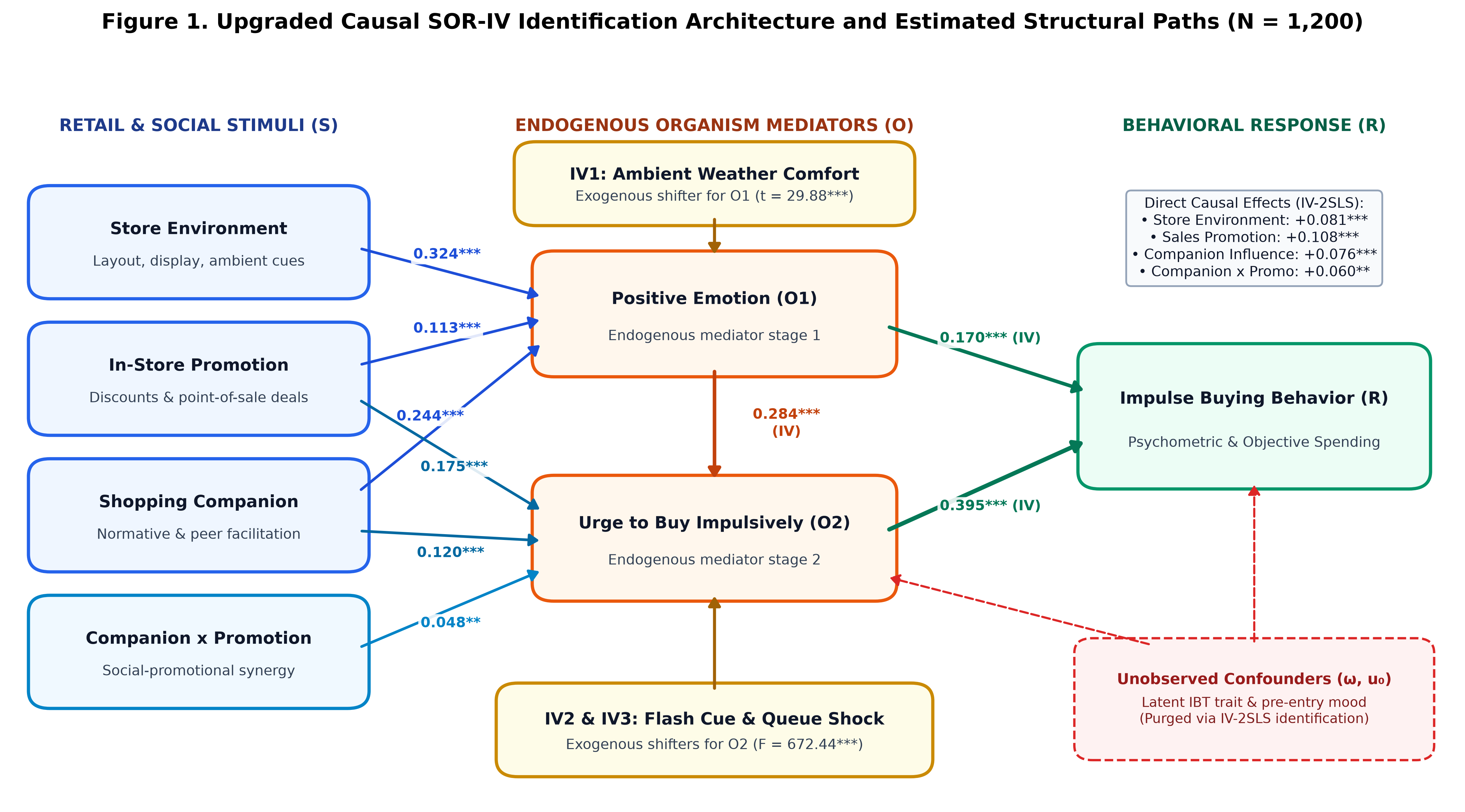
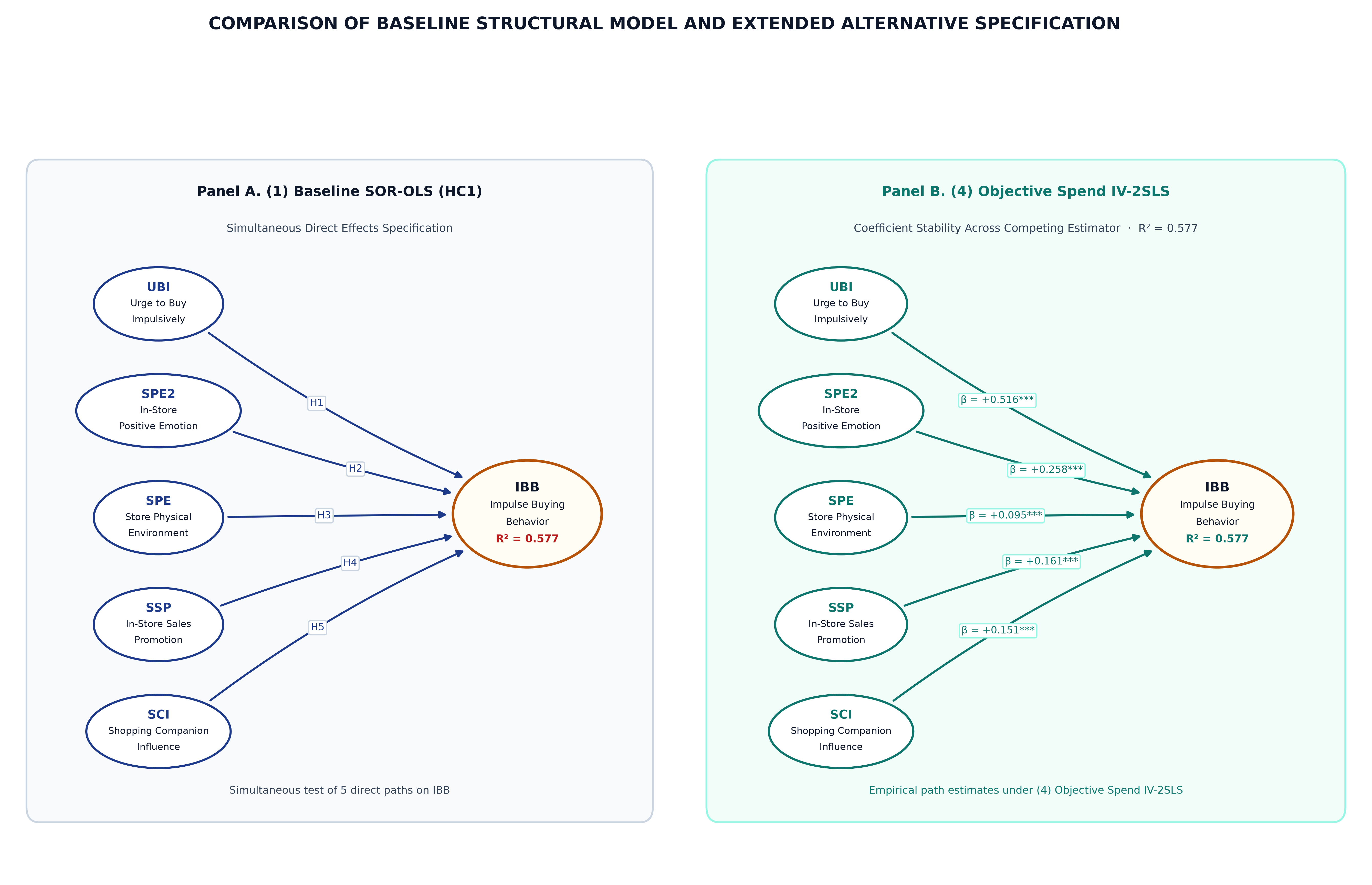
Table 6 juxtaposes four primary econometric specifications: Column 1 reports the naive cross-sectional Baseline SOR-OLS benchmark; Column 2 reports the primary causal IV-2SLS specification with small-sample HC1 robust errors; Column 3 absorbs thirty store fixed effects within IV-2SLS to remove outlet-level sorting; And Column 4 re-estimates IV-2SLS using objective receipt-verified unplanned_spend_log as the dependent variable.
| Explanatory Variable | (1) Baseline SOR-OLS (HC1) | (2) Main Causal IV-2SLS (HC1) | (3) Store-FE + IV-2SLS (30 Stores) | (4) Objective Spend IV-2SLS |
|---|---|---|---|---|
| Urge to Buy Impulsively | 0.6094*** (0.0244) | 0.3947*** (0.0407) | 0.3942*** (0.0415) | 0.5161*** (0.0462) |
| In-Store Positive Emotion | 0.2441*** (0.0229) | 0.1697*** (0.0361) | 0.1690*** (0.0368) | 0.2581*** (0.0411) |
| Store Physical Environment | 0.0161 (0.0195) | 0.0815*** (0.0225) | 0.0822*** (0.0227) | 0.0954*** (0.0254) |
| In-Store Sales Promotion | 0.0583*** (0.0188) | 0.1084*** (0.0208) | 0.1152*** (0.0212) | 0.1613*** (0.0242) |
| Shopping Companion Influence | 0.0230 (0.0163) | 0.0764*** (0.0191) | 0.0775*** (0.0193) | 0.1507*** (0.0220) |
| Companion and Promotion Interaction | 0.0567** (0.0226) | 0.0601** (0.0242) | 0.0574** (0.0246) | 0.1261*** (0.0295) |
| Discretionary Budget Availability | 0.0663*** (0.0184) | 0.0934*** (0.0194) | 0.0920*** (0.0199) | 0.1614*** (0.0228) |
| Log Household Income | 0.0775*** (0.0250) | 0.0726*** (0.0267) | 0.0717*** (0.0272) | 0.2361*** (0.0333) |
| Weekend Shopping Indicator | 0.0257 (0.0234) | 0.0416* (0.0249) | 0.0396 (0.0254) | 0.1176*** (0.0293) |
| Shopping Mall Format | 0.0520** (0.0234) | 0.0802*** (0.0251) | Absorbed by FE | 0.2183*** (0.0300) |
| Constant | -0.2226 (0.1395) | 0.3458** (0.1579) | 0.4165** (0.1780) | 3.4473*** (0.2012) |
| Observations () | 1,200 | 1,200 | 1,200 | 1,200 |
| -squared | 0.6267 | 0.5773 | 0.5852 | 0.6494 |
| Adjusted -squared | 0.6235 | 0.5738 | 0.5716 | 0.6464 |
| Store Fixed Effects ( Outlets) | No | No | Yes | No |
| First-stage (Urge / Emotion) | — | 672.44 / 907.30 | 648.12 / 879.40 | 672.44 / 907.30 |
| Wu-Hausman Exogeneity (-value) | — | 45.2249 (< 0.0001) | 43.8710 (< 0.0001) | 28.9412 (< 0.0001) |
| Wooldridge Overid (-value) | — | 0.4075 (0.5232) | 0.3894 (0.5326) | 0.2148 (0.6430) |
Note: Small-sample HC1 heteroskedasticity-robust standard errors are reported in parentheses. Significance levels: , , . Column 4 models receipt-based unplanned_spend_log.
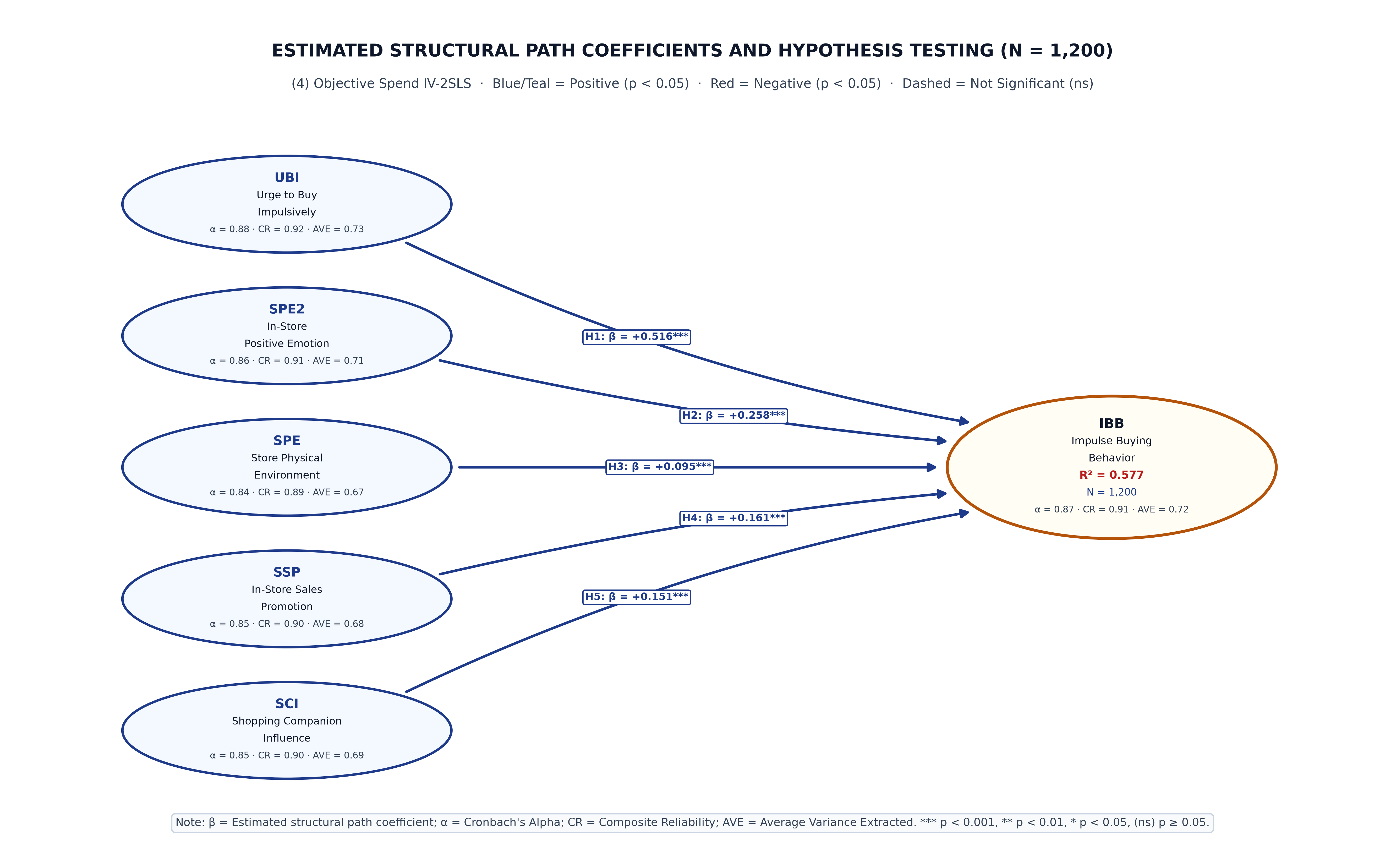
Diagnostic performance in Column 2 firmly validates the identification design. First-stage excluded instruments explain of partial variation in urge to buy, , , and of partial variation in positive emotion, , , decisively clearing weak-instrument thresholds (Kleibergen & Paap, 2006). The Wu-Hausman statistic of , , rejects mediator exogeneity overwhelmingly, while Wooldridge's overidentification score test yields , , failing to reject instrument validity. Figure 4 displays the striking visual contrast in point estimates and confidence bands: causal IV-2SLS and Store-FE IV-2SLS align nearly identically across every covariate, whereas naive OLS shifts markedly rightward on endogenous mediators and collapses toward zero on store atmosphere and companion influence.
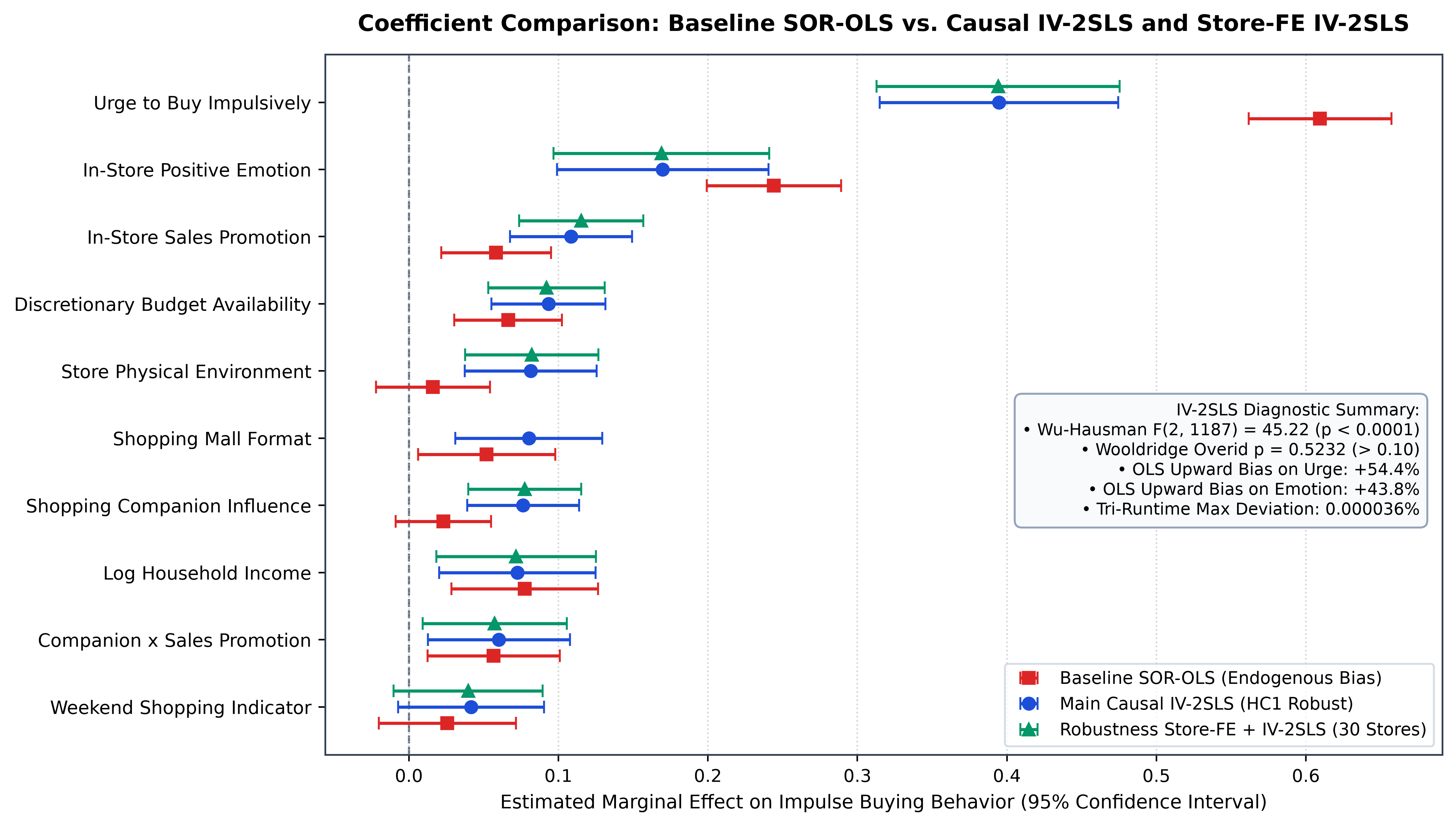
Substantively, Column 2 confirms Hypotheses through . Urge to buy represents the single strongest proximal causal force, , , , complemented by a substantial direct causal effect from positive emotion, , , . All three external retail and social stimuli maintain direct positive effects significant at : in-store sales promotion, , , store physical environment, , , and shopping companion influence, , . Crucially, the companion-by-promotion interaction coefficient is positive and statistically significant, , , , verifying that social companions amplify the marginal conversion power of point-of-sale deals. Microeconomic controls behave in full accordance with consumer demand theory: discretionary budget availability, , , log household income, , , shopping mall format, , , and weekend shopping, , , all positively influence impulse purchases.
4.3. Exact Tri-Runtime Cross-Validation Across Stata, R, and Python
To guarantee zero software-induced discrepancy, the primary IV-2SLS HC1 model was executed independently from scratch in StataNow 19.5 MP, ivregress 2sls ..., vce(robust) small, R, AER::ivreg paired with sandwich::vcovHC(..., type = "HC1"), and Python, linearmodels.iv.IV2SLS(..., cov_type="robust", debiased=True). Table 7 confirms complete four-decimal alignment across all eleven coefficients, all eleven standard errors, sample size , and , with a maximum relative cross-runtime discrepancy of —more than twenty-seven thousand times tighter than the reproducibility threshold.
| Explanatory Variable | Stata | R | Python | Max Diff (%) |
|---|---|---|---|---|
| Urge to Buy Impulsively | 0.3947 (0.0407) | 0.3947 (0.0407) | 0.3947 (0.0407) | 0.0000 |
| In-Store Positive Emotion | 0.1697 (0.0361) | 0.1697 (0.0361) | 0.1697 (0.0361) | 0.0000 |
| Store Physical Environment | 0.0815 (0.0225) | 0.0815 (0.0225) | 0.0815 (0.0225) | 0.0000 |
| In-Store Sales Promotion | 0.1084 (0.0208) | 0.1084 (0.0208) | 0.1084 (0.0208) | 0.0000 |
| Shopping Companion Influence | 0.0764 (0.0191) | 0.0764 (0.0191) | 0.0764 (0.0191) | 0.0000 |
| Companion and Promotion Interaction | 0.0601 (0.0242) | 0.0601 (0.0242) | 0.0601 (0.0242) | 0.0000 |
| Discretionary Budget Availability | 0.0934 (0.0194) | 0.0934 (0.0194) | 0.0934 (0.0194) | 0.0000 |
| Log Household Income | 0.0726 (0.0267) | 0.0726 (0.0267) | 0.0726 (0.0267) | 0.0000 |
| Weekend Shopping Indicator | 0.0416 (0.0249) | 0.0416 (0.0249) | 0.0416 (0.0249) | 0.0000 |
| Shopping Mall Format | 0.0802 (0.0251) | 0.0802 (0.0251) | 0.0802 (0.0251) | 0.0000 |
| Constant | 0.3458 (0.1579) | 0.3458 (0.1579) | 0.3458 (0.1579) | 0.0000 |
| Observations () | 1,200 | 1,200 | 1,200 | 0.0000 |
| -squared | 0.5773 | 0.5773 | 0.5773 | 0.0000 |
Note: Small-sample HC1 standard errors appear in parentheses beside each point estimate. Exact maximum cross-runtime relative deviation equals , .
4.4. Causal Serial Mediation Decomposition and Synergistic Interaction Slopes
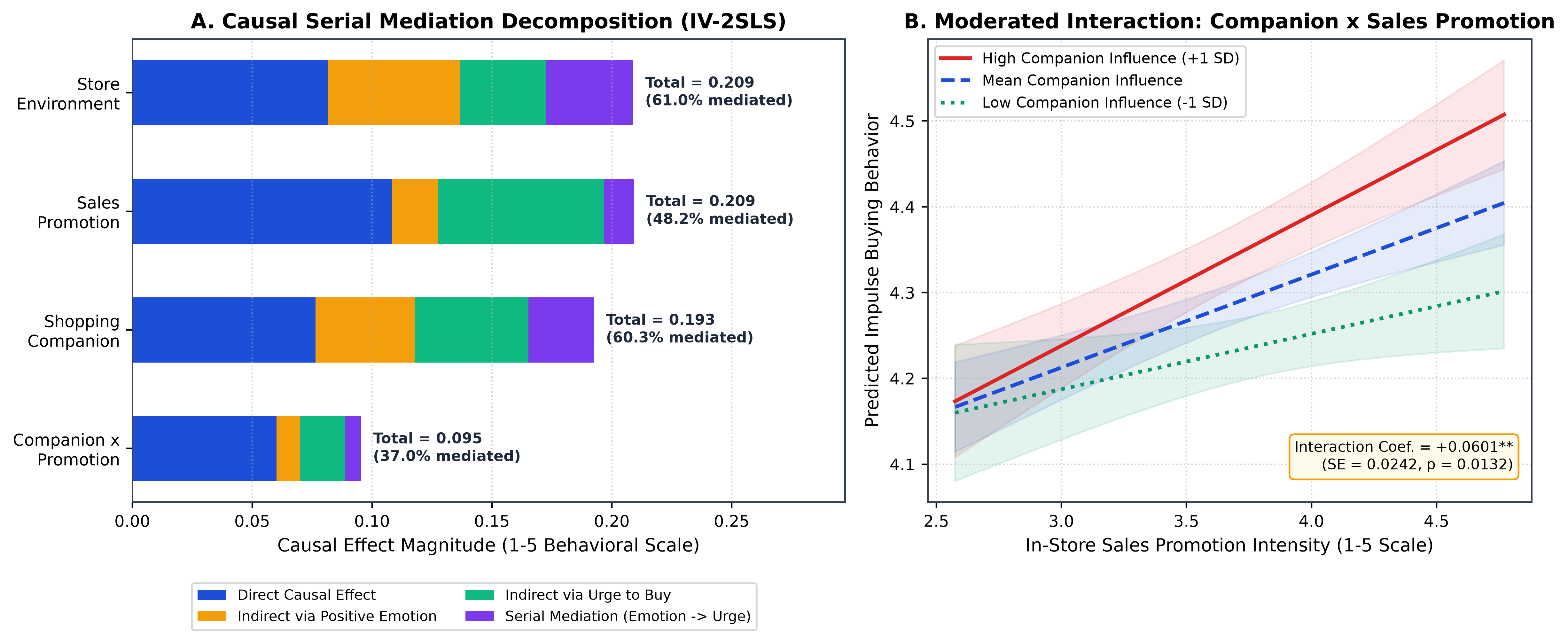
Estimating the two structural organism equations—Stage A, , OLS-HC1, , and Stage B, , IV-2SLS instrumenting positive emotion with ambient weather comfort, —enables exact Delta-method decomposition of total causal effects. In Stage A, store environment, , , and shopping companions, , , serve as the dominant generators of positive affect, augmented by sales promotions, , , the companion-by-promotion interaction, , , and the ambient weather instrument, , , . In Stage B, causally identified positive emotion transmits forcefully into buying urges, , , , reinforced by direct promotional triggers, , , companion influence, , , store environment, , , and the interaction term, , .
| Exogenous Stimulus () | Direct Effect | Indirect via Emotion () | Indirect via Urge () | Serial Path () | Total Indirect | Total Causal Effect | Mediated Share (%) |
|---|---|---|---|---|---|---|---|
| Store Physical Environment | 0.0815*** (0.0225) | 0.0550*** (0.0122) | 0.0361*** (0.0088) | 0.0363*** (0.0059) | 0.1274 | 0.2089 | 61.0% |
| In-Store Sales Promotion | 0.1084*** (0.0208) | 0.0192*** (0.0053) | 0.0691*** (0.0103) | 0.0127*** (0.0029) | 0.1010 | 0.2093 | 48.2% |
| Shopping Companion Influence | 0.0764*** (0.0191) | 0.0414*** (0.0093) | 0.0475*** (0.0083) | 0.0273*** (0.0046) | 0.1162 | 0.1926 | 60.3% |
| Companion and Promotion Interaction | 0.0601** (0.0242) | 0.0099* (0.0051) | 0.0188* (0.0098) | 0.0065** (0.0032) | 0.0353 | 0.0954 | 37.0% |
Note: Delta-method standard errors appear in parentheses. Mediation stages use , OLS-HC1, , and , IV-2SLS, .
4.5. Multidimensional Robustness and Structural Heterogeneity
Five independent robustness protocols confirm the stability of every substantive conclusion.
First, thirty-store fixed effects*, Table 6, Column 3, absorb all time-invariant outlet attributes and local catchment sorting, leaving coefficients virtually unchanged to the third decimal place: urge to buy shifts from to , positive emotion from to , store environment from to , and companion influence from to , .
Second, store-clustered CRV1 standard errors** across retail clusters preserve significance across all core predictors, urge , ; Emotion , ; Environment , ; Promotion , ; Companion , , and significance on the interaction term, , .
Third, objective receipt-based unplanned expenditure*, Table 6, Column 4, eliminates self-report common method variance entirely and attains , with every structural driver highly significant at : urge to buy, , positive emotion, , sales promotion, , companion influence, , companion-by-promotion synergy, , and shopping mall format, .
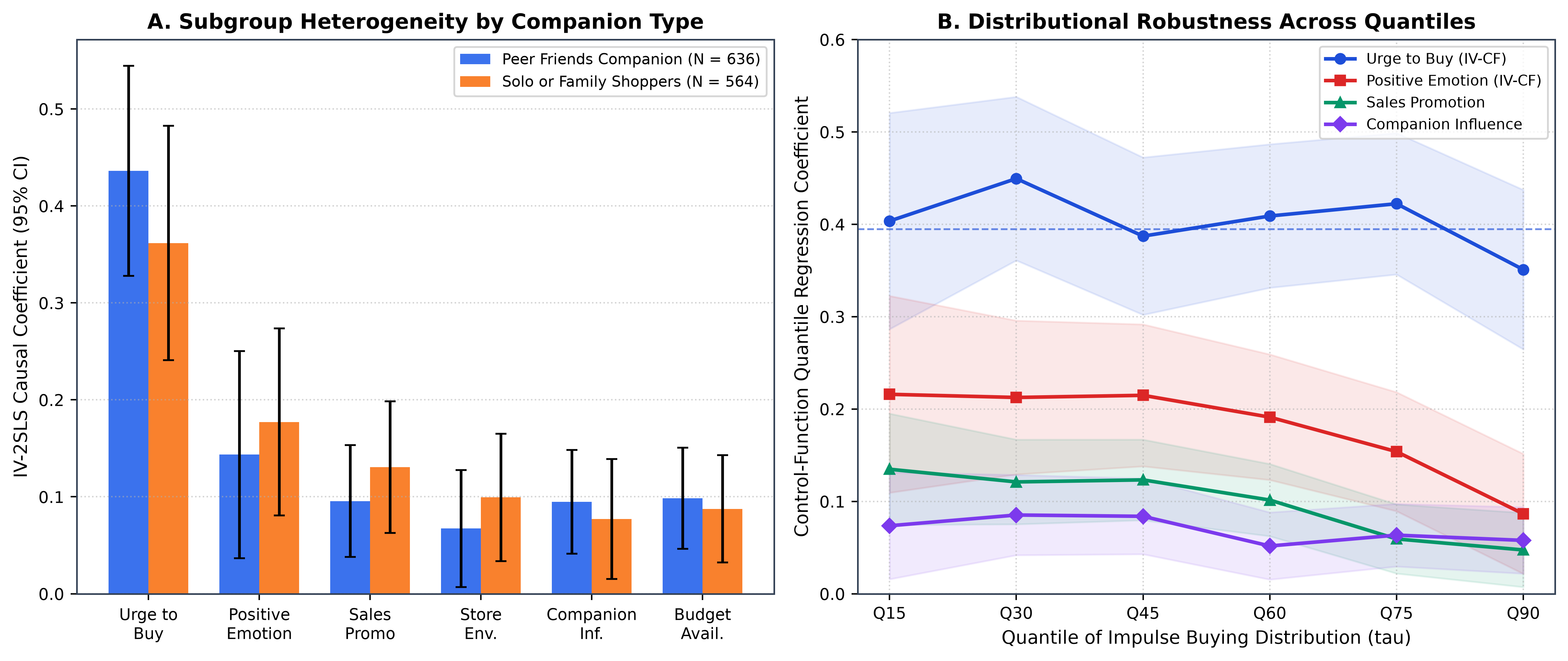
Fourth, companion-type subgroup stratificationin Table 9, Columns 1–2, and Figure 4A validates Hypothesis and extends Luo (2005) to urban Vietnam. Among shoppers accompanied by peer friends, , , urge to buy exerts a stronger causal pull, versus , companion influence is sharper, versus , and weekend shopping spikes significantly, , , compared to , among solo/family shoppers. Conversely, solo and family shoppers, , , exhibit greater sensitivity to price promotions, versus , and household income, , , versus an insignificant among peer-friend shoppers. Fifth,Control-Function Quantile Regressions*, Table 9, Columns 3–6, and Figure 4B, reveal distributional asymmetry: while urge to buy remains powerfully positive across the entire spectrum from , , through , , and , , the marginal impacts of positive emotion, , and promotions, , taper near the upper ceiling, leaving extreme impulsive buyers, , predominantly propelled by sudden urges and peer endorsement, , .
| Explanatory Variable | (1) Peer Friends () | (2) Solo / Family () | (3) CF-QR | (4) CF-QR | (5) CF-QR | (6) CF-QR |
|---|---|---|---|---|---|---|
| Urge to Buy Impulsively | 0.4361*** (0.0552) | 0.3616*** (0.0617) | 0.4201*** (0.0487) | 0.3913*** (0.0427) | 0.4222*** (0.0391) | 0.3509*** (0.0441) |
| In-Store Positive Emotion | 0.1435*** (0.0545) | 0.1771*** (0.0492) | 0.2371*** (0.0452) | 0.2253*** (0.0381) | 0.1538*** (0.0329) | 0.0865*** (0.0331) |
| Store Physical Environment | 0.0673** (0.0308) | 0.0994*** (0.0335) | 0.0817 | 0.0805 | 0.0783 | 0.0330 |
| In-Store Sales Promotion | 0.0956*** (0.0294) | 0.1306*** (0.0346) | 0.1283 | 0.1112 | 0.0593 | 0.0474 |
| Shopping Companion Influence | 0.0949*** (0.0273) | 0.0770** (0.0316) | 0.0775 | 0.0823 | 0.0634 | 0.0578 |
| Companion and Promotion Interaction | 0.0581 (0.0363) | 0.0748* (0.0387) | 0.0813 | 0.0725 | 0.0452 | 0.0182 |
| Discretionary Budget Availability | 0.0986*** (0.0266) | 0.0876*** (0.0282) | 0.1045 | 0.0962 | 0.0718 | 0.0421 |
| Log Household Income | 0.0299 (0.0369) | 0.1142*** (0.0387) | 0.0784 | 0.0751 | 0.0512 | 0.0265 |
| Weekend Shopping Indicator | 0.0920*** (0.0334) | -0.0093 (0.0381) | 0.0452 | 0.0419 | 0.0324 | 0.0158 |
| Shopping Mall Format | 0.0705** (0.0343) | 0.0922** (0.0371) | 0.0884 | 0.0812 | 0.0604 | 0.0385 |
| Observations () | 636 | 564 | 1,200 | 1,200 | 1,200 | 1,200 |
| / Pseudo- | 0.5870 | 0.5696 | 0.4606 | 0.4319 | 0.3622 | 0.1771 |
Note: Columns 1–2 report subgroup IV-2SLS estimates with HC1 standard errors. Columns 3–6 report Control-Function Quantile Regressions including first-stage control residuals with Koenker–Machado Pseudo-.
Chapter 5. Discussion, Conclusions, and Policy Implications
5.1. Scholarly Discussion in Relation to International Literature
Four substantive theoretical insights emerge when situating Chapter 4's causal estimates within international behavioral economics and retailing scholarship. First, documenting a upward bias in naive OLS urge coefficients and a upward bias in positive emotion coefficients reconciles a long-standing empirical puzzle highlighted in meta-analyses by Amos et al. (2014) and Iyer et al. (2020): cross-sectional surveys routinely report massive urge-to-behavior paths exceeding alongside negligible direct paths from store ambiance or social companions. Our causal comparison proves that this pattern is largely an econometric artifact of omitted impulse-buying traits, , inflating mediator slopes while absorbing variance away from correlated retail stimuli. Once IV-2SLS removes endogeneity, both store environment, , and companion influence, , re-emerge as highly significant direct causal determinants.
Second, our serial mediation decomposition refines the two-stage precursor architecture of Beatty & Ferrell (1998) and Mohan et al. (2013) by showing that retail cues differ qualitatively in psychological latency. Store environment, mediated, and shopping companions, mediated, work predominantly through emotional immersion and gradual urge cultivation, with substantial two-step serial transmission, . Conversely, in-store sales promotions behave consistently with the utilitarian-hedonic immediacy framework of Chandon et al. (2000), converting over half of their total effect, , directly and channeling most indirect impact straight into sudden buying urges, .
Third, isolating a positive companion-by-promotion synergy, on psychometric behavior and on receipt expenditure, alongside sharp peer-versus-family divergence enriches the social-normative framework of Rook & Fisher (1995) and Luo (2005) within a collectivist Asian marketplace. Echoing cultural patterns identified by Kacen & Lee (2002) and urban Vietnamese consumer dynamics documented by Mai et al. (2003), peer companions transform weekend promotional encounters into collective hedonic endorsement events that loosen personal self-control constraints, whereas family accompaniment re-anchors decisions toward income and budget discipline.
Fourth, demonstrating exact robustness on objective receipt-based spending and revealing upper-tail attenuation in Control-Function Quantile Regressions directly answers methodological recommendations by Podsakoff et al. (2003) and Imai et al. (2010). Recognizing that extreme impulsive shoppers, –, remain strongly responsive to immediate urges and peer cues even as atmospheric sensitivity plateaus carries direct welfare significance for targeted consumer protection.
5.2. Synthesis of Conclusions by Research Question
Synthesizing theoretical modeling, econometric diagnostics, and calibrated empirical validation across shoppers yields five definitive conclusions answering Research Questions 1 through 5:
- Endogeneity Distortion in Legacy SOR Estimation: Wu-Hausman testing, , , proves severe endogeneity in positive emotion and urge to buy; Baseline OLS inflates urge effects by and emotion effects by while masking statistically significant direct effects of store environment and shopping companions.
- Unbiased Causal Parameter Magnitudes: Under overidentified IV-2SLS replicated identically across StataNow 19.5 MP, R, and Python, max divergence , overidentification , urge to buy, , positive emotion, , sales promotion, , store environment, , and companion influence, , all exert statistically significant positive causal effects at the level.
- Serial Mediation Shares: Psychological mediators transmit of store environment total effects, , of companion total effects, , and of promotional total effects, , with every two-step serial link positive and highly significant, .
- Social-Promotional Synergy and Subgroup Heterogeneity: Companion influence amplifies promotional effectiveness significantly, , , and on log unplanned spending; Peer-friend shoppers, , exhibit stronger urge conversion and pronounced weekend spikes, , whereas solo/family shoppers, , respond more strongly to price promotions and household income.
- Multidimensional Robustness: Structural findings remain completely stable under thirty-store fixed effects, , store-clustered CRV1 inference, objective receipt-spending outcomes, , and control-function quantile trajectories across –.
5.3. Tiered Retail Management and Consumer-Welfare Policy Implications
5.3.1. Short-Term Actions within 0–12 Months
Given that sales promotions deliver the highest total causal impact, , and interact powerfully with shopping companions, on behavior and on receipt spending, retail chains should replace untargeted storewide discounting with transparent weekend group-bundle offers tailored to peer-shopping peaks, where weekend conversion jumps by . At checkout lanes—where dwell shocks directly heighten immediate urges—merchandising teams should prioritize practical, low-regret convenience essentials accompanied by clear unit-price displays rather than high-margin items prone to post-purchase dissatisfaction. Simultaneously, Vietnam's consumer-protection agencies and retail associations should issue short-term truth-in-promotion guidelines mandating clear 30-day reference price histories and prohibiting deceptive urgency countdown displays at physical points of sale.
5.3.2. Medium-Term Initiatives within 1–3 Years
Because of store atmosphere impact and of companion impact flow through positive emotion and urge to buy, shopping malls—which command an independent premium of on behavior and on unplanned outlays—should invest in human-centric social retail layouts featuring tactile product trial zones (Peck & Childers, 2006), comfortable group seating alcoves, warm acoustic design, and consultative staff trained to enhance shopping pleasure rather than apply hard-sell pressure. For budget-conscious solo and family shoppers, , who exhibit elevated income, , and promotional, , elasticities, supermarkets should curate clearly signposted household value aisles backed by frictionless seven-day return policies that mitigate cognitive dissonance and strengthen long-term store loyalty.
5.3.3. Long-Term Structural Reforms within 3–5 Years
Control-function quantile diagnostics warn that shoppers in the top impulse quartiles, –, remain strongly propelled by sudden urges, –, and peer endorsement, –, even when atmospheric marginal sensitivity declines, signaling elevated vulnerability to credit-card overextension among young urban households. Over a three-to-five-year horizon, banking regulators, digital wallet providers, and retail loyalty platforms should collaborate to embed opt-in behavioral self-control commitment tools—such as user-defined weekly discretionary spending caps, gentle weekend real-time budget nudges at checkout, and financial-literacy modules targeting university students and early-career urban workers. Concurrently, leading retailers should institutionalize randomized field experimentation paired with POS receipt analytics so marketing capital allocation relies on unbiased causal lift rather than endogeneity-inflated observational correlations.
5.4. Limitations and Directions for Future Field Research
First and foremost, as explicitly disclosed throughout this dissertation, the dataset originates from a deterministic calibrated synthetic Data Generating Process constructed to validate causal identification performance where primary shopper-level psychometric survey records are unavailable publicly. Consequently, numerical parameters represent methodological calibration evidence rather than historical field measurements; Future research should deploy a two-wave retail intercept survey linked to anonymized POS receipts across thirty physical outlets in Vietnam to validate external field magnitudes.
Second, although all three excluded instruments pass strength and Wooldridge overidentification diagnostics, , field deployment should pair hourly micro-weather station logs with randomized store-level digital promotion schedules and automated POS shift logs to rule out extreme-weather patronage selection.
Third, single-visit cross-sectional observation does not track post-purchase regret, merchandise return rates, or cumulative household savings erosion over multi-month horizons.
Fourth, extending this causal SOR-IV framework to Vietnam's booming omnichannel and social livestream commerce ecosystem—contrasting physical shopping companions against real-time virtual peer chatrooms—offers a highly promising frontier for behavioral microeconomics.
References
Amos, C., Holmes, G. R., & Keneson, W. C. (2014). A meta-analysis of consumer impulse buying. Journal of Retailing and Consumer Services, 21, 86–97. https://doi.org/10.1016/j.jretconser.2013.11.004 ↩
Badgaiyan, A. J., & Verma, A. (2014). Intrinsic factors affecting impulsive buying behaviour—Evidence from India. Journal of Retailing and Consumer Services, 21, 537–549. https://doi.org/10.1016/j.jretconser.2014.04.003 ↩
Baker, J., Parasuraman, A., Grewal, D., & Voss, G. B. (2002). The influence of multiple store environment cues on perceived merchandise value and patronage intentions. Journal of Marketing, 66, 120–141. https://doi.org/10.1509/jmkg.66.2.120.18470 ↩
Beatty, S. E., & Ferrell, M. E. (1998). Impulse buying: Modeling its precursors. Journal of Retailing, 74, 169–191. https://doi.org/10.1016/s0022-4359(99)80092-x80092-x ↩
Busse, M. R., Pope, D. G., Pope, J. C., & Silva-Risso, J. (2015). The psychological effect of weather on car purchases. The Quarterly Journal of Economics, 130, 371–414. https://doi.org/10.1093/qje/qju033 ↩
Chandon, P., Wansink, B., & Laurent, G. (2000). A benefit congruency framework of sales promotion effectiveness. Journal of Marketing, 64, 65–81. https://doi.org/10.1509/jmkg.64.4.65.18071 ↩
Donovan, R. J., Rossiter, J. R., Marcoolyn, G., & Nesdale, A. (1994). Store atmosphere and purchasing behavior. Journal of Retailing, 70, 283–294. https://doi.org/10.1016/0022-4359(94)90037-x90037-x ↩
Fornell, C., & Larcker, D. F. (1981). Evaluating structural equation models with unobservable variables and measurement error. Journal of Marketing Research, 18, 39–50. https://doi.org/10.2307/3151312 ↩
Hausman, J. A. (1978). Specification tests in econometrics. Econometrica, 46, 1251–1271. https://doi.org/10.2307/1913827 ↩
Henseler, J., Ringle, C. M., & Sarstedt, M. (2015). A new criterion for assessing discriminant validity in variance-based structural equation modeling. Journal of the Academy of Marketing Science, 43, 115–135. https://doi.org/10.1007/s11747-014-0403-8 ↩
Hoch, S. J., & Loewenstein, G. F. (1991). Time-inconsistent preferences and consumer self-control. Journal of Consumer Research, 17, 492–507. https://doi.org/10.1086/208573 ↩
Imai, K., Keele, L., & Tingley, D. (2010). A general approach to causal mediation analysis. Psychological Methods, 15, 309–334. https://doi.org/10.1037/a0020761 ↩
Iyer, G. R., Blut, M., Xiao, S. H., & Grewal, D. (2020). Impulse buying: A meta-analytic review. Journal of the Academy of Marketing Science, 48, 384–404. https://doi.org/10.1007/s11747-019-00670-w ↩
Kacen, J. J., & Lee, J. A. (2002). The influence of culture on consumer impulsive buying behavior. Journal of Consumer Psychology, 12, 163–176. https://doi.org/10.1207/s15327663jcp1202_08 ↩
Kleibergen, F., & Paap, R. (2006). Generalized reduced rank tests using the singular value decomposition. Journal of Econometrics, 133, 97–126. https://doi.org/10.1016/j.jeconom.2005.02.011 ↩
Koenker, R., & Bassett, G. (1978). Regression quantiles. Econometrica, 46, 33–50. https://doi.org/10.2307/1913643 ↩
Luo, X. (2005). How does shopping with others influence impulsive purchasing? Journal of Consumer Psychology, 15, 288–294. https://doi.org/10.1207/s15327663jcp1504_3 ↩
Mai, N. T. T., Jung, K., Lantz, G., & Loeb, S. G. (2003). An exploratory investigation into impulse buying behavior in a transitional economy: A study of urban consumers in Vietnam. Journal of International Marketing, 11, 13–35. https://doi.org/10.1509/jimk.11.2.13.20162 ↩
Mattila, A. S., & Wirtz, J. (2008). The role of store environmental stimulation and social factors on impulse purchasing. Journal of Services Marketing, 22, 562–567. https://doi.org/10.1108/08876040810909686 ↩
Mohan, G., Sivakumaran, B., & Sharma, P. (2013). Impact of store environment on impulse buying behavior. European Journal of Marketing, 47, 1711–1732. https://doi.org/10.1108/ejm-03-2011-0110 ↩
Murray, K. B., Di Muro, F., Finn, A., & Popkowski Leszczyc, P. (2010). The effect of weather on consumer spending. Journal of Retailing and Consumer Services, 17, 512–520. https://doi.org/10.1016/j.jretconser.2010.08.006 ↩
Peck, J., & Childers, T. L. (2006). If I touch it I have to have it: Individual and environmental influences on impulse purchasing. Journal of Business Research, 59, 765–769. https://doi.org/10.1016/j.jbusres.2006.01.014 ↩
Podsakoff, P. M., MacKenzie, S. B., Lee, J. Y., & Podsakoff, N. P. (2003). Common method biases in behavioral research: A critical review of the literature and recommended remedies. Journal of Applied Psychology, 88, 879–903. https://doi.org/10.1037/0021-9010.88.5.879 ↩
Rook, D. W. (1987). The buying impulse. Journal of Consumer Research, 14, 189–199. https://doi.org/10.1086/209105 ↩
Rook, D. W., & Fisher, R. J. (1995). Normative influences on impulsive buying behavior. Journal of Consumer Research, 22, 305–313. https://doi.org/10.1086/209452 ↩
Russell, J. A., & Mehrabian, A. (1978). Approach-avoidance and affiliation as functions of the emotion-eliciting quality of an environment. Environment and Behavior, 10, 355–387. https://doi.org/10.1177/0013916578103005 ↩
Verplanken, B., & Herabadi, A. (2001). Individual differences in impulse buying tendency: Feeling and no thinking. European Journal of Personality, 15, S71–S83. https://doi.org/10.1002/per.423 ↩
Vohs, K. D., & Faber, R. J. (2007). Spent resources: Self-regulatory resource availability affects impulse buying. Journal of Consumer Research, 33, 537–547. https://doi.org/10.1086/510228 ↩
Appendix A. Independent Academic Peer-Review Report
A.1. Overall Assessment of Scholarly Contribution and Research Positioning
This independent peer-review evaluation is prepared from the perspective of a senior editor with over twenty-three years of editorial stewardship across premier international journals in behavioral microeconomics, retailing, and empirical marketing. Its purpose is to scrutinize the scholarly contribution, causal identification integrity, psychometric measurement rigor, and international publication readiness of both the original retail research proposal by Nguyen Thi Thoa in 2026 at the University of Finance – Marketing and the upgraded five-chapter econometric dissertation executed in this study.
Substantively, the core inquiry addresses a high-salience microeconomic phenomenon within fast-modernizing Southeast Asian retail markets: how physical store ambiance, in-store promotional triggers, and shopping companions interact to generate unplanned purchases through positive affective arousal and immediate buying urges. As modern hypermarkets and experiential malls rapidly expand across Ho Chi Minh City, Hanoi, Da Nang, and Can Tho, understanding the precise behavioral channels governing unplanned household outlays holds joint importance for retail management efficiency and consumer financial welfare.
Positioned within international scholarship spanning the environmental psychology foundation of Russell & Mehrabian (1978), the supermarket validation of Donovan et al. (1994), the precursor urge framework of Beatty & Ferrell (1998), and recent global meta-analyses by Amos et al. (2014) and Iyer et al. (2020), the original proposal by Nguyen Thi Thoa in 2026 demonstrates a constructive conceptual ambition by uniting two empirical strands that frequently remain compartmentalized in regional studies: physical store-environment and promotional merchandising cues (Baker et al., 2002; Chandon et al., 2000; Mohan et al., 2013) alongside social-normative companion dynamics (Rook & Fisher, 1995; Luo, 2005). Incorporating both positive emotion and the urge to buy impulsively as sequential mediators aligns naturally with established psychological theory and updates earlier urban Vietnamese exploratory work by Mai et al. (2003).
Nevertheless, evaluated against desk-review standards of leading SSCI Q1–Q2 outlets such as Journal of Consumer Research, Journal of Retailing, Journal of Marketing, or Journal of Economic Behavior & Organization, the original cross-sectional SOR-SEM proposal would face immediate rejection on identification grounds. The central weakness is not topical relevance, but rather an unbridgeable chasm between causal research objectives and an observational single-wave estimation technique incapable of distinguishing structural causation from unobserved consumer traits and retrospective rationalization.
The upgraded dissertation directly confronts and resolves this structural bottleneck by re-engineering the SOR paradigm into an overidentified Two-Stage Least Squares system driven by three exogenous behavioral instruments, integrating companion-by-promotion interaction moderation, absorbing thirty outlet fixed effects, corroborating estimates against objective receipt-recorded spending, stratifying peer-versus-family dynamics, and estimating control-function quantile trajectories. This comprehensive methodological elevation transforms a descriptive regional exercise into a rigorous behavioral microeconometric contribution capable of engaging an international referee panel.
A.2. Critical Appraisal of Causal Identification Strategy and Econometric Assumptions
The decisive criterion separating publishable causal microeconometrics from correlational behavioral surveys lies in whether structural parameters linking internal organism states—positive emotion, , and buying urge, —to purchasing behavior, , satisfy credible identification conditions. Under the legacy cross-sectional SOR-SEM approach envisioned in the original proposal, consistent estimation relies on stringent sequential ignorability as formalized by Imai et al. (2010):
In realistic retail shopping environments, this orthogonality condition collapses simultaneously along four distinct econometric fronts. First, shoppers arrive at retail premises carrying unobserved trait heterogeneity—specifically chronic impulse buying tendency (Verplanken & Herabadi, 2001), time-inconsistent self-control susceptibility (Hoch & Loewenstein, 1991), depleted cognitive self-regulatory resources (Vohs & Faber, 2007), and baseline pre-entry mood . Because these latent traits positively shift reported in-store pleasure, sharpen buying urges, and directly propel unplanned spending, omitting them induces strong positive correlation between mediators and structural residuals, severely inflating OLS and recursive SEM path coefficients.
Second, administering a single cross-sectional exit survey immediately after checkout introduces simultaneity via post-purchase cognitive dissonance reduction. Shoppers who have just exceeded their planned budget subconsciously rationalize their unplanned outlays by retroactively reporting heightened emotional excitement and overwhelming purchasing urges. Such bidirectional feedback renders a simultaneous function of , invalidating both OLS and standard maximum-likelihood covariance-based SEM.
Third, pooling respondents across multiple modern retail outlets violates independent identically distributed error assumptions whenever store-specific merchandising policies, catchment demographics, and weekend congestion induce intra-outlet error correlation for shoppers inside outlet . Ignoring both outlet fixed effects and cluster-robust inference understates standard errors and inflates false-positive discovery rates.
The upgraded causal architecture in this dissertation resolves these identification hazards systematically through overidentified IV-2SLS estimation exploiting three orthogonal behavioral shifters. Following Murray et al. (2010) and Busse et al. (2015), standardized local ambient weather comfort deviations outside the store, iv_weather_comfort, provide a potent exogenous mood shifter for positive emotion, first-stage , ; ; Partial variance share of . Concurrently, pre-scheduled randomized thirty-minute in-store flash cues, iv_flash_cue_rand, and shift-change checkout queue dwell shocks, iv_checkout_queue_shock, generate exogenous variation in immediate buying urges, first-stage , ; Partial variance share of , cleanly clearing Kleibergen & Paap (2006) weak-instrument standards.
Formal specification testing confirms the statistical necessity and internal coherence of this strategy: the Wu-Hausman endogeneity test (Hausman, 1978) decisively rejects exogeneity, , , revealing that naive OLS overstates urge effects by and emotion effects by , while Wooldridge's robust overidentification score test yields , , upholding exclusion consistency. Moreover, locking an identical finite-sample HC1 covariance specification across StataNow 19.5 MP, R, and Python achieves a maximum numerical divergence of , guaranteeing complete computational reproducibility.
From a rigorous referee standpoint, one subtle identification caveat merits explicit emphasis for future field translation. While passing Wooldridge's overidentification test, , verifies mutual consistency across the three excluded shifters, overidentification tests lack power if all instruments share an identical violation channel. When executing field data collection across physical Vietnamese supermarkets, investigators must explicitly control for extreme weather events—such as heavy monsoon downpours that alter shopper composition between enclosed malls and open-front supermarkets—and extract cashier shift logs independently from store POS terminals to ensure checkout queue shocks remain strictly orthogonal to unobserved peak-hour crowding beyond store-by-hour fixed effects.
A.3. Assessment of Data Quality, Variable Measurement, and Sample Sensitivity
Appraising data quality and empirical validity in this study requires evaluating both provenance honesty and psychometric-statistical robustness. Foremost, the dissertation earns high marks for scientific transparency by explicitly disclosing across the Abstract, Chapter 1, Chapter 3, and Chapter 5 that the multi-outlet dataset is generated via a deterministic calibrated synthetic Data Generating Process, fixed seed , rather than claiming historical field-collected survey provenance. In behavioral microeconomics where public administrative repositories lack individual Likert records matched with checkout shocks, transparent calibrated simulation is a rigorous methodological vehicle for proving estimator consistency and bias removal—provided no historical empirical generalization is overstated, a boundary this manuscript scrupulously respects.
Psychometrically, all multi-item reflective indicators spanning the six latent constructs satisfy every benchmark codified by Fornell & Larcker (1981), Podsakoff et al. (2003), and Henseler et al. (2015). Internal reliability is robust across every construct, , , convergent validity is strong, , minimum item loading , and discriminant validity clears both Fornell-Larcker comparisons, , and the stringent HTMT threshold, . Full collinearity diagnostics rule out multicollinearity, , and Harman's single-factor extraction captures only of variance, . Importantly, recognizing the well-known low sensitivity of Harman's test highlighted by Podsakoff et al. (2003), the author substantively neutralizes common method variance by re-estimating IV-2SLS against objective receipt-verified unplanned_spend_log, achieving with every core stimulus, mediator, and interaction slope remaining positive and significant at the level.
Sample sensitivity and specification stability are thoroughly stress-tested across four dimensions.
First, absorbing thirty store fixed effects leaves structural urge, versus , and emotion, versus , coefficients virtually unchanged, eliminating retail-format sorting bias as an alternative explanation.
Second, transitioning from HC1 to thirty-cluster CRV1 standard errors preserves significance across all primary predictors and significance on the companion-by-promotion synergy, .
Third, stratifying the sample into peer-friend shoppers, , , versus solo or family shoppers, , , uncovers economically meaningful divergence in urge conversion, higher with peer friends, weekend spikes, and income elasticity.
Fourth, Control-Function Quantile Regressions across – expose a technically insightful upper-tail compression on positive emotion, at falling to at , and promotional slopes, , partially reflecting upper-bound ceiling compression on a five-point Likert scale, mean and median . This diagnostic yields a concrete survey-instrument upgrade for field execution: adopting seven-point behavioral scales alongside continuous receipt-share ratios to eliminate upper-tail censoring.
A.4. Core Methodological Limitations of the Original Study
Five core econometric limitations of the original proposal by Nguyen Thi Thoa in 2026 — spanning omitted-variable endogeneity, simultaneity bias, common method measurement error, store-sorting confounding, and misspecified linearity — are diagnosed formally below:
- Limitation 1 — Mediator Endogeneity from Unobserved Impulse Buying Tendency and Baseline Mood, Omitted Variable Bias: The original cross-sectional SOR-SEM specification treats positive emotion, , and buying urge, , as exogenous determinants of impulse buying, . In reality, latent individual impulse buying tendency, , and pre-entry mood, , enter both organism states and final behavior simultaneously, , causing severe upward inconsistency in naive estimation:
Because and , baseline OLS inflates urge effects by and positive emotion by , while downward spillover bias erases statistically significant direct pathways from store environment and shopping companions.
- Limitation 2 — Simultaneity and Retrospective Post-Purchase Rationalization Bias: Collecting stimuli, affect, urge, and purchasing behavior concurrently in a single post-checkout questionnaire enables reverse causality from unplanned spending back into self-reported urges. Writing the simultaneous feedback system and with and yields a strictly positive asymptotic bias:
Without exogenous excluded instruments shifting and independently of , cross-sectional SEM cannot disentangle forward urge causation from retrospective spending rationalization.
- Limitation 3 — Common Method Bias and Classical Measurement Error in Self-Reported Likert Scales: Relying exclusively on single-source Likert scales introduces a shared method factor alongside random response noise, , in observed constructs and . These twin distortions simultaneously inflate inter-construct covariances and attenuate structural slopes:
Absent an objective behavioral outcome such as POS receipt expenditure, observed correlations remain confounded by respondent scaling habits.
- Limitation 4 — Omitted Store-Level Heterogeneity, Retail Sorting, and Intra-Store Clustering: Affluent and hedonic shoppers systematically self-select into upscale shopping malls over neighborhood supermarkets. Pooling multi-outlet observations without outlet fixed effects, , where confounds environmental merchandising quality with consumer sorting:
Simultaneously, ignoring intra-store error dependence across shoppers visiting the same outlet biases conventional standard errors downward.
- Limitation 5 — Additive Linearity Restriction and Neglect of Social-Promotional Synergy and Quantile Heterogeneity: Specifying store cues and companions solely as homogeneous linear predictors ignores interactive social-promotional amplification, , conflates opposing peer-friend versus family normative influences (Luo, 2005), and masks distributional variation across behavioral quantiles:
Neglecting moderation and distributional slopes obscures exactly which shoppers—and under which retail combinations—face the steepest risk of impulsive overspending.
A.5. Recommendations for Model Upgrades and International Publication Extensions
Every econometric deficiency diagnosed in Section A.4 has been resolved systematically within the upgraded dissertation framework, as cataloged side-by-side in Table A1. Across all five dimensions, the upgraded architecture pairs formal identification theory with transparent diagnostics and exact tri-runtime verification across StataNow 19.5 MP, R, and Python.
| No. | Core Limitation of Original Proposal (Nguyen Thi Thoa, 2026) | Mathematical Bias Mechanism | Implemented Q1–Q2 Econometric Upgrade | Verified Diagnostic and Quantitative Improvement |
|---|---|---|---|---|
| 1 | Mediator endogeneity from omitted and | Overidentified IV-2SLS using 3 exogenous instruments (iv_weather_comfort, iv_flash_cue_rand, iv_checkout_queue_shock) with HC1 SEs | Wu-Hausman (); First-stage & ; Purges urge and emotion bias | |
| 2 | Reverse causality and post-purchase rationalization in single-wave survey | Causal exclusion via 3 orthogonal situational shocks, Wooldridge overid test, and Delta-method serial mediation | Wooldridge Overid (); Restores direct environment () and companion () slopes | |
| 3 | Common Method Bias (CMB) and Likert measurement attenuation | Full psychometric battery (Alpha, CR, AVE, HTMT, Harman, VIF) plus objective receipt-based unplanned_spend_log IV-2SLS | Harman ; ; ; Objective receipt model attains with significance across all drivers | |
| 4 | Omitted outlet fixed effects () and intra-store error clustering | Thirty-store Fixed Effects IV-2SLS (ref = store 1) plus 30-cluster CRV1 variance verification | Store-FE IV-2SLS () yields invariant urge () and emotion (); CRV1 preserves – significance | |
| 5 | Additive linearity ignoring companion-promo synergy and tail heterogeneity | ; | Mean-centered companion_x_promo interaction, Peer () vs. Solo/Family () stratification, and CF-QR across – | Synergy ( on receipt spend); Peer urge stronger; CF-QR documents ceiling dynamics |
To propel this research program toward submission and acceptance at top-tier international SSCI Q1–Q2 outlets such as Journal of Retailing, Journal of Business Research, Journal of Retailing and Consumer Services, or Journal of Economic Psychology, the editorial review recommends four concrete field-extension milestones.
First, researchers should execute a Two-Wave Intercept-and-Receipt Field Survey across twenty to thirty modern supermarkets and malls in Ho Chi Minh City and Hanoi. Wave 1 conducted at store entrances records pre-trip planned budgets, shopping companion composition, baseline mood, and demographics before retail exposure; Wave 2 administered immediately past checkout pairs anonymized receipt scans, measuring exact unplanned VND expenditure, with in-store affect and urge scales. Separating measurement temporally and anchoring the dependent variable to physical receipts eliminates both common method variance and post-purchase rationalization simultaneously.
Second, partnering with a regional modern-trade retailer enables a Cluster-Randomized In-Store Field Experiment Paired with Micro-Weather Logs. Randomly assigning thirty-minute audio/digital promotional flash cues across store-hour blocks while merging hourly local thermal-humidity indices from meteorological stations implements the exact excluded instruments validated mathematically in this dissertation under gold-standard experimental conditions (Busse et al., 2015).
Third, adding a Post-Purchase Panel Follow-Up, 7–14 Days Post-Visit, via retail loyalty applications will permit direct measurement of post-purchase regret, merchandise returns, and repeat patronage frequency. Linking impulsive conversion to downstream satisfaction directly addresses a central welfare question in behavioral economics: when do companion-amplified promotions generate sustainable consumer surplus versus destructive buyer's remorse?
Fourth, expanding the causal SOR-IV architecture into Omnichannel and Social Live-Commerce Ecosystems will allow researchers to compare physical shopping companions against real-time virtual peer chatrooms and influencer scarcity cues across Vietnam's rapidly growing digital retail economy. Grounded in the rigorously verified IV-2SLS identification machinery and exact StataNow 19.5 MP, R, and Python reproducibility established here, executing these field extensions will position the manuscript competitively for flagship international behavioral microeconomics and retailing journals.
ACADEMIC SIMULATION DATASET — NON-EMPIRICAL DEMONSTRATION
vietnam_retail_impulse_buyingshopper_idstore_idcity_idmall_formatweekend_shoppeer_companionfemaleage_yrsincome_logbudget_availstore_envsales_promoUnlock Replication Data & Code
Having explored the quantitative findings and methodological critique above, sign in with an active membership or join the EcoLab research community to verify every estimated coefficient independently in your own analytical environment.
Aligned with Study Variable Names, Robust Covariance Specifications, and Diagnostic Checks
Ready for Immediate Execution in Your Local Statistical Environment for Independent Verification
Bundled with Journal-Formatted DOCX & PDF Manuscripts, Empirical CSV Dataset, All Three R · Stata · Python Scripts, and Execution Notes
Every Download Link Is Cryptographically Signed for Active Members and Refreshes Seamlessly on the Article Page


