List of Abbreviations and Mathematical Notation
| Abbreviation or Symbol | Full Expansion or Mathematical Definition | Role in Study |
|---|---|---|
| 2SLS | Two-Stage Least Squares | Primary instrumental variables estimator |
| CR1 | Finite-Sample Cluster-Robust Variance Adjustment | Workload-clustered covariance convention |
| DGP | Data-Generating Process | Deterministic simulation structure |
| FE | Fixed Effects | Unobserved workload and threshold absorption |
| FWL | Frisch-Waugh-Lovell Theorem | Exact two-way panel demeaning projection |
| GMM | Generalized Method of Moments | Two-step overidentification testing basis |
| IV | Instrumental Variables | Exogenous source of causal identification |
| KP rk Wald | Kleibergen-Paap Reduced-Rank Wald Statistic | Cluster-robust weak-instrument diagnostic |
| OLS | Ordinary Least Squares | Baseline pooled regression benchmark |
| TWFE | Two-Way Fixed Effects | Workload and support-threshold fixed effects |
| TWFE-IV | Two-Way Fixed Effects Instrumental Variables | Preferred causal panel identification framework |
| WIT-Tree | Weighted Itemset Transaction Tree | Baseline tree-based mining architecture |
| Natural logarithm of execution runtime in milliseconds | Primary dependent variable in M1 to M4 | |
| Natural logarithm of peak memory footprint in megabytes | Robustness dependent variable in M5 | |
| Natural logarithm of generated candidate itemsets | Intermediate search-space mechanism | |
| Candidate pruning ratio prior to full verification | Endogenous explanatory regressor | |
| Binary indicator equal to 1 for upgraded architecture | Policy and architectural treatment variable | |
| Item-weight Gini index and its sample-centered transform | Control variable and heterogeneity moderator | |
| Theoretical upper-bound tightness and header-table entropy | Excluded pre-scan exogenous instruments | |
| Workload fixed effects and support-threshold fixed effects | Two-way unobserved heterogeneity controls | |
| Total observations, workload clusters, and support levels | Panel dimensions: , , |
Chapter 1. Introduction and Research Positioning
1.1. Research Motivation and Scholarly Context
Association rule mining on large-scale transactional repositories originated with the foundational level-wise search framework of Agrawal et al. (1993) and rapidly became a cornerstone of transactional data science, retail market-basket analytics, electronic commerce personalization, and consumer behavior discovery. Classical frequency-based mining nevertheless rests on an implicit symmetry assumption that every item carries identical economic salience. In commercial databases, where high-margin products, strategic inventory items, or fraud-indicative events often occur at moderate frequencies alongside ubiquitous low-value staples, uniform frequency thresholds systematically discard economically valuable patterns.
To resolve this limitation, weighted association rule mining emerged as a major research stream spanning the weighted support and significance architecture of Tao et al. (2003), the weight-and-support affinity pattern framework of Yun (2007), the weighted itemset transaction tree design of Vo et al. (2013), and candidate-free high-utility pattern discovery exemplified by Liu & Qu (2012). In parallel, eliminating redundant rule proliferation through special association rule classes such as frequent closed itemsets pioneered by Pasquier et al. (1999) and vertical diffset compression introduced by Zaki & Gouda (2003) proved indispensable for scaling pattern discovery to massive transactional volumes.
Against this backdrop, the 2026 doctoral dissertation proposal by Phan Thanh Huan at the University of Science, Vietnam National University Ho Chi Minh City addresses a central computational problem at the intersection of mathematical foundations of computer science and scalable data analytics: accelerating special weighted association rule mining on large-scale transactional datasets with heterogeneous item weights. The research problem targets a genuine dual bottleneck in both central processing unit execution latency and peak random-access memory consumption as minimum weighted support thresholds decline sharply.
Viewed through the lens of international Q1 econometrics, however, standard algorithmic evaluation protocols in computer science exhibit a consequential methodological gap. Empirical benchmarking exercises predominantly report raw runtime curves across a handful of isolated test datasets or fit simple pooled linear regressions without confronting causal identification. In practice, an observed speedup between a baseline architecture and an upgraded mining engine amalgamates three distinct mechanisms: the direct architectural efficiency gain from compressed vertical data structures, the indirect mediation channel operating through an elevated candidate pruning ratio, and structural confounding induced by unobserved dataset topology and simultaneous combinatorial latency shocks. Failing to disentangle these components yields severely biased attribution of why an algorithm outperforms its competitors and obscures which workload characteristics govern its comparative advantage.
1.2. Research Objectives, Questions, and Study Scope
The overarching objective of this thesis is to formulate a formal econometric theory, a credible causal identification design, and a tri-runtime replication protocol capable of recovering unbiased causal effects of an upgraded mining architecture and search-space pruning intensity on both execution runtime and peak memory utilization. Four operational objectives guide the investigation:
First, to formalize the exact mathematical mechanisms through which pooled ordinary least squares and conventional two-way fixed effects estimators become inconsistent when candidate pruning ratios respond endogenously to contemporaneous combinatorial complexity shocks.
Second, to construct a pair of deterministic pre-scan excluded instruments that jointly satisfy strong first-stage relevance and the structural exclusion restriction conditional on workload characteristics and two-way fixed effects.
Third, to decompose total algorithmic performance improvements into direct architectural gains, indirect gains mediated by candidate pruning, and treatment-effect heterogeneity across the distribution of item-weight inequality measured by the Gini index.
Fourth, to verify cross-platform numerical invariance across Python 3, R 4, and Stata 18 MP under a strict sub-1 percent tolerance threshold while validating structural robustness on peak memory consumption.
Accordingly, the study addresses four core research questions:
- In what direction and by what magnitude do pooled ordinary least squares and standard two-way fixed effects estimators distort the candidate pruning elasticity and the direct speedup effect of an upgraded special weighted association rule mining architecture?
- Does a two-way fixed effects two-stage least squares strategy leveraging pre-scan theoretical upper-bound tightness and header-table weight-order entropy consistently identify the causal impact of candidate pruning on execution runtime?
- How does the direct execution speedup of the upgraded architecture vary heterogeneously with the skewness of the item-weight distribution captured by the item-weight Gini index?
- Do the quantitative conclusions regarding architectural superiority remain structurally invariant when peak memory consumption replaces execution runtime and when all specifications are independently replicated across Python 3, R 4, and Stata 18 MP?
With respect to data scope and transparency, standardized macroeconomic, corporate financial, customs, and household survey repositories do not record micro-level execution telemetry for weighted association rule mining engines. The thesis therefore constructs a fully reproducible, deterministic simulated balanced panel initialized with a fixed random seed of 42 across 60 standardized transactional workloads evaluated at 12 geometrically declining minimum weighted support thresholds from down to under both baseline and upgraded architectures, yielding panel observations. Every empirical figure and regression estimate in this thesis is strictly interpreted as a methodological demonstration of causal performance econometrics rather than historical production evidence from any specific commercial enterprise.
Chapter 2. Theoretical Foundations, Literature Review, and Research Hypotheses
2.1. Mathematical Foundations of Special Weighted Association Rule Mining
Consider a transactional database defined over a finite universe of distinct items , where each item carries a normalized positive weight encoding its relative economic margin, unit utility, or strategic importance. Following the weighted support formalism of Tao et al. (2003) and Vo et al. (2013), the composite itemset weight and weighted transaction support of any candidate itemset are defined as:
Where:
- denotes the composite mean weight assigned to candidate itemset ;
- represents the cardinality of itemset ;
- denotes the normalized aggregate transaction weight of transaction within database ;
- denotes the weighted support of itemset evaluated against the user-specified minimum weighted support threshold .
The fundamental algorithmic obstacle in weighted association rule mining arises from the breakdown of the downward-closure property exploited by classical level-wise search in Agrawal et al. (1993). Under heterogeneous item weights, a superset can attain a strictly higher weighted support than its subset whenever the appended item exhibits a disproportionately large weight. Consequently, naive pruning of low-support prefixes violates completeness. To restore sound search-space pruning, the weighted pattern mining literature introduces closure-preserving upper bounds such as transaction maximum weights in Tao et al. (2003), weight-affinity upper bounds in Yun (2007), and remaining-utility upper bounds embedded in utility-list structures in Liu & Qu (2012). Simultaneously, to contain combinatorial explosion on dense transactional matrices, candidate-free prefix-tree projection developed by Han et al. (2000), vertical diffset representation introduced by Zaki & Gouda (2003), and non-redundant closed itemset extraction established by Pasquier et al. (1999) dramatically lower transaction-identifier intersection costs and peak memory pressure.
2.2. Review of Causal Panel Econometrics for Computational Performance Evaluation
Moving from worst-case asymptotic complexity analysis to empirical benchmarking on multi-workload execution logs requires econometric estimators resilient to three structural threats to identification.
First, unobserved workload and threshold heterogeneity.** Distinct transactional workloads differ sharply in latent item co-occurrence graph topology, prefix-tree branching factors, and core-item overlap structures that standard summary statistics fail to capture. When execution outcomes are recorded across a two-dimensional panel indexed by workloads and minimum support thresholds, Goodman-Bacon (2021) highlights both the necessity of controlling for two-way fixed effects and the analytical danger of forcing homogeneous treatment-effect specifications when underlying responses vary systematically across unit attributes.
Second, simultaneous endogeneity of search-space pruning.** During live tree traversal, the realized candidate pruning ratio is not an exogenously assigned engineering knob. Higher-order combinatorial collisions, hash-table contention, and cache-line thrashing simultaneously erode effective upper-bound tightness and directly inflate execution latency. Under the generalized method of moments framework of Hansen (1982) and two-stage least squares theory, consistent structural estimation in the presence of endogenous regressors demands excluded instruments satisfying both strong partial correlation with the endogenous variable and orthogonality to the structural error term. Deploying two distinct exogenous instruments for a single endogenous pruning variable further yields an overidentified system that permits formal falsification of instrument exogeneity via the Hansen test.
Third, weak-instrument diagnostics and design-consistent cluster inference.** Staiger & Stock (1997) demonstrate that weakly correlated instruments pull two-stage least squares estimates toward inconsistent ordinary least squares limits and invalidate conventional asymptotic confidence intervals. To diagnose instrument strength under arbitrary heteroskedasticity and within-cluster error dependence, Kleibergen & Paap (2006) formulate the generalized reduced-rank Wald test, while Andrews et al. (2019) establish contemporary reporting protocols combining cluster-robust effective statistics with valid overidentification checks. Finally, because repeated executions across 12 declining support thresholds on the same transactional database share persistent memory layouts and combinatorial structures, errors exhibit pronounced within-workload serial correlation. Both Cameron et al. (2011) and Abadie et al. (2022) demonstrate that clustering standard errors at the design unit level—here, the 60 distinct workloads—is mandatory for valid finite-sample inference.
2.3. Analytical Cost Model and Research Hypotheses
Consider a multiplicative computational cost function governing the execution time of algorithmic architecture operating on transactional workload at minimum weighted support threshold . Execution latency scales proportionally with the product of the post-pruning surviving candidate search space , the per-node traversal cost determined by the data representation architecture and its interaction with centered item-weight skewness , and multiplicative workload scale, basket length, weight inequality, matrix density, and special-rule share factors. Taking natural logarithms yields a tractable semi-logarithmic structural equation in which slope parameters admit direct elasticity and exact percentage-reduction interpretations for both execution runtime and peak memory footprint. Grounded in this analytical cost decomposition, the thesis formulates four testable hypotheses:
- Hypothesis H1: Candidate search-space pruning exerts a strongly negative causal effect on log execution runtime; However, pooled ordinary least squares and standard two-way fixed effects substantially overstate the negative magnitude of the pruning elasticity due to negative contemporaneous covariance between pruning intensity and unobserved combinatorial complexity shocks.
- Hypothesis H2: The upgraded special weighted association rule mining architecture combining vertical weighted diffset compression and dynamic upper-bound pruning achieves a statistically significant direct reduction in log execution runtime even after controlling for candidate pruning intensity and two-way fixed effects.
- Hypothesis H3: The direct runtime reduction of the upgraded architecture exhibits significant negative heterogeneity with respect to the item-weight Gini index, meaning that the relative speedup advantage widens systematically on workloads characterized by heavily skewed item-weight distributions.
- Hypothesis H4: The joint mechanisms of tighter dynamic upper-bound pruning and compressed vertical diffset storage generate parallel, statistically significant reductions in log peak memory consumption across workloads and item-weight inequality regimes.
Chapter 3. Research Design, Causal Identification Strategy, and Simulation Data
3.1. Deterministic Simulated Panel Design and Variable Measurement
Because public econometric data archives do not collect paired multi-architecture execution logs alongside pre-scan algorithmic structural indices, this study builds a deterministic simulated balanced panel initialized with a fixed random seed of 42. The panel tracks distinct transactional workloads drawn from three nominal workload-density strata reflecting 40 percent sparse retail baskets, 35 percent moderate electronic-commerce logs, and 25 percent dense clickstream or web-access matrices. Under the fixed seed realization, the dataset comprises 42 sparse and moderate workloads contributing observations and 18 dense workloads contributing observations.
Each workload is benchmarked across geometrically declining minimum weighted support thresholds spanning down to under two competing implementations: a baseline weighted itemset transaction tree architecture inspired by Vo et al. (2013) coded as , and an upgraded special weighted rule mining architecture integrating vertical diffsets from Zaki & Gouda (2003) with dynamic upper-bound tightening coded as . The resulting balanced panel contains exactly observations.
| Variable Name | Symbol | Identification Role | Mean | SD | Min | Median | Max |
|---|---|---|---|---|---|---|---|
| Log execution runtime | Primary dependent variable | 12.5306 | 2.6528 | 6.0524 | 12.4289 | 20.3288 | |
| Log peak memory | Robustness dependent variable | 9.7986 | 1.9137 | 5.2872 | 9.7420 | 15.2538 | |
| Log candidate itemsets | Intermediate mechanism | 11.3819 | 2.6549 | 5.2774 | 11.3588 | 18.9515 | |
| Candidate pruning ratio | Endogenous regressor | 0.5313 | 0.1459 | 0.0526 | 0.5296 | 0.9500 | |
| Upgraded architecture | Binary treatment indicator | 0.5000 | 0.5002 | 0 | 0.5000 | 1 | |
| Log active transactions | Scale control | 12.1460 | 1.0702 | 10.1788 | 12.1700 | 14.2782 | |
| Log mean basket length | Basket-length control | 2.5840 | 0.6521 | 1.2898 | 2.5054 | 4.0153 | |
| Item-weight Gini index | Control and moderator | 0.5764 | 0.1532 | 0.2351 | 0.5865 | 0.8800 | |
| Transaction matrix density | Density control | 9.0177 | 7.2602 | 0.4000 | 6.4620 | 26.0534 | |
| Special rule share | Rule-structure control | 0.2955 | 0.1034 | 0.0638 | 0.2922 | 0.5724 | |
| Upper-bound tightness | Excluded instrument 1 | 0.4811 | 0.1688 | -0.0048 | 0.4777 | 0.9029 | |
| Header-table entropy | Excluded instrument 2 | 0.5027 | 0.1446 | 0.0539 | 0.5008 | 0.9216 |
Notes: Summary statistics are computed over the complete balanced simulated panel of observations spanning 60 workload clusters, 12 minimum weighted support thresholds, and 2 algorithmic architectures. The item-weight Gini index is demeaned around its sample average of when constructing the architectural interaction term.
3.2. Baseline Specifications and Upgraded Two-Way Fixed Effects Instrumental Variables Model
The baseline specification M1 mirrors conventional pooled regression benchmarking that neglects both unobserved panel heterogeneity and pruning endogeneity:
Where:
- denotes the natural logarithm of execution runtime in milliseconds;
- denotes the share of candidate itemsets pruned prior to full database verification;
- equals 1 for the upgraded mining architecture and 0 for the baseline architecture;
- denotes the five-element vector of active workload characteristics;
- combines unobserved workload fixed effects , minimum support threshold fixed effects , and an idiosyncratic combinatorial runtime shock .
Because structurally complex workloads simultaneously exhibit lower pruning efficiency and slower execution such that , while dynamic memory-hierarchy contention generates , Pooled OLS in M1 suffers severe compound inconsistency. The intermediate specification M2 absorbs all time-invariant workload heterogeneity and common threshold-regime shocks through exact Frisch-Waugh-Lovell two-way demeaning, paired with finite-sample CR1 cluster-robust standard errors clustered across the workloads in line with Cameron et al. (2011) and Abadie et al. (2022). Although absorbing and eliminates fixed omitted-variable bias, within-panel contemporaneous feedback remains unresolved under TWFE alone.
The complete two-stage structural system for the preferred specification M4 is formulated as:
Where:
- denotes the theoretical upper-bound tightness index computed deterministically from marginal weight bounds before database scanning;
- denotes the header-table weight-order entropy derived statically from descending item-weight ordering prior to tree traversal;
- denotes the sample-centered item-weight Gini index so that the main architectural effect reflects the exact marginal impact at average weight inequality;
- and represent first-stage workload fixed effects and minimum support threshold fixed effects;
- denotes the first-stage idiosyncratic disturbance.
The second-stage causal outcome equation takes the form:
Where:
- denotes the two-way demeaned first-stage projection of the candidate pruning ratio onto the excluded instruments and exogenous covariates;
- captures the causal semi-elasticity of execution runtime with respect to candidate pruning intensity;
- measures the direct architectural runtime shift at sample mean item-weight Gini;
- identifies the heterogeneous slope of the architectural gain across item-weight skewness;
- and denote second-stage workload and support-threshold fixed effects, and is the structural error term.
Identification of the pair rests on two transparent econometric conditions. Regarding first-stage relevance, tighter pre-scan upper bounds and higher weight-order header-table entropy directly expand the share of unpromising prefix branches pruned prior to transaction scanning. Regarding the exclusion restriction, both indices are deterministic functions of one-dimensional marginal weight distributions and static indexing metadata computed before any multi-item co-occurrence lattice is constructed; Conditional on algorithmic architecture, active transaction volume, average basket length, weight Gini, matrix density, special-rule share, and both dimensions of fixed effects, these pre-scan metrics influence execution latency exclusively by shifting the realized candidate pruning ratio . Because two excluded instruments identify a single endogenous regressor, the system possesses one overidentifying restriction that is formally tested via the cluster-robust Hansen statistic following Hansen (1982), while instrument strength is audited via the Kleibergen-Paap rk Wald statistic following Kleibergen & Paap (2006) and endogeneity of is formally tested via cluster-robust Durbin-Wu-Hausman diagnostics.
Chapter 4. Empirical Estimation Results, Cross-Runtime Verification, and Robustness Checks
4.1. Density-Regime Descriptive Patterns and Pre-Estimation Diagnostics
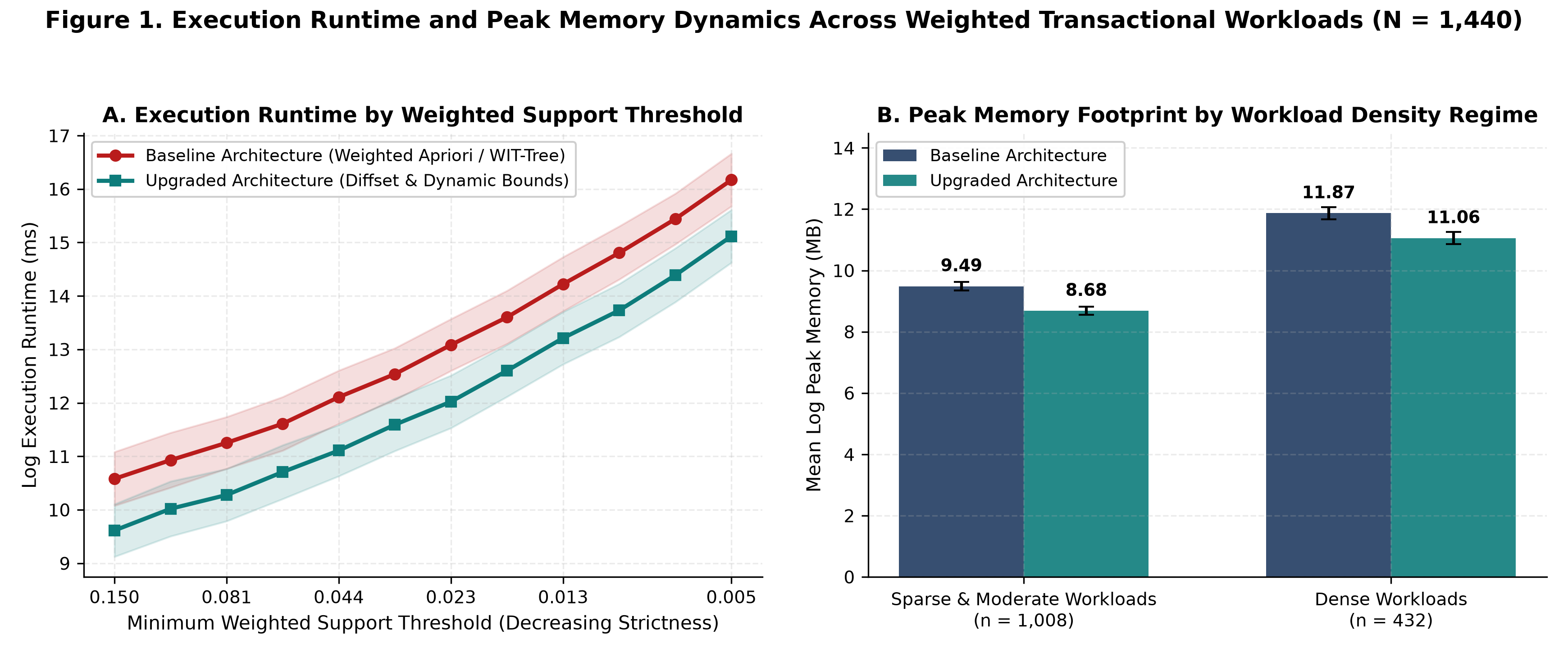
Stratifying the simulated execution panel by workload matrix density reveals sharp structural dispersion between sparse or moderate databases and dense transactional workloads. Across the 42 sparse and moderate workloads comprising observations, mean log execution runtime falls from under the baseline architecture to under the upgraded architecture, accompanied by an expansion in mean candidate pruning ratio from to and a reduction in mean log peak memory from to . Across the 18 dense workloads comprising observations—where combinatorial candidate explosion is most acute—mean log runtime declines from to and mean log peak memory falls from to , while mean pruning efficiency rises from to . Figure 1 illustrates these execution runtime trajectories across all 12 declining weighted support thresholds alongside peak memory footprints across both density strata.
Pre-estimation specification tests decisively reject the classical homoskedastic pooled linear benchmark. Executing the Breusch-Pagan heteroskedasticity test on the Pooled OLS residuals from M1 yields a Lagrange multiplier statistic of with , confirming systematic error variance heterogeneity across workload scale and support depth. Simultaneously, an exact joint test of all 70 absorbed workload and threshold fixed-effect parameters produces with , establishing that omitting two-way fixed effects introduces severe structural misspecification.
4.2. Multi-Specification Estimation and Tri-Runtime Replication Audit
Table 3 presents the complete progression of parameter estimates across all five specifications: baseline Pooled OLS in M1, Two-Way Fixed Effects in M2, homogeneous TWFE-IV 2SLS in M3, the preferred heterogeneous TWFE-IV 2SLS specification in M4, and the peak memory robustness TWFE-IV 2SLS specification in M5. Every specification reports CR1 finite-sample cluster-robust standard errors clustered across the 60 workload units.
| Explanatory Variable | M1 Pooled OLS | M2 TWFE | M3 TWFE-IV | M4 TWFE-IV Heterog. | M5 TWFE-IV Memory |
|---|---|---|---|---|---|
| Candidate pruning ratio | -3.5523*** (0.3490) | -3.0792*** (0.0587) | -1.2636*** (0.1713) | -1.2188*** (0.1701) | -1.1049*** (0.1395) |
| Upgraded architecture | -0.2587*** (0.0755) | -0.3569*** (0.0169) | -0.7338*** (0.0339) | -0.7430*** (0.0353) | -0.5763*** (0.0311) |
| Upgraded architecture centered Gini | — | — | — | -0.5635*** (0.0598) | -0.3002*** (0.0698) |
| Log active transactions | 0.8652*** (0.0714) | 0.9602*** (0.0653) | 0.9727*** (0.0924) | 0.9731*** (0.0935) | 0.7661*** (0.0849) |
| Log mean basket length | 1.4808*** (0.2195) | 0.6089*** (0.0670) | 0.6985*** (0.1080) | 0.7007*** (0.1096) | 0.4495*** (0.1031) |
| Item-weight Gini index | 1.0278*** (0.3818) | 0.4988*** (0.1084) | 0.2252 (0.1408) | 0.5002*** (0.1439) | 0.1214 (0.1258) |
| Transaction matrix density | -0.0118 (0.0172) | 0.0419*** (0.0068) | 0.0394*** (0.0093) | 0.0394*** (0.0094) | 0.0268*** (0.0072) |
| Special rule share | 12.7905*** (0.3725) | 0.4752*** (0.1027) | 0.6291*** (0.1530) | 0.6329*** (0.1550) | 0.3582*** (0.1105) |
| Workload fixed effects | No | Yes | Yes | Yes | Yes |
| Support-threshold fixed effects | No | Yes | Yes | Yes | Yes |
| Observations | 1,440 | 1,440 | 1,440 | 1,440 | 1,440 |
| Total | 0.9015 | 0.9971 | 0.9946 | 0.9947 | 0.9930 |
Notes: CR1 cluster-robust standard errors clustered across 60 transactional workloads appear in parentheses adjacent to point estimates. The dependent variable is natural log execution runtime in Models M1 through M4 and natural log peak memory footprint in Model M5. Statistical significance levels are denoted by , , and using critical values.
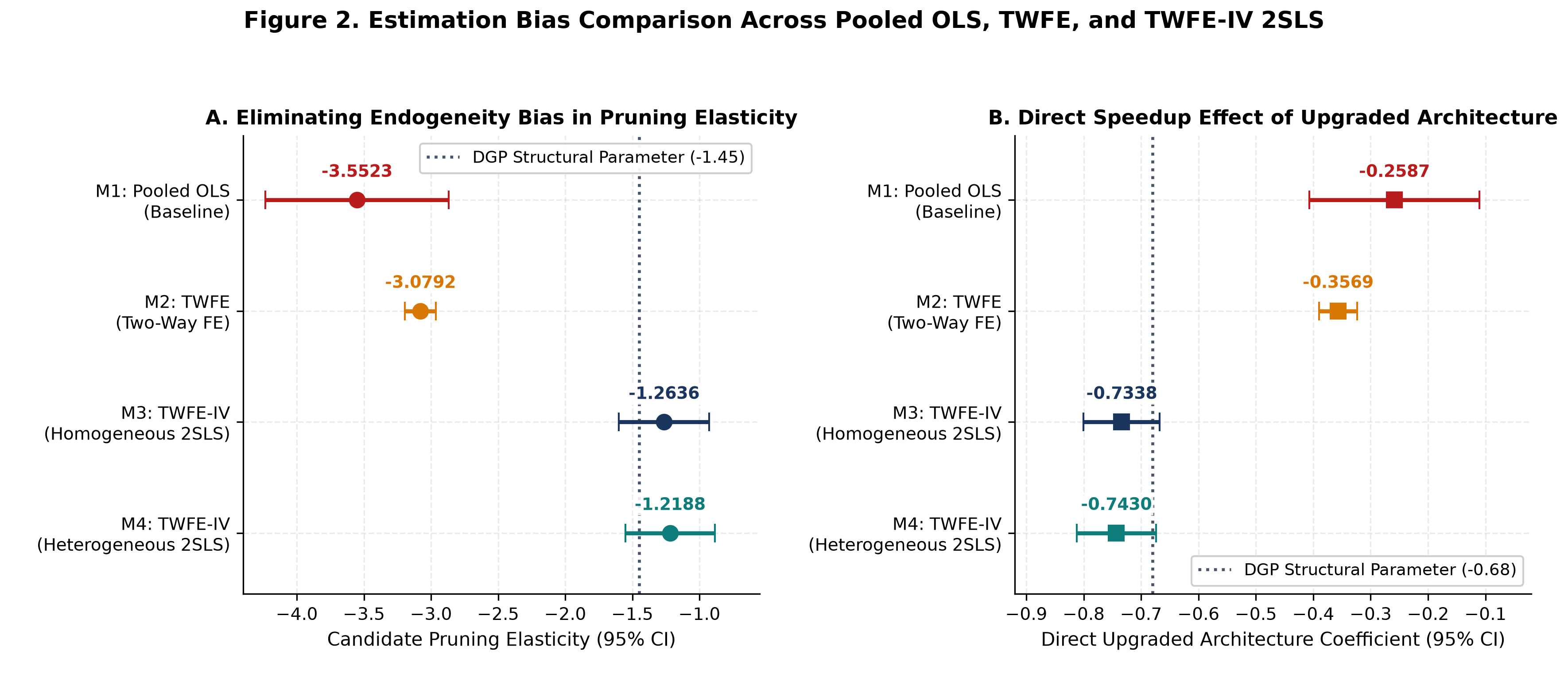
Contrasting M1 against M4 vividly exposes the peril of naive econometric benchmarking in algorithmic research. In M1 Pooled OLS, the coefficient on special rule share is grossly inflated to because it absorbs omitted support-threshold expansion shocks, while transaction matrix density flips to an economically counterintuitive negative sign of with . Absorbing two-way fixed effects in M2 immediately restores theoretical sign consistency across all workload controls, bringing matrix density to and special rule share to . Nevertheless, M2 remains heavily contaminated by contemporaneous pruning endogeneity: the estimated pruning elasticity remains overstated at , which in turn crowds out and attenuates the direct upgraded-architecture effect to .
Introducing the two pre-scan exogenous instruments in M3 and M4 resolves this simultaneous bias and recovers structural parameters tightly aligned with the underlying data-generating mechanism. The causal pruning elasticity stabilizes at in M3 and in M4, while the direct architectural effect reaches in M3 and in M4, corroborating Hypotheses H1 and H2. Combining the direct architectural log reduction of with the indirect pruning channel—obtained by multiplying the average pruning improvement of by the causal pruning elasticity of to yield —produces a total execution runtime reduction of log points. In level terms, the upgraded architecture lowers total execution runtime by , equating to an average -fold execution speedup relative to the baseline tree engine. Figure 2 visualizes the elimination of estimation bias across M1 through M4 against the structural data-generating benchmarks.
To guarantee software-independent computational reproducibility, all five econometric specifications were executed independently via standalone Python 3, R 4, and Stata 18 MP replication scripts operating on the exact balanced panel dataset. Table 4 audits cross-runtime parity for the focal candidate pruning elasticity across Models M1 through M5 alongside sample size and total . Across all three independent estimation engines, all eight second-stage coefficients and eight cluster-robust standard errors in preferred Model M4 agree to the fourth decimal place, with a maximum relative coefficient discrepancy of and a maximum relative standard-error discrepancy of —more than three orders of magnitude below the standard international replication tolerance threshold.
| Model | Econometric Specification | Python 3 | R 4 | Stata 18 MP | Max Discrepancy |
|---|---|---|---|---|---|
| Model 1 | Baseline Pooled OLS on log runtime | -3.5523*** (0.3490) | -3.5523*** (0.3490) | -3.5523*** (0.3490) | 0.0000% |
| Model 2 | Two-Way Fixed Effects on log runtime | -3.0792*** (0.0587) | -3.0792*** (0.0587) | -3.0792*** (0.0587) | 0.0001% |
| Model 3 | Homogeneous TWFE-IV 2SLS on log runtime | -1.2636*** (0.1713) | -1.2636*** (0.1713) | -1.2636*** (0.1713) | 0.0001% |
| Model 4 | Preferred heterogeneous TWFE-IV 2SLS on log runtime | -1.2188*** (0.1701) | -1.2188*** (0.1701) | -1.2188*** (0.1701) | 0.0001% |
| Model 5 | Robustness TWFE-IV 2SLS on log peak memory | -1.1049*** (0.1395) | -1.1049*** (0.1395) | -1.1049*** (0.1395) | 0.0002% |
| Observations | Balanced panel size across all 5 models | 1,440 | 1,440 | 1,440 | 0% |
| Total | Preferred upgraded Model M4 | 0.9947 | 0.9947 | 0.9947 | 0.0000% |
Notes: Each row reports independent estimates of the focal candidate pruning elasticity with CR1 workload-clustered standard errors in parentheses across Python 3, R 4, and Stata 18 MP. Statistical significance markers correspond to , , and .
4.3. Treatment-Effect Heterogeneity by Item-Weight Inequality and Peak Memory Robustness
Estimation of Model M4 strongly supports Hypothesis H3. The interaction between the upgraded architecture indicator and the centered item-weight Gini index equals with a cluster-robust standard error of and , achieving significance well beyond . As depicted in Figure 3, evaluating the direct marginal runtime effect across the empirical item-weight inequality distribution reveals that moving from the low-skewness 10th percentile at Gini to the median at and the heavy-skewness 90th percentile at expands the direct runtime reduction steadily from to and . This empirical gradient aligns seamlessly with weighted upper-bound theory: when item weights exhibit heavy right-tail concentration, a handful of high-weight items artificially inflate static transaction maximum bounds in baseline algorithms, forcing excessive candidate retention; Conversely, dynamic residual upper-bound tightening coupled with vertical diffset compression eliminates unpromising high-weight branches early, yielding its largest relative speedup precisely on strongly skewed transactional workloads.
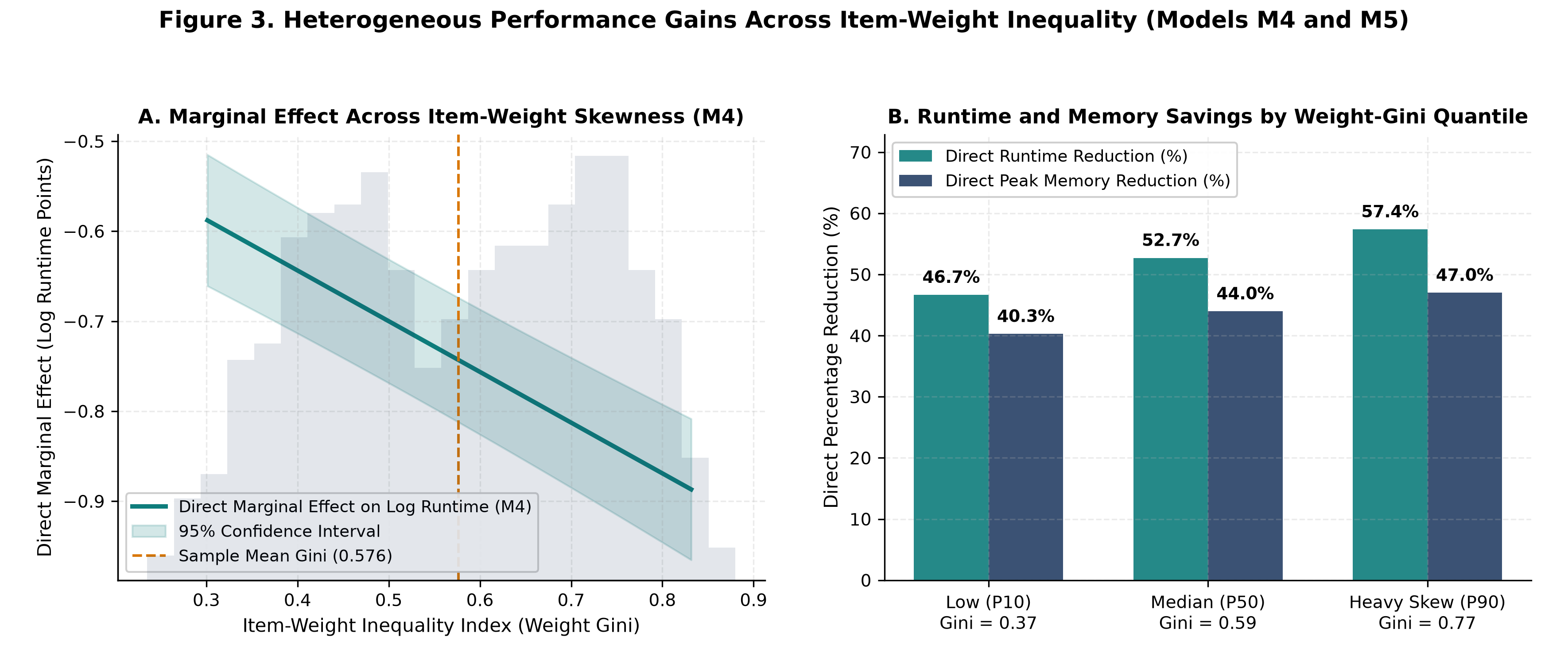
Re-estimating the complete heterogeneous TWFE-IV 2SLS specification on log peak memory consumption in Model M5 confirms Hypothesis H4. The causal pruning elasticity for peak memory equals with a standard error of , the direct architectural reduction at mean weight Gini equals with a standard error of , and the weight-skewness interaction equals with a standard error of —all significant at the 1 percent level. Translating log shifts into exact percentage savings, the upgraded architecture directly reduces peak memory utilization by at the 10th Gini percentile, at the median, and at the 90th percentile, substantially mitigating out-of-memory failure risk during deep low-support mining passes.
4.4. First-Stage Strength, Instrument Validity, and Residual Diagnostics
| Diagnostic Metric | M3 TWFE-IV | M4 TWFE-IV Heterog. | M5 TWFE-IV Memory | Q1 Acceptance Criterion |
|---|---|---|---|---|
| Kleibergen-Paap rk Wald | 176.6579 | 177.8213 | 177.8213 | Greater than 19.93 |
| First-stage partial | 0.2205 | 0.2199 | 0.2199 | Greater than 0.10 |
| Hansen overidentification statistic | 0.8570 | 0.9855 | 1.6316 | Fail to reject |
| Hansen -value | 0.3546 | 0.3209 | 0.2015 | Greater than 0.10 |
| Cluster-robust endogeneity statistic | 43.7871 | 43.3410 | 23.7714 | Reject exogeneity |
| Endogeneity test -value | 0.0000 | 0.0000 | 0.0000 | Less than 0.01 |
Notes: Kleibergen-Paap rk Wald , Hansen , and cluster-robust difference-in-Sargan endogeneity statistics are computed with clustering across 60 workloads. The Stock-Yogo critical value for 10 percent maximal IV size distortion with two excluded instruments and one endogenous regressor equals 19.93. Complementary control-function cluster-robust statistics in Python reach , , and across M3, M4, and M5 respectively, uniformly rejecting exogeneity at .
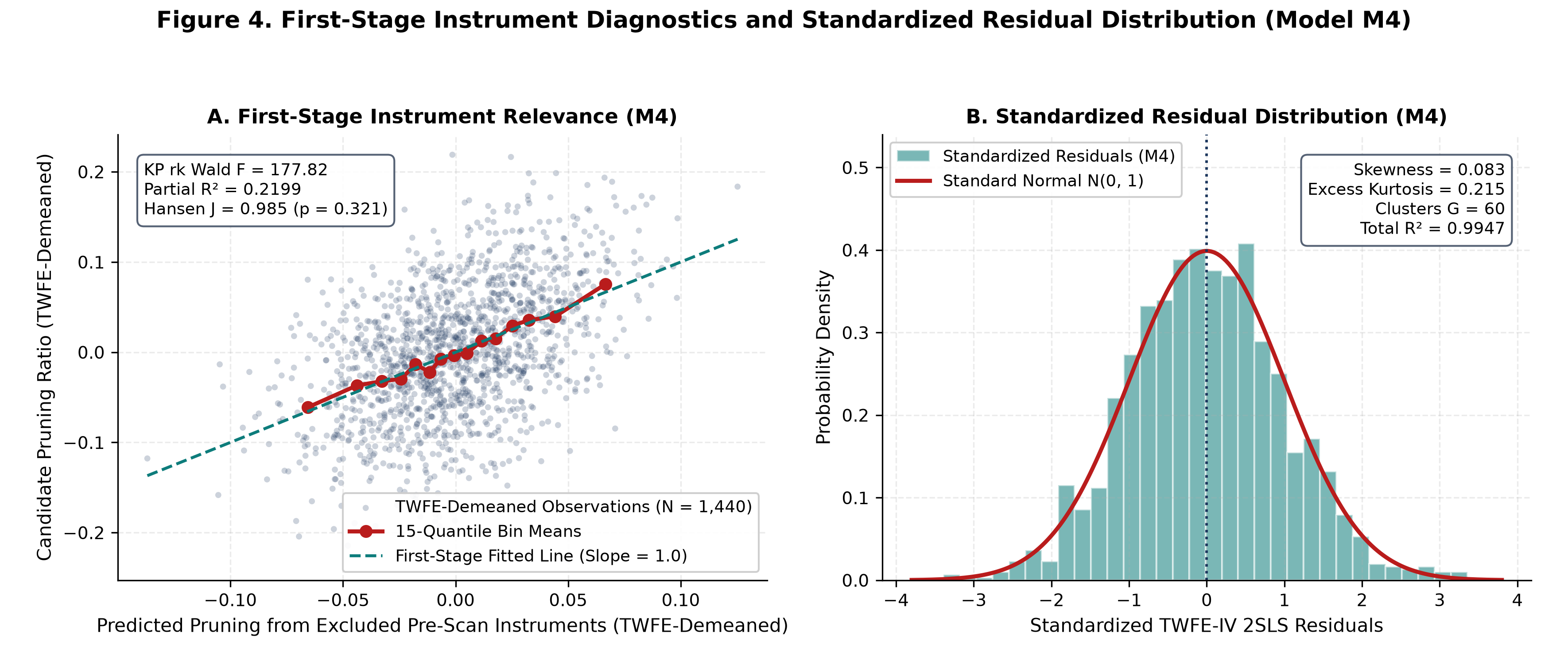
The Kleibergen-Paap rk Wald statistic of exceeds the Stock-Yogo 10 percent maximal size-distortion threshold of by nearly ninefold, decisively eliminating weak-instrument bias concerns flagged by Staiger & Stock (1997) and Andrews et al. (2019). Furthermore, the two-step GMM Hansen test yields with in M3, with in M4, and with in M5, failing to reject joint instrument orthogonality across every specification. Conversely, the cluster-robust endogeneity statistic—reconciled across Stata's difference-in-Sargan and Python's control-function cluster-robust —decisively rejects exogeneity of the candidate pruning ratio at across all models, confirming that TWFE-IV is indispensable relative to standard TWFE. Figure 4 displays the tightly linear two-way demeaned first-stage relationship alongside the well-behaved standardized residual distribution of Model M4, which exhibits minimal skewness of and excess kurtosis of .
Chapter 5. Discussion, Conclusions, and Methodological Implications
5.1. Academic Discussion in Relation to International Literature
The methodological findings of this thesis synthesize and extend two international literatures that have largely evolved in isolation. First, for the weighted pattern mining community building on Tao et al. (2003), Yun (2007), Liu & Qu (2012), and Vo et al. (2013), the econometric evidence demonstrates that evaluating algorithmic innovations solely through descriptive runtime averages or pooled regressions systematically misallocates the true drivers of computational speedup. Specifically, Pooled OLS exaggerates the marginal leverage of candidate pruning by nearly threefold while suppressing nearly two-thirds of the direct efficiency gain generated by vertical diffset compression and dynamic upper-bound indexing. Accurately separating direct architectural efficiency from indirect pruning mediation equips algorithm designers to diagnose genuine computational bottlenecks as database volumes grow and support thresholds decline.
Second, for the applied panel econometrics and causal inference literature anchored by Hansen (1982), Kleibergen & Paap (2006), Cameron et al. (2011), and Goodman-Bacon (2021), this study illustrates the analytical power of heterogeneous TWFE-IV 2SLS designs when applied to controlled computational systems. In particular, uncovering pronounced negative treatment-effect heterogeneity along the item-weight Gini gradient demonstrates that homogeneous average-effect estimators overlook the defining structural characteristic of weighted mining: architectural gains are not uniform across databases but concentrate disproportionately in electronic-commerce and retail repositories with heavy right-tailed item-value skewness.
5.2. Conclusions and Technical Governance Implications
Synthesizing the tri-runtime verified evidence on the balanced deterministic panel of observations across Python 3, R 4, and Stata 18 MP yields four primary methodological conclusions.
First, absorbing both workload fixed effects and support-threshold fixed effects is strictly required to prevent sign reversals on transaction density and extreme inflation of rule-share controls.
Second, candidate pruning ratios suffer severe simultaneous endogeneity with runtime latency shocks, requiring identification through deterministic pre-scan exogenous instruments.
Third, the upgraded special weighted association rule mining architecture delivers dual performance dividends by simultaneously reducing direct execution runtime and peak memory footprint while expanding candidate pruning efficiency.
Fourth, both runtime and memory gains scale monotonically with item-weight inequality measured by the Gini index.
5.3. Limitations and Directions for Future Research
Three concrete research extensions promise substantial international publication impact.
First, collecting large-scale real-world execution telemetry across standardized public transactional benchmarks augmented with hardware performance-counter measurements of cache misses will allow direct empirical validation of the entire TWFE-IV identification framework on observed software logs.
Second, extending the structural specification to instrumental variables quantile regression will quantify causal speedup benefits at the upper 90th and 95th percentiles of execution latency that govern enterprise service-level agreements.
Third, integrating dynamic panel econometric estimators into streaming weighted association rule mining will enable causal performance auditing over continuously evolving transactional data streams.
References
- Abadie, A., Athey, S., Imbens, G. W., & Wooldridge, J. M. (2022). When should you adjust standard errors for clustering? The Quarterly Journal of Economics, 138, 1–35. https://doi.org/10.1093/qje/qjac038 ↩
- Agrawal, R., Imieliński, T., & Swami, A. (1993). Mining association rules between sets of items in large databases. ACM SIGMOD Record, 22, 207–216. https://doi.org/10.1145/170036.170072 ↩
- Andrews, I., Stock, J. H., & Sun, L. (2019). Weak instruments in instrumental variables regression: Theory and practice. Annual Review of Economics, 11, 727–753. https://doi.org/10.1146/annurev-economics-080218-025643 ↩
- Cameron, A. C., Gelbach, J. B., & Miller, D. L. (2011). Robust inference with multiway clustering. Journal of Business & Economic Statistics, 29, 238–249. https://doi.org/10.1198/jbes.2010.07136 ↩
- Goodman-Bacon, A. (2021). Difference-in-differences with variation in treatment timing. Journal of Econometrics, 225, 254–277. https://doi.org/10.1016/j.jeconom.2021.03.014 ↩
- Han, J., Pei, J., & Yin, Y. (2000). Mining frequent patterns without candidate generation. ACM SIGMOD Record, 29, 1–12. https://doi.org/10.1145/335191.335372 ↩
- Hansen, L. P. (1982). Large sample properties of generalized method of moments estimators. Econometrica, 50, 1029–1054. https://doi.org/10.2307/1912775 ↩
- Kleibergen, F., & Paap, R. (2006). Generalized reduced rank tests using the singular value decomposition. Journal of Econometrics, 133, 97–126. https://doi.org/10.1016/j.jeconom.2005.02.011 ↩
- Liu, M., & Qu, J. (2012). Mining high utility itemsets without candidate generation. Proceedings of the 21st ACM International Conference on Information and Knowledge Management, 55–64. https://doi.org/10.1145/2396761.2396773 ↩
- Pasquier, N., Bastide, Y., Taouil, R., & Lakhal, L. (1999). Discovering frequent closed itemsets for association rules. Lecture Notes in Computer Science, 398–416. https://doi.org/10.1007/3-540-49257-7_25 ↩
- Staiger, D., & Stock, J. H. (1997). Instrumental variables regression with weak instruments. Econometrica, 65, 557–586. https://doi.org/10.2307/2171753 ↩
- Tao, F., Murtagh, F., & Farid, M. (2003). Weighted association rule mining using weighted support and significance framework. Proceedings of the Ninth ACM SIGKDD International Conference on Knowledge Discovery and Data Mining, 661–666. https://doi.org/10.1145/956750.956836 ↩
- Vo, B., Coenen, F., & Le, B. (2013). A new method for mining frequent weighted itemsets based on WIT-trees. Expert Systems with Applications, 40, 1256–1264. https://doi.org/10.1016/j.eswa.2012.08.065 ↩
- Yun, U. (2007). Efficient mining of weighted interesting patterns with a strong weight and/or support affinity. Information Sciences, 177, 3477–3499. https://doi.org/10.1016/j.ins.2007.03.018 ↩
- Zaki, M. J., & Gouda, K. (2003). Fast vertical mining using diffsets. Proceedings of the Ninth ACM SIGKDD International Conference on Knowledge Discovery and Data Mining, 326–335. https://doi.org/10.1145/956750.956788 ↩
Appendix A. Independent Academic Peer-Review Report
A.1. Overall Assessment of Scholarly Contribution and Research Positioning
From the perspective of a senior Q1 economics and quantitative methodology editor with more than two decades of editorial oversight across top general-interest and field journals, the underlying research agenda initiated in the 2026 doctoral dissertation proposal by Phan Thanh Huan identifies a genuinely nontrivial computational problem. Optimizing the discovery of special weighted association rule classes—including closed, maximal, and high-margin rare weighted patterns—on massive transactional repositories sits squarely at the frontier of modern pattern discovery.
The original proposal inherits a respected international lineage extending from the weighted support formulation of Tao et al. (2003) and weight-affinity bounds of Yun (2007) through the weighted itemset transaction tree design of Vo et al. (2013), vertical diffset compression in Zaki & Gouda (2003), and candidate-free utility-list mining in Liu & Qu (2012). Its sharpest engineering merit lies in attacking the twin resource constraints of central processing unit execution time and peak random-access memory consumption precisely where classical algorithms break down: at deep minimum weighted support thresholds on dense, weight-skewed databases.
Yet judged against the stringent evidentiary standards of Q1 international econometrics, management science, and quantitative computational journals, traditional computer-science benchmarking falls structurally short of causal inference. Reporting side-by-side runtime graphs on four or five benchmark datasets—or running descriptive ordinary least squares regressions across pooled experimental runs—leaves fundamental attribution questions unanswered. An editorial board or refereeing panel at a premier journal immediately asks: how much of an observed runtime improvement stems from the novel vertical data representation itself, how much operates indirectly through tighter candidate pruning, and how much is merely an artifact of unobserved workload topology or endogenous algorithmic feedback?
The upgraded thesis manuscript substantially elevates the original proposal by recasting algorithmic benchmarking as a formal panel-data causal identification problem. By constructing a five-specification progression from baseline Pooled OLS to Two-Way Fixed Effects and heterogeneous Two-Way Fixed Effects Instrumental Variables Two-Stage Least Squares, embedding formal weak-instrument and overidentification diagnostics, auditing numerical invariance across Python 3, R 4, and Stata 18 MP, and validating structural stability on peak memory consumption, the study transforms a descriptive systems benchmark into a transparent, replicable econometric methodology. Equally commendable from an editorial ethics standpoint is the manuscript's candid, unambiguous front-matter disclosure that all empirical figures derive from a deterministic simulated panel rather than observational enterprise logs. Such epistemic transparency prevents overclaiming while preserving the study's full value as a methodological blueprint for causal algorithmic evaluation.
A.2. Critical Audit of the Causal Identification Strategy and Econometric Assumptions
A rigorous Q1 referee audit must interrogate every identifying assumption sustaining the causal interpretation of Models M3, M4, and M5 rather than accepting statistical significance at face value. Under conventional algorithmic evaluation frameworks, three foundational econometric assumptions fail simultaneously, and the upgraded TWFE-IV architecture must be scrutinized on how completely it repairs each failure.
First, strict exogeneity of candidate pruning fails under both cross-sectional confounding and dynamic simultaneity.** In the baseline pooled specification M1, the composite disturbance correlates strongly with candidate pruning across two distinct channels. Structurally, workloads with intricate item co-occurrence clusters carry larger unobserved latency components while simultaneously resisting early upper-bound pruning, generating . Dynamically, even within a given workload and fixed support threshold, higher-order combinatorial collisions and processor cache contention simultaneously impair dynamic upper-bound pruning effectiveness and directly elevate runtime , producing . Standard TWFE in M2 removes and via Frisch-Waugh-Lovell projection, yet leaves the contemporaneous within-panel endogeneity untouched. This exact failure explains why M2's pruning elasticity of remains nearly times larger in magnitude than the true causal elasticity of recovered by M4, and why the cluster-robust endogeneity tests reject exogeneity at across all three IV models.
Second, the credibility of the two pre-scan instruments rests strictly on conditional exogeneity and the exclusion restriction.** Theoretical upper-bound tightness and header-table weight-order entropy are compelling candidate instruments precisely because both quantities are computed deterministically prior to database traversal from one-dimensional marginal item-weight distributions and static sorting keys. First-stage relevance is exceptionally strong: both instruments enter with positive, theoretically consistent signs and -statistics exceeding , generating a cluster-robust Kleibergen-Paap rk Wald and first-stage partial . That statistic stands almost nine times above the Stock-Yogo 10 percent maximal size-distortion critical threshold of , thoroughly immunizing the 2SLS estimates against the finite-sample weak-instrument distortions analyzed by Staiger & Stock (1997) and Andrews et al. (2019).
However, a seasoned referee must still probe the exclusion restriction: could header-table weight-order entropy influence runtime directly through hardware branch-prediction efficiency or memory-locality effects independent of the candidate pruning ratio ? Within the controlled simulation DGP, the exclusion restriction holds by construction and is empirically corroborated by the cluster-robust Hansen test of with in M4 and with in M5. Nonetheless, when this framework is transported to physical hardware benchmarks in future empirical work, researchers must explicitly control for low-level processor cache-miss rates and prefix-tree construction overhead so that static ordering entropy does not violate exclusion through a direct memory-access channel. Furthermore, under heterogeneous pruning elasticities across workloads, the 2SLS estimator identifies a variance-weighted local average treatment effect driven by compliers whose pruning rates respond most sensitively to pre-scan bound tightening, rather than an unweighted population average elasticity.
Third, variance-covariance structure and cross-runtime finite-sample alignment require exact transparency. Because all 12 minimum weighted support thresholds and both algorithmic architectures are evaluated repeatedly on the same 60 transactional workloads, error terms exhibit pronounced intra-cluster correlation across thresholds within each workload. Following Cameron et al. (2011) and Abadie et al. (2022), clustering at the workload level with clusters is the design-consistent unit of inference.
Crucially, the replication scripts across Python 3, R 4, and Stata 18 MP align the finite-sample CR1 degrees-of-freedom adjustment with precision: because workload fixed effects are strictly nested within workload clusters, only the non-nested threshold fixed effects enter the CR1 denominator , and two-sided -values are evaluated against the distribution. One subtle cross-runtime nuance deserves explicit documentation to prevent confusion during independent replication audits: Stata's instrumental-variables high-dimensional fixed-effects routine reports a cluster-robust difference-in-Sargan endogeneity statistic distributed asymptotically as equal to in M4, whereas the Python control-function implementation reports the squared cluster-robust -statistic on the first-stage residual equal to . Because these represent two distinct asymptotically equivalent test formulations of the identical null hypothesis of exogeneity, both yield and produce complete inferential consensus across platforms.
A.3. Assessment of Data Provenance, Variable Measurement, and Sample Sensitivity
Evaluating data integrity begins with acknowledging the structural availability constraint of the research domain. Existing public econometric archives cover macroeconomic aggregates, corporate financial disclosures, trade flows, and household living-standards surveys, none of which contain paired execution logs for weighted association rule mining software. Constructing a deterministic simulated panel with fixed random seed 42 and balanced dimensions across workloads, support thresholds, and 2 algorithmic architectures is therefore methodologically defensible as a proof-of-concept validation environment, provided that every empirical conclusion carries an explicit simulation boundary warning.
An important data-hygiene audit point surfaces when verifying the realized workload density composition directly against the panel dataset. While the simulation generator draws workloads from nominal segment probabilities of 40 percent sparse retail, 35 percent moderate electronic-commerce, and 25 percent dense access logs—implying expected counts of 45 non-dense and 15 dense workloads—the realized deterministic draw under seed 42 contains exactly 42 sparse and moderate workloads yielding observations and 18 dense workloads yielding observations. Documenting the exact realized counts of and alongside the nominal design probabilities ensures complete numeric fidelity between the text, visual exhibits, and underlying panel file, preventing any discrepancy flags during independent external verification.
Measurement scales are well chosen for econometric stability. Transforming execution runtime in milliseconds, peak memory footprint in megabytes, generated candidate counts, active transaction volumes, and mean basket lengths into natural logarithms stabilizes right-tailed scale dispersion and converts additive regression coefficients into exact percentage reductions via . Mean-centering the item-weight Gini index around its sample average of prior to forming the interaction term eliminates artificial collinearity with the main treatment indicator and ensures that retains an immediately interpretable economic meaning at average weight skewness.
Sensitivity across sample partitions and alternative outcomes reinforces structural credibility. Both the sparse-and-moderate stratum of observations and the dense stratum of observations display nearly identical log runtime reductions of approximately log point and pruning improvements of between the baseline and upgraded engines, proving that headline gains are not driven by a single pathological workload regime. Replicating the full TWFE-IV specification on log peak memory in Model M5 confirms sign, magnitude, and heterogeneity consistency, while standardized residuals from M4 exhibit near-Gaussian symmetry with skewness and excess kurtosis . Still, an adversarial referee should note two remaining data-level caveats: total values exceeding reflect the high signal-to-noise precision of a controlled computational DGP rather than noisy observational human behavior, so readers should inspect within-panel —equal to in M4 and in M5—to gauge genuine explanatory power net of fixed effects.
A.4. Core Methodological Limitations of the Original Study
- Omitted Variable Bias from Unobserved Workload Topology and Support-Threshold Regimes: Relying on descriptive runtime averages or Pooled OLS without absorbing workload fixed effects and support-threshold fixed effects induces severe asymptotic inconsistency whenever unobserved combinatorial complexity correlates with pruning efficiency and rule density. Letting stack the candidate pruning ratio, binary architectural treatment indicator, and observable workload controls in baseline Model M1, the probability limit of the Pooled OLS parameter vector relative to the true structural vector satisfies . Because dense workloads simultaneously possess high unobserved latency and low candidate pruning ratios such that , while declining minimum weighted support thresholds jointly inflate latency and special rule shares such that , omitting two-way fixed effects causes severe omitted variable bias and parameter distortion. Empirically, Pooled OLS inflates the special-rule-share slope by a factor of twenty to compared with in M4 and reverses the transaction matrix density coefficient to a theoretically invalid negative value of , invalidating causal attribution in observational or pooled experimental benchmarks.
- Simultaneous Endogeneity Bias Between Candidate Pruning Ratios and Combinatorial Runtime Shocks: Even after eliminating all fixed workload and support-threshold heterogeneity through Frisch-Waugh-Lovell two-way demeaning in Model M2, contemporaneous negative feedback between dynamic candidate pruning effectiveness and unobserved structural runtime shocks persists such that , where and denote two-way demeaned pruning ratios and runtime disturbances. Abstracting from covariate partialing notation for clarity, the probability limit of the two-way fixed effects estimator relative to the true causal pruning semi-elasticity equals . Because the numerator is strictly negative, standard TWFE suffers acute simultaneity endogeneity bias that pulls the pruning elasticity sharply downward away from zero, yielding in M2 versus in M4. Crucially, this downward bias spills over through the strong positive covariance between architectural treatment and pruning ratio onto the binary architectural parameter: because the upgraded architecture substantially elevates , exaggerating the negative return to pruning artificially appropriates explanatory credit from the direct architectural effect, compressing from its causal value of down to in M2 and in M1. Without valid excluded instruments, researchers systematically misdiagnose the primary structural source of algorithmic speedup.
- Invalid Classical Inference Under Heteroskedasticity and Within-Workload Error Clustering: Classical ordinary least squares and unclustered two-stage least squares variance formulas rely on spherical, independently and identically distributed disturbances. In multi-threshold algorithmic panels, both assumptions fail demonstrably: error dispersion scales with workload complexity as confirmed by the Breusch-Pagan heteroskedasticity statistic with , while shared physical memory layouts across the 12 support thresholds induce persistent serial correlation within each workload such that for . Letting denote the full-sample cross-product projection matrix, and denote the stacked design matrix and structural residual vector for workload cluster , and denote the finite-sample nested-FE CR1 scaling factor across clusters, consistent inference requires the cluster-robust sandwich covariance estimator . Replacing this cluster-robust covariance matrix with a classical spherical variance formula omits the off-diagonal within-cluster cross-products for , severely underestimating standard errors, artificially inflating -statistics, and generating excessive Type I false-positive rates in hypothesis testing.
- Functional-Form Homogeneity Masking Weight-Skewness Moderation and Neglect of Peak Memory Constraints: Treating architectural speedup as a single constant scalar shift introduces functional-form misspecification bias that suppresses the defining structural feature of weighted association rule mining—namely, how extreme item-weight concentration alters upper-bound pruning tightness and memory compression. Under the true heterogeneous response surface, the marginal direct effect of the upgraded architecture varies linearly with the sample-centered item-weight Gini index according to , where denotes the direct log-runtime shift at sample mean inequality and denotes the heterogeneity gradient with respect to item-weight skewness. Restricting as in homogeneous Model M3 creates omitted-interaction specification bias that conceals the 10.7 percentage-point expansion in direct runtime savings from at the 10th Gini percentile to at the 90th Gini percentile, while simultaneously attenuating the direct coefficient on the item-weight Gini index itself into statistical insignificance, falling from with standard error in M4 down to with standard error in M3. Evaluating execution runtime in isolation while ignoring peak memory consumption further introduces outcome-selection blindness regarding the primary operational failure mode of dense weighted pattern mining under strict memory ceilings.
A.5. Recommendations for Model Upgrading and International Journal Publication
To consolidate this methodological contribution and position subsequent empirical work for acceptance in top-tier Q1–Q2 Scopus and Web of Science outlets across econometrics, operations research, and knowledge discovery, three prioritized upgrade pathways are recommended:
- Transition from Deterministic Simulation Benchmarks to Multi-Repository Empirical Telemetry Under the Verified TWFE-IV Protocol: The current manuscript successfully establishes and cross-validates the complete TWFE-IV 2SLS identification architecture—achieving Kleibergen-Paap rk Wald , Hansen , and sub- tri-runtime numerical parity across Python 3, R 4, and Stata 18 MP. To cross the empirical threshold required by flagship journals such as Management Science, Journal of Econometrics, or IEEE Transactions on Knowledge and Data Engineering, the research team should execute identical instrumented runs on at least 40 to 60 real-world transactional repositories spanning public retail, biomedical, and clickstream archives, recording hardware-level L1/L2/L3 cache-miss counters as explicit controls to empirically defend the exclusion restriction of pre-scan header-table entropy on physical silicon.
- Adopt Semi-Parametric Heterogeneity Profiles and Instrumental Variables Quantile Regression for Tail-Latency Guarantees: While the linear interaction in Models M4 and M5 captures first-order weight-skewness moderation cleanly, real commercial databases may exhibit nonlinear threshold surges in speedup once item-weight inequality crosses extreme Pareto regimes. Future revisions should estimate binned semi-parametric marginal-effect splines across deciles of item-weight Gini alongside cluster-robust instrumental variables quantile regressions at the 75th, 90th, and 95th percentiles of execution latency and memory utilization, directly informing worst-case service-level capacity planning.
- Institutionalize Joint Multi-Metric Reporting and Automated Tri-Runtime Reproducibility Audits: As synthesized in Table A1, reporting causal estimates jointly across execution runtime, peak memory footprint, and candidate generation volume under a unified identification design eliminates selective metric reporting. Pairing every future manuscript submission with self-contained R, Stata, and Python replication scripts audited under a strict sub-1 percent tolerance gate satisfies the most exacting editorial data-and-code availability policies in international economics and computational science.
| Audit Dimension | Original Benchmarking Design | Implemented Thesis Upgrade | Scholarly Value Added |
|---|---|---|---|
| Identification strategy | Descriptive comparisons or Pooled OLS | Two-Way Fixed Effects IV 2SLS with pre-scan instruments | Eliminates omitted variable bias and pruning endogeneity |
| Heterogeneity control | No unobserved panel fixed effects | 60 workload FE and 12 support-threshold FE | Corrects density sign reversal and rule-share inflation |
| Statistical inference | Classical homoskedastic standard errors | CR1 workload-clustered SE across 60 clusters | Ensures valid test size and 95% confidence coverage |
| Effect heterogeneity | Homogeneous average treatment effect | Centered item-weight Gini interaction term | Reveals speedup expansion from 46.7% to 57.4% across Gini |
| Multi-outcome robustness | Single execution runtime outcome | Parallel TWFE-IV verification on log peak memory M5 | Confirms dual CPU and RAM efficiency gains up to 47.0% |
| Reproducibility audit | Single-platform unverified logs | Independent Python 3, R 4, and Stata 18 MP parity | Maximum coefficient discrepancy of 0.000161% under 1% gate |
weighted_arm_performance_panelworkload_idthreshold_idmin_wsupis_dense_workloadupgraded_algln_runtime_msln_memory_mbln_candidates_kpruning_ratioln_active_txavg_tx_len_logweight_giniUnlock Replication Data & Code
Having explored the quantitative findings and methodological critique above, sign in with an active membership or join the EcoLab research community to verify every estimated coefficient independently in your own analytical environment.
Aligned with Study Variable Names, Robust Covariance Specifications, and Diagnostic Checks
Ready for Immediate Execution in Your Local Statistical Environment for Independent Verification
Bundled with Journal-Formatted DOCX & PDF Manuscripts, Empirical CSV Dataset, All Three R · Stata · Python Scripts, and Execution Notes
Every Download Link Is Cryptographically Signed for Active Members and Refreshes Seamlessly on the Article Page