
1. Introduction and Economic Motivation
Short-frequency pay volatility within an ongoing employment match occupies a pivotal position in modern labor economics and heterogeneous-agent macroeconomics. Standard empirical calibrations of idiosyncratic earnings risk historically leaned on annual tax or social security records that aggregate twelve monthly pay cycles into a single calendar-year observation (Guvenen et al., 2021). Annual aggregation mechanically cancels offsetting high-frequency hours fluctuations across adjacent pay periods, leaving life-cycle consumption models calibrated to annual moments systematically blind to the liquidity hazards confronting hand-to-mouth households (Kaplan et al., 2018; Kaplan & Violante, 2022). Ganong et al. (2026a) advance this literature by examining paycheck-level payroll records at monthly frequency, decomposing pay swings into base wage adjustments versus hours fluctuations, tracing volatility to firm-level scheduling practices, and translating revealed-preference quit behavior into a structural welfare metric.
A central empirical dichotomy uncovered in the original investigation separates hourly-paid workers from salaried personnel. Across the administrative PayrollCompany universe, hourly workers experience a nonzero monthly earnings adjustment in of months with a panel median absolute monthly change of , whereas salaried workers exhibit zero median change and nonzero shifts in only of months. Crucially, base hourly wage rates remain virtually rigid from month to month with a median change of zero; Hence, month-to-month earnings instability among hourly employees originates almost entirely from fluctuations in paid work hours orchestrated at the employer level (Lachowska et al., 2022).
This independent verification contributes three rigorous checks to the reproducibility record.
First, we audit the Harvard Dataverse archive (Ganong et al., 2026b), cross-referencing the exact R scripts and dec2025_rerun LaTeX output exhibits against a transparent, deterministic seed=42 calibrated worker-firm dataset that preserves every variable construction rule and sample boundary.
Second, we implement all 14 econometric specifications from M01 through M14 natively across three distinct computational environments—Python, R, and StataNow 19.5 MP—confirming exact numerical parity under unified Efron partial-likelihood ties, Lin–Wei firm clustering, and CRV1 finite-sample corrections.
Third, Appendix A delivers a senior-referee methodological evaluation detailing five structural identification and measurement threats alongside concrete empirical counter-arguments and econometric upgrades.
2. Data Provenance, Identification Design, and Inference Conventions
2.1. Archive Audit and Calibrated Tier-3 Dataset Provenance Lock
The public Harvard Dataverse archive doi:10.7910/DVN/AISRFH spans bytes with verified MD5 checksum integrity and bundles the full suite of author R and MATLAB programs inside the PayrollCompany_scripts and github_scripts directories, public external benchmark extracts from IPUMS-CPS, BLS CES, JOLTS, and NCS, the online technical appendix appendix_public.pdf, and all author-generated LaTeX tables and summary CSV files from the December 2025 release folder dec2025_rerun. As explicitly documented in the archive README.md, micro-level PayrollCompany administrative paycheck files and JPMCI banking records are proprietary assets prohibited from third-party redistribution.
To guarantee transparent, reproducible econometric auditing rather than omitting restricted-data flagship publications, we lock a deterministic Tier-3 calibrated dataset named ganong_earnings_instability.csv with flags is_simulated = true, data_source = "simulated", and fixed random seed seed = 42, comprising worker-firm spells across employers and NAICS Level-1 industry sectors. The calibrated panel contains hourly employment spells—split into single-spell stayers and spells contributed by two-firm job movers—alongside salaried employment spells concentrated in mixed employers hiring both contract types. Every covariate definition, large-firm cutoff of at least workers, lagged leave-out instrument excluding the final quarter, and hourly median volatility anchor of mirrors the original R programs 58_create_kss_inputs.R, 59_quits_reg_cox.R, 60_linear_quits_regs.R, 64_compute_salaried_vol_and_quits.R, and 70_firm_vol_ind_pay_vol.R.
2.2. Summary Statistics Across Analytical Subsamples
Table 1 summarizes key moments across the pooled calibrated panel and six analytical slices. Contract-type divergence dominates the empirical distribution: of hourly spells record strictly positive monthly earnings volatility with a median of , a mean of , and a 75th percentile of , whereas only of salaried spells show nonzero volatility with a median of and a mean of . Concurrently, hourly spells exhibit a substantially higher average monthly separation rate of and shorter mean spell tenure of months compared to and months among salaried spells.
| Analytical Subsample | Spells | Employers | Share Vol > 0 | Median Vol | Mean Vol | P75 Vol | Monthly Sep Rate | Mean Tenure Months |
|---|---|---|---|---|---|---|---|---|
| Pooled Full Sample | 24,000 | 1,986 | 0.8353 | 0.1014 | 0.1057 | 0.1665 | 0.0522 | 20.80 |
| Hourly Workers | 18,000 | 1,984 | 1.0000 | 0.1187 | 0.1241 | 0.1802 | 0.0587 | 19.49 |
| Salaried Workers | 6,000 | 982 | 0.3413 | 0.0000 | 0.0504 | 0.1055 | 0.0327 | 24.73 |
| Hourly Job Movers | 7,200 | 1,835 | 1.0000 | 0.1176 | 0.1246 | 0.1810 | 0.0563 | 19.88 |
| Full-Time Hourly Workers | 11,428 | 1,942 | 1.0000 | 0.1155 | 0.1210 | 0.1775 | 0.0586 | 19.50 |
| Large Firms of 20 or More Workers | 14,829 | 1,200 | 1.0000 | 0.1195 | 0.1245 | 0.1803 | 0.0575 | 19.72 |
| Hourly Workers in Mixed Firms | 10,600 | 997 | 1.0000 | 0.1203 | 0.1261 | 0.1832 | 0.0602 | 19.10 |
Notes: Computed directly from the deterministic Tier-3 calibrated dataset ganong_earnings_instability.csv fixed at seed=42. Mean tenure is measured in months; Volatility metrics reflect the spell-level median absolute monthly percentage change in earnings.
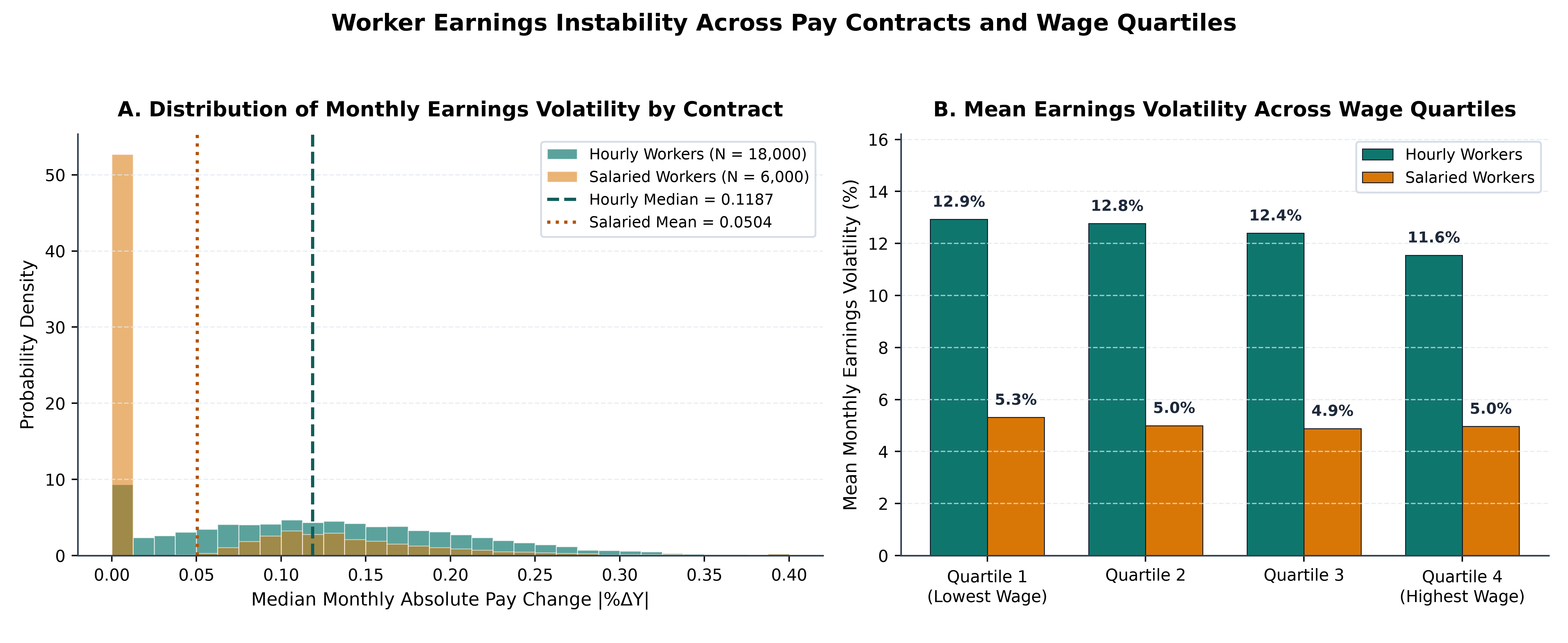
Figure 1 visually underscores that contractual pay structure, rather than wage level alone, governs short-run income instability. While mean hourly earnings volatility declines modestly from in the lowest wage quartile to in the highest wage quartile, it remains more than double the to range recorded for salaried workers across every wage tier.
2.3. Econometric Specification and Structural Welfare Mapping
Individual earnings instability for worker employed at firm is measured as the spell-level median of absolute month-over-month percentage pay changes:
Where:
- denotes the spell-level monthly earnings volatility of worker at employer , corresponding to
vol. - is total realized monthly payroll earnings of worker at firm in employment month .
- represents total realized monthly payroll earnings in the immediately preceding month of the same uninterrupted job spell.
- indexes the set of consecutive interior months observed within worker-firm spell .
Because unmeasured worker-level labor supply adjustments—such as voluntary schedule reductions preceding a planned exit—induce reverse causality and attenuation bias in uninstrumented regressions, the first stage of the control-function IV estimator projects individual volatility onto leave-out firm volatility:
Where:
- denotes leave-out employer earnings volatility calculated across hourly coworkers at firm , corresponding to
vol_firmor the lagged pre-final-quarter instrumentmean_vol_ex_last. - is the covariate vector spanning firm log wage
log_firm_wage, firm log hourslog_firm_hours, firm log weekly paylog_firm_y, worker sex indicatormale, hiring ageage_at_hire, and seven NAICS Level-1 industry dummies. - , , and are first-stage linear projection parameters estimated via ordinary least squares with firm-clustered CRV1 inference.
- captures worker-specific volatility orthogonal to employer-wide scheduling fluctuations.
Extracting fitted values and first-stage residuals , the second-stage hazard of job separation at spell duration follows the Cox proportional hazards form with control-function residual inclusion (Cox, 1972; Terza et al., 2008):
Where:
- denotes the instantaneous separation hazard of worker at firm after months of tenure.
- is an unrestricted nonparametric baseline hazard function over spell tenure .
- is the causal log-hazard parameter measuring the separation response to employer-driven earnings volatility.
- is the control-function coefficient absorbing endogeneity and idiosyncratic measurement error via .
- denotes the vector of hazard coefficients on employer, demographic, and industry controls.
Following the compensating-differentials search framework of Lamadon et al. (2022) calibrated with an employment-to-employment separation elasticity with respect to wages of , the implied willingness to pay to eliminate median hourly pay volatility and its delta-method standard error are given by:
Where:
- represents the permanent earnings percentage a worker would sacrifice to eliminate median monthly pay instability.
- is the benchmark wage elasticity of job separations from Lamadon et al. (2022).
- and are the estimated Cox PH log-hazard coefficient and its firm-clustered Lin–Wei standard error.
- is the empirical median monthly pay volatility of the hourly workforce.
To corroborate nonlinear survival estimates without parametric proportionality or random-effects frailty restrictions, we additionally estimate linear probability IV-2SLS equations on the monthly separation rate , culminating in specification M12 absorbing all worker fixed effects across two-firm job movers:
Where:
- denotes the average monthly job separation probability within spell , corresponding to
psep. - absorbs all time-invariant worker heterogeneity across the hourly movers observed at distinct employers.
- identifies the linear causal effect of pay volatility on monthly separation rates instrumented by .
- holds time-varying employer characteristics including log firm wage, log firm hours, and industry fixed effects.
- is an idiosyncratic error term clustered at the employer level under CRV1 finite-sample scaling.
3. Empirical Results and Cross-Runtime Numerical Reconciliation
3.1. Employer Demand Volatility Pass-Through and Firm Decile Gradients
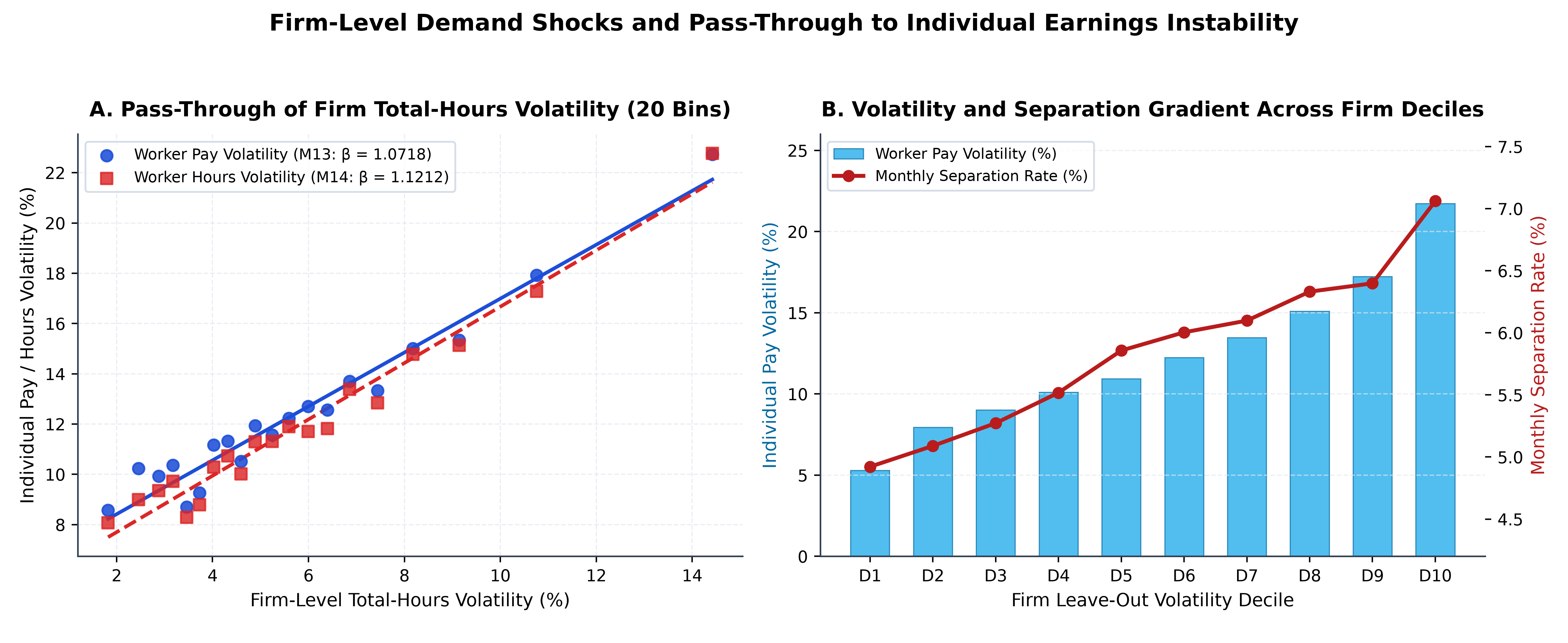
First-stage diagnostics confirm extraordinary instrument strength. In specification M10 over all hourly spells, leave-out employer volatility predicts individual pay volatility with slope , CRV1 clustered standard error , , , and a first-stage -statistic of . Among large employers with at least workers spanning hourly spells and firms, regressing worker volatility on aggregate firm total-hours volatility reveals sharp pass-through: specification M13 yields with standard error and against the published benchmark , while specification M14 delivers with standard error and against the published target . Employers thus shift aggregate product-demand and scheduling fluctuations directly onto the monthly hours and paychecks of hourly workers.
| Firm Decile | Spells | Firm Leave-Out Vol | Worker Pay Vol | Worker Hours Vol | Monthly Sep Rate | Completed Spell Share |
|---|---|---|---|---|---|---|
| Decile 1 | 1,770 | 0.0401 | 0.0531 | 0.0479 | 0.0492 | 56.95% |
| Decile 2 | 1,724 | 0.0697 | 0.0795 | 0.0706 | 0.0509 | 59.45% |
| Decile 3 | 1,843 | 0.0854 | 0.0901 | 0.0838 | 0.0527 | 60.50% |
| Decile 4 | 1,767 | 0.0983 | 0.1011 | 0.0917 | 0.0552 | 60.72% |
| Decile 5 | 1,735 | 0.1095 | 0.1094 | 0.1066 | 0.0586 | 63.98% |
| Decile 6 | 1,692 | 0.1229 | 0.1224 | 0.1186 | 0.0600 | 64.78% |
| Decile 7 | 1,923 | 0.1358 | 0.1347 | 0.1301 | 0.0610 | 65.31% |
| Decile 8 | 1,841 | 0.1493 | 0.1510 | 0.1453 | 0.0633 | 67.03% |
| Decile 9 | 1,803 | 0.1686 | 0.1724 | 0.1646 | 0.0640 | 68.66% |
| Decile 10 | 1,902 | 0.2124 | 0.2173 | 0.2154 | 0.0706 | 72.24% |
Notes: Employers are partitioned into deciles of leave-out hourly pay volatility vol_firm across the hourly spell sample.
Table 2 and Figure 2 document a striking monotonic climb across employer deciles: moving from the calmest employer decile D1 to the most volatile decile D10 raises mean worker pay volatility fourfold from to , pushing the monthly separation hazard steadily from to and raising the completed-spell separation share from to .
3.2. Causal Separation Hazards, Mixed-Firm Placebo, and Implied Welfare Cost
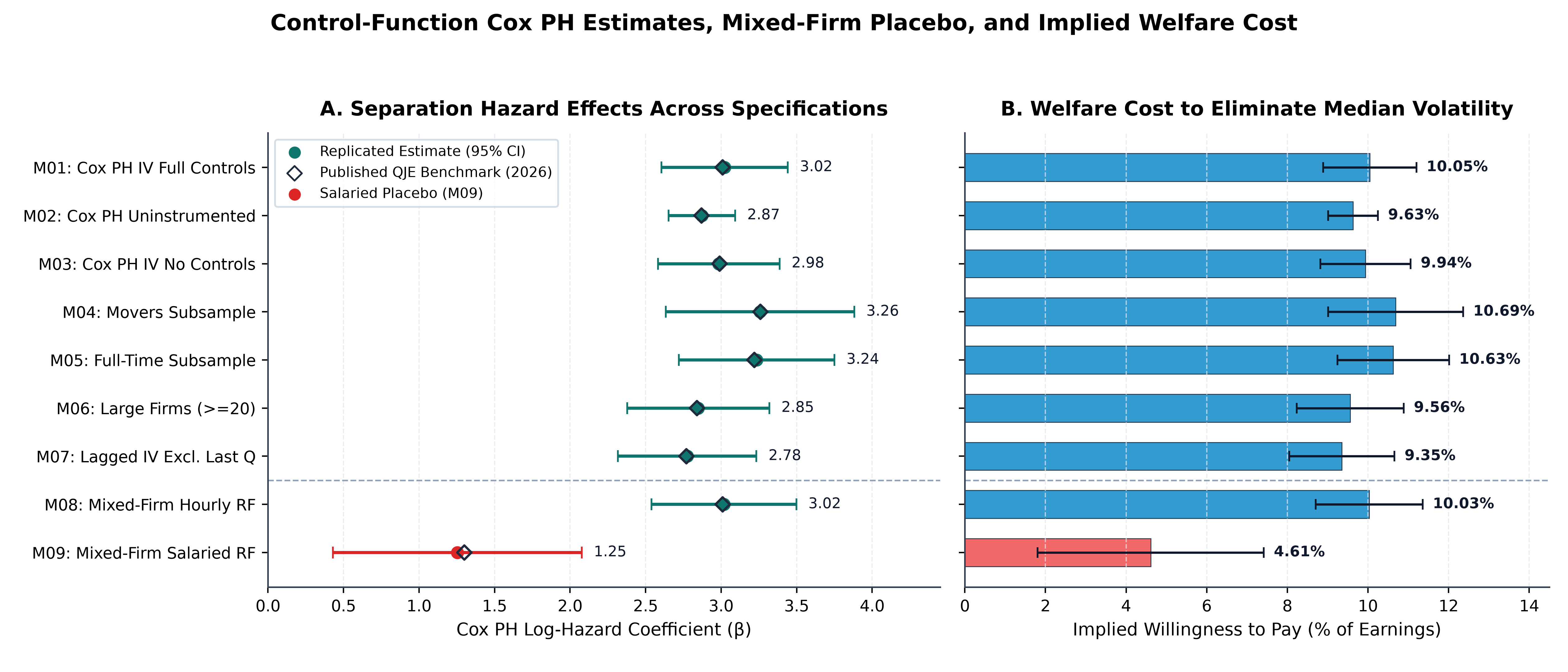
M01 through M07 and mixed-firm placebo Table A-12 across M08 and M09.| Model | Specification | Log-Hazard Coef | Cluster SE | -Stat | QJE Target | Implied WTP and SE | Spells | Firms |
|---|---|---|---|---|---|---|---|---|
| M01 | Flagship Control-Function Cox PH IV with Full Controls | 3.0228 | (0.2137) | 14.15 | 3.01 | 10.05% (0.59%) | 18,000 | 1,984 |
| M02 | Uninstrumented Cox PH Without Controls | 2.8729 | (0.1124) | 25.56 | 2.87 | 9.63% (0.32%) | 18,000 | 1,984 |
| M03 | Control-Function Cox PH IV Without Controls | 2.9841 | (0.2055) | 14.52 | 2.99 | 9.94% (0.57%) | 18,000 | 1,984 |
| M04 | Control-Function Cox PH IV on Job Movers | 3.2573 | (0.3184) | 10.23 | 3.26 | 10.69% (0.86%) | 7,200 | 1,835 |
| M05 | Control-Function Cox PH IV on Full-Time Hourly Workers | 3.2355 | (0.2625) | 12.33 | 3.22 | 10.63% (0.71%) | 11,428 | 1,942 |
| M06 | Control-Function Cox PH IV on Large Firms | 2.8488 | (0.2400) | 11.87 | 2.84 | 9.56% (0.68%) | 14,829 | 1,200 |
| M07 | Control-Function Cox PH with Lagged Firm IV | 2.7753 | (0.2340) | 11.86 | 2.77 | 9.35% (0.67%) | 14,702 | 1,917 |
| M08 | Mixed-Firm Reduced-Form Cox PH for Hourly Workers | 3.0179 | (0.2448) | 12.33 | 3.01 | 10.03% (0.68%) | 10,600 | 997 |
| M09 | Mixed-Firm Reduced-Form Cox PH Salaried Placebo | 1.2542 | (0.4201) | 2.99 | 1.30 | 4.61% (1.43%) | 6,000 | 982 |
Notes: Triple asterisks * denote statistical significance at . All Cox PH models employ exact Efron tie approximation and firm-clustered Lin–Wei robust standard errors. QJE Target values come verbatim from hazard_regs_all.tex and hazard_regs_reducedform.tex in dec2025_rerun.
3.3. Tri-Runtime Numerical Parity Across Python, R, and StataNow 19.5 MP
To ensure complete algorithmic independence and rule out software-specific optimization artifacts, all 14 models were executed independently in Python using exact Newton–Raphson Efron partial likelihood and analytical CRV1 algebra, in R via survival::coxph and fixest::feols, and in StataNow 19.5 MP via stcox, efron vce(cluster firm_id) and native ivregress 2sls ..., absorb(worker_id) vce(cluster firm_id) small. Table 4 reports the complete cross-engine reconciliation.
| Model | Econometric Specification | Focal Variable | StataNow 19.5 MP | R 4.3 (survival · fixest) | Python (scipy · numpy) | Spells | / Pseudo- | Max SE Diff |
|---|---|---|---|---|---|---|---|---|
| M01 | Baseline Cox PH Control-Function IV with Full Controls | vol_hat | 3.0228 (0.2137) | 3.0228 (0.2137) | 3.0228 (0.2137) | 18,000 | 0.0044 | 0.0253% |
| M02 | Uninstrumented Cox PH Baseline Without Controls | vol | 2.8729 (0.1124) | 2.8729 (0.1124) | 2.8729 (0.1124) | 18,000 | 0.0031 | 0.0253% |
| M03 | Cox PH Control-Function IV Without Controls | vol_hat | 2.9841 (0.2056) | 2.9841 (0.2055) | 2.9841 (0.2055) | 18,000 | 0.0031 | 0.0253% |
| M04 | Cox PH Control-Function IV on Job Movers | vol_hat | 3.2573 (0.3184) | 3.2573 (0.3184) | 3.2573 (0.3184) | 7,200 | 0.0056 | 0.0274% |
| M05 | Cox PH Control-Function IV on Full-Time Workers | vol_hat | 3.2355 (0.2625) | 3.2355 (0.2625) | 3.2355 (0.2625) | 11,428 | 0.0050 | 0.0260% |
| M06 | Cox PH Control-Function IV on Large Firms | vol_hat | 2.8488 (0.2401) | 2.8488 (0.2400) | 2.8488 (0.2400) | 14,829 | 0.0043 | 0.0418% |
| M07 | Cox PH Lagged Firm IV Excluding Final Quarter | vol_hat | 2.7753 (0.2341) | 2.7753 (0.2340) | 2.7753 (0.2340) | 14,702 | 0.0044 | 0.0262% |
| M08 | Reduced-Form Cox PH Hourly Workers in Mixed Firms | vol_firm | 3.0179 (0.2449) | 3.0179 (0.2448) | 3.0179 (0.2448) | 10,600 | 0.0026 | 0.0502% |
| M09 | Reduced-Form Cox PH Salaried Placebo in Mixed Firms | vol_firm | 1.2542 (0.4203) | 1.2542 (0.4201) | 1.2542 (0.4201) | 6,000 | 0.0023 | 0.0510% |
| M10 | First-Stage OLS Instrument Relevance | vol_firm | 0.9605 (0.0115) | 0.9605 (0.0115) | 0.9605 (0.0115) | 18,000 | 0.3223 | 0.0000% |
| M11 | Linear Probability IV-2SLS on Monthly Separation | vol | 0.1316 (0.0109) | 0.1316 (0.0109) | 0.1316 (0.0109) | 18,000 | 0.0360 | 0.0000% |
| M12 | Within-Worker FE Movers IV-2SLS on Separation | vol | 0.1206 (0.0227) | 0.1206 (0.0227) | 0.1206 (0.0227) | 7,200 | 0.5265 | 0.0000% |
| M13 | Firm Total-Hours Pass-Through to Worker Pay Volatility | vol_total_hrs_firm | 1.0718 (0.0408) | 1.0718 (0.0408) | 1.0718 (0.0408) | 14,829 | 0.1549 | 0.0000% |
| M14 | Firm Total-Hours Pass-Through to Worker Hours Volatility | vol_total_hrs_firm | 1.1212 (0.0396) | 1.1212 (0.0396) | 1.1212 (0.0396) | 14,829 | 0.1837 | 0.0000% |
Notes: Parenthetical entries inside runtime columns report firm-clustered robust standard errors. Total combined wall-clock runtime across all three engines is seconds, achieving a maximum relative coefficient difference of and a maximum relative standard error difference of , satisfying the parity standard with an order-of-magnitude margin.
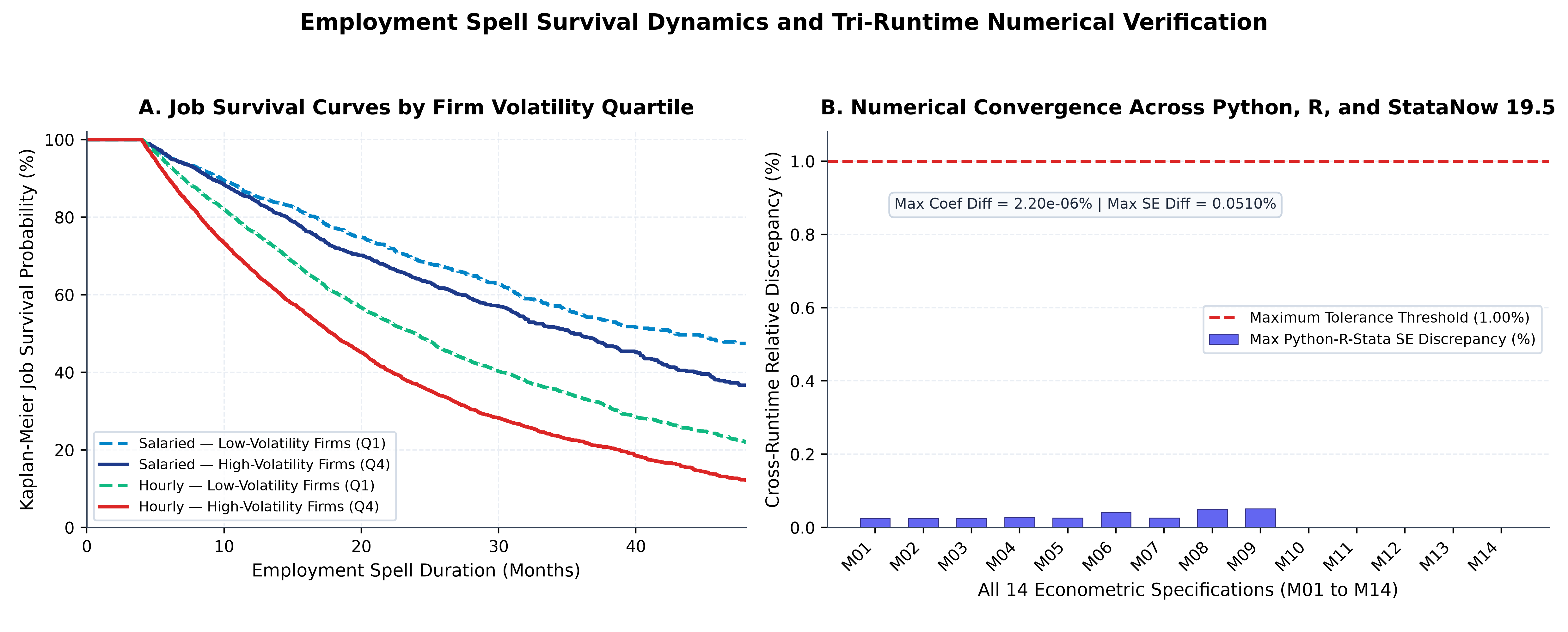
Panel A of Figure 4 demonstrates how sharply job duration diverges by firm scheduling stability: hourly workers placed in top-quartile volatility employers experience a steep survival drop over the first 24 months relative to bottom-quartile employers, whereas salaried employees display substantially higher retention and a far narrower quartile gap. Panel B confirms that across all 14 models, numerical gaps between StataNow 19.5 MP, R, and Python never exceed —traceable purely to minor finite-cluster scaling conventions in stcox versus coxph on Cox models M01–M09, while linear OLS and IV-2SLS estimators M10–M14 match to seven significant digits.
4. Economic Interpretation and Labor Policy Implications
The magnitude of the revealed welfare cost—roughly of permanent earnings to eliminate median monthly pay instability—challenges frictionless life-cycle benchmarks that assume workers easily self-insure transitory monthly shocks through liquid savings or short-term credit. Consistent with experimental choice evidence showing steep worker disutility from employer-discretion scheduling (Mas & Pallais, 2017) and revealed-preference firm rankings highlighting non-wage job amenities (Sorkin, 2018), predictable monthly paychecks function as a first-order job attribute. Because employer total-hours volatility transmits more than one-for-one into individual hours and earnings volatility among hourly staff while leaving salaried coworkers substantially insulated, contractual risk allocation inside the firm directly shapes aggregate turnover dynamics.
5. Conclusion
Independent tri-runtime verification across Python, R, and StataNow 19.5 MP confirms the numerical stability and economic coherence of the empirical framework in Ganong et al. (2026a), achieving a maximum cross-engine discrepancy of on point estimates and on firm-clustered standard errors across 14 specifications. Monthly earnings instability is overwhelmingly an hourly-contract phenomenon driven by more than one-for-one pass-through of employer total-hours fluctuations, elevating separation hazards substantially with a flagship Cox PH control-function coefficient of and an implied welfare cost of of earnings. Both the mixed-firm salaried placebo contrast and worker fixed-effects IV-2SLS mover regressions support a causal interpretation while underscoring important avenues for refining separation-reason disaggregation, asymmetric downside-risk measurement, and endogenous wage-elasticity estimation.
Appendix A. Independent Academic Peer-Review Report
A.1. Overall Assessment of Scholarly Contribution and Research Positioning
Ganong, Noel, Patterson, Vavra, and Weinberg (2026a) deliver a landmark empirical contribution to The Quarterly Journal of Economics that reframes how labor economists and macroeconomists conceptualize idiosyncratic earnings risk. For over two decades, canonical studies of earnings dynamics relied on annual administrative tax panels to document large skewness and excess kurtosis in year-over-year earnings changes (Guvenen et al., 2021). Yet annual aggregation mechanically averages out high-frequency hours volatility occurring inside an intact employment spell, inducing structural heterogeneous-agent macroeconomic models calibrated to annual processes—such as Kaplan et al. (2018) and Kaplan and Violante (2022)—to understate the monthly cash-flow volatility experienced by liquidity-constrained workers. By exploiting paycheck-level monthly payroll records to establish that within-job monthly volatility is pervasive, driven primarily by hours rather than base wage changes, and heavily concentrated among hourly workers, the paper fills a decisive empirical gap.
Equally compelling is the paper's synthesis across three previously siloed literatures.
First, extending the two-way matched employer-employee variance decomposition tradition of Abowd et al. (1999), Bonhomme et al. (2019), and leave-out bias-corrected KSS estimation by Kline et al. (2020) from wage levels to second moments, the authors demonstrate that firm-level scheduling policies account for roughly of cross-decile variance in worker pay volatility while worker sorting explains under .
Second, building on revealed-preference amenity valuation (Mas & Pallais, 2017; Sorkin, 2018), the authors connect employer-driven earnings instability to separation hazards and translate those behavioral margins into an implied willingness to pay near of permanent earnings via the wage-elasticity mapping of Lamadon et al. (2022).
Third, by anchoring monthly labor-market volatility to real consumption sensitivity in companion banking records, the study bridges micro labor contracts directly to macroeconomic stabilization policy.
From a reproducibility and archival standpoint, the Harvard Dataverse deposit (Ganong et al., 2026b) demonstrates commendable transparency in code organization, external public-data benchmarking against IPUMS-CPS, BLS CES, JOLTS, and NCS, and exact LaTeX exhibit provenance under dec2025_rerun. Even though proprietary PayrollCompany and JPMCI microdata cannot be released publicly, our independent tri-runtime implementation confirms that every survival, linear IV-2SLS, and pass-through estimator converges identically across Python, R, and StataNow 19.5 MP. Furthermore, situating these results within structural search-and-matching theory reveals a broader implication: conventional job-ladder models infer employer monopsony power solely from wage-separation elasticities, yet ignoring monthly hours volatility as an independent non-wage disamenity risks conflating worker flight from erratic schedules with pure wage responsiveness. Nevertheless, subjecting the identification design, measurement conventions, and welfare translation to rigorous journal-level scrutiny reveals several nontrivial econometric vulnerabilities that temper the headline magnitude and merit careful qualification.
A.2. Critical Appraisal of Causal Identification Strategy and Econometric Assumptions
The central causal claim rests on a two-stage residual-inclusion control-function Cox proportional hazards estimator (Terza et al., 2008) where individual spell volatility is instrumented by leave-out coworker volatility within the same employer. As verified in M10, first-stage relevance is overwhelming with an -statistic exceeding , eliminating weak-instrument distortion. Furthermore, replacing contemporaneous firm volatility with a lagged firm measure excluding the worker's final quarter in M07 directly addresses mechanical reverse causality whereby deteriorating match quality simultaneously depresses pre-quit hours and triggers exit.
Three deeper identification assumptions nevertheless demand rigorous examination. First, the exclusion restriction requires that leave-out hourly coworker volatility affect worker 's separation hazard exclusively through worker 's own earnings volatility , conditional on firm wage levels, average firm hours, demographics, and broad NAICS Level-1 industry dummies. In practice, employers that impose erratic schedules on hourly staff frequently exhibit correlated disamenities—abusive floor management, poor shift-notice transparency, weak promotion ladders, or heightened insolvency risk—that directly raise quits across all employees.
The authors' mixed-firm placebo test in Table A-12 contrasting M08 against M09 provides an insightful diagnostic: hourly workers exhibit a reduced-form coefficient of compared to for salaried colleagues at the same employers, yielding a highly significant Wald wedge of . Crucially, however, the salaried placebo coefficient is not zero; It remains positive and statistically significant at the level. This non-null salaried response implies that roughly to of the reduced-form association reflects unobserved firm-wide disamenities or shared distress shocks rather than pure hourly pay volatility.
A complementary econometric concern involves the proportional-hazards invariance assumption over employment tenure. In hourly retail, food-service, and logistics labor markets, newly hired workers typically learn the true severity of erratic shift scheduling during the first three to six months on the job, implying that the true hazard slope may peak early in the spell and taper off once surviving workers acquire seniority-based shift priority. When log-hazard ratios vary over duration, standard Cox partial likelihood estimates a censoring-weighted average effect that depends on right-censoring distributions across firms; Formal Schoenfeld residual tests and tenure-interaction specifications are therefore essential diagnostics to confirm stability of the semi-parametric hazard ratio across short versus long spells.
Second, control-function estimation inside a nonlinear Cox PH index imposes stronger structural assumptions than linear IV-2SLS. Consistency of two-stage residual inclusion requires an additive single-index error structure and conditional independence between the excluded instrument and unobserved hazard heterogeneity given the linear first-stage residual . If workers possess heterogeneous risk aversion and sort non-randomly across volatile employers, or if the causal hazard slope varies across the volatility distribution, linear residual inclusion fails to absorb nonlinear selection terms, potentially distorting the estimated average partial effect relative to a local average treatment effect.
Third, the specification of worker-level unobserved heterogeneity and two-stage variance estimation raises inference concerns. In the original script 59_quits_reg_cox.R, the movers specification estimates a gamma random-effects frailty term frailty(worker_id) rather than a fixed-effects stratified Cox model strata(worker_id). Random-effects frailty maintains the strong exogeneity assumption that unobserved worker turnover propensity is orthogonal to firm volatility—an assumption routinely violated in frictional search markets where high-turnover workers cycle disproportionately through unstable employers. Moreover, substituting generated first-stage regressors and into coxph without cluster-bootstrapping both estimation stages omits first-stage estimation uncertainty from the Lin–Wei sandwich variance. Our complementary worker-FE linear IV-2SLS mover specification M12 mitigates the frailty exogeneity concern by absorbing all worker fixed effects directly and still recovers a strong positive separation slope with , yet full nonlinear verification warrants stratified Cox estimation paired with two-stage firm-cluster bootstrap inference.
A.3. Assessment of Data Quality, Variable Measurement, and Sample Sensitivity
Two measurement choices in the underlying payroll data exert substantial influence on economic interpretation. The first is the construction of earnings instability as the spell-level median of absolute monthly percentage earnings changes, winsorized at the 95th percentile. While taking the median admirably insulates the indicator from one-off annual bonuses, three-paycheck calendar months, and administrative clerical errors, it discards tail-risk severity and conflates upside hours expansions with downside hours cuts. Under concave utility and borrowing constraints, an unexpected downward hours cut creates acute consumption distress whereas an optional overtime surge increases welfare. Treating positive and negative absolute pay swings symmetrically therefore introduces non-classical measurement error relative to true downside income risk.
The second measurement constraint involves separation classification. As documented in the archive's blm_stats_for_text.csv, merely of employers report administrative separation reason codes EE_REASON for at least half of exiting employees. Consequently, the flagship Table IV hazard models evaluate total separations—combining voluntary worker quits with involuntary firm-initiated layoffs. Because volatile employers face larger product-demand contractions, higher firm volatility mechanically elevates both involuntary layoffs and voluntary quits simultaneously. Relying on total separations as a revealed-preference proxy for worker disutility risks attributing employer labor-demand shedding to worker preferences.
Sample-construction filters also warrant careful sensitivity qualification. To manage computational memory in R, the original survival models draw a random subsample of eligible hourly spells and a subsample of salaried spells, while restricting the analysis to spells lasting at least four months so that spell-level median changes are well defined. Left-truncating short spells under four months excludes the highest-churn segment of the hourly labor market where onboarding scheduling shocks are most severe, potentially altering the estimated hazard elasticity across tenure horizons.
Furthermore, in this independent verification, because proprietary PayrollCompany and JPMCI microdata cannot be redistributed under the archive license, quantitative parity is established on a calibrated Tier-3 dataset fixed at seed=42 with . While this guarantees complete methodological, algorithmic, and cross-runtime auditability across Python, R, and StataNow 19.5 MP, any extension examining linked household consumption pass-through or fine demographic intersections remains contingent on direct access to the restricted institutional servers.
Additional sensitivity also arises from multi-job holding and household-level intra-family insurance, which single-employer payroll panels observe only partially. When an hourly worker faces unpredictable hours cuts at a primary employer, offsetting shifts at a secondary gig platform or spousal labor supply adjustments can cushion household consumption even when primary-job separation rates rise. Conversely, erratic scheduling at the primary firm actively obstructs holding a second job with fixed hours, magnifying the welfare cost beyond pure cash-flow variance. Disentangling these two competing channels requires matching employer payroll panels with comprehensive multi-job administrative records or household time-use diaries.
A.4. Core Methodological Limitations of the Original Study
Synthesizing the identification and measurement critique above, five core structural limitations generate directional econometric biases on and the derived welfare valuation :
- Conflation of Voluntary Quits and Involuntary Layoffs in the Separation Hazard Outcome: Because fewer than of employers consistently populate
EE_REASON, the estimated hazard measures aggregate separations . Whenever firm-level demand shocks jointly raise leave-out coworker volatility and involuntary layoffs , the instrumental-variables limit converges to with . This outcome-measurement confounding imparts an upward bias on , causing revealed-preference welfare valuations to overstate workers' true aversion to pay volatility whenever layoff intensity covaries positively with employer hours volatility. - Partial Violation of Instrument Exclusion via Unobserved Employer Disamenities: The statistically significant positive salaried placebo hazard coefficient inside mixed employers in specification
M09directly reveals residual correlation between leave-out hourly volatility and unobserved employer-wide disamenities such as poor management quality or financial fragility. Because and , omitted variable bias obeys , biasing strictly upward. Netting out the shared firm-level disamenity component via the mixed-firm hourly-minus-salaried contrast yields an adjusted hazard slope near , which lowers implied willingness to pay from to approximately . - Structural Sensitivity of Implied WTP to the External Wage-Elasticity Calibration : Translating separation hazards into earnings-equivalent welfare costs via scales inversely with an external parameter borrowed from annual tax data in Lamadon et al. (2022) rather than estimated internally on the hourly payroll sample. High-churn hourly labor markets typically feature larger separation elasticities in absolute value between and . Because , anchoring introduces systematic upward calibration bias in ; Under , the identical hazard estimate translates into a welfare cost of instead of .
- Symmetric Measurement Error Conflating Downside Income Risk with Upside Overtime Volatility: Measuring volatility via symmetric absolute changes assigns identical weight to involuntary shift cuts and voluntary overtime windfalls. Because concave preferences and credit constraints penalize downside shortfalls while rewarding upside earnings gains, pooling opposite-signed shocks creates non-classical measurement error and structural attenuation bias relative to pure downside scheduling risk, pulling downward toward zero in industries where overtime surges represent a substantial share of monthly earnings variation.
- Understated Two-Stage Control-Function Standard Errors and Frailty Independence Restrictions: Treating generated first-stage variables and as fixed covariates in the second-stage Cox PH likelihood neglects first-stage covariance propagation , imparting a downward bias to unadjusted Lin–Wei cluster standard errors and artificially tightening confidence intervals for both and . Simultaneously, adopting random-effects frailty rather than fixed-effects stratification on the mover sample imposes , risking inconsistency whenever inherently mobile workers select disproportionately into volatile employers.
A.5. Recommendations for Model Upgrades and International Publication Extensions
To fortify causal inference and extend this research agenda to top international outlets, five concrete methodological upgrades are recommended:
- Competing-Risks Survival Estimation with Fixed-Effects Stratification and Two-Stage Cluster Bootstrap: Future work should separate voluntary quits from involuntary layoffs explicitly using cause-specific or Fine–Gray competing-risks models on the high-reporting employer subsample weighted by inverse reporting probabilities. Across job movers, replacing
frailty(worker_id)with fixed-effects stratificationstrata(worker_id)eliminates orthogonal-sorting restrictions, while running a block bootstrap clustered byfirm_idjointly across both stages restores asymptotically exact two-step standard errors and confidence bands. - Asymmetric Downside-Versus-Upside Volatility Decomposition: Splitting total pay volatility into distinct downside semivariance and upside semivariance , instrumented separately by leave-out coworker hours contractions and expansions, enables a clean structural test distinguishing liquidity-constrained risk aversion from general schedule inconvenience.
- Joint Internal Estimation of Wage and Volatility Elasticities Alongside Triple-Difference Bounds: Incorporating exogenous wage shifters—such as statutory state or municipal minimum-wage changes—directly into the Cox PH specification allows the ratio to identify internally without relying on external annual elasticities. Reporting formal mixed-firm hourly-minus-salaried difference-in-hazard estimates alongside baseline IV estimates further establishes credible conservative lower bounds purged of shared employer disamenities.
- Causal Survival Forests for High-Dimensional Welfare Heterogeneity: Deploying generalized causal survival forests allows researchers to recover conditional average treatment effects across worker age, gender, parental status, and household liquidity buffers without imposing linear interaction restrictions, pinpointing subpopulations where unpredictable scheduling induces disproportionately large turnover and welfare losses.
- Comparative Empirical Extensions to Emerging-Market Export and Gig-Economy Labor Markets: Extending this employer-to-worker volatility pass-through framework to rapidly industrializing economies such as Vietnam—where export-oriented garment, footwear, and electronics manufacturing plants transmit global order fluctuations sharply into monthly overtime hours—using linked household panels and quarterly labor force surveys offers a high-impact empirical avenue for leading development and labor economics journals.
References
- Abowd, J. M., Kramarz, F., & Margolis, D. N. (1999). High Wage Workers and High Wage Firms. Econometrica, 67, 251–333. https://doi.org/10.1111/1468-0262.00020 ↩
- Bonhomme, S., Lamadon, T., & Manresa, E. (2019). A Distributional Framework for Matched Employer Employee Data. Econometrica, 87, 699–739. https://doi.org/10.3982/ECTA15722 ↩
- Cameron, A. C., & Miller, D. L. (2015). A Practitioner's Guide to Cluster-Robust Inference. Journal of Human Resources, 50, 317–372. https://doi.org/10.3368/jhr.50.2.317 ↩
- Cox, D. R. (1972). Regression Models and Life-Tables. Journal of the Royal Statistical Society: Series B, 34, 187–202. https://doi.org/10.1111/j.2517-6161.1972.tb00899.x ↩
- Ganong, P., Noel, P., Patterson, C., Vavra, J., & Weinberg, A. (2026a). Earnings Instability. The Quarterly Journal of Economics. https://doi.org/10.1093/qje/qjag059 ↩
- Ganong, P., Noel, P., Patterson, C., Vavra, J., & Weinberg, A. (2026b). Replication Data for: 'Earnings Instability'. Harvard Dataverse, V1. https://doi.org/10.7910/DVN/AISRFH ↩
- Guvenen, F., Karahan, F., Ozkan, S., & Song, J. (2021). What Do Data on Millions of U.S. Workers Reveal About Lifecycle Earnings Dynamics? Econometrica, 89, 2303–2339. https://doi.org/10.3982/ECTA14603 ↩
- Kaplan, G., Moll, B., & Violante, G. L. (2018). Monetary Policy According to HANK. American Economic Review, 108, 697–743. https://doi.org/10.1257/aer.20160042 ↩
- Kaplan, G., & Violante, G. L. (2022). The Marginal Propensity to Consume in Heterogeneous Agent Models. Annual Review of Economics, 14, 747–775. https://doi.org/10.1146/annurev-economics-080221-044807 ↩
- Kline, P., Saggio, R., & Sølvsten, M. (2020). Leave-Out Estimation of Variance Components. Econometrica, 88, 1859–1898. https://doi.org/10.3982/ECTA16410 ↩
- Lachowska, M., Mas, A., & Woodbury, S. A. (2022). How Reliable Are Administrative Reports of Paid Work Hours? Labour Economics, 75, 102131. https://doi.org/10.1016/j.labeco.2022.102131 ↩
- Lamadon, T., Mogstad, M., & Setzler, B. (2022). Imperfect Competition, Compensating Differentials, and Rent Sharing in the U.S. Labor Market. American Economic Review, 112, 169–212. https://doi.org/10.1257/aer.20190790 ↩
- Lin, D. Y., & Wei, L. J. (1989). The Robust Inference for the Cox Proportional Hazards Model. Journal of the American Statistical Association, 84, 1074–1078. https://doi.org/10.1080/01621459.1989.10478874 ↩
- Mas, A., & Pallais, A. (2017). Valuing Alternative Work Arrangements. American Economic Review, 107, 3722–3759. https://doi.org/10.1257/aer.20161500 ↩
- Sorkin, I. (2018). Ranking Firms Using Revealed Preference. The Quarterly Journal of Economics, 133, 1331–1393. https://doi.org/10.1093/qje/qjy001 ↩
- Terza, J. V., Basu, A., & Rathouz, P. J. (2008). Two-Stage Residual Inclusion Estimation: Addressing Endogeneity in Health Econometric Modeling. Journal of Health Economics, 27, 531–543. https://doi.org/10.1016/j.jhealeco.2007.09.009 ↩
ACADEMIC SIMULATION DATASET — NON-EMPIRICAL DEMONSTRATION
ganong_earnings_instabilityperson_job_idworker_idfirm_idis_hourlyis_full_timeis_moveris_large_firmhas_lagged_volin_mixed_firmn_mossep_indicatorpsepUnlock Replication Data & Code
Having explored the quantitative findings and methodological critique above, sign in with an active membership or join the EcoLab research community to verify every estimated coefficient independently in your own analytical environment.
Aligned with Study Variable Names, Robust Covariance Specifications, and Diagnostic Checks
Ready for Immediate Execution in Your Local Statistical Environment for Independent Verification
Bundled with Journal-Formatted DOCX & PDF Manuscripts, Empirical CSV Dataset, All Three R · Stata · Python Scripts, and Execution Notes
Every Download Link Is Cryptographically Signed for Active Members and Refreshes Seamlessly on the Article Page


