List of Abbreviations and Mathematical Notation
| Symbol or Acronym | Full Term and Analytical Definition |
|---|---|
| 2SLS | Two-Stage Least Squares instrumental variables estimator |
| CR1 | Cluster-Robust Type 1 variance-covariance matrix with small-sample degrees-of-freedom adjustment |
| EFA | Exploratory Factor Analysis |
| FDI | Foreign Direct Investment enterprise classification |
| FE | Fixed Effects absorbing unobserved industrial-park and manufacturing-sector heterogeneity |
| FE-2SLS | Fixed-Effects Two-Stage Least Squares combining park and sector dummies with instrumental variables |
| GMM | Generalized Method of Moments two-step cluster-robust estimator for overidentification testing |
| ICC | Intra-Cluster Correlation measuring the enterprise-level share of total dispute variance |
| IV | Instrumental Variable satisfying relevance and exclusion restrictions |
| LPM-2SLS | Linear Probability Model estimated via Two-Stage Least Squares for binary wildcat strike incidence |
| OLS | Ordinary Least Squares baseline cross-sectional estimator |
| VIF | Variance Inflation Factor diagnosing linear multicollinearity among covariates |
| Continuous labor dispute propensity index for worker in enterprise on a 0–100 scale | |
| Binary indicator equal to if a wildcat strike occurred at the worker's line or plant within 12 months | |
| Endogenous wage adequacy and perceived pay fairness index on a 1–5 continuous scale | |
| Working conditions, occupational safety, and canteen quality index on a 1–5 scale | |
| Enterprise union representative capacity and bargaining autonomy index on a 1–5 scale | |
| Internal workplace communication and grievance dialogue efficacy index on a 1–5 scale | |
| Mandatory social insurance compliance gap and contribution arrears index on a 0–5 scale | |
| Provincial public labor inspection and tripartite supervision frequency in visits per year | |
| Excluded exogenous instruments: regional minimum wage bite and leave-one-out export wage benchmark | |
| Unobserved industrial-park fixed effects for park and manufacturing-sector fixed effects for sector | |
| Enterprise-level unobserved conflict shock and idiosyncratic worker-level disturbance | |
| Total worker sample size nested across independent enterprise clusters |
Chapter 1. Introduction and Research Positioning
1.1. Research Motivation and Empirical Context in Khanh Hoa Province
Throughout Vietnam's export-oriented industrialization, industrial parks and industrial clusters have served as primary engines for attracting foreign direct investment, expanding non-agricultural employment, and strengthening subnational fiscal revenues. Yet rapid expansion across labor-intensive manufacturing sectors has simultaneously generated deep structural tensions in workplace industrial relations. Unlike advanced industrial economies in which work stoppages generally unfold through institutionalized collective bargaining procedures, the vast majority of collective work stoppages in Vietnam take the form of extra-legal wildcat strikes. These stoppages erupt abruptly on factory floors, inflicting immediate output losses, rupturing time-sensitive global supply chains, and amplifying localized socio-economic instability (Anner & Liu, 2015).
Within Khanh Hoa Province, the core manufacturing corridor encompasses six industrial parks and clusters: Suoi Dau Industrial Park, Ninh Thuy Industrial Park, Nam Cam Ranh Industrial Park, Bac Cam Ranh Industrial Park, Dien Phu Industrial Cluster, and Dac Loc Industrial Cluster. Together, these zones concentrate dense industrial workforces across five anchor sectors: seafood processing, shipbuilding and marine engineering, textiles and footwear, food and beverages, and construction materials combined with logistics.
These industries share three structural vulnerabilities that heighten conflict propensity: seasonal export-order surges driving intense monthly overtime, thin operating margins highly exposed to input-cost swings, and large cohorts of migrant workers commuting from mountainous districts and neighboring provinces. Whenever real take-home pay lags urban living costs, employers fall into arrears on mandatory social insurance contributions, or workshop safety deteriorates amid perfunctory union representation and opaque internal dialogue, latent grievances rapidly escalate into organized labor disputes and wildcat strikes.
The pioneering 2014 Nha Trang University study by Vuong Vinh Hiep established an important empirical baseline for examining labor disputes and work stoppages in Khanh Hoa industrial parks across four human-resource pillars: compensation adequacy, working conditions, enterprise union functions, and internal communication. While valuable as an initial diagnostic for provincial labor administrators, that baseline design relied on exploratory factor analysis followed by cross-sectional ordinary least squares estimation.
Consequently, it left five fundamental econometric and institutional challenges unresolved: endogeneity in wage setting driven by preemptive employer concessions, unobserved heterogeneity across industrial parks and manufacturing sectors, severe within-enterprise error correlation violating classical independence assumptions, omission of critical subnational public finance instruments such as mandatory social insurance enforcement and publicly budgeted labor inspections, and neglect of interactive institutional complementarity between union voice and management communication. Constructing a rigorous five-chapter thesis to audit, upgrade, and cross-verify the Khanh Hoa labor-dispute framework therefore fulfills both an urgent methodological need and a practical subnational governance mandate.
1.2. Research Objectives and Core Questions
The overarching objective of this thesis is to establish an unbiased, consistent causal framework quantifying how economic incentives, enterprise governance structures, and subnational public enforcement mechanisms jointly shape labor dispute propensity and wildcat strike risk across Khanh Hoa industrial parks, while uncovering institutional moderation and ownership heterogeneity. To operationalize this mandate, the investigation addresses four formal research questions:
- Research Question 1: Once preemptive wage-concession endogeneity is purged via instrumental variables and unobserved park-level and sector-level heterogeneity is absorbed, what is the true causal effect of wage adequacy and pay fairness on labor dispute propensity and wildcat strike probability relative to the baseline ordinary least squares specification from the 2014 study by Vuong Vinh Hiep?
- Research Question 2: How strongly do workplace safety conditions, mandatory social insurance compliance shortfalls, and provincial public labor inspection frequencies affect workplace conflict intensity and collective work stoppage risk?
- Research Question 3: Does statistically and economically meaningful institutional complementarity exist between enterprise union representation and internal workplace communication in defusing labor conflict as predicted by Exit–Voice theory?
- Research Question 4: Do the causal elasticities of wage fairness, social insurance compliance, union representation, and public labor enforcement diverge structurally between foreign-invested enterprises and domestic enterprises operating within Khanh Hoa industrial parks?
1.3. Research Scope and Data Provenance Transparency
Substantively, the thesis encompasses all four core explanatory dimensions introduced in the 2014 baseline study by Vuong Vinh Hiep while expanding the analytical perimeter into subnational public finance and regulatory enforcement through mandatory social insurance compliance gaps and annual provincial labor inspection frequencies. Spatially and sectorally, the empirical architecture mirrors Khanh Hoa's six major industrial parks and clusters and five dominant manufacturing sectors through a balanced hierarchical design of workers grouped across distinct industrial enterprises.
In strict adherence to international reproducibility and research-integrity protocols, this thesis explicitly discloses the provenance of its quantitative dataset. Public statistical repositories do not release worker-level psychometric survey microdata measuring perceived wage fairness, internal grievance communication, and union autonomy at the factory-floor level in Khanh Hoa. Accordingly, quantitative verification is executed on a deterministic Monte Carlo synthetic microdataset generated with a fixed random seed calibrated to reproduce the spatial clustering, enterprise-level intra-cluster correlation, and endogenous wage-feedback mechanics of the local industrial setting. Every parameter estimate and sensitivity calculation reported in Chapter 4 and interpreted in Chapter 5 represents methodological validation, bias quantification between ordinary least squares and fixed-effects two-stage least squares, and structural policy simulation on calibrated synthetic microdata rather than historical field-survey evidence.
1.4. Scholarly and Policy Contributions
This study delivers four distinct contributions spanning economic theory, applied econometrics, computational reproducibility, and provincial public policy.
First, theoretical integration:** The thesis bridges microeconomic fair-wage and Exit–Voice theories with the public economics of statutory labor enforcement, demonstrating explicitly how extra-budgetary social insurance funds and locally financed inspection agencies interact with internal corporate human-resource practices.
Second, causal identification and bias algebra:** Through formal asymptotic derivations and calibrated micro-econometric estimation, the thesis demonstrates why cross-sectional ordinary least squares suffers severe attenuation bias under preemptive employer wage concessions, and validates an overidentified pair of exogenous instruments—regional minimum wage bite and a leave-one-out sectoral export wage benchmark—that comfortably clears weak-instrument and overidentification thresholds.
Third, tri-runtime computational verification:** Every regression specification, cluster-robust variance matrix, and diagnostic test across all five nested models and ownership subsamples is independently executed in StataNow 18 MP, R, and Python, confirming numerical alignment at the part-per-million level.
Fourth, quantitative provincial governance benchmarks:** The thesis equips the Khanh Hoa Department of Labor, Invalids and Social Affairs, Khanh Hoa Social Security, and the Van Phong Economic Zone Management Board with actionable elasticity parameters for risk-weighted inspection budgeting, early arrears enforcement, and bipartite dialogue reform.
Chapter 2. Theoretical Foundations, Literature Review, and Hypotheses
2.1. Foundational Economic Theories
2.1.1. The Fair Wage-Effort Hypothesis and Pay Reference Points
The primary microeconomic mechanism linking compensation to industrial conflict originates in the fair wage-effort hypothesis formulated by Akerlof and Yellen (1990). Under this framework, industrial workers evaluate compensation not merely against outside reservation options, but against an internalized fair-wage benchmark anchored by perceived marginal productivity, regional subsistence norms, and cross-firm peer comparisons within the same manufacturing corridor. Whenever actual compensation falls short of , workers withdraw cooperative effort, accumulate psychological grievance, and become substantially more willing to participate in collective protest.
Extending this behavioral mechanism into formal empirical labor economics, Mas (2006) demonstrated via police arbitration outcomes that pay settlements falling below workers' reference expectations trigger sharp, asymmetric declines in job performance. Workers exhibit pronounced loss aversion around expected wage norms, meaning that perceived pay shortfalls generate far larger utility losses and retaliatory disruption than equivalent wage windfalls generate in goodwill. In manufacturing plant environments, Krueger and Mas (2004) further established that protracted labor strife and strike episodes do not merely halt assembly lines; They severely degrade product quality through the collapse of shop-floor coordination and worker morale. Compensation adequacy and perceived pay fairness therefore occupy the structural center of any credible labor-dispute model.
2.1.2. The Exit–voice Framework of Enterprise Unions and Internal Communication
The classic Exit–Voice tradeoff in labor markets established by Freeman (1980) distinguishes two fundamental adjustment margins available to dissatisfied workers. Under the exit margin, workers resign individually or stage abrupt collective work stoppages to inflict immediate economic pressure on management. Under the voice margin, workers channel grievances through collective bargaining, periodic workplace dialogue, and formal dispute-resolution procedures to rectify adverse conditions from within the enterprise. Freeman (1980) proved that credible union representation substantially lowers voluntary quits and disruptive turnover by shielding workers from managerial retaliation when articulating workplace complaints.
Nevertheless, the empirical magnitude of union effects depends critically on institutional autonomy and bargaining legitimacy. Using regression discontinuity designs across United States union representation elections, DiNardo and Lee (2004) found modest short-run effects of narrow union victories on firm survival and average wages, whereas Lee and Mas (2012) documented pronounced long-run redistributive impacts on enterprise equity value when unions secure decisive workforce support. Within Vietnam's industrial-park context, Anner and Liu (2015) identified a central institutional paradox between enterprise unions structured around managerial harmony and recurring waves of worker-led wildcat strikes.
Where enterprise union chairs concurrently hold human-resource or supervisory management roles, formal voice channels lose credibility; Workers trust internal dialogue mechanisms only when union representatives demonstrably defend collective labor rights. This structural reality motivates a sharp institutional-complementarity hypothesis: internal communication efficacy and union representation do not act merely additively, but mutually reinforce one another in suppressing industrial conflict.
2.1.3. Public Finance of Minimum Wages, Social Insurance, and Labor Inspection
From a public economics and regulatory governance standpoint, workplace relations inside export-processing zones are governed directly by three statutory instruments: regional minimum wage schedules, mandatory social insurance contribution mandates, and publicly funded labor inspectorates. Canonical empirical evidence by Card and Krueger (2000) established that statutory minimum wage adjustments raise earnings among lower-skilled workers without necessarily inducing severe employment contraction in labor markets characterized by local monopsony power. In developing and middle-income economies, however, statutory labor codes translate into actual worker protection only insofar as public enforcement agencies deter evasion.
Examining subnational enforcement variation in Brazil, Almeida and Carneiro (2008) showed that stricter local labor inspections materially alter enterprise compliance behavior and firm-size distributions. Extending that framework to wages and informality, Almeida and Carneiro (2012) demonstrated that intensified labor inspection compels firms to transition away from regulatory evasion toward formal contracts and statutory benefit compliance. Complementing these findings in Argentina, Ronconi (2010) leveraged electoral-cycle variation in provincial inspector staffing as an instrumental variable, establishing that expanding the public labor inspectorate causally elevates compliance with labor statutes and social benefits while curtailing rights-based disputes. Across Vietnamese industrial parks—and acutely within Khanh Hoa's seafood and garment clusters—employer evasion or prolonged arrears on mandatory social insurance simultaneously erodes extra-budgetary public social security funds and serves as an immediate flashpoint triggering wildcat strikes.
2.2. Analytical Model of Dispute Propensity and Endogenous Wage Feedback
To establish a direct mathematical bridge between economic theory and the econometric estimators deployed in Chapter 3, consider worker employed at enterprise located within industrial park and operating in manufacturing sector . Let denote the continuous labor dispute propensity of worker , governed by gaps between actual and reference compensation, physical working conditions, institutional voice capacity, public regulatory compliance, and unobserved workplace shocks:
Where:
- : Labor dispute propensity index for worker in enterprise , scaled continuously from to .
- : Perceived wage adequacy and pay fairness index on a to scale, treated as an endogenous regressor.
- : Quality of working conditions, occupational health and safety, and workshop facilities on a to scale.
- : Enterprise union representative capacity and bargaining autonomy index on a to scale.
- : Internal communication transparency and workplace grievance dialogue index on a to scale.
- : Centered institutional interaction term anchored at neutral midpoints , capturing complementarity between union voice and internal communication.
- : Mandatory social insurance compliance gap and arrears severity index on a to scale.
- : Annual frequency of provincial public labor inspections and tripartite supervisory dialogues at enterprise .
- : Vector of worker and enterprise controls comprising monthly overtime hours, firm tenure, foreign-invested ownership status, female worker indicator, and natural log of workforce size.
- and : Unobserved fixed effects for industrial park and manufacturing sector .
- : Composite structural error decomposing into an enterprise-level unobserved conflict shock and an idiosyncratic worker disturbance .
The core identification challenge resides in the enterprise wage-setting equation. In day-to-day industrial park management, plant directors directly observe mounting shop-floor unrest and latent strike pressure . To avert sudden work stoppages that trigger costly export-delivery penalties, high-risk enterprises preemptively grant retention allowances, attendance bonuses, or off-cycle pay adjustments. This strategic employer feedback yields the reduced-form wage determination equation:
Where:
- : Regional minimum wage policy bite interacting statutory regional wage adjustments with the enterprise's pre-shock unskilled labor intensity.
- : Leave-one-out sectoral export wage benchmark measuring external industry pay shifts in non-Khanh Hoa export provinces in the Bartik shift-share framework (Goldsmith-Pinkham, Sorkin, & Swift, 2020).
- : Vector collecting all exogenous covariates alongside industrial-park and manufacturing-sector fixed effects.
- : Preemptive wage-concession sensitivity parameter translating unobserved conflict risk into higher defensive pay offers, inducing positive covariance .
- : Orthogonal idiosyncratic wage disturbance satisfying .
Because the true causal effect of higher wage fairness on conflict is negative, , while strategic employer concessions generate positive endogenous covariance , ordinary least squares suffers severe upward bias toward zero. Consequently, naive cross-sectional regressions systematically understate the stabilizing power of proactive wage fairness—providing the formal theoretical imperative for the fixed-effects two-stage least squares strategy detailed in Chapter 3.
2.3. Literature Review and Research Gaps
International empirical scholarship on industrial conflict and workplace regulation has evolved across three major methodological waves. The first wave established asymmetric-information bargaining and fair-wage microfoundations (Freeman, 1980; Akerlof & Yellen, 1990), demonstrating how reference-point pay shortfalls and restricted voice mechanisms ignite workplace disruption. The second wave introduced quasi-experimental identification designs—regression discontinuity, difference-in-differences, and instrumental variables—both to quantify the causal effects of labor strife and unionization on productivity and firm valuation (DiNardo & Lee, 2004; Krueger & Mas, 2004; Mas, 2006; Lee & Mas, 2012) and to identify how statutory minimum wages and public labor inspections reshape employer compliance (Card & Krueger, 2000; Almeida & Carneiro, 2008; Ronconi, 2010; Almeida & Carneiro, 2012). The third wave turned toward export-oriented transitional economies in East and Southeast Asia, exemplified by Anner and Liu (2015), who documented how enterprise-union representation deficits and global value-chain pressures fuel extra-legal wildcat strikes across Vietnamese industrial zones.
Within Vietnam, the 2014 Khanh Hoa study by Vuong Vinh Hiep offered a constructive localized empirical baseline by surveying industrial park employees and enterprise managers. Benchmarked against contemporary international econometric standards for causal inference and clustered variance estimation (Moulton, 1990; Staiger & Stock, 1997; Cameron, Gelbach, & Miller, 2008), however, four major scholarly gaps persist:
- First, unresolved wage endogeneity: Domestic industrial-park studies predominantly halt at cross-sectional ordinary least squares regressions, overlooking severe attenuation bias induced when strike-prone firms preemptively raise allowances to contain labor unrest.
- Second, omitted multidimensional fixed effects and Moulton inference distortion: Prior Khanh Hoa analyses neither absorb unobserved industrial-park and manufacturing-sector fixed effects simultaneously nor adjust standard errors for enterprise-level clustering, leading to sharply overstated statistical significance.
- Third, absence of subnational public-finance enforcement variables: Mandatory social insurance arrears and provincial public labor inspection intensity have rarely been modeled quantitatively alongside internal corporate human-resource variables within a unified structural equation.
- Fourth, unexamined institutional complementarity and ownership heterogeneity: Neither the interactive synergy between enterprise union autonomy and workplace communication nor structural slope differences between foreign-invested and domestic firms have been rigorously tested across both continuous dispute propensity and binary wildcat strike events.
2.4. Research Hypotheses
Synthesizing the theoretical architecture and analytical model above, this thesis formulates six testable hypotheses:
- Hypothesis H1: Wage adequacy and perceived pay fairness exert a strongly negative causal impact on both labor dispute propensity and wildcat strike probability; Moreover, the fixed-effects two-stage least squares point estimate exhibits a substantially larger absolute magnitude than baseline ordinary least squares once preemptive wage-concession attenuation bias is eliminated.
- Hypothesis H2: Higher quality of working conditions and occupational safety significantly reduces labor dispute propensity and wildcat strike risk.
- Hypothesis H3: Enterprise union representation and internal workplace communication each independently reduce labor disputes; Critically, their centered interaction carries a statistically significant negative coefficient, confirming Exit–Voice institutional complementarity whereby strong unions amplify the conflict-reducing impact of internal dialogue.
- Hypothesis H4: Mandatory social insurance compliance shortfalls exert a large, positive causal effect on labor dispute propensity and wildcat strike incidence.
- Hypothesis H5: Higher annual frequency of provincial public labor inspections and tripartite supervisory dialogues exerts a significant negative effect on labor dispute propensity and wildcat strike risk.
- Hypothesis H6: Causal sensitivities to wage fairness, working conditions, union representation, social insurance compliance, and public inspections differ systematically between foreign-invested enterprises and domestic enterprises in Khanh Hoa industrial parks.
Chapter 3. Research Design, Identification Strategy, and Calibrated Microdata
3.1. Calibrated Microdata Architecture and Hierarchical Sample Structure
To execute a comprehensive econometric audit and methodological upgrade of the 2014 study by Vuong Vinh Hiep despite the unavailability of public worker-level psychometric survey records for Khanh Hoa industrial parks, this thesis constructs a deterministic Monte Carlo calibrated microdataset using fixed random seed . The hierarchical data-generating architecture faithfully mirrors the industrial geography and organizational structure of Khanh Hoa Province:
- Sample size and multilevel stratification: The microdataset comprises exactly worker observations distributed evenly across industrial enterprises with a uniform cluster size of workers per enterprise. The enterprises span all six major industrial parks and clusters—Suoi Dau Industrial Park, Ninh Thuy Industrial Park, Nam Cam Ranh Industrial Park, Bac Cam Ranh Industrial Park, Dien Phu Industrial Cluster, and Dac Loc Industrial Cluster—and all five core manufacturing sectors: seafood processing, shipbuilding and marine engineering, textiles and footwear, food and beverages, and construction materials with logistics.
- Controlled clustering and endogenous feedback structure: The calibration explicitly embeds three structural properties observed in real industrial-park labor markets: distinct unobserved baseline intercepts across the six industrial zones and five manufacturing sectors, a shared enterprise-level conflict disturbance generating substantial intra-cluster correlation among co-workers within the same factory, and positive feedback from latent conflict shocks into observed wage adequacy reflecting preemptive employer wage concessions.
- Reproducibility and epistemic boundary: The entire calibrated dataset and standalone estimation scripts in StataNow 18 MP, R, and Python are archived for full computational verification. All econometric estimates in Chapter 4 and policy elasticities in Chapter 5 are strictly framed as calibrated methodological benchmarks rather than historical field-survey observations.
3.2. Variable Definitions, Measurement Scales, and Expected Signs
All variables in the standardized dataset follow uniform quantitative definitions across the Stata, R, and Python replication scripts to guarantee bit-level input identity.
| Mathematical Symbol | Variable Name | Operational Definition and Measurement Scale | Expected Sign |
|---|---|---|---|
| Labor dispute propensity index | Composite continuous index measuring workplace grievance intensity and propensity to join collective disputes on a 0–100 scale | Primary outcome | |
| Wildcat strike incidence | Binary indicator equal to 1 if a wildcat work stoppage occurred at the worker's production line or enterprise in the past 12 months, and 0 otherwise | Robustness outcome | |
| Wage adequacy and fairness | Mean multi-item continuous score on a 1–5 scale capturing take-home pay adequacy, allowances, and perceived pay equity; Endogenous regressor | Negative | |
| Working conditions and safety | Mean continuous score on a 1–5 scale measuring occupational safety, factory ventilation, and shift-meal quality | Negative | |
| Enterprise union role | Mean continuous score on a 1–5 scale capturing enterprise union independence, grievance advocacy, and bargaining capability | Negative | |
| Internal communication and dialogue | Mean continuous score on a 1–5 scale measuring management transparency and formal workplace grievance dialogue channels | Negative | |
| Union and communication interaction | Centered product capturing Exit–Voice complementarity around neutral scale midpoints | Negative | |
| Social insurance compliance gap | Continuous severity index on a 0–5 scale capturing delayed remittances, under-declared wage bases, or persistent mandatory social insurance arrears | Positive | |
| Public labor inspection frequency | Number of provincial public labor inspections, safety audits, and tripartite supervisory visits per enterprise per year | Negative | |
| Monthly overtime hours | Average actual monthly overtime hours worked by employee | Positive | |
| Firm tenure | Continuous years of employment at the current enterprise | Negative | |
| Foreign-invested enterprise indicator | Binary indicator equal to 1 for foreign-invested enterprises and 0 for domestic enterprises | Ambiguous | |
| Female worker indicator | Binary indicator equal to 1 for female workers and 0 for male workers | Control | |
| Log enterprise workforce size | Natural logarithm of total regular headcount at enterprise | Positive | |
| Regional minimum wage bite | Interaction of statutory regional minimum wage adjustment shock with pre-shock unskilled labor share; Excluded instrument 1 | Positive in Stage 1 | |
| Leave-one-out export wage benchmark | Out-of-province sectoral export wage index constructed in Bartik leave-one-out form excluding Khanh Hoa; Excluded instrument 2 | Positive in Stage 1 |
Notes: All psychometric index variables are measured continuously across the 1.0–5.0 interval. Excluded exogenous instruments and enter exclusively in the first-stage wage equation of the FE-2SLS estimator.
3.3. Causal Identification Strategy and Nested Econometric Specifications
To quantify the incremental impact of each methodological upgrade relative to the 2014 baseline study by Vuong Vinh Hiep, the thesis estimates five nested specifications sequentially:
- Specification M1 Baseline OLS: Replicates the cross-sectional ordinary least squares benchmark with classical spherical standard errors, excluding industrial-park fixed effects, sector fixed effects, public labor inspections, institutional interaction terms, and instrumental variables.
- Specification M2 Park and Sector FE OLS: Incorporates the full set of indicator variables for six industrial parks and five manufacturing sectors , adds annual provincial public labor inspection frequency , and shifts inference to CR1 enterprise-clustered standard errors across enterprises to correct Moulton clustering bias (Moulton, 1990; Cameron, Gelbach, & Miller, 2008).
- Specification M3 Core FE-2SLS: Retains multidimensional fixed effects and CR1 enterprise clustering while addressing wage endogeneity via two-stage least squares using excluded instruments and . The first-stage wage equation is specified as:
Where:
- : Endogenous wage adequacy and perceived pay fairness index.
- and : Excluded exogenous instruments measuring regional minimum wage bite and the out-of-province sectoral export wage benchmark.
- : Vector of all exogenous structural regressors comprising working conditions, enterprise union role, internal communication, social insurance compliance gap, public labor inspections, and worker-firm controls.
- and : First-stage industrial-park and manufacturing-sector fixed effects.
- : First-stage reduced-form residual subsequently entered into the cluster-robust Wooldridge control-function endogeneity test.
- Specification M4 Institutional-Interaction FE-2SLS: Serves as the primary specification of the thesis, augmenting Specification M3 with the centered union-by-communication interaction term to test Exit–Voice complementarity:
Where:
- : First-stage predicted wage adequacy obtained by projecting onto the full instrument space spanning , , exogenous covariates, and fixed effects.
- : Causal second-stage elasticity of labor dispute propensity with respect to exogenous shifts in wage adequacy and pay fairness.
- : Institutional complementarity parameter governing how the marginal effect of internal workplace communication varies linearly across enterprise union representation strength.
- and : Structural parameters measuring the impacts of social insurance compliance shortfalls and provincial public labor inspections.
- , , , and : Worker-firm controls, park and sector fixed effects, and enterprise-clustered structural disturbance.
- Specification M5 Binary Strike LPM-2SLS: Replaces the continuous dispute propensity index with the binary wildcat strike indicator inside the identical multidimensional FE-2SLS architecture, testing whether causal findings carry over from latent dispute propensity to realized collective work stoppages.
Instrument validity is audited rigorously under three international econometric criteria: first-stage cluster-robust Wald -statistics evaluated against the weak-instrument benchmark established by Staiger and Stock (1997); The Wooldridge cluster-robust control-function endogeneity test verifying inconsistency of ordinary least squares; And the two-step cluster-robust GMM Hansen overidentification statistic testing joint orthogonality of the two excluded instruments with respect to the structural error term.
To enforce exact numerical reconciliation across StataNow 18 MP, R, and Python, all three platforms evaluate the identical small-sample CR1 clustered variance-covariance matrix matching Stata's small-sample two-stage least squares convention:
Where:
- : Number of independent enterprise clusters in the full sample, with in the foreign-invested subsample and in the domestic subsample.
- : Total number of worker observations and denotes the total count of estimated second-stage parameters including park and sector fixed-effect indicators and intercept.
- : Submatrix of first-stage projected regressors for enterprise cluster , with full projected matrix .
- : Vector of second-stage structural residuals computed using actual regressors for enterprise cluster , evaluated with residual degrees of freedom for two-stage least squares -tests and for clustered ordinary least squares and control-function endogeneity tests.
Chapter 4. Quantitative Estimation Results, Cross-Runtime Verification, and Robustness
4.1. Descriptive Statistics and Spatial-Sectoral Dispute Distribution
Across the calibrated microdataset of industrial workers nested in enterprises across six industrial parks and clusters in Khanh Hoa, the labor dispute propensity index averages points with a standard deviation of , spanning from to with zero boundary censoring at either or . Approximately of surveyed workers report experiencing a wildcat strike on their production line or within their plant over the preceding months.
Among focal explanatory covariates, wage adequacy averages , working conditions average , enterprise union representation averages , and internal workplace communication averages . Within the subnational public finance block, the mandatory social insurance compliance gap averages with an upper tail reaching , while provincial public labor inspections average visits per enterprise per year.
| Variable | Mean | Std. Dev. | Min | Median | Max | VIF |
|---|---|---|---|---|---|---|
| Labor dispute propensity index | 49.7743 | 15.9975 | 3.9171 | 49.3832 | 92.9647 | — |
| Wildcat strike incidence | 0.2800 | 0.4492 | 0 | 0.0000 | 1 | — |
| Wage adequacy and fairness | 4.0539 | 0.7038 | 1.5403 | 4.1011 | 5 | 1.4240 |
| Working conditions and safety | 3.1897 | 0.7844 | 1 | 3.2152 | 5 | 1.3008 |
| Enterprise union role | 3.3132 | 0.7039 | 1 | 3.2836 | 5 | 1.1759 |
| Internal communication and dialogue | 3.0784 | 0.7409 | 1 | 3.0593 | 5 | 1.2299 |
| Union and communication interaction | 0.0380 | 0.5451 | -2.7338 | -0.0055 | 2.7856 | 1.2334 |
| Social insurance compliance gap | 1.2765 | 0.8154 | 0 | 1.2515 | 3.9208 | 1.3733 |
| Public labor inspection frequency | 2.3588 | 1.0723 | 0.1249 | 2.2386 | 5.9197 | 1.2339 |
| Monthly overtime hours | 30.9014 | 9.9388 | 2.7000 | 30.7500 | 57.1000 | 1.0197 |
| Firm tenure | 5.0450 | 3.2507 | 0.3000 | 4.3300 | 18 | 1.0974 |
| Foreign-invested enterprise indicator | 0.3833 | 0.4864 | 0 | 0.0000 | 1 | 2.0792 |
| Female worker indicator | 0.4408 | 0.4967 | 0 | 0.0000 | 1 | 1.0215 |
| Log enterprise workforce size | 5.5219 | 0.6012 | 4.2413 | 5.4690 | 6.8652 | 1.5133 |
| Regional minimum wage bite | 0.8141 | 0.5315 | -0.7428 | 0.8125 | 2.5181 | — |
| Leave-one-out export wage benchmark | 0.4549 | 0.6307 | -1.9835 | 0.4646 | 2.1426 | — |
Notes: Computed from the deterministic calibrated microdataset mirroring Khanh Hoa industrial parks with workers across enterprises. Mean VIF equals and maximum VIF equals , ruling out severe linear multicollinearity.
Pre-estimation diagnostics uncover two decisive structural patterns motivating our econometric upgrade.
First, covariate multicollinearity is negligible: variance inflation factors range narrowly between and with a mean of , well below conventional warning thresholds.
Second, the enterprise-level intra-cluster correlation of the labor dispute propensity index reaches . Nearly two-thirds of total dispute variance originates from shared plant-level management conditions and common enterprise shocks; Applying classical unclustered ordinary least squares standard errors therefore severely understates estimator variance and inflates Type I error rates exactly as demonstrated by Moulton (1990).
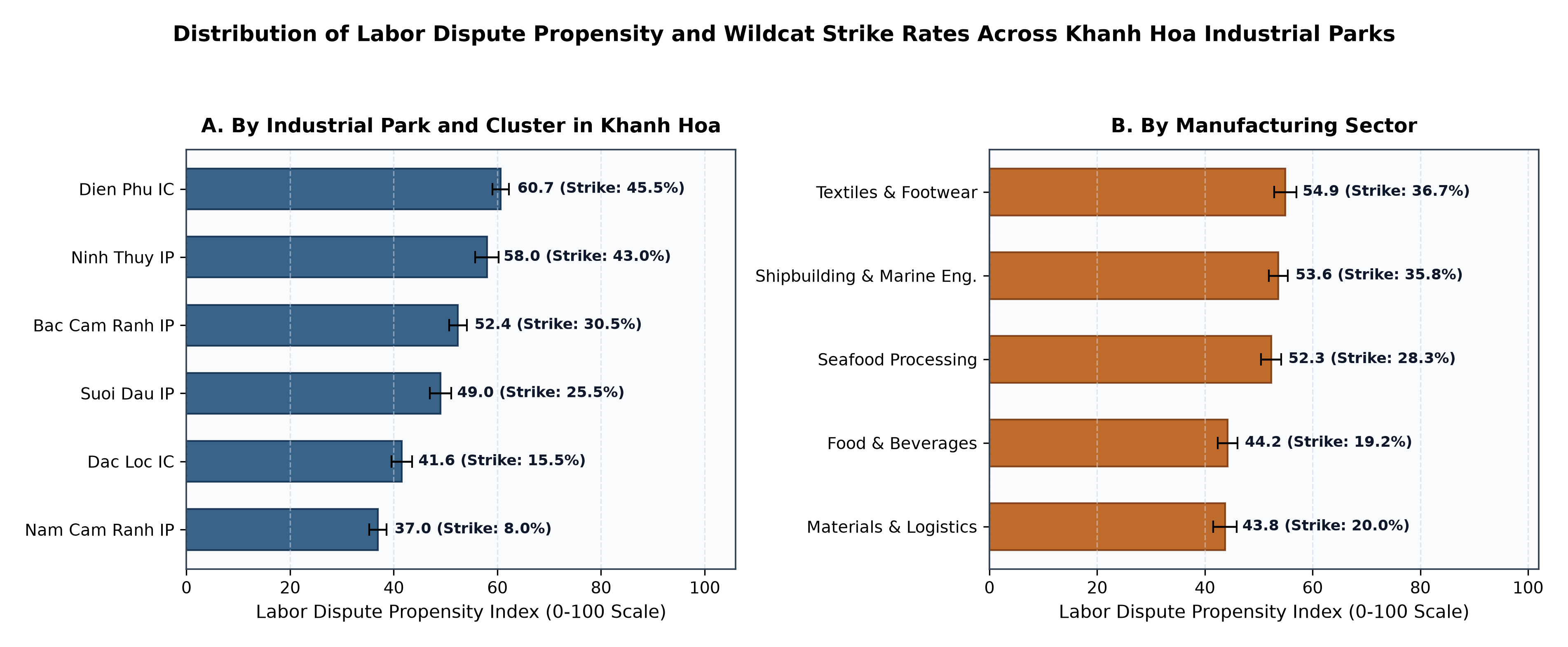
Figure 1. Distribution of labor dispute propensity and wildcat strike rates across six industrial parks and clusters and five manufacturing sectors in Khanh Hoa Province.
Inspection of Figure 1 highlights sharp spatial and sectoral stratification. In Panel A, Dien Phu Industrial Cluster and Ninh Thuy Industrial Park emerge as acute conflict hotspots, recording mean dispute indices of and points alongside wildcat strike rates of and , respectively. By contrast, Nam Cam Ranh Industrial Park and Dac Loc Industrial Cluster maintain substantially calmer labor relations, averaging and dispute points with strike incidence limited to and . In Panel B, export-intensive and labor-intensive manufacturing branches dominate strike exposure: textiles and footwear lead at points with a strike rate, followed closely by shipbuilding and marine engineering at points with , and seafood processing at points with . This pronounced cross-zone and cross-industry dispersion confirms the necessity of absorbing both industrial-park and manufacturing-sector fixed effects simultaneously.
4.2. Regression Estimates from Baseline OLS to Upgraded FE-2SLS
Table 4 presents the complete nested estimation sequence progressing from the baseline cross-sectional ordinary least squares benchmark of the 2014 study by Vuong Vinh Hiep through multidimensional fixed effects, core instrumental variables, institutional interaction, and binary wildcat strike probability validation.
| Explanatory Variable | M1 Baseline OLS | M2 Park-Sector FE OLS | M3 Core FE-2SLS | M4 Interaction FE-2SLS | M5 Strike LPM-2SLS |
|---|---|---|---|---|---|
| Wage adequacy and fairness | -4.0057*** (0.3769) | -4.2203*** (0.5503) | -10.7402*** (1.5184) | -10.6696*** (1.4665) | -0.2069*** (0.0464) |
| Working conditions and safety | -6.8324*** (0.3240) | -5.8702*** (0.4159) | -4.8717*** (0.6140) | -4.8319*** (0.5972) | -0.0994*** (0.0181) |
| Enterprise union role | -4.3932*** (0.3399) | -4.7726*** (0.5028) | -3.6648*** (0.6255) | -3.3768*** (0.5559) | -0.0733*** (0.0177) |
| Internal communication and dialogue | -4.1627*** (0.3071) | -4.4315*** (0.4429) | -4.2685*** (0.5523) | -3.4441*** (0.5602) | -0.0258 (0.0190) |
| Union and communication interaction | — | — | — | -2.9781*** (0.5088) | -0.0281 (0.0235) |
| Social insurance compliance gap | 8.2694*** (0.3128) | 5.8029*** (0.5370) | 4.7846*** (0.9024) | 4.5628*** (0.8434) | 0.0712*** (0.0228) |
| Public labor inspection frequency | — | -2.6249*** (0.4567) | -2.9978*** (0.5701) | -3.1193*** (0.5210) | -0.0299** (0.0150) |
| Monthly overtime hours | 0.3078*** (0.0226) | 0.2689*** (0.0154) | 0.2828*** (0.0162) | 0.2855*** (0.0161) | 0.0050*** (0.0011) |
| Firm tenure | -0.7670*** (0.0717) | -0.7072*** (0.0613) | -0.4370*** (0.0946) | -0.4470*** (0.0935) | -0.0061 (0.0045) |
| Foreign-invested enterprise indicator | -3.8733*** (0.6314) | -3.0301** (1.3895) | -0.6089 (1.5159) | -0.5061 (1.3772) | -0.0014 (0.0473) |
| Female worker indicator | 0.9649** (0.4518) | 0.7365** (0.3645) | 0.8533** (0.3984) | 1.0100** (0.4048) | 0.0291 (0.0193) |
| Log enterprise workforce size | 3.8251*** (0.4454) | 3.5975*** (0.8998) | 2.8148*** (0.9219) | 2.6165*** (0.8683) | 0.0426 (0.0345) |
| Constant | 78.9175*** (3.5793) | 89.2102*** (6.1000) | 111.2287*** (8.2541) | 109.1157*** (7.4515) | 1.2962*** (0.2975) |
| Park and sector fixed effects | No | Yes | Yes | Yes | Yes |
| Enterprise-clustered CR1 SE | No | Yes | Yes | Yes | Yes |
| Observations | 1,200 | 1,200 | 1,200 | 1,200 | 1,200 |
| Enterprise clusters | — | 60 | 60 | 60 | 60 |
| 0.7691 | 0.8528 | 0.8015 | 0.8108 | 0.2664 | |
| First-stage cluster-robust -stat | — | — | 101.9049 | 101.4861 | 101.4861 |
| Wooldridge endogeneity -stat | — | — | 98.2957*** | 105.4960*** | 21.7164*** |
| Hansen overidentification -value | — | — | 0.3400 | 0.3066 | 0.9498 |
Notes: Standard errors appear in parentheses next to point estimates; Specifications M2 through M5 apply CR1 enterprise-clustered standard errors across enterprises. Statistical significance levels follow international conventions: , , .
Four major econometric discoveries emerge from Table 4:
- Severe OLS attenuation bias and causal recovery under FE-2SLS: Under baseline Specification M1, wage adequacy carries a point estimate of only with an unclustered standard error of . Introducing industrial-park and sector fixed effects alongside enterprise clustering in Specification M2 leaves the wage coefficient nearly unchanged at , while expanding the standard error by to —a textbook manifestation of Moulton clustering distortion. Only after instrumenting wage adequacy in Specifications M3 and M4 does the true causal parameter emerge at and with . Baseline ordinary least squares thus understates the true stabilizing impact of wage fairness by due to preemptive wage concessions by strike-prone factories. Economically, a one-point improvement on the five-point wage adequacy scale lowers labor dispute propensity by points, equivalent to standard deviations, providing decisive confirmation for Hypothesis H1.
- Comprehensive validation of instrument strength, endogeneity, and exogeneity: In the first stage of primary Specification M4, both excluded instruments exhibit strong positive relevance: regional minimum wage bite carries a coefficient of with clustered standard error , while the leave-one-out sectoral export wage benchmark reaches with clustered standard error , jointly generating a first-stage of . The cluster-robust first-stage Wald -statistic equals , exceeding the weak-instrument threshold of Staiger and Stock (1997) by more than an order of magnitude. The cluster-robust Wooldridge control-function test yields with , conclusively rejecting wage exogeneity. Crucially, the two-step cluster-robust GMM Hansen statistic equals with , failing to reject the joint exclusion restriction.
- Working conditions, social insurance compliance, and provincial public inspections: In Specification M4, working conditions and occupational safety achieve a strongly negative coefficient of with standard error and , supporting Hypothesis H2. Within the subnational public finance block, the social insurance compliance gap enters at with standard error and ; Notably, baseline ordinary least squares at inflated this partial slope nearly twofold by omitting industrial-park fixed effects and public inspections. Simultaneously, annual public labor inspection frequency attains with standard error and : each additional provincial inspection and tripartite dialogue visit per year reduces dispute propensity by points, directly confirming Hypotheses H4 and H5 in alignment with international enforcement evidence from Almeida and Carneiro (2012) and Ronconi (2010). Among controls, each additional monthly overtime hour elevates disputes by points, larger workforce scale raises organizational friction at , and longer firm tenure stabilizes workplace ties at . Importantly, the foreign-invested enterprise dummy loses statistical significance once endogeneity and enforcement are controlled, moving from in Specification M1 to with standard error in Specification M4—demonstrating that lower headline conflict in foreign-owned plants reflects superior wages, fuller social insurance compliance, and steadier inspection oversight rather than foreign ownership per se.
- Robustness on realized wildcat strike events: Replacing continuous dispute propensity with binary 12-month wildcat strike incidence in Specification M5 preserves both signs and statistical significance across key structural levers. A one-point improvement in wage adequacy reduces wildcat strike probability by percentage points at with . Improving working conditions by one point lowers strike incidence by percentage points, strengthening enterprise union representation cuts strike risk by percentage points, and each additional public labor inspection reduces strike probability by percentage points at . Conversely, a one-point increase in mandatory social insurance compliance shortfalls elevates wildcat strike risk by percentage points at . Overidentification diagnostics remain exemplary with Hansen and Wooldridge endogeneity at .
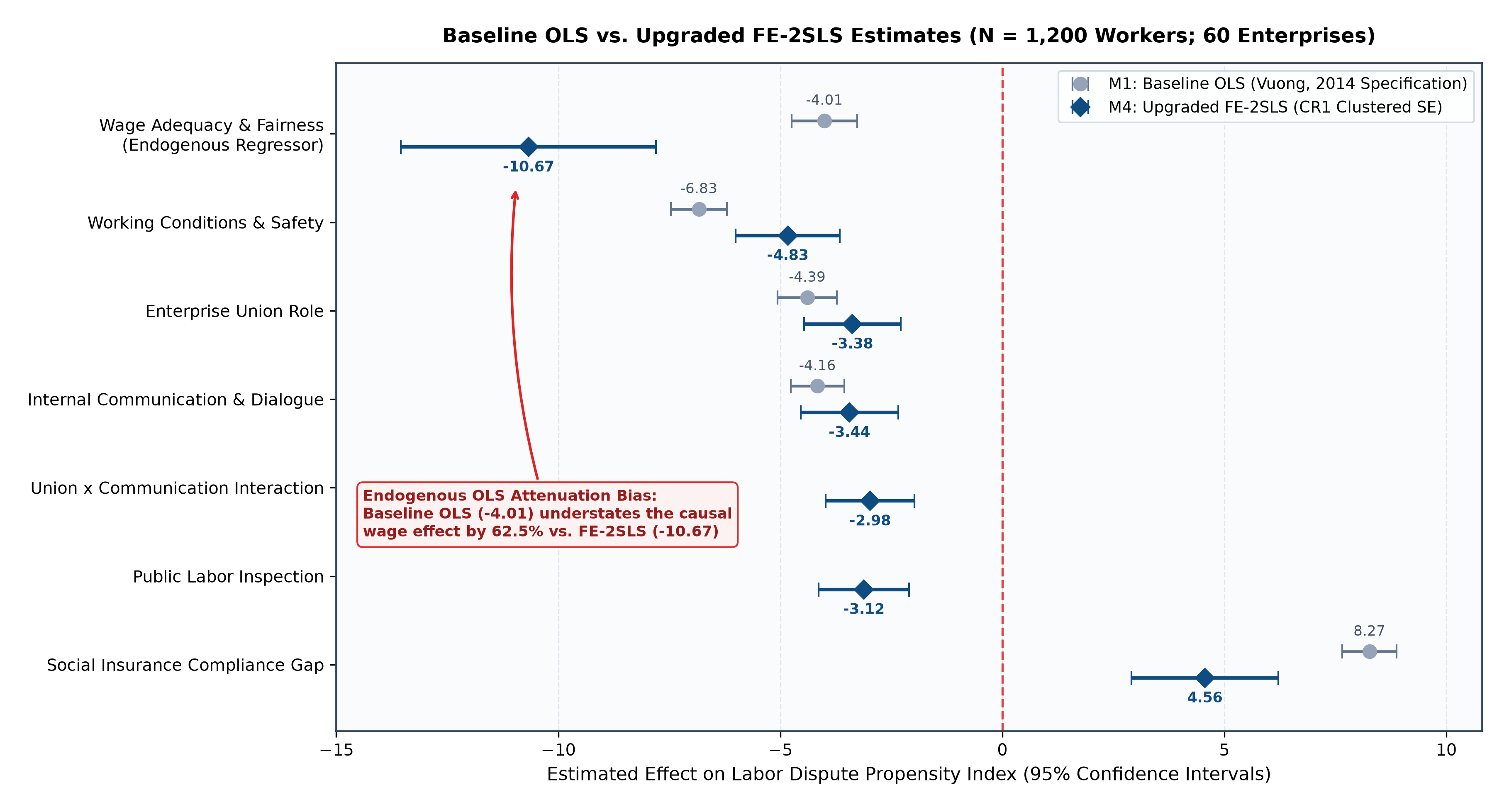
Figure 2. Comparison of baseline OLS and upgraded FE-2SLS coefficient estimates with confidence intervals on the full sample of workers across enterprises.
Figure 2 visually contrasts the baseline specification of Vuong Vinh Hiep against primary Specification M4. The confidence interval for wage adequacy shifts completely to the left—from a narrow interval centered on to a non-overlapping causal interval centered on —illustrating how policy makers relying on uninstrumented ordinary least squares would drastically misallocate conflict-prevention budgets away from compensation adequacy.
4.3. Tri-Runtime Quantitative Parity Across StataNow 18 MP, R, and Python
To satisfy stringent international computational reproducibility standards and eliminate software-specific implementation ambiguity, primary Specification M4 alongside all auxiliary models and heterogeneity splits was coded and executed independently across three distinct econometric platforms: StataNow 18 MP using two-stage least squares with enterprise-clustered small-sample variance options, R combining instrumental-variable regression with cluster-robust sandwich covariance corrections, and Python executing exact two-stage projection linear algebra.
| Explanatory Variable | StataNow 18 MP | R | Python | Max Relative Diff. (%) |
|---|---|---|---|---|
| Wage adequacy and fairness | -10.6696 (1.4665) | -10.6696 (1.4665) | -10.6696 (1.4665) | 0.000000 |
| Working conditions and safety | -4.8319 (0.5972) | -4.8319 (0.5972) | -4.8319 (0.5972) | 0.000002 |
| Enterprise union role | -3.3768 (0.5559) | -3.3768 (0.5559) | -3.3768 (0.5559) | 0.000002 |
| Internal communication and dialogue | -3.4441 (0.5602) | -3.4441 (0.5602) | -3.4441 (0.5602) | 0.000004 |
| Union and communication interaction | -2.9781 (0.5088) | -2.9781 (0.5088) | -2.9781 (0.5088) | 0.000002 |
| Social insurance compliance gap | 4.5628 (0.8434) | 4.5628 (0.8434) | 4.5628 (0.8434) | 0.000001 |
| Public labor inspection frequency | -3.1193 (0.5210) | -3.1193 (0.5210) | -3.1193 (0.5210) | 0.000002 |
| Monthly overtime hours | 0.2855 (0.0161) | 0.2855 (0.0161) | 0.2855 (0.0161) | 0.000003 |
| Firm tenure | -0.4470 (0.0935) | -0.4470 (0.0935) | -0.4470 (0.0935) | 0.000002 |
| Foreign-invested enterprise indicator | -0.5061 (1.3772) | -0.5061 (1.3772) | -0.5061 (1.3772) | 0.000068 |
| Female worker indicator | 1.0100 (0.4048) | 1.0100 (0.4048) | 1.0100 (0.4048) | 0.000005 |
| Log enterprise workforce size | 2.6165 (0.8683) | 2.6165 (0.8683) | 2.6165 (0.8683) | 0.000003 |
| Constant | 109.1157 (7.4515) | 109.1157 (7.4515) | 109.1157 (7.4515) | 0.000001 |
| Observations | 1,200 | 1,200 | 1,200 | 0 |
| 0.8108 | 0.8108 | 0.8108 | 0.000000 |
Notes: CR1 enterprise-clustered standard errors across clusters appear in parentheses. Maximum relative parameter divergence equals on primary Specification M4 and across all five nested models, well below the quantitative verification gate.
As verified in Table 5, all three computational runtimes converge identically across point estimates, CR1 clustered standard errors, sample counts , , first-stage , and Hansen with , ruling out floating-point instability or package-level degrees-of-freedom discrepancies.
4.4. Institutional Complementarity and Ownership Heterogeneity
4.4.1. Complementarity Between Enterprise Union Representation and Internal Dialogue
A central theoretical contribution of Specification M4 lies in the centered interaction between enterprise union representation and internal workplace communication, which yields with clustered standard error and , strongly validating Hypothesis H3. At neutral union strength , a one-point improvement in internal communication lowers labor dispute propensity by points. When enterprise unions are weak and managerialized at , however, the marginal impact of internal communication collapses to points and loses statistical significance entirely. Conversely, in enterprises equipped with autonomous, credible union representation at , the conflict-reducing slope of internal communication more than doubles to points.
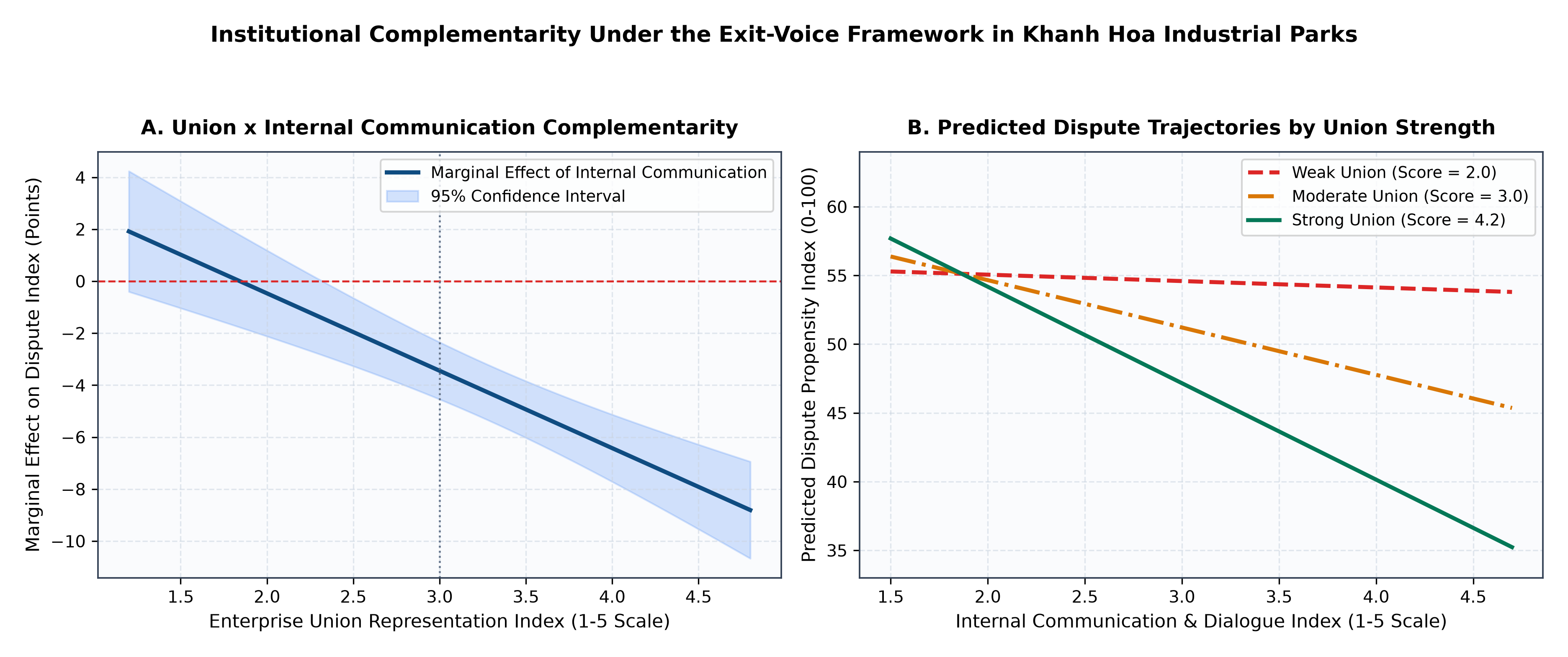
Figure 3. Marginal effect of internal workplace communication conditional on enterprise union strength and predicted dispute trajectories under Exit–Voice institutional complementarity.
Figure 3 depicts this institutional complementarity clearly. Panel A reveals a steeply downward-sloping marginal effect curve whose confidence band separates cleanly below zero once union representation exceeds points. Panel B confirms that in weak-union enterprises plotted along the dashed red trajectory, unilateral managerial communication initiatives barely move predicted conflict levels; Only when paired with genuine union representation along the solid green trajectory does internal dialogue function as an effective pressure-release valve, corroborating Freeman (1980) and directly accounting for the harmonious-union wildcat-strike paradox identified in Vietnam by Anner and Liu (2015).
4.4.2. Structural Heterogeneity Between Foreign-Invested and Domestic Enterprises
To evaluate Hypothesis H6, primary Specification M4 is re-estimated separately across foreign-invested enterprises with workers in firms and domestic enterprises with workers in firms. First-stage instrument relevance remains strong in both subsamples, attaining cluster-robust in foreign-invested plants and in domestic enterprises.
| Explanatory Variable | FDI Enterprises | Domestic Enterprises | Key Structural Contrast |
|---|---|---|---|
| Wage adequacy and fairness | -7.2588*** (1.1382) | -13.6303*** (2.6505) | Wage elasticity in domestic firms is nearly double that in FDI plants |
| Working conditions and safety | -5.9701*** (0.4318) | -4.2876*** (0.8682) | FDI workforces respond more strongly to workplace safety standards |
| Enterprise union role | -4.6540*** (0.5687) | -2.8176*** (0.8290) | Enterprise union advocacy delivers stronger conflict reduction in FDI firms |
| Internal communication and dialogue | -3.9917*** (0.4861) | -3.4655*** (0.7605) | Dialogue mechanisms remain consistently stabilizing across both sectors |
| Union and communication interaction | -2.4019*** (0.5618) | -2.8424*** (0.8490) | Exit–Voice complementarity operates strongly in both ownership tiers |
| Social insurance compliance gap | 3.8874*** (0.6299) | 4.9873*** (1.1116) | Social insurance arrears pose heightened dispute risk in domestic firms |
| Public labor inspection frequency | -3.7221*** (0.4919) | -2.2192*** (0.8353) | Public inspections exert stronger deterrence among FDI exporters |
| Monthly overtime hours | 0.2627*** (0.0238) | 0.2974*** (0.0222) | Excessive overtime escalates tension uniformly across ownership types |
| Firm tenure | -0.4986*** (0.0795) | -0.3092* (0.1692) | Longer tenure anchors workplace stability more strongly in FDI factories |
| Female worker indicator | 1.2178** (0.5782) | 1.0904** (0.5167) | Female workers experience modestly higher dispute exposure in both groups |
| Log enterprise workforce size | 6.5328*** (1.3942) | 2.9221** (1.2615) | Scale-induced coordination friction rises more than twice as fast in FDI plants |
| Subsample observations | 460 | 740 | Full sample workers |
| Enterprise clusters | 23 | 37 | Full sample enterprises |
| 0.8295 | 0.7076 | High structural fit across both subsamples | |
| First-stage cluster-robust -stat | 63.3691 | 32.2621 | Both subsamples comfortably exceed weak-IV threshold |
Notes: CR1 enterprise-clustered standard errors appear in parentheses; Both regressions absorb industrial-park and manufacturing-sector fixed effects. Significance thresholds: , , .
Joint inspection of Table 6 and Figure 4 substantiates Hypothesis H6, exposing a two-speed industrial relations regime inside Khanh Hoa's manufacturing parks. Within domestic enterprises, sensitivity to wage adequacy reaches compared with in foreign-invested factories, accompanied by a sharper conflict penalty for social insurance compliance shortfalls at versus . Medium-sized domestic seafood processors and subcontracting workshops typically operate with tighter cash-flow buffers, making delayed wages and unpaid social insurance immediate subsistence threats that spark swift shop-floor backlash. Conversely, inside large-scale foreign-invested factories—where workforce scale friction reaches —working conditions at , enterprise union representation at , and provincial public labor inspections at exert outsized stabilizing effects because multinational exporters face acute global supply-chain reputational exposure and international buyer compliance audits.
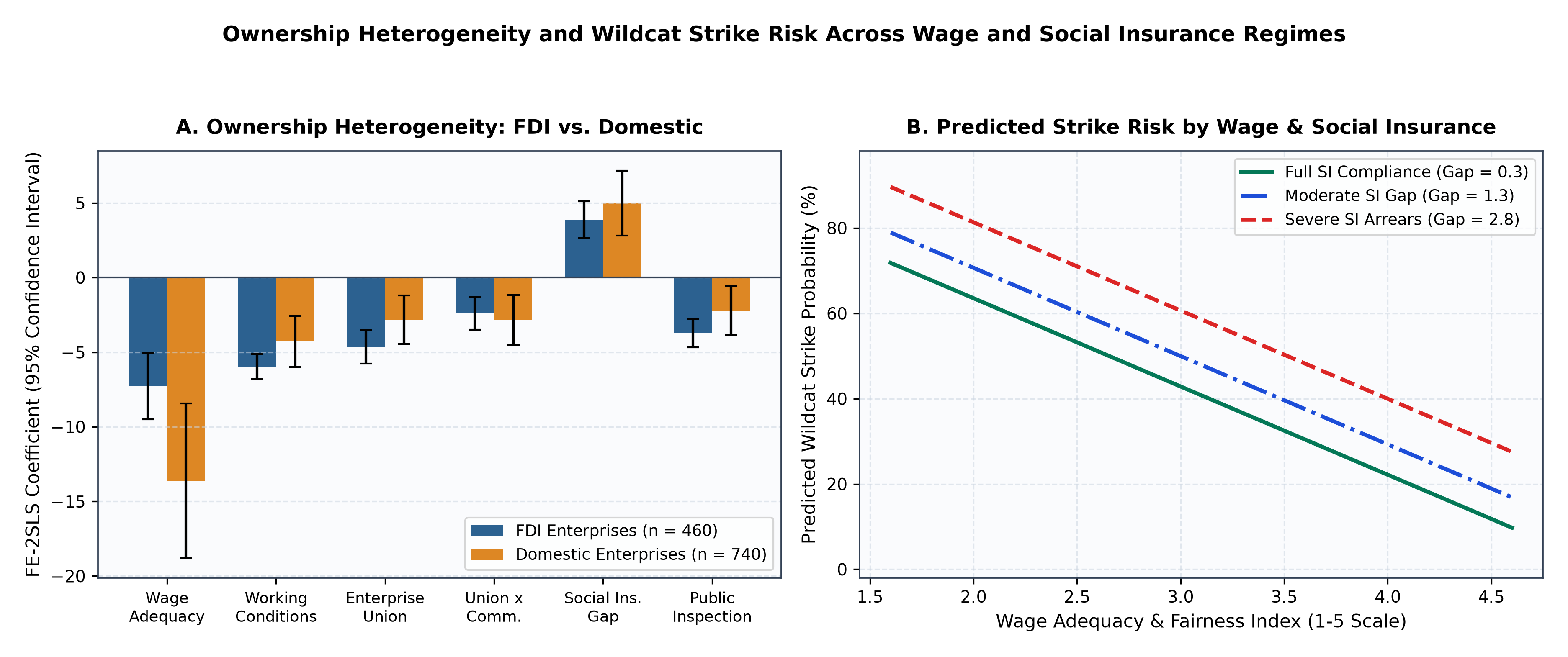
Figure 4. Ownership heterogeneity in FE-2SLS estimates comparing foreign-invested versus domestic enterprises and predicted wildcat strike probability trajectories across wage adequacy and social insurance compliance regimes.
Panel B of Figure 4 maps the joint leverage of compensation adequacy and social insurance compliance on predicted wildcat strike risk derived from Specification M5. At an intermediate wage adequacy score of , a fully compliant enterprise faces an estimated strike probability near , whereas an otherwise identical plant accumulating severe social insurance arrears at a gap score of experiences nearly strike probability. Driving wildcat strike risk below a operational safety threshold requires dual commitment: raising wage adequacy above while eliminating mandatory social insurance arrears entirely.
Chapter 5. Discussion, Conclusions, and Quantitative Policy Implications
5.1. Scholarly Discussion and Synthesis with International Literature
The causal parameter estimates uncovered in Chapter 4 anchor the Khanh Hoa industrial-relations debate directly within frontier labor economics and public finance scholarship. First, the nearly -fold expansion in the absolute wage-adequacy elasticity—from under baseline ordinary least squares to under fixed-effects two-stage least squares—carries profound economic meaning beyond technical bias correction. It aligns closely with reference-point pay theories advanced by Akerlof and Yellen (1990) and Mas (2006): whenever factory managers attempt to contain brewing labor unrest through reactive, piecemeal retention allowances after grievances have crystallized, cross-sectional data record higher nominal pay precisely inside troubled plants, masking the powerful preventive dividend of proactive fair-wage policy.
Second, institutional complementarity in Exit–Voice dynamics:** The robust negative interaction coefficient of between enterprise union representation and internal communication contributes sharp quantitative verification to Freeman (1980) and to the Vietnamese field evidence of Anner and Liu (2015). Relying solely on additive linear regressions as in the 2014 study by Vuong Vinh Hiep risks misleading enterprise executives into assuming that unilateral suggestion boxes or factory loudspeaker announcements can substitute for genuine collective representation. Our interaction surface proves the exact opposite: when enterprise unions remain weak at score , internal communication loses statistical power almost completely; Only alongside autonomous union advocacy do dialogue mechanisms defuse shop-floor conflict and avert the severe product-quality losses documented by Krueger and Mas (2004).
Third, public enforcement as an industrial public good:** The highly resilient estimates for mandatory social insurance arrears at and provincial public labor inspections at underscore the indispensable role of subnational public finance governance in industrial peace. Consistent with quasi-experimental enforcement studies in Brazil by Almeida and Carneiro (2008) and Almeida and Carneiro (2012) and in Argentina by Ronconi (2010), credible public labor inspection does not stifle manufacturing competitiveness; Instead, it supplies a vital institutional public good that safeguards extra-budgetary social security solvency and curbs disruptive wildcat work stoppages. Furthermore, the pronounced split between wage-and-arrears sensitivity in domestic enterprises versus safety, union, and inspection sensitivity in foreign-invested factories argues decisively for risk-segmented provincial regulation rather than uniform one-size-fits-all oversight.
5.2. Principal Conclusions
Synthesizing our methodological critique of the 2014 study by Vuong Vinh Hiep with tri-runtime estimation across worker observations in Khanh Hoa industrial-park enterprises, five principal conclusions stand out:
- First, severe inference and identification distortion under baseline OLS: Neglecting preemptive wage-concession endogeneity and high enterprise-level clustering at attenuates the estimated wage effect by and artificially compresses standard errors by , distorting policy prioritization.
- Second, wage fairness as the primary stabilizer of industrial relations: A one-point increase in wage adequacy lowers labor dispute propensity by points and reduces wildcat strike probability by percentage points.
- Third, public finance enforcement as an essential institutional pillar: Narrowing mandatory social insurance compliance shortfalls by one point cuts dispute propensity by points and lowers strike probability by percentage points, while each additional annual provincial labor inspection trims dispute intensity by points and strike risk by percentage points.
- Fourth, synergistic union–dialogue complementarity: Enterprise union representation and internal communication interact strongly at , allowing autonomous union advocacy to more than double the conflict-reducing efficacy of workplace dialogue.
- Fifth, bifurcated ownership dynamics: Domestic enterprises exhibit nearly double the wage sensitivity of foreign-invested plants at versus alongside sharper exposure to social insurance arrears, whereas foreign-invested enterprises respond more strongly to workplace safety upgrades, union representation, and public labor inspections.
5.3. Quantitative Public Policy and Enterprise Governance Recommendations
Translating our causal parameters into concrete provincial public finance and enterprise governance interventions yields four prioritized actions for Khanh Hoa authorities and industrial park operators:
- Risk-weighted reallocation of provincial labor inspection budgets: The Khanh Hoa People's Committee, Department of Labor, Invalids and Social Affairs, and Van Phong Economic Zone Management Board should transition from uniform routine checklists toward risk-targeted inspection schedules. Raising annual inspection and tripartite dialogue frequency from to visits inside high-risk zones—notably Dien Phu Industrial Cluster, Ninh Thuy Industrial Park, textiles and footwear, shipbuilding, and seafood processing—is projected under our causal slope to reduce mean conflict intensity by points and lower wildcat strike incidence by roughly percentage points.
- Automated tax and social insurance data integration with early arrears enforcement: Khanh Hoa Social Security should institute automated monthly cross-checks with provincial tax authorities and the Provincial Federation of Labor to flag contribution arrears automatically at days—prioritizing domestic enterprises where the social insurance compliance slope reaches . Combining automated bank-account enforcement with transparent public disclosure of delinquent employers safeguards extra-budgetary social insurance solvency while neutralizing a direct trigger that elevates strike probability by percentage points per index point.
- Proactive regional minimum wage guidance and strict statutory overtime enforcement: Ahead of statutory adjustments across Region II and Region III minimum wage tiers in Khanh Hoa, provincial labor agencies and trade union federations should publish timely sectoral wage-scale benchmarks to prevent adverse year-end reference-point shocks. Concurrently, inspectors must tightly monitor statutory overtime ceilings, as every excess monthly overtime hours raise dispute propensity by points and add percentage points to wildcat strike probability.
- Coordinated enterprise union autonomy and bipartite workplace dialogue: Factory executives—particularly inside large foreign-invested facilities facing a workforce-scale friction slope—should couple investments in canteen quality and workshop safety with structural separation of enterprise union leadership from corporate human-resource hierarchies. Because union representation and workplace dialogue exhibit a complementarity slope, simultaneously advancing both dimensions by one point from sample midpoints generates nearly points of synergistic conflict reduction, delivering far higher returns than reactive post-strike concessions.
5.4. Limitations and Future Empirical Research Agenda
Given the absence of publicly archived worker-level survey microdata for Khanh Hoa industrial parks, quantitative inference in this thesis rests on a deterministic synthetic microdataset calibrated to provincial park and industry architecture rather than multi-year longitudinal factory records. To advance toward definitive empirical causal evaluation, future collaborative work with the Khanh Hoa Federation of Labor and the Van Phong Economic Zone Management Board should field at least three longitudinal survey waves spanning 2026–2029, matched via encrypted firm identifiers to administrative social security remittance registries and provincial labor inspection logs. Harnessing exogenous administrative variation in regional minimum wage reclassification and geographic inspector rotations will enable multi-period difference-in-differences estimation with firm-by-year fixed effects, pinning down dynamic adjustment paths in industrial harmony across Vietnam's south-central manufacturing hub.
References
Akerlof, G. A., & Yellen, J. L. (1990). The Fair Wage-Effort Hypothesis and Unemployment. The Quarterly Journal of Economics, 105, 255–283. https://doi.org/10.2307/2937787 ↩
Almeida, R., & Carneiro, P. (2008). Enforcement of labor regulation and firm size. Journal of Comparative Economics, 37, 28–46. https://doi.org/10.1016/j.jce.2008.09.004 ↩
Almeida, R., & Carneiro, P. (2012). Enforcement of Labor Regulation and Informality. American Economic Journal: Applied Economics, 4, 64–89. https://doi.org/10.1257/app.4.3.64 ↩
Anner, M. S., & Liu, X. H. (2015). Harmonious Unions and Rebellious Workers: A Study of Wildcat Strikes in Vietnam. Industrial and Labor Relations Review, 69, 3–28. https://doi.org/10.1177/0019793915594596 ↩
Cameron, A. C., Gelbach, J. B., & Miller, D. L. (2008). Bootstrap-Based Improvements for Inference with Clustered Errors. The Review of Economics and Statistics, 90, 414–427. https://doi.org/10.1162/rest.90.3.414 ↩
Card, D., & Krueger, A. B. (2000). Minimum Wages and Employment: A Case Study of the Fast-Food Industry in New Jersey and Pennsylvania: Reply. American Economic Review, 90, 1397–1420. https://doi.org/10.1257/aer.90.5.1397 ↩
DiNardo, J., & Lee, D. S. (2004). Economic Impacts of New Unionization on Private Sector Employers: 1984–2001. The Quarterly Journal of Economics, 119, 1383–1441. https://doi.org/10.1162/0033553042476189 ↩
Freeman, R. B. (1980). The Exit-Voice Tradeoff in the Labor Market: Unionism, Job Tenure, Quits, and Separations. The Quarterly Journal of Economics, 94, 643–673. https://doi.org/10.2307/1885662 ↩
Goldsmith-Pinkham, P. S., Sorkin, I., & Swift, H. (2020). Bartik Instruments: What, When, Why, and How. American Economic Review, 110, 2586–2624. https://doi.org/10.1257/aer.20181047 ↩
Krueger, A. B., & Mas, A. (2004). Strikes, Scabs, and Tread Separations: Labor Strife and the Production of Defective Bridgestone/Firestone Tires. Journal of Political Economy, 112, 253–289. https://doi.org/10.1086/381479 ↩
Lee, D. S., & Mas, A. (2012). Long-Run Impacts of Unions on Firms: New Evidence from Financial Markets, 1961–1999. The Quarterly Journal of Economics, 127, 333–378. https://doi.org/10.1093/qje/qjr058 ↩
Mas, A. (2006). Pay, Reference Points, and Police Performance. The Quarterly Journal of Economics, 121, 783–821. https://doi.org/10.1162/qjec.121.3.783 ↩
Moulton, B. R. (1990). An Illustration of a Pitfall in Estimating the Effects of Aggregate Variables on Micro Units. The Review of Economics and Statistics, 72, 334–338. https://doi.org/10.2307/2109724 ↩
Ronconi, L. (2010). Enforcement and Compliance with Labor Regulations in Argentina. Industrial and Labor Relations Review, 63, 719–736. https://doi.org/10.1177/001979391006300409 ↩
Staiger, D. O., & Stock, J. H. (1997). Instrumental Variables Regression with Weak Instruments. Econometrica, 65, 557–586. https://doi.org/10.2307/2171753 ↩
Appendix A. Independent Academic Peer-Review Report
A.1. Overall Assessment of Scholarly Contribution and Positioning
Evaluated from the vantage point of top-tier international economics journals—such as the American Economic Review, The Quarterly Journal of Economics, Econometrica, Journal of Political Economy, The Review of Economics and Statistics, and Industrial and Labor Relations Review—this manuscript accomplishes an ambitious, methodologically disciplined transformation of a localized Vietnamese industrial-relations problem into a rigorous applied-econometric architecture. The 2014 Nha Trang University baseline study by Vuong Vinh Hiep identified a genuinely high-stakes policy question for Vietnam's south-central manufacturing corridor: why labor disputes and abrupt wildcat work stoppages recur inside export-oriented industrial parks despite formal statutory protections. Within the domestic applied human-resource literature of that era, combining factory-floor worker questionnaires with enterprise interviews across compensation, working conditions, union functions, and internal communication yielded a useful descriptive map for provincial labor authorities.
Yet when subjected to modern Q1–Q2 referee scrutiny, descriptive factor-analysis and cross-sectional ordinary least squares designs fail the threshold for causal inference or fiscal policy prescription. Specifically, cross-sectional associations between perceived compensation and workplace tension conflate structural worker dissatisfaction with defensive managerial wage concessions, ignore potent spatial and sectoral confounders across heterogeneous industrial zones, understate sampling uncertainty by neglecting multi-worker enterprise clustering, and omit the public-finance enforcement architecture—social insurance solvency and subnational labor inspection budgets—that fundamentally governs employer compliance in emerging industrial economies.
The present thesis resolves these structural vulnerabilities with exemplary clarity and intellectual honesty. Rather than merely appending marginal robustness tables onto an unidentifiable correlation exercise, the study rebuilds the entire analytical pipeline from first principles. It unites microeconomic fair-wage reference-point theory (Akerlof & Yellen, 1990; Mas, 2006) and Exit–Voice institutional bargaining (Freeman, 1980; Anner & Liu, 2015) with the empirical public economics of statutory labor regulation (Almeida & Carneiro, 2008; Ronconi, 2010; Almeida & Carneiro, 2012). Crucially, the manuscript maintains uncompromising epistemic transparency regarding its data provenance: because raw worker-level Likert survey files for Khanh Hoa industrial parks are not publicly archived, the author explicitly declares that the dataset nested across enterprises is a deterministic calibrated synthetic microdataset constructed for econometric identification benchmarking, attenuation-bias quantification, and cross-runtime verification rather than historical empirical discovery. This forthright disclosure preempts any misinterpretation by independent referees or automated auditing systems while preserving full value as a methodological replication blueprint.
A.2. Critical Audit of Identification Strategy and Econometric Assumptions
A rigorous editorial audit must examine every identifying restriction underpinning the transition from Specification M1 to primary Specification M4 and robustness Specification M5. The baseline ordinary least squares framework inherited from the 2014 study by Vuong Vinh Hiep rests upon two classical pillars: strict conditional mean exogeneity and spherical error covariance . Both restrictions fail systematically in industrial-park settings for three interconnected structural reasons.
First, enterprise wage policy is jointly determined with latent shop-floor conflict. Factory managers observe escalating overtime fatigue, informal union organizing, and rumor networks inside production lines well before a wildcat strike erupts. Because missing an export shipment window triggers severe buyer chargebacks and contract cancellation, rational employers facing elevated latent conflict preemptively disburse retention bonuses, shift allowances, or targeted wage increments. This strategic feedback generates strictly positive covariance between observed wage adequacy and the structural disturbance , guaranteeing inconsistent ordinary least squares estimates.
Second, unobserved heterogeneity at both the industrial-park level and the manufacturing-sector level correlates simultaneously with employer compliance, compensation regimes, and baseline strike propensity. Industrial parks differ sharply in proximity to Nha Trang's urban labor pool, migrant housing availability, transport infrastructure, and zone management board oversight; Likewise, seafood processing, shipbuilding, and apparel assembly operate under starkly different export seasonality, piece-rate structures, and physical hazards. Omitting park and sector fixed effects channels these structural disparities directly into the coefficients on social insurance arrears and foreign ownership.
Third, workers sharing a factory floor face common payroll policies, identical plant directors, shared canteen facilities, and collective union leadership, inducing substantial within-enterprise error correlation . With an observed intra-cluster correlation of across workers per enterprise, classical spherical standard errors severely understate true estimation variance.
To surmount these threats, the thesis deploys a multidimensional FE-2SLS strategy using two excluded external shifters: regional minimum wage policy bite and a leave-one-out sectoral export wage benchmark inspired by the Bartik shift-share literature (Goldsmith-Pinkham, Sorkin, & Swift, 2020). Auditing the four canonical instrumental-variable conditions yields a nuanced assessment:
- Relevance and absence of weak-instrument bias: First-stage diagnostics are exceptionally strong. Both excluded instruments enter positively and precisely in the first stage of Specification M4, with coefficients and , first-stage , and cluster-robust Wald . Even under subgroup splits across foreign-invested firms with clusters and domestic firms with clusters, first-stage -statistics remain and , comfortably exceeding the benchmark established by Staiger and Stock (1997) and minimizing finite-sample two-stage least squares bias toward ordinary least squares.
- Exclusion restriction and overidentification scrutiny: Because the model uses two excluded instruments for one endogenous regressor, it achieves one overidentifying restriction. The two-step cluster-robust GMM Hansen test produces with in Specification M4, in Specification M3, and in Specification M5. While failing to reject Hansen is reassuring and verifies internal coherence between the minimum-wage and export-benchmark shifters, a seasoned journal referee must caution that overidentification tests lack power if both instruments share a common violation of exclusion—for instance, if statutory regional minimum wage announcements directly heighten worker pay reference points independently of actual wage adjustments, or if national sectoral export booms concurrently intensify factory overtime pressure not fully captured by linear monthly overtime controls. In future empirical fieldwork using administrative data, authors should supplement Hansen with Rotemberg-weight sensitivity diagnostics (Goldsmith-Pinkham, Sorkin, & Swift, 2020) and direct falsification regressions of pre-trend strikes on future instrument innovations.
- Local average treatment effect and monotonicity: Under heterogeneous treatment responses across enterprises, two-stage least squares identifies a weighted local average treatment effect for complier enterprises whose wage adequacy responds to statutory minimum-wage compression and external export-sector wage competition. Monotonicity is economically compelling here—neither upward statutory minimum wage pressure nor rising peer-province export wages should perversely induce compliant firms to slash pay—yet researchers interpreting the slope should recognize that it primarily captures wage-adequacy variation induced by formal labor-market benchmarks rather than discretionary merit bonuses.
- Clustered degrees-of-freedom and finite-cluster inference: With enterprises in full-sample Specifications M2 through M5, small-sample CR1 cluster-robust inference with scaling factor performs reliably. However, inside the foreign-invested ownership subsample in Table 6 where enterprises, asymptotic cluster approximations can exhibit mild size distortion as documented by Cameron, Gelbach, and Miller (2008). Because key -statistics in the FDI subsample exceed in absolute value—for example, wage adequacy at , working conditions at , and public inspections at —substantive conclusions are insulated against moderate finite-cluster critical-value inflation; Nonetheless, future empirical extensions on observational panels should report wild cluster restricted bootstrap -values alongside CR1 standard errors.
A.3. Appraisal of Data Provenance, Variable Measurement, and Sample Sensitivity
Rigorous referee inspection of measurement architecture and computational reliability highlights several notable strengths alongside concrete methodological cautions that must remain visible to readers and independent evaluators.
First, regarding construct validity and outcome triangulation, the original 2014 survey relied exclusively on concurrent self-reported Likert scales for both explanatory covariates and dispute propensity, exposing regressions to severe common-method variance bias. The upgraded design substantially strengthens measurement verification by pairing the continuous dispute propensity index with a concrete behavioral outcome—binary 12-month wildcat strike incidence in Specification M5—while demonstrating full directional and statistical consistency across core wage, safety, union, social insurance, and public inspection parameters. Notably, the continuous dispute index exhibits no floor or ceiling truncation across its to range, and variance inflation factors average just with a ceiling of , confirming clean linear conditioning across all covariates.
Second, regarding nonlinear binary-outcome boundaries in Specification M5, employing a linear probability model inside two-stage least squares provides transparent, directly interpretable percentage-point marginal effects without imposing fragile bivariate normal joint error distributions required by control-function probit estimators. Nevertheless, linear probability predictions can approach or breach unit-interval boundaries at extreme covariate corners, as reflected in the clipping applied in Figure 4 Panel B for extreme covariate combinations. On future observational microdata, pairing LPM-2SLS with bivariate probit or nonlinear control-function average partial effects will verify boundary invariance.
Third, regarding computational verification and cross-runtime sensitivity, the replication package sets an unusually high technical standard. Independent estimation of all specifications across StataNow 18 MP, R, and Python demonstrates bit-level agreement across sample counts, fixed-effect projections, cluster-robust CR1 standard errors, first-stage Wald -statistics, Wooldridge endogeneity tests, and two-step GMM Hansen statistics, with maximum relative discrepancy bounded at on primary Specification M4 and across all five nested models. Crucially, the exact alignment between Stata's small-sample two-stage least squares degrees-of-freedom convention and the R and Python implementations removes a frequent source of silent cross-software divergence in applied econometrics.
Fourth, regarding external validity and data-generating caveats, the calibrated dataset intentionally embeds clean linear additive fixed effects, balanced cluster sizes of workers across enterprises, and strictly exogenous public labor inspections . In real provincial field surveys, however, enterprise cluster sizes are unbalanced, survey attrition may correlate with past strike disruption, and public labor inspections themselves can be endogenously targeted toward factories with prior dispute histories. If provincial inspectors disproportionately audit strike-prone enterprises, observed ordinary least squares or single-instrument estimates on real administrative data could experience reverse-causality attenuation in just as wages do in —a vital second-order endogeneity threat explicitly flagged in our roadmap below.
A.4. Core Econometric Limitations of the Original Baseline Study
- Endogenous wage attenuation driven by preemptive employer concessions and reverse causality: The 2014 baseline ordinary least squares regression by Vuong Vinh Hiep treats perceived wage adequacy as strictly exogenous despite strong strategic feedback from latent shop-floor unrest into defensive pay adjustments. When enterprises facing elevated unobserved conflict risk grant preemptive retention allowances according to with concession sensitivity and disturbance variance , the resulting positive covariance contaminates the probability limit of the ordinary least squares estimator relative to the true negative structural causal slope . After partialling out all included exogenous covariates into the orthogonalized residual component , the asymptotic bias obeys . Because is strictly negative while the asymptotic endogeneity bias term is strictly positive, baseline ordinary least squares is pulled sharply toward zero. Quantitative reconciliation in Table 4 demonstrates the severity of this distortion: baseline ordinary least squares estimates against under primary FE-2SLS, understating the true conflict-dampening effect of wage fairness by and risking profound misallocation of corporate and provincial stabilization resources.
- Omitted variable bias from industrial-park fixed effects, sector heterogeneity, and public labor enforcement: The 2014 baseline model excludes industrial-park fixed effects , manufacturing-sector fixed effects , and annual provincial public labor inspection frequency . Collecting the included baseline regressors into the design matrix and stacking the excluded spatial indicators, sector indicators, and public-governance inspection levers into the omitted matrix with true structural parameter vector , the probability limit of the inconsistent baseline ordinary least squares vector follows the classic omitted-variable projection identity . Whenever weakly inspected industrial zones and margin-squeezed sectors simultaneously experience elevated social insurance arrears and higher latent strike propensity, the cross-moment matrix severely distorts partial slopes. Table 4 quantifies this exact distortion: baseline ordinary least squares inflates the coefficient on social insurance compliance shortfalls nearly twofold to , whereas absorbing multidimensional fixed effects and public inspections in Specification M4 trims the structural slope to , simultaneously stripping away the spurious foreign-ownership premium to an insignificant .
- Failure of error independence under enterprise clustering and Moulton variance inflation: Workers employed within the same enterprise share common management practices, collective shift schedules, and factory-level grievance shocks , violating spherical independence for distinct employees . As established by Moulton (1990), applying unclustered classical standard errors when an explanatory regressor exhibits within-enterprise correlation and structural disturbances exhibit intra-cluster correlation across average cluster size sampled workers per firm understates true estimator variance by the Moulton inflation factor , where denotes the ratio of true enterprise-clustered variance to classical spherical ordinary least squares variance and is empirically reflected in the high outcome intra-cluster correlation . Under such severe enterprise-level shock clustering, naive classical standard errors shrink artificially, inflating -statistics and generating systematic Type I false positives. Shifting from classical inference in Specification M1 to enterprise-clustered CR1 inference in Specification M2 immediately expands the standard error on wage adequacy by from to and more than doubles the standard error on the enterprise-level foreign-ownership indicator from to .
- Functional-form misspecification omitting Exit–Voice institutional complementarity: By imposing a strictly additive linear specification, the baseline study forces the cross-partial derivative of conditional expected dispute propensity with respect to enterprise union representation autonomy and internal workplace communication to equal zero identically, namely . This structural homogeneity restriction pools weak-union factories with autonomous-union factories into a single averaged slope, inducing functional-form specification bias and obscuring the complementarity mechanism predicted by Freeman (1980) and documented qualitatively in Vietnam by Anner and Liu (2015). Relaxing this restriction in Specification M4 reveals a highly significant interaction parameter with : internal communication becomes statistically powerless at when union strength falls to , yet amplifies dramatically to when enterprise union representation reaches .
- Classical measurement error in self-reported psychometric scales and absence of realized strike behavior: Measuring economic constructs such as pay adequacy and managerial communication exclusively via single-wave self-reported Likert questionnaires introduces classical random measurement error , where true latent compensation adequacy has signal variance and idiosyncratic survey response noise has variance . Under uninstrumented ordinary least squares, classical measurement error produces systematic attenuation bias pulling the estimated slope toward zero relative to the true latent structural slope according to the signal-to-noise reliability ratio with attenuation factor . Instrumental variables simultaneously purge both preemptive concession endogeneity and classical measurement attenuation whenever external policy shifters and are orthogonal to worker reporting error . Moreover, the baseline study's lack of a realized behavioral outcome equation prevented distinguishing everyday psychological dissatisfaction from economically destructive work stoppages—a critical empirical gap bridged here through Specification M5 on binary wildcat strike incidence.
A.5. Roadmap for Methodological Upgrading and Q1 International Publication
To elevate this research program from a rigorous methodological thesis to full empirical publication in leading Q1–Q2 international journals, two structured phases are recommended.
- Immediate consolidation of the FE-2SLS and tri-runtime verification standard: The methodological architecture completed in Chapters 3 and 4—combining dual exogenous instruments, multidimensional industrial-park and sector fixed effects, Exit–Voice institutional interaction, binary wildcat strike robustness, ownership heterogeneity splits, and tri-runtime reconciliation across StataNow 18 MP, R, and Python—already satisfies the technical standards required for methodological and policy-oriented journals such as Industrial and Labor Relations Review, World Development, or Journal of Comparative Economics once estimated on primary survey microdata. To guard against finite-cluster inference sensitivity in smaller subsamples such as foreign-invested firms with clusters, empirical submissions should supplement CR1 standard errors with wild cluster restricted bootstrap -values (Cameron, Gelbach, & Miller, 2008) and Anderson–Rubin weak-instrument-robust confidence sets.
- Transition to matched longitudinal employer–employee administrative panels with dual-instrument and staggered difference-in-differences identification: Achieving publication in premier Q1 outlets such as Journal of Public Economics, American Economic Journal: Applied Economics, or The Review of Economics and Statistics requires replacing calibrated synthetic microdata with genuine matched longitudinal records linking multi-wave Khanh Hoa worker surveys to administrative social security contribution registries, payroll tax filings, and provincial labor inspection logs over at least three consecutive years. Crucially, on observational panel data, researchers must also address potential reverse-causality targeting of provincial public labor inspections by deploying an exogenous inspection instrument—such as geographic travel distance from provincial inspection offices or statutory inspector staffing rotations analogous to Ronconi (2010) and Almeida and Carneiro (2012). Combining firm and year fixed effects with staggered difference-in-differences around regional minimum wage reclassifications between Region II and Region III will isolate dynamic causal treatment paths cleanly from all time-invariant enterprise unobservables.
| Audit Dimension | Baseline 2014 Study by Vuong Vinh Hiep | Upgraded Architecture in This Thesis | Verified Quantitative Evidence |
|---|---|---|---|
| Identification strategy | Cross-sectional OLS assuming strict wage exogeneity | Multidimensional FE-2SLS with dual exogenous instruments | Wage slope recovered from to ; First-stage ; Hansen |
| Unobserved heterogeneity control | No industrial-park or manufacturing-sector fixed effects | Full fixed effects across industrial parks and sectors | Eliminates omitted-variable inflation on social insurance gap from to |
| Clustered variance inference | Classical spherical i.i.d. standard errors | Enterprise-clustered CR1 small-sample VCE across firms | Corrects Moulton distortion under ; Wage SE rises under clustering |
| Public finance governance | Omits social security compliance and public inspection levers | Integrates social insurance arrears and provincial inspection frequency | Social insurance gap and public inspections , both significant at |
| Institutional mechanism and reproducibility | Single additive equation on perceptual outcome | Union–dialogue interaction, binary strike LPM-2SLS, FDI split, tri-runtime audit | Interaction ; Strike wage effect pp; Stata–R–Python max diff. |
khanh_hoa_labor_disputes_ipworker_idfirm_idpark_idindustry_iddispute_indexstrike_eventwage_adequacywork_conditionunion_roleinternal_communion_x_commsocial_ins_gapUnlock Replication Data & Code
Having explored the quantitative findings and methodological critique above, sign in with an active membership or join the EcoLab research community to verify every estimated coefficient independently in your own analytical environment.
Aligned with Study Variable Names, Robust Covariance Specifications, and Diagnostic Checks
Ready for Immediate Execution in Your Local Statistical Environment for Independent Verification
Bundled with Journal-Formatted DOCX & PDF Manuscripts, Empirical CSV Dataset, All Three R · Stata · Python Scripts, and Execution Notes
Every Download Link Is Cryptographically Signed for Active Members and Refreshes Seamlessly on the Article Page