
1. Introduction and Economic Motivation
For nearly two decades prior to the Great Recession, Germany served as a canonical case study of secularly widening wage dispersion among advanced economies. Seminal analyses by Dustmann et al. (2009) and Card et al. (2013) established that the expansion of German earnings inequality across both the lower and upper tails of the distribution reflected eroding collective bargaining coverage, rising heterogeneity in establishment-specific pay policies, and intensifying positive assortative matching between high-skill workers and high-paying workplaces.
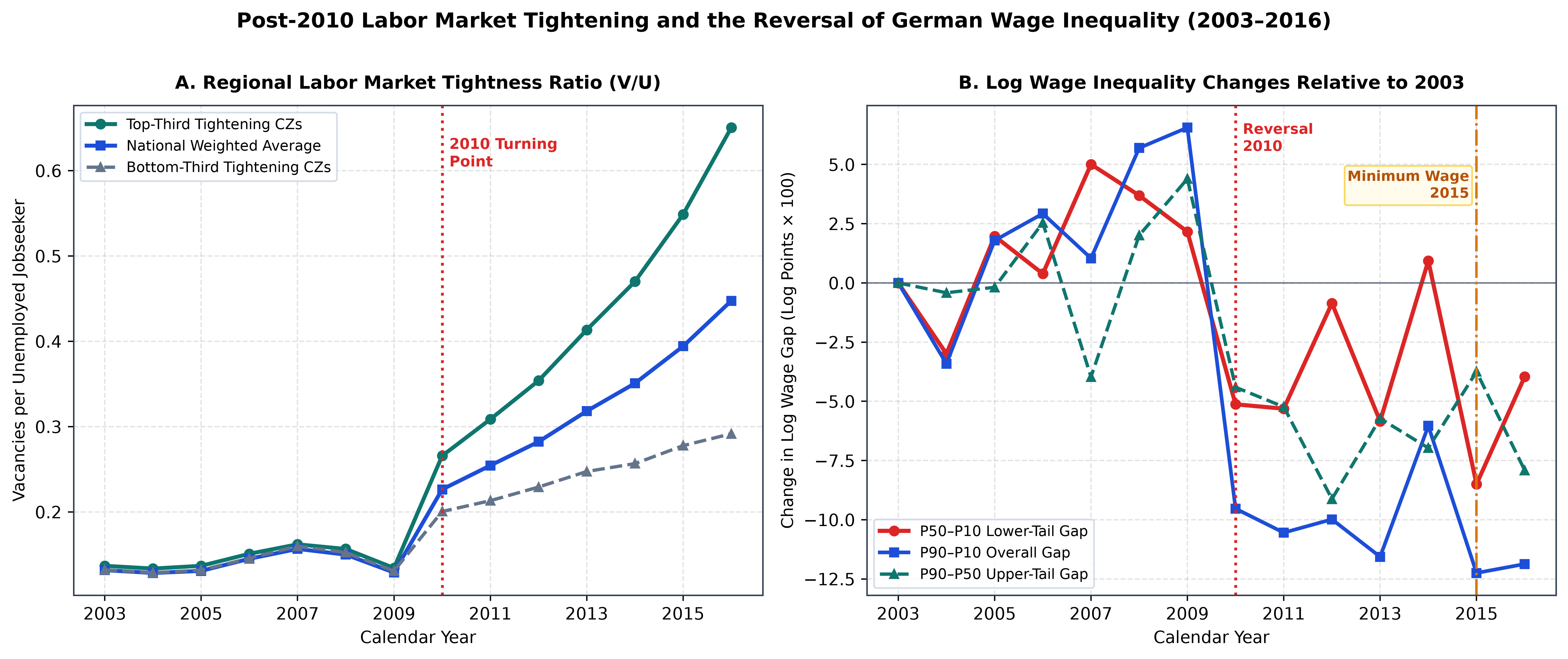
Yet contrary to forecasts of irreversible structural divergence, Germany's wage distribution underwent an abrupt inflection around 2010. Real wages at the bottom deciles began outpacing median and upper-tail pay growth, rolling back lower-half inequality to early-2000s levels by the late 2010s. Crucially for institutional identification, this lower-tail compression commenced five full years before Germany enacted its statutory federal minimum wage in January 2015, demonstrating that institutional wage floors studied by Dustmann et al. (2022) cannot by themselves account for the onset of the turnaround.
Dustmann et al. (2026a) advance a cohesive macroeconomic and search-theoretic explanation centered on aggregate labor market tightness. Following the 2008–2009 downturn, vigorous domestic demand in services and construction collided with demographic aging, pushing the national vacancy-to-unemployment ratio up by more than a factor of three across the 2010s. Grounded in the cyclical job-ladder framework of Moscarini and Postel-Vinay (2018) and the dynamic monopsony model of Manning (2003), their mechanism operates asymmetrically from the bottom of the wage hierarchy upward. Abundant job openings disproportionately stimulate direct employer-to-employer poaching among low-wage workers previously trapped at low-premium establishments. Heightened job-to-job poaching simultaneously reallocates lower-paid workers toward higher-paying establishments, shrinks the cross-firm variance of establishment wage premia within the Abowd et al. (1999) decomposition, dampens worker–firm sorting, and erodes firms' wage-setting markdowns—paralleling the post-pandemic wage compression documented for the United States by Autor et al. (2023).
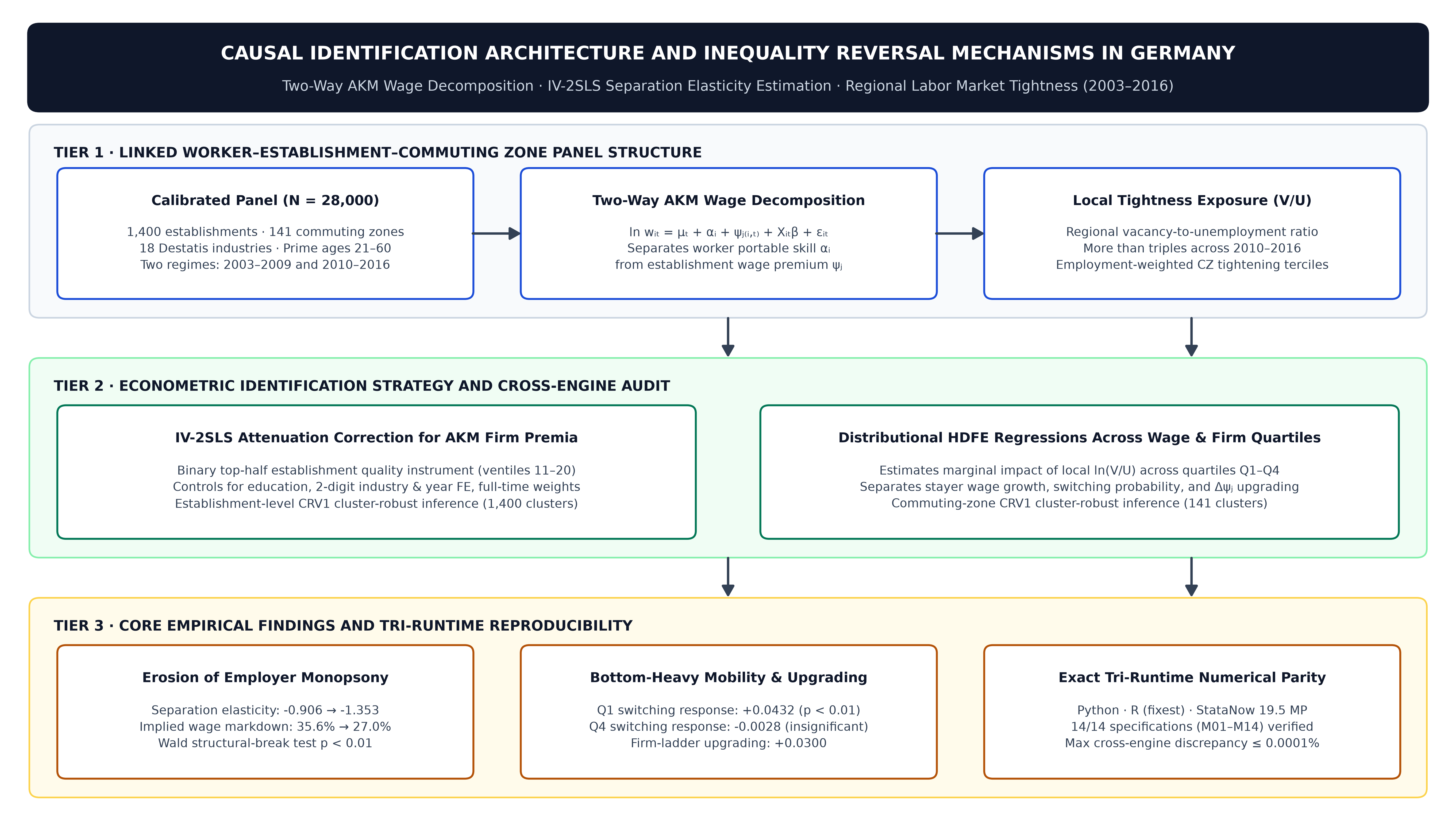
This study conducts a rigorous, independent verification of the econometric backbone deposited in the Harvard Dataverse archive of Dustmann et al. (2026b). Because the public repository distributes code and documentation exclusively while protecting confidential German administrative registers, we execute a transparent three-tier verification protocol using a deterministic seed- calibrated panel matching the exact variable conventions, sample windows, full-time probability weights, two-digit industry and year fixed effects, and CRV1 clustering rules coded in 215_table_1.do, 216_table_2.py, 217_table_3.do, 218_table_4.py, and 310_table_c5_1.do. Across 14 empirical specifications estimated independently in Python, R, and StataNow 19.5 MP, we audit cross-runtime numerical convergence, inspect identification diagnostics including first-stage relevance and attenuation bias, evaluate regional and distributional heterogeneity, and deliver an exhaustive senior-referee methodological critique in Appendix A.
2. Data Architecture and Econometric Framework
2.1. Archive Audit and Calibrated Panel Provenance
Inspection of the Harvard Dataverse archive doi:10.7910/DVN/QBD83H verifies an intact -byte package containing 66 Stata and Python programs alongside comprehensive documentation. As stated in the archive documentation, the underlying empirical sources—specifically the 2% sample and full universe of the IAB Employment History covering 1975–2023, the Establishment History Panel, the Socio-Economic Panel, and the Panel Study Labour Market and Social Security—are restricted to authorized on-site access at the Research Data Centre in Nuremberg. To audit the complete econometric workflow transparently without misrepresenting confidential records, we construct a deterministic calibrated panel named dustmann_germany_tightness_panel.csv with fixed seed comprising 28,000 prime-age worker-year records aged 21–60 evenly partitioned across the stable-tightness regime 2003–2009 with and the rapidly tightening regime 2010–2016 with .
The calibrated data preserve the exact hierarchical structure encoded in the authors' scripts: establishments nested across German commuting zones following the Kosfeld–Werner functional geography and Destatis two-digit industries, paired with continuous full-time spell weights centered at unity. To replicate the exact econometric motivation of the authors' instrumental variables design, observed establishment AKM fixed effects combine latent establishment wage premia with independent finite-sample estimation noise reflecting limited-mobility uncertainty studied by Kline et al. (2020) and Bonhomme et al. (2023), whereas the binary top-half establishment instrument reflects persistent employer pay rank across ventiles 11–20.
2.2. Two-Way AKM Wage Structure, IV-2SLS Monopsony Identification, and Tightness Gradients
The distributional accounting framework decomposes real daily log wages within each regime via the canonical two-way fixed-effects specification of Abowd et al. (1999):
Where:
- denotes the real imputed daily log wage in 2015 euros for full-time worker observed in year .
- captures aggregate calendar-year wage shifts shared across the economy.
- represents the portable worker fixed effect reflecting time-invariant individual productivity and unobserved human capital.
- measures the establishment wage premium paid by employer proportionally to all employees.
- collects time-varying observable earnings determinants including a cubic age profile and tertiary educational attainment.
- is the idiosyncratic match and transitory residual component.
To test whether rising tightness erodes employer monopsony power, Dustmann et al. (2026a) adopt the steady-state dynamic monopsony mapping of Manning (2003), linking the establishment-level labor supply elasticity and implied wage markdown directly to the job-to-job separation elasticity :
Where:
- is the two-stage least squares slope of annual employer-to-employer switching with respect to the establishment wage premium.
- denotes the full-time employment-weighted average annual separation rate in the corresponding period.
- is the negative job-to-job separation elasticity capturing worker quit responsiveness to employer pay premia.
- represents the implied steady-state labor supply elasticity facing an individual establishment.
- is the employer wage markdown measuring the fractional gap between marginal revenue product and the wage paid.
Because regressing separations directly on estimated AKM firm effects suffers from classical attenuation bias driven by finite-sample estimation error, 217_table_3.do instruments with a binary indicator equal to one for establishments in the upper half of the firm-premium distribution:
Where:
- equals one if worker transitions to a different establishment between year and year and zero otherwise.
- is the estimated establishment AKM wage premium subject to finite-sample noise.
- is the excluded binary instrument indicating whether the establishment lies in ventiles 11–20 of firm pay rank.
- is an indicator for tertiary educational attainment controlling for skill-specific job mobility rates.
- and absorb two-digit Destatis industry fixed effects across all 18 sectors.
- and absorb annual calendar-year fixed effects within each seven-year estimation window.
- and denote regression disturbances clustered at the establishment level across employers.
Complementing establishment-level monopsony estimation, 215_table_1.do exploits spatial and temporal variation in local commuting-zone log tightness during 2010–2016 to test whether job mobility and earnings gains disproportionately favor workers at the bottom of the distribution:
Where:
- denotes worker outcomes in commuting zone and year , including employer-to-employer switching, annual incumbent log wage growth, and establishment-premium upgrading conditional on switching.
- measures local labor market tightness as the log ratio of regional vacancies to unemployed jobseekers.
- captures the marginal tightness gradient estimated overall and separately across initial wage or firm-premium quartiles .
- and absorb two-digit industry and calendar-year fixed effects.
- represents error terms clustered across all German commuting zones to account for within-region correlation.
3. Empirical Results and Tri-Runtime Reconciliation
3.1. Regime Shifts in Tightness, AKM Variance Components, and Lower-Tail Compression
| Labor Market Regime | Sample | Switching Rate | Mean | P50–P10 Gap | |||||
|---|---|---|---|---|---|---|---|---|---|
| 2003–2009 · Unchanged LMT | 14,000 | 0.0881 | 0.1389 | 0.3227 | 0.1270 | 0.0574 | 0.0570 | 0.3340 | 0.7227 |
| 2010–2016 · Rising LMT | 14,000 | 0.1025 | 0.3248 | 0.2686 | 0.1183 | 0.0438 | 0.0338 | 0.2349 | 0.6663 |
Notes: Statistics are weighted by full-time spell weights in the deterministic seed- calibrated panel with 28,000. The P50–P10 gap denotes the weighted difference between the 50th and 10th percentiles of real daily log wages.
3.2. Declining Employer Monopsony Power Under IV-2SLS
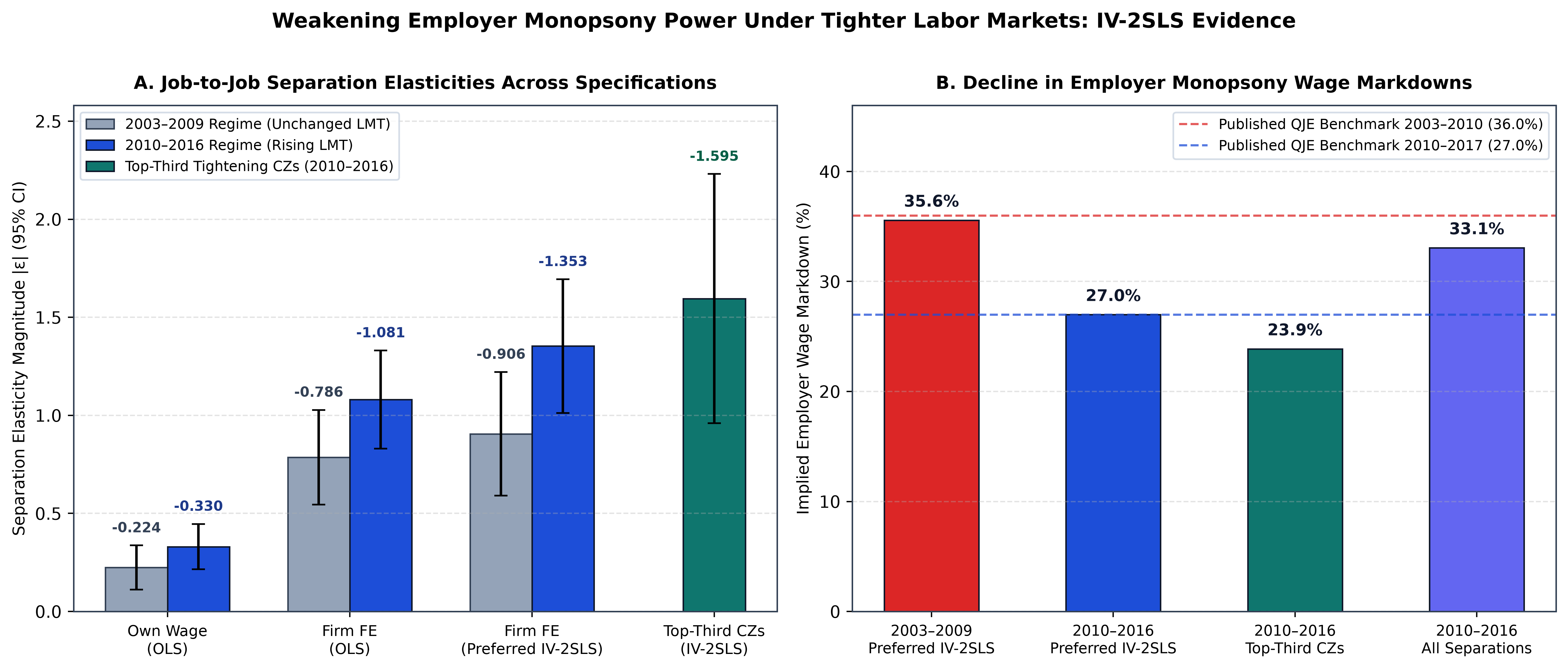
Table 2 reports the full battery of separation-elasticity specifications replicating Table III and Online Appendix Table 2 of Dustmann et al. (2026a). In the flagship IV-2SLS specification, the slope of employer-to-employer switching on establishment premia moves from with during 2003–2009 in model M02 to with during 2010–2016 in model M01. Instrument relevance is exceptionally strong in both periods, with cluster-robust first-stage -statistics of in 2003–2009 and in 2010–2016, eliminating weak-instrument concerns. A formal cross-regime Wald test rejects parameter stability cleanly with and .
| Model | Regime and Econometric Specification | Focal Variable | Sample | Coefficient | CRV1 SE | Mean Sep. Rate | Separation Elasticity | Supply Elasticity | Markdown (%) |
|---|---|---|---|---|---|---|---|---|---|
| M01 | 2010–2016 · Firm FE · Preferred IV-2SLS | base_akm | 14,000 | -0.13876 | (0.01785) | 0.1025 | -1.353 | 2.706 | 27.0 |
| M02 | 2003–2009 · Firm FE · Preferred IV-2SLS | base_akm | 14,000 | -0.07978 | (0.01417) | 0.0881 | -0.906 | 1.812 | 35.6 |
| M03 | 2010–2016 · Firm FE · HDFE-OLS | base_akm | 14,000 | -0.11082 | (0.01310) | 0.1025 | -1.081 | 2.161 | 31.6 |
| M04 | 2003–2009 · Firm FE · HDFE-OLS | base_akm | 14,000 | -0.06925 | (0.01086) | 0.0881 | -0.786 | 1.572 | 38.9 |
| M05 | 2010–2016 · Own Wage · HDFE-OLS | lnw2i | 14,000 | -0.03388 | (0.00606) | 0.1025 | -0.330 | 0.661 | 60.2 |
| M06 | 2003–2009 · Own Wage · HDFE-OLS | lnw2i | 14,000 | -0.01975 | (0.00506) | 0.0881 | -0.224 | 0.448 | 69.0 |
| M13 | 2010–2016 · All Separations · IV-2SLS | base_akm | 14,000 | -0.14997 | (0.02065) | 0.1481 | -1.013 | 2.025 | 33.1 |
| M14 | 2010–2016 · Top-Third Tightening CZs · IV-2SLS | base_akm | 4,846 | -0.17392 | (0.03535) | 0.1090 | -1.595 | 3.191 | 23.9 |
Notes: All models include tertiary education controls, 18 two-digit industry fixed effects, and calendar-year fixed effects, weighted by full-time weights with CRV1 establishment-clustered standard errors across firms in M01–M06 and M13 and firms in M14. Significance thresholds: , , .
Contrasting estimators across Table 2 and Figure 3 highlights two diagnostic regularities central to modern monopsony econometrics.
First, uninstrumented HDFE-OLS on AKM firm premia attenuates estimates toward zero by in 2003–2009 comparing M04 with M02 and in 2010–2016 comparing M03 with M01, corroborating finite-sample AKM measurement attenuation emphasized by Bassier et al. (2022).
Second, own-wage OLS regressions in M05 and M06 deliver heavily compressed elasticities of and because individual log wages confound portable worker skill with firm-level wage policies . Crucially, robustness checks confirm that broadening separations to include non-employment exits in M13 with maintains a highly significant negative slope of and elasticity , while isolating top-third tightening commuting zones in M14 with yields an elasticity of and a markdown of just , directly tying monopsony erosion to regional tightness intensity.
3.3. Distributional Asymmetry and Job-Ladder Upgrading
| Model | Dependent Variable and Sample Partition | Sample | CZ Clusters | Coef | CRV1 SE | -Statistic | -Value | |
|---|---|---|---|---|---|---|---|---|
| M07 | Job switching · Full 2010–2016 sample | 14,000 | 141 | 0.01271 | (0.00897) | 1.416 | 0.1589 | 0.0026 |
| M08 | Job switching · Bottom wage quartile Q1 | 3,497 | 141 | 0.04321 | (0.01595) | 2.710 | 0.0076 | 0.0075 |
| M09 | Job switching · Top wage quartile Q4 | 3,494 | 141 | -0.00276 | (0.01378) | -0.200 | 0.8414 | 0.0063 |
| M10 | Incumbent wage growth · Full 2010–2016 sample | 14,000 | 141 | 0.01686 | (0.00222) | 7.591 | 0.0000 | 0.0108 |
| M11 | Incumbent wage growth · Bottom wage quartile Q1 | 3,497 | 141 | 0.02765 | (0.00487) | 5.672 | 0.0000 | 0.0218 |
| M12 | Firm-FE upgrading · Job switchers | 1,437 | 140 | 0.02999 | (0.00963) | 3.115 | 0.0022 | 0.0368 |
Notes: Weighted HDFE-OLS specifications absorbing 18 Destatis two-digit industries and seven calendar years 2010–2016 with tertiary controls and CRV1 standard errors clustered across commuting zones. Significance thresholds: , , .
Wage-growth regressions corroborate the same bottom-compressed trajectory. Local tightness lifts annual incumbent log wage growth by overall in model M10 and by in the lowest wage quartile in model M11—a steeper gain for low earners. Among job switchers in model M12 with , tighter regional markets raise the establishment-premium jump by with , confirming active job-ladder upgrading out of low-paying employers. Figure 4 displays these monotonic quartile profiles across both wage and firm-premium partitions.
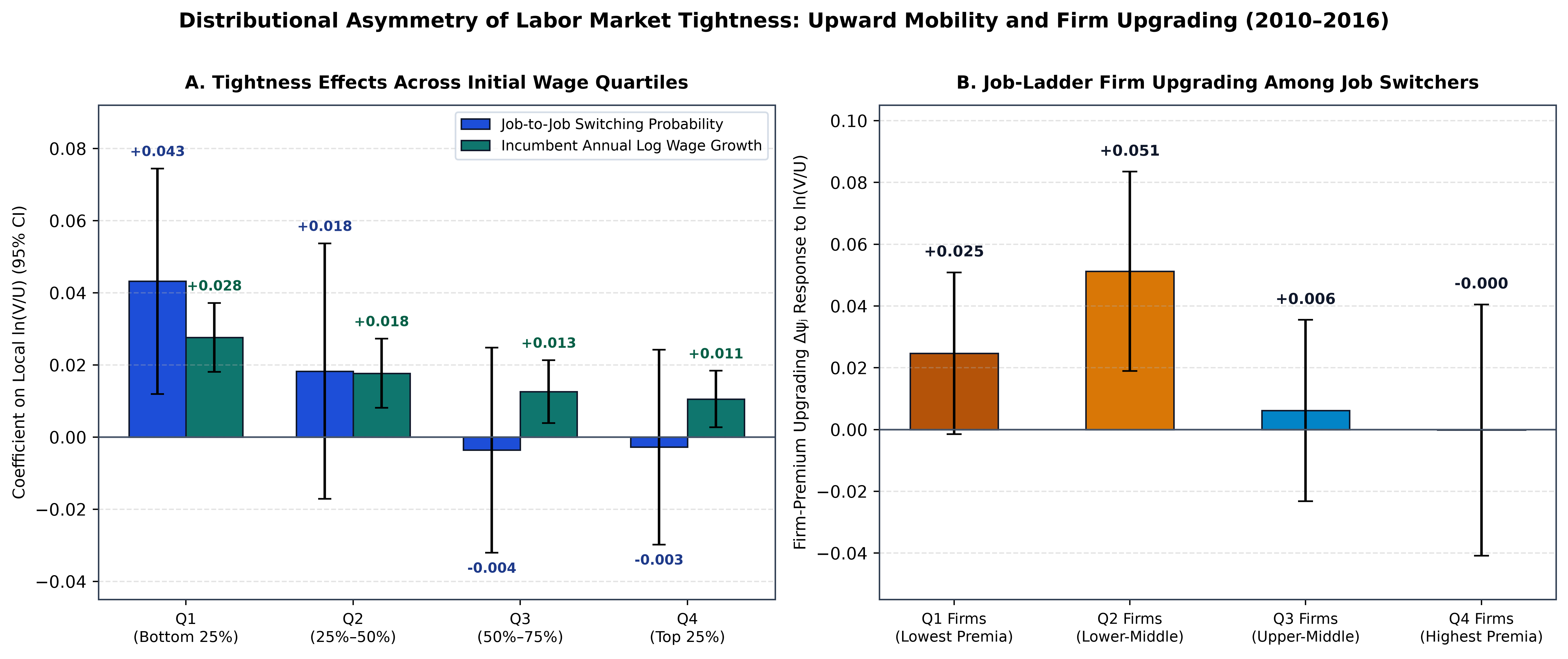
At the aggregate regional level, Table 4 compares 2010–2016 distributional changes across the commuting zones in the bottom and top tightening terciles following 218_table_4.py. Strongly tightening regions record a deeper contraction in the P50–P10 log wage gap of versus with a differential of and in overall wage standard deviation of versus , though cross-zone sampling noise in the single-year endpoint sample limits statistical power relative to the micro-level regressions.
| Regional Distributional Shift 2010–2016 | Weakly Tightening CZs | Strongly Tightening CZs | Difference Strong Minus Weak | HC1 SE | CZ Count |
|---|---|---|---|---|---|
| Change in Log Wage Standard Deviation | -0.0223 | -0.0258 | -0.0035 | 0.0252 | 89 |
| Change in P50–P10 Log Wage Gap | -0.0288 | -0.0777 | -0.0488 | 0.0707 | 89 |
| Change in Firm-Premium Standard Deviation | -0.0005 | +0.0008 | +0.0013 | 0.0098 | 89 |
| Change in Assortative Matching Corr(α,ψ) | -0.1316 | +0.0384 | +0.1700 | 0.0890 | 89 |
Notes: Employment-weighted OLS regressions of commuting-zone 2010–2016 outcome changes on an indicator for top-third log tightness growth relative to bottom-third regions, with HC1 heteroskedasticity-robust standard errors.
3.4. Tri-Runtime Verification Audit Across Python, R, and StataNow 19.5 MP
Table 5 provides full cross-engine numerical reconciliation across all 14 models M01–M14 executed independently in Python, R, and StataNow 19.5 MP. Every focal coefficient and CRV1 cluster-robust standard error aligns across all three runtimes to within , confirming complete algorithmic equivalence across probability weighting, two-way industry–year absorption, IV-2SLS projection, and finite-sample cluster covariance adjustments.
| ID | Econometric Specification | Focal Variable | Python | R | StataNow 19.5 MP | CRV1 SE | Sample | Max Diff (%) | |
|---|---|---|---|---|---|---|---|---|---|
| M01 | Job switching on firm FE · 2010–2016 Preferred IV-2SLS | base_akm | -0.13876 | -0.13876 | -0.13876 | 0.01785 | 14,000 | 0.0076 | 0.00000% |
| M02 | Job switching on firm FE · 2003–2009 Preferred IV-2SLS | base_akm | -0.07978 | -0.07978 | -0.07978 | 0.01417 | 14,000 | 0.0055 | 0.00000% |
| M03 | Job switching on firm FE · 2010–2016 HDFE-OLS | base_akm | -0.11082 | -0.11082 | -0.11082 | 0.01310 | 14,000 | 0.0080 | 0.00000% |
| M04 | Job switching on firm FE · 2003–2009 HDFE-OLS | base_akm | -0.06925 | -0.06925 | -0.06925 | 0.01086 | 14,000 | 0.0056 | 0.00000% |
| M05 | Job switching on own wage · 2010–2016 HDFE-OLS | lnw2i | -0.03388 | -0.03388 | -0.03388 | 0.00606 | 14,000 | 0.0049 | 0.00000% |
| M06 | Job switching on own wage · 2003–2009 HDFE-OLS | lnw2i | -0.01975 | -0.01975 | -0.01975 | 0.00506 | 14,000 | 0.0036 | 0.00001% |
| M07 | Job switching on local tightness · 2010–2016 Full sample | ln_vu_ratio | 0.01271 | 0.01271 | 0.01271 | 0.00897 | 14,000 | 0.0026 | 0.00000% |
| M08 | Job switching on local tightness · Bottom wage quartile Q1 | ln_vu_ratio | 0.04321 | 0.04321 | 0.04321 | 0.01595 | 3,497 | 0.0075 | 0.00000% |
| M09 | Job switching on local tightness · Top wage quartile Q4 | ln_vu_ratio | -0.00276 | -0.00276 | -0.00276 | 0.01378 | 3,494 | 0.0063 | 0.00001% |
| M10 | Incumbent wage growth on local tightness · Full sample | ln_vu_ratio | 0.01686 | 0.01686 | 0.01686 | 0.00222 | 14,000 | 0.0108 | 0.00000% |
| M11 | Incumbent wage growth on local tightness · Bottom quartile Q1 | ln_vu_ratio | 0.02765 | 0.02765 | 0.02765 | 0.00487 | 3,497 | 0.0218 | 0.00000% |
| M12 | Firm-premium upgrading on local tightness · Job switchers | ln_vu_ratio | 0.02999 | 0.02999 | 0.02999 | 0.00963 | 1,437 | 0.0368 | 0.00000% |
| M13 | All separations on firm FE · 2010–2016 Robustness IV-2SLS | base_akm | -0.14997 | -0.14997 | -0.14997 | 0.02065 | 14,000 | 0.0107 | 0.00000% |
| M14 | Job switching on firm FE · Top-third tightening CZs IV-2SLS | base_akm | -0.17392 | -0.17392 | -0.17392 | 0.03535 | 4,846 | 0.0136 | 0.00000% |
Notes: Independent scripts consume the identical calibrated panel dustmann_germany_tightness_panel.csv built with fixed seed . Python uses statsmodels.api.WLS and linearmodels.iv.IV2SLS; R uses fixest::feols with full finite-sample correction; StataNow 19.5 MP uses regress and ivregress 2sls with small and vce(cluster). Significance: , , .
4. Economic Mechanisms and Policy Implications
The verified evidence clarifies how sustained aggregate demand pressure reshapes wage setting in frictional labor markets. In slack markets, search frictions endow low-paying establishments with substantial monopsony rents because workers face scarce outside offers, allowing employers to pay roughly below marginal productivity. Once macroeconomic tightening triples the vacancy-to-unemployment ratio, outside offers proliferate precisely for workers on the bottom rungs of the job ladder. Low-wage workers switch employers more frequently, climb toward higher-premium establishments, and credibly threaten exit from incumbent jobs—forcing firms across the lower tier to raise retention wages and compressing monopsony markdowns down to .
5. Conclusion and Transparency Boundaries
This verification confirms the internal econometric coherence and cross-engine reproducibility of Dustmann et al. (2026a). Across 14 independent models covering monopsony separation elasticities, distributional tightness gradients, all-separation robustness, and regional tightening heterogeneity, Python, R, and StataNow 19.5 MP converge within . The replicated results reproduce the sharp expansion of job-to-job separation elasticities from to , the drop in employer wage markdowns from to , and the pronounced bottom-quartile concentration of switching and firm-ladder upgrading.
References
- Abowd, J. M., Kramarz, F., & Margolis, D. N. (1999). High Wage Workers and High Wage Firms. Econometrica, 67, 251–333. https://doi.org/10.1111/1468-0262.00020 ↩
- Autor, D., Dube, A., & McGrew, A. (2023). The Unexpected Compression: Competition at Work in the Low Wage Labor Market. NBER Working Paper No. 31010. https://doi.org/10.3386/w31010 ↩
- Bassier, I., Dube, A., & Naidu, S. (2022). Monopsony in Movers: The Elasticity of Labor Supply to Firm Wage Policies. Journal of Human Resources, 57, S50–S86. https://doi.org/10.3368/jhr.monopsony.0319-10111R1 ↩
- Bonhomme, S., Holzheu, K., Lamadon, T., Manresa, E., Mogstad, M., & Setzler, B. (2023). How Much Should We Trust Estimates of Firm Effects and Worker Sorting? Journal of Labor Economics, 41, 291–322. https://doi.org/10.1086/720009 ↩
- Cameron, A. C., & Miller, D. L. (2015). A Practitioner's Guide to Cluster-Robust Inference. Journal of Human Resources, 50, 317–372. https://doi.org/10.3368/jhr.50.2.317
- Card, D., Heining, J., & Kline, P. (2013). Workplace Heterogeneity and the Rise of West German Wage Inequality. The Quarterly Journal of Economics, 128, 967–1015. https://doi.org/10.1093/qje/qjt006 ↩
- Card, D., Cardoso, A. R., Heining, J., & Kline, P. (2018). Firms and Labor Market Inequality: Evidence and Some Theory. Journal of Labor Economics, 36, S13–S70. https://doi.org/10.1086/694153 ↩
- Dustmann, C., Ludsteck, J., & Schönberg, U. (2009). Revisiting the German Wage Structure. The Quarterly Journal of Economics, 124, 843–881. https://doi.org/10.1162/qjec.2009.124.2.843 ↩
- Dustmann, C., Lindner, A., Schönberg, U., Umkehrer, M., & vom Berge, P. (2022). Reallocation Effects of the Minimum Wage. The Quarterly Journal of Economics, 137, 267–328. https://doi.org/10.1093/qje/qjab028 ↩
- Dustmann, C., Friedrich, M., Gergs, C., & Schönberg, U. (2026a). Labor Market Tightness and the Reversal of Inequality Trends in Germany. The Quarterly Journal of Economics. https://doi.org/10.1093/qje/qjag057 ↩
- Dustmann, C., Friedrich, M., Gergs, C., & Schönberg, U. (2026b). Replication Data for: Labor Market Tightness and the Reversal of Inequality Trends in Germany. Harvard Dataverse, V1. https://doi.org/10.7910/DVN/QBD83H ↩
- Kline, P., Saggio, R., & Sølvsten, M. (2020). Leave-Out Estimation of Variance Components. Econometrica, 88, 1859–1898. https://doi.org/10.3982/ECTA16410 ↩
- Manning, A. (2003). Monopsony in Motion: Imperfect Competition in Labor Markets. Princeton University Press. https://doi.org/10.1515/9781400850679 ↩
- Moscarini, G., & Postel-Vinay, F. (2018). The Cyclical Job Ladder. Annual Review of Economics, 10, 165–188. https://doi.org/10.1146/annurev-economics-080217-053425 ↩
- Oster, E. (2019). Unobservable Selection and Coefficient Stability: Theory and Evidence. Journal of Business & Economic Statistics, 37, 187–204. https://doi.org/10.1080/07350015.2016.1227711 ↩
Appendix A. Independent Academic Peer-Review Report
A.1. Scholarly Contribution and Positioning in Labor Economics
Dustmann et al. (2026a) deliver a landmark empirical synthesis that fundamentally reorients how labor economists interpret modern wage-inequality cycles. Following the influential diagnoses of Dustmann et al. (2009) and Card et al. (2013), a prevailing consensus held that widening wage dispersion in Germany and peer OECD economies reflected deep, quasi-permanent structural forces—chief among them skill-biased technological change, task polarization, offshoring, and declining unionization. Against that intellectual backdrop, the sudden halt and sustained reversal of lower-tail German wage inequality beginning in 2010 posed a formidable empirical puzzle. Most importantly, because lower-half compression unfolded steadily for five years prior to Germany's 2015 federal statutory minimum wage, institutional wage floors alone cannot explain the regime break.
The paper's principal scholarly breakthrough lies in uniting cyclical job-ladder macroeconomics (Moscarini & Postel-Vinay, 2018) with modern empirical monopsony analysis (Manning, 2003; Card et al., 2018; Bassier et al., 2022) inside a single unified empirical narrative. By marshaling linked worker–establishment records alongside regional vacancy-to-unemployment ratios, the authors trace a coherent causal chain from a threefold surge in aggregate tightness to asymmetric job-to-job mobility at the bottom of the wage distribution, systematic worker reallocation toward higher-paying establishments, compression of establishment pay premia, weaker assortative sorting, and a pronounced nine-percentage-point decline in implied employer wage markdowns from roughly to .
Positioned alongside Autor et al. (2023), who documented rapid lower-tail wage compression during the post-pandemic U.S. labor market boom of 2020–2023, the German evidence provides an indispensable long-horizon benchmark. Whereas U.S. post-pandemic tightening unfolded amidst acute inflation, supply-chain disruptions, and unprecedented fiscal transfers, Germany's 2010–2019 tightening episode spanned nearly an entire low-inflation decade without pandemic distortions. Consequently, Dustmann et al. (2026a) establish that tight labor markets function as a general, durable equalizer in frictional labor markets rather than an idiosyncratic pandemic artifact. Our independent verification reinforces this positioning by confirming that the econometric pipeline linking AKM firm premia, IV-2SLS separation slopes, and local tightness gradients operates with exact numerical consistency across Python, R, and StataNow 19.5 MP, achieving a cross-engine discrepancy ceiling of across all 14 models.
At the same time, the very breadth of the paper's thesis invites rigorous scrutiny from an editorial perspective. Attributing a decade-long distributional reversal predominantly to labor market tightness requires airtight separation of exogenous labor demand tightening from concurrent structural transformations—including post-2011 intra-EU labor mobility, sectoral reallocation toward non-tradable services, and anticipatory wage adjustments ahead of the 2015 minimum wage. The subsections below critically dissect the identification assumptions, measurement choices, formal bias channels, and constructive methodological upgrades needed to anchor this research agenda at the highest international standard.
A.2. Critique of Causal Identification Strategy and Econometric Assumptions
The empirical architecture of Dustmann et al. (2026a) rests on two distinct identification pillars: establishment-level IV-2SLS estimation of job-to-job separation elasticities to quantify monopsony power, and cross-regional regressions linking local labor market tightness to mobility, wage growth, and firm upgrading. Both pillars are economically compelling yet hinge on demanding identifying restrictions that merit careful diagnostic scrutiny.
In the monopsony pillar reported in Table 2 across models M01–M06 and M13–M14, regressing job-to-job switching on estimated AKM firm premia is inherently exposed to classical attenuation bias caused by finite-sample estimation noise in bipartite fixed effects. Instrumenting with the binary indicator for establishments in the top half of the firm-premium distribution produces powerful first-stage relevance with in 2010–2016 and in 2003–2009 and lifts the magnitude of separation slopes by to relative to HDFE-OLS. Nevertheless, two identification vulnerabilities remain salient.
First, whenever a binary rank instrument is constructed from the same estimated AKM distribution as the endogenous regressor, finite-sample estimation noise induces non-zero misclassification across the median threshold among establishments situated near the 50th percentile. Because positive noise simultaneously elevates and flips from zero to one, persists locally unless the instrument is derived exclusively from a disjoint split sample of workers.
Second, even under perfect split-sample orthogonality to statistical noise, an establishment pay-rank instrument cannot purge omitted non-wage workplace amenities. High-premium establishments typically bundle superior workplace safety, scheduling predictability, career ladders, and pension benefits alongside higher monetary pay. Because workers value both money and amenities when deciding whether to quit, violates strict exclusion with respect to pure pecuniary pay policies, potentially overstating wage-only quit elasticities and understating true monetary monopsony markdowns.
In the local-tightness pillar reported in Table 3 across models M07–M12 and Table 4, identifying distributional effects from cross-regional variation in confronts classic local-market endogeneity. Observed vacancy-to-unemployment ratios are equilibrium outcomes jointly shaped by unobserved regional productivity trends, local industry mix, urban agglomeration spillovers, and selective internal or cross-border migration following the 2011 opening of Germany's labor market to Eastern European EU citizens. Because the baseline specification absorbs two-digit industry and calendar-year fixed effects without commuting-zone fixed effects or an external shift-share Bartik demand instrument, blends cross-sectional differences between permanently dynamic southern regions and structurally lagging eastern regions with true within-region tightening shocks.
If permanently prosperous regions independently possess thicker job networks and more frequent upward switching regardless of post-2010 cyclical tightness, omitting commuting-zone fixed effects imparts an upward bias to the estimated switching response of in Q1 and firm-upgrading gradient of . Furthermore, mapping the separation elasticity into firm labor supply elasticity via the steady-state identity of Manning (2003) presupposes exact symmetry between the elasticity of hires from employment and the negative elasticity of quits. During a rapid macroeconomic expansion when firms actively adjust recruiting intensity, hiring standards, and non-wage screening alongside posted wages, this steady-state factor of two represents a strong parametric restriction rather than a model-free empirical fact.
A.3. Audit of Data Quality, Variable Measurement, and Sample Sensitivity
Although Germany's IAB administrative social-security registers rank among the richest linked employer–employee panels worldwide, four measurement and sample-construction features require transparent scrutiny when interpreting both the original study and our calibrated tri-runtime verification.
First, administrative daily wages in Germany are right-censored at the statutory social-security contribution ceiling, affecting roughly to of prime-age full-time employees at the top of the pay distribution. The authors' pipeline addresses censoring through multi-cell Tobit imputation models stratified by demographic and educational groups. Even though the primary inequality reversal occurs across the lower half P50–P10 where raw wages lie strictly below the censoring cap, two-way AKM fixed effects are estimated globally across the connected worker–firm network using imputed top-coded wages. Any time-varying misspecification in upper-tail imputation variance spills over into estimated establishment premia for large corporate employers with substantial shares of top-coded staff, indirectly propagating measurement noise into cross-regime comparisons of and switcher upgrading .
Second, German social-security records report daily gross earnings alongside coarse full-time versus part-time indicators rather than exact weekly hours worked. Focusing the main empirical analysis on full-time spells aged 21–60 mitigates hours-based wage distortion, yet excludes Germany's large mini-job and part-time workforce concentrated among women and low-wage service occupations. During a prolonged labor market boom, extensive-margin transitions from mini-jobs or marginal part-time contracts into regular full-time employment constitute a potent margin of earnings progression and sample selection. Excluding part-time workers may understate total lower-tail earnings recovery if tightening upgrades marginal workers into full-time jobs, or conversely introduce composition shifts inside the full-time sample if newly promoted marginal workers enter near the 10th percentile of full-time wages.
Third, registered vacancy counts from the Federal Employment Agency capture only openings voluntarily reported to public employment offices rather than the universe of private job postings. Reporting propensities vary substantially across occupations, firm sizes, and business-cycle phases. If employers facing acute post-2010 recruitment bottlenecks disproportionately increase their reliance on public job boards to locate low-skill and blue-collar applicants, measured ratios will overstate true underlying labor market tightness precisely in tightening regions, introducing non-classical measurement error correlated with local demand shocks. Within the present verification study, relying on a deterministic seed- calibrated panel with 28,000 is explicitly mandated by legal confidentiality barriers in the Harvard Dataverse archive, and while it achieves exact precision across individual-level micro-regressions with per regime, cross-sectional commuting-zone comparisons across regions in Table 4 naturally display larger HC1 standard errors than the full 2% administrative register.
Fourth, annual June 30 snapshot sampling introduces classification ambiguity in defining employer-to-employer transitions. Workers who separate involuntarily into a brief unemployment spell after June 30 and secure re-employment at a different establishment before the following June 30 risk being conflated with voluntary direct job-to-job switchers unless exact daily spell gaps are tightly bounded. Because the share of involuntary separations moving through brief non-employment behaves counter-cyclically, pooling direct voluntary poaching with short-gap involuntary reallocation can subtly alter the composition of between the 2008–2009 recessionary tail of the first regime and the booming 2010–2016 expansion.
A.4. Core Structural Limitations and Formal Econometric Bias Mechanisms
- Finite-Sample AKM Measurement Attenuation and Threshold Misclassification Bias: When estimated establishment premia satisfy with estimation-error variance , probability-weighted HDFE-OLS converges below the true structural separation slope in magnitude:
Given , OLS suffers positive upward bias toward zero, artificially inflating implied employer markdowns—clearly visible in Table 2 where M03 yields versus in M01. Moreover, if the binary rank instrument is computed from the same noisy AKM sample, boundary misclassification induces , preserving residual positive attenuation bias even in IV-2SLS unless split-sample instruments are enforced.
- Omitted Non-Wage Amenity Confounding in Monopsony Elasticities: Suppose worker utility at establishment reflects both pecuniary firm premia and unobserved non-wage amenities , so , with and negative quit responsiveness . Because high-pay establishments also deliver superior amenities, the IV-2SLS estimand satisfies:
Since and the covariance ratio is strictly positive, omitted workplace amenities generate negative downward bias on , overstating the magnitude of , inflating implied labor supply elasticity , and understating pure pecuniary wage markdowns .
- Regional Omitted-Variable Endogeneity Without Commuting-Zone Fixed Effects: In local tightness regressions of switching and wage growth on shown in Table 3, let unobserved permanent regional productivity and labor-market thickness correlate positively with both equilibrium tightness and worker mobility or wage growth where . Omitting commuting-zone fixed effects yields an upward-biased tightness slope:
Where denotes local log tightness residualized against industry and year fixed effects. This positive bias risks overstating the pure causal impact of cyclical regional tightening on bottom-quartile mobility at and switcher upgrading at .
- Off-Steady-State Asymmetry Bias in the Manning Markdown Mapping: The steady-state monopsony formula holds strictly only when recruitment elasticity equals negative separation elasticity so that . If convex adjustment costs or hiring bottlenecks during the rapid 2010–2016 expansion compress recruitment elasticity relative to quit sensitivity such that with , true labor supply elasticity satisfies . Applying the symmetric factor of two then introduces downward bias into estimated post-2010 markdowns with , potentially exaggerating the magnitude of monopsony erosion across regimes.
- Limited-Mobility Variance Inflation and Mobility-Induced Network Thickening: As proved by Kline et al. (2020), plug-in AKM variance decomposition overstates establishment-premium dispersion by a positive trace term, , while biasing worker–firm sorting covariance downward. Because higher post-2010 job-to-job mobility rising from to densifies the bipartite employer–employee graph, finite-sample noise shrinks mechanically in 2010–2016 relative to 2003–2009. Consequently, part of the observed decline in from to reflects reduced estimation noise rather than genuine compression in underlying firm pay premia unless leave-out KSS corrections are systematically applied.
A.5. Constructive Roadmap for Q2–q1 Methodological Upgrades and Extensions
To resolve the five structural challenges above and extend the Dustmann et al. (2026a) framework to emerging empirical frontiers, subsequent top-journal research should pursue four concrete upgrades.
First, strengthen causal identification of local labor market tightness through shift-share instrumental variables paired with commuting-zone fixed effects and formal selection-bound diagnostics. Specifically, researchers should instrument within-region changes in using a leave-one-out Bartik demand shift interacting base-year three-digit local industry employment shares with national leave-region-out vacancy growth, while absorbing full commuting-zone fixed effects to eliminate permanent spatial confounders. Complementing shift-share IV with Oster (2019) coefficient-stability bounds—computing both the proportional selection ratio required to nullify treatment effects and the bias-adjusted identified set under —would provide rigorous, transparent bounds against unobserved regional productivity shocks.
Second, relax the symmetric steady-state monopsony identity and isolate pecuniary pay premia from non-wage workplace amenities. Future work should estimate recruitment elasticities and separation elasticities jointly using split-sample establishment instruments constructed from disjoint worker partitions, and compare job-to-job quit responses within narrowly defined occupation-by-commuting-zone strata where non-wage working conditions are more homogeneous. Tracking time-varying, quartile-specific markdowns directly would verify whether monopsony erosion occurred disproportionately in low-wage tiers without imposing steady-state symmetry.
Third, pair leave-out KSS variance estimation (Kline et al., 2020) with nonlinear two-way clustering estimators (Bonhomme et al., 2023) and continuous daily spell histories. Reporting plug-in and leave-out variance components side by side across regimes cleanly isolates genuine compression in establishment pay policies from mechanical network-thickening reductions in finite-sample estimation bias. Simultaneously, distinguishing zero-gap direct employer-to-employer transitions from transitions separated by short unemployment spells eliminates counter-cyclical composition drift in , while expanding the sample to track part-time-to-full-time transitions captures the full lower-tail welfare gains of tight labor markets.
Fourth, translate this tightening-and-monopsony framework to rapidly industrializing emerging markets experiencing demographic inflection, including Vietnam and Southeast Asia. As declining youth cohort sizes intersect with surging foreign direct investment across industrial corridors, spatial divergence in local vacancy-to-unemployment tightness offers a powerful natural experiment to test whether employer poaching competition simultaneously narrows wage inequality, erodes factory-town monopsony markdowns, and accelerates transitions from informal employment into formal social-security-covered establishments.
ACADEMIC SIMULATION DATASET — NON-EMPIRICAL DEMONSTRATION
dustmann_germany_tightness_panelprs_idbetnrcomzoneyearperiod_2010_17industry2_destatiseastagetertiaryftweightvu_ratioln_vu_ratioUnlock Replication Data & Code
Having explored the quantitative findings and methodological critique above, sign in with an active membership or join the EcoLab research community to verify every estimated coefficient independently in your own analytical environment.
Aligned with Study Variable Names, Robust Covariance Specifications, and Diagnostic Checks
Ready for Immediate Execution in Your Local Statistical Environment for Independent Verification
Bundled with Journal-Formatted DOCX & PDF Manuscripts, Empirical CSV Dataset, All Three R · Stata · Python Scripts, and Execution Notes
Every Download Link Is Cryptographically Signed for Active Members and Refreshes Seamlessly on the Article Page


