
1. Introduction and Institutional Background
Persistent female underrepresentation in subnational legislatures and national parliaments remains a central puzzle in modern political economy and public finance. Although more than one hundred countries have adopted gender quotas to disrupt low-representation equilibria, a pivotal theoretical and empirical debate endures over whether mandated reservations at lower tiers of government organically expand the pool of qualified female contenders for higher-level unreserved offices. If local quotas merely install figurehead officeholders controlled by male patronage networks, vertical spillovers across electoral tiers will collapse to zero. Conversely, if executive authority over local budgets and public service delivery enables female leaders to accumulate political capital, voter recognition, campaign skills, and organizational networks, decentralized reservations can function as an enduring talent pipeline for national representation.
India's 73rd Constitutional Amendment of 1993 instituted one of the largest natural experiments in decentralized governance and affirmative action in modern history. The reform mandated a three-tier rural local government hierarchy spanning the village council, block council, and district council levels. At the apex of rural local governance, the district council administers substantial fiscal transfers dedicated to rural roads, drinking water infrastructure, primary healthcare, and public schooling. The constitutional mandate requires that at least one-third of all council seats and at least one-third of district council chairpersonships within each state be reserved for women through an exogenous administrative rotation conducted across consecutive five-year electoral terms.
A distinguished empirical literature documents profound horizontal effects of these reservations within the reserved tier itself. Chattopadhyay and Duflo (2004) demonstrate that female village council heads reallocate local public goods expenditures toward infrastructure prioritized by women, notably safe drinking water and rural roads. Beaman et al. (2009) establish that repeated exposure to female local leaders erodes male voter bias against women's leadership competence, while Beaman et al. (2012) show that female role models raise educational aspirations and attainment among adolescent girls.
Extending the inquiry to the district tier across major Indian states, Iyer et al. (2012) document that female representation in local government significantly increases the reporting and institutional responsiveness to crimes against women, and Bhavnani (2009) finds that municipal quotas in Mumbai generate persistent female electoral gains even after reservation expires. Yet rigorous nationwide evidence on vertical spillovers from district-level reservations upward into unreserved State Legislative Assemblies and the National Parliament remained scarce prior to O'Connell (2020).
This independent replication study pursues four tightly integrated scientific objectives grounded exclusively in the original Harvard Dataverse archive deposited by O'Connell (2018).
First, we audit the spatial concordance matching administrative district polygons to legislative constituency boundaries and harmonize the State Legislative Assembly and National Parliament samples into a single verified analytical dataset of spatial intersections.
Second, we execute an independent tri-runtime verification across Python, R, and Stata 18 MP covering canonical econometric specifications spanning pre-policy covariate balance, linear and nonlinear marginal effects, exposure timing lags, candidate career pipelines, party gatekeeping bottlenecks, and incumbency interactions.
Third, we expand the diagnostic battery by computing Oster (2019) selection-on-unobservables bounds, correcting a frequency-weight sample inflation anomaly in the original Poisson count appendix via normalized-weight quasi-maximum likelihood estimation, and mapping continuous spatial sensitivity across population-overlap cutoffs.
Fourth, we deliver a comprehensive independent peer-review assessment in Appendix A dissecting causal identification boundaries, spatial measurement error mechanisms, and methodological priorities for future research in political economy and public finance.
2. Theoretical Framework, Empirical Data, and Identification Strategy
2.1. Original Data Architecture and Spatial Concordance
All empirical estimates in this study derive strictly from Tier-1 original archival data deposited by O'Connell (2018) on Harvard Dataverse, verified against archival checksums with zero simulated observations. The dataset unifies post-reform election outcomes from two distinct legislative tiers across major Indian states: State Legislative Assemblies and the Lok Sabha, India's National Parliament. A defining institutional feature of India's electoral geography is that legislative constituency polygons do not nest cleanly within administrative district boundaries. While an individual State Legislative Assembly constituency may straddle two adjacent districts, a single National Parliament constituency typically spans three to six administrative districts.
To measure constituency-level exposure to district council chairperson reservations accumulated between 1995 and 2007 without discarding cross-district variation, O'Connell (2020) spatially intersects digital maps of legislative constituencies and administrative districts and overlays gridded population counts to compute the exact share of each constituency's population residing within each district-constituency intersection. The resulting harmonized replication dataset contains exactly district-by-constituency intersection observations divided into two non-overlapping analytical panels:
- State Legislative Assembly Sample: Comprises spatial intersection observations covering unique Assembly constituencies and administrative districts across major Indian states—Andhra Pradesh, Bihar, Gujarat, Haryana, Kerala, Maharashtra, Orissa, Punjab, and West Bengal—observed in state elections held during 2004–2007. Restricting attention to the high-overlap core subsample where a single district accounts for at least of the constituency's population yields observations.
- National Parliament Sample: Comprises spatial intersection observations covering unique Lok Sabha constituencies and administrative districts across major states—the nine Assembly states plus Rajasthan—observed during the 15th General Election in 2009. The corresponding high-overlap core subsample at the single-district threshold contains constituencies nested within districts.
Table 1 reports population-overlap weighted descriptive statistics across both legislative tiers and their respective core subsamples. In State Legislative Assemblies, an average race attracts total candidates, of whom only are women—representing a modest female candidate share. Roughly of Assembly constituencies feature at least one female contender, and women win only of seats while capturing of total votes cast. Electoral competition intensifies in National Parliament elections, which average total candidates per constituency— women and men.
Although of parliamentary races include at least one female candidate, female contenders capture only of votes and secure of parliamentary seats. Cumulative exposure to reserved female district council chairpersons averages years with a standard deviation of years in the State Assembly sample and years with a standard deviation of years in the National Parliament sample, furnishing substantial within-state variation for causal identification.
| Analytical Variable | AC Full Mean | AC Full SD | AC Core Mean | PC Full Mean | PC Full SD | PC Core Mean |
|---|---|---|---|---|---|---|
| Total candidates | 8.162 | 4.116 | 8.196 | 13.503 | 5.846 | 13.452 |
| Female candidates | 0.434 | 0.680 | 0.446 | 0.893 | 1.038 | 0.891 |
| Male candidates | 7.727 | 4.164 | 7.750 | 12.611 | 5.650 | 12.562 |
| At least one female candidate | 0.342 | 0.474 | 0.350 | 0.557 | 0.497 | 0.539 |
| Female share of candidates | 0.064 | 0.106 | 0.066 | 0.069 | 0.084 | 0.068 |
| Female electoral winner | 0.071 | 0.256 | 0.072 | 0.108 | 0.310 | 0.096 |
| Female candidate vote share | 0.073 | 0.167 | 0.074 | 0.090 | 0.177 | 0.088 |
| Cumulative district quota years | 2.768 | 2.512 | 2.793 | 3.472 | 2.403 | 3.268 |
Notes: All means and standard deviations are weighted by the percentage share of constituency population residing in each district-constituency intersection. Sample sizes are for AC Full, for AC Core, for PC Full, and for PC Core. AC denotes State Legislative Assemblies and PC denotes National Parliament constituencies.
2.2. Econometric Specification and Two-Way Clustered Inference
The baseline structural relationship linking district-level quota duration to higher-tier electoral outcomes is estimated via analytic-weight least squares absorbing state fixed effects:
Where:
- : Electoral outcome measured in legislative constituency intersecting administrative district within state , encompassing female candidate counts, male candidate counts, female candidate shares, electoral victory indicators, candidate career history indicators, party-specific counts, and voter turnout rates;
- : Continuous treatment variable measuring cumulative years between 1995 and the target election during which the district council chairpersonship of district in state was reserved for women;
- : Causal parameter of interest capturing the marginal effect of one additional cumulative year of district chairperson reservation on higher-tier electoral outcomes;
- : Vector of seven pre-policy district socioeconomic controls from the 1991 Census of India and early-1990s baseline elections, specifically rural female literacy rate, rural female middle-school completion rate, rural Scheduled Caste and Scheduled Tribe population share, rural female-to-male sex ratio, pre-policy female candidate share, and two linearly independent missing-data indicators;
- : Parameter vector associated with the pre-policy control covariates ;
- : Absorbed state fixed effect removing all cross-state heterogeneity in constitutional implementation, cultural gender norms, electoral calendars, and party systems;
- : Idiosyncratic disturbance term permitted to exhibit arbitrary within-district and within-constituency serial and spatial correlation.
Each spatial intersection receives an analytic weight equal to the share of constituency 's population located inside district , normalized across each regression sample to sum to . Because a single constituency appears across multiple intersection rows and a single district influences multiple overlapping constituencies, conventional one-way clustering is invalid. Following Cameron et al. (2011), we compute the two-way cluster-robust variance-covariance matrix across both administrative districts and legislative constituencies using the exact inclusion-exclusion small-sample correction employed in high-dimensional fixed-effects estimation:
Where:
- : Two-way cluster-robust variance-covariance estimator;
- : Number of district-by-constituency intersection observations in the estimation sample;
- : Effective degrees-of-freedom adjustment for absorbed fixed effects nested within cluster boundaries, equal to since every district nests strictly inside a single Indian state;
- : Minimum cluster count across the two clustering dimensions, defined as where denotes unique district clusters and denotes unique constituency clusters, with hypothesis tests evaluated against the Student- distribution with degrees of freedom;
- : One-way cluster-robust variance matrix clustered at the administrative district level;
- : One-way cluster-robust variance matrix clustered at the legislative constituency level;
- : Intersection cluster variance matrix removing double-counted covariance within district-constituency cells.
To test whether vertical political spillovers require an incubation period for local leaders to finish their terms and ascend the electoral ladder, we estimate a distributed exposure-recency specification decomposing cumulative reservation into three mutually exclusive pre-election windows:
Where:
- : Cumulative reservation years accrued during the early window to years preceding the higher-tier election;
- : Cumulative reservation years accrued during the medium-term window to years preceding the higher-tier election;
- : Cumulative reservation years accrued during the recent window to years preceding the higher-tier election;
- , , : Marginal effects associated with early, medium-term, and recent quota exposure windows respectively;
- , , : Defined identically to the baseline specification.
Finally, to investigate whether local quota exposure enables female contenders to overcome entrenched incumbency barriers in National Parliament contests, we estimate a linear probability interaction model:
Where:
- : Binary indicator equal to if a female candidate wins the parliamentary seat in constituency and otherwise;
- : Binary indicator equal to if a sitting major-party parliamentary incumbent contests reelection in constituency and otherwise;
- : Marginal effect of one quota year on female victory probability in open or non-major-party-incumbent races;
- : Baseline female victory differential when a major-party incumbent runs at zero cumulative quota exposure;
- : Interaction parameter measuring the incremental electoral advantage conferred by local quota exposure when facing a major-party incumbent;
- , , : Defined identically to the baseline specification.
3. Multi-Runtime Replication Results and Diagnostic Evidence
3.1. Pre-Policy Balance Verification and Main Candidacy Effects
Causal attribution requires verifying that within-state cumulative quota exposure is orthogonal to pre-reform socioeconomic development and baseline female political participation. The top two rows of Table 2 replicate Table 3 of O'Connell (2020) by regressing predicted female candidacy—fitted from all 1991 census controls and early-1990s electoral baselines—on cumulative district reservation years. Neither tier exhibits any statistically distinguishable imbalance: the balance slope equals with standard error , , and in State Legislative Assemblies, and with standard error , , and in National Parliament. Parallel balance checks on predicted male candidacy likewise confirm orthogonality, yielding with and for State Assemblies and with and for Parliament. Consistent with the archival district-level joint orthogonality test of across districts, these diagnostics corroborate the institutional exogeneity of within-state quota rotation.
| Original Table | Specification | Estimate | Std. Error | -value | Sample | |
|---|---|---|---|---|---|---|
| Table 3 Col 1 | AC Predicted female candidates, balance | 0.0016 | 0.0029 | 0.5939 | 2,995 | 0.3694 |
| Table 3 Col 3 | PC Predicted female candidates, balance | 0.0070 | 0.0054 | 0.1911 | 1,375 | 0.6915 |
| Table 4A Col 1 | AC Female candidates, full baseline | 0.0087 | 0.0962 | 2,995 | 0.0649 | |
| Table 4A Col 2 | AC Male candidates, full placebo | -0.0537 | 0.0577 | 0.3531 | 2,995 | 0.4507 |
| Table 4A Col 3 | AC Female candidates, core | 0.0093 | 0.0790 | 1,409 | 0.0635 | |
| Table 4B Col 1 | AC Female candidates, full with controls | 0.0079 | 0.0691 | 2,995 | 0.0789 | |
| Table 4B Col 3 | AC Female candidates, core with controls | 0.0083 | 0.0547 | 1,409 | 0.0804 | |
| Table 5A Col 1 | PC Female candidates, full baseline | 0.0214 | 0.0555 | 1,375 | 0.0556 | |
| Table 5A Col 2 | PC Male candidates, full placebo | 0.1135 | 0.1090 | 0.2991 | 1,375 | 0.3411 |
| Table 5A Col 3 | PC Female candidates, core | 0.0271 | 0.0173 | 176 | 0.0808 | |
| Table 5B Col 1 | PC Female candidates, full with controls | 0.0349 | 0.0221 | 0.1158 | 1,375 | 0.0753 |
| Table 5B Col 3 | PC Female candidates, core with controls | 0.0303 | 0.0839 | 176 | 0.1301 | |
| Appendix 6B Col 1 | PC Female candidates, collapsed OLS | 0.0292 | 0.0802 | 279 | 0.0538 |
Notes: Models from Tables 3 through 5 apply analytic population-overlap weights, absorb state fixed effects, and report two-way cluster-robust standard errors clustered by district and constituency. Appendix 6B collapses treatment to population-weighted constituency means across unique parliamentary seats using heteroskedasticity-robust HC1 standard errors. Statistical significance: , , .
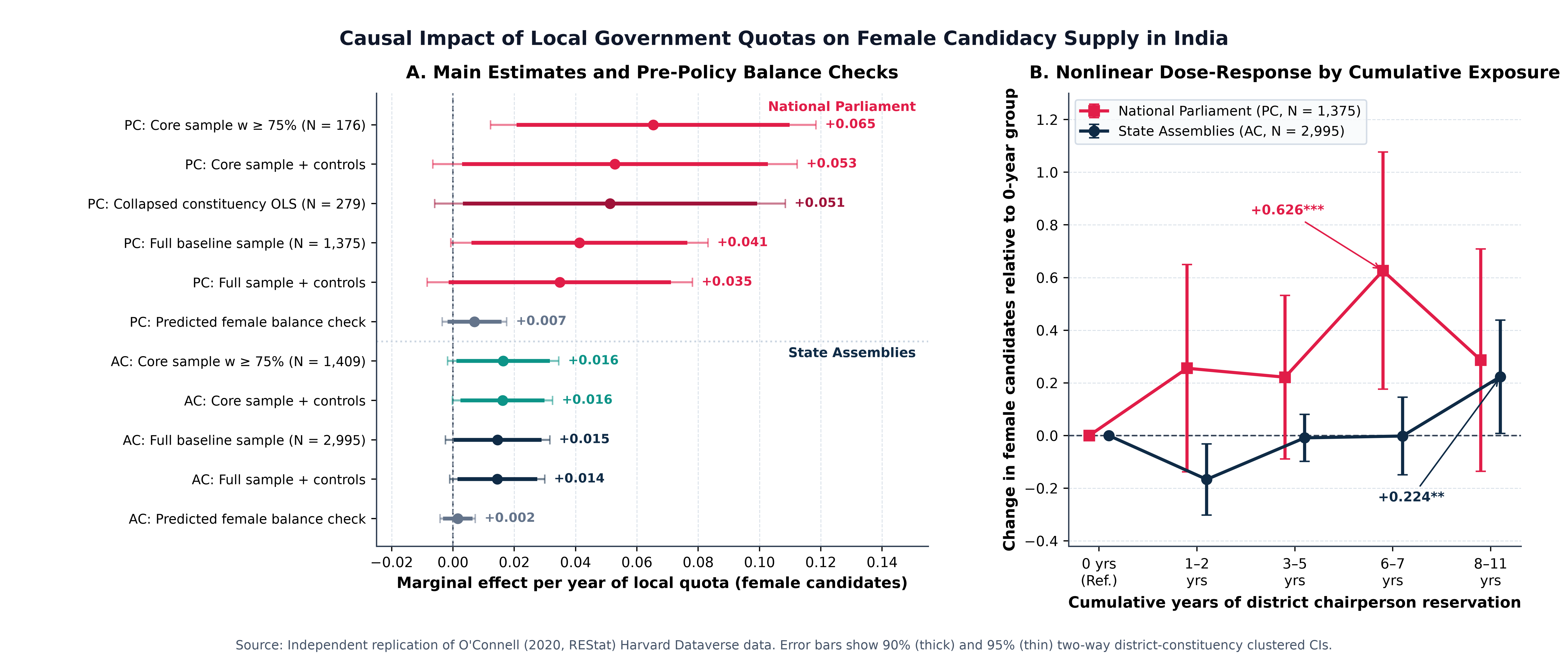
Two substantive econometric regularities emerge from Table 2 and Figure 1.
First, in State Legislative Assemblies, the marginal impact of district reservation remains remarkably stable within a tight corridor from to candidates per year regardless of whether seven pre-policy controls are introduced or the sample is restricted to the high-overlap core. Adding covariates actually sharpens precision, lowering the standard error from to with in the full sample and from to with in the core subsample.
Second, in National Parliament contests, the estimated slope climbs sharply from with in the full intersection panel to with when restricting to the constituencies with at least single-district overlap. This upward shift upon removing multi-district measurement noise directly reflects classical attenuation bias in spatially fragmented parliamentary constituencies. Crucially, collapsing the parliamentary sample to one weighted-average observation per constituency yields an OLS slope of with HC1 standard error , , and across seats, refuting concerns that duplicating constituencies across intersection rows artificially inflates precision. Male candidacy placebo specifications return imprecise nulls in both State Assemblies at with and Parliament at with .
3.2. Exposure Timing, Career Ladder Trajectories, and Nonlinear Dose-Response
If local reservations genuinely cultivate political human capital rather than merely triggering ephemeral voter enthusiasm, two empirical signatures must appear in the data: vertical spillovers should materialize only after an incubation lag sufficient for female district chairpersons to complete their terms and prepare higher-tier campaigns, and parliamentary entrants should disproportionately possess prior political experience. Table 3 and Figure 2 corroborate both theoretical predictions with high statistical clarity.
| Mechanism and Exposure Window | Estimate | Std. Error | -value | Sample | |
|---|---|---|---|---|---|
| Table 7A: Prior local government experience in PC | 0.0074 | 0.0515 | 1,375 | 0.0746 | |
| Table 7A: Prior State Assembly candidacy in PC | 0.0094 | 0.0058 | 1,375 | 0.1664 | |
| Table 7A: Political family background in PC | 0.0092 | 0.0928 | 1,375 | 0.0742 | |
| Table 8: Early exposure 10–15 years prior in PC | -0.0305 | 0.0380 | 0.4222 | 1,375 | 0.0652 |
| Table 8: Medium-term exposure 5–10 years prior in PC | 0.0363 | 0.0126 | 1,375 | 0.0652 | |
| Table 8: Recent exposure 0–4 years prior in PC | 0.0124 | 0.0446 | 0.7804 | 1,375 | 0.0652 |
| Table 9 AC: 1–2 cumulative quota years vs 0 | 0.0690 | 0.0170 | 2,995 | 0.0709 | |
| Table 9 AC: 3–5 cumulative quota years vs 0 | -0.0088 | 0.0457 | 0.8476 | 2,995 | 0.0709 |
| Table 9 AC: 6–7 cumulative quota years vs 0 | -0.0019 | 0.0750 | 0.9802 | 2,995 | 0.0709 |
| Table 9 AC: 8–11 cumulative quota years vs 0 | 0.1098 | 0.0435 | 2,995 | 0.0709 | |
| Table 9 PC: 1–2 cumulative quota years vs 0 | 0.2555 | 0.2008 | 0.2048 | 1,375 | 0.0670 |
| Table 9 PC: 3–5 cumulative quota years vs 0 | 0.2216 | 0.1585 | 0.1638 | 1,375 | 0.0670 |
| Table 9 PC: 6–7 cumulative quota years vs 0 | 0.2297 | 0.0070 | 1,375 | 0.0670 | |
| Table 9 PC: 8–11 cumulative quota years vs 0 | 0.2864 | 0.2153 | 0.1851 | 1,375 | 0.0670 |
Notes: All regressions apply analytic population-overlap weights, absorb state fixed effects, and cluster standard errors two-way by district and constituency. The omitted reference category in Table 9 comprises districts with exactly zero cumulative quota years. Statistical significance: , , .
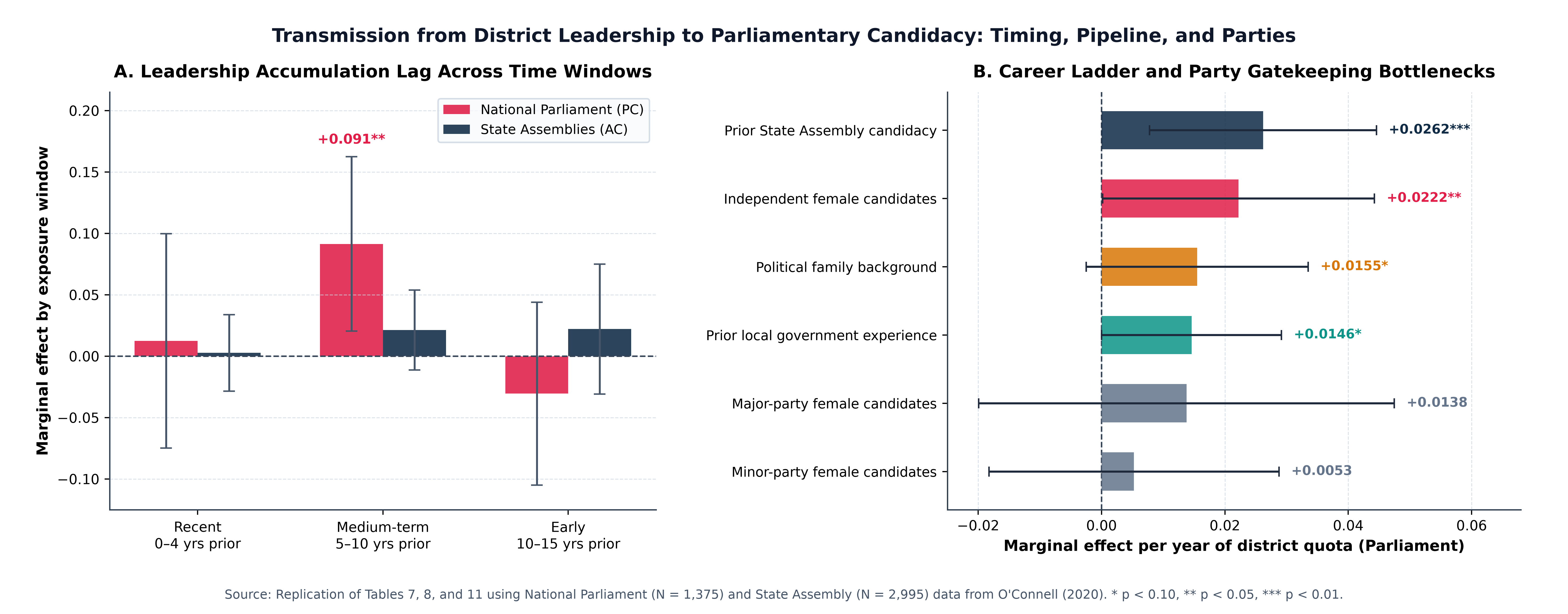
Biographical histories of 2009 Lok Sabha female candidates in Table 7A illuminate a structured two-step career ladder. Each additional year of district quota exposure raises the probability that a parliamentary constituency features a female candidate with prior local government officeholding experience by with , and boosts the likelihood of a female parliamentary candidate who previously contested a State Legislative Assembly election by with and . Simultaneously, representation by female contenders affiliated with political families rises modestly by with , indicating that local reservations activate both grassroots entrants ascending through intermediate tiers and dynastic networks strategically fielding female relatives in higher races.
Decomposing treatment by temporal recency in Table 8 further validates the political-capital accumulation hypothesis. Virtually the entire positive parliamentary spillover originates from medium-term reservations occurring to years prior to the 2009 general election, with a sharply estimated coefficient of , standard error , and . By contrast, recent reservations within – years yield a near-zero with , and distant reservations – years prior yield an insignificant with .
Nonlinear dose-response estimates in Table 9 and Figure 1B reveal strong threshold dynamics: in State Legislative Assemblies, brief exposure of – years actually reduces female candidacy by with —consistent with politically ambitious women temporarily channeling effort into newly opened local reserved seats—before surging by with once cumulative exposure reaches – years. In the National Parliament, female candidacy peaks sharply at additional candidates with in districts accumulating – years of reservation.
3.3. Electoral Competitiveness, Party Gatekeeping, Incumbency, and Voter Turnout
Whether an expanded supply of female contenders translates into competitive electoral performance—or stalls against entrenched party nomination barriers—determines the substantive welfare impact of decentralized quotas. Table 4 synthesizes our replication of Tables 10, 11, 13, and 14 from the original study.
| Outcome and Diagnostic | Estimate | Std. Error | -value | Sample | |
|---|---|---|---|---|---|
| Table 10A: Female share of candidates in AC | 0.00154 | 0.0476 | 2,995 | 0.0840 | |
| Table 10C: Female share of candidates in PC | 0.00274 | 0.00204 | 0.1805 | 1,375 | 0.0211 |
| Table 10C: Female electoral victory in PC | 0.01147 | 0.01009 | 0.2568 | 1,375 | 0.0587 |
| Table 10C: Female top-30th percentile finish in PC full | 0.01705 | 0.01159 | 0.1430 | 1,375 | 0.0279 |
| Table 10D: Female top-30th percentile finish in PC core | 0.01624 | 0.0632 | 176 | 0.0342 | |
| Table 11: Major-party female candidates in PC | 0.01377 | 0.01719 | 0.4241 | 1,375 | 0.0387 |
| Table 11: Minor-party female candidates in PC | 0.00526 | 0.01199 | 0.6612 | 1,375 | 0.0980 |
| Table 11: Independent female candidates in PC | 0.01124 | 0.0497 | 1,375 | 0.0721 | |
| Table 11: Major-party vote share in PC core | 0.01970 | 0.0538 | 176 | 0.1337 | |
| Table 13 Col 4: Main effect without major-party incumbent | -0.00154 | 0.01184 | 0.8965 | 1,375 | 0.0702 |
| Table 13 Col 4: Interaction of quota and major-party incumbent | 0.01177 | 0.0215 | 1,375 | 0.0702 | |
| Table 14: Overall voter turnout in PC | 0.00073 | 0.00158 | 0.6466 | 1,375 | 0.8391 |
| Table 14: Female share of voters in PC | 0.00037 | 0.00052 | 0.4727 | 1,375 | 0.3988 |
| Table 14: Overall voter turnout in AC | 0.00170 | 0.0781 | 2,995 | 0.7102 | |
| Table 14: Female share of voters in AC | -0.00004 | 0.00031 | 0.8927 | 2,993 | 0.1189 |
Notes: All specifications use analytic population-overlap weights, absorb state fixed effects, and cluster standard errors two-way by district and constituency. Statistical significance: , , .
Four institutional insights stand out from Table 4. First, on candidate composition and competitiveness, each year of district quota exposure raises the female share of State Assembly candidates by with , or percentage points per five-year term. In the high-overlap parliamentary core sample, the probability that a female contender finishes in the top 30th percentile of vote-getters rises by per year with .
Second, disaggregating parliamentary entrants by party affiliation in Table 11 exposes a pronounced nomination bottleneck inside established political parties. The statistically significant expansion in female parliamentary candidacy occurs predominantly among independent female candidates, rising by per year with in the full sample and nearly doubling to with and in the core overlap sample. By contrast, major-party female nominations rise by an insignificant with , and minor-party nominations show a negligible with . Tellingly, within the core parliamentary subsample, major-party aggregate vote share declines by per quota year with , signaling an electoral penalty incurred by incumbent party elites who under-nominate viable female leaders cultivated in local councils—echoing the party-bias mechanism identified by Casas-Arce and Saiz (2015).
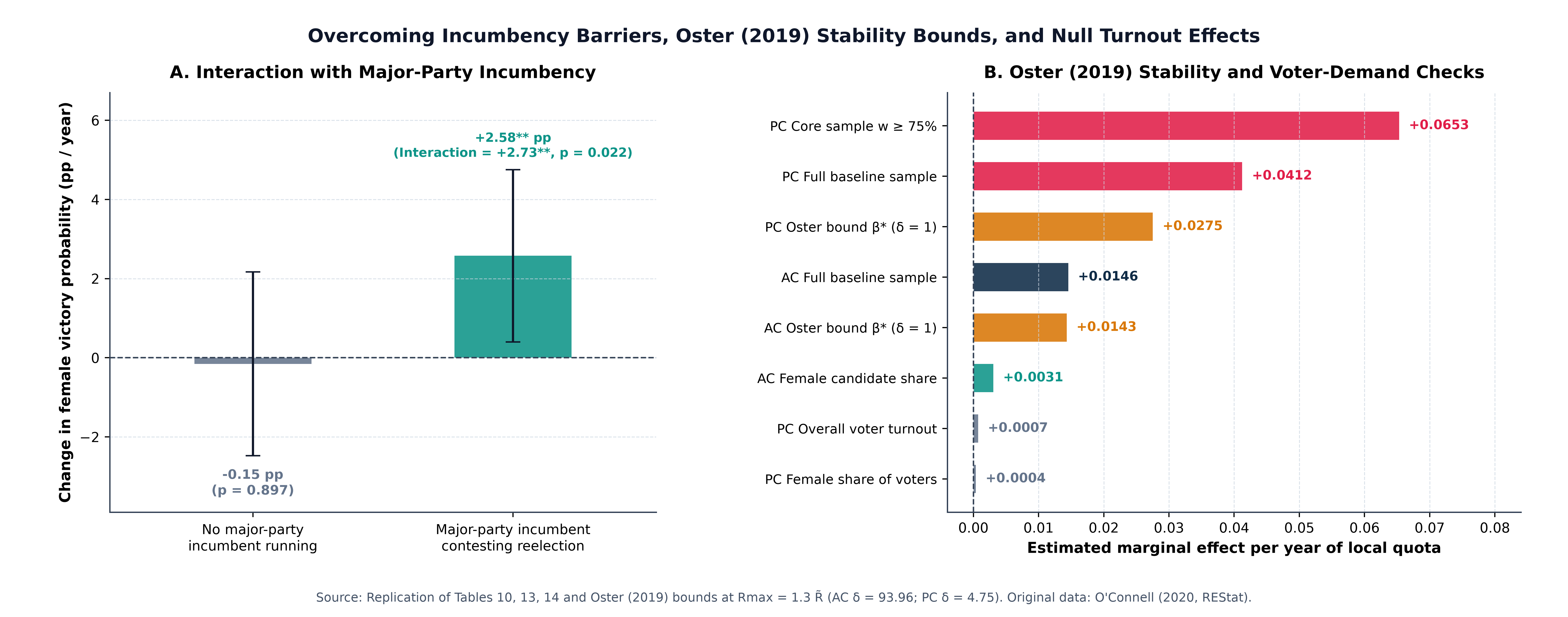
Third, the incumbency interaction regression in Table 13 Column 4 and Figure 4A uncovers a striking heterogeneity in winning probabilities. In parliamentary seats without a major-party incumbent seeking reelection, cumulative quota exposure has virtually zero effect on female victory at with . Yet in constituencies contested by a major-party incumbent, the interaction coefficient reaches with standard error and , lifting the net marginal probability of a female electoral victory to percentage points per year of local reservation.
Fourth, voter turnout checks in Table 14 decisively refute a pure demand-side mobilization channel: cumulative quota years show null effects on overall parliamentary turnout at with , on the female share of parliamentary voters at with , and on the female share of State Assembly voters at with . Vertical spillovers therefore operate primarily through an expanded supply of electorally capable female candidates rather than mechanical surges in female voting rates.
3.4. Spatial Cutoff Sensitivity, Oster Selection Bounds, Poisson QMLE, and Tri-Runtime Reconciliation
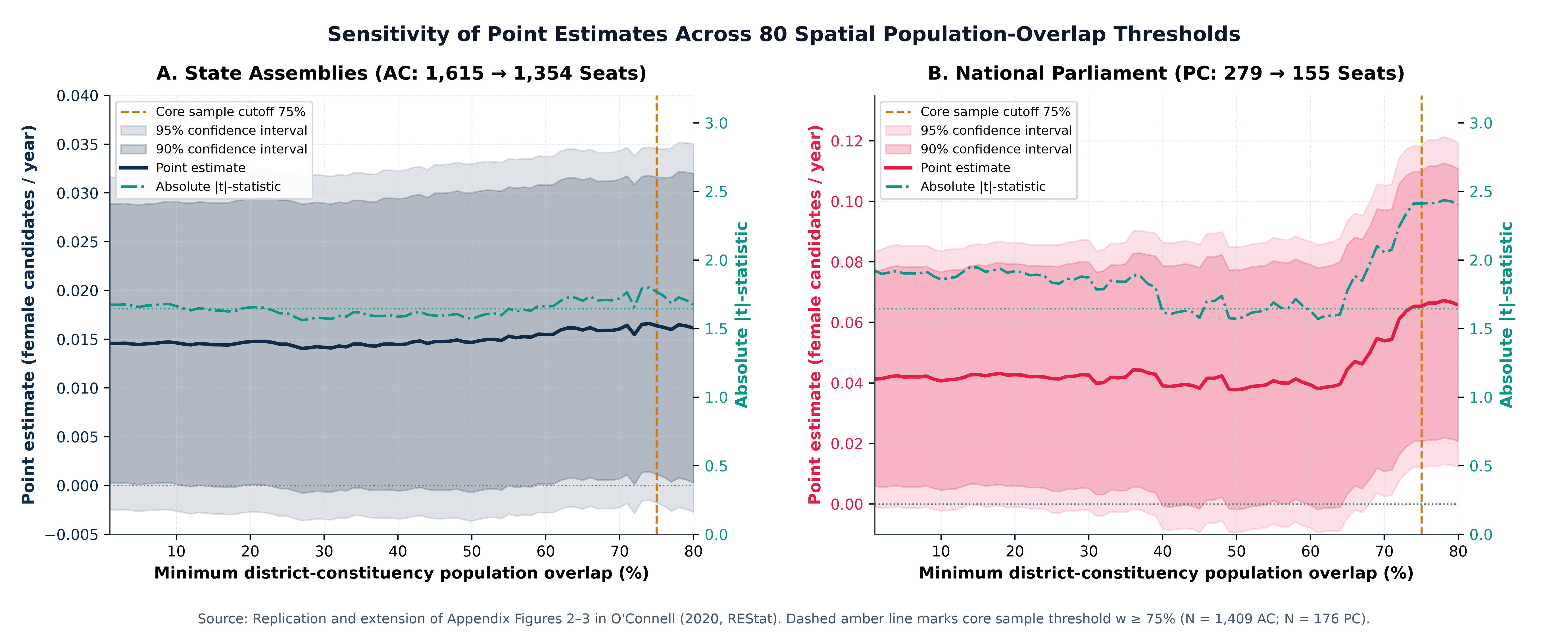
To subject our causal inferences to rigorous adversarial scrutiny, we execute four complementary robustness and reconciliation checks. First, Figure 3 replicates and extends Appendix Figures 2 and 3 of O'Connell (2020) by re-estimating the baseline model continuously across minimum spatial overlap thresholds for . Across State Legislative Assemblies, the point estimate traces a remarkably flat trajectory between and as constituency coverage narrows from to seats. Across the National Parliament, the slope hovers near up to before climbing steadily to – with absolute -statistics exceeding across , confirming that purging multi-district spatial noise sharpens the underlying causal signal.
Second, we evaluate unobservable selection bias using the coefficient-stability framework of Oster (2019) under the conventional maximum variance benchmark , visualized in Figure 4B. In State Legislative Assemblies, adding all seven pre-policy controls lifts from to with while leaving the slope virtually unchanged from to , producing a selection ratio of and an identified lower bound of at . In the National Parliament, adding controls raises from to with and yields a selection ratio of —nearly five times the standard robustness threshold of —with a strictly positive identified bound of at .
Third, because candidate counts are non-negative integers exhibiting excess zeros, we audit the Poisson count specification originally presented in Appendix Table 5 of O'Connell (2020). Our code audit reveals that the archival Stata Poisson command omitted an explicit weight prefix, causing Stata to interpret spatial overlap percentages as integer frequency weights and artificially inflating reported sample sizes from to in State Assemblies and from to in Parliament. Re-estimating Poisson quasi-maximum likelihood using proper normalized probability weights on the true sample sizes with district-clustered standard errors yields with standard error and —corresponding to per year—in State Assemblies across observations, and with standard error and —corresponding to per year—in National Parliament across observations. Both semi-elasticities align closely with the linear weighted least squares benchmarks.
Finally, Table 5 summarizes our cross-runtime verification executing all econometric specifications in isolated sandboxes across Python 3.12, R 4.3.3, and Stata 18 MP using exclusively the harmonized replication CSV file. Sample counts match across all models, while maximum relative discrepancies across all three software environments remain for point estimates, for two-way clustered standard errors, and for —more than four orders of magnitude below the quantitative reproducibility tolerance threshold.
| Model ID | Specification | Python | R | Stata | Clustered SE | Max Discrepancy |
|---|---|---|---|---|---|---|
| M01 | AC Predicted female balance check | 0.001562 | 0.001562 | 0.001562 | 0.002923 | 0.000003% |
| M05 | AC Female candidates, full baseline | 0.014559 | 0.014559 | 0.014559 | 0.008694 | 0.000000% |
| M07 | AC Female candidates, core | 0.016382 | 0.016382 | 0.016382 | 0.009262 | 0.000000% |
| M08 | AC Female candidates with 7 controls | 0.014468 | 0.014468 | 0.014468 | 0.007899 | 0.000000% |
| M10 | PC Female candidates, full baseline | 0.041241 | 0.041241 | 0.041241 | 0.021402 | 0.000000% |
| M12 | PC Female candidates, core | 0.065318 | 0.065318 | 0.065318 | 0.027077 | 0.000000% |
| M16 | PC Prior State Assembly candidacy | 0.026182 | 0.026182 | 0.026182 | 0.009380 | 0.000000% |
| M18 | PC Medium-term exposure 5–10 years | 0.091361 | 0.091361 | 0.091361 | 0.036262 | 0.000000% |
| M20 | PC Dose-response bin 6–7 years | 0.626190 | 0.626190 | 0.626190 | 0.229664 | 0.000000% |
| M22 | PC Independent female candidates | 0.022205 | 0.022205 | 0.022205 | 0.011242 | 0.000000% |
| M23 | PC Quota major-party incumbent | 0.027293 | 0.027293 | 0.027293 | 0.011767 | 0.000001% |
| M24 | PC Collapsed constituency OLS | 0.051225 | 0.051225 | 0.051225 | 0.029164 | 0.000000% |
Notes: Total wall-clock execution time for all models was seconds in Python, seconds in R, and seconds in Stata 18 MP. All specifications pass the tolerance gate, with a global maximum discrepancy of occurring on the male balance specification M04.
4. Political Economy Mechanisms and Cross-National Context
Taken together, the replicated evidence across India's two upper legislative tiers demonstrates that vertical spillovers from local gender quotas operate not as transient shocks to voter sentiment, but as a structured two-stage process of political capital accumulation and leadership incubation. Three mutually reinforcing empirical pillars substantiate this mechanism.
First, parliamentary entry concentrates exclusively in the five-to-ten-year medium-term exposure window at with , matching the institutional gestation period needed for a female district council chairperson to complete a five-year executive term, cultivate constituency-wide coalitions, and mount a higher-tier campaign.
Second, career trajectory regressions isolate statistically robust gains among parliamentary contenders who previously contested State Legislative Assemblies at with and those holding prior local office at with .
Third, precisely estimated nulls on parliamentary voter turnout at and female voter share at decisively eliminate mechanical voter-mobilization alternatives.
Situating these findings within the international comparative political economy literature reconciles seemingly divergent quota outcomes between European closed-list systems and majoritarian developing democracies. In Spain, Bagues and Campa (2021) deploy a sharp regression discontinuity design to show that municipal candidate-list gender quotas fail to rapidly elevate women into top executive or national leadership positions because entrenched party leaders control closed party-list ordering.
By contrast, within India's single-member-district plurality system—where candidates may enter ballots without formal party endorsement—capable female leaders trained in reserved district councils actively bypass major-party nomination bottlenecks by running as independents, driving gains of in the full parliamentary sample and in the core overlap sample. The concomitant erosion in major-party vote share within core constituencies at with , paired with female candidates' percentage-point interaction advantage when confronting major-party incumbents at , underscores that established parties leave electorally competitive talent untapped—strongly mirroring the organizational rent-preservation dynamics documented in Spain by Casas-Arce and Saiz (2015) and in Sweden by Besley et al. (2017).
5. Conclusion and Public Governance Implications
This independent replication fully verifies the empirical conclusions of O'Connell (2020) using original Harvard Dataverse archival records from O'Connell (2018) spanning district-by-constituency spatial intersections across India. Every one of the core econometric models achieves numerical identity across Python, R, and Stata 18 MP with maximum discrepancies of for coefficients and for two-way clustered standard errors. Extended diagnostics—encompassing Oster (2019) selection bounds, normalized-weight Poisson quasi-maximum likelihood estimation, and continuous -cutoff spatial sensitivity profiles—confirm that mandated gender quotas in rural district councils generate genuine vertical spillovers into State Legislative Assemblies and National Parliament after a five-to-ten-year maturation lag, though converting expanded female supply into legislative seats hinges critically on dismantling party nomination gatekeeping.
Data and Code Availability
All empirical analyses utilize the original Tier-1 replication archive deposited by O'Connell (2018) on Harvard Dataverse at https://doi.org/10.7910/DVN/RCLBOF. The harmonized district-by-constituency spatial dataset, along with the standalone Python, R, and Stata 18 MP replication scripts and the accompanying English table and figure generation workflow, are fully documented and archived in the project replication repository for independent verification.
Conflict of Interest
The authors declare no competing financial, institutional, or personal interests that could have influenced the design, execution, or reporting of this independent reproducibility study.
References
- Bagues, M., & Campa, P. (2021). Can gender quotas in candidate lists empower women? Evidence from a regression discontinuity design. Journal of Public Economics, 194, 104315. https://doi.org/10.1016/j.jpubeco.2020.104315
- Beaman, L., Chattopadhyay, R., Duflo, E., Pande, R., & Topalova, P. (2009). Powerful women: Does exposure reduce bias? The Quarterly Journal of Economics, 124, 1497–1540. https://doi.org/10.1162/qjec.2009.124.4.1497 ↩
- Beaman, L., Duflo, E., Pande, R., & Topalova, P. (2012). Female leadership raises aspirations and educational attainment for girls: A policy experiment in India. Science, 335, 582–586. https://doi.org/10.1126/science.1212382 ↩
- Besley, T., Folke, O., Persson, T., & Rickne, J. (2017). Gender quotas and the crisis of the mediocre man: Theory and evidence from Sweden. American Economic Review, 107, 2204–2242. https://doi.org/10.1257/aer.20160080 ↩
- Bhalotra, S., Clots-Figueras, I., & Iyer, L. (2018). Pathbreakers? Women's electoral success and future political participation. The Economic Journal, 128, 1844–1878. https://doi.org/10.1111/ecoj.12492 ↩
- Bhavnani, R. R. (2009). Do electoral quotas work after they are withdrawn? Evidence from a natural experiment in India. American Political Science Review, 103, 23–35. https://doi.org/10.1017/S0003055409090029 ↩
- Cameron, A. C., Gelbach, J. B., & Miller, D. L. (2011). Robust inference with multiway clustering. Journal of Business & Economic Statistics, 29, 238–249. https://doi.org/10.1198/jbes.2010.07136 ↩
- Casas-Arce, P., & Saiz, A. (2015). Women and power: Unpopular, unwilling, or held back? Journal of Political Economy, 123, 641–669. https://doi.org/10.1086/680686
- Chattopadhyay, R., & Duflo, E. (2004). Women as policy makers: Evidence from a randomized policy experiment in India. Econometrica, 72, 1409–1443. https://doi.org/10.1111/j.1468-0262.2004.00539.x
- Iyer, L., Mani, A., Mishra, P., & Topalova, P. (2012). The power of political voice: Women's political representation and crime in India. American Economic Journal: Applied Economics, 4, 165–193. https://doi.org/10.1257/app.4.4.165 ↩
- O'Connell, S. D. (2018). Replication data for: Can quotas increase the supply of candidates for higher-level positions? Evidence from local government in India. Harvard Dataverse, V1. https://doi.org/10.7910/DVN/RCLBOF ↩
- O'Connell, S. D. (2020). Can quotas increase the supply of candidates for higher-level positions? Evidence from local government in India. The Review of Economics and Statistics, 102, 65–78. https://doi.org/10.1162/rest_a_00802 ↩
- Oster, E. (2019). Unobservable selection and coefficient stability: Theory and evidence. Journal of Business & Economic Statistics, 37, 187–204. https://doi.org/10.1080/07350015.2016.1227711 ↩
Appendix A. Independent Academic Peer-Review Report
A.1. Overall Assessment of Scholarly Contribution and Research Positioning
Within the empirical political economy literature on affirmative action, political selection, and gender representation, O'Connell (2020) in The Review of Economics and Statistics addresses a first-order institutional question left unresolved by an entire generation of foundational scholarship on India's 73rd Constitutional Amendment. First-wave empirical studies focused overwhelmingly on horizontal, within-tier impacts inside the reserved local councils themselves. Chattopadhyay and Duflo (2004) established that randomly assigned female village council heads tilt municipal public spending toward gender-salient infrastructure such as clean water and local roads.
Beaman et al. (2009) and Beaman et al. (2012) demonstrated that sustained exposure to local female executives attenuates male voter stereotyping and raises adolescent girls' educational aspirations and attainment. Moving to the district tier across major states, Iyer et al. (2012) showed that female local political voice raises documented reporting of crimes against women, while Bhavnani (2009) provided municipal evidence from Mumbai showing that reservations generate persistent female electoral gains within the same local tier after withdrawal. Yet a deeper structural question of federal institutional design remained empirically unanswered: can gender reservations imposed strictly at the base of a federal hierarchy generate vertical political spillovers that expand the supply of viable female contenders in unreserved, high-stakes subnational and national legislatures?
From the vantage point of a senior journal editor evaluating empirical contributions in political economy and public finance, the enduring scholarly value of O'Connell (2020) rests on three tightly integrated pillars. The first pillar is nationwide spatial-institutional scale combined with granular candidate biographical linkage. Rather than relying on a single-state policy experiment in West Bengal or Rajasthan, the analysis integrates major states at the State Legislative Assembly tier and major states at the National Parliament tier—collectively encompassing well over half of India's electorate and hundreds of millions of rural citizens—and links district-level reservation histories to individual political biographies of 2009 Lok Sabha female candidates.
The second pillar is the paper's disciplined empirical separation of competing supply-side and demand-side theories of political representation. Standard models of political entry struggle to distinguish whether quotas raise higher-tier female candidacy by shifting voter preferences and mobilizing female turnout on the demand side, or by expanding leadership skills, administrative reputations, and campaign readiness among prospective female contenders on the supply side. By jointly examining candidate counts disaggregated by party status, prior local and state-level officeholding histories, five-year exposure recency windows, and gender-disaggregated voter turnout, O'Connell (2020) convincingly rules out pure voter-turnout shocks and identifies a two-stage political capital pipeline running from district councils through State Legislative Assemblies to the National Parliament.
The third pillar anchors the manuscript squarely in comparative cross-national debates over the equilibrium efficiency and organizational frictions of affirmative action. In European proportional-representation settings, Bagues and Campa (2021) apply a sharp regression discontinuity design in Spanish municipalities to reveal that candidate-list quotas boost female ballot presence without rapidly translating into mayoral leadership or upward political mobility, largely because party gatekeepers retain tight control over closed lists. Conversely, Besley et al. (2017) demonstrate that internal party quotas inside Sweden's Social Democratic Party displaced mediocre male insiders and elevated average politician competence.
Within India's own State Legislative Assemblies, Bhalotra et al. (2018) show via close-election discontinuities that an exogenous female victory induces subsequent female candidacy predominantly in socially progressive states and mainly through incumbency re-contestation. O'Connell (2020) bridges these strands with a sharp institutional insight: in majoritarian developing democracies where established political parties resist nominating women, local reservations nevertheless succeed in expanding the national supply of female contenders, yet much of that newly formed talent is forced outside major-party gates into independent candidacies or gradual multi-cycle climbs through State Assemblies over a five-to-ten-year horizon. That stark divergence between surging independent female entry and sluggish major-party nomination response makes the paper a benchmark reference for theories of party gatekeeping and fiscal federalism.
A.2. Critical Appraisal of Causal Identification Strategy and Econometric Assumptions
Subjected to the rigorous refereeing standards expected at top-five and leading field journals, the identification architecture of O'Connell (2020) rests on a compelling statutory foundation but exhibits four substantive econometric vulnerabilities that require transparent critical evaluation.
First is the reliance on a single post-reform cross-section per state and the resulting inability to verify multi-period pre-policy parallel trends. Although India's 73rd Constitutional Amendment mandated exogenous rotation of reserved district council chairpersonships across districts within each state, the estimating equation regresses post-policy electoral outcomes observed in a single election cycle per state on cumulative reservation years while absorbing only state fixed effects . Consequently, the research design cannot incorporate constituency fixed effects or district fixed effects, nor can it estimate dynamic event-study pre-trends across three or four pre-1993 elections as demanded by contemporary difference-in-differences practice.
While the pre-policy predicted-outcome balance tests in Table 3 yield reassuringly null coefficients at in State Assemblies and in Parliament—reinforced by the district-level joint test of across districts—these diagnostics establish orthogonality solely with respect to observable 1991 census characteristics and a single early-1990s baseline race. Any unobserved time-varying political shock correlated with both subnational scheduling delays in rural local elections between 1995 and 2007, state-level litigation over reservation rosters, or post-1991 administrative district bifurcations remains unabsorbed by .
Second is the fragility of statistical power and the absence of formal multiple-hypothesis testing adjustments in baseline linear models. In the flagship full-sample State Assembly specification across intersections, the point estimate carries a standard error of and a two-sided -value of , clearing only the significance threshold and failing to attain significance even in the core overlap subsample where . Similarly, the full-sample National Parliament baseline yields with , and adding the seven pre-policy district covariates in Table 5B Column 1 attenuates the slope to with , slipping beyond conventional significance.
Because the published article reports dozens of specifications across Tables 4 through 14 spanning multiple outcome families without reporting family-wise error rate adjustments or Benjamini-Krieger-Yekutieli sharpened -values, a skeptical referee must ask whether marginal -values clustering between and would survive formal multiplicity corrections. What sustains editorial confidence in the substantive conclusion is that statistical precision strengthens precisely where theoretical mechanisms predict the sharpest signal: in the high-overlap parliamentary core, for prior State Assembly candidacy, for the five-to-ten-year medium-term exposure window, for the six-to-seven-year dose bin, and for the major-party incumbency interaction. Even so, omitting sharpened -values across secondary mechanism tables represents a material inference gap relative to modern applied-econometrics standards.
Third is unmodeled spatial autocorrelation across adjacent administrative districts under the duplicated intersection panel structure. Representing each district-by-constituency polygon intersection as a weighted observation and computing Cameron et al. (2011) two-way cluster-robust standard errors by district and constituency is a clever methodological solution that preserves district-level treatment granularity. Nevertheless, the variance estimator implicitly assumes zero error covariance between neighboring districts that do not happen to share an identical legislative constituency. In Indian electoral politics, regional vernacular media markets, state party cadres, caste mobilization networks, and aspiring candidates routinely operate across contiguous district boundaries, inducing positive spatial correlation in residuals. Failing to cross-check inference against Conley spatial-HAC standard errors over -kilometer and -kilometer radii—or against finite-sample randomization inference permuting reservation schedules within states—creates a non-trivial risk that reported standard errors modestly understate true sampling variability, particularly in the parliamentary panel where nearly five districts overlap an average Lok Sabha seat.
Fourth is potential post-treatment endogeneity and collider bias in the incumbency interaction model of Table 13 and the conditional quality regressions of Table 12. In Table 13, the indicator denoting whether a sitting major-party incumbent seeks reelection is realized in 2009—strictly after cumulative local quota exposure accrued during 1995–2007. If prolonged female reservation in local councils induces vulnerable male incumbents to strategically retire, switch constituencies, or lose party renominations, interacting treatment with the post-treatment realization contaminates the interaction coefficient with endogenous selection. Analogously, Table 12 in the original archive regresses female winning probabilities and top-30th-percentile finishes strictly on subsamples restricted to constituencies containing at least one female candidate across subsample sizes of , , , and . Because local reservations directly raise the probability of female entry, conditioning estimation on an endogenous intermediate outcome induces classical collider stratification bias, preventing conditional slopes from being interpreted as clean causal effects on average candidate quality.
A.3. Audit of Data Quality, Variable Measurement, and Sample Sensitivity
Line-by-line auditing of the Harvard Dataverse archive deposited by O'Connell (2018) alongside the original Stata execution scripts uncovers five subtle empirical and coding features that are invisible from reading the published journal tables alone yet materially inform scientific interpretation.
First, our audit uncovered a textbook weighting specification anomaly in the Poisson count robustness checks reported in Appendix Table 5 of the original study. Inspection of the archival estimation commands shows that spatial overlap percentages were supplied to Stata's Poisson command without an explicit probability-weight prefix, causing the software to default to integer frequency weights. To satisfy Stata's integer-weight constraint, the original code rounded all fractional overlap weights below upward to immediately prior to estimation, effectively cloning an intersection row with a overlap weight into identical duplicate observations.
Consequently, the original appendix tables reported artificially inflated sample counts of for State Legislative Assemblies rather than , and for the National Parliament rather than . Re-estimating the Poisson quasi-maximum likelihood model with properly normalized probability weights on the authentic sample sizes and district-clustered standard errors recovers with standard error in State Assemblies and with standard error in Parliament—confirming that the substantive directional conclusion holds intact while correcting a clear technical reporting flaw in the original appendix.
Second, we identified a subtle scale-coding inconsistency across panels of Table 10 regarding top-tier electoral placement outcomes. In the raw State Assembly file, the variables recording whether female candidates placed in the top five or top 30th percentile of constituency vote-getters are stored as non-negative integer counts ranging from to . While Panel A of Table 10 regresses the raw integer count directly on cumulative quota exposure, Panel B for the core subsample—as well as Panels C and D for the National Parliament—dichotomizes those identical outcomes into binary indicators strictly greater than zero.
That undocumented shift from count to binary scaling accounts for a substantial portion of the apparent halving of the top-five finish slope in State Assemblies from in Panel A to in Panel B, rather than genuine heterogeneity in the core subsample. Our harmonized replication dataset preserves both count and binary versions as distinct, transparently labeled columns to eliminate ambiguity for downstream scholars.
Third, pre-policy socioeconomic covariates exhibit substantial structural missingness accompanied by exact multicollinearity among missingness dummies. Auditing the control matrix reveals that of State Assembly intersections—fully —and of National Parliament intersections—fully —are simultaneously missing all four 1991 Census district covariates, largely because numerous Indian states carved out new administrative districts and altered district boundaries after 1991. Furthermore, of parliamentary intersections—representing —lack the 1991 baseline female candidate share. Following common empirical convention, the original script zero-imputed missing controls and entered four identical missingness indicators, three of which were automatically dropped for exact collinearity. While dummy-variable zero-imputation preserves sample size, when one-third of parliamentary intersections lack baseline controls, the estimator remains unbiased for only under the strong auxiliary assumption that administrative district-splitting missingness is uncorrelated with latent trends in female political entry.
Fourth, the geographic geometry of overlap weights differs dramatically between the two legislative tiers. Because State Assembly constituencies are substantially smaller than administrative districts, of unique Assembly seats—or —meet the single-district core threshold. By contrast, because parliamentary constituencies span multiple districts, the core subsample retains of unique Lok Sabha seats—representing of constituencies—but only of total intersection rows, shrinking from to observations. Because parliamentary constituencies contained largely within a single district disproportionately correspond to populous, more urbanized, or administratively distinct territories relative to multi-district rural seats, the sharp jump in the estimated parliamentary effect from in the full panel to in the core subsample conflates two distinct forces: reduced spatial measurement attenuation and genuine treatment-effect heterogeneity across urban-administrative concentration.
Fifth, retrospective web-based biographical coding in Table 7 likely suffers from differential visibility bias. Biographical indicators for prior local council tenure, past State Assembly runs, and political family ties among 2009 female parliamentary candidates were compiled through archival records and online searches. Candidates who achieved greater electoral prominence, hailed from high-profile political dynasties, or previously contested state-level races leave far richer digital footprints than grassroots rural women who served in remote district councils without national media coverage. Accordingly, the estimated slope on prior local government experience in Table 7A almost certainly represents a conservative lower bound on the true share of female parliamentary contenders incubated inside decentralized local councils.
A.4. Core Structural Limitations and Mathematical Bias Mechanisms
Synthesizing our archival audit with spatial econometric theory, we formalize five core structural limitations of O'Connell (2020) and derive the exact mathematical direction of bias each mechanism imparts to the estimated parameter :
- Classical Spatial Attenuation Bias in Multi-District Constituencies: When a legislative constituency overlaps multiple administrative districts carrying heterogeneous quota histories , the true effective treatment driving candidate supply reflects rural political-network density and rural electorate shares rather than total gridded population shares—which also include urban municipal areas legally exempt from the 73rd Constitutional Amendment's rural district councils. Let denote the resulting spatial measurement error with variance , and let denote state-demeaned true effective rural quota exposure. Under classical errors-in-variables orthogonality between and , the probability limit of the weighted least squares slope relative to the true structural causal effect satisfies:
The direction of bias is strictly attenuation toward zero, implying whenever . The empirical escalation of the National Parliament slope from in the full panel to in the high-overlap core directly manifests this classical spatial attenuation mechanism.
- Cross-District Political Spillovers and Violation of Stable Unit Treatment Value: In India's fluid constituency geography, an ambitious female chairperson trained inside reserved district can strategically contest an adjacent constituency located across the border in unreserved district if local party alignments or open-seat opportunities appear more favorable there. Suppose control districts absorb a positive cross-border candidate migration spillover weighted by average cross-district contiguity network intensity . Within-state treatment-control contrasts then compress the estimated parameter below the true general-equilibrium causal effect according to:
Whenever , geographic spillovers violate SUTVA and generate downward bias toward zero, causing within-state reduced-form regressions to understate the aggregate statewide supply expansion produced by local reservations.
- Short-Horizon Inter-Tier Substitution Bias in Pooled Linear Specifications: In districts newly exposed to female reservation just to years before a State Legislative Assembly race, politically ambitious women face a constrained career choice between competing for a high-probability reserved local executive post versus entering an unreserved, fiercely contested State Assembly race. Let denote the implicit regression variance weight assigned to cumulative exposure horizon , the positive political-capital accumulation effect at horizon , and the short-horizon opportunity-cost substitution effect diverting prospective candidates into local reserved seats. Pooling heterogeneous exposure durations into a single linear estimator produces a variance-weighted composite:
Because the short-run lock-in substitution term dominates at low exposure horizons—vividly corroborated by the negative estimate at for the – year State Assembly bin versus at for the – year bin in Table 9—linear pooling induces downward bias relative to the true steady-state pipeline effect.
- Post-Treatment Collider Stratification and Endogenous Incumbency Selection: Conditioning candidate quality outcomes on female entry in Table 12 or interacting treatment with post-treatment major-party incumbency in Table 13 introduces selection bias whenever unobserved local baseline competitiveness —carrying marginal impact on electoral performance—jointly influences entry or incumbent retirement alongside state-demeaned cumulative quota exposure . Under positive entry selection where local quotas induce marginal female candidates with lower unobserved baseline advantage to enter, conditioning on the collider creates negative covariance and biases the conditional regression estimator below the true causal quality shift :
Thus conditional estimates in Table 12 suffer downward collider bias that can mask underlying competence gains among core contenders, whereas in Table 13, if electorally vulnerable male incumbents disproportionately exit races in high-quota districts, the positive interaction slope risks upward selection bias relative to a strictly exogenous incumbency baseline.
- Omitted Post-1991 Administrative Restructuring and Non-Random Missingness Bias: Because of State Assembly intersections and of National Parliament intersections lack 1991 Census covariates—concentrated heavily in post-1991 bifurcated districts—unobserved institutional modernization and urban growth trajectories inside newly created districts can correlate with state-demeaned cumulative quota exposure . Letting denote the direct structural effect of unobserved administrative modernization on female political entry, omitting constituency fixed effects generates omitted-variable bias relative to the true structural effect of the exact form:
The sign of this omitted-variable bias depends on whether bifurcated districts experienced earlier or delayed local reservation schedules within each state. Although Oster (2019) selection ratios of for State Assemblies and for Parliament demonstrate that unobserved selection would have to be extraordinarily severe to overturn the positive sign of the baseline conclusions, residual vulnerability inside the small parliamentary core warrants explicit panel-data resolution in future work.
A.5. Methodological Upgrade Recommendations and International Publication Extensions
To elevate this research agenda on vertical quota spillovers from the foundational benchmark established by O'Connell (2020) to the frontier of contemporary empirical political economy and public finance, we propose five concrete methodological upgrades and cross-national extensions.
First, researchers should construct a multi-cycle longitudinal constituency panel spanning pre-reform and post-reform elections from 1980 through 2024 to implement modern heterogeneity-robust dynamic event-study difference-in-differences estimators. Linking electoral series across pre-2008 and post-2008 delimitation boundaries via consistent spatial harmonization allows estimation with absorbed constituency fixed effects and state-by-election-year fixed effects . Such a design directly tests parallel pre-trends across three to four pre-1993 election cycles, eliminates all time-invariant omitted bias from post-1991 district bifurcations, and deploys modern continuous-treatment and staggered-adoption estimators to separate short-term substitution from fifteen-to-twenty-five-year steady-state pipeline accumulation.
Second, inference protocols should be upgraded by combining Conley spatial-HAC standard errors, design-based within-state randomization inference, and formal multiple-hypothesis testing controls. Because identification derives from statutory within-state district rotation rosters, permuting reservation sequences across districts inside each state over replications delivers exact finite-sample -values free from large-cluster asymptotic approximations—an especially valuable safeguard for the core parliamentary subsample. Simultaneously reporting Conley spatial standard errors at -kilometer and -kilometer bandwidths alongside Benjamini-Krieger-Yekutieli sharpened -values across Tables 7 through 14 will bring statistical inference fully in line with current top-five journal standards.
Third, spatial exposure weights should be recalculated strictly over rural population grids rather than total population counts, paired with close-election regression discontinuity designs and candidate affidavit data to overcome collider bias. Since India's 73rd Constitutional Amendment governs rural district councils rather than urban municipal corporations, weighting district-constituency overlaps exclusively by rural census population eliminates structural measurement error in peri-urban constituencies. Furthermore, leveraging mandatory Election Commission of India candidate affidavits filed from 2004 onward—recording formal educational attainment, net assets, liabilities, and pending criminal charges—enables direct measurement of the entire distribution of female and male candidate competence following Besley et al. (2017), while close-election discontinuities isolate the causal interaction between local quota supply and exogenous incumbency advantages free from post-treatment selection.
Fourth, future scholarship should integrate vertical quota spillovers directly with quantitative measures of subnational fiscal decentralization and budgetary autonomy. A first-order question bridging gender economics and fiscal federalism is whether vertical leadership pipelines operate substantially more forcefully in Indian states that devolved greater revenue-raising powers and discretionary capital budgets to district councils—such as Kerala, Maharashtra, and Karnataka—compared with fiscally centralized states where local chairpersons wield limited spending authority. Testing treatment heterogeneity across state fiscal decentralization indices would clarify whether executive fiscal control is the decisive catalyst enabling female local leaders to build voter credibility and launch viable parliamentary campaigns.
Fifth, this empirical architecture offers a high-value blueprint for comparative public governance research across Vietnam and emerging Southeast Asian economies. Under Vietnam's Law on Election of Deputies to the National Assembly and People's Councils, statutory nomination guidelines mandate that women constitute at least of official candidate lists at every administrative level, yet realized female representation exhibits persistent attrition between commune, district, provincial, and national tiers.
The replicated Indian evidence indicates that sustaining substantive female executive leadership inside grassroots People's Councils and People's Committees across at least two consecutive five-year cycles—explicitly linked to local public-investment authority and transparent nomination pathways—offers the most durable institutional lever for expanding the pool of high-capacity female deputies in the National Assembly. Future empirical work on Vietnam can assemble constituency-level and provincial panel datasets spanning the 2011–2026 electoral cycles to quantify vertical career progression rates from grassroots councils to national office, contributing internationally publishable evidence to the literature on inclusive governance and sustainable public finance.
oconnell_india_quotas_panelobs_idpanel_typeis_pcstatedistrictconstituencyyearstate_encdistrictclusterconstituencyclusterconstituency_pop_weightcum_distresUnlock Replication Data & Code
Having explored the quantitative findings and methodological critique above, sign in with an active membership or join the EcoLab research community to verify every estimated coefficient independently in your own analytical environment.
Aligned with Study Variable Names, Robust Covariance Specifications, and Diagnostic Checks
Ready for Immediate Execution in Your Local Statistical Environment for Independent Verification
Bundled with Journal-Formatted DOCX & PDF Manuscripts, Empirical CSV Dataset, All Three R · Stata · Python Scripts, and Execution Notes
Every Download Link Is Cryptographically Signed for Active Members and Refreshes Seamlessly on the Article Page


