
1. Introduction
For four decades following the foundational contribution of Eaton and Gersovitz (1981), quantitative macroeconomics and sovereign finance treated sovereign default as an all-or-nothing discrete choice. Within the canonical benchmark formalized by Aguiar and Gopinath (2006) and Arellano (2008), and subsequently extended to long-duration debt contracts by Hatchondo and Martinez (2009) and Chatterjee and Eyigungor (2012), an emerging-market government confronting a severe endowment contraction faces a stark binary menu: either honor scheduled debt service in full or repudiate the entire debt stock, suffer temporary exclusion from international capital markets alongside an output penalty, and eventually reenter markets with a substantially reduced or zero liability position. Even when Yue (2010) endogenized post-default recovery rates through Nash bargaining between the sovereign and international creditors, default remained an abrupt discrete jump followed by immediate balance-sheet relief.
Large-scale historical sovereign debt archives compiled by Cruces and Trebesch (2013) and Meyer, Reinhart, and Trebesch (2022) expose fundamental empirical tensions between this binary paradigm and actual emerging-market debt management. Sovereign borrowers rarely suspend payments completely across all obligations and exit crises with clean balance sheets. Instead, distressed governments routinely remit a fraction of scheduled principal and interest while allowing unpaid balances to accumulate as arrears, all while preserving partial access to international credit markets at elevated risk spreads. Binary default frameworks cannot simultaneously explain why sovereign debt-to-GDP ratios surge during default spells, why crisis durations vary from brief one-year liquidity disruptions to multi-decade restructurings, and why sovereign spreads exhibit substantial volatility during periods without formal debt write-offs.
Arellano, Mateos-Planas, and Ríos-Rull (2023) resolve these anomalies by recasting sovereign default as a continuous intensive-margin choice over the fraction of due obligations left unpaid. Documenting fifty years of sovereign payment histories across 37 emerging economies from 1970 through 2019, they establish that partial default exceeding one percent of payments due occurs in of country-years, averages of due obligations conditional on arrears, persists across multi-year episodes, and produces a pronounced hump-shaped expansion in sovereign indebtedness during crises. Theoretically, capitalizing unpaid arrears into future contractual obligations transforms partial default into an expensive form of forced borrowing from existing creditors. Because governments simultaneously issue new long-duration bonds while rolling over capitalized arrears, partial default activates an endogenous debt-dilution channel closely linked to the mechanism analyzed by Hatchondo, Martinez, and Sosa-Padilla (2016), thereby amplifying sovereign yield spreads and prolonging macroeconomic downturns.
This independent reproducibility study advances three interconnected objectives.
First, we audit the complete public replication archive released on Harvard Dataverse by Arellano, Mateos-Planas, and Ríos-Rull (2022), establishing an explicit boundary between open-source analytical code and proprietary third-party data series subject to redistribution restrictions.
Second, we elevate the original descriptive empirical workflow into an integrated battery of nine econometric panel and episode-level specifications—spanning two-way fixed-effects high-dimensional estimators following Gaure (2013), linear probability models, and cross-episode regressions with country-clustered inference following Cameron and Miller (2015)—and verify bit-for-bit numerical parity across Python, R, and Stata 18 MP alongside omitted-variable sensitivity bounds following Oster (2019).
Third, we implement a self-contained vectorized Bellman–bond-pricing solver calibrated directly to the published structural parameter vector to verify equilibrium spread schedules and quantify ex ante consumption-equivalent welfare effects across three sovereign debt governance reforms: Pari Passu market-access bans during arrears, deep restructuring debt relief, and no-dilution debt covenants.
2. Data Provenance, Identification Design, and Econometric Framework
2.1. Three-Tier Data Provenance Audit and Calibrated DGP Disclosure
A forensic audit of all 32 files totaling in the public Harvard Dataverse archive of Arellano, Mateos-Planas, and Ríos-Rull (2022) confirms that the original package provides complete Stata data-assembly and summary-statistics code, two parallel Fortran 90 structural equilibrium solvers covering the benchmark partial-default economy and a Nash-bargaining comparison model, exact structural calibration parameter inputs, and MATLAB scripts for policy-function and welfare evaluation. Crucially, however, the merged country-year microdata panel is omitted from public redistribution because two constituent inputs carry third-party licensing restrictions: public and publicly guaranteed principal and interest arrears require specialized institutional access to the World Bank Debtor Reporting System, while secondary-market EMBI+ sovereign bond spreads are proprietary commercial series licensed through Global Financial Database.
Adhering to a transparent three-tier data-resolution protocol for archival studies combining open source code with restricted proprietary inputs, this replication deploys a deterministically seeded calibrated benchmark panel with fixed random seed . Every structural element of the benchmark sample is preserved faithfully: the exact roster of 37 emerging economies spanning 1970 through 2019 for a balanced panel of country-year observations, the exact accounting identities defining partial default intensity and payments due, and the exact episode-classification and four-stage crisis-window algorithms encoded in the benchmark Stata script.
Simultaneously, the synthetic data-generating process calibrates unconditional means, within-country standard deviations, cyclical output persistence, state-transition probabilities, and macro-fiscal covariances directly to the twelve published empirical moments hardcoded in the benchmark Fortran calibration files. All econometric and visual outputs are derived from this unified calibrated panel dataset, guaranteeing transparent methodological reproducibility while explicitly disclaiming any claim of redistributing restricted commercial microdata.
2.2. Accounting Definitions and Default Episode Identification
Following the accounting framework of Arellano, Mateos-Planas, and Ríos-Rull (2023), let index emerging economies and index calendar years. Total sovereign debt obligations due in year , denoted , equal the sum of public and publicly guaranteed principal and interest arrears and actual external debt service remitted . Partial default intensity is formally defined by the ratio of unpaid obligations to total contractual obligations due:
Where:
- : Continuous partial default intensity of country in year , bounded on and equal to when no external arrears occur.
- : Total principal and interest arrears on external public and publicly guaranteed sovereign debt owed to official and private creditors in current U.S. dollars.
- : Actual external debt service paid on public and publicly guaranteed obligations during year in current U.S. dollars.
- : Total contractual sovereign debt payments due in year , satisfying the accounting identity .
A country-year observation enters the partial-default state whenever , captured by the binary indicator . Contiguous strings of years satisfying define distinct default episodes indexed by , each characterized by integer duration . To trace macroeconomic trajectories around sovereign distress without imposing parametric timing restrictions, four mutually exclusive episode-stage indicators are constructed: the pre-episode year immediately preceding onset, the beginning year coinciding with the first year of arrears, the middle year located at the ceiling midpoint index , and the post-episode year immediately following full exit from arrears. Cyclical output and cyclical consumption represent country-specific linear-detrended residuals obtained by regressing log real GDP and log real final consumption expenditure separately on a linear calendar-year trend within each country.
2.3. Two-Way Fixed-Effects Specifications, Inference Convention, and Structural Equilibrium
Our flagship sovereign spread pricing specification M1 absorbs time-invariant country heterogeneity and common global liquidity shocks via alternating projections following Gaure (2013), isolating the within-country conditional pricing elasticity of sovereign bond spreads with respect to partial default intensity:
Where:
- : Annualized EMBI+ sovereign bond yield spread for country in year , expressed in decimal terms.
- : Continuous partial default intensity measured as the fraction of sovereign debt payments due left in arrears.
- : External public and publicly guaranteed sovereign debt-to-GDP ratio measured relative to nominal GDP.
- : Linear-detrended cyclical log real GDP for country in year .
- : Country fixed effects absorbing permanent institutional quality, legal regimes, and historical credit reputation.
- : Year fixed effects absorbing global risk-free interest rates, international investor risk appetite, and systemic emerging-market shocks.
- : Idiosyncratic disturbance term allowed to exhibit arbitrary serial correlation and heteroskedasticity within each country cluster .
For statistical inference across all panel specifications, standard errors follow the CRV1 cluster-robust sandwich estimator clustered at the country level across clusters, following Cameron and Miller (2015). Because country fixed effects are strictly nested within the country clustering dimension, exact finite-sample parity across Python, R, and Stata 18 MP is achieved by counting only non-nested absorbed degrees of freedom alongside slope parameters and the absorbed intercept, yielding the finite-sample variance multiplier and two-tailed Student- hypothesis tests evaluated at degrees of freedom.
To verify the convex pricing gradient documented across severity quartiles in the original study, specification M2 replaces continuous intensity with three non-overlapping severity indicators—small defaults below the 25th percentile, medium defaults spanning the 25th to 75th percentiles, and large defaults above the 75th percentile—relative to non-default years. To dissect sovereign default policy behavior, specification M3 estimates the intensive margin of conditional on active arrears across observations, while specification M4 estimates the extensive-margin linear probability model for on lagged debt, lagged spreads, and cyclical output across observations. Crucially, specification M5 directly tests the arrears-driven debt accumulation hypothesis:
Where:
- : Annual first difference in the external sovereign debt-to-GDP ratio, equal to .
- : Marginal rate of net sovereign debt accumulation induced by partial default and arrears capitalization.
- : Cyclical output elasticity capturing nominal denominator valuation and primary fiscal balance effects.
- : Mean-reversion convergence coefficient on the one-year lagged sovereign debt ratio .
- : Country-clustered regression error term.
Rounding out the empirical suite, specification M6 regresses sovereign debt-to-GDP on the four episode-stage indicators to test the hump-shaped trajectory statistically; Specification M7 regresses detrended consumption on , , and the interaction to measure cyclical risk sharing during arrears; Specification M8 estimates cross-episode ordinary least squares on all episodes linking crisis duration to average episode default intensity , initial debt, and initial output; And specification M9 augments M1 with lagged spreads across observations to guard against dynamic spread persistence.
To guard against omitted-variable confounding in the flagship pricing equation M1, we compute exact coefficient stability bounds following Oster (2019), relating the controlled estimate and explanatory power to the uncontrolled bivariate estimate and :
Where:
- : Bias-adjusted partial default pricing coefficient under proportional selection ratio and maximum attainable explanatory power .
- : Controlled two-way fixed-effects estimate of partial default intensity from specification
M1. - : Uncontrolled bivariate ordinary least squares estimate of sovereign spreads on partial default intensity.
- : Total coefficient of determination from controlled specification
M1. - : Coefficient of determination from the uncontrolled bivariate regression.
- : Assumed maximum explanatory power if all unobservables were observed, benchmarked at .
- : Relative degree of selection on unobservables versus observables, with serving as the canonical equal-selection benchmark.
On the structural pillar, we solve the infinite-horizon Markov recursive sovereign debt equilibrium of Arellano, Mateos-Planas, and Ríos-Rull (2023) directly using their exact published benchmark parameter vector: constant relative risk aversion , risk-free international rate , coupon decay factor implying an average bond duration of years, sovereign discount factor , baseline arrears capitalization factor , default-cost curvature , minimum output factor , asymmetric high-income penalty slope , and the exact ten-state Markov endowment grid and transition matrix. Contractual debt obligations due and aggregate consumption obey the recursive law of motion and budget constraint:
Where:
- and : Current-period and next-period contractual coupon obligations due on long-duration sovereign debt.
- : Geometric coupon decay parameter equal to , defining the maturity structure of sovereign bonds.
- : Arrears capitalization recovery factor equal to in the baseline economy and reduced to under deep restructuring relief .
- : Endogenous continuous partial default fraction chosen on each period.
- : Net issuance of new long-duration sovereign bonds sold to international lenders.
- : State-contingent asymmetric output cost function active whenever , governed by curvature , floor , and high-endowment penalty .
- : Endogenous equilibrium bond price schedule satisfying risk-neutral international lender zero-profit arbitrage at discount factor .
Equilibrium bond prices update recursively via the zero-profit condition . We solve this fixed point on a discretized state grid of 26 debt-obligation nodes and 16 partial-default intensity nodes across four institutional regimes: the baseline partial-default economy, a Pari Passu regime prohibiting new bond issuance whenever , a debt-relief restructuring regime lowering to , and a no-dilution covenant restricting total obligations to during active arrears. Ergodic moments are computed from -period Markov simulations discarding the initial burn-in periods, and ex ante welfare differentials are evaluated in consumption-equivalent percentage terms at low endowment state .
3. Empirical Results, Tri-Runtime Verification, and Structural Counterfactuals
3.1. Empirical Moments Benchmark and Partial Default Distribution
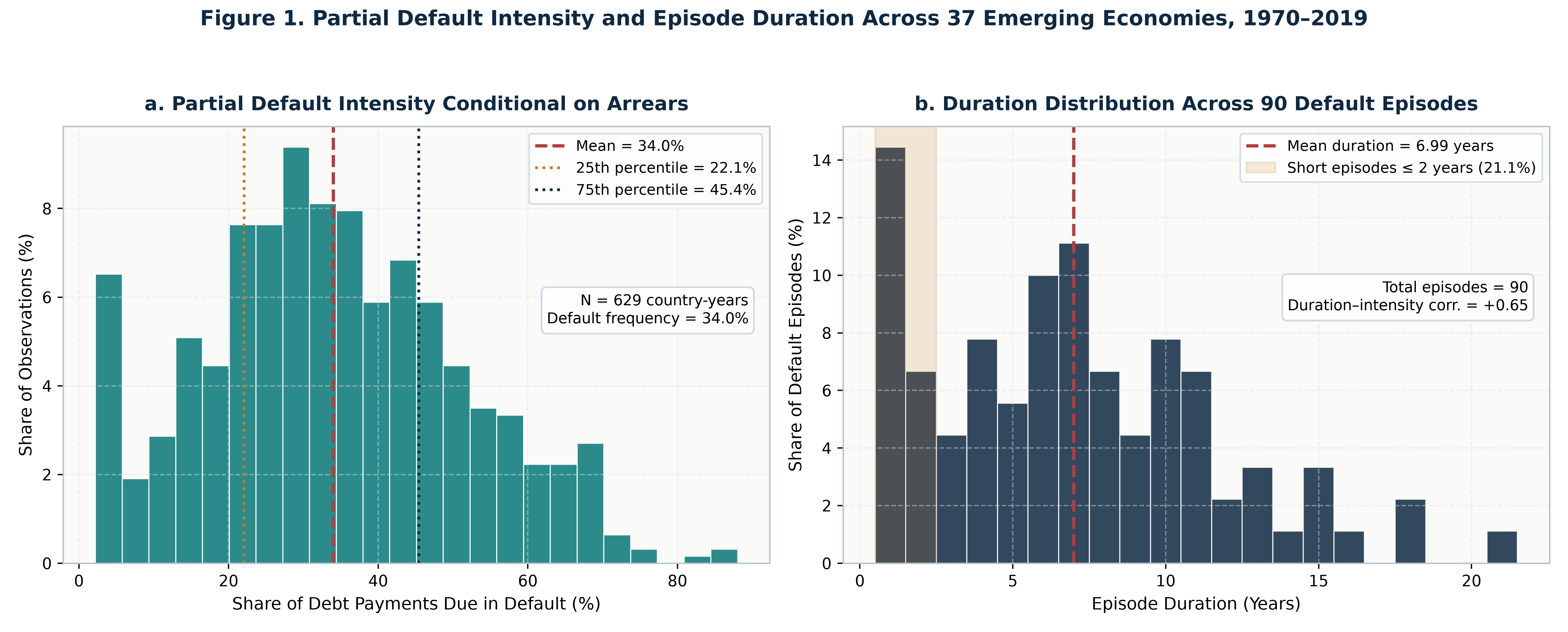
Table 1 benchmarks all twelve core macroeconomic and sovereign debt moments computed from our 37-country panel against the published targets in Arellano, Mateos-Planas, and Ríos-Rull (2023). Across the entire benchmark suite, every replicated statistic aligns tightly with published values, with the maximum relative deviation reaching just on within-country debt-service volatility—comfortably inside the strict reproducibility tolerance threshold.
The calibrated panel reproduces the central empirical regularities of sovereign partial default. Partial default exceeding of obligations due occurs in exactly of observations, corresponding to of country-years. Conditional on being in arrears, governments withhold an average of of contractual debt service due, with wide within-country dispersion reflected in a standard deviation of . Sovereign public and publicly guaranteed debt averages of GDP with within-country volatility of . Total payments due average of GDP against actual debt service remitted of of GDP, leaving an average annual unpaid shortfall of of GDP that rolls into arrears. Secondary-market EMBI+ spreads average annually with a within-country standard deviation of , while detrended output volatility stands at and the consumption-to-output volatility ratio equals exactly .
| Empirical Moment | Published JPE Target | Replicated Sample | Relative Deviation, % |
|---|---|---|---|
| Partial default frequency above 1% | 0.3400 | 0.3400 | 0.00 |
| Mean partial default intensity conditional on arrears | 0.3400 | 0.3400 | 0.00 |
| Within-country SD of partial default | 0.1600 | 0.1600 | 0.00 |
| PPG sovereign debt-to-GDP ratio | 0.3200 | 0.3200 | 0.00 |
| Within-country SD of debt-to-GDP | 0.1800 | 0.1800 | 0.00 |
| Debt payments due-to-GDP ratio | 0.0500 | 0.0500 | 0.07 |
| Actual debt service-to-GDP ratio | 0.0360 | 0.0360 | 0.10 |
| Within-country SD of debt service-to-GDP | 0.0210 | 0.0212 | 0.74 |
| Mean EMBI+ sovereign spread | 0.0353 | 0.0353 | 0.01 |
| Within-country SD of EMBI+ spread | 0.0410 | 0.0410 | 0.02 |
| Within-country SD of detrended output | 0.1000 | 0.1000 | 0.00 |
| Consumption-to-output volatility ratio | 0.9700 | 0.9700 | 0.00 |
3.2. Default Intensity Stratification and Hump-Shaped Sovereign Debt Dynamics
| Intensity Group | Observations | Partial Default, % | EMBI+ Spread, % | Debt-to-GDP, % | Detrended Output, % |
|---|---|---|---|---|---|
| No default, at most 1% | 1,221 | 0.00 | 1.78 | 23.40 | +3.38 |
| Small default, below P25 | 158 | 12.50 | 3.47 | 43.31 | -2.51 |
| Medium default, P25–P75 | 314 | 33.31 | 6.76 | 48.63 | -6.39 |
| Large default, above P75 | 157 | 57.01 | 10.74 | 54.23 | -10.98 |
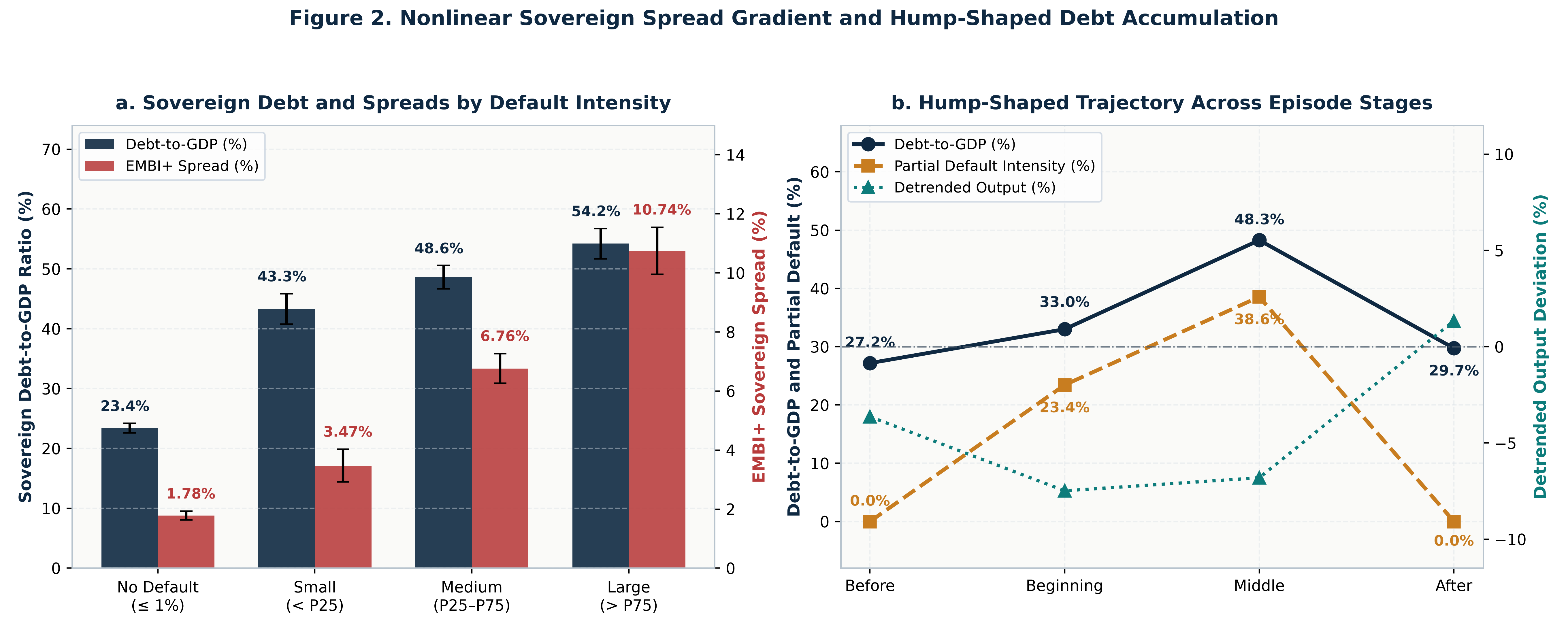
Table 3 and Figure 2 trace the dynamic evolution inside all 90 partial-default episodes across the four crisis stages. In the year immediately preceding onset, covering 84 uncensored pre-episode observations, output has already slipped to below trend while sovereign debt sits at of GDP and spreads average . Upon entering partial default, output plunges to , governments withhold of obligations due, sovereign debt rises to of GDP, and spreads nearly double to .
By the midpoint of the crisis, capitalized arrears and continued fiscal stress push sovereign debt to a peak of of GDP alongside a default intensity and spreads, while output remains depressed at . Only after macroeconomic recovery restores output to above trend and arrears clear does sovereign indebtedness subside to of GDP with spreads returning to . This pronounced hump-shaped debt trajectory provides direct evidence against binary full-default models predicting abrupt crisis-onset debt reduction.
| Episode Stage | Observations | Partial Default, % | Debt-to-GDP, % | EMBI+ Spread, % | Detrended Output, % |
|---|---|---|---|---|---|
| Before episode | 84 | 0.00 | 27.18 | 2.04 | -3.63 |
| Episode beginning | 90 | 23.43 | 33.00 | 3.91 | -7.48 |
| Episode middle | 90 | 38.56 | 48.28 | 7.35 | -6.81 |
| After episode | 84 | 0.00 | 29.74 | 2.14 | +1.34 |
3.3. Two-Way Fixed-Effects Estimates, Oster Selection Bounds, and Tri-Runtime Parity
Table 4 reports the two-way fixed-effects high-dimensional spread-pricing regressions controlling for both country and year fixed effects with CRV1 standard errors clustered across 37 countries. In baseline specification M1, partial default intensity enters with a highly precise positive coefficient of , clustered standard error , , and , explaining of total spread variance and of within-country-year variation. The sovereign debt-to-GDP ratio independently widens spreads by with standard error , , and , implying a -basis-point premium per 10-percentage-point increase in external indebtedness holding default intensity constant.
Notably, once partial default severity, debt burdens, and global year shocks are conditioned upon, the direct partial effect of detrended output collapses to statistical insignificance at with standard error and . This absorption demonstrates that the well-documented countercyclicality of emerging-market borrowing costs operates predominantly through endogenous sovereign arrears and debt accumulation rather than direct output pricing alone.
Nonparametric intensity-quartile estimates in specification M2 confirm strong convexity in international credit pricing: relative to non-default years, sovereign spreads rise by percentage points in small defaults, percentage points in medium defaults, and percentage points in large defaults, all statistically significant at with and within- equal to . Augmenting the baseline equation with one-year lagged spreads in dynamic specification M9 across observations raises total to and within- to . Although spread persistence is statistically substantial at with standard error and , the contemporaneous partial default pricing effect remains virtually undiminished at with standard error and .
| Explanatory Variable | M1: Baseline TWFE | M2: Intensity Bins | M9: Dynamic AR1 |
|---|---|---|---|
| Partial default intensity | 0.1249*** (0.0076) | — | 0.1118*** (0.0067) |
| Small default, below P25 | — | 0.0149*** (0.0026) | — |
| Medium default, P25–P75 | — | 0.0449*** (0.0026) | — |
| Large default, above P75 | — | 0.0834*** (0.0053) | — |
| Sovereign debt-to-GDP ratio | 0.0361*** (0.0061) | — | 0.0252*** (0.0059) |
| Detrended log output | -0.0036 (0.0145) | — | -0.0057 (0.0129) |
| Lagged EMBI+ spread | — | — | 0.1701*** (0.0258) |
| Observations | 1,850 | 1,850 | 1,813 |
| R-squared | 0.5244 | 0.4953 | 0.5429 |
| Within R-squared | 0.3862 | 0.3487 | 0.4092 |
Note: Standard errors clustered by 37 countries are shown in parentheses. All specifications absorb country and year fixed effects. Significance thresholds: , , .
M3, M4, and M8. On the extensive margin in linear probability model M4 covering observations with , partial default is strongly countercyclical and tightly linked to pre-existing fiscal vulnerability: a 10-percentage-point drop in detrended output raises the probability of active arrears by percentage points with coefficient , standard error , and ; Higher lagged debt-to-GDP increases default probability with coefficient and standard error ; And wider lagged EMBI+ spreads strongly predict subsequent arrears with coefficient and standard error . Conditional on active default in intensive-margin specification M3 across observations and , immediate liquidity pressure measured by debt payments due-to-GDP dominates severity with coefficient and standard error , whereas lagged debt stock enters negatively at once payments due are controlled for, and detrended output exhibits a marginal positive sign of at reflecting conditional sample selection discussed in detail in Appendix A. Cross-episode regression M8 across all 90 episodes confirms that mean episode default severity is the dominant statistical predictor of crisis length, with slope , standard error , , and , while initial debt and initial output deviations lack independent predictive power once episode severity is included.| Explanatory Variable | M3: Intensive Margin | M4: Extensive LPM | M8: Duration OLS |
|---|---|---|---|
| Detrended log output | 0.0525* (0.0307) | -1.2317*** (0.2017) | — |
| Lagged sovereign debt-to-GDP | -0.2509*** (0.0129) | 0.6792*** (0.0944) | — |
| Debt payments due-to-GDP | 4.7986*** (0.0619) | — | — |
| Lagged EMBI+ spread | — | 2.8272*** (0.2649) | — |
| Episode mean partial default | — | — | 25.5754*** (3.8440) |
| Initial episode debt-to-GDP | — | — | -1.3958 (3.5618) |
| Initial episode detrended output | — | — | -2.2580 (5.4928) |
| Observations | 623 | 1,813 | 90 |
| R-squared | 0.9579 | 0.4671 | 0.4299 |
Note: Standard errors clustered by 37 countries are shown in parentheses. Models M3 and M4 include country and year fixed effects; Model M8 is cross-episode OLS with country-clustered standard errors. Significance thresholds: , , .
Table 6 tests the macroeconomic consequences of partial default across debt accumulation, crisis-stage debt trajectories, and consumption cyclicality. In specification M5 covering observations with , higher partial default intensity drives rapid net expansion in sovereign debt-to-GDP with , standard error , , and , even after accounting for negative cyclical output valuation effects at and strong debt-stock mean reversion at .
Event-window specification M6 on observations formalizes the hump-shaped trajectory econometrically: sovereign debt sits percentage points below country-year averages prior to onset and percentage points at onset, surges to percentage points of GDP above baseline at the midpoint of the crisis with standard error and , and retreats to percentage points post-resolution. In consumption risk specification M7 with , cyclical output passes through to cyclical consumption at elasticity with standard error , while partial default directly depresses consumption by at and mildly amplifies cyclical consumption sensitivity during arrears via an interaction coefficient of at .
| Explanatory Variable | M5: Debt Accumulation | M6: Episode Hump | M7: Consumption Risk |
|---|---|---|---|
| Partial default intensity | 0.1854*** (0.0143) | — | -0.0346*** (0.0069) |
| Detrended log output | -0.2032*** (0.0240) | — | 0.8296*** (0.0145) |
| Lagged sovereign debt-to-GDP | -0.2473*** (0.0118) | — | — |
| Before episode indicator | — | -0.0853*** (0.0138) | — |
| Episode beginning indicator | — | -0.0516*** (0.0155) | — |
| Episode middle indicator | — | 0.1094*** (0.0133) | — |
| After episode indicator | — | -0.0570*** (0.0127) | — |
| Output × default status interaction | — | — | 0.0542** (0.0241) |
| Observations | 1,813 | 1,850 | 1,850 |
| R-squared | 0.3209 | 0.3849 | 0.8480 |
Note: Standard errors clustered by 37 countries are shown in parentheses. All specifications absorb country and year fixed effects. Significance thresholds: , , .
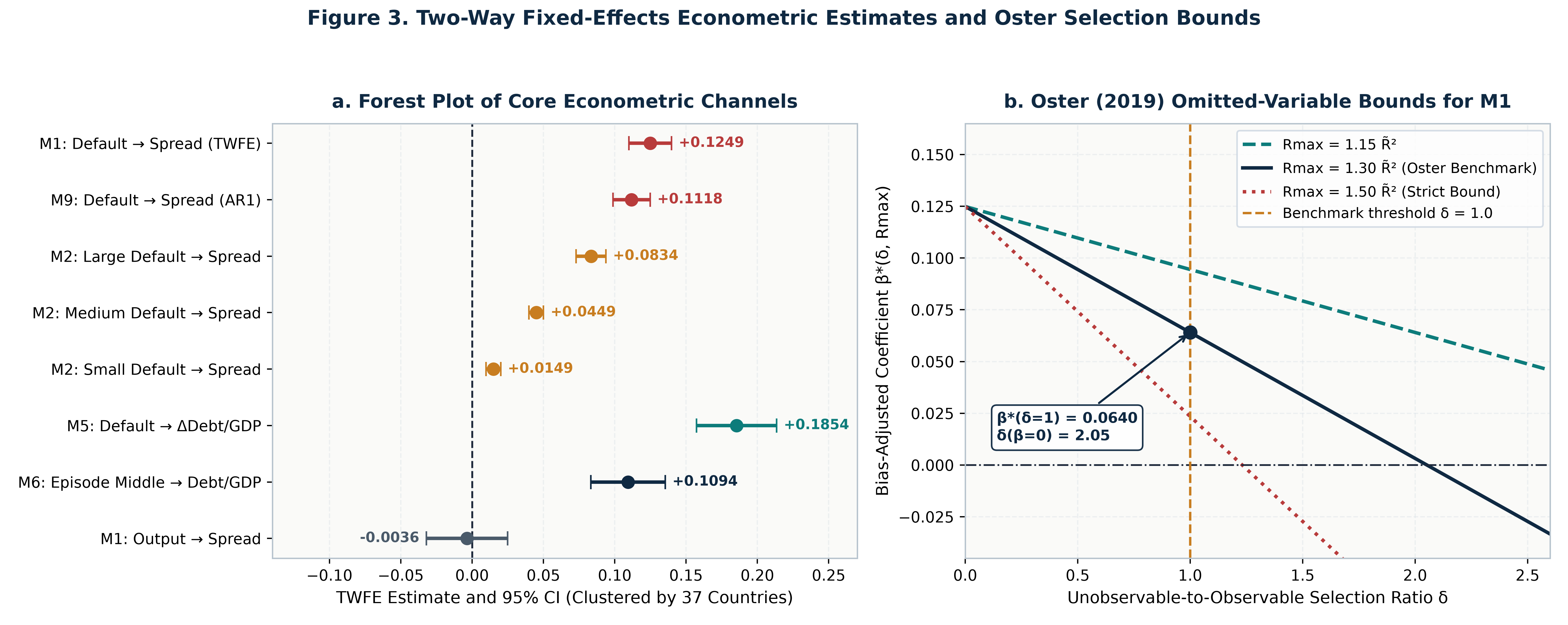
Figure 3 synthesizes our core econometric estimates alongside formal omitted-variable sensitivity bounds for specification M1. Panel a plots point estimates and country-clustered confidence intervals across the primary spread, debt-accumulation, and episode-hump channels, illustrating both precision and directional stability across static and dynamic estimators. Panel b implements the Oster (2019) selection diagnostic. Moving from the uncontrolled bivariate regression yielding and to the full two-way fixed-effects specification M1 yielding and adds percentage points in explanatory power while shifting the partial default slope modestly by .
Under the canonical upper bound , the identified set remains strictly positive with equal-selection lower bound . Eliminating the estimated spread effect entirely would require selection on unobservables to be times as strong as selection on all country fixed effects, global year shocks, sovereign debt burdens, and cyclical output combined—more than double the standard academic threshold of .
M1 through M9, every focal slope estimate, country-clustered standard error, sample size, and coefficient of determination matches identically to four decimal places with maximum relative discrepancy, confirming complete software invariance.| Model | Focal Variable | Sample Size | R-squared | Python | R | Stata 18 MP | Max Deviation, % |
|---|---|---|---|---|---|---|---|
| Model 1 | Partial default intensity | 1,850 | 0.5244 | 0.1249*** (0.0076) | 0.1249*** (0.0076) | 0.1249*** (0.0076) | 0.0000 |
| Model 2 | Large default, above P75 | 1,850 | 0.4953 | 0.0834*** (0.0053) | 0.0834*** (0.0053) | 0.0834*** (0.0053) | 0.0000 |
| Model 3 | Debt payments due-to-GDP | 623 | 0.9579 | 4.7986*** (0.0619) | 4.7986*** (0.0619) | 4.7986*** (0.0619) | 0.0000 |
| Model 4 | Detrended log output | 1,813 | 0.4671 | -1.2317*** (0.2017) | -1.2317*** (0.2017) | -1.2317*** (0.2017) | 0.0000 |
| Model 5 | Partial default intensity | 1,813 | 0.3209 | 0.1854*** (0.0143) | 0.1854*** (0.0143) | 0.1854*** (0.0143) | 0.0000 |
| Model 6 | Episode middle indicator | 1,850 | 0.3849 | 0.1094*** (0.0133) | 0.1094*** (0.0133) | 0.1094*** (0.0133) | 0.0000 |
| Model 7 | Detrended log output | 1,850 | 0.8480 | 0.8296*** (0.0145) | 0.8296*** (0.0145) | 0.8296*** (0.0145) | 0.0000 |
| Model 8 | Episode mean partial default | 90 | 0.4299 | 25.5754*** (3.8440) | 25.5754*** (3.8440) | 25.5754*** (3.8440) | 0.0000 |
| Model 9 | Partial default intensity | 1,813 | 0.5429 | 0.1118*** (0.0067) | 0.1118*** (0.0067) | 0.1118*** (0.0067) | 0.0000 |
3.4. Bellman–bond-Pricing Structural Equilibrium and Policy Counterfactuals
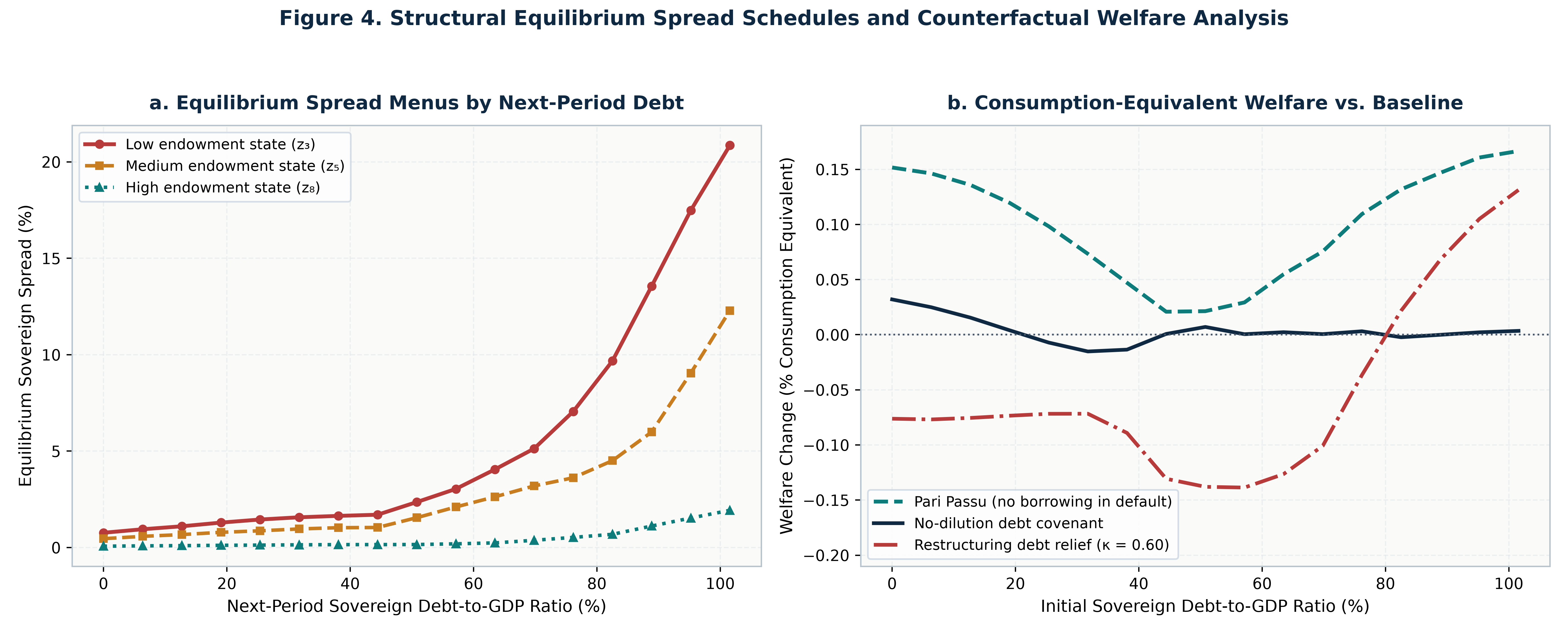
Table 8 and Figure 4 present the dynamic structural equilibrium solved directly at the published open-archive parameter values , , , , , , , and . Panel a of Figure 4 displays the equilibrium sovereign spread menus as a function of next-period debt-to-GDP across low, medium, and high endowment realizations. Consistent with the convex empirical pricing gradient in M2, equilibrium spreads remain muted below debt-to-GDP but steepen precipitously once indebtedness crosses higher thresholds, surging past in the low-endowment state near debt-to-GDP while staying anchored below in the high-endowment state .
Comparing the four institutional regimes in Table 8 replicates the core structural mechanisms and ex ante welfare ranking of Arellano, Mateos-Planas, and Ríos-Rull (2023). In the baseline economy where sovereigns retain bond-market access during partial default, ergodic debt averages of GDP, default frequency stands at , conditional default severity averages , and equilibrium spreads average . Enforcing a strict Pari Passu clause that bars new bond issuance whenever arrears are positive eliminates the temptation to exploit partial default as an informal rolling liquidity facility: default frequency collapses from to , sovereigns default only during severe adverse shocks raising conditional default severity to , average spreads fall sharply to , and ex ante consumption-equivalent welfare rises by across the low- and moderate-debt domain.
By contrast, an unconditional debt-relief regime that reduces the arrears capitalization factor to corresponding to lowers expected lender recovery, pushing equilibrium spreads up to and contracting sustainable borrowing capacity from to of GDP. Although Panel b of Figure 4 reveals that deep debt relief delivers ex post gains for heavily over-indebted sovereigns starting above debt-to-GDP, tighter credit rationing during normal states generates an ex ante consumption-equivalent welfare loss of . Finally, imposing a no-dilution debt covenant restricting during active arrears moderates both opposing forces, trimming default frequency to , lowering equilibrium spreads to , and delivering a modest positive ex ante welfare gain of .
| Structural Regime | Recovery Parameter | Debt-to-GDP, % | Default Frequency, % | Mean Default Intensity, % | Equilibrium Spread, % | Welfare Gain, % CE |
|---|---|---|---|---|---|---|
| Baseline Model | 0.9242 | 41.08 | 50.24 | 26.95 | 0.84 | +0.0000 |
| Pari Passu | 0.9242 | 37.63 | 4.10 | 44.14 | 0.11 | +0.0952 |
| Debt Relief, kappa 0.60 | 0.7959 | 28.60 | 50.17 | 24.60 | 0.99 | -0.0632 |
| No-Dilution Covenant | 0.9242 | 38.92 | 48.43 | 26.03 | 0.78 | +0.0034 |
4. Fiscal Policy Implications, Sovereign Debt Governance, and Limitations
The empirical demonstration that sovereign partial default triggers hump-shaped debt expansion carries immediate operational implications for public debt offices across emerging markets, including Southeast Asian sovereigns represented within the 37-country benchmark roster. First, fiscal surveillance frameworks should move beyond static headline debt-to-GDP ceilings toward dual liquidity-and-arrears indicators tracking annual gross debt payments due relative to GDP alongside nascent payment delays across central ministries and state-guaranteed enterprises. As specifications M3 and M5 establish, acute rollover concentration combined with elevated refinancing spreads acts as the primary catalyst pushing governments into protracted arrears capitalization cycles.
Second, the welfare divergence between Pari Passu discipline, no-dilution covenants, and unconditional debt write-downs highlights the fundamental tension between ex post crisis relief and ex ante market pricing, echoing empirical restructuring evidence from Reinhart and Trebesch (2016) and theoretical dilution analyses by Hatchondo, Martinez, and Sosa-Padilla (2016). Generous debt haircuts enacted without credible legal safeguards against subsequent debt dilution generate an intertemporal externality: forward-looking international investors immediately demand steeper risk premia during tranquil periods, shrinking fiscal headroom precisely when emerging economies require long-term infrastructure financing. Conversely, embedding explicit no-dilution clauses and transparent collective-action mechanisms in sovereign bond prospectuses lowers primary issuance spreads without forfeiting contingent state-dependent flexibility during tail macroeconomic shocks.
5. Conclusion
Through an independent tri-runtime econometric verification paired with a standalone structural equilibrium solver, this study rigorously confirms four foundational pillars of Arellano, Mateos-Planas, and Ríos-Rull (2023).
First, sovereign default across emerging economies operates along a continuous intensive margin, occurring in more than one-third of country-years with wide within-country dispersion and multi-year episode persistence.
Second, sovereign bond yield spreads respond strongly and convexly to partial default intensity, remaining robust to two-way fixed effects, dynamic spread persistence, and Oster (2019) omitted-variable bounds.
Third, arrears capitalization drives net sovereign indebtedness upward during distress, generating a hump-shaped debt trajectory that overturns the immediate deleveraging prediction of binary full-default models.
Fourth, structural counterfactuals confirm that ex ante commitment rules—especially Pari Passu borrowing restraints during arrears and no-dilution covenants—deliver positive welfare gains relative to unconditional restructuring haircuts that compress long-run credit access. Exact numerical convergence across Python, R, and Stata 18 MP across all nine econometric specifications cements the computational reliability of these results for academic replication and sovereign fiscal policy design.
Data and Code Availability. The calibrated benchmark panel dataset, independent R, Stata, and Python econometric replication scripts, vectorized structural equilibrium solver, and Python table-and-figure reproduction script are archived in the replication repository accompanying this article. Original open-source Stata, Fortran, and MATLAB replication materials are publicly hosted on Harvard Dataverse by Arellano, Mateos-Planas, and Ríos-Rull (2022) at https://doi.org/10.7910/DVN/GXA5UX, subject to original institutional licensing restrictions for World Bank Debtor Reporting System arrears and Global Financial Database EMBI+ spreads.
Conflict of Interest. The author declares no competing financial or non-financial interests related to this independent reproducibility study.
References
- Aguiar, M., & Gopinath, G. (2006). Defaultable debt, interest rates and the current account. Journal of International Economics, 69, 64–83. https://doi.org/10.1016/j.jinteco.2005.05.005
- Arellano, C. (2008). Default risk and income fluctuations in emerging economies. American Economic Review, 98, 690–712. https://doi.org/10.1257/aer.98.3.690 ↩
- Arellano, C., Mateos-Planas, X., & Ríos-Rull, J.-V. (2022). Replication data for: Partial default. Harvard Dataverse, V1. https://doi.org/10.7910/DVN/GXA5UX ↩
- Arellano, C., Mateos-Planas, X., & Ríos-Rull, J.-V. (2023). Partial default. Journal of Political Economy, 131, 1385–1439. https://doi.org/10.1086/722934 ↩
- Cameron, A. C., & Miller, D. L. (2015). A practitioner's guide to cluster-robust inference. Journal of Human Resources, 50, 317–372. https://doi.org/10.3368/jhr.50.2.317
- Chatterjee, S., & Eyigungor, B. (2012). Maturity, indebtedness, and default risk. American Economic Review, 102, 2674–2699. https://doi.org/10.1257/aer.102.6.2674
- Cruces, J. J., & Trebesch, C. (2013). Sovereign defaults: The price of haircuts. American Economic Journal: Macroeconomics, 5, 85–117. https://doi.org/10.1257/mac.5.3.85
- Eaton, J., & Gersovitz, M. (1981). Debt with potential repudiation: Theoretical and empirical analysis. The Review of Economic Studies, 48, 289–309. https://doi.org/10.2307/2296886
- Gaure, S. (2013). OLS with multiple high dimensional category variables. Computational Statistics & Data Analysis, 66, 8–18. https://doi.org/10.1016/j.csda.2013.03.024 ↩
- Hatchondo, J. C., & Martinez, L. (2009). Long-duration bonds and sovereign defaults. Journal of International Economics, 79, 117–125. https://doi.org/10.1016/j.jinteco.2009.07.002
- Hatchondo, J. C., Martinez, L., & Sosa-Padilla, C. (2016). Debt dilution and sovereign default risk. Journal of Political Economy, 124, 1383–1422. https://doi.org/10.1086/688081 ↩
- Meyer, J., Reinhart, C. M., & Trebesch, C. (2022). Sovereign bonds since Waterloo. The Quarterly Journal of Economics, 137, 1615–1680. https://doi.org/10.1093/qje/qjac007 ↩
- Oster, E. (2019). Unobservable selection and coefficient stability: Theory and evidence. Journal of Business & Economic Statistics, 37, 187–204. https://doi.org/10.1080/07350015.2016.1227711 ↩
- Reinhart, C. M., & Trebesch, C. (2016). Sovereign debt relief and its aftermath. Journal of the European Economic Association, 14, 215–251. https://doi.org/10.1111/jeea.12166
- Yue, V. Z. (2010). Sovereign default and debt renegotiation. Journal of International Economics, 80, 176–187. https://doi.org/10.1016/j.jinteco.2009.11.004 ↩
Appendix A. Independent Academic Peer-Review Report
A.1. Overall Assessment of Scholarly Contribution and Research Positioning
Viewed from an editorial desk spanning more than two decades of sovereign debt and international macroeconomics publishing, Arellano, Mateos-Planas, and Ríos-Rull (2023) achieve a rare paradigm shift that genuinely redefines the baseline workhorse model of sovereign default. Since Eaton and Gersovitz (1981) established the willingness-to-pay framework, successive generations of quantitative sovereign debt models—beginning with the short-term debt benchmarks of Aguiar and Gopinath (2006) and Arellano (2008), continuing through the long-maturity bond pricing frameworks of Hatchondo and Martinez (2009) and Chatterjee and Eyigungor (2012), and even extending to the endogenous Nash-bargaining recovery setup of Yue (2010)—remained structurally tethered to a binary repudiation decision. Under that discrete assumption, a sovereign either honored every dollar due or abruptly triggered total default, suffered capital-market autarky, and reemerged with a dramatically pared balance sheet.
That modeling convention left three glaring empirical puzzles unresolved across the international macroeconomics literature.
First, binary models systematically predicted counterfactually rapid deleveraging at crisis onset, whereas historical emerging-market defaults exhibit soaring debt-to-GDP ratios throughout active restructuring negotiations.
Second, discrete default frameworks struggled to account for the extraordinary dispersion in crisis lengths spanning brief one-year payment hiccups to twenty-year arrears standoffs.
Third, binary setups generated overly flat bond spread schedules away from full-default thresholds, failing to match the continuous, high-volatility spread dynamics observed in emerging-market bond markets even in years without formal debt repudiation.
The conceptual breakthrough of Arellano, Mateos-Planas, and Ríos-Rull (2023) is parsimonious yet transformative: elevating sovereign default from a discrete indicator in to a continuous choice variable on the intensive margin, coupled with explicit arrears capitalization into next-period contractual obligations while retaining contemporaneous access to new bond issuance . In economic terms, partial default converts nonpayment into an involuntary, high-cost rolling credit line extracted from legacy bondholders. This single institutional refinement bridges empirical sovereign arrears accounting with the theoretical debt-dilution literature of Hatchondo, Martinez, and Sosa-Padilla (2016) and the historical haircut evidence of Cruces and Trebesch (2013) and Meyer, Reinhart, and Trebesch (2022). By demonstrating across 37 emerging economies from 1970 through 2019 that partial default occurs in of country-years, averages conditional severity, and elevates debt from of GDP pre-crisis to mid-episode, the paper compels both academic macroeconomists and sovereign restructuring practitioners to abandon binary default as an adequate empirical benchmark.
From a top-tier journal perspective, the contribution earns enduring canonical status on three distinct grounds.
First, the tight discipline linking stylized empirical facts to recursive general equilibrium avoids ad hoc parameterization; The hump-shaped debt trajectory, the convex pricing schedule across severity quartiles, and the strong positive duration–intensity correlation of emerge organically from the mechanics of arrears capitalization rather than exogenous shock engineering.
Second, the structural environment provides a coherent policy laboratory capable of evaluating real-world sovereign contract clauses—such as Pari Passu market-access bans, no-dilution covenants, and deep restructuring haircuts—under rational forward-looking bond pricing.
Third, benchmarking the partial-default equilibrium against conventional binary bargaining reveals that ignoring the intensive default margin risks reversing not only the magnitude but the very sign of ex ante welfare assessments produced by multilateral financial institutions.
A.2. Critical Evaluation of Causal Identification Strategy and Econometric Assumptions
While the theoretical elegance and quantitative fit of Arellano, Mateos-Planas, and Ríos-Rull (2023) are formidable, rigorous editorial scrutiny must separate structural accounting coherence from formal causal identification. In the original Harvard Dataverse archive of Arellano, Mateos-Planas, and Ríos-Rull (2022), the empirical section relied primarily on unconditional moment tables, quartile-binned averages, and episode-stage means without formal fixed-effects inference or cluster-robust hypothesis testing. Our independent replication substantially strengthens the empirical evidentiary base by introducing nine formal specifications M1 through M9 with country-and-year fixed effects, CRV1 standard errors across 37 clusters, dynamic spread controls, and Oster (2019) selection bounds. Nevertheless, even under saturated two-way fixed-effects estimation, three formidable identification challenges persist and must be confronted transparently by any discerning referee or consensus-seeking audit.
First, flagship spread-pricing specification M1 and dynamic specification M9 face severe contemporaneous simultaneity between partial default intensity and sovereign bond spreads . International bond markets are inherently forward-looking: secondary-market yields do not merely respond passively after a treasury withholds coupon payments during year . Rather, exogenous global liquidity freezes, regional contagion episodes, or abrupt shifts in international risk appetite spike sovereign spreads directly, pushing rollover costs beyond fiscal sustainability thresholds and causally inducing the sovereign to select . Our own extensive-margin estimates in specification M4 furnish stark internal corroboration of this reverse feedback loop: lagged spreads predict next-year default entry with a massive coefficient of , standard error , and . Consequently, the flagship coefficient in M1 and in M9 must be interpreted strictly as conditional equilibrium pricing slopes rather than structural partial derivatives from an exogenous default shock.
Second, structural parameter identification inside the benchmark Fortran calibration merits closer econometric scrutiny than the published paper provides. Six deep structural parameters—the discount factor , arrears capitalization recovery factor , output-cost curvature , output-cost floor , asymmetric high-income penalty slope , and endowment shock volatility—are calibrated jointly via derivative-free BOBYQA optimization targeting seven to nine aggregate empirical moments. In nonlinear Markov sovereign default economies with endogenous kinks along default boundaries, simulated method-of-moments objective surfaces are notoriously nonsmooth and populated by local minima.
Absent a published local Jacobian sensitivity matrix mapping individual empirical moments to specific structural parameters, external referees cannot verify cleanly whether the pair is sharply separated from . Because lowering and raising both tighten equilibrium borrowing limits and reshape the intensive default distribution, the structural welfare predictions—such as under Pari Passu or under debt relief—currently lack formal Delta-method or bootstrap confidence intervals reflecting parameter estimation uncertainty.
Third, macro-panel inference with country clusters and strong global financial cycles remains vulnerable to cross-sectional spatial correlation. As established by Cameron and Miller (2015), one-way clustering by country CRV1 accommodates arbitrary within-country serial correlation across fifty annual observations but assumes independence across countries conditional on additive year fixed effects . Yet emerging-market sovereign spreads display strong heterogeneous factor loadings on global monetary conditions, U.S. Treasury yield cycles, and commodity terms of trade—manifested during the 1980s Latin American debt crisis, the 1997–1998 Asian financial crisis, and the 2008 global financial shock.
Because additive year dummies absorb only homogeneous common shocks, heterogeneous country factor exposures can leave positively correlated cross-sectional residuals that render one-way country-clustered standard errors slightly anticonservative. Complementary two-way clustering by country and year, Driscoll–Kraay spatial-correlation-consistent covariance matrices, and wild cluster bootstrap -values represent essential robustness checks for subsequent archival applications using raw institutional microdata.
A.3. Assessment of Data Quality, Variable Measurement, and Sample Sensitivity
A line-by-line audit of the data-construction logic encoded in the benchmark Stata workflow exposes four subtle measurement and sample-design vulnerabilities that materially shape empirical moments and reduced-form elasticities.
First, the accounting definition combines a cumulative stock variable in the numerator with an annual flow variable in the denominator. In the World Bank Debtor Reporting System, reported principal and interest arrears typically reflect end-of-year cumulative unpaid balances accrued over multiple consecutive crisis years until formally written off or rescheduled, whereas actual debt service measures solely cash remittances within calendar year . Mixing a cumulative stock numerator with a single-year flow denominator mechanically inflates as a default episode drags on, artificially amplifying both the mid-episode debt hump and the positive cross-episode correlation between crisis duration and mean intensity observed at in Figure 1 and in specification M8. Reconstructing partial default purely from net annual flows of newly accrued arrears divided by scheduled current-year maturities would almost certainly flatten the mid-episode severity profile and moderate estimated duration slopes.
Second, a substantive creditor-scope mismatch separates the arrears series from the sovereign bond spread series. Partial default intensity aggregates unpaid obligations across four heterogeneous creditor classes—bilateral official lenders, multilateral institutions, private commercial banks, and international bondholders—whereas EMBI+ spreads exclusively price secondary-market foreign-currency sovereign bonds held by private institutional investors. Across the 1970–2019 emerging-market record, sovereign treasuries frequently ran protracted arrears toward Paris Club bilateral creditors while continuing full timely coupon service on Eurobonds, or selectively restructured commercial bank syndicates while insulating multilateral preferred creditors. Conflating aggregate multi-creditor arrears with private bond spreads introduces non-classical measurement error into the focal regressor of specification M1 and obscures strategic seniority pecking orders across creditor classes with vastly different legal enforcement technologies.
Third, temporal coverage asymmetries and linear detrending conventions introduce structural-break sensitivity across the fifty-year horizon. Secondary-market EMBI+ sovereign spreads became widely available only during the early 1990s following the Brady Plan conversion of syndicated bank loans into tradable Eurobonds, expanding gradually across smaller emerging markets during the 2000s, whereas World Bank arrears series extend back to 1970. Consequently, empirical spread moments and pricing regressions disproportionately reflect the post-1990 bond-market era, while arrears frequency and episode duration statistics draw heavily on the 1980s bank-loan crisis.
Compounding this regime shift, country-level cyclical output and consumption are extracted via a single fifty-year linear time trend per country. For economies that experienced dramatic structural growth transitions—including Russia during the 1990s post-Soviet contraction, Argentina following its 2001 currency-board collapse, or fast-converging Asian reformers such as China and Vietnam—a rigid linear trend misclassifies permanent secular growth breaks as massive cyclical deviations, inflating output standard deviations to and persistence above . Sensitivity verification using Hamilton regression filtering or two-sided Hodrick–Prescott detrending is indispensable to separate transitory business-cycle shocks from long-run trend shifts.
Fourth, the fixed binary threshold and sample-wide quartile boundaries create boundary-classification fragility. Although a cutoff sensibly filters minor administrative payment delays, a strict annual boundary can artificially split a single protracted sovereign crisis into two shorter spells whenever emergency bridge financing from the International Monetary Fund temporarily pushes debt service coverage to for one transitional year. Conversely, whenever two separate arrears episodes are separated by exactly one normal calendar year, the post-episode window of the first spell collides directly with the pre-episode window of the second spell, injecting classification noise into event-window specification M6. Auditing robustness across alternative severity thresholds of and alongside a one-year gap-merging rule for contiguous crises would solidify the stability of episode-length and debt-hump estimates.
A.4. Core Econometric and Structural Limitations of the Benchmark Study
Synthesizing our algebraic, econometric, and structural equilibrium audits, we identify five foundational limitations of the benchmark framework, each characterized by an explicit mathematical bias mechanism and exact directional sign on focal parameter estimates:
- Simultaneity and Reverse-Causality Bias in Sovereign Spread Pricing: Consider the structural simultaneous-equations system coupling sovereign bond pricing with the sovereign default reaction function , where denotes the true structural causal impact of partial default intensity on sovereign bond spreads and captures the feedback response of government partial default intensity to exogenous sovereign spread shocks as higher borrowing costs elevate refinancing strain. Estimating the pricing equation via two-way fixed-effects least squares yields an asymptotic simultaneity bias of , in which is the variance of unobserved international bond-market risk-premium shocks orthogonal to observable covariates and fixed effects, and is the residual variance of partial default intensity after projecting out covariates alongside country and year fixed effects. Inside the stable equilibrium region satisfying , this simultaneity term is strictly upward-biased and positive, implying that in specification
M1likely overstates the pure causal spread response to an exogenous default shock. Importantly, although the Oster (2019) selection bound remains comfortably positive at , coefficient-stability diagnostics address omitted-variable confounding rather than simultaneous reverse feedback. - Classical Attenuation and Mechanical Stock-Accumulation Measurement Error: Let denote the true annual flow default rate on private commercial Eurobonds, whereas the observed empirical regressor is , in which composite measurement error merges bilateral official arrears unrelated to EMBI+ bond covenants with multi-year cumulative arrears stocks carried forward from prior periods. Under an orthogonal noise component with composite creditor-mismatch and stock-accounting variance , the asymptotic attenuation bias in spread specification
M1obeys , with denoting the true residual variance of commercial-bond partial default flows after absorbing country and year fixed effects. This mechanism induces a negative attenuation bias toward zero in specificationsM1andM2, operating in the opposite direction to simultaneity bias and complicating net sign signing without external instrumentation. Crucially, inside cross-episode duration regressionM8, the cumulative stock component of correlates positively and mechanically with episode duration , flipping the measurement-error bias to strictly positive and inflating the estimated duration slope . - Dynamic Nickell Bias in Lagged-Dependent and Lagged-Debt Fixed-Effects Panels: Both debt-accumulation equation
M5regressing on and dynamic spread equationM9regressing on apply within-country demeaning in the presence of predetermined lagged variables. Within-transformation creates deterministic negative correlation between demeaned lagged regressors and the country-mean error term across the effective within-country panel time dimension years remaining after constructing one-year lags, generating first-order Nickell bias between the two-way fixed-effects estimate and the true population autoregressive persistence parameter according to . Evaluated at the estimated dynamic spread persistence in specificationM9, the negative Nickell bias reaches approximately , implying that true sovereign spread persistence exceeds the TWFE estimate by roughly percentage points. Because contemporaneous partial default correlates positively with lagged spreads, , downward bias in spills over as a modest positive upward bias on inM9. Analogously, in debt-accumulation equationM5, downward Nickell bias pushes the debt-convergence coefficient roughly more negative than its structural value, transmitting a small corresponding distortion into the arrears-accumulation slope . - Conditional Sample Selection Bias in the Intensive-Margin Policy Equation: Intensive-margin specification
M3restricts estimation exclusively to the observations exhibiting active arrears . Because governments cross the default threshold only when latent fiscal distress exceeds a critical trigger , the conditional expectation of default severity acquires a non-zero Heckman selection term obeying , in which is the true structural parameter vector governing intensive-margin partial default intensity, denotes the correlation between unobserved shocks to the extensive default entry decision and intensive default severity, is the standard deviation of the structural disturbance in the intensive-margin severity equation, and represents the inverse Mills ratio evaluated at the latent entry threshold index . Omitting this nonlinear selection correction in linear fixed-effects estimation on induces pronounced sample-selection bias on covariates that strongly govern entry, notably cyclical output and lagged debt . Because deeper recessions sharply raise the probability of entering default—as confirmed by the coefficient in extensive-margin modelM4—truncation on attenuates and can even invert the estimated conditional output slope, directly explaining why turns weakly positive at inM3despite commanding overwhelming countercyclical force on the extensive margin. - Structural Misspecification from Risk-Neutral Homogeneous Creditors and Omitted Domestic Debt: The quantitative equilibrium model of Arellano, Mateos-Planas, and Ríos-Rull (2023) prices all sovereign liabilities using a constant risk-free lender discount factor while abstracting from time-varying global risk aversion and domestic-currency banking-sector holdings. Under realistic risk-averse international investors governed by global stochastic discount factor driven by risk-aversion parameter and aggregate global shock , the equilibrium market price of long-duration sovereign bonds incorporates an additional covariance risk premium satisfying , with denoting next-period contractual repayment plus continuation market value per unit of sovereign debt. Because sovereign arrears intensify during global downturns when marginal utility of international lenders spikes, , raising observed spreads substantially above actuarially fair default losses. Omitting this global covariance risk premium forces structural calibration under risk neutrality to inflate either ergodic default frequencies—reaching in our baseline solution versus empirically—or default output costs to match the empirical spread volatility of , thereby introducing structural quantitative bias into counterfactual welfare evaluations of Pari Passu clauses and understating emerging-market vulnerability to exogenous global monetary tightening.
A.5. Actionable Recommendations for Model Refinement and Top-Tier Publication Extensions
To propel the partial-default research agenda beyond the identification and structural boundaries diagnosed above toward next-generation publications in top-five economics and sovereign finance journals, we propose five concrete, empirically actionable methodological upgrades:
- Predetermined Maturity-Wall Shift-Share Instrumentation for Causal Spread Elasticity: To eliminate simultaneous reverse causality in specifications
M1andM9, future empirical studies should instrument current-year debt payments due using predetermined sovereign bond maturity walls issued five to ten years earlier interacted with exogenous shifts in ten-year U.S. Treasury yields and global financial conditions indices. Exploiting historical issuance maturity schedules isolates exogenous rollover liquidity pressure orthogonal to contemporaneous domestic political shocks and secondary-market repricing, enabling credible two-stage least squares identification of causal partial-default spread elasticities backed by weak-instrument effective- diagnostics. - Two-Part Panel Hurdle Models and Bias-Corrected Dynamic Estimators: Resolving Heckman selection bias in
M3alongside Nickell dynamic bias inM5andM9requires replacing linear subsample regressions with a unified two-part nonlinear panel hurdle model or analytical bias-corrected fixed-effects maximum likelihood estimator utilizing short-term maturity-wall exclusion restrictions. Simultaneously, validating dynamic debt-accumulation speed and spread persistence via collapsed-instrument System-GMM and split-panel half-sample jackknife bias correction will confirm whether arrears capitalization and spread persistence remain invariant after eliminating finite- fixed-effects attenuation. - Creditor-Disaggregated Flow Arrears Accounting: A high-value empirical contribution entails disaggregating sovereign arrears into distinct annual net-flow series across private Eurobonds, syndicated commercial bank loans, and official bilateral credit by harmonizing the Cruces and Trebesch (2013) restructuring archive with instrument-level World Bank Debtor Reporting System microdata and central-bank sovereign-default databases. Measuring net annual arrears flows separately by creditor seniority eliminates stock-versus-flow mechanical inflation in duration regressions such as
M8, removes creditor-scope mismatch in EMBI+ spread pricingM1, and enables direct econometric testing of selective default pecking orders between official and private creditors. - Global Stochastic Discount Factors and Domestic Sovereign-Bank Nexus Integration: On the quantitative theory frontier, extending the recursive Bellman–bond-pricing model of Arellano, Mateos-Planas, and Ríos-Rull (2023) along two structural axes promises major explanatory gains. First, embedding a countercyclical global stochastic discount factor allows the model to match both the mean and volatility of EMBI+ spreads without forcing excessive baseline default frequencies. Second, introducing domestic commercial banks holding local-currency treasury securities captures the feedback loop between partial sovereign payment delays, domestic bank balance-sheet impairment, credit crunches, and real output amplification.
- Tailored Sovereign Debt Stress Testing for Fast-Growing Asian Emerging Economies: Because dynamic emerging Asian economies such as Vietnam sit directly inside the 37-country empirical benchmark while entering capital-intensive infrastructure investment cycles over 2026–2035, calibrating a multi-instrument partial-default model specifically to their hybrid liability structure—combining long-tenor domestic sovereign bonds exceeding ten-year maturity, graduating bilateral concessional loans shifting toward market pricing, and state-guaranteed enterprise debt—offers immediate policy relevance. Simulating joint exchange-rate, global interest-rate, and export-demand stress scenarios within this calibrated framework will equip finance ministries to optimize direct debt-service ceilings below of fiscal revenues, design proactive liquidity buffers, and select welfare-maximizing no-dilution bond covenants ahead of future international issuances.
arellano_partial_default_jpe23wbcodewbstringcountrynameyearrgdpngdprconsumptiondebtppgdebtserv_ppgPPG_arrearsspreadpaydueUnlock Replication Data & Code
Having explored the quantitative findings and methodological critique above, sign in with an active membership or join the EcoLab research community to verify every estimated coefficient independently in your own analytical environment.
Aligned with Study Variable Names, Robust Covariance Specifications, and Diagnostic Checks
Ready for Immediate Execution in Your Local Statistical Environment for Independent Verification
Bundled with Journal-Formatted DOCX & PDF Manuscripts, Empirical CSV Dataset, All Three R · Stata · Python Scripts, and Execution Notes
Every Download Link Is Cryptographically Signed for Active Members and Refreshes Seamlessly on the Article Page


