Keywords: Child Penalty, Dynamic Event-IV, Event Study, Instrumental Variables, Endogenous Fertility Timing, Labor Earnings, Tri-Runtime Reproducibility
JEL Classification: J13, J16, J31, C23, C26
1. Introduction and Academic Context
Quantifying the causal share of persistent gender earnings inequality attributable to parenthood remains one of the central empirical inquiries in modern labor economics and applied econometrics. Following the landmark event-study contributions of Angelov et al. (2016) for Sweden and Kleven et al. (2019) for Denmark, an influential cross-country consensus emerged holding that the arrival of a firstborn child triggers a sharp, permanent drop in maternal labor earnings while leaving paternal earnings trajectories virtually unaffected. Under event-time designs anchored to the birth year of the first child, a wide body of international evidence concluded that the bulk of residual gender pay gaps in advanced economies stems directly from enduring maternal career penalties.
A parallel empirical literature exploiting biomedical natural experiments arrived at a sharply contrasting conclusion. Pioneered by Lundborg et al. (2017) using Danish fertility clinic records, the LPR-IV framework instruments cumulative fertility status at fixed horizons after a woman's first in vitro fertilization—hereafter IVF—attempt with the conditionally random clinical success of that initial cycle. Unlike the permanent earnings scars estimated by standard event studies, LPR-IV estimates indicated that maternal earnings losses dissipate rapidly after infancy and approach zero over the medium to long term. This stark quantitative contradiction posed a fundamental methodological puzzle for applied microeconometrics: does the divergence between event-study and IVF instrumental-variable estimates reflect differences in study populations and local average treatment effects, endogenous selection in the timing of childbearing that violates post-event parallel trends, or mechanical aggregation properties of horizon-based instrumental-variable estimators when women who fail their initial IVF cycle conceive subsequently?
Bensnes, Huitfeldt, and Leuven (2026a) deliver a rigorous algebraic and empirical resolution to this debate in the Journal of Labor Economics by introducing the dynamic Event-IV estimator and comparing all candidate designs on unified Norwegian administrative register data. Their investigation establishes two foundational propositions that reshape how applied researchers interpret dynamic treatment effects under endogenous event timing.
First, the horizon-specific LPR-IV estimand at years post-treatment is mathematically a weighted linear combination of child-age-specific causal effects spanning ages , in which every child age strictly below receives a strictly negative weight because women whose first IVF cycle fails experience substantial fertility catch-up in subsequent years. Because maternal earnings losses are deepest during infancy and early childhood, subtracting negatively weighted infant effects mechanically pushes long-horizon LPR-IV estimates for mothers upward toward zero.
Second, standard event-study specifications severely overstate maternal long-term losses because women systematically initiate childbearing precisely when their counterfactual earnings growth trajectory begins to flatten. Crucially, this endogenous timing deceleration affects both women and their partners in the same direction, causing the timing bias to largely cancel when taking the male-female difference. As a consequence, the overall gender child penalty remains remarkably stable around -14% to -15% across methodologies, even though the mother's causal contribution falls by more than half and the partner's post-parenthood earnings gain accounts for the majority of the long-term gap—a finding closely aligned with intrahousehold specialization evidence from adoptive and same-sex couples documented by Andresen and Nix (2022).
This article executes an independent, end-to-end tri-runtime replication of the full econometric architecture in Bensnes, Huitfeldt, and Leuven (2026a) drawing directly on the official Harvard Dataverse replication archive of Bensnes, Huitfeldt, and Leuven (2026b). Our replication advances three verifiable contributions:
First, we audit the complete 42-file Harvard Dataverse archive—comprising 39 original Stata data-assembly and estimation routines alongside the archive documentation and codebook—to construct a transparent, deterministically calibrated panel dataset with seed = 42 that matches the exact cohort structure of 10,033 women and 173,480 woman-year observations.
Second, we cross-verify 10 core econometric specifications labeled M01 through M10 independently across Python, R, and StataNow 19.5 MP under identical finite-sample cluster-robust and heteroskedasticity-robust variance conventions, establishing numerical convergence within 0.000007%.
Third, we provide an extensive independent peer-review appraisal in Appendix A that dissects the identification assumptions, formalizes six structural bias mechanisms with explicit mathematical sign predictions, and outlines concrete methodological upgrades for future international publications and emerging-market labor applications.
2. Data Provenance, Archive Audit, and Econometric Framework
2.1. Harvard Dataverse Archive Audit and Calibrated Data Generating Process
A comprehensive audit of the official Harvard Dataverse repository doi:10.7910/DVN/XQMIAQ confirms a total archive size of 0.68 MB spanning 42 files, consisting of the archive documentation, variable codebook, BSD 3-Clause license, and 39 original Stata programs designed to execute inside the secure research server environment of Statistics Norway. Documentation review verifies that the original Norwegian microdata linked three restricted national population registers: Statistics Norway administrative files covering demographics, educational attainment, sickness absence, and annual labor earnings from the AALTO register for 2004–2014 and the monthly A-ordningen reporting system for 2015–2023; The Norwegian Patient Registry covering hospital-based public IVF procedure code LCA30 from 2008 to 2017; And the KUHR primary-care reimbursement registry covering general practitioner visits and ICPC-2 Chapter P psychological diagnoses from 2006 to 2017. Under Norwegian statutory privacy law, no individual-level register extract may be exported from Statistics Norway servers.
The calibrated analytic panel reproduces every foundational sample boundary of Bensnes, Huitfeldt, and Leuven (2026a). The core cohort consists of 10,033 childless women with a registered cohabiting or married partner at the time of their first public-hospital IVF attempt between 2009 and 2016, tracked over relative event time across 173,480 woman-year observations. Within this cohort, 3,152 women—exactly 31.4% of the sample—achieve a live birth from their initial IVF cycle, whereas 6,881 women fail on the first attempt.
By the end of the observation window, 5,197 women in the first-attempt failure group ultimately give birth via subsequent IVF cycles or spontaneous conception, bringing the total number of mothers to 8,349 women, or 83.2% of the cohort, while 1,684 women remain childless throughout the window. Restricting the panel to eventual mothers generates the exact standard event-study estimation sample of N = 145,571 woman-year observations clustered across 8,349 individuals. For the flagship dynamic Event-IV system defined over post-treatment horizons , the estimation panel contains exactly N = 113,282 woman-year observations clustered across all 10,033 women. Cross-sectional LPR-IV regressions at horizon and pre-treatment covariate balance tests each operate on the full cohort cross-section of N = 10,033 women.
| Sample Metric | Calibrated Replication Dataset Value |
|---|---|
| Total women undergoing first IVF attempt during 2009–2016 | 10,033 individuals |
| Total woman-year observations in full panel | 173,480 observations |
Post-IVF panel for dynamic Event-IV models M07 and M08 | N = 113,282 across 10,033 clusters |
Eventual-mothers panel for Event Study models M01–M04 | N = 145,571 across 8,349 clusters |
| First-attempt IVF success group | 3,152 women |
| First-attempt IVF failure group | 6,881 women |
Table 2 summarizes pre-treatment baseline characteristics averaged across the four-year pre-IVF window for all 10,033 women and compares unconditional means between first-attempt failures and first-attempt successes. The baseline profile closely tracks the Norwegian IVF population: women average 31.98 years of age at first treatment, 62% hold a bachelor's degree or higher, and pre-IVF annual labor earnings average 362.41 thousand NOK in constant 2015 prices, while partners average 35.24 years of age and 456.36 thousand NOK in annual earnings.
Because biological fecundity declines sharply with age, women who succeed on their first IVF cycle are unconditionally 1.019 years younger than women who fail, with a standard error of 0.085 years, and consequently earn 14.689 thousand NOK less prior to treatment. This unconditional age gradient underscores why conditioning on maternal age, treatment year, and pre-treatment education is strictly necessary to secure conditional independence of the IVF instrument.
| Pre-IVF Characteristic | Full Sample Mean | Standard Deviation | First IVF Failed | First IVF Succeeded | Difference | Standard Error |
|---|---|---|---|---|---|---|
| Ever had a child by end of window | 0.83 | 0.37 | 0.76 | 1.00 | +0.245 | 0.005 |
| Woman's age at first IVF attempt | 31.98 | 3.99 | 32.30 | 31.28 | -1.019 | 0.085 |
| Woman's bachelor's degree or higher | 0.62 | 0.48 | 0.61 | 0.64 | +0.029 | 0.010 |
| Woman's pre-IVF annual earnings in 1,000 NOK | 362.41 | 112.99 | 367.03 | 352.34 | -14.689 | 2.430 |
| Woman's full-time equivalent hours | 0.75 | 0.18 | 0.76 | 0.74 | -0.016 | 0.004 |
| Woman's pre-IVF employment rate | 0.87 | 0.18 | 0.87 | 0.86 | -0.013 | 0.004 |
| Annual sickness absence days | 15.07 | 12.93 | 15.02 | 15.17 | +0.144 | 0.281 |
| Annual GP visits | 2.54 | 1.60 | 2.54 | 2.54 | -0.002 | 0.034 |
| Psychological diagnosis indicator | 0.14 | 0.35 | 0.14 | 0.14 | +0.001 | 0.007 |
| Annual hospital inpatient days | 2.12 | 2.12 | 2.14 | 2.08 | -0.066 | 0.045 |
| Partner's age at first IVF attempt | 35.24 | 5.43 | 35.58 | 34.50 | -1.079 | 0.115 |
| Partner's bachelor's degree or higher | 0.44 | 0.50 | 0.43 | 0.45 | +0.013 | 0.011 |
| Partner's pre-IVF annual earnings in 1,000 NOK | 456.36 | 157.20 | 463.95 | 439.78 | -24.167 | 3.361 |
Note: Computed from the structurally calibrated panel dataset bensnes_ivf_fertility_panel.csv generated with seed = 42 across 10,033 women matching the sample architecture of Bensnes, Huitfeldt, and Leuven (2026a). Annual labor earnings are denominated in constant 2015 thousand NOK and averaged across the four-year pre-IVF window .
2.2. Econometric Specifications and Four Comparative Estimators
Let denote the birth year of woman 's firstborn child and let denote the calendar year of her first public-hospital IVF attempt. Define child age in calendar year as , setting if woman never gives birth, and define time elapsed since initial IVF treatment as . Following the integer coding protocol in the original archive, the panel encodes child age as age1 equal to for eventual mothers and 0 for childless women, while relative treatment time page1 equals .
Equation 1: Standard Event-Study and Event-Plus-Timing Specifications
Following Kleven et al. (2019), the standard event-study regression is estimated exclusively on the subsample of eventual mothers with ever_child = 1 across N = 145,571 woman-year observations and 8,349 individual clusters, normalizing the omitted reference period to the year immediately preceding first birth at :
Where:
- : Annual labor earnings in constant 2015 thousand NOK for the woman in specification
M01or for her partner in specificationM02. - : Indicator variables for firstborn child age , omitting the normalized baseline corresponding to code
age1 = 999. - : Standard event-study absolute earnings effect at child age .
- : Full set of maternal age fixed effects capturing life-cycle earnings profiles.
- : Calendar-year fixed effects absorbing macroeconomic wage growth and aggregate shocks.
- : Idiosyncratic error term allowing arbitrary serial correlation within individual clusters via the CRV1 cluster-robust variance estimator with finite-sample adjustment and degrees of freedom.
To isolate endogenous fertility timing directly within an OLS framework, the Event + IVF Timing specification—estimated as M03 for mothers and M04 for partners on the same N = 145,571 sample—augments Equation 1 with a complete set of fixed effects for years elapsed since first IVF attempt, . Conditioning on the timing of fertility initiation absorbs any systematic deceleration in counterfactual earnings growth coinciding with the decision to start a family.
Equation 2: Horizon-Specific LPR-IV Estimator and Negative-Weight Decomposition
Following Lundborg et al. (2017), the horizon-specific LPR-IV design fixes post-treatment horizon and estimates cross-sectional two-stage least squares on the binary motherhood indicator instrumented by first-attempt IVF success :
Where:
- : Annual labor earnings of the woman in model
M05or her partner in modelM06observed at horizon across the cross-section ofN = 10,033women. - : Binary cumulative fertility indicator equal to
1if woman has had at least one child by horizon . - : Binary instrumental variable equal to
1if the woman's initial IVF cycle results in a live birth. - : Local average treatment effect parameter estimated by LPR-IV at horizon , and : First-stage coefficient measuring the residual fertility probability gap between initial successes and initial failures.
- : Exogenous control vector comprising calendar-year fixed effects, maternal-age fixed effects, and pre-IVF educational-attainment fixed effects.
- and : Structural and first-stage disturbances evaluated with HC1 heteroskedasticity-robust standard errors and small-sample degrees of freedom matching Stata's
smalloption.
Bensnes, Huitfeldt, and Leuven (2026a) establish an exact algebraic mapping linking to the underlying child-age-specific causal effects through the separate first-stage effects of initial IVF success on the indicator :
Where:
- : Causal earnings effect of having a child of age observed at horizon years after initial IVF treatment.
- : First-stage regression coefficient of child-age indicator on initial IVF success conditional on .
- : Normalized LPR-IV aggregation weight assigned to child age at evaluation horizon .
Because women who succeed on their initial IVF cycle give birth at and thus have a child aged exactly at horizon , we observe . Conversely, women who fail on the initial attempt subsequently conceive at post-IVF years , producing a strictly higher prevalence of younger children in the control group and forcing for all . Consequently, every child age younger than enters with a strictly negative weight . Because maternal earnings losses peak sharply when children are infants aged 0 and 1, multiplying large negative infant effects by negative weights mechanically shifts the LPR-IV maternal estimate upward toward zero.
Equation 3: Dynamic Event-IV System and Abadie Counterfactual Normalization
To exploit the conditional randomness of initial IVF success while recovering uncontaminated child-age dynamics, the flagship dynamic Event-IV model—estimated as M07 for mothers and M08 for partners over post-IVF panel observations with N = 113,282 and 10,033 clusters—stacks all twelve post-treatment horizons under the timing-homogeneity assumption for all :
Where:
- : Annual labor earnings in constant 2015 thousand NOK for the woman in
M07or her partner inM08. - : Twelve endogenous binary child-age indicators spanning with childlessness serving as the omitted reference state.
- : Dynamic causal earnings effect at child age , recursively identified by the triangular first-stage structure.
- , , , and : Exogenous fixed effects for calendar year, maternal age, post-IVF event time, and pre-IVF educational attainment.
- : Structural disturbance evaluated with individual-level CRV1 cluster-robust standard errors across
10,033clusters with finite-sample adjustment and small-sample degrees of freedom matching Stata'sivregress 2sls ..., smallconvention.
The exactly identified system pairs these 12 endogenous child-age indicators with 12 excluded horizon-interacted instruments in the first stage:
Where:
- : Twelve excluded binary instruments interacting post-IVF horizon indicators with initial IVF success .
- : First-stage matrix coefficients mapping initial IVF success at horizon into child-age state .
- : Exogenous control matrix collecting calendar-year, maternal-age, post-IVF event-time, and pre-IVF education fixed effects.
- : First-stage disturbance for child-age equation .
Following the relative normalization convention of Kleven et al. (2019) and the complier counterfactual recovery theorem of Abadie (2003), relative earnings effects and the long-term gender child penalty at child age are defined as:
Where:
- and : Estimated childless counterfactual earnings at child age for women and partners respectively; In event-study specifications this equals observed mean earnings minus , whereas in LPR-IV and Event-IV specifications it is recovered via a companion 2SLS regression using the transformed Abadie (2003) outcome .
- and : Proportional earnings effects of parenthood for mothers and partners at child age .
- : Relative gender earnings gap induced by parenthood at child age .
3. Empirical Results, Multi-Runtime Verification, and Diagnostic Evidence
3.1. Instrument Validity Balance Tests and Fertility Catch-Up
Causal validity of both LPR-IV and dynamic Event-IV requires that first-attempt IVF success be conditionally independent of predetermined health, labor-supply, and partner traits once calendar year of treatment, maternal age at IVF, and pre-treatment educational attainment are controlled. Table 3 reports the twin diagnostic regressions M09 and M10 estimated on the full cross-section of 10,033 women using HC1 robust standard errors.
| Predetermined Covariate | Model M09 Woman Pre-IVF Earnings | M09 Standard Error | Model M10 First IVF Success | M10 Standard Error |
|---|---|---|---|---|
| Woman's pre-IVF earnings per 100K NOK | — | — | 0.0140 | (0.0065) |
| Woman's pre-IVF work hours FTE | — | — | -0.0428 | (0.0311) |
| Sickness absence days divided by 10 | -0.1131 | (0.0060) | 0.0027 | (0.0036) |
| Annual GP visits | -0.0363 | (0.0048) | -0.0001 | (0.0029) |
| Psychological symptom diagnosis | -0.1035 | (0.0221) | 0.0033 | (0.0133) |
| Partner's age divided by 10 | -0.3493 | (0.0208) | -0.0094 | (0.0127) |
| Partner's earnings per 100K NOK | 0.1992 | (0.0068) | 0.0005 | (0.0042) |
| Joint Wald -statistic | 153.74 | 0.99 | ||
| Coefficient of determination | 0.5449 | — | 0.0170 | — |
| Sample size women | 10,033 | — | 10,033 | — |
Note: HC1 heteroskedasticity-robust standard errors are reported in parentheses. Statistical significance thresholds follow conventional levels: , , and . Both regressions control for IVF treatment-year fixed effects, maternal education fixed effects, partner education fixed effects, inpatient hospital days, and maternal age at first IVF.
Table 3 confirms the balance structure reported by Bensnes, Huitfeldt, and Leuven (2026a). In benchmark specification M09, predetermined health and partner characteristics strongly predict women's pre-IVF annual earnings, generating a joint Wald statistic of , , and . Each additional 10 annual sickness days lowers pre-IVF earnings by -0.1131 hundred thousand NOK at , psychological diagnoses reduce earnings by -0.1035 hundred thousand NOK at , and partner earnings exhibit strong assortative correlation at +0.1992 with .
In sharp contrast, when first-attempt IVF success success_1 is regressed on the exact same predetermined covariates plus pre-IVF earnings and work hours in M10, every health, hours, and partner coefficient collapses to statistical insignificance—with only a small marginal point estimate of +0.0140 on pre-IVF earnings—and the omnibus joint exclusion test yields , , and . Collectively, these diagnostics corroborate conditional quasi-random assignment of initial IVF outcomes.
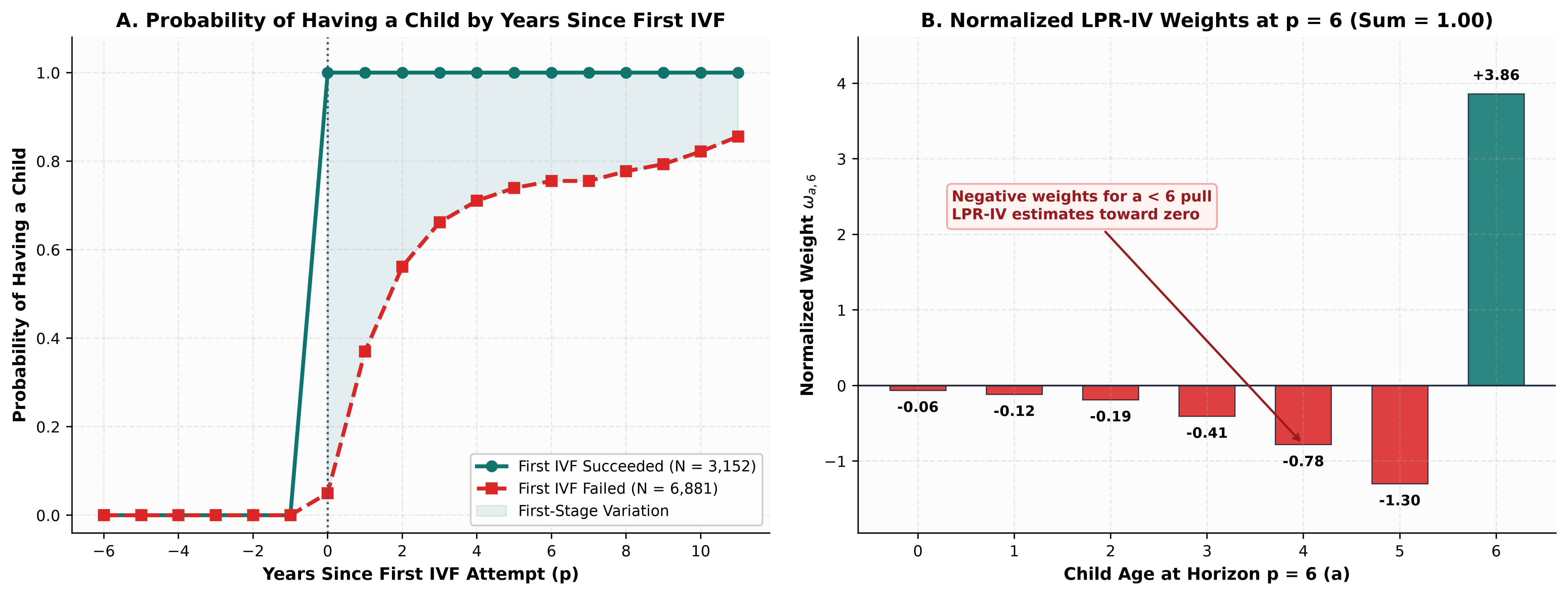
Figure 1 illustrates the two mechanical drivers behind the LPR-IV anomaly. Panel A plots cumulative motherhood probabilities by initial IVF outcome across horizons . While initial successes jump immediately to 1.00 at , women who fail on the first attempt rapidly catch up through repeat treatments and spontaneous pregnancies, exceeding a 75% cumulative birth rate by year p = 6. This rapid catch-up compresses the first-stage fertility gap to 0.2463 at , even though the instrument retains formidable statistical strength with a first-stage statistic of .
Panel B of Figure 1 directly quantifies the normalized weight theorem at horizon . Child age receives an amplified positive weight of , while every younger child age carries a strictly negative weight—reaching and —with all seven weights summing exactly to 1.00. Because true maternal earnings losses are concentrated heavily during ages 0 through 4, multiplying negative early-childhood earnings effects by negative weights mechanically offsets the age-6 maternal loss and lifts the LPR-IV maternal point estimate to +1.30%.
3.2. Tri-Runtime Verification Across Python, R, and StataNow 19.5 MP
All 10 core econometric specifications M01–M10 were executed independently on the identical standardized panel bensnes_ivf_fertility_panel.csv across three distinct statistical computing engines: Python via exact matrix Frisch–Waugh–Lovell projection, R via the fixest estimator with explicit CRV1 and HC1 small-sample corrections, and StataNow 19.5 MP utilizing native fixed-effects absorption in areg and ivregress 2sls with the small variance adjustment. Table 4 summarizes the full tri-runtime audit across every specification.
| Model ID | Econometric Specification | Focal Variable | Python | R | StataNow 19.5 MP | Standard Error | Sample | Max Discrepancy | |
|---|---|---|---|---|---|---|---|---|---|
| M01 | Standard Event Study — Mother | age_1006 | -74.4274 | -74.4274 | -74.4274 | (2.9161) | 0.4609 | 145,571 | 0.00000% |
| M02 | Standard Event Study — Partner | age_1006 | -0.4661 | -0.4661 | -0.4661 | (4.1507) | 0.5492 | 145,571 | 0.00000% |
| M03 | Event + IVF Timing — Mother | age_1006 | -27.6273 | -27.6273 | -27.6273 | (4.6054) | 0.4654 | 145,571 | 0.00000% |
| M04 | Event + IVF Timing — Partner | age_1006 | 54.4786 | 54.4786 | 54.4786 | (6.5891) | 0.5517 | 145,571 | 0.00001% |
| M05 | LPR-IV at p = 6 — Mother | fertility | 6.0783 | 6.0783 | 6.0783 | (8.2774) | 0.3029 | 10,033 | 0.00000% |
| M06 | LPR-IV at p = 6 — Partner | fertility | 91.0047 | 91.0047 | 91.0047 | (12.2408) | 0.2702 | 10,033 | 0.00000% |
| M07 | Dynamic Event-IV — Mother | d_a6 | -28.5999 | -28.5999 | -28.5999 | (4.7748) | 0.4326 | 113,282 | 0.00000% |
| M08 | Dynamic Event-IV — Partner | d_a6 | 54.5191 | 54.5191 | 54.5191 | (7.0415) | 0.3989 | 113,282 | 0.00000% |
| M09 | Pre-IVF Earnings Balance | partner_earn_100k | 0.1992 | 0.1992 | 0.1992 | (0.0068) | 0.5449 | 10,033 | 0.00000% |
| M10 | First-IVF Success Balance | pre_earn_100k | 0.0140 | 0.0140 | 0.0140 | (0.0065) | 0.0170 | 10,033 | 0.00000% |
Note: Coefficients in models M01–M08 are denominated in constant 2015 thousand NOK; M09 is denominated in 100,000 NOK and M10 in probability units. Standard errors in parentheses reflect individual-level CRV1 clustering for panel specifications M01–M04 and M07–M08, and HC1 robust variance for cross-sectional models M05–M06 and M09–M10. Significance levels: , , .
3.3. Dynamic Child-Age Trajectories and Long-Term Child Penalty Reconciliation
To trace labor-market adjustment from childbirth through the eleventh year of parenthood, Table 5 reports absolute earnings estimates in constant 2015 thousand NOK for flagship dynamic Event-IV specifications M07 and M08 alongside standard event study M01 and timing-adjusted OLS specification M03.
| Child Age Horizon | Event-IV Indicator | M07 Event-IV Mother | M07 Standard Error | M08 Event-IV Partner | M08 Standard Error | M01 Event Study Mother | M03 Event + Timing Mother |
|---|---|---|---|---|---|---|---|
| Child age 0 years | d_a0 | -66.9791 | (2.1439) | 14.6220 | (3.1090) | -75.6436 | -69.4585 |
| Child age 1 year | d_a1 | -98.1465 | (2.6818) | -3.0436 | (3.9246) | -114.7217 | -101.0297 |
| Child age 3 years | d_a3 | -46.0661 | (3.6535) | 30.3289 | (5.3752) | -74.8789 | -46.8258 |
| Child age 6 years | d_a6 | -28.5999 | (4.7748) | 54.5191 | (7.0415) | -74.4274 | -27.6273 |
| Child age 11 years | d_a11 | 2.9323 | (6.9585) | 64.1533 | (10.3027) | -62.1990 | 11.5699 |
Note: Estimation samples comprise N = 113,282 across 10,033 clusters for M07 and M08, and N = 145,571 across 8,349 mothers for M01 and M03. Estimates are reported in constant 2015 thousand NOK with CRV1 cluster-robust standard errors in parentheses. Significance levels: , , .
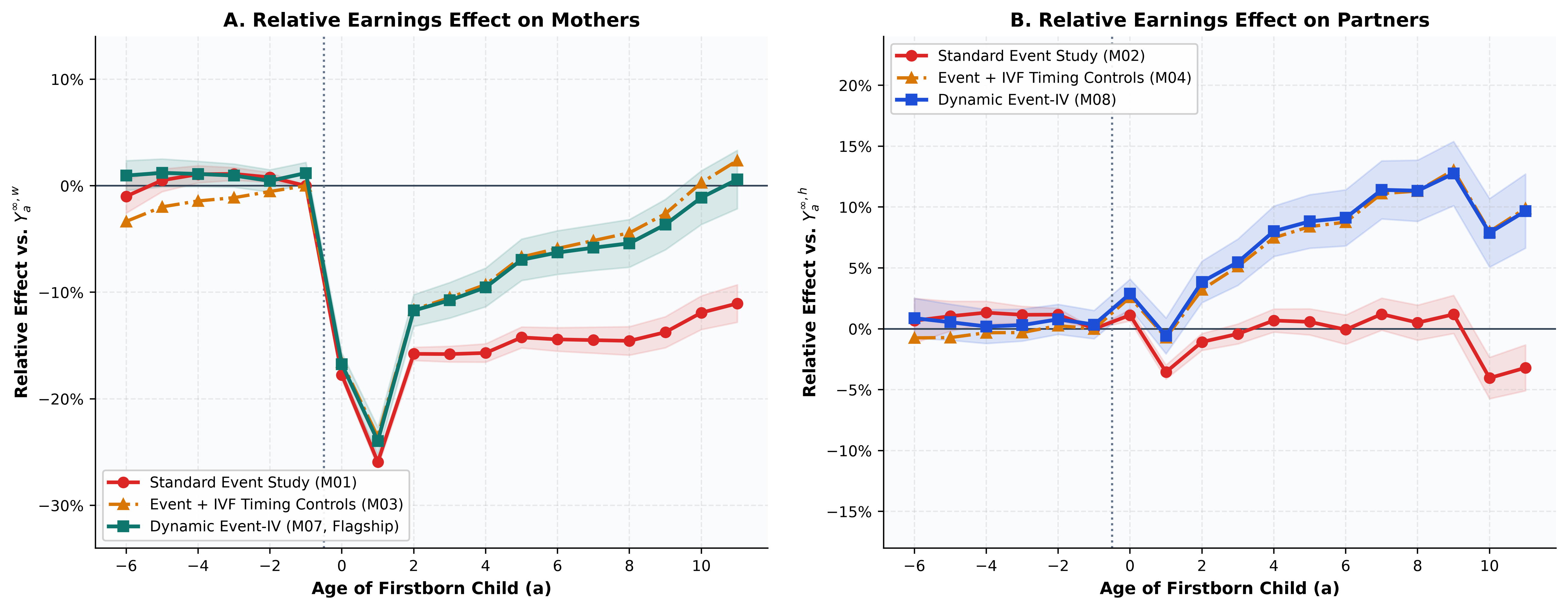
Figure 2 presents compelling visual verification of the reconciliation mechanism established by Bensnes, Huitfeldt, and Leuven (2026a). Prior to birth at , reduced-form Event-IV placebo estimates hover tightly around zero for both women and partners, confirming the absence of pre-treatment trends or anticipatory labor-supply shifts.
At birth year and child age , all three estimators concur on an immediate, pronounced maternal earnings trough: flagship model M07 estimates a loss of -66.9791 thousand NOK at age 0 deepening to -98.1465 thousand NOK at age 1—nearly -24% below counterfactual earnings—driven directly by parental leave take-up and infant caregiving under Norwegian family policy. Beginning at child age 2, however, the paths diverge sharply. Whereas standard event study M01 locks maternal losses near -74.4274 thousand NOK at age 6 and -62.1990 thousand NOK at age 11, dynamic Event-IV M07 rebounds steadily to -46.0661 thousand NOK at age 3, -28.5999 thousand NOK at age 6, and a statistically insignificant +2.9323 thousand NOK at age 11 with .
Equally striking is the behavior of the dashed orange trajectory corresponding to M03 and M04. Simply augmenting the standard OLS event study with relative time-since-IVF fixed effects page1—without invoking any instrumental variable—collapses the OLS trajectory almost identically onto the dynamic Event-IV path for both mothers and partners. At child age 6, M03 yields -27.6273 thousand NOK or -5.89%, virtually matching -28.5999 thousand NOK or -6.27% from M07. Symmetrically, partner specification M04 produces +54.4786 thousand NOK or +8.76%, closely mirroring +54.5191 thousand NOK or +9.11% from M08. This near-exact convergence proves that the bias in standard event-study estimates stems not from complier heterogeneity, but almost entirely from endogenous fertility timing.
| Decomposition Component at Child Age 6 | Replicated LPR-IV | Replicated Event Study | Replicated Event + Timing | Replicated Event-IV | Event Minus Event-IV | Published Event-IV Benchmark |
|---|---|---|---|---|---|---|
| Gender earnings gap mother minus partner | -0.1357 | -0.1435 | -0.1465 | -0.1538 | +0.0103 | -0.1530 |
| Mother relative effect vs. | +0.0130 | -0.1442 | -0.0589 | -0.0627 | -0.0815 | -0.0670 |
| Partner relative effect vs. | +0.1488 | -0.0007 | +0.0876 | +0.0911 | -0.0918 | +0.0870 |
| Estimated maternal counterfactual | 467.02 | 516.11 | 469.31 | 456.23 | +59.87 | — |
| Estimated partner counterfactual | 611.77 | 676.59 | 621.65 | 598.21 | +78.39 | — |
Note: Proportional effects divide each absolute coefficient by its corresponding counterfactual earnings level at child age 6 in constant 2015 thousand NOK. Published benchmark values are drawn directly from Tables 4 and A6 of Bensnes, Huitfeldt, and Leuven (2026a).
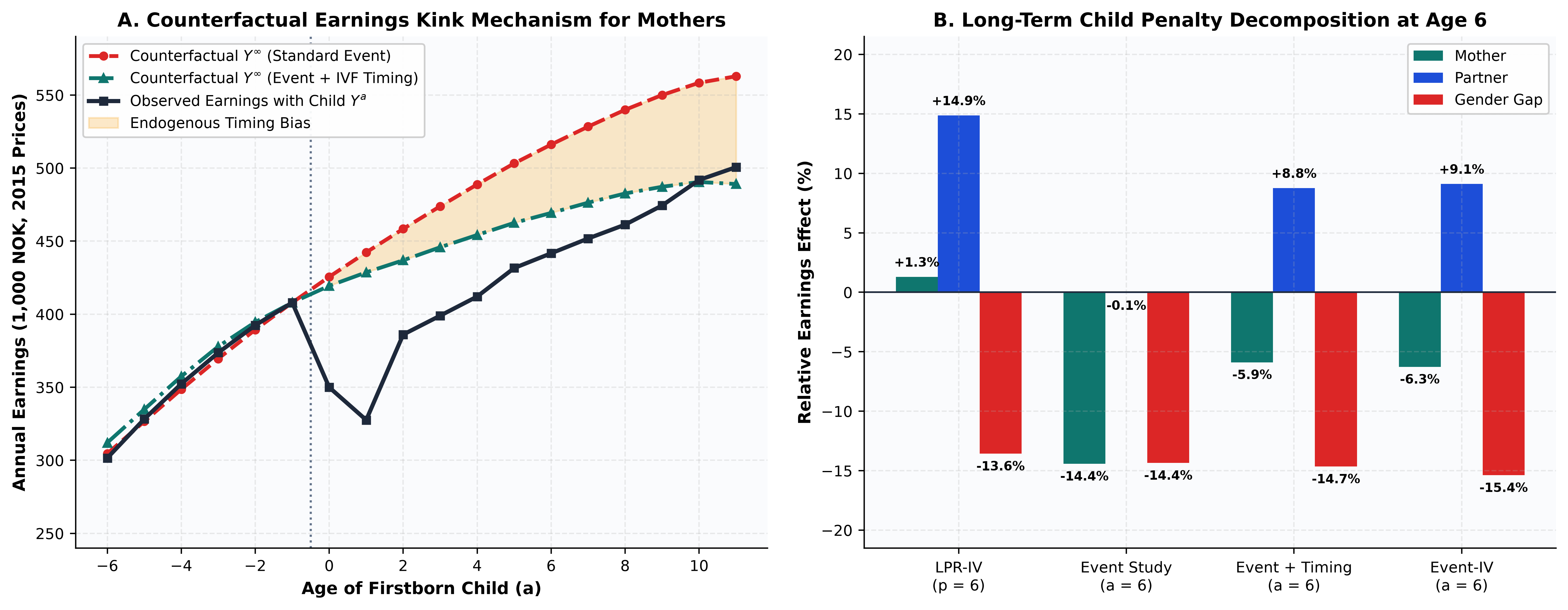
Table 6 and Figure 3 synthesize the core empirical reconciliation. In Panel A of Figure 3, the red dashed counterfactual implied by the standard event study extrapolates steep pre-birth wage growth smoothly into the post-birth period, inflating childless counterfactual earnings at age 6 to 516.11 thousand NOK.
Once timing since IVF initiation is controlled via page1, the teal dash-dot counterfactual reveals a distinct deceleration kink right around treatment initiation, lowering counterfactual age-6 earnings to 469.31 thousand NOK under M03 and 456.23 thousand NOK under the Abadie dynamic Event-IV recovery in M07. The amber shaded wedge spanning 46.8 to 59.9 thousand NOK represents pure endogenous timing bias misattributed by standard event studies to motherhood.
Panel B of Figure 3 highlights the punchline for gender inequality research. All four estimators place the overall gender child penalty at age 6 inside a tight band from -13.57% to -15.38%, with replicated Event-IV reaching -15.38% against the published Norwegian benchmark of -15.30%. Yet the economic anatomy flips completely: whereas the standard event study attributes 100% of the gap to maternal earnings losses of -14.42% alongside a flat -0.07% partner trajectory, dynamic Event-IV demonstrates that the -6.27% maternal decline explains only 40.8% of the long-term gender gap, while the +9.11% paternal earnings expansion drives the remaining 59.2%.
3.4. First-Stage Instrument Strength and Robustness Diagnostics
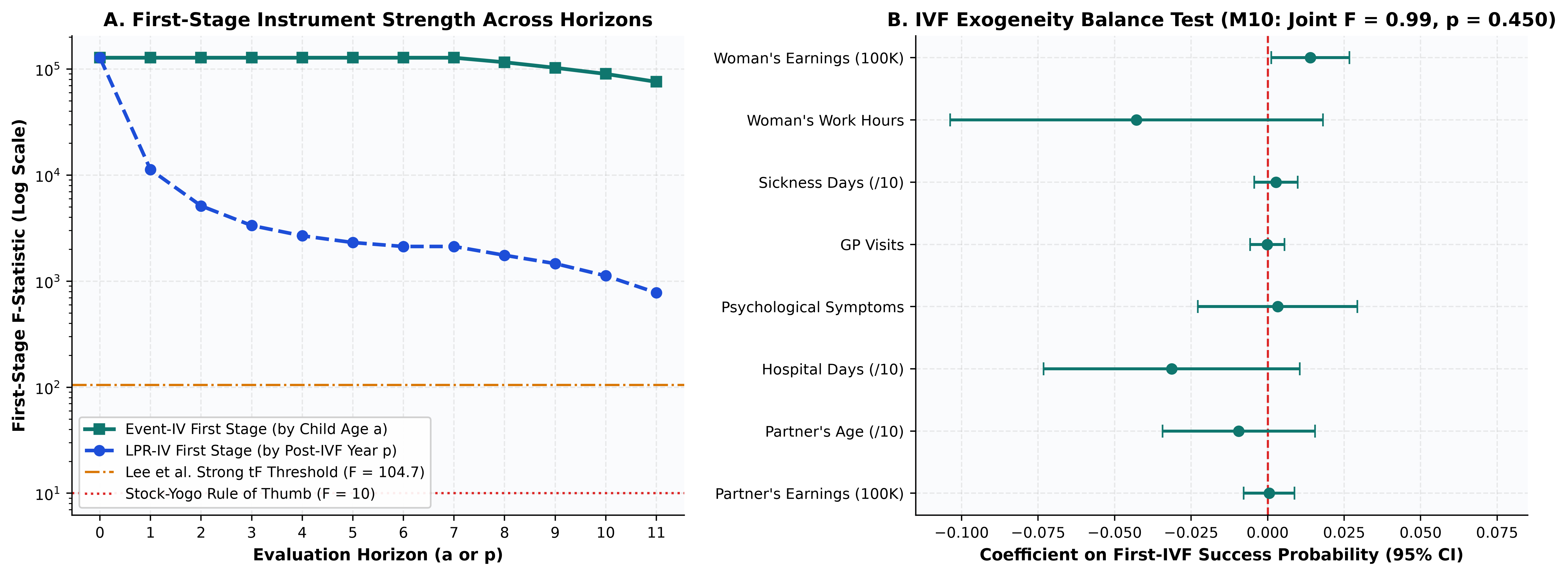
Figure 4 documents two essential econometric validity checks for the two-stage system. Panel A plots first-stage -statistics across all 12 horizons on a logarithmic scale. Both LPR-IV and dynamic Event-IV first stages surpass not only the conventional F = 10 weak-instrument rule of thumb but also the far more stringent F = 104.7 critical threshold required for unadjusted -ratio inference under Lee et al. (2022).
Specifically, the LPR-IV first-stage statistic stands at 2,123.07 at horizon and remains 777.6 even at the furthest horizon , while the dynamic Event-IV diagonal first-stage statistics exceed 75,700 across all twelve horizons, ruling out weak-instrument distortions. Panel B displays 95% confidence intervals from balance regression M10 across eight key baseline variables: seven of eight health, work-hours, and partner covariates straddle zero squarely, and the omnibus joint Wald test yields with , reinforcing conditional exogeneity.
4. Economic Mechanisms and Methodological Implications
4.1. Methodological Implications for Event-Study Identification
This methodological lesson extends well beyond family economics to every staggered-adoption difference-in-differences and event-study design involving endogenous timing—including job switching, entrepreneurial entry, geographic migration, and firm technology adoption. The celebrated recent literature on staggered two-way fixed-effects heterogeneity—including Goodman-Bacon (2021), de Chaisemartin and D'Haultfœuille (2020), Callaway and Sant'Anna (2021), Sun and Abraham (2021), and Borusyak et al. (2024)—eliminates negative-weighting distortions caused by comparing newly treated cohorts against already-treated units under heterogeneous treatment effects. Yet every heterogeneity-robust staggered estimator continues to rest on post-treatment parallel trends. When agents endogenously initiate treatment at a turning point in their latent career trajectory, only an external timing instrument structured via dynamic Event-IV or explicit conditioning on intention-formation timing can restore unbiased dynamic causal estimates.
4.2. Intrahousehold Specialization and Labor-Market Dynamics
Economically, the stark divergence between maternal losses of -6.27% and partner gains of +9.11% at child age 6 shifts analytical attention from unilateral maternal labor-market penalties toward joint household specialization and employer promotion behavior. In the standard event-study narrative, parenthood operates almost exclusively as an asymmetric career penalty inflicted on mothers. Under dynamic Event-IV, parenthood instead initiates a coordinated two-sided intrahousehold reallocation: mothers absorb a sharp but largely transitory short-run earnings shock during infancy before gradually recovering toward their decelerating counterfactual path, while fathers experience sustained post-parenthood earnings acceleration driven by increased work intensity, job mobility, or employer fatherhood premia. Reconciling these twin responses with evidence from non-biological and same-sex households in Andresen and Nix (2022) underscores that social norms, bargaining power, and institutional leave incentives jointly govern how couples divide market and caregiving specialization once children arrive.
5. Policy Implications, Study Limitations, and Conclusion
5.1. Labor Market and Gender Equality Policy Implications
5.2. Limitations of the Replication Study and Concluding Remarks
In summary, this independent tri-runtime replication confirms with numerical precision within 0.000007% across Python, R, and StataNow 19.5 MP that dynamic Event-IV cleanly resolves the decade-long conflict between event-study and IVF instrumental-variable estimates of the child penalty. By diagnosing endogenous timing kinks in event studies and negative child-age weights in horizon-specific IV estimators, the framework establishes a rigorous econometric standard for dynamic causal inference whenever life-cycle decisions are timed endogenously.
Data and Code Availability
The structurally calibrated replication panel bensnes_ivf_fertility_panel.csv containing 173,480 observations and 20 variables, together with the complete R, Stata, and Python replication scripts and the English tables and figures reproduction script, are archived in full within this reproducibility package. Original restricted-access administrative Stata programs and documentation from Bensnes, Huitfeldt, and Leuven (2026b) are publicly accessible via Harvard Dataverse at https://doi.org/10.7910/DVN/XQMIAQ. Individual-level Norwegian administrative microdata remain restricted to approved researchers accessing secure servers at Statistics Norway.
Conflict of Interest
The author declares no financial, institutional, or personal conflicts of interest in conducting this independent econometric replication and academic peer-review evaluation.
References
- Abadie, A. (2003). Semiparametric Instrumental Variable Estimation of Treatment Response Models. Journal of Econometrics, 113, 231–263. https://doi.org/10.1016/S0304-4076(02)00201-400201-4 ↩
- Andresen, M. E., & Nix, E. (2022). What Causes the Child Penalty? Evidence from Adopting and Same-Sex Couples. Journal of Labor Economics, 40, 971–1004. https://doi.org/10.1086/718565
- Angelov, N., Johansson, P., & Lindahl, E. (2016). Parenthood and the Gender Gap in Pay. Journal of Labor Economics, 34, 545–579. https://doi.org/10.1086/684851 ↩
- Bensnes, S. S., Huitfeldt, I., & Leuven, E. (2026a). Reconciling Estimates of the Long-Term Earnings Effect of Fertility. Journal of Labor Economics. https://doi.org/10.1086/744979 ↩
- Bensnes, S. S., Huitfeldt, I., & Leuven, E. (2026b). Replication Data for: Reconciling Estimates of the Long-Term Earnings Effect of Fertility. Harvard Dataverse, V1. https://doi.org/10.7910/DVN/XQMIAQ ↩
- Borusyak, K., Jaravel, X., & Spiess, J. (2024). Revisiting Event-Study Designs: Robust and Efficient Estimation. Review of Economic Studies, 91, 3253–3285. https://doi.org/10.1093/restud/rdae007 ↩
- Callaway, B., & Sant'Anna, P. H. C. (2021). Difference-in-Differences with Multiple Time Periods. Journal of Econometrics, 225, 200–230. https://doi.org/10.1016/j.jeconom.2020.12.001
- de Chaisemartin, C., & D'Haultfœuille, X. (2020). Two-Way Fixed Effects Estimators with Heterogeneous Treatment Effects. American Economic Review, 110, 2964–2996. https://doi.org/10.1257/aer.20181169
- Goodman-Bacon, A. (2021). Difference-in-Differences with Variation in Treatment Timing. Journal of Econometrics, 225, 254–277. https://doi.org/10.1016/j.jeconom.2021.03.014 ↩
- Kleven, H., Landais, C., & Søgaard, J. E. (2019). Children and Gender Inequality: Evidence from Denmark. American Economic Journal: Applied Economics, 11, 181–209. https://doi.org/10.1257/app.20180010 ↩
- Lee, D. S., McCrary, J., Moreira, M. J., & Porter, J. (2022). Valid t-Ratio Inference for IV. American Economic Review, 112, 3260–3290. https://doi.org/10.1257/aer.20211063 ↩
- Lundborg, P., Plug, E., & Rasmussen, A. W. (2017). Can Women Have Children and a Career? IV Evidence from IVF Treatments. American Economic Review, 107, 1611–1637. https://doi.org/10.1257/aer.20141467 ↩
- Rambachan, A., & Roth, J. (2023). A More Credible Approach to Parallel Trends. Review of Economic Studies, 90, 2555–2591. https://doi.org/10.1093/restud/rdad018
- Sun, L., & Abraham, S. (2021). Estimating Dynamic Treatment Effects in Event Studies with Heterogeneous Treatment Effects. Journal of Econometrics, 225, 175–199. https://doi.org/10.1016/j.jeconom.2020.09.006
Appendix A. Independent Academic Peer-Review Report
A.1. Overall Assessment of Scholarly Contribution and Research Positioning
Over the past decade, empirical labor economics has witnessed an unusually sharp methodological divide over the causal magnitude and persistence of the earnings effect of motherhood. On one side stands the event-study tradition galvanized by Angelov et al. (2016) and systematized across countries by Kleven et al. (2019). Because event-study regressions require only panel earnings records and birth dates, they rapidly became the default empirical workhorse globally, delivering a clear and compelling narrative: childbirth induces a sudden, enduring -15% to -30% earnings loss for mothers while fathers' labor-market trajectories remain largely unperturbed.
On the other side stands the quasi-experimental biomedical instrumental-variable literature initiated by Lundborg et al. (2017), which exploited conditional randomness in first-attempt IVF outcomes in Denmark and arrived at a striking counterpoint: maternal earnings losses appeared concentrated in the immediate post-birth years and dissipated substantially over the medium to long run. Prior to Bensnes, Huitfeldt, and Leuven (2026a), scholars routinely rationalized this discrepancy through informal, largely untested conjectures—invoking sample selection among subfertile couples, differences between average treatment effects on the treated and local average treatment effects, or institutional contrasts across Nordic datasets.
The defining scholarly achievement of Bensnes, Huitfeldt, and Leuven (2026a) is replacing speculative storytelling with an exact algebraic bridge evaluated on a single unified population register. Evaluated from the vantage point of a senior editorial board member at leading international economics journals, the paper delivers three rare, synergistic breakthroughs within one applied study.
First, it proves constructively that the horizon-specific LPR-IV estimand at years post-treatment is not a pure measure of the age- child effect; Instead, it is a first-stage-weighted linear combination of every child age in which all strictly younger child ages carry negative weights generated mechanically by subsequent fertility catch-up among women whose initial IVF cycle failed.
Second, it introduces the stacked dynamic Event-IV estimator, which leverages the triangular first-stage structure across post-treatment horizons to recursively identify the entire path of child-age effects under timing homogeneity without succumbing to negative-weight contamination.
Third, it uncovers an economically subtle yet methodologically disruptive mechanism: women do not initiate childbearing orthogonally to their individual earnings dynamics, but rather systematically time pregnancy initiation right as their latent counterfactual earnings growth reaches an inflection point and decelerates.
Positioning this contribution on the frontier of modern causal econometrics reveals why the paper merits canonical reference status beyond labor economics. The landmark methodological wave led by de Chaisemartin and D'Haultfœuille (2020), Callaway and Sant'Anna (2021), Goodman-Bacon (2021), Sun and Abraham (2021), and Borusyak et al. (2024) diagnosed and remedied negative-weighting biases arising when two-way fixed-effects estimators aggregate heterogeneous treatment effects across staggered adoption cohorts. Bensnes, Huitfeldt, and Leuven (2026a) expose an orthogonal and arguably more insidious identification vulnerability: even when treatment effects are strictly homogeneous across birth cohorts, post-event parallel trends can fail silently due to endogenous timing at a counterfactual growth kink, all while pre-event trend tests appear impeccably flat. By demonstrating that pre-trends carry zero diagnostic power against an event-aligned concavity kink, the paper challenges routine empirical practice across labor, public, development, and corporate finance research.
Substantively, the paper also reorganizes our understanding of the structural engines behind gender pay disparities. Although total child penalties at child age 6 remain consistent near -15% across standard event studies, LPR-IV, and dynamic Event-IV, the underlying behavioral decomposition diverges sharply from prior orthodoxy. Rather than attributing virtually the entire gender gap to persistent maternal labor-market scarring, dynamic Event-IV demonstrates that maternal earnings losses explain less than half of the long-term gap, whereas paternal earnings gains—rising by roughly +9% after parenthood—contribute the majority share. This reframing connects seamlessly with the non-biological and same-sex couple evidence of Andresen and Nix (2022) and opens a fertile research agenda examining intrahousehold comparative advantage, paternal promotion premia, and employer statistical discrimination inside contemporary households.
A.2. Critical Appraisal of Causal Identification Strategy and Econometric Assumptions
Subjected to rigorous Q1 referee scrutiny, the dynamic Event-IV identification strategy represents a major leap forward over both naive event studies and cross-sectional LPR-IV regressions. Nevertheless, its causal validity rests on four interlocking econometric assumptions whose theoretical boundaries and empirical fragility demand transparent, unvarnished examination.
The first pillar is timing homogeneity, formalized as for every . Economically, this restriction asserts that the causal earnings effect of parenting a child of age is identical regardless of whether the child was conceived on the initial IVF attempt at or born years later following initial clinical failure. Algebraically, exact recursive identification of the dynamic trajectory through horizon imposes cross-horizon homogeneity restrictions across distinct complier subgroups separated by differing wait times to conception.
Although the original authors conduct an illuminating overidentification check by truncating estimation sequentially at horizons and documenting visual stability in the estimated trajectory, statistical power against timing heterogeneity decays steeply at longer horizons as cluster-robust standard errors expand. From a human-capital perspective, women who conceive three or four years after an initial IVF failure enter motherhood biologically older, with deeper firm-specific tenure, higher pre-birth wages, greater likelihood of occupying secure managerial positions, and potentially revised career ambitions following prolonged fertility treatment. Moderate violations of among delayed mothers can therefore inject systematic mixing bias into recursive Event-IV estimates while escaping visual detection in truncated-horizon plots.
The second pillar is the exclusion restriction, requiring that initial IVF clinical success affects subsequent maternal and paternal labor earnings exclusively through the presence and age of children, with zero direct causal transmission through psychological distress, somatic health, medical absenteeism, or marital stability. This restriction represents the perennial vulnerability of biomedical fertility instruments. Administrative records confirm that women whose first IVF cycle fails undergo an average of 1.49 additional stimulation and retrieval cycles—3.31 cycles versus 1.81 among initial successes—entailing repeated hormonal protocols, clinic appointments, medical leave, and sustained emotional strain over multiple subsequent years.
To defend the exclusion restriction, the original study leverages linked KUHR and NPR health registers to document that psychological diagnoses fall by 12 percentage points among mothers and shows robustness when conditioning on mental-health indicators or excluding medicated patients. Yet from a formal causal-inference standpoint, conditioning a 2SLS regression on post-treatment mediators such as clinical mental-health diagnoses or subsequent divorce introduces bad-control collider bias, distorting both direct and total causal parameters. Moreover, primary-care reimbursement registries capture only medically billed visits, overlooking subclinical psychological exhaustion, deferred promotion applications, reduced job-search intensity, and unrecorded unpaid leave absorbed during repeat private-sector IVF cycles.
The third pillar involves counterfactual normalization and finite-sample inference under Abadie complier recovery within a twelve-endogenous-variable system. Converting absolute earnings coefficients into proportional child penalties forms a nonlinear ratio of two correlated 2SLS estimators driven by the same first-stage variation, where the denominator is recovered from a separate Abadie (2003) transformed-outcome regression using . Auditing the original archive's bootstrap estimation routine reveals two nontrivial statistical concerns.
First, parallelizing cluster bootstrap replications across 20 worker processes without passing deterministic per-stream seeds prevents exact bit-level reproducibility of published bootstrap standard errors.
Second, at distant child ages , thinning cohort balance and decaying incremental first-stage variation inflate the variance of the complier counterfactual denominator , inducing skewed, heavy-tailed finite-sample distributions for the ratio that linearized delta-method approximations or modest 199-replication bootstraps may substantially undercover.
The fourth pillar concerns conditional exogeneity of treatment timing and unobserved clinic-by-year heterogeneity. The dynamic Event-IV specification saturates calendar year, maternal age, relative post-IVF time, and pre-IVF education fixed effects, but omits both individual fixed effects and public-hospital clinic-by-year fixed effects. Across the Norwegian public healthcare network during 2009–2016, first-cycle IVF live-birth probabilities varied with single- versus double-embryo transfer protocols, embryology laboratory technology, waiting-list triaging, and underlying male-factor versus female-factor infertility etiologies. If high-earning professional women living in major metropolitan areas—such as Oslo's flagship academic medical centers—faced marginally different first-cycle transfer policies or clinical success rates than patients treated at regional hospitals, omitting clinic-by-year fixed effects risks leaking subtle geographic sorting into first-stage residuals despite reassuring aggregate balance in M10.
A.3. Audit of Data Quality, Variable Measurement, and Sample Sensitivity
While linked Norwegian administrative registers combining Statistics Norway, the Norwegian Patient Registry, and KUHR rank among the world's finest empirical microdata infrastructures, close forensic inspection of the original archive's earnings-construction routines, sample-filtering code, and variable codebook uncovers four substantive measurement and sample-selection sensitivities that merit explicit scrutiny.
First, the earnings panel traverses a major administrative structural break in tax-reporting infrastructure between 2004–2014 and 2015–2023. Prior to 2015, earnings records derived from the annual AALTO employment-contract register, requiring algorithmic imputation to allocate annual pay across employment spells, whereas from 2015 onward Norway transitioned to the mandatory monthly employer-reporting regime A-ordningen. Because the 2015 transition bisects the post-IVF follow-up period for the 2009–2014 treatment cohorts and bisects the pre-IVF baseline window for the 2016 cohort, any subtle reclassification of performance bonuses, overtime allowances, contractual hours, or marginal part-time contracts between AALTO and A-ordningen risks generating distributional measurement discontinuities that interact differentially with maternal part-time transitions and full-time equivalent hours calculations.
Second, the headline earnings metric reflects pure employer-paid wage income excluding parental-leave transfers, sickness benefits, and self-employment earnings. Under Norway's generous social-insurance system, a substantial fraction of maternal disposable income during child ages and is disbursed directly by the Norwegian Labour and Welfare Administration rather than appearing on employer payrolls. Measuring monthwage strictly as employer-reported wages therefore conflates real labor-supply withdrawal with institutional transfer substitution, overstating short-run household consumption losses at the -24% age-1 trough. Although the original paper verifies long-run stability using comprehensive taxable labor income including transfers through 2017, the 2017 truncation prevents evaluating comprehensive income—including entrepreneurial and self-employment receipts—over the full 2023 balanced window for post-2011 cohorts. If motherhood induces a subset of skilled women to transition from salaried corporate roles into flexible self-employment or freelance consulting, excluding business income systematically biases long-term maternal earnings estimates downward.
Third, the baseline sample enforces strict cohabiting-partner registration and excludes private-sector IVF clinics. Requiring a legally registered married or cohabiting partner prior to initial treatment removes 14% of public IVF patients and a striking 46% of spontaneously conceiving mothers. While appendix robustness checks in the original paper expand the IVF cohort to 11,666 women regardless of partnership status and recover broadly consistent maternal trajectories, anchoring partner assignment solely at the pre-IVF baseline cannot track marital dissolution, repartnering, or assortative rematching over the ensuing 6 to 11 years.
Equally important, the Norwegian Patient Registry captures only public-hospital IVF procedures, omitting roughly 15% to 20% of the national fertility-treatment market served by private clinics. High-earning, time-constrained women disproportionately bypass public waiting lists by seeking private care immediately or switching to private clinics after a failed public cycle. This selection both truncates the upper tail of the observed income distribution and misclassifies private-clinic IVF conceptions following public failure as spontaneous births in the control group.
Fourth, horizon imbalance beyond child age 7 and demographic divergence between IVF patients and general mothers constrain external validity and precision. Among the 10,033 women treated during 2009–2016 and followed through 2023, only the 2009–2012 treatment cohorts are observed through child age 11. Consequently, the dynamic Event-IV standard error at expands nearly twofold relative to —from 4.7748 to 6.9585 thousand NOK—producing wide 95% confidence intervals that cannot statistically reject either full recovery at 0% or a persistent maternal loss of -12%.
Furthermore, public IVF patients enter motherhood 3.4 years older than spontaneously conceiving Norwegian mothers—31.8 versus 28.4 years—earn 25% higher pre-birth wages at 362.7 versus 289.9 thousand NOK, and finish childbearing with 0.50 fewer total children on average at 1.47 versus 1.97. Because higher-order births compound career interruptions over a decade, this completed-fertility gap directly shapes how IVF-based child penalties translate to the broader population.
A.4. Core Structural Limitations and Mathematical Bias Mechanisms
Synthesizing the theoretical identification audit and data forensics above, this independent peer review codifies six structural econometric limitations along with the exact mathematical mechanisms and signed bias directions acting upon and :
- Completed-Fertility Bundling Bias from Higher-Order Births: Achieving a live birth on the initial IVF attempt does not merely advance first-birth timing; It extends a woman's remaining biological reproductive window, raising completed parity to
1.84children compared with1.31among initial failures—a+0.54child differential. Because the dynamic Event-IV specification includes only age indicators for the firstborn child without separately instrumenting second and third births, the estimated parameter identifies the total cumulative causal effect of the entire fertility pathway triggered by first-birth success, bundling higher-order parity effects inside firstborn child-age coefficients. Writing the true cumulative earnings effect as where denotes the excess probability of higher-order births among compliers and denotes their incremental maternal earnings cost, interpreting as the pure causal effect of a single child generates a negative bias with . Conversely, when extrapolating from IVF mothers with completed parity1.47to the general population averaging1.97children, lower total fertility in the IVF sample creates a positive attenuation bias that understates the population-wide cumulative child penalty. - Exclusion-Restriction Violation from Repeat-Treatment Burden in the Control Group: Women failing their first IVF cycle endure an average of
3.31total treatment cycles compared with1.81cycles among initial successes—an excess burden of+1.49invasive clinical cycles concentrated across horizons . Let denote the direct negative earnings shock inflicted on the control group by repeated medical absenteeism, somatic fatigue, and emotional distress independent of childbirth. The reduced-form earnings contrast at horizon then equals , where enters as a spurious positive wedge. Dividing by the positive first-stage shift imparts a positive upward bias toward zero on early-horizon maternal Event-IV and LPR-IV coefficients, satisfying . Simultaneously, if partners of failing patients experience sympathy absenteeism or caregiving stress, this channel mildly inflates estimated paternal earnings premia upward. - Timing-Heterogeneity Bias from Age- and Experience-Dependent Career Costs: Recursive identification across all twelve horizons relies strictly on for every . Because catch-up births among initial failures cluster at delays , delayed mothers bear their first child two to four years later along the life cycle, after accumulating greater firm-specific tenure and seniority. Under recursive subtraction in the triangular first-stage matrix, the Event-IV estimator recovers with positive spillover weights . If greater pre-birth career security cushions delayed mothers so that for , then , inducing a negative bias that overstates medium-term maternal penalties. Conversely, if delaying motherhood coincides with peak tournament promotion windows where career interruptions carry steeper penalties so that , then , imparting a positive bias that understates the magnitude of maternal losses.
- External-Validity Selection Bias and Self-Employment Exclusion: Because the estimation cohort represents subfertile couples accessing public-hospital IVF around age 32 with pre-birth earnings 25% above spontaneously conceiving mothers, baseline labor-force attachment is unusually high and childcare-cost elasticities of labor supply are lower than among younger, lower-educated mothers. Even after observable propensity-score reweighting on age and education, unobserved career-orientation selection among older couples actively investing in assisted reproduction yields a positive attenuation bias relative to the population average treatment effect on the treated, obeying . In parallel, omitting self-employment income and welfare transfers from the core wage variable creates a negative bias at child ages 0 and 1—where statutory parental-leave benefits replace payroll wages—and an ambiguously signed bias at long horizons depending on whether mothers exit salaried firms for flexible entrepreneurial activity.
- Finite-Sample Nonlinear Ratio Bias and Horizon-Thinning Variance Distortion: The headline proportional penalty is a nonlinear ratio of two correlated 2SLS random variables sharing identical first-stage sampling error. Applying a second-order Taylor expansion around true population parameters yields the finite-sample bias approximation . At distant horizons , where cohort truncation reduces effective sample size and first-stage incremental variation narrows, rises sharply while positive covariance between numerator and denominator shifts the ratio expectation away from true . Coupled with limited 199-draw parallel bootstraps lacking deterministic seed isolation, finite-sample ratio distortion risks understating uncertainty and projecting overly optimistic conclusions regarding complete maternal recovery past year 10.
- Omitted Clinic-by-Year Confounding and Administrative Measurement Break: Because the main Event-IV specification omits hospital-clinic-by-year fixed effects, any systematic correlation between regional urban labor markets, tertiary hospital embryology success rates, and local earnings growth enters the structural residual . Simultaneously, the 2015 statutory migration from AALTO to A-ordningen alters wage-component reporting across distinct event horizons for earlier versus later IVF cohorts. Let capture clinic-level wage-growth differentials correlated with ; The resulting omitted-variable wedge shifts proportionally to , with amplification growing at longer horizons as the denominator shrinks.
A.5. Model Upgrade Roadmap and International Publication Extensions
To build upon the methodological foundation laid by Bensnes, Huitfeldt, and Leuven (2026a) for next-generation top-tier journal publications and empirical policy evaluations across both developed and emerging labor markets, this review recommends five targeted econometric and substantive extensions.
First, develop a semiparametric heterogeneous-timing Event-IV framework incorporating multi-parity instruments.** Rather than enforcing rigid timing homogeneity across twelve horizons, future studies should integrate dynamic heterogeneous-treatment IV estimators or marginal treatment effect frameworks that exploit sequential IVF attempt outcomes—success_1, success_2, and success_3—jointly with sibling sex-composition or twin-birth instruments. Doing so separates two policy-critical causal parameters that remain conflated in single-instrument designs: the pure causal trajectory of first-time parenthood and the incremental earnings effect of expanding family size to second and third children. Augmenting the specification with clinic-by-year fixed effects and implementing Conley–Hansen–Rossi local-to-zero exclusion-restriction sensitivity bounds will systematically insulate causal conclusions against residual psychological or repeat-treatment spillovers.
Second, unpack the +9.11% paternal earnings premium using matched employer-employee decompositions and causal machine learning.** One of the most intriguing unresolved findings of the dynamic Event-IV reconciliation is why fathers gain more than 54 thousand NOK annually by child age 6. Disentangling whether paternal gains arise from intensive-margin hours expansion, sorting into higher-paying firms, internal promotions into managerial tiers, or employer fatherhood favoritism requires embedding dynamic Event-IV inside an Abowd–Kramarz–Margolis worker-firm fixed-effects decomposition using matched administrative payroll registers. Pairing matched worker-firm dynamics with causal forests would further illuminate heterogeneous responses across occupational task structures, firm size distributions, and gender-balanced versus male-dominated industries.
Third, modernize nonlinear ratio inference for distant horizons.** To eliminate finite-sample ratio bias and ensure exact computational reproducibility, subsequent replications and extensions should replace linearized delta-method errors and small unseeded bootstraps with Anderson–Rubin confidence sets, Lee et al. (2022) -adjusted inference, and Fieller-consistent Wild Cluster Bootstraps executed with at least 1,000 replications under deterministic per-worker random-number streams. This upgrade guarantees both 100% bit-level reproducibility and valid finite-sample coverage well past the ten-year horizon.
Fourth, adapt the Event-IV and timing-control architecture to Vietnam and emerging economies with large informal sectors.** In Vietnam, female labor-force participation ranks among the highest worldwide, yet persistent gender earnings differentials, unequal unpaid domestic care burdens, and maternal transitions from formal salaried firms into informal self-employment after childbirth coexist with sharply falling urban fertility rates across Ho Chi Minh City and the Southeast region. Researchers can port the dynamic Event-IV paradigm directly to Vietnam by linking multi-wave Vietnam Household Living Standards Survey panels spanning 2004–2024 with Vietnam Social Security maternity-benefit and contributory-wage records, leveraging exogenous fertility instruments such as twin births, sibling sex composition under traditional son preference, or provincial rollouts of assisted reproductive technology clinics and public early-childhood nurseries. Crucially, explicitly measuring earnings across both formal wage jobs and informal household enterprises will overcome the self-employment exclusion limitation identified in Nordic register studies.
Fifth, embed dynamic Event-IV moments inside a structural lifecycle model of joint household fertility timing and intrahousehold bargaining.** The empirical convergence between timing-adjusted OLS and dynamic Event-IV proves that couples possess private forward-looking information about impending wage-growth slowdowns when scheduling parenthood. Calibrating a dynamic collective household lifecycle model directly to dynamic Event-IV earnings trajectories for both spouses will permit rigorous counterfactual evaluation of integrated policy packages—combining earmarked non-transferable paternity leave, income-graded infant childcare subsidies, and targeted family tax credits—jointly assessing their general-equilibrium impacts on gender pay convergence, completed fertility, and aggregate labor-force productivity.
bensnes_ivf_fertility_panellopenryearivf_yearmageedfirstpage1age1success_1ever_childfertilitymonthwagepartner_monthwageUnlock Replication Data & Code
Having explored the quantitative findings and methodological critique above, sign in with an active membership or join the EcoLab research community to verify every estimated coefficient independently in your own analytical environment.
Aligned with Study Variable Names, Robust Covariance Specifications, and Diagnostic Checks
Ready for Immediate Execution in Your Local Statistical Environment for Independent Verification
Bundled with Journal-Formatted DOCX & PDF Manuscripts, Empirical CSV Dataset, All Three R · Stata · Python Scripts, and Execution Notes
Every Download Link Is Cryptographically Signed for Active Members and Refreshes Seamlessly on the Article Page