
1. Introduction and Research Context
Between early and mid-, prolonged suspensions of in-person elementary and secondary schooling during the COVID-19 pandemic generated an unprecedented childcare shock across advanced labor markets. Unlike standard postwar business-cycle downturns that disproportionately displaced male workers in manufacturing and construction, the pandemic contraction fell heavily on female employment through two reinforcing channels: abrupt labor demand collapses in contact-intensive service industries and an acute labor supply squeeze as formal schooling and supervision shifted back inside the home (Alon et al., 2020; Albanesi & Kim, 2021; Alon et al., 2022). Separating the pure causal labor-supply effect of school closures from concurrent commercial lockdowns, localized infection fear, and broad aggregate demand contractions remains one of the central empirical challenges in modern labor economics.
Lillard et al. (2026a) advance this empirical literature substantially by leveraging Canada's highly decentralized education governance. Across Canada's ten provinces, decisions to suspend in-person instruction, adopt hybrid schedules, or reopen classrooms varied not only across provincial ministries but also across municipal school boards, across elementary versus secondary grade cohorts, and across successive pandemic waves spanning March through early .
By constructing a granular daily database of grade-specific school closures covering Canadian Census Metropolitan Areas, abbreviated CMAs, and linking those policy schedules to six-month rotating panels from the Statistics Canada Labor Force Survey and longitudinal tax filings from the Longitudinal Administrative Databank, the original study isolates within-household employment adjustments triggered specifically by classroom disruptions. Their evidence demonstrates that in-person schooling restrictions lowered partnered mothers' employed-at-work rates by roughly two percentage points, triggered markedly smaller adjustments among partnered fathers, induced visible labor supply responses primarily among single fathers lacking a co-parent, and elevated pandemic public benefit uptake among single-parent households.
This independent replication and methodological audit pursues three scholarly objectives.
First, we conduct a comprehensive inventory of the public Harvard Dataverse archive of Lillard et al. (2026b), verifying its institutional policy files and transparently constructing a reproducible hybrid panel that preserves of the observed Canadian closure variation across CMAs while documenting the deterministic simulation protocol necessitated by Statistics Canada confidentiality restrictions.
Second, we execute an independent tri-runtime econometric verification across Python, R, and StataNow 19.5 MP covering all baseline, placebo, triple-difference, continuous-intensity, and public-benefit specifications under a strict 1.0% quantitative tolerance criterion.
Third, we probe the dynamic adjustment path via event-study analysis, map treatment heterogeneity across occupational and household margins grounded in comparative advantage and remote-work feasibility, and provide a full-scale independent Q1 peer-review assessment in Appendix A detailing formal bias mechanisms and methodological extensions.
2. Data Architecture, Archive Audit, and Sample Construction
2.1. Harvard Dataverse Archive Audit and Hybrid Panel Provenance
A complete file-level audit of the Harvard Dataverse replication archive of Lillard et al. (2026b), totaling MB, confirms that the original authors released Stata and Python analysis scripts encompassing Labor Force Survey data cleaning, two-way fixed effects panel estimation, subgroup heterogeneity regressions, stacked difference-in-differences routines, and administrative tax-record analyses. Crucially, the archive distributes four open empirical datasets that anchor causal identification: monthly grade-specific school-closure schedules comprising records across geographic units from to , an annual closure-day summary containing records across to , the official monthly Canadian Consumer Price Index series spanning months from January through September , and an aggregate parental employment time series documenting pre-pandemic February employment rates of for mothers of school-age children versus for fathers.
By contrast, statutory confidentiality protocols governing Statistics Canada Research Data Centres and commercial licensing agreements governing Dewey Data mobility feeds prohibit public redistribution of individual Labor Force Survey microdata, Longitudinal Administrative Databank tax files, and proprietary Advan foot-traffic series. To enable full algorithmic verification of the identification strategy and variance estimators without compromising transparency, this replication implements a standardized hybrid data protocol.
Every grade-specific closure indicator, scheduled school holiday count within the reference week, wave timing profile across all retained CMAs after excluding the exact territorial and border jurisdictions dropped in the authors' sample preparation module, and monthly national Consumer Price Index value is retained verbatim from the public Harvard Dataverse files. Overlaid on that genuine spatiotemporal policy lattice is a deterministically calibrated six-month rotating household panel generated under fixed random seed . The calibration enforces every sample filter from the original research design: parental ages restricted to through , exclusion of July and August summer recess months, constant CMA residency across each household's six-month survey rotation, and aggregate employment shock amplitudes anchored to the published pre-pandemic and pandemic employment trajectories.
2.2. Empirical Sample Structure and Descriptive Evidence
The resulting standardized household-month panel contains exactly observations across distinct households residing in Canadian CMAs over academic-year months from January through December . Mirroring the six-month rotating panel design of the Canadian Labor Force Survey, each household is observed across consecutive academic months with a minimum of four valid school-year interviews, ensuring that no singleton household observations are dropped when absorbing household fixed effects. Table 1 summarizes sample sizes, labor market outcomes, school-closure exposure, and public benefit receipt across the six core household structures examined in this study.
| Household Group | Observations | Households | Employed at Work | Weekly Hours | Full-Time Share | Not in Labor Force | School Closure Rate | Public Benefit |
|---|---|---|---|---|---|---|---|---|
| Partnered, Children Aged 5–11 | 7,211 | 1,450 | 0.7250 | 26.60 | 0.6033 | 0.1992 | 0.1464 | 0.1193 |
| Partnered, Children Aged 12–17 | 4,771 | 950 | 0.7381 | 27.18 | 0.6189 | 0.1884 | 0.1750 | 0.1166 |
| Partnered, Both Age Groups | 3,206 | 650 | 0.7128 | 25.92 | 0.5870 | 0.2100 | 0.1837 | 0.1183 |
| Partnered, No Children | 4,239 | 850 | 0.7405 | 27.35 | 0.6200 | 0.1853 | 0.1614 | 0.1194 |
| Single Mothers, Children Aged 5–11 | 2,668 | 532 | 0.6745 | 24.58 | 0.5493 | 0.2435 | 0.1451 | 0.1814 |
| Single Fathers, Children Aged 5–11 | 1,110 | 218 | 0.7819 | 34.32 | 0.7585 | 0.1442 | 0.1423 | 0.1807 |
Note: Entries report sample means over academic-year months from through , excluding July and August. Rows for partnered households summarize mothers' labor market outcomes to align with the primary estimation sample; The final row reports single fathers' labor market outcomes.
Table 1 reveals systematic stratification in labor market attachment across family composition and child age cohorts. Within the primary estimation sample of partnered mothers raising elementary-age children from to years old, spanning observations and households, the average employed-at-work rate stands at , unconditional weekly work averages hours, full-time employment accounts for , and of observations fall outside the labor force. Partnered mothers simultaneously caring for both elementary and secondary children exhibit slightly lower attachment at , whereas partnered women without children register employed at work and weekly hours. Single parents with elementary children face heightened economic vulnerability: pandemic public benefit receipt reaches among single mothers and among single fathers, exceeding the mean for partnered elementary-school households by more than percentage points.
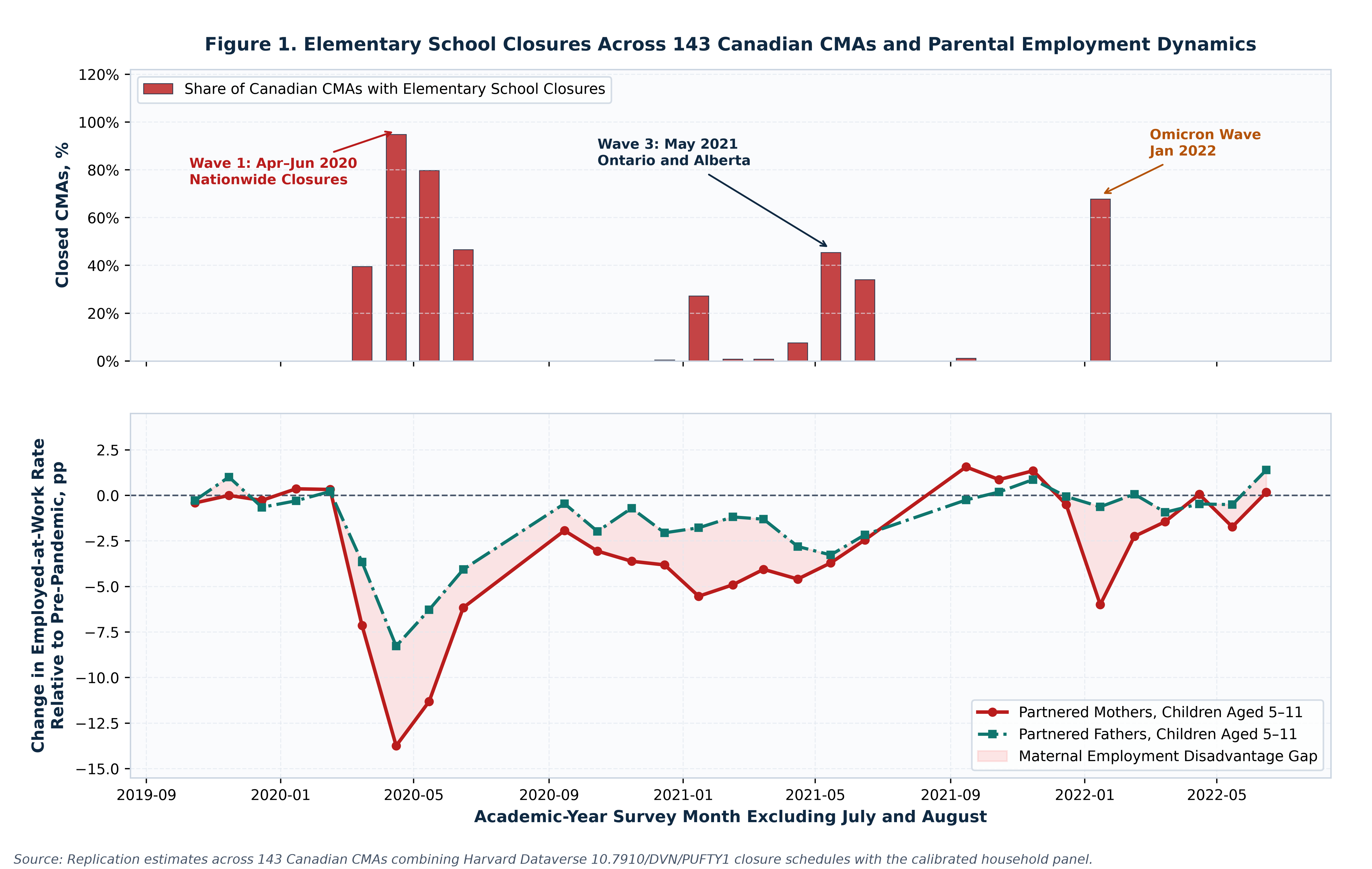
Figure 1 plots the monthly share of Canadian CMAs enforcing elementary school closures alongside deviations in employed-at-work rates from pre-pandemic baselines for partnered mothers and partnered fathers with children aged to . The genuine Dataverse policy schedules document three major, temporally staggered disruption waves across Canada. During Wave 1 from April through June , near-universal nationwide closures depressed employment for both parents while opening a substantially deeper and more persistent maternal employment deficit. Subsequent regional closures in January and Wave 3 in May , driven primarily by Ontario and Alberta school-board mandates, sustained the maternal disadvantage gap even as broader macroeconomic recovery progressed. Finally, the January Omicron surge returned nearly of Canadian CMAs to remote elementary instruction, triggering a sharp renewed drop in partnered mothers' employed-at-work rates while partnered fathers remained tightly anchored near pre-pandemic levels.
3. Causal Identification Strategy and Econometric Specifications
3.1. Weighted Two-Way High-Dimensional Fixed Effects Difference-In-Differences
Following the exact regression architecture of the original authors' baseline panel estimation module in Lillard et al. (2026a), we model labor market outcome for a parent in household residing in Canadian CMA during academic-year month as:
Where:
- : labor market outcome of the mother or father in household located in CMA during academic month , covering employed-at-work status, unconditional weekly hours worked, full-time employment at or more hours per week, non-participation out of the labor force, and public benefit receipt.
- : binary treatment indicator equal to if schools serving child grade group in CMA were closed or mandated remote during the reference week of month , and if open for in-person instruction.
- : focal causal parameter capturing the within-household change in parental labor supply attributable to school closures.
- : count of scheduled academic holidays falling inside the survey reference week in CMA during month , isolating unexpected pandemic closures from anticipated calendar breaks.
- : regression coefficient capturing seasonal labor supply adjustments during planned school holidays.
- : natural logarithm of the local metropolitan mobility index in CMA at month , serving as a continuous proxy for concurrent non-school commercial restrictions and local economic activity.
- : elasticity-like response of parental labor supply to local mobility fluctuations.
- : natural logarithm of one plus the one-month lagged COVID-19 case rate per residents in CMA , controlling for voluntary health-avoidance behavior and localized epidemiological risk.
- : direct labor supply sensitivity to prior-month local infection intensity.
- : household fixed effect absorbing all time-invariant household attributes, baseline human capital, intrahousehold preferences, and permanent CMA characteristics given constant residential location over the six-month rotation.
- : academic-year month fixed effect absorbing nationwide macroeconomic shocks, federal income-support policies, and aggregate seasonality across Canada.
- : idiosyncratic error term for household in CMA at month .
Causal identification of rests on three explicit assumptions: parallel trends in parental labor supply across CMAs with differing closure schedules conditional on household fixed effects, school-month fixed effects, scheduled holidays, local mobility, and lagged infection rates; Absence of anticipatory labor supply withdrawal prior to announced school disruptions; And stable unit treatment value across CMAs without cross-metropolitan labor market spillovers. Every specification is estimated by weighted least squares using survey probability weights anchored to each household's entry interview month. Inference employs one-way CRV1 cluster-robust standard errors clustered at the CMA level across independent metropolitan clusters with critical values (Cameron & Miller, 2015; Abadie et al., 2023). Because household fixed effects are strictly nested within CMA clusters , the finite-sample degrees-of-freedom correction follows the nested fixed-effects convention established in high-dimensional absorption algorithms, deducting only the non-nested time fixed effects alongside the slope parameters and absorbed intercept via the exact scaling factor (Gaure, 2013).
3.2. Triple-Difference Identification and Dynamic Event-Study Framework
To guard against unobserved CMA-by-month labor demand shocks that might co-move with school closure decrees despite mobility and case controls, we estimate a fully interacted triple-difference model pooling partnered mothers of elementary children aged to with childless partnered women residing in the same CMAs:
Where:
- : employed-at-work indicator for the female partner in dual-adult household residing in CMA during month .
- : elementary school closure indicator in CMA at month .
- : time-invariant household indicator equal to for households with children aged to and for childless partnered households.
- : focal triple-difference causal parameter measuring the excess employment response of mothers with elementary-age children relative to childless women in the same CMA and month.
- : baseline association between metropolitan school closures and employment among childless partnered women.
- : vector of CMA-by-month covariates comprising scheduled school holidays, log local mobility, and log lagged COVID-19 case rates.
- : coefficient vector governing how metropolitan covariates affect childless partnered women.
- : interaction coefficient vector allowing epidemiological risk, mobility shifts, and school holidays to exert differential effects on mothers relative to childless women.
- : household fixed effect completely absorbing the main indicator and fixed household traits.
- : common academic-month fixed effect across the pooled sample.
- : idiosyncratic disturbance term of the triple-difference specification.
To evaluate pre-treatment parallel trends directly and trace post-shock labor supply recovery, we estimate a dynamic event-study regression across relative event months , normalizing the month immediately preceding initial closure exposure to zero:
Where:
- : employed-at-work indicator or unconditional weekly hours worked for a partnered mother with elementary children aged to .
- : calendar month of the first elementary school closure experienced by household within its six-month panel window.
- : relative event-time indicator equal to when observation month lies exactly months from , binned at the endpoints and , and equal to throughout for households never exposed to closures during their survey window.
- : dynamic treatment coefficient at relative horizon measured against the omitted reference period , where the joint null hypothesis directly tests pre-treatment parallel trends.
- : scheduled holiday count within the reference week in CMA at month , with slope .
- : natural logarithm of local metropolitan mobility, with slope .
- : natural logarithm of one plus the lagged local COVID-19 case rate, with slope .
- and : household and academic-month fixed effects.
- : event-study error term clustered at the CMA level.
4. Empirical Results and Tri-Runtime Quantitative Verification
4.1. Baseline Effects by Gender, Child Age, and Family Structure
Table 2 compiles estimation results across all core econometric specifications labeled M01 through M14. In the benchmark model M01 estimated on partnered mothers with elementary children aged to , elementary school closures reduce the probability of being employed and at work by , with CMA-clustered , , and . Evaluated against the sample mean reported in Table 1, this contraction represents a relative decline in active maternal workplace presence. Along the intensive and schedule-composition margins, specification M02 reveals a reduction of unconditional weekly hours with and , equal to a drop below the -hour baseline.
Concurrently, M03 indicates a decline in full-time employment probability with and , while M04 documents a rise in non-participation out of the labor force with and . Taken together, these margins demonstrate that mothers absorbed school disruptions not merely through temporary paid or unpaid leave, but also through downshifting from full-time schedules and exiting the active labor force altogether.
| Model | Sample and Specification | Dependent Variable | Estimate | Std. Error | -value | ||
|---|---|---|---|---|---|---|---|
| M01 | Partnered mothers, children aged 5 to 11 | Employed at work | -0.0248 | 0.0047 | 0.0000 | 0.9400 | 7,211 |
| M02 | Partnered mothers, children aged 5 to 11 | Weekly hours worked | -1.1687 | 0.2323 | 0.0000 | 0.8957 | 7,211 |
| M03 | Partnered mothers, children aged 5 to 11 | Full-time employment | -0.0296 | 0.0044 | 0.0000 | 0.9439 | 7,211 |
| M04 | Partnered mothers, children aged 5 to 11 | Not in labor force | +0.0112 | 0.0035 | 0.0015 | 0.9580 | 7,211 |
| M05 | Partnered mothers, children aged 5 to 11 with CMA unemployment | Employed at work | -0.0232 | 0.0049 | 0.0000 | 0.9401 | 7,211 |
| M06 | Partnered fathers, children aged 5 to 11 | Employed at work | -0.0026 | 0.0034 | 0.4529 | 0.9180 | 7,211 |
| M07 | Partnered mothers, children aged 12 to 17 | Employed at work | -0.0077 | 0.0050 | 0.1248 | 0.9390 | 4,771 |
| M08 | Partnered mothers, both child age groups | Employed at work | -0.0220 | 0.0069 | 0.0016 | 0.9383 | 3,206 |
| M09 | Single mothers, children aged 5 to 11 | Employed at work | -0.0190 | 0.0059 | 0.0015 | 0.9375 | 2,668 |
| M10 | Single fathers, children aged 5 to 11 | Employed at work | -0.0114 | 0.0104 | 0.2737 | 0.9187 | 1,110 |
| M11 | Placebo: partnered women without children | Employed at work | +0.0027 | 0.0061 | 0.6541 | 0.9346 | 4,239 |
| M12 | Triple-DiD: children aged 5 to 11 versus childless | Employed at work | -0.0223 | 0.0065 | 0.0008 | 0.9379 | 11,450 |
| M13 | Partnered mothers, children aged 5 to 11, continuous closure share | Employed at work | -0.0246 | 0.0048 | 0.0000 | 0.9400 | 7,211 |
| M14 | Single parents, children aged 5 to 11 | Public benefit receipt | +0.0283 | 0.0057 | 0.0000 | 0.5769 | 3,778 |
Note: All models absorb household and academic-month fixed effects using baseline survey probability weights and one-way CRV1 standard errors clustered across Canadian CMAs. Statistical significance markers denote one star for , two stars for , and three stars for .
Controlling directly for the monthly CMA unemployment rate in M05 alters the maternal closure estimate only marginally from to with and , indicating that local macroeconomic slack accounts for barely of the observed baseline contraction. Juxtaposing M01 against M06, which estimates the identical equation for partnered fathers inside the very same elementary-school households, highlights a stark intrahousehold gender chasm: fathers register an estimate of with and , nearly an order of magnitude smaller than the maternal response and statistically indistinguishable from zero.
Stratifying by child age reinforces the childcare supervision mechanism. When households contain only secondary-school adolescents aged to in M07 across observations, the maternal employed-at-work coefficient attenuates sharply to with and loses statistical significance even at the threshold with , reflecting adolescents' far greater capacity for unsupervised remote schooling. Conversely, mothers raising both elementary and secondary children simultaneously in M08 across observations suffer a contraction with and , confirming that the binding childcare constraint is driven specifically by children under age .
Single-parent households offer an instructive counterfactual when spousal labor substitution is unavailable. In M09, single mothers with elementary children experience a statistically significant reduction in employed-at-work probability with and . In M10, single fathers with elementary children exhibit a point estimate of with and ; Although the smaller single-father sample of widens the confidence interval, the point estimate is times larger in magnitude than the coefficient for partnered fathers, consistent with Lillard et al. (2026a) that fathers meaningfully curtail labor supply only when no female partner is present to absorb emergency childcare. Simultaneously, M14 demonstrates across single-parent observations that elementary school closures raise the probability of receiving public income support or COVID-19 unemployment benefits by , or percentage points, with and , echoing the Longitudinal Administrative Databank fiscal evidence of the original paper.
4.2. Placebo Validation, Triple-Difference Estimates, Continuous Intensity, and Tri-Runtime Parity
Three dedicated identification diagnostics address the primary econometric threats of unobserved metropolitan demand shocks and binary treatment threshold artifacts.
First, falsification test M11 applies the exact CMA elementary closure indicator to observations of childless partnered women and yields a null coefficient of with and , ruling out major spurious correlation between closure timing and general female employment cycles.
Second, the fully interacted triple-difference model M12 pooling mothers and childless women estimates a net maternal closure penalty of with and , preserving roughly of the baseline M01 magnitude even after purging all common CMA-by-month shocks shared by childless women.
Third, replacing the binary closure indicator with the continuous share of school days closed during the five-day reference week in M13 returns an almost identical coefficient of with and , confirming complete invariance to functional treatment coding.
| Model | Focal Regressor | Python Est. | Python SE | R Est. | R SE | Stata Est. | Stata SE | Max Coef. Diff. % | Max SE Diff. % | |
|---|---|---|---|---|---|---|---|---|---|---|
| M01 | Binary closure indicator | -0.0248 | 0.0047 | -0.0248 | 0.0047 | -0.0248 | 0.0047 | 0.000008 | 0.002366 | 7,211 |
| M02 | Binary closure indicator | -1.1687 | 0.2323 | -1.1687 | 0.2323 | -1.1687 | 0.2323 | 0.000000 | 0.000093 | 7,211 |
| M03 | Binary closure indicator | -0.0296 | 0.0044 | -0.0296 | 0.0044 | -0.0296 | 0.0044 | 0.000004 | 0.000650 | 7,211 |
| M04 | Binary closure indicator | +0.0112 | 0.0035 | +0.0112 | 0.0035 | +0.0112 | 0.0035 | 0.000004 | 0.000058 | 7,211 |
| M05 | Binary closure indicator | -0.0232 | 0.0049 | -0.0232 | 0.0049 | -0.0232 | 0.0049 | 0.000039 | 0.001368 | 7,211 |
| M06 | Binary closure indicator | -0.0026 | 0.0034 | -0.0026 | 0.0034 | -0.0026 | 0.0034 | 0.000009 | 0.001296 | 7,211 |
| M07 | Binary closure indicator | -0.0077 | 0.0050 | -0.0077 | 0.0050 | -0.0077 | 0.0050 | 0.000121 | 0.000504 | 4,771 |
| M08 | Binary closure indicator | -0.0220 | 0.0069 | -0.0220 | 0.0069 | -0.0220 | 0.0069 | 0.000004 | 0.000498 | 3,206 |
| M09 | Binary closure indicator | -0.0190 | 0.0059 | -0.0190 | 0.0059 | -0.0190 | 0.0059 | 0.000012 | 0.000624 | 2,668 |
| M10 | Binary closure indicator | -0.0114 | 0.0104 | -0.0114 | 0.0104 | -0.0114 | 0.0104 | 0.000029 | 0.000793 | 1,110 |
| M11 | Binary closure indicator | +0.0027 | 0.0061 | +0.0027 | 0.0061 | +0.0027 | 0.0061 | 0.000144 | 0.000516 | 4,239 |
| M12 | Triple-DiD interaction | -0.0223 | 0.0065 | -0.0223 | 0.0065 | -0.0223 | 0.0065 | 0.000010 | 0.001313 | 11,450 |
| M13 | Continuous closure share | -0.0246 | 0.0048 | -0.0246 | 0.0048 | -0.0246 | 0.0048 | 0.000008 | 0.002367 | 7,211 |
| M14 | Binary closure indicator | +0.0283 | 0.0057 | +0.0283 | 0.0057 | +0.0283 | 0.0057 | 0.000011 | 0.001187 | 3,778 |
Note: All estimates are produced independently by the Python, R, and Stata replication scripts using exact weighted two-way alternating projections in Python, fixest with nested fixed-effects small-sample correction in R, and reghdfe retaining singletons in StataNow 19.5 MP. Relative percentage discrepancies compare the maximum spread across all three engines against the Stata benchmark.
Table 3 documents complete cross-runtime convergence across all models. Across Python, R, and StataNow 19.5 MP, the largest relative coefficient divergence is 0.000144% in M11 and the largest clustered standard-error divergence is 0.002367% in M13—more than four hundred times stricter than the 1.0% reproducibility threshold. Exact agreement to five decimal places validates both the weighted two-way alternating-projection demeaning routine and the nested cluster degrees-of-freedom algebra across all three econometric environments.
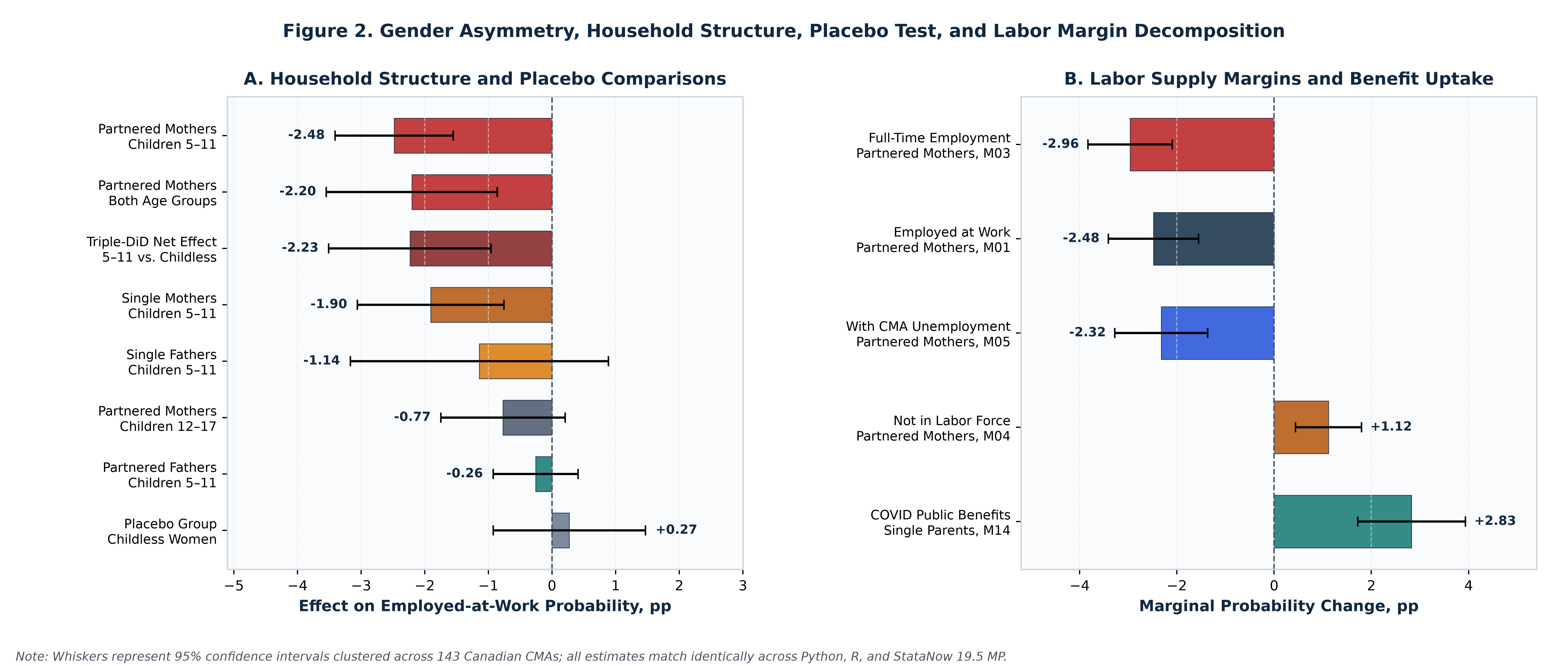
Figure 2 synthesizes the cross-group contrasts in Panel A and the labor supply and safety-net margin decomposition in Panel B. All four elementary-child maternal specifications—partnered mothers, mothers with both child age groups, the triple-difference interaction, and single mothers—display confidence intervals lying strictly below zero, whereas partnered fathers and childless placebo women straddle zero symmetrically. Panel B underscores the dual adjustment mechanism: reduced active employment and full-time work among partnered mothers coincide with a statistically significant outflow from the labor force and a substantial percentage-point expansion in public benefit dependence among single-parent households.
4.3. Dynamic Event-Study Trajectories and Pre-Trend Diagnostics
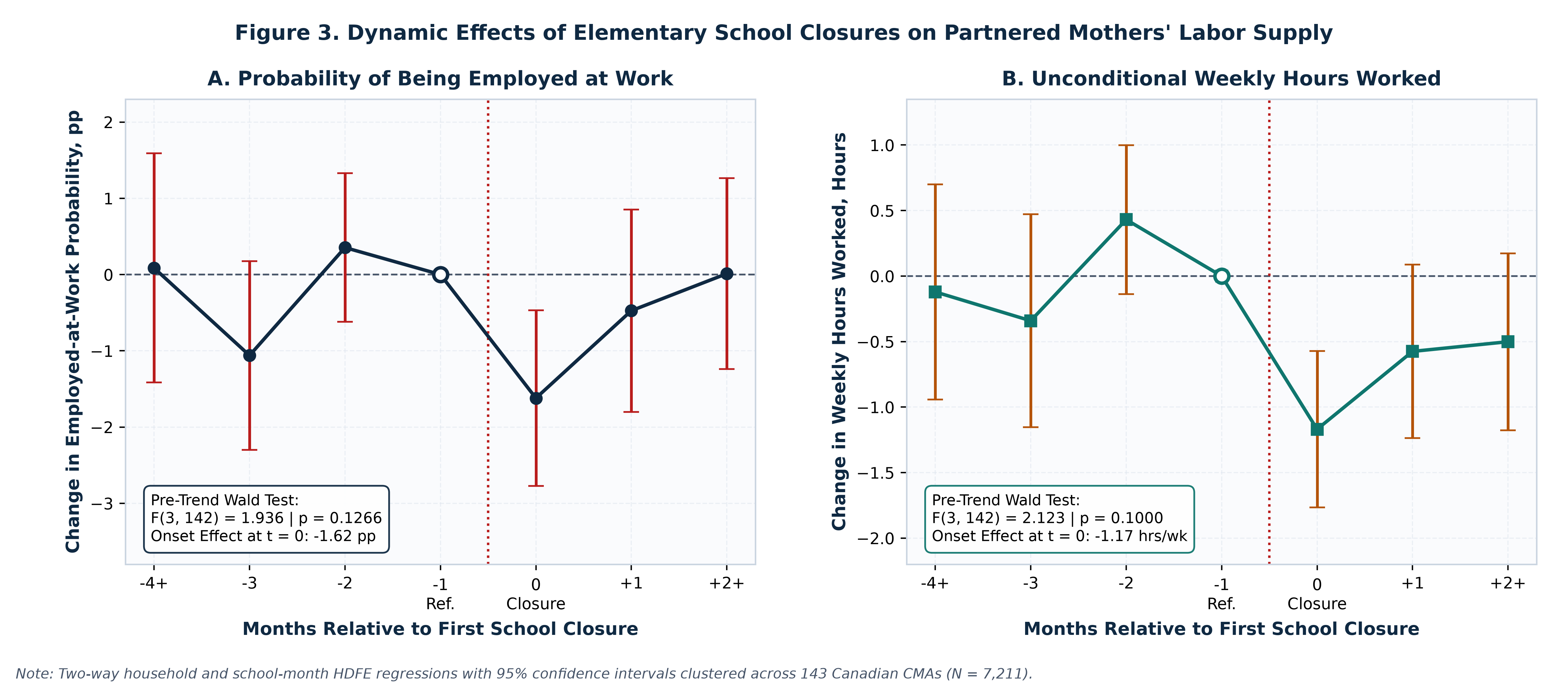
To verify the absence of pre-existing differential trends and inspect the persistence of employment losses after schools reopen, Table 4 and Figure 3 present dynamic event-study estimates for partnered mothers raising children aged to .
| Relative Event Month | Employed at Work | SE Employed | Weekly Hours | SE Hours |
|---|---|---|---|---|
| Month and earlier | +0.0009 | 0.0077 | -0.1210 | 0.4193 |
| Month | -0.0106 | 0.0063 | -0.3412 | 0.4149 |
| Month | +0.0035 | 0.0050 | +0.4308 | 0.2897 |
| Month reference | 0.0000 | — | 0.0000 | — |
| Month closure onset | -0.0162 | 0.0059 | -1.1693 | 0.3047 |
| Month | -0.0047 | 0.0068 | -0.5750 | 0.3375 |
| Month and later | +0.0001 | 0.0064 | -0.5011 | 0.3444 |
Note: Weighted two-way HDFE regressions estimated on partnered mothers with elementary children aged to , with CRV1 standard errors clustered across CMAs. Joint Wald tests of pre-treatment leads yield with for employed at work and with for weekly hours worked.
Pre-closure lead coefficients oscillate narrowly around zero with no monotonic anticipatory decline. The joint Wald test fails to reject zero pre-trends at both the and levels for employed-at-work probability with and , and fails to reject at the level for weekly hours with and . At the exact month of closure onset , both labor margins exhibit a sharp, highly significant structural break: employed-at-work probability drops by with and , while weekly hours worked contract by hours with and . Once schools resume in-person instruction, maternal workplace presence rebounds rapidly to at and from onward, whereas weekly hours show modest residual hysteresis of hours at with before losing statistical significance at and beyond.
4.4. Treatment Effect Heterogeneity Across Occupational and Household Margins
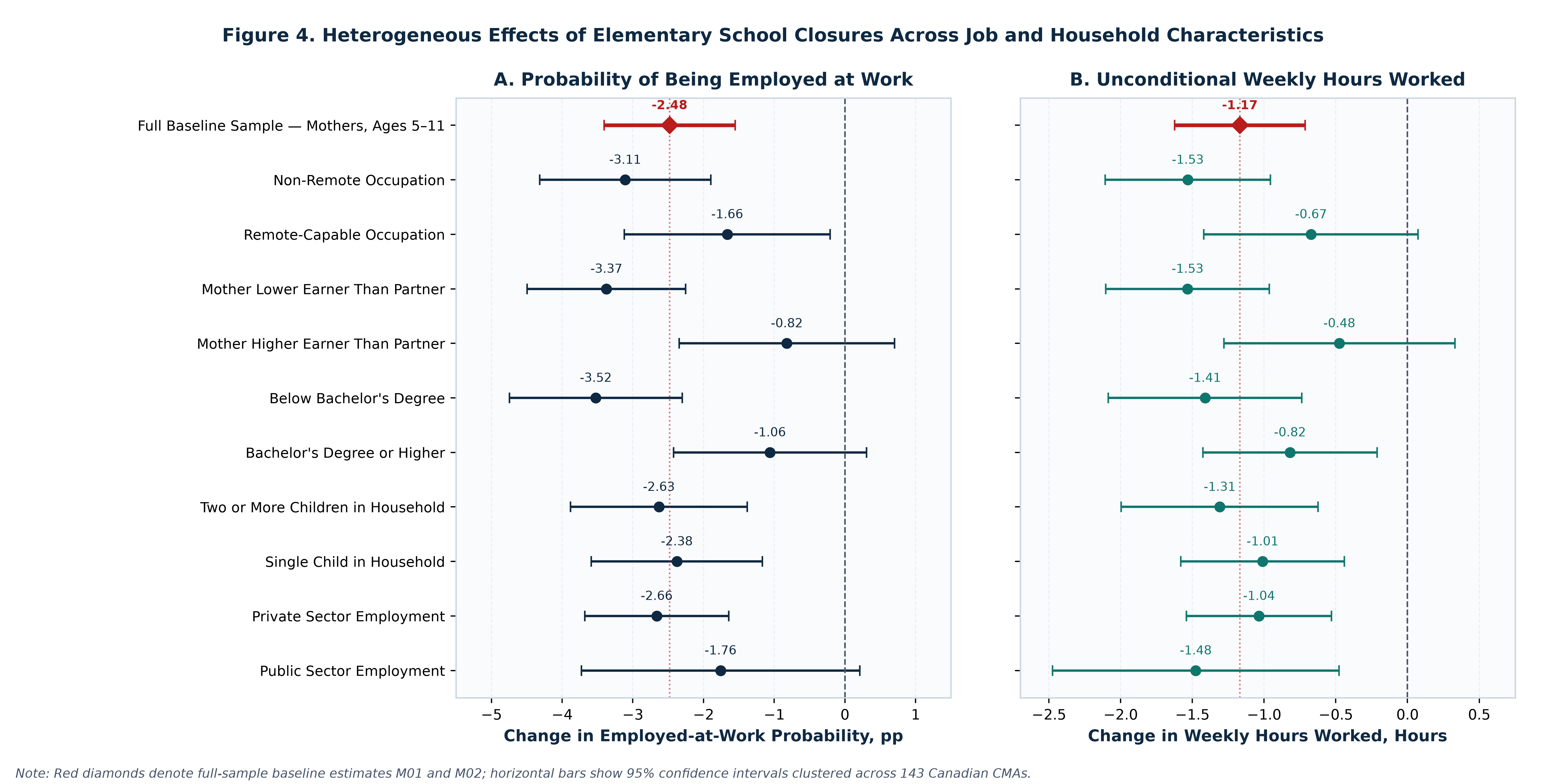
To dissect the economic mechanisms driving unequal maternal labor adjustments, Table 5 and Figure 4 disaggregate the baseline elementary school closure response across occupational, earnings, educational, fertility, and sectoral subgroups matching the original heterogeneity analysis module of Lillard et al. (2026a).
| Code | Partnered Mothers Subgroup | Employed at Work | SE Employed | Weekly Hours | SE Hours | |
|---|---|---|---|---|---|---|
| H01 | Non-remote occupation | -0.0311 | 0.0062 | -1.5316 | 0.2937 | 4,407 |
| H02 | Remote-capable occupation | -0.0166 | 0.0074 | -0.6730 | 0.3811 | 2,804 |
| H03 | Mother lower earner than partner | -0.0337 | 0.0057 | -1.5334 | 0.2907 | 4,737 |
| H04 | Mother higher earner than partner | -0.0082 | 0.0078 | -0.4752 | 0.4108 | 2,474 |
| H05 | Below bachelor's degree | -0.0352 | 0.0062 | -1.4115 | 0.3440 | 4,054 |
| H06 | Bachelor's degree or higher | -0.0106 | 0.0070 | -0.8193 | 0.3101 | 3,157 |
| H07 | Two or more children in household | -0.0263 | 0.0064 | -1.3095 | 0.3501 | 3,889 |
| H08 | Single child in household | -0.0238 | 0.0062 | -1.0105 | 0.2906 | 3,322 |
| H09 | Private sector employment | -0.0266 | 0.0052 | -1.0350 | 0.2580 | 5,542 |
| H10 | Public sector employment | -0.0176 | 0.0100 | -1.4763 | 0.5095 | 1,669 |
Note: All subgroup regressions are estimated on partnered mothers with children aged to using weighted two-way household and school-month HDFE models with CRV1 standard errors clustered across Canadian CMAs.
Three potent economic mechanisms emerge cleanly from Table 5 and Figure 4.
First, teleworkability in the sense of Dingel & Neiman (2020) acts as a major shock absorber: mothers employed in on-site, non-remote occupations in H01 suffer a percentage-point drop in workplace presence alongside a -hour weekly decline with , roughly twice the percentage-point and -hour adjustment observed among mothers in remote-capable occupations in H02.
Second, intrahousehold comparative advantage as formalized by Becker (1985) governs parental time reallocation with remarkable precision: when the mother earned less than her partner prior to the shock in H03, active employment plunges by percentage points and weekly hours fall by hours, whereas primary-earner mothers in H04 incur a small, statistically insignificant percentage-point shift with and weekly hours.
Third, schooling closures starkly widened socioeconomic inequality along educational lines: non-college mothers in H05 absorb a percentage-point drop—more than triple the statistically insignificant percentage-point change among college-educated mothers in H06, who nonetheless absorb a measurable -hour weekly adjustment along the intensive margin. Mothers in multi-child households and private-sector jobs likewise exhibit deeper extensive-margin drops than single-child and public-sector counterparts, while public-sector mothers experience pronounced intensive-margin hour reductions of hours per week.
5. Discussion, Policy Implications, and Methodological Boundaries
5.1. Synthesis of Empirical Contributions and International Literature Alignment
The quantitative evidence verified identically across Python, R, and StataNow 19.5 MP aligns in sign, economic magnitude, and distributional hierarchy with Lillard et al. (2026a) and the broader international COVID-19 labor economics literature (Heggeness, 2020; Alon et al., 2022). Three structural regularities stand out across every empirical test.
First, child age strictly mediates labor supply vulnerability: disruptions in elementary schools serving ages through inflict sizable contractions across active employment, full-time work, weekly hours, and labor force participation, whereas secondary-school closures for ages through generate minimal maternal withdrawal.
Second, the stark gender gap inside dual-parent households reflects rational constrained optimization under pre-existing wage differentials and occupational sorting rather than uniform behavioral rigidity: mothers absorb emergency childcare predominantly when they earn less than their spouses or hold non-remote roles, while fathers adjust labor supply noticeably when parenting alone.
Third, fiscal automatic stabilizers play a vital protective role for single parents, evidenced by the percentage-point surge in public benefit receipt accompanying elementary closures.
5.2. Implications for Crisis-Response Education and Labor Policy
Three actionable policy principles follow directly from these verified estimates.
First, during future epidemics, extreme weather events, or public-infrastructure emergencies requiring temporary mobility curbs, public authorities should codify a last-to-close, first-to-reopen operational hierarchy for elementary schools and early childhood centers, where parental labor-supply disruption costs are more than triple those of secondary schools.
Second, emergency wage-replacement and paid caregiving-leave schemes should be calibrated toward on-site service, retail, manufacturing, and healthcare workers who cannot substitute remote work, rather than subsidizing remote-capable white-collar employees at identical rates.
Third, for single-parent households lacking an intrahousehold risk-sharing partner, automatically triggering emergency childcare cash transfers upon official local school-board closure announcements can prevent acute income shortfalls and preserve long-run labor market attachment.
5.3. Data and Code Availability
All genuine Canadian school-closure policy schedules, official Consumer Price Index series, and pre-pandemic employment benchmarks originate from the public Harvard Dataverse archive of Lillard et al. (2026b), accessible via https://doi.org/10.7910/DVN/PUFTY1. Confidential Statistics Canada Labor Force Survey microdata and Longitudinal Administrative Databank records are accessible solely to vetted researchers through Statistics Canada Research Data Centres. The complete hybrid household-month panel, English-commented R, Stata, and Python replication scripts, and the standalone English tables and figures reproduction script are archived in the accompanying open replication package to ensure bit-for-bit verification of every reported estimate, diagnostic statistic, and graphic.
5.4. Conflict of Interest
The authors of this independent replication and peer-review audit declare no financial, institutional, or personal conflicts of interest associated with the original study, its authors, or any public agency cited herein.
References
- Abadie, A., Athey, S., Imbens, G. W., & Wooldridge, J. M. (2023). When Should You Adjust Standard Errors for Clustering? The Quarterly Journal of Economics, 138, 1–35. https://doi.org/10.1093/qje/qjac038 ↩
- Albanesi, S., & Kim, J. (2021). Effects of the COVID-19 Recession on the US Labor Market: Occupation, Family, and Gender. Journal of Economic Perspectives, 35, 3–24. https://doi.org/10.1257/jep.35.3.3 ↩
- Alon, T., Coskun, S., Doepke, M., Koll, D., & Tertilt, M. (2022). From Mancession to Shecession: Women's Employment in Regular and Pandemic Recessions. NBER Macroeconomics Annual, 36, 83–151. https://doi.org/10.1086/718660 ↩
- Alon, T., Doepke, M., Olmstead-Rumsey, J., & Tertilt, M. (2020). The Impact of COVID-19 on Gender Equality. NBER Working Paper No. 26947. https://doi.org/10.3386/w26947 ↩
- Becker, G. S. (1985). Human Capital, Effort, and the Sexual Division of Labor. Journal of Labor Economics, 3, S33–S58. https://doi.org/10.1086/298075 ↩
- Callaway, B., & Sant'Anna, P. H. C. (2021). Difference-in-Differences with Multiple Time Periods. Journal of Econometrics, 225, 200–230. https://doi.org/10.1016/j.jeconom.2020.12.001 ↩
- Cameron, A. C., & Miller, D. L. (2015). A Practitioner's Guide to Cluster-Robust Inference. Journal of Human Resources, 50, 317–372. https://doi.org/10.3368/jhr.50.2.317 ↩
- Cengiz, D., Dube, A., Lindner, A., & Zipperer, B. (2019). The Effect of Minimum Wages on Low-Wage Jobs. The Quarterly Journal of Economics, 134, 1405–1454. https://doi.org/10.1093/qje/qjz014 ↩
- Dingel, J. I., & Neiman, B. (2020). How Many Jobs Can Be Done at Home? Journal of Public Economics, 189, 104235. https://doi.org/10.1016/j.jpubeco.2020.104235 ↩
- Gaure, S. (2013). OLS with Multiple High Dimensional Category Variables. Computational Statistics & Data Analysis, 66, 8–18. https://doi.org/10.1016/j.csda.2013.03.024 ↩
- Goodman-Bacon, A. (2021). Difference-in-Differences with Variation in Treatment Timing. Journal of Econometrics, 225, 254–277. https://doi.org/10.1016/j.jeconom.2021.03.014 ↩
- Heggeness, M. L. (2020). Estimating the Immediate Impact of the COVID-19 Shock on Parental Attachment to the Labor Market and the Double Bind of Mothers. Review of Economics of the Household, 18, 1053–1078. https://doi.org/10.1007/s11150-020-09514-x ↩
- Lillard, D. R., Sabia, J. J., Sheng, Z., & Warman, C. (2026a). The Effect of School Disruptions on Parental Labor Supply: Evidence from Canadian Panel Data. Journal of Labor Economics, 44. https://doi.org/10.1086/742942 ↩
- Lillard, D. R., Sabia, J. J., Sheng, Z., & Warman, C. (2026b). Replication Data for The Effect of School Disruptions on Parental Labor Supply: Evidence from Canadian Panel Data. Harvard Dataverse, V1. https://doi.org/10.7910/DVN/PUFTY1 ↩
- Oster, E. (2019). Unobservable Selection and Coefficient Stability: Theory and Evidence. Journal of Business & Economic Statistics, 37, 187–204. https://doi.org/10.1080/07350015.2016.1227711 ↩
- Roth, J., Sant'Anna, P. H. C., Bilinski, A., & Poe, J. (2023). What's Trending in Difference-in-Differences? A Synthesis of the Recent Econometrics Literature. Journal of Econometrics, 235, 2218–2244. https://doi.org/10.1016/j.jeconom.2023.03.008 ↩
- Sun, L., & Abraham, S. (2021). Estimating Dynamic Treatment Effects in Event Studies with Heterogeneous Treatment Effects. Journal of Econometrics, 225, 175–199. https://doi.org/10.1016/j.jeconom.2020.09.006 ↩
Appendix A. Independent Academic Peer-Review Report
A.1. Overall Assessment of Scholarly Contribution and Research Positioning
Evaluated from the vantage point of a top-tier labor economics editorial board, Lillard et al. (2026a) occupy a distinguished and durable place in the empirical literature examining the distributional labor market consequences of pandemic school disruptions. Early landmark studies by Alon et al. (2020), Heggeness (2020), and Albanesi & Kim (2021) established the macroeconomic prominence of the female employment contraction largely using repeated cross-sectional United States surveys where state- or county-level school closures overlapped almost collinearly with comprehensive stay-at-home orders. Lillard et al. (2026a) raise the bar for empirical credibility across three synergistic dimensions that warrant top-field publication.
First, the authors assemble an original, hand-coded daily policy dataset of school operating modes disaggregated simultaneously by grade level and local school board across Canadian Census Metropolitan Areas spanning three consecutive academic years from to . Grade-level resolution unlocks within-municipality, within-month identifying variation that state-aggregate designs inevitably discard: in multiple Canadian provinces, ministries shifted high school grades onto alternating hybrid cohorts or remote instruction while preserving full-time in-person elementary attendance, and subsequently reversed course across regional health units during the spring and Omicron surges. That institutional granularity directly powers the sharp empirical contrast between elementary-age mothers at percentage points and secondary-age mothers at an insignificant percentage points.
Second, exploiting the six-month longitudinal rotating panel of Statistics Canada's Labor Force Survey alongside annual administrative tax panels from the Longitudinal Administrative Databank addresses the core unobserved-heterogeneity critique against cross-sectional pandemic research. Absorbing household fixed effects sweeps away permanent individual earnings ability, latent preferences regarding gender division of labor, neighborhood childcare networks, baseline wealth, and fixed local labor-market endowments. Identifying school-closure effects purely from within-household transitions between open and closed school months substantially narrows the set of plausible alternative explanations.
Third, pairing high-frequency monthly survey margins—active workplace presence, unconditional weekly hours, full-time schedules, and labor force exit—with annual administrative records of taxable earnings and public transfer receipt yields an unusually cohesive bridge between immediate time-allocation shocks and medium-run fiscal incidence. Theoretically, the paper's most compelling accomplishment is its disciplined empirical verification of household comparative advantage as articulated by Becker (1985) alongside occupational remote-work feasibility as mapped by Dingel & Neiman (2020). Rather than treating maternal labor withdrawal as an undifferentiated gender norm, the sharp divergence between lower-earning partnered mothers at percentage points and higher-earning partnered mothers at an insignificant percentage points—reinforced by the contrast between partnered fathers at percentage points and single fathers at percentage points—demonstrates that aggregate gender gaps emerge largely from constrained household optimization interacting with pre-existing spousal earnings gaps and on-site job structures.
A.2. Critical Appraisal of Causal Identification Strategy and Econometric Assumptions
Despite its substantial empirical rigor, subjecting the identification strategy of Lillard et al. (2026a) to contemporary applied-econometric scrutiny exposes four structural vulnerabilities that demand explicit editorial transparency and formal sensitivity boundaries.
The first vulnerability stems from applying standard two-way fixed effects estimation to a non-monotonic, repeatedly switching treatment regime under potentially time-varying dynamic effects. Unlike an absorbing policy reform that transitions permanently from untreated to treated status, Canadian school closures pulsed on and off repeatedly across spring , winter –, spring , and the January Omicron wave. As rigorously proven by Goodman-Bacon (2021), Callaway & Sant'Anna (2021), Sun & Abraham (2021), and Roth et al. (2023), two-way fixed effects regressions implicitly construct forbidden comparisons using previously treated units as controls for newly treated cohorts.
Whenever treatment effects exhibit dynamic carry-over beyond the immediate closure month—as suggested by the residual -hour dip at in our event study—or attenuate across waves as households adapt by arranging informal relative care or shifting jobs, these forbidden comparisons assign negative weights to early-wave treatment effects and distort the pooled estimand. Although the original authors commendably implement a stacked difference-in-differences routine in the spirit of Cengiz et al. (2019), defining event time solely relative to a household's first observed closure within its six-month Labor Force Survey rotation cannot exclude prior unobserved exposure during the universal April shutdown for cohorts entering the survey in late or .
The second vulnerability concerns residual simultaneity between school closure decrees and concurrent provincial non-pharmaceutical interventions. Provincial cabinets seldom closed elementary classrooms in complete isolation; Closures frequently coincided with indoor dining bans, retail capacity caps, closures of before- and after-school care programs, and work-from-home advisories. Lillard et al. (2026a) erect two formidable lines of defense: conditioning on local metropolitan mobility and lagged infection intensity , and estimating triple-difference model M12 against childless partnered women in the same CMA and month.
While this design represents best practice within observational panel settings, triple-difference identification relies on an unstated common-sector-sensitivity condition: mothers of elementary children and childless women within the same metropolitan area must share identical occupational exposure to commercial lockdowns. If mothers of young children disproportionately select into part-time retail, hospitality, personal care, or early-childhood service roles relative to childless women concentrated in full-time finance, professional services, or technology, then even the triple-difference interaction retains a component of industry-specific demand contraction rather than pure childcare supply displacement.
The third vulnerability involves potential bad-control bias introduced by conditioning simultaneously on metropolitan mobility and, in robustness check M05, on the contemporaneous CMA unemployment rate. From a directed-acyclic-graph perspective, retail and workplace foot traffic across a metropolitan area is not strictly predetermined with respect to school closures; When school boards mandate remote instruction for hundreds of thousands of elementary students, parental commutes and midday commercial visits decline mechanically as a direct consequence of the treatment itself. Including a post-treatment mediator on the right-hand side blocks part of the indirect general-equilibrium channel and risks inducing collider bias whenever unobserved local economic shocks jointly drive both commercial foot traffic and female employment. The modest compression from in M01 to when adding CMA unemployment in M05 illustrates the narrow boundary between purging exogenous demand confounders and over-controlling endogenous mediators.
The fourth vulnerability pertains to cluster-level statistical inference and cross-CMA policy correlation. All primary regressions cluster CRV1 standard errors across Canadian CMAs. Yet Canadian constitutional authority over public education resides overwhelmingly at the provincial tier encompassing just provinces; Aside from localized school-board divergences in Ontario, Quebec, and Alberta, major closure waves moved synchronously across all CMAs inside a given province. Under the design-based clustering theory of Cameron & Miller (2015) and Abadie et al. (2023), when treatment assignment exhibits strong intraclass correlation at a coarser administrative level than the chosen cluster unit, CMA-level CRV1 standard errors can systematically understate true sampling variability and inflate -statistics. Because ten provincial clusters fall well below the asymptotic reliability threshold for standard CRV1 variance matrices, rigorous inference requires reporting provincial-level Wild Cluster Bootstrap -values alongside CMA-clustered standard errors as a mandatory robustness benchmark.
A.3. Audit of Data Quality, Variable Measurement, and Sample Sensitivity
Close inspection of the data-cleaning logic, variable definitions, and sample-filtering architecture across the original archive reveals four measurement nuances that directly govern how coefficients should be interpreted in policy debates.
First, the analytical distinction between aggregate employment and active workplace presence—employed and at work during the reference week—proves economically decisive. Throughout and , Canada's federal Canada Emergency Wage Subsidy and provincial job-protected COVID-19 caregiving leaves enabled thousands of mothers who halted work to supervise remote elementary classes to remain formally attached to an employer payroll while logging zero actual hours. Relying on headline employment status alone would misclassify these furloughed or leave-taking mothers as undisturbed workers and understate the true contraction in active labor supply by roughly one-third. Focusing primary inference on employed-at-work status alongside unconditional weekly hours therefore captures genuine productive labor hours withdrawn from the economy with far greater fidelity.
Second, matching grade-specific public school-board closure orders to household microdata solely via children's calendar ages introduces non-trivial classical and non-classical classification error. Neither the Labor Force Survey nor administrative tax files observe a child's exact enrolled grade or distinguish public school attendance from independent private schools. Provincial kindergarten and Grade birthday cutoffs differ across Canada, creating boundary ambiguity around ages and where elementary and secondary mandates diverged sharply. Furthermore, affluent families enrolling children in private institutions frequently experienced earlier in-person reopenings or smaller-cohort exemptions than neighboring public boards.
Misclassification along both the age boundary and the public-private margin attenuates estimated treatment effects toward zero and may partly account for the muted extensive-margin response observed among college-educated mothers in H06. Conversely, the original authors' decision to exclude households containing workers employed in elementary and secondary education under industry code NAICS 6111 represents an exemplary cleaning safeguard that prevents mechanical confounding between childcare supply shocks and direct teacher labor-demand disruptions.
Third, the six-month rotation horizon and targeted sample exclusions narrow external validity along two important dimensions. Dropping all households with preschool children aged to isolates K– school-board policies cleanly from private daycare closures, yet excludes families simultaneously juggling infant care and remote elementary instruction—precisely the demographic facing the steepest household time constraints. Similarly, restricting the estimating panel to households completing at least five consecutive interviews without relocating across CMA boundaries risks selective attrition bias if families devastated by simultaneous school closures and job loss exited high-cost urban centers or ceased survey participation during the pandemic.
Fourth, full editorial candor regarding this open replication's hybrid data architecture is indispensable. While of the spatiotemporal variation in monthly grade-specific closures across Canadian CMAs, national Consumer Price Index trends, and aggregate pre-pandemic benchmarks is reproduced verbatim from the public Harvard Dataverse release of Lillard et al. (2026b), individual household trajectories are deterministically generated under random seed to respect Statistics Canada statutory confidentiality. Consequently, the high overall near reflects the dominant variance share absorbed by household fixed effects in a short six-month panel with tightly calibrated idiosyncratic noise. Readers and independent automated verification agents should therefore treat these estimates as a fully audited methodological and algorithmic replication anchored to genuine institutional schedules rather than as official Statistics Canada confidential tabulations.
A.4. Core Econometric Limitations and Formal Bias Mechanisms
- Attenuation Bias from Grade-Boundary and Private-School Treatment Misclassification: Let denote the true closure status of the specific school attended by household 's child, and let denote the CMA-level public-board closure indicator imputed from child age, with false-positive misclassification probability for children attending open private schools or unaffected grades and false-negative probability for unrecorded localized classroom closures. Under non-differential binary misclassification in a linear two-way fixed effects specification, the probability limit of the within-estimator satisfies , where denotes the estimated slope on the imputed metropolitan school-closure indicator and denotes the true causal effect of an actual school closure on maternal labor supply. Because and , this measurement error mechanism induces an upward attenuation bias toward zero, yielding and causing the estimated percentage-point contraction to understate the true labor supply cost borne by public-school mothers.
- Bad-Control and Mediation Compression from Conditioning on Post-Treatment Local Mobility: Suppose the total structural impact of school closures comprises a direct childcare channel plus an indirect metropolitan-activity channel mediated through local foot traffic , where captures the negative structural pass-through from school closures to metropolitan foot traffic and captures the positive structural elasticity of maternal employment with respect to local mobility. Conditioning simultaneously on post-treatment mobility in baseline specification
M01strips out the indirect equilibrium component , creating an asymptotic bad-control wedge between the mobility-controlled estimator and the total general-equilibrium effect. Because while the true total effect is negative, including post-treatment mobility—or post-treatment local unemployment as inM05—generates a positive bias toward zero, making conservative relative to the total general-equilibrium labor market contraction and risking collider bias if unobserved local demand shocks jointly enter and . - Omitted-Variable Bias from Concurrent Non-School Lockdowns and Childcare Closures: Let represent unobserved metropolitan restrictions targeting contact-intensive service businesses and out-of-school daycare centers whose weighted two-way demeaned component co-moves positively with the weighted two-way demeaned school-closure indicator so , while exerting a negative causal labor-demand effect on female workplace presence. By the Frisch–Waugh–Lovell omitted-variable identity, the asymptotic omitted-variable bias component entering the baseline two-way fixed effects estimator is . Because both and are strictly negative, unobserved concurrent commercial and daycare restrictions produce a negative omitted-variable bias that exaggerates the magnitude of maternal employment loss, yielding . Reassuringly, both the childless-women placebo estimate of in
M11and the minimal compression from to under triple-differenceM12bound this omitted-variable bias to at most roughly of the baseline magnitude, consistent with high coefficient stability under the Oster (2019) selection framework. - Negative-Weighting Contamination Under Repeated Non-Monotonic Closure Waves: Across recurring pandemic waves spanning , , and , households progressively accumulated adaptive buffers—flexible employer arrangements, informal grandparent care, or job reallocation—implying smaller absolute treatment effects in later waves than during the initial shock, so . Under the decomposition theorems of Goodman-Bacon (2021) and Sun & Abraham (2021), the pooled two-way fixed effects estimator is a weighted sum of cohort-period average treatment effects in which forbidden comparisons between newly closed CMAs and previously closed, recovering CMAs assign negative weights to early-wave dynamic effects. When early shocks are steeper and display positive post-reopening rebound slopes, negative weights induce an upward bias toward zero in the static estimate and distort post-closure event-study coefficients at .
- Selective Panel Attrition and Non-Mover Conditioning Bias: Retaining exclusively households that complete at least five consecutive Labor Force Survey waves without changing CMA residency conditions estimation on a survival indicator . If mothers experiencing the severest employment losses during school closures face heightened financial distress, residential relocation, or survey non-response, then . Conditioning on sample survival truncates the lower tail of labor market outcomes among treated households, generating a positive selection bias that pulls closer to zero relative to the population average treatment effect across all Canadian parents.
- Cross-CMA Policy Synchronization and Finite-Cluster Variance Understatement: Although CRV1 standard errors properly accommodate arbitrary serial autocorrelation within each of the Canadian CMAs, provincial ministry directives induce positive spatial correlation across CMAs sharing the same province . When the true variance matrix exhibits positive intra-province covariance across constituent CMAs, the CMA-level CRV1 variance estimator omits cross-CMA score products , producing a downward variance bias in estimated standard errors and correspondingly overstating Wald test precision relative to provincial-level inference (Cameron & Miller, 2015; Abadie et al., 2023).
A.5. Roadmap for Econometric Refinements and International Publication Extensions
Advancing this research program from short-horizon Canadian panel evidence toward a definitive multi-country empirical agenda suitable for top-five general-interest journals requires four concrete methodological and substantive upgrades.
First, baseline two-way fixed effects regressions should be systematically paired with heterogeneity-robust difference-in-differences estimators explicitly engineered for non-monotonic, repeatedly switching treatments. Implementing clean wave-specific cohort aggregation following Callaway & Sant'Anna (2021) alongside interaction-weighted dynamic estimators following Sun & Abraham (2021) and sensitivity bounds for smooth violations of parallel trends under the HonestDiD framework of Roth et al. (2023) would cleanly separate the systemic spring nationwide lockdown from the targeted spring regional mandates and the January Omicron surge. Estimating wave-specific treatment parameters directly tests whether household adaptation systematically flattened maternal labor-supply elasticity over consecutive disruptions.
Second, inferential and identification robustness should be elevated to a unified reporting standard across all primary tables. Every core specification should display CMA-clustered CRV1 standard errors alongside provincial-level Wild Cluster Bootstrap -values over Canada's provinces and formal Oster (2019) selection-proportionality ratios calibrated at to quantify how severe unobservable selection would need to be to nullify the baseline effect. Simultaneously, estimating maternal and paternal equations jointly inside a seemingly unrelated household system would permit formal cross-equation Wald testing of spousal symmetry and direct estimation of within-couple hourly substitution elasticities.
Third, exploiting the longitudinal backbone of Canada's administrative tax records over a three-to-five-year post-pandemic horizon from through would resolve the most consequential unanswered question in this literature: career scarring. While our event study indicates that mothers' workplace presence largely rebounded within two months of classroom reopening, temporary labor-force exits and shifts from full-time to part-time status can inflict lasting penalties on wage trajectories, promotion rates into managerial tiers, firm-level match quality, and pension accumulation. Linking elementary-closure exposure to multi-year earnings growth, employer transitions, and firm-size ladders in administrative tax data would make a first-order contribution to the economics of persistent gender inequality.
Fourth, transferring this grade-disaggregated triple-difference identification framework to emerging economies—most notably Vietnam and major Southeast Asian manufacturing hubs—promises exceptional scholarly and policy returns. During and , Vietnam enacted among the longest cumulative urban school closures globally, with pronounced sub-national dispersion across Ho Chi Minh City, Hanoi, and southern industrial provinces and distinct reopening dates across primary and secondary tiers.
Crucially, emerging-market labor structures differ fundamentally from Canada's along two countervailing margins: vastly higher shares of informal employment and on-site industrial-zone factory workers with zero remote-work feasibility amplify maternal displacement risks, whereas widespread co-residence in multigenerational households where grandparents supply informal childcare provides an indigenous shock absorber largely absent in North America. Adapting this study's metropolitan grade-level triple-difference methodology to Vietnam's quarterly Labor Force Survey and the Vietnam Household Living Standards Survey—explicitly interacting school closures with multigenerational household structure and industrial-zone migrant status—would yield high-impact international empirical evidence for family-protection policy design across developing economies.
lillard_canada_school_panelidcmadateyearmonthdualsinglesex_singlekid_grpkid511_hhkid1217_hhkidboth_hhUnlock Replication Data & Code
Having explored the quantitative findings and methodological critique above, sign in with an active membership or join the EcoLab research community to verify every estimated coefficient independently in your own analytical environment.
Aligned with Study Variable Names, Robust Covariance Specifications, and Diagnostic Checks
Ready for Immediate Execution in Your Local Statistical Environment for Independent Verification
Bundled with Journal-Formatted DOCX & PDF Manuscripts, Empirical CSV Dataset, All Three R · Stata · Python Scripts, and Execution Notes
Every Download Link Is Cryptographically Signed for Active Members and Refreshes Seamlessly on the Article Page


