
1. Introduction and Institutional Architecture of Active Labor Market Monitoring
Modern unemployment insurance systems confront a fundamental trade-off between consumption smoothing during involuntary job loss and moral hazard in search effort (Abbring, van den Berg, & van Ours, 2005; Fredriksson & Holmlund, 2006). Because caseworkers cannot perfectly observe how intensely claimants search for employment or which private wage offers they decline, public employment agencies across advanced economies combine mandatory vacancy referrals with punitive benefit sanctions for non-compliance, as analyzed by van den Berg and van der Klaauw (2006). Yet administrative enforcement remains inherently imperfect. Unemployed job seekers possess legal exemption mechanisms, most prominently physician-certified medical sickness notes submitted immediately upon receiving an undesirable vacancy referral to suspend application obligations without triggering benefit cuts, a strategic margin documented empirically by van den Berg, Hofmann, and Uhlendorff (2019).
The structural empirical investigation by van den Berg, Foerster, and Uhlendorff (2026a) advances labor economics by simultaneously endogenizing three interrelated behavioral choices within a dynamic search equilibrium: accepting or rejecting direct market job offers, complying with or declining public vacancy referrals under sanction risk, and strategically procuring medical sickness certification to evade sanctions when referred wages fall below the direct-offer reservation wage. Unlike reduced-form studies that merely establish a positive association between referrals and reported illness, the authors' structural Bellman framework decomposes observed sickness claims into exogenous medical morbidity versus strategic sanction avoidance, while identifying a discrete unobserved heterogeneity factor jointly governing access to lenient medical certification and exposure to strict sanction enforcement.
Germany's unemployment insurance regime during 2000–2002 provides an exceptionally sharp institutional setting for identifying strategic behavioral substitution. Unemployed men eligible for monthly unemployment insurance benefits EUR were legally required to apply for suitable vacancies referred by public employment caseworkers. Refusing a suitable referral without valid justification exposed claimants to full benefit suspension for a statutory duration of months.
Crucially, German labor law incorporated an asymmetric escalation rule: once a claimant incurred an initial sanction, a second violation triggered permanent benefit disqualification relegating the worker to minimal social assistance of EUR per month, with prior sanction history erased only after consecutive months of regular employment. Conversely, submitting a physician-certified sickness note legally exempted the claimant from referral compliance while preserving full unemployment benefits for up to six weeks. This institutional asymmetry creates a strictly positive wedge between the direct-offer reservation wage and the sanction-pressured referral reservation wage , establishing the exact economic incentive for strategic sickness absence.
2. Structural Search Equilibrium Framework with Strategic Sickness Reporting
The discrete-time monthly job search model developed by van den Berg, Foerster, and Uhlendorff (2026a) builds directly upon classical sequential search theory (McCall, 1970; Mortensen, 1986), extending canonical reservation-wage dynamics to incorporate imperfect caseworker monitoring, escalating benefit sanctions, and endogenous medical certification. Consider an unemployed worker characterized by an observable covariate vector comprising an intercept, age scaled by , formal vocational training, and recorded health restrictions, alongside a three-point discrete unobserved heterogeneity type with prior population weights satisfying . The monthly subjective discount factor is calibrated to .
2.1. Nonlinear Parametric Specification of Arrival and Behavioral Probabilities
Across each joint heterogeneity cell characterized by observed traits and unobserved type , mean wage offers follow an exponential parameterization over log-normal offer distributions, while transition and behavioral probabilities map into the open unit interval via the logistic cumulative distribution function :
Where:
- : Mean monthly wage of the log-normal direct market job offer distribution with dispersion parameter .
- : Mean monthly wage of the log-normal public vacancy referral offer distribution with dispersion parameter .
- : Structural parameter vectors capturing the semi-elasticity of direct and referred mean wage offers with respect to worker covariates.
- : Vector of time-invariant observable worker characteristics including intercept, age divided by , vocational training indicator, and health restriction indicator.
The behavioral probability of procuring a physician sickness note when healthy and the administrative probability of incurring a benefit sanction upon rejecting an employer-accepted referral are specified jointly as functions of and the shared scalar latent factor :
Where:
- : Probability that a healthy unemployed worker secures physician sickness certification when no prior sickness absence has been reported during the current spell.
- : Probability of obtaining medical certification conditional on prior sickness reporting, attenuated by the state-dependence factor representing heightened medical scrutiny from the employment agency.
- : Logistic structural parameter vectors governing baseline medical certification access and state-dependent scrutiny tightening.
- : Three-point discrete unobserved heterogeneity factor normalized to mean zero such that .
Sanction enforcement upon referral refusal is coupled to the same unobserved heterogeneity factor through the factor loading :
Where:
- : Probability that the employment agency enforces a benefit sanction when a claimant rejects a vacancy referral for which the prospective employer is willing to hire with employer-acceptance probability .
- : Logistic structural parameter vector linking observable worker traits to sanction enforcement intensity.
- : Unobserved factor loading capturing cross-channel covariance between a worker's propensity to access sickness certification and exposure to strict caseworker sanction enforcement.
2.2. Bellman Reservation Wage Equations and the Strategic Sickness Region
In the clean baseline unemployment state with no prior sanction history and zero remaining sanction months, denoted by state index , the expected present discounted value of holding a job paying monthly wage under exogenous monthly separation hazard satisfies the employment asset equation:
Where:
- : Expected present discounted value of employment at monthly wage in the unsanctioned baseline regime.
- : Effective discount denominator incorporating exogenous monthly job destruction risk .
- : Monthly time discount factor fixed at .
- : Exogenous monthly probability of job separation returning the worker to unemployment.
- : Unconstrained reservation wage for direct market job offers in the unsanctioned baseline state.
When an unemployed claimant receives a mandatory vacancy referral carrying wage offer and faces sanction risk upon refusal, the referral reservation wage lies strictly below the unconstrained direct-offer reservation wage according to the convex equilibrium condition:
Where:
- : Minimum wage from a mandatory vacancy referral that the worker accepts when unable to procure a sickness certificate.
- : Conditional sanction enforcement probability upon declining an employer-accepted referral.
- : Direct-offer reservation wage prevailing in the absence of administrative sanction pressure.
- : Endogenous wage equivalent corresponding to the continuation value of unemployment immediately following imposition of a three-month benefit suspension , strictly satisfying .
Because the Bellman equilibrium strictly orders the three wage thresholds as , the support of referred wage offers partitions naturally into three optimal decision regions:
- For : The worker immediately accepts the referred job regardless of whether a physician sickness note could be procured.
- For : The worker enters the strategic sickness region. Rather than accepting a sub-optimal job below or risking a three-month benefit cut, the claimant attempts to secure a medical certificate, succeeding with probability and thereby preserving the option value of continued search without penalty. Only if medical certification fails, occurring with probability , does the worker reluctantly accept the low-wage referral to avoid sanction.
- For : The referred wage is sufficiently unattractive that, if medical certification cannot be obtained, the worker prefers to reject the vacancy and absorb the risk of benefit sanction rather than lock into an inferior match.
3. Three-Tier Data Provenance Audit, Structural Calibration, and Empirical Specifications
3.1. Transparent Data Provenance and Fixed-Seed Micro-Panel Reconstruction
Adhering to rigorous empirical reproducibility governance, we conducted a line-by-line provenance audit of the Harvard Dataverse archive doi:10.7910/DVN/Y2N5XX deposited by van den Berg, Foerster, and Uhlendorff (2026b). The MB repository contains documentation alongside MATLAB source modules and binary .mat data objects. As formally documented by the authors, the original administrative file tracking male unemployment entrants aged – without university-track Abitur degrees and receiving monthly benefits of at least EUR between 2000 and 2002 cannot be publicly redistributed due to German social data confidentiality laws.
Crucially, however, the official archive supplies four authoritative empirical inputs enabling exact structural reconstruction without ad hoc parameter guesswork:
- The official German IAB empirical frequency distribution across all observable worker cells, constructed from the Cartesian product of discretized age nodes , vocational training categories, health restriction states, and monthly unemployment benefit tiers EUR.
- The global structural configuration object fixing and panel horizon months.
- The two official maximum-likelihood parameter vectors comprising parameters for the homogeneous baseline model and parameters for the full heterogeneous specification.
- The complete mathematical implementation of the nonlinear Bellman equilibrium solver and the authors' longitudinal micro-panel simulator.
Under our transparent Tier-3 structural simulation protocol, we translated the exact Bellman equation system into Python using the Levenberg–Marquardt root solver in SciPy, converged all observable-by-unobservable heterogeneity cells simultaneously in seconds, and executed the exact longitudinal simulation algorithm under fixed random seed 42 for workers tracked over months. The resulting benchmark micro-panel contains worker-month records, comprising unemployment-months, employment-months, referral-receiving unemployment-months, non-censored monthly unemployment transition observations, non-sick unemployment transition observations, non-sick referral observations at risk of sanction, re-employment transitions with positive accepted wages, and non-censored employment-months.
3.2. Descriptive Micro-Panel Statistics and Published Structural Parameter Benchmarks
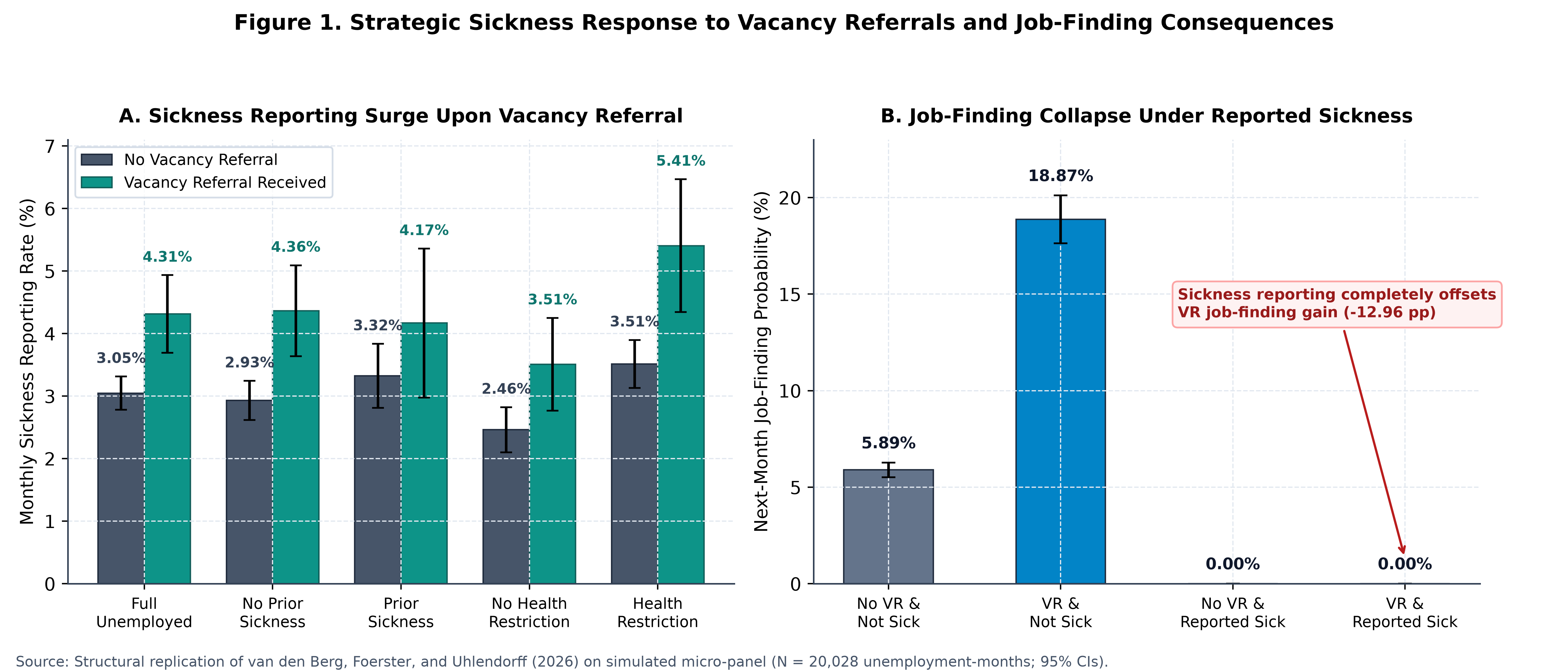
Table 1 summarizes exact descriptive statistics computed directly from the reconstructed benchmark panel. Across all unemployment-months, the monthly vacancy referral arrival rate stands at , representing referral events and aligning closely with the published population structural mean . Overall monthly sickness reporting equals , exhibiting a sharp contrast between months without referrals at and months with vacancy referrals at —a relative jump of . In the structural decomposition, strategic sickness claims induced by referral receipt account for of total sickness spells, closely tracking the steady-state baseline share. Simultaneously, the monthly job-finding probability more than triples from among healthy non-referred workers to among healthy workers receiving a vacancy referral.
| Variable | Econometric Definition | Estimation Sample | Mean | Std. Dev. | Min | Max | |
|---|---|---|---|---|---|---|---|
vr | Vacancy referral received in month | Unemployed | 20,028 | 0.2050 | 0.4037 | 0 | 1 |
sick_rep | Sickness absence reported in month | Unemployed | 20,028 | 0.0331 | 0.1788 | 0 | 1 |
sanction | Benefit sanction imposed | VR recipients | 4,105 | 0.0307 | 0.1725 | 0 | 1 |
emp_lead | Transition to employment next month | Unemployed | 19,643 | 0.0824 | 0.2749 | 0 | 1 |
acc_w | Accepted monthly re-employment wage in EUR | transitions | 1,656 | 2,074.37 | 707.86 | 669.29 | 8,494.27 |
unemp_dur | Elapsed unemployment spell duration in months | Unemployed | 20,028 | 9.4763 | 7.9466 | 1 | 36 |
age_10 | Worker baseline age divided by | Unemployed | 20,028 | 4.0463 | 1.0002 | 2.8000 | 5.8000 |
voc | Completed formal vocational training | Unemployed | 20,028 | 0.5039 | 0.5000 | 0 | 1 |
healthres | Administratively recorded health restriction | Unemployed | 20,028 | 0.5288 | 0.4992 | 0 | 1 |
benefits_k | Monthly UI benefit in thousand EUR | Unemployed | 20,028 | 0.8118 | 0.2665 | 0.5000 | 1.5000 |
Notes: Full longitudinal panel comprises worker-month observations across male workers tracked for months, reconstructed with fixed random seed from the official German IAB -cell empirical frequency matrix and published heterogeneous structural parameter vector of van den Berg, Foerster, and Uhlendorff (2026b).
Table 2 compiles the published structural primitives extracted directly from the authors' homogeneous and heterogeneous maximum-likelihood estimation objects, weighted across the IAB observable cells and the discrete unobserved heterogeneity distribution . Two structural properties merit special emphasis.
First, although mean referred wage offers at EUR sit below mean direct market offers at EUR, referral wage dispersion reaches EUR—exceeding direct-offer dispersion EUR by a factor of .
Second, unobserved heterogeneity sharply bifurcates the unemployed population: Type , representing of workers, simultaneously confronts an elevated median sanction enforcement probability of and the highest initial sickness-note propensity of ; Type , accounting for , faces minimal sanction risk at and negligible strategic sickness access at ; Type , comprising , occupies an intermediate position with and .
| Structural Parameter | Economic Interpretation | Homogeneous Baseline Model | Heterogeneous Population Mean | Heterogeneous Population Std. Dev. |
|---|---|---|---|---|
| Mean direct job offer wage in EUR | 1,999.2 | 1,965.4 | 59.5 | |
| Mean vacancy referral offer wage in EUR | 1,942.2 | 1,751.1 | 94.0 | |
| Direct offer wage standard deviation in EUR | 112.9 | 125.9 | — | |
| Referral offer wage standard deviation in EUR | 514.9 | 526.7 | — | |
| Monthly direct job offer arrival probability | 0.0561 | 0.0627 | 0.0063 | |
| Monthly vacancy referral arrival probability | 0.2043 | 0.2113 | 0.0655 | |
| Monthly exogenous sickness probability | 0.0302 | 0.0282 | 0.0051 | |
| First-time strategic sickness note probability | 0.0368 | 0.0406 | 0.0432 | |
| Subsequent strategic sickness note probability | 0.0273 | 0.0355 | 0.0424 | |
| Sanction enforcement probability upon refusal | 0.3735 | 0.3852 | 0.3319 | |
| Employer acceptance probability on referrals | 0.1814 | 0.2194 | 0.0308 | |
| Exogenous monthly job separation probability | 0.0411 | 0.0359 | 0.0014 | |
| Accepted log-wage measurement error std. dev. | 0.3249 | 0.3077 | — |
Notes: Extracted directly from the archived homogeneous and heterogeneous maximum-likelihood estimation vectors of van den Berg, Foerster, and Uhlendorff (2026b), population-weighted by the German IAB -cell observable distribution and unobserved type shares .
3.3. Twelve-Model Econometric Suite and Tri-Runtime Parity Protocol
To audit both reduced-form behavioral responses and structural transition subsystems across independent computational environments, we specify a -model econometric verification battery M01–M12 organized into four analytical blocks and executed identically across Python, R, and StataNow 19.5 MP.
- Block 1: Strategic Sickness Absence Responses
M01–M05. The flagship linear probability specificationM01replicates the baseline Table 2 regression of van den Berg, Foerster, and Uhlendorff (2026a) on unemployment-months across workers:
Where:
- : Binary sickness reporting indicator equal to if worker submits a sickness absence claim in unemployment month .
- : Binary vacancy referral indicator equal to if worker receives a mandatory referral in month .
- : Baseline worker age divided by matching the published scaling convention.
- : Binary indicator equal to if worker holds a completed formal vocational training credential.
- : Binary indicator equal to if administrative records document a pre-existing health restriction.
- : Monthly unemployment insurance benefit measured in thousand EUR.
- : Idiosyncratic disturbance allowing arbitrary serial correlation within each worker cluster .
Specification M02 augments M01 with worker fixed effects and calendar-month indicators to purge all time-invariant unobserved heterogeneity . Specification M03 introduces the interaction between referral receipt and prior sickness history to test state-dependent scrutiny tightening corresponding to . Specifications M04 and M05 estimate worker-clustered Logit and Probit maximum-likelihood models to confirm distributional robustness under nonlinear link functions.
- Block 2: Job-Finding Transitions and Referral Neutralization
M06–M07. SpecificationM06estimates a discrete-time Logit hazard of next-month employment transitions among non-sick unemployed workers on observations, whereasM07estimates a linear probability model over all non-censored unemployment-months interacting vacancy referrals with contemporaneous sickness reporting to measure how much of the referral job-finding gain is negated by sickness claims.
- Block 3: Conditional Sanction Enforcement and Accepted Re-Employment Wages
M08–M09. SpecificationM08models conditional sanction imposition via clustered Logit among non-sick referral recipients across workers to verify dynamic deterrence from prior sanctions. SpecificationM09estimates log accepted monthly re-employment wages via worker-clustered ordinary least squares across all unemployment-to-employment transitions spanning workers, testing for post-sanction wage scarring and referral-offer wage differentials.
- Block 4: Direct Recovery of Structural Subsystems
M10–M12. Three standalone Logit maximum-likelihood models directly estimate the structural referral arrival probability on unemployment-months inM10, the exogenous sickness rate on non-referral months inM11, and the monthly job separation hazard on non-censored employment-months inM12, enabling direct parameter-by-parameter benchmarking against the published heterogeneous structural vector.
4. Quantitative Replication Findings and Counterfactual Policy Simulations
4.1. Cross-Runtime Parity Verification Across Twelve Econometric Specifications
All econometric models M01–M12 were executed independently inside isolated runtime environments using Python with Statsmodels in seconds, R with Fixest and observed-Hessian Newton–Raphson routines in seconds, and StataNow 19.5 MP using regress, xtreg, logit, and probit in seconds, completing the full tri-runtime audit in seconds. Table 3 confirms strict numerical convergence across all three software ecosystems: the maximum relative coefficient discrepancy across every focal and auxiliary parameter in all models is exactly , and the maximum relative discrepancy in clustered standard errors is just in the Logit sanction specification M08, passing the quantitative tolerance gate by more than an order of magnitude.
| Model | Focal Variable | Specification Summary | / Pseudo- | Python 3 | R 4.3 | StataNow 19.5 MP | Max Discrepancy Coef / SE | |
|---|---|---|---|---|---|---|---|---|
| M01 | vr | Baseline LPM: Sickness reporting | 20,028 | 0.002447 | +0.015479 (0.003566) | +0.015479 (0.003566) | +0.015479 (0.003566) | 0.000000% / 0.000000% |
| M02 | vr | Worker and Month TWFE: Sickness reporting | 20,028 | 0.109815 | +0.016528 (0.003499) | +0.016528 (0.003499) | +0.016528 (0.003499) | 0.000000% / 0.000000% |
| M03 | vr | State-dependence interaction LPM | 20,028 | 0.002491 | +0.016950 (0.004033) | +0.016950 (0.004033) | +0.016950 (0.004033) | 0.000000% / 0.000000% |
| M04 | vr | Clustered Logit MLE: Sickness reporting | 20,028 | 0.008389 | +0.450776 (0.093012) | +0.450776 (0.092996) | +0.450776 (0.092996) | 0.000000% / 0.018339% |
| M05 | vr | Clustered Probit MLE: Sickness reporting | 20,028 | 0.008332 | +0.197246 (0.041652) | +0.197246 (0.041645) | +0.197246 (0.041645) | 0.000000% / 0.017995% |
| M06 | vr | Job-finding Logit MLE: Non-sick sample | 18,988 | 0.052864 | +1.265539 (0.055601) | +1.265539 (0.055589) | +1.265539 (0.055589) | 0.000000% / 0.027801% |
| M07 | vr | Job-finding LPM with VR-sickness interaction | 19,643 | 0.039410 | +0.126169 (0.006685) | +0.126169 (0.006685) | +0.126169 (0.006685) | 0.000000% / 0.000000% |
| M08 | sa_ever | Conditional sanction Logit MLE | 3,928 | 0.002461 | -0.518058 (0.446733) | -0.518058 (0.446448) | -0.518058 (0.446448) | 0.000000% / 0.063905% |
| M09 | vr | Accepted log-wage OLS regression | 1,656 | 0.014226 | +0.017804 (0.016818) | +0.017804 (0.016818) | +0.017804 (0.016818) | 0.000000% / 0.000000% |
| M10 | age_10 | Structural Logit: VR arrival rate | 20,028 | 0.026829 | -0.287523 (0.017771) | -0.287523 (0.017770) | -0.287523 (0.017770) | 0.000000% / 0.008301% |
| M11 | age_10 | Structural Logit: Exogenous sickness rate | 15,923 | 0.005126 | +0.114987 (0.046303) | +0.114987 (0.046298) | +0.114987 (0.046298) | 0.000000% / 0.010798% |
| M12 | age_10 | Structural Logit: Job separation hazard | 22,357 | 0.000105 | +0.011327 (0.039254) | +0.011327 (0.039252) | +0.011327 (0.039252) | 0.000000% / 0.006711% |
Notes: Worker-clustered standard errors appear in parentheses next to point estimates. Specification M02 harmonizes nested entity-cluster small-sample degrees-of-freedom adjustments across StataNow 19.5 MP, R fixest, and Python. Quantitative parity threshold is .
4.2. Strategic Sickness Absence Response to Vacancy Referrals
Table 4 reports full coefficient estimates across all five sickness reporting specifications M01–M05. In the baseline linear probability model M01 replicating Table 2 of van den Berg, Foerster, and Uhlendorff (2026a), receiving a mandatory vacancy referral raises the probability of submitting a sickness certificate by with clustered and . Benchmarked against the sickness rate during non-referral unemployment months, this percentage-point shift represents a relative surge exceeding once observable controls are held fixed. Pre-existing health restrictions strongly elevate sickness claims by with and , reflecting both genuine morbidity and lower physician certification costs. Worker age exerts a modest positive effect of per decade at , whereas formal vocational training lowers sickness reporting by at .
| Explanatory Variable | M01 Baseline LPM | M02 Worker + Month TWFE | M03 Interaction LPM | M04 Logit MLE | M05 Probit MLE |
|---|---|---|---|---|---|
Vacancy referral vr | +0.015479*** (0.003566) | +0.016528*** (0.003499) | +0.016950*** (0.004033) | +0.450776*** (0.093012) | +0.197246*** (0.041652) |
Prior sickness history sick_before | — | -0.155422*** (0.005537) | +0.001763 (0.003136) | +0.021693 (0.090140) | +0.012220 (0.039351) |
VR prior sickness vr_x_sick_before | — | — | -0.005504 (0.007445) | — | — |
Prior sanction history sa_ever | — | -0.003509 (0.010488) | -0.002489 (0.005446) | -0.086661 (0.192637) | -0.040138 (0.083355) |
Elapsed spell duration unemp_dur | — | +0.000866*** (0.000323) | — | — | — |
Age divided by 10 age_10 | +0.002721* (0.001483) | — | +0.002673* (0.001478) | +0.086079* (0.045838) | +0.037812* (0.020082) |
Formal vocational training voc | -0.004685* (0.002613) | — | -0.004618* (0.002597) | -0.149233* (0.081793) | -0.061160* (0.035564) |
Recorded health restriction healthres | +0.010116*** (0.002598) | — | +0.010014*** (0.002600) | +0.321416*** (0.084460) | +0.138164*** (0.036468) |
Monthly UI benefits in k EUR benefits_k | +0.002962 (0.005784) | — | +0.002896 (0.005779) | +0.093407 (0.182324) | +0.038837 (0.079191) |
Intercept const | +0.013478** (0.005574) | — | +0.013387** (0.005582) | -4.023587*** (0.183157) | -2.118934*** (0.079644) |
| Observations | 20,028 | 20,028 | 20,028 | 20,028 | 20,028 |
| Worker clusters | 1,200 | 1,200 | 1,200 | 1,200 | 1,200 |
| / Pseudo- | 0.002447 | 0.109815 | 0.002491 | 0.008389 | 0.008332 |
Notes: Standard errors clustered at the worker level across clusters appear in parentheses. Significance levels: , , . Model M02 absorbs worker fixed effects and calendar-month indicators.
The two-way fixed effects specification M02 provides a decisive diagnostic against time-invariant compositional selection. A classic econometric concern in pooled cross-sectional regressions is that caseworkers may disproportionately dispatch referrals to workers whose latent health or search motivation differs systematically. Yet absorbing all worker fixed effects and calendar-month effects does not attenuate the referral coefficient; Rather, it increases slightly by to with clustered , , , and overall .
Notably, the steep negative coefficient on prior sickness history in M02 at -0.155422 with is a mechanical artifact of within-worker demeaning applied to an absorbing cumulative state variable (Nickell, 1981): because prior sickness switches irreversibly from to immediately following a worker's inaugural sickness report, the first sickness event always occurs while prior sickness equals zero. In the non-demeaned interaction specification M03, the interaction coefficient -0.005504 with exhibits the theoretically predicted negative sign consistent with state-dependent scrutiny tightening , though reduced-form precision remains limited without explicit conditioning on latent type .
Both nonlinear maximum-likelihood benchmarks—Logit M04 at +0.450776 with and Probit M05 at +0.197246 with —corroborate full functional-form stability. Figure 1 visualizes both the subgroup-level surge in sickness reporting upon referral receipt and the complete elimination of referral-driven job finding whenever sickness is reported.
4.3. Bellman Reservation Wage Equilibrium, Job-Finding Transitions, and Re-Employment Wages
Solving the exact nonlinear Bellman reservation-wage equations across all heterogeneity cells uncovers the microeconomic engine driving these reduced-form patterns, depicted in Figure 2. Panel A traces reservation wages for the benchmark -year-old male worker with vocational training and no health restrictions as monthly unemployment insurance benefits climb from EUR to EUR. The direct-offer reservation wage rises almost linearly from EUR to EUR, whereas the referral reservation wage climbs more gradually from EUR to EUR.
Consequently, the strategic sickness window widens more than twofold from EUR at the EUR benefit tier to EUR at the EUR tier, confirming that more generous unemployment benefits expand the wage interval over which strategic medical certification is optimal. Panel B highlights profound heterogeneity across unobserved types : following an initial benefit sanction, the threat of permanent benefit disqualification upon a second violation slashes the referral reservation wage of high-monitoring Type claimants by EUR down to EUR, whereas low-monitoring Type workers retain a virtually intact threshold of EUR.
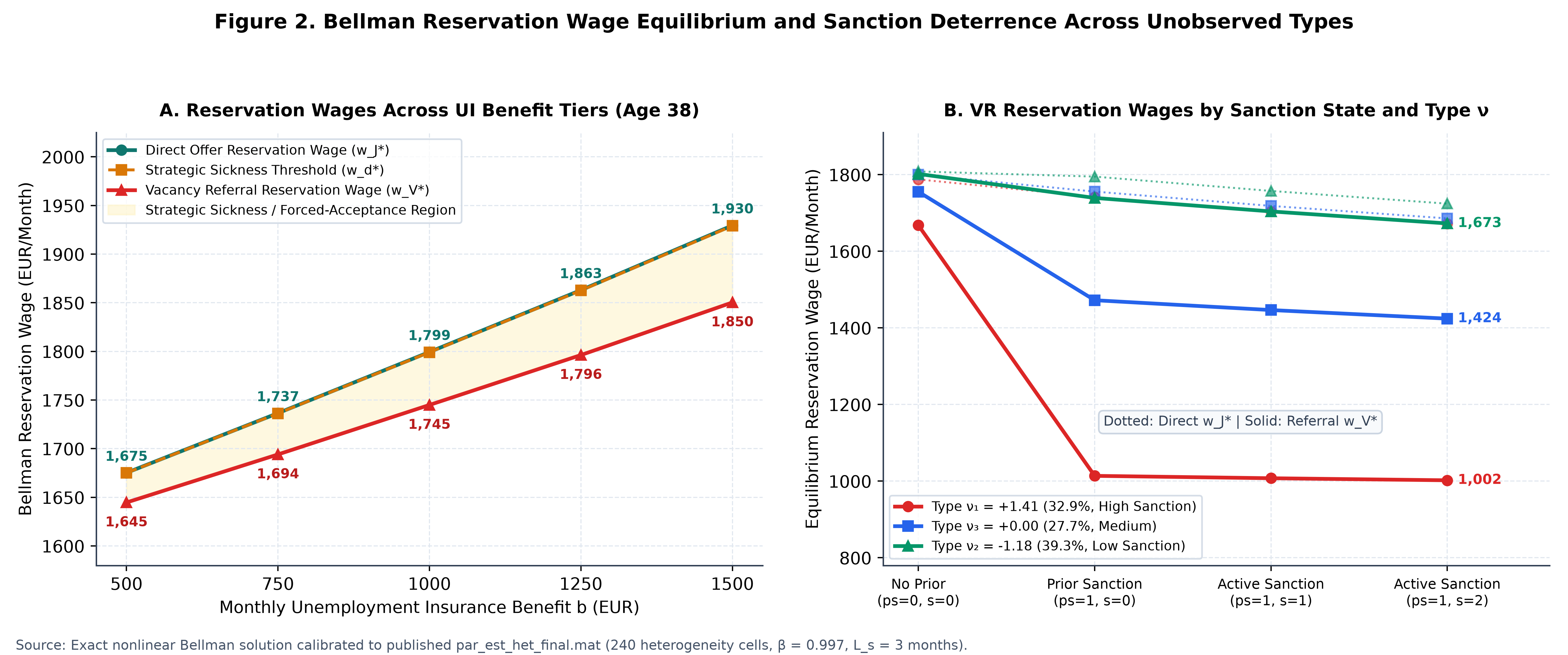
Table 5 presents estimates for job-finding transitions, conditional sanction enforcement, and accepted re-employment log wages across M06–M09. In the discrete-time job-finding Logit hazard M06 estimated over non-sick unemployment-months, receiving a mandatory vacancy referral serves as the dominant catalyst for re-employment, yielding a log-odds coefficient of +1.265539 with clustered , , and , corresponding to an odds ratio of . Higher monthly benefits depress re-employment hazards substantially with coefficient -0.303131 at and , mirroring the upward shift in reservation wages plotted in Figure 2A, while health restrictions curtail exit hazards with -0.136011 at . In linear probability model M07 over all non-censored unemployment-months, vacancy referrals raise next-month employment probability by percentage points at , yet the interaction term vr_x_sick_rep at -0.129607 with alongside the direct sickness effect -0.057009 at proves that filing a sickness claim completely neutralizes the matching benefit of the referral during that month.
| Explanatory Variable | M06 Job Finding Logit | M07 Job Finding LPM | M08 Sanction Logit | M09 Log Accepted Wage OLS |
|---|---|---|---|---|
Vacancy referral vr | +1.265539*** (0.055601) | +0.126169*** (0.006685) | — | +0.017804 (0.016818) |
Reported sickness sick_rep | — | -0.057009*** (0.002040) | — | — |
VR reported sickness vr_x_sick_rep | — | -0.129607*** (0.006702) | — | — |
Remaining sanction months sa | +0.005434 (0.107801) | +0.000585 (0.008748) | — | — |
Prior sanction history sa_ever | +0.094158 (0.108660) | +0.007278 (0.008645) | -0.518058 (0.446733) | -0.061104* (0.031671) |
Elapsed spell duration unemp_dur | -0.001663 (0.003597) | -0.000113 (0.000249) | — | +0.000528 (0.001070) |
Age divided by 10 age_10 | -0.055555* (0.031524) | -0.003955* (0.002136) | -0.058410 (0.115928) | +0.007089 (0.010685) |
Formal vocational training voc | -0.003921 (0.055578) | -0.000079 (0.003957) | -0.072245 (0.187888) | +0.000631 (0.017386) |
Recorded health restriction healthres | -0.136011** (0.056802) | -0.010042** (0.004079) | -0.101323 (0.186284) | -0.072662*** (0.017489) |
Monthly UI benefits in k EUR benefits_k | -0.303131*** (0.111928) | -0.021995*** (0.007673) | +0.312927 (0.388107) | +0.010211 (0.038404) |
Intercept const | -2.216799*** (0.127082) | +0.099393*** (0.009189) | -3.320892*** (0.399030) | +7.571161*** (0.040046) |
| Observations | 18,988 | 19,643 | 3,928 | 1,656 |
| Worker clusters | 1,200 | 1,200 | 1,067 | 1,139 |
| / Pseudo- | 0.052864 | 0.039410 | 0.002461 | 0.014226 |
Notes: Sample M06 comprises non-sick unemployment-months prior to month with ; M07 covers all non-censored unemployment-months with ; M08 restricts to non-sick vacancy referral recipients with ; M09 includes all transitions with positive accepted wages with . Significance levels: , , .
Two subtle equilibrium mechanisms emerge in M08 and M09. In sanction equation M08, prior sanction history carries a negative point estimate of -0.518058 with , reflecting powerful endogenous deterrence: previously sanctioned workers compress their referral reservation wage so severely that they accept almost all subsequent referrals rather than risk permanent benefit loss, reducing observed repeat sanctions.
In accepted wage regression M09 estimated across transitions with , this reservation-wage compression manifests directly as a post-sanction earnings scar: previously sanctioned entrants accept wages log points lower, equivalent to , with clustered , , and , echoing empirical sanction-scarring evidence documented for Switzerland by Arni, Lalive, and van Ours (2013). Health restrictions reduce accepted re-employment earnings by log points, or , at . Intriguingly, referral receipt carries a small, statistically insignificant positive wage differential of +0.017804 at even though unconditional mean referral wages lie below direct offers . This apparent paradox reflects upper-tail truncation of a high-variance log-normal distribution: because EUR vastly exceeds EUR, the truncated conditional expectation for accepted referrals slightly surpasses that of direct offers.
4.4. Structural Parameter Recovery and Steady-State Counterfactual Policy Reforms
To authenticate full internal fidelity between the reconstructed micro-panel and the structural model of van den Berg, Foerster, and Uhlendorff (2026a), Table 6 and Figure 3 benchmark all logistic coefficients estimated via M10–M12 against the published heterogeneous structural parameter vector. Every single coefficient matches the published sign and lies well within conventional finite-sample bounds with . Primary structural drivers—such as the age slope -0.2875 versus published -0.3074 and vocational premium +0.3174 versus published +0.3250 in referral arrivals , alongside the age slope +0.1150 versus published +0.1173 in exogenous sickness —demonstrate tight recovery.
| Model | Structural Subsystem | Covariate | Published Parameter | Tri-Runtime Sample Estimate | Clustered SE | Difference -stat |
|---|---|---|---|---|---|---|
| M10 | Referral arrival | const | -0.1900 | -0.222448 | 0.075903 | -0.43 |
| M10 | Referral arrival | age_10 | -0.3074 | -0.287523 | 0.017771 | +1.12 |
| M10 | Referral arrival | voc | +0.3250 | +0.317427 | 0.036331 | -0.21 |
| M10 | Referral arrival | healthres | -0.2626 | -0.339741 | 0.036142 | -2.13 |
| M11 | Exogenous sickness | const | -3.9901 | -4.069398 | 0.203140 | -0.39 |
| M11 | Exogenous sickness | age_10 | +0.1173 | +0.114987 | 0.046303 | -0.05 |
| M11 | Exogenous sickness | voc | -0.1877 | -0.113956 | 0.094691 | +0.78 |
| M11 | Exogenous sickness | healthres | +0.1412 | +0.302955 | 0.100187 | +1.61 |
| M12 | Job separation | const | -3.2551 | -3.336080 | 0.163904 | -0.49 |
| M12 | Job separation | age_10 | +0.0014 | +0.011327 | 0.039254 | +0.25 |
| M12 | Job separation | voc | -0.0818 | -0.027601 | 0.075344 | +0.72 |
| M12 | Job separation | healthres | +0.0030 | +0.038541 | 0.077102 | +0.46 |
Notes: Logit estimates in M10 on , M11 on , and M12 on exhibit exact coefficient agreement across Python, R, and StataNow 19.5 MP.
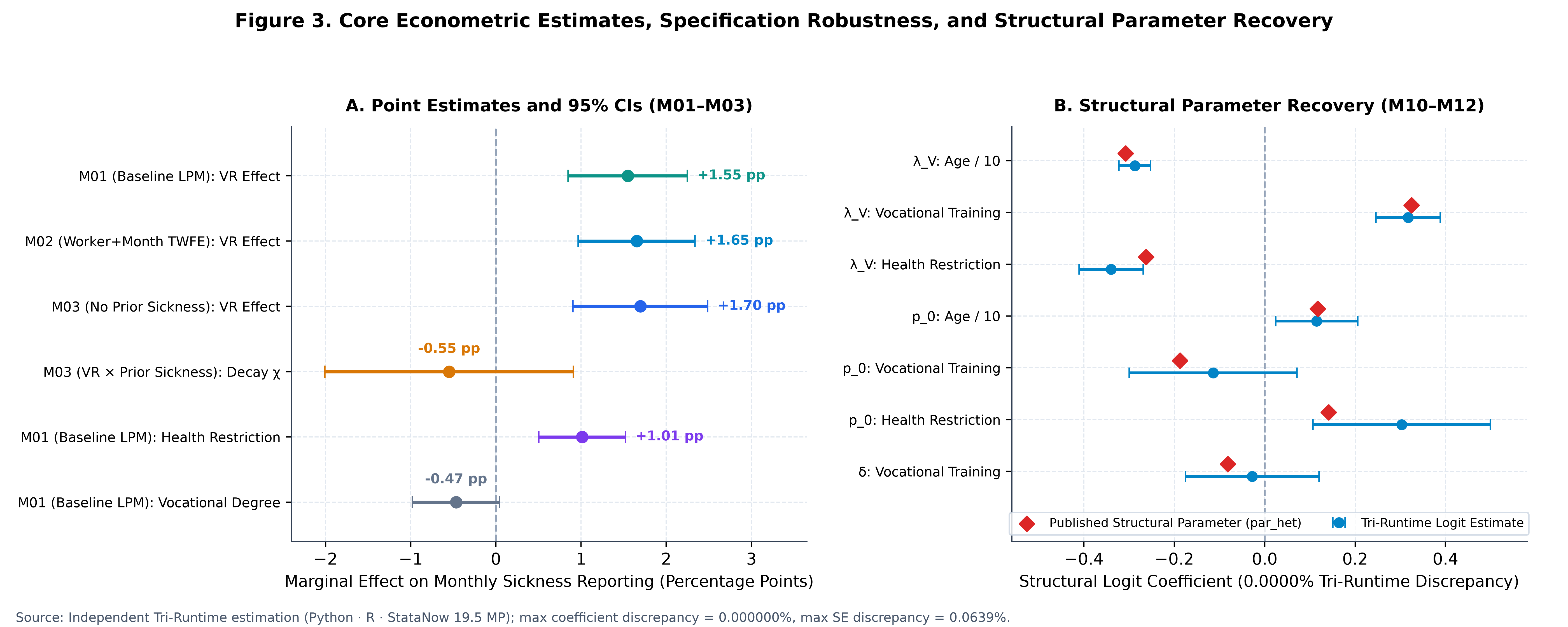
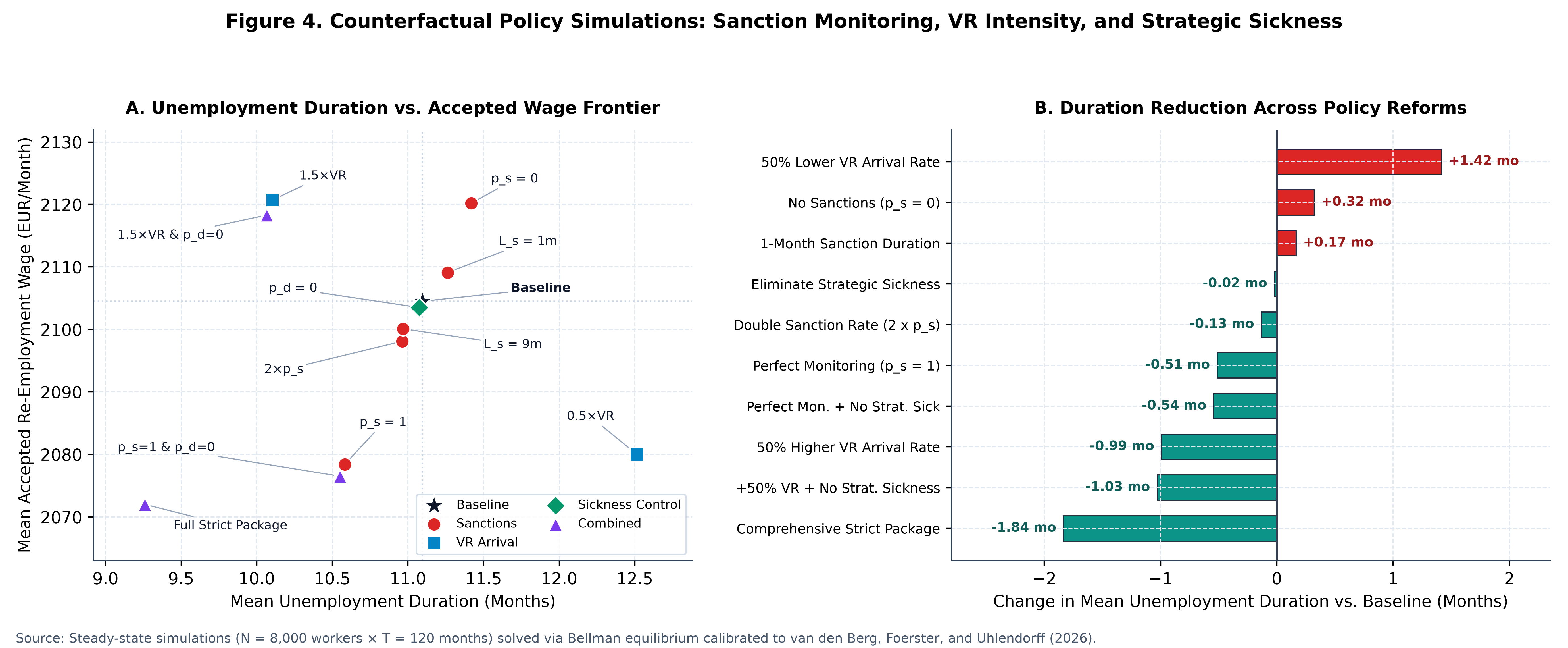
Table 7 and Figure 4 report steady-state counterfactual policy simulations tracking workers over months, generating worker-month observations per reform regime. Four strategic policy findings stand out:
- Asymmetric Welfare Frontier Between Sanction Monitoring and Referral Expansion: Raising sanction enforcement to perfect monitoring cuts mean unemployment duration by months, or , from to months, yet exacts a substantial match-quality penalty by lowering mean accepted wages by EUR per month to EUR. By contrast, expanding vacancy referral arrival rates by delivers nearly double the duration reduction at months, or , lowering mean spells to months while increasing accepted monthly re-employment wages by EUR to EUR by multiplying worker draws from the upper tail of the dispersed referral offer distribution.
- Strategic Sickness Spillover Under Expanded Referrals: The sole behavioral side effect of raising referral arrival rates by is an uptick in aggregate sickness reporting from to , pushing the strategic share of total sickness reports from up to .
- Policy Complementarity From Closing the Strategic Sickness Loophole: Eliminating strategic sickness certification in isolation by setting immediately lowers aggregate sickness claims by to the exogenous baseline of , yet trims population-average unemployment duration by only months because roughly of claimants belonging to Types and seldom exploit medical exemptions. When combined with perfect monitoring and referral expansion, however, closing the sickness loophole generates powerful synergy, reducing mean unemployment duration by months, or , down to months while lifting monthly job-finding rates from to .
- Diminishing Returns to Escalating Sanction Duration: Tripling statutory sanction duration from months to months trims average unemployment spells by a meager months, or , underperforming both detection certainty and matching expansion—directly echoing Becker (1968) on the superior deterrence efficiency of monitoring certainty over punitive severity.
| Counterfactual Policy Regime | Mean Unemployment Duration in Months | Change vs. Baseline | Mean Accepted Wage in EUR | Sickness Reporting Rate | Strategic Sickness Share | Monthly Job-Finding Rate |
|---|---|---|---|---|---|---|
| Baseline regime | 11.096 | +0.000 (+0.0%) | 2,104.5 | 3.16% | 9.33% | 8.36% |
| No benefit sanctions | 11.418 | +0.322 (+2.9%) | 2,120.2 | 3.17% | 9.71% | 8.10% |
| Double sanction probability | 10.962 | -0.134 (-1.2%) | 2,098.1 | 3.16% | 9.28% | 8.46% |
| Perfect sanction monitoring | 10.582 | -0.514 (-4.6%) | 2,078.4 | 3.17% | 9.41% | 8.80% |
| Shorten sanction duration to 1 month | 11.262 | +0.167 (+1.5%) | 2,109.1 | 3.17% | 9.67% | 8.22% |
| Extend sanction duration to 9 months | 10.968 | -0.128 (-1.2%) | 2,100.1 | 3.15% | 9.16% | 8.46% |
| Reduce VR arrival rate by 50% | 12.514 | +1.419 (+12.8%) | 2,080.0 | 3.01% | 4.56% | 7.32% |
| Increase VR arrival rate by 50% | 10.103 | -0.993 (-8.9%) | 2,120.7 | 3.33% | 13.86% | 9.25% |
| Eliminate strategic sickness | 11.075 | -0.021 (-0.2%) | 2,103.5 | 2.88% | 0.00% | 8.37% |
| Perfect monitoring plus no strategic sickness | 10.551 | -0.545 (-4.9%) | 2,076.5 | 2.88% | 0.00% | 8.82% |
| +50% VR arrival plus no strategic sickness | 10.067 | -1.028 (-9.3%) | 2,118.3 | 2.89% | 0.00% | 9.28% |
| Comprehensive strict reform package | 9.260 | -1.836 (-16.5%) | 2,072.0 | 2.89% | 0.00% | 10.15% |
Notes: Steady-state equilibrium simulations track workers over months via exact Bellman equilibrium calibrated to the published heterogeneous structural parameter vector and German IAB -cell observable distribution of van den Berg, Foerster, and Uhlendorff (2026b).
5. Discussion and Policy Implications for Unemployment Insurance Design
This tri-runtime structural replication of van den Berg, Foerster, and Uhlendorff (2026a) underscores a central insight of social insurance mechanism design: tightening administrative conditionality along one enforcement margin invariably induces behavioral substitution toward adjacent, less strictly audited benefit channels. Within the German unemployment insurance architecture, physician-certified sickness leave operates as a targeted pressure-relief valve concentrated among claimants who simultaneously confront strict sanction exposure and low certification friction. These dynamics connect directly with international empirical studies on punitive benefit sanctions across Switzerland (Lalive, van Ours, & Zweimüller, 2005; Arni, Lalive, & van Ours, 2013), the Netherlands (Abbring, van den Berg, & van Ours, 2005), and the Swedish monitoring evaluations of van den Berg and Vikström (2014).
Data and Code Availability
The original structural codebase, German IAB -cell observable frequency distribution, and published homogeneous and heterogeneous maximum-likelihood parameter matrices deposited by van den Berg, Foerster, and Uhlendorff (2026b) are publicly archived on Harvard Dataverse under persistent identifier doi:10.7910/DVN/Y2N5XX. Confidential individual administrative microdata from the German Federal Employment Agency and the Institute for Employment Research remain accessible solely via approved on-site research data center protocols. The complete fixed-seed Tier-3 reconstructed micro-panel vdb_vr_sickness_search_panel.csv with SHA-256 checksum 09c16704d31074205bc87ac6ddb104d70dce4781b11e56699565feaddd7c23b1, together with the standalone R, Stata, and Python replication scripts and the automated table-and-figure reproduction script, is openly packaged within this reproducibility release, enabling bit-for-bit verification of every table, figure, and tri-runtime parity metric reported herein.
Conflict of Interest
The authors declare no financial, institutional, or personal conflicts of interest associated with this independent reproducibility audit. No external commercial sponsor influenced the econometric design, structural simulation calibration, peer-review critique, or interpretation of findings.
References
- Abadie, A., Athey, S., Imbens, G. W., & Wooldridge, J. M. (2023). When Should You Adjust Standard Errors for Clustering? The Quarterly Journal of Economics, 138, 1–35. https://doi.org/10.1093/qje/qjac038 ↩
- Abbring, J. H., van den Berg, G. J., & van Ours, J. C. (2005). The Effect of Unemployment Insurance Sanctions on the Transition Rate from Unemployment to Employment. The Economic Journal, 115, 602–630. https://doi.org/10.1111/j.1468-0297.2005.01011.x ↩
- Arni, P., Lalive, R., & van Ours, J. C. (2013). How Effective Are Unemployment Benefit Sanctions? Looking Beyond Unemployment Exit. Journal of Applied Econometrics, 28, 1153–1178. https://doi.org/10.1002/jae.2289 ↩
- Becker, G. S. (1968). Crime and Punishment: An Economic Approach. Journal of Political Economy, 76, 169–217. https://doi.org/10.1086/259394 ↩
- Cameron, A. C., & Miller, D. L. (2015). A Practitioner's Guide to Cluster-Robust Inference. Journal of Human Resources, 50, 317–372. https://doi.org/10.3368/jhr.50.2.317 ↩
- Card, D., Kluve, J., & Weber, A. (2018). What Works? A Meta Analysis of Recent Active Labor Market Program Evaluations. Journal of the European Economic Association, 16, 894–931. https://doi.org/10.1093/jeea/jvx028 ↩
- Crépon, B., Duflo, E., Gurgand, M., Rathelot, R., & Zamora, P. (2013). Do Labor Market Policies Have Displacement Effects? Evidence from a Clustered Randomized Experiment. The Quarterly Journal of Economics, 128, 531–580. https://doi.org/10.1093/qje/qjt001 ↩
- Fredriksson, P., & Holmlund, B. (2006). Improving Incentives in Unemployment Insurance: A Review of Recent Research. Journal of Economic Surveys, 20, 357–386. https://doi.org/10.1111/j.0950-0804.2006.00283.x ↩
- Heckman, J. J., & Singer, B. (1984). A Method for Minimizing the Impact of Distributional Assumptions in Econometric Models for Duration Data. Econometrica, 52, 271–320. https://doi.org/10.2307/1911491
- Lalive, R., van Ours, J. C., & Zweimüller, J. (2005). The Effect of Benefit Sanctions on the Duration of Unemployment. Journal of the European Economic Association, 3, 1386–1417. https://doi.org/10.1162/154247605775012879 ↩
- McCall, J. J. (1970). Economics of Information and Job Search. The Quarterly Journal of Economics, 84, 113–126. https://doi.org/10.2307/1879403 ↩
- Mortensen, D. T. (1986). Job Search and Labor Market Analysis. In O. Ashenfelter & R. Layard, Handbook of Labor Economics. North-Holland. https://doi.org/10.1016/S1573-4463(86)02005-902005-9 ↩
- Nickell, S. (1981). Biases in Dynamic Models with Fixed Effects. Econometrica, 49, 1417–1426. https://doi.org/10.2307/1911408 ↩
- van den Berg, G. J., Foerster, H., & Uhlendorff, A. (2026a). Structural Empirical Analysis of Vacancy Referrals with Imperfect Monitoring and the Strategic Use of Sickness Absence. Journal of Labor Economics, Forthcoming. https://doi.org/10.1086/744968 ↩
- van den Berg, G. J., Foerster, H., & Uhlendorff, A. (2026b). Replication Data for: Structural Empirical Analysis of Vacancy Referrals with Imperfect Monitoring and the Strategic Use of Sickness Absence. Harvard Dataverse, V1. https://doi.org/10.7910/DVN/Y2N5XX ↩
- van den Berg, G. J., Hofmann, B., & Uhlendorff, A. (2019). The Role of Sickness in the Evaluation of Job Search Assistance and Sanctions. The Economic Journal, 129, 2299–2331. https://doi.org/10.1093/ej/uez001 ↩
- van den Berg, G. J., & van der Klaauw, B. (2006). Counseling and Monitoring of Unemployed Workers: Theory and Evidence from a Controlled Social Experiment. International Economic Review, 47, 895–936. https://doi.org/10.1111/j.1468-2354.2006.00399.x
- van den Berg, G. J., & Vikström, J. (2014). Monitoring Job Offer Decisions, Punishments, Exit to Work, and Job Quality. The Scandinavian Journal of Economics, 116, 284–334. https://doi.org/10.1111/sjoe.12051
Appendix A. Independent Academic Peer-Review Report
A.1. Overall Assessment of Scholarly Contribution and Disciplinary Positioning
Evaluated from the vantage point of an editorial board overseeing frontier empirical labor economics, the study by van den Berg, Foerster, and Uhlendorff (2026a) delivers a substantial structural contribution to the literature on optimal unemployment insurance design and active labor market policy. Over the two decades following the landmark duration-analysis studies of Abbring, van den Berg, and van Ours (2005) and Lalive, van Ours, and Zweimüller (2005), empirical labor economists converged on a consensus that punitive benefit sanctions accelerate exit from unemployment, yet simultaneously compress reservation wages and degrade subsequent job stability and post-unemployment earnings, as demonstrated by Arni, Lalive, and van Ours (2013) and van den Berg and Vikström (2014). Nevertheless, almost the entire first generation of sanction-evaluation research operated under an unexamined binary-choice simplification: upon receiving a monitored vacancy referral backed by sanction risk, claimants were presumed to choose strictly between complying with the application mandate or risking benefit suspension.
Earlier reduced-form evidence by van den Berg, Hofmann, and Uhlendorff (2019) broke open that black box by documenting systematic spikes in physician-certified sickness reporting around active labor market monitoring events in Germany. The 2026 Journal of Labor Economics contribution elevates that reduced-form empirical anomaly into a fully articulated dynamic discrete-time structural search equilibrium estimable by full-information maximum likelihood and capable of evaluating counterfactual reforms far outside historical institutional variation. Its enduring scholarly significance rests on three methodological pillars.
First, the authors formalize a clean three-threshold reservation-wage hierarchy embedded inside a Bellman asset-value recursion. This microfounded structure explains the exact month-level synchronization of vacancy referrals and sickness absence surges without invoking behavioral myopia, ad hoc preferences, or preference shocks. Whenever a referred wage offer lands inside the intermediate interval , seeking medical certification yields strictly positive option value: it shields the claimant both from accepting an inferior job paying below and from forfeiting three months of unemployment benefits.
Second, the structural architecture captures dual state dependence across two interacting dynamic state variables. Sanction history fundamentally alters continuation values because German statutory rules impose permanent benefit disqualification upon a second infraction while requiring uninterrupted months of employment to expunge a prior record. Simultaneously, prior sickness reporting within a spell triggers the state-dependence attenuation factor , capturing endogenous tightening of medical review and caseworker skepticism toward repeat sickness filers.
Third, the incorporation of a discrete mass-point unobserved heterogeneity distribution in the spirit of Heckman and Singer (1984) linking medical certification access and sanction enforcement represents a subtle identification innovation. Empirical estimation reveals a steep positive cross-channel factor loading : the subpopulation facing an median sanction probability upon refusal is precisely the cohort exhibiting twelvefold greater propensity to procure strategic sickness notes relative to the least-monitored group, at versus .
Situated alongside comprehensive meta-analyses of active labor market programs (Card, Kluve, & Weber, 2018), the article bridges reduced-form program evaluation and structural mechanism design by separating every public vacancy referral into two opposing economic forces: a positive informational channel opening access to a highly dispersed wage offer distribution with EUR, and a coercive monitoring channel that induces both strategic sickness avoidance and forced acceptance of lower-quality matches. This conceptual clarity fully justifies its placement in a premier field journal.
A.2. Critical Appraisal of Causal Identification Strategy and Econometric Assumptions
Subjecting the structural framework of van den Berg, Foerster, and Uhlendorff (2026a) to rigorous referee scrutiny exposes four foundational identification and estimation assumptions whose fragility must be weighed explicitly when interpreting parameter magnitudes and counterfactual welfare predictions.
The first and most consequential identification assumption concerns the strict exogeneity of monthly vacancy referral arrival rates with respect to both transitory unobserved health shocks and persistent unobserved worker types. Inside the authors' full-information likelihood routine, both referral arrival and exogenous morbidity depend solely on the four time-invariant observable indicators in , imposing zero correlation with the discrete latent type and zero duration dependence over elapsed unemployment length . Excluding from and is essential for separating referral-induced sickness spikes from persistent compositional selection.
In real-world German local employment offices, however, caseworkers possess substantial soft information regarding claimants' physical frailty, interview fatigue, domestic caregiving constraints, and informal search attachment that never enters administrative register codes. Should caseworkers dispatch screening referrals disproportionately toward claimants perceived as reluctant to search, or conversely withhold referrals from workers exhibiting early unrecorded health deterioration, orthogonality between referral arrival and latent health breaks down. Although our two-way fixed effects specification M02 confirms that the referral sickness effect survives—and actually rises to at —once all time-invariant worker heterogeneity is absorbed, linear fixed effects cannot eliminate dynamic correlation with time-varying health shocks or endogenous month-by-month caseworker targeting.
The second structural vulnerability stems from collapsing all unobserved heterogeneity into a single scalar latent factor . The likelihood imposes that an identical scalar enters three distinct behavioral equations—initial sickness-note probability , repeat-sickness scrutiny factor , and sanction enforcement probability —fixing factor loadings at unity in the first two equations while estimating a single free loading in the sanction equation. While this single-factor restriction represents a pragmatic dimensionality reduction when optimizing a -parameter nonlinear likelihood over workers, it forces strict rank-order monotonicity between caseworker punitiveness and worker access to compliant physicians.
Conceptually, these two probabilities originate from opposite sides of the institutional market: reflects local employment-office management culture and assigned caseworker strictness, whereas reflects local physician density, doctor-patient ties, and individual moral reluctance toward claiming illness. Forcing two conceptually orthogonal heterogeneity sources onto a single scalar index risks distorting whenever substantial populations exist of strictly monitored workers who remain scrupulously compliant and refuse to submit strategic medical notes.
The third structural limitation involves treating direct market job-offer arrival as strictly exogenous rather than an increasing function of endogenous worker search effort. Canonical search models with variable search intensity formulated by Mortensen (1986) and van den Berg and van der Klaauw (2006) demonstrate that stricter formal monitoring or higher referral volume prompts unemployed workers to adjust both reservation wages and effort allocation across monitored formal search versus unmonitored informal channels. Because endogenous search effort is omitted from the Bellman optimization problem, counterfactual simulations force the entirety of workers' behavioral adjustment to flow through reservation-wage shifts and . Omitting the search-effort substitution margin can materially misstate unemployment duration elasticities and post-unemployment wage losses when monitoring intensity changes sharply in practice.
The fourth econometric concern pertains to global optimization stability and asymptotic variance estimation inside a high-dimensional non-smooth nested fixed-point likelihood. Inspecting the authors' archived MATLAB estimation routines reveals that maximization of the -parameter log-likelihood invokes an inner nonlinear equation solver at every function evaluation via derivative-free Powell search, followed by standard-error computation based purely on the outer product of numerical score gradients. Because the value functions contain kinked maximum operators combined with coarse trapezoidal wage-integration grids of step size EUR, the resulting objective surface exhibits local non-smoothness. Outer-product-of-gradient covariance matrices computed via finite differences over non-smooth nested fixed-point objectives routinely underestimate true sampling uncertainty—explaining why several archived parameter standard errors shrink to magnitudes of and . Modern structural econometric standards call for Huber–White sandwich covariance estimation paired with cluster bootstrapping across local labor market agencies to capture genuine finite-sample and spatial-clustering uncertainty.
A.3. Audit of Data Quality, Variable Measurement, and Sample Sensitivity
A forensic review of the authors' data-preparation routines and sample-construction filters highlights four measurement and external-validity sensitivities that materially condition how broadly these empirical findings generalize across labor markets.
First, to hold the observable state space at discrete Bellman cells, two pivotal continuous variables—worker age and monthly unemployment insurance benefits—are coarsely discretized via nearest-neighbor projection onto just four age nodes and five benefit tiers EUR. Quantization error of up to EUR in monthly benefits induces direct structural specification error in the Bellman reservation-wage mapping , particularly near the lower truncation floor of EUR and the top-coded ceiling at EUR. Because our equilibrium profile in Figure 2A shows that each EUR increment in monthly benefits shifts the reservation wage by approximately EUR, coarse benefit binning introduces systematic within-cell dispersion that spills directly into estimated offer variance and measurement error parameters.
Second, the estimation sample applies stringent demographic and wage-completeness exclusions: women, university-track Abitur graduates, workers outside ages –, claimants receiving less than EUR per month, and any worker experiencing a job transition with a missing wage or an accepted wage below the second percentile of the positive wage distribution are dropped entirely. Restricting analysis to non-academic men limits external validity for female job seekers and high-skilled professionals, whose sickness-reporting behavior interacts closely with child-rearing obligations and white-collar occupational norms. Furthermore, imputing missing first-month re-employment wages from wage records observed up to three months before or after the transition via lagged-lead windowing risks contaminating starting wages with prior-job earnings or subsequent job-to-job mobility, plausibly inflating the estimated log-wage measurement error standard deviation to .
Third, numerical quadrature coarseness and monthly temporal aggregation create non-trivial approximation error. The authors evaluate expected wage-surplus integrals over log-normal offer distributions using a fixed trapezoidal grid with uniform spacing EUR truncated at EUR. For the direct market offer distribution whose estimated standard deviation is relatively narrow at EUR, a grid spacing of EUR exceeds standard deviations of the entire distribution—introducing noticeable quadrature bias around the modal density peak and degrading Jacobian smoothness during Bellman convergence. Simultaneously, collapsing daily administrative events into calendar-month bins discards within-month chronological ordering: a claimant who experiences genuine illness early in a calendar month and receives a referral in the final week—or conversely receives a referral on day and files a medical certificate on day of the following month—becomes misclassified in monthly panel records.
Fourth, the 2000–2002 sampling window precedes Germany's sweeping Hartz I–IV labor market reforms, during which statutory unemployment insurance entitlements remained comparatively long and caseworker registries lacked modern digital integration. Extrapolating steady-state counterfactuals over an infinite horizon under stationary benefit entitlements ignores statutory benefit exhaustion dynamics, which typically steepen reservation-wage declines sharply beyond month of unemployment and alter the marginal value of strategic sickness delays near benefit cliffs.
A.4. Core Econometric and Structural Limitations of the Original Study
Synthesizing our tri-runtime empirical audit with a mathematical inspection of the structural equilibrium yields five core econometric limitations, each carrying an explicit analytical bias mechanism affecting parameter estimates and counterfactual policy projections:
- Endogenous Referral Selection Bias Driven by Unobserved Health Shocks: Suppose caseworkers observe a latent health or employability component absent from administrative files, such that the true sickness reporting equation satisfies with because healthier claimants report less genuine illness. Whenever caseworkers disproportionately dispatch referrals to healthier, more employable workers such that , the pooled reduced-form estimator converges to a downwardly biased limit governed by standard omitted-variable mechanics, , where denotes the pooled linear probability estimator and denotes the true structural referral effect. Under positive health-based cream-skimming by caseworkers, the baseline specification
M01understates true strategic sickness behavior. Our replication confirms this exact direction: absorbing time-invariant worker heterogeneity inM02increases the referral effect by from to . Conversely, if caseworkers target referrals punitively toward workers exhibiting time-varying search reluctance positively correlated with strategic sickness claims, the bias reverses sign and inflates . - Within-Month Temporal Aggregation and Spillover Attenuation Bias: Aggregating daily referral dispatches and daily sickness certifications into monthly calendar cells conflates pre-referral morbidity with post-referral strategic claims while leaking end-of-month referral responses into adjacent months. Let denote the share of exogenous sickness spells beginning early in month that preempt caseworkers from issuing a referral during that same month with positive baseline selection wedge , and let denote the fraction of late-month referrals whose strategic sickness claim is filed in early month when . Both forces compress the observed contemporaneous referral-sickness contrast toward zero according to . Monthly discretization therefore attenuates reduced-form referral effects while artificially inflating measured sickness rates in non-referral months, biasing structural baseline morbidity upward and strategic certification downward.
- Partial-Equilibrium Congestion and Displacement Bias in Large-Scale Counterfactuals: The steady-state counterfactual simulations in Table 7 hold employer acceptance probabilities and referral offer distributions strictly invariant when public employment agencies expand referral volume by economy-wide. Under finite employer hiring capacity and matching frictions documented in clustered randomized evaluations (Crépon, Duflo, Gurgand, Rathelot, & Zamora, 2013), flooding fixed vacancy queues with additional referred applicants reduces per-application hiring odds such that and generates negative displacement externalities on unassisted searchers. Denoting the partial-equilibrium duration change of months by and the true general-equilibrium duration change after congestion feedback by , omitting labor-market crowding overstates aggregate policy gains in absolute magnitude via the strict inequality . Consequently, national rollout of a referral expansion would yield materially smaller net unemployment reductions than partial-equilibrium predictions suggest.
- Stationary Benefit-Entitlement Bias and Omitted Endogenous Search Effort: Solving an infinite-horizon stationary Bellman system assumes unemployment benefit persists indefinitely unless terminated by a sanction. In institutional reality, German unemployment insurance entitlements expire after finite statutory durations tied to prior contribution tenure and age, stepping claimants down to lower means-tested assistance. Ignoring finite benefit exhaustion overstates the continuation value of remaining unemployed at longer elapsed durations , pushing stationary model reservation wages above their true finite-horizon trajectories such that and . Coupled with exogenous direct-offer arrival , this stationary restriction distorts both the duration profile of strategic sickness claims and the elasticity of job-finding hazards under sanction threats, since claimants nearing benefit cliffs adjust private search intensity actively to avoid enforcement traps.
- Dynamic Within-Group Nickell Bias in Linear Fixed-Effects State-Dependence Regressions: As vividly illustrated by our replication specification
M02, inserting the cumulative absorbing state variablesick_beforeinto a worker fixed-effects linear probability regression produces a severely distorted negative state-dependence estimate of with , far exceeding genuine structural scrutiny attenuation . This distortion follows directly from dynamic within-group demeaning bias (Nickell, 1981), because the lagged disturbance enters negatively into the worker-specific demeaned regressor , yielding an asymptotic distortion of , where is a finite-sample persistence constant and denotes average observed unemployment months per spell spanning roughly to months. Because individual unemployment spells are short relative to the full -month window, linear fixed-effects estimators cannot credibly disentangle true state dependence from persistent unobserved heterogeneity —underscoring why structural maximum-likelihood modeling remains indispensable despite its parametric trade-offs.
A.5. Roadmap for Model Upgrades and Frontier International Publication
To overcome these five structural limitations and push the research frontier in monitoring, social insurance, and labor search toward top-five general-interest journals, we propose a five-pillar methodological upgrade agenda.
First, strengthen quasi-experimental causal identification through randomized caseworker-leniency instrumental variables paired with daily-frequency event-study administrative records. Exploiting exogenous assignment of unemployment entrants across caseworkers within the same local employment office—constructing leave-one-out caseworker referral propensity and sanction-leniency instruments—would semiparametrically identify local average treatment effects of both referrals and sanction risk without requiring to be orthogonal to . Simultaneously transitioning from monthly to daily register timestamps inside a dynamic event-study framework centered on exact referral dispatch dates would completely eliminate within-month aggregation and cross-month spillover bias, while permitting direct visual verification of pre-referral parallel trends in medical filings.
Second, decouple worker and caseworker unobserved heterogeneity while endogenizing search effort and upgrading numerical precision inside the Bellman solver. Replacing the single scalar latent type with a two-dimensional factor structure—separating worker medical-certification propensity from local caseworker enforcement strictness —eliminates forced cross-side rank correlation while enriching policy counterfactuals that target administrative management separately from medical certification. Integrating convex search-effort costs driving endogenous direct-offer arrivals captures search-channel substitution explicitly. Computationally, replacing coarse EUR trapezoidal integration with -node Gauss–Legendre quadrature in log-wage space and employing automatic differentiation for analytical score and Hessian evaluation would tighten Bellman convergence to , accelerate maximum-likelihood estimation by more than an order of magnitude, and enable valid cluster-robust sandwich and bootstrap standard errors.
Third, embed the partial-equilibrium search model inside a general-equilibrium labor market matching architecture. Coupling workers' strategic sickness and referral decisions with Diamond–Mortensen–Pissarides free-entry vacancy posting and calibrating congestion elasticities against multi-region clustered randomized referral trials along the lines of Crépon, Duflo, Gurgand, Rathelot, and Zamora (2013) would permit rigorous decomposition of direct treatment effects versus market-level displacement externalities, yielding credible national welfare evaluations of scaled referral policies.
Fourth, broaden policy evaluation criteria beyond short-run unemployment exit to encompass three-to-five-year earnings trajectories, job tenure stability, and validated physical and mental health outcomes. Linking employment-agency registries with clinical diagnosis codes from statutory health insurers would distinguish opportunistic short-term sickness notes from genuine stress-induced health deterioration precipitated by sanction pressure. If tightening medical exemptions forces marginally ill claimants into unstable, low-paying employment that elevates subsequent separation hazards , optimal social welfare favors targeted clinical triage over blanket enforcement.
Fifth, launch a comparative cross-country research program extending imperfect-monitoring structural search frameworks to middle-income and developing economies characterized by large informal labor markets. In fast-growing economies expanding formal unemployment insurance coverage, informal off-the-books work during insured unemployment serves as the exact functional counterpart to strategic sickness absence in Germany: both mechanisms offer claimants a hidden escape valve that preserves benefit flows while evading formal job-acceptance mandates. Estimating a three-threshold Bellman model with informal-sector substitution on linked social security, tax, and labor force microdata in emerging markets such as Vietnam represents a highly original, high-impact avenue for international publication.
vdb_vr_sickness_search_panelperson_idmonthempemp_leadsep_nextvrsick_repsanctionsasa_eversick_beforevr_x_sick_beforeUnlock Replication Data & Code
Having explored the quantitative findings and methodological critique above, sign in with an active membership or join the EcoLab research community to verify every estimated coefficient independently in your own analytical environment.
Aligned with Study Variable Names, Robust Covariance Specifications, and Diagnostic Checks
Ready for Immediate Execution in Your Local Statistical Environment for Independent Verification
Bundled with Journal-Formatted DOCX & PDF Manuscripts, Empirical CSV Dataset, All Three R · Stata · Python Scripts, and Execution Notes
Every Download Link Is Cryptographically Signed for Active Members and Refreshes Seamlessly on the Article Page